


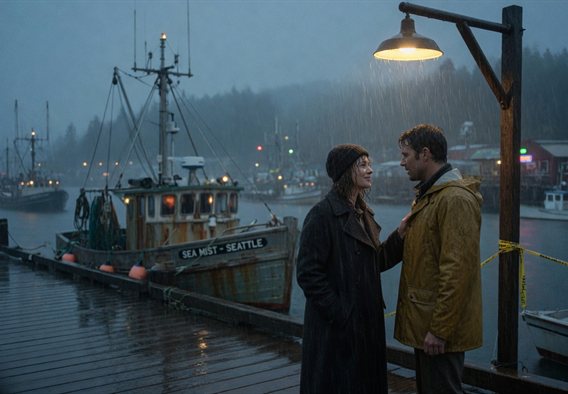


The Lockward and the Dreamwalker

There is a question every warden of Vellamere learns to ask before she falls in love, and it is this: what would it cost me, and who else would pay it? Sol Vane had answered that question at nineteen, blood on her palm, the Oath of Doors still stinging in the creases of her hand. She had answered it again every morning for six years, tying on her key-ring in the grey light of the Lockward barracks, and the answer had never changed. Nothing. No one. Not ever.
She was wrong, of course. But she did not know it yet, and on the night the dreamwalker came to her door, the night was cold and honest and had no reason to warn her.
One: The Oath and the Key
To understand why Sol Vane stood her watch with her spine straight as a drawn bowstring, you must first understand the doors.
Vellamere was built on a fault line between two worlds. The waking city, with its terracotta roofs and its bell towers and its fish markets that smelled of salt and citrus, sat on the near side of the Veil. On the far side lay the Reverie, the country of sleep, where the dead kept their old faces and the dreaming minded lived out whole second lives. Between the two ran a hundred and nine doors of green bronze, set into walls, cellar floors, the sides of wells, the hulls of moored ships. Each door was sealed by a lockward of the Guild, each lock answered only to a key sung into being from the wardens own voice, and each door stayed shut.
That was the rule. The rule had a reason, and the reason had a grave.
Ninety-one years before Sol took her oath, a lockward named Ilsabet Corvin had fallen in love with a dreamwalker. Dreamwalkers were the hereditary guides of the Reverie, the ones who could walk a sleeping soul safely to its destination and back. They were beautiful the way storms are beautiful, and they lived by a different law: all doors are one door. Ilsabet believed him. She unsealed the great door beneath the Cathedral of Quiet Water, and she and her dreamwalker meant to walk through together, just the two of them, just for an hour of his country.
The door did not open for two people. It opened for everything.
Three streets of the Wakefield quarter slid into the Reverie in a single night, houses and hearths and forty-one sleeping souls who never woke again. The Reverie bled back in return: dreams that refused to end, a fog of half-made things that haunted the harbor for a decade. The Guild rebuilt the door at the cost of eleven wardens lives, and they wrote the First Sealing into law with Ilsabets name at the top of it, a caution and a curse. No lockward shall unseal a Veil-door for love, for gold, for pity, or for any dreamwalker living or dead. The penalty is the unmaking of the key, the stripping of the name, and the gate.
The gate was a cell carved into the Veil itself, halfway between worlds, where a warden could be neither alive in one country nor dreaming in the other. Wardens did not speak of it. Wardens tied their key-rings on in the grey morning light and did not fall in love with anything that slept.
Sol was good at her work in the way that only people with something to prove are good at things. She was the granddaughter of a fishwife and the daughter of a warden who had died with his key still turning in the Harbor Door, holding it shut against a surge from the Reverie while the tidal quarter evacuated. She had his hands, wide and scarred, and his stubbornness, and his voice, low and grainy, the kind of voice that keys came to willingly. By twenty-five she held the third-highest ring in the Guild, and the Guildmaster called her Vane the Vigilant, and she hated the title and answered to it anyway.
The night it all began, she was walking the circuit of the Hill Door, the one set into the roots of an old watchtower above the terracotta roofs. Fog had come up the harbor in slow grey ropes. Her lamp made a small wet circle of gold around her boots. And standing in front of her door, close enough that his coat brushed the bronze, was a stranger with a travelers satchel and eyes the color of a candle seen through smoke.
He did not look like a trespasser. That was the first alarming thing. He looked like he had been standing there for some time, waiting, patient as tide, and when he turned to her he did it slowly, the way you turn toward someone you have been listening to for a while.
You are the one who sings it shut, he said. Every night. I have heard you from the other side.
Two: The Stranger at the Hill Door
Sol had a procedure for trespassers. It began with a warning, proceeded to a summons bell, and ended, if necessary, with a binding knot of spoken brass that would hold a grown man to the cobblestones until the watch arrived. She got as far as the warning.
Step away from the door, she said. Name and house.
Emeric Vale, he said, and her blood went cold in a way she had not permitted it to go cold in years. Of the House of Vale. You would know the name.
She would. The Vales were the first family of the dreamwalkers, the heirs of the Reverie, the line that Ilsabets lover had come from. The Guild history was specific on that point: the man who beguiled Ilsabet Corvin through the great door had been a Vale. Every apprentice learned the name alongside the penalty. For a Vale to stand in front of her door, on her side of the Veil, in waking air, was not trespass. It was provocation.
How are you even here, she said. Waking-side walking is a hanging offense in your house. The Concord of 1143.
I know the Concord. I helped draft the amendment to it. Emeric turned his palm up, and in it, like a coin of pale glass, sat a permitslip sealed with both house crests. Legation work. My family and your Guildmaster have been negotiating access rights for two years. Someone has to certify the dreamwalkers who carry sleeping messages between cities, or the letter trade stays in smugglers hands. I am the someone my house sends to be argued with.
She did not take the slip. She had been raised on the story of persuasive pieces of paper. Certify it from your own side, she said. You have no business touching my door.
I have not touched it. He stepped back, hands open, deliberately out of reach of the bronze, and she registered the gesture the way you register a mans hands at a card table. See? I know the law better than most of your Guild remembers. I am not here to beguile anyone, Warden. I am here because I need a door certified, and there is exactly one lockward in Vellamere whose keys I trust, and I have been listening to her sing this one shut for three months.
Sol had heard flattery deployed against wardens before. Smugglers tried it every spring. This was not that. This was worse, because it was not flattery. He said it the way you report weather. And beneath the words was something she had never encountered from waking men: he spoke with the cadence of someone accustomed to carrying other peoples dreams, unhurried, precise, impossibly gentle around the edges.
I do not take certification work for your house, she said. Guild policy. No lockward serves a dreamwalker. Not for pay, not for the Concord, not for anything.
I know, he said. I have read the First Sealing four times. I can recite Ilsabet Corvins sentence by heart. He looked at the door then, really looked, and his voice dropped into something raw. I am not Ilsabets descendant, Warden. I am his. His great-great-grandson through the daughter nobody talks about, the one the Guild erased from the record because it was easier to make my line pure villains than to admit a lockward loved one of us and we loved her back. The rule you live under was written by frightened people about my family and yours, and I have spent my whole life inside it, and I came here tonight to ask you to help me change it.
The fog moved. The lamp guttered. Sol Vane, who had a procedure for everything, discovered that she had no procedure for a man who told the truth to her face at midnight in front of the most forbidden door in her circuit.
No, she said, and it came out quieter than she meant. Absolutely not. Find another door. Find another warden. The answer is no.
He nodded, once, without argument, which she had not expected and which she resented. Then I will ask again some other night, he said, when you are less tired. You are very tired, Warden Vane. You sing the seal flatter than you did in autumn. Even keys get worn. Good night.
And he walked away down the hill through the fog, and Sol stood her full watch, and then a double watch, and the seal on the Hill Door was perfectly sound, and she slept badly, and this is how every love story that ends well begins: with a no that does not hold.
Three: The Case of the Slipping Doors
Three weeks later, doors started failing.
Not breaking. Slipping. A Veil-door under proper seal held like a held breath, absolutely still, for years at a stretch. These doors were breathing. The washerwoman at the Tanner Row door swore the bronze had hummed against her palm. A cellar door in the Saltwick district developed a seam of light along its edge, thin as a hair, and the baker who lived above it dreamed the same dream every night for a week: a harbor at evening, a boat with no rower, a figure on the pier waving. The Guild sent inspectors. The inspectors found nothing structurally wrong, which was the worst possible finding, because it meant the doors were not being forced. They were being called.
Something on the far side was singing to them.
The Guildmaster convened the full ring of senior wardens in the Hall of Quiet Hinges, a room warded so heavily that sound itself moved through it reluctantly. Sol sat at the third seat, youngest person present by fifteen years, and listened to a room full of veterans talk themselves in circles.
The doors answer only to keys, said Warden Ostrander, who had held the Northgate for forty years. And only to sung keys. Nothing crosses unless one of ours opens it.
Then one of ours is compromised, said Warden Bec, who had buried two apprentices in the gate. We test every key. We burn out the weak.
Or, said a voice from the doorway, it is not one of yours at all, and your doors have simply grown lonely.
Every warden in the hall turned. Emeric Vale stood in the entrance with the Guildmasters permission-slip in hand and the unhurried patience of a man who had been kept waiting in that doorway on purpose and did not mind. Sol felt her spine go rigid and made herself keep her eyes on the table. Looking at him would be a concession. Looking at him, she suspected, would also be a mistake of a different kind, because in the flat daylight of the hall he was worse than he had been in fog. He was exactly the sort of handsome that made a person suspicious of her own judgment.
She looked anyway. She was honest with herself about her vices, and curiosity had always been chief among them.
Explain, said the Guildmaster.
Doors are not stone, Emeric said, walking to the great table as though he had been invited, which, technically, he had. They are hinges between two living countries. The Reverie has its own tides, its own seasons. Right now it is in a season your records call the Long Ebb, because your archives only survived one before. The far country draws inward. Its doors go quiet, its borders shrink, and anything living on the far side that needs the near side begins to press against the skin of the Veil. Not to invade. To breathe. The doors are slipping because the Veil is contracting, and your seals are fighting a tide you have no charts for.
And your house knows this because, said Ostrander.
Because we live there, Emeric said. Because our whole trade is reading tides in a country made of sleep. Because the Long Ebb is why my house has been petitioning yours for two years, and why the permit I carry authorizes a joint survey, and why I stood on a hill three weeks ago asking Warden Vane for the loan of her voice.
Sol felt every warden at the table turn to look at her. The Guildmaster raised an eyebrow that had probably ended wars.
Warden Vane declined, she said evenly. I decline now. I have a circuit. I have doors of my own to hold.
And I have a city to keep from sliding into a dream, Emeric said, not unkindly. The last Long Ebb took three streets, Warden. It will take more this time, unless someone who can sing both a seal and an opening walks the doors with me and learns which ones are straining. I do not need you to love a door open, Vane. I need you to know which ones are about to fail. That is not the First Sealing. That is your job.
The hall was silent. The Guildmaster looked at Sol for a long moment, and Sol understood, with the particular clarity of a woman being handed a decision shaped exactly like a trap, that the old warden was going to say yes. The doors were slipping. The Guild had no charts. The dreamwalker knew the water.
Warden Vane, the Guildmaster said, you will conduct the survey. Under the old statute, joint certification. Warden Bec will hold your circuit. And Vane. The rules of the First Sealing apply to you at every hour of every day of this work. You will not be alone with him beyond the letter of the survey. You will not sing anything but a seal in his presence. And if you feel the least bend in your oath, you will report it before you act on it. That is not distrust. That is what ninety-one years of dead wardens bought us.
Yes, Guildmaster, said Sol, and hated how much she did not mean it as a surrender.
Emeric thanked the hall with a small bow, and as the wardens filed out he fell into step beside her in the corridor, and said, only for her: You will report any bend in your oath. I will hold you to that harder than your Guildmaster would. I have seen what happens to the other side of this story, Vane. I would rather lose the survey than watch you pay for it.
She stopped walking. Why, she said. Why do you care what happens to me.
He considered the question honestly, which annoyed her more than a smooth answer would have. Because you sang that door shut every night for three months before I ever saw your face, he said, and I have heard a thousand voices carry dreams across the Veil, and yours is the first one I ever wanted to answer. Now. Where is the first failing door.

Four: The Survey of Ninety Doors
The survey took them through every quarter of the waking city, and it was, in the way of long shared labor, the most dangerous thing either of them could have done.
They worked by statute: two witnesses for any sensitive door, daylight hours, full logs. They worked by statute and broke it by increments so small that neither of them could name the moment the increments became something else. It began with rain. There was a door in the flooded crypt of a deconsecrated chapel that could only be reached at low water, and the low water came at dusk, and by the time they had waded back through the crypt with their logs soaked gray, the rain had set in for the night and the last ferry had gone. They sat under the chapels broken eave sharing a flask of his coffee, which was bitter and spiced with something that tasted like the far side of sleep, and argued about Ilsabet Corvin.
She was reckless, Sol said. She opened a door for love and forty-one people paid for it.
She was twenty-six, Emeric said, in love with a man who told her his country was safe because he believed it, and then your Guild made her name a curse instead of asking why a trained warden, a good warden, would break the deepest law she owned. Rules that cannot survive the question of why are not rules, Vane. They are scars.
And yours survived the question of why, she said. The Vales walked waking-side uninvited for a century.
My family paid the Concord in exile, he said. My grandfather could not attend his own daughters wedding on this side. I have cousins in the Reverie who have never seen the sea except as sleepers. Do not mistake me, Warden. I think your rule and my rule were both written in grief, and grief makes terrible law. But I am not here to tear anything down in a night. I am here because the water is rising and someone has to bail, and you are the only person on either side of the Veil whose company I would choose for bailing.
That, Sol said, was nearly a compliment.
I am saving the compliment, he said, for when you admit the Saltwick door is failing faster than your logs say.
She laughed. It escaped before she could catch it, a real laugh, the kind she had not let out of her chest since her fathers funeral, and she saw him hear it, and saw him decide, visibly, not to make anything of it. That was the second dangerous thing about Emeric Vale. The first was that he knew things. The second was that he knew when not to say them.
The doors failed faster through the winter. Sol learned to read the strain in bronze the way Emeric read tides, and Emeric learned, to his own surprise, to hear the difference between her seal and every other wardens seal in the Guild. You put the last note down like setting a sleeping child into a bed, he told her. Other wardens drop it. You lower it. She had never thought about it before. Now she could not stop thinking about it, which told her exactly how much trouble she was in.
The vulnerability came at the Harbor Door, the one her father had died holding. It was the strongest door in the city, and it was straining, and Sol had known it would be, and she had said nothing for six weeks because saying it would mean standing in front of the place her father died and admitting there was nothing she could do about the water rising behind it. Emeric read the omission in her logs, because he read everything, and instead of confronting her he simply scheduled the Harbor Door last and arrived with two flasks and no witnesses and sat down on the cold stone steps in front of it.
We do not have to go in, he said. We can sit here. I have found that most doors are easier to face once you have sat in front of them a while and let them know you are not afraid of what they are holding.
My father died on those steps, she said.
I know. I carried part of his last dream, he said. That is what I came to tell you, the first night, before I ruined it with a petition. In the Long Ebb before this one, a warden died at this door holding it against the surge. His last dream was of his daughter on the barracks steps, tying on her key-ring. The Reverie keeps dreams that strong. I was a boy. I walked it every year on the anniversary. He was not afraid, Vane. He was proud. He was so proud it still echoes.
Sol did not cry. She had a warden's discipline about crying in front of doors. But she sat down on the steps beside the man her whole Guild had been raised to distrust, and she let the silence hold her up, and when she finally spoke her voice was wrecked and steady at once.
If I lose this door, she said, it will not matter that it was a tide. I will be the Vane who lost the Harbor Door.
No, he said. You will be the Vane who heard it strain and did something no lockward in ninety-one years has been brave enough to do. You have to let me teach you an opening, Sol. Not through it. A listening opening. A keyhold wide enough for sound only. It is the smallest magic my house has and it has kept dreamwalkers alive through two Long Ebbs, and your Guild forbade it in the same breath as the great door because fear does not sort its targets. I will not teach it without your full and awake and unpressured yes. And if you say no, we find another way, even if it costs streets.
She looked at the door her father had died to hold. She thought about the rule, and the grave under the rule, and the forty-one sleepers, and the baker in Saltwick dreaming of a harbor at evening. She thought about her oath, and how the oath had never once asked her what she wanted, only what she would refuse.
Yes, she said. Teach me. Fully awake. Freely given. And Emeric, if this unmakes me, I will haunt you across two countries.
That, he said, and his smile was not the patient one, it was the real one, the one that changed his whole face, is the first honest threat you have made me. Yes. Agreed.
Five: The Listening Opening
He taught her the listening opening over four nights, and it was the closest thing to intimacy either of them had ever survived.
The magic of the Vale house was not the theater the waking city imagined. It was small and patient. A dreamwalker did not command sleep; a dreamwalker accompanied it. The listening opening was the smallest accompaniment of all: a single note, sung on the breath rather than the voice, that widened a keyhold by the width of a whisper so that two countries could hear each other. Nothing crossed. Nothing could cross. But through that hairline gap, a warden could hear the strain in her own door, could learn which hinges were singing and which were weeping, could map the Long Ebb from the inside.
The first night, Sol could not do it. Her oath rose in her like a wall; the blood on her nineteen-year-old palm burned; every lesson in the Hall of Quiet Hinges shouted that a Vale was teaching her to open a door and she was letting him. Emeric did not push. He sat back on the wet steps and said, stop, you are fighting two wars, we will try tomorrow, and went and stood in the rain at the far end of the harbor like a man keeping vigil over his own history.
The second night she asked him a question instead. When you taught this to other dreamwalkers, she said, did it ever frighten them.
Always, he said. The first note is grief, Sol. It is the sound of admitting that the wall between you and the rest of everything is thinner than you were taught. Everyone who learns this cries. I cried. My mother made me practice on a garden door where nobody could see.
So the second night, when the grief came up in her throat with the note, she let it. She sang the opening on the breath, one hairline of sound, and the Harbor Door answered, and what came through the keyhold was not horror. It was tide. Deep, slow, tidal breathing, the far country pulling in its breath the way the sea pulls back from a shore before a great wave. And underneath the tide, faint as a coin at the bottom of a well, her fathers pride, still echoing, exactly as Emeric had promised.
She wept on the steps of the Harbor Door with a dreamwalkers coat around her shoulders, and he sat beside her without touching her, and said nothing, because he understood that what she was hearing required no commentary, only witness.
She was not alone with him beyond the letter of the survey. She did not sing anything but a seal and a listening opening in his presence. She reported every step to Warden Bec in dry, defensible log entries. By the letter, she was innocent.
By the letter, a held breath is empty. The trouble with hairline openings is that they do not close all the way, once learned. Something moved through the gap in both directions. On her side, it was a growing, unbearable attention to the sound of his voice, the way he hummed the far-side cadences while he worked, the way he said her name with the second syllable softened, Sol, like a tide turning. On his side, she never asked. She found out anyway, later, in the worst hour of the whole affair: he had stopped walking his familys house-corridors in the Reverie because the corridors had begun to echo with a warden singing a seal, and the elders of his house had noticed that the heir of Vale now dreamed, every night, of a harbor at evening, a door of green bronze, and a woman with her fathers stubborn hands.

Six: The Pier
The survey ended in early spring with a map: forty-one doors straining, nine critical, the Long Ebb charted for the first time in ninety-one years. Sol presented it to the Guild. Emeric presented the far-side data to the Concord. Both houses had what they needed to reinforce the doors through the ebb. The work, by every measure, was a triumph, and the triumph meant the end of the arrangement, and both of them knew it, and neither of them said it.
On the last night, Emeric asked her to walk the pier at Tanners Reach, the farthest point of her old circuit, where the harbor opened onto black water and the far country was close enough to taste. There was no door there. There was no work there. It was not on any log.
This is off the survey, she said.
Yes, he said. Entirely off the survey. You can turn around. I will not follow, and I will not ask again, and I will go back through the Harbor Door tomorrow and you will not have to see me until the next Long Ebb. But I stood on this pier once as a boy, and I saw a city full of lamps on the other side of the water, and I have wanted, my whole life, to stand on it with someone from that city who chose to be there. Not for a door. For an evening.
The wind came off the water. The lamps of Vellamere burned behind her like a hundred small verdicts. Sol Vane stood at the edge of her whole lawful life and made a decision that was not lawful at all, only true.
She stayed. They walked the pier. They talked about nothing, about his mothers garden doors and her fathers soup recipe and whether eels dreamed, and somewhere in the middle of the nothing, with the black water breathing below and the far country humming at the horizon, he stopped walking and turned to her, and she turned to him, and the distance between them went from professional to mortal in the space of one shared breath.
I am going to kiss you now, he said, unless you tell me not to, and I need you to know that I will take the telling not, all the way home, and never once regret you.
I am not going to tell you not to, she said. I have been not telling you to since the chapel crypt. Kiss me before I remember my oath.
He laughed, low, and the laugh was still in the air when he kissed her, and the kiss was careful and then it was not, and her hand found the front of his coat and his hand found the small of her back, and the harbor held still around them. It was a kiss like a listening opening: a hairline of sound between two countries, through which everything could be heard. When they broke apart, her key-ring had sung one soft involuntary note against her hip, and he had heard it, and they had both stood there in the lamplight breathing like people who had jumped off something.
That, he said unsteadily, is going to be a problem.
Yes, she said. A large one. Come to the door at the chapel crypt on Thursday. I will bring the logs.
He was still laughing when she walked away, and the laugh followed her all the way up the hill, and she held it against her ribs like contraband.
Seven: The Price of a Hairline
They had eleven days. The Long Ebb used every one of them.
On the twelfth day, the surge came early. It came at the Saltwick district, at the weakest of the critical doors, in the hour before dawn, and Sol was two streets away finishing her round when every key on her ring sang at once, a sound like a struck glass, and she ran.
The Saltwick door was bowing outward. The seam of light along its edge had widened to the width of two fingers, and through it came not monsters but weather, the pressure of a whole country inhaling toward the gap, and the baker above it was awake and hammering on his floor, and the street was beginning to fill with sleepwalkers, the near-side people the ebb was pulling toward the light with their eyes shut and their faces peaceful. Sol put her hands on the bronze and sang the seal and the seal bent. The tide was beyond her. One warden, even Vane the Vigilant, could not hold a door against the Long Ebb at its height. She needed what the First Sealing had forbidden for ninety-one years: a warden on one side and a dreamwalker on the other, singing the door together, the near hand and the far hand, or the door would go the way of the Cathedral of Quiet Water.
She sang the listening opening. Through the hairline she called, on the breath, the one name that would damn them both.
He came. Of course he came. He came through the Reverie at a dead run along the far side of the Veil, and he did not ask her to open the door for him, and she did not. He set his voice against the far side of the bronze the way a man sets a shoulder against a beam, and she felt the door steady, and together, her seal and his listening note, they sang the Saltwick door closed as the ebb crested and broke against it like a wave against a seawall. The seam of light shrank to a hair. The sleepwalkers woke on the cobblestones, confused and cold and alive. The baker stopped hammering.
And then, in the grey dawn, with the street emptying and both of them still pressed to the bronze on opposite sides of a law, Warden Bec arrived with six wardens and the Guildmaster, and looked at the sound of two voices coming out of one door, and understood everything.
Eight: The Trial of Doors
They were tried together in the Hall of Quiet Hinges, which had not held a trial since Ilsabet Corvins.
Sol would not say she had been deceived, because she had not been. She would not say the listening opening was a trick, because she had learned it awake, freely, and it had saved the survey, and it had just saved Saltwick. Emeric would not say his house should be exempt, because it should not; he broke the Concord the moment he set his voice to a waking-side door, and he said so, plainly, and asked that his penalty be his alone. The hall heard that the heir of Vale had chosen the gate for himself to keep a warden from it, and the hall went very quiet, because that was not the behavior the First Sealing had been written about.
Then Sol stood, and did the thing she had been building toward since a foggy night on a hill.
She recited the First Sealing, all of it, including the forty-one names. And then she recited the survey: nine critical doors, forty-one straining, the Long Ebb charted, the Saltwick surge held, the baker alive, the street awake. And then she said: The rule was written to prevent this, and it has instead prevented us from preventing this. A rule that costs streets to preserve itself is not an oath, it is a monument. I broke the law. Here is what the law cost, and here is what breaking it bought. I will take the gate if you rule I must. But I am asking this hall to change the rule, not to forgive me for it. Write a new sealing, with the listening opening in it, lawful, trained, bounded, and pair it with a Concord amendment so no warden and no dreamwalker ever has to choose again between the law and the drowning. I did not fall because I was beguiled. I fell because he was worth it, and because the work could not be done alone. Make the work possible and the falling becomes nobody's crime. It becomes everyones choice.
The hall deliberated for three days. The Guildmaster, it was said afterward, argued for the gate with real grief, because the Guildmaster had buried friends in the Veil and did not believe grief should ever be reasoned with. But the salt stain was still on the Saltwick cobblestones where the sleepwalkers had lain, and the survey maps were on the table with nine red circles, and the arithmetic of the Long Ebb did not care about anyone's scars.
The verdict came down on the fourth morning. Sol Vane: suspended six months, key-ring confiscated, reinstated upon completion of a written charter for the new Office of Paired Sealing, which she would then lead. Emeric Vale: expelled from waking-side travel for one year, save under paired supervision, which was to say, save under hers. The First Sealing was repealed and rewritten by spring: no unsealing for love, for gold, or for pity, but the listening opening lawful to any warden trained under the Office, and waking-side passage lawful to any dreamwalker under paired bond. The gate stood empty. The forty-one names stayed carved where they were, because grief keeps its monuments, but beneath them the Guild cut a second line of stone, the first new words in ninety-one years: The door hears best when two voices hold it.
Nine: What the Door Heard
The year that followed was the busiest of their lives and the happiest, and they measured it in small lawful things. The first class of paired wardens, eleven of them, terrified of their first listening opening, and Sol telling them what Emeric had told her: everyone cries, I cried, practice on a garden door. The first lawful crossing under paired bond, a dreamwalker carrying a grandmothers last message to a grandson across the Veil, both of them weeping, the door opened wide and held steady by a warden on each thought. The first anniversary of Saltwick, marked by the baker, who sent them up a loaf shaped like a key.
On the night the charter was signed, Emeric walked her circuit with her, all of it, the hill door and the crypt and the pier, and at the Harbor Door they sat on the steps with two flasks, and he said, this is where I would ask you something, if we were the kind of people who did such things in front of doors.
We are exactly that kind of people, she said. It is on record.
He set down the flask. He had rehearsed something, she could tell, some speech about tides and countries, and she watched him abandon it, watched him decide that the truest thing was also the smallest.
Sol Vane, he said, I have carried ten thousand dreams and I have never once wanted to live in one. Marry me in the waking country. Marry me with your oath renewed and my exile ended and every door in Vellamere listening. I will not pretend the rule was wrong to frighten us. It was right to be frightened. I am asking anyway. I am asking with my eyes open.
Yes, she said, before he finished, because some answers do not wait for the end of the question, and then, more slowly, with the whole weight of a woman who had spent six years refusing everything: Yes. With my eyes open too. Fully awake. Freely given.
He laughed, and the laugh was still in the air when he kissed her, and her key-ring sang one soft note against her hip, and through the bronze of the Harbor Door, faint as a coin at the bottom of a well, something on the far side sang back.
They were married in the autumn, in the Hall of Quiet Hinges, under the carved names and the carved amendment, and every warden in the Guild attended, and so did a delegation of dreamwalkers who had never seen the sea except as sleepers and who stood in the harbor light afterward with their faces turned toward the water for a long, long time.
The last word belongs to the door. Wardens of the Office of Paired Sealing are taught, on their first night, to press a palm to the Harbor Door and listen. What they hear is tide, deep and slow, a country breathing. What they hear underneath it, if they listen the way Sol taught them to listen, patiently, without fear, is an echo that has not faded in two generations: a warden who died holding a door, singing his pride into the bronze. Sol goes there on the anniversary, every year, with her wife's ring and her husband's hand and her father's stubborn hands of her own, and she presses her palm to the green bronze, and she sings the seal, and she lowers the last note the way you set a sleeping child into a bed.
The door holds. The tide turns. And on the pier at Tanners Reach, two lamps burn every evening, one on either end, close enough that their light meets in the middle of the black water, and the people of Vellamere, who love a story almost as much as they love a rule, will tell you what the lamps are for if you ask.
They are for the warden and the dreamwalker, the locals say. For the night the law learned to hear.
The door hears best when two voices hold it.
The End. Thank you for reading.

Cade Ellison
Cade specializes in romantasy and paranormal romance: magic systems with rules, courts with knives, and longing that rearranges destinies.
Leave a comment
Comments