

What the Orchard Kept
The Question That Followed Her Home
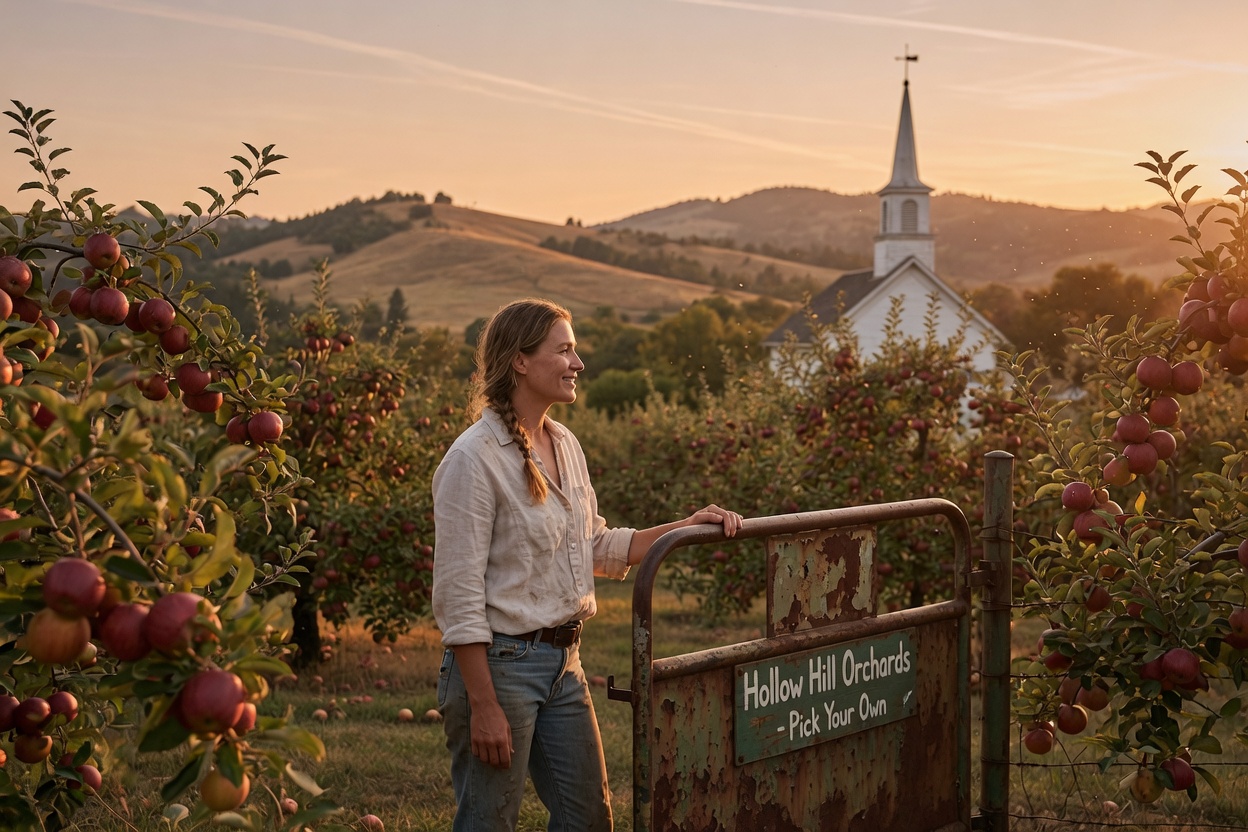
Can a place that watched you fail ever forgive you, and could you ever forgive it? Delia Hart had carried that question across eleven years and nine hundred miles, and on the third Friday of September it finally set her down at the rusted gate of Hart Orchard, just outside Copper Creek Hollow, with a rental car still ticking behind her and her father's lawyer on speakerphone saying, for the third time, that the estate would not settle until she came in person.
She hung up. She stood very still. The orchard rose in front of her like a sentence she had never finished.
Thirty-four years old, and she was the woman who had written the tasting notes for a best-selling vanilla bourbon candle and a shelf-stable pumpkin spice glaze, and not one soul in this town would consider that a résumé. She had a chemistry degree and a palate that could pick out a trace of oak in a blind pour, and she had spent a decade turning sweetness into money for other people because she could not stand to make anything of her own. Anything of her father's, she corrected. That was the truer wound.
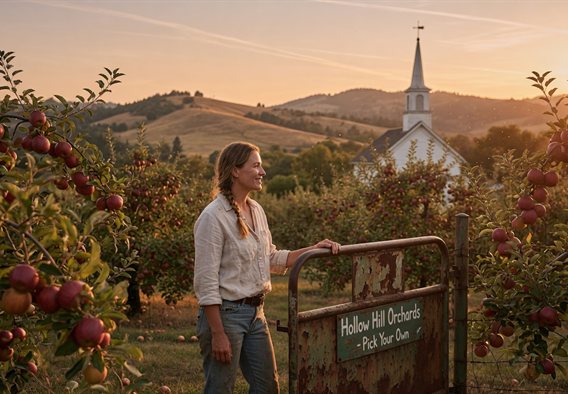
The apples were heavy on the trees, late-season Honeycrisp and old gnarled Winesaps, and the grass between the rows was cut. Someone had been keeping this place. She had assumed it would be a ruin.
Then a man came down the row with a ladder on his shoulder and a canvas picking bag at his hip, and he stopped when he saw her, and Delia felt the question change shape entirely, because she knew that walk, that deliberate easy stride, and she knew the man attached to it, and she had been dreading him without even knowing his name was the one she was dreading.
Sam Aldridge. He had been three years ahead of her in school. He had been her father's best picking crew hand, then foreman, then something closer to family, and then he had been the person her father called every week while she called once a year.
"You must be the heir," he said. He did not smile.
"I must be," she said.
"Ned's been gone four months," he said. "The estate notice ran in the county paper in May. I half figured nobody was coming."
"I came."
"You came." He set the ladder down against the tree with great care, as if she might bolt if he moved too fast. "Then you're just in time. Pick starts Monday, and I could use a hand."
"I'm not staying," Delia said, and hated how it sounded, like a promise and a plea at once.
Sam looked at her a long moment, and his face did something complicated, grief and wariness and something warmer fighting for the same ground. "Nobody ever does," he said. "Doesn't mean the apples wait."
That was how it began, the way most things in Copper Creek Hollow began: with work, and weather, and two people deciding what they owed the dead.
The Man Who Stayed
Sam Aldridge was thirty-seven and built like the orchard had made him, broad through the shoulders, sun creased at the corners of his eyes, hands that knew every graft on every tree. He had come to Copper Creek at nineteen with a duffel bag and an apprenticeship and no family to speak of anywhere, and Ned Hart had fed him supper in the farmhouse kitchen three nights a week for a decade. Sam had repaid it by learning everything Ned knew and half of what Ned felt, and by staying on after the leases were signed and the market turned and the money went thin.
He had also, over the years, heard a great deal about the daughter. The brilliant one. The one who got out. The one whose calls Ned logged in a spiral notebook like rare weather events. Sam had built a whole portrait of Delia Hart out of pride and absence, and none of it had prepared him for the woman standing at the gate looking at her father's trees like they were witnesses for the prosecution.
"You've been keeping it up," she said the next morning, walking the rows with a clipboard she did not need. "Lease terms?"
"Sixty-forty, my favor on labor, his on land. We've been shipping to a co-op in Kulm and doing a roadside stand on weekends." He handed her a Winesap without asking. "Try that."
She bit it. She was, professionally, incapable of eating fruit without judging it, and he watched her do the whole thing, the first crunch, the half second where her eyes went somewhere internal, the small involuntary nod.
"Balanced," she said. "High acid, but the sugar holds it. There's a spice note. Clove?"
"Old rootstock," Sam said. "Everybody wants Honeycrisp. The Winesaps are the ones worth keeping."
"My father used to say that."
"Your father said a lot of things to me," Sam said, and it came out more pointed than he meant, and he saw her flinch, and he was man enough to notice he'd drawn blood and too honest to pretend he hadn't. "I'm sorry. That wasn't fair."
"It was fair," Delia said. "I know what I was. I know what I did."
"What did you do, exactly?" he asked, and there was no cruelty in it, only curiosity, and that was worse. "Leave? People leave. Half this town's kids leave. He was proud you got out, Delia. He told everybody at the grange."
"Then why did I feel like a failure every single time I called him?"
Sam had no answer for that, so he offered her the honest thing instead. "Because grief doesn't file its paperwork on time. Come on. I'll show you the press shed before you sign anything, because if Caldwell Development's man has already been out here, you're going to need to know what's actually in that shed."
"Who's Caldwell Development?"
Sam's jaw worked. "The people who want to turn your father's orchard into nine identical houses and a retention pond. They've been circling three farms in the valley. Yours is the prettiest."
Delia felt the ground shift under a conversation she hadn't agreed to have yet. "It's an orchard, not a monument," she said, too fast, and watched something close down in his face.
"No," Sam said. "It's not a monument. It's a living thing, and it's been keeping forty families in fruit for eighty years. But sure. Nine houses and a pond."
He walked off toward the shed and she stood among the trees holding a half-eaten Winesap, feeling judged by fruit, which was a new low even for her.
Main Street Remembers Everything
Copper Creek Hollow had four hundred souls, one stoplight that blinked amber out of habit, and a main street that functioned as the town's collective memory. Delia walked it that evening because the farmhouse had no food and her courage needed an errand.
Dot's Counter still existed, run by Dot herself, seventy-one years old and sharp as a paring knife, and the bell over the door announced Delia to every booth in the place. There was a beat of silence you could have bottled.
"Ned Hart's girl," Dot said finally, and came around the counter and hugged her hard enough to rearrange ribs. "You look like him when you frown. Sit. Meatloaf's whatever, pie's good."
"I don't need..."
"Sit," said Dot, in the voice of a woman who had fed this town through two floods and one very bad year for the grain elevator, and Delia sat.
By the time the pie arrived she had been briefed on everything: the millpond dredging, the new couple running the bookshop, the fact that Pastor Emory's granddaughter had taken over the pharmacy, and, in a lowered voice from the booth behind her, the fact that Caldwell Development had made offers up and down the valley and that Hart Orchard was the keystone. Sell it, and the co-op lost its anchor grower, and the Harvest Fair lost its cider, and the whole fragile arithmetic of the town's fall season tipped over.
"No pressure," Dot said, setting down the pie with a look that was one hundred percent pressure.
"I'm a flavor chemist, Dot. I live in a condo with a doorman. I don't know anything about orchards."
"You know what things taste like," Dot said. "Around here, that's a calling."
Delia paid for a meal she hadn't ordered and walked out with a to-go box and the distinct sense that she had been drafted into something. Outside, the light was doing that thing this valley did in September, gilding everything, forgiving everything, and she thought, not for the first time, that the town had never actually done anything to her. She had done it to herself. The town had just been there, remembering.
The Letter She Didn't Open
There was a sealed envelope in her father's desk drawer, her name on it in his handwriting, and she had carried it from Chicago in her laptop bag like contraband and not opened it. The lawyer had told her about it in May. She had told herself she'd read it at the right time. In truth she was afraid of it the way some people are afraid of water.
Her relationship with Ned Hart had been conducted mostly in silence and small kindnesses that both of them misread. He had wanted her to take the orchard. He had never once asked, because asking felt like chaining her, and she had never once offered, because offering felt like surrender. Two proud people, one piece of land, and eleven years of calls that lasted four minutes. When he died in his sleep in the farmhouse in May, she had flown in, signed what needed signing, wept once in a rental car at the county line, and gone back to a product development sprint for a national pizza chain.
She was not proud of any of that. But shame, she had learned, was just another flavor note. You could live around it.
Now she sat on the farmhouse porch at dusk with the envelope on her knee and Sam's words in her ears, and she did not open it. She put it back in the bag and went to bed, and dreamed of a press shed full of light.
Work Is a Language
Picking week changed something between them, because work is a language and they both turned out to be fluent.
Sam ran the crew with quiet precision, and Delia, who had never picked commercially in her life, learned the twist-and-lift in an afternoon and the ladder etiquette in two. She was clumsier than the high school kids he hired every fall, and she outworked all of them, and Sam pretended not to notice and noticed everything.
"You're good at this," he said on the fourth day, when she'd filled her bins ahead of the pick schedule.
"I'm good at everything," she said. "It's exhausting."
He laughed, a real laugh, surprised out of him, and the sound of it did something to the air between them. "Modest, too."
"I'm not modest. I'm compensating." She looked at him over the bin. "My father never told you anything true about me, did he?"
"He told me you were the smartest person he ever met," Sam said. "He told me you could taste a storm coming in the well water. He told me he didn't understand what you did for a living but he kept one of your candles in the truck and burned it every winter."
Delia stopped walking. The bin handle cut into her palm and she let it. "He did not."
"Top shelf behind the seat," Sam said. "Vanilla bourbon. I restocked it twice. Drove to the mall in Fargo for it, which he complained about the entire way and the entire way back, both times."
She had to put the bin down. She walked to the end of the row and stood among the trees with her back to him until she could see straight, and Sam, who understood privacy the way farmers understand weather, went on picking and let her have the moment.
When she came back her eyes were red and her voice was even. "What else did he say about me?"
"Ask me over supper," Sam said. "I make a passable chili and a terrible cornbread, and I don't burn the candles, so I've got questions too."
Supper and the First True Thing
He cooked in the farmhouse kitchen, in her father's kitchen, with a competence that undid her a little, and the chili was indeed passable and the cornbread was indeed terrible, and they argued about the cornbread like it mattered, which is to say like people who were circling something bigger and glad of the decoy.
"Buttermilk," Delia said. "You're skipping the buttermilk."
"I'm skipping the buttermilk because I forget it every time."
"Write it on your hand."
"I will write it on my hand," he said solemnly, and she laughed, and the laugh turned into the kind of silence that has weight.
"He talked about you every week," Sam said into that silence. "For eleven years, Delia. Every single week. Mostly it was the same sentence. She's busy. She's got her own life. He said it like he was defending you to somebody. I think the somebody was himself."
"I called him four times a year," she said. "I sent a card at Christmas. I knew his birthday was in March and I never once..." Her voice cracked and she pushed through it, because she had decided years ago that she did not crack in front of people. "I built a whole career out of making people feel things. That's literally my job. I can make a stranger cry with a strawberry. And I couldn't pick up a phone."
"Because picking up the phone meant hearing that he was proud and knowing you hadn't earned it," Sam said, not unkindly. "That's not a character flaw, that's a father. Mine died when I was fifteen and I've been trying to earn it ever since from a man who can't grade the work anymore. I recognize the math."
She looked at him across the table, this stranger she'd known her whole life, and felt the terrifying relief of being accurately read.
"Why did you stay?" she asked. "You could have gone anywhere. You're the best orchard man in the valley, anyone can see that. Why here?"
"Because he asked me to," Sam said simply. "Two years ago, before he got sick, he asked me to keep it alive until you were ready. He said, she'll come back when she's ready, and when she does, don't let her sell to the vultures, and don't let her talk herself out of belonging here. Those were his words. Belonging."
Delia sat very still. "He asked you to wait for me."
"He asked me to wait for the orchard," Sam corrected, but his ears had gone red, and they both knew what the correction was worth. He stood and started clearing plates with excessive diligence. "I'll do the dishes. You should open that letter. Whatever's in it, it's yours, and keeping it sealed is just picking the same scab with a different hand."
She went upstairs to her childhood room, sat on a bed that had been made up with fresh sheets by somebody who anticipated her arrival, and did not open the letter that night either. But she fell asleep easier than she had in months, and in the morning she wrote, on a scrap of recipe card, buttermilk, and left it on his counter, and heard him laughing about it through the window while she pulled on her work gloves.
The Fair, the Deal, and the Stakes Getting Real
The Harvest Fair was three weeks out, and it was, Delia learned, the load-bearing event of the entire town year. The cider from Hart Orchard went into every booth in some form: the pie contest, the church punch, the rotary brats simmered in it, the little paper cups the third graders sold for a dollar. The fair paid for the school's winter bus route. The fair was how the volunteer fire department raised its equipment fund. Lose the orchard and the fair became a craft sale in a parking lot.
Sam laid all this out on the porch one evening with a legal pad, the way he laid out everything, careful and unornamented, and Delia listened with her professional brain running, which was a mistake, because her professional brain immediately started pricing the asset.
"The co-op contract is barely break-even," she said. "The equipment is thirty years old. I ran the numbers, Sam. Even with the lease income, the orchard loses money most years. He was subsidizing it out of his savings. The estate can't do that."
"I know," Sam said. "I did the books for him for six years."
"Then you know it's not sentimental, it's arithmetic. Caldwell's offer clears the estate debt, funds the fair trust twice over, and sets me free to..." She stopped, because free to what had never actually had an ending.
"Free to go back to your real life," Sam said. There was no accusation in it. That was the worst part. Just a man stating a forecast he'd long ago made peace with.
"This isn't my real life."
"Isn't it?" He looked at her, and for the first time since the gate she saw anger in him, banked and old. "You've been here six weeks. You know every tree by name now. You reblended the roadside cider and doubled the stand's sales in a weekend, and you did it because you couldn't help it, because making things taste right is the truest thing about you. Your father knew it. Everybody on this street knows it. The only person still deciding whether you belong here is you, and you're losing that vote."
"You don't get to..." she started, and stopped, because he did get to, was the thing, he'd earned the standing with four months of grief and eleven years of candle runs to Fargo.
"Fair enough," she finished instead. "But it's my name on the deed, Sam. Mine. That's not a vote, that's a fact."
"Yes," he said. "It is." And he picked up his hat and went out to check the irrigation, which is what men in this valley did instead of saying the fourth true thing, and Delia stood on the porch with the legal pad in her hands and realized she was angry mostly because he was right.
"You can't keep a place alive by visiting it," her father had written, in a letter she would not read for another ten days. "And you can't keep a person alive by leaving them something. You have to stay, Delia-girl. Staying is the whole trick."
The Kiss at the Press Shed
It happened at the press shed on a Sunday, because important things in this story kept happening at the press shed.
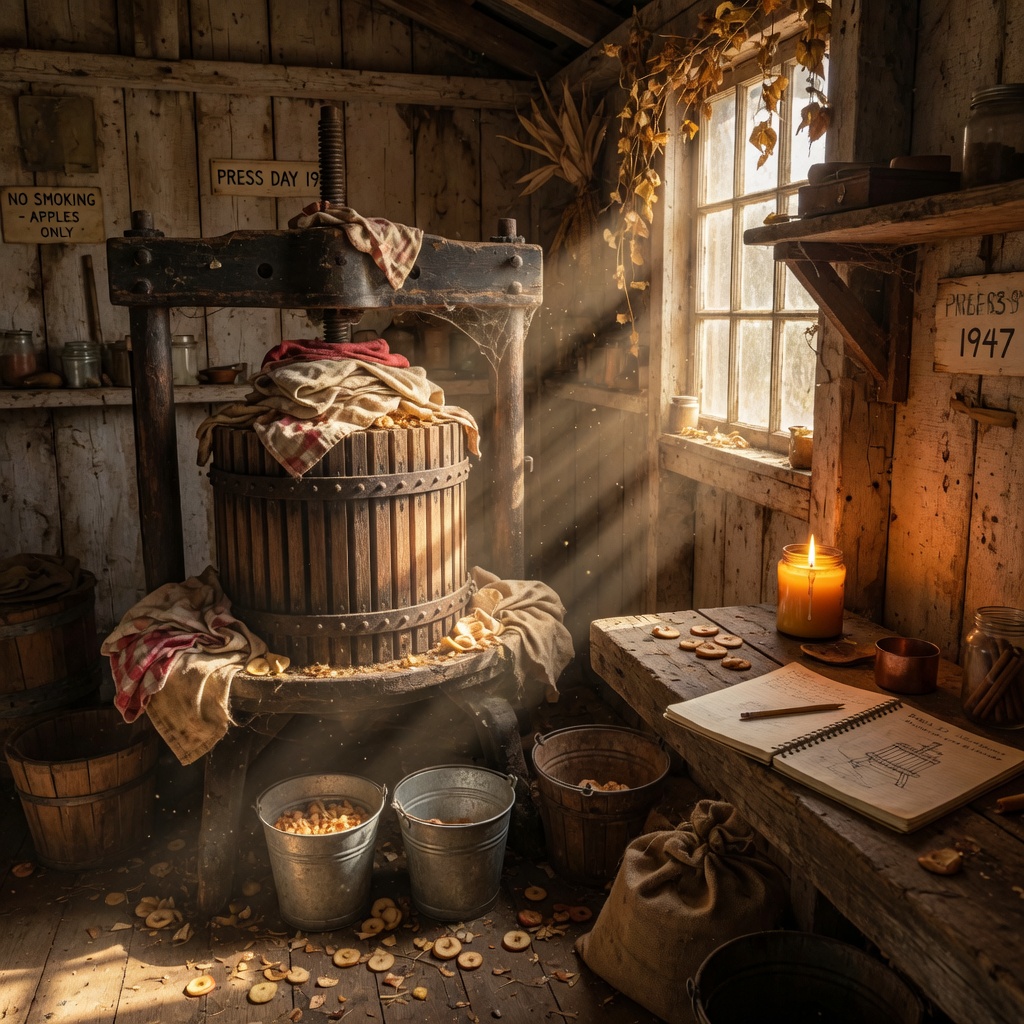
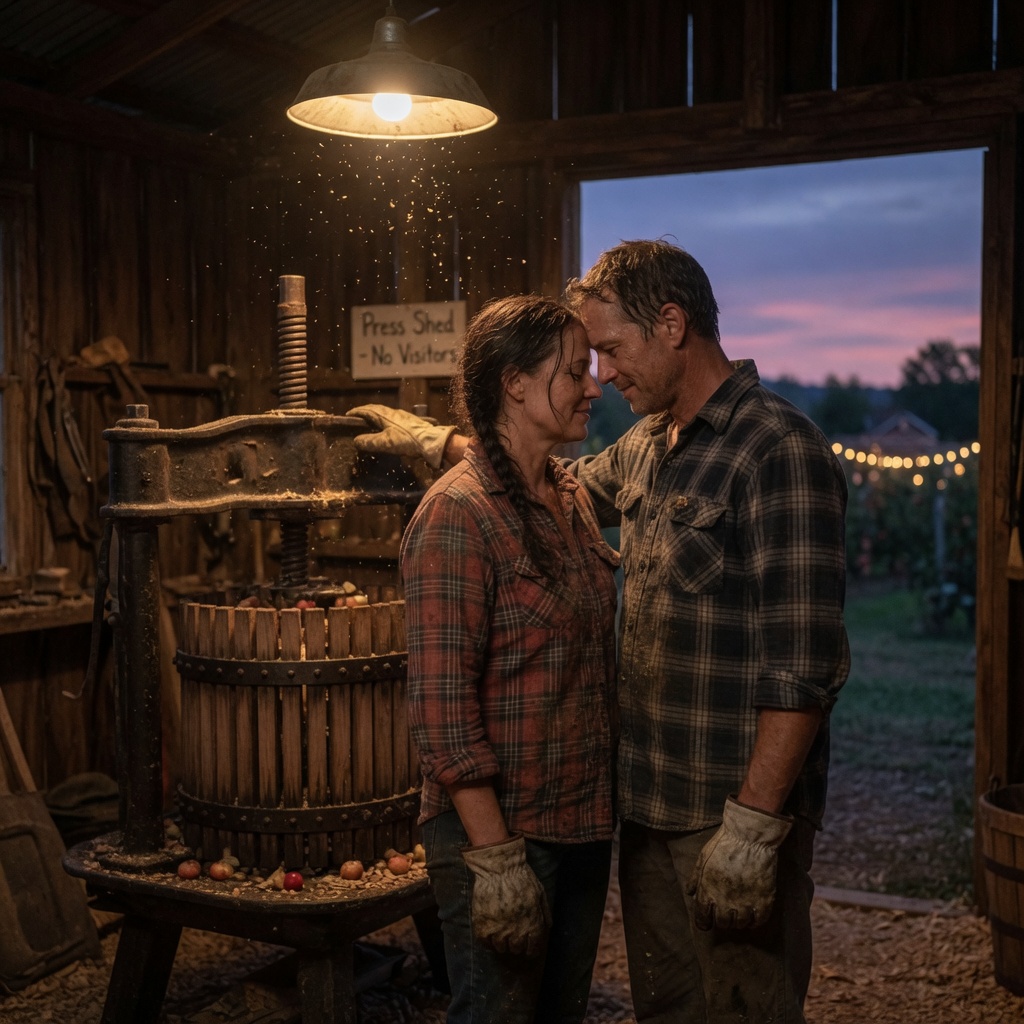
The old press was a nineteenth-century rack-and-cloth monster, hand cut timber and a screw the size of a fence post, and it had not run in three years. Sam had been quietly restoring it for two of those, nights and weekends, and that Sunday he asked her to help true up the screw threads, and they spent four hours shoulder to shoulder in sawdust and copper-scented air, and somewhere around the fourth cloth she stopped pretending the air between them was just air.
"Sam," she said.
"Hmm."
"You've been waiting for me since May and I've been avoiding you since I was twenty-three and one of us should probably say something."
He set down the wrench with enormous care. "I've been waiting since the summer I was twenty-one and you came home from college and argued with Ned for an hour about acid blend ratios in the press shed, and you were wrong about half of it and magnificent about all of it, and I thought, well, there it is, that's the person, and then you drove off and I watched the taillights for about a mile too long."
"Sixteen years," she said.
"Give or take."
"You should have said something."
"You should have come back," he said. "We were young. It evened out." And he crossed the two steps between them and put his hand along her jaw, asking with the pause, giving her the whole length of the pause, and she answered it by closing the distance herself, so that when they kissed it was a decision they made simultaneously, which is the only kind of kiss worth the name.
It was slow and it was thorough and it was sixteenth-years long, and when it broke she was laughing and crying in roughly equal measure and he was pressing his forehead to hers saying, "Okay, okay, all right," like a man catching his breath after a storm he'd been forecasting since he was twenty-one.
"I'm not staying," she said into his collar, and felt him go still. "I mean, I don't know. I mean, I want to want to, and I don't know how to want things I might fail at."
"Delia." He tipped her chin up. "You don't have to decide tonight."
"But you've decided. You decided sixteen years ago."
"I decided about me," he said. "You have to decide about you. Those are different jobs, and I'm not doing yours."
She loved him for that, and the loving terrified her, and she did what she always did with terrifying things, which was schedule around them.
The Dark Night
Here is the thing about Delia Hart's flaw: it was never dishonesty and it was never coldness. It was flight. When a room filled up with expectation, she found the exit before her feelings could be witnessed, and she dressed the exit up in logistics. She had left college roommates, left two jobs, left a man in Seattle who had only ever asked her to be on time. She left efficiently. She left with a checklist.
The call came on a Tuesday, three days before the fair. Caldwell's final offer, escalated, with a signing deadline of Friday and a sweetener: they would fund the fair trust and name the pavilion after Ned Hart, and the whole thing would be handled, clean, dignified, done.
She said she'd think about it, and hung up, and stood in the farmhouse kitchen with Sam's chili simmering on the stove for a supper he'd invited the whole picking crew to, because that was how Sam did things, wide open, witnesses everywhere, and she felt the walls of the room start to move in, the whole town's hope and her father's letter and Sam's sixteen patient years all leaning on her at once, and the exit lit up green like it always did.
She turned off the stove. She wrote a note that said, I need a few days, I'm sorry, I'll call you. She put the letter in her laptop bag unopened, because if she read her father's last words and then sold the orchard she'd never survive it, and if she read them and stayed, she'd be staying for a dead man instead of for herself, and either way she couldn't bear to be seen deciding. So she didn't decide. She drove. She left the letter in the bag and the question at the gate and did the thing she had always, reliably done.
She got as far as the county line motel before the flight curdled into the familiar shame-flavored silence, and she sat on a bed with a laminate headboard and understood, with a clarity that felt like fever breaking, that there was no version of her life where this exit led anywhere new. Every exit was the same exit. She had been walking out of the same door for sixteen years.
She opened the letter.
Delia-girl. If you're reading this, I'm done, and I'm sorry for every call you made that lasted four minutes, because I know the math on those. I didn't ask you to come back because asking felt like chaining you, and I'd rather miss you free than have you here resentful. But I want you to know what I knew. That orchard isn't the past. It's the one place where who you are is not a performance. You taste the world, honey. You always did. That well water after a storm, that's you. There's a young man here who kept a candle in his truck because I couldn't stop talking about you. If you're reading this and he's still around, do me one favor. Press the Winesaps with him once. Then decide. Whatever you decide, I was proud. I was proud the whole time. Love, Dad.
She sat with it until the light in the motel window went from gold to gray, and then she picked up her phone and called Sam, and it rang through to voicemail because he was, at that moment, standing in front of a room of picking crew and half of main street eating chili and making excuses for her with a dignity that made her chest hurt when she heard about it later.
"I'm coming back," she said to his voicemail. "I'm not calling about the deal. I'm calling about the cornbread. Write buttermilk on your hand. I'll be there for the press run Thursday."
The Quiet Gesture
She expected the grand version. She had left him standing in front of a crowd; she'd braced for the speech at the fair, the scene, the public accounting. What she got instead was Sam Aldridge alone in the press shed at seven in the morning Thursday, having driven to Fargo the day before, which she learned from the receipt taped to the press: one candle, vanilla bourbon, the good brand.
It was burning on the shelf above the press. Next to it was the spiral notebook, Ned's call log, open to the last page, and beside that a recipe card in Sam's blocky handwriting: buttermilk, Delia's cornbread, do not forget, she will notice.
He had rigged the whole shed for the Winesap press. Cloths cut and washed, buckets staged, the screw greased and trued, and on the crusher hopper a taped sign in his hand: First press in three years. Hers.
"You fixed it," she said from the doorway, and he turned, and his face did the complicated thing again, and this time she could read all of it.
"Couldn't run it without the acid-blend expert," he said. "I hear she's magnificent about half of it."
"I'm going to read that as a compliment."
"It's both." He came toward her and stopped a step short, leaving her the distance, always leaving her the distance. "The Caldwell deadline was yesterday. I told their man you'd answer at the fair, in front of everyone, because whatever you choose, this town can live with it if you say it straight. That's not pressure. That's just what I promised your father. Say it straight."
"Sam." She took the last step herself, the way she had in the kiss, decision in her own body. "I ran. You knew I'd run."
"I hoped you wouldn't."
"And you didn't chase me. You lit a candle and fixed the cornbread recipe."
"Chasing teaches people to run faster," he said. "Building something worth running back to seemed smarter."
Delia Hart, who had spent a decade engineering feelings in laboratories for strangers, stood in a shed full of the real thing and understood that the gesture was not the candle or the notebook or the tape on the hopper. The gesture was four months of grief and sixteen years of patience converted into a working press and an open door and no speech at all.
"I read the letter," she said. "He said press the Winesaps with you once, then decide."
"Then we'd better press," Sam said, and handed her the first cloth.
The Fair and the Answer Said Straight
They pressed until dark on Thursday and again Friday, and the Winesap run came off the press a deep garnet with that clove note riding the acid, and Delia blended the batch the way she'd been carrying around in her head for six weeks, and Sam tasted it and went quiet and then said, "That's the orchard. That's actually what it tastes like to stand in it," and she cried into the brix refractometer a little, which he had the grace not to mention.
Saturday was the fair. Main street closed at noon, bunting on the bookshop awning, the third graders with their paper cups, the fire department's brat grill going, Pastor Emory's granddaughter running the pie contest with Dot as judge, and the pavilion at the far end freshly framed, its sign still blank, waiting on a name or not.
Delia stood up on the flatbed at four o'clock with a cup of her father's orchard's cider and the Caldwell contract folded in her pocket, and she said it straight.
"I'm not selling," she said, and the sound that came off main street was the sound of a town exhaling eight years of held breath. "But I want to be clear about why, because you all deserve the truth and my father deserved it too. I didn't stay because of the trees, and I didn't stay because of a letter. I'm staying because of a cornbread recipe and a candle in a truck and because the man who ran this orchard for eleven years never once treated me like the person who left. I'm staying because I ran to the county line and the whole way there, the thing I was running from and the thing I was running to turned out to be standing in the same press shed." She looked at Sam, who stood at the edge of the crowd with his hat in his hands. "The orchard stays. The lease stays, and gets renegotiated, because I've decided sixty-forty favors the wrong party. And if the man holding his hat will let me, I'd like to make it a partnership in every sense of the word, apples and cider and one household, starting whenever he's ready, which I'm told might be another sixteen years, so everybody get comfortable."
Sam put his hat on. He walked to the flatbed. He said, "I bought buttermilk this morning," which meant yes in every language this valley spoke, and the town came apart in the good way, and Dot hugged Delia hard enough to rearrange ribs a second time, and the fire department poured the first cups of the new press on the house.
Epilogue: One Year Later
The following September, the sign over the press shed read Hart and Aldridge, and the cider took a bronze medal at the state fair, and the roadside stand doubled again, and the pavilion at the Harvest Fair was named for Ned Hart anyway, at Delia's insistence, funded by the orchard's first genuinely profitable year.
They were married on the flatbed in October, which is to say Pastor Emory said a few words, Dot catered, the third graders sold cider at the ceremony for a dollar, and the whole town showed up because in Copper Creek Hollow a wedding on main street is a public works project. Delia wore boots. Sam wore the hat. Her father's call log sat open on the head table to the last page, and under it, in a new spiral notebook, Sam had started a fresh log titled Calls From Delia, and it was already three pages long, mostly of her calling from the orchard to the farmhouse to ask whether he'd remembered the buttermilk.
He always remembered. He'd written it on his hand the first year, and then it had stopped being a note and started being a habit, and that, Delia thought, dancing with him under the string lights while the Winesaps came ripe on the hills, was the whole trick. Not the grand returns. Not the letters. The staying, in four-minute increments, every single day, until staying was simply what you were made of, like acid in good fruit, invisible and holding everything up.
"Happy?" Sam asked, the way he asked, with the pause, always the pause, leaving her the distance.
"Magnificent about half of it," she said, and closed it herself.
The End. Thanks for reading this Heartbound Stories novelette. If the orchard kept something for you too, share it with someone who left home and kept the recipe.

Lila Monroe
Lila writes contemporary and small-town romance with banter-forward leads and soft landings. She believes the best love stories sound like two specific people, not a trope checklist.
Leave a comment
Comments