


The Engagement Clause
The question everyone in Bellwether Springs kept asking was simple enough: what would you pretend, and for how long, before the pretending became the truest thing about you? Della Marchetti had driven eleven hours with a rented trailer and a dying ficus to find out, and she had not even unpacked her good boots yet when the answer started forming in the margins of her grandmother's will.
One: The Clause
Hattie Marchetti had been dead for six weeks, and she was still running the town. Della felt her presence everywhere on Main Street: in the painted rock the fourth graders left on the bakery step, in the way the pharmacist tipped his hat to the empty doorway, in the laminated note taped inside the register that read, in Hattie's looping hand, DO NOT LET THE KNEADING MACHINE WIN. IT CHEATS.
The will reading had been held in the back office of the bank, among the smell of old carpet and the disapproving hum of Wendell Frye, the estate attorney, a man who looked like he had been ironed by someone who hated him. He read the standard parts in a dry voice, and then he put on his glasses and leaned toward the paper like it had personally insulted him.
"Item seven," he said. "In the event that my granddaughter, Della Rose Marchetti, wishes to retain ownership of the property at 14 Maple Row, known to the town as Marchetti's Bakery, she must be, within one calendar year of my passing, engaged to be married. The building passes to her upon her wedding day. If she is not so engaged within the year, the property passes to the Bellwether Springs Historical Society, to be converted into a museum of regional baking."
The room went quiet. Della's cousin Priya, who had driven down from Spokane for the free lunch, choked on her coffee.
"That can't be legal," Della said.
"It's unusual," Wendell admitted, "but your grandmother was lucid, witnessed, and stubborn as a mule in a hailstorm. I advised against it. She told me, and I quote, that love was the only inheritance worth enforcing."
"She didn't believe in enforced anything," Della said. Hattie had spent forty years refusing to carry a credit card, refusing to sell her sourdough starter, refusing to remarry the man who proposed to her every October at the Harvest Supper. Hattie believed in choosing things. Over and over. On purpose.
"Then perhaps," Wendell said, folding his glasses, "she wanted to make sure you chose."
Della walked out of the bank into the gray October afternoon and stood on the courthouse steps, looking down Main Street at the string lights that would not be lit until the Founders Day festival, at the hardware store, the diner, the flower cart that was really a truck bed with a tarp. Eleven hours she had driven. From a city where nobody knew her name and nobody asked her to stay. She had left this town at twenty-two with a suitcase and a grudge and a plan, and the plan had worked, technically. She was a pastry chef at a hotel restaurant in Denver. She made plated desserts for people who photographed them before they ate them. She was very good and very tired.
"You could fight it," Priya said, coming out after her, coat flapping. "Contest the will. Undue influence, whatever."
"She didn't have undue influence. She had opinions."
"So grow an opinion. Get engaged. To who, though? You haven't dated anyone since that cellist, and he moved to Berlin."
"He moved to Denver, he just acted like it was Berlin."
"So who?"
Della looked down the street. The hardware store had a new hand-painted sign, HOLT & SON, though everyone knew it was just Holt, that the son part was aspirational, that Ash Holt had bought the place at twenty-eight with a loan from half the town and an argument with the other half. He was out front on a ladder, rehanging the OPEN flag that had blown down in the night wind, and he looked up at the same moment, and did not wave, because Ash Holt had never once waved at her in her entire life, not even when they were nineteen and she had, in a moment of weakness she still denied, kissed him behind the feed store.
"Absolutely not," Priya said, following her gaze. "Della. No. I can hear you thinking."
"I'm not thinking anything."
"You're thinking about the guy you've been feuding with since high school."
"We don't feud. We disagree."
"You put his store in the paper once. In Denver. You called his paint selection 'the color palette of a sad doctor's office.'"
"It was true. It was sage green. All of it. The trim was also sage green."
Ash came down the ladder, and because the universe was bored, he walked over. "Marchetti," he said. "Heard about the will. Condolences, again. My mom made a casserole but you weren't at the house."
"I was in Denver. I'm back now." She lifted her chin. "Permanently, probably. Depends on item seven."
"I heard about item seven," Ash said, and there was something in his face, a flicker of a smile he was trying to put down like a loaded weapon. "Whole town heard. Wendell read it out loud twice, apparently, because the first time nobody believed him."
"Glad my inheritance could fund the gossip economy."
"You want to grab coffee sometime," Ash said, and then stopped, and Della watched, with a strange rising delight, as a man who had once eaten a ghost pepper on a dare without blinking visibly panicked about a sentence. "Never mind. Forget I. Good luck with the clause." He retreated to his ladder like a man fleeing a battlefield he had personally decorated.
Priya stared at her. "He was going to ask you out."
"He was going to ask me to help him with inventory. Ash Holt would rather marry a ladder."
"You kissed him."
"We were nineteen. It was a harvest moon. Legally it never happened."
But Della was still looking at the ladder, and the ficus in her rental car was still dying, and item seven sat in her chest like a stone she had swallowed whole.
Two: The Proposal, Technically
She spent two weeks running the bakery on fumes and grief, waking at four because Hattie had woken at four, burning her first three batches of morning buns because the oven ran hot on the left side, a fact Hattie had never once written down because she believed some knowledge should be earned. The regulars were kind in the way of small towns, which is to say they told her the truth only after buying something. Rosa at the diner counter said the buns were "getting better, honey, they really are," which meant the first ones had been a war crime.
On a Tuesday, Ash Holt came in at six forty five, as he apparently did every Tuesday, and ordered a black coffee and a cheese danish, and Della handed him both and said, before her brain could file an objection, "I need to ask you something and I need you to not laugh."
"I never laugh," Ash said. "Ask Priya."
"I need a fiancé."
Ash set down his coffee. The shop was empty except for old Marv in the corner, who was pretending to read the paper with his ears fully extended toward them like satellite dishes.
"Run that by me again," Ash said.
"Item seven. I have a year. I don't have a boyfriend, I don't have prospects, I don't have time to date anyone honestly while running this place, and if I don't get engaged the building goes to the Historical Society and they will put my grandmother's recipe cards under glass like she's a pioneer woman who churned butter. I need someone to be engaged to me. Fake. Paperwork and performance. Until the wedding."
"Until the wedding."
"There's a loophole. Wendell confirmed it. The will says engaged to be married and married upon transfer, but it doesn't specify the marriage has to survive. We get engaged, we have a wedding, the deed transfers, and then, I don't know, we have a very quiet, very amicable annulment. Six months minimum so nobody feels lied to. Everyone gets a party. The town gets its festival season. I get the bakery."
Ash was quiet for a long moment. Marv turned a page he could not possibly have finished.
"Why me?" Ash said finally.
It was a fair question and Della had prepared four answers, none of which were the true one, which was that he was the only man in town she had ever wanted, and wanting him was the whole problem, and if she was going to spend a year performing a love she could not have, she would rather do it with the one person who already knew how to keep his distance from her.
"Because you hate spectacle," she said, "and this town runs on spectacle. You're the only person who could sell an engagement without enjoying it. Also you owe me."
"I owe you?"
"Sophomore year. You told Mrs. Kettleman I switched the salt and sugar in her demonstration muffins."
"You did switch them."
"I did, but you ratted, and I got detention, and I have carried this for fifteen years. Consider this my invoice."
Ash rubbed his jaw. He had a way of looking at things before agreeing to them, prices, paint chips, her, and Della felt the look like a hand on the back of her neck. "Rules," he said. "If we do this, we do it with rules."
"Obviously."
"Rule one. Nobody knows but us. Not Priya, not Marv, not your mother in Phoenix. If it leaks, it leaks from our mouths."
"Agreed."
"Rule two. No touching beyond what the audience requires. Hand holding in public. That's it."
"You kissed me first, sophomore year, for the record."
"And I've regretted the paperwork ever since. Rule three. We don't lie to each other. We lie to everyone else, constantly, beautifully, but not to each other. If this stops being okay for either of us, we call it. No matter when."
"That's a good rule," Della said, quieter than she meant to.
"Rule four." He picked up his danish and took a bite, and his eyebrows went up despite himself, and she felt the small victory of that in her sternum. "Rule four, we win Founders Day. The bakery and the hardware store enter the business challenge together this year, as a couple, and we beat the Kettleman sisters' combined garden center, because they have won seven years running and I have a bet with Dale Kettleman that I intend to collect on."
"You want to weaponize our fake engagement for commerce."
"I want a functioning alliance. Yes."
Marv turned another page. "Weather's coming," Marv announced to no one. "Big snow. Big wedding weather."
Della put her hand flat on the counter. "Ash Holt. Are you proposing to me?"
"I'm negotiating a merger," Ash said, "with a buyout clause," and he finished his danish in two bites and left exact change on the counter, and Della stood there in her grandmother's apron and realized she had just gotten engaged and had not even brushed her hair.
Three: The Rules of Engagement
They wrote the rules on a legal pad at the hardware store's back counter after close, sitting on paint stools under a single bulb, and it was the most fun Della had had in four years, which was its own kind of warning sign she chose not to read.
Rule five: the proposal must be public and must be good, because Bellwether Springs deserved theater. Rule six: they would tell exactly one truth to the town when asked how it happened, which was that she asked him, because she had, and the town would believe it because Della Marchetti had never once waited for a man to do anything. Rule seven: Sunday dinners. His mother, Carol, and her dead grandmother's chair at the bakery, alternating. A fiancé who never ate with the family was a fiancé the aunts would autopsy.
"Your mother is going to interrogate me," Ash said.
"Carol Holt will ask you four questions and know everything by the second one."
"Then I'll answer two of them honestly. That's my whole strategy for your family too, by the way. Your mom's in Phoenix?"
"She is. She and Hattie hadn't spoken since I was twelve. There's a story there and it's not tonight's story."
"Fine," Ash said. "Then it's mine someday, if we're doing Sundays."
"You're doing Sundays."
"Then I'll earn the story."
Rule eight was Della's: no talking about the harvest moon. "What harvest moon?" Ash said, with a face of such perfect innocence that she threw a paint stirrer at him.
The proposal happened four days later at the Founders Day planning meeting, in the basement of the Methodist church, because Ash Holt did nothing halfway and nothing mercifully. Della had been told there was a scheduling matter regarding the business challenge. She walked in to find the entire planning committee, the mayor, both Kettleman sisters, the pastor, and Marv, who had secured the best seat.
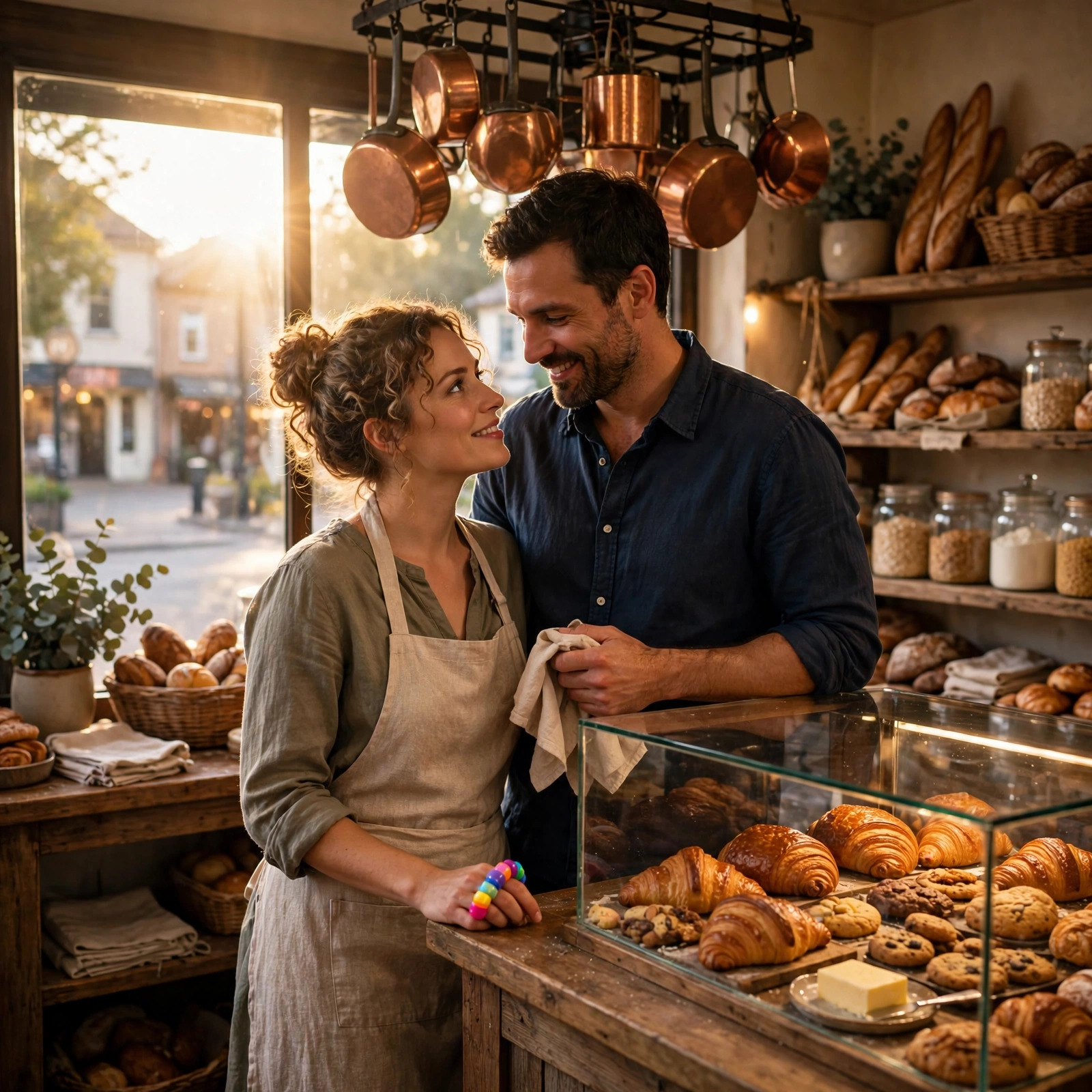
Ash stood up from the folding chairs holding a ring pop, the cherry kind, and Della understood in one electric second exactly what he was doing: the whole town would laugh, the whole town would talk, and no one would ever look closely enough at a joke to check whether it was one.
"Marchetti," he said, going down on one knee on the church basement linoleum, "you once told the Denver paper my paint choices were the color palette of a sad doctor's office. I have since repainted. I am a changed man. Marry me so this town can finally have something to talk about besides the Kettlemans' gourds."
The room erupted before Della could even act. She was laughing for real, which helped, laughing so hard she had to put a hand on the folding table, and she said, "You absolute menace, yes," and he pushed the ring pop onto her finger in front of God, the pastor, and forty-one witnesses, and Dale Kettleman stood up and said, "This changes nothing about the gourds," and the meeting devolved from there.
By nine the next morning, Doreen at the post office had told everyone. By noon, the bell above the bakery door had rung so many times Della stopped wiping her hands. People came in to congratulate her and stayed to buy things, which Ash, arriving at four with a bouquet of gas station carnations and a look of pure apology, immediately understood.
"Your sales," he said, scanning the near-empty pastry case.
"Sold out. Twice. Someone ordered a cake for a birthday in March. Ash, I think your joke was good for business."
"It wasn't a joke," he said, and then heard himself, and went pink to the ears, and put the carnations on the counter. "It was a strategy."
"It was a cherry ring pop."
"It was a cherry ring pop with a legal purpose."
She should have laughed. Instead she looked at the carnations, which were slightly crushed, which meant he had carried them in his truck all day through errands, through the feed store, through the planning fallout, holding them wrong but holding them, and something in her chest did a thing she filed firmly under item seven and refused to examine.
"Thank you for the flowers," she said. "Fiancé."
"Don't say it like that," Ash said. "You'll wear it out before the wedding."
Four: Sundays and Small Frauds
The trouble with a fake engagement, Della learned, was that it came with a real schedule. Carol Holt made pot roast on the first Sunday and asked exactly four questions: how did he propose, what were they doing for the wedding, did Della's mother know, and was he happy. Ash answered two honestly. The proposal, in full, with the gourd line, which made Carol laugh until she had to sit down, and the wedding: Founders Day weekend, next June, small, the grange hall, no gourds. The other two he answered with a steadiness that Della watched like a person watching a high wire.
"Are you happy, Ash?"
"I'm getting there," he said, and Carol looked at Della over the pot roast with an expression that said, clearly, you be careful with this one, and Della nodded, and meant it, and had no idea yet how much she would need the warning herself.
Her mother called from Phoenix that night. "A ring pop?" Gloria Marchetti said. "Your grandmother engineered an entire inheritance clause and you accepted a ring pop."
"It's a long story."
"Is it about the Holt boy? Because it was always going to be about the Holt boy, Della, even when you were twelve and pretending it wasn't. Your grandmother knew that. That's why the clause exists."
"The clause exists because Hattie was a romantic tyrant."
"The clause exists," her mother said, "because that woman watched you leave this town at twenty-two like you were escaping a fire, and she knew the only way to make you look back was to make looking back mandatory. Don't tell me what that woman believed. I spent thirty years on the wrong side of her beliefs."
After the call Della sat in the bakery office with Hattie's recipe cards spread out, and found, tucked behind the kolache card, a note in her grandmother's hand: DELLA ASKS WHY THE OVEN RUNS HOT. TELL HER IT'S BECAUSE THINGS LEFT UNATTENDED BURN. That was all. No explanation. Hattie had never once in her life said a thing plainly when a parable would do.
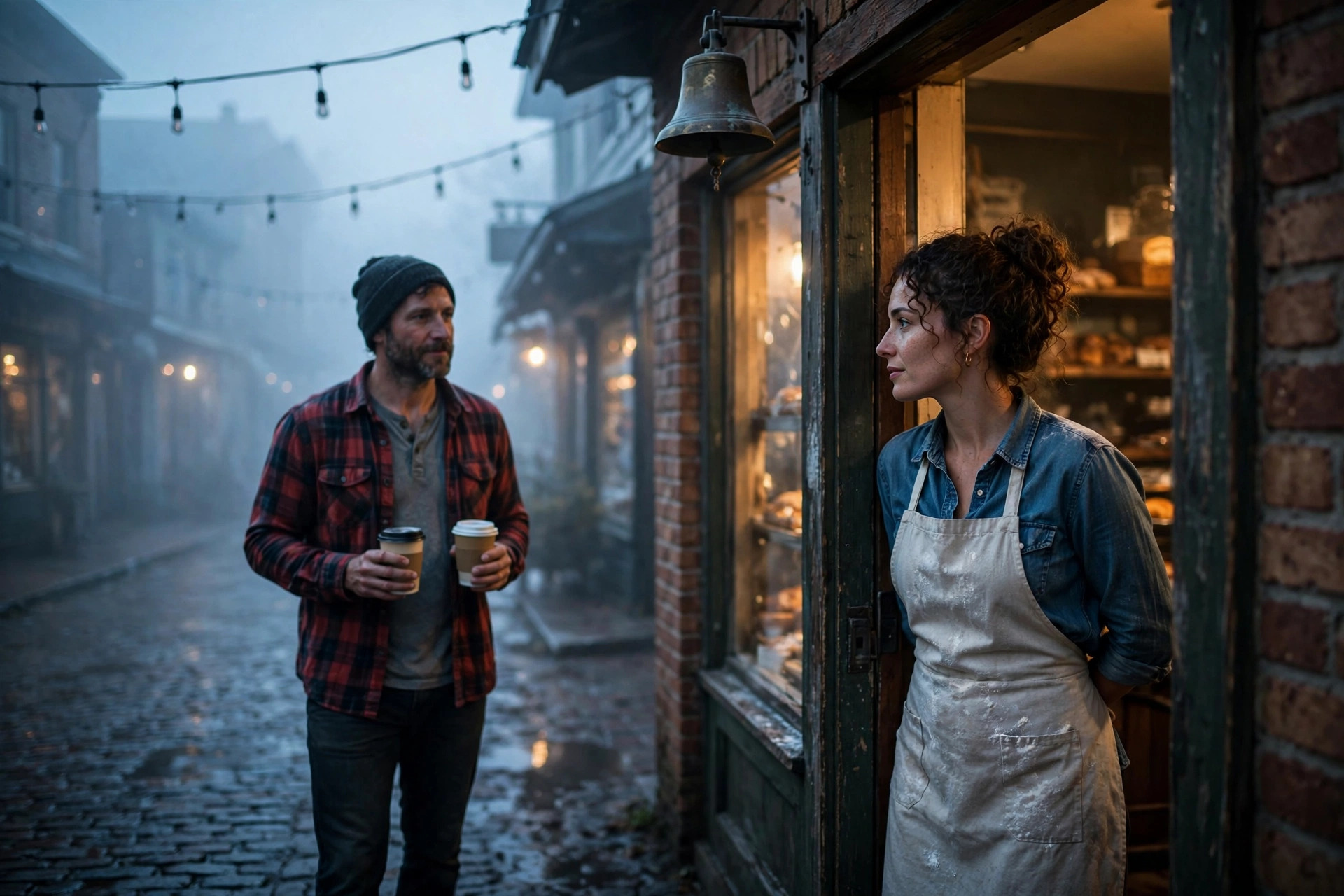
The weeks took on a shape. Tuesdays, Ash at six forty five, black coffee, cheese danish, and lately he had started carrying in a box of something, a valve for the espresso machine he had fixed without asking, a length of oak for the warped counter, a bell for the back door that Hattie had taken down in 1998 for reasons lost to history and which Della had found in a box labeled MISC and which Ash had polished and rehung while she pretended to be busy with laminated dough.
"You didn't have to do that," she said.
"Rule three," Ash said, wiping his hands on a rag. "No lying to each other. So: I did it because the back door scared me. That hinge screamed like a haunted thing. Also I like the bell."
"Why do you like the bell?"
He put the rag down. "Because when it rings, I know it's six forty five," he said, and left before she could assemble a response, and Della stood in her grandmother's kitchen with flour on her hands and the bell still shivering above the door.
The town, meanwhile, had adopted them with a ferocity neither had budgeted for. Doreen started a countdown board in the post office. The pastor offered premarital counseling, which they attended twice, purely for cover, and which became, horrifyingly, the most honest conversations either of them had had in years, because the pastor asked questions like "what does your partner need that they won't ask for," and Ash said, without looking up, "someone to tell her the oven forgives her," and Della had to leave the room on the grounds of a sudden pastry emergency.
The rules held. Mostly. Rule two strained in week six at the Kettlemans' autumn open house, when Dale's wife Bee, a retired deputy with the eyes of a bloodhound, watched them across the cider table and said, "You two don't stand like engaged people. Engaged people orbit. You two are standing like you're ready to be photographed." So Ash put his arm around Della's waist, lightly, a hand resting more than holding, and Della discovered that her whole nervous system had opinions about that hand, and Bee said, "Better," and Della did not pull away for eleven minutes, and counted every one of them.
"You okay?" Ash murmured as they left.
"Fine. Great. The rules are intact."
"Your heart rate is intact?"
"That's not in the rules."
"It should be," Ash said, and held the truck door open for her, and drove her home through streets that smelled like woodsmoke and wet leaves, and neither of them said anything else, which was its own kind of rule breaking.
Five: The Festival, and the Slip
The Harvest Supper was the oldest event on the Bellwether calendar, older than the Founders Day challenge, older than the gourds, held every October in the grange hall with folding tables and a pie contest and a dance floor that was really the floor. Hattie had won the pie contest nineteen times and had her name on a plaque by the door. Della entered this year in her grandmother's name and her grandmother's crust, the one that ran hot on the left, the one she had finally learned by feel, and she won, and when they called her up, the hall clapped so long and so hard that the plaque rattled.
"My grandmother baked this pie every year of my life," Della said into the borrowed microphone, "and I learned it in her kitchen after she was gone, which is when I learned most of what she had to teach me. She left me a building and a riddle. I'm doing my best with both." She looked out at the hall, at Ash at the end of a table with his mother, at Marv, at the Kettlemans, at a town that had decided her story was theirs now. "Thank you for keeping her seat warm."
Then the band started, because the Harvest Supper always ended in a dance, and the rules said nothing about dancing, a gap in the paperwork Ash identified immediately by standing up and holding out his hand with the expression of a man exploiting a loophole.
"Public performance," he said. "Audience requires it."
"The audience is eating pie."
"Bee is watching. Rule of Bee: we orbit."
So they danced, and it was fine, it was a waltz-adjacent shuffle to a song about pickup trucks, and then the band, who had been playing this hall for thirty years and knew exactly what they were doing, slowed everything down, and Ash did not let go, and Della did not step back, and the performance stopped being a performance somewhere in the second verse and neither of them called it.
"You dance like a man who practiced," she said, to say something.
"I watched videos. Three of them. At one in the morning. Dale walked in on the third one and I told him it was forklift safety."
She laughed into his shoulder. His hand was flat against her back, and it had stopped being a prop hours of conversation ago, and outside the hall the first snow of the year was starting, fat and slow, and someone's grandmother was already saying look at them, look at those two, and Della thought, with the strange clarity of a person standing on a ledge, that she had not been held like this since, and then stopped the thought like shutting a door.
"Ash," she said. "Rule two."
"I know."
"You're breaking rule two."
"I know," he said again, and did not move his hand, and she did not move hers from his shoulder, and the song ended and the next one started and they kept dancing, and Della understood that the paperwork of this arrangement had a hole in it the exact shape of everything she actually wanted.
He walked her to the truck under the snow. The grange hall lights were behind them, the whole town visible through the windows, warm and noisy. At the truck door he stopped, and the snow came down between them, and he looked at her the way he looked at things before agreeing to them.
"Della."
"Don't," she said, not unkindly. "Whatever sentence that is, we can't afford it yet."
"It was going to be about the snow."
"It wasn't."
"No," he admitted. "It wasn't."
"Goodnight, fiancé."
"Goodnight, Della," he said, using her name like it cost something, and she watched his taillights the whole way down Maple Row and then sat in her cold kitchen for an hour eating winning pie out of the tin and renegotiating her own rules in her head, badly.
Six: What Wendell Knew
In December, Wendell Frye asked them both to come to his office, and Della went with her stomach already knotted, because attorneys do not summon engaged couples for pleasant news.
"Two matters," Wendell said. "First. The Historical Society has retained counsel. They believe the clause is unenforceable as against public policy, and they are prepared to challenge. If they win, the property transfers regardless of your marital status."
"So I could just," Della said slowly, "stop?"
"You could. Though I'd note, off the record, that their counsel is Dale Kettleman's brother-in-law, and their stated plan for the building involves removing the ovens in phase one. I'd also note that the challenge would take a year and cost more than the ovens."
"And the second matter?"
Wendell took off his glasses, which Della now understood was his tell. "Your grandmother added a codicil in March. It's dated after the original will. It says, and I quote: IF MY GRANDDAUGHTER ATTEMPTS TO FULFILL ITEM SEVEN BY MEANS OF A FALSE ENGAGEMENT, THE CLAUSE IS VOID AND THE PROPERTY GOES TO THE HISTORICAL SOCIETY ANYWAY. SHE WILL KNOW WHAT SHE DID AND WHY. TELL HER THE OVEN FORGIVES HER."
The office was very quiet. Ash was the first to speak. "How would she know? How would anyone enforce that?"
"It's not enforceable," Wendell said. "No court in this state would touch it. But your grandmother didn't write it for a court." He put his glasses back on. "She wrote it for the two of you, in this room, in December. I have been sitting on it since March waiting for exactly this meeting. She made me promise to read it only when you both came in together looking guilty. You came in looking guilty. Congratulations and condolences."
Della walked out of the bank into the snow without her coat. Ash caught up to her at the corner of Maple Row, and she turned on him, furious and laughing at once, because there was no other available response.
"She knew. Of course she knew. She ran this town for forty years, she knew I'd do exactly this, she planned it, she planned the loophole, she planned the codicil, she planned us."
"Did she plan us?" Ash said. "Or did she just leave the door open?"
"Don't be reasonable right now, I'm having a crisis."
"You're having a crisis because the lie got expensive," Ash said, quietly, and the snow kept falling, and neither of them moved. "Here's what I know. The codicil doesn't matter legally. The Historical Society challenge doesn't matter unless we let it. What matters is that in September I told you a rule and in October I broke it and in November I watched you count the minutes I held you and in December I am standing in the snow wanting to break every rule on that legal pad, and the question isn't your grandmother anymore, Della. The question is whether this is still a merger."
Della looked at him. Eleven hours she had driven. Fifteen years of not waving. One harvest moon, legally nonexistent.
"I need time," she said, which was true, and also the coward's version of the other sentence, and they both knew it, and he nodded, and said, "Take it. Rule three still holds. I'm not lying to you: I'll wait."
Seven: The Unmasking
She did not get her time. Small towns do not sell time; they auction it. The Historical Society's challenge, amplified by Dale's brother-in-law and a slow news week, hit the county paper in January under the headline IS BELLEWETHER'S SWEETEST INHERITANCE BUILT ON A LIE? Someone had talked. Someone always talked. The article did not name sources, but it quoted "a planning committee member" speculating that the engagement had "convenient timing," and it reproduced the codicil, which Wendell had been required to file, in full, including the line about the oven.
Della read it at four in the morning in the bakery, and by seven the bell above the door had a different sound, or she imagined it did, and the customers came in careful, the way people come into a sickroom. Rosa bought nothing and said nothing and hugged her. The Kettleman sisters bought a dozen kolaches and said, "We're team Marchetti, whatever the paper says," which was the most grace the gourd dynasty had ever extended.
Ash came at six forty five and found her hands in the flour and her face wet, and he did not touch her, because rule two, because the town was watching through the window, because everything had teeth now.
"Options," he said, sitting down across the counter like a man laying out tools. "One. We deny everything and fight the challenge. Two. We get married for real, fast, before the hearing, and dare anyone to say a word. Three. We tell the truth, all of it, the clause and the codicil and the ring pop, at the Founders Day meeting, in front of everyone, and let the town decide what it wants to do with us."
"Option two," Della said, and heard how fast she said it, and saw him hear it too.
"That's the one where I stop being a strategy," he said carefully. "I want to be clear about what I'm hearing."
"What are you hearing?"
"That you'd rather marry me in a panic than lose me in a hearing."
The words landed exactly where he aimed them. Della put down the scoop. "And what would you be doing," she said, "in option two? Marrying me to save the ovens?"
"No." He said it flat and immediate, no performance in it at all. "I'd be marrying you because I've been in love with you since you switched the sugar and the salt and blamed the wind. Everything since September has been me finding legal pretexts to stand near you. The rules were the lie, Della. Not the engagement."
The bell over the door rang. Marv came in for his usual and read the room with a professional's eye and said, "I'll take two danish and no gossip," and stood by the window radiating attention.
"The codicil," Della said, because she had to say something true and hard or she would say yes and never know if it was fear talking. "If I do this because I'm cornered, she wins the argument and loses the point. I came back for a building, Ash. I have to stay for a reason."
"Then here's my reason," Ash said. "I repainted the whole store in October. Went from sage to a warm clay color. Took two weekends. I didn't do it for Dale's bet or your newspaper quote. I did it because you were going to see it every day for the rest of your life and I couldn't stand for you to be right about me."
Marv turned to the window and studied the street with enormous concentration.
"Option three," Della said. Her voice shook and she let it. "The truth. All of it. But not at the planning meeting." She wiped her hands on her apron. "At the Harvest Supper is where we started lying. The Founders Day festival is where we stop. On the stage. Before the business challenge results. You and me and a microphone and the whole town."
"You want to confess to a fake engagement in front of the town that just spent four months planning our bridal shower."
"I want to stop performing," Della said. "For the first time in years. Possibly ever."
Ash looked at her for a long moment, the look he gave things before agreeing to them, and then he came around the counter, and broke rule two completely and on purpose, and kissed her in front of Marv and the window and God and the pastor's wife, and it was nothing like the harvest moon, because the harvest moon had been a beginning and this was a decision.
"Okay," he said against her mouth. "Founders Day. The truth. But I'm keeping the ring."
"It's a ring pop."
"I had it laminated," Ash said. "Don't ask how."

Eight: Founders Day
The Founders Day festival filled Main Street in early June, string lights and sawdust and the Kettlemans' gourd display, which had gone, in a bold late move, thematic: a gourd carved to resemble a wedding cake, which everyone pretended not to find charming. The business challenge results would be announced at eight from the bandstand. At seven fifty, Della stood behind the stage with a legal pad in her hand, the original one, rules five through eleven still visible, and her heart going like the bell above her door.
"Nervous?" Ash said. He wore the one good shirt. The ring pop was on her finger, laminated and gleaming like a relic.
"Terrified. You?"
"I watched videos. Three of them. About public speaking."
"Dale walked in on one, didn't he."
"He thinks I'm rehearsing a eulogy. Let's keep it that way."
The mayor introduced them to whoops and applause, the applause of a town that had bought shower gifts, and Della walked out into the light with Ash's hand in hers, real, both of them past pretending it was for the audience, and she looked out at Rosa, and Doreen, and the Kettlemans, and Bee with her bloodhound eyes, and Carol Holt in the front row holding a casserole dish for reasons unknown, and Marv in the best seat.
"Some of you have read the paper," Della said, and the crowd went still in the way of crowds who have been waiting months for exactly this. "So I'm going to tell you the truth, all of it, and then we'll do the challenge results, and then you can decide what kind of town you live in."
She told them. The clause. The ring pop. The legal pad, which she held up, to laughter. The codicil, and her grandmother's line about the oven, which made several older women wipe their eyes, because everyone in Bellwether Springs had been told a parable by Hattie Marchetti at some point and never recovered. She told them about the Historical Society challenge and the ovens coming out in phase one. She told them the engagement had started as a merger with a buyout clause.
"And then?" someone called out, and it was Rosa, merciless, and Della looked at Ash.
"And then it wasn't," she said. "I can't tell you the exact day it stopped being fake. I can tell you the day I knew it was real. It was a Tuesday at six forty five and a man rehung a bell my grandmother took down in 1998, and he told me he liked it because when it rang he knew it was six forty five, and I realized I had rearranged my entire life around a man's coffee order." She took a breath. "So here's what I'm asking. Not for understanding. For ovens. If the bakery matters to this town the way it mattered to my grandmother, come to the hearing in July and say so. And if it doesn't, that's a real answer too, and I'll hear it."
Ash stepped up to the microphone. "I have one correction," he said. "The proposal was not a joke. It was a strategy. But the man proposing was not strategic. I've been done for since sophomore year. I just needed a legal pretext. Thank you, and please vote for the gourds, they worked very hard."
The crowd made a sound Della had never heard from a town, a low collective exhale, and then Bee stood up, and the whole street quieted, because Bee had been a deputy and everyone knew a verdict when they saw one coming.
"I knew in October," Bee said. "At the cider table. Engaged people orbit. Those two were standing like they were ready to be photographed because they were performing, sure. But they were performing for each other. Nobody performs that hard for an audience they don't love." She sat down. "Motion to tell the Historical Society where to put their museum."
"Seconded," said Dale Kettleman, to the shock of no one who understood his marriage.
The mayor, sensing history, banged the gavel on a folding table. The challenge results were read: second place to the garden center, to visible gasping, and first place, by a margin the mayor called unprecedented, to Holt & Son and Marchetti's Bakery, entered jointly, as a couple, for a restored storefront collaboration nobody had actually submitted, because Doreen had submitted it for them, because towns do that.
The string lights came on all at once. Ash pulled Della behind the bandstand into the dark between the electrical boxes, and the noise of the town washed over them like weather.
"So," he said. "The merger is now a hostile takeover. I'm told there's a wedding in the bylaws."
"There's a real one," Della said. "If you want it. Not for the deed. The deed's handled, the town's handling it, we could annul tomorrow and I'd still have the ovens. So this is the first thing I've chosen in years with nothing at stake except the choosing." She held up her hand, ring pop and all. "Ask me properly. No committee. No codicil. No audience except the electrical boxes."
Ash went down on one knee on the sawdust, which was not romantic, which was in fact a workplace hazard, and did not care.
"Della Marchetti. I don't have a gourd line. I don't have a legal pretext. I love you, I've loved you through every rule we wrote, and I want to marry you for the worst possible reason, which is that I want to. Will you marry me?"
"Yes," she said, before he finished the sentence, which he would bring up at every anniversary for the rest of their lives. "Yes, obviously, yes, you menace."
Nine: The Wedding, and What the Oven Said
They married on Founders Day weekend the following June, in the grange hall, under the plaque with nineteen Hatties on it. Carol made the pot roast for the rehearsal dinner. Priya caught the bouquet and looked personally betrayed by fate. The Kettleman sisters catered and put one decorative gourd on the cake table and were permitted to keep it. Wendell Frye attended, off the clock, and was heard to say the codicil was, on reflection, the best-drafted document of his career.
Doreen retired the countdown board and replaced it with a new one. The Historical Society withdrew its challenge in February, formally, after forty residents spoke at the hearing and Dale's brother-in-law discovered that defending a museum of regional baking against a town armed with pie was not a winning position. The ovens stayed. The oven still ran hot on the left side. Della never fixed it. Some things you earn.
On the wedding morning, in the bakery office, in her dress, with flour on one sleeve because she had made the cake herself and would apologize to no one, Della found one last note tucked behind the kolache card, in the box labeled MISC, which she had finally finished unpacking. It was dated three years back, in Hattie's hand, and it said: DELLA COMES HOME IN JUNE. ASK ASK ASH TO FIX THE BACK DOOR. HE'LL SAY THE BELL IS WHY. LET HIM KEEP SAYING IT. IT'S TRUE.
Della sat down on her grandmother's chair and laughed until she cried, and then cried until she laughed, and then went out to the front where the bell was hanging where Ash had put it, and where Ash was standing in his good shirt at six forty five on a Saturday, waiting for her with two coffees, black for him, and hers exactly the way he had memorized it without ever being told.
"She knew," Della said, holding up the note. "June. She wrote June."
"She always did run this town," Ash said, and rang the bell on his way past, for no reason, for every reason, because when it rang, he knew it was six forty five, and now, so did she, forever.
Marchetti's Bakery opens at six. The bell rings at six forty five. Regulars know why. Newcomers ask, and get told the whole story, which takes two coffees and is, by every official account, entirely true.
"Love was the only inheritance worth enforcing."
Ivy Chen
Ivy writes historical and second-chance romance with period texture and modern emotional clarity. Courtship stakes, letters, and choices that cost.
Leave a comment
Comments