




The Hours Before September

I. The Shop on the Rue de la Bûcherie
Clara Whitfield had been in Paris for three years and had learned to say almost everything in French except the things that mattered.
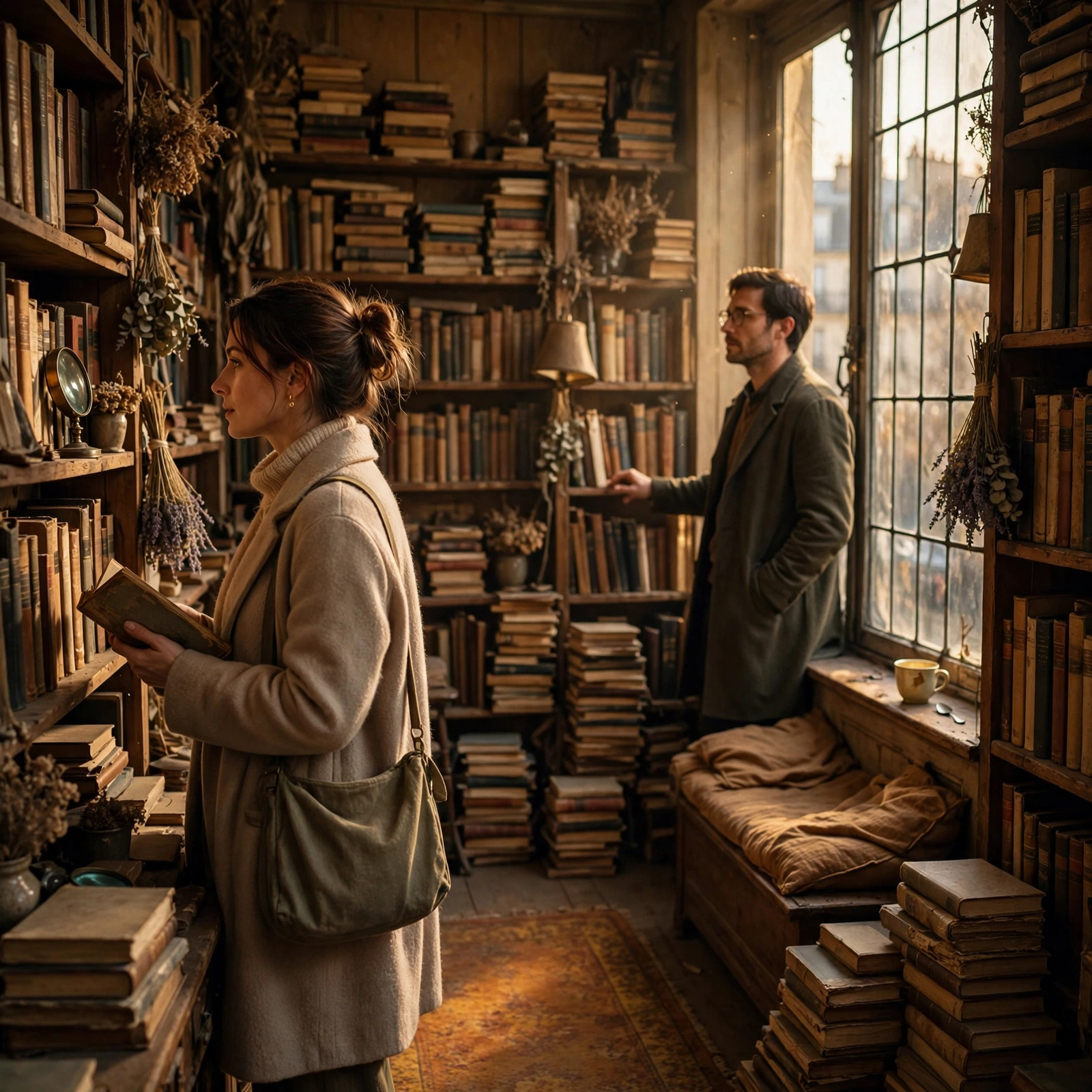
The bookshop had no sign worth reading, only a weathered board above the door with the name Moreau painted in letters that had given up on themselves sometime before the war. Clara had walked past it for two years without entering, the way a person walks past a door she is not ready for. Then, in May of 1924, needing a dictionary she could not afford new, she pushed it open and the little bell above the frame rang once, thin and bright, like something startled.
The man behind the counter did not look up immediately. He was copying something by hand into a ledger, his pen moving with the patience of a man who had never once been in a hurry, and when he did look up she saw a face that was difficult to read and entirely worth trying to. Thirty-odd years. Dark hair pushed back by a hand that had obviously pushed it back many times that morning. Eyes the grey-brown of the Seine in October.
"I am looking for a French-English dictionary," she said in French, "the large kind, and preferably one whose previous owner did not eat while reading."
His mouth moved, not quite a smile. "That limits us to perhaps half the shop." He came around the counter, and she noticed he moved carefully, favoring his left leg very slightly, a hitch so small she might have imagined it. "You are the translator. Whitfield. The detective serials."
She blinked. "You know my work?"
"Everyone in this quarter knows your work. Mademoiselle Ferro on the corner reads them aloud to her cat." He turned toward the reference shelves. "The killer is always the notary. In every one."
"You have clearly read several."
"Enough to worry about me." He stopped before a row of spines and pulled one out, blowing dust from the top edge. "Here. Eleven francs, because the previous owner underlined things in red and wrote insults in the margins. You may consider the insults free."
She opened it. On the flyleaf, in faded pencil, someone had written Ce que l'eau dit au feu, personne ne l'entend. What the water says to the fire, no one hears. She read it twice without understanding why it made her chest tighten, and closed the book before her face could do anything about it.
"It is perfect," she said. "Especially the insults."
"Julien Moreau," he said, and offered his hand. His grip was brief and dry, and it was over in a second and a half, and Clara Whitfield, who had been a wife and was now a widow and considered herself finished with the entire subject, thought about that handshake for three days.
She told herself it was the margins. The insults were very funny.
II. What Julien Did Not Say
Julien Moreau noticed three things about the American widow in the first ten minutes, and he spent the following week pretending he had noticed none of them.
First: she stood in a bookshop the way other people stood in churches, shoulders dropped, guard lowered, as though the presence of books permitted her some rest she got nowhere else. Second: her widow's weeds were worn but old, the black gone slightly greenish at the cuffs, which meant she kept wearing them not for show but because she had nothing else, or because she was not finished with them yet. Third: when she read the flyleaf inscription, something crossed her face, quick as a fish under ice, and whatever it was had cost her something to hide.
He knew about hiding things. He was, professionally, a modest man: books bought, books sold, books mended with paste and thread and a patience he had learned in a hospital in Lyon where the surgeons had spent four hours on his leg and told him afterward, with Gallic bluntness, that he would walk but never march. He had learned the rest of his patience in the two years after, in a house with one empty chair at the table, listening to the sound of a street that had taken his brother Luc and his own ambitions and handed back, in exchange, a limp and a talent for keeping his voice level.
Luc had died at Verdun. Before the war, Luc had been the brilliant one, the one who was going to Paris, who was going to buy this very shop and fill it with first editions and make something of it. Julien had bought it instead with the family's remaining money, and had spent eight years tending it like a grave with good lighting.
None of which he explained to the translator Whitfield. What he said, the second time she came in, was: "You are looking for the second volume of Zola, left side, near the window, where I put it because you look at that window when you think no one is watching."
She stopped mid-step. "That is an alarming sentence."
"It is a shopkeeping sentence. I watch everything in this shop. It is how I have not been robbed since 1919." He set down his ledger. "Though the widow at number 14 did once leave with a psalm book she believed she had paid for. I let her keep it. She needed it more than I did."
"You're generous in a very strange way," she said.
"You are observant in a very strange way. How is the notary doing this month? Is he the killer again?"
"I cannot discuss the plot with a man who spoils every book in Paris."
"I spoil nothing. I merely have pattern recognition, which is different, and cheaper."
She laughed then, a real laugh, unguarded, and Julien heard it land somewhere he had not permitted anything to land since 1918, and he very carefully picked up his pen and did not look at her again for the rest of the transaction.
III. The Rules of a Long Summer
By June, Clara had established, without meaning to, a routine that had the structure of a decision she was refusing to make.
Three afternoons a week she crossed to the Left Bank with a manuscript under her arm, because the third floor of her lodging house was too hot for work and the shop had a window seat that caught the river light. Julien, who had never allowed a living soul to use that seat, had allowed her to use it without comment, and neither of them acknowledged what that meant.
They had rules, unwritten and therefore sacred. They discussed books, translation, the insolence of the courier service, the quality of the coffee at the cart on the corner. They did not discuss her husband, Thomas, dead four years now of pneumonia contracted in a bad winter in Baltimore, or her mother's letters, which arrived weekly and grew steadily more detailed about Clara's brother-in-law's empty house in Ohio. They did not discuss his leg, or his brother, or the photograph in the back office of two young men in uniforms, one smiling too hard.
They did not discuss the fact that she had stopped wearing her wedding ring last month, and that he had noticed, and that she had noticed him notice, and that both of them had agreed in silence to let the whole subject drown quietly in the river and stay there.
"You are translating badly today," Julien observed on a Tuesday in late June, leaning against the end of her window seat with his arms crossed. "I can tell because your mouth is doing the thing."
"What thing?"
"The thing where the sentence has beaten you and you are pretending the sentence does not exist."
"The sentence is terrible," she admitted. "The detective is creeping through a garden. I have written that he 'moves like a cat' twice and I would rather die than write it a third time."
"Move like what, then?"
She looked at the open window, at the traffic on the quay, at a delivery man easing a cart backward through a gap that had no business accommodating it. "Like that man. Like someone navigating a space that will not cooperate, with total patience and no noise and a low opinion of everyone watching."
"That is the single best sentence I have heard in this shop in eight years," Julien said, "and I will deny having said it if you repeat it."
"You are always threatening to deny your compliments. You should hear yourself do it. It is a whole performance."
"It is not a performance. It is a policy." He straightened, and something in his tone shifted, the play going out of it, and Clara felt the air between them thin. "Why is your mother writing you about Ohio?"
The question arrived like a stone dropped into still water. She kept her eyes on the page. "How do you know what my mother writes me about?"
"Last week your landlady's niece came in and gossiped while I was wrapping her Zola. She does not know I know you, apparently, so she said everything. Ohio. An empty house. A brother-in-law who needs a housekeeper with handwriting." He paused. "You went pale when I said the word just now. So. The question stands, and you are allowed to throw the dictionary at me."
Clara did not throw the dictionary. She closed it, very gently, aligning the edges, and when she spoke her voice was the level, reasonable voice she used on landladies and customs officers. "Thomas's brother George wants me to come back. There is a house, and his daughters, and the girls need schooling, and everyone has agreed for four years that I am required there and I have agreed for three of those years that I will go in September."
"September," Julien repeated. Nothing else.
"September," she confirmed, "when the steamship fares are lower."
He nodded once, the nod of a shopkeeper acknowledging a delivery date, and said, "Then you had better finish the garden scene. The cat man cannot creep forever," and went back to his ledger, and Clara sat in the window seat with the river light on her hands and felt something that had no name in either of their languages begin, very quietly, to bleed.
IV. The Storm Shelf
In July a storm came up the Seine valley and broke over Paris in the early evening, and Clara was in the shop when it arrived.
The rain hit the roof like thrown gravel. The lights guttered. Julien swore in two languages and went around lighting the hurricane lamps he kept for exactly this, and the shop filled with a low amber glow that made every corner look like a room in a painting. Clara left the window seat and stood in the middle of the floor and turned her face up and simply breathed, because for three years she had been moving through the world with her breath held and she had only recently begun to notice.
"You will want to go home before the gutters flood," Julien said from the poetry alcove, not looking at her, moving a lamp to a shelf because apparently the shelf required it.
"I want to stay," she said, before the reasonable voice could intervene. "I never stay. It rains and I go home and I am alone with a lamp and I translate one bad sentence an hour until the loneliness wins. I would like, just once, to stay somewhere while it rains."
The lamp took his whole attention for a moment longer than it needed. Then he set it down. "Then you will help me," he said. "The storm shelf. Every shopkeeper in the quarter keeps one. Books that came in damaged, water-stained, unlucky. We keep them out of the stock so they do not jinx anything. There is a system. It is dull, it takes an hour, and it is better than being alone with a lamp."
So they spent the storm at the back of the shop, on the floor, sorting ruined books into a crate, their shoulders a hand's width apart, the rain drowning the whole city outside. He showed her how to tell repairable damage from fatal damage. She held the lamp. A water-stained copy of Verlaine fell open to a page circled in pencil and she read it before she could stop herself, and her breath went somewhere and did not come back right away.
Il pleut doucement sur la ville.
It rains gently on the city.
"Not gently tonight," she managed.
"No," he said. He did not take the book from her. He sat very still in the lamplight with the rain coming down and let her hold the poem as long as she needed to, and that small act of stillness undid her more thoroughly than any sentence he had ever spoken.
"Julien," she began, and stopped, because what came next was enormous and the lamplight was too small a place to hold it.
"Mm," he said, which was all the encouragement there was.
"I have not told you," she said slowly, "that this shop is the first place since Thomas died where I have felt like a person instead of a caretaker for other people's grief. I have not told you because once I say it out loud, September stops being a plan and starts being a betrayal, of somebody, and I am not sure of whom."
The rain filled the silence for a long time. Then Julien said, very quietly, "The storm shelf exists so that damaged books can be tended. That is all I know about anything."
And Clara understood that he had almost said something back, something with his brother's name in it or her name in it, and had closed the door on it, and she let the door stay closed because she was suddenly, terribly afraid of what they would both see if it opened. She held the lamp higher. They went back to the ruined books. Neither of them touched the other, and it was the most intimate hour of either of their lives.
V. What Julien Would Not Admit
After she left that night, into the washed streets with her collar up, Julien stood in the empty shop and understood that he had lost a war he had been refusing to admit he was fighting.
He lit the last lamp. He looked at the window seat, which was exactly the shape of her sitting in it, and at the two teacups she had begun leaving on the sill, hers with a chip in it that he had not mended because mending it would end the pretense that it was temporary. Everything between them was temporary, built entirely of indefinite articles. A seat. A visit. A September.
Luc had loved a girl named Marguerite, and Luc had died at Verdun, and Marguerite had married a dealer from Marseilles, and Julien had stood at her wedding holding his hat and congratulating everyone with a face like a shut window, and he had sworn, that night, that he would never again be the man who was left holding everything except the person. It was better to be unfinished. Unfinished things could not be broken.
And now there was an American widow with ink on her fingers who laughed at his policies and read Verlaine in the rain and was leaving in September, and the choice was not stay-or-go, the choice was feel-or-don't, and Julien Moreau stood in his dead brother's shop and did the arithmetic and found, to his astonishment, that no amount of discipline made the numbers come out to nothing.
He took the chipped teacup off the sill. He set it next to his own, where hers had been sitting all along, two cups together. Then he put it back on the sill, because the next time she came in, he wanted her to see where it belonged.
VI. The Almost
It happened in August, in the late light, the hour when the river turns to hammered brass.
Clara had finished the garden scene. The detective had crept through it like a man with a low opinion of everyone watching, and the American editor had cabled approval and an insulting sum, and she came into the shop that evening carrying a bottle of champagne she had bought with the first actual profit of her working life, and Julien looked up at the bell and the bottle and the expression on her face and felt his whole careful structure lean.
"It sold," she announced. "The serial sold to America, as an American serial, and they asked for twelve more, and I am to be paid properly, like a person, and I bought this at the wine shop and the man laughed at me for buying champagne at four in the afternoon and I laughed back." She put it on the counter with a slight tremor. "I have no glasses."
"In a bookshop, there are always glasses." He produced two, actual wine glasses, from under the counter, and she chose not to ask why he had them, and he chose not to tell her that they had been Luc's, from the life Luc had planned, and that he had kept them for six years without once pouring anything into them.
They drank standing up in the doorway, watching the quay. The champagne was rough and excellent. A barge went past loaded with gravel, and the bargeman waved, and they waved back like two people with no secrets.
"Clara," he said.
Just her name. First name, the first time, and she turned and the brass light was on half his face and his hand had come up, not touching her, hovering an inch from her jaw, asking without asking, and everything in the last three months stood up inside her at once and said now.
"Julien, I," she said, "I have to tell you before September takes it out of my hands, I,"
The boy from the tailor's up the street came skidding through the door, breathless, calling her name. A cable. From Ohio. Her sister-in-law. Something about George.
The world did not slow down, which was the cruelty of the world. Clara read the cable in the lamplight with Julien standing close enough that she could feel the warmth coming off him, and George was ill, not dying, but ill enough, and the family was asking her to sail early, the end of August instead of the end of September, and the words swam and rearranged themselves and became, unmistakably, a door closing.
"I have to go," she said. "I have to reply tonight. I have to."
"Of course," Julien said, and his voice was level, and he stepped back, and the inch of air where his hand had hovered closed over like water.
She was at the door when she turned. "What I was going to say," she said, "I am still going to say it. I am just not going to say it while someone is ill and the boat is booked. When I say it, I want it to be the whole truth, not a person running out of time."
He nodded. He did not trust his voice. She left. The bell rang, thin and bright. The two glasses stood in the doorway light with the last of the champagne in them, and Julien did not move for an hour, and the river went on being brass, and then went on being dark.

VII. Silence in Two Cities
The last two weeks of August were a study in how much silence two people can manufacture between themselves.
Clara came twice. They discussed her packing, the shipping office, the weather. He wrapped four novels for the voyage and charged her eleven francs with a face like the ledger itself. She paid, and made a joke about the insults being free, and neither of them laughed, and the shop felt, to both of them, like a room they were already only remembering.
She wanted, more than she had wanted anything in years, to say the sentence. She composed it on the third floor of her lodging house at night, over and over, revising it like a bad translation. Do not ask me to stay, because George is ill and I am going. Ask me to come back, and I will come back, and I will come back with money of my own and no weeds and no one's permission to seek. It was a good sentence. Every time she brought it to the counter of her courage, he was wrapping a book, or a customer was present, or his face had the shut-window look, and she put it away again, because a sentence spoken at the wrong moment becomes a different sentence entirely.
Julien, for his part, spent two weeks discovering that a man can be brave about shellfire and cowardly about four words. He had drafted his own sentence. Then come back. Come back to the shop, to the seat, to the chipped cup, come back not as a widow going through the world with held breath but as Clara, and I will be here, and this time it will be said out loud. Every afternoon the bell rang and it was never her and never the moment, and he told himself he would say it on her last day, and her last day arrived, a grey Thursday in the last week of August, and she came in at eleven with her trunks already gone to the dock, and a customer was there, an old colonel buying Baedekers, and Julien waited him out with a politeness that cost him everything, and by the time the colonel left she was already at the door, hat on, gloved, the whole architecture of departure between them.
"Write to me," she said. "The nieces will forward letters if you label them Aunts' Business, in capitals."
"I will write," he said. "The detective must solve something before winter. Send me the American proofs so I can spoil the plot for the quarter."
"That is a promise disguised as a business arrangement."
"Everything important in this shop is disguised as a business arrangement."
She looked at him across the counter, across eight years of his careful life and three years of hers, and he saw her lips part, and every nerve in him leaned toward her, and she said, "September," and went, and the bell rang, and he stood in the doorway and watched her cross the quay without once looking back, because he knew, the way you know a thing in your own bones, that if she looked back neither of them would survive the departure in one piece.
VIII. The Choice
She wrote from the ship. The letter took eleven days.
Julien, I spent the crossing composing the sentence in seven languages and I am only going to send it in two. In English: I am not going to Ohio. George is recovering and has a housekeeper and I have understood, somewhere in the middle of this ocean, that I have spent four years trying to belong to a grief by obeying it, and I am finished. In French, which I have learned is the better language for me: il pleut doucement sur la ville, and I am standing at a porthole deciding where my rain falls, and it falls on a small shop on a street whose sign has given up. Keep my seat. Do not mend the cup. I am coming back, not as anyone's caretaker. Yours, Clara.
He read it four times. Then he took off his apron, in the middle of the afternoon, which had never once happened, told the psalm-book widow from number 14 to mind the shop, and walked to the nearest telegraph office, and paid for underlining: The seat is yours. The cup is waiting. Come home.
It was the first time in eight years he had written a sentence about himself in which he was not disguised as anything.
IX. The Hours Before
She came back on the last day of September, in the evening, in a light rain, without weeds, in a coat the color of autumn apples, and she stood outside the shop for a full minute the way she had for two years before entering, except that this time she was not deciding whether she was ready for a door. She was rehearsing the sentence. Out loud. In the rain. In both languages.
He saw her through the window before she saw him, this man with his careful face and his mended city, and he did not wait for the bell. He came out into the rain with no coat and no sense at all, and they stood on the wet quay a meter apart, and the river was dark and the lamps were small and gold and the rain came down softly, so softly, on the city.
"My sentence has twenty clauses," she said. "I have been revising it since mid-Atlantic."
"Mine has four words and I have had a month and cannot find them."
"Say yours first," she whispered, "and then I will not need any of my clauses."
He came closer, until the rain was something happening between them and not to them, and his hand came up, and this time it did not hover. It touched her jaw, warm despite the rain, and he looked at her for one long second, asking without a single word, and she said, "Yes. Julien. Yes," and only then, with permission given in her own voice, did he kiss her.
It was not a storm. It was the opposite of a storm. It was slow and deliberate and it undid three months of subtext and two wars' worth of caution and four years of a woman holding her breath, and Clara held onto his lapels and kissed him back with the full ridiculous ordinary truth of it, and somewhere above them the shop bell rang in the wind, thin and bright, like something startled, like something finally answered.
When they broke apart he pressed his forehead to hers, and his voice came out rough and unguarded and entirely undisguised. "Come home," he said. "Come home, Clara."
"That was only three words."
"The fourth one is next, and it takes the rest of my life to say properly."
"Then you had better start," she said, laughing, crying, both, "and I had better stay to hear it."
The rain fell gently on the city. Inside, the two teacups stood together on the sill, one of them chipped and never mended, exactly where they belonged.
The End. If you enjoyed this slow-burn Parisian romance, the associated novella The Hours Before September: The Complete Season continues Clara and Julien's story through the winter of the American proofs.

Marcus Hale
Marcus writes slow-burn and marriage-of-convenience stories where logistics become intimacy and competence is a love language.
Leave a comment
Comments