

The Skip and the Sunshine
Can a guarded athlete who trusts nobody let a relentlessly warm new partner into her circle, and into her heart, in a single week of championship curling? That is the question this story answers, one stone at a time.
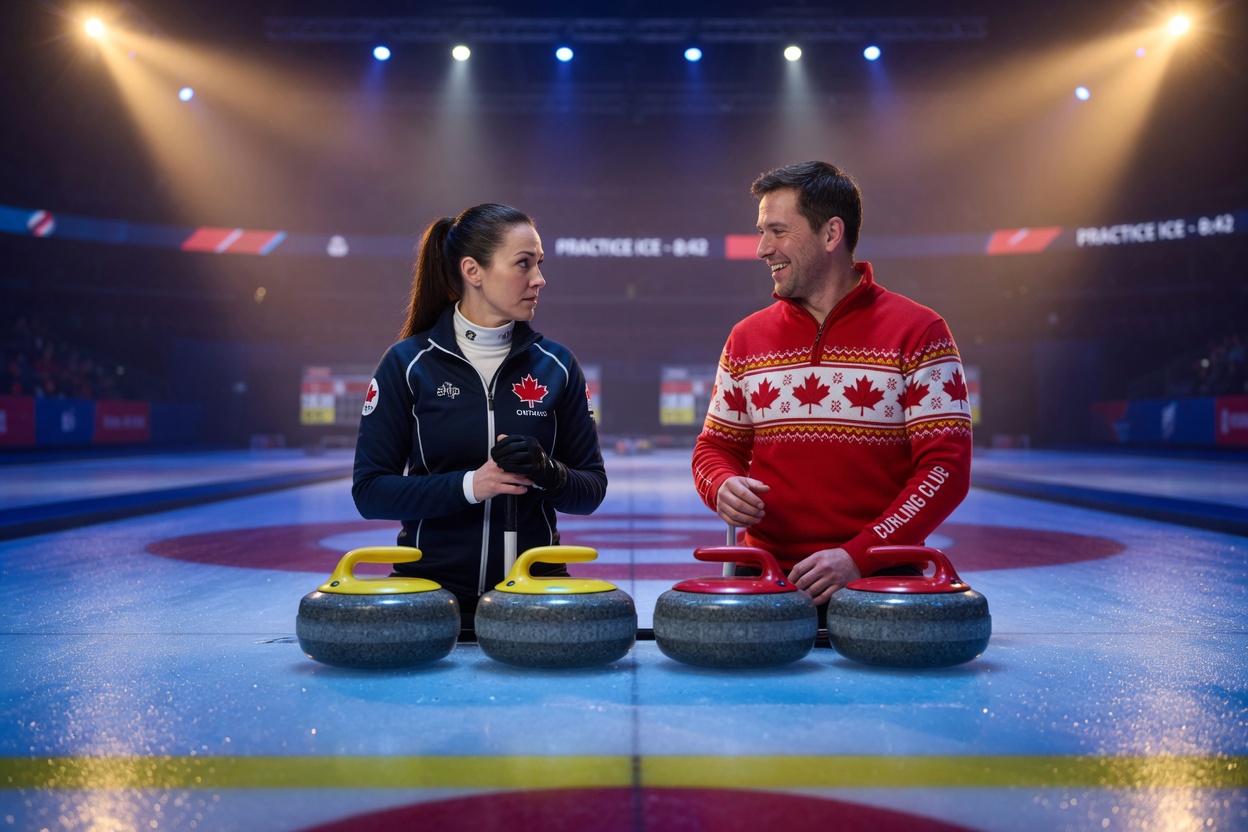
Chapter One: The Replacement
Talia Vance had a system for dealing with people, and the system was this: as few of them as possible, at the greatest possible distance, for the shortest possible time. It had served her well through six national championships, two world podiums, and one catastrophic shoulder surgery that had taught her the true meaning of the word alone.
So when the mixed doubles draw posted and her name appeared next to Desmond Marchetti, she read it three times hoping the letters would rearrange themselves into something survivable. They did not.
Des Marchetti. The human golden retriever of the national circuit. The man who had once spent an entire end of a televised match complimenting the ice technician. The man whose postgame interviews were quoted by actual teenagers on actual posters.
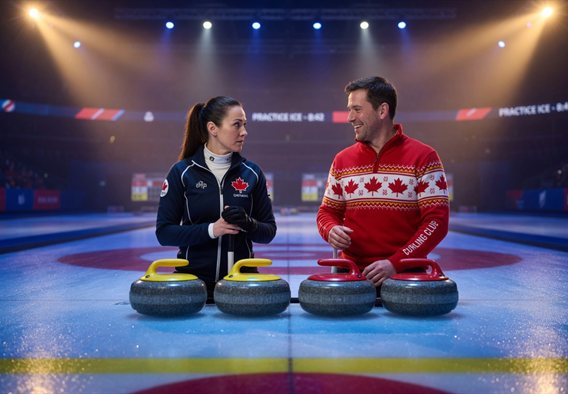
She found him in the practice facility lobby, and of course he was already smiling.
"Talia Vance," he said, like her name was good news. "I have been rehearsing this moment for two hours and I still don't have a good opener, so here it is: hi. I'm your worst nightmare, apparently, based on your face."
"My face is fine."
"Your face is beautiful, is the thing, and right now it's doing a thing where you're calculating how many rules exist against trading partners mid-week." He stuck out his hand. "Rules say you can't. I checked. I want you to know I checked, because I wanted you that badly."
She shook his hand because refusing would take more energy than enduring. His palm was warm. She hated that she noticed.
"Let's establish the terms," she said. "We have six days before the trials. We are not friends. We are colleagues. You throw lead stones, you listen when I call line, and you do not narrate. You have a reputation for narrating."
"I have a reputation for being pleasant."
"Same thing."
Des laughed, and the sound bounced around the marble lobby like a stone she couldn't catch. "Okay, Skip. Terms accepted. For the record, though, I requested you."
"Nobody requests me."
"I know," he said gently, and something about the gentleness was worse than the grin. "That's kind of my whole point."
Chapter Two: Six Days
The rules of mixed doubles curling are simple on paper: two players, five stones each, one pre-positioned, and a power play that lets you move the target stones and gamble everything. In practice it means you cannot hide. In team curling, four people share the blame. In mixed doubles, there is one partner, and the ice between you is eight feet wide and forty-six feet long, and every mistake belongs to exactly two people.
Talia had spent three years building her mixed doubles partnership with Rob Teller, and Rob had blown out his knee in a charity hockey game in October, which was a sentence she was still angry about. The surgery had gone fine. The therapy had gone fine. Her shoulder, rebuilt from a labrum tear nine months ago, was cleared. Cleared was a clinical word. Cleared did not mean whole.
Des showed up to the first practice with two coffees, one black, one with oat milk and cinnamon, and a notebook.
"The black is yours," he said. "I guessed. I'll learn. The notebook is where I've been watching film of you for two weeks."
"That's alarming."
"It's homework. Look." He flipped it open. Pages of small, neat handwriting. Her release points by game. Her draw weight tendencies on fresh versus groomed ice. Her percentage on in-turns versus out-turns by year, going back six seasons, including the years before her injury. "Here's what I noticed. Since the surgery you've stopped throwing the tap-backs. Not fewer of them. Zero. You call around them."
The gym was loud with the scrape of other pairs, and it still felt like the room went quiet.
"I call the shot the game needs," Talia said.
"You call the shot your shoulder can survive," Des said, not unkindly. "Which is smart. Which is coaching yourself around a wound. But the trials don't reward survivors, they reward scorers, and your tap-back was the best in the country. So here's my proposal. You rebuild it with me, in private, this week, where nobody's watching, and by Sunday you throw it in a game like you never lost it."
"My shoulder is cleared," she said. "Cleared means cleared."
"Cleared means your surgeon says it won't break. It doesn't mean you believe him." He closed the notebook and looked at her, and the grin was gone, and underneath it was something steadier. "I'm not here to fix you, Talia. I'm here to throw stones at the broom you put down. The fixing thing, I've been told, is annoying."
She almost smiled. Almost. "Drink your cinnamon coffee and get on the ice."
"Oat milk," he said, pleased, "and you didn't say no to the tap-backs."
Chapter Three: The Language of Ice
The thing nobody tells you about curling is that it is a conversation conducted at ninety-two feet, in a language of weight and rotation and sweeping pressure, and that two people can be fluent in different dialects and take a year to understand each other. Or a week, if one of them has apparently memorized the other's film.
Day two, they threw ninety minutes of draws and Talia stopped hating it. Day three, they ran hit-and-roll drills and Des turned out to be quieter on the ice than she'd expected. Off the ice he was a weather system. On it, he threw, he swept, he asked one clear question per end. She realized, with something like suspicion, that his warmth was a discipline, not a default. That a man that easy to be around had probably decided to be that way on purpose, the way she had decided the opposite.
"You're staring at me," he said, brushing the ice between throws.
"I'm auditing you."
"How's the audit going?"
"Inconclusive."
"Take your time," he said, and threw a guard so perfectly weighted it stopped with a sigh, and she thought, inconclusive was a lie. The audit was going extremely well and she resented it.
That afternoon a reporter caught them in the hallway of the arena, a woman with a lanyard and a recorder and the hungry look of someone chasing a storyline. "Talia, big question. Your old partner Rob Teller's been quoted saying he hopes to be back for worlds, and there are rumors the federation's already shopping for a permanent mixed doubles pair. Is Des a placeholder or a partner?"
The question had teeth. Talia felt them. Placeholders were what happened to her. She was the one people traded away, quietly, in the arithmetic of rosters. She opened her mouth to say something clipped and quotable and terrible.
"Hey, before she answers," Des said, stepping half in front of her with the ease of a man redirecting traffic, "can I say the boring true thing? Which is that we're the only pair in this field that has never thrown a game together, and we're here anyway, and that's the story. Whether we're a placeholder or a partner is a question for Sunday. Rob's my friend, by the way, and his knee is a tragedy, and if you print anything that makes it look like Talia's glad about it, I will call your editor and be extremely polite in a way that wastes an hour of their life."
The reporter laughed. Talia did not. But in the elevator afterward she said, "You didn't have to do that."
"Do what?"
"Answer for me."
"I didn't answer for you. I answered for me. I'm allowed to have opinions about my own partnership." He pressed the button for the lobby. "Also I've watched you do every media scrum alone for three years and you look like a woman being audited by the IRS. Somebody should stand next to you. It's not a rescue if it's just company."
"It felt like a rescue."
"Yeah," Des said. "It did a little. Sorry. I'll recalibrate."
He did not recalibrate, exactly. But he asked, after that. Every time. Before he stepped in, he looked at her, a small question with eyebrows, and she discovered that being looked at with a question was a very different experience from being spoken over.
Chapter Four: The Tap-Back
Day four, at ten at night, after the arena had emptied and the ice crew had gone, Talia stood at the hack with a stone in her hand and did not throw it.
Des was sweeping the sheet, alone, for no reason, because he was a man who could not be still. He saw her hesitation and set the brush down without comment and walked out to the house and stood behind it, hands in his pockets, waiting.
"I was three weeks from the world finals," she said to the far house, "when my shoulder went. Non-contact. A delivery. Twelve years of the same motion and it just went, like a light switch. The surgeon said the repair was textbook. The physical therapist said my range was better than before. And I stood in the gym and I could not make myself throw at a stone. Because the last thing I did at full strength was the thing that broke me."
Des said nothing. That was the first surprise. The second was that she kept going.
"Rob got hurt and I had three days to find a partner and I know, I know the federation was calling everyone else first because I'm a risk. I'm the pair you get if nobody better answers. And you requested me, and I've spent four days trying to figure out what you want, because nobody requests the damaged skip."
"I want to win the trials," Des said. "And I want to do it with the best thrower in the field, who is you, including and especially the tap-back. Not the tap-back you used to have. The one you have now. Which I believe exists."
"On what evidence?"
"On the evidence of every drill you've called this week that snuck a little closer to contact. You've been rebuilding it in plain sight. You thought you were hiding it. Talia, I watch film for fun. You've been teaching your shoulder to trust the ice again one inch at a time, and it's working, and the only thing left is the moment where you stop checking."
He walked to the hack and set a stone in front of her, close to the house, a tap-back target, and stepped back.
"Throw it at me," he said. "The stone. Obviously. If it goes wrong, it goes wrong at midnight in an empty building, which is the cheapest place in the world for it to go wrong."
"You're infuriating."
"Frequently."
She settled into the hack. She thought about her grip, her balance point, the drive of her leg, and then she thought about Des Marchetti standing in the house with his hands loose at his sides, believing in a version of her she had not met yet, and she pushed off.
The stone ran straight and struck the target flush and rolled over and stopped, and the sound of it, that clean click of granite on granite, went through her like a struck bell.
Des whooped. He actually whooped, both arms up, echoing in the empty arena, and Talia stood at the hack with her heart slamming and her eyes burning and thought, oh no. Oh no, this was not going to stay professional.
"Again," she said, voice rough.
"Again," he agreed. "Until your arm falls off. That's the whole plan. It's in the notebook."
They threw tap-backs until one in the morning, and the last one she threw was the best stone of her life, and when it stopped she laughed out loud, alone, just once, and Des heard it and said nothing at all, which was the kindest thing anyone had done for her in years.
Chapter Five: Media Day
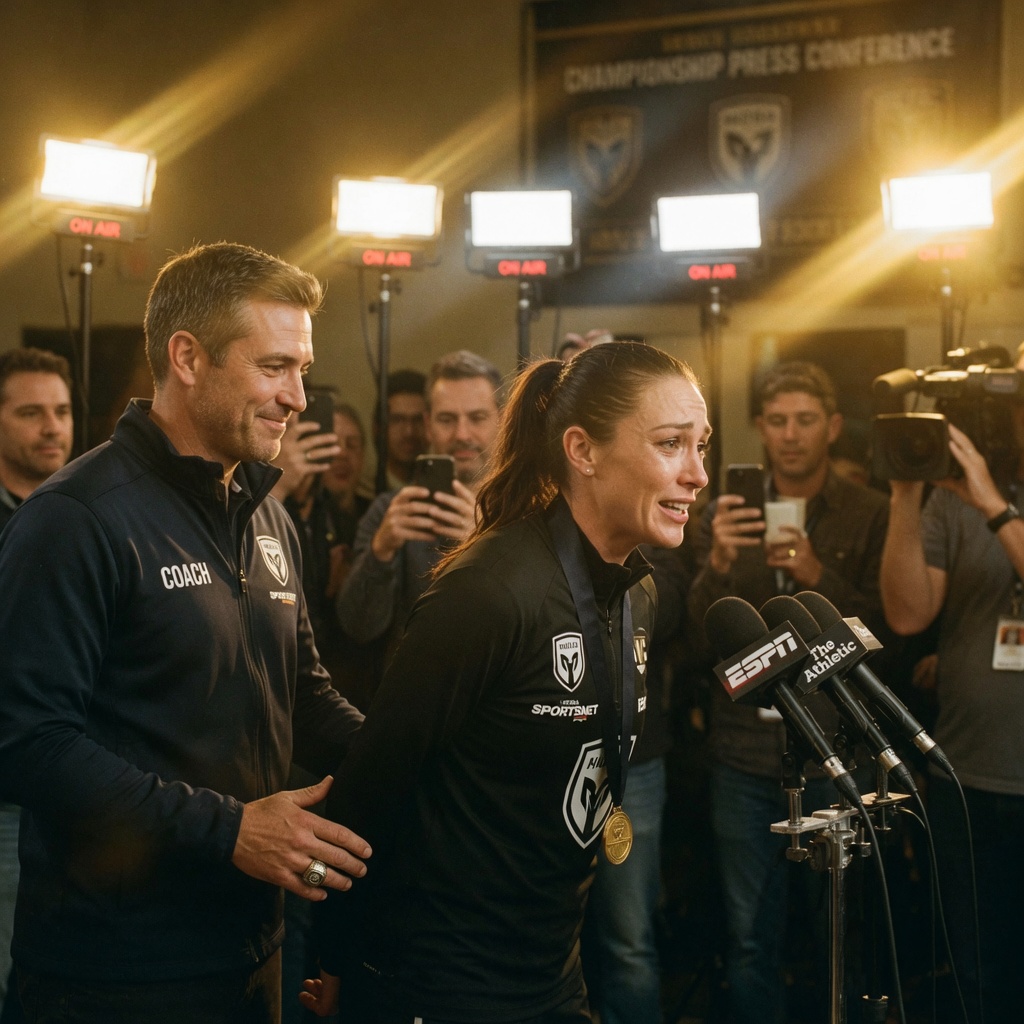
Media day was a cattle call. Twenty pairs, a carpeted ballroom, a bank of lights, and a row of cameras that Talia faced the way she faced a Blizzard warning: with preparation and dread.
The morning's headlines had already landed. Someone had talked. A federation source, unnamed, saying the Vance Marchetti pairing was "an experiment with an expiration date" and that the selection committee "values long-term potential over fragile veterans." Fragile veterans. Two words, deployed with surgical cruelty.
Des read it on his phone in the elevator and went still, which she had learned was his version of fury.
"Okay," he said. "Plan."
"There's no plan. There's just answering questions."
"There's a plan. The plan is: I talk about strategy, you talk about anything, and if anyone uses the word fragile I will "
"You will smile at them," Talia said, "because that's your whole method."
"My method works."
"Your method works on people who want to like you. These people want a fight."
The ballroom was exactly as predicted. The third question, from a man with a shaved head and a smug half smile, was about the leaked quote. "Talia, do you consider yourself fragile?"
The room got that hush of people hoping for blood.
"I consider myself precise," Talia said into the microphone, and her voice did not shake, and she was distantly amazed by that. "I consider my shoulder nine months post-op with full clearance and a better range of motion than the man asking the question has in his typing wrist. And I consider the phrase fragile veterans to be the kind of thing a source says when they've never stood at a hack with something torn and come back anyway, which is the single most common experience in this sport and the least respected. As for long-term potential, you're looking at it. My partner requested me. Write that down."
Silence. Then the man said, "Your partner's sitting right there. Des, does the skip speak for you?"
Des leaned into his microphone. "She speaks for the pair. That's what a skip is. I throw, I sweep, and occasionally I get to stand next to the most prepared athlete in this building and watch her end a narrative in eleven seconds. Best seat in the sport."
The scrum moved on. In the corridor afterward, Talia's hands finally started shaking, the delayed aftershock, and Des wordlessly put her coffee in one of them and stood between her and the wall so the incoming sponsors had to go around him.
"Fragile," she said. "Fragile veterans."
"Terrible phrase. Genuinely, as a writer, hack work."
"I just ended my career with a federation source, probably."
"You just ended a narrative. Different thing. Careers are longer than cycles, and yours isn't close to done." He looked at her. "That was, and I say this with full knowledge of what it costs me to admit, kind of terrifying. In a good way. Like a storm you'd pay to watch from a good porch."
"Did you just call me a storm?"
"I'd take it back but it's accurate."
"You," Talia said, "are a public relations liability and I would like to file a complaint about the pairing." She was smiling. She could feel it happening and could not stop it.
"Complaints go through my agent," Des said. "He's a golden retriever too. It's a whole firm."
Chapter Six: The Power Play
The trials opened Friday morning and the field was brutal. Sixteen pairs, double round robin, top two to nationals, no margin for a cold start. Their first opponent was the reigning national pair, the Okafor twins, who played with the calm of people who had never once doubted their own inheritance.
Talia and Des lost the hammer draw. Lost the first end. Stood at 0-2 down after two and the small crowd, such as it was, hummed with the particular energy of people watching an experiment fail on schedule.
Third end, Talia called the power play.
Des blinked. "Third end? Down two? That's "
"Early, yes. The twins protect corners like it's religion, so we're not going to get an open look later. We take it now and I hit and stick on the pre-positioned stone and we steal the end or we die trying."
"I love dying trying," Des said. "It's on my business cards."
She moved the stones, threw the corner guard with the touch of a safecracker, and Des, sweeping like his arms were on loan, got her hit to stick by a millimeter. The end came apart in their favor, three points, steal, and the hum in the crowd changed key.
They won that game 7-5. They won Friday night's game on a last-stone draw to the button that Talia threw with a hand so steady she wanted to frame it. Saturday they went 3-0. By Saturday night, the narrative had flipped so completely that the same reporter from the hallway wrote a piece headlined The Pair Nobody Wanted, and Talia cut it out of the printed schedule sheet and folded it into her bag and did not mention this to anyone.
Except that Des saw. Des, who noticed everything, saw her fold it, and said nothing, and the nothing was so loud she wanted to kiss him.
Which was a problem. Which was becoming, by the hour, less of a problem and more of a countdown.
"Hey," he said that night, outside the hotel, in the cold, their breath making little clouds. "Crew's going to the late diner. You in?"
"I have ice tape to do."
"You have ice tape to do while eating a grilled cheese. I've seen you do harder things. This week alone."
"Des."
"Yeah?"
"Why are you like this? Genuinely. Where did it come from? Because nobody is like this by accident, and I've been watching you for six days and I cannot find the mechanism."
He was quiet for a moment. The parking lot lights made orange pools on the frost.
"My dad coached junior curling for thirty years," he said. "Never made a national team himself. Bad knees, worse luck. But he believed, like a religion, that the sport gives you back what you put into the room. That if you're good to people, the game gets easier, not harder. He died four years ago, and at the funeral, two hundred curlers showed up, from four decades of teams, and I stood there thinking, this is what you win. Not medals. Rooms full of people who came. So I decided to be a man who fills rooms." He shrugged. "It works about eighty percent of the time. The other twenty percent is you, apparently, standing there with your audit clipboard."
"I don't have a clipboard."
"You have a clipboard energy."
"That's not a real thing."
"It's the realest thing I've ever said." He put his hands in his pockets. "Come to the diner, Talia. Not for the team. For the grilled cheese. The team is a coincidence."
She went. She ate a grilled cheese at one in the morning across from a man who knew the names of every server, and the ice tape took forty minutes and the diner took two hours, and when she got back to her room she sat on the bed and thought, with clinical accuracy, that she was in trouble.
Chapter Seven: The Wobble
Sunday was the last round robin day, four games, and it went wrong in the third one.
Not dramatically. Curling injuries never are. She threw a normal draw, a stone she had thrown ten thousand times, and on the follow-through her shoulder gave her a warning, a hot wire of pain that she recognized the way you recognize a former address. She hid it. She finished the end. She called a timeout in the break and stood in the hallway and breathed through it and decided, in the space of ninety seconds, to lie.
"It's fine," she told Des. "Fatigue. It's fine."
"Your last three draws were two feet heavy."
"I said it's fine."
He looked at her for a long moment. On the ice he would have accepted it. Off the ice, in a hallway that smelled of floor wax and adrenaline, he did not accept it, and the not-accepting was somehow the most respectful thing she had ever been handed.
"Okay," he said. "Then here's what fine looks like. You keep throwing, I keep sweeping, and we adjust the calls so your heaviest shots come early in ends when the ice is still fresh and you're warm. If the shoulder's a two out of ten, tell me two, and I'll build around two. If it's a seven, Talia, you tell me seven, because I'd rather lose a game than watch you lose the shoulder. Say the number."
"Three," she said. And then, because the honesty had a momentum once it started: "Three and a half."
"Three and a half. Got it." He held out his hand for the high five the timer required, and when she took it he didn't let go right away. "Thank you for the number. I know what it cost."
They won that game anyway, ugly, on his sweeping and her guile and a tenth-end steal, and they lost the fourth game, which meant they finished the round robin second overall and advanced to the final on Monday, against the Okafor twins, for the second nationals berth, with a federation delegation in the stands taking notes like appraisers at an estate sale.
That night Talia iced her shoulder in the team medical room and Des sat across from her, filling out the post-game wellness form for her because her arm was dead weight and her handwriting had gone to seed.
"Pain now?" he read.
"Four."
"I'm writing three point five."
"That's falsifying a document."
"It's optimism with a pen. Different department." He finished the form and set it down. "Talia. Tomorrow, if it gets bad, if the shoulder goes, I need you to hear this before the game instead of after. There is no version of tomorrow where you owe the pair your body. If it's a seven, we stop. We lose the final in front of the entire federation and I will stand at the presser and say my partner is the best thrower in this building and the bravest person I've met and that the score is a rounding error next to what she gave this week."
"You can't say that. It'll sound like an excuse."
"It'll sound like the truth. Those aren't the same and I've stopped pretending otherwise." He leaned back in the plastic chair. "Also, unrelated, but I got a call today. The broadcaster wants me for a promo shoot Tuesday morning. Big one. The kind with a lighting budget. And I told them no."
"You told the network no? You, who complimented an ice technician on camera?"
"The shoot conflicts with our recovery session. You think I'm letting a lighting budget have the tap-backs? We have a rebuild to finish. Tuesday is session three of five. I did the math."
"Des, that shoot could set up your whole next year."
"My next year has a person in it," he said, simply. "It's this one, if she'll have me, in a professional capacity, terms and conditions negotiable. The shoot will find me later. Sessions don't wait."
Talia looked at the ceiling of the medical room and negotiated, internally, with the part of herself that had spent nine years keeping the world at brush length.
"Desmond."
"That's my full government name and I'm frightened."
"After nationals, whatever happens Monday, I'd like to keep throwing with you. Through worlds, if we make it. Through the cycle." Her voice was even, mostly. "In a professional capacity to start."
"To start," he repeated, and the grin that came up on him was not the lobby grin, the one for rooms. This one was small and private and it did something structural to her chest. "Yeah, Skip. To start."
Chapter Eight: The Final
The final was a war conducted with brooms.
The Okafors came out sharp, up one, up two, playing the disciplined corner game they'd built their dynasty on, and Talia's shoulder sat at a steady four and she built around it the way Des had taught her to build around a number: heavy shots early, touch shots late, and a partner sweeping the devil out of every stone she threw.
Fifth end, down two without hammer, she called the power play again, and this time the twins were ready, and it failed, and they gave up a steal. 6-3 after five. The federation delegation in the stands had the settled posture of people watching a fragile veteran crack on schedule.
"Hey," Des said at the break, low, just for her. "Sixth and seventh are ours. I've seen this movie. You wrote it."
"You've watched four days of me. You don't know this movie."
"I've watched four days of you," he said, "which is four days more than anyone else bothered, and I know exactly how this movie ends."
The sixth end they forced a double and stole two. The seventh, Talia drew against two with the last stone and buried it to the inch, and Des's celebration nearly dislodged the stone with the vibration of his stomping. 6-5 after seven, hammer theirs.
Eighth end, the Okafors blanked it, and ninth they took one, 7-5, and the tenth end began with Talia's shoulder at a number she did not say out loud.
She threw her first three stones well. Des drew his last one to sit shot behind her guard, buried, and the twins burned their options trying to remove it and settled for a tap that left Talia the last stone, the hammer, the game, everything, with a house full of granite and one narrow lane through the left side.
There were two shots. The safe raise to force an extra end with hammer retained. And the tap-back, through the port, to remove the shot stone and lie two, to win the trials outright, the shot she had rebuilt at midnight with an audience of one.
The crowd noise dropped away. Des crouched at the far house, brush on the ice, and he didn't call either shot. He waited. He let her have it, whole, the way she had never let herself have anything.
She called it to herself, silently: the tap-back. She thought about her grip. Her balance point. The drive of her leg. She thought about a man who had requested her, who had done the math on her healing and refused to charge her for it, and she pushed out of the hack with everything she had.
The stone ran the lane like it had been mailed there. It struck the shot stone flush, removed it clean, and rolled over and stopped, and the second Okafors stone sat a quarter inch farther from the button.
Two points. 7-7. No, wait. The arithmetic resolved in a rush of scoreboard light: 8-7. Vance and Marchetti, national trials champions.
The building came apart. Des came apart. He crossed the eight feet between them at a dead sprint and stopped himself a foot away, hands hovering, the question with eyebrows, and Talia, who had spent a week learning to say the number, said the other thing instead.
"Yes," she said, and pulled him in.
He hugged her carefully, shoulder side lifted clear, and she laughed into his jacket because even at the top of the loudest moment of her life he was building around her number, and that, she understood finally, was not restraint. That was love, already fluent, already speaking her dialect.
"The tap-back," he said into her hair. "The tap-back! In the final! On national "
"Don't narrate."
"I'm narrating forever. It's in my contract now. You signed by hugging me."
Chapter Nine: After
The presser afterward was short and merciful and Talia was, for once, not dreading it, because she had a plan, and the plan was Des's plan, which was the boring true thing.
"Talia, the federation source called your pair an experiment with an expiration date. Response?"
"The experiment," Talia said, "concluded tonight at 8:47 p.m. with a score of eight to seven and a nationals berth, and I'd describe the results as replicable. We'll be running the trial through worlds and, the committee willing, the cycle after. My partner and I have an agreement about longevity."
"Des? Anything to add?"
"Just that I requested her," Des said, "and I'd like the record to show I'd do it again, and that she's not fragile, she's forged, and if the source would like to come to a Tuesday recovery session and watch her throw forty tap-backs, we have coffee and I make a genuinely great playlist."
The room laughed. The federation delegate in the front row did not laugh, but she did write something down, and Talia chose to believe it was a phone number for the training staff.
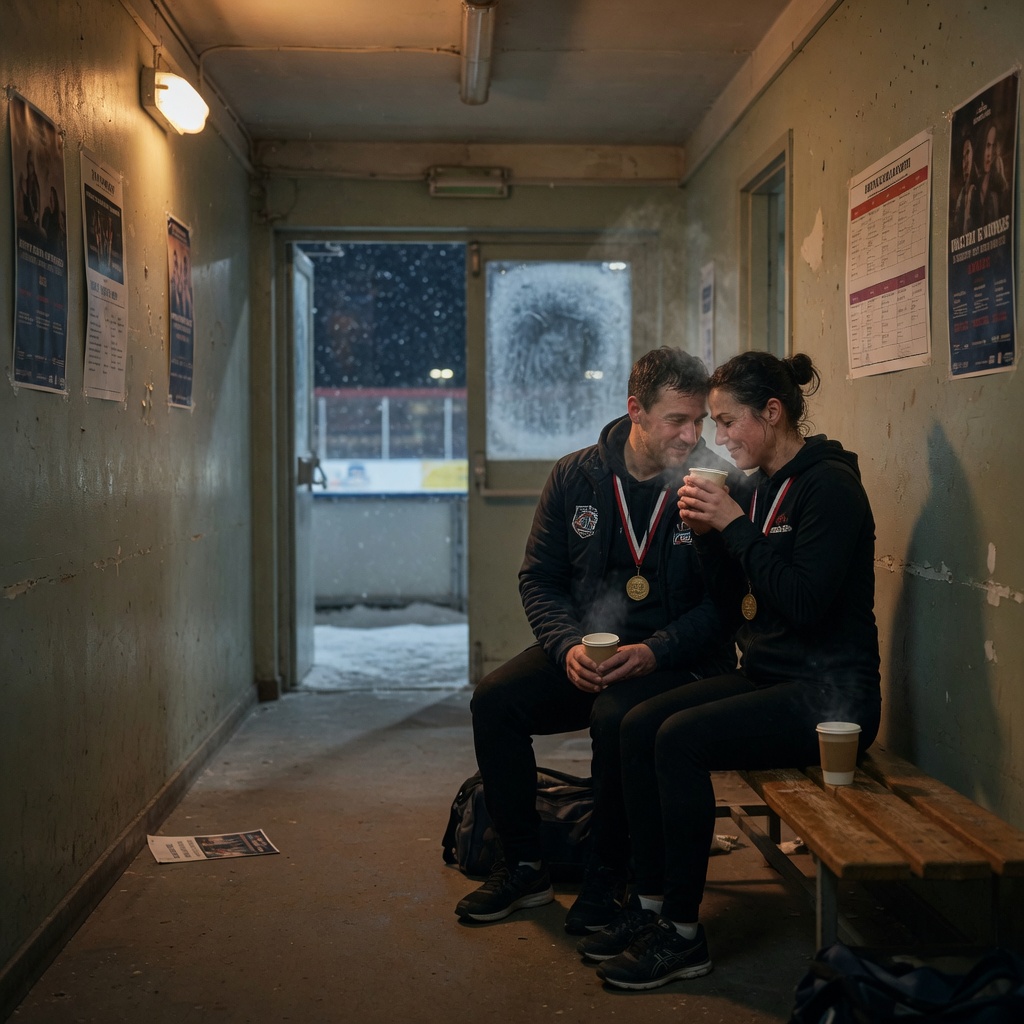
Late that night, medals around their necks, arena emptying, they walked out through the tunnel to the parking lot where the frost had come back and the lights made their orange pools.
"So," Des said. "Terms and conditions."
"Terms and conditions."
"Where are we starting, exactly? You said professional capacity to start. I'd like to propose an amendment. I'd like to propose dinner. Tomorrow. After the recovery session. A real dinner, with a reservation, where I have prepared conversation topics and you have your clipboard."
"I don't have a clipboard."
"Bring it anyway."
"Desmond." She turned to face him. The tunnel light behind him made a halo, which was ridiculous, and accurate. "I've spent nine years being efficient about people. It's the whole personality. You should know what you're getting into."
"Talia." He stepped closer, and the cold made her breath shake, and none of it was the cold. "I've spent my whole life being warm at people. You should know that the first time you almost smiled at me, day two, after the hit-and-rolls, I walked into a door in the locker room. A door I have opened every day for six years. I am not getting out of this. I'm just asking about the reservation."
"Thursday," she said. "Seven o'clock. After session three of five."
"It's a date."
"It's a trial," she said, and then, because the honesty had a momentum once it started and she was done fighting it: "With an extremely long-term outlook. Possibly permanent. The committee will be notified."
Des Marchetti laughed, the sound bouncing down the tunnel like a stone she had finally, finally caught, and kissed her, soft and brief and asked-with-eyebrows even now, and Talia Vance kissed him back and thought that the sport gives you back what you put into the room.
She had put in a tap-back at midnight and a number spoken out loud and a yes in an empty building. What came back was a man who filled rooms, standing in the smallest one, holding her hand like a hammer stone with the game on the line.
Thursday, seven o'clock. Session three of five. The rest of the cycle.
She was already looking forward to the coffee. Black. He'd learn the rest as he went. She'd let him.
Noah Carrington
Noah covers sports romance and forced-proximity heat: rivalries, road trips, and the quiet moment after the crowd goes home.
Leave a comment
Comments