

The Invitation Clause
The Writ of Unmaking
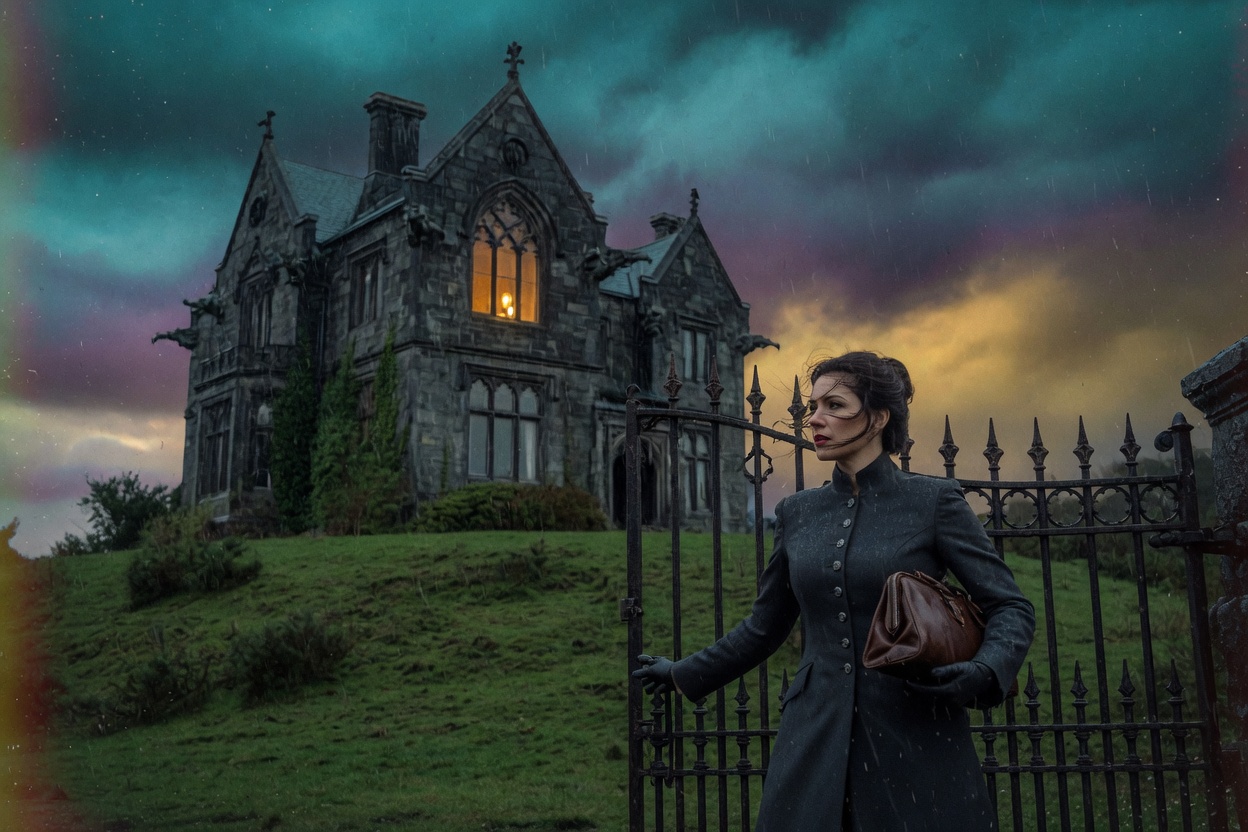
Marisol Vega had stripped the wards off forty-one haunted properties in her six years with the Conclave of Rational Thaumaturgy, and she had never once been met at the door by the monster himself, holding a decanter of wine like a man greeting a rude dinner guest.
"You're late," he said.
"I'm early," she said. "The writ says sundown. The sun is visibly still up." She tipped her chin toward the western sky, where the last orange band of it clung to the hills above Vale Hollow like a stubborn stain. "You just don't like the reminder."
"I dislike being audited," said Aurel Vane. "The sunset is merely personal."
He was taller than the case file suggested, which annoyed her, because she had written the case file's physical description herself from photographs and had mentally edited him down to a crooked old relic. The photographs had lied. He stood in the doorway of Vane House in a dark green sweater with the sleeves pushed up, dark hair swept back from a pale face that was unfairly, architecturally handsome, and his eyes were the flat silver of a coin left out too long in the rain.
She held up the writ. Parchment, wax seal, the Conclave's triple-stamped disapproval. "By order of the Regional Conclave, all pre-modern wards on this property are to be decommissioned within thirty days. Vane House sits on the planned route of the Hollow Line railway. Public good. My jurisdiction. Your cooperation is noted and, frankly, irrelevant."
"The public good," Aurel repeated, tasting the phrase. "Interesting. Who decided the public good requires a manor stripped bare at midnight? My wards are the only reason the hillside hasn't slid into the river. The only reason the village below slept soundly for two hundred years. I made a bargain with this land, Miss Vega. It holds. Nothing you do with your little writ changes what the land and I owe each other."
"Bargains with land are exactly the kind of unregistered covenant the Conclave exists to dissolve." She stepped forward, and he did not move aside, and they stood nose to nose on the threshold in a silence that had teeth in it. "You're in my way."
"I am my own way." He smiled then, and it was not a nice smile, but it was a very good one, and she hated that her pulse noticed. "Miss Vega. I have watched forty Conclave auditors be born, grow old, and retire to seaside cottages. You will forgive me if I do not tremble at the newest one."
"Then you can forgive me," she said, "when I take your house apart one thread at a time."
He stepped back. Only back, never away. "Sundown's here. Do come in. The house will insist."
She stepped across the threshold. The wards shivered under her fingers like a struck harp string, and somewhere deep in the stone, something old took her name and wrote it down.
The Auditor's Ledger
Aurel watched her walk his great hall like a woman walking into an argument she intended to win, and he found, to his considerable irritation, that he wanted to watch her do it.
She was not what the Conclave usually sent. The others came in armored in bureaucracy, all clipboards and gray robes and fear they pretended was procedure. This one wore a charcoal coat and boots that had actually walked somewhere, and her dark hair was pinned up with what appeared to be a silver knitting needle that was, on closer inspection, a wand of old Conclave steel. She opened a leather ledger and began drawing the house's wards in ink, line by line, humming under her breath a tune he hadn't heard since it was fashionable.
"You hum," he said. "Most auditors pray."
"Praying is for people who think the house might win." She didn't look up. "Your outer perimeter is a Leyden lattice. Pre-1800. Improvised from a storm-catcher. That's actually clever, which offends me, because it's also illegal. Unregistered covenant, subsection nine."
"Clever things are usually illegal. That is why they're clever." He poured two glasses of wine anyway, because his mother had raised him with manners before she'd raised him from the ground. "Your lattice assumptions will fail, incidentally. The storm-catcher draws on the hill's weather, and this hill has moods."
"So I've read. Your file is four hundred pages."
"I wrote two hundred of them myself, to waste your time."
She looked up at that, and for the first time she smiled fully, and the smile was sharper than the writ. "You wrote four hundred pages of lies to slow down a thirty-day audit."
"One hundred and eighty pages of lies," he corrected. "The rest is true, which is worse for me."
Something in his chest did a small, traitorous flip at her laugh, one short bark of it, quickly strangled. He turned away to fuss with the fire, which did not need fussing, and reminded himself of three facts. One: the Conclave's dissolution of wards was how the Order of the Pale Sun had found his maker, in 1849, and burned a house with eleven of his blood-kin inside it. Two: he had rebuilt Vane House's defenses himself, stone by stone, over a century, and he would not hand them to a smiling bureaucrat with a steel wand. Three: she had a pulse, warm and quick, and he had been alone on this hill long enough that a pulse was a dangerous thing to notice.
"The wine is a bribe," she said, appearing at his elbow and taking the glass anyway.
"Everything is a bribe. I've been alive three hundred and eleven years. That is the single consistent law of the species."
"Mm. And what does the species say about working with the auditor instead of against her?" She took a sip and her eyebrows lifted despite herself. "This is bribing me very successfully, for the record."
He should have said no. He catalogued all the reasons to say no, in the order the dead would have listed them, and then he heard himself say, "Tomorrow, sundown, the east wing. If you're going to unmake my life's work, the least I can do is make you do it in front of me."
"How romantic," she said, deadpan, and wrote something in her ledger that he very much wanted to read and was never going to be allowed to.
East Wing, Third Sundown
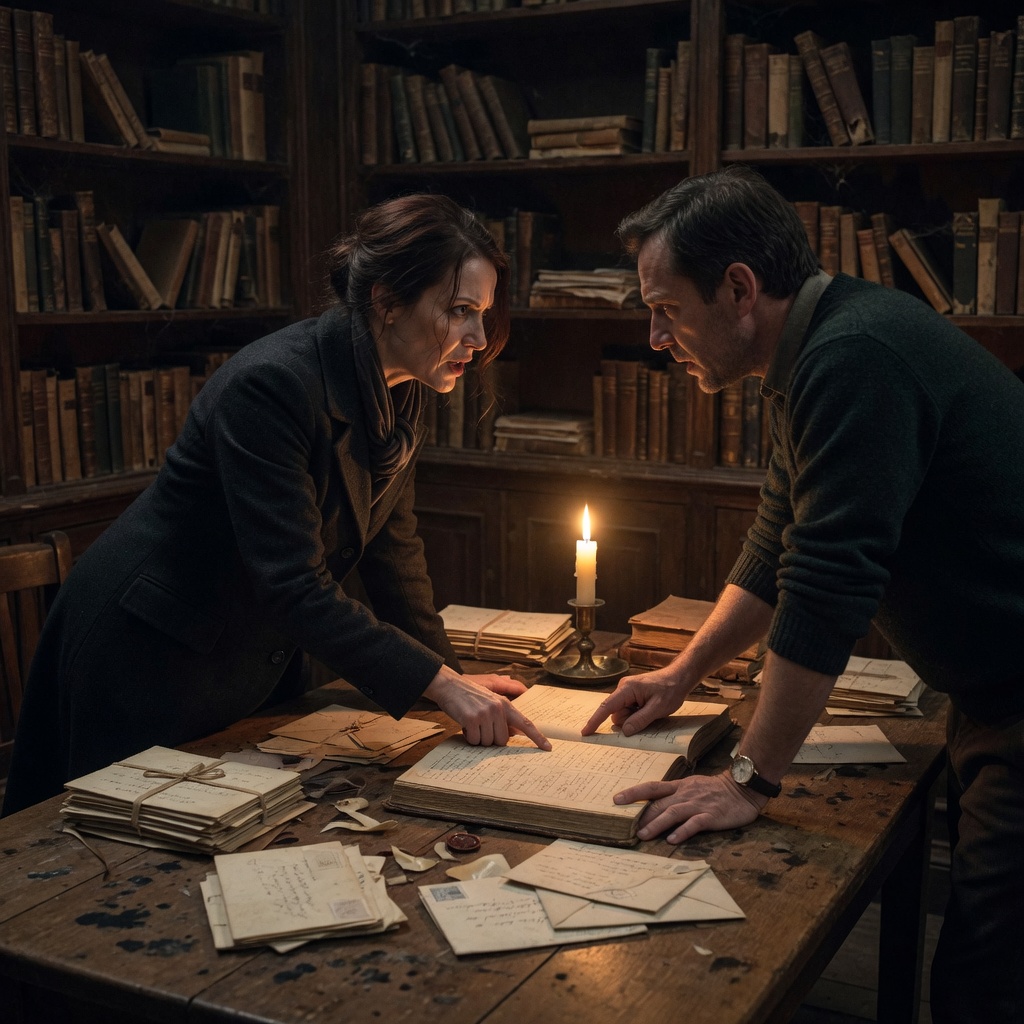
By the third sundown they had a system, which was the most dangerous thing that had happened to either of them in a century.
She drew a ward, he dissected it. He defended a covenant, she dismantled it with subsection citations he began, disgustingly, to admire. The east wing's library filled with candle smoke and the smell of ink and the specific electricity of two competent people who would rather die than concede a point.
"The river covenant is load-bearing," Aurel said, tapping the map. "You dissolve it, and the spring floods take the eastern cellar. There are four hundred years of letters in that cellar. My maker's letters. My own, from when I was alive."
"Then register the covenant," Marisol said. "Filing it protects it. The Conclave doesn't dissolve registered covenants, it certifies them."
"Registering means the Conclave reads them." His voice went flat, and she heard the flatness, because she was unfortunately perceptive as well as annoying. "The letters are private."
"Private things get people killed," she said. "My grandmother hid a working from the Conclave. Unregistered. When the Pale Sun raid came through her valley, they burned her for the working and her neighbor for knowing about it. I was eleven. So don't lecture me about the value of privacy." She said it fast and ugly and then stopped, visibly furious at herself for having said it at all.
"Marisol." He used her first name for the first time. It felt like picking up a live coal. "I am sorry. That is an unforgivable thing to have seen."
"It's not unforgivable. It's Tuesday, for people like us." She steadied her pen. "The point is, I'm not the Pale Sun. The Conclave reformed. Registration protects now. It's not perfect, but it's the best system anyone's built, and I've spent six years making it better, one filing at a time, because if it's rigid and transparent, then nobody burns for what they love."
"And what do you love?" he asked, before his three hundred years of manners could stop him.
"Order," she said. "What do you love?"
"My letters," he said. "And, lately, watching you lose arguments to my east wall."
"I have not lost a single argument to your east wall."
"The east wall and I count differently." He slid the map toward her, and his hand crossed the candlelight into her half of the table, and neither of them mentioned it, and neither of them moved it back.
The Rule of Doors
On the fifth night, she asked him about the Clause, because it was in his file and she was contractually obligated to verify every clause, and this one made the Conclave's scribes uneasy.
"The Invitation Clause," she said. "Walk me through it."
"There's nothing to walk. It's the oldest law of my kind and it isn't negotiable." He stood at the window, watching the hill. "A vampire cannot cross a dwelling's threshold uninvited. But once invited, the invitation is permanent. It cannot be revoked. Not by the host, not by the vampire, not by death, not by sale of the property, not by anything under heaven. It binds."
"Permanently binds the vampire to the house?"
"To the household." He turned. "To the person who spoke the words. An invitation from a host weaves into the blood. If the host dies while the invitation stands, the vampire feels it. Every night. For as long as the vampire exists. It is, I'm told, like wearing a wound that never closes. Which is why my kind are careful whom we ask to let us in."
She wrote it in her ledger, and then she looked up, and there was something in her face he couldn't read. "You invited me in, that first night. Sundown's here, do come in."
"I did," he said.
"Why? You knew what I was there to do. You had every reason to lock the door."
He considered lying. He had a lifetime's practice. "Because you would have found a way in eventually, and I wanted to be the one who opened it."
She held his eyes for three full seconds. Then she said, "Noted," and wrote one more line in the ledger, and shut it harder than the sentence required, and they both pretended the room hadn't just changed shape.
What he did not tell her, what he had told no one in a hundred and seventy years, was the other half of the Clause. The clause that if an invitation is spoken twice, freely, by a host who means it in their heart, the binding runs the other way too, and the host feels the vampire's death just as the vampire feels the host's. A doubled invitation is a knot. He had watched it done once, in 1849, by his maker and her human husband, six months before the Pale Sun burned them together in the same fire. He had stood outside the burning house, uninvited, forever, and listened.
He was not going to make that mistake. He was not going to say it twice.
He was already, at the fifth sundown, fairly certain he wanted to.
The Crack
It happened on the eleventh night, and it happened because of the cellar.
The dissolution was going well, which was the problem. The eastern cellar's river covenant had to be dissolved before it could be re-registered, and the dissolved hours were the vulnerable hours, and Marisol had scheduled the work for a full moon because the lattice held best in moonlight. She had not scheduled the landslide warning, which came in at dusk over her Conclave wire: three days of rain upstream, the river swollen, the hillside's old scars flexing.
"Cancel it," Aurel said, when she told him.
"Can't. The writ timeline. If I slip thirty days the Conclave reassigns the audit, and the next auditor won't spend a night in the library arguing about your letters. They'll dissolve everything and file nothing."
"Then I'll go down and hold the hill myself. The river covenant responds to me. It always has."
"The covenant won't be there. I dissolved the anchor at noon, it reinstates at dawn. That's twelve hours of naked hillside." She was already pulling on her coat. "So I'm going down to the cellar to hold the anchor line manually. It's a two-person working and you're coming with me."
"The cellar floods from the river side. If the wall gives while we're in there."
"Then you'll be very sad and I'll be very dead, so let's not be in there when it gives. Anchor line. Twelve hours. I need someone who can go all night without getting tired."
He looked at her for a long moment. "You are going to be the death of me, and I am three hundred years too old to find that charming."
"You find it a little charming."
"I find it somewhat charming," he conceded, and followed her down.
The cellar held four hundred years of letters in oilcloth and cedar, and it held two people and a candle and an anchor line of braided silver, and from midnight until nearly dawn it held the sound of the river eating the far wall. Marisol fed the line steadily, hands raw, voice hoarse from the working, and Aurel stood with his palms flat against the wet stone, holding the hill the way he had held it for two centuries, and somewhere around three in the morning he understood that he was not holding the hill. He was holding her. The covenant was a fiction he told the river. What he was actually doing was keeping one stubborn, exhausted, extraordinarily brave woman alive in a hole in the ground.
"Talk to me," she said at four, slurring with fatigue. "If I stop talking I'll stop working."
"What shall I talk about."
"Anything true."
"In 1849," he said, "the Pale Sun burned my maker's house with eleven of my kin inside. The Conclave's ward audit had been leaked to them. That is why Vane House has four hundred pages of file. That is why I built the storm-catcher lattice myself, with my hands. I promised the dead I would never again let anyone map my defenses." He heard her hands still on the line. "I have spent one hundred and seventy years keeping that promise. And six days ago I let you walk in and start drawing."
Marisol's voice, when it came, was careful. "Why did you let me?"
"Because when you walked up the hill, you weren't afraid of me. Everyone is afraid of me. You were annoyed with me. It was," he said, "the most alive I have felt since the fire."
She turned her head against the stone wall and looked at him across the candlelight, riverwater seeping somewhere below, and her eyes were wet and furious about being wet. "Don't," she said. "Don't say things like that when I'm holding a covenant line. I can't afford to feel things right now."
"You started it. Anything true, you said."
"I hate you," she said, which was transparently no longer true, and they both knew it, and she went back to the line, and he went back to the hill, and neither of them said another true thing for the remaining two hours, which was its own kind of conversation.
The Order of the Pale Sun
They surfaced at dawn, filthy, alive, and changed, and the change lasted four days before the world noticed.
It noticed on the fifteenth night, in the form of a woman in a white coat standing at the iron gate with an old-fashioned lantern, an emblem of a sun stamped in ash on her breast, and a smile Marisol had last seen on the worst day of her childhood.
"Warden Slee," Marisol said, from the doorway, every muscle cold. The Pale Sun had never fully dissolved, whatever the Conclave brochures claimed. It had gone quiet, gone underground, gone to wearing nicer coats.
"Auditor Vega." Warden Slee's voice was warm as a hospital. "You've been cataloguing the Vane collection for fifteen days. I'd like the inventory. The lattice work, the letter vault, the resident's feeding schedule. The Order will pay the Conclave rate and a little extra for the inconvenience."
"The Conclave doesn't sell inventories."
"The Conclave doesn't know you're being paid to look the other way while a predator keeps a private library of compulsion techniques." Slee tilted her head. "Or did you think nobody noticed the auditor hums? Your grandmother hummed too, I'm told, the night we came for her working."
Marisol's hand found the doorframe. Behind her, in the dark of the hall, she could feel Aurel standing utterly still, listening, and she knew that if she stepped aside even an inch, Slee did not leave this gate. "The inventory stays with the Conclave," she said. "Get off this hill."
"Invitations are permanent, you know," Slee said pleasantly. "Yours. His. We know what you are to each other by now, Miss Vega, we've been reading your wire for days. And the Order has a very simple position on creatures who bind themselves to Conclave personnel." She raised the lantern so the light crossed the threshold and touched the hall. "We don't need to get in. We just need to know where the binding is strongest. That's tonight. Sleep well."
She turned and went down the hill, and Marisol shut the door, and stood with her back against it, shaking, and Aurel was there in the sudden way of his kind, not touching her, just near, silver eyes going over her face like he was auditing her.
"She's not bluffing," Marisol said. "The binding, the house, it's a beacon. Any tracker with old Sun methodology can find the knot of an invitation and pull the thread. They'll collapse the wards through the binding itself. They'll come through me."
"Then we leave."
"I can't leave, Aurel, the audit, the cellar, the hill."
"The hill will keep." His voice was doing something she'd never heard it do. It was frightened. "Marisol. Listen to me. There is a way to cut the beacon. You revoke the invitation."
"You told me it can't be revoked."
"It can't. I told you the truth. But there's an older form, a severance, and I know it, and if you speak it I will feel it for the rest of my existence, which is potentially quite long, and you will be free, unbound, invisible to them. I will lose you from my blood but you will be alive, and alive is the only version of you I require." He said it fast, like a man dismantling a bomb in a burning room, and it took her three full seconds to understand what he was offering.
"No," she said.
"Marisol."
"No. You don't get to volunteer for a wound that never closes. I've seen what that does to people. I watched my grandmother's whole valley wear it." Her voice cracked and she hated it and kept going. "There has to be another way."
"There is one other way," he said, very quietly, "and I have sworn for one hundred and seventy years never to use it."
"Tell me anyway."
The Second Invitation
"The Clause runs both ways," he said, "if it's spoken twice."
He told her all of it. The doubled invitation, the knot that runs in both directions, the host who feels the vampire's death, the maker and her husband and the fire and what he had listened to through the door of a house he could not enter. He told her the methodology the Pale Sun used was precisely to sever a one-way binding, and that a doubled binding could not be severed from outside, because a knot with two living hands on it has no loose end. They could track a one-way invitation like a scent. A two-way one was closed. Hermetic. The oldest shield his kind knew, and almost no one used it, because it meant consenting to feel each other die.
"So the shield is love," Marisol said. "The entire defensive capability of your species is love, and your whole civilization decided that was too expensive."
"Our civilization," said Aurel, "is not known for its healthy decisions."
"And if you die, I feel it. For how long?"
"However long you live. And if you die, I feel it forever. That's the price. That's why I offered the severance first." His jaw was tight. "I will not ask you for this. I want to be clear that I am not asking. I am telling you what exists, and then I am going to start packing your bag."
"You are the most infuriating man I have ever audited."
"You have audited forty-one properties."
"And you're the most infuriating thing in all of them." She crossed the hall to him, close enough that she could see the coin-silver of his eyes doing something unsteady. "Say it anyway. If we do this, it isn't a tactical filing, it isn't a covenant, it isn't you deciding for me. It's me deciding. Both of us. Out loud. Because that's the whole point of everything I do, Aurel. Nobody burns for what they love if the choice is open and on the record."
"Marisol," he said, and his voice was not flat now, it was ruined, three hundred years of it coming apart at the seams, "I would rather feel your death for eternity than spend one night of it not knowing if you lived. Let me in. Again. For real."
She took his face in both hands, and his breath, such as it was, stopped.
"Come in," she said. "Aurel Vane, come in. I mean it in my heart. I have meant it since the cellar."
He made a sound that was not quite a word, and the whole house answered. Every ward she had spent fifteen days dissolving flared back to life at once, brighter, the doubled knot closing through them like a bell through water, and she felt him, suddenly, everywhere, the cold and the patience and the terrible stubborn care of him, and he felt her, the humming, the fury, the grandmother and the ledger and the eleven-year-old girl who had decided no one else would burn, and they stood in the hall holding the fact of each other like people surfacing from deep water.
"Oh," she said, weakly. "That's a lot."
"You get used to it," he said, unsteadily. "I am given to understand one does not, ever, actually get used to it. I may have been misinformed by everyone who described it."
She laughed, and this time she didn't strangle it, and he felt the laugh from the inside, and had to sit down on the bottom stair about it, which was undignified, and which neither of them cared about at all.
What the Pale Sun Found
The Order of the Pale Sun came at three in the morning with four trackers and a severance rig that smelled of burnt hair and old churches, and Warden Slee walked up to the gate confident as Sunday.
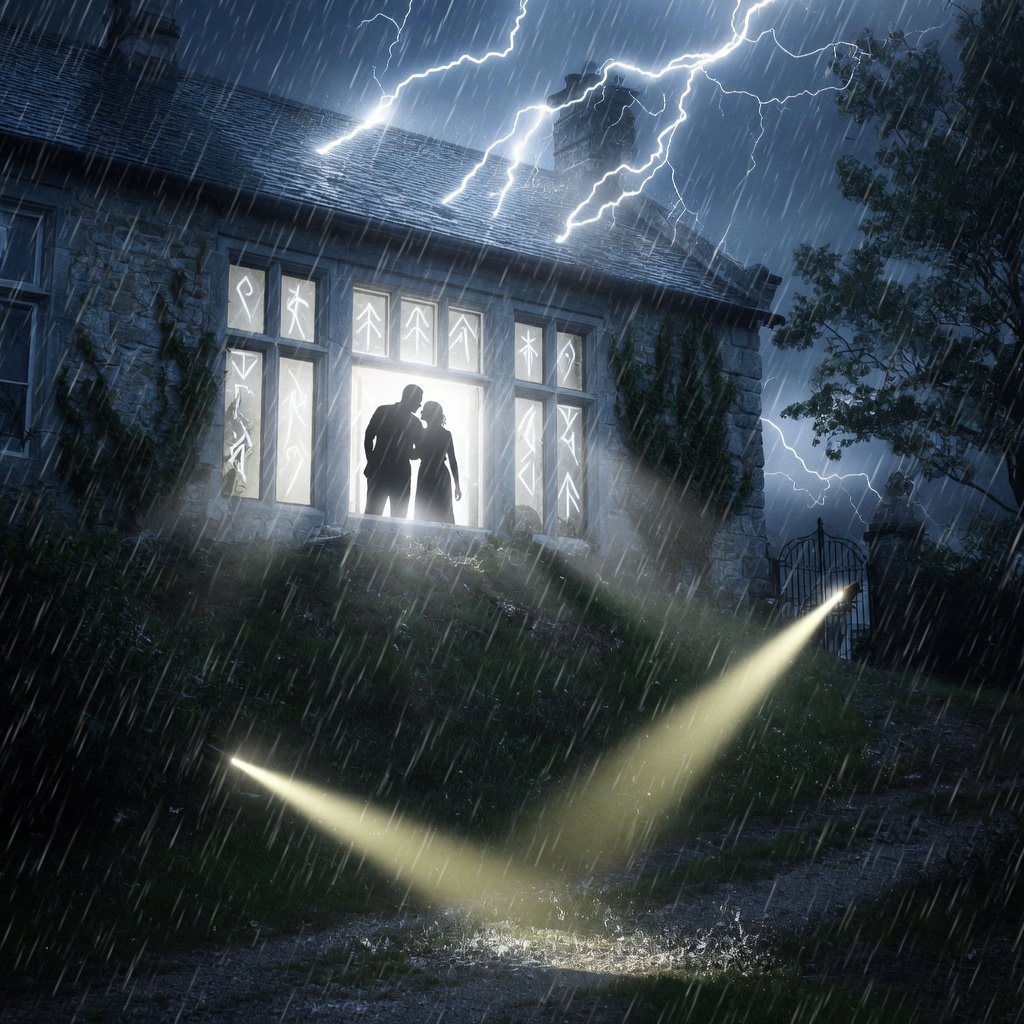
They found a house with no seams. They found a binding that did not point anywhere, a knot with no loose end, wards that answered to two hearts at once and could not be collapsed through either. One of the trackers, a nervous young man with chalk on his fingers, tried the standard pull three times, and on the third attempt the storm-catcher lattice took the hill's weather personally and emptied a month of accumulated mood on the gate in eleven seconds of cold vertical rain.
"They've doubled it," the tracker said, from inside his hood. "Warden, they've doubled the invitation. There's nothing to sever. There's nothing to follow. The whole property is closed."
Slee stood in the downpour and looked up at the lit windows, where, if she had eyes good enough, which she did not, she would have seen two silhouettes standing close together at the glass, entirely unhurried, watching the rain like people watching a fireworks display organized on their behalf.
"The Conclave will hear of your unauthorized visit," said the voice of Marisol Vega, projected through the storm with a warden-grade amplification working that Slee had no idea an auditor could do. "Recorded, timestamped, filed under subsection nine. Registration protects, Warden. That's the whole point. Nobody burns for what they love."
Slee looked at the house, and the house looked back with four hundred pages of legally registered, Conclave-certified, doubled-knot, ironclad nothing-to-steal, and she did what bullies do when the math changes. She left.
The Filing
The Conclave hearing, three weeks later, lasted ninety minutes and would have gone badly for everyone if Marisol had not arrived with four hundred pages of registered covenant, a warden-grade assault documented to the minute, and an audit report that read, in part: Vane House wards assessed as pre-modern but exemplary. Recommended disposition: certification in full. Note on the resident: I would like the record to reflect that I began this audit intending to dismantle his life's work, and am ending it as co-author of it. The Conclave should hire more of whatever this was.
"This last paragraph is unprofessional," said the Chief Registrar.
"This last paragraph," said Marisol, "is the only true thing in the file that I didn't write under duress."
The certification passed. The river covenant was registered, the cellar sealed and protected, the Hollow Line routed politely around the hill because the hill, it turned out, was load-bearing in more ways than one. And on the first free night after the hearing, Aurel Vane found Marisol Vega in the east wing library, at their table, under their candles, and set down a glass of wine and a single sheet of paper.
"What's this," she said, not looking up from her ledger, because she knew exactly what it was, because she could feel him coming down the hall for the last thirty seconds, which was going to take considerable getting used to, and she never wanted to get used to it.
"A letter. My own, from when I was alive. The only one I've never shown anyone. I'm showing you." He sat down across from her. "You said private things get people killed. I've decided to gamble on the alternative."
She read it. It was short. It was about his mother, and a garden, and the last ordinary afternoon before everything. When she looked up, her eyes were bright and her voice was wrecked and her face was doing something it had never once done in a professional setting.
"I have a filing for you," she managed.
"Do you."
"I, Marisol Vega, host of record, hereby invite you, Aurel Vane, into my apartment in the city. Permanently. The rent is outrageous and the radiator screams. I mean it in my heart. I've meant it since you sat down on the stairs."
He was quiet for a moment. "You understand what you've just done. If that radiator ever kills you, I will feel it for eternity."
"Then you'd better help me fix the radiator," said Marisol Vega, curse auditor, humming, and reached across the candlelight for his hand, and did not move it back.
The End.

Cade Ellison
Cade specializes in romantasy and paranormal romance: magic systems with rules, courts with knives, and longing that rearranges destinies.
Leave a comment
Comments