





The Repair of Small Hours
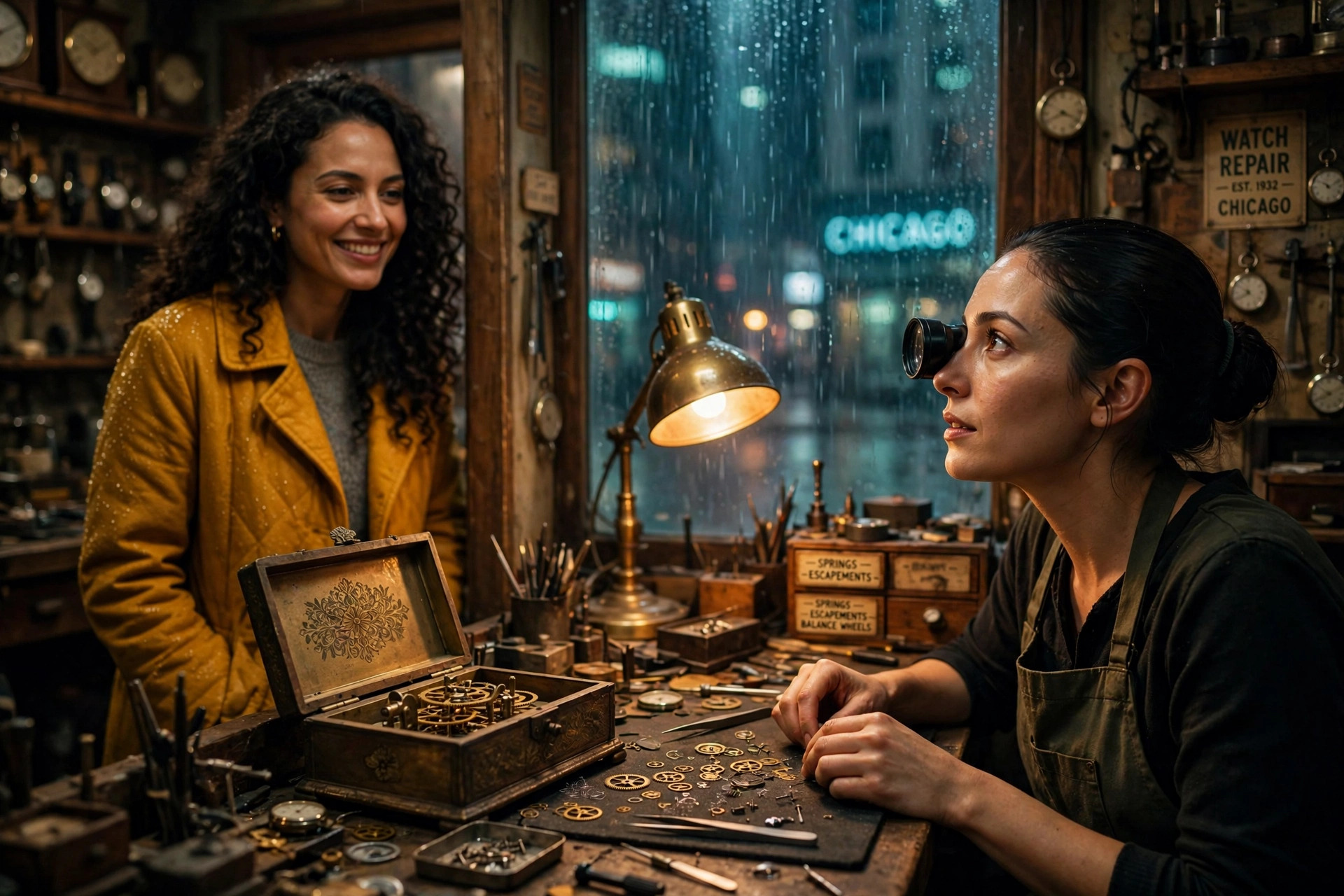
People in Chicago will tell you that love finds you when you least expect it, and Marisol Vega had a professional opinion about that: love, like a quartz movement, was cheap, battery operated, and likely to die on you in two years. Which was why, when the bell over her shop door rang at nine minutes past seven on a Tuesday evening, announcing the last customer she had any intention of serving, she did not look up from her loupe.
"Excuse me," said a voice like a warm kitchen. "Are you open? The little sign says closed, but the light says open, and honestly the light seemed more trustworthy."
"The sign is accurate," Marisol said. "We close at seven."
"It is nine minutes past seven," the voice agreed, and she heard the smile in it, which was annoying. "So you've been open for me for nine whole minutes. That's very generous of you."
Marisol set down her tweezers with the deliberate care of a woman counting to ten. She looked up.
The woman in her doorway was holding a shoebox the way people hold shoeboxes containing things they love, which is to say with both hands and a certain held breath. She was maybe thirty, with curly dark hair escaping a scrunchie, flour on one sleeve, and the kind of face that looked like it apologized to furniture when it bumped into it. Her coat was the color of marigolds. Nobody over the age of six should own a marigold coat, Marisol thought, and then caught herself noticing that the color did extraordinary things for her eyes.
"I know it's late," the woman said. "But my grandmother's music box stopped singing, and she's moving into assisted living on Friday, and I thought, fix-it shops close at seven, everyone closes at seven, this whole city closes at seven, but maybe, just maybe." She ran out of sentence and stood there, breathing a little hard, hope coming off her in waves.
Marisol sighed. It was a sigh she had practiced, one that communicated that she was doing this under protest and the protest would be noted in the file. "Put it on the counter."
The smile the woman produced could have powered a small grid. "You're my favorite person in Chicago and I don't even know your name."
"That seems premature."
"Theo," the woman said, sticking out a floury hand, then reconsidering and wiping it on her coat first. "Theo Marchetti. I own the flower shop three doors down. Bloom Theory? You've probably seen the ridiculous awning."
Marisol had seen the ridiculous awning. It was pink. It had a winking cartoon daisy on it. It offended her on a structural level. "Marisol Vega," she said. "Vega Watch and Clock."
"I know," Theo said. "Your sign is very elegant. Very restrained. Very you, probably. We're neighbors and I've never come in because I was raised not to bother people at work, which, now that I'm bothering you at work, I realize was a good instinct."
Marisol opened the shoebox. Inside, nested in a dish towel printed with lemons, was a small wooden music box, walnut, with a hand-carved lid. The brass key was taped to the bottom. She lifted it out and turned it over with a care she had not used on anything all day, and something in her chest shifted, the way a mainspring shifts when it catches.
"Swiss movement, probably Repertoire style, but the case is handmade," she said. "Somebody made this. Somebody who loved the person they gave it to."
"My grandfather made it," Theo said softly. "For my grandmother, the year they got married. Sixty-one years ago."
Marisol looked at the box again. Sixty-one years of being wound. Sixty-one years of a song played so many times it wore grooves into a family. "I can have it by Friday," she said. "No promises on the song. The cylinder teeth wear."
"It doesn't have to be perfect," Theo said. "It just has to play. She hums it when she can't sleep. If it plays, she'll know the way home."
And that was the problem with this job, Marisol thought later, alone at her bench at midnight, the music box open under her lamp like a patient on a table. The problem was that people came in with their whole hearts in shoeboxes, and she had to touch them.
One: The Inventory of a Closed Heart
Marisol Vega had a system for everything, and the system was the point. She woke at five forty, drank black coffee standing up, opened the shop at nine, and worked until her eyes ached. She did not do lunch with other shop owners. She did not do the street fair committee, the business association, or the group chat that Theo Marchetti had somehow added her to, which she had muted within four minutes.
The system existed for good reasons. Her father had built this shop with his hands, had fixed the clocks of half of Logan Square with his hands, and had died at his bench with a mainspring in his tweezers and no note, no warning, nothing but an unpaid invoice for a mantel clock that was still, eight years later, sitting on shelf nine with a tag that said HOLD. Marisol had inherited the shop, the debt, the city's sympathy, and a deep and abiding belief that if you let people in, they left anyway, and they left you the invoice.
So: the system. Repair tickets, not conversations. Estimates, not small talk. The door locked at seven sharp, and the hours after seven belonged to the work, which never left, which never smiled at you and moved to Scottsdale.
Except that the music box would not cooperate. She cleaned the movement, dressed the pivots, and tested the cylinder. The comb played four notes, buzzed, and stopped, like a singer with stage fright. She would need to true two teeth on the cylinder, which meant fabricating, which meant the lathe, which meant the small hours.
Which was fine. She liked the small hours. The small hours didn't want anything from her.
At eleven the next morning, the bell rang and Theo came in with a small jar of yellow tulips and the expression of a woman committing a crime she felt great about.
"Before you say anything," Theo said, setting the jar on the counter next to the register, "these are for the counter. Not for you. For the counter. The counter looked cold."
"The counter is wood," Marisol said. "It has no feelings."
"The counter gives off an energy, Marisol. And the energy is lonely."
"Please don't put a name to my loneliness. It hasn't earned that."
But she took the tulips when Theo left. She put them in the back room, out of sight of the counter, where she could see them through the doorway, which was a completely different thing than having flowers on the counter, and she did not examine why she kept glancing up at the yellow.
The flower shop, she learned despite herself, operated at a volume. Theo played music in the mornings, old soul records, and she talked to her customers the way other people talk to old friends, and twice a week a van came and the whole sidewalk smelled like a garden that had been told wonderful news. Marisol's shop, by contrast, was a place of hushed ticks and the tiny grammar of springs. She had believed she preferred it that way. She was beginning to suspect she had simply gotten good at the quiet.
Two: A Study in Yellow
On Thursday Theo came in with two coffees and a paper bag and said, "I brought you a guava and cheese pastry because you strike me as a guava person, and if I'm wrong, I'll eat it myself and bring you something else, so really it's a foolproof system."
"You don't have to feed me," Marisol said. "I'm not a stray."
"Everyone's a stray," Theo said, putting the coffee down. "Some of us just have better coats." She gestured at her own marigold coat. "See? Resource management."
Marisol drank the coffee. It was perfect, which was irritating. "Why are you here. You have a store. With customers. Who presumably pay you."
"I have a very competent assistant named Priya who is holding the fort, and I have a theory," Theo said, "that grumpy people aren't actually grumpy. They're just people whose day hasn't been improved in a while, and nobody wants to be the one to go first."
"That's not a theory, that's a fortune cookie."
"Fortune cookies are correct at an alarming rate." Theo leaned on the counter, and the light from the window caught her, and Marisol noticed, in the way she noticed a hairspring out of true, that Theo had a tiny scar through one eyebrow and that she wanted, unreasonably, to know the story. "Did you finish the teeth? On the cylinder?"
Something in Marisol unclenched, just slightly, at being asked about the work. Nobody asked about the work. People asked when it would be ready and what it would cost. "Two teeth done. One to go. The music should be close to pitch by tomorrow."
"Can I hear it? When it's done? Before she gets it?" Theo's voice went careful. "I haven't heard it since I was nine. I used to sneak into her room and wind it and she'd pretend to be asleep, and when my grandfather died she stopped winding it, and I think that's when it stopped, I think it just waited."
Marisol looked at the box on her bench, open under the lamp, its brass cylinder catching the light. Sixty-one years of a song, and a woman who hummed it to find her way home in the dark. "Friday," she said. "Before noon. You can hear it here."
Theo's whole face did something complicated and bright. "Okay," she said. "Okay. I'm going to go pretend I have dust in my eye. Excuse me." She did not have dust in her eye. She left anyway, and the bell rang behind her, and Marisol stood in her hushed shop with a guava crumb on her thumb and the distinct feeling that her system had developed a leak.
Three: The Soft Competence
Friday, eleven forty. Theo arrived with no flowers, no coffee, no pastry, just herself, wringing her hands, and Marisol almost preferred it, because it meant this wasn't a transaction. She set the music box on a velvet pad in the middle of the counter and stepped back.
"You do it," she said, and held out the key.
Theo's hands shook. She wound it, three turns, four, and Marisol said, "That's enough," and Theo let go of the key like it was hot.
The box began to play.
It was an old waltz, something with a name nobody remembered, and the note that had buzzed now rang true, and the two repaired teeth held, and the little comb walked up the melody like someone climbing familiar stairs in the dark. Theo made a sound that was half laugh and half something else, and pressed both hands over her mouth, and cried, openly, without apology, in the middle of Vega Watch and Clock.
"It sounds like being nine," she said finally. "It sounds exactly like being nine."
"The pitch is within a few cents of where it likely started," Marisol said, and then stopped, because Theo was looking at her with an expression of such naked gratitude that the sentence died of exposure.
"You fixed sixty-one years," Theo said. "Do you understand what you do? You don't fix boxes. You fix the distance between then and now. You gave my grandmother her song back."
"I trued two teeth," Marisol said. "It's clockwork, not a miracle."
"It's both," Theo said, "it's both, that's my whole point," and she reached out and took Marisol's hand, the one still faintly stained with brass polish, and held it for exactly three seconds, and said, "Okay. Okay. I have to go before I cry on your counter. Your counter's had a big week."
After she left, Marisol looked at her hand. She looked at it for a long time. Then she got the mantel clock down from shelf nine, the one with the tag that said HOLD, the one her father had never finished and she had never been able to touch, and she set it on her bench, and she did not open it. But she looked at it. That was new.
Four: The Rhythm Section
After that, it got away from her, the way songs do.
Theo came by on Tuesdays with pastries and on Fridays with nothing but conversation, and Marisol found, to her professional irritation, that she had started keeping track. She learned that Theo woke at four thirty in season because florists are secretly farmers, that she had a brother in Austin she missed with a physical ache, that she talked to her plants by name and the fiddle leaf fig was named Duke and had opinions. She learned that Theo's laugh had two settings, one for company and one that escaped when something was truly funny, and that Marisol had begun engineering for the second one.
"You did that on purpose," Theo accused her one Friday, wiping her eyes after Marisol had described a customer who'd wanted a pocket watch engraved with the phrase TIME IS A FLAT CIRCLE AND SO AM I. "You made a joke. Voluntarily. I'm putting it in the newsletter."
"There's no newsletter."
"There's a newsletter. Priya runs it. You're a headline."
In exchange, Theo learned things Marisol had never handed out. That the shop had been her father's. That the debt came with it, and the silence, and shelf nine. That Marisol had been engaged once, at twenty-six, to a man who had said, in the end, that living with her was like living with a beautiful locked room, and Theo had gone quiet at that, actually quiet, which was its own kind of miracle.
"He didn't want a locked room," Marisol said, staring at her hands. "He wanted a room he didn't have to be interesting in. I was too much work. His word. Work."
"Hey," Theo said, and her voice had lost all its brightness and gained something steadier. "You are not work. You are a person with standards and a tragic pastry deficit. Those are different things."
"That's the nicest anyone's ever insulted me."
"I contain multitudes." Theo turned her coffee cup in a slow circle. "For the record, I don't think you're grumpy either. I think you're someone who decided a long time ago that if you didn't ask for anything, nobody could make you feel like a burden. And it's costing you a fortune."
Marisol did not answer. She looked at the tulips, which had migrated from the back room to the counter at some point she couldn't identify, and which she now watered herself, a fact she had told no one.
Five: The Landlord
The trouble came, as trouble does, wearing a nice suit.
Derek Halloran of Halloran Property Group bought the building in October, and by November he had a plan: redevelop the block. Boutique fitness, a wine bar, "elevated retail experiences." The rents, naturally, would elevate too. He held a meeting for the tenants in the vacant corner unit, and Marisol went, because ignoring a thing had never once made it smaller.
Halloran was all teeth and open collar, and he worked the room like a man who had read about rooms. When he got to Marisol, he glanced at the paperwork. "Vega Watch and Clock. Cute. Look, I'll be straight with you, a repair shop isn't an elevated retail experience. If you took the buyout now, you'd be ahead of the curve. Some of your neighbors get it. The flower place, she's already talking about a gofundme or whatever." He smiled at Marisol, confident, categorizing her. "You seem like a numbers person. Take the numbers."
"I am a numbers person," Marisol said. "Here are mine. This block's foot traffic is up because of the businesses on it, not despite them. Your pro forma assumes we're replaceable. We're the reason your wine bar will have customers. You're not buying a building. You're buying an ecosystem and calling it dirt."
Halloran's smile flickered. "That's charming, but sentiment doesn't sign leases."
"Neither do I," Marisol said, and walked out, and only in the hallway did she discover her hands were shaking, and only a few minutes after that did she find Theo waiting for her on the sidewalk in the cold, holding two coffees, having heard every word through the door.
"That," Theo said, "was the single most attractive thing I have ever witnessed, and I once saw a man return a wedding ring to the correct size by eye."
"I'm going to fight him," Marisol said. "Officially. With the association. I've been on the committee for eight years and never once said a word at a meeting. I'm going to say words. Many words."
"I'll make signs," Theo said. "I have opinions about fonts."
"Your fonts are a war crime."
"Our fonts," Theo said, and then stopped, because she'd heard herself, and Marisol heard it too, the our, sitting there in the cold air between them like a coin someone had dropped.
"Theo," Marisol said carefully. "Why are you really fighting this? The buyout money would change your life. You told me the shop barely clears in winter."
Theo looked down at her coffee. When she looked up, the sunshine was gone and what was underneath was forged, load bearing, the thing that held the whole warm structure up. "Because three years ago I sat in my divorce lawyer's office and he used the word too much. My whole life, people have used that word. Too loud, too much, too sunny, too whatever. And I decided I'd rather be too much than be less, and I built a shop where being too much is the entire business model. And Halloran wants to price out every person on this block who ever made someone feel like they were exactly enough." She was not crying. Her voice was completely level. "So yes. I'm fighting. I'm not fighting because I'm optimistic. I'm fighting because I'm right, and those look similar from the outside but only one of them holds."
Marisol stood there in the cold, coffee going lukewarm in her hand, and thought: there it is. The spine. She'd known it was there. You don't get a laugh like that without armor underneath.
"Okay," she said quietly. "Then we fight properly. I'll do the numbers. You do the people. And Theo, for the record, you are not too much. You are precisely the amount. I've measured."
Theo blinked. "Did you just flirt with me using the language of precision instruments?"
"I don't know how else to flirt."
"Marisol," Theo said, delighted and dangerous, "that's the best thing anyone's ever said to me," and she stepped in close, and asked, softly, with all her fluency pointed like a lamp, "Can I hug you? I want to. I'm asking first."
The asking undid her a little. "Yes," Marisol said. "You can."
Theo smelled like eucalyptus and cold air, and she hugged like she did everything, generously, with her whole self, and Marisol let her forehead drop against Theo's shoulder and stood there for eleven seconds, which she counted, because she was who she was.
Six: The Long Repair
The fight took four months. Marisol built a counter-proposal: heritage leases, staggered rent, a shared marketing fund, the block's history as the selling point instead of the obstacle. She sat through association meetings with her jaw set and said her words. Theo turned out to be terrifyingly good at this part, the part Marisol hated, the phone calls and the press and the petition with nine hundred signatures, and Priya ran the newsletter, and the local paper ran a piece titled THE BLOCK THAT FIXES THINGS, with a photo of Marisol at her bench that she hated and Theo had framed.
They won. Not everything, but enough. Halloran kept the building and, cowed by the coverage and a historic preservation angle Marisol's lawyer had unearthed, kept the tenants, at numbers they could live with. On the night it closed, the block threw a party under string lights, and Priya hauled out a cake, and Theo gave a speech that made the bar owner cry, which Marisol noted was not a high bar but still.
Afterward, the two of them ended up on the curb behind the flower shop, sharing the last of the cake on a paper plate, the party a warm murmur through the wall.
"I have a confession," Theo said. "I didn't come into your shop that first night just for the music box."
"I know. Nobody comes in at nine past seven just for a music box."
"Priya had told me about you. The mysterious watch lady. Very intense. Fixed a pocket watch for her grandfather and wouldn't take a tip." Theo scraped the plate. "And I'd seen you through your window. Every night, working late, all alone with all those clocks. And I thought, that woman is keeping time for the whole block and nobody is keeping time for her." She looked over. The string lights made her eyes gold. "So yes. I brought the box because the box was true. But I also brought the box because I wanted an excuse to know you, and my grandmother always says the best doors are the ones you knock on twice."
Marisol was quiet for a moment. "I have a confession too. The tulips. I moved them to the counter. In week two. I told you they were in the back. They've been on the counter since October."
"I know," Theo said. "Priya walks past your window every night. You water them at six fifteen."
"You had me surveilled."
"I had you noticed. It's different and I'll defend it in court."
The laugh that came out of Marisol then was the unguarded one, the second setting, the one that escaped, and Theo looked at her like she'd been waiting eight months to hear it and had just decided never to let the sound go extinct.
"Marisol," Theo said. "I'd like to take you on a date. A real one. Where I don't bring pastries as a pretext. I want to hold your hand somewhere that isn't a curb. I want to find out what your second-setting laugh does in a movie theater. Yes? No? I'm asking first, and I'll keep asking first, that's a promise, not a line."
"Yes," Marisol said. "Obviously yes. I've been keeping a list of restaurants with good acoustics since March."
"You've been keeping a LIST?"
"It's alphabetized by neighborhood. I have a system."
"You have a disease," Theo said, and kissed her, softly, on a curb in Logan Square, and the kiss tasted like cake and like a long repair finally holding.
Seven: What Keeps Time

The first date was a diner with terrible acoustics and perfect pancakes, because Theo picked it and Marisol's list could be amended. The tenth was Marisol's workshop after hours, where she taught Theo to true a cylinder tooth and Theo taught her that you could, in fact, dance to old soul records in a room full of ticking clocks, and that the clocks did not judge, and that Marisol could be pulled into a slow spin if you asked first and laughed second.
The mantel clock on shelf nine took Marisol a year. She worked on it in the small hours, when the shop was quiet and the grief could sit on the bench beside her without either of them having to make conversation. Her father's last movement, his unfinished thought. She found, deep in the train, a repair he'd made badly and abandoned, a pivot he'd rushed, and she understood, with a pain that was also a kind of gift, that he had been tired, that he had been human, that the great Vega had cut corners once, on one pivot, on one night, and had meant to come back.
She came back for him. She redid the pivot properly, finished the train, cleaned the case, and put the clock in the front window, running, with a small card: REPAIRED. EVERYTHING KEEPS TIME. SOME OF US JUST NEED HELP.
On the anniversary of the block's victory, Theo closed Bloom Theory at two and walked three doors down with yellow tulips, and found Marisol at the bench, and said, "It's six fifteen."
"I know what time it is," Marisol said. "I always know what time it is. That's my whole thing."
"And yet," Theo said, "you're coming home with me."
It was not a question, but Marisol answered it anyway, setting down her tweezers, leaving the lamp on over the bench, one small light in a shop full of patient clocks, ticking toward morning.
The End.
Reader question answered: Can a guarded heart and a hopeful one really build something that lasts? In this story, they wind each other and find out.

Lila Monroe
Lila writes contemporary and small-town romance with banter-forward leads and soft landings. She believes the best love stories sound like two specific people, not a trope checklist.
Leave a comment
Comments