


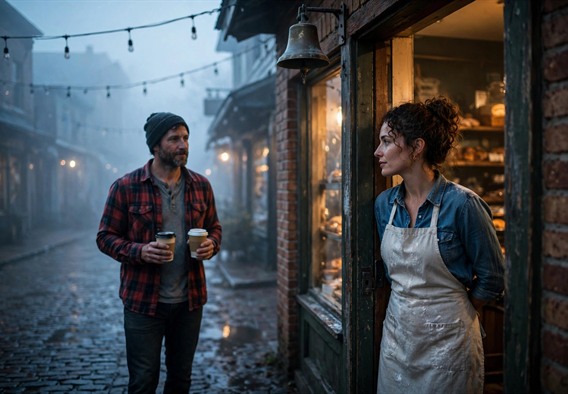

Weather Hold
What happens when the one person you spent two years avoiding becomes the only person you cannot escape? That is the question Maya Okafor had to answer the night the mountain closed its roads and gave her nowhere to hide from Jonah Reyes.
The Call Sheet She Never Wanted
The email arrived at 6:14 in the morning, and Maya read it four times before her coffee finished brewing, hoping the words would rearrange themselves into something survivable. They did not.
Okafor, M. Assigned support staff: J. Reyes, physiotherapy, alpine camp, Silverpine Basin, 10 days.
She set the phone face down on the counter and stared at her reflection in the kitchen window, at the woman with the dark circles and the taped right shoulder, the woman who had won the World Cup overall title in ice climbing last season and who had, eighteen months ago, done something unforgivable to the best physiotherapist she had ever worked with.
She had quit on him. Mid rehab. Six weeks out from finals, with her rotator cuff screaming and her confidence bleeding out, she had looked at Jonah Reyes across the treatment table and told him that his careful, patient, methodical plan was going to cost her the season, and that she did not have time to be careful. Then she had walked out of his clinic, found another physio who would push her harder, won the title, and torn the cuff a little worse doing it.
He had never said a word about it. That was the worst part. He had simply signed off on her transfer with a note that read, professionally, neutrally, like a scalpel: Discharged at athlete request. Recommend continued load management. Fourteen words. She had read them a hundred times, hunting for anger and finding only precision.
Now her federation had restructured its medical staff, and the universe, with its fondness for irony, had assigned her to him for the most important training block of her career. Ten days at altitude in Silverpine Basin. A pre season camp for the championship circuit. Her coach called it non negotiable. Her shoulder, which had ached all summer, called it something else.
Maya packed her bag with the mechanical focus of someone who had learned that feelings were a luxury athletes in her position could not afford. Rope, tools, ice tools, boots, the brace she was supposed to wear and usually did not. At the bottom of the duffel, wrapped in a spare shirt, she tucked the small carved wooden bird Jonah had given her three years ago, back when they were just athlete and staff, back before she understood that the quiet man with the steady hands had been holding her whole career in them like something breakable.
She had no idea why she still carried it. She told herself it was superstition. She told herself a lot of things.
The Road Up
They drove up together because there was only one vehicle going to the basin and the federation had decided, with its usual genius, that the two of them should share it.
Jonah looked exactly as she remembered and nothing like she remembered. Same lean build, same dark hair pushed back from a forehead that always seemed to be solving a problem, same wire rimmed glasses he wore for reading and forgot he was wearing. But there was something more settled in him now, some weight he carried without flinching, and when he loaded her duffel into the truck without asking which one was hers, because of course he knew her bag, her stomach did a slow, traitorous flip.
"Okafor," he said. Just her name. No warmth, no chill. A measurement.
"Reyes." She climbed into the passenger seat and fixed her eyes on the road. "Thanks for the ride."
"It's the assignment." He pulled out of the lot, and the valley began to fall away beneath them, pine forest climbing the slopes in dark green ranks, the first ridgelines of the Silverpine massif shouldering into a sky the color of dirty pewter.
They made it forty minutes in silence before Maya's need to fill it won, as it always did. "The forecast said flurries."
"The forecast said a Pineapple Express tap is parked offshore and the jet stream is aimed directly at the basin," Jonah said. "The federation website said flurries. There is a difference between a forecast and a hope."
"You always did like being the one who knew things."
"I like being the one who is prepared." His hands were easy on the wheel, ten and two, unhurried. "You'd know that if you'd stayed for the second half of your rehab."
The words landed exactly where he must have known they would land, in the soft damaged place under her ribs, and Maya understood that he had been holding that sentence for eighteen months the way she had been holding the wooden bird. Not thrown. Just carried. Ready.
"I won the title," she said, and hated how defensive it sounded.
"You did." He nodded at the road, at a switchback dropping away into cloud. "And then you climbed nationals on it, and worlds on it, and now you tape your shoulder before every session and pretend the tape is ceremonial."
"You've seen my medical file."
"I wrote half of it."
The road narrowed. The trees pressed closer. Snow began to fall, small and dry at first, flakes that dissolved on the windshield and then stopped dissolving. Maya watched them accumulate on the wiper blades and felt the familiar itch under her skin, the competitive one, the one that said weather was just another opponent and she had never lost to an opponent yet.
Jonah glanced at the sky and then at the fuel gauge and then, briefly, at her, and she saw something in his face she had never seen there before. Not anger. Not the professional blankness she deserved. Concern. He was worried, and he was trying to decide whether to tell her how much.
"Reyes," she said. "Talk."
"There's a weather hold protocol for the basin road," he said. "If accumulation passes thirty centimeters in twenty four hours, they close the upper section for avalanche control. No vehicles up or down until it clears."
"It's October. It never holds thirty centimeters in October."
"It did in 2019," he said. "And 2021. And I checked the telemetry this morning because I check everything, which you may recall is my whole personality." A ghost of something moved at the corner of his mouth, not quite a smile, and Maya felt it like a hand on the back of her neck. "There's a hut at the basin. Stone, wood stove, supplies for eight. The rest of the camp party comes up in three days. Until then it's the hut, the tools, the training wall, and us."
"Us," she repeated.
"Unless you'd like to argue with the mountain about it." He shifted down for the steepest pitch. "I've read your file, Okafor. You argue with everything. I wouldn't bet on the mountain."
The Hut

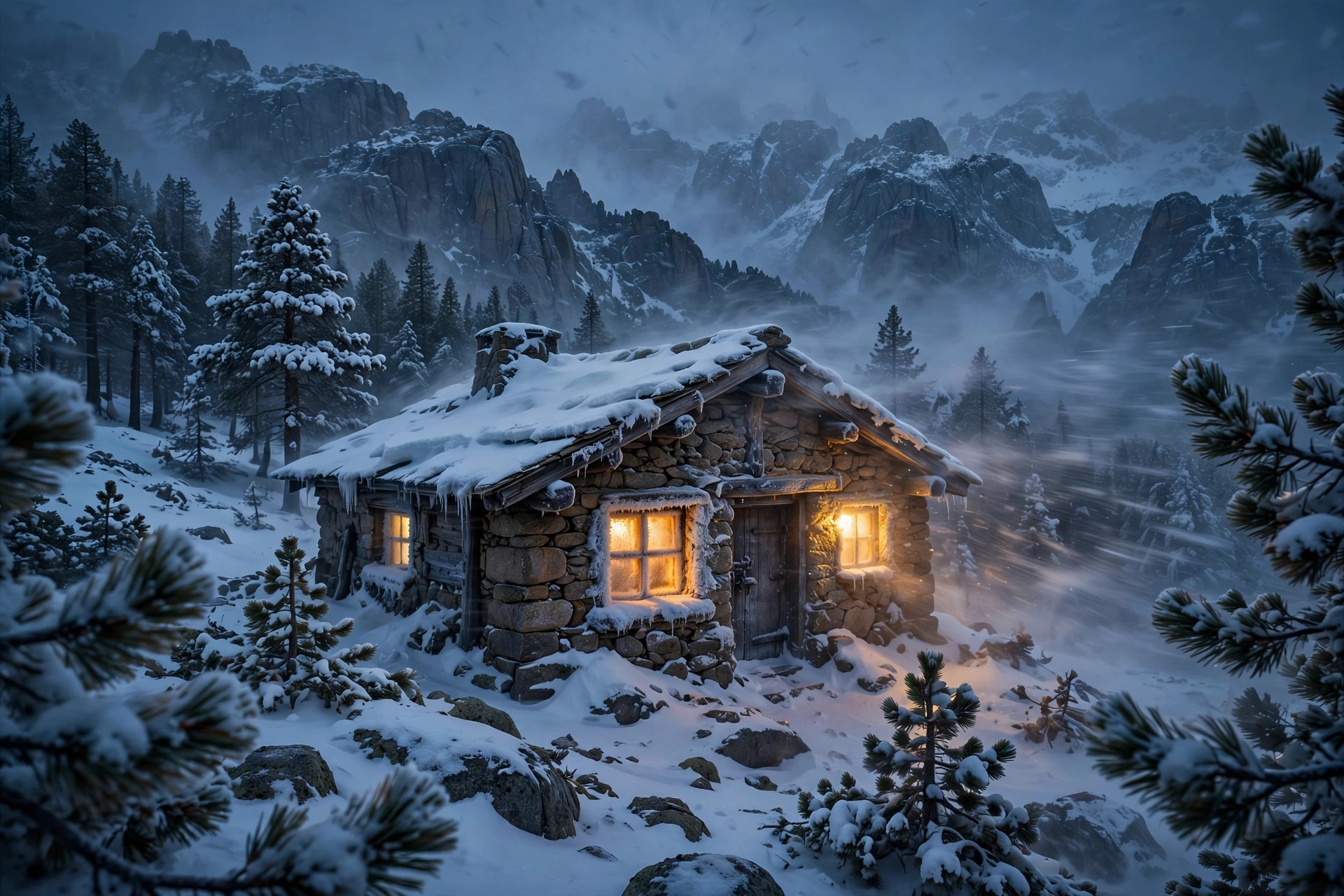
The hut sat on a granite shelf above a frozen tarn, low roofed and stubborn looking, built by some club of long dead optimists who had believed mountains should be met with craft rather than conquest. Jonah got the fire going before Maya had finished bringing in the second load of gear, and by the time she came back inside, shaking snow from her hair, the room had already begun to arrange itself around him.
That was the thing about Jonah Reyes that people misread. They called him quiet, and he was, but his quiet was not absence. It was attention. He noticed the draft under the door and stuffed it with a folded feed sack. He noticed that the water bucket had a hairline crack and swapped it for the copper one. He noticed, she realized with a start about an hour in, everything, all the time, including her.
"Left shoulder is carrying more than the right," he said conversationally, as she racked her ice tools. "You've shifted your whole movement pattern. Your hooks are landing heel first to protect the swing."
"My hooks are landing however I want them to land."
"Mm." He was already unpacking his kit, laying out the tools of his trade with the same unhurried precision he used for everything: tape, shears, the little brass handled instruments she had once fallen asleep watching him clean. "We'll do a baseline assessment tomorrow. Full screen. Then I'll tell you what I see, and you can decide whether to hear it."
"You can't make me do anything."
"No," he agreed mildly, and that was somehow more infuriating than an argument would have been. "I never could. That was always the problem, Maya. I could only ever make the plan. You were always the one who got to decide whether to trust it."
The use of her first name landed in the small room like a struck match. She turned away and busied herself with the stove, feeding it a split of spruce, watching the flames take hold. Outside, the wind had begun to talk to itself in the trees, a low continuous syllable that would, she knew, build over the next day into a roar.
They ate dinner at opposite ends of the table with the lamp between them like a border crossing. He had brought real food, of course, because he was Jonah: dried mushrooms, lentils, a brick of dark chocolate he divided into exact squares without being asked, sliding one square onto her napkin the way he used to at training camps years ago. She ate it. She hated herself for how carefully she ate it.
"Tell me about the new physio," he said, out of nowhere, eyes on his plate.
"Why?"
"Because you're here with me for ten days, and I need to know what plan you've been following, so I don't undo good work or compound bad work."
"There is no plan," she said, and the truth escaped before she could stop it, the way truths do in thin mountain air. "There were three physios in eighteen months. I kept quitting on them. The last one fired me, actually. She said, and I quote, that I wanted a technician, not a therapist, and that I should find one who doesn't ask questions."
Jonah set down his fork. For a long moment the only sound was the wind and the fire and the tick of the cooling stove. When he looked up, his glasses had fogged slightly at the edges from the heat, and behind them his eyes were the same steady brown she had spent two years refusing to think about.
"And did you?" he asked. "Find one?"
"I found the federation restructure," she said, "and the assignment email, and you. The mountain has a sense of humor."
"Mountains don't have humor," Jonah said. "They have consequences. People bring the humor." He stood, collected her plate along with his, and washed them at the basin without another word, and Maya sat in the firelight feeling the strange, disorienting sensation of being cared for by someone who had every right to stop.
Baseline
The assessment happened the next morning because he was a professional and she was, whatever else was true, one too.
He worked in silence at first, and his silence was a language she remembered too well. Two fingers at the head of her humerus, reading the joint like braille. A thumb tracing the scapular border, finding the knotted ridge of overwork. Passive range, then resisted, then the little functional tests he had invented himself over years of working with climbers, tests that asked the shoulder not how it felt in a chair but how it felt at the moment of commitment, at the moment when the whole body weight swung from one tired tendon.
"Tell me about the pain," he said. "Not the number. The character."
"It's a hook," she said. "It catches at the top of the swing. Deep, when I load overhead at the extreme. Then it lets go and pretends nothing happened."
"When did the tape start?"
"January."
"When did the sleep get bad?"
She looked at him. "How did you know my sleep is bad?"
"You have a line between your eyebrows that only shows up when you haven't slept," he said, writing something in his log. "You used to get it during exam blocks in your degree. I used to put an extra square of chocolate on your napkin those weeks." He said it without emphasis, an inventory item, and it undid her more than an accusation would have. "Maya. The shoulder is loadable. It's not the shoulder I'm worried about. It's the system around the shoulder. You've been spending the tendon like a credit card because the alternative was resting, and resting meant sitting still with everything you didn't want to feel."
"That's out of scope," she said, too fast.
"Probably," he agreed, and closed the log. "So is everything else in this hut. We're well outside scope, both of us. Storm's building. Wind's going to hit the west face around midnight. I suggest we train in the morning, do the mobility work in the afternoon, and I suggest you let me show you the loading plan I've had in a drawer for eighteen months."
"You kept a plan for me?" The question came out smaller than she intended.
Jonah put his glasses on top of his head and looked at her the way he used to look at her across the treatment table, before everything, when being looked at that way had felt like being seen by a lighthouse.
"I keep plans," he said. "It's my whole personality."
The Storm Arrives
It arrived at night, as the big ones do, and it arrived with intention.
Maya woke at 2 a.m. to a sound like the whole sky being dragged across the ridgeline, the hut shuddering in gusts that came at intervals like a fighter testing a guard. The fire had burned to embers. She got up to feed it and found Jonah already awake, sitting by the stove in the red glow, a headlamp dimmed to a coin of light on the floor, a battered paperback open on his knee that he was not reading.
"Tea's in the blue thermos," he said, without looking up. "The good one. I brought it for you."
"You brought a specific thermos for me."
"You hate the taste of the hut water after it sits. You said so at three camps. I notice things." He finally looked up, and the ember light moved across his face. "It's a category four wind out there. Road crews won't touch the pass until it drops below category two and the control work is done. Best case, we're here four days. Worst case, seven."
"And the rest of the camp party?"
"Delayed. They'll come up behind the control crews." He closed the book on his finger. "So it's just us and the consequences."
She poured tea from the blue thermos and sat on the floor across the stove from him because there were only two chairs and sitting in one would have felt like accepting an invitation to a negotiation. The floor felt neutral. The floor felt like a demilitarized zone. The tea was perfect, of course, brewed strong with the honey already dissolved, and she held the cup with both hands and watched the storm try the shutters.
"Jonah." His name in her mouth felt like stepping onto thin ice and finding it held. "Why did you never say anything? When I left. You just signed the form. Fourteen words. I counted."
"I know you counted," he said. "You count everything. It's your whole personality." And there it was again, the almost smile, the ghost that haunted the corner of his mouth. But his eyes were serious. "I didn't say anything because I was angry, and I don't trust myself to speak when I'm angry. My father was a yeller. I decided at fifteen I would never be one. So I stayed quiet until it passed, and by the time it passed, you'd won a title on an injury I would have rested, and what was there to say that wasn't either bitter or bossy?"
"You could have said you were angry."
"Yes," he said simply. "I could have. That's the honest answer. I should have. I've had eighteen months to practice the sentence." He turned the book over in his hands. "I was angry, Maya. Not because you left. People leave. Because you left to do exactly the thing I was trying to prevent, and you did it while telling me my care was the obstacle. I built my whole practice on the idea that careful and strong are the same thing, and you looked at me and told me they weren't."
"And were they?" she asked. "The same thing?"
"Ask your shoulder," he said, and the wind threw a gust at the hut so hard the shutters rang, and neither of them laughed, because it wasn't funny, and because they were both already laughing at something else, some older wound, and laughter would have been too much weight on the ice.
Training in the Hollow of the Storm
The eye of the high pressure behind the front never came, but there were lulls, and Jonah planned around them the way he planned around everything, with the calm of a man who had made a discipline of accepting reality on its own terms.
They trained in the mornings in the gear loft he had rigged with the hut's beams, a hanging ladder and two boards and a set of rings he had carried up, God help her, in his own pack, because of course Jonah Reyes came to a storm prepared with rings. He rebuilt her warmup from the ground up. He threw out the tape, not as a punishment but as a negotiation: tape for competition days, training bare, so the tissue could learn its own limits again instead of borrowing confidence from an elastic bandage.
"Fear has a grip strength," he told her, spotting her on the rings, his voice low and even beneath the wind. "It's stronger than yours. You can't out pull it. You can only make the movement so honest that fear has nothing to grip."
"That's very poetic for a load management guy."
"I contain multitudes. Two more. Slow."
She did the two more, slow, and her shoulder sang a little at the top of the second, and she hung there breathing, and he counted her breaths out loud the way he used to, four in, six out, until the singing faded, and when she dropped to the mats her eyes were wet and she pretended it was the wind driven snow coming under the door.
Afternoons were mobility and maintenance, and this was where the hut shrank. There was nowhere to go. The storm owned the outside world absolutely; visibility dropped to the length of the safety rope Jonah had rigged between hut and woodshed. So she lay on the mat by the stove while he worked, and his hands, which she had spent two years trying not to remember, remembered everything about her. The scar from the 2019 fall on her calf. The place at the base of her skull where tension gathered like sediment. The exact pressure that made her breath go out of her in a sound she could not disguise.
"You used to hum," he said quietly, one afternoon, working the line of her thoracic spine. "When a release was real. You never knew you did it."
"I don't hum."
"You're humming right now."
She was. She stopped, mortified, and he said, "Don't. It means it's working. It's the most honest thing you do," and she lay there with her face in the crook of her arm and let him be right, because the storm had taken away every door she could have walked out of, and some part of her, the part that was tired down to the bone of doors, was grateful.
The Silence That Spoke
On the fifth night the storm reached its full voice, and the power of it changed something in the room. The wind stopped gusting and became a single sustained note, a held breath of the planet, and the hut became a boat in a sea of white, and Maya and Jonah sat on the floor with their backs against the stone wall, shoulder to shoulder because the wall was cold and the alternative was admitting they wanted the contact, and neither of them spoke.
They did not speak for a long time.
And the silence was not empty. It was the fullest conversation Maya had ever had. She felt it in the way his breathing slowed to match hers, an unconscious duet. She felt it in the fact that neither of them reached for a book or a phone or a task, that they had both agreed, without words, to simply be present inside the noise, together, and that this was a thing two people could only do if they had stopped performing for each other entirely.
Her shoulder pressed against his arm. His hand rested on the floorboards between them, palm up, an open question he did not ask aloud.
She looked at that hand for a long time. The calluses on it were a map of his life: the pull up bars, the kettlebells, the years of working hands. She thought about all the times she had seen those hands hold someone else's career gently and thoughtlessly, the way other people breathe, and how she had never once let him hold hers, not really, because being held that carefully had felt like a debt she did not know how to repay except by being perfect, and she had never been perfect, so she had run.
The wind held its one enormous note. The fire settled. Snow ticked against the window like fingers testing glass.
Maya moved her hand the six inches across the floorboards and laid it in his open palm.
He closed his fingers around hers slowly, carefully, the way he did everything, and neither of them looked at the other, and neither of them let go, and the silence went on speaking, saying all the things that four days of conversation had only circled: I see you. I am not asking you to be perfect. I am asking you to stay.
When she finally trusted her voice, she said, "I quit on you because you were the only one I couldn't stand to fail in front of."
His thumb moved once across her knuckles. "I know," he said. "That was the part that broke my heart. Not the leaving. The reason."
The Wooden Bird
She gave it to him the next morning, in the flat gray light after the front's main body had passed and before the cleanup crews could possibly arrive, when the world outside the window was a foot and a half of unmarked white and the only tracks were fox.
"I took this," she said, holding out the little carved bird, a nutcracker of a thing, wings folded, head tilted, carved from dark Alpine wood with a patience she recognized now as his. "After I left your clinic. From the shelf by your desk. I don't know why. I told myself it was an accident. I've been carrying it for two years and I have never once told anyone about it and I need you to know that I am not a person who does things like this, except apparently I am, with you."
Jonah took the bird and turned it in his hands and she watched something move through his face, weather of its own, and when he spoke his voice was rough at the edges, the first unpolished thing she had ever heard from him.
"I carved this the week after my first athlete died," he said. "Avalanche, on a route she had no business being on in those conditions. I couldn't work for a month. I sat in my shop and I carved birds, because birds are the one thing that can sit on a storm and not be broken by it. I gave it to you because you were flying into weather constantly and pretending it was nothing." He looked up. "And you stole it when you left. Maya. You stole my grief bird."
"I didn't know," she whispered.
"No. But you took the thing that meant the most, because that's what you do. You take the heaviest weight and you carry it alone and you call it strength." He set the bird on the windowsill, in the light, where it looked suddenly like what it had always been: an offering. "Here's what I know about you, Okafor, from your file and from three years of watching you refuse to be known. You are not afraid of pain. You're afraid of being a burden. Every reckless thing you've ever done was a tax you paid in advance so nobody would ever have the right to say you owed them care."
Maya sat down on the bench by the window because her legs had opinions about standing. "That's not fair."
"No," he agreed. "It isn't. Nobody taught you any different. But you're thirty one years old and the storm took away the road, and I'm asking you, while there's nowhere to run, to try the other thing. The thing where you let someone carry half."
"And if I'm bad at it?"
"You'll be bad at it," he said. "You're bad at everything the first time. It's the only thing about you that's ordinary." The almost smile arrived, and this time it landed, and it changed his whole face, and Maya understood that she had been in love with this man for years and had filed it under every other name she could find.
"Jonah," she said. "If I kiss you right now, is that a patient boundary thing, or are we past that?"
"We were never in that," he said. "I fired myself from your file the day you left. Ethically I couldn't treat someone I was in love with. So the assignment email put you in front of me as a colleague, and everything I've done this week has been colleague to colleague, and it has been the hardest professional performance of my life."
"You're in love with me."
"I have plans in a drawer for you," he said. "Plural. I rewrote them every season you were gone. So yes. The answer to your question is yes, and you can kiss me, and I would like it noted for the record that I am not going anywhere afterward, and neither are you, because the road is closed."
"The road," Maya said, standing, closing the distance, putting her hand flat on his chest where his heart was doing something unprofessional, "has never in my life been this convenient."
She kissed him, and it was not careful at all, and that was the point. It was the first thing in years she did badly, on purpose, in front of someone, and he caught her laugh in his mouth and answered it with his own, and outside the window the fox tracks filled slowly with snow and the wooden bird sat in the light between them like a witness who approved.
What the Road Returned
The road opened on the eighth day, two days later than best case, one day later than worst, and when the knock finally came, a federation driver in a plow escort stamping snow off his boots, Maya and Jonah were sitting on the same side of the table, her feet in his lap, her shoulder in a new brace he had made her promise to actually wear, a training plan open between them that they had written together, her name and his in the same ink.
"Ready to roll in ten," the driver called, and went back to the truck.
They looked at each other over the plan. The storm was over. The world had come back with its roads and its schedules and its championship circuit waiting, and Maya felt the old reflex rise, the itch to be first out the door, first to the vehicle, first to control the terms of the exit.
She let it rise. She watched it like a weather system. And then she did the new thing, the thing she had practiced for eight days in a stone hut with the best hands in the federation wrapped around her ankle.
"Ride up front with me," she said. "It's a long drive down."
Jonah closed the plan and slid the wooden bird into his chest pocket, where it made a small, specific weight, a thing carried and returned and carried again. "I'll ride anywhere you're going," he said. "That's the deal now. You should read the terms before you sign."
"I've read them," Maya said. "I'm keeping the plan."
She kissed him once, briefly, in the cold bright morning, and shouldered her bag, and walked out into the enormous washed silence of the basin, and this time she did not walk alone.
The season that followed was, by every measure that mattered, the best of her career. She stood on the top step in Saas Fee with Jonah's brace on her shoulder and his bird in her pocket, and when the reporters asked who she owed her comeback to, she smiled and said, "The weather." It was not, strictly, a lie.
"You can't out pull fear. You can only make the movement so honest that fear has nothing to grip."
An original work of fiction. All characters are adults and fictional.
Get notified when new stories drop
Noah Carrington
Noah covers sports romance and forced-proximity heat: rivalries, road trips, and the quiet moment after the crowd goes home.
Leave a comment
Comments