


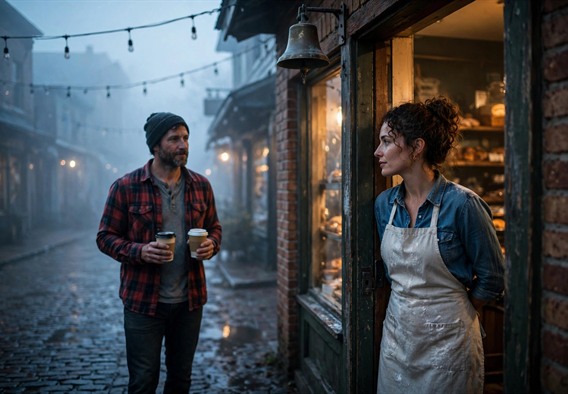

The Wardkeeper and the Truthreader
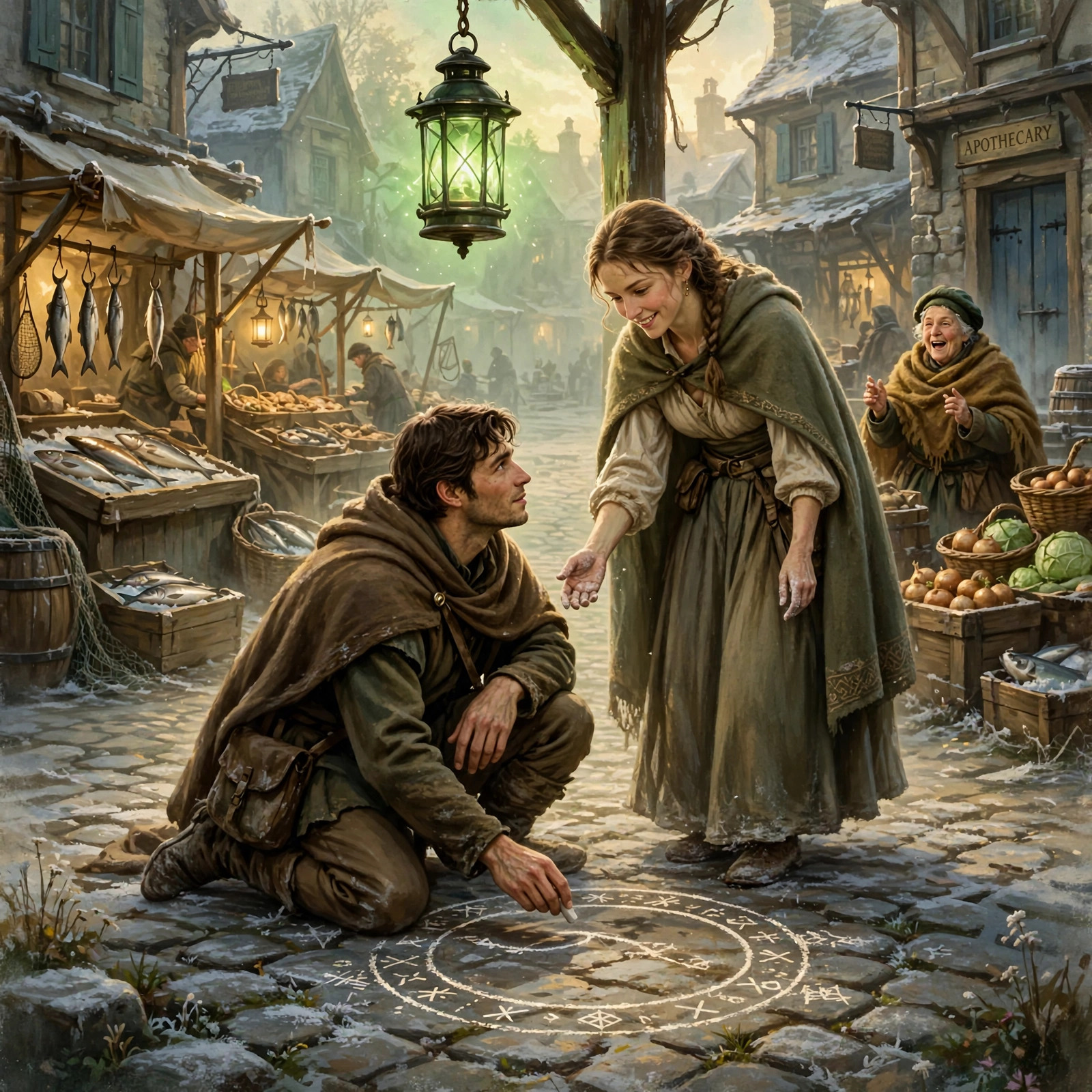
The wardlight over Wickfall Market turned green at dusk, and Maren Hollowell felt it in her teeth before she saw it.
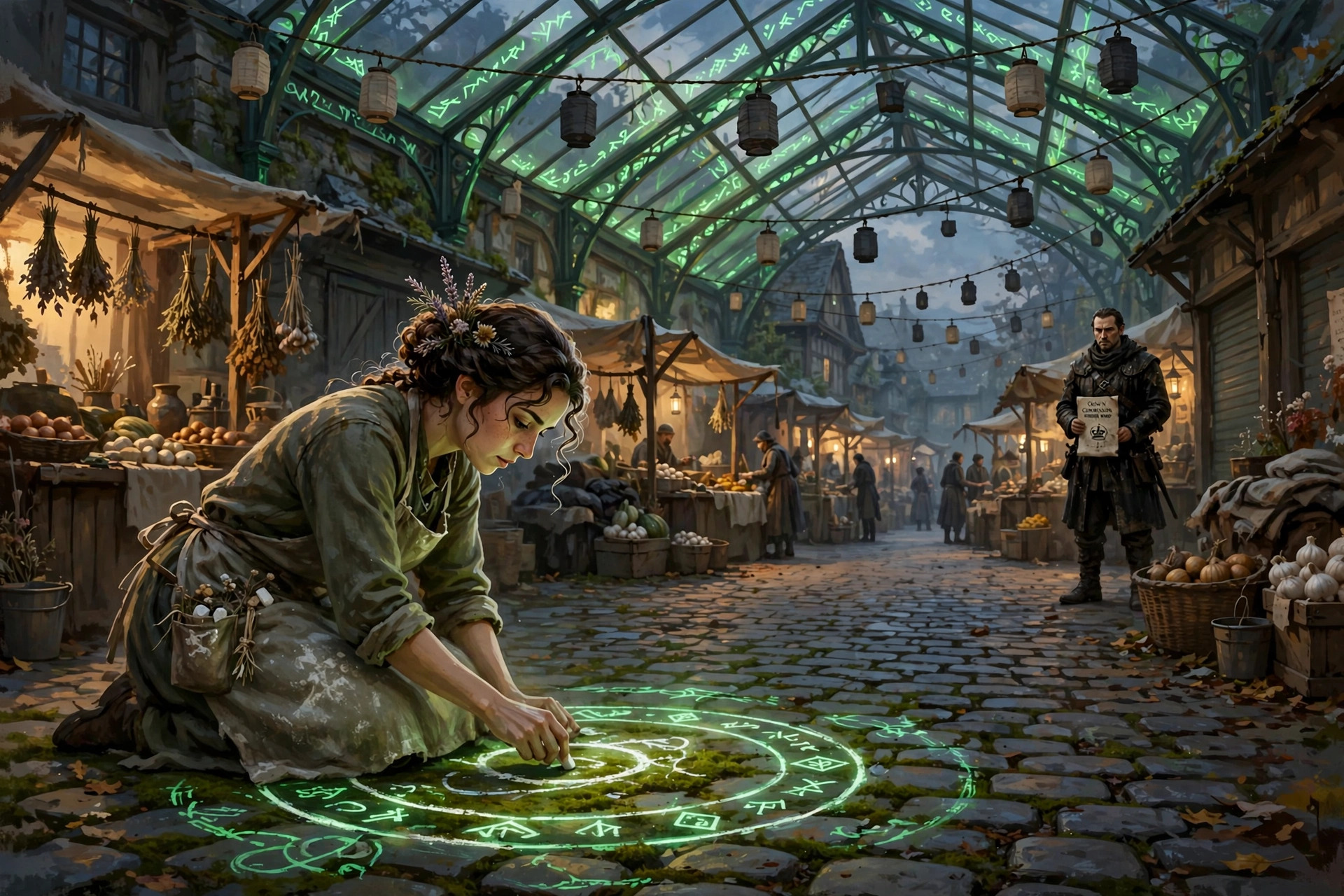
Nine years she had kept these stones, and the market's hum still found her through the soles of her boots, up through the cobbles, the way a tuning fork finds a toothache. Green meant truth held. Green meant nobody in the market square had spoken a lie since the last bell, and the two hundred souls buying endive and lamp oil under the glass roof could be trusted with their change.
Green meant she had done her work and no one was burning.
She was on her knees at the north stone, pressing a new chalk ring into the moss between the cobbles, when the bells announced a visitor. Not a trader. Traders came at dawn with carts that stank of fish and wet wool. This bell was the high, thin one, and it rang twice, which meant Crown.
"Wardkeeper." A man came through the fishmongers' row with his collar turned up against the smell and no talent at all for hiding that he disliked it. Dark coat, road dust to the knee, a signet at his wrist that caught the wardlight and threw a coin of gold onto the cobbles. "Rafe Corvane. Crown commission. I'm here for the tithe audit."
"The audit's at month's end." She sat back on her heels. "It's the ninth of the month."
"It's the ninth of the month," he agreed pleasantly. "I'm early. Smugglers don't keep calendars, so I've stopped keeping one too."
Maren stood, wiped her palms on her apron, and did not offer her hand. Under the wardlight, hands were dangerous things. "You know what the green means, Auditor?"
"It means nobody's lied in this square since the bell."
"It means nobody's lied and gotten away with it." She tipped her chin at the glass roof, the pale lamp of the wardlight hanging in it like a moon drowned in pond water. "One lie smokes your breath. People cough it out like a chimney. Two lies blister your tongue. Three within a season and you burn where you stand. We've had two burnings in thirty years, and I don't want a third on my stones."
"Then you'll want to be careful what you tell me." He produced a folded paper from inside his coat, and she recognized the wax before he opened it. Dark red. The Chancellor's own seal. "Complaints from the capital. Wickfall's salt tithe has run light for four seasons. Four. That's not drift, Wardkeeper. That's a hole, and holes have makers."
"Or bad scales."
"Or bad scales," he said again, in that pleasant way that was starting to itch. "But I'm told you weigh the salt yourself. Every barrel, every sack, your own mark on the ledger. So if the scales are bad, you're the one who made them bad."
The market noise went on around them. A woman argued over eels two rows down. Somewhere a crate broke, and someone laughed. Maren kept her face still, which was a skill she had practiced longer than warding.
"You can read the ledger," she said. "You can read the scales. You can read anything in this square that isn't bolted."
"And the bolted things?"
"Are bolted for a reason."
He smiled. He had a good face when he smiled, which was a nuisance, because everything else about him was a threat with a signet on it. "You're not what I expected, Wardkeeper. The complaint said negligent. Negligent people don't kneel in moss at dusk."
"The moss is why the ring holds. Water gets under the chalk, the ring breaks, the ward drops." She picked up her brush. "You can't see a ward, Auditor. You can only keep it dry."
"I know," he said. "I've spent my career around them."
"Around them."
"Inside them is where people burn."
She looked at him properly then. He let her, standing still under the green, and she thought she saw something in his face that she recognized, though it took her the walk home that night to name it. It was the look of a man who had stood close to a fire, close enough to smell it on his own sleeves, and had never once been allowed to flinch.
"Lodging," she said, because someone had to be practical. "The Amber Stair has rooms. Tell Magda you're with the audit and she'll overcharge you."
"She'll overcharge me anyway. She can smell a Crown purse."
"Then you'll fit in," Maren said. "Everything here is more expensive than it looks."
She turned back to the north stone, and she heard him stand there a moment longer than he needed to, the way people do when they want to be invited to stay. She pressed the chalk ring home with her thumb and did not invite him.
Green light lay over the cobbles. Somewhere in the capital, someone had decided her market was a hole. And she had spent nine years making sure that everything worth hiding in Wickfall was hidden so well that even a truthreader with a commission and a pleasant mouth would have to burn himself to find it.
Salt Ledger
Rafe had read ledgers in fifteen towns, and every one of them lied the same way: in the margins.
Wickfall's salt ledger was beautiful. Columns straight as harp strings, each barrel weighed, each sack counted, each mark in the same small, stubborn hand. He sat with it for two days in the market's weighing hall while the wardlight shifted green overhead, and the numbers balanced, and balanced, and balanced, and his teeth ached the way they did when a room was too clean.
"You do this by hand," he said on the second afternoon. "Every mark."
"The ward does the arithmetic." Maren came in smelling of chalk dust and rain, shook the water off her coat over his table, and did not apologize. "A false weight smokes the weigher's breath. So nobody false-weighs."
"So nobody gets caught false-weighing."
"Same thing, from where I sit." She pulled a stool over and sat, and he noticed she kept the table between them, and he noticed he noticed. "You've been staring at that page for an hour, Auditor. Tell me what's wrong with it, because I'll tell you now it's right."
"It's too right." He tapped the tithe column. "Four seasons, and the yield from these pans never wanders. Not a flood year, not a drought year, not a bad month. Salt doesn't do that. Salt is weather with a price on it."
"Maybe we're good at it."
"Nobody's that good." He watched her face. Under the wardlight you could not lie, but you could hold still, and she held still like a woman who had taught herself how. "Somebody's shaving the tithe before it's weighed. Small, steady, the same amount each season. Steady enough to look like nothing."
"And you want to catch them."
"I want to close my file." He said it before he thought better of it, which was a habit twelve years in the Crown's service had not cured. "I've been on the road since spring. I'd like to write 'resolved' on something before winter."
"And then ride to the next town."
"And then ride to the next town."
She looked at him a long moment. Rain came down the weighing hall's high windows and the wardlight caught it and turned it to green glass. "There's a woman here," she said at last. "Old Sess. She salts fish for the winter poor. Takes her tithe honestly. Last winter her hands cracked open from the brine and she weighed with her wrists, and I sat with her every evening for a month while the salt got into the cracks, and she never once lied to me about how much it hurt, because she couldn't, because of that." She pointed up at the light. "That's what this ward is for, Auditor. Not catching. Keeping."
"The Crown doesn't distinguish."
"I know." She stood. "I've read your commission. 'Restore the tithe, identify the responsible.' It doesn't say anything about what happens to them after."
"No," Rafe said. "It doesn't."
She stopped at the door. "Do you want to know what I think, or do you want to know what's true? Because under your ward they're different things, and out here they're the same, and out here I don't have to tell you either."
"Wardkeeper." He closed the ledger. "If I wanted easy truths I'd have stayed in the capital."
She almost smiled. He saw it arrive and get turned away at the gate. "Tomorrow's the ninth-day market. Half the border comes through. If your shaver's local, they'll be standing in that square, and if they lie to you, you'll see the smoke with your own eyes. Come at dawn. Wear boots you don't mind ruining."
"Why?"
"Because you'll be standing in fish water by the second bell." She left.
Rafe sat in the green light with the closed ledger and the rain and the smell of chalk she had left behind, and he thought, with the particular displeasure of a man discovering a complication: I like her.
It was going to make everything harder.
Lantern Night
The ninth-day market ran until midnight, and at midnight Wickfall hung its lanterns.
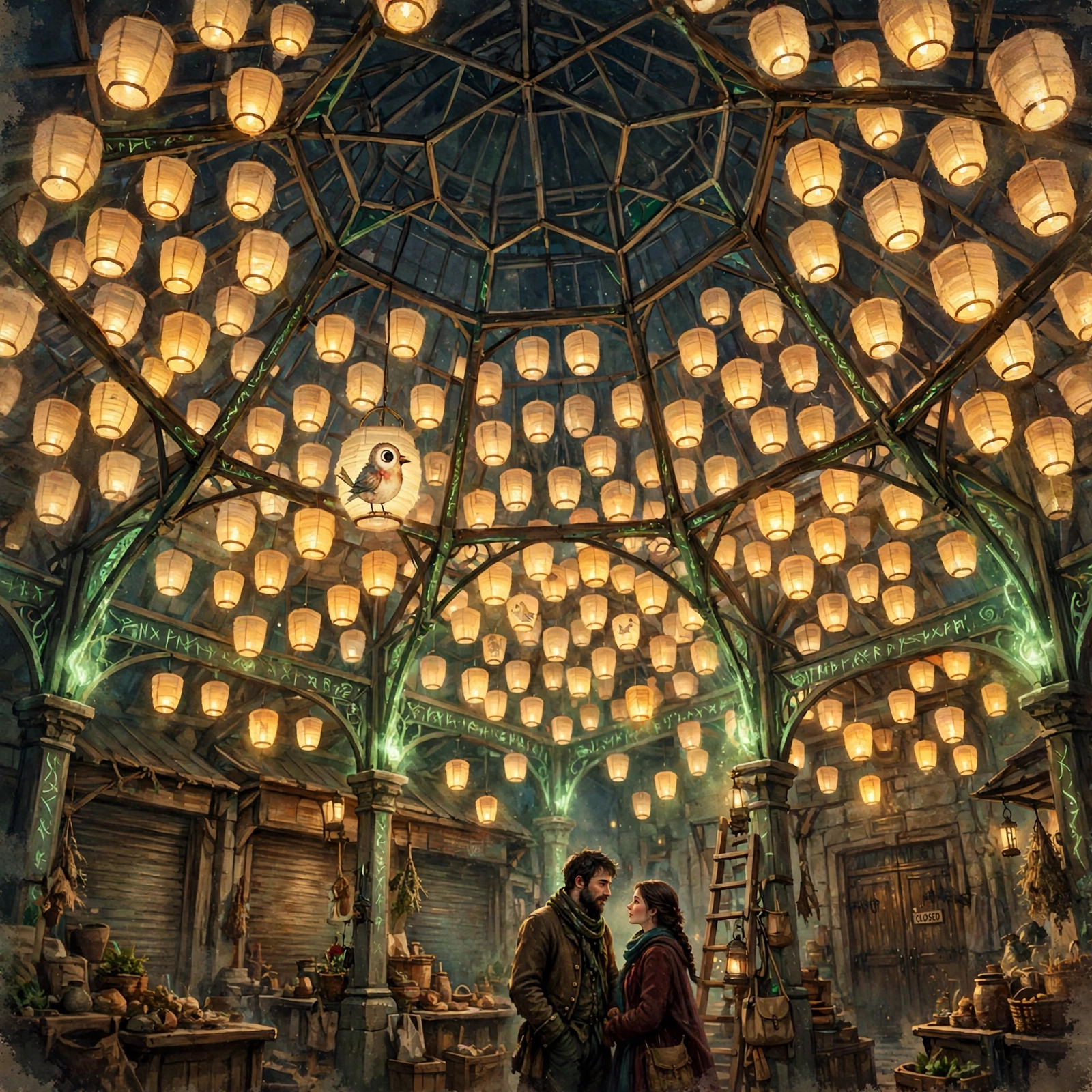
It was an old custom, older than the ward. Every trader who had told no lie that day, and been burned by no breath, got to hang a paper lantern from the glass roof's iron ribs, and by the last bell the whole market glowed like the inside of a beehive. Maren had hung one every year for nine years. Her lantern had a wren painted on it, badly, by Old Sess's granddaughter, who had been six and certain it looked right.
"You weigh it down with river stones," she told Rafe, handing him the twine. "Paper rises. Everything here rises if you don't hold it down."
"That's a metaphor."
"That's a lantern."
He laughed. She had not expected that, a real laugh, sudden, at her, and she covered the way she always covered, by working. She tied his lantern to the rib above the fish stall and he held the ladder, and his hands were steady, and hers were not, and she hated that hers were not.
They had spent nine days together. That was the arithmetic of it. Nine days of him appearing at her stones at dusk with questions, of her correcting his border pronunciation over supper at the Amber Stair, of one evening in the warded storehouse where a barrel had cracked and they had shoveled salt in the dark until their arms shook and he had said, quietly, "You could have assigned me anywhere else in this town, and you keep assigning yourself next to me," and she had said, "The salt's on the north side," and he had shoveled, and nothing else had been said, and both of them had gone home full of the nothing.
"Ask me," he said now, from the bottom of the ladder. The lanterns swayed above them and the light came down through the paper in warm coins on his face.
"Ask you what?"
"Whatever you've been not asking for nine days. You're the only person in this market who holds still around me, and I've worked out it's not manners."
She looked up past him at the wren lantern, her bad wren, its eye too big. "Under the wardlight," she said, "when you question someone, and they smoke, and everyone in the square sees the smoke. What happens after?"
"Depends on the crime."
"And if they're nobody? If they're a girl who moved salt across the border line for medicine money, or a man who shaved a tithe to keep his boat? What does the Crown do with small liars, Auditor?"
"Fines," he said. "First offense. It's not the burning people think."
"And after the fine, when the whole market has seen the smoke? When their children's children will say their family smokes?" She came down one step. "I was fourteen when I watched a man burn in a square like this one. Not here. Ellersby, my mother's town. He lied about a debt, and then a second time about the debt, and then a third time when he begged, and everyone was begging him by then to just stop, and he burned on the cobbles in front of me."
Rafe did not say anything. The lanterns ticked against the iron ribs.
"I was a witness in that case," Maren said. "I'd seen him take the money. Telling the truth put him on those cobbles. My truth. And everyone told me I'd done right, and the truth was the whole law, and the man was ash before the frost." She looked at him and made herself keep looking. "So when you ask me to help you find someone who shaved a tithe, understand what you're asking. You're asking me to stand there again with the same truth in my mouth."
He climbed one step so they were nearer level, and his voice was low. "I sat in a courtroom in the capital, four years ago. A woman accused of selling ward-secrets. I read her, she tested clean twice, and the third time the prosecutor asked the question crooked, and she answered the crooked question straight, and the instrument said lie. I said lie. I was the instrument." His jaw worked. "She went to the mines. Eight months later the real seller confessed in another town, in a letter, for nothing, because he was dying and wanted it off his chest. I read the letter. Every word of it clean."
"And you've carried that since."
"I've carried that since." A shrug that did not look like a shrug. "So no, Wardkeeper. I don't think your truth killed that man. I think a square full of people who wanted a rule more than they wanted a person killed him. The light only shows. People decide what showing is worth."
Maren stood on the ladder in the lantern glow and felt something in her chest come loose from a nail it had hung on for fifteen years.
"Nine days," she said. "That's the longest I've gone without telling anyone about Ellersby."
"Eight months," he said. "For the letter."
She climbed down. He held the ladder and did not touch her, and the not touching was louder than the lanterns.
"The audit," she said, when her feet were on the cobbles. "The shaver. I think I know which stalls run light, and I've known for a while, and I haven't moved on it, because it's medicine and boat-repair and children's shoes, Auditor, and I couldn't stand in a square and smoke a grandmother over shoes."
His face changed. She watched it change and understood, too late, that she had just handed the Crown's man a hole with a maker in it.
"Maren," he said.
"You'll want that in writing, I imagine." Her voice came out flat. "Under the light, where it'll hold."
She walked out of the market under two hundred honest lanterns, and she did not hang hers.
The Blind Door
Rafe spent two days not writing the report, which for him was an act of vandalism.
He knew files. A file left open was a file someone senior would close for you, badly. He had watched it happen in fifteen towns. And so on the third morning he stood in the weighing hall with his pen cut and his ink wet and Maren's words sitting in him like a swallowed coal, children's shoes, and he wrote the report.
He wrote it complete. Stalls, names, seasons, the shaved weights, the blind spot in the north quarter's ward where an old salt cellar door let goods cross the line unlit. He wrote that the wardkeeper had known and had not reported, and that her knowledge made her an accessory, and that the Crown's letter of the law did not distinguish between mercy and theft.
Then he sealed it, and he took it to the market at dusk, because he was a coward about exactly one thing and had decided to do it with witnesses.
Maren was at the north stone. She was always at the north stone. She was chalking the ring over the cellar door, the blind door, closing her own hole with her own hands, and she did not look up when his boots stopped in her light.
"You'll want the market bell," she said. "If you're going to do it publicly. That's how it's done. Ellersby rang theirs."
"I'm not ringing anything."
"Then you're doing it quietly, which is worse."
"Maren." He held out the sealed report. "I want you to read it before it goes."
"I don't need to read it. I know what's in it. I told you what's in it, at lantern night, like a fool, because you stood at the bottom of a ladder and told me about a woman in the mines, and I thought, this one, this one is different, this one has smelled the smoke on his own sleeves." She was still on her knees. Her hands were shaking around the chalk. "Nine days of questions, and the tenth day you hand me a paper. You want to know the joke? Everything I told you was true. You know it was true. You can't lie under your own light, and I never lied to you once, not once, and I'm still standing in a square waiting to burn."
"It's not a warrant."
"It's a Crown seal."
"It's my commission," Rafe said, and then he stopped, because the next part was the part he had been circling for two days. "I rode here in spring with eleven other files. This is my last one. I put in to resign at midsummer, before I ever saw your square, and the Chancellor held my papers until the audit closed." He crouched so they were level, the sealed report between them on the cobbles. "I have until the frost. That's the whole of it. Whatever this paper is, I'm the last one who'll ever carry it, and everyone who comes after me will be worse, because they won't have a letter from a dying salt smuggler keeping them up at night."
"That's supposed to comfort me."
"No." He set the report down on the chalk ring she was mending. "It's supposed to be a question. I can send it and burn your town's way of surviving, or I can hold it, and every day I hold it I'm lying by omission to everyone who trusts this light, and I'm the one who's spent his whole life telling people that the truth is the whole law."
"So send it."
"That's what I thought you'd say."
"Then say the rest."
He looked at the green overhead, the light he had stood under in fifteen towns and never once let matter. "I don't want to be the instrument anymore. I've been the instrument since I was twenty-two years old, and I'm good at it, and I hate it, and the first thing in fifteen years I've wanted to be instead is whatever a man is who stands in a market that keeps its own people."
Maren put her chalk down. "You want me to feel sorry for the Crown's auditor."
"No. I want you to tell me what the wren on your lantern is."
"A wren."
"It has an eye the size of its head."
"A child painted it."
"I know," he said. "I've watched you look at it every night for a week. You don't look at it like a bird."
"It was the winter of Ellersby," she said, and her voice cracked down the middle of the word. "The girl who painted it. She'd just seen a man burn too. We hung it together. It's the only thing I kept from that year."
The wardlight hummed over them. Down the rows, traders were closing their stalls, and someone was singing, badly, and the whole market was green and warm and full of people who had all told the truth all day and got lanterns for it.
"Rafe." She said his name for the first time. "If you hold that paper for me, you'll be living a lie in a square that burns liars. Every day. It'll smoke you a little every day for the rest of your life."
"I know what it does."
"Do you?" She reached out and took the report off the chalk ring, and turned it over in her chalk-white hands. "Because I've got a better idea, and you're not going to like it."
She stood up with the paper, and walked to the wardlight stone at the center of the square, and held it out to him under the green.
"Read it aloud," she said. "Here, where everything shows. To the whole market. Every name you wrote, including mine. And then ask them what should happen to us."
"You're mad."
"I'm a wardkeeper." The lanterns were going out, one by one, as traders left. "And this ward was never for catching, Auditor. It's for keeping. Let's see what it keeps."
Crown Seal
The market bell rang at dusk, and Wickfall came.
Two hundred people, more, packed into the square under a green light with a paper lantern or two still forgotten in the ribs overhead. Old Sess in the front with her cracked hands wrapped in wool. The salt runners Rafe had never once managed to catch in eleven towns of practice, standing together by the fish stalls with their hats off, which frightened him more than anything else that evening.
And Maren, on the wardlight stone, holding the report out to him.
Rafe took it. He broke the seal, because a Crown paper unread is a lie by omission in a square that knows the difference, and he read it aloud, every word, in the flat voice he used for instruments and arithmetic. Stalls. Names. Weights. The blind door. The wardkeeper's knowledge. When he reached the last line he looked up, and the entire market looked back, and nobody smoked.
"The tithe runs light," he said. "That part of the file is true and I'll stand behind it. What happens next is the part I don't get to decide anymore. So." His voice sounded wrong in his own ears, too human for the square. "Wardkeeper. Say what you did and why. Under the light, where we'll all know it's true."
Maren stepped up beside him. "I kept the north quarter dark for three winters," she said, clear to the back rows. "The salt that crossed there fed medicine chests and boat repairs and about forty pairs of shoes. The tithe still got its honest share of everything else. I did it because I watched a town burn a man when I was fourteen for less than this, and I decided my ward would never feed anyone to a square. That's all true. Ask me anything."
Old Sess called out, "How much medicine, girl?"
"Enough. Sixty jars last winter."
"Whose children took it?"
"Yours, Sess. And the Priory's, and the ferryman's."
A silence, then, that Rafe felt in his sternum. The market was doing its own arithmetic and doing it in the open, and he understood with a lurch that he had never once seen that, in fifteen years, in any square, in any light.
Then Maren turned to him, and the look she gave him he would spend years trying to describe later. "Now him," she said. "He has a letter to read. It came to him four years ago from another town. He's never read it aloud because he says he's carried it. Tonight he puts it down."
"Maren."
"Under the light, Auditor. If you're going to live here, you don't get to hold anything back where we can't see it."
He had the letter in his coat. He had carried it in his coat for four years through fifteen towns, folded to fit the inside pocket, ink worn thin along one crease. He took it out. The square went very quiet, the particular quiet of two hundred people realizing they were about to be trusted with something.
"It's from a dying man," Rafe said. "A smuggler. He confessed to a crime a woman was sent to the mines for, a crime I helped convict her of with my gift. She served eight months of a life sentence in a hole in the ground because I stood in a light like this one and said the crooked thing was true."
"She got out," said a voice he didn't know, an old man near the front. "The mines turned her loose when the letter came in. Everyone on the border knows that story. Nobody knew who the reader was."
"Now you do." His hands were not steady, and he let them be unsteady where everyone could see. "I resigned my commission over it. Midsummer, it takes effect at frost. This audit is my last act as the Crown's instrument, and I came into this market planning to write 'resolved' on it and ride away, because that's all I've ever been good for, and instead." He stopped. Started again. "Instead I found a wardkeeper on her knees in the moss keeping a town's people safe from their own law, and I would rather burn on these cobbles than write the paper that ends it."
The wardlight hung green above all of them. Nobody smoked.
"So," Rafe said. "I'm asking. What does this town want done about its tithe?"
Old Sess stood, slowly, wool and all. "We pay it," she said. "In full, from tonight, and we make the ledger say so, and we fix the blind door so it's not blind anymore, but it's a door. Not a hole. A door. And the wardkeeper keeps her stones."
"And the man who shaves it," someone shouted, "carries the extra weight himself, come spring, on his own back, in front of everybody."
Laughter went through the market, and it was the laughter of people who had just found out they were the kind of town that could laugh in that light.
Rafe looked at Maren. "You planned this."
"I hoped for it." She stepped down off the stone. "I couldn't know. That's the thing about the light, Auditor. It only shows. People decide what showing is worth."
"You're quoting me."
"It was a good sentence. I've been carrying it about nine days."
He put the letter back in his coat, and for the first time in four years it sat there like paper instead of like a stone.
"Wardkeeper," he said. "There's a wren lantern in the roof with an eye the size of its head. I'm told there's twine. If a man had no commission left at frost and no town of his own."
"He'd better be good with river stones," Maren said. "Everything here rises if you don't hold it down."
Dawn Stone
Frost came to Wickfall on a Tuesday, and Rafe Corvane's commission turned to nothing in his pocket at midnight like a leaf, and by dawn he was on his knees in the moss at the north stone with a brush.
"Circular," Maren said, above him. "You're doing it straight. The ring has to close on itself, or the water gets in."
"You told me that on the first day."
"You nodded like a man listening to a metaphor."
"You said it wasn't one."
"It wasn't." She crouched, took his wrist, and turned the brush in his fingers until the chalk came around toward its own tail. Her hands were warm and chalk-dusted and sure, and she had stopped keeping the table between them around the same week the market had decided, loudly, in the way of markets, that the two of them were a fact of the square and should stop pretending otherwise. "There. Close it."
He closed the ring. The ward hummed up through the cobbles the way it always did at dawn, and the light overhead went green, and stayed green, and from the fishmongers' row came the first shout of the day, which was Old Sess arguing with a crate.
"The letter," Maren said, not looking at him, painting her own ring two stones away. "You took it out of your coat last night. I saw you burn it in the stove at the Amber Stair."
"It's finished. The man who wrote it was dying, the woman he wrote it about is free and married and keeps goats, I checked, and it stopped being a debt the day a whole market heard it. It was just paper after that." He dipped his brush. "Magda charged me for the stove ash. She said Crown men burn things expensive."
"You're not a Crown man."
"No." He said it slowly, and the words came out of him the way the chalk came off the brush, leaving the stone changed. "I don't know what I am. I've been somebody's instrument since I was twenty-two and I have no idea what a person is when nobody's holding him. I know I'm good at dry things. Rings. Ledgers. River stones."
"You're good at more." She sat back and looked at him across two chalk rings in the dawn, and the market bell rang the first hour, thin and high, and nothing about it meant Crown anymore. "You stood in front of two hundred people and read your own worst year off a page."
"You handed me the page."
"I handed you the page," she agreed, "because I couldn't pick it up myself. That's what I keep learning in this square, Rafe. Fifteen years of holding still so nobody could see my hands shake, and it turns out the light doesn't care if you shake. It only cares what you say."
"And what you do with what you're holding."
"And that." She stood, and offered him her hand, chalk dust and all, and he took it and came up off his knees. "The market's hiring. Wardkeeper's assistant. Terrible pay. Fish water by the second bell. There's a girl who'll paint you a lantern, and I warn you now, whatever you ask her to paint, it will come out with an eye the size of its head."
"Maren."
"I'm offering you a post, Auditor."
"I'm not an auditor."
"Then I'm offering you a post." Her voice went rough at the edges, and she let it, in the green, where everyone could see. "A town. A stone. A wren with a big eye. Me. All of it rises if you don't hold it down, and I'm done holding things down alone, and I would very much like to know what you say to that, here, under the light, where it counts."
Rafe looked up at the wardlight, the same drowned-moon green it had been the first evening, when he had come through the fish stalls with his collar up and caught her kneeling in the moss. Two hundred people would come through that light today and tell the truth in it, and some of them would tell it badly, and none of them would burn, because a woman with chalk on her hands had decided what the showing was worth.
"Yes," he said. The wardlight held green overhead, steady as a harp string, and neither of them smoked. "That's all true."
"I know," said the wardkeeper of Wickfall Market, and she kissed him then, chalk dust and all, in the green dawn under two hundred honest lanterns, while Old Sess shouted from the fish stalls that some of them hadn't been hung yet and would somebody please fetch the twine.
He fetched the twine. He was good at dry things, and warm ones, and everything in that square was finally, freely, held.
Get notified when new stories drop

Marcus Hale
Marcus writes slow-burn and marriage-of-convenience stories where logistics become intimacy and competence is a love language.
Leave a comment
Comments