


The Second Shot
Forty-Seven Days
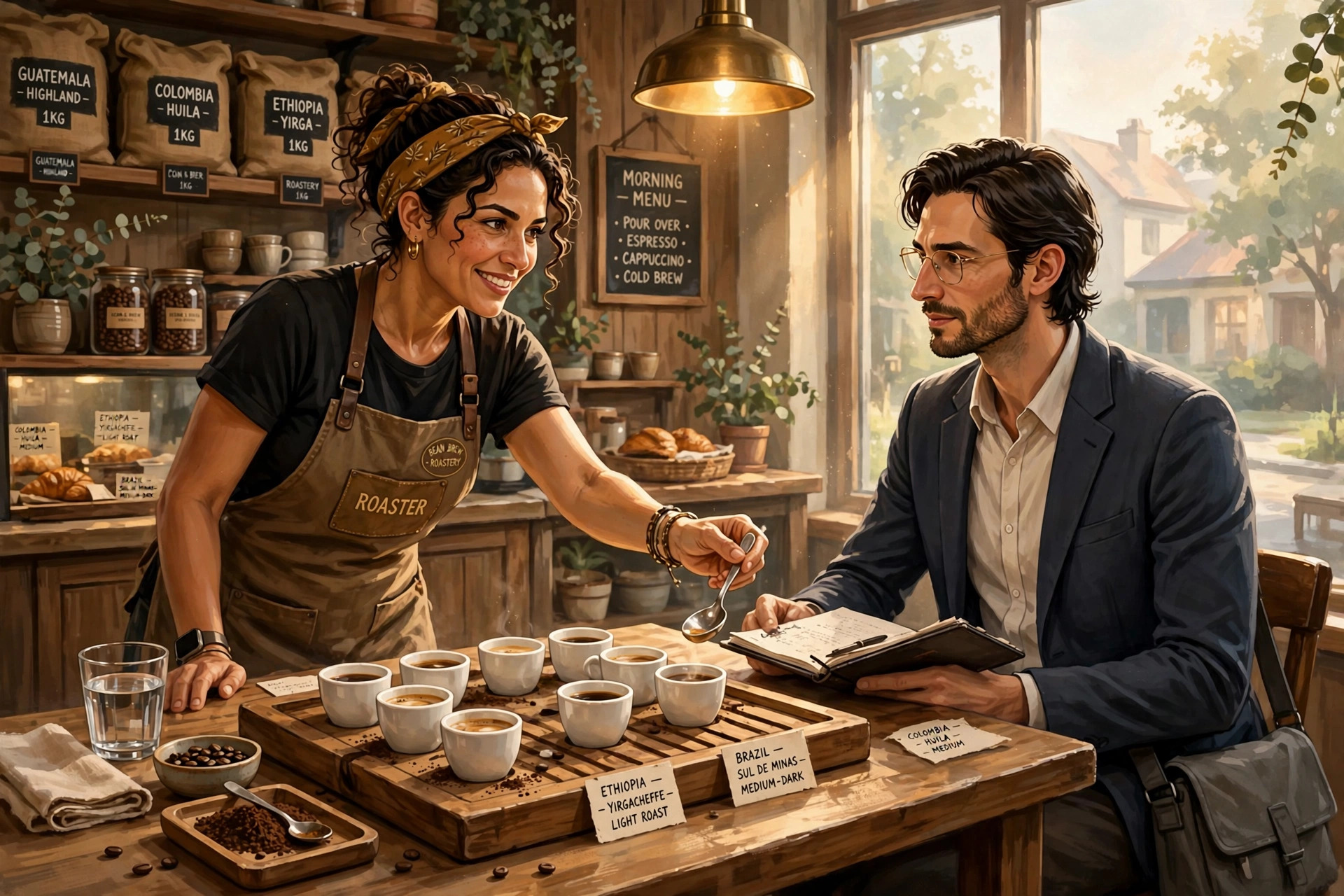
The cupping table was set before the neighborhood had finished waking up. Maya lined up the sample trays in their wooden grooves, five roasts in a row, spoons laid out like silverware at a dinner she wasn't sure she'd been invited to.
Rosa came through the back door shaking rain off her jacket. "He's early."
"He's on time. We're early." Maya checked the water kettle's temperature anyway. It was fine. Everything was fine. "Which one is he?"
"The tall one who looked at our awning like it owed him money." Rosa hung her jacket on the hook by the grinder. "Nathan Pryce's consultant. The new landlord hired him the same week the sale closed, so he's either very good or very cheap."
The bell over the door rang. The tall one filled the frame for a second before stepping in, umbrella collapsed under one arm, notebook in hand. He had the kind of face that looked like it was apologizing for the notebook.
"Maya Okonkwo?" he said. "Theo Lindqvist. I'm here about the lease."
"You're here about the lease, and you're standing in my cupping." She gestured at the table by the window. "Sit down. You can evaluate the coffee while you evaluate the building. It saves everybody a second appointment."
Rosa mouthed be nice across the room. Maya ignored her. Six years they'd run Emberline together, and Rosa still hadn't learned that nice was not the thing Maya led with.
Theo sat, set the notebook down, and looked at the trays the way some people looked at church. That, she hadn't expected.
"You do public cuppings?"
"Last Saturday of the month. Free. We pour about a hundred and twenty cups over four hours, the whole block shows up, kids steal cookies, somebody's dog gets a biscuit." She pushed a spoon toward him. "You've done this before."
"Once or twice." He picked up the spoon, turned it over. "You're scoring blind?"
"Cups are numbered. Nobody knows which tray is which until the end." She lifted the kettle. "You're the tiebreaker vote today, consultant. Congratulations."
They cupped. Slurped, spat, scribbled. The regulars drifted in, Rosa kept the cookies moving, and for forty minutes Maya almost forgot what the notebook was for. Theo scored like he'd been born with a clipboard, but he tasted everything, even the tray she'd slipped in as a joke, an old batch past its prime.
Then he got to tray four.
He slurped, paused, slurped again. His pen stopped.
"Problem?"
"It's muddled." He said it quietly, like that would help. "The acidity's there but it's fighting itself. There's a roast defect, probably development stalled in the middle of the charge. You're losing the top notes entirely. What's the origin?"
"That's my flagship." Maya set the kettle down harder than she meant to. "It's the Emberline blend. It's been on the menu since we opened."
"It tastes like a blend that exists to cover its own parts." He caught himself, too late. "I'm sorry. That came out wrong."
"No, I heard you the first time." The shop had gone quiet around them. Two of the regulars were pretending very hard to study their cups. "Rosa. Rosa, come here."
Rosa came, wiping her hands on her apron, and Maya watched Theo's face as Rosa set a manila folder on the cupping table. A fat one. Rubber-banded.
"Lease renewal terms," Rosa said. "Forty-seven days out. The new landlord wants a viability assessment before they'll talk numbers, and this gentleman is the assessment." She untied the apron. "I'm going to the bank before it closes. Maya, don't kill him, we still need the signature."
She left through the back, past the rain barrel they used for the window boxes, and the bell didn't even ring, because the back door didn't have one.
Maya sat down across from Theo. The folder sat between them like a third party.
"So," she said. "You're the man who decides whether we exist in the fall."
"I'm the man who writes a report. Somebody else decides."
"That's a distinction I'm supposed to find comforting?"
"It's a distinction I wish were bigger than it is." He turned his cup in its groove. "For what it's worth, the cupping's good. The space is good. Your crowd is loyal. The report isn't going to say close them."
"It's going to say fix my flagship."
"It's going to say the flagship has a problem, yes." He winced at his own sentence. "I've roasted that profile before. Development stalled in the middle is usually a drum temp problem, or you're charging too hot and dropping too early. It's fixable. It might be one adjustment."
"It might be my grandmother's scale is off by half a degree and I'd rather it wasn't." She pointed at the back shelf, above the roaster, where the little brass scale sat in its place of honor. "That scale came from her kitchen. It's older than me. I've calibrated it every month for six years because if it drifts, it's like she drifted."
Theo looked at the shelf, then back at her, and something in his face shifted. "My sister runs intake at a shelter over on the west side. I send them about sixty pounds of roasted coffee a year, whatever I've got extras of. Two years ago I sent a batch I knew was underdeveloped, because I told myself nobody at a shelter would notice." He turned the spoon over in his hands. "They noticed. A woman there cornered me at pickup and described the exact flaw, in detail, with better vocabulary than I use. I about died."
Maya laughed before she could stop it. "What did she say?"
"'Your coffee tastes like it's apologizing.' I think about it weekly." He smiled, and it changed his whole face, and she disliked how much she noticed that. "So no. I'm not going to pretend your flagship is fine because the folder's sitting right there. But I'm also not going to pretend I don't know what a fixable roast tastes like."
She looked down the table. Tray five, the old batch, the joke, the one that had scored worst of everything. She picked it up, walked around the table, and set it down in front of him.
"Number five. Lowest score of the day. Two days past its prime, maybe three, I lost count." She put a clean spoon on top of it. "The roaster's in back. Drum holds twelve kilos. Charge temp's written on the tape on the wall."
"You want me to..."
"You want me to what," she said. "Roast it yourself. Right now. If my flagship's got one adjustment wrong, you'll find it in one batch. And if you can't, then you write your report knowing the problem's harder than your notebook says it is. Either way, you leave here having actually touched the thing you're grading."
Theo looked at the tray. Then at the shelf, at the little brass scale. Then at her.
"That's a terrible idea," he said. "I'd be roasting on an unfamiliar machine, blind, with the owner watching."
"Forty-seven days," Maya said, and tapped the folder. "You've got less time than you think and so do I. So either the report's honest or it isn't, and it can't be honest until you've been burned by my drum at least once."
He picked up the tray. The spoons rattled.
"Okay," he said. "But if I make it worse, you have to let me come back and try again."
"If you make it worse," Maya said, reaching for her apron, "you're coming back every Saturday until you don't."
She led him past the cupping table toward the roaster, and behind them the bell rang as the next regular came in out of the rain.
The Green Beans
The alley door was supposed to be locked at five in the morning. Maya came through it with two bagels in one hand and her keys in the other and stopped dead, because the roaster was already warm, and someone was standing in front of it in a gray coat, humming.

"It's five a.m.," she said.
Theo turned around with the sample tray balanced on his palm, twelve kilos of her worst lot looking small and pale against the drum behind him. "You said come back. You didn't say when. Nobody's roasting at five except people who mean it, I figured."
"I'm roasting at five."
"Right, that's my whole point. You're the competition and you're not even here yet."
She hung her keys on the hook by the door and set the bagels on the counter, mostly so her hands would have something to do that wasn't pointing at the door. The drum was charging. He'd found the tape on the wall, the one with the charge temp written in her handwriting, and he'd set the machine to it, and he hadn't touched anything else. That surprised her more than the humming.
"You know my machine charges at thirty-eight degrees over drop," she said. "You could've dropped that twenty points and started coasting."
"It's not my machine. I don't coast on machines I don't know."
"It's not a horse."
"Everything with a temperature dial is a little bit a horse."
She laughed, and hated it, and pulled her apron off the hook. Fine. If he was going to burn her coffee at dawn, she was going to watch him do it.
He dropped the beans in at charge, and the machine took them with its usual reluctant groan, and she took up her spot two steps back with her arms crossed, which was her spot, and he glanced at her once and then didn't again, which meant he'd noticed where she stood and decided not to care. The beans went green to pale yellow, and he leaned in with the trier, pulled a bean, split it, frowned at it.
"Too early," Maya said. "You're at yellow and you're pulling like you're looking for cinnamon. Give it another ninety seconds."
"I'm not looking for cinnamon. I'm smelling for grass going off." He slid the trier back in. "Your drum runs hot on the back half, you know that? Third batch I've watched, and the bean probe reads high every time."
She did know that. She'd known it for three years and compensated by habit instead of by thermometer, which was not a thing she planned to say out loud. "It reads high because it's mounted wrong."
"It reads high because it's cheap."
"It reads high because it's mounted wrong, and it was my grandmother's, and it lives on this shop, so watch your mouth about that scale."
The brass scale sat on the back shelf above the roaster, catching the drum light, and he followed her eyes up to it and held up one hand in surrender, trier still in the other.
"Noted. The scale gets a pass. The bean probe doesn't."
"Nobody's defending the probe."
First crack came early, the way it always did on her drum, a soft stutter instead of a pop. He crouched to listen, ear near the door, and she came forward without deciding to, past her two-step line, and crouched too, and their hands both went for the trier at the same time.
His fingers landed over hers. Warm, floured with chaff, callused at the first knuckle where a trier sits. Neither of them moved for a second. The beans cracked on inside the drum, patient as a heartbeat.
"Sorry," he said, and didn't let go.
"You're on my trier."
"It's your trier on your roaster in your shop. I'm aware of the whole situation." He slid his hand back, unhurried, and stood. "Pull it for me? My hands shake after first crack. Always have. Nerves."
She pulled the trier, and the smell that came off the beans stopped her mid-motion. Nutty, round, deeper than yellow, not yet at the edge of carbon, and she held the sample to the light and saw the color she'd been chasing for two months and missing. He'd done it by backing off where she pushed.
"Drop it," she said quietly.
"Ma'am."
"Don't call me ma'am, I'm not fifty."
"Drop it or extend it?"
"Drop. Now." She checked the clock. "Twenty seconds past where I would've. You were right to wait."
He pulled the release and the beans came out into the cooling tray in a tumble of sweetness and smoke, and she stood over them while they ticked and faded from crackle to quiet. He didn't say anything. He was watching her face instead of his coffee, which should have annoyed her and instead made her ears go hot.
"Grounds," she said, "and a kettle, and don't touch my cupping bowls."
"Wouldn't dream of it."
They brewed it side by side with her old batch, same grind, same water, and she slurped hers first and got exactly what she'd been getting: something thin at the finish, an apology where the body should be. Then his. She set the spoon down very carefully, the way you set down a glass you're afraid to drink.
"Well," Theo said.
"Shut up."
"I didn't say anything."
"You were going to. I can hear it in your posture."
The finish was clean. Long. A little cocoa at the end that her old batch didn't have and shouldn't have lost, and the answer was sitting right there in the difference, the twenty seconds at the turn, the patience she'd stopped having somewhere around the week the lease started looming. She was relieved and furious in equal measure, and the mix was so familiar from other parts of her life that she nearly laughed.
"Eighty-four," she said. "Your roast. I score it, it's an eighty-four. Mine's a seventy-nine on a good day and today wasn't one."
"That's generous."
"It's accurate, which is different. I don't inflate scores. That's the one thing I've never done." She pulled the chalkboard off its nail by the register, the one where she wrote the daily cupping scores for anyone walking past to see. Under yesterday's numbers, in her own careful hand, she wrote the date and then Theo's batch, 84.
He leaned in to read it. "You're putting that up? In front of customers?"
"It's a public board."
"Maya. It says your roaster got beat in your own shop."
"It says a visiting roaster ran one batch on an unfamiliar drum and did well. That's a compliment to the drum too, if you think about it." She hung it back on the nail and stepped back and looked at it, his name in her handwriting, and something about the shape of the letters pleased her so much that she locked the feeling away for later. "It stays up."
"Rosa's going to ask."
"Rosa asks about everything."
"And you'll tell her the truth?"
She looked at him. Outside the front glass it was still dark, the streetlights on, the rain barrel in the alley catching the drip off the awning, five minutes from the train and the whole city still asleep. He was rumpled and chaff-dusted and waiting for her answer like it was a test he'd studied for and didn't trust.
"I'll tell her the truth," Maya said. "That a guy who grades roasts for a living showed up at five a.m. without being asked, ran my grandmother's drum better than I've been running it, and got an eighty-four while I stood there and let him. And that it's on the board because it's true and I don't erase true things off my board."
"Even when it costs you."
"Especially then."
He smiled, and it did that thing to his whole face again, and she picked up her bagel and took a bite of it standing there in the smoke and the quiet, and offered him the other one, and didn't look away when he took it.
Rain in the Alley
The storm arrived on Day 6 like it had a grudge. Maya heard it first as a hiss against the back door, then as a full roar, and by two in the afternoon the sky had gone the color of wet slate and the alley behind Emberline had turned into a river with opinions.
"The barrel," Rosa said from the doorway, towel over her shoulder. "It's floating."
Maya didn't argue. She pulled her jacket on over her apron and went out into it. The rain hit her like a hand, flat and cold, and she was soaked before she'd crossed half the alley. The rain barrel, the big blue food-grade one they used to water Rosa's pepper plants and flush the pour-over station in dry months, had lifted off its cinderblock and was drifting toward the fence with its lid skating away like a dropped coin.
She got both arms around it and immediately understood the problem. Full, it weighed more than she did. Half-full and half-mad, it weighed exactly enough to win.
"Theo!" she yelled, because he was already there. He'd come in from the roastery door, sleeves shoved up, no jacket at all, which told her he'd seen the water rising and simply moved toward it the way water moves downhill.
"Tip it first," he shouted over the rain. "Empty it, then carry."
"I know how to move a barrel, I've lived with it for six years."
"Then move it!"
Together they got it angled against the wall, and she pulled the lower drain plug she'd forgotten existed, and the water sheeted out over their boots and ankles and away down the alley toward the storm drain, and the barrel came up suddenly light and eager. They walked it back to the corner by the bricks, one on each side, and Rosa appeared with the lid and the bungee cord and a face like a woman watching two people learn to dance in a swimming pool.
"You're both drenched," Rosa said. "Completely. Professionally."
"It's a professional barrel," Theo said, and Maya laughed before she could stop herself, water running off her nose, her apron plastered to her like a second skin, and the laugh came out bigger than the joke deserved because the storm was loud and ridiculous and the barrel was saved and there was nothing else to do with the feeling.
Rosa pointed past them. "The shelf."
Maya turned. The back shelf above the roaster was indoors, of course it was, but the drain pipe against that wall had been weeping for a week, a slow damp stripe she'd kept meaning to call someone about, and today the pipe had given up pretending. Water ran down the wall in a rope, behind the shelf, and the shelf itself had begun to lean.
"The scale," she said.
Her grandmother's scale sat at the top, in its wooden case with the brass pan, the one thing in the building she'd have run back inside for. She didn't say that. She was already inside and taking the stairs two at a time, dripping, and Theo was behind her and Rosa behind him, and the shelf chose that moment to let go one bracket with a crack like a knuckle.
He got there first. Not to grab the scale, she noticed, her whole chest tight. He got under the shelf itself, both hands flat on the wood, taking the weight, so the lean stopped and the case sat still.
"Take it," he said, voice tight. "Slow. My arms are not permanent."
Maya lifted the case with both hands. It was heavier than memory told her, warm somehow, and dry, the only dry thing left in the room. She carried it to Rosa's desk and set it down on top of the lease folder, which Rosa snatched away with a yelp and held against her chest like a shield, and then Rosa said something about forty-seven days and laminating it, and Maya barely heard her.
Theo lowered the shelf onto the crate stack Rosa shoved under it, stepped back, shook water off his forearms, and leaned against the roaster with his eyes closed, breathing like a man who'd carried something real.
"That's an Ainsworth," he said, still not opening his eyes. "The scale."
"It was my grandmother's. It's the only thing in this shop I trust completely."
"You should. It's better than anything made since." He opened his eyes. "Your pour-over grind, Day 3. You weighed it on that?"
"I weigh everything on that."
"That's why your numbers hold." He said it simply, like weather, and she had to look away from him and pretend to check the case latch.
Rosa set the lease folder in the drawer, slammed it, and pointed at Theo. "You. Come downstairs. You've been in this shop more than I have this week and we're paying nobody for it, so at least be useful. There's coffee."
The alley had a narrow awning over the back step, an old striped thing Rosa's cousin had salvaged from a restaurant closure, and the rain came down so hard now that it bounced, white and busy, off every surface beyond the awning's edge. Rosa brought out the kettle tray and the Handpour and three cups, then went back in for sugar and left them there, which was Rosa's version of giving a room to two people.
Maya poured. Theo cupped his hands around his and neither of them sat, because the step was running with water, so they stood shoulder to shoulder in the dry strip under the awning, watching the alley pour.
"Rosa says forty-seven days," Theo said.
"On the lease. Yeah. Renewal terms are due, the landlord's circling, the whole carousel." She sipped. "I'm not worried about it today. Ask me tomorrow."
He turned the cup slowly. The rain noise filled everything, so that speaking felt private even outdoors, even in daylight.
"Then let me tell you something before tomorrow," he said. "The consulting report. The one I mentioned, the roastery review I was hired to write. It's due in two weeks."
The coffee went cold in her mouth for a second. She swallowed it. "Two weeks."
"Two weeks. I've been extended once already, and my client won't extend again. Whatever I recommend in that report, my client follows, because that's how they work. They're careful, they're serious, and they buy what they're told to buy."
Maya looked at the alley wall, at the barrel roped to the corner, at the storm drain swallowing its share. "And you're telling me this under my awning. While I pour you my Geisha."
"I'm telling you this because I can't stand how you looked when I said eighty-four was a good score and you wrote it on a public board. I thought about it for three days. Nobody does that. You don't inflate, you don't hide, you don't protect the brand at the expense of the truth, and I've sat in boardrooms with people who'd erase their own grandmother for less." He stopped. Rain. Then: "So you should know what's coming, and you should know I haven't written a word of it yet."
She studied him. His hair was flat with rain and his forearms were still wet and he watched her face with more attention than he'd given the cupping table, which was saying something.
"Why not?"
"Because I've been busy." He laughed, short, embarrassed, and turned his cup over in his hands once more. "There's a thing I should also confess. My sister works at a shelter uptown. kitchen staff. I've been sending them beans for months, sixty pounds of roasted coffee so far, all of it labeled from a donor account I made up. Anonymous. Some name off the top of my head."
"Why anonymous?"
"Because if it had my name on it, my firm would call it positioning." He said the word like it tasted of pennies. "My sister has enough to carry without being somebody's story. The shelter knows her, they know the coffee shows up, nobody signs anything. That's the arrangement. Except last week she texts me a photo of the bag, and it's my handwriting on the label, and she says, this is your roast, you absolute fraud, I'd know your curves anywhere."
Maya laughed so hard she had to save the cup, holding it out over the rain on straight arm while it shook.
"She roasted you," Maya said.
"Fully. Evenly. Better than I deserved." He grinned, and it went all the way through him. "I bring it up because it's the thing I'm most proud of and it has no name on it. And I stood in your shop on Day 3 and watched you write a true score in public and I thought, she'd understand that. And I couldn't make myself say it until the sky did this."
The rain eased a shade, the way storms do, taking a breath before the next one. Rosa rattled the door behind them, said something about towels and inventory, and left again. Under the awning it was warm with steam off the cups.
"Two weeks," Maya said.
"Two weeks."
"Then you'd better drink that while it's hot." She tipped her chin at the alley, the barrel, the drain, the whole drowned city. "Nothing out here is going anywhere for a while."
They stood there drinking, close enough that their elbows touched when the wind pushed the awning's edge. Maya had somewhere to be. She always had somewhere to be, Rosa could tell you the schedule. But the second cup went down slow, and the storm kept talking, and for once she didn't check the clock over the door, and didn't notice that she hadn't.
"Your grandmother kept good tools," Theo said at some point, into the quiet.
"She kept everything," Maya said. "That was her whole thing."
Over his cup, Theo smiled like he already knew that, and she let it stand, and the rain went on filling the barrel she'd have to empty again tomorrow, and she found she didn't mind.
The Report
The rain had moved on by Day 10, and Emberline's front room smelled of wet cardboard drying in stacks. Nathan Pryce arrived at four with a leather portfolio under his arm and a handshake for everyone, including Rosa, who took it from the doorway and did not come farther in.

"I appreciate you both making time," Nathan said. "Landlord wants a recommendation on the renewal by month's end. I told him I'd walk the block myself before I wrote a word."
He said it like a man being fair on purpose. Maya poured him a cup of the Ethiopian, watched him take the smallest possible sip, and set the sample tray on the table between them so the whole row of bowls faced him. Theo sat across from her with his notebook closed for once, one thumb pressed flat against its cover.
"Walk me through your numbers," Nathan said. "Square footage, foot traffic, what the buildout cost you."
"Rosa has the folder," Maya said. "Six years of them. Every repair, every permit, the month we redid the drains ourselves because the plumber wanted three weeks."
Rosa brought the lease folder from her desk drawer and set it down with both hands, the way you set down something that belongs to somebody. Nathan opened it, turned pages, and made a small sound through his nose. Then he reached into the portfolio and laid a stapled draft beside the folder, and Maya saw the header before he'd finished placing it.
Recommendation: Non-renewal of specialty tenancy, introduction of national coffee franchise.
The room went very quiet. Somewhere in the back the roaster ticked as it cooled.
"That's not final," Nathan said quickly. "That's a draft. My associate started it before I took the account. I brought it because I don't hide things."
"You brought it because you wanted us to see it," Maya said.
"I brought it because you deserve to know what the landlord is reading." He turned the pages around so they faced her. "You're at a disadvantage and I'd rather you weren't."
She looked down the page. There were columns. There was a rent comparison. There was a line about brand recognition, and a line about parking, and then, halfway down the second page, a phrase in the associate's tidy little font that she read twice because the first time her eyes refused.
Tenant exhibits sentimental attachment to equipment; buildout lacks commercial standard.
She read it a third time. Sentimental attachment. To equipment. Her grandmother's scale sat in its wooden case on Rosa's desk, ten feet away, brass pans polished, the little brass weights still in their velvet slots, and some associate who had never stood in this room had called it a liability in a report that would decide whether the room continued to exist.
"This equipment," she said, and her voice came out level, which frightened her more than shouting would have, "has a name. It has a handprint worn into the handle. Do you know what that phrase does, in a document like this?"
"Maya," Theo said quietly.
"No, I'd like to hear it. What does 'sentimental attachment' do when a landlord reads it?"
Nathan looked at his own hands. "It suggests the fixtures don't transfer value. I didn't write it. But it's in the draft, and I'm not going to pretend it isn't."
She turned the page. There, in the margin of the third sheet, in pencil, in handwriting she knew better than her own, was a note. Ask M. about the scale, historical value. Beside it, a date. Four days ago. Day 6.
The day they had stood under the awning. The day he had told her about the sixty pounds of coffee going to the shelter with no name on it, and she had felt, for the first time in years, like someone had handed her something true without asking for a receipt. The day he had said your grandmother kept good tools with that softness in his mouth, and she had let him see the whole shelf of her.
She set the page down flat so her hands wouldn't do anything she'd have to apologize for.
"You asked me about the scale," she said. "On Day 6. Under the awning. You knew this draft existed."
"I knew a draft existed. I didn't know what was in it."
"You knew they were measuring us for a chain store and you stood here drinking my coffee and asking me what my dead grandmother meant to me, and then you went home and wrote ask her about the scale in the margin of the thing that's going to bury us."
"That's not what the note is." He was up out of his chair now, notebook left on the seat. "I wrote it because I was trying to fight the draft. Historical value is an argument, Maya. It's a real one. Appraisers use it. I needed you to tell me what the scale was, where it came from, so I could put it in front of the landlord in language he'd respect."
"You could have told me there was a fight. You could have said, they're writing a report, help me argue it. Instead you waited for rain and a free cup and my worst soft spot, and you took notes."
"I took notes to protect you."
"You took notes to protect the account." She heard Rosa inhale by the door and not speak, which was its own kind of loyalty. "Forty-seven days, Nathan. That's what's left on the lease. Forty-seven days, and you two have been passing me around like a case study in sentimental attachment."
"Maya." Theo's voice caught on something. "The cupping, the hundred and twenty cups, the roast, all of it was real. I'm on your side of this."
"There's no such thing as a side when you're paid by the other one." She was standing. She didn't remember standing. Her chair had rolled back and knocked the sample tray, and one of the bowls rang against the table, a small bright note that nobody moved to stop. "You knew. Day 6, you knew, and you let me stand in the rain and feel understood. That's not a side. That's a technique."
"It's not."
"Then it's worse. It's a habit."
She took the lease folder off the table, because it was hers, six years of receipts and permits and the drain they'd fixed with their own hands. She put it back in Rosa's desk drawer herself, closed the drawer with her hip, and took her jacket off the hook.
"Maya." Nathan rose too, palms out. "The report isn't final. Give me a week. Let me walk the block, let me put a counter in front of him."
"You walked in with the answer in your bag. You just wanted to watch us read it."
She stopped at the door. Rosa had her keys in her hand and her mouth in a flat line, and behind her the afternoon light came down the street the way it did in October, low and honest.
"You want to know what the scale is?" Maya said. "It's a woman who fed a block of people with it and never once called it a brand. When you write that down, get the spelling right."
The door bell rang behind her, once, and then the street took her.
The room settled. Nathan stood over the draft for a moment, then folded it into his portfolio without squaring the pages. "I'll have a counter by Friday," he said, to nobody in particular, and left by the same bell.
Theo sat back down because sitting felt safer than the alternative. On Rosa's desk, the scale's case was open, the way Maya always left it, because she said the brass wanted light. The dust cloth she kept folded beside it had slid half off the desk when Rosa set the folder down, and it lay across the corner of the blotter, gray and soft and fraying at one edge.
He picked it up. He meant to fold it and put it back. Instead he stood there holding it, in the middle of the empty cafe, with the roaster ticking cooler and the door bell still fading, holding a cloth that smelled of brass and lavender and a woman he had never met, and he did not put it down for a long time.
Rosa came back in from the alley, saw him standing there, and went to the counter to start a pot without saying anything at all.
Two Resignations
Theo came in through the rain with his portfolio under his coat and a cardboard box against his hip, and the door bell rang twice because the wind pushed it back open behind him. Maya was behind the counter with a rag in her hand and did not put the rag down.
"It's Friday plus three," she said. "Nathan said a week. A week was Friday."
"Nathan's here," Rosa called from the back hall, because he was, sitting at the window table with his own folder squared in front of him like a man waiting for a job interview. He'd been there twenty minutes and had ordered nothing. Rosa had brought him water anyway.
Theo set the box on the counter. It was the size of a drawer, and taped shut, and he did not sit down. "I need ten minutes. All three of you. Then I'll go and you can talk about me at your leisure."
"Talk about you where?" Maya folded the rag and hung it on the espresso machine's towel rail, which was a thing she did when she wanted her hands free for an argument. "You wrote the report, Theo. You read the numbers aloud to us like a eulogy. There's nothing left to hear."
"There's a second version." He unsnapped the portfolio on the counter, turned it so she could see, and stepped back from it, hands raised, as if it might go off. "Same numbers. Different report. It kills my fee. All of it. And it recommends the opposite of what I was sent to recommend."
Rosa came out of the hall drying her hands on her apron. Nathan turned in his chair. Nobody spoke for long enough that the rain on the awning got loud.
"Explain that," Rosa said.
"The landlord pays me to tell him whether a ten percent rent bump breaks this business. I told him it does, and then I told him something he didn't pay for. I told him the bump breaks the block, not just the till, and that Emberline under its current terms generates more for that building in foot traffic and goodwill than the bump would in cash. I put numbers on it. The cupping you host, the hundred and twenty cups poured on a Saturday, the five-minute walk from the train that people make because this is here and not some other place. I told him a renewal at current terms plus an expansion of the roasting side was the cheaper thing for him to own. I put my fee at zero so nobody could say I was tilting the scale."
"Your firm will bill him anyway," Nathan said.
"My firm won't. Because I resigned Tuesday." Theo said it plainly, without drama, the way a man reads a number off a page. "I finished the report first. I wanted it finished and on his desk before I told anyone, and then I wanted to bring it here first, because it's your block and you should see it before he does."
Maya looked at the portfolio the way she looked at a bag of coffee someone wanted her to carry without opening. Then she opened it. Six pages, dry language, a chart she recognized because it was her own notebook wearing a tie. Her eyes went down the page and stopped.
"This line. 'Tenancy terms extended.' Extended how?" She looked up. "There's a signature block. Two of them. It's already signed by the landlord."
The quiet that followed had a shape to it, and the shape was Rosa's.
Rosa set her apron on the counter. She went to her desk, opened the drawer, and took out the lease folder, and out of the lease folder a sheaf of papers with a blue clip, and out of that sheaf one page, which she laid on the counter between the espresso machine and the taped box like a card she'd been holding for some time.
"He signed it day one," Rosa said. "Before Nathan ever walked in here. He'd already agreed to renewal at current terms. Nathan wasn't sent to evaluate the lease. He was sent to be the hard face so I could keep pretending the decision wasn't mine."
"Rosa."
"The terms are good. They were always going to be good. He likes this place, he likes what we did with it, six years of receipts and he's never once had to call us. I could have shown you this in October." Rosa's hand stayed flat on the page. "I didn't. Because the page has my name on it too, and next to my name it says what happens when I step back, and I wasn't ready to say that out loud in front of you."
Maya didn't move. The rain kept on the awning. Nathan had turned fully around in his chair, and even he had the sense to keep his mouth shut.
"Say it now," Maya said.
"I'm done. I have been done since spring. My knees know it and my bank account knows it and my grandson knows it, because he asks why I'm still standing up for a living. The expansion Theo wrote about, the roasting side, the wholesale accounts. That was always meant to be your half, and you've been doing it two years without the title or the pay, because I let you, because you'd never take a thing you thought was a gift." Rosa slid the page across the counter. "I need you to sign the part that says you don't object to my terms. That's the veto. You've had it since we inked the original. Nobody moves out, nobody moves in, nobody retires unless you sign."
Maya picked the page up. She read all of it, top to bottom, the way she read everything, twice. Theo watched her and did not offer a pen, and neither did Nathan, and Rosa didn't either, because they all knew where she kept them.
She took a pen from the cup by the register, the chipped black one, the one that had signed every invoice for six years. She signed. Her hand didn't pause anywhere except at the end, and the pause was small, and then it was done, and she turned the page around and pushed it back across the counter with two fingers.
"Your grandson," she said. "You have a grandson."
"Four in October."
"You never said."
"You never asked what I did on Sundays. You asked if I'd covered the Sunday shift." Rosa's face did something complicated and won. "That's my fault, not yours."
Maya wiped the counter where the page had been, though it was clean. "The sixty pounds," she said, to Theo, not looking at him. "Every month, the roast that goes to the shelter. That was you, not a wholesale account."
"My sister runs intake there. It's not charity, it's logistics. She says the good coffee gets to the families who stopped trusting that anyone would give them the good coffee." He shrugged, awkward in it. "It's the only part of the month I don't mind myself."
"And the box?"
"My desk things. They offered to forward my mail to my flat and I told them I didn't trust the flat with it yet." He looked at the box, taped and dry while everything else in his life had come loose. "There's a truck out there I hired this morning, because I assumed I'd be leaving with my tail in my hand and I wanted to leave like a person, not a problem. Two movers, hourly, standing under the awning across the street right now, and I no longer need any of it."
"So don't go," Maya said.
"I resigned, Maya. My standing with the landlord, the firm, all of it, that's ash as of Tuesday. I'm not holding a card anymore. I came to hand you the last two and let you decide if I'm worth anything without them."
She came around the counter. Rosa stepped back from it, and Nathan, unasked, got up and began clearing the window table as if that were a job someone had given him.
"You sat at that cupping table and told me the rain was a technique," Maya said.
"It is."
"You hid nothing today. You torched yourself to give us the true version. That's not a report. That's a decision." She stopped close enough that the rain on her shoulders from the door was the same rain on his coat. "I'm still angry. I want that on the record."
"Noted."
"Take the truck back. Pay the movers for the hour. Then walk back here, five minutes, in whatever this decides to do next, and I'll have a cup poured and a chair out, and we'll start with what you want, not what you were sent for."
"And if I'm not worth anything without the cards?"
"Then I'll have wasted a very good cup." She took the taped box off the counter and set it in his arms, and held the door.
Theo went out into it. The truck stood across the street with its hazards ticking, and the movers had their collar up under the awning, and the rain came down the October street the way it had all week, low and unhurried, like it had nowhere better to be. His coat soaked through in the time it took to cross. He told the movers they could keep the hour. He watched them pull away before he could change his mind about it, and then he stood on the sidewalk with the box against his hip and the cafe's light going gold behind the glass, and he did not know if the door would open again, and the bell did not ring, and he waited.
From inside, he heard the grinder start.
The Chalkboard
The blue came first, a little after five, and Maya was already at the window with a rag because the chalk had gone silvery under her wrist halfway through the night. She'd rewritten the board twice. The first version had been tidy. She'd wiped it with the flat of her hand and started over in big letters, because the board had always belonged to whoever was loudest at it, and she'd decided, somewhere around two in the morning, that this morning she was the loudest one awake.
Rosa found her at quarter to six with two paper cups and a look that traveled from the board to the paint dust on Maya's knuckles and back.
"You repainted the whole thing."
"The scores needed to match the sheet. Rosa's Rain Barrel, sixty-eight. House Blend Ember, seventy-one."
"We tied on the second pass."
"The board says what the board says. There's a third column now."
Rosa set the cups down and read it out loud, which was Rosa's way of making a person stand behind her own handwriting. "Second roaster wanted. Mornings early, rain or shine. Apply inside, ask for whoever's holding the grinder." She looked at her over the rim of her cup. "We don't need a second roaster."
"I know."
"We can't pay much."
"I know that too."
"So it's not a job posting, it's bait."
Maya rinsed her hands under the bar sink and dried them on her apron. "It's a door with a sign on it. He can walk past it or not. I'm done deciding things for him."
The rain had thinned overnight into something the October street wore instead of weather. Rosa unlocked the register, and the two of them moved through the opening like six years of mornings had rehearsed it for them, which they had: water in the urn, grinder hopper full, chairs down off the last tables, the door propped so the alley could breathe. The barrel sat in its corner behind the building, patient as a landlord, catching what it was given.
He came at six forty, when the light had turned the color of the inside of a cup. Maya saw the shape of him first through the glass, pausing at the chalkboard the way people pause at shop windows, hands in his pockets, reading. Then reading again. Then he stood there long enough that Rosa said, from the espresso machine, "If he's still there in ninety seconds I'm going out."
"You're not."
"I'm going to the barrel to check the water and I'm going to say something rude on my way."
"You're going to stay right there." Maya untied her apron, hung it on the hook by the door, and went out into the wet morning in her shirtsleeves.
Theo turned when the bell didn't ring, since she'd opened the door without it. Up close, his coat had dried stiff in odd places, and there was a paper box under his arm with the shop's tape on it, and she did not ask about the tape because some things a person carries back should just be carried back.
"The board says you're hiring," he said.
"It does."
"You're not hiring."
"We're hiring a second roaster. Mornings early. Rain or shine." She looked at the board through the glass with him, the two of them standing in the same three feet of sidewalk. "The pay's bad and I'll be hard to work for, and I'm still angry, and I expect that to last a while, because I earned it honestly."
"I have money," he said. "I don't need a job."
"I know. I hired you anyway. The notice went up at two in the morning and I did not take it down, so that's where we are."
He was quiet for a moment, and the rain moved through the awning above them, and a bus went by at the far corner with its lights still on against nothing. "You put your score and Rosa's on the board."
"Sixty-eight and seventy-one. And a column for the new roaster with nothing in it yet."
"You're going to make me earn a number."
"The number's yours the minute you pour something true. Could be a fifty. Could be an eighty. Rosa got a sixty-eight in a hurricane off a barrel roof, so the bar is not low."
He laughed, one short note, the first one she'd heard out of him that hadn't been aimed at softening a sentence. Then he looked at the door like it was the one thing on the street he couldn't read. "Maya. If I take it, I'm taking it from you. Not from the lease, not from a report. You understand that's harder for me."
"I'm counting on it being hard. Easy offers are how you got in here in the first place." She held the door. "Come clock in."
Inside, Rosa had the cups out on the sample tray without being asked, three of them, in a line, steam rising off the first. She looked at Theo over the counter and said, "Your apron's on the hook. The one with the burn on the hem. I kept it out of the rag bin on a feeling."
He took the apron down slowly, like the hook might change its mind. "Rosa."
"Sixty-eight in a hurricane," she said. "Beat that before lunch and I'll let you use my grandmother's scale."
The scale sat on her desk in its open case, brass and small and older than all three of them put together, and Maya watched him look at it and understand that it wasn't a joke, it was a drawer being unlocked.
They set the tray on the cupping table together, her turning the cups by their rims so the handles lined up the way she liked, him filling the third from the urn because he'd watched her do it enough mornings to know which pour was first. He hesitated over the kettle. He set it down and made the pour again, a little lower, a little slower, and she didn't say anything, because a pour that's been corrected is worth more than a pour that was always going to be right.
The first cup was Ember's own, dark and steady, and she took it standing up, and he took his standing next to her, and Rosa took hers sitting on the stool she wasn't supposed to sit on, by the desk, near the scale. Nobody scored anything. It was the first morning in a long while that the coffee was just the coffee, and Maya drank hers and felt the whole day ahead of her with forty-seven days on the lease and a new column with room in it.
"Hours are six to two," she said. "You'll be early. You're the type."
"I'm the type," he agreed, into the cup.
They worked the morning through, and the regulars came in the regular order, and Theo learned the grinder the way he'd learned everything, twice as fast as was polite about it. At two, when the last chair had gone back up and the urn was drained and Rosa had taken the register bag to the safe, Maya stood at the door with the keys loose in her hand.
"Lock it," she said, and held the ring out flat on her palm.
He fit the deadbolt, and she kept her hand under his while he turned it, so the keys lay in the space between both of them when the bolt went home. Through the glass, the room behind them went dim as Rosa, inside, killed the lamps one by one, the roaster last, its pilot light holding a small orange stubbornness above the cooling tray.
"Six o'clock tomorrow," Maya said.
"I'll be early."
"I know." She turned the ring once in their shared grip, the way you'd turn a stone over in a river, and the two of them stood on the dark side of the glass of everything they'd kept, and the rain had stopped somewhere in the afternoon without either of them noticing, and she didn't let go of the keys, and neither did he.
Get notified when new stories drop

Lila Monroe
Lila writes contemporary and small-town romance with banter-forward leads and soft landings. She believes the best love stories sound like two specific people, not a trope checklist.
Leave a comment
Comments