



A Season for Second Chances
The Morning Room
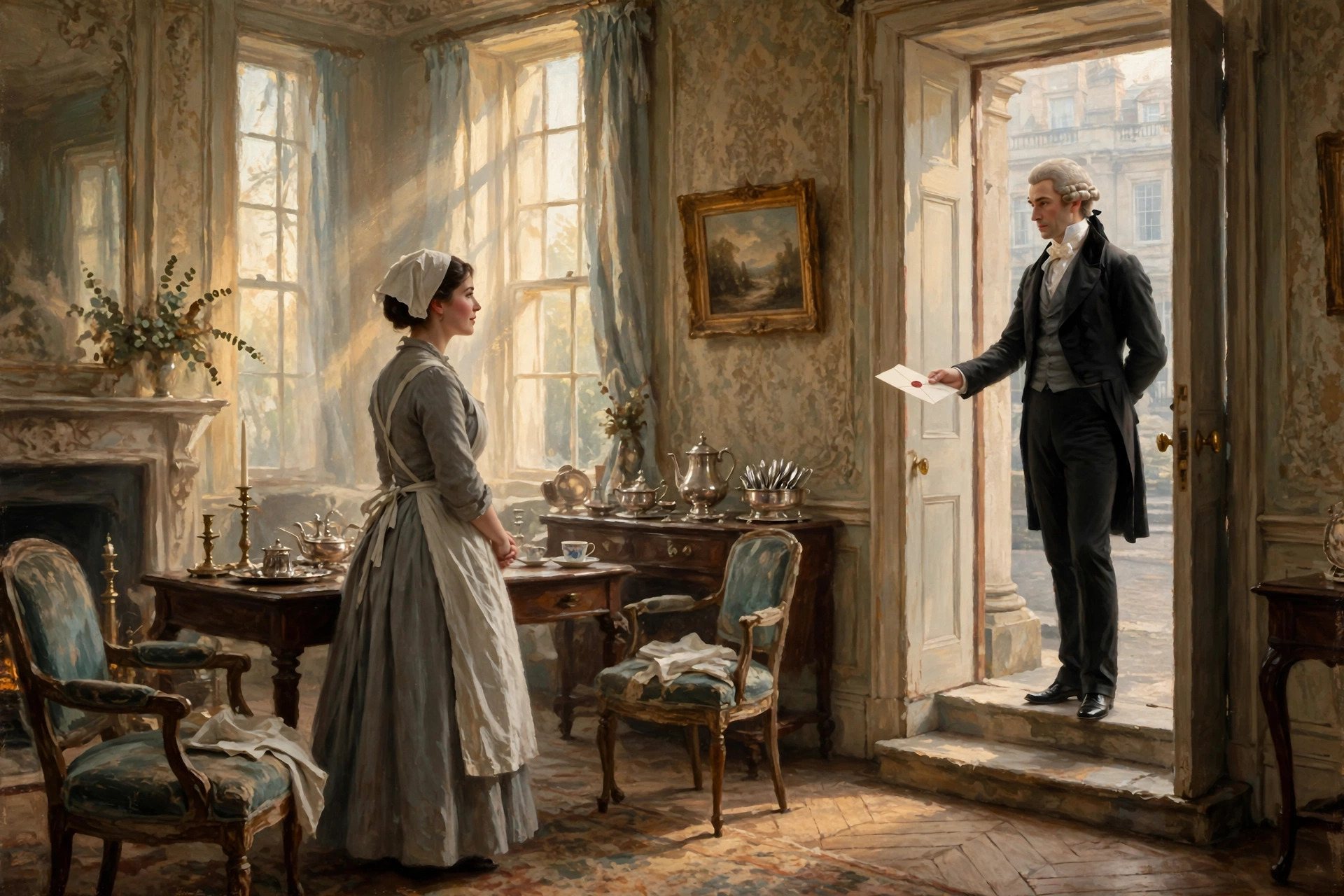
Margaret Ashworth heard the knocker before the clock had finished striking nine, which meant whoever stood on Mrs. Hollis's steps had not come for a social call. Callers with good manners waited until ten. Callers with business arrived early, and callers with business in Mayfair had been arriving at this particular door with a persistence that made her stomach fold in on itself like a letter read too many times.
She set down the silver polish, tucked her cloth into her apron pocket, and went to the door herself before Jenkins could shuffle down from the kitchen. One of the small economies of a household under siege: the staff had been let down to a cook, a maid who came at seven and left at four, and a footman who had not been replaced when he gave notice in the spring. Margaret had taken up the polishing because Mrs. Hollis could not bear to see the tarnish, and Margaret could not bear to see her employer's face when the silver went grey.
The man on the step held a letter, and he held it the way men held such things, squared off, official, its seal already broken by someone at his own chambers before he'd thought better of it. He was tall, thirty-odd, with the kind of careful clothing that announces a person earns well but not grandly, and he did not look like a creditor's man. Creditors' men came in pairs, usually, and they looked at the house as though measuring it for sale.
"Good morning," he said. "I've come to see Mrs. Hollis."
"Mrs. Hollis is not receiving." Margaret gave him the smile she had spent years perfecting, the one that turned a sentence into a closed door. "If you leave your card, I'll see it reaches her."
"She'll want this." He turned the letter so she could see the direction on it. Not his own chambers. A firm of solicitors she recognized, because their name had appeared on three of the seven letters already stacked inside the writing desk, each one more politely threatening than the last. "My name is Thomas Reed. I'm a barrister. I'm called by these people, Mrs..."
"Miss Ashworth." She did not offer the hand. "I'm Mrs. Hollis's companion. And I can tell you now, Mr. Reed, that she is not well enough to receive letters of this sort, and I will not carry it to her."
His eyes went past her shoulder, into the hall, the way water finds a crack. Men always looked. They were cataloguing the house even while they spoke to her, counting the paintings, the marble, the umbrella stand that had come from Lisbon in another century. She had learned to stand so that she filled the doorway, which worked better in theory than in practice, as he had four inches on her and no apparent embarrassment about using them.
"Then I'll wait," he said. "I've come a long way, and the matter is time-sensitive."
"All matters of this kind are time-sensitive. That is the entire fashion of them."
She heard the stick before she saw the woman leaning on it, the slow tap of Mrs. Hollis negotiating the hallway tiles on a bad hip and a worse night, and Margaret's heart sank, because Mrs. Hollis never came to the front door. She had not come to the front door since the third letter arrived.
"Margaret, who is it?"
"Nobody, ma'am. A caller misdirected."
"I heard the word barrister." Mrs. Hollis arrived at the door in her grey morning gown, her white hair plaited for the day, her chin at the angle that forty years of running a shipping family had left her with, and she looked at Thomas Reed the way a general looks at terrain. "Reed. Were you not at the assizes, the year of the wet harvest? You argued the grain case."
"I did, ma'am." Something shifted in his face, the professional blankness giving way by a half inch. "You were in the gallery."
"I was in the gallery, and I remember a young man who argued for two days and won on the third. Come in, Mr. Reed. Margaret, stop looming in the doorway like a customs officer. You'll make the poor man think we've something to hide."
We have a great deal to hide, Margaret thought, and stepped aside.
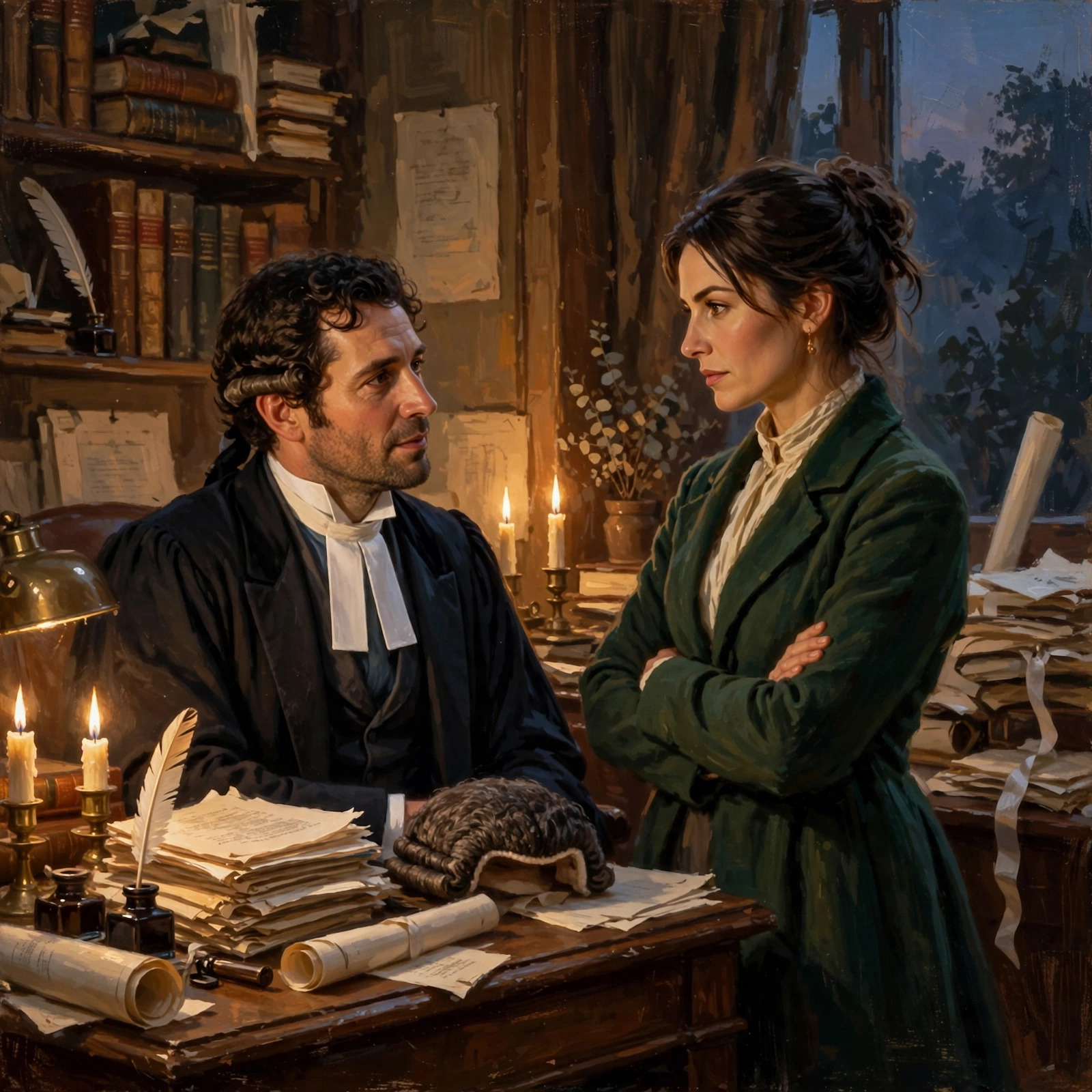
She followed them into the morning room because she had no dignified alternative. It was the room where the letters lived. The writing desk sat by the window with its drawers locked, and inside the lower drawer, beneath a false bottom Margaret had discovered while searching for sealing wax, was her father's ledger, and she would rather have died than let a barrister within ten feet of it. Her father had been dead seven months. He had been dead two days before the first letter arrived, which she had always considered the single kindest act of his entire dishonest life.
Mrs. Hollis settled into her chair by the fire, though the fire had gone out an hour ago and nobody had relaid it. "Now, Mr. Reed. Say your piece."
Thomas laid the letter on the table between them, but he did not sit, and Margaret noted that too. Barristers who intended to be brief did not sit. "This firm acts for a consortium of creditors, ma'am. Among the debts they've purchased is a considerable obligation bearing your signature. Some four hundred pounds."
"Four hundred," Mrs. Hollis repeated. Her hand found the arm of the chair.
Four hundred pounds. Margaret's own salary for four years, paid quarterly and always on time, because Mrs. Hollis was scrupulous to a fault about wages, scrupulous about everything, which was precisely why the words bearing your signature had gone through the room like a dropped glass. Margaret knew, in the way one knows a wound before the blood shows, that Mrs. Hollis had signed nothing.
"That is not possible," Mrs. Hollis said. "Show me the instrument."
"I can't show you their copy, ma'am. It's not in my possession." Thomas paused, and Margaret watched him choose his next words the way a man chooses footing on wet stone. "But I can tell you the debt is one of a group sold together out of the same estate. An estate in probate. The Ashworth estate."
The room got very quiet. The clock on the mantel counted off three seconds, four, and Margaret stood with her back straight and her face arranged into polite incomprehension while everything inside her went cold.
"You know what that name is," Thomas said to her, not unkindly, and not gently either.
"I know what my own name is."
"Margaret." Mrs. Hollis's voice, soft. "Sit down, child."
"I'd rather stand."
"Then stand, but stand nearer." Mrs. Hollis turned back to the barrister, and there was something in her face Margaret had never seen before, and it took her a moment to recognize it as fear. Mrs. Hollis did not do fear. She had crossed the Bay of Biscay in a coal ship in January once, according to family legend, and had come home complaining about the soup. "Mr. Reed. Say the rest of it."
Thomas looked from the old woman to Margaret, and Margaret watched him arrive somewhere, some private decision made in the space of a breath. "The consortium has one purpose, ma'am, and that is payment. They aren't sentimental. If the debt stands, they'll petition, and a petition against this house will be printed in the papers alongside the Ashworth name, which is already being printed in the papers. I don't have to tell you what that does to an estate's value, or to a household's standing."
"It does what it does," Mrs. Hollis said. "I've survived worse."
"Perhaps. But you'll be fighting it alone, in public, at your age, and with Miss Ashworth's name chained to yours in every column." He turned to Margaret then, and his voice lost its courtroom smoothness entirely, became flat and quick, a man laying his cards down because he had run out of shuffling. "Miss Ashworth. You've been turned away from every drawing room in Mayfair since the scandal broke. I know that. I'm sorry for it. And I've read the debts your father left, all of them, and I know what's coming for this house in six weeks if something doesn't change."
Six weeks. She had thought no one outside the solicitors knew the timeline. "How do you know that figure?"
"Because I set it. The petition is drafted. I'm the one they'll send to serve it." He let that sit a moment, then drew a folded paper from inside his coat, held it, did not open it. "I'm not here to serve anything. I'm here with an offer, and I'll make it plainly, because you strike me as a woman who prefers plain things. Marry me."
Mrs. Hollis's stick clattered against the chair leg.
"Marry you," Margaret repeated.
"A respectable marriage, announced in the papers, settled properly, before the petition can be filed. A barrister of good standing, with an income and a name, taking as his wife the daughter of a dishonest man. The creditors will settle for a fraction, because a son-in-law's settlement reads better than a lawsuit, and Mrs. Hollis keeps her house, and the gossers lose their favorite story the moment you're legimately provided for." He set the folded paper on the table between them. "There's no courtship in this offer. I'm not pretending otherwise. But it protects what you love, and I believe you'll find that matters more than you expected it to."
He took up his hat then, as though the matter were finished, and Margaret stared at the paper on the table and could not yet make herself reach for it, because reaching would mean knowing what was written inside, and knowing would mean deciding, and deciding would mean the morning room, this room with the dead fire and the locked desk and the ledger she had not told a living soul about, would never be the same room again.
"You'll hear from me by Thursday," she said.
"I'll hear from you tonight," Thomas said, from the doorway, "because your father's creditors don't wait for Thursdays, and I suspect, Miss Ashworth, that neither do you."
He was gone before she found an answer, and Mrs. Hollis reached across and took the folded paper, and opened it, and read it, and looked up at Margaret with her chin trembling for the first time in forty years.
"Margaret," she said. "It's a settlement. He's given us the whole of it."
Margaret crossed the room and read the figure, and the figure was four hundred pounds, and the name signed beside it was Thomas Reed, and somewhere in the hall the front door was still trembling on its hinges.
Petersham's Garden
Margaret had walked the gravel path of Petersham's garden a hundred times as a girl, counting the yew hedges the way other girls counted ribbons, and she had never once walked it with a man who kept adjusting his coat buttons as though they might file a complaint against him.
"You didn't have to propose we walk," she said, when they had passed the second hedge and he had not yet said anything beyond good morning. "The papers could have come by the post."
"The post is read."
"By whom?"
"By everyone. Your father's affairs made certain of that."
It was said without softness, and she found she preferred it that way. Everyone else had learned to say her father's name the way one handled broken glass, sweeping around the sharp parts, and Thomas Reed set the glass on the table and told her it was broken.
"Then talk," she said. "You said the settlement would be four hundred pounds to the creditors. I've done sums in the night, Mr. Reed, and I can't make that figure sit still. Where does it come from?"
"From me."
"From your income."
"From my first year's income, mostly." He stopped at the gate where the gravel forked toward the orangery, and she realized he had steered them there on purpose, because the fork was the one place in the garden where the road back to the house could not be seen. He wanted her to feel she could speak freely. She did not know what to do with a man who thought of such things, so she said nothing, and he went on. "The creditors will take four hundred and a formal apology in the papers. They'll take it because a lawsuit against a barrister's father-in-law is a nuisance, and a settlement is a payday. But it empties my chambers' reserve for the year. If a bad quarter follows, I'll be taking work I'd rather not take."
"And you'd do that for a stranger's mother figure and a forger's daughter."
"Mrs. Hollis isn't a stranger. She fed me once, when it mattered. And you, Miss Ashworth, are about to be my wife. I find I'd rather not begin the marriage by quibbling over whether I know you well enough to help you."
She had prepared arguments on the walk from the house. She had prepared a speech, in fact, three of them, all beginning with the word imprudent, and every one of them had just died on the gravel. "That's not romantic," she managed.
"No. I told you it wouldn't be."
"Most men would lie about it."
"Most men," he said, "would have offered you a prettier story and a smaller settlement. I'd rather you know exactly what you're agreeing to. Down to the shilling."
They walked on. The orangery roof was going green at the joints, same as always, and the gardener had planted the borders thick with late roses, fat and half-open, and Margaret thought about her prayer book upstairs, and the pressed rose inside it from the summer her father had still been honest, and did not say so.
"Six weeks," Thomas said, as if reading a column of figures aloud. "That's what the banns require, three Sundays, and Mrs. Hollis wants the announcement in Monday's paper. If you'd rather a different timetable, say so now. Once the announcement prints, we're both committed, whatever we discover about each other."
"What do you expect to discover?"
"I don't know. That you snore, perhaps. That I take my tea too strong. That we quarrel about something neither of us can name until the third year." A pause, almost a smile, gone before she could check whether it had really been there. "Most marriages are founded on less information than ours. We have a contract, a deadline, and a mutual enemy. Some couples never get the enemy."
And Margaret laughed. She hadn't meant to. It came out of her like a bird startled off a railing, and she pressed her glove to her mouth too late to stop it, and found Thomas watching her with an expression she could only call arrested, as though the sound had caught him mid-motion and pinned him there.
"You laugh at your own predicament," he said.
"I laugh at yours. You've contracted to marry a woman Mayfair won't receive. I've been turned away from every drawing room in that neighborhood since the scandal, save one, and you're tying your respectable name to her. That's funnier than anything at the playhouse."
"It's not funny."
"No," she agreed, and the laughter had nowhere to go, so it sat in her chest, warm and inconvenient. "It's not. But if I don't laugh at it, Mr. Reed, I'll do something worse with it, and I've done worse things already. I've hidden in this house since spring. Mrs. Hollis pretends the callers stay away because of the heat. We both know the truth of it, and we're both too tired to say it aloud."
He was quiet for the length of the orangery wall. Then: "My mother died when I was young. My father worked himself into the grave keeping up appearances, and I learned early that appearances cost more than honesty. I have never once regretted paying for honesty instead." He turned his hat in his hands, once around, and she noticed his hand had gone to the breast of his coat and stopped there, against the pocket, on something folded. "Which is why I'd rather you knew the terms cold. No warmth on the paper that isn't in the living of it."
"That's a grim way to run a betrothal."
"That's a grim way to run a life. The betrothal gets whatever's left."
She looked at him properly then. The starched collar, the coat brushed to thread at one cuff, the ink stain on his right forefinger that no amount of scrubbing had ever quite removed. He had made her an offer that would beggar his own year and asked for nothing but her hand and her name in the Monday paper, and he stood there describing it like a man reading an inventory of someone else's goods.
"The terms are acceptable," she said. "With one addition."
"Name it."
"If we're to be married in six weeks, you'll call me Margaret. Not Miss Ashworth. I've been Miss Ashworth in every room I've been unwelcome in. I'd rather not be unwelcome in my own marriage."
"Margaret." He said it carefully, the way he'd said the settlement figure, as though testing whether the number held. "Then you'll call me Thomas. Fair's fair."
"Fair's fair."
They had come round to the fountain at the garden's center, dry since she was a girl, its basin full of leaves, and Thomas stopped and looked at it and then at her, and she thought he might say something further, something about what would happen after the banns, what the marriage would actually be when the papers stopped printing and the creditors went home satisfied. She found she wanted him to. She found the wanting was the most alarming part of the whole morning, worse than the debts, worse than the figure, and she opened her mouth to cover it with something brisk about arrangements.
A sparrow dropped from the orangery roof into the dry basin, thrashed among the leaves, and flew off with something in its beak that was almost certainly not food, and Margaret laughed again, and this time she let it happen, and when she looked up Thomas was watching her, not the bird at all, caught full in the act of it.
They both looked away. Both of them too slowly, and the gravel crunched under their feet for a dozen steps before either of them managed a word.
"The announcement goes in Monday's paper," Thomas said, to the hedge.
"I know," Margaret said, to the roses. "I'll be ready."
The Banns Read
The church had been neither full nor empty, which Margaret decided was the correct condition for a banns reading: enough witnesses to make it true, not enough to make it theater. The curate's voice had carried the names out over the heads like a stone dropped in a pond. Thomas Reed of this parish and Margaret Ashworth of this parish. A man near the back had turned to look at her. A woman had not bothered to hide behind her hat.
"They'll get used to it," Mrs. Hollis said now, carving the chicken as though the matter were settled, which in a sense it was. "The first Sunday is gossip. The third Sunday is old news. You'll see."
"I've seen how quickly Mayfair tires of things," Margaret said. "I'm counting on it."
Thomas was late to the table, which was unlike him, and when he sat down he did not reach for the wine. He ate the way he did everything, neatly and without apparent appetite, and Margaret watched him push a pea to the edge of his plate and leave it there and thought that something was sitting badly with him, and it was not the chicken.
Mrs. Hollis saw it too. She always saw things. She set down her knife.
"You went pale in church," she said. "Both of you, but you most. I put it down to the occasion, and now I put it down to something else. Out with it, Mr. Reed."
"Thomas," he said. "Please. He insisted on Sunday that I'm nearly family."
"Then out with it, Thomas."
He turned his glass a quarter turn on the cloth, and then another, and Margaret recognized the motion. It was the same one he made in the garden, the same one he made before saying anything that cost him. She had a catalogue of them now, six days long, and she was not sure when she had started keeping it.
"The banns," he said. "The reading of them. My father sat through a reading once, the year before he died. Not his own. A creditor's daughter's, marrying a man who'd agreed to take her along with the debts attached. A package arrangement. The father stood up in the third pew and thanked God aloud for providing." He set the glass down. "My father came home and said nothing for a fortnight, and then one night at supper he told me he'd stood in that church and understood, for the first time, exactly what he was. Not a man with debts. A man being traded with them."
Mrs. Hollis had gone very still. The room was quiet enough that Margaret could hear the fire settling in the grate.
"He died the following spring," Thomas said. "I was admitted to the bar the year after. I've told no one that. Not my chambers, not a soul. I've spent my whole career making certain no one ever stood where that girl stood. And then last week I found myself arranging precisely the thing I've spent my life despising, and I stood in church this morning hearing my own name read out and wondering which pew I was sitting in."
Margaret put her fork down. "You think you've traded me."
"I think I offered you a settlement and a deadline and never once asked you what you wanted. I asked what you'd accept. Those aren't the same question, and I know the difference. I've made a career of the difference."
"And you're telling me this now because the banns frightened you into honesty?" She kept her voice level, because the alternative was not level, and she found the alternative was rising fast. "Six weeks, Thomas. You set the date. You set the terms. You did the arithmetic on your own year down to the pound, and you did it alone, the way your father did everything alone, and now you sit at my employer's table and tell me you've been carrying him around in your coat like a second deed."
"Margaret," Mrs. Hollis said, a warning.
"No." Thomas's voice was quiet. "She's earned the right to say it. Say the rest, Margaret."
The rest was the part she had not said to anyone, not to Mrs. Hollis, not to the mirror. "I wanted it to be a trade," she said. "I wanted it desperately. Because if it was a trade, I could survive it with my accounts in order. Debts settled, name restored, husband paid in kind, everyone's ledger square. And then you had to go and be decent about it. You had to go and be honest about it, and now I don't know where to put the honesty, because there's no column for it."
Thomas looked at her the way he'd looked at the fountain, and then at her, and this time he did not look away. "Then we'll build the column as we go. I'm told that's what a marriage is. I wouldn't know. I only ever watched one fail."
Mrs. Hollis rose without a word and left the room, which frightened Margaret until she returned, three minutes later, carrying something small in both hands.
She put it on the table between the candles. A prayer book, green cloth gone soft at the corners, a ribbon marker gone pale.
"Your mother's," Mrs. Hollis said. "She left it with me the last time she came to this house, the summer I broke my ankle and she stayed a month to plague me. She said, Keep this somewhere I'll have to come back for. I've kept it eleven years. She was cleverer than she knew, or I was slower than I hoped." She pushed it across the cloth. "It's yours. It was always going to be yours. But I wanted to give it to you on a Sunday, after the banns, because I remember what it is to have your name read out in a church and feel the ground tilt."
Margaret did not touch it at first. Then she did, and the cover fell open the way a book does when it has been opened to the same place a hundred times, and there, flat between the pages, was a rose. Dark, dried to the color of old wine, pressed so thin it had become the paper's own shape.
"I put that there," Mrs. Hollis said. "The day I got the letter. Don't ask me which rose. I don't remember. I remember only that she'd have wanted something of the world in it, and the world was all in bloom that June."
Thomas said nothing. He watched Margaret's hands, and Margaret watched them too, and found they were not entirely steady, and found she did not mind that the two people at the table could see it.
"Thank you," she said. Both meanings. Every meaning.
Later, when the candles had been snuffed in the dining room and Mrs. Hollis had gone up with her book of sermons and her opinion that young people kept late hours for no reason she'd ever discovered, Margaret sat alone in the window seat of her room with the prayer book open on her knees. The rose lay in its place. Somewhere below, gravel crunched, and she knew without looking that it was Thomas walking the garden path rather than calling his carriage, because he had done it every night since Sunday, and she had never once let him know she'd noticed.
She turned the pages. Her mother's handwriting lived in the margins, small and slantwise. Asked patience, received an education. Margaret read it twice and laughed once, alone, in the dark.
She had spent ten days with a plan folded up inside her like a letter: the railways, the coast, a new name in a town that read no London papers. She had priced it. She had, in her head, packed for it. And now, with the book warm on her knees and the rose lying where her mother's summer had pressed it flat, she went looking for the plan and could not find it anywhere. In its place, unbidden and unbudgeted, were other things. Where she and Thomas would sit in that church on the third Sunday. Whether the morning room's desk would hold both their papers. What his face would do the first time she made him laugh somewhere no one could see.
She closed the book gently, so the rose would not shift, and sat a long while with her hand on the cover, planning a life.
Below, the gravel crunched, and stopped, and crunched again, going on.
The Terms
Two mornings after the rose, Mrs. Hollis declared war on the linen cupboards and conscripted Margaret into it, which was how Margaret came to be alone in the morning room at eleven o'clock, holding a list of things that wanted counting, while Mrs. Hollis interrogated a housemaid two floors above.

The settlement papers had come the evening before, in a packet from Thomas's chambers, tied in red string and addressed to Mrs. Hollis with a covering note in his hand. For the family to look over at leisure, he had written, as though four hundred pounds were a trifle one looked over the way one looked over a field. Margaret had watched Mrs. Hollis read it, had watched her lips thin, and had said nothing, because the sum was meant to be her business and no one had made it her business yet.
The packet sat on the writing desk, half untied. Mrs. Hollis had gone through it at breakfast, muttering about lawyers and their paper, and had abandoned it there, string curled on the blotter like a sleeping thing. Margaret only meant to tidy it. That was all. To square the pages and set them beneath the ledger where Mrs. Hollis would find them, because Mrs. Hollis could not abide a loose paper and would speak of it for a day and a half if she found one.
But the pages would not square. They were thicker at the back, the packet, and when Margaret pressed her palm flat to straighten them, a folded sheet slid loose and lay on the desk with her father's name uppermost.
She stood very still, the way one stands when a wasp has landed on one's sleeve.
Then she read it.
It was not the settlement. The settlement was the front of the packet, fair copies, terms in a clerk's fair round hand. This was a private memorandum, Thomas's own writing, close and slanted, dated the week before the betrothal was announced. It set out, in his dry barrister's shorthand, the substance of her father's debts. And beside the worst of them, the ones that had brought the creditor's men to Mrs. Hollis's gate, the ones that had closed every drawing room in Mayfair to Margaret since the summer, he had written a single line of plain English.
Signature forged beyond reasonable doubt. Compare hand, page 41 of Ashworth's ledger. She could not have known.
And beneath that, in the same ink, added later or in the same sitting, she could not tell: Say nothing. Let the debts stand hers to answer for, and the marriage will read as rescue. Gratitude is a better foundation than pity.
The morning room was very quiet. Somewhere in the house a door shut, gently, the way doors shut when one is not meant to notice them. Margaret sat down in Mrs. Hollis's chair without deciding to, the better to hold the paper, and read it again, and then a third time, because surely the third time the words would rearrange themselves into something else. They did not. Her father's hand, the one that had signed her school reports and her mother's condolences, had signed Beatrice Hollis's name to ruin, and Thomas had known it, had proved it, had compared it against page 41 of the ledger that had sat in this very desk all along, and had folded the proof away and let her carry the guilt like a stone in her chest through six weeks of banns and fittings and congratulations she could not swallow.
She knew the ledger. She had catalogued it for Mrs. Hollis, the spring before, when the scandal was new and Mrs. Hollis had wanted everything of her father's accounted for. Page 41. She had passed over page 41 and seen only columns.
He had seen a forgery. He had seen her innocence, whole and provable, and he had put it in a drawer.
She heard him before she saw him. The front step, the knocker, Mrs. Hollis's voice on the stair saying something about linen, and then he was in the doorway of the morning room with his hat in his hand, come about some point of the settlement or the church or the six weeks, and he saw her face, and he stopped so completely that the room seemed to hold its shape around him.
"You've found the memorandum."
"I've found it, yes." Her voice came out level, which surprised her, because her hands were not level at all. "You proved my father forged her signature. On the worst of the debts. The ones that made me poison in every house in London."
"I proved it, yes."
"And you said nothing."
"Margaret."
"You let me sit in that drawing room of Lady Carrington's and be looked at like a thief's daughter, which I am, but I am not a forger's accomplice, and you knew it, you had it written down, you had compared the hand yourself, and you let me believe I was carrying his guilt on my own back."
"Because it was better you should think so." He set his hat on the desk, carefully, on the corner, as though the desk were the one thing in the room that might still be reasoned with. "Consider how it stood. If the debts are proved forged, Mrs. Hollis sues a dead man's estate, which is ash, and the creditors sue her for their costs, which she cannot meet. The estate falls. Your position falls with it. Mine with it too, once chambers learned I'd spent my settlement defending a fraud." He said it plainly, the way he said everything, as though plainness were a kind of honesty. "Whereas if the debts stand, and I marry you, and pay them, the creditors are satisfied, the estate is shielded, and you are provided for. Everyone is saved. I saved everyone."
"You saved everyone but me, and you charged me gratitude for it."
"I charged you nothing."
"You wrote it down. Gratitude is a better foundation than pity." She lifted the memorandum. Her hand shook and she let it, because hiding it had been his trade and she refused to make it hers. "You sat in this house, at this desk, and you decided what I was allowed to know about my own father. Whether I was his dupe or his accomplice. You decided I should be the accomplice, because the dupe would owe you nothing but the truth."
"The truth was a weapon in your hands. You'd have gone to her with it. You'd have gone to the creditors with it, in that state you were in, and you'd have burned the estate to the ground to clear his name. I have watched you for six weeks, Margaret. You would have done it in a week."
"Then you should have stopped me. You should have argued with me. You should have told me and trusted me to be something better than a woman with a torch." She stood, and the chair scraped, and the sound was ugly and she was glad of it. "You want a wife who owes you her rescue. Who looks at you and sees the man who paid four hundred pounds for her good name. I have been bought before, Mr. Reed, by a house and a wage and a woman kind enough to keep me, and I know exactly how the account reads. I will not be bought by a husband who could have given me the one thing that was mine already, my innocence, and kept it in a drawer instead so it would cost me more."
"Margaret, the banns have been read twice."
"Then God has heard twice, and I will make sure He hears something different the third time."
He looked at her for a long moment, and she watched him understand that the argument he had prepared, and she could see there was one, whole and folded in him like the deed in his coat pocket, would not be spent here, on her, today. He picked up his hat.
"Where will you go?"
"That," she said, "is no longer your account to keep."
He went out through the hall, and she heard Mrs. Hollis on the stair, and the front door, and nothing after that but the ordinary sounds of a house pretending at afternoon.
Margaret sat down again and took the ledger from the desk, and opened it to page 41, and laid her father's forged hand beside his true one, and looked at them both for a long time, and found she could cry and count at once, which was also an education.
She packed that night. Not the plan she had priced out ten days ago, the railways, the coast, the new name. Something smaller and more honest: one case, dark wool for travel, the prayer book with the rose still pressed in it, and the ledger, because it was her father's, and whatever he had been, he was not Thomas Reed's to keep in a drawer. She wrote one line to Mrs. Hollis and left it on the desk where the memorandum had lain, and she was on the first train out of London before the sun had properly risen, with the ledger on her knees and her innocence, for the first time in a year, in her own hands.
The Seaside Inn
The sea was doing its honest work outside the window of the inn's small parlor, grinding the shingle over and over, when a horse stopped in the yard and a voice she knew asked the landlord which lady had taken the corner room. Margaret had been in the seaside town three days, long enough to learn that the gulls stole at dawn and that the landlady's tea was bitter and the bread was not, and now she learned a third thing, which was that her heart could hear Thomas Reed through a floor and a wall and a closed door, and drop.
She had two minutes, and she spent one of them being honest with herself: she had known he would come. A man who filed memoranda did not misplace a fiancée. She spent the other minute moving the ledger from the table to her case, because whatever happened in this room, her father's book was not going to sit out and be looked at by him again, not as evidence, not as currency, not as anything.
Then the knock, and she said, "It's open," because it was a public inn and he was a member of the public, and she would not be found huddled behind a latch like a woman with something to hide.
He came in with his hat in his hand and three days of the road on his coat, and he did not sit, and he did not send her in front of him into a chair, and he said, "You look well."
"I am." The gulls went over the window, loud and low. "It's the sea air. Mrs. Hollis always said it was restorative, and she was right about the sea if not about everything."
"She knows where you are."
"She does. I told her. I didn't tell you, and she didn't either, so before you congratulate her on her loyalty, you should know she only kept it because I asked her to, and she has been kept by people before and did not care to do it to me." She moved the tea things an inch, so the table had some order on it. "Was it a long ride?"
"Long enough. I did it in two stages. I'm not twenty anymore and I stopped pretending I was somewhere around Northfleet." He set his hat on the table, wrong way up, like a man intending to stay. Then he took it up again, and put it on the shelf by the window, which meant the same thing but farther off. "There's no settlement filed."
"I hadn't asked after it."
"You should. It was four hundred pounds to your father's creditors, and it would have left chambers with almost nothing for the first year, and I told them yesterday I wasn't filing it. The creditors can have what my chambers recover, when they recover it, and the recovery is not my problem anymore, because I've resigned."
The room went quiet enough that she could hear the shingle turning over itself below the window. "Resigned."
"There's a letter in London saying so. Probably under a paperweight by now." He was not quite steady on his feet, she noticed, in the way of a man who had slept in a saddle, and he kept his hand on the back of the chair without sitting in it. "I gave up the thing I was protecting, Margaret. Because you were right, and I'll say it plainly, since I seem constitutionally incapable of saying anything else: you were right, and I knew it while I was doing it, and I did it anyway, and that is the part I can't excuse."
"Which part?" she said. "The knowing or the doing? Because you had better know, Thomas, that I have had three days and a long train ride to decide which one I minded, and the train won, and the answer is the knowing. A man who does a wrong thing blindly can be forgiven. I lived a year in that forgivable country. A man who does it with his eyes open and a page number in his head is something else."
"Then I'm something else." He said it without flinching, and she watched him make himself go on. "I found the ledger in February. Page forty-one, the forged hand beside the true one, plain as a morning. I had the proof of your innocence in my hand while I was drafting the terms of your rescue, and I put it in a drawer, because if you were innocent then you didn't need me, and if you didn't need me I could think of no reason under heaven you would have me."
She had meant to stand still for this, and she found she was sitting down, on the window bench, because her legs had opinions her pride did not. "Say that last part again."
"No."
"Thomas."
"You heard it. I'm not going to dress it up twice. You asked me once what remained if you signed nothing, and here is the whole of it, plainly, as plainly as I can." He came around the table at last and sat across from her, and he took from inside his coat a folded paper, creased hard, carried a long way against his ribs. "This is a deed. A cottage, in the village near the sea here, I won't pretend I bought it blind, I chose this town because I chose the cottage, and the deed is made out in your name. Only yours. Not Mrs. Hollis's, not a settlement held in trust, not a wife's portion. Yours whether you marry me or marry no one or stand on the shingle every morning for fifty years telling the gulls what a scoundrel I am. I had it drawn before I came. The man who wrote the memorandum kept a copy of everything and a way out of everything, and I wanted there to be one paper in the world where your name stood and no one could take it back."
She took it. Her hands were not as steady as she would have liked, and the paper was warm from being carried, and she read her own name, Margaret Ashworth, in the legal hand, with no other name hitched to it anywhere, and she read it twice.
"This is very grand," she said, "for a man with no chambers."
"The cottage was cheap and the chambers were dear, and it turns out I have always known which one I could live without."
"And what do you live on, Thomas? Charity? Your sense of your own virtue, which I have now heard priced and found to be considerable?"
"Law work," he said. "There is a solicitor here in town, a decent man, overworked, drowning in leases and wrecks and fishermen's disputes. He'll take me on for wages. Not barrister's wages. Clerk's wages, near enough, which is a humbling thing to say aloud, and I find I don't mind it as much as I feared." He turned his hat over on the shelf, and she saw his hands wanted something to do and were refused. "I was never going to be poor. I made sure of that first, all my life, before anything else, and it made me a man who prices people. I priced you. I sat in that morning room and I priced you, and you saw it, and you were right to walk out of my arithmetic."
She looked at him for a long moment, this man she had left in a London drawing room with a folded argument in him, and saw that the argument had been spent after all, but not on her. On himself. Somewhere on the road, in the rain probably, in some inn yard where nobody knew his name.
"The banns have been read twice," she said. "Six weeks from the announcement to the date, and it's been fifteen days. There's time yet to stop the third reading."
"I know. I know to the day."
She held the deed, and it was heavier than paper had any right to be, and then she leaned forward and set it on the table between them, flat, squared to the edge, and put one finger on it, and looked at him.
"Thomas," she said. "If I sign nothing, what remains?"
The Cottage Gate
The gate had a latch that wanted lifting with both hands, and Thomas lifted it, and the sun came through the pickets in stripes across his sleeves, and Margaret stood on the outside of it in her wedding grey and thought: this is the last moment I stand anywhere without him, and then she thought: no, that moment passed in the church this morning, and I did not even notice it go.
"After you," he said, and held the gate wide, and she did not go through it.
She stood in the road instead, in the dust and the salt wind, with the sea making its steady noise beyond the rooflines, and she looked at the cottage the way she had looked at the deed in the inn parlor, twice, careful, as though reading it might change what was written there. It was small. It was whitewashed. It had a door the color of a robin's egg and a garden gone to thyme and wild roses, and a fence that leaned, and behind one of the crooked windows she could see a curtain Beatrice Hollis had sewn herself, badly, out of a remnant, and had posted down wrapped in brown paper with a note that read: For the windows, before you do anything foolish like buying any.
"Margaret." His voice had gone quiet. "You've stopped."
"I've stopped."
"People will talk."
"People have been talking since April. It would be a shame to waste all that effort."
A cart went by on the road, and the man on it touched his cap to them both, to her especially, and slow, and she knew very well what he was thinking, because the whole town had thought it at the church and on the walk after and would go on thinking it over their suppers: that woman, the one from the scandal, the one whose father did what he did, married this morning to a respectable man with a good coat. And the town was welcome to its supper. She had spent her whole life being the subject of other people's suppers, and she had learned, slowly, in a seaside inn over a folded deed, that being talked about and being known were two very different rooms, and that she had finally been let into the second one.
"The banns were read three times," Thomas said. He was still holding the gate. "Nobody objected. I confess I waited for it each Sunday. Some aunt of yours, some clerk of your father's, rising in the pew."
"Nobody rose."
"Nobody rose." He smiled, and then he didn't, and she watched him set the smile down the way he set everything down, carefully, in its place. "I have to tell you what I did with the ledger. You know I sent it to the creditors' man, but you don't know what I wrote with it, and you should, before you walk through this gate, because once you're in, you're in, and I would rather you chose it knowing the whole of me. I've had enough of half-telling you things."
"Then tell me."
"I wrote that your father forged her signature, and I enclosed the pages that prove it, and I wrote that I had known it when I offered to settle the debts with money, and that I had offered the money anyway, first, because I wanted to be the one who fixed it, and being the one who fixes things was worth more to me than the truth was. To her, and to you. I put that in the letter, to a stranger, in my own hand, and the man read it, because he wrote back. He wrote that the debts were void where the signature was forged, that Mrs. Hollis owed nothing, that the estate would stand, and that in thirty years of practice he had never once been handed a confession with a man's name at the bottom of it, and he did not quite know what to do with mine."
The wind moved the wild roses against the fence. Somewhere behind the cottage a gull made an argument with another gull and lost.
"So the money stayed mine," he went on. "The four hundred pounds. It's in the bank in town, whole, and I've been offered clerk's wages for real work, and I find that I'd rather be a man who told the truth badly and late than a man who bought the appearance of it early. That's the whole ledger of me now. You've read it."
She had. She stood in the road with the dust coming up around her hem, and she thought of Beatrice Hollis, who had come down on the public coach two weeks ago without a word of warning, and had looked at Margaret across the inn's little parlor for a long moment, and had said, "You look thin," and then, before Margaret could assemble any defense at all, "So does he. Marry him quickly, before you both blow away."
"She gave us her blessing," Margaret said. "You know she did. She stood in that parlor and she said that my father had made her sign things she never read, and that she'd known it for years, and that she'd let me carry the shame of it because carrying it herself was worse. And then she said the truest thing anyone has said to me in my whole life. She said, The people who shut their doors on you were never going to open them, dear, so stop knocking, and come home."
"And is this home?"
"That," she said, "is what I have been standing in the road deciding."
His hand tightened on the gate, and she watched him make himself loosen it, and she watched him not say any of the things a clever man says when he wants to win, because he had learned, somewhere between one town and this one, that she was not a door to be talked open. He waited. The sea kept on. The roses kept on. Thomas Reed, who had once filled every silence in a morning room with arithmetic, stood in a garden gate in the wind and let the silence be hers.
"I'll tell you what I decided," she said. She took the prayer book out of her reticule, the small worn one, the one that had gone with her on the coach and out of the city and into the church that morning, and she opened it to the place where the rose lay flat and brown and pressed thin between the pages, a rose from a garden she had not been allowed to keep. "My father gave me this when I was small, and I kept it, and I kept keeping things, all my life, because keeping was safer than choosing. Things can't leave you if you never open the book. But the book has to open, or the rose goes to dust and nobody ever sees what it was."
She lifted the rose out. It held together, barely, thin as the paper it had slept on.
"So I'm done keeping," she said. "I'm choosing. Out loud, so you hear it, and so I do. Thomas Reed, I choose you. Not the settlement, not the rescue, not the respectable man in the good coat who stands between me and the talk. You. The one who told the truth badly and late and then told it well. I choose you, and I'll keep on choosing you, every day, which is the harder thing, and I've never once in my life run from the harder thing once I'd seen it clearly."
"I know you haven't," he said, and his voice was not quite steady, and he did not pretend otherwise. "It's the most frightening thing about you."
She put the rose in his buttonhole, pressing the thin stem down with her thumb, careful as a signature, and the brown petals sat against the grey of his coat like a small flame that had decided, after years of being shut in a book, to be lit.
"There," she said. "Now you're kept."
"Now I'm kept," he agreed.
He lifted the latch and held the gate, and she took his arm, and together, married, in a small town where the whole of the great world's gossip had traveled ahead of them and been found dull by supper, they walked through the cottage gate, and the latch fell behind them, and neither of them looked back at the road.
Get notified when new stories drop

Marcus Hale
Marcus writes slow-burn and marriage-of-convenience stories where logistics become intimacy and competence is a love language.
Leave a comment
Comments