


The Lantern Loft
The Cracked Window
She came up the loft stairs two at a time, and the smell reached Theo before she did: warm beeswax, cold lead, and under both, something sugary that had to be Pell's Bakery on the corner.
He set down his chisel. The brass lantern on his worktable gave a small, interested flicker.
"You're the glazier," he said.
"And you're the man who's going to tell me I'm doing it wrong." She dropped a canvas tool roll on the bench beside his, then a paper bag that leaked powdered sugar. "Ada warned me. Mara Ellison. Hi."
"Theo Vance."
"I know. She said you'd glower." She looked past him, and her whole face changed.
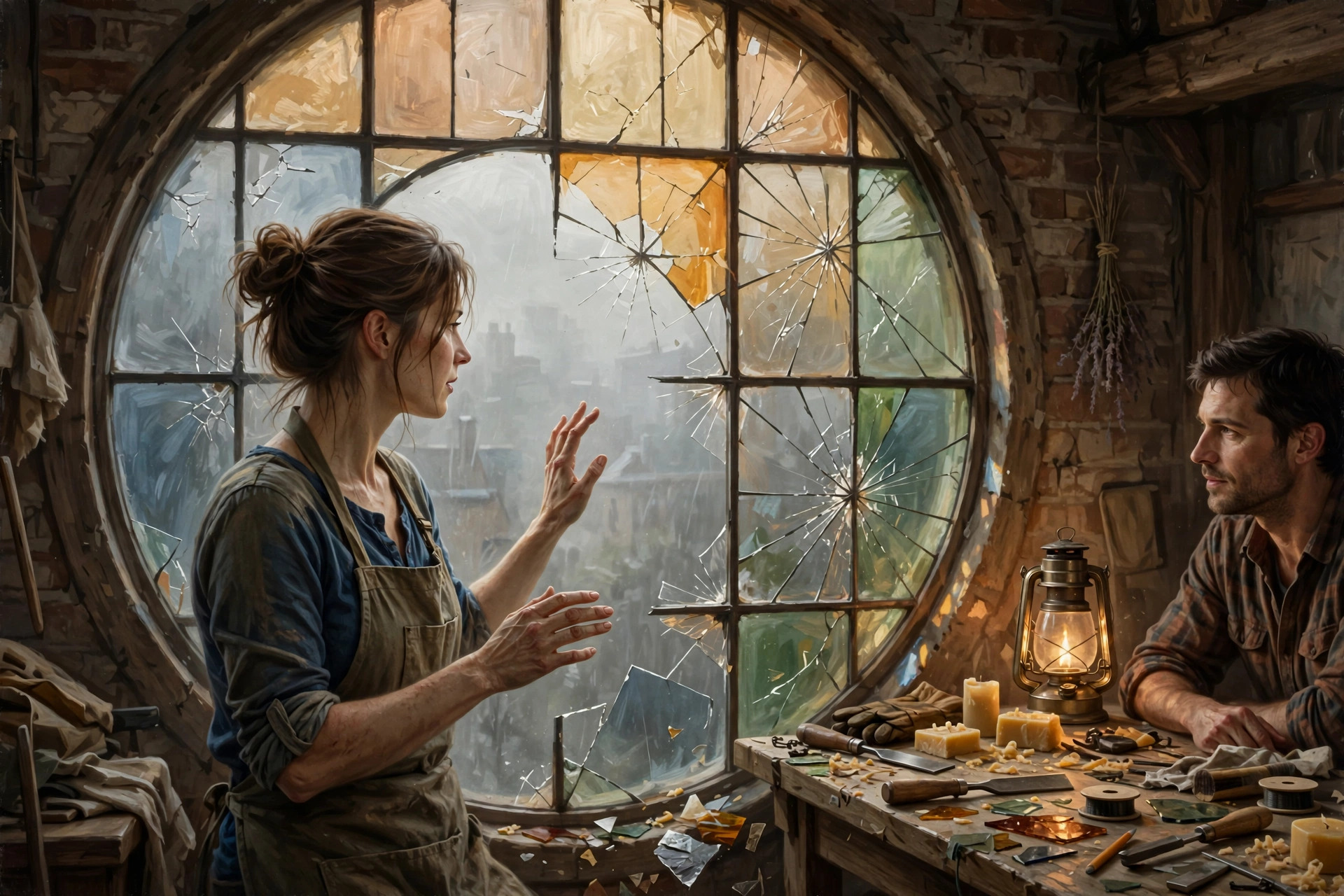
The great window took up most of the Lantern Loft's east wall, a wheel of leaded glass taller than both of them stacked, its twenty-four panes set in a spiral of amber, smoke-blue, and a green like river water in shade. In the grey morning it should have glowed. Instead the light came through in broken pieces. Seven panes were cracked, some with a single hair-fine line, two shattered into stars that still clung to their lead out of sheer stubbornness.
Mara walked to it slowly. She didn't touch it. She tipped her head and studied the cames, the solder joints, the way the frame sat in the brick, and Theo found he was watching her hands. They were small and scarred across the knuckles, and they hovered an inch from the glass as if they were listening.
"Who leaded this?" she asked.
"Nobody you'd have met."
"That's not an answer."
"It's the one I've got."
Ada Quill came in behind them with a thermos under one arm and her reading glasses pushed up into her silver hair like a tiara. "Theo, be civil. She's the best in Ashby, and she's the only one who didn't laugh at my deadline."
"I laughed," Mara said. "Just not out loud."
Ada poured three cups of tea nobody had asked for and set them on the windowsill in a row. "Whole by the solstice. All of it. I don't care if you two argue about it the entire time, so long as the glass gets done."
Theo cared. He had spent the night walking Harrow Street with the lantern swinging from his fist, checking every doorstep, every lintel, every sleeping house where the wards had thinned to cobweb. Three families had woken to frost on the inside of their bedroom windows. One child had sleepwalked to the end of the block and stood there, humming, until her father found her. None of them knew why. They weren't supposed to.
"Here's what I'll need," Mara said, unrolling her tools across the bench. Cutters, a lathekin, a fid, a pair of grozing pliers with the paint worn off the handles. "I'll pull the broken panes one at a time and pin the rest while I work. I'll match the colors from what I can get. The blue is going to be a nightmare, but there's a supplier upstate who might--"
"No."
She looked up. "No to the blue?"
"No to all of it. You don't pull the panes. You lift the cracked glass out and set the new glass into the original lead. Nothing in that frame gets cut or replaced."
"Some of that lead is a century old and soft as butter. If I reuse it, it'll sag inside a year."
"It won't."
"You don't know that."
"I do."
She put the pliers down very carefully, the way some people set down a glass they'd rather throw. "Mr. Vance. I'm going to say this once, kindly. I've been doing this a long time, and I've met a lot of men who know more about my job than I do. Not one of them has ever been right."
Ada sipped her tea and said nothing, which was its own kind of verdict.
Theo couldn't explain it. The lead wasn't just lead. It had been drawn through the old warden's hands, and his before that, and every came held a little of the working that knit Harrow Street together while it slept. Cut it out and the window would be pretty and useless. But you didn't say that to a stranger with powdered sugar on her sleeve and a skeptical mouth.
"Reuse what you can," he said. "Humor me."
"I don't humor people. I do the job right." Still, she pulled a pair of gloves out of her pocket, considered them, and stuffed them back. "Fine. I'll test the lead first. If it's sound, I'll keep it. If it's rubbish, we're having this conversation again."
"Gloves," he said.
"Can't feel the glass in gloves."
"It's broken glass."
"Yes, thank you, that's why I'm here."
She chose the lowest of the seven, a wedge of amber near the bottom of the spiral with a crack running corner to corner. She worked the lathekin under the lead, coaxing the flange back with small, patient strokes. A thin chain had slipped free of her collar while she bent, and a ring swung from it, an old gold band with a chip of garnet, ticking softly against the frame each time she leaned in.
Theo told himself he was watching to make sure she didn't damage anything.
The amber came loose on one side. She reached in to steady it, and the pane next to it, one of the starred ones, chose that moment to shed a piece. It dropped like a guillotine across the pad of her thumb.
"Ow. Ow. Okay." Blood welled fast and bright and ran down her wrist.
He was there before he'd decided to move. He caught her hand in both of his, turned it palm up, pressed his thumb above the cut to slow it.
And the thread went.
It left him the way a held note leaves a singer, without asking. A line of light he'd carried behind his breastbone his whole life uncoiled, slid down his arm, through his fingers, and sank into her skin like water into sand. He felt it knot. He felt the far end of it settle somewhere warm and stubborn and entirely not his.
Behind her, the great window brightened. Just a little. Just the panes nearest her hand, warming from dull to honey, as if someone had lit a candle on the other side.
Theo's mouth went dry.
One person. A warden got one, in a whole life, and he'd sworn on his mother's kitchen floor that he'd never give it to anyone, because he'd watched what it did. He'd watched a bond turn into a lead and a lead into a leash, and his mother learn to ask permission to go to the shops.
"You're squeezing," Mara said.
He let go too quickly. "Sorry."
"It's fine. It's not deep." She frowned at him. "You've gone a very strange color."
"I don't like blood."
"You're the one who told me to wear gloves, so I suppose you've earned a told-you-so." She wrapped her thumb in a strip of cloth from the tool roll and tied it off with her teeth. Then, because she was apparently made of something tougher than he was, she went straight back to the window. "Hold this edge for me."
He held it. Her shoulder brushed his arm, and the thread hummed between them like a plucked wire. She didn't flinch. She didn't feel it at all.
She eased the cracked amber out of its lead in one clean piece and held it up to the light, turning it. "There. One down."
"Six to go," Ada said quietly. She was looking at the window, at the warm patch of glass that hadn't been warm a minute ago, and then she was looking at Theo over the rim of her cup.
Mara laid the amber on a cloth on the bench and went to rinse her hand at the little sink in the corner. While her back was turned, Theo picked up the shard that had cut her. It was no longer than his finger, wickedly thin, her blood drying dark along its edge. It was warm. It shouldn't have been warm.
He slid it into his coat pocket.
"Theo," Ada said.
"Mm."
"What just happened?"
Mara turned off the tap and glanced back at them both, shaking water from her fingers, eyebrows up.
Theo picked up his chisel and turned toward the worktable, toward the lantern, which was burning steadier than it had in weeks.
"Nothing," he said. "Nothing happened."
Pell's Bakery Bread
On the fourth night, the bread arrived before Theo did. Mara heard the paper bag first, crackling its way up the stairwell, and then the smell reached her: caraway, and something sweeter underneath, butter browned at the edges. She didn't look up. She had a sheet of new amber on the light table and a score line halfway across it, and if she stopped now the line would wander. "You're late," she said. "You're early. Ada said six." "Ada said six on the first day. I've decided six is a suggestion." She ran the cutter to the edge, set it down, and snapped the glass clean over the lip of the bench. Then she looked. He was standing at the top of the stairs with snow melting in his hair and a bag from Pell's Bakery held out in front of him. "What's that?" "Dinner." He set it on the corner of her bench, well away from the glass. "They sell off the day's loaves at half seven. If you're at the door with exact change, you get the end of the honey cake for nothing." "So you're a regular." "I'm a man who lives above a draper's and owns one pan." He tore the loaf in half with his hands, looked at both pieces, and gave her the one with the heel. "They think I'm tragic." "You are a bit tragic." She took the heel anyway. It was still warm, and the crust shattered when she bit it. She tried not to make a noise and failed. Theo smiled at the floor, as if smiling at her directly might cost him something. Then he took his half to the far side of the loft, to his worktable and the brass lantern, and ate standing up. That was how it went. On the fifth night he brought a seeded rye and a wedge of cheese wrapped in wax paper. She brought a flask of tea strong enough to strip paint. They ate on her bench with the cracked panes laid out between them like patients, and he told her which streets on Harrow Street had the oldest wards, the ones that went back further than anyone's grandmother. She told him about a church in Ashby where she'd spent a whole winter on her back on scaffolding, restoring a rose window for a vicar who hummed hymns badly and brought her mince pies. "Was it worth it?" "The window? Yes. The pies were dry." She brushed crumbs off her jumper. "Your turn. Worst job you've ever had." He thought about it longer than the question deserved. "This one, some nights." "Because of me?" "Because of the cold." He nodded at the great window on the east wall, at the gaps where seven panes had been and the dull lead framing them. "It gets in." She set the first new pane that night. It took her two hours to trim the amber to the old template, another hour to work the came open with her lathekin and ease the glass into its channel. Theo came over near the end to read the ward lines, the faint silver tracery only he seemed able to see, and stood at her shoulder with his hands in his pockets. She pressed the lead home with her thumb. The amber warmed. It wasn't dramatic. It was the kind of warming that could have been the lantern behind her, or the low streetlight below, or her own tired eyes. She glanced back at his worktable. The lantern was burning, small and even. "Good," Theo said, a little hoarse. "That's good." He went back to his side of the room. When she looked again, the pane was just glass. On the sixth night, her pliers betrayed her. She'd had them longer than she'd had anything. They'd been the first tool she bought with her own money in the week she moved her life out of a flat that had never been hers, and they had a wobble in the pivot she'd been ignoring for a year. She was grozing the curved edge of the second pane, nibbling the glass down a crumb at a time, when the jaws slipped sideways and bit a chip out of the wrong place entirely. "No. No, no, no." She held the pane up to the light. The chip ran a hair past the line. Useless. "Oh, for..." Theo was beside her before she'd finished swearing. He didn't touch the glass. He held out his palm for the pliers. "I can have those right for tomorrow." "I'll manage." "You just told a pane of glass to go to hell." "It deserved it." She closed her hand around the pliers. They were warm from her grip, the rubber on the handles split and patched with tape. "I don't hand my tools over. I'm sorry. It isn't about you." He didn't argue. That surprised her more than anything. He just put his hand back in his pocket and waited, and the waiting wasn't impatient. It looked almost like relief, as though she'd answered a question he hadn't asked out loud. She looked down at the ruined amber. Fifteen days to solstice, and she was down a pane because she was too stubborn to let a man fix a rivet. "Ask me properly," she said. His eyebrows went up. "Mara. May I please fix your pliers?" "You may." She put them in his hand. "If you lose them, I'll haunt you." "You're in the right building for it." She cut another pane with a borrowed pair from his drawer, clumsy things that felt like wearing someone else's shoes. Across the loft, he sat under the lantern with her pliers taken apart in front of him, a jeweler's file in one hand, head bent so low his hair nearly touched the bench. Every so often he held the jaws up to the light and squinted down them like a man sighting a rifle. She went home at one. He was still there. On the seventh night, they were waiting on her bench, set squarely on the tool roll. The old rivet was gone. A new one sat flush in the pivot, bright against the dull steel. The jaws had been filed true, so that when she closed them they met along their whole length without a gap. He'd fitted a spring between the handles where there had never been one, and the split rubber was gone too, replaced with thin dark leather, stitched tight. She opened and closed them. They moved like they'd been waiting years to. "Theo." He was at his table with his back to her, doing something unnecessary to the lantern wick. "Too stiff? I can ease the spring." "They're perfect." She ran her thumb over the stitching. The leather had been cut to her grip, wider at the base where her palm sat. He must have measured the old tape. "How long did this take you?" "Not long." "Liar. Your eyes look like you slept in a hedge." "I always look like that." She tried them on a scrap of amber. They took a bite so clean it barely made a sound. She set the second pane that night without a single wrong chip, and when she pressed the last of the came closed and stepped back, he was there again at her shoulder, reading the silver lines, and the glass warmed. Both panes this time. The new one and the one from the night before, like two windows lit in the same house. She looked at the lantern. Then at him. He was looking very hard at the lead. "Draught," he said, before she'd asked anything at all. On the eighth night, she brought the bread. It was a small victory. She got to Pell's Bakery at twenty past seven with exact change and came away with a plaited loaf and the end of the honey cake, and she climbed the loft stairs with snow on her own hair for once. Theo looked up from his table and his whole face changed. "You went to Pell's." "I'm told I'm tragic now." "Welcome." He came and took the cake from her as if it were fragile, and they ate it in silence on her bench, picking at it with their fingers, his knee a careful inch from hers. The third pane was the hardest. It sat high on the left, where the lead had buckled when the ward faltered, and she had to straighten the came with the flat of her knife before the glass would go in at all. She worked on the stepladder with the pliers in her back pocket. Theo held the ladder. "Hand me that." He passed up the lathekin. Their fingers met on the handle. She took it. "Hold the panel at the bottom, would you? It's shifting." He climbed two rungs behind her and braced the lead with the flat of his hand, close enough that she could feel the cold coming off his coat, and the warmth under it. She eased the amber into the channel. Pressed. Pressed again. The glass caught light. Not honey this time. Gold. Real gold, deep and steady, and not only the pane under her hands. The two below it kindled too, all three at once, so bright she could see the shadows of her own fingers thrown across the lead. Theo let go of the panel and stepped down off the ladder. The gold faded to honey. Then to amber. Then to glass. Mara stayed where she was, very still, her palm flat on the came. "Come back up." "Mara..." "Please." He climbed one rung. The panes warmed. Another. Gold, all three, and the lantern on his table guttered as if somebody had opened a door. She turned on the ladder and looked down at him, at his white knuckles on the rail and the way he wouldn't meet her eyes. "Theo," she said. "Why do they only do that when you're near me?"Under the Lantern
The lights went out on the eleventh evening with a soft electric sigh, halfway through a joint.

Mara stopped with the iron an inch above the lead. Below the east wall, Harrow Street went dark house by house, porch lamps and kitchen windows folding into the snow like cards turned face down. Somewhere a dog started up and thought better of it.
"Well," she said into the black. "That's my iron cold in about four minutes."
"Lines are down past Ashby." Theo's voice came from the far side of the loft, from the direction of his worktable. "It'll be hours."
"I don't have hours. I have a joint going dull."
She heard him move. A drawer, a scrape of metal, and then a small sound she didn't have a word for, something between a match striking and a held note. Light bloomed inside the brass lantern on his table. It wasn't candle colour. It was paler and cleaner than that, the white of frost with a blue heart, and it filled the loft right up to the rafters without throwing a single hard shadow.
Theo stood over it with two fingers still resting on the little brass door. He closed it gently, the way you'd close a door on a sleeping child.
"You did that with your hand," Mara said.
"I did that with the lantern."
"Theo."
"Mostly with the lantern." He carried it across and set it on the floor beneath the window, angled up so it lit the fourth pane, the blue one, low on the right. "Is that enough to see by?"
It was more than enough. Every line of the came stood out, every bead of flux. She could see the hairline she'd been chasing in the old lead and the pale scar on the back of his left hand that he never explained.
"It'll do." She dug in her tool roll and came up with the butane iron, the ugly one she'd bought at a hardware sale years ago and never trusted. She thumbed the ignition. It caught on the third try. "Don't look at me like that. It works."
"I didn't say anything."
"Your eyebrows did."
She knelt on the low stool in front of the pane and leaned in. The flux hissed under the tip. Solder ran bright and slid into the joint, and she drew it smooth with a quick pass. Then she leaned further for the next one, and the chain at her neck swung forward on its own weight, her mother's ring turning on the end of it, glinting an inch from the hot tip.
She jerked back. "Damn it."
"Are you burned?"
"No. Nearly melted my mother, though." She killed the flame, reached behind her neck, and fumbled with the clasp. Her fingers were stiff from the cold and the clasp was tiny, and she swore at it twice before it gave. She pooled the chain in her palm, the ring heavy in the middle of it, and held it out without turning around. "Here. Hold this."
For a moment nothing happened.
Then his hand came under hers, warm, careful, and the chain slid from her palm into his. She felt him close his fingers over it. She felt it, absurdly, somewhere under her collarbone.
"Don't drop it," she said.
"I won't."
"It's the only thing of hers I kept. I sold the rest when..." She relit the iron and bent to the joint, because it was easier to say to the lead than to his face. "When I moved up here. After the wedding didn't happen."
The solder ran. She smoothed it.
Theo said nothing, which was why she kept going.
"Two weeks out. Dress was paid for. And he sat me down in my own kitchen and said he'd realised I was a project for him. Something he'd been fixing. He said it like he was being kind. Like I should be grateful he'd noticed before he'd sunk more time into me." She tapped the iron clean on the sponge. "He'd chosen the flat. The ring. The date. I'd said yes to every single thing because it was easier than arguing, and it turned out I wasn't even the one he wanted. Just the one he'd started on."
"Mara."
"So now I choose." She leaned into the next joint. "My job. My hours. My terrible soldering iron. Nobody decides anything for me anymore. I'd rather get it wrong on my own than have someone get it right on my behalf."
Behind her, the chain chimed faintly, as if his hand had tightened.
She finished the joint and sat back on her heels. The blue pane was sound. Four of the seven now, and the lead lay flat and clean under the frost-white light.
When she turned, Theo was sitting on the floor beside the lantern with his back against the wall and her chain wound twice around his fingers. He was looking at the ring as though it might ask him something.
"Your turn," she said.
He huffed something that wasn't quite a laugh. "Is that how it works?"
"It's how it works tonight."
He was quiet long enough that she thought he'd refuse. Then he said, to the ring, "My father was a warden. Before me."
She set the iron down on its stand and waited.
"He was good at it. Everyone said so. Wards on his street never so much as flickered." His thumb moved over the band. "He was bound to my mother. That's what wardens do, or what they did. You tie your light to someone, and it steadies you. Only it steadies you by holding on."
"Holding on how?"
"She used to walk me to school. Every morning. And every morning she'd stop at the end of our road, at the gate by the postbox, and she'd go white. Just for a second. Like she'd walked into a wall nobody else could see." He swallowed. "She never went past it. Not once, in all the years I knew her. I didn't understand until I was trained. His light didn't like her far away. So she wasn't."
Mara's chest went tight. "Did he know?"
"I think he told himself he didn't." Theo set the lantern a little straighter, though it didn't need it. "That's why I keep mine in there. Shut up in brass. Where it can't go anywhere it isn't told."
She looked at the lantern, at the patient, contained shine of it. Then at him, holding her mother's ring as if it were made of something far more breakable than gold.
"You're not him," she said.
"You don't know that."
"I know you made me cake at midnight when I forgot to eat. I know you stood in the snow for twenty minutes because I said the draught was coming from outside and you wanted to check." She got up off the stool and crossed to him and crouched, so they were level. "I know you're holding that like it's mine. Because it is."
He lifted his eyes to hers at last. Up close, in that light, they were more grey than she'd thought, and very tired.
"Mara, there's something about the window I should--"
"Later." She didn't know why she said it. Only that she was cold, and he was warm, and for once she didn't want to be told anything. She wanted to decide something. "Is it important right now?"
He looked at her mouth. "Not right now."
She leaned in. So did he. Close enough that she could feel his breath against her lip, close enough that the chain in his hand pressed between them, cold metal against her wrist.
He stopped. A hair's width away, he stopped, and she felt the effort of it go through his whole body.
"You're sure," he said. Not quite a question. More a plea.
"I'm choosing," Mara said, and closed the distance herself.
His mouth was warm and uncertain for exactly one second, and then it wasn't. His free hand came up to her jaw. The chain slid against her pulse. She curled her fingers into the front of his coat and held on, and he made a low sound that she'd be thinking about for days.
Behind them the window began to hum.
Not the four new panes. All of it. Every one of the twenty-four, mended and cracked alike, singing one deep, steady note that she felt in her knees and her teeth and the soles of her feet. The lantern flared. Frost-white light poured up through the glass and out over Harrow Street, and down in the dark, one by one, she thought she saw the sleeping houses brighten.
You Didn't Ask
The sixth pane went in a little after ten, with snow ticking at the outside of the glass and Theo holding the came steady while Mara pressed the last lead edge flat with her thumb.

"There," she said. "Tell me that isn't beautiful."
"It isn't beautiful."
She turned to glare at him and found him smiling, the small crooked one he'd started letting her see since the night on the floor. Three days of it now. Three days of him bringing her coffee before she asked and standing a little too close at the bench, and neither of them saying anything about it, which suited her fine. Nobody was rushing anybody.
"It's adequate," he amended.
"It's perfect, and you know it."
The new pane was the deep blue of a winter evening, cut to match the old pattern of the lantern-bearer's cloak. When she laid her palm against it, frost-white light threaded out from under her fingers and ran along the lead like a slow fuse, and the glass took it in and warmed. She'd stopped being startled by that around pane three. Now she just liked it.
One opening left. Low on the right, beside the lantern-bearer's boot, where the seventh crack had been. The replacement sat ready on her bench, a square of smoky amber she'd spent most of yesterday shaping. Her tool roll lay unfurled on the sill beneath it, each tool in its canvas slot, her grozing pliers already in her hand.
"We could do it tonight," she said. "Seven days early. Ada would faint."
"Ada doesn't faint." Theo was looking at the back of her hand, at the light still clinging to her knuckles, and his smile had gone somewhere. "Mara--"
The loft door banged open.
Ada Quill came up the last steps with snow on her shoulders and a white paper bag in one gloved fist, already talking. "Pell's was out of the almond ones, so you'll have to suffer through cinnamon. Theo, the wards on the lower end of Harrow Street are holding better than they have in years. I walked it twice." She stopped in the middle of the floor and looked at the window. "Oh. Oh, look at you."
Mara grinned. "Six down."
"I can see." Ada set the bag on the worktable beside the brass lantern and came closer, her eyes narrowed in the way they went when she was reading something other people couldn't. "And I can see that." She nodded at Mara's hand. "It's taken beautifully. I'll admit I worried, when Theo told me it caught on the first touch. Usually there's some fuss with a bond. Resistance. But you've been leading it through the glass like you were born to it."
Mara looked down at her hand. The light was fading off her fingers now, sinking back into her skin the way it always did.
"A bond," she said.
Ada glanced at Theo. Whatever she saw in his face made her go very still.
"Ada." Mara kept her voice light. It took some work. "What bond?"
"I thought..." Ada's mouth tightened. "Theo. You told me she knew."
"I said I'd tell her."
"That is not the same sentence."
Mara turned. He hadn't moved from beside the window, but he'd gone straight-backed, his hands at his sides. He looked like a man waiting for a sentence to be read out.
"Tell me what?"
He was quiet long enough that Ada made a small impatient sound. Then he said, very evenly, "Wardens carry a light-thread. It's how we hold the wards. Most of us never bind it to anyone. When you shook my hand, the first morning, it bound to you."
"Bound to me."
"It's why the panes take the light when you set them. It goes through you. Your hands lead it into the glass." He swallowed. "It wasn't a decision. It just happened."
"The first morning." She thought of it. The stairwell, her hand stuck out because she always shook hands, his hesitating half a second too long before he took it. The jolt she'd blamed on the cold. "That was two weeks ago."
"Yes."
"Two weeks. And you knew the whole time that something of yours was inside me, running through my hands, and you just..." She laughed, and it came out wrong. "You brought me coffee."
"It's only ever one," Ada said quietly. "A warden gets one bond in a lifetime. It doesn't happen by accident often, Mara. When it does, it means something."
"It means he picked." Mara heard her own voice rising and couldn't stop it. "Or it picked, or the magic picked, I don't care which. Somebody decided I was the right shape for something and fitted me into it, and nobody thought I might like to be asked."
She'd heard that before. Not in those words. In a kitchen she didn't live in anymore, with a ring she'd given back, a man telling a friend on the phone that she'd been a real project, honestly, but she's coming along. She'd stood in the hallway with grocery bags cutting into her fingers and understood that every kindness had been a renovation.
"Is that what this was?" She pointed at the window. "The cake. The snow. Did you need me happy so it would take better?"
Something went across his face, fast and ugly, like she'd struck him. Then it closed.
She watched it happen. Watched the warmth go out of him the way the light went out of her fingers, until the man standing in front of her was the one she'd met on the stairs: polite, guarded, nothing showing.
"It doesn't matter what it was," he said. "There's one pane left."
"It matters to me."
"The window needs to be whole by the solstice. Seven days. If it isn't, every ward on Harrow Street goes dark, and there are children asleep in those houses." He crossed to her bench and picked up the amber pane with careful hands. "You can be angry with me afterward. You can be angry with me for the rest of your life. But you'll set this first."
"I'll what?"
"The bond's in you now. Nobody else can lead it." He held the pane out to her. "You can't walk away from this, Mara. I'm sorry. You don't get to."
Ada said, "Theo," sharply, the way you'd say a dog's name.
He didn't look at her. He was looking at Mara with the pane held out between them, and his face was perfectly calm, and his hands were shaking so slightly she might have imagined it.
She didn't take the glass.
"You didn't ask," she said. "Not once. Not the first morning, not on the floor the other night when you had your chance and said later like it was a gift you were giving me. And now you're telling me what I get to do."
"I'm telling you what has to happen."
"Those aren't different, the way you say them."
Her fingers opened. She didn't decide it. The grozing pliers simply slid out of her grip and hit the floorboards with a flat iron clatter, loud in the quiet loft, and bounced once and lay still beside the leg of the butane iron's stand.
Nobody picked them up.
"Mara," Ada said. "Please."
"I'm sorry, Ada. I am." She was already pulling her coat off the hook. Her hands felt strange inside the sleeves, too warm, as if she could feel the thread now that she knew it was there. "Find somebody else."
"There isn't anybody else," Theo said. Flat. Certain.
"Then you should have thought about that two weeks ago."
She went down the stairs fast, past the landing where they'd met, out into Harrow Street. The snow was coming thicker. Behind her, through the loft's high east wall, the great window glowed blue and gold and amber over the rooftops, beautiful and nearly finished, and it was not the light that made her eyes sting.
Up in the Lantern Loft, the amber pane sat back on the bench where Theo had set it down. The pliers lay where they'd fallen. And beneath the one dark gap in the glass, Mara's tool roll was still spread open on the sill, every slot full but one.
The Cut Thread
The heat left her hands at ten past nine on the eighteenth, while Mara was rinsing a mug in the little sink of the room above Pell's Bakery.
For four days it had been there, low and constant, the way a cup of tea warms your palms after you've set it down. She'd hated it. She had held her hands under cold water to drown it and slept with them tucked under her arms and told herself she could feel nothing at all. Then, between one breath and the next, it was simply gone, and the cold that rushed in behind it was so total that her fingers forgot the mug.
It hit the edge of the sink and broke cleanly in two.
She stood looking at the halves. Downstairs the ovens ticked as they cooled. Out the window, over the white roofs of Harrow Street, the Lantern Loft's east wall was a dark square where, every night since she'd left, a faint blue glow had leaked through the shutters.
Nothing glowed now.
She didn't sleep. At six, when the bakery lights came on and the smell of butter and yeast came up through the floorboards, she went down in yesterday's sweater and took the table by the window, and she was still sitting there with an untouched roll when Ada Quill came in out of the snow.
Ada didn't stamp her boots or unwind her scarf. She crossed straight to the table and sat, and her face was gray at the edges.
"You felt it."
Mara turned her hands over on the tabletop. They looked ordinary. "Last night. Just after nine."
"Nine-oh-eight. I was there." Ada pulled off one glove, finger by finger. "He sat on the floor under the window with your pliers and the lantern, and he asked me to hold the light steady, and I told him he was a fool, and he did it anyway."
"Did what?"
"Cut it." Ada set the glove down very precisely. "You know there's only ever one. He told you that much, I hope."
"He told me a lot of things, eventually."
"Then he'll have told you a warden gets one bond in his life, and if he severs it he doesn't get the sight back." Ada's voice stayed level, but her bare hand had found the salt shaker and was turning it in slow quarter turns. "He's watched those wards since before I took the coven. Every thread over every roof. He could tell you which house had a sick baby by the way the light frayed over the door. And this morning he walked down Harrow Street and stopped in the middle of the road and looked up, and there was nothing there for him. Just snow."
Mara's throat had gone tight. "I didn't ask him to do that."
"No. You didn't." Ada stopped turning the shaker. "I'm not here to make you feel sorry, Mara. I'm here because he's outside, and he wouldn't come in until I'd told you he was coming, so you'd have the chance to leave first."
Through the fogged window, past the gold lettering, a tall shape stood at the curb with snow collecting on its shoulders.
"He's been there twenty minutes," Ada said. "I'll be at the counter. I've a dozen rolls to pay for and no intention of hurrying."
She stood, collected her glove, and went. Mara watched the shape at the curb. She could go up the back stairs. Nobody would stop her. That was the point, she understood, and it sat in her chest like a stone.
She didn't move.
After a while the door opened and the bell over it rang, and Theo Vance came in and stood a moment just inside, blinking at the warm air the way people do after a long time in the cold. He looked as if he hadn't slept either. There was a fresh scrape across the back of his left hand, and when he pulled out the chair across from her he did it carefully, like a man unsure of the floor.
He didn't sit straight away.
"I can stand," he said. "Or go. I only need a minute."
"Sit down, Theo."
He sat. He reached into his coat pocket and took out two things and set them on the table between the roll and the sugar bowl, side by side, the way she laid out tools before a cut.
The first was her mother's ring on its thin chain, the clasp mended now with a twist of fine brass wire.
The second was a sliver of pale green glass no longer than her little finger, one edge still bearing a rust-brown smear.
She knew it before she let herself look. The first morning. The cracked pane on the landing, and her own carelessness, and the bright quick sting across her thumb. He'd taken her wrist to look at the cut, and she'd felt something like a struck match in her palm and thought it was only the shock.
"That's where it took," Theo said. "When I caught your hand. I didn't choose it. I need you to know that part, because it's true. But it's the only part that's in my favor, so I won't lean on it."
She said nothing. He went on looking at the shard rather than at her.
"I knew within the hour. I felt the wards drawing through you when you lifted the first pane, and I knew what it was, and I picked that up off the landing and put it in my pocket and decided not to tell you." His thumb moved against the table edge. "I told myself it was so you'd keep working. That's half true. The other half is I didn't want to watch your face when you found out."
"Why?"
"Because of my father." He said it plainly, a fact he'd set down many times in private and never aloud. "He had a bond too. He used it on my mother for thirty years. He always knew where she was, how she felt, whether she was lying. He called it closeness. She used to stand at the sink with her hands under the tap, just standing there, and I didn't understand until I was older that she was trying to feel something that was only hers."
Mara looked down at her own hands on the table and then quickly away.
"I swore I'd never do that to anybody," he said. "Then I did it anyway. I just did it quieter, and I called it being careful. And when you found out I told you what you had to do, like he would have." He lifted his eyes to her finally. They were the same gray they'd always been, but something behind them was gone, some habit of looking past her to a light only he could see. "So I cut it. You're not bound to anything now. Not to me, not to the window, not to Harrow Street."
"Ada said you can't see them anymore."
"No." He almost smiled. "It's very quiet. I keep looking up."
"And the wards?"
"Still there. Thinner. The window's twenty-four panes and twenty-three are set, so they'll hold a while longer on their own. Two more days, maybe, if the cold eases." He glanced toward the counter, where Ada was conducting a long debate about rye. "Ada's sending for a glazier from the coast. Ada will pay you in full for the work you've done. That's settled, I made sure of it. Nobody's going to come knocking."
"Theo."
"I'm not asking you for anything." He said it gently, and he meant it, she could see he meant it, and that was somehow the worst of all. "Not to come back. Not to forgive me. I only wanted you to have these, and to hear it from me straight, once, without anybody's hand on anybody."
He pushed his chair back. He didn't reach for her. He stood, buttoned his coat over the scrape on his hand, nodded once toward Ada, and went out into the snow, and the bell rang behind him, and the shape on the pavement grew small up Harrow Street and was gone.
Mara sat for a long time.
Her hands were cold. They were only hers. She had wanted that so badly, and now that she had it she found it was simply a fact, like the weather, and it did not tell her anything about what to do next.
Ada came back with her paper bag and didn't sit. She looked at the two things on the table, then at Mara, and said only, "The loft's unlocked," and left.
Mara picked up the ring first. The brass wire on the clasp was neat and tight, twisted with the kind of patience you couldn't fake. She fastened the chain around her neck, and the ring settled cold against her breastbone and slowly began to warm, the ordinary way metal warms against skin.
Then she picked up the shard. It was light. The old stain had gone dark and dry along its edge, and when she tilted it to the window the snowy morning came through it pale green.
She could have left it on the table for the girl who wiped them down.
Instead she wrapped it in a paper napkin, folded the napkin twice, and put it carefully in the inside pocket of her coat, over her heart, where it would not cut anybody.
Solstice Glass
The butane iron hissed when Mara lit it, and Theo turned his head toward the sound before he turned anything else.
He was in the chair by his worktable, coat still on, the brass lantern burning low at his elbow beside the pastry bag nobody had opened. It was a little past four in the morning. Snow ticked against the roof. Ada sat on a stool near the stove with a thermos between her boots and looked as if she had been waiting for exactly this and would deny it under oath.
"You came back," Theo said.
"I came to finish a window." Mara set the iron in its stand and bent for the grozing pliers, still lying on the floor where she'd dropped them two days ago. They were cold. She wiped them on her sleeve. "Somebody left my tools all over the place."
"That was you."
"Then somebody should have tidied up after me."
His mouth moved, almost a smile, and then didn't. His eyes were open and fixed a little to the left of her, on nothing. She had known what it would mean when her hands came back to her empty. Seeing it was something else. She looked at the bench instead.
The new amber pane lay where she'd left it, unset, beside the ruined one and the first cracked pane under its cloth. Twenty-three set. One gap in the east wall, stuffed with a folded blanket that breathed cold around its edges.
She took the napkin out of her inside pocket and unfolded it on the bench.
Ada leaned forward. "Is that what I think it is?"
"It's the piece that started all this." Mara turned the green shard under the lantern. The dark stain along its edge looked like old rust in this light. "It came out of this window. It ought to go back in."
"It's the wrong color for that opening."
"So I'll make it the right color for that opening." She slid the paper pattern out from under the amber pane and drew on it with a grease pencil, a small leaf shape near the lower corner. "Amber all round, green in the middle. A flaw you can see. I like a window that admits it's been broken."
Theo said, very quietly, "Mara. There's nothing feeding it now. I can't..." He stopped and started again. "If it doesn't hold, it won't be your fault."
"I know whose fault it'll be." She scored the amber along her new line, and the glass gave its small, clean shriek. "Mine. That's the whole idea."
She worked. That was the only way through it. She snapped the amber, nibbled the curve with the pliers in little bites until the leaf-shaped hole was a hair larger than the shard, and grozed the shard itself, gently, along its unstained side, so the old mark stayed whole. Twice she held the pieces up together and twice she took them down and ground another breath off an edge. Her fingers knew this. Nobody had given it to them.
Ada poured tea from the thermos into its lid and set it at Mara's elbow without a word. Mara drank half and went back to the lead.
She stretched a length of came in the vise until it went taut and bright, cut it, and opened the channel with her thumbnail. The amber went in. The green went in, snug in its leaf. She tapped horseshoe nails along the outside edge to hold it all square, brushed flux on each joint, and touched the iron to the solder. A bead of silver flowed, shone, and dulled. Then the next. Then the next.
Behind her Theo had stood up. She heard the chair, then his hand finding the edge of the worktable, then two careful steps.
"Sit down before you trip over my iron."
"I know where your iron is." A pause. "Roughly."
"Roughly is how people lose eyebrows."
He sat on the corner of her bench instead, close enough that his knee was nearly at her hip, not touching. He kept his hands folded in his lap. She noticed that, and noticed that he had chosen it, and noticed that it made her throat hurt.
"What does it look like?" he asked.
She almost didn't answer. Then she did. "Honey with a leaf caught in it. The leaf's got a dark seam down one side. The solder's ugly on the left joint, I'll fix it on the back."
"It's not ugly."
"You can't see it."
"I can hear you being pleased with it," he said. "You tap the bench twice when it's right."
She looked down. Her fingers were resting on the wood. She had, in fact, just tapped it twice.
She turned the pane and soldered the back, then rubbed cement into the channels with a stiff brush until the lead went black and the glass sat firm. Ada watched the gap in the wall the entire time, her pale eyes narrowed as if she were reading small print.
"Well?" Mara said.
"Set it first. I'm not counting chickens in a henhouse with a hole in it."
Mara pulled the blanket out of the opening. Cold came in hard. Beyond the gap Harrow Street lay blue and asleep, every window dark, snow drifted against the doors of people who had no idea anyone was up here thinking about them. She lifted the pane in both hands, fitted the bottom edge into the frame, and eased it upright. It went in with a small, true click. She pressed the lead flanges flat with her thumbs, worked putty along the seam, and stepped back.
The draft stopped.
That was all, at first. The cold simply stopped coming in. Then the lantern on the worktable steadied, its flame standing straight for the first time in a week, and something in the room settled, the way a house settles when the last person comes home and locks the door.
Ada let out a long breath through her nose. "Oh," she said. "Oh, look at that."
"Tell me." Theo's voice was rough.
"It's holding. Twenty-four of twenty-four." Ada stood up off her stool, which she did not do for many things. "And there's no thread in it. None. It's holding on solder and cement and that girl's bad temper." She looked at Mara. "Glass that's made right remembers what it's for. I'd forgotten. I've been leaning on wardens so long I'd forgotten."
Mara didn't trust herself to say anything. She wiped her hands on a rag until they were cleaner than they needed to be.
Ada picked up her thermos. "I'll be at Pell's when they open. Somebody should tell the street they slept safe, even if they'll never know what it means." At the top of the stairs she paused. "The stipend stands, Theo. A warden's more than his eyes. Don't argue with me before breakfast."
Then she was gone, and the loft was quiet except for the iron cooling with small ticks on its stand.
Theo hadn't moved from the bench. "You didn't have to do this."
"Stop telling me what I don't have to do." She came and stood in front of him. "I've had two days of nothing on my hands but my own skin. I walked to the river. I broke a mug. I sat in my room over the bakery smelling bread at three in the morning and thought, nobody's pulling me anywhere. And I came here anyway."
"Mara..."
"Let me finish. I'm not good at this, I'll lose it." She reached up and unfastened the chain at her neck. The brass wire he'd twisted onto the clasp was still neat, still tight. She slid the ring free and took his hand, the scraped one, and turned it palm up. "This is me, choosing. Nobody's hand on anybody. Mine on yours, because I'm putting it there."
She pushed the ring onto his little finger, the only one it would fit. It stopped at the knuckle.
"Hold that for me," she said. "I'll be wanting it back. That's the point. You'll have to keep seeing me."
He closed his fingers around it slowly. "I can't see you."
"Then you'll have to keep finding me. I'll make noise. I'll tap things."
He laughed, a short, broken sound, and bent his head until his forehead rested against her collarbone. She put her hand on the back of his neck and left it there. Neither of them said anything for a while. Outside, the dark over the rooftops had begun to thin to grey, and then to a pale, clear gold at the bottom edge of the sky.
The sun came up over Harrow Street on the shortest day of the year and struck the east wall of the Lantern Loft. Light poured through the old panes and the new ones alike and lay across the floorboards in long amber stripes, and in the lowest corner a small green leaf glowed on the boards at their feet.
"It's dawn," she told him.
"I can feel it. On my face."
"There's more." She took his hand, the one wearing her ring, and drew him off the bench and across the floor, three steps, four, until they stood in the light. She lifted his fingers and laid them flat against the last pane she'd set, over the leaf, over the dark seam that would never wash out, and held them there under her own.
The glass was warm.
Get notified when new stories drop

Cade Ellison
Cade specializes in romantasy and paranormal romance: magic systems with rules, courts with knives, and longing that rearranges destinies.
Leave a comment
Comments