


The Wrong Room
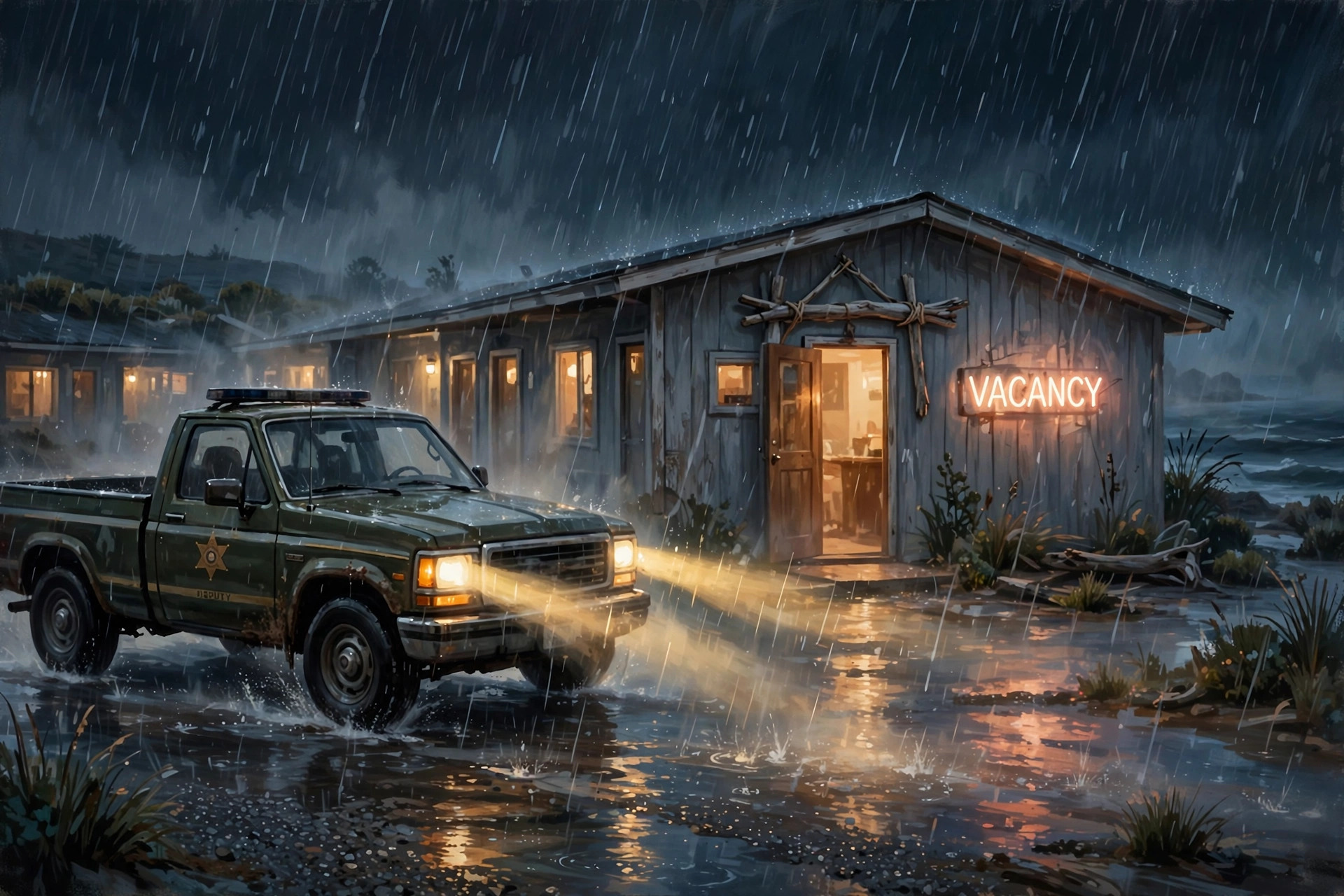
Rain hit the windshield in sheets before Maren Vasquez's door was even shut, and Deputy Walker Boone was already leaning across her to grab the handle and yank it the rest of the way closed, like she was a suspect, not a witness.
"I had it," she said.
"You had it halfway."
She pulled her canvas duffel onto her lap before he could reach for it. The bag rode between her boots the whole drive out of Cedar Key, her thumbs pressed against the seam where she'd stitched the lining shut two nights ago. Inside that seam was a drive the size of a matchbox, and inside that drive was every payment route her old employer had used to wash money through eleven shell companies. Five days. The grand jury convened in five days, and then she could be a person again instead of a case number.
The truck's headlights found a shape ahead: a long, low building with salt-gray siding, a driftwood cross nailed above the office door, and a neon VACANCY sign blinking in and out with the gusts. Pelican Point Motel. Six rooms, from what the file said, and only two of them worth sleeping in this time of year. The rest had storm shutters screwed down over the windows like closed eyes.
"Charming," Maren said.
"It's quiet." Walker parked nose-out, between two light poles so the truck sat half in shadow. He cut the engine and sat there a moment, watching the building in the mirror. "Rules. You stay off the porch lights. You don't answer the office phone. If I'm not in eyeline, you're behind a locked door."
"I've been following rules for four months, Deputy. I could write a manual."
"Then this'll be a nice review for you."
He got out into the wind, and she followed, hunching into her jacket. The rain came sideways, warm and stinging. Gusts had already knocked the weather station offline, the radio had said, driving seventy-mile-an-hour squalls ahead of the real system, and the causeway would shut before dark. That was the whole reason she was here tonight instead of a hotel with room service. Isolate the witness. That was the logic. Maren couldn't argue with the logic. She just hated being the thing it got applied to.
The office smelled like mildew and lemon polish. A TV muttered hurricane track maps to nobody. The owner's nephew, a rangy kid who'd been sweeping the porch when they pulled in, took Walker's cash without much talk and slid two keys across the counter. Maren noticed Walker's hand cover the little paper sleeves before she could see the room numbers.
"Which one am I?" she asked.
"You'll see when you're in it."
"That's not how questions work."
"That's how this works." He nodded toward a hallway door that led along the interior of the building. "Inside route. Nobody sees you cross a parking lot."
Room 4 had working shutters, a space heater that rattled like a coffee can full of bolts, and a connecting door in the far wall with a deadbolt on their side. Walker checked the window latches, checked the bathroom window twice, and dragged the room's only chair under the connecting door's knob as a second thought.
"There's a shotgun in the truck," he said, not really to her. "I'll bring it in before the weather turns."
"Reassuring."
"I left word with dispatch. Two deputies rotate past every ninety minutes when the road's passable." He glanced at her duffel, then away, like he'd decided not to ask. "You eat?"
"I ate."
"You ate something from a gas station, which isn't the same thing." He pulled a protein bar from his jacket and set it on the dresser, and she hated that it was the kindest thing anyone had done for her all week.
She sat on the bed with the duffel between her knees. "Can I ask you something, Deputy Boone?"
"Walker."
"Can I ask why a deputy with the county is doing witness transport on a hurricane night? This feels above the mileage rate."
He stood at the window, one slat of the shutter bent aside so he could see the black line of the water. "I worked the fraud case your numbers came out of. Before the state attorney took it over, I was the one who pulled you over that first night, for the tail light." A pause. "You had a duffel then, too. Same one."
Her thumbs went still on the seam. "You remember my tail light."
"I remember you had the look of somebody driving somewhere she couldn't come back from." He let the shutter slat fall closed. "Get some sleep. The storm gets here after midnight, and once it does, nobody's crossing that causeway till morning."
It was nine when the power flickered, ten when it browned out for good. The heater died mid-rattle. Walker came back with a battery lantern, a shotgun from the truck rack broken down into his bag, and a look on his face that she'd already learned to read as a man doing arithmetic he didn't like.
At eleven, they heard the boat.
A motor, low, out on the water. Then the grind of a hull on sand, muffled by rain, somewhere down the beach. Maren counted it in her head, out of professional habit. Close. Four hundred meters, maybe less, with the wind carrying the sound sideways.
Walker moved to the window without turning the lantern up. "Stay away from the glass."
Footsteps on shell, then on concrete. The nephew's broom was nowhere, and the porch light by the office had gone dark on its own, which it hadn't been wired to do. Two shapes crossed the parking lot, low and quick, and stopped at the door at the far end of the building.
Room 6.
The room Walker had asked the nephew for. The room he'd paid cash for under a slow, deliberate count of the bills, the way a man leaves a number in someone's memory on purpose.
The door of Room 6 splintered. Voices, short and hard. A flashlight beam swept the empty room's ceiling through the shutters, and then the voices turned ugly, and the two shapes came back out into the rain fast, empty-handed.
They didn't run for the beach. They came down the walkway, trying doors, and the third handle they tried had been left careless on Walker's instructions.
Room 4's connecting door was already open. Walker had thrown the bolt on the adjoining room an hour before, staged it with a suitcase and a turned-down bed for exactly this. "Move," he said, one hand on her arm, shotgun coming out of the bag in pieces he assembled in the dark faster than she would have believed. "Through. Now."
Maren went through the connecting door with the duffel hugged to her chest, into the mirror image of Room 4, colder, damper, a bed with a plastic mattress cover. Behind them the door to the walkway gave with a crack of wood, and boots hit the floor she'd just left.
Walker pulled the connecting door shut between them and the flashlight beam, drove the deadbolt, and set his shoulder against the frame. On the other side, a drawer was pulled out and dumped. The mattress in Room 4 hit the floor. Then, closer, right against the door, a voice she couldn't make words out of, and then nothing. Boots retreating. The motor out on the water again, fading north.
Neither of them moved for a long minute. Rain hammered the shutters. The lantern's low glow made the room feel like a cave.
"They'll be back," Maren said. Her voice came out steadier than her hands. "When they realize the beach road's under water and the causeway's closed, they'll circle in."
"No." Walker eased off the door but stayed near it, shotgun still across his arm. "They were told a room number, and the room number was empty, and now they think the tip was garbage. That was the idea."
"You gave them the wrong room on purpose."
"I gave somebody the wrong room on purpose." He set the shotgun within reach of the door, on the floor, muzzle toward the frame. "Somebody's been talking. I don't yet know who."
She looked at him, at the deadbolt, at the one bed and the plastic cover and the storm getting louder by the minute. "So what happens now, Deputy?"
"Now we stay in this room, because it's the one they think is empty." He pulled the chair from the corner and set it under the connecting door's knob, same as the one on the other side, and something about the repetition of it, the neat doubled lock, made her feel strangely less alone. "Causeway's shut. Nobody crosses till morning, including them."
"And morning?"
"Morning I get you four more days closer to that jury." He glanced at her duffel, one flick of his eyes, and this time he didn't look away. "Try the mattress. I'll take the door."
Canned Heat
Maren woke to gray light and the smell of rain on old plaster. Walker was already up, crouched over a small blue camp stove he'd set on the towel-covered desk, feeding it from a green bottle of fuel. The connecting door still had its chair under the knob. The shotgun was where he'd left it, on the floor, muzzle toward the frame, patient as a dog.
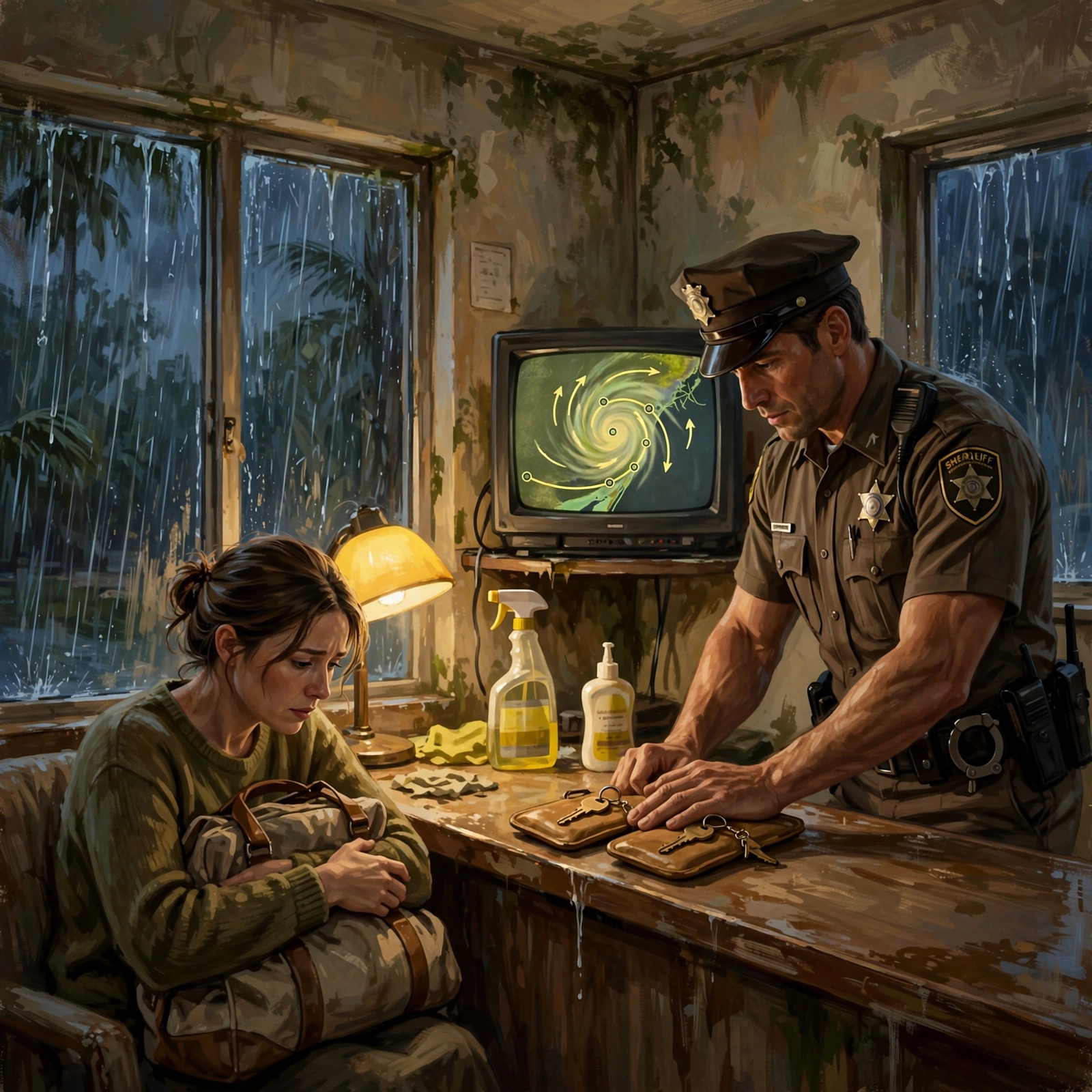
"Morning," he said, without turning around. "Causeway's still shut. I walked the length of the lot at first light. Nobody on the water."
"You went outside?"
"To the end of the porch and back. Wind's gusting near seventy out of the southeast. Whitecaps on the channel. No boat crosses that in the dark, and no boat lands four hundred meters off a beach in it either. We've got a day of nobody."
He said it like a weather report, and she let herself sit with that for a moment, the idea of a whole day with no boots in the hall. Four days left after this one. Four days, and a grand jury, and then a life that was hers again, whatever shape it had left.
He struck a match and the stove caught with a soft pop. "There's a pantry off the office. I brought up what would keep." He tipped his chin at the desk's other end, where he'd laid things out in a row like evidence: three cans, a sleeve of crackers, a jar of peanut butter, a dented canister of ground coffee.
"Beanie-Weenies," she read off the first label. "That's a crime, Deputy."
"That's breakfast." He shook the can of coffee and frowned at the sound of it, mostly air. "There's enough for one honest pot, maybe two. I figure we drink it slow and split the rest down the middle."
She watched him set a dented pot of water on the stove, and something about the smallness of it, the care, undid a knot she'd been carrying in her chest since the boat motor woke her. He was rationing like a man who'd done it before, somewhere without a kitchen.
"You've done this," she said.
"Storms mostly. Lost a week on a barrier island once, year of the big ones." He adjusted the flame down to a blue ring no bigger than a quarter. "You learn quick what a can of anything is worth."
The water took its time. Rain ran hard on the shutters, then harder, then eased, then ran hard again, so that the room had its own weather indoors. She sat cross-legged on the bed with the duffel beside her, and while he cooked she worked, because her hands didn't know how to be still. The ledger lived on the drive, and the drive lived sewn flat into the duffel's lining, but she'd spent two nights before the boat committing pieces of it to paper, small pages of figures she could burn if she had to. She had the notebook open on her knees, adding a column, when he handed her a tin mug.
"Careful. It's hot and it's terrible."
It was both. She drank it anyway, and it was the best thing she'd tasted in two days, and she told him so, and the corner of his mouth moved.
"There's a lady who runs the hardware store in Cedar Key, she'd sell me a real pot if I could get to her." He tore the crackers into halves and dealt them onto the mattress cover like cards. "When the bridge opens."
"If it opens."
"It'll open. Water comes, water goes. That's the whole trick of this place."
They ate that way, cross-legged on the floor between the beds with the stove between them, Beanie-Weenies out of the can and crackers and the peanut butter passed back and forth, one knife between them, wiped on the same napkin. She couldn't remember the last time she'd shared a meal where nobody was watching the door but her. He watched the door, so she got to watch him, which turned out to be its own kind of rest.
"You do this at home?" she asked. "Cook?"
"I do eggs." He considered. "And I do a chili that's mostly confidence. My sister claims it twice a year, which is charity." He pointed his spoon at her notebook. "And you do numbers. What am I looking at there?"
She angled the page away before she'd decided to. Old habit. Six years of audits had taught her that a column of figures was nobody's business but the client's, and this client was a grand jury she hadn't met yet.
"Money that moved through a shipping account that shouldn't exist," she said. "Payments in from companies that are shells, payments out to boats that don't dock anywhere. I found it doing the year-end books. Standard engagement, until it wasn't."
"And you took it to the state instead of taking it to your employer."
"I took it to my employer first." The words came out flat, and she regretted the taste of them. "That was a mistake. Two days later I'm being followed, my firm's telling me to take a leave of absence, and a man parks outside my apartment for a week. So. I called the state attorney's office from a pay phone. Who knew I had it in me."
"I did," Walker said. "Last night. Anybody who hugs a bag that tight when boots come through the door has it in them."
The rain leaned on the shutters. He got up to check the window, easing the slat of the shutter apart with two fingers, and she saw it then, plainly, in the gray light: his hand was shaking. Not the cold. Not nerves the way she understood nerves. A fine, steady tremor, there and gone while he looked out at the white water and then let the slat fall back and turned around.
He caught her looking. He didn't pretend otherwise, which she had not expected.
"Old injury," he said, sitting back down. "Right wrist, and the hand goes along with it when it wants to. Cold makes it chatty. Doesn't affect the trigger finger, before you worry about it."
"I wasn't worried about the trigger finger."
"No?"
"I was worried about the hand." She said it before she could file it down into something safer, and something crossed his face, quick and surprised, that she had no business finding as warm as she did.
He cleared his throat and reached for the coffee bottle, poured the last of the water through, and set the pot back on the blue ring. "One more cup, then we're on to rainwater, which I don't recommend."
She drank hers slow, watching him doctor his with the end of a creamer packet he'd produced from a shirt pocket like a magician. And when the mug was empty and he was over at the door again, checking the deadbolt out of pure habit, she did the thing she had not done since this started.
"Walker."
He turned.
She turned the notebook around on the floor so it faced him, open to the middle pages, the columns she'd been checking all morning. "Shell company on the left. Vessel on the right. The amounts in between are what I could reconstruct before I left. It's not the drive, it's just my copy, but it shows the shape of it."
He came back and sat, and he didn't touch the notebook, and he read it slow, his lips moving a little on the company names, and she understood that he was being careful with her the way he'd been careful with the coffee, making the small amount last.
"This top one," he said. "That vessel's been through here. I've stood on that dock."
"I know," she said. "That's why you're the only person I've shown it to."
The rain came down harder, and neither of them moved to check the window.
"Four more days," he said.
"Four more days," she said, and for the first time since the boat, the number sounded less like a sentence and more like a plan.
Driftwood Fire
The power died at half past nine in the morning, mid-sentence, the office lights blinking out along with the hum Maren hadn't known she was hearing until it stopped. Walker looked up from the county map he'd been annotating with a grease pencil, and the silence after the fridge quit was the kind that made the whole Pelican Point Motel feel suddenly further from anywhere than it had the day before.
"Storm took a line somewhere," he said. "Could be the pole at the end of the point, could be the mainland. Either way it won't be fixed in this."
Outside, the wind had climbed overnight, gusts rolling off the gulf in long shoves that bent the sea grapes flat and sent the rain sideways under the awning. The radio in his truck had gone quiet an hour earlier, and the last weather bulletin had put the gusts at seventy miles an hour, high enough that the county had closed the causeway before dawn. There was no driving out of Cedar Key now, not for her, not for anyone, and the strange thing was how little that frightened her compared to how it should have.
She was at the office window with her duffel at her feet, where it had stayed since the first night, when she heard him rattling around behind the front desk.
"There's a hearth," he said, with the tone of a man confessing to hoarding. He hauled a canvas tarp off a squat brick fireplace built into the office's back wall, back behind the ice machine that no longer had anything to say for itself. "Old man who built this place ran it on driftwood every winter. There's a pile out behind the laundry room that's been seasoning since before I was born, near enough."
He went out into the weather and came back twice, his poncho shining, arms full of gray, salt-whitened lengths of wood, and stacked them beside the hearth with the care of someone who had done this a hundred times. She watched him crumple newspaper, set the kindling, work a lighter until the catch took. Within twenty minutes the fire had found its voice, cracking and settling, and the office smelled of smoke and hot brick, and the cold that had crept into her hands since the power failed began to loosen.
They dragged two of the lobby's rattan chairs close enough to feel it on their shins. He made coffee on the hearth, because of course he did, the blue camp pot set on a flat stone at the fire's edge, and she thought about telling him he was a man of one solution and decided against it, because the solution worked.
"This is the part I hate," he said, when they'd been quiet a while. "Day three. The waiting part. The first two days you're busy being somewhere you shouldn't be. Day three you're just... where you are."
"Where you are," she said, "is a motel with six rooms and two of them fit to sleep in, no power, no causeway, and a deputy who makes better coffee than the diner back home."
"Flattery's noted." He turned his mug in his hand. "You're holding up better than most."
"Most what?"
"Most people I've sat with, waiting on a grand jury." He said it easily, and then he didn't, and she watched the ease go out of him like a tide pulling back from a flat. He stared into the fire. "There was one before you. Two winters back. A man who drove a fuel truck for the port and saw what was in the tanks that weren't supposed to be there. Good witness. Careful. I moved him twice, and the second place was a rental off the highway, and I thought it was far enough off the radar that nobody would find it before he was called."
She didn't say anything. The fire popped.
"They found it in four days," he said. "They didn't get in, I got him out the bathroom window with ten minutes to spare, but he took a fall off a retaining wall doing it. Shattered his heel. Healed wrong. Walks with a cane now, at an age where he should be carrying his grandkids on his shoulders instead." He looked at her, finally. "He was on my watch. That's the part I don't say out loud, but you're stuck in this room with me for two more days, so you might as well know what kind of deputy you've got."
"The kind who got him out the window," she said.
"The kind who put him at a place they found."
"You don't know how they found it."
"No," he admitted. "I don't. Never did figure it. That's what sits in me about this, if you want the truth of it." He rubbed his bad wrist without seeming to notice he was doing it. "Somebody talked, or somebody saw, or somebody was watching the whole time, and I never learned which. So now I over-stack the wood and check the deadbolt twice and I'm a pain to be cooped up with."
"You're not," she said. And then, because the fire and the quiet made her braver than the daylight did: "You want to trade? A confession for a confession?"
"Depends on the confession."
"The man who taught me everything," she said, "the one who got me my first real job, who sat me down my first week and told me the numbers always tell you the truth if you're patient with them. He's the one whose books I've been reading for two years. I testified against him. I'm going to testify against him again, five days running from now, and he wrote me a letter when it all came out, and I've never opened it. It's in a drawer at my sister's place in Cedar Key, sealed, and every month I decide this is the month I'll read it, and every month I don't."
Walker was very still. "Why not?"
"Because if it's kind, I'll have to forgive him. And if it's cruel, I'll have spent all this time being right about someone I loved." She laughed, short and not much of a laugh. "Either way I lose the version of him I kept."
"The one who told you to be patient with the numbers."
"Yes."
He nodded slowly, and he didn't tell her she'd done the right thing, and he didn't tell her she'd done the wrong thing, and she understood that this was its own kind of being taken care of. The rain hammered the awning. The fire had climbed to a steady roar, and the light of it moved on his face, on the line of his jaw, and she realized how near the chairs had drifted, that they were sitting close enough that she could feel the warmth of the fire and the warmth of him as two separate things.
He reached over and took her mug off the arm of her chair, to refill it from the pot, a small ordinary motion, and he did it slowly, and he looked at her while he did it, and her heart went strange and quick.
"Maren."
"Yes."
Then, from outside, low and unmistakable under the wind: the burr of a small engine, and then it cut, and the silence where it had been was louder than the storm.
Walker was on his feet with his hand already at his belt. He killed the camp pot's handle flat and crossed to the window in three strides, staying off the glass, and looked north along the shore through the gap in the shutters.
"Boat," he said. "Small one. It's just touched the flat." He held up a hand for silence, listening. "Four hundred meters out, give or take. They put in on the north flat and they've killed the engine."
Maren stood, her duffel strap already in her fist before she'd decided anything. "Nobody comes up the north flat in this weather to go fishing."
"No," Walker said, and his voice had gone flat and fast and certain. "They don't."
The Broken Promise
The engine noise never came again. Walker watched the north flat through the shutter gap for a long count of ten, then let the blind fall and turned the lock on the office door with a click that sounded very loud in the room.
"They're sitting out the weather," he said. "Or they're waiting for the wind to lay down. Either way, nobody crosses that flat in the dark."
"So we call it in."
Maren already had her hand out for the sat phone on the desk. Walker didn't move it toward her. He moved it toward himself, slowly, the way a man moves something he'd rather not be holding.
"Not tonight."
"Walker. Four hundred meters. You said it yourself."
"I said nobody crosses in the dark." He set the phone face down on the blotter, and his hand stayed on top of it, warm and wide and immovable, and something in her chest went cold before her mind caught up with why. "The state's people know where you are. They don't need a two A.M. call telling the same thing to a night clerk who'll write it on a sticky note."
"That's not how it works. There's a duty line. There's a number I was given, and I was told to use it if anything changed."
"Nothing's changed."
"Everything's changed. There's a boat on the flat."
"There's a boat that can't move." He said it evenly, patiently, and the patience landed on her the wrong way, the way it always landed when someone was being patient at her instead of with her. "The bridge has been closed since the gusts hit seventy. The grand jury sits in five days whether you spend them here or somewhere else. I move you at first light, up the coast road, and the state's people wake up to a message saying you're relocated and safe. Nobody hears your voice in the meantime. Nobody hears mine."
She heard the shape of it a full second before he finished saying it, and that second was worse than the sentence.
"You're not going to tell them."
"I'm going to tell them after it's done. When there's something to tell."
"That's the same thing," she said. "You know that's the same thing."
"It's not the same thing."
"It's the exact thing." Her voice climbed and she didn't care. "You've decided what happens, and everyone else finds out on a need-to-know basis, and the person it's mostly about gets treated like a pallet of evidence that needs a truck."
"Maren."
"Don't Maren me. I've been cargo before. I know the sound the manifest makes." She was on her feet, and the duffel strap was in her fist again, her thumb worrying the canvas seam where the drive slept inside the lining, and she was aware of doing it and did it anyway. "The last man who moved me around without telling the office is the reason I'm here. He loved me, and he kept things from me for my own good, and every single one of them was right up until the one that wasn't. And then I got to find out after."
The rain filled the silence between them for a moment.
"This isn't that," Walker said.
"It's the shape of that. I can see the shape from here, I've got a professional eye for shapes like this." She was shaking, and the fire made the shaking visible to her, small tremors in the light on her hands. "He hid things, Walker. He was careful and he was quiet and he loved me, and it didn't matter, because the problem was never the love. The problem was the quiet."
"The problem," he said, quiet and flat, "is that somebody in this building knows what room you sleep in, and I don't yet know who, and until I do, every call we make goes through one more set of ears. That's the arithmetic. That's all of it. You can hate me for the arithmetic, but don't tell me I do things the way he did them."
"Then tell me who you called today. Tell me what you wrote down. Tell me one thing you did today that I know about."
He didn't answer, and the not answering answered it.
The bathroom was behind her, down the little hall past the ice machine, and she was in it with the bolt turned before she'd fully decided to walk. The door was hollow-core and cheap, the bolt a brass hook-and-eye somebody's uncle had screwed in crooked in about 1975, and she stood against it breathing hard in a room that smelled of bleach and old caulking, listening to him say her name once, twice, then stop saying it.
"Maren. Come out."
"No."
"There's a window in there with a latch that doesn't work. You're safer in the office."
"Then I'm unsafe in the bathroom. That's my choice. You like choices, don't you? You make them all day for everyone."
Nothing for a while. Just rain, and the fire ticking out in the office, and the wind working at the awning like a hand trying the same locked doorknob over and over.
"I'm going to sit here," he said at last, and she heard the wall beside the door take his weight, a slow wooden complaint as he slid down it to the floor. "All night if you want. You don't have to talk to me."
"I know I don't."
"That's not what I meant."
"It's what it does, though." She slid down her side of the door too, until they were a finger's width of cheap pine apart, back to back through a slab of it, and it was so stupid and so near that her eyes stung. "You want to keep me safe, and you want to keep me ignorant, and those are two different projects and you keep filing them in the same folder."
A long quiet. She could hear him breathing. Slow, deliberate, the breathing of a man keeping his temper in a bucket with a lid on it.
"My sister called me once," he said. "Ten years back. Her husband was upside down on a boat loan, some dirty broker out of Cedar Key, and she knew, she'd known for months, and she told nobody because he'd asked her not to. She kept his secret because she loved him. And I found out standing in her kitchen while the broker's people were taking the trailer, and the thing I couldn't forgive wasn't the broker." The bucket lid shifted. "It was being stood next to my own sister and realizing I was the last person in her life she'd trusted with the truth."
Maren put her head back against the door and looked at the ceiling, where the paint had blistered into a little map of Florida.
"You're doing it to me right now," she said. "You know that."
"Yeah," he said. "I heard it about halfway through saying it."
She laughed, wet and unwilling, and hated that she laughed.
"Five days," she said. "Four, now. Then the grand jury sits and the drive does its work and I go back to being a person with a normal tax practice and a mailbox."
"Four," he agreed. "And you'll spend the first one of them in a bathroom, and I'll spend it on a floor."
"Seems fair."
"Nothing about this is fair, sweetheart."
She let sweetheart sit there between them. She didn't open the door. But she stopped crying, mostly, and she wrapped her arms around the duffel and put her cheek against the canvas, over the hidden seam, over the thing inside that had cost her a mentor and a career she'd loved and, very nearly, her whole quiet decent life. Somewhere outside, the wind bent the palms flat along the point, and out on the water the small dead boat sat with its patient men, and none of them could be heard from the bathroom, which was, she supposed, the point of walls.
Far off down the corridor, past the office and out the side door by the laundry, a screen door opened and caught the wind and banged once against its frame. Neither of them thought anything of it. The nephew had gone out to check the storm lines, after all. Somebody's uncle would have said so.
The Ledger Burns
Dawn came gray and sideways, the last of the wind still shoving rain against the office windows, and Maren woke on the bathroom floor with the duffel under her head and her hand already on the hidden seam.
The first wrong thing was the smell. Woodsmoke she knew; they'd kept the office hearth burning all night because the power had been out since Tuesday. But under the smoke there was diesel, and diesel had no business inside a building.
The second wrong thing was the side door by the laundry. It didn't bang. It opened without its hinge complaining, and the only door at Pelican Point that opened quietly was the one somebody had oiled.
Walker was already moving. He'd slept dressed in Room 5 with the shotgun on the floor beside him, and he came through the connecting door low, socked feet silent, and put his back to the wall beside her bathroom frame. His eyes asked one question. She answered it by standing up, duffel and all, and putting herself behind him.
"Two of them," he breathed. "Maybe three. Stay off the windows."
The front door of the office didn't break. It was simply, suddenly, open, and the driftwood cross above it swung on its one remaining nail as men came through it out of the rain. Two men, wet to the chest, one carrying a pry bar, the other carrying nothing, which frightened her more. Behind them, in the doorway, hat dripping, stood the nephew with the face of a boy who had rehearsed his apology in advance.
"Room five," the nephew was saying. "I told you, she's in room five, I gave you the key to—"
"You gave us a key to a room with sheets over the furniture," the man with the pry bar said. "So now we do it the loud way."
Maren watched Walker's shoulders change. Not surprise. Something colder and sadder, the look of a man confirming a bill he'd already calculated.
"You knew," she whispered.
"I gave him five-forty minutes ago and watched him run to a pay phone in Cedar Key with his hood up," Walker said. "I gave him room five because I wanted them in the wrong end of the building while we went out the other. Didn't figure on the wind dying down enough for their boat to land on the beach. Four hundred meters of open sand makes a lot of noise in rain, but not enough."
The nephew heard his uncle's name in Walker's voice and flinched like he'd been struck. "They said nobody'd get hurt. They said it was a business thing."
"Get out of my doorway," Walker said, and raised the shotgun, and the office got very quiet except for the fire snapping in the hearth and the rain working the roof.
The man with nothing in his hands smiled at Walker the way men smile when they've done arithmetic on someone. "Deputy. Off your island, off your backup. Causeway's been shut since the gusts hit seventy. Nobody's coming across that bridge for you."
"Wind's under fifty now," Walker said. "It reopened at first light. You drove your boat to the wrong beach on the last morning it mattered."
It was a bluff, and Maren knew it was a bluff, and the man with the pry bar clearly decided it was too. He came forward anyway, not fast, the way you walk toward something you've decided already belongs to you, and his eyes went past Walker's shoulder and found her, and found the duffel she was holding against her chest like a child.
"There she is," he said. "And there it is."
Maren had spent five days thinking about this moment, and in all her versions of it she was brave in a clean way, decisive, unafraid. What actually happened was that her hands were shaking so hard the zipper of the duffel chattered against its teeth, and she was so angry, at the nephew, at the men, at herself for every month she'd spent pretending not to see what her mentor's beautiful books were for, that the anger did the job the courage couldn't.
She put her fingers into the lining seam and ripped it open along its whole length, one hard tear, and the drive fell into her palm. Black, small, ordinary. One encrypted drive holding three years of laundered payments, the whole architecture of it, the thing the state attorney's office had bought her future with.
"You want it?" she said, and her voice came out steadier than her hands. "Here's the thing about me. I don't keep copies. Not in a cloud, not in a drawer. I'm careful the way you have to be careful when you're alone. This is it. The only one."
The man with the pry bar took another step, and Walker stepped with him, and the office was suddenly too small for the three of them and the fire.
"You burn it, you burn your ticket out of this," the man said. "Your deal. Your protection. You'd be throwing away the only thing keeping you worth anything alive."
"No," Maren said. "I'd be throwing away the only thing keeping you two in my kitchen. That's not the same as worth."
She turned to the hearth. The fire had been fed an hour ago and it was still serious, orange and deep, and she stood in front of it for one second with the drive in her open hand, and she thought about her mailbox, and her quiet practice, and the mentor who had smiled at her across a desk while teaching her exactly how to hide a fortune, and she thought, you can't take back what you never should have given me to carry.
She threw it in.
The plastic didn't scream. It just went dark and then it went liquid, and the flames licked up around it like the fire had been waiting all night for exactly this delivery, and both men shouted at once, lunging, and the one with the pry bar swung it at Walker, and Walker didn't swing back. He stepped in front of Maren instead, and the pry bar's edge caught him across the shoulder, tearing the wet shirt and the skin under it, and he grunted once, dropped the shotgun to grab the man's wrist, and took him down onto the office floor the hard way, knee in the spine, arm up behind the back, all of it done with the economy of somebody who'd rather end a fight than win one.
The other man was at the hearth with his hand in the fire, and Maren watched him understand, watched the math finish on his face: melted, gone, unrecoverable, and nothing left in this building worth a felony but a deputy with a bleeding shoulder pinning his partner to the linoleum.
He ran. Out the door, past the nephew, who was crying now, saying something about his uncle, and through the gray rain toward the beach and the small dead boat, and Maren stood at the office window and watched him go, empty-handed, half a mile of open water between him and anything he'd been promised.
Then, faint and getting louder, from the direction of the bridge: sirens.
"Wind dropped," Walker said from the floor, breathing hard, not letting go of the man under him. "Told you it reopened."
"You told me a lot of things at first light that weren't true yet." She knelt beside him and put her hand on his shoulder, on the torn edge of the shirt, careful of the graze underneath. "Stay still."
"It's a scratch."
"It's a scratch you got standing between me and a pry bar." She looked at the hearth, where the fire was settling back down over its small black ruin, and felt lighter than she had in three years. "I just burned my whole future in there, you understand. No deal. No grand jury present. Nothing to trade."
"I know."
"You're not going to tell me it was brave?"
"No, ma'am." His hand came up and covered hers on his shoulder. "I'm going to tell you it was five days, and you're done hiding, and when those units get here you're going to tell them every single thing you know. All of it. Out loud, in the open, on the record. And then I'm buying you breakfast, because you just did the hardest thing I've ever watched somebody do, and you did it shaking."
Outside, the county cars came across the causeway with their lights turning the rain blue and red, and the driftwood cross above the door, shot loose on its nail by nothing but weather, finally came down and landed soft in the wet sand of the porch, and nobody saw it go but the nephew, who was sitting on the steps with his head in his hands, and who would, eventually, and painfully, tell his uncle everything.
Two Cups
Morning came up over Cedar Key, Florida, the color of a clean penny, and Maren Vasquez stood in the office of the Pelican Point Motel with two paper cups in her hands and no idea how to start the conversation she had walked out here to have.
The storm had spent itself in the night. The wind was down to a breeze with salt in it, and the sun sat low and wide over the water, and the causeway, which had been closed since the gusts hit seventy, was open again, traffic moving on it in both directions like nothing had ever stopped. The state attorney's people had come and gone by noon yesterday. She had given them everything, out loud, in the open, on the record, exactly as Walker had said she would. The real drive, the one she'd surrendered before she'd ever set fire to anything, was in their hands in Cedar Key, and the grand jury had convened that morning, and she was, for the first time in three years, a woman with no appointment she was afraid of.
The nephew was gone. His uncle had put him in the truck at first light and driven him toward town, and neither of them had looked at the motel on the way out. Maren had watched the truck go and felt something that was not forgiveness but was in the same family.
The driftwood cross lay where it had fallen, in the sand of the porch steps. She had thought about hanging it back up. She hadn't. It seemed more honest lying there with the tide marks on it, a thing the weather had taken down and not put back.
Walker was in the office doorway with a broom, sweeping sand out that the storm had swept in, because that was the kind of man he was, the kind who could not stand in a room that needed sweeping without doing something about it. His shoulder was bandaged under a shirt that was not his, one of the clean ones she had fetched from his truck while he sat on the porch railing and gave her instructions on which duffel, which pocket, which keys. She had liked doing it. She had liked knowing which pocket.
"You're up early," he said, without turning around.
"I never went down. I've been awake since four."
"That's not early. That's a disorder."
She laughed, and it surprised her, how easily it came. She held out one of the cups. "Trade you."
He leaned the broom against the doorframe and took it, and his fingers brushed hers over the lid, and neither of them pretended they hadn't. "What am I trading?"
"Coffee for sweeping."
"That's robbery. This is your motel now, technically. Your name's on the register and everything. I swept my own rooms." He drank. "Still got two of the six habitable, by the way. If you're keeping count."
"I'm always keeping count. It's the whole problem with me." She looked out at the water, at the light on it, at the place where a small dead boat had been towed off the beach sometime in the small hours. "They offered me relocation this morning. On the phone, before you were up. New name, new city, new everything. A whole life in a box, delivered."
The broom stayed still against the frame. "You said no."
"I said I'd think about it."
"Which, from you, means you already know."
"I already know." She turned her own cup in her hands, slow, watching the lid go around. "Here's the thing. I've spent three years being a person with a plan for every exit. Two bags packed at all times. Cash in three currencies. I could tell you within a minute of any room what I'd take if I had ten seconds to leave it." She looked up at him. "I don't want to be that person anymore. I burned my exit on purpose. And now the state wants to hand me a brand new one, gift-wrapped, and I stood on this porch this morning and realized I'd rather stay in a broken motel on a coastline that tried to drown me than vanish somewhere and be nobody again."
"You'd never be nobody."
"You know what I mean. A person with no one." She drank, buying herself a second. "So I'm staying. I'm going to run this place, at least through the season, because his knee won't let him and because somebody should and because I'm good at books, even bad ones. Especially bad ones. And that's the whole announcement. That's everything I rehearsed."
"You rehearsed it."
"Four times. In the mirror. It was longer. I cut the part about the porch."
"Keep the part about the porch."
The breeze came off the gulf and moved the fringes of the awning, and down the beach a heron stood in the shallows being patient about something.
"The thing is," she said, "the plan I made, the staying plan, it has a hole in it. I keep running it and it keeps coming up one short." She took a breath. "You live out of your truck, Walker. You have since I've known you. Six days and I've never once seen you go home, and I asked the uncle, and he said he didn't think there was one. So. Here's my question, and I want you to actually answer it and not be gallant about it, because I've had enough gallantry for one week." She nodded toward the office, toward the cross lying in the sand below the empty nail. "Would you stay? Here. Not because there's a threat. There isn't one anymore, not a real one. Just because I would like you in my life at a fixed address. That's the whole question."
He looked at her for a long moment, and then he set his cup on the porch rail, and he crossed to his truck, and she thought for one terrible second that she had miscounted, that she'd read every room wrong, that he was about to say something kind and get in and drive.
Instead he reached into the cab and lifted out his duffel, the same one she'd gone through for his shirt, and carried it back across the sand, and up the steps, and past her, and set it down inside the office, on the floor, against the desk. Then he came back to the doorway and picked up his cup like he'd merely been getting a refill.
"Yes," he said. "That's my answer. Yes."
"That's it? No speech?"
"I've been waiting since Tuesday for you to ask. I wasn't going to be the one to say it first. It's your motel." He drank. "Also the coffee's cold."
"It's not." She pressed the cup against his hand anyway, checking, and he let her, and she was smiling and hating it, the wide unguarded kind, the kind she hadn't seen on her own face in a mirror in years. "Okay. It's a little cold."
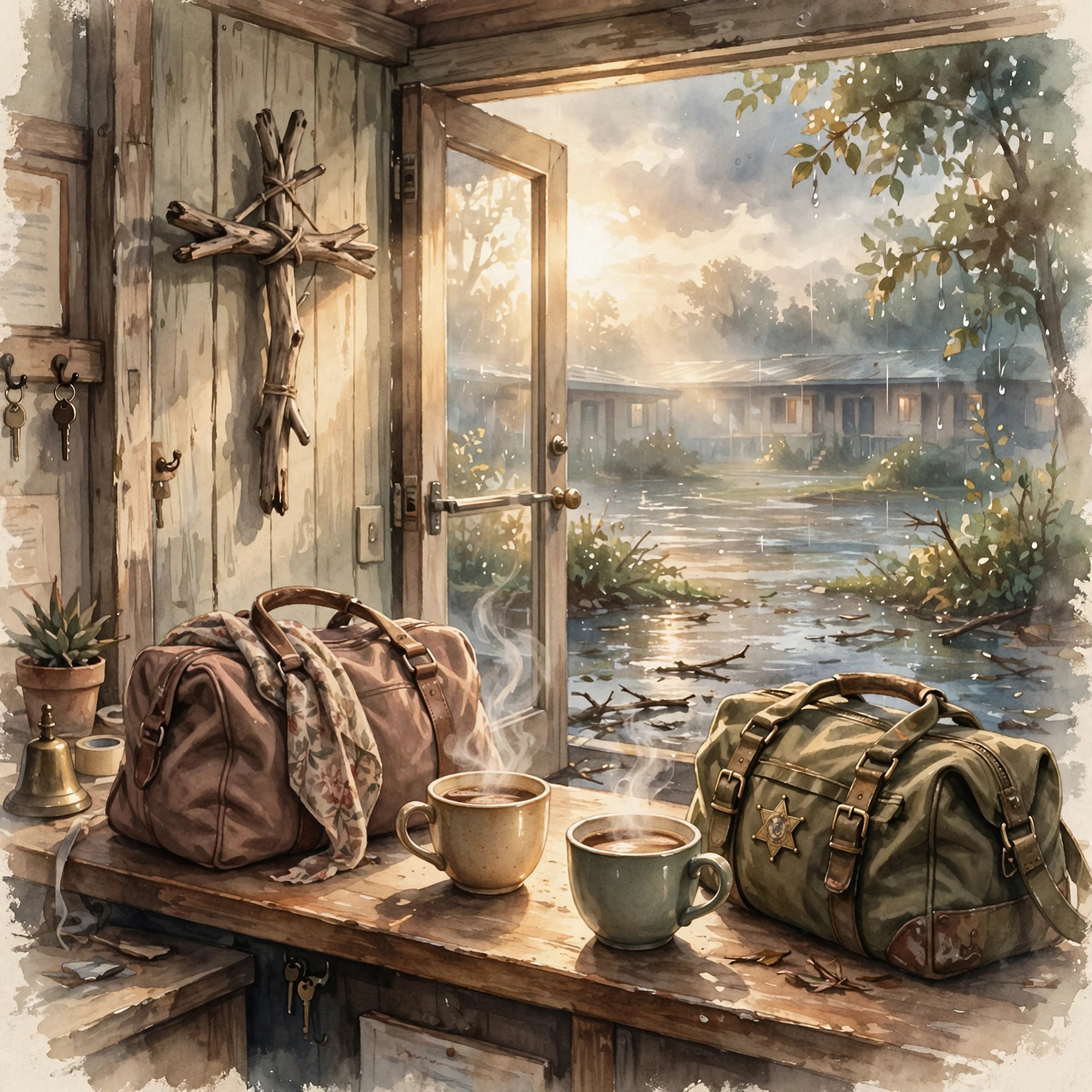
"I'll take it warm or cold. Same as everything else around here." He tipped his head toward the office, where his duffel leaned against the desk next to the register with her name in it, one bag beside the place where hers sat stitched with a hollow seam that no longer held anything. "Two rooms out of six. Two cups. Seems about right for a start."
Maren stepped over the driftwood cross where it lay in the sand, and went in, and moved her duffel over so the two bags stood together, and looked at them a while, side by side, against the desk in the morning light.
"A start," she said. "I can work with that."
Get notified when new stories drop

Serena Blake
Serena writes romantic suspense and dark romance for readers who want pulse and payoff. Her stories chase trust as hard as they chase danger.
Leave a comment
Comments