


The Nine Door
The door to Halbrook Street stuck in the rain, the way it always did, and Mara Ellison shouldered it open with the envelope held high and dry against her chest. One in the morning, and the Nine Door was down to its bones: chairs upside down on tables, the bar lights cut to a single amber strip, somebody's cigarette still burning in a tin dish by the till.
Six years of closing nights and she could walk that floor blind. Past the bar. Past the coat rack. Down the short hall to the office, where the light under the door was wrong.
Not the desk lamp. Something orange, and moving.
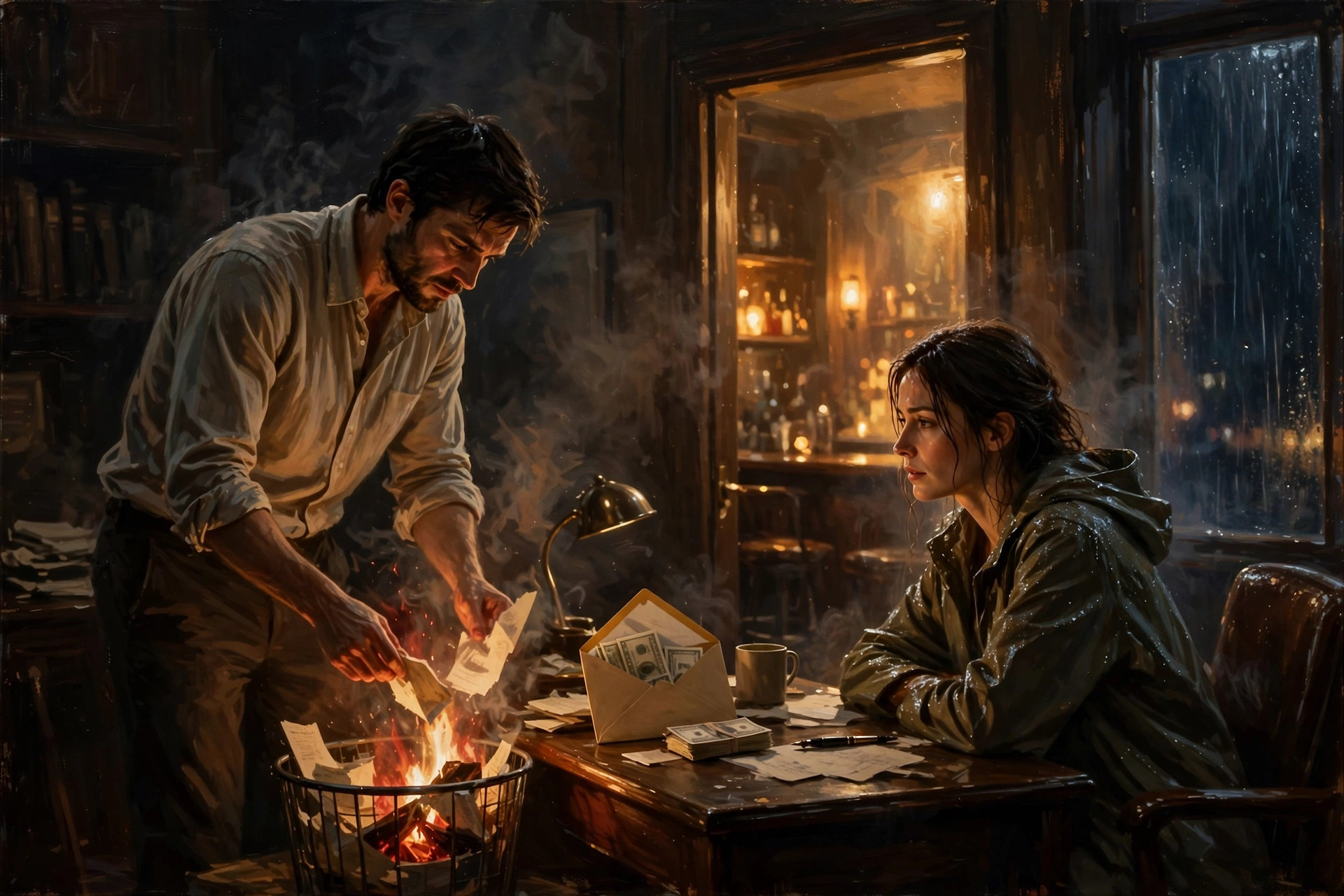
She pushed the door open with her hip. Dane Kovac stood over the metal wastebasket with a lit match held low, feeding pages in one at a time, watching each one catch before he gave it the next. His sleeves were rolled, his tie was gone, and his coat hung off the back of the chair with the weight of something still in the pocket.
"You're burning the good paper," she said. "That's the rag stock. It's twice the price of the cheap stuff."
"Then it'll burn twice as clean." He didn't look up. The match went out. He struck another off the box without hurrying, the little scratch and flare of it loud in the small room.
Mara set the envelope on the desk, thick corner first, the way she always did so the bills faced whoever counted them. "Ricky settled. Nineteen hundred, and he had the grace to look ashamed about it."
"Was it all there?"
"He counted it twice in front of me. I counted it once behind him." She pulled out the desk chair and sat, toeing the wastebasket an inch away from Dane's shoe with the familiarity of somebody who had done it before. "You want to tell me what those pages are? Because if it's inventory, we keep inventory. That's the entire point of inventory."
Dane fed in the last page and watched it curl. "Ozzy Petrakis sat in this room an hour ago."
The ash smell got into the back of her throat. She let the silence sit, because she had learned the hard way that silence worked on Dane where questions got his back up.
"He holds our note," he said finally. "Held Skip's paper, inherited ours when Skip died. I've been paying him two percent a week, regular as rain. Tonight he says two percent isn't moving him anymore." His jaw worked. "He gave me twenty-one days. Pay the note in full or he calls it, and he takes the club."
"Twenty-one days." She said it flat, doing the arithmetic in her head and not liking any of it. "The full note. Out of what? The till and a lemon rind?"
"He had an offer ready, of course. He always has the paperwork typed before he tells you there's paperwork. He wants me to sell. Sign the place over at his price, walk away clean, and he keeps everybody on at their same jobs, only his." Dane said that last word like it tasted spoiled. "He put his hand on my desk while he said it. Like we were shaking on something."
Mara thought of the floor as she'd crossed it. Nine card tables in the back room, felt swept, chips racked. Two dozen people who cashed checks drawn against this place every single week. She thought of Rosa behind the bar who had a kid in school, and of the kid who bussed glasses on weekends and was saving for a car. None of them had ever heard of Ozzy Petrakis, and all of them worked for him now, in a way that mattered more than the name on the license.
"So you burned his offer," she said.
Dane looked down into the wastebasket, at the gray flakes going soft and dead. "That's the copy he left for me to sign."
"Is it."
"I read it first. Twice." He rolled his sleeves down, button by button, slow. "It's a fair price, Mara. That's the poison in it. Fair enough that if it goes to court, it looks like a man being reasonable and me being a stubborn mule."
"You're not a mule."
"No. I'm worse. I'm sentimental." He laughed, short and low, and it had no floor under it. "Twenty-one days. You should take your pay through the till tonight, before the number gets theoretical."
"Don't do that." Her voice came out sharper than she meant, and she softened it by unbuttoning her coat, spreading it over her knees like she was settling in for a long stay. "Don't hand me the exit before you've even looked for the door."
"There's no door. There's a window, and it's got his price written on it."
"There's the books." She leaned forward. "Dane. I've kept these books six years. Every week, every table, every short pour and comped steak dinner. If he's claiming we're underwater, I want to see it in our own figures, not his. You put our real numbers in front of a judge and Ozzy's 'fair price' starts looking like a fire sale."
He was quiet for a long moment. Rain ticked against the office window, unhurried, like it had somewhere to be and no deadline.
"Skip's year," he said. "The old year, before he passed. It was never balanced. I closed it out rough, took the loss on my own signature, and put the ledger away." He rubbed the back of his neck. "You knew Skip. He was loose with a pencil."
"He was loose with everything." She kept her voice easy, kept her hands still in her lap, while her heart did a slow, cold turn over. Skip had been loose with a pencil. She knew exactly how loose, and she knew what that kind of looseness looked like from the inside, wearing handcuffs. "Where'd you put it?"
"Locked cabinet. The green one, against the back wall. It's been locked since the funeral." He looked at her, and something in his face was asking before his mouth got to it. "If we're going to fight Ozzy with our own paper, I need the true year. Every page, even the ugly ones. And you're the only one I trust to look at it and not... add things up out loud before you've finished."
Mara looked at the green cabinet. Squat steel thing, older than her employment here, older than Skip's tenure, paint chipped along the top edge where somebody had once pried it in a hurry. She thought about what might be in it. Loose pencils had loose ends, and hers were the kind that had already cost her two years of her life once, in a small room with a small window, for paperwork that had her name on it and her father's debts under it.
She thought about that, and then she thought about Dane standing at a burning wastebasket an hour after a man had put his hand on his desk, and about two dozen paychecks.
"All right," she said.
Dane dug into his coat pocket and came out a brass key, old and heavy, gone dark in the grooves. He set it in her palm instead of on the desk, and his fingers were warm and stayed a half second longer than handing a key requires.
"It sticks," he said. "Left, then down, then it gives."
"I've fought worse locks." She closed her hand around it. The brass still held the heat of his pocket, and she didn't examine why she noticed that.
"Balance the old year," he said. "Whatever you find, you bring it to me before it goes anywhere near a courtroom. Promise me that part."
"You'll see it first. I promise." She stood, shrugging back into her coat, and the weight of the key settled against her hip in one pocket while the envelope went into the other. "Go home, Dane. Sleep. Twenty-one days is a number, not a sentence."
"Twenty-one days," he said, like a man testing a rope.
She got her arms into the sleeves, and as she pulled the coat straight something slipped from the inner lining and dropped, and skittered, and spun down flat on the desk between them with a flat little clack.
A hundred-dollar house chip, ivory gone yellow, one edge chipped clean off. Her bookmark. It had ridden through three winters and two employers in that pocket, and it had never once fallen out.
Dane looked at it. Then at her. His eyes were tired, but they weren't tired enough to miss a thing.
"That's from the house set," he said quietly. "The old set. We retired that set the year I took over."
Mara's hand closed over the chip before she'd decided to let it. The brass key pressed its shape into her palm through the same motion.
"It's mine," she said. "From before your year."
"Nobody who works for me carries a lucky chip out of the till." He was watching her face, patient as the rain. "Nobody honest, anyway."
She stood in the doorway of the office she'd kept clean for six years, with the key in one hand and everything she'd never said stacked up behind her teeth, and for the first time in a long time she didn't know which one to protect first, the job or the truth.
"Goodnight, Dane," she said.
He let her get three steps down the hall before his voice followed her, low, not unkind, and not letting it go either.
"Balance the old year, Mara. All of it."
She walked out into the rain with a chipped hundred in one pocket and a brass key in the other, and both of them felt heavier than paper had any right to be.
Roosevelt Diner
The diner on Roosevelt Road smelled like burnt coffee and onions fried at four in the morning, and Mara understood immediately why Dane did his real business there. Nobody eavesdropped on a man in a booth by the window, not when the waitress had already decided he was somebody's uncle and refilled his cup without asking.

He was already there when she came in out of the rain, four days after he'd handed her the brass key, and he didn't wave. He just turned his cup a quarter turn on its saucer, and she took that as her invitation. She slid into the booth across from him, coat still on, the key and the chipped hundred riding her pockets like bookends.
"You didn't sleep," she said.
"You didn't come back to the club."
"I had books to open." The waitress appeared at her shoulder, and Mara ordered coffee before she'd decided she wanted it. When the woman had gone, she folded her hands on the table. "Three days with the old ledgers. I've got a question for every answer."
"Ask."
"After you tell me what I'm actually here for. You didn't summon me to a diner at six a.m. to talk about depreciation."
Dane took a napkin from the dispenser, uncapped a pen he'd brought for the purpose, and wrote a number on it. He turned it around and slid it across the Formica.
Two percent.
"Per week," he said. "On the note. That's Ozzy Petrakis's opening position. The debt carries that rate until either he calls it or I clear it, and he called yesterday to say he's in a mood to call. He's giving me twenty-one days to pay it off or sell. His words, not mine."
Mara looked at the number. She'd expected something ugly. She hadn't expected it to be dressed up this neat.
"That's not his rate," she said.
"It's the rate he gave me."
"I know what he gave you." She pulled the napkin back and turned it over, hunting a clean space. "Ozzy has been lending on Halbrook Street longer than I've been alive. His paper runs higher than two. I've seen his terms on three other buildings. If he's quoting you two, it's because two is a number nobody shops around. It looks gentle. It reads gentle in a courtroom, too, if it ever gets that far. And it means the principal underneath it is uglier than he wants on the first page."
Dane's cup stopped its slow quarter turns. "You've seen Ozzy's other paper?"
"I've seen the parts that got copied around." She let that sit, because the fuller truth, the part about exactly how she'd come to see a lender's private terms, was a door she was not opening in a diner at sunrise. Six years she'd kept his books clean. She wasn't going to hand him reasons to look at her too closely. "The point is the number. Two percent a week on a note this size, over the years he's held it, and the payoff he's demanding doesn't square. Either he's rounding the principal up quietly every cycle, or somebody on our side was paying him short and letting the gap hide."
The coffee arrived. The waitress set it down with the clack of a woman who'd seen every kind of breakfast and cared about none of them, and Mara drank before it cooled, because it gave her something to do with her mouth that wasn't the whole truth.
"Our side," Dane repeated.
"His side, your side, whoever signed the interest vouchers back then. That's the point, Dane. I can't tell whose arithmetic is broken until I close the old year properly, and I can't close it properly until I know what Skip was signing." She said the name flatly. She'd said it around him a hundred times in six years and never once watched his face this closely while doing it. Something moved in it, small and fast, and was gone. "It was before your year, but not far before. You know what the private room carried then."
"Nine tables."
"Nine tables," she agreed. "Full every night, by the old tallies. So where's the cash from them? Because the ledgers under Skip say the back room ran soft for his last two years, and I don't believe it ran soft. I believe it ran off the books, and someone balanced the difference so nobody upstairs would trip on it."
Dane was quiet for a while. A bus went past the window, throwing a slow wedge of light across the table, and Mara watched the light cross his hands instead of his face, because his hands said more. He turned his pen over twice. He hadn't picked the napkin back up.
"How much short," he said finally.
"Rough count, the old green ledger shows about two hundred and fourteen thousand missing across those two years. Could be less once I chase the transfers. Could be more. It isn't rounding error. Somebody with a steady hand moved that money on purpose, in pieces small enough to look like a bad week, over a long stretch of good ones."
"Skip kept the room, Skip kept the count, and Skip died before the audit."
"That's the shape of it."
Dane picked up the napkin then. He wrote the two percent again, then a figure under it, then drew a line through both, hard enough that the pen tore a little hole in the paper. He slid it back to her. "This is the arithmetic Ozzy wants me to accept. Pay him his number in twenty-one days or hand him the club. That note's the only thing standing between me and the street, Mara. Not just me. Twenty-two other people cash a check off that room."
Twenty-four staff, she thought. Two dozen names on the payroll sheet she signed every other Friday. He'd said twenty-two, and he'd said it without flinching, and she'd caught the gap before it finished leaving his mouth.
She didn't call it out loud. She just pulled the pen out of his fingers, took a fresh napkin, and started writing the honest version: the principal as the old ledger recorded it, the rate Ozzy actually charged on Halbrook, the compounding done right, and then the number that should have been owed against the number Ozzy was demanding. She crossed things out. She carried a remainder in the margin. Somewhere in the middle of it her shoulder came down toward the table and she realized Dane had leaned in too, his arm almost alongside hers over the paper, both of them hunched over napkin math like a pair of conspirators or a couple of kids cheating off the same test.
The difference was sitting there in her own handwriting, small and obscene.
"He's demanding more than the honest number," she said quietly. "Not by a little. By a lot. Enough that selling looks like mercy compared to paying."
"Because selling is what he came for." Dane sat back. The booth springs complained. "So the books matter."
"The books are the whole game. If I close the old year and show the note's been padded, you don't have to sell anything. You might not even owe him what he says. But it means going back through Skip's ledgers line by line, and it means whatever I find goes in front of a judge, which is exactly what you told me not to do."
"I told you I see it first."
"That's not the same thing."
"No." He rubbed his eyes with a thumb and forefinger. "It isn't."
The waitress came back and topped them off without a word, and Mara wrapped both hands around her cup and let the heat do what heat does to a person who's spent three nights in a cold back office with a green ledger and a locked cabinet.
"Here's my price," she said. "If the books don't save the note, if Ozzy calls it anyway and the club goes, you keep the staff whole first. Their back pay, their references, whatever comes after. Before the creditors. Before Skip's side of it, before your own name. That's what I get for opening those ledgers all the way down."
"You'll have it in writing."
"You can't give me what you won't have."
"Then you have my word, and you've had six years to learn what that buys."
She almost smiled. She didn't let it all the way out, but it got as far as the corners.
Mara pushed the napkins toward him, slid out of the booth, and got her arms into her coat sleeves. The brass key swung its small weight against her hip. The chip sat quiet in the other pocket, and she was aware of it, and aware that he was aware of it, and neither of them had said its name since that night.
She'd taken two steps toward the register when his hand closed around her wrist.
Not hard. Just there, warm from the coffee cup, his thumb landing on the edge of her pulse like a man marking a page he didn't want to lose.
"The old green ledger," Dane said. "Whatever's in it, whatever Skip did, whatever it says about me. You bring it to me first. Not Ozzy. Not a judge. Me."
Her pulse moved under his thumb, and she hated that it moved in a way he could count.
"You first," she said.
He let go of her wrist. She felt the release more than the grip, the way you feel a door shut more than a draft. Then she paid for both coffees at the register out of her own pocket, because there were some columns she still preferred to keep balanced on her own, and she walked out into the gray morning on Roosevelt Road with the key in one pocket, the chip in the other, and the shape of a number in her head that could save the Nine Door or bury it, depending on whose hands it landed in.
Green Ledger
Five nights later, the back office smelled like cold lo mein and hot toner, and Mara had stopped pretending she was going home.
The green ledger lay open between them on the desk, its spine cracked white from years of being pressed flat against a photocopier nobody was supposed to know about. Dane sat on his side of the desk with his sleeves shoved up and his tie long gone, working a column of Skip's old numbers with a pencil he refused to put down. Mara worked the other side, where the deposits lived, and every so often one of them would slide the container of kung pao across the desk like a chess move.
"Page two-forty," she said. "Deposit slip says forty-one hundred. The ledger says thirty-nine."
"Bank copy?"
"Thirty-nine." She turned the ledger so it faced him. "The bank and the ledger agree. It's the deposit slip that doesn't. That's not sloppiness. That's somebody building a slip that matches what he meant to deposit."
Dane set the pencil down. That was how she knew it was bad. He'd sharpened that thing twice tonight.
"Again," he said. "From the top."
"From the top." She flipped back to the first page of Skip's year and ran her finger down the margin where the running totals lived. "Skim starts small. Three hundred here, five hundred there, always in weeks with a big private game upstairs, always on nights the nine tables in the back room were full. Nine tables, two hundred a seat, cash all night long. Easy money to lose track of, if you were the only one counting." She reached the last page Skip ever touched and put her finger under the number she'd finished adding an hour ago, before the food came, before Dane came back down from locking the front room. "Two hundred and fourteen thousand. That's the hole, and it's not a one-year hole. It goes back three years before that."
The radiator under the window knocked twice, warming up. Neither of them said anything for a while. Outside, Halbrook Street did its two a.m. business, which on this block was mostly a delivery van idling and a man across the way practicing trumpet with the window shut.
"Say it," Dane said.
"I just did."
"Say the part you're not saying. You've had it in your mouth for an hour. You keep almost saying it and then you eat instead."
She put down her chopsticks. "The skim explains the debt. The debt explains Ozzy's offer. Two percent a week on money the club never had, because Skip was pulling cash out from under it for years, and you were paying suppliers out of your own pocket to keep the doors open, and you never told anyone why the pocket kept getting shallower." She looked at him across the ledger. "You knew. Maybe not the number. But you knew there was a number."
Dane leaned back in the chair until it creaked. "Skip was my partner twelve years. He shook my hand the day we got the keys to this place and he cried a little, and I pretended I didn't see it, and he pretended I didn't see it, and that was the whole arrangement. I saw what he let me see." He rubbed his eyes with a thumb and finger. "The night he died, he called me. Two in the morning. I was asleep on the couch with the TV on, and I almost didn't answer."
Mara didn't move.
"He said, 'Dane, I need to tell you something about the books.' That's it. That's the whole sentence. Then he said, 'Not tonight, it's late, come by the club tomorrow, I'll show you everything.' And I said fine. And I went back to sleep on the couch, and he drove out to the lake road anyway, alone, at two in the morning, to sit in his car and look at the water, which is what he did when something was eating him. And the road was wet." Dane looked at the ledger, not at her. "Tomorrow came and there was no tomorrow. So the last thing my partner ever asked me for was a day off from telling me the truth, and I gave it to him."
The radiator knocked again. Mara turned her wrist over, unbuttoned her cuff, and slid her father's watch down off her forearm where she'd taken to wearing it pushed up, face to the inside, so the ticking sat against her pulse. She set it on the desk between them, on top of the ledger's worst page.
"He had it in him to tell you," she said. "That counts."
"Does it."
"It's the only thing that counts tonight. He called. Plenty of men don't call."
Dane looked at the watch. It was a plain steel thing, worn dull, with a crystal that had a scratch across the six. "That's not yours."
"My father's." She didn't say the rest of it. She didn't say where she'd been when she'd learned what kind of trouble a person's paperwork could buy them. She just said, "He taught me columns before he taught me cursive. I used to think that was the inheritance. Turns out it was." She picked the watch back up and put it on properly this time, buckled at the wrist, face out. "I've been leaving it in a drawer. Decided this week it should keep time for something."
"Two hundred and fourteen thousand short," Dane said, "and you're wearing the watch to work. That's a strange kind of optimism."
"It's not optimism. It's evidence." She tapped the ledger. "Ozzy holds a note he thinks is just bad luck and bad management. This says otherwise. This says the club was healthy and got drained, which changes what the note's worth and what a court does with it, if it comes to that. You don't sell your answer to the man holding the question. You don't sell, period. Not on his clock. Not in twenty-one days."
"Twenty-one days, two percent a week, and a dead partner who can't testify." Dane's voice had gone somewhere flat. She watched him do it, watched him pack the grief back into its drawer and slam it, the way he did, the way he'd done it for years in front of her, and something in her chest went hot and stupid.
"You don't have to do that," she said. "Pack it away. Not in front of me."
"Six years you've kept my books and I never once asked you for a feeling about them."
"You're asking now."
"Am I."
He was. He'd leaned forward with his forearms on the desk, over the ledger, over the ruins of the kung pao, and she'd leaned in too, because someone had to close a distance that size and it wasn't going to be him. The office was very small at two in the morning. The lamp buzzed. Her father's watch ticked against her pulse where his eyes were, and she thought, clearly, absurdly, that he could probably hear it.
"Dane," she said, and it came out lower than she meant.
"Mara," he said, and it came out like an apology for something that hadn't happened yet.
The alarm went off.
Not the soft chirp of the front door contact. The full sound, the bell over the bar upstairs hammering the way it only hammered when a window broke or a door was forced, and both of them were on their feet before the second ring, and the moment between them was gone so completely it was like it had been spent.
"Stay here," Dane said, already moving, and she said "No," already moving, and that was the whole argument.
They came up the back stairs fast, Dane first, and pushed through into the front room with the light still low and the bar lit blue along its edge, and stopped.
The room was torn open. Not robbed, torn. Chairs on their sides. The register drawer out on the rail, hanging. Glass from the front window case all over the first two tables, and the case's old framed photos swept off the wall and left face down on the floor, every one of them, like someone had wanted the faces not looking.
Dane moved through it slow, hands loose at his sides, and Mara stayed near the bar door because she'd learned a long time ago what a person should and shouldn't touch.
On the bar, dead center, one card lay face up. Heavy stock, cream white, a phone number in small type. She didn't have to pick it up to know whose name would be on the other side, but she picked it up anyway, because that was her job now, evidence, and turned it over.
Ozzy Petrakis.
"Nine days," Dane said, looking at the broken glass, not at her, and his voice had no flatness left in it. "He gave us twenty-one, and he couldn't even give us that."
Mara slid the card into her coat pocket, next to the brass key and the chipped hundred, and felt all three of them settle against her like small debts of her own. "Then we stop asking for time," she said. "We start answering."
The Break
Ozzy Petrakis did not knock. That was the first thing. The second was that he came at seven in the evening, on the twelfth day, with the front doors open and the floor staff rolling silverware, so that his entrance had an audience whether anyone wanted one or not.

Mara was at the end of the bar with the day's deposit pouch under her hand when the room changed temperature. She felt it before she saw him. Rosa stopped mid-laugh at the service station. Two of the bartenders looked at each other and then carefully looked at nothing.
"Dane," Ozzy said, arms wide, voice pitched for the room and not for the man. "You didn't call. I waited. I'm a patient man, ask anybody."
Dane came out of the back hallway slow, drying his hands on a towel he didn't need, and Mara knew every inch of that slowness. It was the same deliberate calm he used on drunk men who thought they'd been cheated at the nine card tables in the back room. It had never once, in six years of watching it, been turned on her.
Wordlessly, Dane set the towel down.
"The window was a mistake," Ozzy said. "Not mine. I don't do glass, I do numbers. Two percent a week and I could've carried you forever. But you didn't call, so now we're past percentages." He turned, and his eyes found Mara at the end of the bar as if he'd known exactly where she'd be standing. "And here she is. The famous bookkeeper."
"You don't talk to my staff," Dane said.
"Staff." Ozzy smiled at her, and it was a real smile, warm, which was worse. "Sweetheart, tell him what you told my lawyer six years ago. Nothing. She said nothing, Dane. She said it for two years, actually." He let that sit. He let it sit in front of Rosa and the bartenders and the kid who bussed on weekends, and Mara felt the room do the arithmetic behind her back, every one of them, quick and quiet.
"State's attorney," she said. Her voice came out level, which cost her. "Not your lawyer."
"Oh, that's right." Ozzy tapped his temple. "See, I get everybody mixed up. Your father's lawyer, my lawyer, the state's attorney. You sat in a room with all of them, didn't you. Two years in Decatur and she never said one name. Not yours, not mine, not anybody's." He looked around the bar, delighted. "That's loyalty. That's the kind of loyalty you can't buy. Although," and he chuckled, "we did cover her commissary, didn't we, honey. Somebody had to look after your father's girl."
The room had gone completely still. Someone in the back turned off the radio, which was the kindest thing anyone did all night.
Dane hadn't moved. He was looking at her, not at Ozzy, and his face had gone somewhere she couldn't follow. "Decatur," he said. Flat. A question shaped like a fact.
"Dane," she said.
"Decatur is a prison, Mara."
"I know what it is."
"Six years," he said. "You've kept my books for six years. You counted my money every night."
"Every night, and it was always yours, every dollar, and you know it or you'd never have left me alone with the deposit, which by the way you did, every single, " she stopped, because Ozzy was watching her the way men watch a card game they've already fixed, and because Rosa had tears standing in her eyes, and because there was no version of this that ended with the room believing her.
"Ozzy," Dane said quietly. "Upstairs. Now."
"No, no, I'm comfortable right here." He settled onto a barstool like he owned the deed. "Twenty-one days, Dane. I gave you twenty-one and I hear you've been counting. Nine left, give or take a broken window. But honestly?" He tipped his head at Mara. "I came to see her. I wanted to look at the woman who does all that quiet, quiet work. Your books are the only clean thing about this place. Isn't that funny? A club with a felon at the till and a saint's ledger."
Dane crossed the bar floor. He put his hand on Ozzy's shoulder, and it looked courteous, and everyone in the room with eyes could see the knuckles. "Upstairs," he said again.
"After you," Ozzy said pleasantly.
They went up. And Mara stood at the end of the bar with the deposit pouch still under her hand and her father's watch ticking on her wrist like a small accusation, and the staff did not look at her, which was its own sentence. Rosa finally did. Rosa said, "Mara, honey," and then didn't have anything after it, and went back to the silverware.
She was still standing there, ten minutes later, when Dane came down alone and walked past her into the back office without a word. She followed because she was owed an accounting, and because the alternative was standing at the bar forever.
He had the green ledger open on the desk. The lamp buzzed over it. Two hundred fourteen thousand short, all of it in Skip's neat little hand, and the lock on the cabinet had not been forced, which meant Dane had the brass key, which meant he'd always had it, which meant he'd always known.
"You read it," she said. "Days ago. You read my father's name in it, you read mine between the lines, and you never said a word."
"I didn't know about Decatur."
"You knew enough to pull the file and count. You knew enough not to trust me with it, and you were right, so congratulations." She pulled the deposit pouch off her shoulder and set it on the desk. "I never took anything from you. Two years in a room and I never said one name, and I would not have said yours either, not for anything he offered, and he offered plenty."
"I know." Dane pulled open the top drawer, and she watched him do it, watched him reach past the cash counted for the meat vendor and take out a banded stack that had nothing to do with the vendor, and set it on the desk between them, and she understood one second before he said it. "It's not about what you took."
"Dane."
"There's a paper." He produced that too, a single typed page in a folder. "Confidentiality. It protects the club, it protects you, it's just language. Sign it, take the retainer, and this stays between us. Nobody upstairs needs to know what Ozzy said or what he got wrong."
The office was very small. She thought of every quiet thing he'd ever handed her, every envelope of cash, every raise that came without a review, the way he'd never once asked about her father, and she understood at last that it was not delicacy. It was habit. Dane bought people. It was gentler than Ozzy's way and it was the same currency.
"Retainer," she said. "That's a lovely word."
"It's a living."
"It's a leash." She put her hand in her coat pocket, past Ozzy's card, past the brass key, and closed her fingers around the chipped hundred-dollar chip, the one Ozzy had handed her months ago with the little bow, the one she'd kept for exactly this. She set it on the desk on top of the typed page, dead center, so it covered the title line. "Tell him his money's no good here. You can tell him I said so, you have my permission, that's the only thing I'll sign."
"Mara. Where will you go?"
"Roosevelt Road," she said, which was nothing, which was where the diner was, where the coffee was bad and nobody asked. "I'll send my key back."
"Keep the key."
"You'll need a new bookkeeper. One without a file. Rosa can count, if you let her."
He didn't stop her at the door. That was the thing she would hold against him longest, that he stood there with the cash and the unsigned page and let her go, because stopping her would have cost him something, and Dane Kovac had never in his life paid for what he could buy.
She went out through the bar, and the staff pretended not to watch, and then it was Halbrook Street and the rain had come down while they'd been in the office, a real Chicago rain, sideways and cold, and she stood under the dead awning for one breath with her collar up before she walked into it.
Nine days left on his clock. She'd kept worse company than rain.
Her Father's Watch
On the twentieth night, Mara sat at her kitchen table with the green ledger open under the lamp and her father's watch ticking beside her hand. She had taken it out of the drawer three days ago, when the walking had stopped being useful, and wound it every night since, though it ran slow and always would. It had been his. Everything else of his had gone to lawyers and restitution, but the watch had been in her coat the day they sentenced her, because he'd put it there himself that morning, and no one had thought to take a watch off a bookkeeper's daughter.
The ledger was the thing Ozzy wanted. She'd had seven days at the diner to think it through, and it kept not adding up. He held the club's note. Two percent a week was a fine business if a man wanted to be paid. But he hadn't come to collect money. He'd come to the back office on a Thursday at seven in the evening, sat down across from her, and asked, first thing, before the offer, before the bow, where the old books went. She'd told him the truth, that they were boxed in the basement, and watched his eyes do arithmetic, and thought nothing of it at the time. She thought of it now constantly.
So on the twentieth night she stopped pretending to sleep and pulled the last of the green ledger's pages into the light and read her father's shorthand the way he'd taught her, in the kitchen on Halbrook Street, when she was small enough to sit on the counter. His marks weren't marks to her. His hand was a hand she knew. Column headers in Greek letters. A little crescent next to certain entries, and beneath the crescents, initials. Not the club's. Not Skip's.
O.P. Over and over. She ran her finger down a page from years back, before Dane, before her, and the crescents thickened, and beside one of them her father had written a number and circled it twice, which meant do not touch this one, which meant I have to touch this one.
He had kept Ozzy's books once. That was the whole of it, sitting plain under the lamp. Her father hadn't just cooked for the club. He'd cooked for Ozzy Petrakis, and he'd written it all down anyway, in a code only he and his daughter read, because a man who can't stop keeping books keeps books on the men who buy him. That was the ledger. That was why Ozzy wanted it out of the basement and into a shredder before he called the note and took the building with everything in it.
Two hundred and fourteen thousand was what the ledger said Skip had taken. The crescents said something older and bigger. Her father had died protecting those pages, in a way. He'd certainly died within reach of them.
She looked at the watch. Five past two in the morning, running slow, so call it quarter past. Tomorrow, day twenty-one, the note came due, and Ozzy would take the Nine Door and its nine card tables and two dozen paychecks unless Dane sold. Dane wouldn't sell. Dane would let it all burn first, she knew him, six years of knowing him, because selling was paying and Dane Kovac had never paid for anything he could outlast.
She picked up the phone and dialed the club, and he answered on the second ring, which meant he'd been sitting by it.
"It's late," he said.
"It's quarter after two."
"For you it's late. You called me. That's late."
"Dane. I have the green ledger here. The old one."
A silence, and under it, she could hear the club behind him, the last table going quiet, a door somewhere. "You took it home."
"It's my father's hand. I can read it. Nobody else alive can." She turned a page as she spoke, her finger on a crescent. "Ozzy's initials are all through the back of it. Years of them. He's not after the debt, Dane. The debt is the excuse. He's after the book."
"Mara."
"He asked me where the old books went. First thing out of his mouth, before he ever said a number. I keep hearing it. He doesn't want his two percent. He wants paper that says what my father wrote about him, and if he forecloses, the boxes in the basement belong to him and everything in them does too."
"Come to the club. We'll go through it together."
"No." She said it and heard how it landed, and softened. "Come here. I'm at home. Give me an hour, I'll be dressed. Bring nothing, I've got coffee, it's terrible, you'll survive it."
He was there in forty minutes, and the rain had found him on the way, his coat black with it, his hair flattened, water still coming off the hem of it onto her landing. He stood in her doorway holding the brass key out in his open palm.
"You left this under my office door," he said. "Day fourteen. I know because Rosa told me, twice, like I'd done it myself."
"I said I'd send it back."
"I'm not returning it because you asked." He set it in her hand and closed her fingers over it with his own, briefly, both their hands wet. "I'm returning it because you were right and I've had a week to say it and I haven't, and the week's over. I'm sorry. For the paper. For the money on the desk. For standing there while you walked out."
"You had nine card tables and two dozen paychecks to think about."
"I had you walking out to think about. I thought about it the whole time. That's the difference, and I'm not going to pretend it isn't."
She let him in. She hung his coat on her door where it dripped onto a newspaper, and she poured the terrible coffee, and she put the ledger between them on the kitchen table next to the watch.
He read the crescents for a long time without touching anything, hands flat on the table, the way a man keeps himself honest. Then he said, quietly, "This hangs him."
"It might. Years back, before you, before me. My father kept it because he couldn't not. Men like Ozzy don't leave witnesses, they leave accountants, and my father knew it, and he wrote it down anyway in a hand nobody could read but me." She turned the last page toward Dane. "This is the one real thing I have, and I've been sitting here all night deciding whether to hand it over or burn it."
"And?"
"And I'm asking you to trust me. Not to buy me. Trust me. Let me trade it. I walk into his office at the club at dawn, I put this ledger on his desk, and I tell him he forgives the note, in writing, all of it, or the last page goes to a lawyer I know who reads Greek. And then the book disappears, and nobody ever reads it, and my father's name stays out of it, and so does mine."
"He'll ask what you want in return."
"He already knows what I am. He looked me up before he ever shook my hand, that's how men like him bow." She hadn't told Dane about the two years, and she watched him now, testing whether he'd known. His face didn't change. Maybe he hadn't known. Maybe he had, six years ago, and never once asked, the way he never asked about her father. She found she couldn't say it out loud at quarter to four in the morning, and that not saying it was a choice too, and she set it down again, gently, somewhere behind the ledger. "He'll take the trade. It costs him nothing but a piece of paper he never should have held."
"And if he doesn't."
"Then we're no worse off than tonight. But he will." She slid a fresh sheet across the table to Dane and uncapped a pen. "One thing first."
"Name it."
"You sign something for me. Nothing Ozzy ever sees. One page, my terms. It says the books stay mine, my hand, my access, no confidentiality papers, no retainers, no buying me quiet. If I keep the Nine Door's books, I keep them in daylight. That's the deal. You've paid me in cash for six years and never once given me a reason why, and I've decided I'd rather have a reason."
Dane took the pen. Outside, the rain had thinned to a drizzle, and the sky over the rooftops was going the color of wet slate, and somewhere below a truck went by on the way to the markets. He read her page twice, and then he wrote his name at the bottom of it, and it was the first thing she'd ever watched him sign instead of hand over.
"Dawn," he said, capping the pen. "We'll take my car. I'd like it on record that your coffee is worse than the diner's."
"Noted and denied." She wound her father's watch, put the ledger into her satchel with both hands on the clasp, and reached for her coat. "He'll be at the club by five. He likes to watch the day staff come in."
"Then we'll be early," Dane said, and he held the door.
Dawn Card
The Nine Door's back room was better light than it deserved at five in the morning. Grey came up through the blinds in strips and lay across the green felt of the nine tables like somebody had dealt the dawn out face down. Ozzy Petrakis was already at the far table, of course, coat off, sleeves rolled, a folded newspaper at his elbow and his lawyer beside him with a briefcase closed but not latched. He'd watched the day staff arrive for years, Mara knew. He liked seeing what a building could not afford to lose.
"You beat the baker here," Ozzy said. "That's a first."
"The baker's slow today." Dane pulled out a chair for Mara first, then sat, and nobody had to be told this was her table. She set her satchel on the felt, unbuckled it, and took the green ledger out with both hands. Her father's watch rode her wrist, ticking louder in the quiet than it ever did at home.
Ozzy looked at the ledger the way some men look at a face they'd hoped was dead.
"That's the old book," he said.
"That's the whole book." She laid it flat, corner to corner, in front of him. "Skip's shorthand, Skip's columns, and two hundred fourteen thousand dollars short over four years, in his hand, in ink, with dates. Two percent a week is a number, Ozzy. This is arithmetic. You've been charging Dane for a dead man's pockets."
The lawyer unlatched the briefcase without being asked. Ozzy didn't look at him. He put on a pair of reading glasses that aged him ten years and turned the first page, and the room went quiet except for the paper.
He read for eleven minutes. Mara counted them on the watch.
"You'll take my word," Ozzy said finally, "that I never knew."
"I'll take your arithmetic," Mara said. "You didn't know. Skip was careful, and careful men die with their luck. But you hold a note you collected on a lie, and you've been paid on that lie for three years, and I'm not asking you to feel anything about it. I'm asking you to trade."
"For the book."
"For the book. You keep it, you close it, you never open it where anyone reads Greek. Nobody prints my father's name in a courtroom exhibit, nobody prints mine. In exchange you bring the club's note to this table and you burn it or sign it over, in front of your own lawyer, before the coffee's cold."
"And the shortage?"
"Dane's covered it. Every dollar." She didn't look at Dane. "You'll find no hole under your foot, Ozzy. Only the paper."
Ozzy took the glasses off. He looked at Dane, and Dane looked back with his hands loose on the table, and the strip of grey light had crawled up to the third table and was still moving.
"Heidi will want a receipt," Ozzy said to his lawyer, and Mara let the name of Skip's widow pass through the room and out again, unspoken by anyone else.
"She'll get one," Dane said. "She's owed a cleaner truth than I gave her."
The lawyer wrote three pages in a hand like fence wire. Ozzy signed twice, and then he opened the leather folio at his elbow, took out the note, and pushed it across the felt with two fingers. Dane countersigned the transfer the lawyer held out, unhurried, and turned the note face down like a card he'd been dealt and finally wanted out of his hand.
"Twenty-one days I gave you," Ozzy said, standing. "You used twenty-one of them. I respect a man who doesn't waste a deadline."
"I respect a man who leaves before the coffee's cold," Mara said, and Ozzy laughed, one bark, and buttoned his coat.
At the door he stopped. "You know what he'll do now," he said, tipping his chin at Dane. "Own it outright. No bank, no partner, no note. Men like him go strange without a debt on their back."
"I'll keep him busy," Mara said. "I hear the books are a lot of work."
He left the ledger on the table. Of course he did, she thought. He'd already read what was in it, and what he wanted was never to see it again.
The lawyer packed up, shook nobody's hand, and went. The door swung twice and stilled.
Dane got up, walked to the window, and put the blind-cord back on its hook as if it had been his errand all along. Then he came back and sat across from her, at the same table, and for a while neither of them said anything, and the felt held the note face down between them like the pot in a game neither had started.
"Twenty-one days," Dane said. "You told him we'd be no worse off than tonight. That was day twenty-one talk. This is day twenty-two, and we're better off."
"You're welcome."
"Don't." He turned the note over, looked at Skip's signature on it one more time, and put it in his coat pocket next to the brass key. "I want to tell you something, and I want it to be at this table, not over money. You remember your first week here."
"I remember the till was short a hundred dollars on a Thursday and I dropped in my own hundred to square it before you saw the count."
"You dropped a chip," Dane said. "A hundred chip, chipped on the rim, from the old days, your father's era. And I counted the drawer that night myself, and found the chip where a bill should've been, and I knew three things at once. I knew Skip had been in the drawer. I knew you'd covered it out of your own coat rather than write a name in a book. And I knew that if I ever asked you about it, you'd lie to me, because that's what people do about the people they're protecting."
Mara put her hand flat on the felt. "So you never asked."
"So I never asked. And then I paid you in cash, so the drawer's mistake never grew a paper trail to you, and I never asked about your father either, because a woman who squares a till with her own chip has already decided what she'll carry and what she won't. You want reasons, Mara. That was mine. Not charity. Respect, wearing a lazy man's coat."
"You could have said."
"I could have." He shrugged. "I'm saying now. Day twenty-two." He reached into the inside pocket of his coat, and she thought, brass key, but instead he came out with a plain black business card with the Nine Door's name embossed on it and one word printed under the logo: Accountant. He set it on the felt in front of her, face up.
"The office chair beside mine," he said. "Same room, same desk, my left hand side, my name on the door next to yours. Salary, papers, taxes filed like a church does them. Not because you're owed for tonight. Because you've been doing the job for six years in a hallway, and I'd rather you did it where I can watch your face when the numbers go strange."
"You're not buying my quiet," she said. "I told you. Daylight."
"Daylight," Dane agreed. "Every page, your hand. I get to gripe about the coffee."
"You'll gripe anyway."
"I'll gripe anyway." He nudged the card half an inch toward her. "Take it or deal it back."
She picked it up, turned it over twice, and put it in her coat pocket, in the pocket where the chipped hundred chip had ridden that Thursday years ago and where she'd carried it since, out of some habit she'd never once examined. Then she took the chip out, set it in the middle of the felt, and turned it so the chip on its rim caught the light.
"Then this belongs in the club," she said. "Not my coat."
"I'll drill a hole in it," Dane said, "and hang it over the till."
"You'll do nothing of the kind. It goes in a drawer with the first ledger. The real first one."
"Yours, then. The drawer or the coat."
She put it back in her pocket.
Down the hall, the front door rattled and the day staff started in, voices first, keys second, the cook arguing with somebody about deliveries before she was even through the kitchen door. Footsteps stopped at the private room. A waitress with her coat half off looked in, saw the two of them at the far table with the grey light all the way up to the fifth card table now, and grinned.
"Boss. You want the coffee on, or are you two still working?"
"On," Dane said. "And put on the good pot. We've got nothing due till dark."
She went. Mara gathered the deck from the rail, shuffled it in short expert strokes, and dealt two hands, slow, the way you deal when the game is only a reason to sit.
"Stakes?" Dane asked.
"Winner keeps the ledger drawer key."
"I already have the brass key."
"Then you have something to lose." She turned her first card up. "Ante."
Dane put his hand over the dealt cards before she could drop the deck, and she left her fingers where they were, and neither moved for a second, and it was her watch ticking into the quiet and the cook's radio down the hall and the rain finally finished somewhere over Chicago.
"I'd have lost this club," he said, "and I've been through losing before, and I find I minded this one worst."
"You didn't lose it."
"No." He lifted his hand. "Deal."
She dealt. He took two cards and gave her one, badly, on purpose, so their hands had to touch across the felt each time. Outside the blinds the sky went from slate to pale gold, and the staff came through in ones and twos, and nobody disturbed the far table where the boss and the woman who kept his books sat playing for a brass key neither of them would have let go.
Get notified when new stories drop

Serena Blake
Serena writes romantic suspense and dark romance for readers who want pulse and payoff. Her stories chase trust as hard as they chase danger.
Leave a comment
Comments