





The Exposed Cords
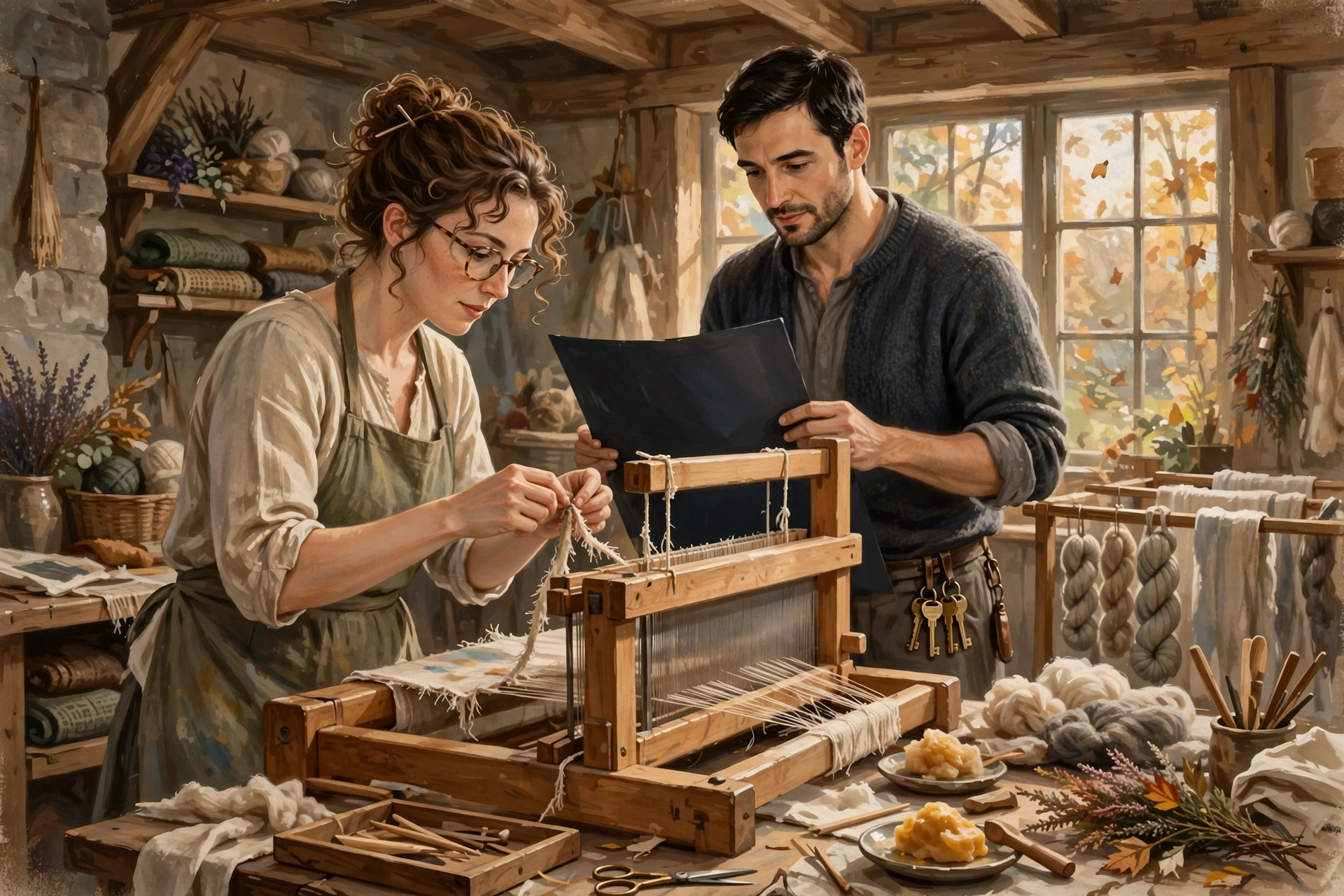
Elva Rennet caught the sagging cord before it slipped behind the loom’s rear beam. Her tool roll slid from her elbow, scattering wooden probes across the floor of Brindlewick Loft.
A boot stopped the longest probe from rolling beneath a cupboard.
“Please tell me that isn’t a load-bearing piece of string.”
She looked up at the man standing beside the loom, a ring of workshop keys hooked to his belt. His sleeves were rolled back from forearms dusted with lint.
“Not anymore.” She kept the cord pinched between finger and thumb. “You’re Lucan Dey?”
“And you’re the reason I’ve been forbidden to improve anything until further notice.”
“Elva Rennet. I’d offer my hand, but this is trying to escape.”
He retrieved her probe and laid it on the worktable beside her tool roll. “The cooperative described you as thorough.”
“They hadn’t seen my invoice yet.”
His mouth shifted at the corner.
The loft smelled of beeswax and damp wool. Beyond the loom, an early autumn draft stirred the drying cloths near the entrance landing. Everything else had its place: linen cords coiled on pegs, steel fittings sorted into shallow trays, workshop bookings pinned beside the kitchen corner.
Elva eased the loose cord forward. The beech frame had sound joints, though a treadle creaked when she tested it with her shoe. Uneven wear shone along a guide. Someone had kept the loom clean without sanding away the evidence she needed.
“You’ve left the rubbing marks.”
“I assumed you’d prefer evidence to enthusiasm.”
“Usually.”
She traced the damaged heddle cord to its fastening. Its small central eye guided a warp thread, but the linen above it had thinned almost to nothing.
“This comes out.”
Lucan moved nearer, stopping beyond her open tool roll. “Could you reinforce it instead? That section has held its enchantment evenly.”
“The cord hasn’t held its tension evenly.”
“Replacing sound old work can introduce trouble.”
“So can calling it sound.”
His eyebrows rose. Elva loosened her grip before irritation could make her tug too hard. He had asked a reasonable question. She was answering a different man, in a different workshop, who had once turned every explanation of hers into something he apparently knew already.
She reached for a sheet of dark backing paper.
“Would you hold this behind it?”
Lucan took the paper without reaching across her hands.
Against the dark surface, the pale fibers separated visibly. Elva bent the slack section over the rounded end of her probe. A powdering of linen dust fell onto the paper.
“A sleeve would hide this, not strengthen it. Under repeated lifting, it’ll fail beside the reinforcement. Then you’ll have uneven sheds, broken warp, and charms woven through both.”
He studied the dust.
“Replace it.”
She glanced at him.
“That wasn’t a difficult sentence,” he added. “I can repeat it if necessary.”
“I’m accustomed to a longer argument.”
“I save those for people who put wet mugs on the timber.”
Elva set the probe down, more carefully than she needed to.
She unfastened the damaged cord rather than cutting it. Its knots deserved examination, and the worn section would help explain the repair in her report. Lucan held the neighboring cords clear while she drew it free.
At the worktable she placed it beside her unloaded pearwood shuttle. The shuttle’s beeswax finish had worn smooth beneath her palm; she shifted it onto the curled end of the discarded linen to keep it from slipping away.
“I’ll inspect the guide before threading the replacement.” She returned to the loom. “Could you support that group while I check underneath?”
“Here?”
“A little higher. Yes.”
They steadied the exposed working cords together.
Warmth brushed Elva’s knuckles.
Across the vacant working space, a copper-colored filament appeared, bright as silk held near a lamp. It stretched between the front and rear beams, passing through the opening they had cleared.
Elva withdrew her hand. Lucan released his cords at the same instant.
The filament remained.
“That,” he said, very quietly, “is a living fate thread.”
The kettle began rattling in the kitchen corner.
Neither moved toward it.
“Tell me exactly what that means.”
Lucan looked from the thread to her face. His earlier amusement had gone.
“The loom’s inherited enchantment has recognized compatibility between us. It offers a lifelong magical partnership. It doesn’t mean we’re in love, or that we’ll ever be.”
Elva stared at the warm copper line.
“We’ve barely been introduced.”
“The loom isn’t known for its manners.”
“Can it make either of us do anything?”
“No. It can’t compel desire, touch, honesty, or agreement. You don’t owe me anything because it appeared.”
That answer came without hesitation. She looked at his hands, held loose at his sides, well away from hers.
“And removal?”
“There are only two ways. We can both knowingly accept the lifelong partnership. Then it can be lifted free intact.” He paused. “Or one of us severs it. Whoever cuts it permanently loses their weaving magic.”
The kettle lid rattled harder.
Elva crossed to the kitchen corner and took it off the heat. She needed the silence more than she needed tea.
“Scissors? Taking the frame apart?”
“Neither gets around it. Ordinary force can’t break it. A blade only severs it through a weaver’s deliberate choice, and the loss is permanent. Dismantling the loom leaves the thread attached to its working space.”
She returned, stopping short of the filament.
“And destroying it doesn’t forbid an ordinary relationship?”
“No. It removes the offered magic. Nothing else.”
“Good. Not an invitation. A necessary distinction.”
“Understood.”
His voice had roughened slightly. Elva found herself noticing the dark lashes lowered toward the loom, then resented the timing of her own eyes.
She pointed to the space the thread crossed.
“It’ll obstruct the warp.”
“And the shed. We can’t run household-charm work through it.”
The booking sheet beside the kitchen looked less harmless now.
“The reopening is still scheduled for the fifth day?”
He nodded. “Members have paid work waiting. Keeping the workshop closed means that work stops too.”
Elva rubbed linen dust from her fingertips. Her magic was part of every examination she performed, every weakened textile she persuaded to reveal its hidden strain. She could not casually lay it down.
Neither, apparently, could he.
“Your position requires weaving magic.”
“Yes. The cooperative pays me to maintain it and supervise access. The accommodation comes with the position. Without magic, I wouldn’t be eligible to stay.”
He looked toward the keys at his belt, then back at her.
“That’s information, Elva. Not an argument for accepting.”
She appreciated the distinction enough to be wary of appreciating him.
“My agreed restoration fee is two thousand four hundred dollars. If I complete the mechanical repairs and refuse the partnership, is it still payable?”
“Yes. I certify mechanical completion. I can’t withhold your fee because you refuse a bond. The thread isn’t part of your contract.”
“I’ll need that in writing.”
“Of course.”
Again, no argument. She had prepared herself for one so thoroughly that its absence left her standing with her shoulders braced.
Lucan reached for the workshop ledger, then stopped. “May I use the clear end of your table?”
Her table. For the duration of the repair, at least.
“Yes.”
He passed close enough that she noticed the rough cord marks across his fingers. The copper thread warmed as he approached it; when Elva stepped nearer to examine its position, the warmth increased. She kept her hands to herself.
Leaving would be simple. She could roll up her tools before any further part of her life acquired someone else’s handwriting.
Instead, she opened her notebook.
“I can inspect the treadle linkage without disturbing it.”
Lucan set the ledger down. “Shall I bring the lamp?”
“Please. Then let me decide where it goes.”
He inclined his head and fetched it.
On the worktable, the damaged cord lay beneath her pearwood shuttle. Across the opening she had cleared, the new thread glowed.
Elva knelt beside the loom and selected a probe.
“I’m continuing the paid repair,” she told him. “That’s all I’m agreeing to.”
Lucan waited with the lamp until she showed him where to put it.
The Pearwood Shuttle
Elva eased the loose washer along the treadle pin while Lucan kept the lamp angled beneath the loom. The washer caught on a burr. She turned it, tried again, and received a fine sprinkling of old wool dust down her cuff.

“Your loom has opinions.”
“Usually about my housekeeping.”
She glanced up. His expression remained solemn, but the lamp shifted neatly with her hand.
“For once, I agree with it.”
The washer came free. She set it in her parts tray, then lowered the treadle with her fingertips. Its familiar creak ended in a scrape.
“There. Did you hear that?”
Lucan crouched beside her without bringing the lamp closer. “The linkage catches before it reaches the end of its travel.”
“Exactly. Not the cord alone.”
He looked pleased rather than embarrassed to have found another problem. She liked that about him before she remembered to be cautious.
Beeswax and damp wool scented the weaving floor. Above their heads, the copper-colored thread crossed the working opening, luminous even in the morning light. Elva could repair every ordinary part beneath it and still leave the cooperative with a loom nobody could use.
She straightened, brushing dust from her sleeve.
“Before we take the linkage apart, I’d like to establish how much clearance remains. Not remove the thread. Just see whether it yields sideways when the shafts move.”
Lucan rose with the lamp. “Enough room for repairs, you mean.”
“Yes. I’m not proposing we outwit lifelong magic with a ruler.”
“Good. The cooperative owns a very disappointing ruler.”
She laughed, surprising herself.
With the shafts at rest, she slipped a smooth wooden guide beneath the luminous strand. Lucan watched from the other side of the beech frame, his hands clear of the working cords.
“No tension,” she told him. “I’ll stop as soon as it resists.”
The guide touched the copper silk. Elva moved her wrist sideways, barely enough to disturb an ordinary loose thread.
The strand slid over the wood and settled back across the same opening.
She changed the angle. Again, the thread found its place between the beams, leaving no route wide enough for ordinary weaving.
“That’s sufficient.” She withdrew the guide. “We can reach the fittings around it. We can’t hold it aside and carry on.”
Lucan lowered his gaze to the blocked opening. “And pulling harder wouldn’t improve our judgment.”
“Rarely does.”
She laid the guide down. No more pressure, no clever hook. She understood the choices already. Testing the space had not made either choice smaller.
At the worktable, her pearwood shuttle still rested on the damaged cord. She lifted it and laid the cord along a clean cloth for comparison, then took a small sampling frame from her case.
“We can check the replacement linen away from the loom. I need to see how it behaves under friction before I commit to threading it.”
“What would you like me to do?”
She nearly answered, Nothing yet.
Instead, she passed him the shuttle. “Load this while I stretch the sample warp.”
He accepted it with such care that she looked up from the frame.
Lucan held the little boat-shaped tool by its edges, as though warmth from his fingers might spoil the finish. He examined the bobbin, then reached for a cloth.
“It’s a shuttle,” Elva told him. “Not a sleeping moth.”
His hand stopped above the cloth. “I was trying to respect your tools.”
“Then let it do some work. It finds reverence unsettling.”
He turned the pearwood over, exposing the shallow hollow she had carved to fit her thumb. “Does it object to admiration as well?”
“Only if admiration delays loading the linen.”
“A demanding household.”
He settled it properly into his palm. Without the ceremonial care, his hands became quick and assured. Rough cord marks crossed his fingers; a pale patch on his thumbnail caught the light as he fitted the bobbin.
Elva pulled the warp snug across the sample frame and found herself watching him instead of checking the spacing.
She checked the spacing.
“You made this?” His thumb followed the shallow hollow.
“Yes.”
“The balance is good.”
“I carved it for my own hand.”
“That explains why it keeps correcting mine.”
There it was again, the dry humor beneath all his careful courtesy. She preferred him like this, with a little mischief in his mouth.
He returned the loaded shuttle. She passed it through the lifted threads and drew the linen across without pulling the edge inward.
“Plain weave. Nothing enchanted.” She pressed the weft into place with a narrow wooden comb. “That way we know what the material itself is doing.”
Lucan leaned close enough to see the crossing threads, but left her elbow room.
“You’ve allowed extra width.”
“It’ll draw in. Less if we’re patient.”
“A criticism already.”
“An invitation to astonish me.”
His smile arrived slowly. Elva felt it somewhere inconvenient beneath her ribs.
The copper thread glimmered beyond his shoulder. She turned the frame toward the window. It had not taught him how to listen or made him funny. Whatever compatibility it recognized, it could not account for the pleasure of having her work understood.
Lucan touched the table beside the sample. “Tea?”
“Please.”
He gathered the kettle from the kitchen corner. Before setting it near the water jug, he glanced back at her open case.
“Your linen is beside the cups. May I move the packet to the dry end of the table?”
“Leave the packet. The cups can come here, beyond the tray.”
“Here?”
“Yes.”
He put them where she indicated.
Such a small thing, asking. Yet she did not have to stop weaving to reclaim her place. Her shoulders loosened as he returned to the kettle.
In her former partnership, supplies had migrated first. Then commissions, then the name at the top of work she had done. She had grown skilled at packing before someone could tell her that sharing meant surrendering another shelf.
Lucan brought the tea without rearranging anything.
“Would you hold the frame?” she asked.
He set his cup down and took the far edge.
With the wood supported, she could examine the sample without bracing it against her body. Accepting help proved considerably easier when it arrived in the shape she had requested.
The kettle rattled as it cooled. Elva rubbed the replacement linen between finger and thumb, comparing it with the retained cord.
“This needs more testing. I won’t approve it on appearance.”
“Then we keep testing.”
She looked at him. “Even with the reopening approaching?”
His fingers tightened briefly on the frame. “Members depend on getting their work through. But a rushed repair won’t help them.”
“And you depend on this place.”
“Yes.” He looked toward the kitchen corner. “The resident post requires weaving magic. So does my right to the accommodation. I meant what I told you yesterday.”
“I know.”
“I can repair wood and fittings without it. That wouldn’t make me eligible to remain the loomkeeper.”
He gave her the information plainly, but his gaze lingered on the cup beside his hand.
Elva resisted the urge to offer a reassurance neither of them could use.
“I can’t settle that for you.”
“I’m not asking you to.”
She nodded, then lifted the sample toward the light. The linen crossings lay evenly, though she could feel a slight roughness where the weft bent.
“Your turn. Keep the edge loose.”
Lucan drew his chair nearer. “And don’t handle the shuttle like endangered wildlife.”
“You’ve been listening.”
“It seemed safer.”
She shifted the frame between them. His fingers approached the warp too carefully, and instruction rose immediately to her tongue. She could finish the sample faster herself.
Instead, Elva placed her handmade shuttle in Lucan’s open palm for the next pass.
The Repaired Treadle
Elva slid a strip of paper between the treadle and its wooden guide, then pulled. The paper tore.
“There.” She lifted the splintered end toward Lucan. “The wood’s catching here. Not at the pivot.”
He crouched beside her on the weaving floor. His sleeve brushed her elbow, and she became unnecessarily aware of the warmth beneath it.
“I could ease that face.”
“A little. We’re making clearance, not kindling.”
“There goes my ambitious heating plan.”
She passed him the pencil. “Mark it before we take it apart.”
He leaned into the space beneath the beech frame, keeping clear of the copper-colored thread stretched across the working opening. Its light gilded his knuckles. Beyond it, the restored heddles hung evenly, ready for tests the obstruction still prevented.
Elva watched his pencil follow the rubbed patch on the treadle. It was easier than watching his mouth.
They disconnected the linen linkage and lifted the treadle free. Lucan carried it to the worktable while she brought the wooden guide and the parts tray. She moved the sampling frame away from the shavings they were about to make, setting her pearwood shuttle beside it.
“May I clamp it here?” He indicated the cleared edge.
“Yes. Pad the jaws.”
He folded scraps of cloth around the wood before securing it. Elva appreciated that he did not look up for approval afterward.
The loft smelled of beeswax and damp wool. Somewhere behind them, the kettle rattled on its stand. She had forgotten to pour the water again.
“Tea before wood?” Lucan asked.
“Wood. Tea has already demonstrated considerable patience.”
He took up the small plane. A pale shaving curled away from the marked face, fine enough for the light to show through.
Elva set the guide against the newly pared surface.
“Another pass near this end. Leave the rest.”
His hands adjusted immediately. Rough working cords had left shallow red lines across his fingers; a small nick beside his thumbnail caught against the plane’s grip. She fetched a clean scrap and laid it beside him.
“For your thumb.”
“It’s nothing.”
“Then it’ll require very little cloth.”
He smiled, but put the plane down and wrapped the nick.
She returned to the parts tray. The loose washer lay beside the retaining nut, both cleaned and ready. Such manageable pieces. Each had a place, and neither mistook being needed for permission to occupy everything.
“You’ve gone quiet,” he observed.
“I’m considering whether to tell you something inconvenient.”
“About the treadle?”
“No.”
He rested his hands on the table, away from her tools.
Elva turned the washer over with a fingertip. “I used to share work with someone I also shared a life with. At first, it seemed sensible. Shared supplies, shared clients. Less paperwork.”
“And then?”
“My designs became our designs when there was labor involved. His designs when there was praise.”
Lucan’s mouth tightened. He did not interrupt.
“I corrected people. He called it embarrassing. I asked for separate invoices. He called it distrust.” She stopped turning the washer. “Eventually I left. But I let a great deal disappear before I did.”
“You shouldn’t have had to fight for your own name.”
“No. I also shouldn’t have kept hoping that being reasonable would make him reasonable.”
She glanced toward the sampling frame. Her shuttle lay beside it, shaped to her palm, with no apology carved into the wood.
“I keep business and intimacy apart now. My commissions. My accounts. My keys.”
“That sounds clear.”
“Sometimes it is. Sometimes someone asks an ordinary question about helping, and I’m mentally packing before they finish.”
Lucan looked down at the treadle. “Would you rather I stopped offering?”
There it was: the quick adjustment, the attempt to make himself fit before she had explained the shape of the problem.
“No. I’d rather practice answering. And you can let me answer before solving anything.”
He rubbed a fleck of wood from his sleeve. “That may take practice too.”
“I gathered.”
His laugh was brief, without much amusement.
“I lived with someone who grew tired of having supper opposite an empty chair. There was always something here that couldn’t wait. A fitting, a charm that wouldn’t hold, someone needing access after hours.”
“Sometimes there would have been.”
“Sometimes. Not always.” He pressed his wrapped thumb against the table. “I made her compete with the workshop. Then I was surprised when she stopped entering the competition.”
Elva left the washer alone.
“Did you think she’d stay because you were useful?”
“I thought she’d understand because I was useful. After she left, I became more useful.” He glanced toward the kitchen corner. “If I could have everything ready before anyone needed it, perhaps nobody would find a reason to send me away.”
The admission settled between the tools.
She could picture it too easily: a cup placed just so, a shelf cleared, a whole life made ready with no room left to refuse politely.
“I like being considered,” she told him. “I don’t like discovering that my answer’s been supplied for me.”
“I can see how those might look alike from my side.”
“And how an offer might look like an instruction from mine.”
He reached for the plane, then paused. “Shall I finish this?”
“Yes. That answer’s easy.”
He took the last thin shaving. Elva checked the fit, then smoothed the pared surface while he cleared the bench. Together they carried the treadle back, seated its pivot, and restored the washer beneath the retaining nut. She held the wooden guide in position while he secured it.
When she reached for the linkage cord, he lifted it into her hand rather than fastening it himself.
“Thank you.”
“For passing string?”
“Don’t become unbearable about it.”
His smile returned.
Elva connected the linkage and lowered her foot onto the treadle. It creaked, descended, and returned without catching.
She tried again, slowly enough to feel any hesitation through her sole. The linen drew evenly. The guide stayed clear.
Lucan crouched to watch the pivot. “Clean travel.”
“At last.”
She yielded the place to him. He tested it while she watched the linkage, and the treadle rose level beneath his foot.
Beyond their hands, the living thread brightened. It remained stretched between the beams, untouched and thoroughly unimpressed by competent joinery.
“That doesn’t clear the loom for use,” Elva reminded him.
“No.”
“The replacement linen still needs friction testing. Then the remaining checks.”
“I’ll leave the workshop access notice as it is.”
She nodded. The members’ household-charm work still waited on this room. A smooth treadle mattered, but it wasn’t permission to pretend everything else had disappeared.
At the worktable, they finished the plain sample on the small frame. Lucan supported the far edge while she passed the shuttle through and settled the weft. Then she gave him the shuttle and held the frame for him.
His final pass lay loose enough at the edge.
“Better,” she murmured.
“I shall try to survive such lavish praise.”
They secured the ends and freed the little cloth. Elva spread it flat beside the shuttle, then sat down. Lucan took the adjacent chair, leaving a careful space between them.
For a while she examined the sample. Then she stopped pretending.
“May I kiss you?”
His gaze lifted to hers.
“Yes.”
“I’m not accepting the partnership. I’m not deciding anything larger this evening.” She kept her hands in her lap. “I mean a kiss.”
“So do I.”
There was no qualification after it.
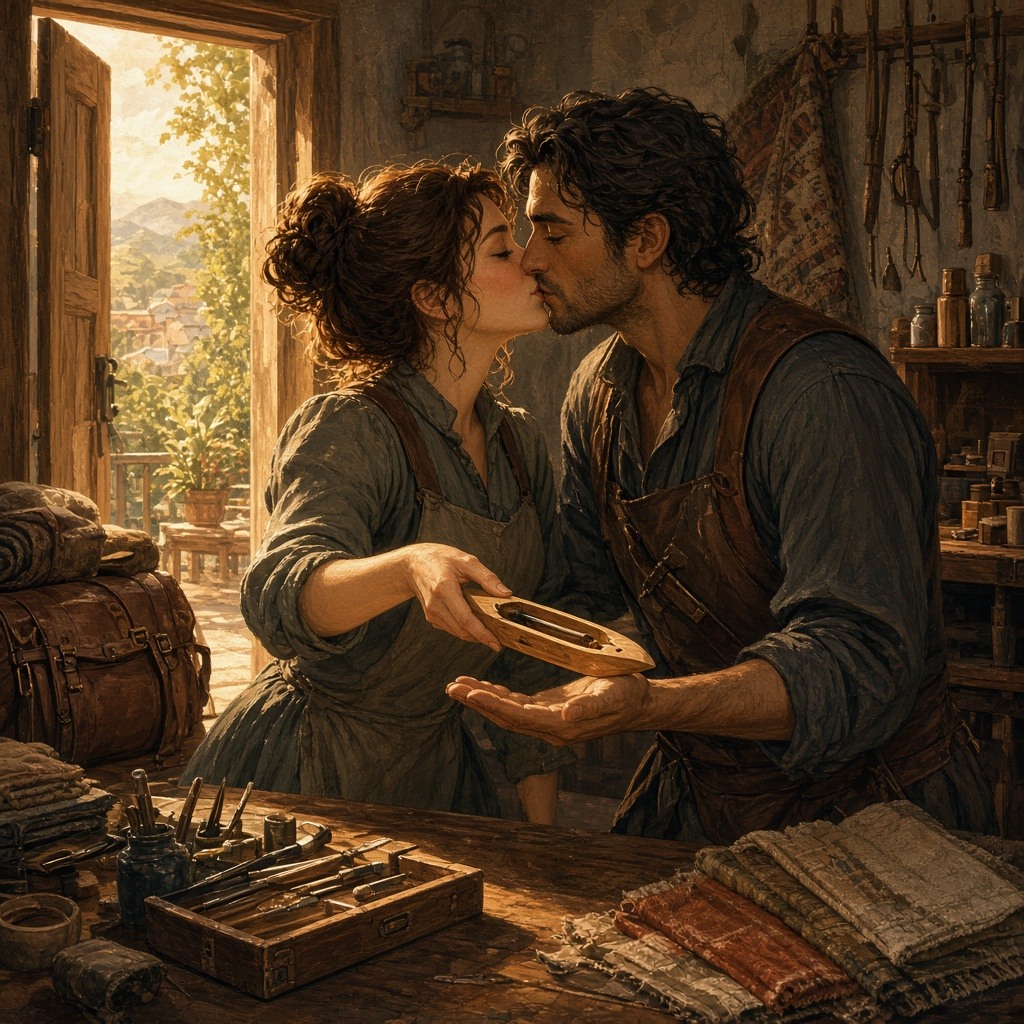
Elva leaned toward him. He met her without pulling her nearer, his lips warm and gentle against hers. The kiss lasted only a moment. She drew back far enough to see his face, and his smile arrived slowly, almost shyly.
Her own smile felt impossible to conceal.
“The tea,” he murmured, “has probably lost patience.”
“Let it.”
He stayed beside her. She left her chair where it was.
Across the weaving floor, the treadle rested level beneath the loom. Their completed plain sample lay beside the pearwood shuttle, and they remained close at the worktable, neither reaching for the magical thread.
The Cleared Table
Elva pulled the replacement linen through its guide again, then stopped it against her thumb. No new fuzz clung to the cord. She shifted the inspection lamp closer and bent until her cheek nearly touched the beech frame.
“Again,” she told Lucan.
He pressed the pedal slowly. The linkage descended without snagging, and the linen slid past the guide without rubbing its edge.
“You’re making that face,” he murmured.
“This is my professional face.”
“Then I owe several innocent pieces of furniture an apology. I thought you disliked them.”
She tried to keep her mouth straight. “Most furniture improves under suspicion.”
The early light caught the rough cord marks on his fingers. Yesterday, those fingers had rested on the chair beside hers without reaching for anything she hadn’t offered. She looked back at the guide before the memory could distract her from the last inspection.
They checked the remaining fittings together. Elva tested each fastening, watched the shafts rise and settle, and ran her palm over the repaired joint. The wood remained firm under pressure. Nothing shifted where it shouldn’t.
Between the beams, the copper-colored thread gleamed.
It hadn’t yielded to sound joinery or patience. The loom could move through its mechanical checks, but it still couldn’t weave the household charms booked for tomorrow.
“That’s the mechanical work finished.” Elva straightened carefully. Her knees objected to the morning’s negotiations with the floor. “No further abrasion. No catching. The repaired joint’s secure.”
Lucan rose and offered her the inspection lamp’s handle rather than his hand. She took it, oddly grateful for the distinction.
“I’ll sign the record.”
At the worktable, he drew the completion sheet from under a flat board. Elva set the lamp down and read over his shoulder while he entered the final checks. The room smelled of beeswax and damp wool, familiar enough now that she would notice their absence when she returned to her own workroom.
Lucan turned the sheet toward her.
“Mechanical restoration completed by Elva Rennet,” she read aloud. Below that, the unresolved magical obstruction was recorded separately. Her fixed fee remained listed without qualification: $2,400.
“Anything missing?”
“The replacement cord passed friction testing.”
He added it, signed his name, then handed her the sheet.
“Your copy. I’ll keep the duplicate for the cooperative.”
She checked the signature before slipping the record into the flat pocket of her tool roll. The payment itself would follow the cooperative’s usual process, but her completed work was certified. No one could mistake her refusal of a magical partnership for an unfinished repair.
“Thank you.”
Lucan’s smile came quickly. “There’s something else.”
He lifted a folded length of linen from the far end of the table.
Her sampling frame stood there, aligned with the table’s edge. Beside it lay the plain sample they had finished yesterday. Her pearwood shuttle rested in a shallow wooden tray she hadn’t seen before.
Beyond them, the broad surface had been cleared. The jars of maintenance wax and bundles of spare cords were gone.
“I moved my supplies to the loom cupboard.” He opened a storage door below the table. Empty shelves showed pale rectangles where boxes had stood. “This stays dry, even when the windows mist. There’s room for your rolls, and the larger frames could stand along the wall.”
Elva’s hand remained on the fastening of her tool roll.
“For the collection this morning?”
“For your work.” He touched the tray’s rim. “Permanently, if you like it. I padded that so your shuttle won’t knock against the lamp base.”
She looked at the empty shelves again.
They were good shelves. Deep enough for wrapped textiles, well away from the kitchen corner. He had moved his own things out of the best working light.
“You cleared all this before asking me?”
His smile faltered. “I thought it would be easier to show you.”
“Show me what?”
“How it could fit. Your conservation work here, my maintenance work by the loom. We wouldn’t need to keep carrying everything between places.”
We.
She opened her tool roll.
“Elva, it isn’t a requirement.”
She slid her inspection mirror into its sleeve. The narrow handle caught on the cloth, and she pushed it harder than necessary.
“You’ve put my tools where you think they belong.”
“Only the things already on the table. I haven’t touched your roll.” He drew his hand away from the tray. “I thought after yesterday, perhaps we could begin considering something shared.”
“Yesterday I asked to kiss you.”
“I know.”
“I was quite particular about what I wasn’t agreeing to.”
The kettle rattled in the kitchen corner. Lucan glanced toward it, then stayed where he was.
“I remember what you told me.” His voice had lost its lightness. “I didn’t think offering a place was the same as taking yours away.”
Elva gathered her measuring tape, wound it, and tucked it beside the mirror.
It had begun with convenience before. A shared cupboard. Someone else handling the correspondence because she was busy. Her name omitted from a proposal because everyone involved supposedly knew whose work it was.
By the time she had objected, asking for her own name on her own work had been treated as an insult.
Lucan reached toward the open storage door, then stopped.
“Would you let me finish explaining?”
“I’ve seen the explanation. It has shelves.”
His mouth tightened.
She heard the sharpness too late. There had been care in the little padded tray. She could see that without trusting the future he had arranged around it.
“That was unfair,” she added, though she didn’t stop packing. “But you should have asked.”
“Yes. I should have.” He rubbed his palm along the table edge. “I thought making room would show you I wasn’t expecting you to fit yourself around me.”
“You chose the room.”
“It’s a table, Elva. Not a contract.”
“Then why does it already contain my work?”
He looked down at the sample. She could have waited there, could have let the question remain between them without reaching for another tool. Instead, she picked up her cord gauge.
“There’s more to consider than either of us,” he continued. “The workshop opens tomorrow. Members have paid work waiting. If we accepted the partnership, we could lift the thread out intact. The loom would be clear. I could keep maintaining it. Nothing here would have to come apart.”
Her fingers stopped around the gauge.
“Including your position.”
“Yes.” He didn’t look away. “Including my position. And my rooms. I’m not pretending those don’t matter.”
“They matter very much. That doesn’t make them mine to preserve by agreeing to a lifetime.”
“I’m not asking you to do it only for that.”
Only lodged between them.
Elva placed the gauge into its pocket with exaggerated care.
“A kiss, a cleared table, and now the cooperative’s household income.”
“That isn’t how I meant it.”
“It’s how you’re asking.”
He stepped back, leaving the width of the table corner between them. The copper light caught his sleeve.
“I like you,” he told her. “I thought you knew that.”
Her throat tightened. “I do.”
“Then don’t make this sound like I’ve calculated what you could save me.”
“Have you left yourself any way to like me if I save nothing?”
He opened his mouth, then glanced toward the obstructed loom.
She wished he hadn’t.
“I can’t separate it all as neatly as you can,” he admitted.
“I haven’t separated anything neatly.” Her tool roll lay crowded with things she had put into the wrong pockets. “But I was hired to repair a communal loom. I wasn’t hired to become its permanent remedy.”
“I never called you that.”
“Then please stop putting the workshop beside us whenever you speak about us.”
The kettle lid rattled again. Neither moved toward it.
Lucan rested his hands against his thighs. “You began packing before I could tell you what I meant.”
She looked at the open roll. He was right about that, and she had no comfortable answer.
“I did.” She swallowed. “But I’m not accepting the bond.”
He nodded once. Nothing in his face suggested relief.
Her shuttle remained in its new tray. Elva lifted it out, her thumb finding the hollow she had carved to fit her own hand. She put it into the roll, folded the cloth over her tools, and closed the ties.
Lucan stayed beside the cleared place she had never agreed to occupy.
The Cut Thread
Elva lifted her tool roll from the landing bench and felt for the flat pocket through the canvas. The signed completion copy crackled under her fingers. She had carried the roll this far before going out for air, then stayed away until the afternoon light had shifted across the windows of Brindlewick Loft.
She could take it and leave.
Inside, wood scraped against wood.
Through the open doorway, Lucan lifted the narrow tray from the worktable. Her shuttle had fitted there too neatly. Now he set the tray beside a dismantled shelf, its brackets gathered in a shallow dish.
The sampling frame stood in its old place. The plain sample lay beside it. He had brought back the communal basket of mending supplies, including the pincushion that leaned like a poorly filled pie.
Elva stepped across the threshold.
Lucan turned, still holding a screwdriver. His gaze dropped to her roll, then returned to her face.
“Your copy’s in the flat pocket. I didn’t move it.”
“I know. I came back to collect it.”
He put the screwdriver down. “May I say something before you go?”
Her fingers tightened around the ties. “You may.”
He stayed on the other side of the table.
“I planned where you’d work without asking whether you’d work here. I made room for your things and treated that as permission to arrange your life.” He glanced at the dismantled shelf. “Then I used the members’ work and tomorrow’s reopening to argue for what suited me.”
“You made refusing you sound like refusing all of them.”
“Yes.” His jaw shifted. “I’m sorry. They need a working loom. That doesn’t entitle me to a lifelong partnership with you.”
The kettle rattled in the kitchen corner. Neither of them went to it.
Elva set her roll on the table but kept her palm over it.
“Taking the shelf down doesn’t make me less likely to leave.”
“It isn’t meant to.”
She studied the empty place where he had prepared storage for her. There were small screw holes in the wood. He had not filled them or hidden them under a cloth.
“I liked that you’d noticed how I work,” she admitted. “That was part of why I was so angry.”
His shoulders lowered a little, though he did not approach.
“I could have asked.”
“I might have liked being asked.”
Outside the windows, the afternoon had turned the glass pale gold. Inside, the loft smelled of beeswax and damp wool, familiar enough now to make her distrust how readily her body settled into it.
Lucan looked toward the loom.
“I’m going to release it.”
Her palm slipped from the tool roll.
The copper-colored thread stretched between the beams, bright against the beech frame. It had ignored every harmless adjustment they had tried. It lay across the working path with the delicacy of something that could stop a livelihood without bearing its weight.
“You mean cut it.”
“Yes.”
“When?”
“This afternoon. Whether you stay or leave.” He rubbed his thumb over a rough mark left by a working cord. “If you never see me again, the loom will still be clear.”
She looked at his hands. Yesterday, one of them had rested against her cheek only after she had moved closer. She remembered that care as clearly as she remembered the shelf.
“Don’t make this another arrangement I discover after you’ve decided what I’ll feel.”
He flinched.
“You’re right to ask. I hope you’ll see me again. I can’t make myself not hope it.” He spread his empty hands. “But you haven’t agreed to anything. You won’t owe me an answer because of this.”
Elva walked to the loom. The light touched her cuff without tugging her nearer. It had never made her touch him. It could not even make this conversation easier.
“We could discuss me doing it.”
Lucan’s hands fell to his sides.
“Elva.”
“Discuss it. Not decide it for me. My magic is mine to weigh.”
“It is.” He took a moment before continuing. “You could choose to cut it. I’m not saying you couldn’t bear the loss. But I’m responsible for keeping this workshop usable. I won’t ask you to take that loss so I can keep my work and my rooms.”
“I offered.”
“I heard you.” His voice roughened. “And I’m declining to hand you the shears. Not because your choice matters less. Because I can make this choice myself.”
She folded her arms, then unfolded them. There was no argument here that could leave both their lives untouched. She disliked him less for refusing to pretend there was.
“You understand it’s permanent.”
“Yes.”
“Not until the loom settles. Not until someone finds a better working.”
“My weaving magic won’t return.” He looked directly at her. “I’ll no longer qualify for the resident loomkeeper position. I’ll have to find other work and leave the accommodation.”
She pressed her thumb into the seam of her sleeve.
“And cutting it doesn’t decide anything between us.”
“No. It removes the thread. Nothing else.”
She nodded, though her stomach remained tight.
Lucan fetched the workshop shears from their hook. He carried them closed, handles resting in his palm. At the loom, he knelt and set them on the floor.
Elva crouched nearby, leaving him space.
“Would you rather I went?”
He looked at the shears for a long moment.
“I’d rather you stayed. You don’t have to.”
“I can stay.”
He reached into the frame and lifted the living thread. Copper light pooled against his fingers. There was nothing fragile about it now. It lay over his skin, unbroken and impossibly bright.
He picked up the shears.
Elva’s knees pressed against the floorboards. She nearly spoke, then stopped herself. She had asked whether he understood. He had answered her.
Lucan settled the thread between the blades. For a moment he did nothing. His mouth compressed, and his free hand shook enough to disturb the light.
“I’m giving up my weaving magic,” he said quietly. “I understand.”
He closed the handles.
The blades met with a small metal click.
Light vanished from between his fingers. Dull fibers slipped over his knuckles and fell to the floor, scarcely distinguishable from ordinary sweepings.
Elva stared at them. She had expected something louder.
Lucan put the shears down carefully. He did not rise.
After a while, he reached for a linen working cord and drew it between his palms. Elva knew the small warming he used to soften a stiff cord before adjusting it. She had watched it pass through his fingers while they worked.
Nothing changed.
He rubbed the linen once, stopped, and opened his hands.
“Will you check?”
She touched the cord beside his thumb. It was cool. There was no trace of the familiar warmth traveling through it.
“It’s cold.”
He nodded but kept looking at his palms.
Elva lowered herself fully onto the floor. The boards were hard, and a loose fiber clung to her skirt. She left it there.
“I don’t know what to say.”
“Neither do I.”
She resisted offering him work she did not have, or a place in her home she had not considered. Neither would put warmth back into that cord.
Lucan finally released it. His fingers remained curved around the space where it had been.
“I keep thinking I haven’t done it properly.”
Her throat tightened. “The warming?”
“Yes.” He wiped his cheek with his sleeve, looking irritated by the wetness. “As if I’ve forgotten something simple.”
She stayed beside him until he could stand. He accepted her hand to get up, then let it go.
At the worktable, Elva drew her signed copy from its pocket and placed it safely aside.
“I can help prepare the manual checks,” she said. “If you’d like me to.”
Lucan pulled out a chair. He sat rather than reaching for another task.
“Yes. Please.”
She loosened the ties of her tool roll. The canvas opened across the table, revealing the pearwood shuttle she had carved to fit her own hand.
Across from her, Lucan covered his mouth. His eyes filled again. This time he did not turn away, and Elva left the roll open between them.
The Worktable
Elva nudged the loft door shut with her heel and lifted the paper bag clear of the latch.
Lucan looked up from beside the loom. His shirt was buttoned crookedly at the collar. She resisted the impulse to cross the floor and fix it.
“Breakfast,” she said. “Something with apples. The bag’s becoming transparent, which generally recommends a pastry.”
His mouth shifted, almost a smile. “You came back.”
“I did.”
She put the bag beside her open tool roll. Beeswax and damp wool scented Brindlewick Loft; from the kitchen corner came the rattle of the kettle. Everything looked offensively familiar for a morning on which he could no longer warm a working cord.
Lucan picked up the testing sheet. “Shall we?”
“Let me take my coat off. I’m meticulous, not waterproof.”
He waited while she hung it on the entrance peg.
At the loom, Elva retrieved the shears from the floor and laid them safely on a nearby shelf. Then she crouched beside the repaired fitting while Lucan worked the foot lever. The treadle creaked. Its travel remained clean, without the sideways drag that had scored the old bearing surface.
“Again, slowly.”
He pressed down. She watched the clearance, then checked the steel for fresh rubbing. Nothing caught.
They worked through the remaining checks, changing places when she needed to feel the resistance herself. The shafts lifted evenly. The brake held and released. Linen cords settled without snagging, and the repaired frame stayed square under tension.
Lucan reached toward a cord, palm open.
He stopped before touching it.
Elva kept her eyes on the fitting until he lowered his arm. She could offer him privacy without pretending she hadn’t noticed.
“That’s the mechanical list,” she said.
“Will you try the charm passage?”
She rested her palm against the beech and sent a small measure of her own weaving magic through the test warp. Warmth traveled freely across it. The loom answered with the quiet shimmer she had been hired to restore.
Lucan watched it fade.
“Clear,” he said.
She marked the sheet. Ready for ordinary workshop use. The words looked so small.
He fetched the dustpan while she took the broom. Under the frame, the severed fibers lay among lint and pale wood dust. No copper light remained. They moved when the bristles touched them, as helplessly as any other sweepings.
Elva swept them into his dustpan. He emptied it into the workshop waste basket and stood looking down.
She rested the broom against the wall.
“Tea?”
“Please.”
By the time she brought the mugs over, he had opened the cooperative’s maintenance account on his laptop. His resignation filled the screen.
“Would you read it?” He drew his hands into his lap. “Only for anything unclear.”
She sat beside him. The letter stated that he could no longer perform the magical duties of the resident loomkeeper. It requested arrangements for handing over access and vacating the accommodation.
“It’s clear.”
“I keep looking for a less final word than resignation.”
Elva set his mug within reach. “I don’t think a different word would make sending it easier.”
“No.”
He read it again, then pressed send.
The confirmation appeared. He closed the laptop halfway, opened it again, and wiped a drop of tea from the table with his sleeve.
She didn’t tell him he would soon find something better.
“I haven’t found another room,” he said. “Or paid work. There are people who’ve asked about ordinary repairs before. Asking isn’t an order.”
“No. But you can show them what you can do.”
He glanced toward the dismantled shelf beside the removed tray. “Some of my examples are embarrassing.”
“The joinery isn’t.”
That brought a brief, reluctant smile.
He fetched the shelf and a wooden shuttle box with a neatly replaced hinge rail. From a cupboard he brought a small sampling frame, its split corner repaired with an inset patch.
“All without magic?”
“All. Glue’s very patient with me.”
They cleared a patch of the table for photographs. Lucan took them himself, turning each piece toward the window. Elva helped him prop the shelf upright, but left him to choose the descriptions.
When he wrote that he could assess repairs before quoting, she nodded. He saved the document under his own name.
Then she took out her phone and submitted her invoice for $2,400 through the cooperative’s usual accounts form, attaching the completion certificate he had already signed. The receipt arrived before her tea had cooled.
She put her retained paper copy into her document wallet.
Lucan pulled the pastry bag toward them. “You should eat before the apples soak through.”
“There’s something I need to say first.”
He withdrew his hand.
Elva flattened the bag’s folded edge. She could still leave with everything neatly finished: repairs approved, invoice submitted, tools packed. She had become very good at leaving while departure could pass for efficiency.
“I came back for you,” she said. “Not just the checks.”
His gaze rose to hers.
“And not because I owe you affection. What you did doesn’t make me yours.”
“I know.”
“I believe you do. I need to hear myself say it, too.”
He nodded and waited.
“I’d like to keep seeing you. Supper. Walks. Finding out whether you’re unbearable when there isn’t a loom to repair.” She loosened her grip on the paper. “I’m keeping my home and my business. I’m not offering a shared address.”
“Supper sounds good.”
She searched his face, almost irritated by how little there was to argue against.
“That’s enough?”
“It’s something I’d very much like.” His mouth softened. “You don’t have to improve the offer.”
Elva reached across the table, palm upward. He placed his hand in hers. Rough linen had marked the skin along his thumb; she stroked beside the reddened line.
“I’m still frightened,” he said. “About work. Leaving here. Sometimes I forget for a moment, and then I remember.”
“You can tell me when you remember.”
His hand tightened around hers.
“Tonight?” she asked. “Supper at my place. You’d be visiting, not measuring for shelves.”
He let out a surprised laugh. “No measuring equipment.”
“I’ll make soup. Bring bread if you like.”
“I’d like that.”
They settled on the evening, with enough time for her to go home and cook without rushing. She sent him her address. He saved it without adding anything about keys, cupboards, or where his belongings might fit.
Elva finally opened the pastry bag. The apples had behaved better than expected.
While they ate, Lucan turned the repaired sampling frame over. Plain cotton still crossed it, ready for a small demonstration.
“Could I borrow that?” she asked.
He slid it toward her.
She lifted the pearwood shuttle from her tool roll. Its curved side fitted her palm, exactly as she had carved it to do. She wound ordinary yarn onto its bobbin, seated it, and drew the end through the eye.
“You admired the edge on my repair sample,” she said. “I could show you how I keep it even. No enchantment involved.”
He looked at the shuttle for a long moment.
“I might be slow.”
“Then I’ll have time to finish my tea.”
His smile stayed this time. He rose and reached for a chair, then paused.
“Where would you like to sit?”
Elva considered the window, the frame, the space beside him.
“Here. Beside you. Move yours closer so we can both reach.”
They drew their chairs together at the worktable. With supper arranged and the cleared loom ready for other hands, she passed him the plain wooden shuttle. He tried its path through the cotton, then laid it back in her waiting palm.
Get notified when new stories drop

Cade Ellison
Cade specializes in romantasy and paranormal romance: magic systems with rules, courts with knives, and longing that rearranges destinies.
Leave a comment
Comments