


Room Four
The headlights went off a quarter mile back, by agreement, and the last stretch of the coast road unrolled black and salt-smelling under the moon. Wren Castellano counted the turns out of habit. She had spent nine years counting things for a living, and the last four months counting everything twice, and tonight she counted the minutes between the turnoff and the low neon sign that buzzed above the office of the Pelican Bend Motor Court.
"Two miles off the highway," the marshal said from the driver's seat. "Single lane in, single lane out. I drove it twice yesterday."
"You drove it twice yesterday," she said, "and nobody followed you, because nobody knew you were looking."
"Nobody knows you're here either."
"That's the plan, anyway."
He didn't answer that. He pulled the sedan around the back of the office, into the dark between two oaks, and cut the engine. "Room four. End of the row, faces the water on one side, faces the lot on the other. I don't love the water side."
"You don't love anything," she said, and opened her door before he could get around to it.
Deacon Holt was out of the car anyway by the time she stood, and he walked the way he had walked since the federal building in Raleigh, like a man doing arithmetic with every step. He put himself between her and the lot without seeming to. He did it the way other people breathed.
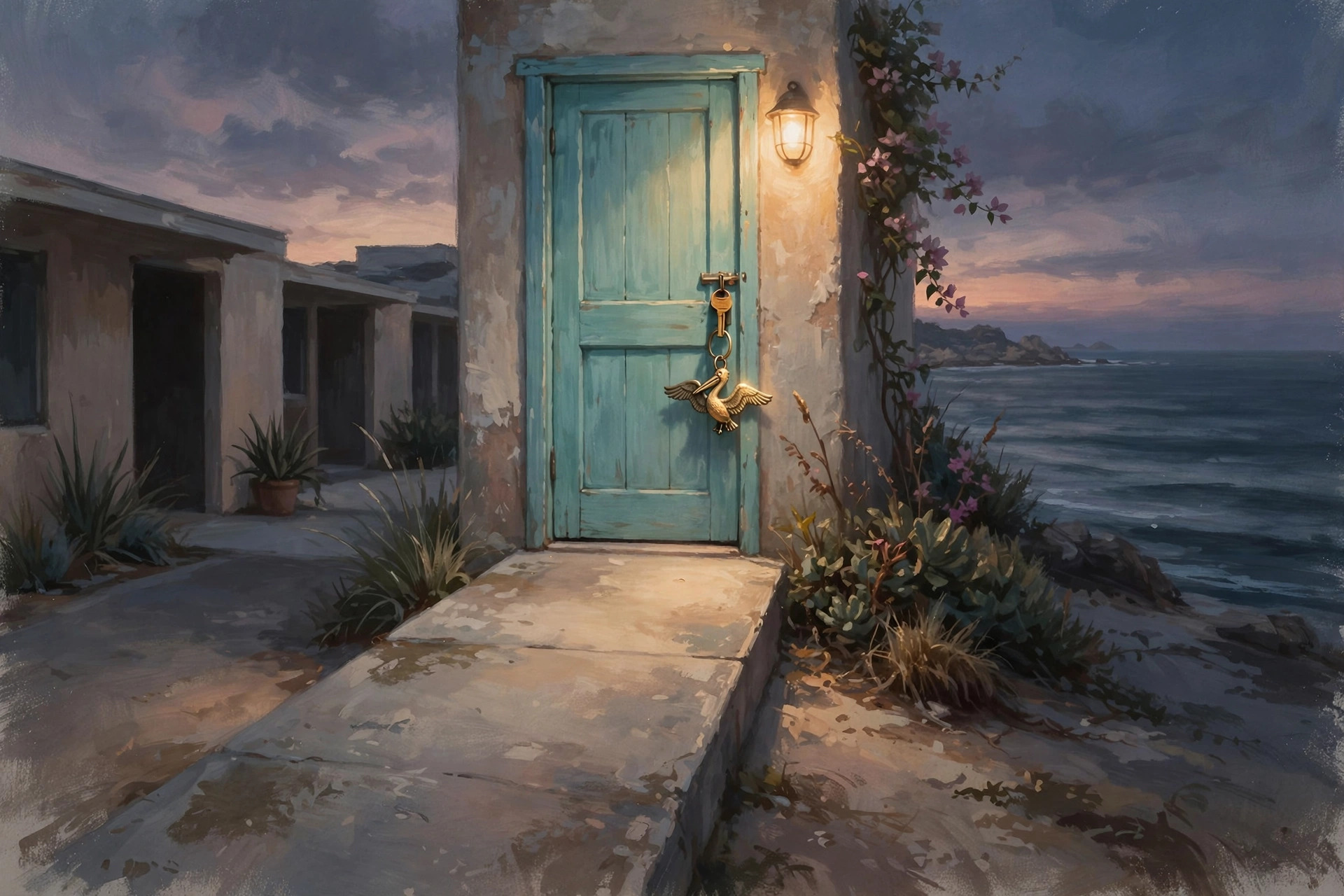
The night clerk had gone home at ten; the key had been left in a lockbox with a code he'd been given and she hadn't. Room four was at the end of a concrete walk that a decade of storms had tilted toward the sea. The door was paint-burned aqua, and the key on its ring was brass, and hanging from that ring was a small brass pelican, cut by hand, soldered crooked at the tail.
Wren stopped with her hand out and didn't take the key from him.
"That's mine," she said. "Marisol made it. My sister. She solders the brass in her shop and it comes out looking like a bird that lost an argument with a wave."
"It came with you from Raleigh?"
"It came with me everywhere. It was on my key ring when they moved me out of my apartment in an hour and a half." She held her palm out flat, and after a moment he set the key in it, and the pelican lay warm from her hand a second later, and heavier than a bird should.
"You want to check the room," she said, "go ahead."
"I want to check the room."
"I know. That wasn't an argument. That was me being tired of arguing."
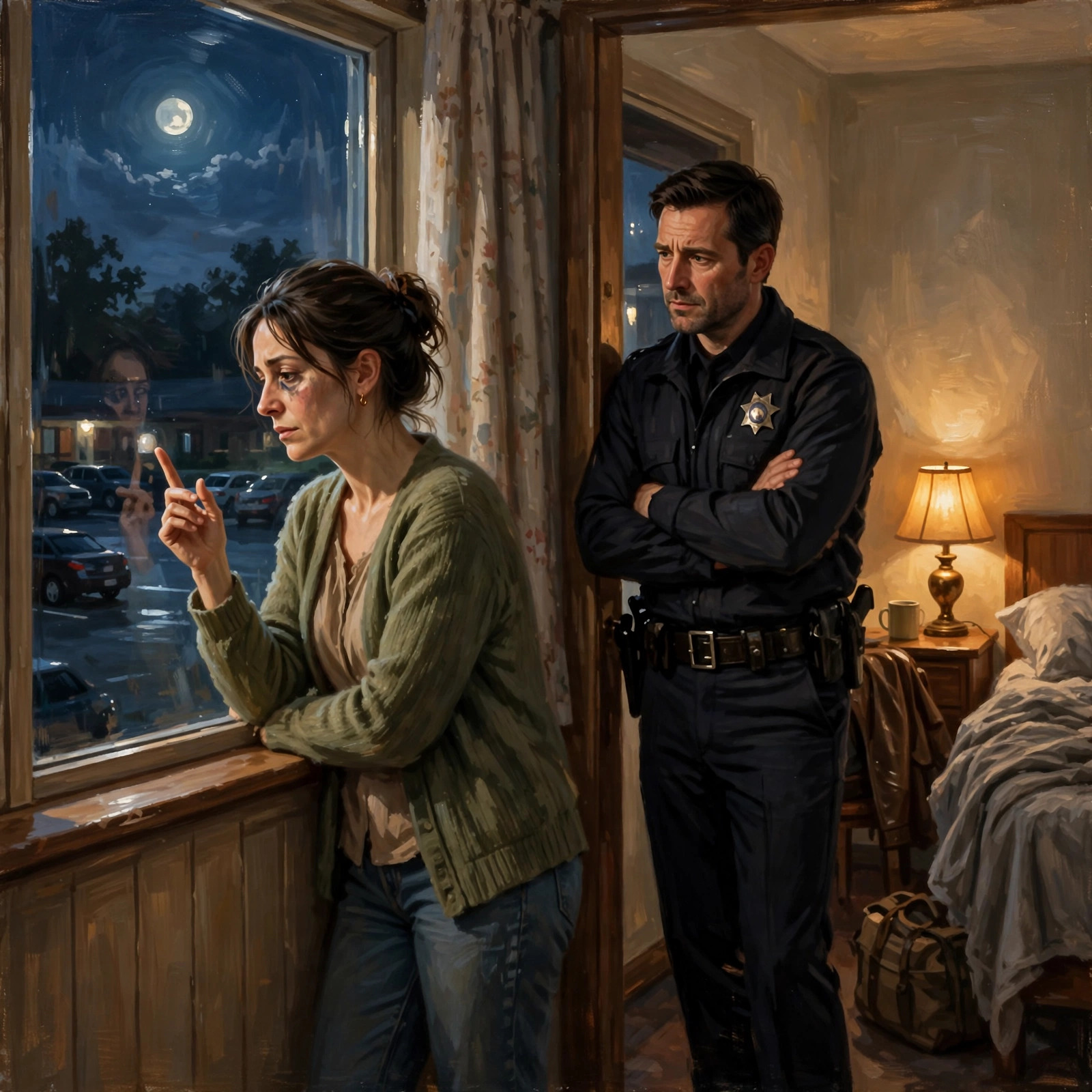
He went in first. She stood in the doorway and watched him work it the way she would have watched an auditor work a ledger, to learn the method. He looked behind the door, under both beds, inside the closet, up at the seams of the curtain, down at the grates of the wall unit. He ran the shower. He flushed the toilet. He opened the connecting door to room five, looked through, came back, and shut it.
"Room five's empty," he said. "Nobody booked for the season except four rooms, and none of those four are this end. You've got the quiet side."
"The quiet side." She came in and set her one bag on the far bed, the one that didn't face the window. "You keep saying things like they're a comfort. The quiet side. Nobody knows. Single lane in."
"They are a comfort."
"They're a plan." She sat on the end of the bed, and the bed creaked, and she was too tired to care how loud it was. "I've been moved four times in four months, Deputy Holt. I've had three safe houses and one hotel with a marshal who watched the parking lot all night and never once asked me a question that wasn't on a form. So before you jam whatever you're about to jam under that door, I want one thing understood."
He had, in fact, taken a rubber doorstop out of his jacket, and he stopped with it halfway to the gap under the deadbolt. "Which is?"
"I'm not a box. You don't get to carry me and stack me and decide where I sit. I'm the case. Everything the government has against Ellis Grange is in my head and in that binder, and it got there because I'm careful, not because I'm obedient. So when you make a call about me, you make it out loud, and you make it to me first."
He stood there a second with the doorstop in his hand. The neon from the office sign came through the curtain seam and made a thin orange line across his shoulder.
"Fair," he said. "Here's mine, then, out loud. You don't open that door for anything but me, and you don't open that curtain without asking. Somebody knocks, somebody calls, somebody says they're the front desk, the night manager, or your sister with a flat tire on the highway, you don't touch the chain until I say. People who hunt witnesses don't kick doors first. They knock, and they're polite, and they're very often holding something that looks like a reason."
"People who hunt witnesses," she said. "You mean a specific person."
"I mean a habit of the world." He set the doorstop and pressed it firm under the deadbolt with the side of his shoe, and she watched the door take the pressure and hold. "That's not protocol, by the way. Protocol says I get you a room and I take the one across the lot and I check you every two hours."
"And instead?"
"Instead I'm sleeping on a cot in room five with this connecting door open, and you'll hear me cough all night, and I apologize in advance for that."
"That's a rule of yours," she said. "It costs you something. Sleep, I mean."
"I don't sleep much anyway." He said it flatly, the way you'd say the tide table. He dragged the cot frame out of the closet of room four first, then thought better of it and carried it through to the other side, and she heard him setting the legs in the dark of the next room, one at a time, quiet about it.
She turned the brass pelican over in her fingers. Marisol had cut the wing too thick and the beak too long, and it was the best thing anyone had ever made for her, because her sister had made it in a shop full of flowers and solder on her last birthday, back when Wren still thought the worst thing in her life was a long Thursday.
"Deputy Holt."
"Holt," came back through the connecting door. "Deacon, if we're doing this for eight more nights."
"Deacon. Nine days until I walk into that grand jury room. Nine days, and then my life starts being mine again, or it starts being something else, I don't know which. What happens on day ten?"
He leaned through the doorway, one shoulder against the frame, and for the first time since Raleigh he looked at her like she was a person and not a set of documents in a lockbox. "Day ten," he said, "you get to be bored. Bored is the whole job. Everything I do from the second you got in my car is aimed at getting you bored safely."
"Then here's my rule," she said. "You get one of mine, I get one of yours, we'll trade the rest as they come up. My rule is the binder. Nobody touches the binder, nobody moves the binder, nobody decides the binder goes in a trunk or a safe without me. Everything in it cost me more than you know. It stays where I can see it."
"Where can you see it from?"
She looked at the nightstand between the beds, then at the floor by the headboard, then set the pelican key ring on the nightstand and laid the binder beside it, squared. "There."
"Then there it stays." He straightened. "Door stays deadbolted, doorstop stays in, curtain stays shut. You get the bed. I get the cot. If you hear me up at four, it's the coffee, not you."
"One rule of yours, one of mine," she said. "And you take the cot by the connecting door."
"That's three rules," he said. "You're an accountant."
"I'm an accountant," she said, pulling the thin motel blanket up, boots off, still in her jacket because the room hadn't decided to be warm yet. "Counting's the one thing they can't take from me. Good night, Deacon."
"Good night, Wren."
He left the connecting door open the width of a hand, turned off his light, and she lay listening to the tide two hundred yards out, and to the faint creak of a cot when a careful man lay down on one, and to nothing else at all. The pelican gleamed dull brass on the nightstand in the dark. She fell asleep with her hand near it, which was not something she would have told him, and which he would have understood anyway.
The Gray Truck
The town store in Harrow Point opened at seven, and by eight Deacon had decided they were going.
"You need coffee that isn't from a machine," he said, standing in the doorway of room four with his boots already on. "And I need bread that isn't from a machine. That's not me being charming, that's a supply run. It goes in the log."
"There's a log?"
"There's always a log."
Wren pulled her jacket off the hook behind the door. The key came with it, and the brass pelican swung once against her knuckle, warm from hanging near the little heater all night. She put it in her pocket instead of back on the nightstand, which she told herself was practical and not sentimental, and followed him out.
The morning was gray-silver, the kind the North Carolina coast does in November without apology. The motor court sat back off the coast road, its eleven rooms in a lazy L around a gravel lot, four of them occupied for the season by fishermen who wanted cheap and quiet. Deacon walked the car first, all four sides, then held the passenger door for her, which she noted and filed.
"You check the car every time?"
"Every time."
"Even though nobody knows we're here."
"That's the best time to check," he said. "Nobody knowing is a theory. I like evidence."
She almost smiled. She kept it to a near miss and got in.
The store was two miles of single-lane road back to the coast highway, then three more into Harrow Point proper, a stretch of weathered shops with a bait counter at one end. Inside, it smelled of coffee and newspaper and the sweet dust of penny candy that nobody under fifty bought anymore. Wren took the basket and started down the aisle, and Deacon took the coffee, and it took her half the store to notice they'd fallen into a rhythm without discussing it. He put things in the basket she reached for. She handed him the jar he was squinting at before he asked.
"You do this a lot," she said. "Shopping for someone."
"Guarding someone."
"You handed me the peanut butter."
"You were between me and the register," he said. "I'm extremely strategic."
She laughed, actually laughed, and the sound surprised her enough that she cut it off. He didn't look at her like it was strange. He just looked, briefly, like a man who'd done something right on purpose.
At the register she caught him watching the window, and she followed his eyes without moving her head, the way you learn to when you grow up keeping books you don't want anyone reading over your shoulder. A gray pickup rolled past the front of the store, slow, and went on toward the water.
Deacon paid in cash, counted his change, and said nothing about it.
In the car, he took the long way back through town, past the church and the shuttered crab shack and out the other side, which added eleven minutes she timed on her phone, and when they turned onto the single-lane road she saw the same gray truck parked at the bend near the coast highway, empty, a contractor's rack in the bed.
"That truck was at the store," she said.
"Lots of gray trucks."
"That one has a dent in the rear panel. Left side. I do numbers for a living, Deacon, shapes come free."
He didn't answer. His hands were easy on the wheel, his eyes working the mirrors in a pattern she was starting to see everywhere, and she sat with her arms folded and let two hundred yards of pines go by.
"It's probably a fisherman," he said. "There's four rooms of them at the court. Trucks like that are a dime a dozen out here."
"Okay."
"You don't sound convinced."
"I sound like a woman who was told 'probably.' Accountants don't say 'probably' unless we're about to be wrong on purpose."
He pulled into the gravel lot of the motor court and parked facing the road, which she noticed, and cut the engine, which she also noticed, because he didn't get out. He sat with his hands on the wheel and the tide sound coming up over the dunes and looked at her sideways.
"It's nothing," he said.
"Right."
"Wren."
"Here's the thing." She turned in the seat to face him, the binder's weight in her tone even though the binder was on the nightstand in room four. "I spent four years sitting three doors down from a man who was moving seventeen million dollars through a shell company, and every person in that building said 'probably fine' about something, including me, for longer than I'm proud of. I know what 'it's nothing' sounds like when it's real. That wasn't it."
His jaw worked once. He looked at the lane, at the pines, at the bend where the truck had sat.
"Third time," he said finally, quietly. "It was at the gas station this morning when I walked the lot at six. I clocked it then. That's three."
The words landed in the car and stayed there. Three. She watched him count it out, watched what three sightings cost him, and understood that his whole plan for her safety had been built on the idea that nobody could be watching, and a man who watches once is a coincidence, twice is a pattern, three times is a job.
"Why lie about it?"
"Because you're seven days out from a grand jury, and you've been moved four times in four months, and you finally slept a whole night through. I checked. The connecting door was open a hand's width all night, and you didn't so much as turn over." He said it flat, but his hands had left the wheel now, resting on his thighs like they'd been carrying something and set it down. "I didn't want to be the one to take last night away from you over a truck."
"So you were going to carry it alone."
"That's the job."
"No." She reached over and tapped his forearm once, two fingers, brief, a ledger mark. "The job is keeping me alive to testify. Carrying it alone is a habit, and it's a bad one, and I know bad habits, I have a family full of them. Next time you see that truck, I see it too. Same second. That's the rule. You've got three of mine already, you can afford that one."
He looked at her hand where it had touched him, then at her, and something in his face gave up a small piece of ground.
"Same second," he said. "All right."
"Thank you. Now here's what I saw, since we're sharing: one man, alone, phone mounted on the dash, didn't come into the store, didn't buy gas at the station I'm guessing you saw him at. He didn't look like a fisherman. Fishermen look at the water. He looked at the lot."
Deacon was very still.
"You saw his face?"
"Middle, dark jacket, cap. Hands in his pockets. He waited in the truck while I paid. I thought nothing of it, because I've spent four months making myself think nothing of everything, and then you started being strange about the window and I did the arithmetic."
"Wren."
"I'm not asking you to tell me it's fine. I'm telling you I'm useful. Not just the binder. Me."
He got out of the car without answering and came around to open her door, and she stood up into the wind off the water with the grocery bag against her hip and the pelican fob warm in her pocket. He scanned the lane one more time, the bend, the pines, the empty gravel where the truck wasn't.
"I'll make some calls," he said. "Quiet ones."
"And the room?"
"The room we keep," he said. "It's still the best ground for two miles of road with one way in."
She walked ahead of him to room four, and it wasn't until he turned the deadbolt behind them both and propped the connecting door with the same wedge of folded cardboard from the night before that she felt it. The room was the same room. Same twelve feet of tired carpet, same two beds, same heater ticking in the corner, same tide underneath everything. But it was smaller now, both of them knowing what they knew, and neither of them saying so, and the daylight through the curtain seam cutting a thin line across the binder on the nightstand like a string pulled tight.
"Coffee," Deacon said, holding up the bag, "that isn't from a machine."
"Small mercies."
"That's the whole store here." He set the bag on the dresser, and his eyes went once more to the curtain seam, once to the window, and back to her. "Drink it while it's hot. I want you sharp."
"I'm always sharp."
"I'm starting to see that." He said it low, almost to himself, and turned to unpack the bread.
The Binder
Rain came in off the water before noon and settled over the motor court like it had paid for the room. Wren watched it from the seam of the curtain, one eye, the way Deacon had taught her, and behind her the heater ticked and the binder waited on the nightstand where it had waited all night, fat with four years of other people's money.
"You're pacing," Deacon said from the connecting doorway. He'd propped it open with the same folded cardboard, a hand's width, just enough that a voice could carry between rooms. "You've done four laps."
"I've done two and a half. You count footsteps like you count trucks."
"Everything counts." He came in with two mugs and set one on the nightstand beside the binder. "Rain day. Nobody's moving on anything in this. Roads will flood at the bend by three. Drink."
She drank. The coffee was the good kind from the store bag, and she wasn't going to tell him it steadied her, because he'd file it. He filed everything. Yesterday he'd admitted the gray truck, three times in one day, first at six in the morning, and then he'd stood in the lane with his thumb hooked in his belt and looked at the empty gravel like it might testify.
"I can't sit still and I can't go out," she said. "So give me something to do."
"You have something." He nodded at the binder. "That."
"That's mine already. I've read it forty times. It doesn't get new."
"Then teach it to me." He dragged the room's one chair to the table, turned it backward, sat with his arms folded over the top. "You heard me. Day three of nine. I'm guarding a witness and a binder, and I know what a grand jury is. I don't know what's in yours. If I'm standing between you and the door, I should know what I'm standing in front of."
She looked at him for a long moment. Nobody had asked her to teach it. They'd asked her to carry it, to keep it dry, to produce it on the ninth day, to be the person attached to it. She carried the binder to the table and it landed heavy, the way seventeen million dollars lands even when it's only paper.
"Seventeen million," she said. "That's the number the government will say out loud. It moved through a vendor that didn't exist, over four years, out of the pension fund. Ellis signed every renewal. That's the trap of being the boss. Your name is the machine."
"Show me the route."
She opened the binder and the pages made their dry sound, and she turned it toward him, and she put her finger down. "Quarterly, the fund paid invoices from a shell vendor. Facility maintenance, custodial, compliance review. Boring on purpose. Nobody audits boring. The money goes out, it lands in a second account, it comes back up clean through payroll, consulting fees, a marina. Four years of that, three hundred invoices, all of it neat as a hymn."
His eyes moved down the column. "This one?"
"That's the first one I ever questioned. Amount was fine, date was fine, everything was fine except it wasn't. I've done this nine years. The numbers were behaving, and I didn't believe them."
"So you went to Grange."
"I did." She kept her voice flat. This was the part she'd said at depositions until it was smooth as river stone. "He thanked me. He told me I had a future. Then he moved me off the pension work and I sat at my desk for two months and watched my replacement find nothing, because the pattern changed shape to hide from me."
"And you reported it anyway."
"Late. Four months late." She turned a page she didn't need to turn. "You want to know why I waited, ask the real question. Everyone asks the real question in a nicer accent."
"I don't care about the accent." He hadn't moved off the chair. "I care that you know I know it cost you."
The rain thickened against the window. She could feel the pelican fob in her pocket, warm from her hand, brass her sister had cut and soldered in a shop three states from here, and she heard herself talk before she'd decided to.
"My father kept books," she said. "Bar, then a little distribution company after. He drank the bar first, then the company. I was eleven, twelve, and he'd hand me the ledgers and say, make this make sense, sweetheart, don't tell your mother. So I did. I made them make sense. For years. I got so good at it I did it for a living." She looked at the binder instead of him. "The first thing I ever learned about money is that you don't tell anyone anything, because telling costs more than knowing. I watched Ellis skim for four months before I said a word to anyone, because that's the training. Four months. Seventeen million had a lot of room to grow in four months."
Deacon was quiet long enough that she looked up.
"Nobody taught me ledgers," he said. "My father taught me exits. Every restaurant, every church, every gym, first thing, count the doors. He was a marshal too. Drove it into me before I could drive." His jaw worked once. "He'd have liked that you came forward. He had no patience for men who kept books crooked and daughters who fixed them."
"You think I fixed them?"
"I think you took the worst kind of arithmetic a kid gets handed and turned it into the thing that's going to put a man away." He straightened off the chair. "That's not a wound. That's aim."
She didn't answer that. She sipped the coffee and let it sit.
"Now your half of the trade," she said. "Teach me the exits."
So he did. He walked her to the window, two feet back from the glass, and made her look at the lane. "Rain's a gift. Nobody watches long in rain, glass fogs, windshirts run wipers, wipers are motion, motion draws the eye off you. Now count with me. Door, deadbolt, chain, window, then what's past the window. Gravel. Then the pines. Then the water. You do that count every hour, ten seconds, until you don't have to think about it."
"Ten seconds."
"Your body learns doors before your head does. That's the whole trick. You get one exit in your head, you're a mouse in a bucket. You get five, you're somebody who walks out of things."
She ran the count. Door, bolt, chain, window, gravel, pines, water. It had a rhythm like reconciling a column. She did it twice more and something in her chest unlocked a quarter turn, and she hated that a man with a flat voice and a backed-up chair had done it with ten words.
"Again, at the glass," he said. "One eye, seam of the curtain."
She took her post. Rain. Gravel gone silver with water. The bend of the lane. And there, pulled onto the shoulder where the road met the coast highway, two miles of damp air away, gray, wipers going, the truck.
Her body did what he'd taught it before her mind caught up. She stepped back from the seam, slow, no hurry, and her hand went into her purse and came out with the compact.
"Deacon." Her voice came out level. "It's back."
"Don't move. Show me with the mirror only."
"That's what I'm doing." She cracked the compact at chest height, angled it toward the window, and caught the little glass-framed rectangle of the lot, the rain, the distant smudge of the gray truck on the shoulder. She held it out. He crossed the room, took it in her hand's place, and studied it.
"Plate," he said. "Zoomed in that won't read. Can you get a number?"
"I can get a number if the number wants to be gotten." She turned the compact a degree at a time, the way she'd angle a spreadsheet when a column wouldn't sum. The rain streaked the little mirror. The truck's nose was angled toward the lane. And there, in the glass, backwards and small but real: the plate. She read it to him twice, once backwards, once the way it printed.
"Paper," he said, and she tore the flyleaf off the binder's back pocket and he took it and wrote the plate in block capitals. Then he dug in his jacket and came out with a roll of white tape, the kind from a hardware store, and he wrapped a strip around his wrist and copied the plate onto it in pen.
"On your wrist," she said.
"Wrist goes where I go. Paper stays in rooms." He capped the pen with his teeth. "Rental plates in this county run a series. Three letters, then a block of numbers in a band. That one's inside the band. Somebody local rented it or somebody drove in and rented local so their own plate never shows."
"Which is it?"
"That's what the quiet calls are for." He looked at the tape, then at her. "You got the number with a mirror in the rain. I'd have lost it in the time it took me to find glass."
"I stare at numbers all day," she said. "They hold still better than people."
"He held still too long." He nodded once toward the window. "Man watches a parking lot in weather like this, he's not fishing and he's not lost. That's a pattern. Somebody's paying for patience."
They stood together, two feet off the glass, and she ran the count. Door, bolt, chain, window, gravel, pines, water, and out past the water, somewhere in it, a man with rain on his roof who didn't know she'd read his plate in a mirror the size of a cookie.
"If it shows again," Deacon said, "we move at dawn."
"Dawn's in how many hours?"
"Fifteen. Sleep when I tell you." He tore bread from the loaf on the dresser and handed her half, and she took it, and they ate standing up, two feet from the window, watching the rain do what rain does to the road in a place where the only way in was the only way out.
The Filing Log
The rain quit sometime in the night, and the morning came in bright and ordinary, which fooled nobody. Wren drank her coffee at the little table with the binder open in front of her, doing what she did every morning now, walking the columns again. Seventeen million dollars had gone out of the pension fund a vendor at a time, and she knew the shape of it the way other people knew a song. Deacon was on the cot in room five with the connecting door open its hand's width, and she could hear him not sleeping, which was a sound she'd learned in four days: the absence of turning over.

His phone buzzed at ten past eight.
She heard him sit up before she heard his boots hit the floor. He came through the doorway already talking, the phone flat to his ear, and she watched him cross to the window in three steps and stop two feet off the glass, the distance he always kept from it.
"Say it again." A pause. His free hand went flat against the sill. "Which log. Who pulls that log." He was quiet a long time. Whoever was on the other end did most of the talking, and Deacon stood there taking it, and she could tell from the set of his shoulders that whatever was coming was bad in a way that had a shape to it, a specific shape, not weather.
"No," he said finally. "No, don't. I'll move her my own way. You keep the paper dry and I'll keep her dry." He ended the call and stood there a second with the phone still in his hand, looking at the parking lot like it was a receipt that wouldn't add.
"Pack," he said. "Everything. Five minutes."
"Deacon."
"Five minutes."
"You just got a call that changed your face, and I get five minutes and no sentence with a verb in it."
"It's not your five minutes to spend. Bag the binder."
She didn't move. He was already pulling the dresser drawers, sweeping her things toward the bed with the back of his arm, and there was something in the efficiency of it that put a cold wire down her back. Not because it was rough. Because it was practiced. Because he did it the way her father used to do it, packing them into the car at midnight with the lights off, her mother holding the door, nobody telling anybody anything because telling was how you got hurt.
"You're doing the thing," she said.
"Doing what thing. Bag the binder."
"The thing where a man decides what a woman can handle and carries the rest himself. I've seen it my whole life. I used to be the books it got carried in."
He stopped, one hand still inside a drawer. "This isn't your father."
"No. It's worse, actually. He had debts. You have a phone, and the phone just told you something, and I watched your face while it did, and now you want me in a car with no explanation. That's not protecting me. That's managing me."
"Wren."
"Tell me what's in the log."
He set the drawer shut, quiet, like the drawer was somebody sleeping. "There's a filing system," he said. "Service-side. Every protective detail that moves through this district gets a form, and the form has a line for the location, and the location is supposed to be sealed. This morning somebody with my supervisor ran a routine pull, an audit, nothing aimed at us. And there's a log of who's pulled that form since I filed it. There's a second name on it. One pull, two nights ago, out of the U.S. Attorney's office, after hours."
The room got very quiet. Outside, a gull said something rude about the world and let it go.
"A clerk," she said slowly, "in the office prosecuting Grange, knows where I am."
"Knows there's a form with an address on it. The address is this motor court."
"And the man in the truck."
"Found us two nights ago. Two miles off the highway, down a single lane, three days after I filed." He wasn't looking at her. He was looking at the wrist tape with the plate on it, like the plate had been a word problem and he'd just been handed the answer key. "I've spent twelve years trusting that system. The seals, the forms, the chain. It's not the truck that found you. It's the paper. Somebody I probably trained, or somebody who trained somebody I trained, sold a line item, and it drove to your door."
She sat down on the edge of the bed because her knees had opinions now. Four months of being moved. Four times. Every time, some man with a badge had known her location, and she had let it be so because that was the trade, her testimony for their walls. And one of the walls had a door in it that anybody's money could open.
"How many people knew where I was," she said. "Before this morning."
"On paper, two. Me and my supervisor."
"And now it's a number nobody can count."
"Now it's a number nobody can count."
He crossed the room and crouched in front of the dresser, and she watched him take the brass pelican off the nightstand where she'd left it in the night, the little keychain Marisol had soldered out of sheet brass for her birthday, and set it into her jacket pocket hanging on the chair. He did it gently. He did it like it was an apology he didn't have words for yet, which was the first thing he'd done all morning that didn't scare her.
"Here's what I was going to do," he said. "Load you in the car at dusk, drive you somewhere off my own paper, tell you the shape of it when I decided you needed it. That's the training. Compartment the asset, control the information."
"I'm not an asset."
"I know." He stood. "I've been telling myself you're the job. It's cleaner. Except the job read a license plate in a mirror the size of a cookie, and the job is the only reason we know to move at all, and I keep treating your eyes like they're a liability instead of the best equipment I've got."
The rain came back right about then, a warm thin coastal rain, no thunder in it, just water deciding to fall. It put a gray light across everything, the parking lot, the eleven doors, the four other rooms with their seasons' worth of curtains drawn. She thought about leaving it. She had been brought here in the dark and she'd have left in the dark and never once have seen the place whole.
"Here's what I want instead," she said. "Every thought you have about my safety, I have it the same second. Not because I'm brave. Because I spent four months watching a man I trusted steal from people who couldn't afford it, and the whole time I told myself a door would open later, a better moment, and the better moment never came until it nearly cost me everything. I don't do the dark anymore. Not for anybody's system."
He looked at her a long moment, rain washing the window between them.
"The leak's inside the process I trusted," he said. "So I can't use the process. There's a road I know off the coastal route, and a shack a fisherman keeps for me, no paper on it anywhere, and after that I don't know yet. I'd be going off the book with you, and the book is the only thing I've had in twelve years that never let me down, so understand what it costs me to say I don't trust it today."
She zipped the binder into the bag with the file folders, the receipts, the whole paper skeleton of Grange's four years, and stood.
"Then ask me," she said.
"Wren." He picked up her bag before she could, then set it back down, and left it for her, which she noticed. "Will you run with me. Not into a car because I said so. With me. Your eyes, my route, both of us watching."
She took the jacket off the chair, felt the pelican's little weight swing against her palm in the pocket, and put it on.
"Yes," she said. "Dusk or now?"
"Now's better than dusk." A corner of his mouth moved, not quite a smile, the first one in two days. "You're the one who doesn't wait for better moments."
They went out into the thin rain and she didn't look back at room four, because he was already walking beside her, matching her steps, and for once neither of them was ahead of the other. The motor court sat down in the pines behind them, eleven doors, four of them lived in, all of them empty of her now, and the single lane ran them out to the highway while the light came apart over the water toward Raleigh, five days out, where a room of strangers would sit and wait for her to say the numbers out loud.
"Rain's on my side of the car," Deacon said at the vehicle, taking the driver's door. "You take the dry side."
"There's no dry side, Deacon."
"There's drier."
She got in. The plate was still on the tape at his wrist, and the road went one direction, and they took it, and this time he told her which direction and why.
The Clam Shack
The shack sat back off the water at the end of a shell road, past a row of staked crab pots stacked like winter barrels, its weathered gray boards going silver where the salt had gotten into them. Deacon killed the lights a hundred yards out and let the car roll the last stretch on gravel and nerve, and Wren watched the water through the trees, black and moving, and counted the windows. Two in front, one on the side facing the marsh. No road behind it. One way in, and he'd already told her on the drive that one way in meant one way out, said it like a man reciting something he'd said to himself for years.
"My cousin's," he said, cutting the engine. "He runs clams out of Harrow Point in the season. Come October he's in Florida and this sits empty, and I've sat in it twice with a fishing pole I never used." He handed her the flashlight before he handed her anything else, and she understood that too, the order of it.
Inside smelled of cedar and old coffee and the low tide. One room, a cot, a table, a stove that took matches. He checked the lock on the door twice and then a third time with his hand flat against the wood, and she let him have all three because yesterday was still on both of them, the rain, the road, the thing they'd left behind in the pines.
He set a phone on the table. Not his. A burner, cheap and square, bought at a gas station two towns up with cash she'd watched him count from his own pocket.
"You said one call," he said. "It's yours to spend. Route it through the relay, it'll bounce off towers twice, lands in a flower shop before anybody upstream sees it. Ninety seconds. Not because I say so. Because ninety seconds is what the bounce buys us."
Wren picked the phone up and it was warm from his jacket and she stood there a moment with her thumb over the keypad. She had rehearsed this in four safe houses and never once dialed.
"She'll want to know where I am."
"Then she'll be disappointed. Same as you were."
"That's a terrible thing to say to a witness."
"You've said worse to a marshal."
She dialed the shop number from memory, because Marisol had never changed it, not once in eight years, and it rang twice and then her sister's voice came through with the sound of the cooler humming behind it and a rubber band snapping off somebody's stems.
"Castellano's, we're closing."
"It's me."
The sound on the other end changed completely, the shop noise gone, a door closing. "Oh my God. Oh my God. Are you all right? Are you somewhere cold? You hate being cold."
"I'm warm. I'm safe. I can't tell you where."
"I know. The man who called before said that. He had a polite voice and no information and I hated him." A pause, and Wren heard her sister's breath go uneven. "I've been arranging funeral wreaths for other people's families for two months and crying in the walk-in. Don't ever do this again."
"I can't promise the flowers part."
"You know what I mean." Then, quieter, the voice Marisol used when she was about to say a true thing and pretend it was small. "The pelican. Do you still have it?"
Wren's hand went into her jacket pocket without her telling it to. The little brass weight found her fingers, the soldered wing, the rough cut edge her sister had filed too fast and never fixed. "I have it."
"Good. That's all I needed. Go be safe. Go be somewhere warm with your polite man." And before Wren could answer, the line was open air, and Marisol was gone, the way she always went, fast, so that the goodbye couldn't be taken back by either of them.
Wren set the phone down. Sixty seconds of the ninety, and she'd have paid a year for it. She put the pelican on the table anyway, out of her pocket, where she could see it, and Deacon looked at it and didn't ask.
Then he unfolded a map across the table, an actual paper map, creased soft from other pockets, and put his finger on the coastal highway. "Tomorrow we go to Raleigh. Off-book. My supervisor thinks we're at the motor court until I say different, and tonight I file the different." He tapped the burner. "One message. Location change, new coordinates, and the coordinates are wrong. I'm putting us forty miles north of where we'll actually be."
She looked up. "That's a false report. You'd be filing a false location into your own system, and if this goes wrong, that's your badge, Deacon. That's twelve years."
"I know what it is. I did the arithmetic in the car." He wasn't looking at the map anymore. He was looking at her hands on the table. "Here's the thing I worked out on the drive, and you're not going to like it. If the leak's inside the process, then the process tells Fenn where I say we are. So the process is mine now. I say north, Fenn's man drives north, and we go west on your route instead. Which means the false report isn't just cover. It's the play. But it only works if the route is real, and the only person in this shack who has spent nine years following money through worse than this is sitting across from me holding a pelican."
"Deacon."
"You're the only person whose judgment I'd bet my life on," he said. "I need you to hear that, because I don't say things like that twice. My last detail, I chose the road. I picked the route, the fast one, the one I knew, and the witness rode it and died on it, and I have not taken a night off since, because nights off are where you pick roads. Tomorrow I'm handing you the road. That's what it costs. I'm paying it. Ask me why and I'll tell you it's tactics, but we'd both know I was lying."
The stove ticked. Outside the tide was coming up under the dock boards, patient, indifferent, keeping its own books.
"I stopped trusting my own judgment years ago," Wren said. She hadn't planned to. It came out the way the tide came in. "My father handed me his ledger when I was younger than Marisol is now and said, fix it, and I fixed it, every month, and I told no one, and I got so good at telling no one that when it was Grange, when it was my own employer with his hand on my first promotion, I watched him skim for four months before I could make myself say a word. Four months. Seventeen million dollars moving through a shell vendor and I sat there balancing my own fear against his signature like it was arithmetic. Every road I've picked since, I second-guess it down to the gravel. So when you say you'd bet your life on my judgment, I want you to know what you're betting on."
He came around the table. He didn't do it fast, and he didn't do it like a decision, and he didn't touch her at first. He stood near enough that she could see the tired in his eyes and the plate number still ghosting the tape at his wrist.
"Four months of watching, and then you said the word," he said. "Nobody made you. Your own father taught you silence and you broke it anyway, for people you'll never meet, on the strength of receipts. That's not broken judgment, Wren. That's the best I've seen in twelve years, and I've been paid to grade it."
She laughed, and it came out wet, and he put his arms around her, and she let him, her cheek against his shoulder, the map cool under her hand on the table. He kissed the top of her head, soft, like an apology to the whole idea of her, and she turned her face up, and he paused, giving her the road, and she took it.
The kiss was quiet and unhurried and tasted faintly of gas station coffee and salt. When they broke apart he rested his forehead against hers for a second, breathing, both of them.
"Shifts," he said, rough. "You first. Wake me at two."
"You'll sleep through me waking you."
"I won't."
She lay down on the cot still wearing her jacket, and he sat in the chair with the flashlight and the map, and she kept her fist closed because she'd taken the pelican off the table when he wasn't watching, and it was small and brass and cut by her sister's hands, and it was the only thing in the whole dark room she had chosen for herself.
Courthouse Steps
They left the clam shack before the gulls were up, Wren driving the first leg because it was her route and he had promised her the road. Highway 70 out of Harrow Point, then the county cut over to 17, then the fast slab toward Raleigh. She had drawn it on the map the night before in blue ballpoint, three bends and a fuel stop, and Deacon had read it twice and folded it into his jacket without a correction. That alone had kept her warm past the cold in the shack.
"You're checking the mirror again," he said, an hour out.
"You taught me the mirror. Day three. Gray truck, left lane."
"You've got a better memory than my training officers."
"I've got a better memory than you'd like. You checked the plate against the rental series twice."
He didn't argue with that. He watched the road the way he watched everything, counting exits, and she drove and let him, because it turned out that being guarded by Deacon Holt felt less like being locked in a box than being carried in two careful hands.
The gray truck picked them up south of the county line. She saw it first, three cars back, and said nothing, because he had taught her that too. He made one call on the burner, low voice, and then he said, "Fenn. Alone. He likes to work alone, tail far enough back to feel safe. He's not going to feel safe today."
"He followed the false report. Forty miles north."
"He followed the report until the report stopped matching the road. Then he followed the road. That's what watching gets a man who's patient." He set the phone down. "There are four cars ahead of us with federal plates and two behind. He's been inside the net since the county line. He just doesn't know it yet."
She kept her speed steady. Somewhere in the third bend the gray truck pulled off at a produce stand, probably to turn around, probably to call Grange, and she watched it shrink in the mirror until it was gone, and her hands ached on the wheel, and Deacon put his palm flat over her knuckles once, brief, and took it back.
They took her in through the federal courthouse garage in Raleigh, and the last thing she saw from the car was Fenn standing at the perimeter with Grange's two men from the office, all of them folded into waiting vehicles by agents who had been there since dawn, and Grange himself was taken at his house that same morning. Nobody shouted. It was quiet, almost clerical, the way the whole thing had been quiet from the start, four years of skimming and seventeen million dollars and a man who signed her first promotion, all of it coming down to signatures and a room with a wooden rail.
Day nine, she testified. Two hours in the morning, an hour after lunch, and the binder never left her hands. She walked them through the shell vendor invoice by invoice, the pension contributions that moved sideways instead of forward, the four months of her own watching laid out in a clean trail of dates. Grange's name came out of her mouth steady. She had practiced saying it in the shack with her eyes shut, and it turned out she didn't need the practice. The foreman thanked her. The prosecutor squeezed her shoulder on the way out, and she let him, because it wasn't his shoulder she wanted.
Deacon was on the steps when she came out into the late light, jacket off, tie gone, sitting like a man who had finally let a wall down. He stood when he saw her.
"It's done," she said. "They indicted on every count."
"I know. I watched the clerk's face through the door."
"You can't see the clerk's face through that door."
"I can see the door. The door was enough." He came down two steps and stopped beside her, and the courthouse was emptying around them, and the afternoon was gold on the stone. "The leak's closed, too. Your ledger trail and my false report, together. The clerk who pulled the sealed location form two nights before we moved, she pulled it again yesterday, and yesterday that form said forty miles north, and the only people who knew we weren't forty miles north were the ones who had earned it. She was in the parking lot by noon. Fenn's phone had her number in it."
"So the process turned on itself."
"The process turned on itself." He looked at his shoes, then at her. "I trusted that process for twelve years. Paperwork, filings, sealed forms. And the paper is what nearly handed you to him."
"And you broke it."
"And I broke it." He exhaled. "I'd been guarding witnesses the same way since the wreck. Every exit a threat, every route mine, never a night off. You're the first one I ever asked instead of ordered, and you're the first one who ever handed me a better road than mine."
She looked down at her hands, still ink-smudged from the binder. "I called Marisol. From the steps, twenty minutes ago, while you were watching the door."
He went still. "You told her where you are?"
"I told her everything. The indictment, the coast, the last nine days. I've been calling her twice a year and lying by omission since I was old enough to dial, because my father taught me that books and sisters both stay safer when you keep the numbers to yourself." She held up the burner. "She cried, and then she called me an idiot, and then she said the pelican was brass because I never wear anything that shines, and she was right, and she wants to meet you at Christmas, and I said I'd have to check with your exits."
He laughed, a real one, short and surprised, and she thought she could count on one hand the number of times she had heard it.
"Christmas," he said.
"It's a big ask. There's a tree. She'll make you carry things."
"I can carry things." He reached into his jacket pocket, and she saw the small brass shape before she saw his hand open. The pelican, hand-cut and soldered, her sister's work, the fob from her motel room key. She had set it on the shack table at dawn, her hands full of map and keys, and he had taken it and said nothing.
"You had it the whole drive."
"Whole drive. Whole testimony. I figured if it worked for you, in the dark, with your fist closed around it, it could work for me in my pocket." He set it in her palm and closed her fingers over it, both of his hands around her one. "Room four is still paid through the month. The owner's gone north for the season and left the key under the same crooked brick, and the motor court is eleven rooms with nobody in ten of them, and I put in for leave. First night off in three years. I'd like to spend it two miles off the highway with the door deadbolted and you arguing with me about the deadbolt."
"I don't argue about the deadbolt anymore. I double-lock it now."
"I know. I've been watching you do it for nine days." His thumb moved over her knuckles, slow. "Stay. Not because I'm assigned. Not because there's a road out there with a gray truck on it. Stay because you choose the room."
The brass pelican sat warm in her hand, and the courthouse steps emptied behind her, and she thought about her father's ledgers and the four months of silence and every number she had ever balanced against her own fear. She had spent her whole life proving things to paper. This was the first proof she got to give to a person.
"I already called my sister from these steps," she said. "You're the second person I've told the truth to today. Don't waste the slot."
"I won't."
"Then drive. Your turn. I'll navigate."
He took the keys out of his pocket and dangled them, and the brass pelican swung off her hand and clicked against the metal, and the sun was going down over Raleigh, and they went to the car together, no shifts, no route of his, just the long road back to the coast and a crooked brick and a room with her handwriting still on the notepad by the phone, and she chose it.
Get notified when new stories drop

Serena Blake
Serena writes romantic suspense and dark romance for readers who want pulse and payoff. Her stories chase trust as hard as they chase danger.
Leave a comment
Comments