



Gask's Ultimatum
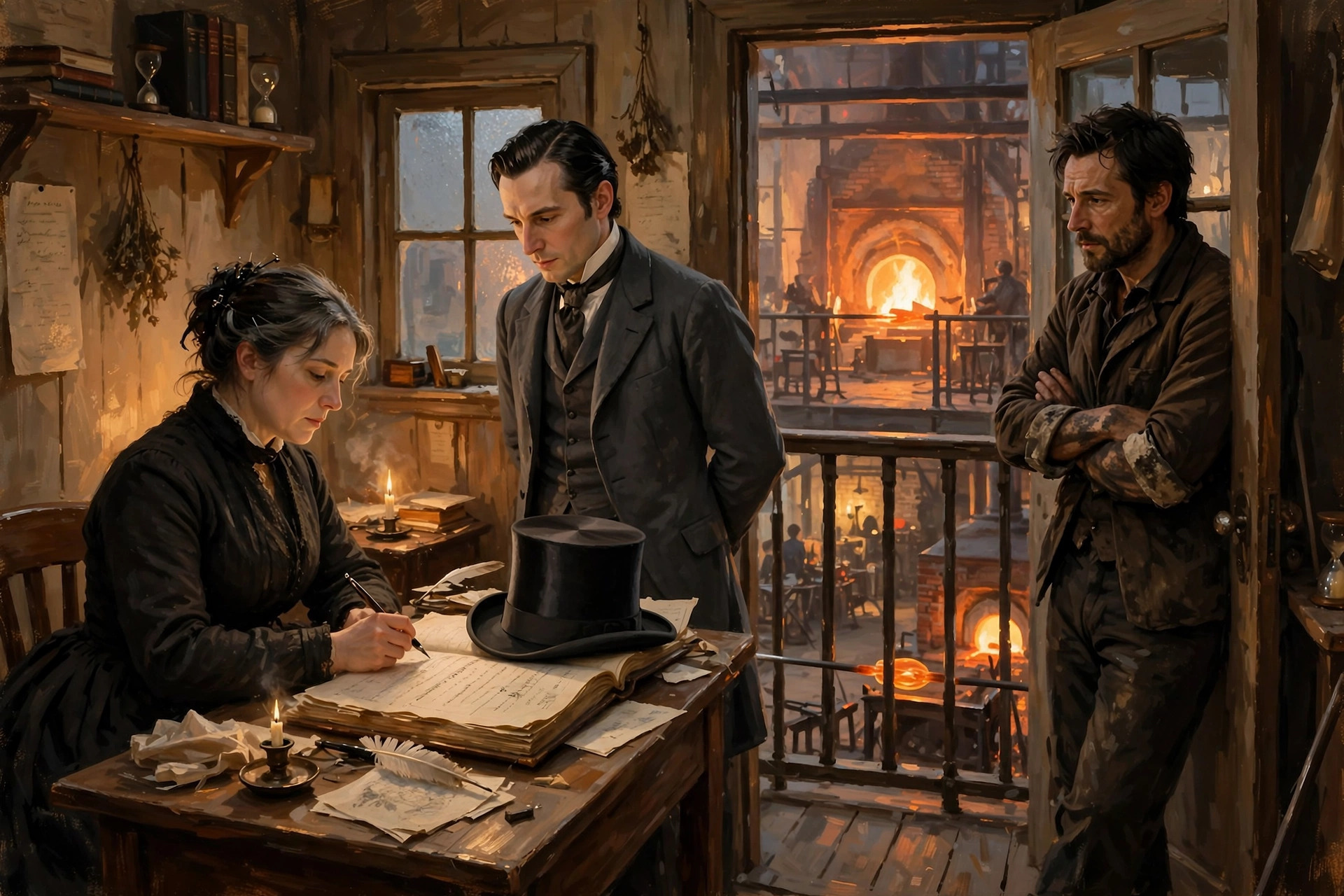
Lemuel Gask laid his hat on the open ledger, right across the March column, and Hester Quillfeather looked at it for exactly as long as manners allowed.
"Mr Gask. That's the page I was working on."
"So it is." He lifted the hat, brushed the paper with two fingers as if she'd been the one to soil it, and set the hat on the stool instead. "I'll be brief. I dislike keeping a lady from her sums."
The counting room was small, a box of planks with one window that looked down on the works floor. Through the glass the furnace breathed orange, and a gatherer turned a pipe in the glare, slow and patient. The heat came through the boards into Hester's boots. It always did. Six years she'd sat here, and she'd never once been cold.
Callum Thorne stood against the doorframe with his arms folded and soot on one cuff. He had said nothing since Gask arrived. He had the look of a man bracing a ladder that someone else was about to climb.
"The lender holds four hundred pounds against this glasshouse," Gask said. "You know the figure, Mrs Quillfeather. You wrote it."
"I did."
"It falls due at Michaelmas. My principals would be content to let it stand another year, on one condition." He turned his neat, pale face to Callum. "They'll not lend into a bachelor's lodging over a furnace. They want a respectable owner household. A wife, a hearth, a master who's settled in Stourhaven and not likely to bolt."
"I've been here a year," Callum said.
"You've been here a year with a stranger's name on the deed and no one to answer for you. And the patron's contracts, which are the only way this works earns the four hundred, go to a married master. I've asked. It's the patron's rule and he won't bend it for glass, however pretty."
Hester kept her pen still. Under the desk her left hand pressed flat against her pocket-book, where a folded paper lay that no one in Stourhaven had ever seen. She did not look at the pocket. She looked at Gask.
"And if Mr Thorne is not married by Michaelmas?"
"Then the mortgage is called, the stock is sold, and the lender's trustees will have a very tidy auction." Gask smiled at her. It was a small smile, the kind he probably used on widows. "Your own wages are paid by the late owner's estate, I believe. I'd not like to see that estate wound up."
"You could close the works," Callum said, "and sell it empty. That's cleaner for you."
"It would be. But a furnace like yours takes nine days to come back to working heat. A buyer won't pay for a cold hole in the ground." Gask picked up his hat again. "I'll return the Friday before Michaelmas. A wedding, Mr Thorne, or a sale. I'm sorry for it. I did admire the old master's work."
He paused at the door. On his way in he'd stopped at the workbench shelf in the works, where the ruby goblet stood, and Hester had seen him look too long. He looked now, down through the window, toward the shelf. The light off the furnace caught the glass and turned it the colour of a held coal.
"Remarkable piece," he said, to no one, and went out.
The latch dropped. Neither of them moved until the sound of his boots had crossed the yard and died in the lane.
"Well," Callum said at last. He rubbed his jaw and left a streak of ash. "That's a bad afternoon."
"It's a bad quarter." Hester drew the ledger toward her and turned it so the columns faced him. "Come here, please."
He came. He smelled of hot sand and the lemon soap Birdie Marsh made him use on his hands. She had never minded the smell, which was a thing she'd noted and set aside.
"Receipts," she said, and tapped. "Four hundred pounds due. Without the patron's contracts we can't raise a quarter of it by autumn. With them, we can nearly do it. With them and a lender who will wait, we can."
"I can add, Hester."
"Then you'll see it comes to one line." She laid her pen across the page like a ruler. "The banns are read three Sundays. The first is the day after tomorrow. If we give them to the Reverend tonight, you're a married master by the fourth Sunday, with weeks to spare before Michaelmas."
He didn't speak. She heard the furnace, and the long scrape of a pipe on the marver below.
"You're saying you'd marry me," he said slowly.
"I'm saying the ledger would be improved by it."
A laugh broke out of him, short and startled. Then it went out of his face, and he looked at her properly, the way he looked at glass when he was deciding whether it would hold. "Hester. That's a great deal to give a man who can't pay you what you're owed this quarter."
"It's not a gift. It's an arrangement, and I have terms." She had them ready. She'd had them ready, in some drawer of her mind, since the moment Gask said the word wife. "What I earn is mine. What I save is mine. I keep my own room and my own books, and nobody asks me what's in them. We stand up in church, we keep a respectable house, and we let Stourhaven believe what it likes."
"Stourhaven will believe a great deal," Callum said. "Miss Pruett will want to see us holding hands over the hymn book."
"Miss Pruett will want to see sincerity." Hester's mouth went dry on the word. Agatha Pruett could smell a lie from the far end of the nave, and she'd had Hester's measure for nine years. "We'll have to be civil enough that she can't object."
"Civil." His mouth tugged. "I can manage civil."
"You can manage a great many things, Mr Thorne. I'd like to be sure there's nothing in the works I ought to know about before I put my name beside yours. The chimney order for the patron is due. The page for it is blank."
Something crossed his face and was gone, quick as a bird past a window. "In hand," he said. "All of it. You'll see it when it's finished."
She waited a moment longer than she needed. He held her eye and gave nothing, and she, who trusted figures because figures couldn't smile, let the blank page lie. The patron's date was weeks off. She told herself that was reason enough.
"Then we're agreed on terms," she said.
"Wait." He held up a hand, then turned and was gone down the stair to the works. She heard him cross the floor. She saw him through the window, stopping at the workbench shelf, reaching up with both hands as though the thing might startle.
He came back up carrying the ruby goblet.
Hester stood. She knew that glass. Everyone at the works knew it, and nobody touched it. His mother had kept it, and it was the one piece left of his father's old gold-ruby work. It was blown, he'd told her once, and left overnight to cool, and had never cracked. Birdie dusted around it as if it were a sleeping animal.
"Callum, put that back."
"No." He set it on the desk beside her inkwell, careful as a man setting down an egg, and grinned at her, a crooked, tired, fond grin that was entirely out of place. "A woman who keeps my books will need somewhere for her pens. Every bookkeeper's wife should have a vessel for her quills. Betrothal gift. I'm told it's customary."
"It's not customary. It's absurd."
"It's the best glass I own." The grin faded a little at the edge. "Go on. It'll hold them better than that chipped mug."
She had never put anything into it. She picked up her three pens, the steel-nibbed one and the two quills, and slid them into the glass one at a time. The furnace light struck through the red and laid a small, warm stain across the open page, over March, over the four hundred pounds, over her own cramped figures.
"If you break a pen in it, I'll hold you responsible," she said, and her voice came out less even than she'd meant.
"I'll risk it." He wiped his palm down his waistcoat and held it out across the ledger. "Three Sundays, Mrs Quillfeather."
She looked at the hand, scarred across the knuckles, a pale old burn on the wrist. Then she put her ink-stained fingers into it. His grip was warm and dry and careful, and he did not let go at once, and neither did she.
"Three Sundays," she said, and they shook on it over the page.
First Banns
The Reverend Pruett cleared his throat the way he did before every announcement, and Hester, in the fourth pew from the front, discovered she had folded her gloves into a very small square.
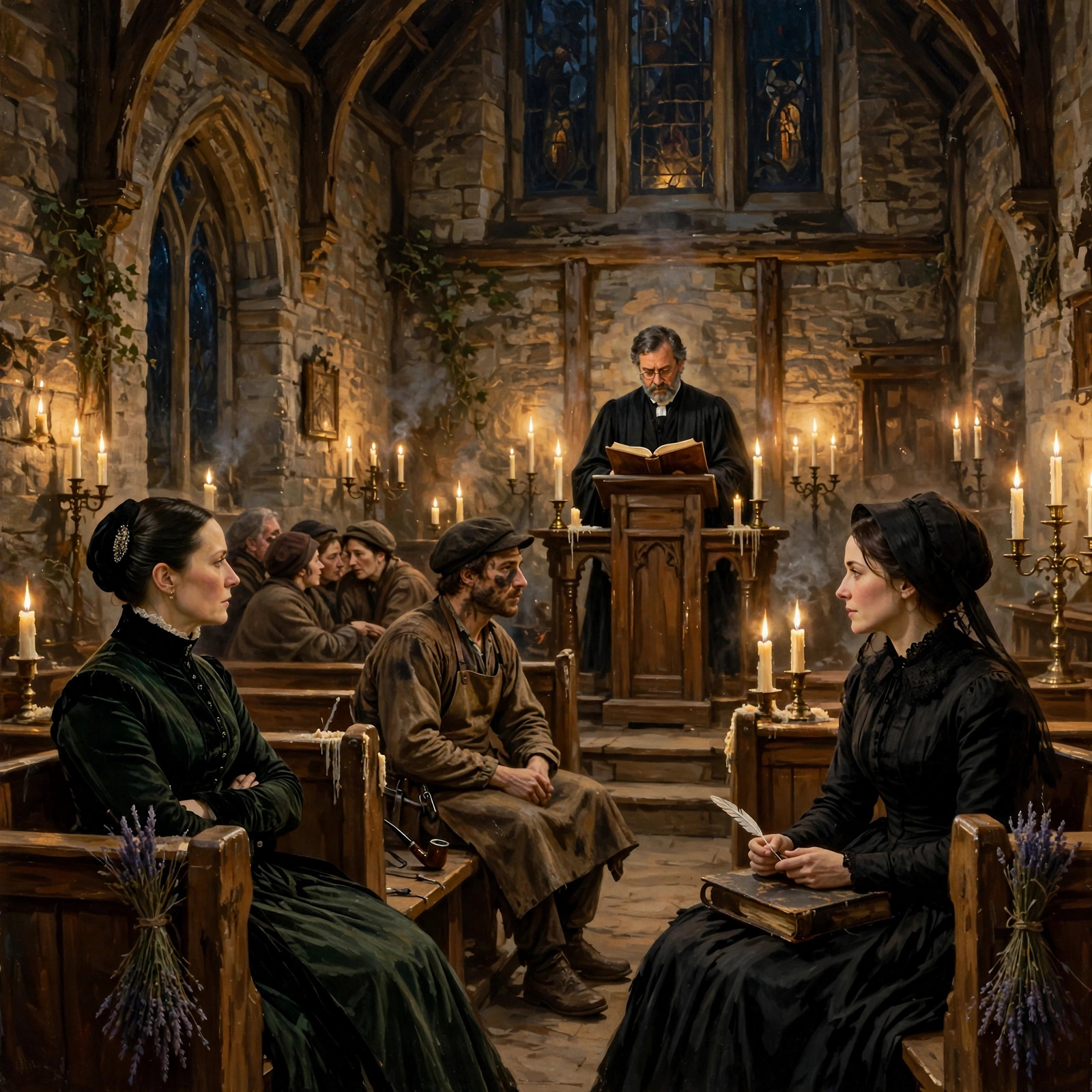
Callum sat beside her in a coat cut for a thinner man. He had scrubbed his hands until the old scars stood out white. Behind them St Wulfstan's smelled of damp hassocks and beeswax, and every bonnet in Stourhaven had been brushed for the occasion.
"I publish the banns of marriage between Callum Thorne, bachelor, and Hester Quillfeather, widow, both of this parish. If any of you know cause or just impediment why these two persons should not be joined together, ye are to declare it. This is the first time of asking."
Somewhere at the back a hymn book hit the floor. Nobody picked it up.
In the front pew, Agatha Pruett turned her head. She did it slowly, all of her at once, jet pin glinting in her hat. She looked at Hester. She looked at Callum. Then she looked at the four inches of oak between them, and Hester understood that the gap had been entered in some private ledger.
Callum moved a half inch closer. Hester felt it through the pew. She did not move away, and she did not know which of them she was annoyed with.
The vicarage parlour afterwards was warm and over-furnished, with a clock that ticked as if it disapproved of the company. Miss Pruett poured the tea herself. She handed Hester a cup without asking, and Hester took it with the small, sinking feeling of a woman whose preferences had been recorded.
"Mr Thorne. You have lived among us a year, and I have seen you in church twice."
"Once for a christening," Callum said. "Once because it rained."
"And today?"
"Today I was invited. By the banns, I think."
The Reverend made a small noise into his saucer. His sister did not.
"Mrs Quillfeather. What does he take in his tea?"
Hester opened her mouth and found nothing in it. Five years of his late uncle's accounts, a year of Callum's, and she could have recited the cost of every pane of glass in the works. She had never once noticed his tea.
"Black," Callum said mildly. "Stewed past all decency. And she takes milk, no sugar, and says nothing when the milk's turned. She just drinks it, looking at the wall, like she's paying a fine."
Hester's cup rattled against the saucer. It was true. She had not known anyone had been watching her drink.
"Banns are not a bargain struck at market," Miss Pruett said. "If I think this is one, I shall say so aloud, in my own church, with my brother standing there."
"Agatha," said the Reverend gently.
"I'm only telling them the arrangements, Osric." She set down the teapot. "People perform in the first week, Mr Thorne. They tell the truth in the second. I shall ask again."
Walking back down the hill, Hester said, "She means it."
"I know."
"She's stopped weddings before. A draper's son, in my second year here. He'd a wife in Leeds."
"Then we'd best not have one in Leeds." He glanced at her sidelong. "How did you not know the tea?"
"I know the sugar-loaf bill," she said stiffly, and he laughed so suddenly that a rook went up from the hedge.
The inkstand broke on the Wednesday.
It was not dramatic. She had bought it with her first quarter's wage in the role, a plain pewter stand with a pressed-glass well and a ground-glass stopper, and nothing else in the counting room was entirely hers. She reached for it too quickly, thinking of Gask's Friday and a column that would not close, and her sleeve caught the stopper. It went off the desk edge and met the flagstones with a small, final sound.
Two pieces and a scatter of glitter. She knelt and gathered them into her palm, and for a moment she simply stayed there on her knees with the ink drying in the well.
"Hester?" Callum had come to the door with a ledger tucked under his arm, not his own, she noted. He saw her hand, and he crossed the room and crouched beside her. "Let me see."
"It's a stopper. It's nothing."
"It's your stopper." He took the larger piece between finger and thumb and turned it to the window. "Ground neck, a little under an inch. Give me the well."
"You've a furnace to mind."
"The furnace minds itself, that's what nine days of coaxing buys. Give me the well."
She gave it to him. She told herself it was only the inkwell she was surrendering.
She followed him down at dusk, after the last gatherers had gone, and stood on the bottom stair where the heat touched her face. Birdie Marsh was banking the glory hole with the elaborate unconcern of a girl who intended to describe everything to the whole village by morning.
Callum took a gather of glass on the blowpipe, no larger than a walnut. It glowed like a held coal. He rolled it on the marver, breathed once into the pipe, and the glass swelled into a small bright bubble. He worked it with the jacks, quick and patient, drawing the neck, pinching the shoulder, turning, always turning. His face in the light was so entirely absorbed that Hester felt, absurdly, that she was intruding on a prayer.
It took him three tries. The first slumped. The second came out lopsided, and he swore under his breath and broke it off without a flicker of shame. The third was a small clear teardrop with a perfect, tiny hollow in it, and he knocked it off the iron into the annealing oven and shut the door with a hand that was not entirely steady.
"Tomorrow," he said. "It has to cool slowly, or it'll crack the first time you breathe on it."
"Like everything," Birdie said innocently, and fled.
Hester's eye went past him to the back wall. Straw-packed crates stood stacked there under a tarpaulin, a good many of them, and not one was entered in any column she kept. She opened her mouth.
"Mind the heat," Callum said, and put his body gently between her and the wall, and the question went back where it had come from.
In the morning the stopper sat on her desk, ground to the neck with emery, clear as a drop of water. It seated in the well with a soft kiss of glass on glass. She put her thumb on it. It was still faintly warm, or she imagined so.
That night she took the thing she kept beneath the loose board in her room, looked at it, and put it back. She did not think about why her hands were slow.
On the tenth day the Reverend read the banns a second time, and the church was fuller than the first. Hester did not hear most of it. She was watching Miss Pruett's back.
The lady waited at the lychgate afterwards with her prayer book against her chest, like a woman at a customs house.
"Mrs Quillfeather. Tell me something he has done for you that cost him."
Hester had a ready answer, a tidy one about the wage arrears he'd settled. It died on her tongue.
"My inkstand broke," she said. "He blew me a new stopper. It took three tries and he swore at two of them. And he didn't stop to ask whether it was worth the trouble."
"It was an hour," Callum said. "Less."
"It was the whole evening, and the furnace was in a mood." Hester heard her own voice, warmer than she'd allowed it to be in years. "He didn't mention it after. He just left it on my desk."
Miss Pruett looked at Callum a long moment. Then she looked at Hester's right thumb, where a thin blue smear of ink lay beside the nail, and something in her face shifted a fraction.
"Hm," she said. She turned toward the vicarage, and gave one hard nod.
Annealing Oven
Hester carried the ruby goblet down to the works in both hands, with her pens knocking together in her apron pocket. Four days after the second banns the furnace room was at its worst, the air shaking above the pots, the floor gritty underfoot. Callum looked up from the bench and saw what she carried. His face did something quick and private before it settled.
"That's not for the glasshouse," he said. "That's for your desk."
"It's a thing I've been keeping pens in without knowing how it was made." She set it on the stone ledge beside the annealing oven, out of the draught. "Miss Pruett asked what you'd done for me. I'd like to be able to say what I've done for you. I can't say that about glass, because I've only ever counted it."
"You want to be taught."
"I want to know what a gather weighs when I enter it. Show me."
He did not answer at once. He turned the goblet a quarter on the ledge, so the light from the furnace mouth came through the bowl and stained the stone red.
"It came out of the pot clear as water," he said. "Gold in it, a pinch, but no colour at all. The red only came when it was put back in the heat. Striking, we call it." He took his hand from the stem. "My father's. My mother kept it on the dresser and wouldn't let anyone fill it."
Hester waited for the rest. None came. He took up an iron pipe instead and held it out, and she understood that was all she would get today.
"Roll your sleeves," Birdie called from the far bench, where she was pretending to sort cullet. "Cuffs catch."
"They're buttoned," Hester said.
"They catch buttoned."
She rolled them to the elbow anyway. The pipe was heavier than it looked, five feet of iron, the mouthpiece worn smooth by years of other mouths. Callum stood her at the working hole of the furnace. Inside, the pot of glass glowed a colour for which her ledgers had no column, somewhere between honey and the inside of a flame.
"Warm the tip first. Then in, a short way, and turn. Always turn. Stop turning and it slumps off the iron and into your boots."
"How fast?"
"As if you were winding wool and didn't want to be caught at it."
She thought of the wool her mother wound, and that helped. She dipped the pipe. The glass took hold of the iron with a slow, greedy weight she felt up through her wrists, and she turned and counted the turns under her breath. At twelve she lifted. A bright rope of glass stretched from the pot to the pipe, long and lazy, and she turned and turned and the rope thinned and broke.
"There," she said. A glowing lump hung from the iron's end, the size of a hen's egg. Pleasure ran through her so bright and silly that she forgot to keep counting.
"Turn."
"I am turning."
"You've stopped."
She had. The lump sagged. A thread of glass swung off it like treacle off a spoon, caught her rolled cuff on the way down, and the linen went brown with a hiss. Smoke rose against her forearm. Then Callum's hand was around her wrist and his other arm had taken the pipe from her, and the bucket by the wall slopped as he plunged her arm in to the elbow.
Cold shocked up to her shoulder. She said a word her late husband would not have thought her capable of. Over at the cullet bench Birdie made a sound like a kettle.
"Let me see." He drew her arm out and turned it in the light, thumb on the inside of her wrist where the pulse was. The skin was pink in a narrow stripe and no worse. The sleeve above it was burnt through in a ragged brown ring, and the smell of scorched linen hung between them.
"I've ruined a good blouse," Hester said, because it was the safest thing to say.
"I'll pay for the blouse."
"You will not. It's a charge to the works, and I'll enter it myself under protective clothing." Her voice shook very slightly. "Which I clearly should have bought."
He laughed, short and surprised, and he did not let go of her wrist. "You're not hurt."
"I'm not hurt." She did not take her arm back either. The pulse under his thumb was making a fool of her, and she knew he could feel it.
He let go first. He fetched the pipe from where he'd propped it, put the cooling lump into the glory hole to soften again, and brought it out glowing. Then he held it out to her a second time.
"Again?" she said.
"You don't leave a pipe because it bit you. That's how you learn to be afraid of it." He said it lightly, but it had the sound of something he'd been told once, hard. "Take it. I'll stand behind."
He stood behind. It was not what she had expected, though she hadn't known what she expected. His chest was an inch from her shoulder blades and the furnace heat was in front of her, so that she was warmed from both sides at once. His hands came round and closed over hers on the iron, calloused, scarred across the knuckles, perfectly sure.
"Here. Let the pipe roll in your fingers, not your wrists. Feel that?"
"Yes."
"You're gripping."
"I don't let go of things easily."
It was out before she could stop it. His hands did not move for a moment. Then his thumb pressed lightly along the back of hers, loosening one finger and then the next.
"No," Callum said, close to her ear. "I'd noticed. Let it go a little, and it turns by itself."
She let it go a little. The pipe turned, smooth and easy and on its own weight, and the glowing lump at its end spun round with it, round and perfect, no longer fighting her. His breath moved the loose hair at her temple. She had kept books for six years in a room with a door that shut, and she could not think of a single entry that had ever felt like this.
"Now to the marver," he said, and his voice was not quite steady. "Walk. Slowly. Don't stop turning."
They walked together, one body at the pipe, to the flat iron table. He showed her how to roll the gather against it so it came out even, rough as a plum. When it was done he took the pipe away, tapped it sharply, and the lump dropped into his gloved hand. It was a fat, lopsided, honey-coloured disc with a bubble trapped at the centre.
"That's a paperweight," Hester said. "I think. By accident."
"It's the ugliest I've ever seen," he said, with great satisfaction, and opened the annealing oven.
The heat there was gentler, a steady glow in a brick belly. Her disc went in beside two rows of Birdie's tumblers. Callum shut the iron door and latched it, and the two of them stood side by side with their hands almost touching on the cooling brick.
"It'll sit till morning," he said. "Slow. Or it cracks."
"Tomorrow."
"Tomorrow." But he was not looking at the door. He was looking at her, at the brown ring on her sleeve and the strand of hair that had come down and the cold bucket-water still drying on her arm, with an expression she had no entry for and wanted very much to keep. She looked back. She meant to look away, and she did not.
"Mr Thorne!" Birdie's voice rang out from the cullet bench, bright with innocence. "Sorry. Sorry! It's only that the pot wants skimming, and Mrs Quillfeather's trousers are on fire."
"My trousers are not," Hester said, without moving her eyes.
"Her sleeve, then," said Birdie, to no one at all. "I'll just stand here."
Cracked Chimneys
Birdie set the paperweight on Hester's ledger at half past seven, as though presenting a christening gift. The bubble still sat at its heart, and the honey colour had deepened overnight.
"Mr Thorne says keep it," Birdie said. "He says it's the first one that ever held a page flat without being asked." She looked at Hester's sleeve, mended in the night with black thread, and had the grace to say nothing about it.
Hester thanked her and meant it. When Birdie had gone she turned the lump in her fingers. It was warm from the window. She put it back on the page and picked up her pen, and for an hour she was a woman with a pleasant morning in front of her.
The patron's order was the last column to square before the third banns. She had the sand bought, the soda, the coal for the long burn. She had the wages. What she did not have was the sales. Forty lamp chimneys had been cast in the first run, and not one had been delivered, or crated, or entered anywhere in her hand.
She took down the furnace log from its nail by the counting-house door. It was Callum's book, written in a quick slanting pencil she had learned to read across a room. Three weeks back, near the foot of a page, she found it. Lehr. 40 chimneys, cracked through. Wrote off. He had ruled a line under it and gone on to the next day as if the page had simply ended.
She read it twice. Then she read the date again, because the date was the week Gask first came. The week before he had sat in her office and said he'd be glad to inspect the books.
The works was empty at the back, the men at dinner, Callum gone down to the carter's with Birdie to argue over coal. Hester crossed the floor and stood in front of the tarpaulin she had walked past for fifteen days. The straw underneath smelled of dust and cold. She lifted the corner and drew out the nearest chimney, clear as a held breath of water, and tilted it to the window.
A hairline ran from the foot to the shoulder, fine as a hair on a glass plate. She turned it over. Another. She laid two fingers against the rim, only to feel whether it was real, and the chimney parted in her hand with a small clean note and fell in two halves into the straw.
She stood very still. Then she put the halves back, folded the straw over them, and drew the tarpaulin down square.
She said nothing that day, nor the next. She watched him instead, and that was the hard part, for he was kind. He brought her tea in the counting house. He asked whether the new stopper sat true. On the sixteenth, he stood at her door with soot on his jaw and asked, almost shyly, whether she would walk down to the vicarage with him after the service on Sunday and let Miss Pruett see them do it. She said she would. She said it to the inkstand.
That night she could not sleep. At eleven she dressed, took the ledger from her desk, and walked down the hill with it under her arm like a shield.
The glasshouse was dark. The furnace had been banked to a low red eye, and the long room lay in dim orange and black, the pipes along the wall like the ribs of something sleeping. Callum sat on an upturned crate by the marver with his hands hanging between his knees. He did not seem surprised to see her.
"I couldn't sleep either," he said.
"I came to say something."
"Let me go first." He stood. His face was half lit, the near side red, the far side lost. "Please. If you speak first I'll lose my nerve, and I've only the one to spend."
She let him. The ledger stayed against her ribs.
"I said it was for the works," Callum said. "For Gask, for the patron. It was, at the start. But I've stood at that rail this fortnight watching you count my coal, and I don't want a paper wife. I want the real thing. The kitchen, the quarrels about the washing, the lot." He laughed, short and rough. "I wanted you to know before anything comes out that makes you think I said it for the wrong reason."
Her throat had gone tight. She had come with a speech. It was folded very small now, somewhere beneath her breastbone.
"I'd have liked to hear that a week ago," she said. "Before I read the furnace log."
He did not move. The furnace ticked in its brick.
"I want it as well," Hester said, and hated how plainly it came out. "That's the worst of it. I stood in this room with a burnt sleeve and I wanted it so badly I forgot to look at my own books. Then I looked. Forty chimneys, Callum."
"They cracked in the lehr. I'd have--"
"You'd have told me when? After Michaelmas? After Gask had the works and I'd signed my name beside yours on a contract for chimneys that don't exist?"
"I was going to re-run them." His voice had dropped. "I can't. The furnace lets go cold if I draw it down, and it takes nine days to come back to working heat. I haven't nine days and forty chimneys to spare, and I haven't four hundred pounds. I thought if I could get you through the banns, and then find a way..."
"You thought you'd manage it. Alone. Like a man carrying a pail across a floor and hoping nobody looks."
"Yes." He said it flatly. "That's what my father did, and I swore I'd never be him. I only meant to keep it off you."
"Off me." She opened the ledger on the marver, hard, to show him the sums. The page turned and a small oblong of card slid from behind the endpaper and spun to the floor between their feet.
Both of them looked down at it. She was nearer, but he was faster.
He held it to the furnace mouth to read. She knew every word on it without looking. Edinburgh. Third class. A date in the week after Michaelmas, printed in plain black ink.
The silence went on long enough for the furnace to tick twice.
"Terms," Hester said. "I told you at the start my savings were my own."
"You didn't tell me they were for this." He turned the card over as though it might say something kinder on the back. "You stood in church. You let Miss Pruett look you in the eye and you let me ask you to walk down to the vicarage on Sunday, with this in your book."
"And you let me balance accounts that were a lie!"
"That's not the same."
"No, it isn't," she said. Her voice shook, and that made her angrier. "Mine hurt no one. Yours would have hung me beside you in front of the whole village."
"Yours would have left me standing at the church door."
"I was going to tell you."
"When?" He said it quietly, and that was worse than if he had shouted. "After Michaelmas?"
She had no answer. Her own word, handed back, was a cold thing to hold.
"You're your father," she said, because she was cornered and it was the sharpest thing within reach. "Smiling and handing over tea while the books burn."
She watched it land. He did not flinch. He went still, which was worse, and held out the ticket on his open palm, the card steady in the red light.
"And you're packed already," he said. "You've been out the door since the day you came in. Take it."
She took it. Her fingers brushed his palm and neither of them moved for the space of a breath. Far up the hill the church bell struck midnight. It was Sunday, and the third banns would be read at eleven.
Hester slid the card back behind the endpaper, shut the ledger, and walked out.
The door swung to behind her, and the glow from the banked furnace went with it.
The Satchel
For five days Hester kept to her desk and her figures, and Callum kept to the far furnace. They worked a room apart and never crossed it. She heard his pipe ring against the marver. He heard her pen. Birdie carried messages between them, standing in the counting-house doorway with her cap crushed in both fists, and once said, "You could just shout, you know. It'd be quicker." Neither of them answered her. The glass stopper stayed in Hester's inkwell. Every time she dipped a pen it caught the window light and threw a small green coin on the page. She did not take it out. The ticket sat behind the endpaper of the ledger like a stone in a shoe. On the morning of the twenty-third day the wheels of a hired gig came up the yard. Hester knew the set of that pony's feet before she looked. Lemuel Gask climbed down with his satchel under one arm and his hat squared on his head. He stood a moment and looked at the chimney stack, as a man looks at a horse he has already priced. Birdie came in at a run. "He's early. He's asked for the back wall." She swallowed. "I never told him. I swear on my mother." "I know you didn't." Hester shut the ledger and held it against her chest. "Stay by me." Out in the yard the air smelled of coal smoke and wet straw. Callum had come from the furnace with his sleeves still rolled and his forearms bright with heat. He did not look at Hester. He looked at Gask. "The patron's steward wrote to me," Gask said. "Forty chimneys, to be delivered before Michaelmas. He wishes to know they'll be good ones. I thought I'd see for myself." Boots sounded on the gravel behind them. Agatha Pruett came through the gate with a covered basket on her arm and her bonnet strings tied in a hard bow. "My brother's fee receipt for the church," she said, and held it out to Hester without taking her eyes off the men. "And I was told there's linen wanted for Sunday. Don't mind me." Nobody had told her any such thing. Hester took the receipt anyway. Gask crossed to the back wall. The tarpaulin hung there, grey and stiff, over the shapes of the crates. His gloved hand went out to the corner of it. "Leave it," Callum said. Then, lower, "I'll do it." He took the canvas in both fists and dragged it back. Dust and chaff rose. The crates stood open, straw packed round the glass, and in the straw lay the chimneys, row on row, each one clear as water and each one split from lip to shoulder. Hester had seen them once, in the dinner hour, hating him. Now, in plain morning, they looked smaller than that. They looked like what they were, a month of a man's work gone wrong in the dark. Gask drew one out and ran his thumb along the break. "Forty." "Forty," Callum said. "The furnace was too hot at the finish and the annealing failed. They went in the night. I wrote them off in the furnace log three weeks past." He turned his head, and for the first time in five days his eyes found hers. "Mrs. Quillfeather has the book. Nothing's been moved or mended in it." Her mouth had gone dry. She opened the ledger to the entry, pressed it flat, and held it out. Her hands shook only a little. "It's all there. I've entered it since. Nothing's hidden now." Gask read it twice. He set the broken chimney on the crate lid with great care. "The patron's contract goes to a married master," he said, "and goes on delivery. This gives you neither. Nine days to bring the furnace back to heat, and Michaelmas nearer than that." He laid the satchel on the crate and unbuckled it. "Four hundred pounds, Mr. Thorne. I did say it plainly." "You did." "Then let me say the rest plainly. Once you're wed, whatever your wife holds is yours in law." His gaze moved to Hester, mild as milk. "Mrs. Quillfeather has drawn wages from the late owner's estate for six years, and by my reading of the books she has spent very little of them. I would take that against the shortfall." The yard went quiet. Hester felt Agatha turn and look at her, and she stared at a crack in the paving stones. Her whole self was in that sum. Six years of cold rooms and mended gloves. The ticket was only the last line of it. "No," Callum said. "Mr. Thorne--" "No." He put his hand inside his apron and drew out something wrapped in a cloth. He had carried it down from the ledge. He must have decided it before the gig ever reached the gate, and Hester understood that with a lurch, because she had not seen him decide. He unfolded the cloth. The ruby goblet sat in his palm, deep and dark, a coal that had learned to hold still. Birdie made a small sound. "My father blew this," Callum said. "It's the only piece of his that's left. Gold-ruby, annealed overnight, and sound as the day it was made. You'll have collectors who'll know its worth better than I do." He held it out. "That's against the debt. And this." He took a folded paper from his coat. Hester knew it by the patron's seal. He opened it on the lid of the crate and held out a hand without looking. "Pen." She had one behind her ear. It was her own, and it still carried the green dust of the stopper. She gave it to him, and their fingers did not touch. "I'll make over the master's name on this contract," he said, writing as he spoke. "Your nominee fills it, or the patron finds another house. It was never going to be filled by me in time. You know that, and so do I." "That is a good deal to give up," Gask said slowly. "It's less than she'd lose." Callum did not raise his voice. He did not look at Hester either. "Whatever she's put by is hers, and it stays hers. Put that in your satchel with the rest." Gask took the goblet. He held it to the sky and turned it, and the red light fell across his cuff. For a moment his careful face went almost soft. Then he wrapped it in the cloth and laid it in the satchel on top of the paper, and buckled the strap. "Goblet and contract together stand against the whole four hundred," he said. "I'll write the discharge today and send it down to the vicarage for the parish book. The mortgage is satisfied, Mr. Thorne." He glanced at Agatha. "I'll need a respectable witness." "You'll have one." Agatha crossed the yard in four strides and signed where he showed her. She wrote slowly, the way she did everything, and straightened with the pen still in her hand. "I've seen worse bargains made in this parish. Not many." "As for the banns," Gask said, drawing on his gloves, "the lender no longer requires a wedding. That is a matter for the village." He touched his hat to Hester and climbed back into the gig, and the pony took him down the hill at a trot. Callum stood a while where the crate lids lay open. Then he picked up the cloth the goblet had come in, found it empty, and put it down again. Hester said, "Callum." He looked at her then. He looked as though he wanted to say something, and what he said was, "Your pen's on the crate." He walked past her to the gate. Agatha sniffed behind her. "Well." Hester went to the doorway and stood there with the ledger against her ribs. The sun had cleared the chimney stack. Callum went down the lane between the hawthorns with his sleeves still rolled to the elbow. His hands hung open and empty at his sides, and he did not once look back.Church Porch
Hester came into the works at seven with her good gloves in her pocket and found Birdie on her knees at the front furnace, raking cold ash into a pan.
"You're not to be here," Birdie said. "It's your wedding day. Bad luck."
"The ledger's here."
That was not an answer, and they both knew it. Hester looked at the back wall. The tarpaulin lay folded over a barrel. The crates stood open, and the forty chimneys lay in their straw with hairline cracks catching the window light like frost on a pane. She had read about them in ink. Seeing them uncovered, with nobody guarding them, made something in her chest go tight.
"Who took that off?"
"He did." Birdie sat back on her heels. "Told Mr Gask to his face, before he'd even been asked. Said the lot was cracked and he couldn't re-run it, not with the furnace cold. Hester, he..." She stopped and pressed the back of her wrist to her mouth.
"He what?"
"Miss Pruett said I wasn't to."
"Birdie."
It came out in a rush, the way water comes out of a cracked jug. The patron's contract, with the master's name struck off it in Callum's own hand. The goblet, wrapped in a handkerchief and buckled into Gask's satchel. Four hundred pounds cleared, and nothing left to show for it but a clean page. "He said it was so your money stayed yours," Birdie finished. "He said you'd got somewhere to be."
Hester did not remember crossing to the counting-room. The lamp had burned itself dry on the desk. The little glass stopper sat in her inkwell, leaning a little from its third try. She lifted the ledger, thumbed up the endpaper, and drew out the folded square of paper and the ticket behind it. She counted what was there twice, because counting was how she'd always managed not to feel things.
Then she put on her gloves, though her hands were not steady, and went down the lane at a pace that wasn't ladylike.
Gask was at breakfast in the Hare and Lantern with his satchel by his boot, and he had the grace to look surprised. He heard her through. He set down his knife and named a figure that was meant to be an insult. She laid the notes on the cloth without a word, and he counted them slowly, as though they might be forged.
"It is a pretty piece," he said at last. "But I confess I'd have kept it for less sentiment."
"Then you've been well paid for yours," Hester said, and took the handkerchief bundle off the table herself.
The church clock was striking eleven when she reached the foot of the hill. She ran the rest. Her hat slid sideways and she let it. The goblet was cool through the linen and she held it against her ribs like a living thing.
The whole village stood in the churchyard. They had come for the fuss, and also, she saw with a small jolt, for him. The cooper's wife. The lamplighter. Half the men who'd ever drawn a wage from the works, standing with their caps in their hands. The Reverend Osric Pruett waited in the porch in his surplice, with his book open and his spectacles pushed up on his forehead. Agatha stood at his elbow with her arms folded and her mouth set like a latch.
And Callum stood alone in the porch, with nothing in his hands.
He had on his good coat, and a collar that looked as if it had been put on by someone who disliked it. He saw her and his whole face went still. He did not take a step. She understood, from the way his weight stayed rooted, that he had made up his mind to let her go if she'd come to say it.
She came up the path and into the shade of the porch, and the murmur in the yard dropped away.
"You're late," Agatha said.
"I had an errand."
"So I see."
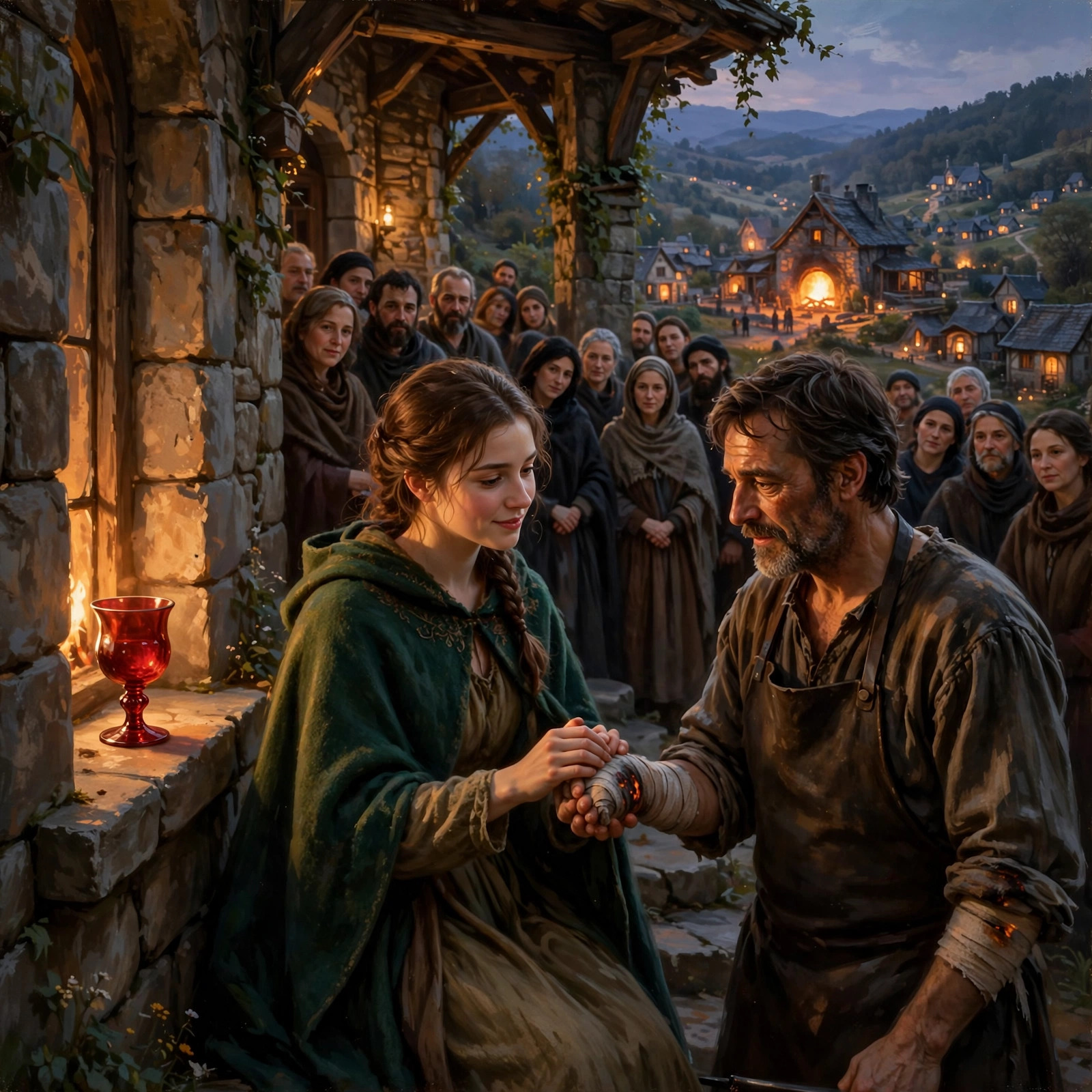
Hester turned to Callum. Up close, his eyes were red-rimmed and very steady. She held the bundle out, and when he didn't take it, she unwrapped the handkerchief herself. The goblet came free into the grey light, deep red and ordinary, and she set it on the old stone sill beside the porch door where the window could hold it.
"Hester." His voice scraped. "What have you done?"
"Bought it back. Mr Gask thought it was dear. I thought it was cheap."
"That was your passage. That was every..." He stopped. "I did it so you'd have it. All of it. So nobody could say you owed this place a day."
"I know. Birdie told me, and she's ruined, she'll never be trusted with a secret again." She drew a breath, and found her words weren't in the order she'd rehearsed. "You've spent a year watching me count other people's money, and in all that time you never once asked what I'd spend my own on."
"I didn't think I'd the right."
"You hadn't. That's why I'm telling you." She took the ticket from her glove and held it between them. "It's good for the week after Michaelmas. I looked at it all the way up the hill. It's a decent post, a decent town, and nobody there knows what my husband did with my dowry. I wanted it so badly I couldn't see anything else." Her thumb pressed the paper's fold. "I've been right about every column I ever added. I think I've been wrong about the sum that matters."
Behind her, someone in the crowd coughed and thought better of it.
"You could still go," Callum said, very low. "I'd not stop you. I'd rather you went with the goblet than stayed for the want of it."
"I know you would." She nearly laughed. "That's the thing. You'd really let me. So I'm staying because nobody's making me, and nobody's paying me, and there's a furnace at the bottom of that hill that takes nine days to heat and I'd like to be there for all nine."
She tucked the ticket into his coat pocket, over his heart, and patted it flat.
"Keep that. Or burn it. Gather me a better paperweight with it."
He made a sound that was half a laugh and half something he had apparently been holding for a year. Then his hands were on her face, warm and rough and not quite certain, and she covered them with her gloves.
Agatha Pruett cleared her throat.
"I have watched you two for three Sundays," she said, to the porch at large. "I came this morning with an objection ready. I was going to say that a marriage got up for a mortgage deserves no blessing." She unfolded her arms. Her eyes, Hester saw, were wet, and Agatha was glaring at the effect. "I find the mortgage has been paid, and I find no bargain left to object to. Osric, begin before I change my mind."
"Dearly beloved," said the Reverend, who had waited twenty-four years for this particular sister to say that sentence, and who beamed over his spectacles.
Birdie arrived at a run in the middle of the second line, sooty to the elbows, and slid in at the back of the crowd with her hand pressed to her side. She caught Hester's eye and mouthed something. It looked like I lit it.
Hester said her vows in her ordinary bookkeeper's voice, clear enough for the back wall, and was surprised that it shook only once. Callum's answers came out rough and sure. When the ring went on, it caught the light on her scorched cuff. When the Reverend pronounced them, the yard let go a breath, and then a cheer that sent two rooks off the yew.
She leaned against his sleeve, and the porch stone was cold under her slippers.
On the sill the goblet stood red in the grey light, and neither of them touched it. Down the hill past the rooftops of Stourhaven, from the squat chimney of the Thorne Glasshouse, a thread of smoke was climbing straight into the still air. Beneath it she could just make out a low orange glow, no more than a coal's worth, in the mouth of the front furnace. It was a long way from working heat. It was a start.
"Nine days," Callum murmured against her hair.
"Nine days," said Hester, and took his hand.
Get notified when new stories drop

Ivy Chen
Ivy writes historical and second-chance romance with period texture and modern emotional clarity. Courtship stakes, letters, and choices that cost.
Leave a comment
Comments