


Room Four
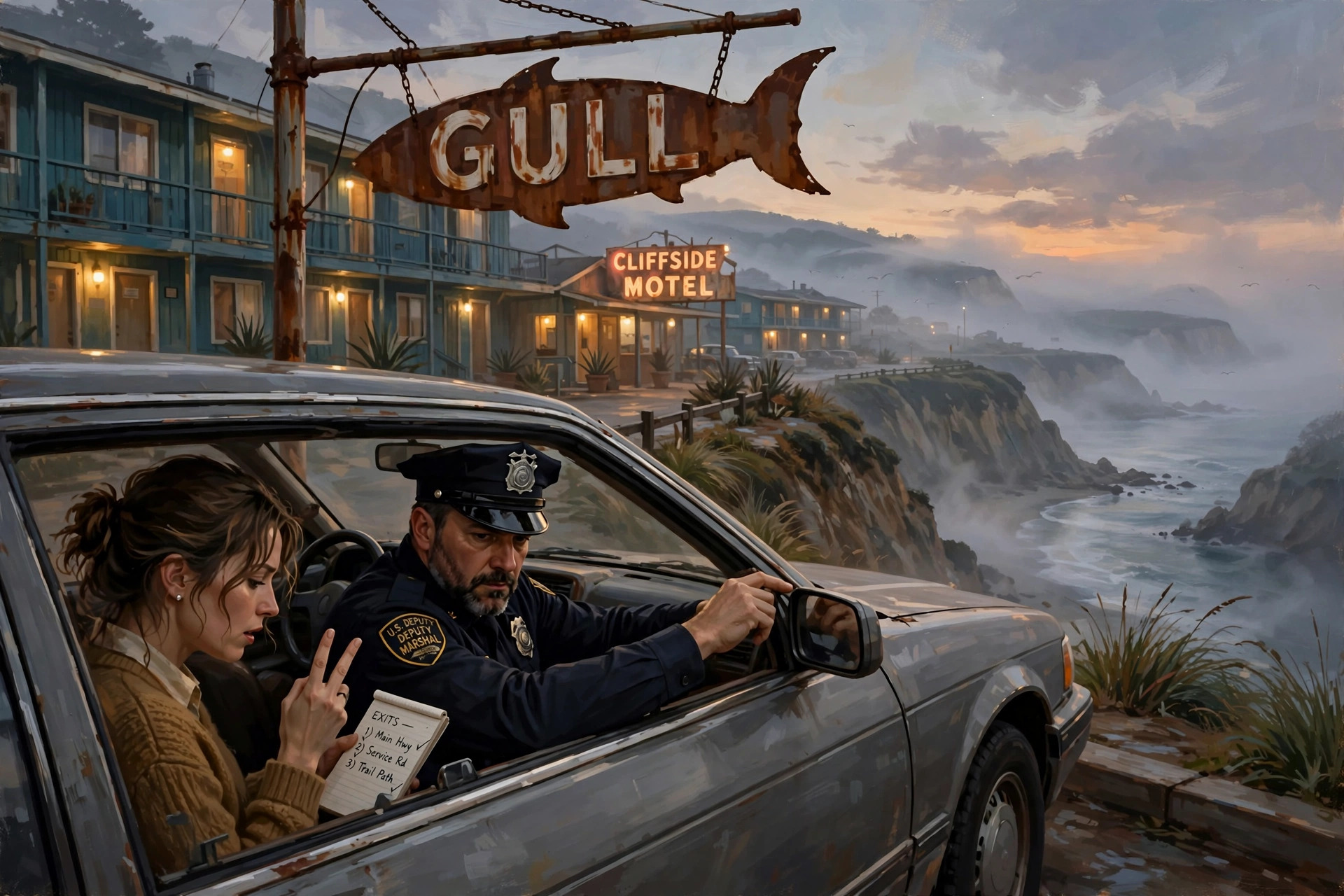
The sedan smelled like gas station coffee and gun oil, and Odessa Rill had spent the last two hours deciding which one she minded less. The coffee was winning. She kept her hands flat on her knees, the way she'd learned in depositions, and counted exits.
"There," she said, as the highway signs thinned to one green blade. "That turnoff. That's a way out."
"Was," Callum Harte said. His eyes never left the road. "They closed the county stretch in October. Grading."
"So if we needed to run north, we'd have to double back through town."
"We're not running north." He said it like a man reading it off a card, and she filed the flatness of it away with everything else she'd filed about him in two days of airports and back lots. He drove the way he sat: nothing wasted, nothing offered.
The coast came up all at once, gray water under a grayer sky, and the cliff road ran along the top of it with a low guardrail and a drop she could measure without trying. Forty meters, maybe, down to a line of black rocks where the waves hit and turned to spray. She'd looked at enough site surveys to eyeball a drop.
"Pinchard Cove," Callum said, as if she'd asked. "Population holds at four hundred in the off-season. Fewer in January."
"And we're in the off-season."
"Deep in it."
The Gullwing Motel sat at the end of the cliff road with its sign half-lit, a rusted gull on a pole turning slow circles in the wind. Twelve rooms, she guessed, counting doors as they pulled in. Seven of them had shutters bolted across the windows, plywood gone soft at the edges. The office had a light on and a hand-lettered card in the window that said OPEN, which struck her as optimistic.
Callum parked where the car faced out, nose to the road, and she noticed that too. He left the engine running while he looked at the mirrors, both of them, then the rocks below the rail, then the tree line behind the lot.
"Stay in the car until I open your door."
"I know the protocol."
"Then you know I'll say it anyway."
He got out. Wind came off the water hard enough to shove at her when he opened her door, cold and tasting of salt, and she stood up into it with her bag held against her ribs like a ledger she didn't trust anyone else to carry. Fourteen of those, she thought. Fourteen ledgers, photocopied and logged into evidence, and every one of them a reason a man in the city wanted her quiet before she could say the numbers out loud under oath. Nine days from now, she'd say them. Nine days was nothing. Nine days was a fiscal quarter, if you were nervous.
A man came out of the office before they reached it. Heavyset, beard going gray at the chin, a ring of keys jingling on one finger like a coin trick he'd gotten bored of. He wore a windbreaker over a flannel shirt and had the loose, unhurried stance of somebody who hadn't needed to run anywhere in years.
"You're the marshal," he said, holding out his free hand. "Marv Ostrey. I run the place. My cousin's family keeps the boatyard down the point, so if you hear engines at odd hours, that's them, not trouble." He grinned. "Unless it's trouble, in which case, I never said a word."
Callum's handshake was brief. Odessa watched the joke hit him and slide off, and she watched Marv notice it slide off, and the grin went crooked.
"It's a joke," Marv said. "Around here we do those."
"Noted," Callum said, which was somehow worse than nothing, and Odessa put a hand over her own mouth to keep her face diplomatic.
"He's had a long drive," she offered.
"Nine days," Marv said, and she went still until he tapped the window of the office, where a paper calendar hung by the register. "That's how long you booked. One room, nine nights, cash up front. Room four." He worked the keyring around and held it out to her, not Callum, which she appreciated more than she could say. "It's the best one. Heat works, hot water's honest, and the window looks at the water instead of the lot."
She took the key. Brass, worn smooth, a paper tag with a fat 4 in someone's handwriting.
"I'll want the room at the end," Callum said. "Not four."
"Four is the end. Far side, past the ice machine." Marv pointed. "Like I said. Best one."
"Ice machine works?"
"It makes a noise like a man drowning, and it makes ice. You take your pick what to call that."
Callum walked the length of the building anyway, Odessa trailing with her bag, while Marv followed at the amiable distance of a man who had decided this was the most entertainment his January had offered so far. Callum checked the cliff side first. The rail behind room four was sound, and below it the drop went down and down to the rocks, white water hitting black stone.
"You could put a ladder there," Odessa said. "Down the face. For the guests."
"I could," Callum said. "I won't."
She counted the sightlines while he counted his. One road in, graded stretch closed to the north, the tree line behind the lot, the boatyard point to the south with its engine shed and its moored boats riding low. A single streetlight at the road. The office light. Nothing that moved except the sign's rusted gull, turning and turning.
Room four smelled like cedar and old paint. Two beds, a radiator ticking under the window, a bathroom done in salmon tile that had been fashionable some other decade. The window looked at the water, exactly as promised. She set her bag on the far bed and took out the flip phone, the prepaid one her legal team had handed over in a parking garage like something out of a bad film, and set it on the nightstand where she could see it. Noon calls. Someone would have told her the schedule by now if anyone told her anything.
"Bathroom window locks," Callum said from behind her. He'd come in without asking, which she noted, filed, and decided not to spend anger on yet. "Radiator's independent of the office thermostat, so nobody cuts your heat from outside. Door's solid core, hinges are pinned. The bolt's new."
"How do you know the bolt's new?"
"Because Marv told me he replaced it last month, and the brass doesn't match the door handle." He said it without any particular pride, the way he'd said everything, and she found herself almost charmed against her will, which she also noted and filed.
"You checked this room before we came."
"I drove up in November and booked a night under another name." He set a dented steel thermos on the dresser, and she realized it had been riding on his dashboard the whole trip, empty, rolling loose, because she'd heard it knock against something on every turn. "Coffee's gone cold, but there'll be more tomorrow. I fill it every morning."
"For me?"
"For the detail." He said "the detail" like other men said "my family." "I'll be in the car. I sleep in the car."
"There's a second bed."
"There's a sightline from the car to the road and the lot and the point. There isn't one from the second bed." He moved to the door, checked the hallway once, twice, the way some people touched a pocket for keys. "Bolt it after me. You open it for nobody but me, and not for me until I say the word."
"Which word?"
"I'll pick something." For the first time something moved at the corner of his mouth, small, gone before she could be sure it had been a smile. "You'll have nine days to memorize it."
Marv was still in the lot when Callum went out, hands in his windbreaker, watching the water like it might do something interesting.
"Anything else you need," Marv called to her through the closing door, "you shout. I'm in the office till ten, and after that I'm in twelve, which is right through the wall."
"Through the wall," she said. "Good to know."
"That's the spirit." He laughed at his own joke, alone, and ambled off toward the office.
She bolted the door and stood there with her hand flat on the wood, listening. Wind. Water. The radiator ticking. Through the gap under the door, the lot light went dark for a second as Callum crossed it, and then she heard the car door open, pause, and his voice come quiet through the wall, not meant for her, though she caught it anyway.
"Seat goes back," he said, to himself or to nobody. "Seat, not the room."
She looked at the second bed, made and untouched, and at the cedar-smelling dark of the window, and the water beyond it going at the rocks, forty meters down, all night long.
"Nine days," she said to the empty room, and got out her ledgers.
The Noon Call
Dawn on the second day came gray and sideways, and it came with a knock. Two knocks, a pause, one more. Callum's rhythm, she was learning, the way she'd once learned a client's habits from nothing but receipts.
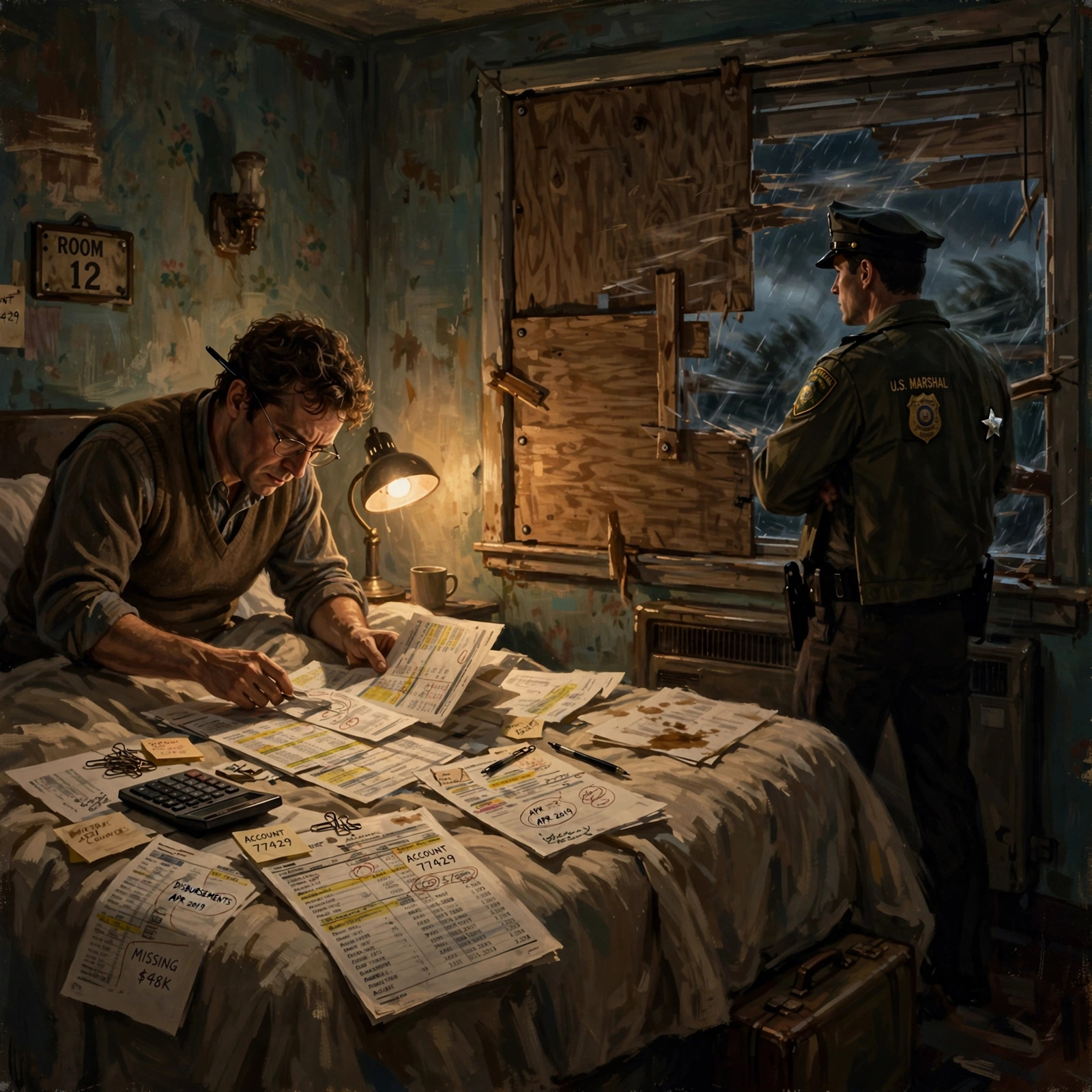
She opened the door on the chain first, saw his collar, and unhooked it. "You could just say it's you."
"Anyone can say it's me." He held out the thermos, full now, warm through her palms when she took it. Steam rose off the cup lid he'd screwed on loose. "You could hear it in my voice, sure. But a man off the road with a gun doesn't need to talk his way in if the door's already open. Chain every time."
"You checked this bolt before I ever got here."
"I did."
"And?"
"And it's new. Somebody replaced it this fall, which means somebody cared about this room before you did." He glanced once down the covered walkway, then back. "Drink it while it's hot. I'm on until eight."
She sat on the sill with the thermos between her hands and watched him walk the lot, then the point, then back, unhurried, hands loose, like a man counting boats. He'd told her last night he worked in four-hour blocks, and she'd assumed that meant stiffness, schedules, a guard shaped like a fence. It didn't look like that. It looked like weather, something that just kept happening at the edges of her day.
At noon he knocked again and handed her the flip phone through the gap in the chain. "Your lawyers. You get ten minutes, I listen to the whole call from the porch, and you don't say where you are. Not the town, not the motel, not the county."
"They already know the county."
"Then don't confirm it." He leaned on the rail outside room 4, and she dialed from the sill, the phone warm from his pocket, which she noticed and then made herself stop noticing.
The call was short. Her lawyer's paralegal did most of the talking, a bright, efficient voice she'd worked with for weeks, reading off exhibits. Fourteen ledgers, entered and logged. Odessa gave yes and no and "that's correct" until the words went thin, and when she hung up she found Callum watching her instead of the road.
"You count when you talk to them," he said. "Did you know that? Exhibits. Numbers. You go flat as a receipt."
"That's what I am to that courtroom. A receipt."
"That's not what I said." He straightened off the rail. "Come on. Walk with me before you turn back into paperwork."
The porch ran the length of the motel, twelve rooms' worth of gray boards on stilts over the cliff side, and the third step from the bottom had a crack in it that flexed under her shoe like a bad promise. She'd noticed it that first night, going down to look at the water. Callum had noticed it before she had. She could tell because he stopped at it the way he stopped at doors, reading it.
"That step's got a month left," he said.
"It's not your motel."
"It's your staircase." He was already crouched, pressing the crack with his thumb, weighing it. "Marv's got a scrap pile. I saw it behind the office."
Marv appeared the way he seemed to, out of the weather, wiping his hands on a rag. "That step's been on my list since Labor Day. The list is long and I am one man with one ladder."
"You got a saw?" Callum asked.
"I got a saw, a hammer, half a coffee can of screws, and a cousin who says the tides will rot anything I build anyway, so why build." Marv grinned at Odessa. "He's an optimist, my cousin. Keeps a skiff down at the family slip at the boatyard, and the boatyard argues back."
Callum had gone still in a way she was beginning to recognize as him thinking. Just for a breath. Then he said, "Saw and the screws'll do," and nothing else about cousins.
The repair took most of an hour. Callum pulled a sound board from Marv's scrap, measured it against the old one twice, cut it, and had the cracked tread out before Odessa fully understood the afternoon had changed shape. She sat on the rail above them with the thermos and watched him work. He was good at it, patient with the screws, unhurried, and when the new board sat flush he stood on it and bounced twice on his heels.
"You'll want to paint it or it'll cup by spring," Marv said.
"It'll hold till spring. That's all a step's asked to do."
Odessa came down and stood on it, and it held, and the little sound of it, solid under her shoe, was absurdly satisfying. "You didn't have to do that."
"No," he agreed. "The old one would've carried you another month."
"Then why?"
He gathered the sawdust into his palm, unhurried, and tipped it over the rail into the scrub. "Because you'll go up and down these stairs maybe forty times before you testify, and I don't like odds I haven't checked."
Forty times. She did the arithmetic without meaning to, nine days, four or five trips a day, and hated that he'd done it too, and hated more that it made her feel safer rather than watched. That was the trouble with men like him. The watching and the caring came out of the same pair of eyes and there was no filing them separately.
Marv left them a deck of cards from the office drawer and went back to his ledgers of tide times and septic schedules. They played at the picnic table by the lot, where Callum could see the road. She expected him to be bad at cards, too square for them, and he lost the first three hands on purpose before she caught it.
"You're letting me win."
"I'm letting you relax. It's different."
"Deal honestly or not at all."
So he did, and he was better than she was, and she lost the next four hands laughing at the size of her own defeat, and it was somewhere in the fourth of those that she realized she had moved her chair to see both the road and him, the same arrangement he'd made with his own. She caught his eye on it. He'd seen her do it. He dealt her another card without comment, but the corner of his mouth did the small thing again, and this time she was sure it was a smile.
"Tomorrow," he said, "you walk the cliff path with me at noon instead of sitting on that sill. You've got to know the ground if you're ever running on it."
"Running where?"
"Toward the motel or toward the road, never along the edge." He tapped the deck. "Forty meters down, and it's rocks all the way."
"I know what's down there. I listened to it all night."
"Listening's not knowing." He set the deck down between them, squared it with one finger. "You'll know it by Thursday."
The light was going amber over the water when Marv came out to collect the cards and the coffee can of screws. "Cousin of mine may come round the yard this week," he said, offhand, to nobody in particular, patting his pockets. "He's got a skiff on the family slip, like I said, and he likes to check on her when the weather turns. You might see him on the dock. Big fella. Don't be alarmed, he's friendly as a post."
"Noted," Callum said, and shuffled the cards once, clean and quick, and Odessa watched his hands and thought nothing of it at all. Eight days left. The step held. The coffee was warm. That was enough for one afternoon, and she took it up the stairs to her.
The Skiff
The noon call came and went on the third morning, and Odessa spent it the way she'd spent the others: sitting on the sill of room 4 with the prepaid phone warm against her ear while Gail Fenno read her the schedule updates in that quick, competent voice. Deposition excerpts by Tuesday. The accountant from the Seattle office will walk you through the exhibits. Nine days, Odessa. You're doing the right thing.
She was tired of people telling her she was doing the right thing. She'd done the arithmetic on what the right thing cost, and nobody else had run those numbers.
When she hung up, Callum was in the doorway with the thermos, and the smell of the coffee reached her before he did.
"You look like a woman who just got bad news."
"I look like a woman who got a schedule. It's worse."
He set the thermos on the sill within her reach, the way he did, without being asked, and stood where he always stood, where he could see the lot and the road through the gap in the curtains. The coffee was hot and good and tasted faintly of the steel it had lived in for a decade, and she drank it and watched the water below the cliff work at the rocks.
"The cliff path today," he said. "Thursday's coming whether you like it or not."
It wasn't Thursday yet. But the morning was clear and the wind was down, and the path was a thing she'd looked at from the window for three days and never once touched, and she was so bored of the room that the boredom had started to feel like a medical condition. So she followed him down the porch steps, past the third one, which held.
Marv was in the lot with a hose, rinsing salt off somebody's trailer. He lifted two fingers off the nozzle at them. "Weather's turning," he said. "Cousin's liable to come round checking on his skiff. Told you that."
"You told me," Callum said.
The path ran behind the motel, narrow and switchbacked, down toward the boatyard side where the Ostrey family kept their docks. Callum went first. He went first everywhere, she'd noticed. Doors, stairs, the path. He never asked to. He just put his body between whatever might come and wherever she was standing, and did it with the same absent, automatic efficiency he brought to filling the thermos, and it should have been reassuring and mostly it was, except for the part of her that kept a ledger on everything and had started keeping one on him.
Halfway down, he stopped her with a hand out flat, and she nearly walked into it because she'd been watching the water instead of him.
"There," he said, low. He had the binoculars out of his jacket already, up and focused before she'd even followed his arm. "The far dock. The long slip."
She didn't have binoculars. She had a job that had taught her to find the shape of money in a page of numbers, and it turned out that was a kind of looking too. What she could see, at distance, in the flat gray light: a man on the dock, big, unhurried, standing at the end of the long slip where a small boat sat tied. He had a camera. He wasn't photographing the boat. The long end of the dock pointed back up at the cliff, at the motel, at twelve rooms, seven of them shuttered, and one of them hers.
"He's taking pictures," she said.
"He's taking pictures."
"Of us."
"Of the building," Callum said, which was technically true and felt like a lie, and she filed that feeling in the ledger she was keeping on him, under things to check later.
He watched a long time. The binoculars never came down. The man on the dock moved once, unhurried, down the slip toward the skiff, checked something on her stern, moved back, and lifted the camera again toward the cliff. Callum's jaw did something small and hard.
"You know him," she said. It wasn't a question.
"I know his build." He lowered the glasses finally. "I don't know his face from here. But I know what he's for." He turned and looked at her, and his voice came out flat, the way it did when it was being kept flat on purpose. "That's Wenner's man. The one who'd be on your legal team's payroll doesn't photograph buildings. That's the one who's sent ahead to find you."
Her stomach dropped, and she hated that it dropped, and she hated more that he saw it drop.
"So what do we do?"
"We go back up. We don't run, we don't hurry, we don't give him a single thing worth a second frame. He's across the water and a boat ride away from anything he could do to you today. Today you're fine. I need you to act fine."
"Act."
"You're a professional witness," he said. "Act like the professional part."
They walked back up the way they'd come, unhurried, which cost her more effort than the whole path had. He put himself on her left the whole climb, between her and the sightline down to the water, and she was too busy keeping her pace even to say anything about it.
At the top, Marv was coiling his hose. Callum stopped in the lot and put his hands in his pockets, and Odessa watched him do the thing he did with people, which was to make himself a slower, duller version of himself.
"Marv. Your cousin. Big fella, skiff on the family slip."
"That's him. Bram. He's due round any day now."
"If he shows up," Callum said, "you give me a knock. Any hour. No reason needed."
"He's harmless," Marv said, and laughed at his own hose. "Friendliest man on the coast."
"Even so."
Inside, Callum changed the watch without announcing it. She knew because she knew the shape of his days now, the four-hour blocks, the car, the thermos, and that afternoon the blocks got shorter and the door checks doubled and he took the binoculars out to the lot twice while the light was still up, standing at the fence line with his glasses pointed across the water at a dock she couldn't see from the room.
She went out once, cold coffee in hand, and stood a few feet off. He didn't lower the binoculars.
"Supper's a can of something," she said. "Marv left it."
"In a minute."
The light went out over Pinchard Cove, gray going to pewter, and the binoculars stayed up. She watched his shoulders, the set of them, the way the whole man pointed at the far dock like something being held under pressure.
Then he took out his phone and did something she hadn't seen him do before. He photographed the dock. Long, careful, braced against the fence post, framing the empty slip and the water behind it, and then he looked at the picture, and then at something on the screen she couldn't see, and his jaw did the hard thing again.
"Callum."
"Hmm."
"You just photographed an empty boat slip."
"I photographed his slip number. If the skiff moves, I want to know which direction it went."
"That's not what I'm asking." She set her cup down on the fence rail. "This morning you knew that man's build before you ever got the glasses up. You knew what he was for. You've been watching the legal team's side of things like a man counting his own change, and you doubled the watch this afternoon like you were expecting him, specifically him, not just anybody Wenner could send."
He lowered the binoculars. He didn't turn around all the way.
"I'm asking what you aren't telling me," she said. "And I'd like it if you didn't act like the answer was a schedule."
The water worked at the rocks forty meters below. The step was still holding, the coffee was still warm, and Callum Harte stood at the fence with his back half to her, and she watched him decide something, and she couldn't see which way it went.
Shutters Down
The storm came up the coast before dawn on the fifth day, and Odessa knew it was coming before she opened her eyes, because the gulls had gone quiet and the window of room 4 was ticking with the first hard drops of it. She lay still under the blanket and counted the ticks the way she counted everything, and by the time she reached forty she heard the car door outside, soft, controlled, Callum checking the lot in the dark before first light the way he always did.
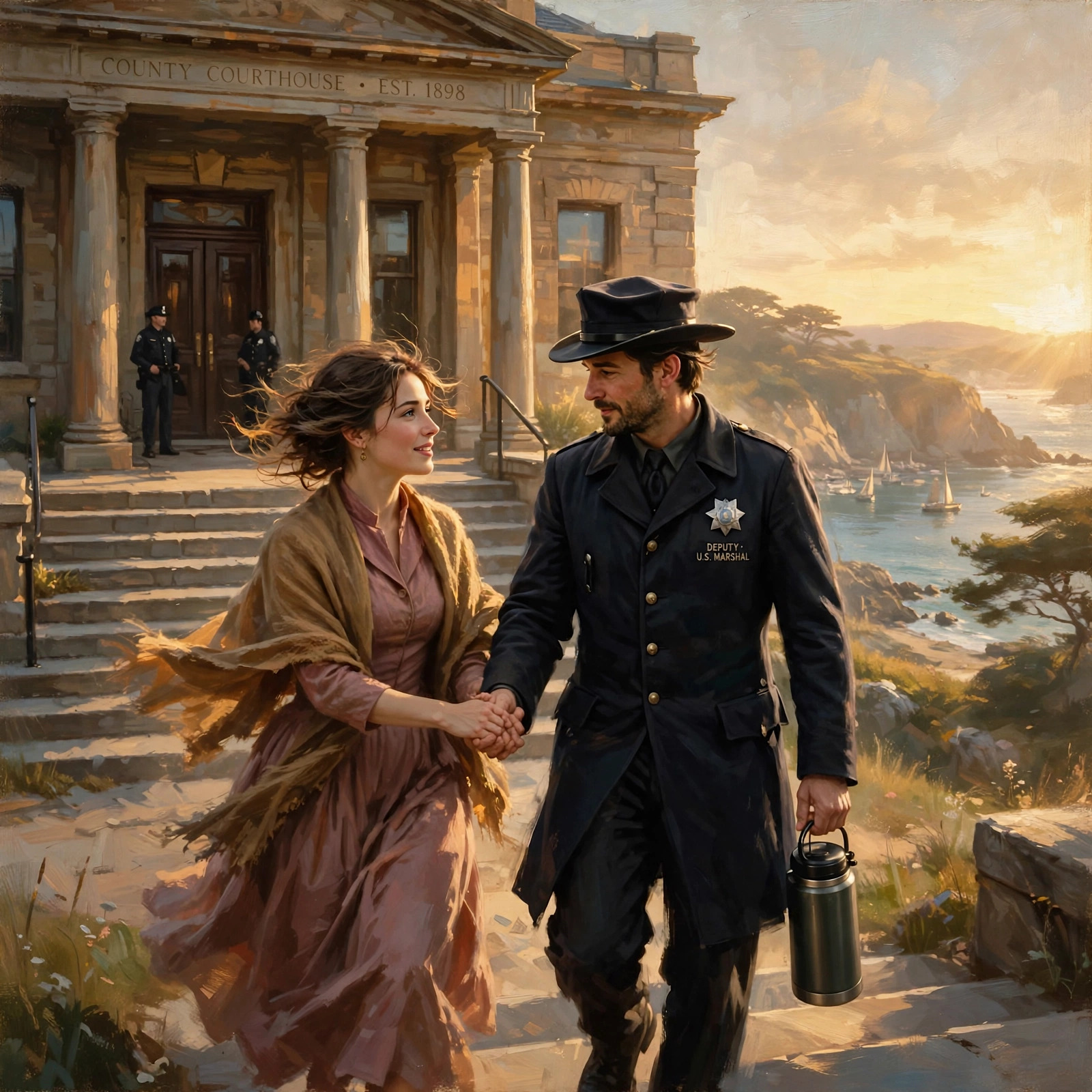
He came in with the thermos before seven. That part was routine now, the steel warm through her palms, the smell of coffee stronger than the rain. What wasn't routine was the way he set it down and went straight to the window instead of to his cup.
"Skiff's gone from the slip," he said.
She came up beside him. The sea below the cliff had gone the colour of wet slate, and the wind was dragging white scraps off the tops of the swells. Forty meters down, the rocks were taking it, one long boom after another, and past the boatyard, out where the long slip cut into the water, there was nothing tied where something had been tied yesterday.
"Marv's cousin."
"Marv's cousin." He was already pulling his jacket on. "Weather turned. Marv said he'd come by when it did."
"You told me that like it was a warning."
"It was a weather report." He looked at her then, and there was something in his face she hadn't seen in the four days she'd been studying it, which was that he was frightened and had decided not to spend the fright on his face. "Stay in. Bolt's new, I checked it before you ever got here. I'll be on the porch."
"In this?"
"In this."
The rain came on full by nine, and it came sideways. The twelve rooms of the Gullwing stood along the cliff with seven of them shuttered for winter, and the shutters on room 4 were the old wooden kind, plank on iron, and by ten the wind had found the loose one on the east side and was working it like a hand working a lock. Odessa stood at the sill with the thermos, gone cool in her grip, watching the far water where a grey skiff might or might not be out there in the grey.
Callum came in off the porch soaked to the collarbone and didn't waste time on that. "We're shutting them," he said. "All of them. If the power blinks, I want this room dark from the outside before anybody's eyes adjust."
They worked the east shutter together. It took both of them, the wood swollen with salt years, and she took the heavy side without being asked and held it while he set the iron bar, and then the room went from grey to brown, the storm-light cut down to the seams. He moved to the next window. She followed. The bar on that one was bent and he had to fight it, and she held the plank flat with her shoulder and felt the whole shutter shudder against her with each boom off the rocks below, the wind in the gap behind it like breath in a pipe.
"Hold," he said, unnecessary, because she was holding.
The bar went over. The room went dark.
And then they were standing in the brown dark of it, close, both hands still up on the wood, the storm loud against the other side, and neither of them moved back. She could hear him breathing. She could hear herself. Somewhere in the last hour the fear had changed shape in her, gone from the cold ledger kind, the counting kind, into something that lived in her arms and her throat, and here was this man pressed into the same small dark, holding the same wall up, and she thought about the four days of him, the thermos every morning, the four-hour blocks, the way he'd photographed an empty slip with his jaw set hard rather than tell her one thing about why.
She kissed him.
There was no deciding to it, or the deciding had already been done somewhere in her back on day two and had only now reached the front of her. He went still for the length of half a heartbeat, one full beat of the storm, and then he answered, and the answer was nothing like the controlled man of the watch rotations. His hand came up and cupped the back of her head like something he'd been keeping behind glass, and the wall took both their weights, and the shutters held, and outside the rain hammered the planks they'd just closed as if it wanted in on it.
When they broke apart, the dark was still dark, and he said, quietly, "Odessa," and nothing after it, and she said, "Don't," meaning don't make it a schedule, don't make it a protocol, and he didn't. He put his forehead down against hers and stayed there, both of them breathing the same warm pocket of air, until the wind shifted outside and both of them heard, clear under the storm, the low engine note of something coming up the coast road slow.
He was off her and at the shutter seam in one motion. She heard him breathe once through his teeth. "Truck," he said. "Not the skiff. It went past." The engine note faded north. He let out a breath. "Marv's truck's the only one that comes up this road. That wasn't Marv's."
"So he's driving it now."
"Or somebody's driving him." He straightened his jacket, an old habit with nothing left to straighten. "I need the porch for an hour. Bolt behind me. Don't open for anyone, including me, until I say the word."
"What's the word?"
"You'll know it's me."
The door shut. The bolt went over. She stood alone in the brown light with her mouth still warm and her heart going, and after a while she poured the cold thermos coffee out the sink drain and sat on the bed and did not turn the lamp on, because he'd said dark from the outside, and she'd decided somewhere in the last five days that she was going to be the kind of witness who did what the man guarding her life asked, even when he wouldn't tell her why.
Even when he kissed like that and still wouldn't tell her why.
An hour later he tapped at the door and said her name, and she let him in, and he was dryer and grimmer and had a paper bag of food from Marv, and the afternoon wore itself out against the shutters. He went out again at the four-hour mark. She watched through the seam as the car pulled around to face the road, his silhouette in it, hood up against the rain.
She hadn't meant to go out to the car. That was the truth of it and she knew it was the truth while she did it, rain cutting sideways under the porch roof, the door handle of the sedan cool and wet in her hand. She told herself it was the umbrella she'd left on the seat two days ago. It was not the umbrella.
The glovebox was shut but not latched, the way things get in a car a man lives in. Her fingers found the fold of paper behind the registration, a tight square of his small upright handwriting, and she carried it into the light of the bathroom and unfolded it, and read it standing up.
His notes. Dated two days back. Leak inside legal team. Confirmed day 3. Paralegal, initials G.F. A routing number, a payment memo copied off a screen, ninety thousand dollars moved through a cousin. Cousin = B. Ostrey. And under that, in the same upright hand, the part that took the floor out from under her: Do not disclose to witness. Two days held. Case integrity.
Two days. He had known for two days. He had known while he photographed the slip, while he doubled the watch, while he stood at the fence with his back half to her deciding something, and this morning, this morning he had known exactly which cousin and exactly which paralegal and exactly whose cousin the money had come through, and he had shut the shutters with her and kissed her back in the dark with all of that folded behind the registration, held, the way he held everything.
Gail. Gail Fenno, who called her every noon, who said honey into the burner phone, who knew precisely where room 4 was because Odessa herself had told her, on schedule, every day at noon.
The rain worked at the shutters. Odessa refolded the paper along its worn creases and went out into the storm with it flat under her hand, across the lot, and the sedan window came down before she reached it, his face in the wet dark going from alert to something else as he read hers.
She didn't speak. She walked past him into room 4, and he followed, dripping, saying her name once, and she set his notes down on the little table between the two chairs, the paper still holding its fold, and stood on her side of it and said nothing.
The Boatyard Slip
Day six began without a word. Callum set the thermos on the sill at dawn, same as always, and Odessa let it sit there and steam and go cold, because talking to him meant trusting him, and she had seen where that ended. It ended with your own name on a payment memo.
He tried once, midmorning, standing in the door of room four with the rain still dripping off his collar.
"Odessa."
"I'm fine."
"You're not."
"Then I'm not." She kept her eyes on the window. "You're on watch. Watch."
He stood there a moment longer. Then the door clicked shut, and she heard his boots go down the repaired third step, the one he'd fixed with a scrap board from Marv's pile, and she hated that she knew the sound of every plank he'd touched.
At noon she made the burner call and listened to Gail Fenno's gentle voice ask how she was holding up, and she said fine, holding up fine, and gave the room number to the woman who had already sold it once. It was the schedule. It was the case. She understood schedules and cases. What she didn't understand was a man who knew the schedule was rotten and let her dial it anyway.
He came back from the car at two, holding his notebook out flat on his palm, like an offering or a confession, she couldn't tell which.
"I've been sitting on something," he said. "You know that now. I need to go see Renner about it. Today. I don't want to leave you here alone, so you're coming with me, and you don't have to talk to me, but you have to be in the truck."
"Fine," she said. The word came out flat as a shut door.
Marshal Supervisor Renner met them in the gravel pullout above the cove, engine idling, twenty years in the job written in the way he never fully got out of his vehicle. Callum got out and stood in the rain and talked to him through the window, and Odessa sat in the truck and watched the wipers and read their mouths. She saw Renner's eyebrows go up twice. She saw him shake his head once, hard, the way men do over things they've already decided.
When Callum got back in, he was wet through and grim.
"He says the case can't take it. Fenno's on your prosecution team. If we move on her, Wenner's counsel screams tampering, everything you copied gets challenged, nine days becomes a year, maybe more."
"So the ninety thousand keeps working."
"So the ninety thousand keeps working until you're on the stand. That's what I told myself. For two days." His hands were tight on the wheel. "I requested a transfer off this detail, back when I thought you'd be safer with someone I wasn't..." He stopped. Started over. "Renner had it approved. Coast desk, my sister's county, starting next month. I told him to tear it up just now. In front of you, I know you didn't hear it, but I need you to know it happened."
She looked at him properly for the first time all day. "Why would you burn that?"
"Because I'm finishing this one. Whatever it costs me."
She turned back to the window. The coast road slid by, gray and stitched with rain. She didn't forgive him. But she put the fact away carefully, the way she put facts away, and it sat next to the memo and didn't fit with the rest of what she knew about him, and that bothered her all night.
The knock came at dawn on day seven. Three raps, Marv's knuckles, unmistakable, any hour he'd promised, and here was the hour.
"Cousin's skiff is on the slip," Marv said through the door, breath smoking in the cold. "He come in overnight with the weather. I seen him tie off and head up to the diner. I figured you'd want to know before he's done with his eggs."
Callum was already dressed. He'd been dressed for hours, she suspected. He looked at her once, quick, checking, and she crossed her arms and got in the truck, because nobody was leaving her in a motel room while Bram Ostrey ate breakfast in the same county.
The Ostrey family's boatyard sat at the neck of the cove, a sprawl of ways and hoists and tarps, the long slip running out into water the color of pewter. Bram's skiff rode there, low and dirty, tied off with sloppy knots. Callum walked the slip with Renner's man on the phone and Marv alongside in his rubber boots, and Odessa watched through the windshield as they did the thing she hadn't expected: nothing dramatic. Callum cast off the bow line and let the tide take the skiff loose, then Marv ran a chain and padlock through the mooring ring, and the skiff sat out there swinging, stranded, a boat with no way home.
Bram came back along the shore path with a paper coffee cup and stopped dead when he saw it. Even at forty meters she saw him understand. He turned, and Renner's vehicle was already across the path behind him, and Callum was walking toward him with his hands loose and open, and that was it, that was all it took, a chain and a padlock and men who had planned while he ate his eggs.
He didn't run. He looked at Marv, long, and Marv looked at the ground, and then Bram held out his wrists.
"You didn't see my face at the motel," he said to Callum. "I never went near the motel."
"You photographed it," Callum said. "From this slip. Three days running. We'll talk about the rest in Wren County."
They put him in the truck because Renner's vehicle had to stay on the path, and that was how Odessa came to be sitting thirty centimeters from the man who'd been hired to make sure she never testified. He was big and ordinary, damp around the collar, cuffs behind him, and he smelled like coffee and diesel. He looked at her in the mirror once and then at the floor.
"The woman, in the picture he sent," Bram said. "I never signed on for a woman. He said locate, that's all. Locate." He shook his head slowly. "There's money in locating."
Nobody answered him.
Callum drove them back up the cliff road with the cove going silver behind them, and in the quiet, without her asking, without anyone asking, he started talking.
"Everything. Right now. No schedule voice." His eyes stayed on the road. "I traced the leak on day three. Gail Fenno. Ninety thousand, routed through you-know-who in the back seat there, cousin to cousin, and I confirmed it with the memo and I told no one, because if we pulled Fenno, your whole case wobbles, and I decided that was mine to decide. That was the sin. Not the knowing. The deciding alone."
"Two days," she said.
"Two days. And there's more. Before this detail, I worked a witness in Cascadia. Shared my thinking with a colleague I trusted, and he was on the other side's payroll, and my witness took a bad fall for it. Since then I don't share, I just hold, and I held you the same way, and you found the notes because I'm bad at hiding things from people who count for a living. I'm sorry. For the holding and for the lying I told myself was protection."
The rain had stopped. Light came through the windshield and lay across his hands on the wheel, and Odessa looked at the cuffs clicking faintly in the mirror, and at Marv's padlocked chain riding in the truck bed, and at the man beside her who had just set down everything he had, unprompted, in a moving truck with a prisoner in the back.
"The transfer," she said. "Your sister's county. You really tore it up?"
"Renner's tearing it up right now. I called her from the porch last night to tell her I wouldn't be close by, and she said, and I quote, 'About time you liked your work.'" He almost smiled. "It's not the coast I wanted anymore, anyway."
"No? What is?"
He glanced at her, just once, and back to the road.
"Nine days to trial. Ask me on the courthouse steps."
Courthouse Steps
The Wren County Courthouse had forty-one steps. Odessa had counted them on the drive past two days ago, out of habit, out of the same reflex that made her total the sugar packets in a diner and the exits in a parking garage, and this morning she counted them again while Callum's sedan idled at the curb. The morning was the flat gray kind, no wind, the kind of quiet that made the coast feel like it was holding still to watch.
"You don't have to walk me up," she said. "I'm as safe as I get."
"I know." He shut off the engine anyway. "Renner pulled two uniforms for the doors. I'm furniture until you're out."
"You've never been furniture a day in your life."
He smiled at the steering wheel, which was new, the smiling-at-nothing thing, and she filed it away the way she'd stopped filing things about him and started just keeping them.
They'd driven down in the dark, leaving the Gullwing with the room keys on the desk and Marv standing there with his padlock keys in his fist, saying, "Anytime you two need a room and nobody's chasing you, off-season rate." He'd said it gruff, eyes on the register, and then he'd looked up and meant it.
Now the courthouse doors opened ahead of her and Gail Fenno came out of a side hallway with a prosecutor on one side of her and a woman in a windbreaker on the other, cuffs already on. Odessa stopped. She hadn't planned to stop. Her shoes were new and hurt at the heel and she stopped anyway, three feet of marble between them.
Fenno looked older than she had in the memo's photo, and tired, and her eyes went to Odessa and then down, fast, the way a person drops a hot pan.
"The ledgers balance now," Odessa said. It was a stupid thing to say. She'd rehearsed nothing, and that came out, and she watched it land on Fenno's face like a slap with no palm in it. "All fourteen."
Fenno said nothing. The windbreaker woman steered her toward the stairs going down, and Odessa stood in that hallway with her heart going hard until Callum's hand landed warm between her shoulder blades, once, and lifted.
"Ninety thousand," Odessa said, quiet, walking. "I keep doing the math on it. What's a person's location go for. Per day."
"Don't," Callum said. "That math doesn't balance any way you run it. I've tried."
Then she was at the courtroom doors, and the doors were heavy, and Callum peeled off to stand with Renner by the wall, and she went in alone the way she'd known for nine days she would.
The room was too warm. Wood paneling, a jury box with nobody in it, Denny Wenner's lawyers at the long table looking at her like weather. She put her hand on the Bible, and the court clerk's voice was nice and bored at the same time, and she sat, and the prosecutor stood, and it began.
Fourteen ledgers. She'd copied them in a locked conference room on a Tuesday with her sweater over the door window, and now she walked twelve men and women through every one, page by page, column by column, where Tallis Freight's declared salvage tonnage didn't hold water, where the same forty-foot skiff showed up as two skiffs on paper, where the "repair costs" leaving the account came back in eleven days wearing different clothes. The numbers were old friends. She'd spent six years learning to read money that lied, and for an afternoon, in a warm room that smelled like floor wax, she read it out loud.
Wenner's lawyer went at her twice. The second time he asked whether she'd ever had a dispute with his client's firm, and she said, "Only the one about whether the books were real," and one juror laughed before she caught it, and the judge didn't.
When she stepped down it was past three and her heel had blistered and she didn't care about anything except that her mouth had held up, and fourteen ledgers were now the government's, and somewhere in the county system a woman named Gail Fenno was being arraigned for ninety thousand dollars of somebody's life.
She surrendered the burner phone in the clerk's office at the prosecutors' table, the little plastic flip phone she'd used for every noon call, every check-in, every voice on the other end of the worst week of her working life. The clerk wrote a receipt. One line. Evidence. Odessa looked at it in the clerk's hand and felt lighter by exactly nothing, and then a whole lot lighter, and that was the strange part.
Outside, the gray had burned off. The steps were full of afternoon, and Renner was on the second landing talking into his phone, and Callum was at the bottom of all forty-one with his hands in his pockets like a man waiting for a bus.
She came down nine of the steps before she said anything.
"They told me Wenner's firm will fold by summer. The whole thing. Receivers."
"I heard."
"Fenno's charged. This morning, before I even got here. Two agents took her off the elevator."
"Renner told me. He also told me the transfer paperwork came back unsigned with a note on it." Callum's mouth did the thing. "My note. Taped back together wrong on purpose."
"He would."
"Eight steps to go, Odessa."
She stopped. He stopped. The steps emptied around them, a clerk going by with a file box, a gull riding the wind up off the bay, somewhere behind the buildings the sound of the coast doing its patient work.
"Ask me," she said.
"You said nine days to trial. Ask me on the courthouse steps."
"These are them."
"So ask."
He came up the last eight, unhurried, a man with no rotation starting at four, no car to sleep in, no schedule voice left anywhere in him. "Come on, then. Coast or city. Where does a forensic accountant with no active case hang her hat."
"I've been doing the math on that," she said. "There's a firm in Wren County that audits the harbors. They called twice. There's an apartment over a bakery in Pinchard Cove that Marv says stands empty nine months a year and smells like bread. There's a man there who fills a thermos every morning whether I drink it or not, and I've started drinking it or not."
He was very still. "Which is the answer."
"All of it. That's the answer. All of it."
"You hated this coast."
"I hated being kept on it." The distinction had taken her the whole nine days to find, and there it was, out loud, on the steps, where he'd asked her to put it. "There's a version of me that went back to the city tonight and took the firm's money and never told anybody where she'd been. I ran her numbers. She's worse off."
"And the trial's done. You're a free woman, technically. You don't need a detail anymore."
"Technically."
"So the question isn't protection."
"No," she said. "The question is whether the man who tore up his coast transfer for me is staying, and I'd like the answer before I sign anything, because I did the math on long distance too, and it doesn't balance."
Callum looked at her, and then past her, down the steps to where Renner had hung up and was watching them both with his arms folded like a man at a ballgame he'd already bet on. Callum reached into the car through the open window and came out with the dented steel thermos, full, warm through her hands when he pressed it into them, and beside it two cups, the tin ones, dented in their own places, and he set all of it on the stone balustrade like it was nothing at all.
"I wired my sister this morning," he said. "Told her I found the coast office. It's you. It's the whole place. I'm not transferring anywhere."
"Renner approved that?"
"Renner approved it Tuesday."
"Tuesday," she said. "You've known since Tuesday and you made me stand here and say it first."
"I wanted to hear it in the open air." He took one of the cups and poured, steam going thin between them. "You counted the steps on the way in. I watched you."
"Forty-one."
"I counted the days instead." He handed her the cup. "Nine was enough."
She laughed, one loud syllable that surprised the both of them, and drank, and the coffee was worse than the bakery's and better than she'd had in a year. He took the second cup for himself and picked up the thermos in the same hand, and his other hand found hers, palm to palm, no watch rotation starting, nothing to guard but the warmth, and they went down the last steps of the Wren County Courthouse together, unhurried, two people with a cove waiting and no one behind them at all.
Odessa Rill walked toward the water she'd hated on day one and carried nothing but a paper receipt for a phone that no longer mattered, a thermos that would need filling again by morning, and the hand of a man who had learned to say everything out loud, on the arm of a woman who had finally done the same.
Get notified when new stories drop

Serena Blake
Serena writes romantic suspense and dark romance for readers who want pulse and payoff. Her stories chase trust as hard as they chase danger.
Leave a comment
Comments