



The Pot Room

The last hand of the night came down to a tourist from somewhere up the coast, and Odile Ferre could tell from the deal that he was about to lose his shirt, his shoes, and possibly his return ticket.
The pot room of the Marrow Room ran hot after midnight. Smoke drifted along the low ceiling and caught the brass of the hanging lamps, and the felt of her table had gone soft in the center from seven years of hands dealt in that same spot. Six players sat tonight. Five of them she could read like street signs. The tourist, the big one in the rumpled gray jacket, she could read like a billboard. He was three drinks past careful and two cards from being broke in a town he didn't know, and it was all going to happen on her felt.
She shuffled, and her eyes did what they always did, what she'd trained them to do since the year she learned to deal: counted everything. The chips in front of each man. The watch the tourist had set on the rail. The stack of markers on the board by the door, brass tags hanging off nails, each one riding a debt until it cleared. She kept a running tally in her head of every number in the room, and when her head ran out of room, she kept the rest in the calfskin notebook stitched into her apron pocket, the one her grandfather had made for her the year she first picked up a deck.
He'd told her a dealer who counts is a dealer nobody can steal from. He'd never told her what to do when the stealing started anyway.
"Bets, gentlemen," she said.
The flop came ugly. The turn came worse. The tourist had two pair and the face of a man who believed the river owed him something, and across from him sat a lawyer from Harbor Street with a flush draw and a lazy smile. The pot was already too big. The tourist shoved the last of his chips in with a shaking hand, then reached for the watch on the rail to cover the rest.
Odile's hand moved before the rest of her did.
It was a small thing. A house card, off the bottom of the deck she was squaring, gone into her palm and out again in the same motion she used to tap ash from a cigarette. Two seconds of nothing. Then the river card turned, and it was a blank for both of them, and the lawyer's draw died on the felt, and the tourist raked a pot that kept his watch on his wrist and his ticket home in his pocket.
The room cheered politely. The tourist tried to kiss her knuckles. She pulled her hand back with a smile that had closed doors before.
And then she felt it. Someone watching. Not the room, not the table. Her.
A man stood in the doorway of the pot room with his shoulders against the frame and his arms loose at his sides, dark-haired, dressed too well for a player and too plain for management. She knew the type in one glance. A settlement man. The kind Krayne sent around to collect on markers and clear them off the board, all money, all math, no small talk. He'd been there for the last three hands, she realized. He'd been there when the river card turned.
He'd seen the card go into her palm.
She met his eyes across the room, and he held them for a long moment, face giving nothing back, and then he looked away, unhurried, as if the pot room had gotten dull. As if nothing at all had happened on her felt.
Her heart did not slow down for another full minute.
"Cash out, gentlemen," she called. "Kitchen closes when I do, and I'm feeling merciful."
The tourist staggered off toward the bar to celebrate. The players settled their tabs. And that was when Silas Brand came off the floor and did the thing that turned the whole night cold.
Brand ran the pot room like a man who'd been given a ship and suspected the crew of mutiny. Six years behind the booking desk had taught him to walk soft and write fast, and tonight he walked straight to the marker board by the door, reached into his coat, and produced a brass tag. Small, stamped, tarnished at the edges like all the rest. He hung it on a nail in the middle of the board, dead center, where every player leaving the room would pass it.
Odile knew that tag. She knew the initials stamped into it before she could even read them across the room. T.F.
"Interest moved," Brand said, loud enough for the room, soft enough to sound like a favor. "Mr. Krayne's reviewing the books. Terms aren't what they were last month. Family rates either."
He said family while looking straight at her.
Tobi. Her little brother, who parked cars and ran errands and had signed his name to a marker at Brand's desk one bad night to cover a friend who couldn't cover himself. Fifteen thousand, two hundred, and change, the last time she'd made herself look at the figure. She'd been paying it down out of her tips for months, quiet, in cash, never enough to draw a question. She had the receipts folded flat in her notebook, every one, because that was the other thing her grandfather had taught her: never owe anyone without a paper trail of your own.
She kept her hands flat on the felt. Dealers don't reach for anything when the floor is watching.
"Mr. Brand," she said. "That nail's a little high for a tag that small. People will strain their necks."
"People will see it," Brand said. "That's the idea."
The settlement man in the doorway hadn't moved. He was still watching her, she could feel it, though when she glanced over he was studying the marker board itself, his eyes moving tag to tag, nail to nail, like a man doing arithmetic on someone else's debts.
Then the door at the back of the stair opened, and Otto Krayne himself came down into the pot room, which he did about twice a year, and the whole floor went still.
Krayne owned the Marrow Room, owned the building under it, owned half the quiet in Ashport, and carried it all in a gray suit that fit like it had been made around him. Twenty-two years the club had been his, and he had never once come down the back stair this late without something being wrong. He didn't go to the bar. He didn't go to the tables. He stopped in the middle of the floor with Brand at his elbow and let the room look at him, and he let the silence grow until even the tourist at the bar had shut up.
"Twelve days," Krayne said. Not loud. He never needed loud. "That's what's left on the books before I sit down with the people from Harbor Street. They like what they see, they buy. They don't, I keep what I've got and we all tighten belts."
He looked at the marker board. At the brass tags. At the fresh one in the center.
"But their people read books the way a doctor reads an x-ray," he went on. "And right now, my books are not well. Somebody's table in this room is carrying paper it shouldn't. Somebody's been shorting my pot."
Nobody in the room moved. Odile's palm was still warm where the house card had rested, and the settlement man's eyes had come back to her, steady, unreadable, and this time he didn't look away.
"Twelve days," Krayne said again, and turned for the stair. "Find it. Or they will."
Brand smiled at the marker board, at the little brass tag hanging there with her brother's name on it, and Odile slid her deck into its box and clicked it shut.
Fenwick Street
The flat over the Fenwick Street laundry smelled of steam and starch, and Odile had learned to sleep through the presses starting at five, but she had not learned to sleep through Tobi coming home through the window. She sat up in the dark with her grandfather's notebook already in her hand, out of habit, because a sound in the night meant something owed somewhere, and she heard him land soft on the floorboards and go still.
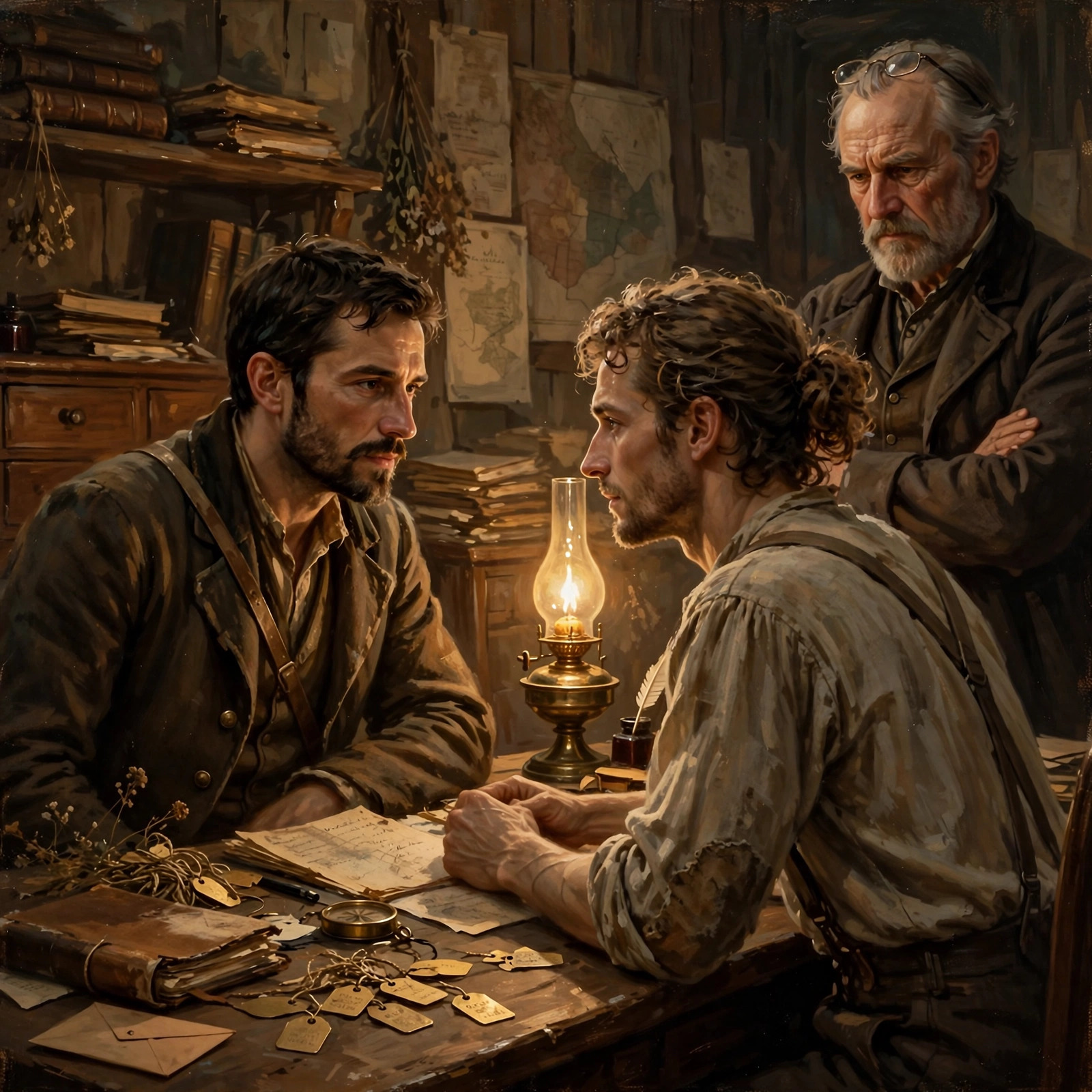
"It's me," he said, as if she couldn't tell. He'd been saying it's me since he was small enough to need the window at all.
"You reek of the freight yards," she said, and lit the lamp. "Sit down before you fall down."
He sat at the kitchen table like a boy in a principal's office, elbows in, shoulders up around his ears. There was a bruise coming up along his jaw, yellow at the edges, and his knuckles were split. She put coffee on the stove because it gave her hands something to do other than shake him.
"Brand's men came by the yard," Tobi said. "Two of them. I got over the fence."
"You got over a fence with a fifteen-thousand-dollar signature on your back."
"Fifteen two," he said. "With the interest he raised it. You know that better than I do."
She did know. She knew it down to the dollar, down to the last receipt folded into the back pocket of her apron, and she was not going to tell him that the number had been coming down, night by night, from her own tips. He'd have gone to Brand himself, hat in hand, and Brand would have taken the rest of him with it.
"Why did you sign it, Tobi?" She'd asked before. He'd never answered with anything that held still.
"Because Marek was going to lose his boat." He said it fast, like it had been waiting in him. "His family's whole catch is off that boat. Brand had him at the table and the man was shaking. What was I supposed to do, watch?"
"Yes," she said. "That. That is exactly what you were supposed to do."
"That's not how you raised me."
"I didn't raise you to be a collateral."
The coffee was done. She poured two cups, and they drank them bitter and too fast, and neither of them said anything about the marker board, or the brass tag hanging center nail, or the twelve days Krayne had put on the whole room last night. He fell asleep at the table with his head on his arms, and she covered him with her coat and sat up with the notebook open, adding figures by lamplight until the presses started.
The knock came the next evening, just past dark, while Tobi slept and the laundry below sighed its steam up through the floorboards. Three knocks, unhurried, a man with nowhere better to be. She knew before she opened it. She'd watched the settlement man all her dealing life, the way you watch weather coming in over the harbor, and she'd never once had him at her door.
Cassian Dray filled the doorway in his gray suit, hat in hand, and looked past her shoulder into the flat before he looked at her. He had eyes that took inventory, she'd always thought, and she stood so that her body made a wall of the doorway.
"Miss Ferre."
"Mr. Dray."
"Your brother's bed at the rooming house hasn't been slept in two nights," he said. "His shift started at six. The valet stand's been short a runner. I followed the short."
"Maybe he's got a girl," she said.
"Maybe." He tipped his head, listening to the flat. "But he doesn't type like a man with a girl. He types like a man hiding from his own floor manager."
Behind her, Tobi shifted on the chair, one soft groan of the floorboards, and Cassian's eyes came back to hers, patient. He didn't push past her. He didn't reach for the door. He waited, holding his hat, like the knock itself had been the whole of his errand and he was content to stand there until winter.
"He's twenty-four," she said. "He's not a boy."
"No," Cassian said. "He's a signature. That's what the board sees. That's what Harbor Street will see when their people read the books."
"Come up, then." She stepped aside. "You've climbed my stair already. You may as well say what you came to say where my brother can hear it."
He came up slow, and stood in her kitchen like a man careful of where he put his weight. His eyes went over the room the way they'd gone over the marker board, tag by tag. The cold coffee still on the stove. The betting slips she'd left out on purpose, tipped and totalled, because a clean table is a table with something to hide. Her grandfather's notebook sat under her hand where it always sat, and she watched him notice it, and she watched him not ask.
Tobi woke when the floor creaked, and came up off the chair with his fists already half made, and Odile put a hand flat on his chest.
"Sit," she said, and he sat, because she was his sister and because twenty-four years of her voice counted for more than any of his fear.
"Mr. Dray," Cassian said, and put his hat on the table, which somehow made everything worse. "You signed a marker at Brand's table. Fifteen two, with the interest. It's on the center nail. That nail is the first thing anyone sees when they walk in the pot room, and in twelve days, the people who walk in will be from Harbor Street, and they read paper the way I read it."
"I'll pay it," Tobi said. "I work. I've been working."
"You've been running," Cassian said. "There's a difference, and Brand collects the difference."
"Then he can collect it from me," Odile said.
Both of them looked at her. She pulled the betting slips toward her and squared them, small movements, buying a second to choose the words.
"I deal to that room seven nights a week," she said. "I clear my rake and I clear it clean, and I have never carried paper in that room that I couldn't cover. If my brother's marker has to move before Harbor Street comes, it moves to me. Put it on my nail."
"Odile," Tobi said, "no."
"You signed for a friend's boat," she said, not looking at him. "I'm signing for my brother. We're a generous family, apparently."
Cassian picked his hat back up. He turned it once in his hands, and when he spoke it was quiet, and it was not to Tobi at all.
"If I sell that paper to a collector, I'm clear by Friday," he said. "That's the easy book. That's the book I've always kept." He looked at her slips, at her hands, at the notebook under them. "Your brother's marker is a bad debt on a board that Krayne's about to show to strangers, and bad debts get cut out like rot. If it sits on your nail, it sits on you, and I'd have to write you into the short books, and then I'd have to look at you the way I'd look at anyone else carrying paper."
"Then don't look at me that way," she said. "Look at me the way you looked at me last night."
He went still. Just his hands, on the brim of the hat. She'd dealt long enough to know a man deciding whether to show his cards.
"Seven days," he said finally. "I hold the marker myself. It doesn't go to a collector, it doesn't go back to Brand, and it doesn't touch the center nail while Harbor Street's people are reading the room. Seven days, and your brother works his shifts like nothing's wrong. If you can cover it in seven days, it clears clean. If you can't, I sell, and I tell you first."
"Done," Odile said, before Tobi could open his mouth. "You have a name for the hold?"
"I have a job," he said. "The job is settling. This is me settling."
She wrapped a plate of the seed bread she kept under a cloth, still good from morning, and tied it in paper, because a man who does you a turn eats at your table, that was how her mother had been, and it cost nothing to keep doing it. She put it in his hands at the top of the stair.
"For the walk," she said.
"I don't need bread."
"Nobody needs bread. That's not why it's given."
He took it. He went down three steps, and then he stopped, and she knew the shape of a man turning back before he did it, and she waited.
"Your notebook," he said. "The one that never leaves your apron. You write in it every night."
"Every hand I've ever booked," she said. "Why?"
"Bring it," Cassian said. "The whole thing. Every pot-room night you've dealt since you started on my books. Don't copy it. Don't clean it. Bring it as it is, tomorrow, to the club, before the floor opens."
"It's mine," she said.
"I know what it is," he said. "That's why I'm asking."
He went down the stair with the bread under his arm, and she stood at the top until the outer door closed, and then she went in and woke her brother, and started him on the dishes, because her hands wanted something to do other than shake.
The Back Stair
The back stair of the Marrow Room smelled of the workshop stove two floors down, coal ash and linseed, and the smell climbed all the way to the landing where Odile waited with the notebook under her arm. She'd slept four hours and dealt the other twenty in her head, and the notebook had ridden up from the Fenwick Street laundry in her apron pocket, where it had ridden every night for twelve years, warm from her hip.
Cassian came up at ten past nine, before the floor opened, hat still on, the paper wrapping from the seed bread folded flat in his coat pocket instead of thrown away. She'd seen him do it. He'd folded it like a receipt. She didn't say she'd watched.
"You ate it," she said.
"I ate it." He set his hat on the banister post. "Cold. Good. My mother made something like it."
"Everyone's mother made something like it. Sit down."
The stair was wide at the landing, wide enough for a man and a card table and a woman who dealt for a living, and the ash drifted up past them in thin gray flakes that settled on the banister rail and on Cassian's sleeve and on the leather cover of the notebook when she set it on her knees. Calfskin, stitched by her grandfather the year she learned to deal, gone soft at the corners from her hands.
"That's it," he said. "The whole thing."
"Every pot-room night I've dealt since I came up off the floor. Open it."
He didn't reach for it. "You count your hands."
"I count everything. You learn that when you're nine years old and men are carrying furniture out of your house at noon." She said it flat, the way she said anything true, and watched him not know where to put it. "Open it."
He opened it. The pages were ruled in her hand, dates down the margin, tables dealt, hours booked, drop counted, tips. Small careful columns. He turned pages slowly, and the ash came down around them and she let it, because there was no wind on the stair and nothing to do but sit while a man read twelve years of her nights.
He stopped a third of the way in. "Here. Two winters back. You wrote dropped table."
"Dropped table. Twenty minutes, the felt burned where a lamp went over. They booked me the full shift."
He took out a stub of pencil and wrote on the back of the folded bread paper. "Twenty minutes, two winters back. What else."
She gave him the rest the way she'd give him cards, one at a time, face up. The night the stove backed up and they cleared the room for an hour. The night Krayne hosted the harbor men upstairs and the pot room sat dark from midnight, though the books showed it lit until three. The night her own table went short a dealer because Brand moved her to the front room for a private game, and the pot room's book that night showed four hands where she knew there had been two.
He wrote each one. The pencil was short as her thumb and he held it the same careful way, like something he'd be accounting for later. When she finished he added the column twice, lips moving, and she watched him do it, and then he turned the bread paper around so she could see.
"Your hours and the book," he said. "They don't agree. Not once this year. Every gap falls on a night the pot room's camera film went for a swap."
"I know what I dealt. I don't know what the book says."
"The book says more. More hands, more hours, more drop." He tapped the paper. "Somebody's writing games into nights that had none."
The ash came down between them. Down in the workshop somebody shoved the stove door and the stair breathed warm for a moment, then cold.
"How much," she said.
"I've been hunting it for months. It's not a little. It's the kind of number that makes a man want the books clean or the club sold, one or the other, and Krayne's picking sold." He said the next part slower. "He promised me a stake in this place. When I started clearing his paper, he said, hold on, boy, one day the Marrow Room's half yours. That was his word. Half." His jaw worked. "Now he says he never said it. Now he says a stake was a figure of speech, and I've got nine years of collecting other men's debts and no paper with my name on anything but the work."
"So you're not hunting for him."
"I'm hunting for me. If the books are dirty, the buyout falls through, and dirty books don't sell for seventy-five thousand, and a man who was promised half of something might rather have half of nothing than nothing at all." He almost smiled. It was a bad smile, tired at one corner. "That's not arithmetic a settlement man admires in himself."
"It's honest arithmetic."
"It's not clean arithmetic."
"I never asked you for clean. I asked you for true."
He looked at her then, longer than the stair required, and she looked back, and the notebook sat on her knees between them with twelve years of her handwriting open to a night the books had lied about. Her apron pocket rode against her hip with the brass tag in it, the club's own stamp, cut and stamped in the workshop under their feet the year the doors opened. She'd taken it off the center nail herself this morning, before the floor men came in, because Cassian held the paper now and the nail was Brand's to read, and a tag on a nail says to any man watching: this one still owes.
"You're carrying it," he said.
"You saw me take it down."
"I see everything at your table. You know that by now."
She took the tag out and laid it on the open notebook, face up, the stamped letters dull in the stair light. Tobi's initials. Fifteen thousand two hundred, minus what she'd slipped against it from her own tips, receipts folded into her drawer at the laundry, a private tally nobody asked for. The tag sat on her grandfather's stitching like it had been invited.
"Your brother signed it to cover a friend," Cassian said.
"Marek's boat. I know."
"Do you know who booked it?"
"Brand books every marker in that room."
Cassian turned the bread paper over and looked at his own column again, though she could see he wasn't reading it. He was deciding. She'd watched men decide over cards for seven years and this was a man on a draw, counting what it cost to stay in.
"The gaps in the book," he said. "They're not random. Every false hour was booked by the same hand. I've read that hand for years, I just hadn't laid it against yours. Whoever writes that shorthand books the swaps on the camera film too." He put the pencil away. "The desk where he books it is in the office above the pot room. Krayne's office. He leaves it empty Thursday nights. Krayne dines on Harbor Street, Brand walks the floor, and the office door locks from the stair side."
"Thursday," she said. Four days. "You want to look at his desk."
"I want to see the shorthand against your hours myself, in his hand, in that room. Not copies. Not you telling me. If your book is going to stand against his, I need to be the one who found it there, and I need you beside me when I do, because you're the only one in Ashport who can read those nights back to front."
The stove door clanged again below. Warm air rose and took some of the ash up past them into the dark above the landing, and she watched it go.
"Thursday," she said. "After the floor opens. You come to the pot room like a man checking a table, and you take the stair, and I follow when my break comes."
"Odile." He picked the hat off the banister and didn't put it on. "If he's written your brother's name on paper he made himself, you need to understand what that man will do before he lets it be found."
"I understand what men do over money. I've understood it since I was small enough to hide behind the woodbox and watch the house go." She closed the notebook over the tag and put the tag back in her apron pocket, where it rode against her hip with the weight of a dealt card. "Thursday. The office. His desk."
He stood, and he was close on the narrow stair, closer than the landing needed, and he didn't step down right away. "Your notebook," he said. "You never showed it to anyone."
"No."
"Why me."
"Because you looked at my table for two nights before you ever sat down at it," she said, "and you never said a word about the card I palmed for that tourist, and a man who keeps quiet about a thing like that is either saving it or ashamed of it, and you weren't saving it."
He went down three steps. Then he stopped, hand on the rail, and looked up at her through the drifting ash. "I'll be at your table Thursday," he said. "Deal me something honest."
"I deal everything honest," she said. "It's the rest of the room that doesn't."
She sat on the landing until his footsteps faded past the workshop door, and then she opened the notebook to the year's first page and read her own small columns down the margin, all the nights the books had made longer than her hands. Four days. She counted it the way she counted everything, twice, and put the number away with the tag.
Brand's Desk
The office above the pot room smelled of Krayne's cigars and the copying machine's warm ink. Odile came up the back stair at the change of her break, carrying the marker book flat against her chest the way she carried a shuffled deck, level and still, so nothing could shift inside it. Cassian was already there. He had the lamp pulled low over Brand's desk and the drawers open, and he did not look up when she came in, only moved his coat off the second chair without being asked.

"He keeps the false hours in the bottom drawer," Cassian said. "Under the film requisitions. He thinks the order of the drawer hides the order of the nights. It doesn't."
He set a loose sheaf on the desk. Nine markers, each one stamped with the club's brass round, each one signed across the bottom in a hand she knew. Odile put the book down beside them and opened it to the pages she had marked with her own slips of paper.
"Read me the dates on the markers," she said.
He read them. She followed down her margins with one finger. March the ninth. Her column said she'd dealt until two and gone home. The marker said the table ran until six. March the twenty-third. April the fourth. Every date the same in one way, and she said it out loud. "Every one of those nights, the film canister went down to the workshop and came back up swapped. I sign the film out and in myself. I remember each canister. Those nine nights, I didn't deal past two o'clock, and I'd stake my tips on it."
"Look at the shorthand on the hours." Cassian turned a marker toward her under the lamp. "That slash through the seven. The little hook on the four. Nobody on the floor writes a four like that except the man who books the hours. I've read six years of his ledger pages. I'd know that hand in the dark."
She looked, and what she saw settled over her the way a bad run settles, cold and certain. Forty-one thousand dollars of paper that had walked out of the pot-room books, all of it written in the same manager's hand, all of it dated on nights the cameras had gone conveniently blind. "It was never Tobi," she said. "It was never my table. He built the paper himself and hung it on the nearest name."
"He built it to cover what he took," Cassian said. "The markers aren't the theft. The markers are the rug he threw over the theft."
She was reaching for the copying machine's lid when the door opened without a knock.
Silas Brand filled the frame of it in his gray suit, floor keys on his belt, and for one second nobody in the room moved. Then he came in and shut the door behind him with the softness of a man closing a register.
"That's Krayne's book," he said, "and that's Krayne's desk, and the pair of you are in his office on a Thursday with his paper under your hands. I could call that plenty of things."
"Call it what you like." Cassian did not rise. He put one flat hand on the nine markers, unhurried. "You already know what we'd call it. Forty-one thousand in paper, all booked in your hand, all dated on film-swap nights. The arithmetic took me four months. It took her four days."
Brand looked at Odile. Six years she'd worked his floor, and she had watched him charm drunks and break a stack pointer over his knee when a runner was slow, and she had never once seen his face do what it did now, which was go smooth and careful, like a man counting his own chips. "Fer girl," he said, "you've had a good position here. Quiet nights, good rake, and me keeping the collectors off your family's paper all this while. You want to think about what happens to that position when I'm not feeling generous."
"You raised the interest on his marker twice without the book's say-so," she said. "I've got the receipts for every dollar I've paid against it, and every one of them is dated and signed by me. My name, my money, my hand. Nothing you can do to that paper frightens me, because I've already written down everything you did to it."
"There's a collector on Harbor Street who'd buy that marker tonight for cents," Brand said. "One word from me."
"One word from either of us goes to the gaming board," Cassian said, and now he did stand, and he was between Brand and the desk, easy, hands loose. "Sworn complaint, the book and the markers attached, the film requisitions attached. They'll freeze the license before Friday. Krayne's buyer walks, the sale dies, and you go into an inquiry with your own shorthand on nine forged instruments. I've settled debts in this town for nine years, Silas. I know what a man's paper does to him at an inquiry better than any man alive. Don't make me carry yours there."
"You'd burn the club to save a dealer's people," Brand said. "I've watched you nine years, Dray. You don't spend people. You spend money."
"I know exactly what I spend." Cassian's voice went quiet in a way Odile had not heard from him across a table. "That marker the boy signed belongs to me now, at face, out of my own savings. Thirty-eight thousand dollars, every dollar I've put back from nine years of settlements. It's not your paper to sell to Harbor Street or anyone else, because I've already stood behind it. And these nine," his hand covered the forged markers again, "go to Krayne, tonight, with the dates and the film nights laid side by side. You can be in the room when he reads them or you can be in the wind. Pick."
Brand stood a long moment. The office clock ticked. Somewhere below, the pot room opened for the evening, chairs scraping, cards riffling up through the floorboards like rain on a roof.
"You've been behind that boy's paper from the start," Brand said to her, soft. "Paying it down out of your apron. I knew. I let you, because a dealer who pays is a dealer who keeps quiet."
"I kept a tally," she said. "I've kept a tally since I was a child. Quiet isn't the same as safe, and I was never going to be either one for you."
He went out without another word, and his keys rang once against the doorframe on the way, and then the stair was empty above the noise of the floor.
The copying machine was old and slow and Krayne's, so they used it. Page by page, Odile laid her grandfather's stitched notebook on the glass and brought the lid down, and the light moved through her columns and put them on paper in stacks, nine markers and every film night and every hour she had truly dealt, copied twice, one set for Krayne and one set that Cassian folded into his breast pocket over his heart. When it was done she squared the originals and tied the notebook shut with its leather thong, and her hands were steady, and she noticed they were steady, and she noticed he was watching them.
"You'd have spent all of it," she said. "Every dollar. On my family. Before tonight you didn't even know if it was my table that was short."
"I knew by the third night it wasn't your table. I sat at it for four more."
They went down the back stair together with the copies between them. The ash from the laundry below had given the air a warm bread smell, and the third landing was dark where the bulb had gone again, and there, where the wall narrowed and the rail was worn smooth, she put out one hand and took his sleeve, and he stopped, and she pulled him down to her height and kissed him.
He made a small sound against her mouth, surprise and then not surprise, and the copies crinkled between their chests, and his free hand came up and cradled the back of her head as if she were something that could be dealt wrong. She kissed him the way she did everything, once decided, all the way through, until the stair and the floor noise and the whole sleeping building went quiet behind her eyes.
When they broke apart he stayed close, forehead bent toward hers. "Odile."
"I live over the laundry," she said. "Two flights up. The plate from Sunday is still in my icebox and I am not standing on a cold stair telling you things you already heard me say with my hands."
He laughed, low and rusty, like a man remembering how. She took the copies from him, put them into her own apron where the brass tag rode, and led him up the last two flights with her fingers laced through his. At her door she got the lock on the first try. The flat was warm and small and smelled of starch and seed bread. She pulled him in after her, and reached back, and closed the bedroom door behind them with a click that was soft as a dealt card turning face down.
The Workshop Stove
Cassian had told her nine in the morning, before the club woke, and Odile was on the office landing at ten to, with her notebook tied shut under her arm and the brass tag riding her apron. The door of Krayne's office stood open. Inside, the old man sat behind his desk with a stove poker in his hand, feeding the workshop stove that heated the upstairs floor, and the room smelled of coal and burnt paper and, underneath it, the lemon polish somebody wiped the markers with every morning.
Brand was already there, standing too near the corner, and Tobi sat on the stiff horsehair chair by the window with his cap in his fists, summoned like the rest of them. He looked up when Odile came in, and the look he gave her was the one from when they were small, the one that said he had done something and she was going to have to be the one to fix it.
Cassian came in behind her, closed the door, and did not sit.
"Otto," he said. "I've got paper for you."
"I can smell it on you," Krayne said, not turning from the stove. "Copier ink. Somebody's been busy upstairs." He set the poker in its iron rest and folded his hands on the desk. "Show me."
Cassian took the folded copy set from his breast pocket, opened it flat on the desk, and put two fingers on it. "Every hand Odile dealt in the pot room for six weeks, in her own hand, against every hour booked on the same nights. The hours don't match. The extra hours all fall on nights the camera film was swapped. And they're all written the same way." He turned the top sheet around so it faced Krayne. "That shorthand. It's not hers. It's not mine. It's the hand that books every marker in this room."
The room got very quiet. Tobi stopped worrying his cap.
Brand laughed once, a short, hard sound with nothing in it. "That's a tally book some dealer keeps under her own bed. It proves whatever she wants it to prove."
"It proves arithmetic," Cassian said. "Forty-one thousand dollars booked into hands that were never dealt, on nights the film was out of the cans. Nine markers carry it. All nine in that hand." He laid his other hand on the desk, and Odile saw what was in it, and her breath went thin. The nine papers, fanned, stamped and dated, the shorthand running along their bottoms like a signature the man who wrote it could not stop making.
"Where did you get those?" Brand's voice had gone up half a tone.
"I bought them," Cassian said. "This morning. From your desk, through the desk of a man who sells what he's paid to forget he saw." He reached into his coat and set an envelope on the desk, thick and unsealed. "Thirty-eight thousand dollars. My settlement savings. Nine years of clearing other men's debts, and it's every dollar of it. Fifteen-two of it buys Tobi Ferre's marker at face. The rest buys the nine forgeries, so that no collector on Harbor Street ever holds paper with this club's stamp that this club didn't honestly make."
Odile had known it was coming. He had told her on the stair, holding her hand, that he had the money and that he was going to spend it, and she had argued with him for two flights of stairs and lost. Knowing it, she still felt the sum land in the room like a physical weight, and she watched Krayne's face as it landed on him too.
"Your savings," Krayne said slowly. "For a valet's marker and paper I could have burned myself."
"You could have. You'd have burned it blind, and Harbor Street would still be holding a copy of the short books on Monday when they come to look. Now they're not. The books are clean, Otto. The skim is bought back, every dollar, and the proof of who wrote it is standing in your office."
Brand looked at the envelope, then at the papers, then, for a long moment, at nothing at all. Odile watched him do the arithmetic she had watched him do a hundred times across the pot-room floor, and watched him come up, this once, short.
"Silas," Krayne said. Not loud. The stove ticked behind him.
"It was small, at first." Brand's voice came out flat, like a man reading a bill. "Two hundred on a night. Then the film swaps got easy, and the pot room got busy, and nobody counted but the dealer, and I thought she counted for herself only." His eyes flicked to Odile, and there was something almost like respect in them, which was the worst thing she had seen all week. "I wasn't going to let the boy's marker go to a collector. I was going to clear it once the books settled."
"You forged his name to cover yours," Odile said.
"I forged a name I thought would scare nobody into looking." Brand took a breath. "I'll say it plain, Otto, since the paper says it anyway. It was me. All nine. The film swaps, mine. The hours, mine. Not the dealer, not the valet." He turned to Krayne, shoulders coming down like a man setting down crates. "I'd rather say it here than say it on the board in front of Harbor Street."
Krayne sat still for so long that the stove popped once in the silence. Then he pushed back his chair, took the nine papers off the desk, and crossed to the workshop stove without a word. He opened the iron door. The heat rolled out and touched Odile's face.
"Stamp them first," she said, and her voice came out steadier than she had any right to. "The marker and the forgeries. Stamped cleared, in front of all of us, in the book. So nothing rides on my family's name anymore."
Krayne looked at Brand. Brand went to the desk, got out the stamp and the pot of ink, and did it with his own hands, one paper at a time, while Tobi stood close enough to watch the ink take. Cleared. Cleared. Ten papers, and the brass tag Odile had carried for nine days she took from her apron and set on the desk at the last, and Brand stamped that too, and it was done, and her apron pocket was light as it had not been since she was young.
Then Krayne fed the nine forged papers into the stove. They caught fast, curling, and the shorthand went first, and she watched every hour that had never been dealt burn off the club's books and up the flue and out of all their lives.
"You can go, Brand," Krayne said to the fire. "You'll settle the rest with me out of your wages, and you'll be lucky if that's all of it. Go."
Brand went. He did not look at anyone on the way out, and the door clicked after him like the last card of a long hand going face down.
Tobi stood up from the horsehair chair, and Odile took his arm and walked him to the door, and kissed his cheek, which he pretended to hate, and sent him down to the floor with a look that promised a conversation later, and he went.
Then it was the three of them, and the stove, and the envelope of Cassian's money still sitting on the desk between two men who had been something like friends for nine years.
"You spent your own stake," Krayne said, "to clean my books and clear a valet's debt and put my floor manager in my stove. And you want me to believe you did it for the girl."
"I did it for the books," Cassian said. "She happened to be the only one in this building who kept honest ones."
Krayne picked up the envelope, weighed it in his hand, and set it back down in front of Cassian. "Keep your money's lesson, anyway. But hear me, Dray. There's no stake in this club for a man who turned its own ledgers against it to prove a point. Whatever I said on some night with a bottle in me, I unsay it now. You'll collect and clear, same as always, and that's the whole of what you'll be to me."
Odile's hand found Cassian's sleeve, the way it had on the third landing, but he didn't look at her. He looked at Krayne, and at the stove where his proof was ash, and at the envelope holding nine years of his life.
"I'll deal with that," he said.
Dawn Cut
The deadline fell on a Monday, and the syndicate's man from Harbor Street came up the stairs at ten to midnight with a lawyer's bag and a checkbook smelling of new ink. Odile heard the whole of it from the pot-room floor, because Krayne left the office door open on purpose, the way a man leaves a window open when he wants the whole house to smell the rain.
"Seventy-five thousand," the man said, "as discussed, contingent on clean books. I can have the deposit moved by morning."
"You can move it back where it came from," Krayne said. "The books are clean now. Cleaned them myself. Ninety minutes ago, matter of fact, with a stove and a match. The club isn't for sale, and you were never getting it, and if you'd read the paper before the check you'd have known that."
There was a silence long enough to shuffle through. Then the man's heels went down the back stair, and Odile heard Krayne laughing to himself alone in the office, a sound she had heard maybe four times in seven years and never once directed at anyone.
It was almost dawn when he called them up. All four of them. Tobi first, still in his valet's gray from the coat check, and Odile, and Cassian, who had been sitting at the rail since midnight with a cup of coffee gone cold in front of him.
"I want the room swept before the evening shift," Krayne said. He had a fresh case of cards under one arm, still sealed in paper. "And I want it dealt in, proper. All this clean paper deserves a proper start." He looked at Odile. "You. Cut the deck."
He set the case on the felt, tore the paper off, and the smell of new cards came off it like a bakery off a street, clean glue and crisp stock. He had never once in seven years put a fresh case on the felt himself. That was floor work. That was Brand's work, and Brand was gone.
Tobi stood at Odile's shoulder while she broke the seal. He had come out of Friday morning lighter than he had gone into Tuesday, and it showed in him the way it shows in a young man, all through the shoulders. The brass tag that had ridden his debt for two years sat on the rim of the table where the boxboy stack usually went, stamped CLEARED twice, once by Brand and once, unrepeatably, by Krayne's own punch.
"Pocket that," Krayne said to him. "It's not club property anymore, it's a paperweight with a lesson in it. Take it home. Don't read it too often."
Tobi picked it up with two fingers, as if it might still be warm. It wasn't. It was just brass, heavy as a door handle, and it went into his pocket, and Odile watched it go the way she had watched other things go into other pockets all her life, and for the first time she could remember, she watched without keeping a number.
Because that was over. She had spent twelve years in Ashport counting what everyone owed, hands in a stitched calfskin book, and the book had gone up Krayne's stair under her arm three nights ago and done its work, and now it sat in her lap, and there was nothing left in it that anyone could take from her.
Krayne dealt himself to the rail. "I'm not dealing," he said. "I'm auditing. Deal us something, Ferre. Your friend too. He's got an hour of my time left before I start pretending to work."
So she sat down across from Cassian at the table where he had first watched her deal, and she stripped the new deck, and squared it, and it made a sound like a zipper, brand new. He was looking better than Tuesday. Not rested, but settled, the way a house looks after the storm's off it and the shutters are still up.
"Take a card," she said.
He took one. She cut to him and pushed the deck across the felt, halfway, and left it there, resting in the middle of the table, in the no-man's land between the rail seats.
"I want to say something and I want to say it where we are, at this table, at this hour, because I've decided hours matter. It's what's in the book." She lifted the notebook out of her lap and set it on the felt beside the cut. The calfskin was worn shiny at the corners from her hands. "Twelve years of hands. Every hand I ever booked, and every debt I ever watched walk out that door. My grandfather stitched it the year I learned to deal, because I was a girl who needed to know that nothing could be taken from her unawares."
"I know," Cassian said. "I've seen inside it."
"You've seen forty pages of it. Copied pages. You held the copies in your breast pocket while you spent nine years of savings buying paper that wasn't worth a cent." She turned the book and put it in front of him, both hands flat on the felt, not quite pushing it. "Hold the rest."
He didn't reach for it. He looked at her, then at the book, then back. Krayne and Tobi were behind him at the rail, and she was glad of it, because she had asked for the table and this was where it had to happen, and she had made her peace with an audience.
"That book is the reason I never owed anyone. Not the club, not a landlord, not a man. Not you. And I'm tired of holding it, and I'm not throwing it out, but I'm done holding it with both hands. So it's yours to hold. In your coat. Next to whatever you've got left."
Cassian sat back. Around them the pot room was coming up, Krayne having the lamps turned on one at a time like it was Sunday, like it was a chapel.
"You know what I gave up," he said quietly.
"I know what you have. I know what you are. And I know you took a job in the dealing school across the Fen Street bridge because you could've gone back down the coast and didn't." That had come to her secondhand, through Tobi, who heard everything that moved through the coat check, and she trusted it, and she could see by his face that she was right. "So here's what I'm asking, and it's not small. Stay in Ashport. Stay in it tired, stay in it with your money spent, stay in it with a stake that got taken back. Stay for me, and let me stay for you, and see what two people can build who don't owe each other anything but want to."
Tobi, at the rail, made a small sound and then put his hand over his mouth. Krayne didn't move at all. He'd been waiting on the rail like a man at a bus stop.
Cassian picked up the notebook. He didn't open it. He turned it over once, the way you'd turn over a hand you already knew, and he put it inside his coat, into the inner pocket where the copied pages had ridden, and did up the button.
Then he cut the deck back to her, and squared it with one hand, which she had never once been able to teach herself, and left it in the middle of the table.
"Deal," he said.
"You want a stake in me," she said. "That's the bet you're taking."
"It's the only one I ever wanted cleared."
She laughed. She couldn't help it, and the sound bounced off the empty felt and the brass rail and came back to her warmer than it left. The window over the stairs was going gray, and then, as she dealt the first hand onto fresh felt in the club's twenty-second year, it went gold along the edge, sunrise climbing the wall until it laid itself flat across the table like a fourth player, touching the deck, the cards, his coat where the notebook sat.
"Ace," she said, "or the sun rises."
"Both," he said, and turned his card face up, and it was an ace, and neither of them looked at it.
Get notified when new stories drop

Serena Blake
Serena writes romantic suspense and dark romance for readers who want pulse and payoff. Her stories chase trust as hard as they chase danger.
Leave a comment
Comments