


The Ramp Treadmill
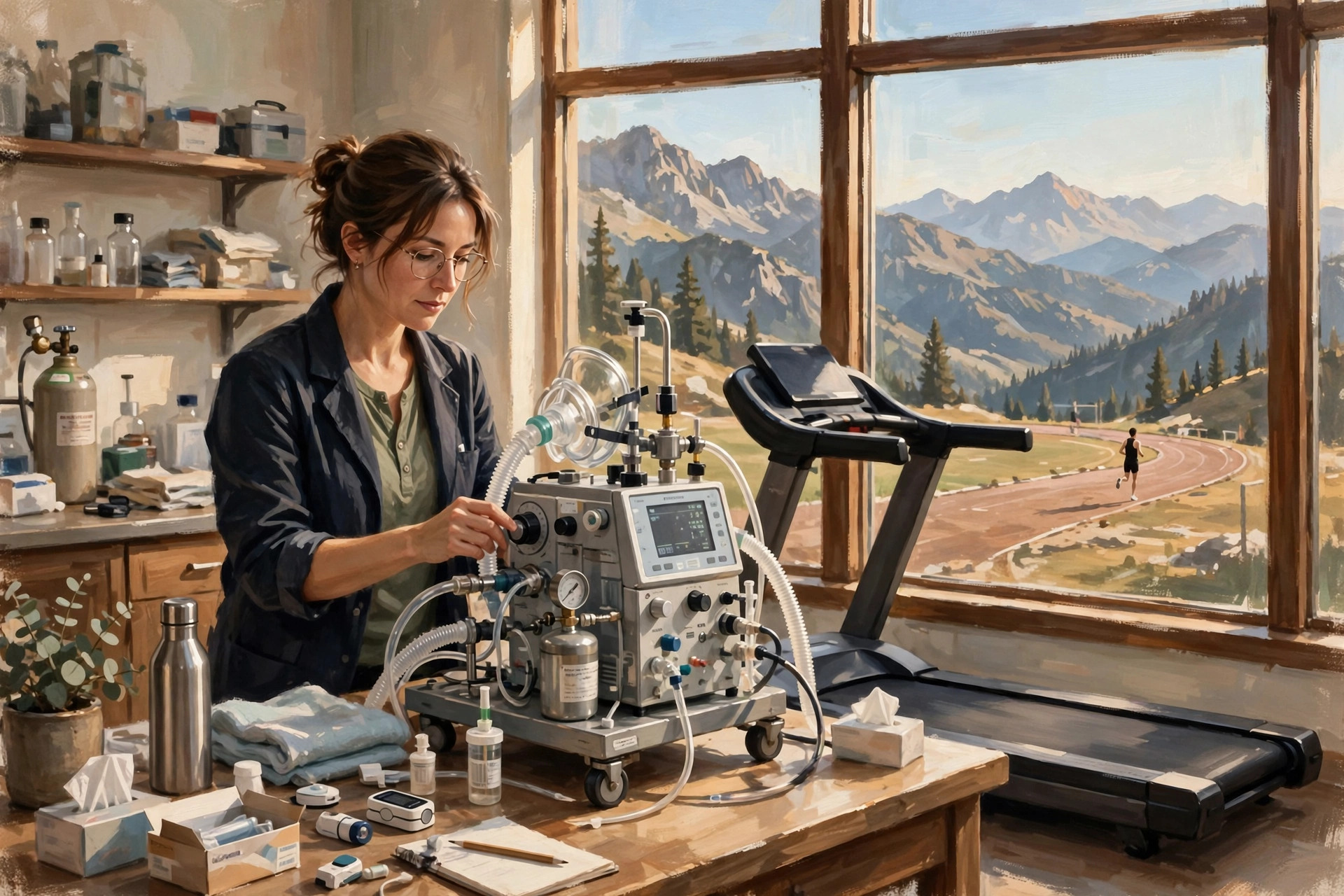
The ramp treadmill hummed like it had been waiting all winter for her, and Juno Adler supposed it had. Two years she'd run testing labs out of borrowed corners of the Cordate Endurance Center, hauling sensors down corridors in a milk crate. Today the crate stayed under the bench. Today the machines were bolted where she'd drawn them on the napkin she'd never thrown away: treadmill by the window, metabolic cart at its right hand, the whole arrangement angled toward the mountains so an athlete on the belt could see the ridgeline instead of a wall.
She'd labelled the day on the clipboard before she'd even put her bag down. Day 1. Forty-two days to the qualifier. Forty-two days for the center's flagship athlete to find a world championships standard or watch the season, and likely the career behind it, close on him like a gate. Ms. Harriet Cordate had been plain about the arithmetic at the contract signing. You get the lab you asked for, Ms. Adler. I get publishable performance data from Marsh. Real numbers, not vibes.
The 8 a.m. slot on Juno's schedule read D. MARSH — RAMP TEST, and the treadmill belt sat still and gleaming, which was its own kind of answer. She gave it twenty minutes. Then thirty. She recalibrated the gas analyser nobody was breathing into, twice, and then gave up on pretending and went looking for Pax Ono, who could be counted on to know where everyone in the building was hiding.
He was in the equipment room, counting cones onto a trolley with the resigned air of a man who had counted cones many times before.
'Pax. Marsh. Ramp test. Any idea?'
He didn't look up. 'You're new to him.'
'I've been here a year.'
'To him, you're new.' Pax stacked the last cone. 'He hasn't run a digital test in the three nights I've been here late. I lock the track lights at nine, and every night there's a set of prints on lane one before mine. Same cadence, every interval. Beautiful, honestly. Like a metronome.' He shrugged. 'He times himself. Old brass thing on his wrist. Won't let anything else near him.'
p>Three nights. Three empty evenings of a funded athlete avoiding the instruments her salary depended on. Juno took the lab stopwatch off the wall hook, its plastic casing warm from the window sun, and headed for the track.
The center's track sat at 2100 meters of altitude, a thin-aired oval the color of rust with the mountains standing behind it like patient witnesses. Devlin Marsh was the only thing moving out there, running lane one in the morning glare, and Pax was right about the metronome. Even from the gate she could see it: the hips level, the arms quiet, every stride landing on the same beat as the last. Twelve years in the sport did that to a body, or it broke it. Often both.
She waited until he came around to the home straight and stepped onto the apron. He pulled up beside her, breathing through his nose like the effort was a rumour about someone else, sweat darkening the collar of a shirt gone soft with age. His eyes went to the stopwatch in her hand first. Not her face. The stopwatch.
'Ms. Adler,' he said. 'The new lab.'
'You knew my name before I introduced myself. That's a good start. Your 8 a.m. slot missed you.'
'I don't do sensors.' He said it the way other men said I don't drink, a rule with a scar behind it somewhere. 'No masks, no belts, no carts. I run my intervals, I write my numbers down, and nobody's laptop gets a copy.'
'Nobody's laptop wants one.' She held up the stopwatch. 'This is it. Plastic, dumb, loyal. I press the button, it starts. I press it again, it stops. That's the whole surveillance state.'
Something crossed his face at surveillance, quick and then gone, filed away. She noticed the filing. She was beginning to build a file of her own.
'You're on my schedule for a reason, Mr. Marsh. You need a qualifier standard. Sixty-seven seconds a lap, every lap, for twenty-five of them, at altitude, at the end of a season. Nobody finds that on feel. The body lies to the ambitious.'
'The body lies to people who stop reading it in high school,' he said. 'I've been reading mine for twelve years. I know what a good session feels like, and I know what a bad one feels like two days before it shows up in anyone's cute little graphs.'
'Then your graphs would be right two days early. That's not an insult where I come from.'
He almost smiled. Almost. His wrist turned, unconscious, covering the brass stopwatch with his palm like she'd tried to take it instead of just look at it.
'You clock yourself,' she said. 'Every night, per Pax. So you already believe in numbers. You just want them to belong to you alone.'
'I want them to be true.' For the first time he looked at her instead of past her, and there was something underneath the flatness of his voice, some old weather in it. 'Numbers get shared. Numbers get sold. Numbers get read by people who didn't earn them, and then they decide things about you at a desk, and you find out from a newspaper. I'm not doing that again.'
Again. Not ever. She let that sit, because she had an again of her own, and hers had a hospital bed in it and a career that ended because somebody trusted a scoreboard over a son's wince. She kept her notebook for exactly that reason. Nobody read her margins. Nobody ever would.
'Here's what I can offer,' she said. 'One session. Me, this stopwatch, the track you already own. No sensors, no cart, no data leaving my hands. I hand-time your laps, you tell me what you felt on each one, and we see if my dumb plastic agrees with your twelve years of feel. If it doesn't, you never have to talk to me again, and I'll tell Ms. Cordate the lab tested you fine on my say-so.'
'And if it does agree?'
'Then I'm the only person in this building who knows what your bad sessions feel like two days early. And you get to decide whether that's a threat or an advantage.' She held the stopwatch out, flat on her palm, an offering with a button on it. 'Your terms for the morning. My stopwatch.'
He looked at it a long moment. Then, instead of taking hers, he unstrapped the brass one from his wrist and held it out. The case was polished to softness, the back plate engraved with worn initials she didn't lean close enough to read, the crown worn smooth by years of thumbs. It still held old laps in its face, she was sure, the way old wood holds heat.
'My terms, my watch,' he said. 'My grandfather had it made my first season running juniors. It's never once told a newspaper anything.' He set it in her palm, and the weight of it was startling, like being handed something alive. 'One session. Tomorrow, dawn. You time, I run, nothing gets written down that leaves this track.'
'Dawn,' she agreed, and closed her fingers around the brass. 'Wear something you can lie to me in, Mr. Marsh. I'll want your numbers honest even when your face isn't.'
He laughed then, one short note, the first she'd heard out of him, and started his cooldown without another word. Juno stood on the apron of the empty new lab's shadow, an old man's stopwatch ticking against her pulse, and thought: forty-two days. It felt, for the first time that morning, like enough.
Dawn Laps
The cold came through her gloves the way Pax had promised it would, and Juno stood on the infield at five to six with a brass stopwatch in one fist and her notebook under her arm, watching frost smoke lift off the track. Verano Springs sat two thousand one hundred meters above the sea, high enough that dawn arrived thin and bright, and Devlin was already on the far straightaway, gliding through his warm-up strides like the altitude owed him a favor.
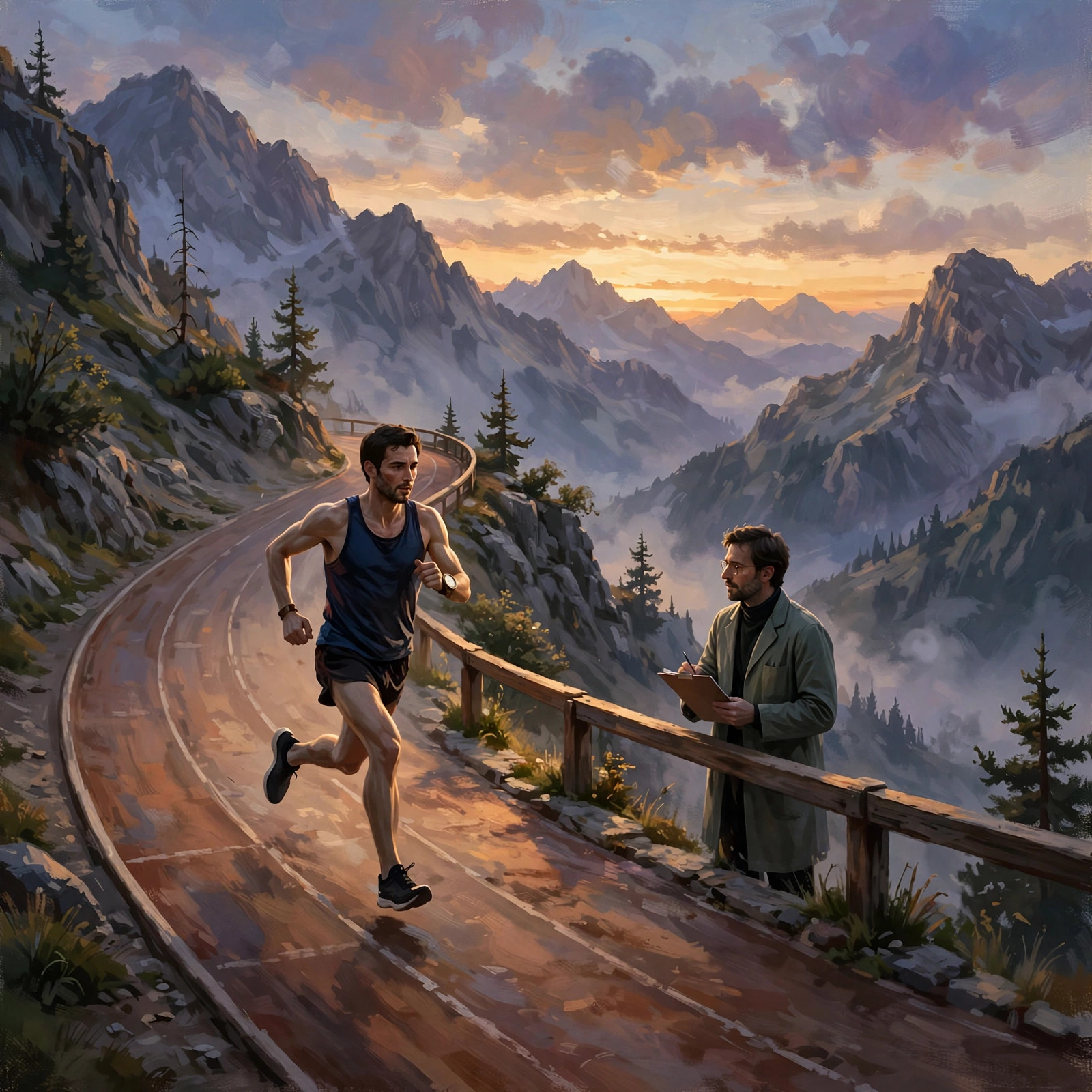
Pax had a thermos and a folding chair positioned at the finish line, which he called his office. "He's been here since five thirty," Pax said. "Third morning this week I've seen him out here in the dark."
Three solo runs before today's first session together. She wrote that down, then drew a box around it, because a man who runs alone before dawn is either dedicated or hiding something, and in her experience the two wore the same shoes.
Devlin jogged over, breath steaming. "You brought paper."
"I said I would."
"And no mask."
"A hand-timed baseline. Your terms." She held up the brass watch. "I kept it wound."
Something in his face loosened, a half-degree, like a bolt giving a turn. "Grandfather would appreciate that. Nobody winds a watch with cold fingers twice."
They started easy. Four laps conversational, four at what he called honest, four at what he called uncomfortable, and Juno called splits from the curb while Pax stood at the two-hundred mark and raised a hand each pass. She wrote every lap in the notebook: pencil, paper, her own ruled columns, nothing touching a server anywhere. The sun cleared the ridge and lit the track gold, and the more laps he ran the stranger her numbers got.
Because he was fast. Not gradually, measurably, spreadsheet fast. Fast in a way that made her check the watch face twice to be sure the brass hadn't drifted. On the uncomfortable set he sat at sixty-eight, sixty-seven, sixty-seven per four hundred meters, at altitude, in October, at the end of an hour, and when he finished he wasn't even bent over. He walked a cool-down circle with his hands laced behind his head.
She stared at the page. Later, in the lab, she'd put him on the ramp and get the machine's version of the same story, and the ceiling she'd measure there, the number she'd carry to Harriet as proof the lab earned its keep, would come in high, higher than his race plan assumed, higher than the season his coach had drawn up for him deserved. She could see the shape of it already from the laps alone. She closed the notebook on her thumb.
"Your race plan's wrong," she said.
He stopped walking. "Good morning to you too."
"I mean the plan you came here with. The negative split, hold something back until three to go, then grind. That plan is built for a runner with less engine than you have. You're sitting on more than the plan lets you spend." She tapped the notebook against her palm. "You could take it out earlier and you'd still have change left."
"Or," he said, "the plan's right and your eyes are generous. Hand timing drifts. No offense to my grandfather."
"I can read a stopwatch, Marsh."
"Can you read a lap?"
"I've read ten thousand laps."
"From the curb." He looked at the track, then at her feet, then, unexpectedly, at the bag on his shoulder. "You can't. That's not an insult. It's just true from the curb. So." He crouched, pulled his spare pair of racing shoes out of the bag, and set them on the frost-stiff grass in front of her. "Put those on. Run one lap. Not fast. Just a lap. I'll hold the watch, and you tell me after what you felt, not what you think."
"I'm in a down jacket."
"Then you'll be slow. That's fine. One lap."
Pax made a noise into his thermos that was mostly a laugh. She handed Devlin the notebook, unzipped the jacket and dropped it over his folding-chair territory, and laced up his shoes. They were half a size big, and they had been worn into a shape that was entirely not her foot, and something about wearing another person's shoes on a cold track at six forty in the morning felt more like a signature on a contract than any form she'd ever signed in the lab.
"From the line," Devlin said. He had the brass watch ready, thumb on the crown. "Go when you're ready."
She went. The first hundred felt fine. The second felt like the altitude had been waiting for her with its hand out, and by the back straight her legs were writing checks the thin air refused to cash. She came off the final curve with her arms all wrong and crossed the line wheezing, and the lap was slow, glacially, embarrassingly slow, and it did not matter at all because now she understood something the notebook had never told her: the back straight at this altitude was a liar. The air didn't feel hard there. It felt fine. It saved all its lying for the last two hundred, when the bill came due.
Devlin caught her elbow before she could sit down on the wet grass. "Walk. Don't stop."
She walked, gulping. He held the watch where she could see it.
"Now," he said. "What did the lap say?"
"That the second half costs more than the first half admits."
"There it is." He closed the watch into her hand, still warm. "That's what I'm asking my plan to do. Hold a lie for two hundred meters, then pay it off in the last lap with people around me who are better liars than I am." He shook his head, and for the first time he wasn't performing confidence, he was doing the actual arithmetic out loud. "So when you say take it out earlier. Earlier by how much?"
She walked another ten meters with it, breath coming back, and gave him a number she'd been holding since his third hard lap. "Three seconds a lap. Through two-thirds of the race. Then it's just you and whoever's left."
He was quiet long enough that she thought she'd lost him. "Three seconds is a cliff," he said finally. "If I fall off it, the season's done."
"If you don't spend it, the season's wasted. There's a difference."
The voice from the fence arrived before its owner did. "That's the spirit I fund," Harriet Cordate said, gloved hands folded on the rail, silver hair unhurried in the wind. Juno hadn't heard her arrive and suspected nobody ever did. "Juno. Five days in. Tell me you've got something for the file."
"You'll get your page," Juno said. "One page. On the schedule we agreed."
"I'm patient," Harriet said, in the tone of a woman who owned the building they were standing on. She looked down the track with an appraiser's eye. "Forty-two days, Devlin. The standard doesn't care how we feel about it." She tapped the rail twice, a small bell of farewell, and walked on toward the main hall.
Pax muttered something into his thermos that Juno chose not to hear.
Devlin watched Harriet go. "She ever come to the track before six otherwise?"
"Not that I've seen."
"Hm." He turned back, and the fence and the funder and the forty-two days all fell off him at once, the way a starting gun falls off a runner. "So. Three seconds. Through two-thirds. You'll be at the clock for the hard sessions, calling splits?"
"Pax on the lap clock, me on the brass, both of us writing paper."
"And if I blow up in week three and you're wrong?"
"Then we're wrong together, on paper, in my hand, and I rebuild the plan by Thursday."
He looked at her, then at the shoes she was still wearing, then held out his hand. "New pacing plan. Three seconds. Two-thirds."
She shook it. His grip was careful, the way a man shakes when he knows exactly how strong he is. "Deal."
Pax raised the thermos. "I'll get a bigger chair."
They stood there a moment longer than the shake required, both of them pretending to watch the frost come off the track, both of them, Juno suspected, privately and unscientifically pleased. She bent to unlace his spare shoes and thought: two thousand one hundred meters, forty-two days, one brass watch, and a plan nobody in either of their offices would believe. It was, she admitted, walking to the infield, the best baseline session of her career.
She wrote that down too, in the margin, where no summary would ever reach.
Storm at the Trailhead
Rest day meant different things to different people. Pax spent his on a bench by the equipment shed with a crossword. Harriet, Juno had learned in two years of sharing a building with her, spent hers reading contracts in the main hall with the blinds half-drawn, a woman for whom rest was a category error. Devlin, it turned out, spent his walking up the mountain behind Cordate Endurance Center, and on Day Twenty-one he arrived at the lab door at seven with rain two hours away in the gray and asked if Juno wanted to see the trail.
"Your legs are supposed to be off today," she said.
"They're walking. That's off enough."
She should have said no. She had eleven sessions logged, a notebook half-filled, thirty-one pages of margins in her hand, and a one-page summary due to Harriet by the end of the week that she had not started because the honest version of it was three pages and the deliverable version was one. She said, "Give me ten minutes," and went to find her jacket.
The trail climbed through aspen and then through pine, the track falling away behind them until Cordate Endurance Center was a white comma on a green page. At two thousand one hundred meters everything about Verano Springs got blunter: the light, the air, the wind that arrived without introduction. Devlin set a pace that pretended to be casual and wasn't, and Juno matched it and let him believe she wasn't matching it.
"You walk like you've been timed at this too," he said.
"Hiking in grad school. Field testing protocols. You carry an oxygen analyzer up a mountain enough times, you learn rhythm."
"You carried machines up mountains on purpose."
"Someone had to calibrate them."
"People like you," he said, "volunteer for that?"
"People like me don't call it volunteering. We call it Tuesday."
He laughed, short, and it loosened something in his shoulders that his races never did. She'd been watching those shoulders for twenty-one days now, in a clinical way, mostly.
The sky went from gray to a bruised shade of nothing good. Juno had grown up in flat country where storms announced themselves an afternoon early, and she kept forgetting that here they just dropped over a ridge like someone forgetting to knock.
"We should turn," she said.
"Five more minutes. There's an overlook."
"The clouds are coming in faster than you are."
"Nothing comes in faster than me."
The first thunder arrived eleven minutes later, close enough that the sound and the memory of it overlapped. Rain hit the canopy in one motion, the way a crowd stands up, and Devlin took her sleeve, not her hand, and said, "Overhang. Two hundred meters."
The rock shelf jutted out of the mountainside like a lip, dry underneath, deep enough for two people and one embarrassed silence. Rain came off it in a gray curtain. Juno sat on a flat place, jacket over her knees, and watched water sort itself into streams around their feet.
"You knew this was here," she said.
"I walk the trail most weeks. I don't love being indoors when I'm not being tested."
"You're a delight about being tested."
"I've been told."
The rain turned serious. Lightning, then a count of six before the thunder, then a count of four. Devlin watched the storm the way he watched the clock at the two-thirds mark of a race, measuring what it would cost him.
"Your left hamstring," Juno said. "There's something you do after hard sessions. When you think no one's watching. You press it, right at the top, and then you walk it off sideways for three or four steps."
He went still.
"It's nothing."
"It's not nothing. It's your power side and it's sixteen days before the hard block peaks and you've been hiding it since the first time I saw you run."
Rain sheeted off the overhang. Down-slope, the trail had become a small river with ambitions.
"When I was twenty-two," Devlin said, "my coach benched me at my peak. Told the media it was a 'precaution.' I had a tightening in my quad, and I told him about it, honest, day one, and it went into a file. That file went to a rival camp." He tipped his head against the stone. "My numbers showed up in someone else's training bulletin. So no, I don't put my hamstring in a database. Even one with your handwriting on it."
Juno looked at her own hands.
"My father ran," she said. "Professionally. Fifteen years old, faster than his own coach, and his team knew what was happening in his ankle by year three. He kept saying it was fine. They kept writing 'fine' in a file and running him anyway, because he placed. By the time someone actually looked, his career was over and he walked with a cane for a while."
Devlin turned his head.
"He's the reason I do this job. And he's the reason nobody sees my notebook. Raw numbers are dangerous, people believe them like they're scripture. 'Fine' written in a file ended a career. So I keep honest numbers where only I can hand them over, and I only hand them over if I decide it saves the athlete. Harriet gets a page. She'll only ever get a page."
The rain found a new gear. Something small and green, a pine seed or a torn needle, rode the water past her boot.
"So you never share your files."
"I've never shared a file."
"Not once."
"Not once."
"But you've asked me for everything."
"That's different," she said, and then heard how it sounded. "It's the same. I know it's the same. I'm asking you to trust me with exactly the thing my father's team used badly."
"And if I tell you about the hamstring?"
"Then I plan around it and nothing leaves this mountain. Tightness that gets respected costs you two easy days. Tightness that gets ignored costs you the season."
He pressed his palm flat against the top of his hamstring, right where she'd seen him press it, and described it quietly, in runner's terms, the kind of words that don't go in a summary: a pinch at the top, six weeks, never more than a four out of ten, never during a lap, usually after.
"After warm-down," he said. "Never after a good day. After fast days."
"Days like Wednesday."
"Days like Wednesday."
She nodded and didn't reach for the notebook, and she saw that he saw that.
The storm eased from violence to argument. Water dropped off the overhang's lip in fat single beats. He was closer than she'd planned, the rock having opinions about space, and he wasn't looking at the rain anymore.
"Your father," Devlin said. "Does he still run?"
"He swims now. Says water tells fewer lies."
He smiled at that, and there was a moment, a real one, thunderless, when the gap between them was a decision and both of them knew it. Her hand was on the stone between them. His was not on it and was moving toward not being on it.
She looked at the rain. He looked at the trail.
"Trail's going to be soup," he said, voice a half-step rougher than usual.
"Completely."
"Race in twenty-one days."
"Twenty-two. Qualifier on Day Forty-three."
"Twenty-two," he agreed, and stood, and offered her his hand, and it was a coaching hand, up, steady, nothing extra, and she took it and was professional about it for the entire length of the pull.
They ran the downhill through the rain, easy, both of them that rare thing, unhurried, the mountain doing the pacing for once. No watch. No notebook. No number taken, no number given. Juno's margins were back at the bench and that was where they stayed.
At the bottom, soaked and grinning, Devlin said, "Same time next rest day?"
"You're supposed to be resting."
"That was rest," he said, and jogged off toward his dorm with his hands in his soaked pockets, leaving her standing in the rain with her pulse doing things she had no intention of writing down.
The Clause on Page Three
The track at Cordate Endurance Center sat two thousand one hundred meters above the sea, which meant every fast lap up here was a small argument with the air, and Devlin Marsh had been losing that argument for twelve days. Today, Day Thirty-three, with ten days of racing left before the qualifier, Juno Adler intended to watch him win one.
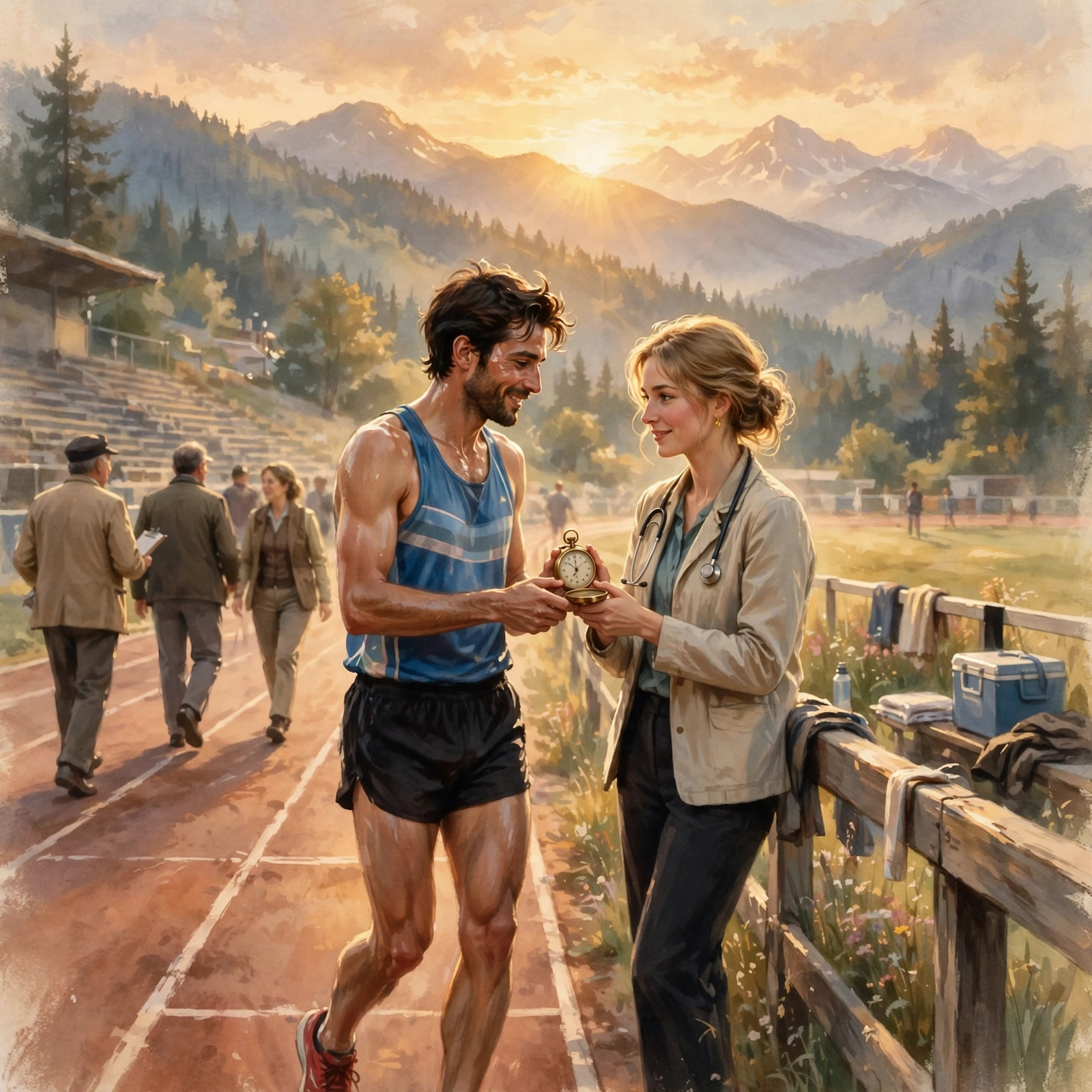
She stood at the rail with his grandfather's brass stopwatch in her palm, thumb on the crown. Pax Ono sat at the lap-clock table two meters away with the backup timer and a pencil behind his ear, because Devlin had made it a condition of the whole arrangement: hand timing, no sensors, and Juno holding the watch he trusted. She'd stopped pretending that was a burden around Day Twelve.
"Session four," she said. "Full distance at race plan. Three seconds a lap faster through two-thirds, then hold. You know the splits."
"Sixty-seven," Devlin said, rolling his left shoulder once, then his right. "I know the splits better than I know my own phone number."
"Then run the splits and forget the phone." She clicked the crown once to seat the mechanism. "On your call."
He walked to the line the way he always did, two breaths through the nose, one long exhale, and then he was gone, and the track was suddenly a very loud place, all by itself, with nothing on it but him.
His engine had tested higher than his season plan assumed. That was the whole quiet revolution of the last month, the number Juno had measured on the ramp in this same lab and never once put in a summary going anywhere but her own cloth notebook: seventy-four milliliters, a ceiling his old pacing had never even visited. He'd been racing the last third of his races like a man saving fuel he actually had. So the new plan spent it early. Three seconds per lap faster through two-thirds of the distance. Then hold.
He came through the first lap and Pax called it, "Sixty-six eight," and Devlin's stride didn't change, and Juno's thumb came down on the brass crown and up again, and the watch was so smooth it felt like it was agreeing with her.
Lap after lap, he kept the pace. Not perfectly. He drifted a half-second slow on lap six, and she saw him take it back on lap seven without panic, which was the thing you could never teach, the thing that separated the athletes who made a career out of this from the ones who made a season out of it. His left hamstring, the one that pinched after fast days, was behaving, and she knew from the trail on Day Twenty-one exactly how much that cost him in silence.
At two-thirds distance he was on the prescribed edge, breathing like a man spending money he'd checked was there, and then he did the beautiful, stupid, wonderful thing: he held. The last laps came through at sixty-seven seconds each, sixty-seven and change, sixty-seven flat, and Pax was calling every one and Devlin was hearing none of them, and Juno stood at the rail with the brass watch warm in her hand and her heart doing arithmetic she had no intention of recording anywhere.
He crossed the line and coasted into the infield, hands on his head, then bent, then straightened, and looked for her the way you look for a verdict.
"Tell me," he said.
"Session pace, hit within tolerance, every lap." She held up the watch. "Your grandfather's stopwatch says you're a different runner than you were a month ago."
He walked over, dripping, grinning in that sideways way he had, and put his hand out, and she put the brass watch into it, and he turned it over and read the engraved back plate with his thumb like a man checking a signature. "Sixty-seven a lap at altitude," he said. "On hand timing."
"On your timing," she said. "I just clicked it."
"You just clicked it." He laughed once, and looked at her, and there was nothing left between them to be professional about.
They went up to the lab office so she could print his taper sheet, ten days out from the qualifier, and the office was empty and smelled like paper and the coffee Pax had abandoned an hour before, and she was saying something about carbohydrate timing that she would never remember, and Devlin said, "Stop talking for one second, Adler," and she did, and he kissed her.
It was not a coaching hand.
She kissed him back with the brass stopwatch still in her fingers where he'd handed it over again, and for a moment the whole month rearranged itself in her chest, every dawn lap and every withheld number leading here, and she thought, with the specific panic of a woman who has been honest about everything except one thing: now. Tell him now.
She pulled back half a step. "Devlin. Before Harriet gets here, there's something in your file you should hear from me, the extension letter, the data rights, it's complicated and I should have,"
The door opened. Harriet Cordate came in with a folder under her arm and her reading glasses pushed up into her silver hair, saying, "There she is. I bring paperwork and I'm not sorry. Juno, the extension needs your signature today, the funder's been asking after it since last week."
Juno's mouth was still open around the sentence she hadn't finished. Devlin, standing a careful half-meter from her now, looked from Harriet to the folder. "Extension?"
"Lab funding," Harriet said briskly, setting it on the bench. "You've been the whole show, Marsh. Your numbers are why this place keeps its lights on. Sign it when you two are done celebrating, whatever it is you two were doing when I walked in." She was already turning for the door. "I've a call in Verano Springs. Pax, if you're up here, the lap sheets go in the cabinet."
Then she was gone, and the letter sat there, sealed no longer, and Juno said, "Devlin, wait," but he had already picked it up, because of course he had, because he was a man who read his own training files now, who trusted paper over machines, who had been burned by a coach who benched him and leaked him to a rival camp years ago and had promised himself no one would ever read his file before he did.
He read. She watched him read. Page one, funding. Page two, her contract, her salary, her lab. Page three, his own name in the data-rights clause, and the named recipient, a training camp three states from here that had poached Harriet's athletes before, and the phrase full biometric dataset, present and historical.
He didn't say anything for four full seconds, which was longer than any silence she'd ever shared with him.
"You knew," he said finally. Not a question.
"From the first week. Devlin, I was going to tell you just now, I was in the middle of telling you when she,"
"The notebook," he said. His voice had gone flat, runner's flat, the voice from lap ten. "The margins. The dawn sessions. The hamstring I never told anyone, the things I told you because nothing leaves this mountain." He held up page three. "It's in a contract, Juno. My file, sold, in a deal that was signed before you ever clicked that stopwatch."
"I never sent anything. Harriet gets one-page summaries, never raw numbers, I've been keeping your real file in my own hand, it was going to be different, I was finding a way out of the clause,"
"You had a month." He set the letter down on the bench, squared it against the edge with two fingers, the way a man does when he wants his hands to be gentle somewhere. Then he took the brass stopwatch out of her fingers, and she felt it leave, all the old laps in it, and his hand did not linger. "My grandfather gave me that watch because a machine lied about me once and a person told the truth," he said. "I thought you were the person."
"Devlin."
"Don't." He picked up his jacket from the back of the chair. "Ten days out. I'll run the standard. You can put that in your summary."
He went out through the track door instead of the hall, down the stairs, out to the oval where he'd just spent every lap he had. She watched him the whole way, past the lap-clock table where Pax stood up halfway and then sat back down, and Devlin crossed the infield without stopping, the brass watch on his wrist catching the late light, going away from her at a pace she could not have hit on her best day.
The office was quiet. The coffee had gone cold. Juno Adler stood at the bench holding the extension letter, unsigned, and it weighed a great deal more than three pages should.
The Torn Letter
Harriet Cordate did not knock. She never had, in two years of surprise visits to the altitude lab, but this time she came with a pen in her coat pocket and an end-of-day deadline, and Juno knew both facts before the office door had finished swinging.
"Four days," Harriet said, "and no signature."
"He needed time."
"He needs forty-three fewer days than you think he does. He needs a lot of things." Harriet set her handbag on the bench, next to the cloth notebook, and did not sit. "The rival camp's people arrive Monday morning to collect the dataset. That was the arrangement before your season even started, and it is the arrangement that keeps this lab's lights on. I need the signature today, Juno. End of day."
Juno looked at the letter where it had lain since Day Thirty-three, unsigned, its third page still creased from the pressure of Devlin's thumb. The room smelled like cold coffee and the lemon cleaner Pax used on the lap-clock table. Somewhere below, on the oval, she could hear a single set of footfalls, unhurried, a taper pace, going around the far turn.
"His full biometric file," Juno said. "Historical and present."
"Data is data."
"It's not." Juno heard her own voice go quiet, and she let it. "My father ran with a team that called his ankle data. Eighteen months of swelling, filed and summarized, and nobody read the margins. When the tendon went, the summary said manageable."
"I know your father's story. I funded you partly because of it."
"Then you funded a person who keeps margins," Juno said. "I've never sent you a raw file. Not once in two years. One-page summaries. You signed off on every one of them, and your camp ran fine."
Harriet's jaw worked once. "This is different. This clause is named in the extension. If it isn't honored, the lab closes at season's end, and your contract with it. I am not threatening, I am reading you my own paperwork."
"I've read it. I've had it memorized since the first week."
That landed. Juno watched it land, the way Harriet's hand stopped patting the pen through the wool of her coat. Four days Juno had spent not saying it, and now it was out, and it was worse aloud than it had been in the dark of the office at night, because Harriet said nothing for a long moment and then said, "You knew. All month."
"I was finding my way out of it."
"There is no way out. There is a signature or there is a closed lab. Juno, you wanted a funded lab of your own since the week you arrived in Verano Springs. I am offering you the whole thing. One signature on one athlete's file."
Down on the track, the footfalls had stopped. Juno could see him through the window glass, Devlin Marsh standing at the lap-clock table with his hands on his hips, talking to Pax, who was sitting up straighter than Pax ever sat. The brass stopwatch caught the afternoon light on his wrist. He'd put it back on. He'd come back up the mountain anyway, four days after leaving it, and Juno did not let herself think about what that meant yet, because Harriet was watching her watch him.
"He doesn't trust machines," Juno said. "A machine lied about him once and it cost him a season, and then his own coach leaked the file that proved it. That's the man whose data you're selling. He agreed to a baseline test on Day Five because I promised him nothing leaves this mountain."
"And you wrote that promise into a clause?"
"I wrote it into his margins."
Harriet followed her eyes to the window. Devlin had picked up the lap clock's clipboard, and Pax was pointing at something on it, and Devlin nodded, and set it down.
"End of day," Harriet said. "You know where to find me."
She went out through the hall, and her footsteps took the stairs slowly, the way a sixty-four-year-old woman's footsteps took stairs at twenty-one hundred meters, and Juno stood alone in the office with the letter and the notebook and about five hours of daylight.
She did not decide at the bench. She decided halfway down the stairs, and by the lap-clock table she was already certain, and she knew she was certain because her hands were steady for the first time in four days.
"Pax," she said. "Bring up the shared drive for me."
Pax looked from her to Devlin and back. "The lab drive?"
"The Harriet folder. The summaries." Pax turned the lap-clock table's little screen toward her, and Juno logged in with her own code, and Devlin watched over Pax's shoulder from two steps back, arms crossed, saying nothing, runner's flat, and she let him see every keystroke. Nine files. A season of one-page summaries, none of them raw, all of them hers. She selected all nine.
"Those are your summaries," Devlin said. "Your work."
"They're his file's shadow." She deleted them, and the folder came up empty, and Pax made a small sound through his teeth like a man watching a record fall. "The raw numbers were never on that drive. They were only ever in one place."
She picked up the extension letter where Pax had set it on the table's edge, someone had moved it down from the office, and she read page three one more time, the clause, the named camp, the words full biometric dataset, and then she took it in both hands and tore it across the clause. The paper gave with a short, clean sound, better sound than she'd expected, and she tore the halves again and laid the pieces on the table with the words facing down.
"That's my lab," she said, to Harriet's empty stairwell, to the mountain, to nobody. "Fine."
Devlin uncrossed his arms. "Juno."
"The lab closes at season's end if the clause isn't honored. She told you that upstairs. I saw her face when she came down those stairs, and I'm not pretending otherwise. I'm choosing the margins." She went and got the notebook from where Pax had carried it down, cloth-bound, corners gone soft, half-filled, two years of honest numbers, and she held it out to him across the lap-clock table. "Read page forty onward."
He didn't take it right away. He looked at her hands on it, at the tape on the spine she'd mended in the first week of her contract, and then he opened it where it fell open, which was the hamstring page, because the notebook knew its own habits by now.
Day Twelve. Left hip dropped a half beat on lap six, guarded top of hamstring on the stride afterward. Asked. He said shoes. Day Nineteen. Same guard, worse after fast days. Day Twenty-one, the trail, the day he'd told her. Finally admitted it. Recurring since before testing began. Build three seconds per lap of headroom into the pace plan so the last third is on tired legs he can trust. And after that, page after page, a taper. A real one. Volume dropping week by week in her own hand, every fast day placed where it wouldn't find his hamstring, rest where it would.
"Day Twelve," Devlin said. "You wrote Day Twelve."
"I watched you every session. You hide it well. I've spent my life learning what hiding looks like on a stride."
He turned pages. Six weeks of himself in someone else's handwriting, the margins full, nothing filed, nothing summarized, nothing sold. He stopped on the page with the race plan, three seconds per lap faster through two-thirds of the race, and then the taper, and the last entry, Day Thirty-seven, written that morning before she'd known he'd come back: He'll come back. His kind always comes back to the place where somebody told the truth. If he does, give him this and get out of his way.
Devlin read it twice. His thumb moved along the margin the way it had on page three of the letter, but gentle this time, and slower.
"You wrote this today."
"I wrote it at five this morning, in case."
"In case I what."
"In case you'd still want it."
Pax had gotten very interested in the lap clock. Devlin shut the notebook, careful with the soft cover, and held it against his chest with both hands, the way he'd held it when he'd handed it back to her once before, except this time he didn't hand it back.
"The qualifier's in six days," he said. "Day Forty-three, your count, not mine, yours is better. The taper in here, the one you built around my leg. I'll follow it. All of it, exactly."
"Okay."
"But the watch stays on my wrist. Hand timing only, no screens, no drive, nothing digitized between here and the line. Pax can hold the lap clock." He paused, and his voice came down off the flat. "And I want you at the table for every session that's left. Your hand on the watch with mine. You've got the better count, Juno. You always did."
Pax held out the brass stopwatch without being asked, and Juno took it, and it was warm from Pax's pocket, and the engraving on the back plate pressed its old worn letters into her palm.
"Dawn tomorrow," she said. "I'll bring the notebook."
"Bring the pen too," Devlin said. "You'll want the margins."
Finish Line, Lane One
The morning of the qualifier came up cold and clean over Verano Springs, the track frost-edged at the curves, the mountains holding their snow like they were being paid to. Juno got to the rail early, notebook in her jacket, pen clipped inside the collar where it wouldn't fall on a bend. Six days of taper sessions behind her. Six mornings of Devlin's watch and her hand on the same brass, his splits penciled in her margins, nothing anywhere a screen could read.
He was in lane one, bib pinned flat, doing the little ankle circles he did when he wanted to look loose. She had learned all his warmups by heart now, which was a strange kind of literacy, reading a man's whole history off eight inches of high-knee skips.
Pax came down the rail with the lap clock under one arm and the folder of heat sheets in his teeth, because he believed in free hands. "Wind's dead," he said around the paper. "Legal. Track's fast. He's got until seven forty in the first lap or the whole thing goes sideways."
"He's got until six sixty-eight," Juno said. "We're not building in slack."
"Right. No slack. I forgot whose margins those were."
Down at the blocks, Devlin looked over. Not a long look. Just a check, the way he'd checked the clock tower every session, the way he'd checked her handwriting on the rest days. She held up the stopwatch so the dial faced him, and something in his shoulders came down an inch.
He walked over. That was the part nobody told you about race mornings, how slow everything got when it mattered. He stopped an arm's length away, breathing like a metronome nobody else could hear.
"Give it to you now?" he said. "Or at the line?"
"Now. So my hands stop shaking before it counts."
He worked the strap off his wrist, slow, and set the brass in her palm, and closed her fingers over it with both of his. The plate was warm from his pulse. She had held this watch for six straight dawns and it had never once felt like it belonged to her until he did that.
"Grandfather bought it off a watchmaker who couldn't afford lunch," Devlin said. "First season I ran as a junior. He said, never let a machine tell you what you did." His thumb pressed the crown once, down and up, the way you'd test a door. "You're the only person I've ever wanted on it."
"Devlin."
"Sixty-seven a lap," he said. "You count. I run. Pax screams the last four hundred."
"I've heard him," she said. "The birds have heard him."
He laughed, short, and it cost him breath he'd need, so she let him go. He jogged back to lane one, and she put her thumb on the crown, and her hands, which had shaken through two altitude tests and one torn funding letter, went quiet the moment there was a lap to hold.
Harriet Cordate arrived at the rail halfway through the women's heat, in a gray coat with a center's worth of enamel pins on the lapel. She stood next to Juno, not looking at her, arms folded, watching the track the way funders watch things.
"Quiet week at the lab," Harriet said.
"Very."
"The extension went unsigned. I got the pieces back in an envelope. Torn through page three, if I recall the clause number right."
"You do."
"Your contract ends with the season, Ms. Adler. You knew that when you shredded my paper."
"I knew it when I read it," Juno said, eyes on the blocks, where Devlin was settling in, hands flat on the track, head down. "That's why I read it."
The starter raised the pistol. Juno's thumb rode the crown. Harriet said nothing for three full breaths, and then, quietly, in the voice of a woman who had outlived every argument she'd ever lost: "The rival camp pulled out of that deal Tuesday, you know. Found out their own data buy was built on a lie. Poetic, of a sort."
The gun went off.
Devlin came out clean, third through the break, no panic, boxed politely out of trouble by the second hundred. Pax's clock showed the lap split and Juno called it under her breath, "Sixty-five," and Harriet, without being asked, said, "He's not paying for that yet."
"He is," Juno said. "Watch lap three."
Lap three cost him. She could see the top of the left hamstring load the way it always loaded, the stride shortening a centimeter where nobody else in the stands would find it, but she found it, because finding it was six weeks of dawns, and her margin notes, and the taper that kept the fast days away from that leg until it had no debts left. He came through at sixty-six flat and did not fight for the lead, which was the plan, which was the exact sentence in her notebook: Let them go at eight hundred. He'll be there at four.
"He's falling behind," Harriet said.
"He's falling into place."
Harriet glanced at her sideways. Juno didn't take her eyes off lane one. "You've got a whole book of him in there," Harriet said. "I've watched you write in it. Every session, every morning, even the ones he skipped."
"Three sessions he skipped."
"Before dawn. I know. I was at the track at four most of those days." A pause, one lap long. "My athletes get poached, my data gets sold out from under my own roof, and the one honest scientist in this building tears up my money to keep a man's hamstring off a server." She unfolded her arms. "Don't look so noble. I tore my hair out all week."
Bell lap. Pax's voice cracked across the infield, "FOUR HUNDRED!" and the crowd did that thing crowds do when a man in lane one starts to move.
"Two laps," Juno said to herself, thumb steady, watch running, sixty-seven's whole arithmetic narrowing down to a bend.
Devlin went. Off the final curve he was second, then the leader's shoulder, and Harriet gripped the rail, and Juno gripped nothing, her hands full of brass and his whole season, the engraving pressed into her palm like a word she could finally read.
She hit the crown on his chest-crossed stride and looked at the dial and knew before he knew. "He's got it," she said. "He's got three seconds."
He had them. He took the line full and upright and unpretty, chopping four steps to fall through it, and the time on the board came up and the crowd noise arrived late, the way it always does at altitude, and the qualifier standard sat there in lights next to his name with room under it.
Pax was already on the infield with the clock held over his head like a harvest. Harriet exhaled through her teeth, a long considered breath, and said, "The lab reopens Monday. Your name over the door, your contract terms your own. I'll sign whatever you put in front of me, so long as you keep the notebook private." Her voice dropped, meant only for the rail between them. "I'd rather lose a dataset than a scientist. Don't quote me."
"It's not in my notebook," Juno said. "Yet."
Devlin came off the track with his hands on his knees, then not, straightening, finding her through the officials and the volunteers and the sudden small crowd of people who wanted to have been behind him all along. He stopped in front of her, soaked, breathing in debt, eyes bright as a held lake.
"Tell me my laps."
She told him, all of them, every split in order, and his face went through each one like weather. When she reached the last lap he closed his eyes on the number.
"Your count," he said. "Better than the board."
Then he took her hand, the one with the watch in it, and didn't take the watch. He folded his fingers over hers and over the crown and over the still-running dial, so their two hands held it together between them, warm brass and a pulse apiece.
"I've got a season now," he said. "Maybe two, on a good leg. And you've got a name and a book full of honest margins, and apparently a building, because I heard her, don't argue." His thumb moved over the crown, gentle, the way he'd touched the pages of the notebook. "Build it. Your lab. Your own. I'll be the legs, you be the count. Nobody's file goes anywhere either of us doesn't sign for. Partner."
"That's a business plan," she said, "delivered in lane one."
"It's the only place I ever say anything true standing still." His grip tightened over their hands, over the watch, over the seconds still ticking up in the space between. "Come on. There's a whole infield between us and Pax, and he's going to hug me whether you're holding on or not."
She laughed, and didn't let go, and the two of them went up lane one's finish line together with the stopwatch still running between their hands, and she never did stop it. It sat at some small unhurried number, ticking, and she let it tick, because that was the whole point of brass: it kept what you did, not what a machine thought you did, and what they had just done, together, on a cold clean morning in Verano Springs, was going to need a whole fresh margin.
Get notified when new stories drop
Noah Carrington
Noah covers sports romance and forced-proximity heat: rivalries, road trips, and the quiet moment after the crowd goes home.
Leave a comment
Comments