



The Flour Bag

The lawyer's office smelled like paper and cold coffee, and Delia Voss sat with her hands folded in her lap while a man in a gray tie read her grandmother's last wishes out loud.
"To my granddaughter, Delia Marie Voss, I leave the Morning Crumb bakery, the building and the business entire, along with its debts."
Its debts. Delia kept her face still. Twelve years of city kitchens had taught her that much, at least. She'd flown home with one suitcase and a black dress, expecting a funeral and a headache, and had been handed a ledger instead. The lawyer slid an envelope across the desk. Inside was a brass key on a fob of river glass, green as a bottle found low in the water. She knew it instantly. It had hung from Ruth's apron her whole childhood, catching the oven light.
"There's a condition," the lawyer said. "Ruth wanted it read plainly."
"Ruth always wanted things read plainly."
"The deed passes free, in full, if the bakery remains open and trading through one Lantern Night. If it doesn't, the parcel goes to the estate's remainder beneficiaries." He cleared his throat. "Lantern Night falls six weeks from yesterday. Forty-four days."
Forty-four days to run a bakery she hadn't set foot in for three years, in a town she'd left at twenty-two and only visited in short, guilty bursts. She turned the key over in her palm. The glass was warm from her own hand.
"And if I just sign whatever paper makes it simple?"
"Then it isn't yours, and neither is the choice."
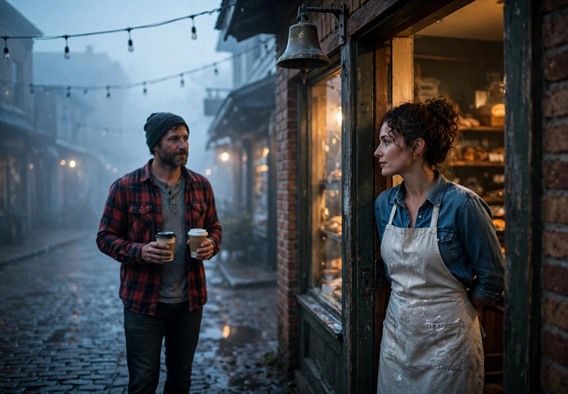
Mayor Nadine Falck was waiting on the sidewalk outside, which surprised Delia until she remembered that nothing in Aldervale happened without half the town knowing by lunch. Nadine had run Lantern Night for six years now, ever since Ruth's knees got too bad for the riverside green, and she looked at Delia the way people look at a jar they're afraid to open.
"I heard," Nadine said. "I'm sorry. She talked about you every week, you know."
"I know." She did know. It was the knowing that stung.
"Forty-four days," Nadine said. "The town can hold its breath that long. Can you?"
Delia didn't answer. She walked instead, down Mill Street, past the shuttered hardware store with its painted window letters, SORREL & SON, and the empty lot where the feed store used to be, and there it was: the Morning Crumb, narrow and two-storied, brick the color of strong tea, the awning furled, the front windows papered over from the inside. A FOR NOTICE paper had been pasted at the corner of the door frame. She didn't read it. She didn't want to know yet.
She went around the side, into the alley, because the front door felt like too much, and stopped.
There was a man in her alley. He was crouched at the cellar bulkhead with a tape measure stretched along the brick, and a clipboard leaned against the wall beside him, and a chalk line ran fresh and white across the courses of her foundation like a cut someone had started drawing on her skin.
"Excuse me," Delia said. "That's my wall."
He stood. He was tall, with sawdust in the brown hair above one ear and a carpenter's pencil tucked behind the other. His boots were scuffed at the toe and his flannel had a tear at the elbow that had been mended with tiny, careful stitches. He looked at her, then at the chalk, then back at her, without a flicker of apology.
"It's also a bearing wall with a bowed courses problem," he said. "I'm measuring it."
"You're measuring it for whom?"
"For the survey." He said it like the word explained itself. "You'd be the family, then. The granddaughter."
"I'd be the owner." She hadn't meant to say it that sharply. The key was still in her fist, and the river glass bit into her palm, and she loosened her fingers around it. "Nobody chalks my grandmother's wall without telling me why."
"The wall doesn't care who owns it." He wiped his palm on his thigh, half a greeting that never got finished. "Asher Kell. I'm doing the structural survey for the block. Standard work."
"Standard work on my building." She looked at the chalk line. It ran level and clean, drawn by a steady hand, and there was something about its neatness that made her angrier than a sloppy one would have. "Who's paying for a survey of a bakery that's been shut for a month?"
"That part's not mine to say." He crouched again, picked up the clipboard, and she saw the pages of it, typed, tidy, headed with an address. Her address. He tilted it away from her without seeming to, just a small turn of the wrist, and something in that small motion landed under her ribs like a stone in shallow water.
"Fine." She stepped back. "You've got a job. I've got a funeral to finish. We don't have to like each other."
"Didn't ask you to." But he paused, and looked up at her from under the bulkhead edge, and his voice came out different, quieter. "I'm sorry about Ruth. I only met her the once, but she fed me anyway. Wouldn't take anything for it either."
That was exactly the sort of thing Ruth would do, and it was the wrong thing to say to Delia just then, because her eyes burned and she had no intention of crying in an alley in front of a stranger with a clipboard. She walked away down the alley without answering, and she heard the tape measure zip back into its case behind her.
"Hey," he called after her. "The chalk. It'll wash off."
She didn't turn around.
The back door was swollen with a month of damp, and she had to put her shoulder into it, and then she was inside the kitchen she'd learned to braid dough in, standing in the smell of cold flour and old oil. Everything was where it had always been. The long oak counter. The proofing shelf. The oven, cold as a shut mouth. On the counter, Ruth's ledger sat open with a pencil laid across it, and the last page of entries ran down the left side in Ruth's upright hand: flour, oil, repairs, repairs, repairs. Delia added the column twice to be sure she'd read it right, and then sat down on the flour bag that served as the corner stool, because her knees had gone strange.
Seven thousand four hundred dollars. Ruth had been carrying that, quietly, for months, and baking all the while, and never once said a word about it on the phone.
"You stubborn, stubborn woman," Delia said to the empty kitchen, and her voice cracked in the middle of it.
A knock came at the alley door. She opened it on Gil Sorrel, sixty-some and stooped in the shoulders the way men get who've lifted sacks for thirty years, holding a paper sack of his own in both hands like it was a live thing.
"Heard you come in," Gil said. "I was next door counting stock." He looked past her at the kitchen, and his face did something complicated. "Shutters down a month and it still smells like her in there."
"It does." She held the door. "Do you want to come in?"
"Can't stay. But this is yours." He handed her the sack. It was heavy, and inside was flour, good flour, stone-milled, the kind Ruth had bought from him by the sack for as long as Delia could remember. "She'd want you to have it on hand. For the loaves."
"The lantern loaves."
"Three hundred, every year, out of that mold of hers. Whole town gets one." He rubbed the back of his neck. "You were gone a while, Delia. Nobody here blames you for that. But nobody here's Ruth, either. You understand what I mean."
She understood exactly what he meant. She held the flour sack against her chest and couldn't find a single word in her.
"Forty-four days," Gil said. "I can still read a calendar. If you're staying, I'm glad. If you're not, I'd rather hear it from you than from the mail."
"I don't know what I'm doing yet, Gil."
"That's the first honest thing anybody's said to me today." He patted the doorframe twice, gently, the way you'd pat a horse. "Lock up. That alley door's been sticking since the spring."
She locked it behind him and stood alone in the kitchen while the light went from white to gold through the papered windows. Then she took the brass key to the front door, worked it into a lock that had gone stiff, and turned it. The door opened onto Mill Street at dusk, onto the lamplight coming up and the swallows going over.
On the proofing shelf, wrapped in a flour sack much like the one Gil had given her, something long sat dusty and patient. She lifted the cloth away. Cherrywood, dark as garnet, oil-finished, carved in the shape of a river lantern. Her grandfather's hands had made it before she was born, and every Lantern Night of her childhood it had turned out three hundred loaves shaped like little lit boats.
Delia sat down on the flour bag with the mold in her lap and the key still in her hand, and for the first time since the funeral she let herself cry, quietly, in her grandmother's kitchen, with the door unlocked and the town going by outside.
Forty-four days. She could hold her breath that long.
Shutters Up
Delia was on a stepladder at six in the morning, working the first shutter loose with a flat knife, when the hinge pin finally gave with a sound like a held note let go. The shutter swung wide. Light ran down the inside of the glass and lit the whole front room dusty gold, and she stood there in it with knife oil on her fingers and thought: eight days. Eight days since the will reading, and this was the first morning the bakery had looked like a bakery instead of a held breath.
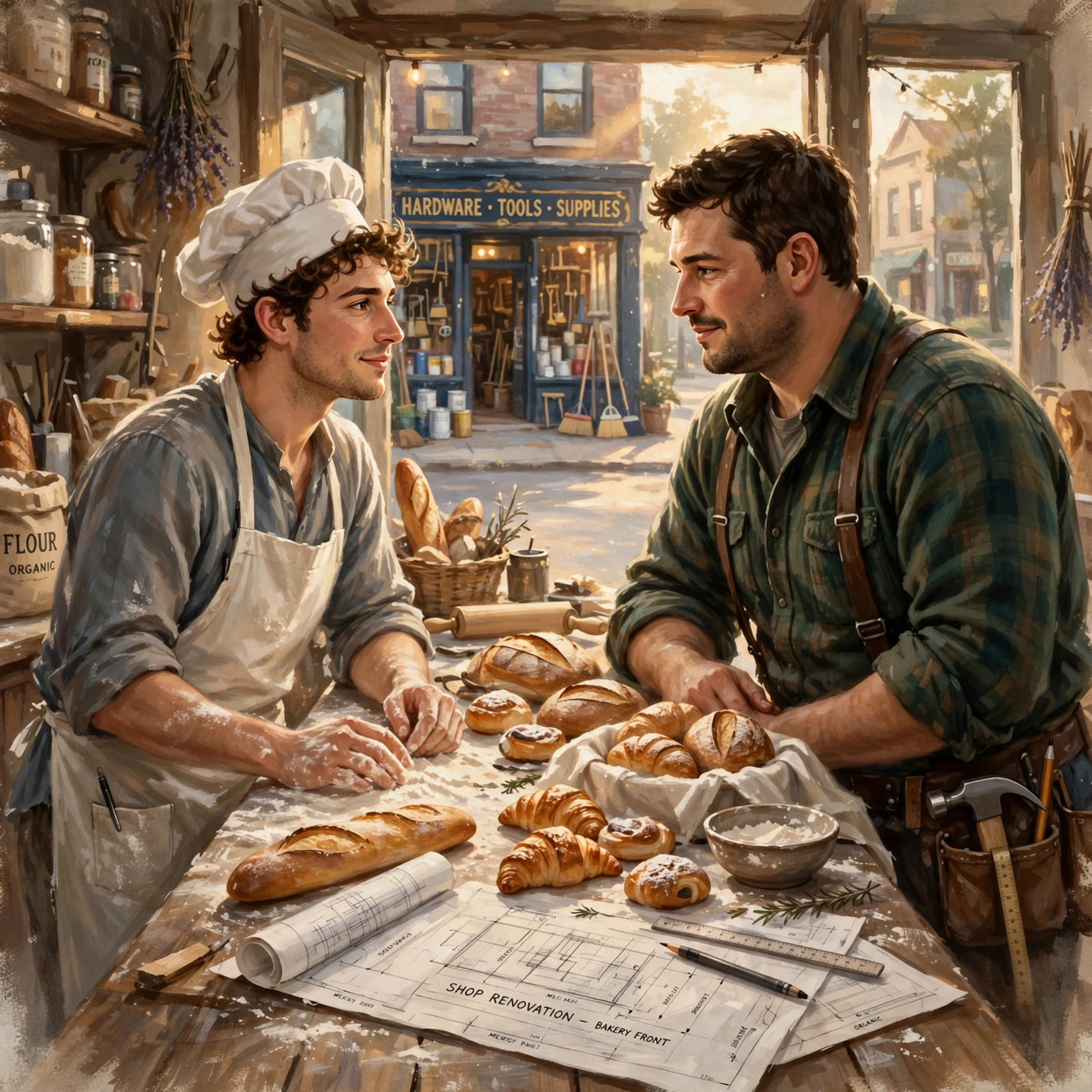
She'd spent the week the way she'd spent twelve years of prep shifts, list to list. The ledger's red had told her the truth in Ruth's own hand: seven thousand four hundred dollars in overdue repairs and supply bills, the furnace man paid late twice, the flour merchant carrying them for months. She'd written letters to half of them already, and the flour merchant had written back one line, Settle when you're trading, Ruth's account stands, which had made her sit down on a flour sack again in the middle of the kitchen.
She unlocked the front door at seven and propped it with the brass key's twin, a smooth river stone Ruth had kept by the register for exactly this. Then she did what she knew how to do. She lit the ovens, rolled dough she'd mixed at four in the morning, and put out the old chalkboard with a new line at the bottom in her own handwriting: Open. Bare shelves. Good bread.
Gil came first, because Gil had come first for thirty years. He had the day's flour order on his shoulder, one sack of the stone-milled, and he set it down inside the door and looked around the room the way you look at a patient who's sitting up again.
"Shutters up," he said.
"Shutters up."
"Your grandmother did that same face, you know. When she was pleased and didn't want anyone to clock it." He tapped the counter twice. "I'll take a roll and whatever's in that basket that smells like her apricot ones."
"Apricot, yes. And the rolls are two dollars now, not like when you started the account."
"Inflation," Gil said gravely, and counted out exact change anyway, coin by coin, and left a tip in the jar that was clearly more than the roll.
The coffee crowd came in slowly, then all at once, and Delia worked the counter with her hands remembering everything the rest of her had been afraid to. Then the bell over the door gave its crooked little ring and Asher Kell came in with a paper cup of gas station coffee he plainly hadn't finished, took one look at the chalkboard, and set the cup down on the counter like a man surrendering a weapon.
"Is yours better than that?"
"Mine is better than anyone's," Delia said. "But you're holding evidence of bad taste."
"It was early. I've been up since five." He said it easily, and she filed it away, because what surveyor was up at five, and where, and she didn't ask, because the week had taught her that asking led to towns and towns led back to her list of reasons she'd left.
She poured him coffee in a real cup. He drank it standing, jacket on, and she noticed he kept his clipboard in his hand rather than set it down, the way a man holds something he isn't done with.
The shelf behind the register chose that moment to let go. It had been leaning for years, she could see the old shim marks, and now the bracket gave a dry crack and the whole run of it sagged, jam jars sliding.
Asher moved faster than she'd have credited. He got a hand under the shelf, took the weight, and held it while she rescued the jars two at a time.
"Your bracket's split," he said. "Through the screw line. It's been coming."
"Everything in this building's been coming for twenty years."
"It's been carrying past what it should, is what it's been doing." He lowered the shelf to the counter, gentle, then crouched to look at the wall. "You've got a stud right there. Someone just missed it. Probably in a hurry, probably in about 1970." He was already pulling tools from his jacket pocket, a driver, a scrap of hardwood. "Give me ten minutes."
"Give me ten minutes and I'll charge you for coffee and a show."
"Then we're even." He said it without looking up.
He was there closer to twenty minutes, and he didn't charge her, and she stood at the register watching him work and understood she was watching a man do the exact thing her week had been made of, small rescues nobody had asked him for. When he set the shelf back on its new bracket and pressed down on the run of it with all his weight, it didn't move at all.
"What do I owe you?"
"Nothing. It's a shelf."
"It's twenty minutes and a hardwood block."
"Then I'll buy two more coffees this week and we'll call it square." He wiped the driver on his jeans and slid it into his pocket. "That's the going rate in Aldervale, I'm told. I'm still learning the local currency."
Gil, back for his second coffee, which she suspected was a tradition she'd interrupted rather than started, settled onto a stool with the whole afternoon on his face.
"A year in town and you're fixing the Morning Crumb's shelves," Gil said to him. "You know what this place is?"
"A bakery."
"It's where every kid in this town got their first heel of bread with butter, free, if their mother was late and they were hungry. Ruth's mother did it before her. Delia here did it too, when she was small enough to sit on that counter." He tipped his chin at the counter Asher had just braced. "That's what it is. It's the place that doesn't check whether you're good for it."
Delia kept her eyes on the cups she was washing. The water was too hot and she didn't move her hands out of it.
"I'm not from here," Asher said. "But I've lived in towns that had a place like it, and towns that didn't."
"Then you know," Gil said, "which kind of town you'd rather work in."
It landed. Delia saw it land, a small stillness in him, the kind she recognized because she'd been carrying one all week. He finished his coffee and thanked her and went out with his clipboard under his arm, and she watched him go down Mill Street without knowing why she was still watching.
The bell rang again at four. Nadine Falck came in with her mayor's sash nowhere in sight, just a cardigan and a canvas bag, and she bought three rolls and stood at the counter eating the first one right there, which Delia remembered her doing at every funeral lunch of her childhood.
"You're trading," Nadine said. "Good. I've been waiting to see the sign."
"Bare shelves," Delia said. "But trading."
"That's all the law asks of a trading business." Nadine brushed crumbs off her fingers, and then her voice went from warm to official by half a degree. "You know about the heritage roll?"
"Ruth used to talk about it. The town list. Protected buildings."
"Protected, eligible for repair grants, and very difficult for anyone to buy out from under. The Morning Crumb is the oldest continuously trading business on that block. I can place it on the roll before the next council, and I intend to. But the roll needs a sound-building certificate. A licensed surveyor, structural, who'll sign that the building's sound." She set her hand flat on the counter. "Do you know one?"
Delia thought of a man with a driver in his jacket pocket, pressing his whole weight on a shelf he'd fixed for free.
"I might," she said. "I'll ask."
"Ask soon. Councils move slow and paperwork moves slower." Nadine gathered her bag, then paused at the door. "She'd have liked seeing you behind that counter, Delia. She talked about it like it was already true."
Delia stood alone in the front room after the bell stopped, with the day's till heavier than she'd expected and the apricot smell still in the air.
She found Asher outside at five, on the bench by the lamppost, going over his clipboard with a pencil. She hadn't meant to go out. Her rule, the one she'd kept since the first city kitchen, was that you didn't owe anyone, and you didn't ask, and you didn't lean. She'd broken it once today already over a shelf.
"The cellar beams," she said. "Are they sound?"
He looked up. "I haven't been in your cellar."
"There's a first time."
He looked at her for a second, then at the pencil in his hand, and something in his shoulders settled. "I could check them properly. Tomorrow, after your morning rush. No charge. I'll bring a light and a tape." He closed the clipboard on whatever he'd been writing. "You'll want it in writing if it's for the heritage roll. I can write a letter that says what a building is."
"Why no charge?"
"Because you're trading again and the whole street knows it, and because I fixed a shelf this morning and I'd like to know the floor under it isn't going anywhere." A pause. "And because I want the coffee here to keep existing. That's the whole of it."
She thought about the list of reasons she'd left, and the shorter list of what she'd come back to, and how both lists had a hole in them shaped like a man who showed up at five with a clipboard and didn't ask anything of her.
"Fine," Delia said. "But I'm paying you in apricot ones, and if you refuse again I'll take it personally."
"That's a rate I can live with," Asher said, and she went back in to lock up, and left the cellar door unbarred for him.
The Test Loaf
Eight days of trading had put a rhythm back into Delia's hands. She kneaded at five, pulled the first trays at six, and by half past seven the regulars had names again, faces she'd known as a girl and relearned as a stranger with flour on her sleeves. On the eighth evening she stayed late, because the mold was waiting.
She unwrapped it on the long bench by the ovens: the cherrywood lantern her grandfather Edwin had carved in 1987, oil-finished, worn smooth at the handles where Ruth's palms had polished it for decades. Thirty-seven years in the family. She washed it slow, dried it in a towel, and oiled it the way Ruth's margins had instructed, every groove, every rib of the little paneled sides.
The bell over the front door rang at eight, which was late for anyone but Asher.
"You're still lit," he said. "I saw the windows from the bridge."
"I'm testing a loaf. The lantern one. For Lantern Night." She said it and heard how it sounded, a stranger claiming a tradition, and kept her voice steady. "Ruth's ledger says three hundred loaves, every year, one mold, batch after batch. I'd like to manage six."
"Then you'll want the cellar looked at while you bake. Floors carry weight." He held up a tape measure and a hand lamp. "You said I could."
"I said you could check the beams. Go on down. Mind the third step, it rocks."
He went. She mixed the dough by feel, half of Ruth's measurements in her wrists and half on the card, and listened to him move below her, the lamp's glow swinging stripes across the cellar hatch. When the dough had rested, she cut a piece to the mold's size, pressed it into the oiled lantern, and set it to proof on the warm shelf above the oven.
The tape snapped loud downstairs. Then again. Then a long silence.
"These beams," Asher called up. "Who put them in?"
"Edwin, some of them. The rest are older than the town's paved road."
More snapping. She heard him mutter something, a number, and then nothing.
"Come up when you're done confusing yourself," she called.
He came up with his tape looped and his lamp off, and there was a crease between his brows she hadn't seen before. "They're sound," he said. "Full dimension, dry, tight at the joints. I'd put a floor on them without a second thought."
"That's good news."
"It's odd news." He set the lamp on the bench, careful of the flour. "Somebody's been calling this cellar trouble. There's a draft report going around that says the beams down there don't carry their own weight." He rubbed his thumb along the tape's edge. "I've read it. I've been half-writing it. And it doesn't match what I measure when I actually measure."
Delia wiped her hands and didn't answer at once. She'd spent twelve years in kitchens learning that when a man said half-writing, there was a whole sentence underneath it. "Whose report?"
"A job's. I do surveys, letters, structural letters, whatever the brief says." He said it flat, and she watched him decide to leave it flat, and let him. "The beams are the truth I can sign my name to. That's what I'll write."
The loaf was rising. She turned to check it and felt the heat of the ovens on her back, familiar as a held-out hand. "Show me your hands while we wait," she said. "The scars. I'll trade you."
He looked surprised, then held them out. The right palm had a long pale seam. "Table saw, my second year on sites. I was rushing, the foreman wanted the day closed out. Rushing costs skin."
"Mine's a sheet pan." She showed the shiny mark along the inside of her wrist. "Sixty portions of a torte, one o'clock in the morning, a chef who'd left already and a kid who hadn't learned to say no yet. I learned that night." She turned her wrist in the oven light. "I also learned that burns teach faster than chefs."
"Is that why you stayed in the cities so long?"
"One reason." She didn't give him the others. "Yours? Why move every year?"
"Gig to gig. You follow the work, you don't ask the work questions." He shrugged like a man shrugging off rain. "This year I wanted one contract, one town, a full twelve months. I thought I'd found it."
She almost asked who had it. The words were on her tongue and she swallowed them, because asking would mean leaning, and her rule was old and load-bearing. Instead she said, "The loaf's ready," and turned it out of the mold onto the peel.
The lantern shape held. Ribs, panels, a little crown where the handle ring would go after baking. Asher leaned in to see it and his shoulder came against hers, warm through flour-dusted cotton, and neither of them moved away.
"That's not bread," he said. "That's a lamp."
"It's a loaf pretending to be a lantern. On Lantern Night everyone on the green carries one, and when the mayor's finished reading the names, you break it and share it. Ruth fed the whole town this way. Three hundred, she wrote, every single year, like it was nothing."
She slid it into the oven, and the oven door stuck, the way it had stuck all week, and she yanked it with the heel of her hand, the way she had all week.
"Hold on," Asher said. "That hinge is sheared. One screw's doing three jobs."
"It's done it for years."
"It doesn't have to." He was already at his bag, already coming back with a driver and two screws and a scrap of brass shim. "Hold the door."
She held it. He worked under her hands, close, patient, the little shim seated where the hinge sagged, screws run in clean. The door swung shut like it had been oiled, which, she realized, watching him, it partly had been, by the warmth of the room and the grease of a thousand loaves.
"Try it."
It opened. It closed. It didn't stick.
"Ruth would've kissed you," she said, before she'd weighed it.
"I'd have taken it as payment." He straightened, and he was near enough that she could see he hadn't shaved since morning, and she stepped back to the peel and the heat and the smell of the crust beginning.
They ate the test loaf at half past ten, torn warm at the bench, butter from the walk-in, the lantern's crown broken off first because that was the rule, apparently, the crown goes to the baker. He gave her the crown without being told.
"Three hundred," he said, looking at the crumbs. "That's not six batches. That's a plan. Proofing space, oven schedule, hands."
"I know. I've been doing the arithmetic all week and it keeps coming out short."
"Then I'll come the night before and count with you. Lantern Night's eve. We'll map the batches on paper before we're both asleep in the flour."
"You'd give up an evening."
"I'd give it to this room," he said, and looked at the ovens like they were a view.
She should have told him then. The will, the condition, the whole shape of what the bakery had to survive, the reason three hundred loaves mattered more than bread ever had. The sentence was built and ready in her chest, and what stopped her wasn't caution, exactly. It was the old arithmetic: tell a man what you need from him and you've handed him the knife to leave you with. He had a contract somewhere, a year he wanted, a brief she hadn't seen. If he knew the bakery was a wager with a deadline, he'd be kind about it. Kindness was fine. Kindness didn't stay.
"The night before," she said. "Bring your appetite. Payment in loaves."
"Same rate," he said, and packed his tape, and at the door he paused. "Delia. The beams are sound. Whatever the paper says, whatever anyone wants the paper to say, I'll write what the tape wrote. I don't sign things I haven't measured."
She stood in the warm room after the bell, with the lantern mold washed and oiled and ready, and the door swinging sweet on its repaired hinge, and she wanted to believe him the way she'd wanted nothing since the lawyer's envelope. She washed the last pan instead. That, too, was Ruth's way.
The Letterhead
The second test loaf went in at nine, and by ten the whole bakery smelled like Lantern Night had come twenty days early and moved into the walls. Delia turned the cherrywood mold out onto the bench, tapped the rim, and the loaf came free in one piece, lantern-shaped, proud, its carved crown still sharp after thirty-seven years of Saturdays.
"Better than last week's," Asher said from the stool by the proof rack. He'd shown up at seven with a crate of eggs from Gil's cousin and no explanation, and she hadn't asked for one, and that had become its own kind of evening: him reading her oven times aloud while she scaled flour, both of them arguing about whether the door hinge thanked him or not.
"Last week's cracked at the shoulder."
"Last week's tasted fine."
"Last week's would've shamed her in front of three hundred people." She said it lightly. It didn't land lightly. He didn't flinch, though. He never did, these days. He just looked at the loaf like it was a load-bearing wall he'd decided to trust.
The rain started while the loaf cooled, a soft rattle on the awning over the back step. Asher carried the tray out to the step so the crust would set in the wet air, the way Ruth used to, the way Delia had told him on day eight without meaning to tell him anything. He sat on the left of the step. She took the right, with the loaf between them on its tray, steaming faintly under the eave.
"You're going to tell me the crown rule again," she said.
"I remember it. Crown goes to the baker."
"You remembered it. That's different from knowing why." She broke the crown off and held it out. "She said the baker burns her tongue all year so the town doesn't have to. The crown's the payment."
He took it. His fingers were warm from the tray, and they stayed near hers a beat longer than the bread required, and she let them.
"Delia."
"Don't say anything nice," she said. "I'll ruin it."
"I wasn't going to be nice." He set the crown on his knee, unbroken. "I was going to say I've moved eleven times in fourteen years. Eleven towns. I know what a year of being somewhere does to a man's handwriting, and mine's already changing. My letters have gone rounder since October. That's your fault."
She looked at him. Rain came off the awning in a loose, even string, and the loaf between them smelled like her whole childhood, and he was looking back with the same steady attention he gave a joist he'd decided not to condemn.
"Rounder," she said.
"Rounder."
She kissed him. She'd tell herself later it was the bread, the rain, the eight days of him learning her oven times, but in truth it was just that he'd said your fault like it was a place he'd decided to live. His mouth was warm and tasted of crust, and his hand came up to her jaw careful as it was with the hinge, and for a minute the whole day was the awning and the rain and the two of them on the back step of the Morning Crumb, not moving anywhere.
She pulled back first. Her ears were hot. "That was payment," she managed. "For the hinge."
"I did that for free."
"Then it was a bonus."
He laughed, low, and was halfway to saying something when his phone went off in his coat, that flat ring he always silenced within two notes. He silenced it. It started again. He checked the screen and his face did something she hadn't seen it do, a door closing partway.
"I have to take this."
"At ten at night."
"It's my office." He stood, and he was already half somewhere else, the way men get when the phone is a leash. "Two minutes. There's a form due."
He went down the step and out under the maple, collar up, voice dropping into the rain. Delia watched him for a moment, then looked at his clipboard, lying flat on the step where he'd left it, and the rain, which had swung on the wind, was starting to freckle the pages.
She carried it in out of the weather. That was all. She was saving his paperwork, and she'd hand it back when he came in, and that would be that.
She set it on the bench by the lantern mold to shake off the drops, and the top sheet slid half out of its clip, and she pushed it back in, and then she stopped pushing.
The letterhead said WHITMORE DEVELOPMENT. She knew the name. Everyone in Aldervale knew the name, from the letters that had come to Ruth last spring, which Ruth had kept in the drawer under the register and read aloud with her glasses low on her nose and her voice flat as a spatula. She picked the clipboard up properly then. She didn't pretend otherwise.
She read the draft. Structural survey, preliminary. The Morning Crumb bakery, Aldervale. She read the list of observed conditions, and there in the middle of it, plain as a burn, was the cellar: substantial beam deterioration, recommend against continued occupancy, demolition to be considered the economical remedy. His tidy letters, rounder since October. His measurements. His signature block, unsigned, waiting.
His tape had read those beams sound eight days ago. He'd said so standing in that cellar. Whatever the paper says, I'll write what the tape wrote. And here was the paper, and here was the other paper, the paid one, the one that wanted her building down.
The bell over the back door, the one that didn't have a bell, was nothing, so she heard only his boots on the step and then his voice behind her, easy, easy as ever.
"Everything all right? It got wet?"
She turned with the clipboard in both hands. "You work for Whitmore."
He looked at the clipboard, and she watched something go out of his shoulders, and he didn't reach for it. "I'm on contract to them. Survey work. It's a year, Delia. It's the first full year I've been offered since I started."
"And the year needs my building condemned." She laid the draft on the bench, open, so the demolition line sat face up under the light. "This is you. This is your writing."
"It's a draft."
"It's a draft with my bakery in it and the word demolition in it, and you've been standing in my kitchen for eight days eating my bread and fixing my door and saying the beams are sound…"
"The beams are sound. That's what the tape said."
"Then what is this?" Her voice came out louder than the room deserved. "What is this paper, Asher? Because I can read, and it says the cheapest thing to do with everything my grandmother built is knock it flat."
"It says what they asked for the first pass. It's not filed. It's not signed."
"It's got a date on it. It's got a deadline on it, doesn't it? Things like this always do."
He was quiet then, and the rain filled the room in from the step, and she understood the shape of his quiet. It was the quiet of a man who did the job, kept his head down, and let the paper mean whatever the paper was going to mean. She knew that quiet. Her father had had it. Half the town had it. It was the quiet of people who stay nowhere long enough to be asked what they'd done there.
"There's something you don't know," she said, and her voice had gone low and even, which was worse, and she knew it was worse. "The will has a condition. The bakery only passes to me free if it stays open and trading through one Lantern Night. Twenty days from now. If it closes, if it can't trade, if anything happens to that door before then, it doesn't come to me. It goes to sale. And there's a company standing in the rain with a clipboard full of reasons for that door to close."
"Delia, I didn't know anything about a will."
"You knew about the demolition. You knew Whitmore wanted the parcel. You've known since before you ever bought a coffee here, haven't you? Day one. The tape on the door, the look at the brickwork. You were working then too."
"I measured what I was asked to measure."
"And you didn't ask what it was for." She took the brass key out of her pocket, the river-glass fob cold in her palm, and she did what she'd been avoiding since the lawyer's envelope: she used it. She turned the lock on the front door while he stood four feet away, and the bolt went over with a sound like a period at the end of something. "You measured my grandmother's beams and you wrote her building into a wrecking line. You did it with a straight face and a free hinge and a kiss on my back step, and I have to get up in five hours and make bread in a room you've already buried on paper."
"The draft isn't filed. I told you, I don't sign what I haven't measured, and I'll measure it all, every board, and it'll be the truth, whatever the truth is…"
"Go home, Asher."
"Delia."
"Take your clipboard." She held it out to him across the bench, arm straight. The rain kept on behind her, patient on the step, on the cooling loaf, on everything. "Take your year. I hope it's warm wherever they send you next."
He took it. He looked like he'd started three sentences and dropped all of them, and his knuckles were white around the clip, and he went out through the back door into the rain without his coat collar up, which somehow was the thing that made her eyes sting.
She locked that door too. Then she stood in the middle of the bakery with the lantern mold and the cooling loaf and the whole dark room, and she didn't cry, because Ruth hadn't either. Ruth had washed pans.
Delia washed the tray, and the crown of the loaf sat on the bench uneaten, and she left it there.
The Downpipe
Seven days was long enough to bake through the hurt, or so Delia told herself on the morning of day thirty-one, when Nadine Falck knocked on the bakery window with a folder in one hand and a look on her face that said town business had come to the bakery at last.
"I need you on the alley," Nadine said. "Behind your building. There's a man digging at your wall, and he says you should see it."
Delia wiped her hands on her apron and untied it in three moves, because the timer in her chest had started the second Nadine said digging. "A man."
"You'll know him. He's got a spade that isn't his and a surveyor's badge that is."
The alley behind the Morning Crumb ran narrow between the bakery and what had been the old feed shop, gravel and moss and one leaning gutter stack that Delia had looked at every day for a month without seeing. Gil Sorrel was already there, arms crossed, standing in the doorway of his store like he'd grown there. And at the bakery wall, on his knees in the wet gravel, was Asher Kell, with a trench a foot deep opened along the brickwork and water pooling in it, shining.
Delia stopped ten feet away. Her voice came out flat. "You're digging up my foundation."
"I'm digging beside it." He didn't look up. His shirt was soaked through at the shoulders and his hands were caked to the wrist, and he'd worked whatever this was alone, by the evidence, for hours. "Come look, and then decide about the spade."
Nadine moved first, mayor's folder under her arm, and Gil put a hand out near Delia's elbow, not gripping, just there. "I watched him start at six," Gil said. "I asked him what for. He said, proof. I figured you'd want to see it either way."
Delia came forward because her feet decided before she did. The trench ran along the base of the bakery's north wall, the one that shared the alley, and near the bottom, where the brick met the old stone footing, there was a seam of damp that climbed in a stain the shape of a long tongue, higher than a man's hand, higher than the rain could account for.
"There," Asher said. He pointed with the spade handle at the pipe above them, the downpipe that ran off the feed shop's roof gutter and down along the alley wall, elbowing out at the top of the bakery wall and dumping everything it caught straight into the gap between the two buildings. "That pipe's Whitmore's. Their crew put it in last spring when they refitted the feed shop for viewing, and they never set the outlet far enough out or sealed the joint. Every rain, all year, the water's been sheeting down inside this gap and soaking the ground against your wall. It wicks under the footing. It's been raising the damp readings in your cellar every wet week since it went in."
Delia looked at the pipe, then at the stain, then at the trench, and something in her chest turned over slowly. "The cellar readings. The ones in your report."
"Every one of them." He set the spade down flat across the trench, careful, and stood, and his knees were soaked and his hands were shaking a little with the cold or with something that wasn't cold. "I wrote those readings up as defects in your beams and your footing because that's what the brief asked me to find, and I found what I went looking for, and I stopped there. I stopped there because that's the habit. You do the paid job, you don't ask what it's for. You said that, and you were right, and I've been doing it for ten years, town to town, contract to contract."
"Asher."
"Let me finish. Please." He said it quietly, and Gil, who had started to speak, closed his mouth. "The beams are sound. I taped them on day sixteen and they were sound, every one, and I knew it, and I still carried the draft around for eight more days because it was easier to carry a paper than to look at what the paper would do. Then you locked the doors, and I went home, and I read my own draft all night, and I couldn't make the numbers in it mean what I'd written them meaning. So I came back and I started digging, because a surveyor who can't find where the water comes from hasn't surveyed anything."
He reached into his jacket, hanging off Gil's fence rail, and brought out the draft, the whole typed stack, edges curled from a week of rain since. He held it out to Nadine first, mayor to citizen. "You're the mayor. This should go in front of you. Whitmore's option needs a defect report justifying demolition, filed before day forty-two. I'm withdrawing it. Formally, now, in front of you and whoever else wants to stand in the cold."
"The retainer," Nadine said, and her voice wasn't unkind, but it was exact. "Whitmore pays you forty thousand a year for that standing brief. You withdraw that, they don't renew. You know that."
"I know what it costs." Asher's jaw worked once. "It was going to be my settled year. One place, one contract, twelve months. First time in a decade. I did the arithmetic on it every night." He set the draft down on the fence rail and took out a pen and a second, clean form, already typed. "So here's the rest of it. This is a finding of structural soundness on the Morning Crumb building, Aldervale, on my badge and my license. Beams sound. Footing sound, and dry, once the downpipe's fixed. Damp in the cellar attributable to an off-site drainage fault, documented, photographed, and here in this trench. Nadine, you said if a qualified surveyor certified the building sound, you could put it on the heritage roll. I'm qualified. I'm certifying. File it."
Nadine took the form and read it standing in the alley, and Delia watched her eyes go down the page twice, and then Nadine looked up at Asher for a long moment. "You understand what you've just signed away."
"Forty thousand dollars," Asher said. "And the year." He didn't dress it up. Delia noticed that. He could have made it braver and he didn't.
Delia stood with her arms folded and her heart going hard, and she hated that her eyes stung, and she didn't say anything, because there was a whole week of locked doors between them and a kiss neither of them had mentioned, and none of it fit in her mouth at once.
It was Gil who moved. He came off his doorway, took the spade up out of the trench, and leaned it against his own wall. "Thirty years I've kept this store," he said. "Thirteen of them I've watched Whitmore's men come through this alley doing half a job and leaving the other half for somebody else's wall. Ruth bought her flour from me every week of those years, and she'd have skinned me if I let a man kneel in the cold for her building and sent him off with nothing." He dug in his coat and brought out a little bound book, a job book, the kind Delia remembered from her childhood, the kind he'd written screen repairs in. "Town repair roll. I keep it, the council funds it, and I've been behind on it two years because there's nobody in Aldervale who can read a beam anymore. Gutters, sills, the bridge rail, the church door. It's day work and it's honest and it's here, in one place, if you want it."
"Gil," Asher said, "I just gave up a year of work."
"You just made yourself the only man in this town who'll tell the truth about a wall with his name on it," Gil said. "That's not nothing, son. That's a trade. Take the book."
He held it out. Asher looked at it, and then past it, at Delia, once, the way you check a light in a window. She didn't move. She kept her arms folded and her door, whichever door that was, shut. But she watched him take the book and open it against the fence rail and sign his name under Gil's thumb, Asher Kell, Aldervale, in a carpenter's careful block letters, and she watched Nadine fold the soundness certificate into her folder with the heritage paperwork, and she watched the trench full of honest water shine at the bottom like the whole thing had been there all year, waiting for somebody to kneel down and ask it a question.
"The downpipe gets fixed this week," Asher said to Nadine. "I'll do that one free, since I've already got the trench open."
"You'll do it on the roll," Gil said, "and you'll get paid, because I don't run a charity." He shut the book. "Daylight's short. You want to start now?"
Asher rolled his sleeves back down. He gathered his jacket off the rail, leaving the withdrawn draft folded into Nadine's folder, and he paused once beside Delia on his way to the feed shop ladder, close enough that she could smell the wet earth on him.
"Thirteen days," he said. "To Lantern Night. I'll have the pipe off the wall by tomorrow, and the readings dry in a week if the weather holds. The loaves are yours. But if you need hands for three hundred of anything, you know where the hardware store is."
He went up the ladder. Delia stood in the alley with Nadine's folder already walking toward town hall and Gil already calling up measurements, and she did not call anything after him, and she did not unlock anything either. But she stayed until he had the elbow joint loose in his hands, working in the cold with his year already spent, and that was a kind of answer she wasn't ready to give out loud.
Lantern Night
The frost came early and polite, the way it did everything in Aldervale, and by dusk on Lantern Night the riverside green had a crust of white sugar on it that Delia would have paid good money to reproduce in pulled sugar and could not, because some things only one town baked and it was this one.
Three hundred loaves sat on trestle tables under the string lights. Three hundred, in Ruth's cherrywood lanterns, turned out of the mold at four in the morning while Asher's new downpipe, fixed and paid for, carried the roof water honestly away from both buildings for the first time since last spring. Delia had baked the last batch alone in the quiet and had cried into exactly one of them, the one shaped like the little boat, and she had set that one aside for herself.
Nadine had the list in her hand and the town at her back. Six years she had stood on the low stone wall by the river and read the names of the year's dead while everyone held their loaves up like little lit lamps, unlit, waiting for the breaking. Delia had been away for six of those readings, and Ruth's name had never been on the list until now, and now it was, in Nadine's tidy municipal ink, Voss, Ruth, baker, and Delia stood in the front row of her own town like a stranger with a loaf in her hands.
Gil found her before the reading started. He had a lantern loaf too, one of Delia's, and he turned it over twice, checking the crumb through the window in the lid the way he checked everything.
"She'd have shorted the raisins," he said. "She was cheap about raisins."
"I know. I put the raisins in anyway."
"Good. Somebody in this town had to stand up to her." He said it at his own loaf, soft, the way he said most true things, sideways.
Then Asher came across the green, and Delia's whole chest did something she had no professional vocabulary for.
He was carrying a lantern loaf. It was the worst lantern loaf she had ever seen. It had clearly risen unevenly, cracked on one side, and gone dark at the peak where the oven had beaten it, and the window in its lid had been cut crooked, with a kitchen knife, by someone who did not know you scored the lid first. He held it in both hands like it was a bird with a bad wing.
"You baked," she said.
"I baked."
"In what?"
"Your back oven, this afternoon, while you were out here setting tables. Gil showed me where Ruth kept the starter." He held it out. "Don't look at the score. I know the score's wrong. I scored it cold because I was scared of it."
She took it. It was heavy and slightly dense and smelled like him, like sawd and cold air, under the smell of the bake. She broke a corner off the cracked side and ate it, standing right there under the string lights, in front of the whole gathering green, because a pastry chef who gave a man a verdict gave it honestly.
"It's underproofed," she said. "It's also good."
"Those can both be true?"
"In this town, everything's both." She looked up. "You baked it in my oven."
"I baked it in your oven." He said it plainly, the way he said measurements. "I had thirteen days to think about what I was going to say tonight, and I kept writing it like a report, and every draft was worse than the last one, so I made bread instead, which is a language you actually respect. Delia. I'm not leaving. The retainer's gone, the year's spent, and I don't have a plan past that except this: I'm on the town roll now, I've got the feed shop wall and the church door and eleven porches after that, and I'd like the twelfth job to be whatever your ovens need, at whatever rate you set, because I want to be at that bench at four in the morning and I want to be the one who scores your lids when your hands are full. That's it. That's the whole finding."
People had gone quiet around them in the way towns did, which was loudly, whispering behind their own loaves.
Delia looked at his terrible beautiful loaf, and at him, and at the river carrying the last of the light out of the valley, and she thought about twelve years of leaving kitchens before they could close, and about a lock she had turned on a man who had already given up forty thousand dollars and a settled year before she ever asked him to. She had spent so long being the one who got out that she had nearly been the one who shut the door on the good thing standing in front of her holding bad bread.
"The rate's high," she said.
"I figured."
"And you start at three in the morning, not four, because the starter doesn't care what you want."
"Yes, chef."
"And you'll have to learn to score hot."
"I'll learn hot."
"Then you're hired." She put the broken corner of his loaf into his hand and closed his fingers around it, and she did not care that half the green was watching, because Nadine was already lifting her list, and it was time.
"Aldervale," Nadine said, "it's Lantern Night. Hold up your loaves."
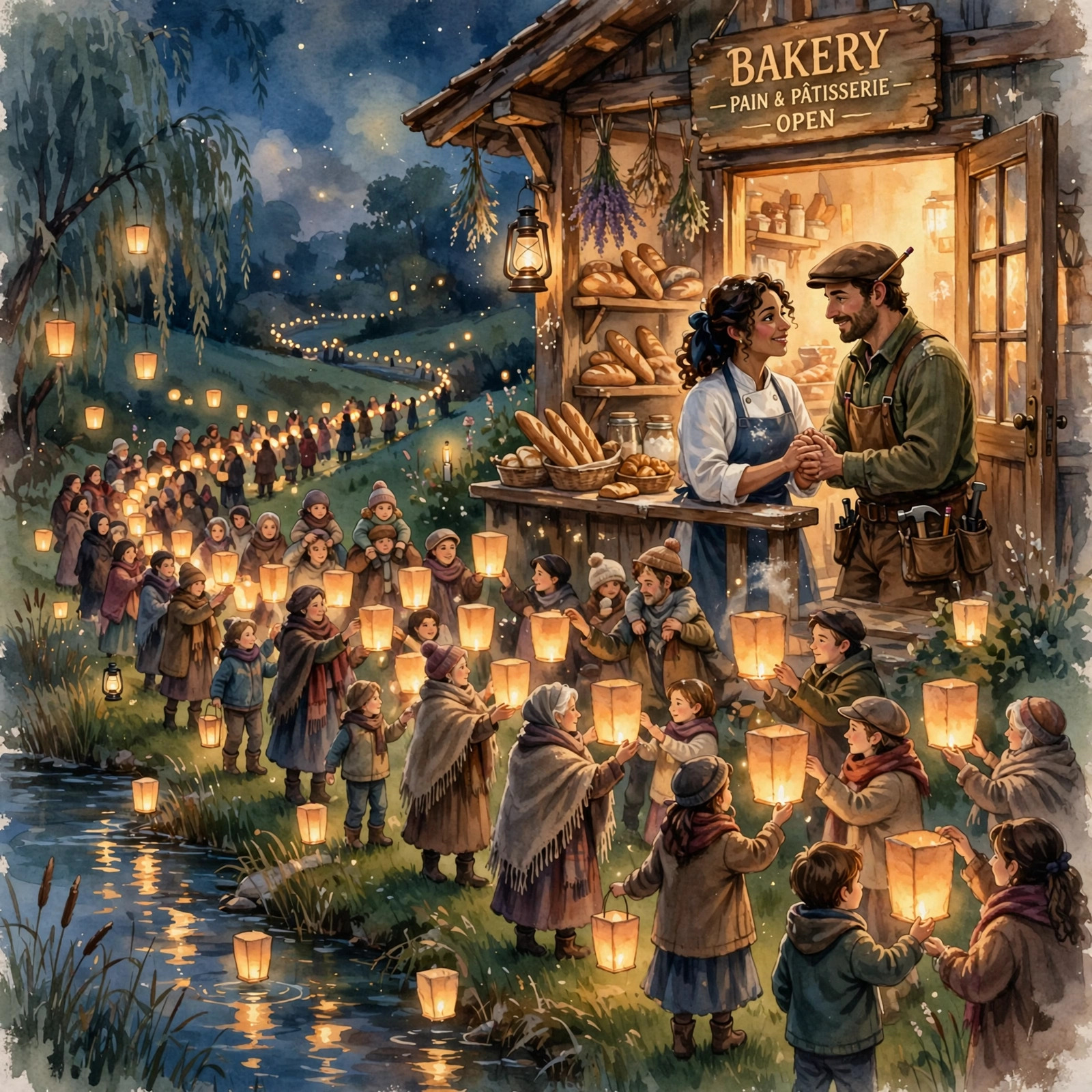
Three hundred lanterns rose along the river, and the strings of lights caught the glaze on them, and the crowd went soft. Nadine read the names. Some were names Delia knew, and some she did not, and that was her own ledger, the years away, and she paid it quietly. Then near the end, Nadine read, "Ruth Voss," and Delia's knees held, which she counted as a professional achievement, and Asher's hand landed flat and warm between her shoulder blades and stayed there through the whole silence, and Gil took off his cap, and the green held its quiet until Nadine said, "Break and share," and three hundred loaves went to pieces down the line, hand to hand, stranger to neighbor, and somebody's kid had Asher's terrible loaf and ate it anyway and asked for the corner piece.
It was past eleven when the green thinned out and the frost came down harder. Nadine came over with her folder, and her face had the particular shine of a mayor at the end of a thing.
"Filed and stamped," she said. "Heritage roll, soundness certificate, the works. And I had a call this afternoon from the Whitmore office. Their option runs out at dawn tomorrow, and their lawyer used the phrase 'declining to renew.' I wrote it down because I wanted to hear myself read it back."
"At dawn," Gil said. "Seven hours, then."
"Seven hours," Nadine said. "I'm staying to watch the clock on it, if anyone wants official company."
Delia looked at the bakery, up the little rise from the green, its windows warm, its sign lit for the first night since Ruth's. She reached into her coat pocket and found the brass key on its river-glass fob, and she walked up through the frost with Asher beside her and the last of the loaves under her arm, and at the bakery door she set his dense little loaf on the step, and she turned Ruth's key in the lock, and then she left it there. In the lock. Hanging in the door, turned, where the whole green could see it, where anyone coming up from the river could read it the way you read a light left on.
"You know somebody will walk off with that," Asher said.
"Nobody in this town would steal Ruth's key."
"You're the one who told me they'd all leave."
"I was wrong about a lot of things this month." She pushed the door open to the green, wide, so the light lay out across the frost and down toward the river, and Nadine stood in it with her folder, checking her watch, and Gil was singing something low with no words to it, and the option was dying quietly somewhere in a drawer in a city neither of them had to live in anymore. "Seven hours to dawn."
"Seven hours to dawn."
She took his hand on the porch, flour still under her nails, sawd still under his, and the loaves went on being passed down the line below them, hand to hand, all the way to the water.
Get notified when new stories drop

Ivy Chen
Ivy writes historical and second-chance romance with period texture and modern emotional clarity. Courtship stakes, letters, and choices that cost.
Leave a comment
Comments