

Lamp Four
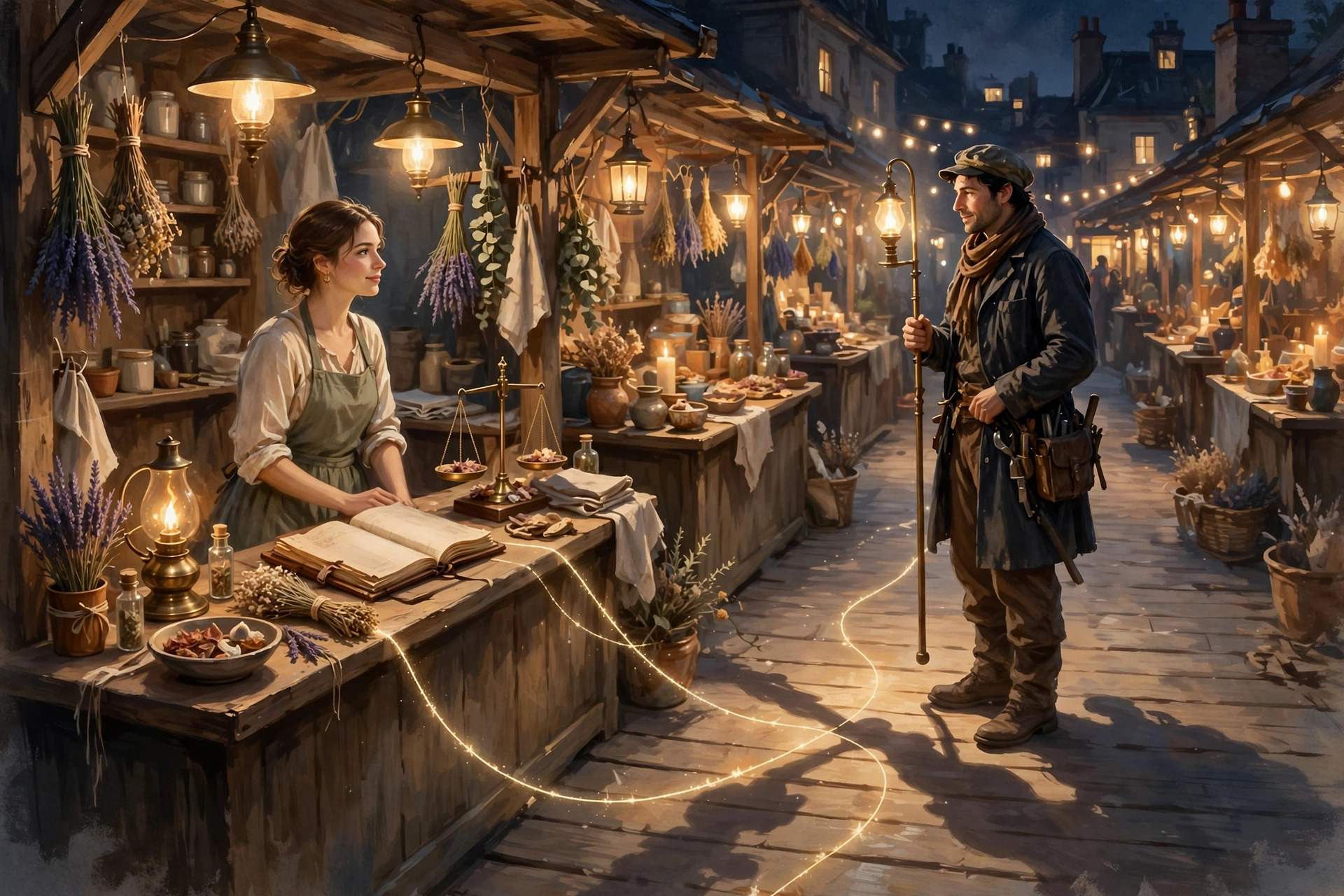
The favor ledger always smelled of candle smoke and old coin, and Nessa Vanter had learned to love that smell the way other people loved rain. She squared the week's entries beneath the brass lamp at her stall, added the final column twice because adding twice was how you stayed honest, and wrote the total in her small, upright hand: forty-one favors owed, twelve repaid, the rest carried. The arcade never slept, exactly, but on the first night of the trading week it slowed, and the stalls along the old opera-house roof settled into their creaks like an audience before the lights went down.
She was blotting the last line when the fourth lamp on the north walk guttered.
Nine spirit lamps kept the Wickless Arcade hidden, nine brass posts brazed long before anyone living could say by whom, and Nessa knew each one by its cough. Lamp one rasped. Lamp seven whistled in rain. Lamp four, the one closest to her stall, had a bad wick and a worse temper, and when it guttered it did so the way a singer loses a note, all at once, with a smell of hot metal.
The dark patch it left was small but wrong, the way a missing tooth is small but wrong. She stood, pen still in hand, and that was when the lamplighter came around the walk with his pole over his shoulder like a fishing rod.
"Evening, clerk," he said. "Sit down, it'll take me half a minute."
"It's my stall's light," she said. "I'll stand if I want."
He grinned at that, which she had not planned on and did not enjoy. Fenn Marlowe had been trimming the arcade's lamps for twelve years, longer than she had been keeping its books, and she knew him the way you know a bridge you cross nightly: reliably, at a distance, without once wondering what held it up. He wore his coat collar turned up against the roof wind and there was lamp-black on his jaw that he had clearly decided was part of his look.
He set the pole's hook under the lamp's glass, lifted the little door, and fed the wick with a twist of his wrist that looked practiced past thinking. The flame took. Warm light spread back across the boards of the north walk, across her ledger, across her ink-stained fingers.
And across both of them at once. He had stepped close to set the glass, and their shadows lay down together on the boards, hers and his overlapping at the shoulder like two coats on one hook.
Something lit between the shadows. A fine thread, thin as spider silk, pale gold, running from the edge of her shadow to the edge of his where they overlapped, bright only where the lamp touched it and invisible a hand's width away. It was not reflection. It was not smoke. She had worked under these lamps for six years and never once seen anything like it, and her first thought, disgracefully, was that it belonged in a ledger, dated, witnessed, filed.
Her second thought was to step back, and she did, and the thread went out like the lamp had.
"Huh," Fenn said softly, to the place where it had been.
"Well," said Poppy Danthe from the pawn vault stair, where she had apparently been standing long enough to see all of it. Poppy kept the vault beneath the arcade, eleven years in the trays and ledgers of other people's emergencies, and she had a stallholder's gift for arriving exactly when a thing became interesting. "That's threadlight."
"That was a draught," Nessa said.
"On a still night, under a relit lamp, between two overlapping shadows." Poppy came up the last steps with her shawl clutched shut at the throat. "I've seen it twice in my whole life and both times the pair pretended it was nothing. It's not nothing, but it's not mine to name, so." She spread her hands, palms up, and turned her voice back to business. "Nessa, when you're done not-writing that down, the vault wants your signature on the week's intake. Nothing exciting. A fob, a brooch, the usual tray."
"The usual tray," Nessa repeated. There was a tray in that vault she never let herself think about on the first night of the trading week, or any night: her grandmother's moonstone ring, silver-gilt, hand-engraved, pawned before Nessa was old enough to be asked whether she minded. The debt sat in the pawn book under her mother's name, and Treasurer Kesh would not release so much as the tray's dust while it stood. Six years Nessa had kept the arcade's favors, and every week she closed the ledger with that number somewhere under her breastbone, patient as a splinter.
She looked at Fenn instead of at the stair. He was coiling his pole's chain around his wrist, and his eyes were on the lamp, not her, which somehow made it worse.
"You've heard the saying," Poppy went on, unable to help herself. "Threadlight shows where a bond's waiting. Old rule, older than the arcade. It fades if nobody tends it." She paused, delicately. "It doesn't fade faster for being ignored, before you ask."
"Nobody asked," said Nessa.
"Nobody ever does," said Poppy, and, mercifully, went back down into the vault with her lamp.
Quiet settled over the north walk. The arcade creaked. Somewhere a stall shutter banged; somewhere else a kettle began its work. Fenn hooked his pole back over his shoulder and did not leave, which she noticed because lamplighters left, that was the whole shape of them, a light and then an absence.
"You know what they say about it," he said at last. "The rule."
"I know what stallholders say. Stallholders say the lamps hiss if you cheat and the roof leaks on liars. I keep the favor ledger. I hear everything twice and believe half of it once."
"That's a careful way to live."
"It's a paid way to live," she said. "Care comes free with the wage."
He laughed, a short warm sound, and rubbed the lamp-black on his jaw as if he'd remembered it was there. "Fair. I'll say this much and then I'll go make my rounds. Whatever it was, it wasn't nothing. I've lit that lamp a thousand times and stood in that same spot doing it, and I've never once had to stand there thinking about it after."
He walked on toward lamp five, and the threadlight did not come back, and Nessa stood at her stall with her pen still uncapped and her blotter dry.
Because the truth was she had already begun, in her head, to write it: First night of trading week, lamp four relit, threadlight observed between the favor clerk and the lamplighter, witnessed by the vault keeper. Clean. Dated. Filed. Six years of entries, every quarrel she could not have and every fear she could not say set down in columns instead of spoken, the ledger her one confidant and her whole inheritance of honesty. She even had the page. Her hand was already moving toward it.
Nessa looked at the lamp, at the boards where the shadows had lain together, at the small dark smudge where the thread had crossed from her to him. Anywhere else in the arcade, she would have called across the roof for Poppy to come witness the entry. That was how it worked. That was how she worked.
She capped the pen and put it in her coat pocket instead.
It was the first thing in years she had chosen not to write down, and her fingers felt the weight of it all the way down the north walk, warm as the lamp, impossible to file.
Favor Ink
Two nights gave the roof time to talk, and by the third the arcade had made up its mind about her. Nessa heard it from the candle stall as she climbed the opera-house stair with the week's papers under her arm: the favor clerk and the lamplighter, threadlight, lamp four, Poppy standing right there with a mop. The stallholders told it the way they told everything, twice as wide and half as true, and she corrected nobody, because correcting it would mean discussing it, and discussing it would mean it had happened to somebody, and she was not ready to be somebody.
Her desk sat where it always sat, in the favour-ledger bay where the candle smoke drifted thickest and the roof slats let down whatever the weather had going. Fenn was already at lamp-landing height when she arrived, which was usual; what was not usual was that he came down. He crossed the boards with a stack of vault paperwork in one hand, unhurried, catching the light of her lamp with his jaw and nowhere else.
"You carry Poppy's trays now?" she said.
"I carry anything heavy. It's in the wage." He set the stack on her blotter and squared its edges against the desk with two taps. "Vault transfer lists. She's re-racking the west shelves and half her cards have gone the colour of weak tea. Anything she can't read, you re-ink. That's the whole errand."
"She has her own hand."
"Her hand's fine. Her cards aren't. Six trays worth." He put one finger on the stack. "There's a rule about faded ink and pawned goods, apparently. If the card can't be read, the item can't be proved, and if it can't be proved it goes to auction by spring."
The pen was already in her fingers before he finished saying it, which she suspected he noticed, because he was still for a moment, and then he went and sat on the end of her desk like a man settling into a familiar chair, which the desk was not, and she did not tell him to get off it.
She worked the stack the way she worked everything, top to bottom, no skipping, and he watched the way people watched rain on glass, which was to say he found it easy to do and hard to stop doing. Somewhere in the middle of it the bellows-man started up on the far walk, and the smoke shifted, and the boards creaked under a passing cart, and none of it interrupted anything, which was its own small event.
Then she turned a card and stopped.
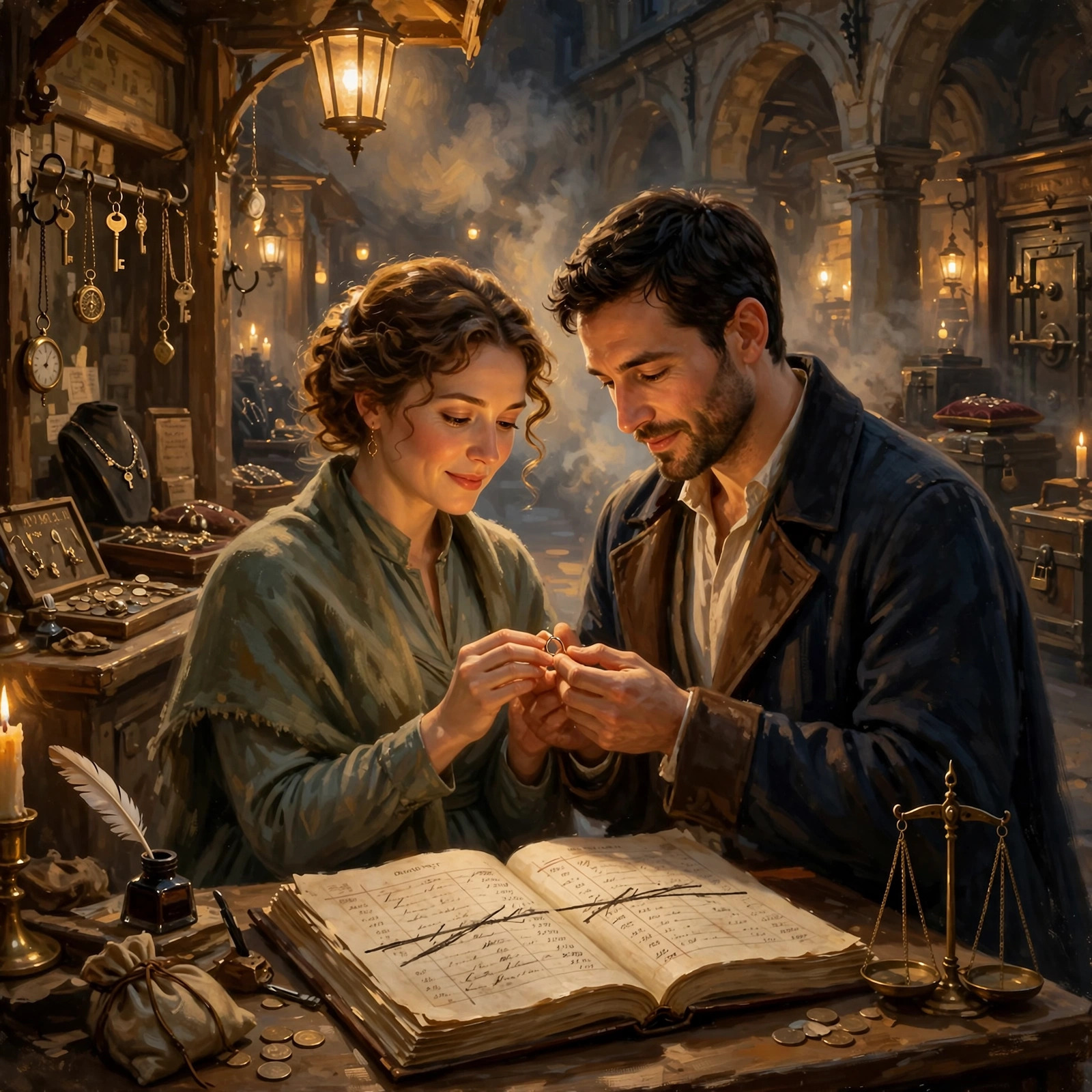
Tray seventeen, slot two. Silver-gilt band, a hand's width of nothing, set with one moonstone the size of a shirt button. Cast and engraved, the card said, in spring 1988. Ada Vanter. Nessa's throat did the thing it did around her grandmother's name, the small closing of a door.
Because she knew the band without needing the card. She had worn it to two funerals and a christening before she was tall enough to see over the favour desk. She knew the engraving, the little curling fern Ada cut into the inner face where only the wearer would ever find it.
And she knew the line under the description, because she had read it every quarter for six years, always from the treasury side, never from the source.
Recorded against: Lena Vanter. Debt outstanding: 3,400 dollars.
"That one's not faded," Fenn said quietly, reading over her shoulder. He had a lamplighter's way of being closer than he'd seemed. "Ink's the freshest thing on the tray."
"It was re-ruled last year. Someone kept it current." She turned the card over. Nothing on the back but the treasury stamp. She turned it back. "The debt stands, so the card stays fresh, so the ring can't be released. Treasurer Kesh's arithmetic. If the entry's open, the vault keeps it."
"It's a small ring," Fenn said, as if that were the argument. "Four millimetres of silver and a stone you couldn't hock for bus fare."
"It isn't the ring that's worth 3,400 dollars." She heard her own voice go flat, the ledger voice, and she let it. "It's my mother's name sitting in a debt column while the stone sits in the dark. That's the collateral."
He didn't say anything to that. He looked at the card, then at her, then at the card again, and she had the sense of a man doing sums he hadn't expected to be handed.
Poppy arrived the way she arrived, already mid-sentence, with a rag over one shoulder and a tray card spinning in her fingers. "Seventeen's not for re-inking, love, I told the runner, seventeen's current, it's only the shelving that moves. That whole tray's flagged for the spring auction if nothing changes. Rules are rules." She stopped. She looked at the card in Nessa's hand, and something in her face went careful, the way she'd gone careful on the north walk two nights ago when the light did what it did. "Well," Poppy said. "You found her."
"You knew which card it was."
"I rack the vault. I know every card in it." Poppy wrung the rag once and hung it back on her shoulder. "It's a good stone, that moonstone. It'd do better at auction than you'd think."
"It isn't going to auction."
"No," Poppy said, mild as milk. "I don't suppose it is."
Poppy went off toward the bellows-man with her tray card, and Nessa sat looking at the ink of her mother's name, fresh as a wound someone had kept clean on purpose.
She could let it stand. That was the lawful thing, the paid way to live. The entry stood, the auction came in spring, and she was a clerk, not a party; clerks don't tamper with treasury cards, clerks re-ink what fades and nothing else.
Instead she pulled the good bottle from her drawer, the one that didn't feather, and she inked the whole tray. Ada Vanter, silver-gilt, moonstone, spring 1988, engraved inner face, tray seventeen, slot two, and she went over the faded lines twice so that no auctioneer's clerk in spring could claim the card couldn't be proved. Whatever the debt column said, the ring would be legible. The ring would be described. The ring would be hers to identify across any table in Coalmere, whatever name sat above it.
"That's not re-inking," Fenn said. "That's armour."
"It's legible." She recapped the bottle. Her hands were steadier than they had any right to be. "You said it yourself. If it can't be read, it can't be proved. I've just made it impossible not to prove."
He was quiet long enough that she looked up, and he wasn't watching the card anymore. He was watching the way she'd held the pen, the way she hadn't hesitated, and she had the strange sense of having been filed somewhere in him, the way she filed people, and she did not hate it, which was inconvenient.
"You could ask the treasury for the release, you know," he said. "Kesh. You could just ask him. He knows what that ring is."
"Kesh knows what everything is. That's how he keeps it all." She set the card in its slot with more care than it needed. "I'll ask. I'll ask properly, at the treasury bay, with the fee book open. But not tonight. Tonight I've done what a clerk can do, and I've done it well, and I'm not going to the treasury smelling of argument."
"A careful way to live," he said, and she heard the echo of the north walk in it, two nights old.
"A paid way."
"You said that already. I'm noticing you say things twice when they're load-bearing."
She laughed before she could stop herself, a short cracked sound that hadn't been used in years, and he smiled like a man who'd been saving the sound up.
He slid off the desk and stood, and instead of going, he looked at her lamp, then at the eight other lights strung away across the roof into the dark, each one his.
"Ask me the lamps' names," he said.
"Lamps have names?"
"Everything here has a name it answers to. That's the whole trick of this place." He touched the edge of her desk, the closest he'd come to touching anything of hers. "Nine lamps, nine names, and I'll teach you all of them. But not for free, because nothing here is free, you know that better than anyone."
"What's the price?"
"One true answer. Each visit. Anything I ask, you answer it plain." He said it lightly and didn't mean it lightly; she could hear both weights at once, and she suspected that was a lamplighter's trick, the way he handled flame. "You deal in favours. I'm dealing in truth."
The smoke drifted. The bellows-man worked. Somewhere below them the town of Coalmere went on not knowing what was said on its opera-house roof.
She should have refused. She kept everyone at ledger's length, six years of practice, and a true answer was a currency she'd never once spent, because her whole inheritance of honesty lived in ink and not in speech. But there was the ring, fresh-inked in tray seventeen, waiting for spring. And there was the north walk, two nights ago, and the small dark smudge where the thread had crossed from her to him, which she had chosen not to write down.
"One answer each visit," she said. "Plain, and short, and I get to keep my secrets that you don't ask about."
"That's all anyone gets to keep here." He picked up his pole. "Ask me one now, then, so you know the shape of it. Any of the nine."
She looked down the line of lights, chose the one she'd watched him relit on the north walk, and asked its name. And when he told her, lamp four's name, the old word the founders had brazed into the brass before anyone living could remember, she wrote it in the margin of the tray card where no treasury clerk would ever look, and that, too, was not nothing.
Lamp-Landing Moths
Two nights of names had taught Nessa one thing: Fenn Marlowe climbed stairs the way other people walked flat ground, which was to say carelessly, and expected everyone behind him to do the same.
"Third stair's loose," he said, without turning around. "Eighth's worse. Step where I step."
"You say that like I've got a choice. There's only one stair."
"There's one stair and about four safe ways up it. I know all of them. That's the whole of my education."
The lamp-landing stair ran up the opera-house's old north face, a spine of iron bolted above the roof slats, and it ended at a platform she had watched lamplighters come off of for six years without once wondering what was at the top. She had assumed a storeroom. She had assumed wrong twice tonight already, and they were only halfway up.
The wind at the turn of the stair pushed her toward the wall, and her hand found the rail, and the rail was warm where his hand had been. She kept her fingers off the warm part. Then the wind came again and she gave up and held it, warm or not.
"You're quiet," he said.
"I'm counting stairs."
"Don't. You'll get to the top and I'll ask my question and you'll have spent all your answers on arithmetic."
That was the trouble with the arrangement, and she'd known it on day one, standing at her desk with his handshake still warm on her palm. One name a night. One true answer a night. He'd already collected two, and both times the questions had come sideways, the way moths come at glass. Do you sleep with the ledger open or shut. What's the first thing you do when your shift ends. Small questions. He hadn't spent anything expensive yet, and a man who kept his change that long was saving up for something.
She'd answered both, out loud, as agreed. It had felt like handing over a coin from a pocket she'd sewn shut.
The stair opened onto the landing and she stopped, because he'd stopped, and then she stopped because of the view.
Coalmere lay under them with its lights off, the whole town a low dark shape stitched with a few street lamps, and above it the roof of the arcade ran away east, and along the north walk the nine brass lamps stood in their line like a sentence she could almost read. From the desk, the lamps were a wall of light you worked inside of. From up here, they were a border. On the far side of them was the dark, and it went a long way.
"That's the town," Fenn said, unnecessarily.
"I've seen the town. I've never seen it from on top of it."
"Nobody does. Bound can't come up here before their rounds, and stallholders don't climb. Poppy says the stair's bad for her knees. I think she's lying. I think she likes the floor too much."
"She likes knowing what's under it," Nessa said, and he laughed, one low note, and pointed along the walk.
"There. End of the line. Lamp nine."
The ninth lamp stood apart from the others, at the very edge of the roof, and it was out. Eight burning, one dark, and the dark one had a mothy halo around it already, wings knocking the brass like tiny fists.
"It's not due to go out for another hour," he said, "but it flickered on my last pass, so I bring it in early rather than let it gutter. A guttering lamp pulls the moths off every other lamp on the walk, and then I'm out here all night with a brush. Come on. You're on rounds with me tonight anyway. Might as well be useful."
He knelt at the ninth lamp, and she knelt where he pointed, and he showed her the little door in the brass base, and the wick, and the spirit feed that you turned a quarter-clockwise and no further.
"Quarter-turn," she said. "No further."
"You can turn it further. Once. Then you're re-cutting a feed line by lamplight, and I'm not teaching that lesson twice."
"Give me the taper, then."
He put the taper in her hand instead of lighting it for her, which she had not expected, and she tipped the flame to the wick, and the lamp took it with a soft sound, like a held word being let go. The light came up gold through the brass, and it lit his face from underneath, and she looked at that lit face a half-second too long and then looked at the flame, which was safer.
Nine for nine. The whole walk burning.
"Good hand," he said. "Steady."
"Ledger hand. You ink three hundred entries a week, you get steady."
"There are worse uses for a steady hand."
She was aware, suddenly and in detail, of how little stair there was behind her and how much of him there was in front of her, kneeling an arm's length away on a landing the size of a desk top, with the whole town dark below and every lamp on the roof burning like witnesses. His eyes had gone from the flame to her mouth. She knew because hers had gone to his, and the moths found the ninth lamp then.
They came off the dark walk in a soft body, a hundred wings and more, and broke around the fresh light, and one went down the little brass door and began knocking itself against the inside of the glass, and Fenn said a word she pretended not to hear and had the door open before she'd finished starting.
"Hold the taper up. No, higher, out of the draft. If it gutters again we do the whole night over."
She held the taper up. He got the moth out with two fingers and a gentleness she wouldn't have bet on, set it loose off the edge of the roof into the dark, and closed the door, and by the time he'd done all that the moment had gone wherever moments go when they're interrupted, which is nowhere, it just waits, but the kneeling had turned into something practical and two people doing a job, and the wind had come back besides.
"Lamp's steady," he said.
"Lamp's steady."
They stood. He didn't move away, and neither did she, and the silence had a weight to it that she broke the only way she knew.
"You owe me a name."
"Do I?"
"It's night three of the arrangement. You're two names down if you've forgotten."
"I keep better books than you do." But he turned and looked down the walk, all nine lamps burning, and said, "Lamp nine. Her name's Vesper."
"Vesper."
"Evening star. The founders ran out of poetry by the ninth one, I suspect. Or saved the only good name for the lamp nobody visits." He said it lightly, and then he said the next part not lightly at all, still looking at the lamps. "I've never brought anyone up this stair. Twelve years of rounds. Poppy's asked twice. I told her the third stair was loose and let her think that was the reason."
She took that in. Then she sat down on the landing's cold iron, took her hand ledger out of her coat, opened it to the margin of the week's page, and wrote it, small, in the corner where the favors that didn't get charged went: Never shown the stair to anyone.
"What are you writing?"
"The only kind of thank-you I know how to give."
He sat down beside her, leaving exactly the space a person leaves who is being careful, and watched her blot it. The moths went on knocking softly at the lit lamps all down the walk, and Coalmere stayed dark under them, and the wind smelled like the end of autumn coming on.
"Ask your question," she said. "You're owed one."
"I know what I'm owed." He turned the taper over once in his fingers, lamp-black hand, careful with a thing that was already out. "Not tonight. I'm saving up."
She didn't ask for what. She wrote that in the margin too.
The Open Book
The treasury bay sat under the opera-house roof like a pocket turned inside out, all brass hinges and ledger smell, and Orbin Kesh sat behind it with the hanging lamp turned down low, which she'd learned over six years meant he wanted something. When the lamp was high, you were being paid. When it was low, you were being asked.

"Miss Vanter. Sit."
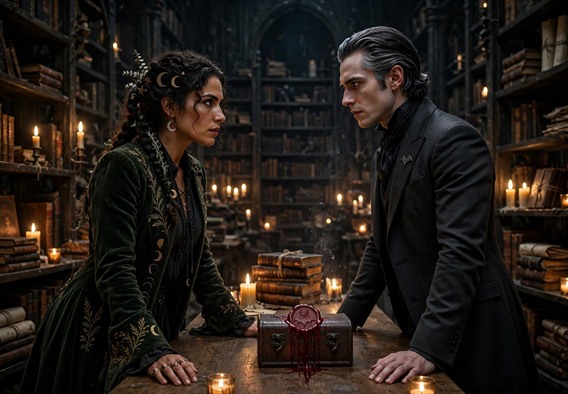
She didn't sit. She stood in front of the desk with her ledger under her arm the way she carried it everywhere, and she noticed, in the way she noticed everything and said nothing, that her grandmother's ring was out of the vault. It sat on a folded square of gray felt on the corner of his desk, the moonstone catching the lamp, the silver-gilt band as thin and stubborn as it had been the last time she'd seen it, on her grandmother's hand, at a kitchen table, in a different century as far as she was concerned. Beside it lay a single sheet of paper, drafted out in Kesh's clerk hand, with a line for a signature at the bottom.
"You've been into the vault," she said.
"Poppy opens it for me when I ask. It's my arcade, Miss Vanter. The pawn stands at three thousand four hundred dollars against your mother's name, and I've held that entry open a long time out of patience." He turned the ring a quarter turn with one finger, not picking it up. "I'm prepared to release it. Forgive the debt entirely. Tonight."
The lamp hissed overhead. Somewhere below the floor, through six layers of old opera house, she could hear the arcade, stalls closing, someone laughing, a coin run along a counter. She kept her face the face she used on stallholders who owed favors.
"In exchange for what."
"Five years." He slid the paper across. "Bound service. Same wage, plus a fifth, and the ring in your hand before you leave this room."
She read it. She read every word of it twice, because that was her job and because it gave her hands something to do that wasn't reaching for the ring. Five years of nights. Five years under the lamps, no daylight, no leaving before dawn, her name entered in the treasury's book the way Fenn's was. Twenty years old, the entry would say when it was done, in a book nobody outside the faction ever read. Thirty-seven, she corrected herself, and was surprised at how the arithmetic arrived like a cold draft.
"The debt's my mother's," she said. "Not mine."
"The ring is your family's. Not mine." Kesh folded his hands. "I'm told you re-inked the tray card yourself, so the pawn couldn't be read as unclaimed and auctioned. A careful girl. Careful girls keep careful books. I'd like yours keeping mine."
"You have my books six nights a week already."
"I'd like them bound to me." He said it kindly, which was worse. "Miss Vanter. Everyone in this arcade is held by something. The stallholders by their leases. Marlowe by the lamps. You, at present, by nothing but habit, and habit walks out. I'm offering to make you expensive to lose."
She looked at the ring. Four millimeters of band, hand-engraved, worth a fraction of the debt on paper and everything in any ledger she cared about. Ada had cast it herself. Ada had also, according to the pawn slip Nessa had found taped inside a flour tin at age nine with no letter attached, been the one who'd carried it into the vault, or her mother had, the handwriting on the slip argued both ways. Somewhere in that vault was the proof of what had actually happened, and Kesh sat between her and it wearing his patient treasurer's face.
Then she saw the other book.
It was Kesh's fee book, lying open on the desk's left edge the way a thing lies when a man means you to see it and has told himself he doesn't. Ruled pages, hand-copied, kept current for over a decade by the treasury clerks. She leaned without stepping closer, out of habit, the ledger's-length habit, and read the line the lamp fell on. Unbinding fees, a column of them. And one fund line, added to year by year in the same small hand: Marlowe, F. Daylight fund. The balance read three thousand nine hundred dollars against a fee of four thousand one hundred, and the last entry was dated that week.
Two hundred dollars short. She stood very still.
Footsteps on the bay's iron stair, unhurried, and the smell of candle smoke and cold air came in before he did. Fenn stopped in the doorway with his taper and his black-ringed hands, and she watched him take in the scene: the low lamp, the paper, the ring, the open book. His face did something small and fast when he saw which page the fee book was on, and then did nothing at all, which was how she knew.
"Marlowe," Kesh said, pleasant. "You're early for your rounds."
"Lamp two's guttering. Came for a new taper." He didn't move for the taper drawer. He looked at Nessa.
"You're buying daylight," she said. Not a question. It wasn't a question because the book had already answered it, three thousand nine hundred dollars of answered it, twelve years of nights saved penny by penny into a line in Kesh's ledger that she had never once been shown.
"Nessa." Just her name, low, like a hand put flat on a table.
"Three thousand nine hundred," she said. "Against four thousand one. You're two hundred short. That's why you took the lamp-landing shifts. That's the extra pay, isn't it. The ones nobody wants." She heard her own voice go ledger-flat, which happened when the alternative was the other thing. "You never showed anyone the stair because the stair's where you count it."
"Miss Vanter has a sharp eye," Kesh said, and there was something in his voice like a man watching a lamp burn down to the end of its oil and finding it interesting.
"I was going to tell you," Fenn said. "At the stair. On the ninth night, after the Rekindling. I had it planned out, which now that I hear it sounds like exactly what it is."
Planned. She thought of the margin entries in her own hand, the thank-yous she couldn't say aloud, the questions he was saving up instead of spending, and she thought, with a small cold clarity, that she had watched a man plan for two hundred nights and mistaken the planning for the company. Threadlight, her grandmother had said once, long before any of this, shows you the thread, dear. It doesn't show you what's tied to the other end.
Kesh turned the lamp up then, briskly, a treasurer's movement, and the light swung across both their faces. Their shadows crossed on the desk's edge, hers and his, under the lamp, and the threadlight came up thin gold between them, visible in the brightened room as it had been visible at lamp four on the first night, and Fenn looked at it, and she looked at him looking at it, and he crossed the bay.
He kissed her. She kissed him back. It wasn't gentle and it wasn't careful, it was a week of stair-top silences arriving all at once, her hand still gripping her ledger against her side like a shield she'd forgotten she was holding, his hand at her jaw, the threadlight flaring between them so bright it printed gold on the inside of her closed eyes, and for the length of it she forgot the fee book entirely.
Then she didn't.
He drew back half a step. The threadlight settled thin again, hanging between them like the last of a lamp before it needs feeding.
"Say it," he said. "My name. Before the ninth night ends. That's all it needs, both names at a lamp, and I'll stay past daylight, I'll spend the fund on anything you..."
"Anything I what." She heard herself arrive at it the way she arrived at everything, through the books. "You'd spend twelve years on anything I sign. That's what he's holding out for, isn't it, that's why the book's open. Not five years of me. Two hundred dollars of you." She turned and looked at Kesh, who had folded his hands and was watching them both with the lamp turned up now and his face giving away nothing except that it had given something away already. "You knew. You left that book open for me to read."
"I left a lamp lit," Kesh said mildly. "You've both been standing in the dark for a week. I dislike waste."
"Nessa." Fenn again, but she was done being looked at gently for one night.
"You were leaving. You were leaving and you let me write you thank-yous in a margin." She heard how it sounded even as she said it, the vault talking, the pawn book talking, the girl with the flour tin talking, and she could not stop her own hand when it took the drafted contract off the desk. She didn't sign it. She tore it in half, and the halves again, and dropped the pieces into the treasury's waste jar by the stair, where the ring's shadow didn't follow them because the ring stayed on Kesh's felt, where it had been bait since she'd walked in.
"Keep the debt open," she said. "Keep the ring. I'm not buying it with either of us."
And she walked out alone, down the iron stair, past lamp two guttering and nobody trimming it, with the threadlight gone thin behind her like a wick down to its last quarter of an inch.
Two hundred dollars short, she thought, and didn't cry until the second landing.
Daylight Fund
Poppy Danthe's vault under the arcade smelled of coal dust and candle wax, and of coin, somehow, even where there was no coin. Nessa came down the pawn-vault stair the next evening with her ledger under her arm and her question rehearsed so many times it had worn a groove in her, like the loose third step she knew better than to trust.
"You'll want the usual tray," Poppy said, not looking up from her lock drawer. Nine years of keys hung above her bench, and her hands moved among them without her eyes' help.
"I want the truth, actually. One question. Plain answer, no ledger between us."
Poppy's hands stopped. "That's an expensive trade in this building, Nessa. You know the tariff."
"I know mine. I'll pay it."
Poppy set the key she was oiling down on the felt. Above them, faint through the floor, the arcade's evening crowd shuffled and laughed, and somewhere a spirit lamp was being trimmed, because the light through the floorboard seams went steady and gold.
"Ask, then."
"My mother's entry. Three thousand four hundred, under Lena Vanter. It's been open since I was a girl. Kesh keeps it open. You keep the vault book. Is it honest?"
The quiet went on long enough that Nessa counted the keys on Poppy's board twice and got different totals both times. Then Poppy said, "You asked me plainly, so I'll answer you plainly, and may the arcade take its cut of me for it." She rose, wiped her hands on her apron, and went to the back of the vault, to a shelf Nessa had never once seen her touch, and brought down a second book. Not the pawn book. Another one, bound in grey card, stamped with the treasury's mark.
"The stallholders' ledger," Poppy said. "Every debt paid in, every debt paid off, fair copy kept separate from the pawn book so no stallholder could doctor what they owed. I keep both. It's why he lets me hold the keys." She laid the grey book on the bench and opened it to a page marked with a pale ribbon. "Read the line."
Nessa read it. She read it again. Her mother's name, in a clerk's careful hand, and against it, paid in full, and a date, and the date was in 2009, before any letter could have come, before the vanishing, before the pawn slip on the kitchen table and the flour tin with the money in it and all the years of nothing since.
"She paid it," Nessa said. The vault walls took the words and gave back nothing. "She paid it before she went. He kept the first entry open anyway. Fifteen years of that entry standing open over my head. Fifteen years of me thinking..."
She didn't finish it. Poppy didn't make her. That was worth something, in a building where everything was supposed to be worth something.
"Why didn't you say?" Nessa asked. It came out softer than she'd meant.
"Because you never asked me plainly, and I've two children in this arcade's pay and a stall I'd lose. And because I thought, some nights, you already knew and were keeping it in that ledger of yours where you keep everything you won't say." Poppy closed the grey book and held it against her chest. "Take the copy if you want it. I'll say it was borrowed for tallying." She pulled the page loose at its perf corners and set it in Nessa's palm, stamped and dated. "He can't argue with a fair copy. He can outwait you. But he can't argue."
Nessa held the page the way she'd have held a lit wick, and went up the stair, and did not thank her, because Poppy had already named the price and neither of them needed it said twice.
She found Fenn at the treasury bay, where she'd known she'd find him, because Kesh's lamp was up and the fee book was open on the desk again, turned to the page with the daylight fund line, and Fenn was standing in front of it with his savings tallied in his hand like a man counting his own pulse.
"Don't," Nessa said.
"You don't even know what I was..."
"I know what's on that page. I've read it. I read it because he left it where I'd read it." She came and stood beside him at the desk, and their shadows overlapped under Kesh's lamp, and the threadlight came up thin and gold between them, unwilled, unspent, and neither of them stepped out of it. "Three thousand nine hundred dollars in twelve years of trimming lamps you're not allowed to leave. I know what it buys. Four thousand one hundred. Daylight. A walk out of here before dawn and never mind the ninth night. I know. And now I know something else, and I need you to stand there and hear it before you spend anything on me."
She laid the stamped page on the desk where Kesh could see it. She watched his eyes go to the date.
"Paid in full," she said. "Before she left. He kept the entry open. He's been holding a paid debt over my head for fifteen years to keep a cheap clerk, and over yours too, Fenn, because he knew you'd..." She stopped, because the sentence had a door at the end of it she wasn't ready to walk through in front of Orbin Kesh.
Kesh turned the page toward his own lamp. Read it. And then, which was the worst of the whole evening, he didn't deny it. He folded his hands, the way he did, and said, "The pawn book is the pawn book. The stallholder's copy is a copy."
"It's a fair copy," Poppy said from the stair's foot, arriving with the grey book itself under her arm, out of breath, "and it's mine, and I'll swear it anywhere you like, Treasurer, and you know it."
The silence had teeth. Kesh looked at the fair copy, and at Nessa, and last at Fenn, and something in his face shut like a drawer. "The debt can be struck," he said at last, evenly. "The ring released. It changes nothing else in this building."
"It changes this," Fenn said, and Nessa turned fast, too late, because he already had his hand flat on the fee book, on the daylight line. "Strike her entry tonight. Release the ring. Take it out of this." His fingers drummed once on the fund. "Three thousand nine hundred against three thousand four hundred. You've seen the arithmetic I do. You set the fee for the unbinding and you know what's left of mine. Clear the debt, release the ring, and keep the rest as..." he hunted for the word and landed on it plainly, "...as waste, if that's what you'd call it. I dislike waste too."
"Fenn." Nessa's voice cracked on the one syllable. "That's your daylight. Twelve years."
"I know what it is." He wouldn't look at her, he was looking at the line, at the number he'd copied into it a night at a time for twelve years. "I've been carrying the number so long I forgot it was meant to buy anything. It's just a number, Nessa. You told me that yourself, in your own way, on the stair." Then, quieter, to the desk more than to anyone, "My brother took his out and walked into the sun and never sent a word back. I've been telling myself the fund was a plan. It's not a plan. It's a door I was afraid of. And I'm not going to stand here and let you think you were leaving with the ring and not with me, because that sentence has been sitting in your margin for a week and I've watched you write around it every night."
Kesh stamped the entry struck. He counted out the release on the felt, took the fund line down to what remained of it, which was a figure small enough to be nobody's door anywhere, and set the moonstone ring on the desk beside its tray card, the pawn entry struck clean through in the fair copy.
Nessa walked out with the ring and the stamped page both in her fist. Fenn followed her to the lamp-landing stair, up past the loose third step, which neither of them mentioned, out onto the rooftop's edge where the nine lamps stood in their cups and the moths came in slow from the dark like bookmarks looking for their pages.
He took her hand, opened her fingers, and set the ring in her palm with the stamped debt page folded under it, and closed her fingers over both, and held them closed with his own.
"There," he said. "Yours. Paid. Both of them, your mother's and mine, paid off the books."
She looked at the ring, and at him, and at the threadlight coming up thin and stubborn between their overlapped shadows on the old opera-house roof, and she opened her mouth, and out of it, for the first time in her life without a ledger between, came the sentence she had only ever written.
"I'm leaving with the ring," she said, "and not with my heart. The ring's my mother's. You're..." Her voice did what her ink never did, and shook. "You keep the heart. That's the entry. That's the whole entry, Fenn, and I want it in the book where people can read it."
He laughed, low, at the edge of the dark, and the moths came on toward lamp four behind him, and tomorrow was the ninth night.
The Ninth Lamp
Rekindling night, the arcade came up like a held note. Nessa stood at the treasury bay with the stamped page from the fair copy flat under her palm, and the stallholders crowded the walk in their festival wool, and every one of the nine lamps burned in its brass cup, waiting to be put out and lit again.
Poppy arrived carrying the pawn vault's ledger under one arm and a candle stub in her apron pocket, because Poppy never trusted anyone else's light. She set the big book on the treasury desk, beside Kesh's fee book, and turned it so the stallholders could see.
"Before we put the lamps out," Poppy said, "there's an entry to correct."
Kesh came around the desk slowly. He had his treasurer's face on, the calm one, the one that had held Nessa's wage and her mother's debt over her head for six years like a shelf she kept bumping into. "The vault's books aren't read aloud, Poppy. That's not how we do things."
"This one is." Poppy opened the fair copy to the page Nessa had carried out of the vault yesterday, and then to the paid column beside it, and laid her hand flat across both. "Lena Vanter settled her debt in full in 2009. Three thousand four hundred, paid to the faction, witnessed, entered in the vault's own hand. It's been paid fifteen years, Orbin, and you kept the first line open anyway."
The stallholders went quiet in the way of people doing arithmetic they don't like.
"Prove it was me," Kesh said, which was not a denial, and everyone on the walk heard that it was not a denial.
"I don't have to prove intent." Poppy took out the candle stub and set it down like a gavel. "I have to prove the debt. Here it is, paid. Nessa, bring the open ledger."
Nessa brought it. Her hands were steady, which surprised her, because the rest of her was not. She opened the favor ledger to her mother's page, to the line she had copied out every week for six years, the line she had first copied out in her own upright hand six years ago. Poppy entered the payment beside it, dated it, and signed, and then passed the pen to Nessa.
"You strike it," Poppy said. "It's yours to strike."
Nessa drew the line through the debt. The nib went clean through to the next page, and she didn't care.
Kesh looked at the walk, at the stallholders with their arms folded, at Fenn standing at the base of the lamp-landing stair in his lamplighter's coat, at the moths already beginning to gather. Whatever he had been about to say, he could hear the room saying it back to him. "The ring's already released," he said at last. "Marlowe paid the balance. I've no further hold on the Vanter account."
"You've no further hold on the Vanter wage, either," Poppy said. "It comes from the common fund, dated tonight, same as every stallholder's. Or it comes before the faction."
"It comes from the fund," Kesh said, and shut his fee book, and for once the shut sound was small.
Nessa had imagined this moment for six years, and in every version Kesh left smaller than the room. In the actual event he simply gathered his papers and went down the back stair, an aging man with a good coat, and the walk let him go, and then the bells began, and it was time.
Fenn worked the Rekindling the way he did everything, from the north walk down, lamp by lamp. He put each flame out with the brass snuffer and relit it from the taper he carried, and the moths wheeled and resettled, and the stallholders cheered each one like a birth. Nessa walked the walk behind him with the ledger under her arm, because tonight she was not on duty, and tonight she was not off duty either, she was simply following.
At lamp nine he paused. "Vesper," he said to it, "don't sulk when I come back tonight with company."
At lamp four he stopped entirely.
Sorrow burned low and even in its cup, the way it had on the night they met, when Nessa had been closing the week's ledger under it and a lamplighter's shadow had crossed her page and the threadlight had come up between them thin as spun sugar, and she had pretended, for a full day, that she hadn't seen it.
"Rekindling ends at midnight," Fenn said. "The rule says the names have to be spoken before the ninth night's Rekindling ends. That's tonight. That's now, in about four minutes."
"I know the rule. I keep the ledger." She set the book down on the walk's stone, closed, with the struck line inside it. "You know what the speaking costs."
"A secret, given to whoever hears it. I know." He looked at the crowd on the walk, and Poppy looked politely elsewhere, and the stallholders found the lamps fascinating. "Mine's this: I never wanted the daylight fund. I wanted my brother to come back and tell me the sun was worth it. He didn't, so I kept saving as if the money could ask him for me." He turned to her. "That's been said once now. It's yours. Say yours, and then say my name, and I'll say yours, and we'll see what the thread does when nobody's holding it back."
Her secret was nine years old and had a mother's shape. "Lena didn't vanish because she stopped loving me," Nessa said, to the lamp, to the moths, to Poppy's politely turned head, to the whole listening walk. "She paid her debt so no one could use it against her, and she left so no one could use me against her, and I've spent my whole life being angry at her for protecting me." Her voice held. Her ink never would have. "There. That's the price. Paid."
The threadlight came up brighter than she had ever seen it, silver and warm, running between their shadows where they overlapped on the old stone.
"Fenn Marlowe," she said.
"Nessa Vanter," he said.
The thread didn't burn out. It settled, went quiet, went from light to something more like a warmth in the hand, and Sorrow guttered once and steadied, and the bells rang midnight down in Coalmere, and the Rekindling was over, and the bond was sealed, and Nessa laughed at the sky because there was nothing else to do with a week like this one.
"It's done," Fenn said. "You know I'm still bound. Daylight fund's spent, on your mother's ring, which I'd do again, which I would do twice." He looked at Sorrow, and at the eight others burning down the walk. "I keep the lamps. I can't leave before dawn and I can't stand in the sun. That's the whole shape of me, Nessa, night for night, year on year."
"I know," she said. "I talked to Poppy this afternoon. There's a desk open at the treasury bay. Night shift. Ledger work, wage entries, the common fund. I can do it in the dark." She lifted her chin. "I moved my inkwell already. It's heavy. Come see."
He looked at her for a long moment, and then he laughed, low, and the moths rose around them like flung rice.
They climbed the lamp-landing stair together, up past the loose third step, which neither of them bothered to mention, out onto the rooftop's edge where the nine lamps burned in their cups and the town lay below with its windows going dark one by one.
The eastern sky had gone the color of a pearl kept in a drawer. First light was coming. Fenn stood in the shadow of the stair's doorway, where he had stood every dawn for twelve years, and this dawn he stood there with her hand in his.
Nessa wore the ring. The moonstone sat pale and full on her hand, the silver-gilt band her grandmother Ada had cast and engraved one spring, and it was warm from her own skin, and it was hers.
"You could still go in," she said. "Someday. Save again. I'd keep the lamps lit while you walked in the sun. I'd want a letter, though. A real one. I've had enough of people who don't write."
"I'm not going anywhere," Fenn said. His hand was warm in hers, and neither of them moved out of the shadow, and the light came up slow over Coalmere and found the roof and the lamps and the two of them standing in the doorway, staying. "This is the door I was afraid of," he said. "Turns out you can stand in it."
Get notified when new stories drop

Cade Ellison
Cade specializes in romantasy and paranormal romance: magic systems with rules, courts with knives, and longing that rearranges destinies.
Leave a comment
Comments