

The Twelfth Plate
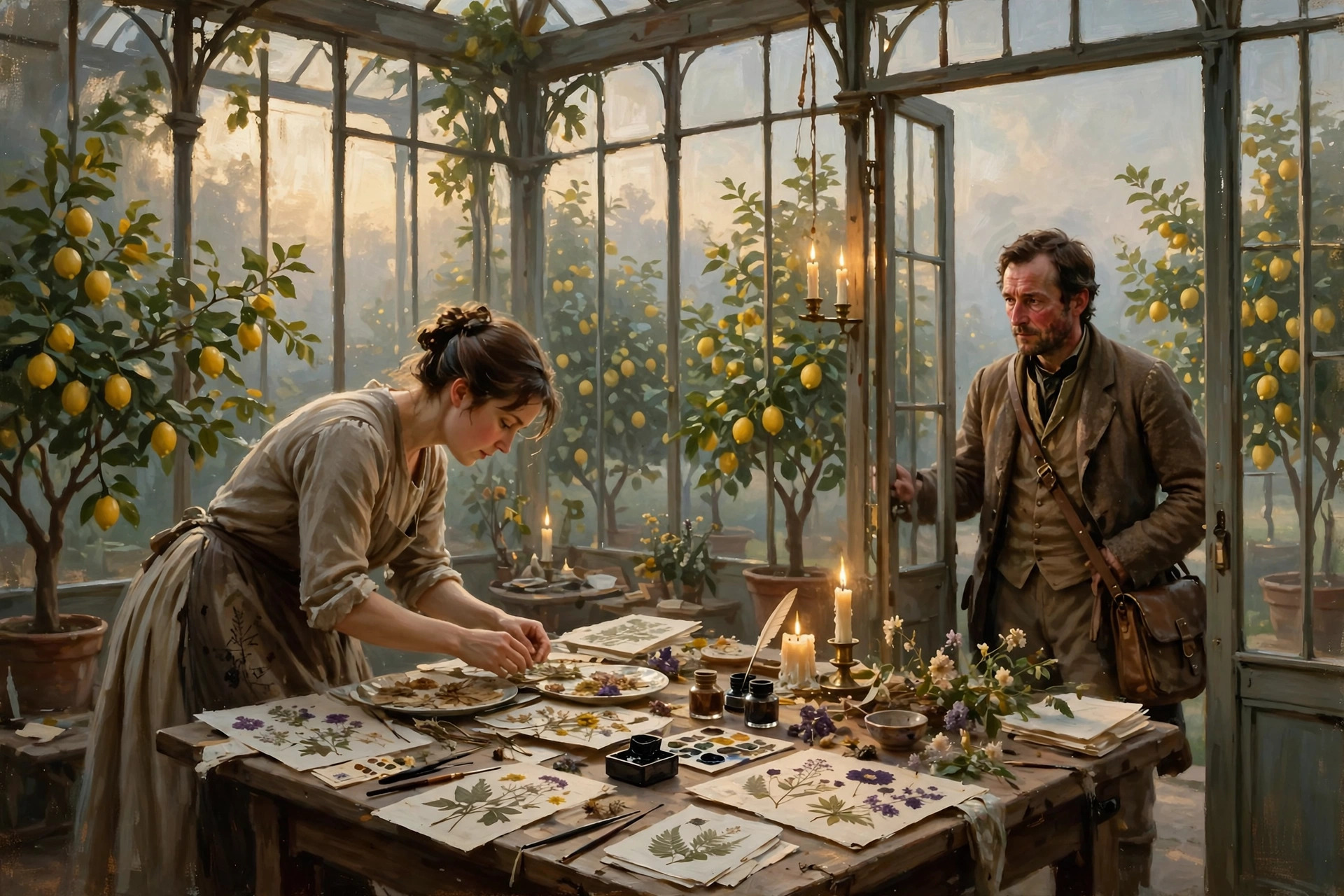
Lavinia Marchbanks had painted in stranger rooms than the orangery at Marlow Grange, but never in one that smelled of warm glass and ripening lemons while a countess watched from a rattan chair. She set out her pencils in a row, uncapped her ink, and told herself that the twelfth plate of a county flora was no different from the eleven before it. A plant was a plant. Press it, measure it, paint it where it grew.
The trouble was that where it grew was now somebody else's business.
"Miss Marchbanks." Lady Ashcombe's voice carried the whole length of the glass house, sharp as a frost on the panes. "You have met Mr. Fairweather? No. Then I shall make the introduction myself, since nobody else in this county seems capable of arriving anywhere on time except the two of you."
The gentleman at the orangery door had boots dusted to the ankle, a leather satchel under one arm, and the sunburnt look of a man who spent his days walking fields with a chain and a staff. He bowed to the countess first, as was proper, and then to Lavinia, and his eyes went past her shoulder to the bench, to the folio, with the frank hunger of a man who had heard about a thing for weeks and was finally seeing it.
"Ma'am. Miss." He set the satchel down. "They tell me you've painted eleven of the county's plants already."
"Forty, when it's finished," Lavinia said. "The flora will carry forty plates."
"And I am told the countess wants each one drawn where my survey puts it." He said it without apology, which she rather admired, and without pride either, which she admired more. "Down to the parish boundary."
"Down to the hedge," said Lady Ashcombe. "Miss Marchbanks, Mr. Fairweather is drawing the county atlas for the Board of Agriculture. Two inches to the mile, which I am assured is very fine. I have decided the flora and the atlas must agree, since half the county will buy one and then the other and be confused if a gentian stands in the wrong parish." She lifted a thin hand. "So you will work together. Here. Every morning until I say otherwise."
Lavinia's pen was in her hand before the countess finished speaking, an old habit, a soldier's habit, reaching for the weapon nearest to hand. She heard him cross the orangery behind her, unhurried, gravel and lemon-rind, and then his shadow fell across her clean paper, cool and blue as a wash of indigo, and the nib caught the sheet and snapped clean off.
She stared at the broken steel. Eleven plates, a year of quiet rebuilding since the pages, a bench in a glass house and a post at Miss Pargetter's seminary that existed on the countess's goodwill, and her hand was shaking over a snapped nib like a schoolgirl's.
"I am so sorry," Edmund said. He did not step away, which she expected, and did not crowd her, which she did not. "Here." A card came past her shoulder, plain, clean-edged. "For the ink. My grandmother used to say a shadow on the page was a sign the work was too big for one person."
"Your grandmother was generous with her sayings."
"She was a widow with six children and a shop full of apprentices. She had to be."
p>Lavinia took the card, set the broken nib on the bench's edge, and did not throw it away. She did not know why she did not throw it away. She fitted a fresh nib instead, and heard the countess make a small sound of satisfaction, as though something had gone precisely to plan.
"There. Now you are introduced to each other's tempers, which saves a week." Lady Ashcombe rose, and the rattan chair creaked its relief. "I will tell you both the rest of it plainly, because I am sixty-one years old and past dressing anything in ribbons."
Lavinia kept her eyes on her bench.
"In nine days' time I hold the Floral Ball here at the Grange. On that night I will name the illustrator of the Ashcombe flora before the whole county, and I will sign the commission then and there. Until that night, Miss Marchbanks, your plates and Mr. Fairweather's maps will lie together on this bench, and I will look at them, and I will decide." A pause, weighted like a press on a flower. "You understand me. Nine days. I am not a woman who likes to be made a fool of, and I am not a woman who changes her mind twice."
"Nine days," Edmund said slowly, "to show forty plants in forty right places."
"No, Mr. Fairweather. Nine days to show me one plate done properly, by the pair of you, with neither of you killing the other over a gentian. The rest will follow." The countess moved to the door, silk whispering against the warm glass. "The orangery is yours until dusk. Mrs. Hobbs will bring tea at noon and complain about the state of the walks. Good morning to you both."
And then she was gone, and the door clicked, and the orangery was very quiet except for the ticking of a gentleman's watch somewhere in Edmund Fairweather's coat and the fat drone of a bee against the glass.
"She means it, you know," he said. "About deciding at the ball."
"I know. Everyone in Ashcombe Wells knows. The countess's mind is the county's weather." Lavinia smoothed the spoiled sheet, the shadow long gone, the snapped nib still sitting at her elbow like a small accusation. "Mr. Fairweather, before we begin, I had better tell you how I work, so you may decide now whether you can bear it."
"Please."
"I paint from pressed specimens. I paint slowly. I do not paint to please a fashion, and I do not paint to please a gentleman's eye, and if a leaf grows on the north side of a hedge I will not move it to the south because the composition is prettier there." She looked up at last. He had taken off his coat and folded it over a chair with the neatness of a man who had packed a satchel a thousand times, and he was listening the way surveyors listen, she supposed, standing still and letting the country come to him.
"Good," he said. "Because I have come across county maps where somebody moved a river because it looked better crooked. I've walked this county for two years, ma'am, and I will not move a hedge for anybody's composition, including yours."
"Including the countess's?"
"Especially the countess's. She pays the Board, not me, and the Board pays for the county as it lies." He drew out a rolled sheet and set weights on its corners, four smooth stones from his pocket, and the orangery sun came through the paper and showed her the whole southern half of the county, rivers like veins, hedges like stitching, every field numbered in a small clear hand. It was, she thought with irritation, a beautiful piece of work. "Now. Where do you want your twelfth plate to stand? Name me the plant."
"The meadow saffron. It flowers in the low field past Saint Aldhelm's, and I pressed three specimens last autumn, so I know it better than I know most of my family." She heard the edge in her own voice on the last word and let it pass. He did not ask about her family. He spread the survey flat and put one blunt finger on the low field.
"Here. Two inches to the mile, so your field is a thumbprint. I'll pencil the boundary light, and you paint over me, and if my line fights your stem, we'll argue about it like Christians."
She almost smiled. She did not let him see it. She brought the folio to the bench where his survey lay, and the buckram cover touched his paper, and the two of them stood a moment looking down at the county and the plant lying together.
"Pencil first," she said. "Light. I mean it, Mr. Fairweather. If I see one of your lines through my wash I will know it for a year."
"You won't see it. But it'll be there under everything, holding the field the way it truly lies." He glanced up, and the glass light caught him full in the face, honest and weathered and a little hopeful, which she distrusted most of all. "One morning's trial. If we can't make one plate together in one morning, we'll tell the countess her scheme is mad, and she'll only sulk for a decade."
Lavinia looked at the pressed saffron, the pencilled field, the broken nib at her elbow. Nine days. The commission, the seminary, the whole careful rebuilt quiet of her life, all of it hanging on a ball and an old woman's judgment.
"One morning," she said, and dipped her fresh nib in the ink. "And it is only for the flora, Mr. Fairweather, whatever the countess imagines she is arranging. Only for the flora."
Survey Lines
By the second morning Lavinia had learned three things about Mr. Fairweather: he arrived before she did, he had already sharpened his pencils, and he had hung his coat over the same chair with the chronometer's chain catching the orangery light, so she stopped pretending not to look at it.
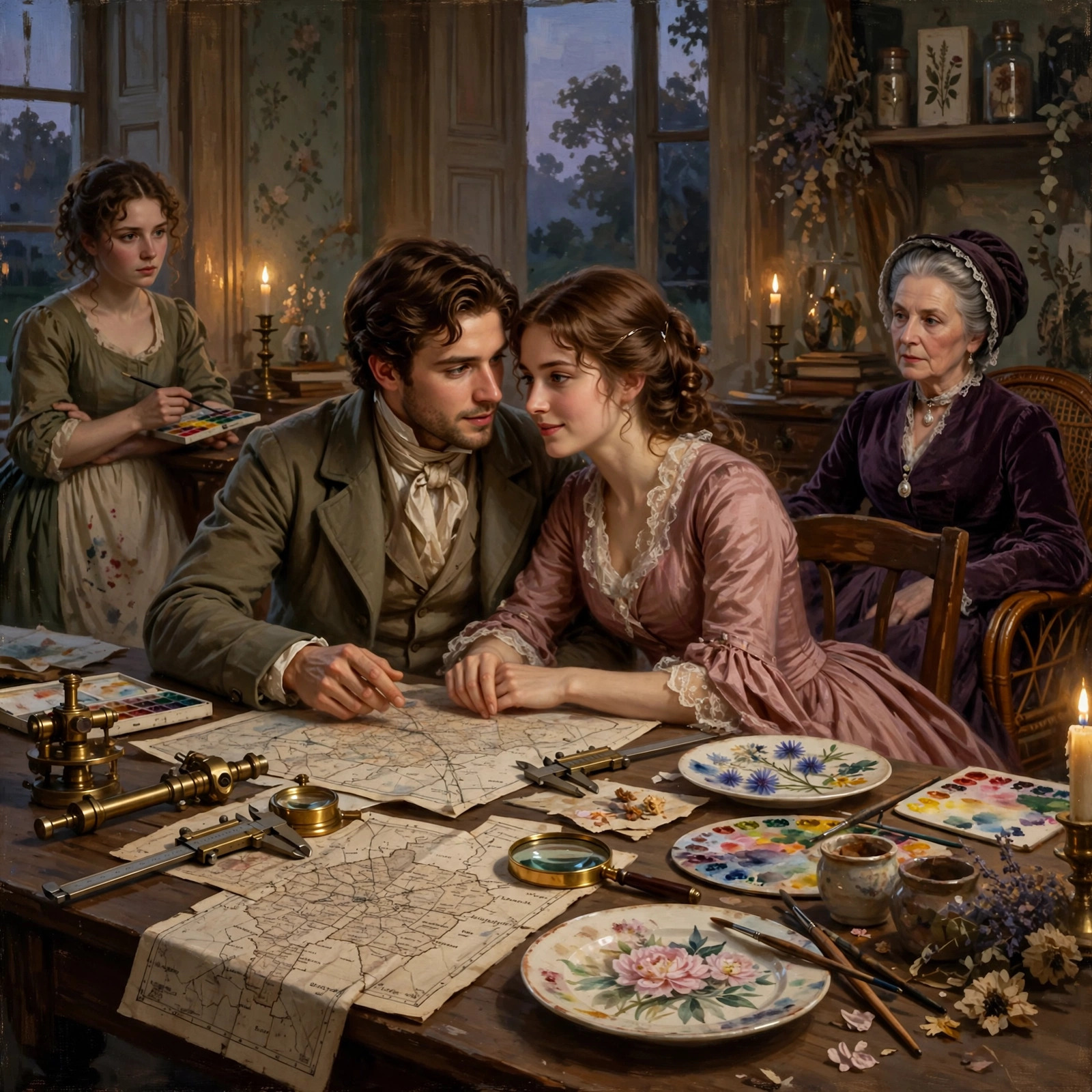
"You're staring at my grandfather's watch," he said, without looking up from his survey.
"I'm staring at the fact that you've pencilled my field crooked."
"I haven't. Come and see."
She came. That was the trouble with him, she was beginning to find. He never made her come twice; he simply laid the thing out and let her own feet decide.
The survey lay flat under his four smooth stones, and along the low field past Saint Aldhelm's wandered a nest of fine brown lines, curling and closing on themselves like ripples that had forgotten to move. She put her finger on one.
"And what is this supposed to be? It isn't a hedge. I've walked that field, Mr. Fairweather, and there is no ditch drawn this way."
"That's not a ditch." He set his pencil down, and she noticed he did that when he meant to teach, the way a man spreads his hands flat on a table to show he's holding nothing. "Those are contour lines. Every line is one height. Walk along one of them and your boots never rise and never fall. Put your finger there and you're walking level."
"Nobody walks level in that field. It rolls."
"It rolls across the lines, not along them. Look." His finger climbed from line to line, up the little crowded rings on the slope above the field. "See how they crowd together here? That's your hill going up sharply. And here, where they spread apart, that's the shoulder, where the slope lies back and takes its ease. The closer the lines, the steeper the ground. You can put your whole hill away in a pocket, if you know how to read it."
She read it. She was annoyed to find she read it at once, the way she was annoyed each time he turned out to be good at something. The hill rose off his paper in rings, the same hill she could see through the orangery glass if she turned her head, and the rings were true. She had walked that shoulder in October with her pressing tin and her boots soaked, and there it was, lying back and taking its ease, in brown lines a half-inch apart.
"Now," he said, and leaned back with his arms crossed, which she had learned meant he was about to be insufferable. "Show me the same thing in your paint. My rings against your wash. Teach me the shoulder."
She uncapped her gum arabic and thought for a moment, and then she worked fast, because this was the one room in the county where she was never uncertain. A wet sheet of grey. Then, before it dried, a second wash laid along the hill's flank, tilted, so the colour pooled at the lower edge and thinned to nothing at the crest.
"There," she said. "That's the shoulder. The dark lies low, the light lies high, and where the two greys meet and one has bled into the other, that's where the hill turns. You don't draw the turn. You let the water find it."
Edmund bent close. Very close. She could see he was not looking at the picture but through it, the way he'd looked through the survey in the sun.
"The water decides where the line goes," he said slowly.
"The water and the paper decide. I only carry the bucket."
"And it always falls to the low ground."
"Water's not a fool, Mr. Fairweather."
He laughed. It surprised them both; it cracked out of him short and rough, like a pencil snapping, and he put his hand over his mouth a half-second too late. She found she was smiling at her own paint before she had given herself leave to, and she bent to the plate so he would not collect on it.
They inked the twelfth plate together after that, and it went the way nothing of hers had gone in a year: quickly. He pencilled the boundary of the low field light as promised, and she laid her meadow saffron over it, three pressed specimens fanned at her elbow, the lilac of the crocus-like petals mixed fresh on her china saucer. Twice his line fought her stem, and twice they argued, and once she was wrong and once he was, and he gave way the first time with no grace at all and the second time laughing, actually laughing, holding up his hands as though she'd put a gun to his survey.
"Move your hedge."
"I don't move hedges."
"It's a pencil hedge, and my saffron has stood in that corner of the field since before the Board of Agriculture was thought of, so move it."
"The hedge is where the hedge is."
"Then the saffron will grow through it, and the countess will ask me why my plate shows a flower with no respect for property, and I will tell her whose line it was."
A pause. He looked at the plate, at his own fine line, at her three lilac stems waiting on his boundary like ladies at a stile.
"Half an inch," he said. "I'll move it half an inch. Not for the Board. For the saffron."
"For the plate."
"For the plate," he agreed, and rubbed it out with his thumb, and she thought, there, that's how a man ought to look when he's been wrong, easy in it, and then she thought, stop it, and reached for her ink.
Miss Pargetter was announced by the orangery door banging, which was her way. She came in with her bonnet strings flying and her shawl crooked, sat herself on the chair with Edmund's coat on it as though unaware it was occupied, and looked at the plate between them for one long, headmistress moment.
"You've not had bad news, I hope," Lavinia said.
"No news that's bad for me." Miss Pargetter straightened her shawl, which was her way of buying time. "The mothers, Lavinia. Two of them, this week, at the door with the little ones in the carriage behind them, asking whether my seminary employs the same Miss Marchbanks that's in the old pages."
Lavinia's nib stopped. The old pages. She knew them by heart, better than her prayers: the printed letters, the whispers set in type, the whole shame bound and sold at a penny.
"The pages are a year old," she said. "A year and more."
"Paper keeps, my dear. You know that better than anyone in this county." Miss Pargetter's eyes went, brief and not unkindly, to the plate, to the fresh lilac, to the whole careful morning of it. "The mothers ask, and I tell them you're the finest brush in three parishes, and they say yes, and then they say the other thing, the thing they came to say. I can hold the seminary for you while the countess makes her mind up. I can't hold the mothers."
"I haven't asked you to hold anything, ma'am."
"No. You never ask. You'd paint yourself into the poorhouse before you'd ask, which is why I came myself instead of writing." Miss Pargetter stood, tugged the shawl straight, and softened the whole speech at the door. "Finish the plate. It's a good plate. Whatever else is true in this county, that's a good plate."
The door closed. The bang of it went down the orangery glass and out among the orange trees and took a long while dying.
Lavinia set her nib down flat on the bench, beside the one she'd snapped and kept, and looked at nothing but her own hands, and breathed. Once, twice, until the air came even again. She would not cry in front of a man she'd known two days. She'd set rules for herself about it, years of rules, and this one she could still keep.
Edmund said nothing at all for a while, which she had not expected of him, and then he said, quietly, not looking at her but at the plate:
"A name can be mended, you know."
"Can it." She kept her voice flat.
"Yes. I've seen it done. It takes longer than a plate and it costs more than a plate, but I've seen a name no one would print come back into a room like it owned the chairs."
She looked up. His face was turned to the saffron, all the laughter gone out of it, and there was something under his voice she couldn't read, some private country he was mapping while he talked to her, and it occurred to her that he had not said how he knew, and had very carefully not said it.
"Mr. Fairweather. Whose name?"
"A colleague's." He picked up his pencil and turned it in his fingers, once, twice. "Ask me another day. We've a plate to ink, and you've a hill to hold, and I've a hedge that's moved half an inch and wants a witness."
She looked at him a moment longer. Then she took up her fresh nib, because the plate was true, whatever the mothers said, and because it was easier than the rest.
"Lilac on the left, then. And if your line shows through my wash, I'll know it for a year."
"You won't see it," he said. "But it'll be there."
Sixty Guineas
Lavinia came out of Saint Aldhelm's with the parish register's cold still on her fingers and found Edmund waiting under the lych-gate, hat off, holding a folded paper as if it were a survey he expected to argue with.
"The vicar's out," she said. "The clerk says he's round the home visits until three."
"Then we've the churchyard to ourselves." He put his hat back on and offered her the path, and they went along it slowly, between the leaning stones, because the graves at Ashcombe Wells were set close and neither of them walked carelessly among other people's names.
"Miss Marchbanks. I've a proposal and it isn't a romantic one, and I'd rather say it plainly than have you find the shape of it later and think I'd been sly."
"Say it, then."
"The countess will name her illustrator at the ball in four days. She'll not put her patronage behind an unmarried woman the papers have printed, and you know it, because your Miss Pargetter knows it, and the mothers at the seminary know it. But a married woman with a husband in the Board's county survey is a different thing in this county's eye. Entirely different. Whether that's just or not I leave to the churchyard."
Lavinia stopped walking. A yew dripped on the wall beside them, patient as anything.
"You're proposing marriage."
"I'm proposing a marriage of licence. The common sort, the vicar's own, no banns wanted, done inside a week. My name is a respectable one at present and it wants nothing but a wife who doesn't turn it into copy. Your name wants exactly what a husband's name gives it. And the Board reads its nomination for county surveyor the same night as the countess signs her commission, which means my atlas and your flora stand or fall together at one ball, and I'd rather we stood together than fell separately."
"You've thought this out."
"I've measured it." A small dry turn of the mouth. "Two inches to the mile is my trade, Miss Marchbanks. I don't do anything at a larger scale."
She looked down the path, at the stones, at the gate, anywhere but at him, because her heart was doing something unhelpful and quick and she wanted it done before she answered.
"And what do you ask of me in it? Hearts aren't in the price, you said."
"Hearts aren't asked and aren't offered and won't be missed. I keep my own house in Cordwainer Lane lodgings, you keep your post and your bench and your folio. I ask that you paint forty true plates and let me put my lines under them, and that you stand at Marlow Grange on the ninth with my name on you and let the county make of it what it likes, which will be exactly what we like."
"And if I say no."
"Then I've misjudged you and I'll say so, and we'll ink the saffron plate tomorrow and be no worse." He turned his own hat brim once in his fingers. "But I don't think I've misjudged you. I think you've been carrying that hill alone for a year because no one offered to hold the other side, and I've room in my arms for one side. It's arithmetic, not poetry. I can't afford poetry this year."
The bell of Saint Aldhelm struck the half hour behind them, and the sound went over the wet graves and out toward Marlow Grange, which stood up through the bare trees with its orangery glass catching what light there was.
"No hearts asked," she said.
"None."
"Then I'll be married, Mr. Fairweather. On those terms and none other."
He put out his hand, and she took it, and it was warm and steady and gripped like a man closing a bargain, which was what it was, and which was, she found, easier to bear than anything sweeter would have been.
"The licence papers want witnessing and printing notice," he said. "I know a printer."
"You know everyone."
"I know the useful half of everyone."
Tredwell's shop on Cordwainer Lane smelled of lamp-black and hot iron and damp paper, and Mr. Nathaniel Tredwell himself came out from behind his common press wiping his hands on an apron that had given up some time ago. He was a wide, comfortable man with a voice made for calling across a shop floor, and he greeted Edmund like a customer he'd been expecting, which Lavinia thought nothing of at the time.
"Fairweather. And this is Miss Marchbanks. Well." He looked at her with an interest she didn't care for and a politeness she cared for less. "The saffron lady herself. My niece has your meadow plate copied out in pencil, miss, and swears by it."
"Your niece is generous," said Lavinia.
"We'll want the marriage notice set for Saturday's sheet," Edmund said, "and the licence papers witnessed while we're here. Two birds."
"Two birds." Tredwell clapped his hands once, soft, on the apron. "Set it then. Fairweather, come round the counter, your eye is better than my journeyman's and I'll not have your notice in crooked type."
So Edmund went round the counter, and Lavinia stayed by the window among the cases of type, and she was, she admitted to herself, interested in spite of everything, because she'd never stood inside a print shop, and the little rooms of sorted letters were like nothing so much as a painter's palette done in metal. She took one up, a shallow tray of commas, and weighed it in her hand. Somewhere in the press behind her the bed was being inked. Somewhere a sheet went down and came up.
She heard Tredwell's voice drop. That was all. A voice like his didn't drop by accident, and she half turned and saw that Edmund had his back to her at the far end of the counter, and Tredwell had brought out from somewhere a packet wrapped in a broadsheet, string-tied, not large, and set it on the wood between them, and leaned on it with both hands while he talked, low, the way a man talks when the words are for one pair of ears.
She turned back to the type cases. Whatever it was, it was shop business, and she'd been looked at enough in her life that she'd made it a rule to look at other people as little as they looked at her.
When the notice had been set and the papers witnessed, Tredwell wrapped the packet away again somewhere under the counter, and Edmund paid for the setting in coin, and said, "Saturday, then," and Tredwell said, "Saturday, and I'll hold you to it," with a warmth that Lavinia heard and filed away as printer's talk, and then they were out in Cordwainer Lane with the light going.
At the seminary Miss Pargetter had the lamp lit and the licence papers spread on her own desk, and she read every line of them twice, which Lavinia could have told her was unnecessary, and then said, "Well," twice, and "He's a solid man, I'll say that, whatever else," which in Miss Pargetter's mouth was a testimonial.
"He is solid," said Lavinia. "He's the most honest measure I've met in this county."
Miss Pargetter handed her the pen. Edmund stood by the window with his hands behind him, looking out at the dark, and his coat hung over the chair, and in it, in the inside pocket, she knew, he carried that silver chronometer of his grandfather's, because he'd told her once he never took it off, and there was something in the way he'd said it that had told her it was the whole of his inheritance and he meant to keep it.
Lavinia sat, and set the nib to the paper, and thought, as the ink came, that it was a clean thing they'd made between them, hers and his, all terms and no concealment, and that four days was little enough to be married in but plenty to be honest in. The signature went down the way her signatures did, quick and even, the L with its loop she'd had since she was a girl.
"There," she said. "Witnessed, printed, and signed. You're nearly stuck with me, Mr. Fairweather."
He turned from the window then, and the lamplight was on his face, and whatever he was carrying in it he set down somewhere she couldn't see, and said, "I've been stuck in worse places."
She laughed, and capped the pen, and did not know yet what Saturday would cost.
Among the Lemons
The bells of Saint Aldhelm's rang nine in the morning while Lavinia stood at the church door with a paper in her glove and her heart going like a kettle someone had forgotten on the hob. It was not the marriage she had once imagined for herself, the one with orange blossoms and aunts weeping into their wine. It was plainer than that, and faster, and the Reverend Mr. Soames pronounced them married before the echo of the bells had quite settled back into the tower.
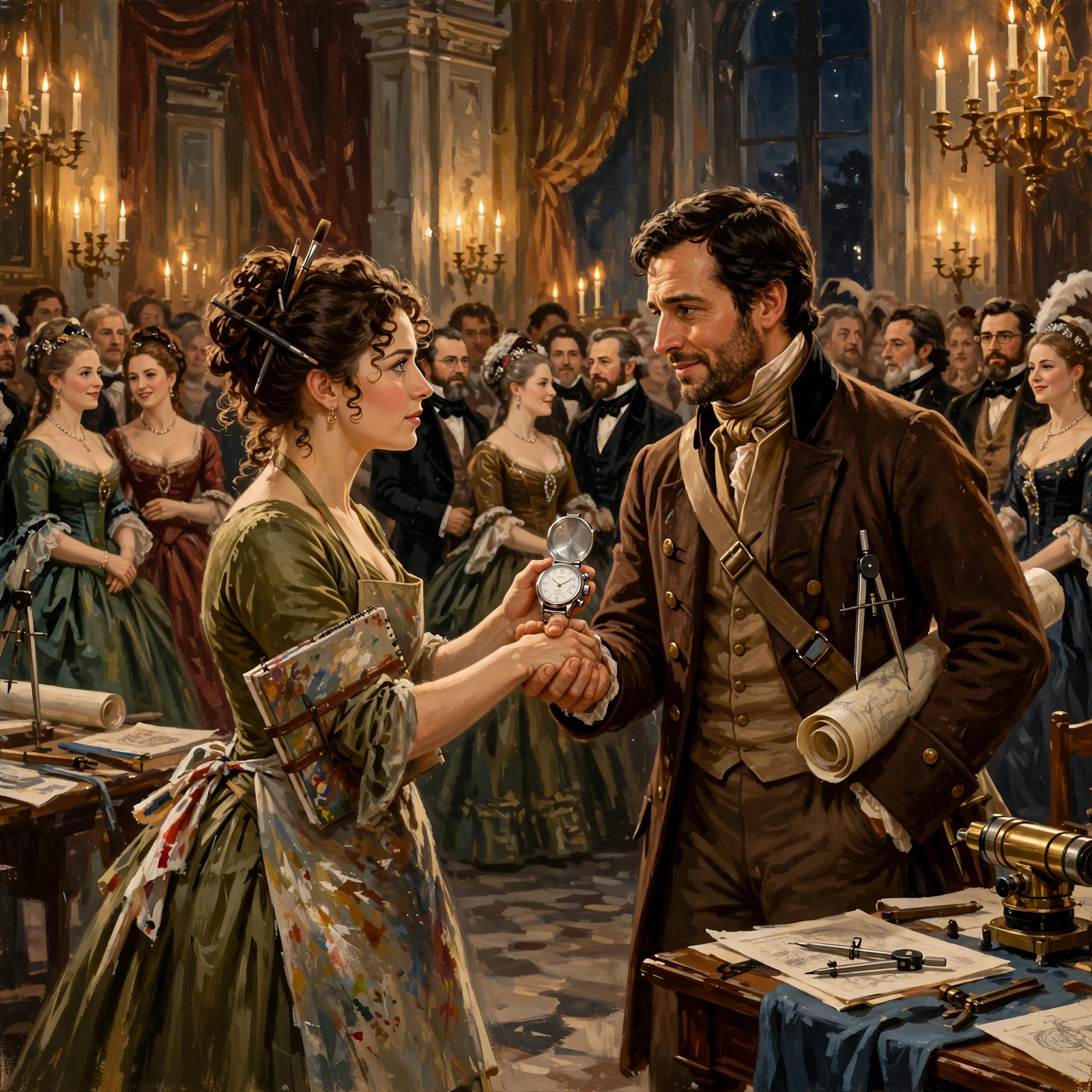
"You may kiss her, if she'll allow it," the clergyman said, cheerful as a sparrow, and then, catching the look on both their faces, added, "or you may save it, I suppose. Plenty of folk do."
They saved it. Edmund offered his arm down the churchyard path as though the path were a boundary he had been hired to walk, and she took it, and they were married, and the county did not so much as tilt on its axis, which was somehow the strangest part.
"I'll see you at the orangery at dusk," he said at the gate. "The countess wants the twelfth plate done before the ball, and we're a plate and a half from done."
"We," she said.
"The survey says saffron where the survey says saffron," he said. "I only draw the hedges it grows under."
She went home to her lodgings and ate something she could not afterward have named, and took down her hair and put it up again twice, which was foolish, because he had seen her hair every working morning for a week and never once looked at it, and she dressed for the orangery as she always dressed, in the grey stuff that took paint without showing it.
Marlow Grange's orangery at dusk was a green-gold country all its own. The lamps were lit early because the countess's gardener believed lemon trees needed light to think by, and the glass held the last of the day the way a cupped hand holds water. The twelfth plate lay on the workbench where it had lain all week, and Lavinia sat to it and worked, and Edmund sat across from her with his survey sheets and did not leave, which was new, and did not pretend to be doing anything but watching her paint.
"You've the saffron too yellow," he said at half past six.
"I've the saffron exactly as the pressed specimen says, and pressed specimens go brown, so I'm obliged to guess the rest, and I guess from the living plants in this very house, so if you'd like to quarrel about it, quarrel with the countess's gardener."
"I never quarrel with a man who owns that many lemon trees." He turned his survey sheet toward the lamp. "The hedge on the eastern edge. I moved it."
She set her brush down on the rest. "You moved it."
"Half an inch. On my sheet. So the saffron sits where the composition wants it and not where the field does." He did not look up. "I've never moved a hedge for anyone in two years of walking this county. I want it entered somewhere that I did it for you, because it will not happen twice."
"I'll enter it in my heart's own ledger," she said, "in invisible ink."
"That's where I keep most of mine."
She laughed, and the sound went odd in the glass house, too warm and too near, and she found she had stopped painting and he had stopped pretending to work, and the lamps hissed and the lemon trees stood in their tubs like a congregation waiting for something to be said.
He came around the bench. There was no reason to; his survey sheets were on his side of it. She stood, because sitting down while a man crossed a room toward you was a coward's way of meeting him, and she had been called a coward in print once this year already and had not enjoyed it.
"Lavinia," he said, and then, as if the rest of the sentence had been surveyed and found too steep, he kissed her.
Among the lemons, with the twelfth plate drying behind her and her married name nine hours old in the parish book. His hand went to her jaw, careful, the way he handled his instruments, and she thought: I am not an instrument. And then she thought nothing at all for a moment, because she had put her hand flat against his waistcoat and he had made a small sound, not words, and she had kissed him back, properly, in a way that had nothing of plainness in it.
When they broke apart, the gardener's boy was standing in the far door with a lamp and the expression of a person trying very hard to be a wall.
"Beg pardon," the boy said. "There's a gentleman come up from the town. Mr. Tredwell. Says it's business and won't keep."
The warmth went out of her hands all at once, the way it does when a door opens in winter. Nathaniel Tredwell did not come up to Marlow Grange on business that was anybody's friend's business, and his business was print, and print, in her experience, was another word for her own name with a stain beside it.
"Show him in," Edmund said, and his voice had gone flat and level, a man reading his own instruments, and she noticed, because she had been a week learning his voices, that he was not surprised.
Tredwell came down the orangery walk with his hat in his hand and a look of apology so thin that a strong light would have gone straight through it. He carried a broadsheet folded in half and a smaller paper folded in quarters, and he laid both on the workbench beside her plate, in the lamplight, where she could not help seeing them.
"Mrs. Fairweather," he said. "My congratulations, madam, on behalf of the Scrutiny and of myself, and I do hope you'll take no offense at the hour."
Mrs. Fairweather. The name sat on her like a coat cut for someone else. She looked at the broadsheet instead. It was a pulled proof of Thursday's page, ink still sharp with the smell of his shop on it, and there, in the middle of a column about turnip futures and a lost terrier, was her own name, and under her name, in quotation marks, words she had written with her own hand and given to a man who had promised to keep them. Words she had thought burned or lost or at the very least private. Words she had never once imagined set in type.
"That's a proof," Tredwell said. "Not yet printed, you understand. It can stay unprinted. It's Thursday's page, and what's in it by Thursday is very much at the discretion of the office."
"And at the discretion of your office," Edmund said, "lies sixty guineas."
The orangery went very quiet. A lemon leaf ticked against glass somewhere in the dark beyond the lamps.
"You've paid him," Lavinia said.
"I offered him terms," Edmund said. "Some weeks ago. Before the countess, before the orangery. Before I knew you'd be, that we'd," and he stopped, because there was no honest end to that sentence, and they both knew it. He had known her nine days. He had bought her letters before the first of them.
She looked at the smaller paper, the one folded in quarters. Tredwell unfolded it for her, helpful as a knife. It was a receipt in his own shop's hand, dated three weeks back, for seven letters, paid in full, sixty guineas, received of E. J. Fairweather, and the ink of it was old enough to have gone brown at the edges, and Edmund stood beside the bench with his hands empty and said nothing at all, and she understood, standing in the warm reek of the proof and the lemon trees, that every morning he had come to this bench and sharpened her pencils and moved his hedge half an inch for her saffron, he had been carrying this in his coat, and had chosen, every morning, the silence.
"You let me believe it was over," she said. "You let me sit here and tell you about the year I had, the pages, the mothers at the seminary, all of it, and you let me believe the worst of it was behind us, and you knew, because you had bought the worst of it, that it was not."
"I knew the letters existed. I didn't know what was in them."
"You knew what they'd be printed in."
He had no answer for that, and she watched him understand he had no answer, and she watched him, even then, even standing in his ruin of his own making, not reach for her, which she would almost have forgiven, and not lie, which she could not.
"Thursday's page," Tredwell said, to the lamps generally, "goes to press Wednesday night."
She took up the proof sheet. It came off the bench easily, the paper light as a leaf, heavier than any plate she had ever painted. Her folio lay open to the twelfth plate, the saffron golden under the lamps, the hedge moved half an inch for love, and she left it open, because she could not have closed it with these hands.
"Lavinia," Edmund said behind her.
She walked out of the orangery into the blue evening with the proof sheet in her hand, and he was still calling her name, her new name, the one he had given her, when the glass door swung to behind her.
The Pawnbroker's Counter
Rain came in the night and stayed, and Lavinia stood at the seminary window with the proof sheet flat on the sill behind her, watching the lane, because she had not slept and because at half past eight Edmund Fairweather came down the lane in a dripping greatcoat with a small case under his arm.
She knew the case. Shagreen, gone grey at the corners, the size of a prayer book. He had carried it every working morning into the orangery and set it at the far end of the bench, out of the way of the gum arabic, and she had never once asked him what was in it, because she had been too busy not asking him about the receipt in his other pocket.
He turned at the corner of Cordwainer Lane, and she took her cloak off the peg and went down the stairs and out after him, into the rain, with no plan at all, only the fixed idea that she was not going to sit in a schoolroom and be surprised by him a second time.
The pawnbroker's window was lit. She stopped across the street under an inn yard's dripping arch, close enough to read the bills pasted in the glass, and watched Edmund set the shagreen case on the counter and open it.
Even across a wet street she could see what came out of it. Silver, and a chain, and the pawnbroker turning it to the light and reading the engraving through his spectacles. Josiah Fairweather, London, 1782. Edmund had said the name once, on the third morning, turning the watch over in his fingers while she mixed a green, and had put it away again and talked about hedgerows instead.
The pawnbroker counted out guineas. Lavinia could not hear the number, but she could see the little stacks of them on the black wood of the counter, and she could see Edmund's face while he watched them counted, which was the face of a man watching a fence taken up, rail by rail, and carted away. Sixty. It was sixty. She knew it was sixty before he ever reached the street, the way she knew rain was rain.
He came out with the case empty and his pockets heavy, and he turned, as she'd known he would, toward Tredwell's shop on Cordwainer Lane, and she went along the opposite pavement with her hood down and the rain in her eyes, and stood where the print shop's great window showed her the whole of the counter.
Tredwell was at the stone. Edmund put the guineas on it in a row, counted aloud so there could be no argument later, and Tredwell counted them again, and then, because the man was tidy in his villainies, he wrote a receipt, and broke the seal on a drawer, and brought out a packet tied with taxed ribbon.
Seven. She could count the knots of it through glass. Seven letters, in her own hand, addressed in her own hand, to the man who had gone to Gretna with Henrietta in the spring of last year with her letters still in his coat.
Then Tredwell did something she had not expected. He left the packet on the counter and walked to the press, and took the lever in both hands, and she watched him unlock the forme and begin, patiently, with a small bodkin, to break it down. Letter by letter. The page that named her, the page quoting her own private sentences, came apart in his fingers into sorted metal, a line at a time, into the case, and Edmund stood and watched every line of it go, like a man verifying a boundary.
She was wet through, and she did not move.
And then the shop door opened, and Henrietta came in out of the rain, and stopped dead on the threshold with her bonnet strings streaming.
"Oh," said Henrietta. "You've sold them."
Lavinia could not hear all of what followed, through the glass and the rain. She heard enough. She heard Tredwell, dry as paper dust: "Sold to this gentleman, miss, for the price you set on them, and I'll thank you not to come round my counter again." And she heard Edmund, low and even, and once, sharp: "-- you sold your cousin's letters to this shop, madam. Say the rest of it plainly."
And Henrietta, whose voice had always carried, whose voice had carried over parish pews and assembly floors all her life: "I did. What of it? She had everything, and I wanted one thing. I wanted the flora. I can paint, Ned, I have always been able to paint, and nobody in this county would ever hand me a brush while she was standing there being pitied for it. She even got the pity. She got the whole of it."
Someone said something quieter. Henrietta's answer came high and cracked: "The countess will never take her now, married or not, and you know it, and I hope you're both very happy."
Then the door again, and Henrietta's umbrella going past the window, and then, inside, Tredwell saying, comfortably, to no one: "Well. That's the last of that page."
Edmund did not leave. He took the packet of letters off the counter, set it in the inside of his coat, and then he asked Tredwell for pen and paper, and stood at the end of the counter and wrote. He wrote for some minutes. He wrote the way he pencilled a boundary, nothing flourishy, everything ruled, and Lavinia stood in the rain and read three words of it backward through the wet glass: Board of Agriculture. And at the bottom, where a signature goes, he signed it, and blotted it, and folded it, and put a shilling on the counter for the paper, because he was a man who paid for his paper even now, and asked Tredwell to see it on the Thursday coach, and Tredwell, who had just made a hundred and twenty guineas out of one shop in two days, agreed.
She was shaking by then, and not only with cold. She got back to the seminary gate before him, by the lanes, hood up, and she was standing under the arch of it when he came along the pavement with the rain running off his shoulders and the shape of the packet plain under his coat.
He stopped an arm's length off. He had every right, she supposed, to come closer now. He did not.
"You followed me," he said.
"Yes."
"Then you saw the watch go. Good. I'd have had to lie about how it went, otherwise, and I'm done with that." He drew out the packet, ribbon and all, and held it out to her flat across both palms, like a surveyor surrendering a field. "They're yours. Every one. I didn't read them. I paid for them before I ever met you, because a name was going cheap in this county and I knew whose it was, and I'd have paid it again, and I'd sell the watch a hundred times over, and the atlas too, which I did this morning by post, and none of that is your debt. It was Wednesday's problem, and it was mine."
She took the packet. Her hands did it without consulting her, the way hands will take a thing they have waited a year for, and the ribbon was wet through, and the letters inside were hers, and she could not have spoken to save her life. Every sentence she had prepared on the walk home was gone, all of it, and there was only the rain, and his face, and the packet weighing four ounces and one whole year.
Edmund put something else on the iron rail of the gate. A small ticket, printed, pierced at one corner.
"The pawn ticket. It's in your name now, not mine. If I keep it, I'll go back for it when the atlas money runs out, and I'd rather not be able to." He stepped back into the rain, and nodded, once, the way he did at the end of a morning's work. "The Grange will be wanting its maps. Mrs. Fairweather."
And he turned, and went up the wet road toward Marlow Grange with his empty case under his arm, and Lavinia stood under the arch with her letters against her chest and the pawn ticket on the rail, and did not call him back.
The Floral Ball
The ballroom at Marlow Grange had been dressed with cut lilies and cut people, and Lavinia stood at the edge of it with her folio under her arm and her heart going like a printer's press. Twelve plates. Two years of pressed specimens and gum arabic, bound in buckram, and every eye in the county pretending not to look at her while looking at nothing else.
Miss Pargetter found her first, near the pillars, in her best grey sarcenet. "You came."
"You told me to."
"I told you to be sensible once a week for eighteen years. You never once managed it. I didn't imagine tonight would differ." But her gloved hand pressed Lavinia's sleeve, twice, which from Miss Pargetter was a paragraph.
Henrietta was across the floor in white muslin, laughing at something, and her laugh died when she saw the folio. She came over anyway, chin up, the way she had come over to church suppers and christenings all her life. "Cousin."
"Hetty."
"You look well." A pause. "Married."
"Since Wednesday morning."
Henrietta's fan opened and shut. "I sold those letters, you know. Before you say whatever you've saved up to say. I sold them and he bought them and I have spent a year being sick about it, and I'd have confessed at Christmas only you'd have hated me more for the confession than the crime."
Lavinia looked at her cousin, whom she had loved before she had loathed, and found the loathing had gone thin in places, like an old wash. "He bought them before he ever met me. Sixty guineas. He never told me until the proof sheet did it for him."
Henrietta went white. "He paid the whole price?"
"With his grandfather's watch."
The fan stopped. Henrietta said, very quietly, "Then I owe him sixty guineas and you a lifetime's apology, and I haven't the means for either. I'll send what I can monthly." And she went back to the muslin and the laughter, but her shoulders were different going than coming, and Lavinia let her go without another word.
Then the doors at the far end opened, and the county made its small noise, the one it reserved for persons of interest. Edmund came in plainly dressed for a surveyor among silks, coat brushed, boots honest, and the whisper ran ahead of him across the floor: his name, the Board's nomination, the atlas, the reading that was to follow the countess's.
He came to her. Of course he came to her; the whole room watched him do it.
"Mrs. Fairweather," he said, and his voice carried on purpose, she could hear that it carried.
"Mr. Fairweather. You're meant to be standing with the Board's men."
"I'm meant to be a lot of places." He looked at the folio. "Twelve plates."
"Twelve."
"Then we're both carrying our work about like evidence." He offered his arm. "Come and be judged with me. It's quicker in company."
Lady Ashcombe received them before the long mirrors, where half the county had gathered under the chandeliers to hear the announcements. The countess was in deep aubergine, and she held her fan like a woman who had long ago stopped needing it for heat.
"Mr. Fairweather. Mrs. Fairweather." She let the second name sit in the air, and the room heard it sit. "You were quick, at Saint Aldhelm's. Wednesday, I'm told. Before the Scrutiny could print a word."
"Before the Scrutiny printed a word, my lady," Edmund said. "Mr. Tredwell broke down the forme himself."
"Did he." Something moved behind the countess's eyes, some old weather. "Then before I say what I have to say, sir, you will say what you have to say, because I'm told the Board's letter is in your pocket and I would rather it aloud than in whispers."
Edmund drew the letter out. He did not open it. He held it flat, the way he had held out the packet at the gate, a man surrendering a field.
"My lords, ladies, gentlemen. The Board of Agriculture has done me the honour of naming me to survey this county. I have written to decline the nomination." The room made a sound like a struck carpet. "I came to Ashcombe Wells two years since to mend a name that was broken in London, through a partner's figures and my own blindness to them. I wanted the atlas because it was the largest honest thing I could put my hand to. I withdraw it because I found a smaller and a dearer one." He looked at Lavinia, and then, deliberately, back at the county. "I married on Wednesday, by licence, at Saint Aldhelm's church, and I would say to anyone who came to this ball tonight to count what it cost: it cost the atlas, and it cost a watch my grandfather finished in 1782, and I am here to tell you it was cheap."
Silence, of the kind that has weight. Then Lady Ashcombe said, "Mr. Fairweather, you are either the most foolish or the most honest man in my ballroom, and I have been twenty years in this county and cannot at present tell you which."
"Neither can I, my lady."
"That," said the countess, "is the first comfortable thing anyone has said to me all evening." She turned to Lavinia. "Give me the folio, child."
Lavinia gave it over. The buckram was warm from her arm.
The countess opened it on the sill of the long window, under the candles, and turned the plates one by one, and the county craned. The meadow saffron. The dropwort. And the twelfth plate, the saffron again, rooted where his survey placed it, every field numbered small in the corner of the sky.
"I said I would not put my patronage behind a woman the sheets had named," the countess said, to the plates, not yet to the room. "I let it be understood. I did not say I liked understanding it that way." She closed the folio. When she looked up her eyes were bright and hard both. "I was twenty-one, and I loved a man my father called unsuitable, and I did what was suitable instead, and I have been twenty years a widow in this house and I never once forgave this county its rules, and I will not be made to enforce them now. Mrs. Fairweather, the county flora is yours. Not your husband's name's. Yours, as it stands in the parish book, married or single, and I will say so aloud to anyone who asks, and to anyone who doesn't."
The room did not know what to do with the silence, so it clapped.
"And you, sir," she went on, turning to Edmund, "since you've thrown away the Board's business with both hands. My estates want surveying. Marlow Grange first. The orangery drains run where my late husband's maps say they do not, and I am tired of being lied to by paper. You'll find the wage honest and the employer impossible."
"I've been employed by the Board of Agriculture, my lady. I'm accustomed."
Somebody laughed. The countess did not, but the corner of her mouth did.
They danced after that, because the county required it of them, one measure with the whole room watching and neither of them able to count the beats. At the end of it he set her down by the long windows, and Lavinia put her hand into her reticule and drew out the shagreen case.
Edmund went very still. "That's in your name. I signed the ticket over so I couldn't go back for it."
"I know what you signed. I redeemed it this afternoon. Sixty guineas, the whole of my quarter's wages from the seminary and the first payment from Henrietta, who came to the gate this morning looking like a whipped spaniel and left looking only like my cousin." She put the case into his hand and closed his fingers over it herself. "It was your grandfather's. It should go to your grandson, someday, and not to Mr. Tredwell's paper bill."
"Lavinia."
"The licence is used already, you'll say, and what's the use of telling me the morrow's business. But I'll say it anyway, because I've decided I'm a woman who says things now, and the county can make of it what it likes." She looked up at him, at the whole honest length of him, and the candles were very bright and she did not care what her face was doing. "Tomorrow, at Saint Aldhelm's, we'll stand up together again, in daylight, with no proof sheet and no price on it and nobody's good name at stake but our own. Chosen. Not convenient. Not for the seminary, not for the countess, not for the atlas. Chosen."
He turned the case over once in his hands, thumb on the worn engraving, and put it in his breast pocket, over the heart, where a man keeps a thing he means to keep.
"Tomorrow, then."
"The morrow is soon enough."
The music struck up behind them, and the county went on looking, and Lavinia stood on the ballroom floor with her hand in his and the folio closed between them, twelve plates and two years, bound and finished, and did not look away from him once.
Get notified when new stories drop

Marcus Hale
Marcus writes slow-burn and marriage-of-convenience stories where logistics become intimacy and competence is a love language.
Leave a comment
Comments