


Midnight Pebble
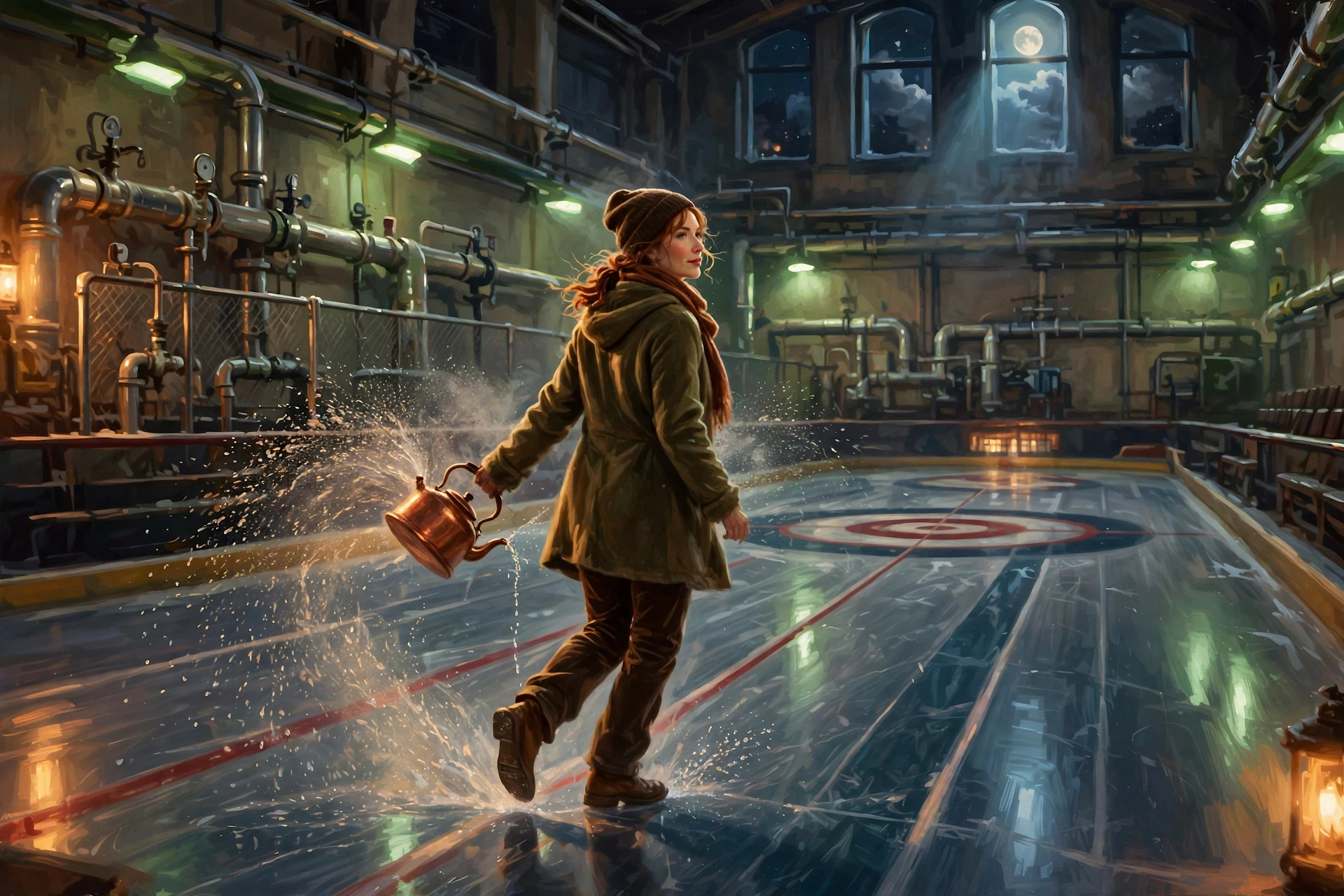
The arena at midnight belonged to Ines Kade, and she liked it that way.
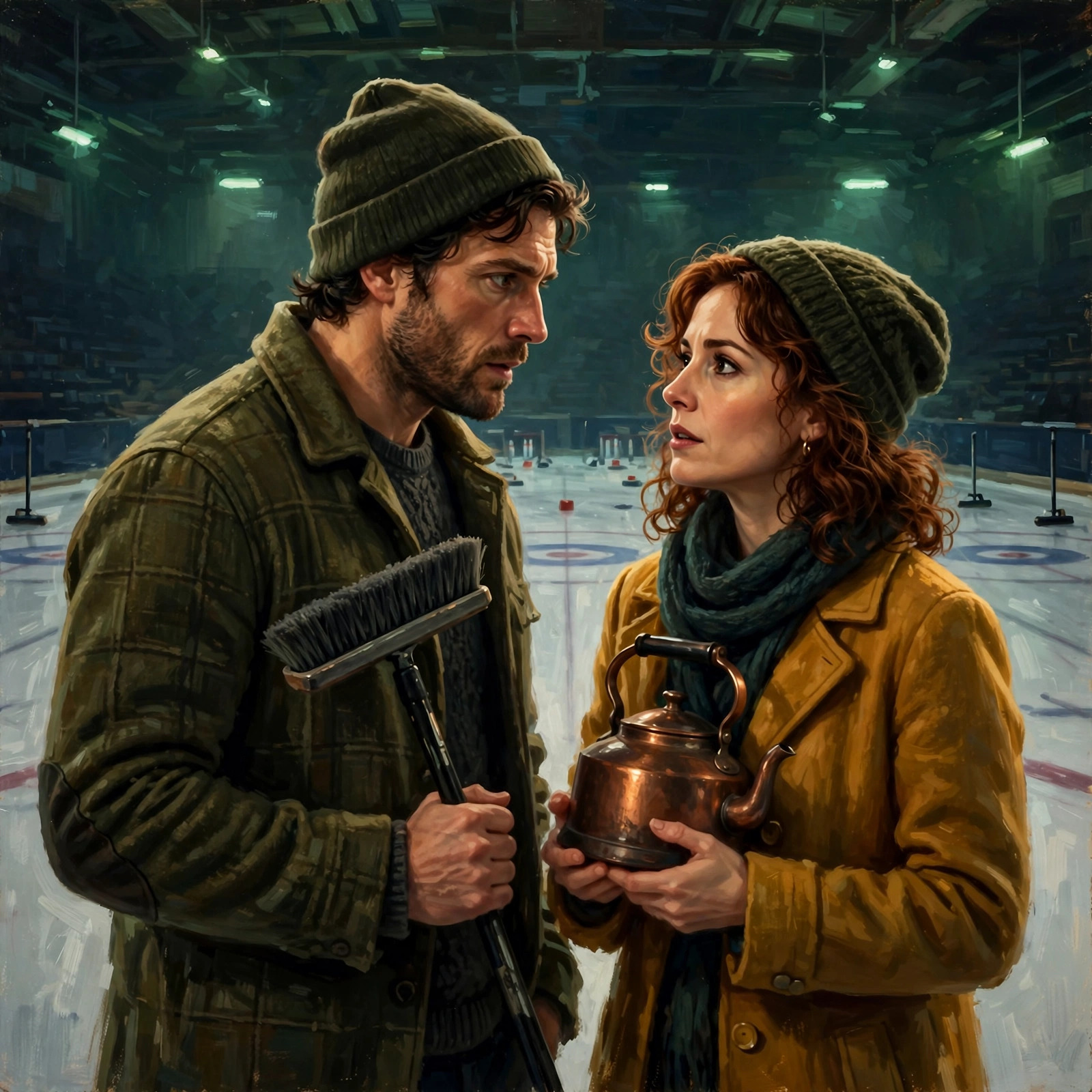
Four sheets of ice lay side by side under the low green lights, empty and quiet except for the compressor humming behind the far wall like a big animal sleeping with one eye open. She walked the length of sheet two with her grandfather's kettle in her right hand, three liters of hot water inside it, the copper warm against her palm, the worn oak handle fitting her grip the way nothing else in her life did.
Pebbling was the part of the job nobody understood until they watched it done. She walked backward from the backline, arm swinging in a slow figure eight, letting the water fan out in fine droplets that would freeze into millions of tiny beads. Those beads were the whole game. A stone rode up on them, curled on them, hesitated or didn't. Get them wrong and sixteen kilos of granite behaved like a stranger. Get them right and the ice told the truth.
Her grandfather Andor had taught her that. He'd built this kettle the winter before she was born, hammered and soldered from a single sheet of copper, the handle riveted on by hand. He'd walked these same boards when the club was half the size and the ice plant was a temperamental ruin. She thought of him every time she filled it. Tonight she thought of him twice, because tomorrow morning the board would open the Glidewell letter.
She didn't want to think about the letter. Frank Tuma had locked it in the office safe that afternoon, unopened, and when she'd asked him what was in it he'd only said, "You know what's in it, Ines," which she did. A commercial surface contractor's guarantee. A number with a lot of zeros. A promise that didn't need sleep, didn't take sick days, and had never once been blamed for a loss.
She shook the thought off and finished the second pass, the droplets hissing faintly as they landed and froze. One more pass and the sheet would sit until morning league, and she could go home and sleep for six hours before it all started again.
That was when the far door opened.
Light spilled in from the lobby, and a silhouette stood in it, tall, shoulders wide, holding a curling broom the way a man holds a broom when he's carried one for a living for a decade. She knew the shape before she knew the face. She'd watched that shape throw ten thousand stones on television and, before that, on this exact sheet.
"We're closed," she called.
"I bought the ice." Marcus Olin stepped through and let the door swing shut behind him, dropping the arena back into green half-dark. "Twelve to two, sheet two. Frank sold it to me this afternoon."
"Frank sold you my maintenance window."
"He sold me practice ice." He came closer, curling shoes already on, and stopped at the backline, maybe four meters from her. Up close he looked older than the posters in the lobby, lines around the eyes, a gray thread at the temple. He also looked exactly like himself, which was the problem. "I asked for the quietest sheet in the building and the quietest hour. He gave me both."
"He gave you my hour."
"I'll work around you." He nodded at the sheet. "You're mid-pebble. I can wait by the boards."
"You'll wait outside, is what you'll do. Fresh pebble needs fifteen minutes to set before anyone walks on it, and that's if they're careful, which you are famous for not being."
Something flickered across his face, there and gone. "That's not actually what I'm famous for."
"No?" She kept her voice level, kept her arm swinging, kept pebbling, because the ice didn't care about her pulse and she wasn't going to let it know. "What are you famous for, then? Remind me. It was a while ago. Four seasons out west, wasn't it? We don't get much western coverage here."
"Ines."
"That's my name. You remembered."
He stood there a moment. She could see him choosing, the way he used to choose shots, weighing the angles. Then he sat down on the edge of the sheet, right at the hog line, unlacing nothing, just sitting, like a man settling in.
"I came back to train," he said. "Provincial playdowns are here in two weeks. Eight ends a game now, did you know that? Shortened the format to save ice time. A skip needs sharp draw weight and this is the best ice in the province. Everyone says so." A pause. "You made it the best ice in the province."
"Don't."
"It's a fact, not flattery."
"Don't talk to me about facts and this ice in the same sentence. Not you." The kettle swung, water fanned, droplets froze. She kept her rhythm because if she stopped she'd have to look at him fully, and she wasn't ready. "I read the paper too, Marcus. I read it six years ago. 'The sheet cost me the game.' Front page of the provincial sports section. Your words, your name, my ice."
"I know what I said."
"Then you know why you can practice at the rink in Marlow and drive forty minutes home."
"Marlow's ice is soft in the corners by the fifth end." He said it flatly, like a man reporting the weather. "And I'm not practicing there. I'm practicing here. I bought the time, I signed the sheet, Frank's got my money, and I'm going to throw stones on your pebble at half past midnight because it's the truest surface I've ever played, and I need true right now."
Her arm kept swinging. Her jaw ached from clenching it.
"You need true," she said. "That's rich. You stood in a scrum in this building, in front of cameras, and told the whole province my ice cost you a provincial title. My ice. My grandfather's kettle was still in this building. He was in the stands that day, Marcus. He heard you say it. He was seventy-nine years old and he heard you tell everyone his ice was a cheat, and then he went home and I took him home and he didn't say a word the whole drive, and he never came to watch another final because of you."
Her voice cracked on the last word. She hated that. She hated that he could still do that, six years and four provinces later, with nothing but a calm face and a seat on her hog line.
He didn't flinch, which was worse. He looked at the ice between his feet for a long moment, then up at her.
"I was wrong about that game," he said. "I know it now. I've known it a while."
"You never printed a correction."
"No."
"You never called. You never walked in that door and said one word to me or to him in six years, and now you buy my midnight and sit on my hog line and tell me you need true?"
"Yes." He said it simply. "Because I owe a debt and I don't pay debts by phone."
"You owe more than you can pay at half past midnight."
"Probably."
She turned to make her third pass, the final one, and that was when the kettle spoke. A sharp dry crack, like a branch going, and the oak handle shifted loose in her grip, the rivets letting go on one side, the whole weight of the copper swinging crooked against her knuckles. Water sloshed over her wrist, hot enough to sting.
"Careful," Marcus said, already on his feet.
"I'm always careful." She caught the kettle against her hip before it could dump itself across the fresh pebble, heart slamming, cradling the thing that had outlasted her grandfather's hands and her entire career and apparently not one more argument with Marcus Olin. The handle hung by one rivet, wobbling. She stared at it. Thirty-four years of service, and it chose tonight.
"Let me see it."
"No."
"Ines."
"You don't touch this kettle. Nobody touches this kettle." She looked at him, finally, fully, the loose handle hot against her palm, and something in her chest made the decision before her head did.
She held it out to him.
"Here." She walked to the hog line and pushed it into his hands before he could refuse, water sloshing, handle dangling. "You know ice so well? You told a whole province you knew my ice better than I do. Finish the sheet. Third pass, backward from the backline, arm like this, figure eight, even or don't bother. If you throw a single stone before it sets, you're off my club."
He looked down at the kettle in his hands. Her grandfather's copper, her grandfather's rivets, cracked loose in an argument about him. For a second she thought he'd hand it back, and she braced for it the way she'd brace for a port-side hit.
Then he weighed it, once, getting the balance, and stepped carefully onto the sheet, and started to walk.
The Glidewell Letter
Ines slept four hours and dreamed in figure eights. By seven she was at the club, kettle on the workshop bench with its handle lashed tight to a dowel with hockey tape, a temporary splint for a patient she intended to treat properly tonight. The tape was Frank's, borrowed from the skate-sharpening drawer without asking, and she'd left a note that said borrowed, will return because eleven years in the building had taught her that Frank Tuma forgave everything except surprises.
She was halfway to the office corridor with a clipboard when Dora Wendt came out of it herself, coat still buttoned, a folder under her arm.
"Ines. Good. You're here early."
"I'm always here early."
"I know." Dora looked at her the way she looked at the ice itself, measuring. "I'd rather you saw this from me than heard it at the meeting."
The office smelled like burnt coffee and radiator dust. Dora laid the folder on the desk and opened it to a letter on paper so white it looked surgical. Glidewell Surfaces, the letterhead said, and below it a phrase in bold that Ines read twice because the first time her eyes refused it: guaranteed playing conditions, playdown week included.
"They put it in writing," Dora said. "That's the whole of it, really. A company comes in, they contract the surface, they guarantee it, and when something goes wrong there's a document with a signature at the bottom. When something goes wrong on your ice, Ines, what do I hold up in front of the board?"
"The ice."
"The ice." Dora repeated it without a smile, which was worse than a laugh. "I've sat in this chair for seven years, and I've watched you carry this place on your back, and I'm telling you plainly, as one woman to another, because nobody else will: the board likes a sure thing. Nine of them vote the morning after the playdowns end. I won't pretend they're not leaning."
Ines kept her eyes on the letter. Guaranteed playing conditions. As if ice were a mattress. As if you could buy the pebble, the frost, the way a sheet woke up on the third end and settled by the seventh, the way her grandfather used to say every sheet of ice had a mood and your whole job was to learn it before it changed.
"You could ask them what their guarantee is worth when the plant goes down at four in the morning and their nearest crew is three hours away," she said. "I live eleven minutes from this building."
"That's what you should say at the meeting. Say exactly that." Dora closed the folder. "I'm not against you. I want you to understand that. I'm against losing."
Frank was in the doorway with two mugs, one of which he set down in front of Ines without being asked. He glanced at the folder, and his jaw did the thing it did when he was biting down on a sentence.
"You've read it, Frank," Dora said.
"It's in the safe. I read everything that goes in the safe." He stirred his coffee slowly. "It's a good letter. Well printed."
"And?"
"And nothing. I schedule ice. I don't make policy, I don't vote, and I don't hand out opinions in front of the chair." He said it pleasantly, and his eyes stayed on Dora, but when she left, mug in hand and folder under her arm, he stood in the empty doorway a moment longer than he needed to. Then he looked at Ines and said, very quietly, "Your coffee's getting cold," which was Frank Tuma for everything he wasn't allowed to say.
She drank it standing up, and then she went to work, because the ice didn't care about letters.
She scraped first. The scraper was a forty-inch blade on a long handle, her favorite tool in the world, the one that turned her from a woman into a plane shaving a millimeter off a frozen lake. She'd started on sheet one, walking backward from the backline, when she registered that the arena wasn't empty.
Marcus was sitting in the third row of the stands with a thermos, watching her the way he used to watch houses, back when he was learning to read ice for a living. Not the way people watch a job being done. The way people study something they intend to steal.
"You bought midnight," she called. "It's nine in the morning."
"I bought the week. Frank's rates were reasonable." He came down the steps unhurried, stopped at the boards. "I'm not touching anything. I'm watching."
"Watch from up there."
"I can see better from here."
She let him stay, which surprised her, and worked the scraper down the sheet in long overlapping passes, the old rhythm taking over, blade whispering, frost peeling off in a fine gray ribbon. He didn't talk. That was the strange part. In her memory Marcus Olin had never once stopped talking, on ice or off it, and now he stood at the boards for an hour like a man at a museum, and the only sound was the blade and the compressors humming under the floor.
When she finished sheet one and moved to the pebble cart, he said, "Teach me."
She stopped. "You have a rink for that. You have a vice who reads ice better than anyone I've ever seen."
"Jonas reads stones. He always has. There's a difference." He paused. "You know there's a difference."
She did know. She'd said almost those exact words to her grandfather once, and he'd laughed until he had to sit down.
"Why?" she asked. "Why now, after four seasons out west and a whole province of ice you could rent?"
"Because I blamed the wrong thing for six years, and I'd like to know what I was blaming." He set the thermos on the cart. "Because your grandfather made that kettle and I've never once known what goes into the water. Temperature. Pressure. Whatever it is you actually do out here at midnight. I skipped all of it. I skipped it and then I stood in a scrum and talked about it like an expert."
The honesty of it landed somewhere under her ribs, and she turned to the cart so he couldn't see her face do whatever it was doing.
"Three liters," she said. "That's a sheet. Hot, not boiling, and you walk it in passes, even, overlapping, never two weights of water in the same lane or the stone reads the seam. If you pebble heavy, the stone runs straight and fast. Too light and it drowns. The stone tells you everything. You just have to listen to it, which you'd know if you'd ever asked."
"I'm asking."
She filled the backup kettle, the stainless one, the one with no history, and put it in his hands. "Sheet four. Nobody's on it today. Walk it from the backline, backward, like you're painting a fence and the fence is judging you."
He walked it. He walked it badly. The first lane came off his wrist in fat uneven drops, a lane of boulders, and she watched him stop at the far end, look back down the damage, and not say a word in his own defense, which was so unlike him that she almost laughed out loud.
"Again," she called.
He did it again. Worse, somehow, or she wanted him to think so. Then a third time, and the wrist figured something out, and the fourth lane was almost a lane.
"Now the bad one," she said. "You redo the first two before that pebble sets or you'll be throwing over a washboard all week."
He redid them. He redid them twice. He was still at it when she went to check the plant, and through the window in the plant room door she could see him at the far end of sheet four, sleeves shoved up, walking backward, patient as winter, going over one lane again and again until the water lay right.
The compressor gauge on the wall read dead steady, four sheets fed, everything balanced, the whole building holding its temperature like a promise. She checked it twice. She was smiling at the second check, and she made herself stop, and then she stood there a moment longer anyway, because the gauge was easier to look at than the man on her ice, and because it was, for once, the truth.
"Passes," she called through the door, before she could decide not to. "That one passes."
Oak Handle
The workshop bench sat under one fluorescent tube that buzzed in cold weather, and by three in the afternoon it was buzzing. Ines laid the kettle on its side on a folded towel, hockey tape still splinting the oak handle to a dowel, and went to the drawer for the drill bit.
"I expected a shop like this to be tidier," Marcus said, from the stool he'd dragged over without being invited.
"You expected wrong." She peeled the tape off in one long pull, and the handle came free in her palm, the old rivet heads sheared clean through, the wood worn pale where her grandfather's hand and then hers had polished it. "Hold this."
He held the handle. He held it like it was worth something, both hands, and she decided not to comment on that, because she'd seen men hold babies with less care.
"Copper rivets," she said. "Not aluminum. Aluminum creeps when the water's hot. Copper holds."
"Where does a person even buy copper rivets."
"A person doesn't. A person inherits a coffee tin." She shook the tin, and it rattled like a purse full of small coins, and she picked out two rivets her grandfather had cut and domed himself, decades before either of them had a say about it. "Drill the holes clean first. The old ones oval out. You re-rivet into an oval hole and the handle works loose again by February."
He drilled. She held the kettle steady, and the bit caught once and skated, and he swore with real feeling and started again, slower, and this time the holes came clean. She set the rivets with the dolly block under the head and tapped the shafts over, tap, tap, the small bright sound of it filling the workshop the way it had filled her whole childhood, her grandfather's mitten on her hand over the hammer, both of them squinting at the flare of the metal.
"Your rivets," he said, looking at the finished flare. "They're domed."
"His doming punch. In the tin." She turned the handle in the light. It sat tight, no rock, no give, the oak flush against the copper shoulder of the kettle the way it had for thirty-some years. "It'll outlast me. That's the whole idea of it."
He was quiet for a moment. Then, "Can I ask you something without you throwing the dolly block?"
"Depends."
"Why does it matter so much? The kettle. The ice. Any of it. Glidewell would lay you a floor you could measure with a laser, and you'd still have a job somewhere. You're good. You could walk into any club in the province and they'd hand you the keys by lunch."
She set the kettle upright and looked at the bench rather than at him.
"Because it's his," she said finally. "Because I grew up under that compressor, and because when people say Larkfell ice, they mean him, and now they mean me, and if a company comes in and pours their guaranteed floor over it, then the thing he made is gone and I stood next to it and watched. That's all. That's the whole answer."
"It's not a small answer."
"No. It's not."
She sent him home at five with the instruction to sleep, because he had a draw to throw in four days and champions sleep, and he went, and she didn't watch the door close behind him, and then she did.
She came back at four in the morning, because that was when the building belonged to her. The playdowns opened the next day, and the ice had to be right, and the ice would be right, and the only way she knew to make sure of that was to do it herself in the dark with the lights down low and nobody's shoes on the sheets but hers.
He was already there.
He was sitting on the backline of sheet one with his delivery shoes on, laced, a thermos beside him, and when the plant room door opened and the light spilled out he didn't look surprised. He looked like a man who had planned to be caught.
"Frank sold me the mornings," he said. "Whole week. You signed off on it."
"I signed off on practice ice. Not on four a.m."
"Four a.m. is when you pebble. You said. Tuesday, when you were pretending I wasn't going to keep showing up, you said the dawn pebble is the one that sets the day. So." He stood, and picked up the thermos, and held it out. "I brought two cups."
She should have thrown him out. It was her hour, the one hour the building asked nothing of her except attention, and she had guarded it for nine years, through a divorce of a boyfriend and two presidents of the board and one entire winter when she was so tired she hallucinated a stone on sheet three. She took the cup.
"The copper one's ready," she said. "We're doing it together, and you're doing the north half, and if I see one fat drop I'm taking it back."
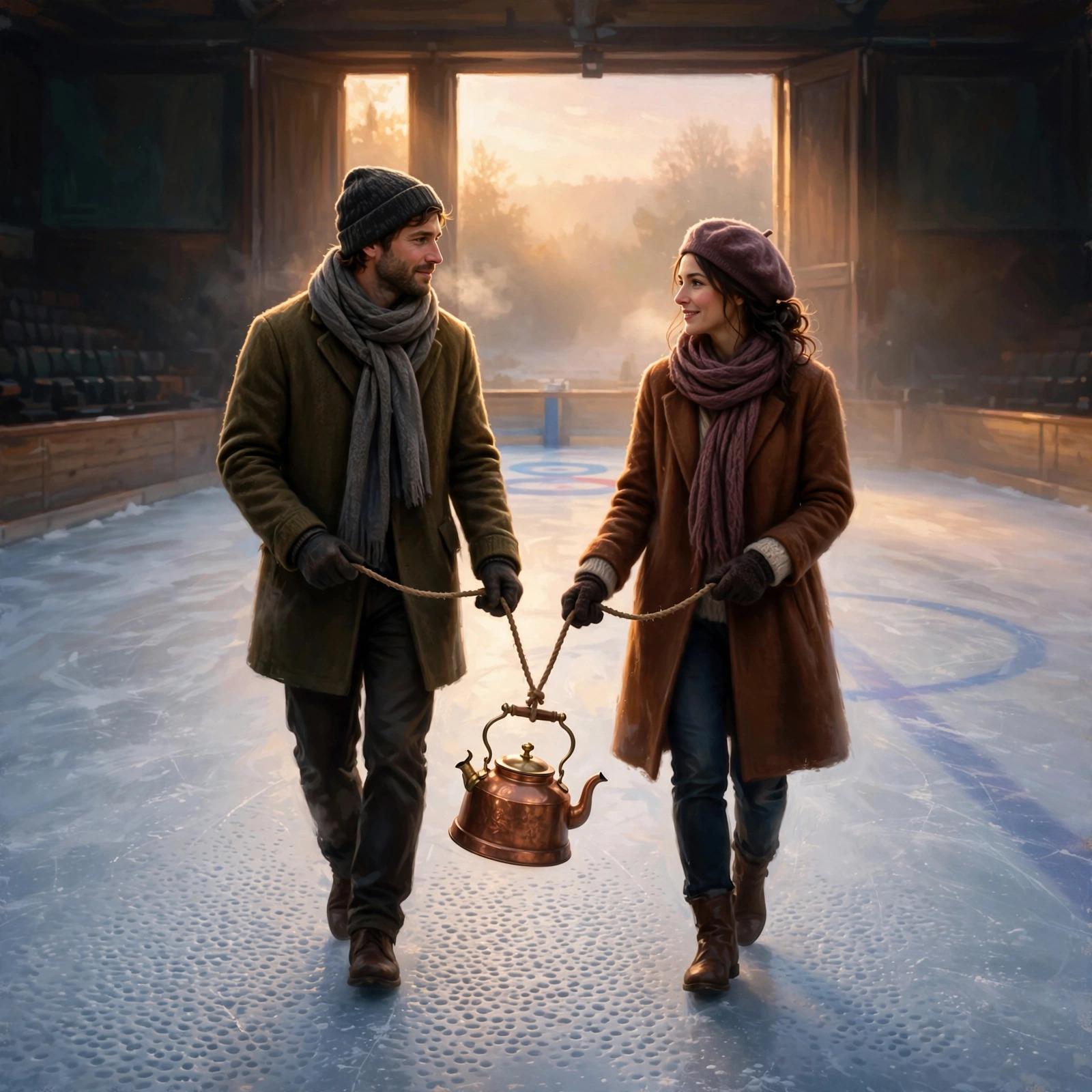
They filled the kettle from the hot tap in the plant room, three liters, the water steaming but never boiling, and she tested the temperature against the inside of her wrist the way her grandfather had, and handed the kettle over, and Marcus took it in both hands like it had just been issued to him by somebody official.
"It's warm," he said, surprised.
"It's supposed to be warm. Warm water bonds. Cold water sits on top and then you're freezing beads onto a lake instead of building a floor." She lifted the stainless backup off the shelf. "North half. I'll take the south. We walk toward each other. You know what you're doing now, mostly."
"Mostly."
"Mostly is a passing grade on this sheet."
They walked. The arena was dark except for the low amber over the ice and the one line of fluorescents over the walkway, and the two of them moved down the sheet from opposite ends, backward, the kiddles swinging in small figure eights, water going down in fine even passes, and the sound of it was the sound the building made when it was happy, a soft hiss, like rain deciding to be polite about it. In the middle of the sheet they passed each other close, both walking backward, both concentrating, and he said, quietly, not stopping his wrist, "Your lanes are beautiful," and she said, "Yours pass," which from her was a sonnet.
They met at the far walkway, both kettles light now, and she took his kettle from him to hang it, and he said the thing he had come at four in the morning to say.
"I need to tell you why I picked this club."
"It's close to the highway."
"I picked it because it's true." He said it plainly, no performance in it, which she had learned this week was how he said the things that cost him. "I've thrown on a lot of ice, Ines. Four seasons out west, the arenas with the laser floors, the ice that comes out of a truck and plays like a video game. And it's all fine. It's fine the way a vending-machine coffee is fine. Then I came back here Tuesday and threw my first draw and the stone told me the truth the whole way down, every foot of it, and I sat on the backline like an idiot for a minute because I'd forgotten what that felt like. This is the truest surface I've ever thrown on. I came back to play on your ice. On purpose. I want you to know that's what I chose, whatever happens after."
She stood very still with both kettles in her hands.
"You want a medal," she said, "for saying my ice is good."
"No." He looked at the sheet, the fresh pebble already setting under the low light, a million small beads freezing into a floor. "I want you to know I knew. Six years ago I knew, and I stood in front of a microphone anyway and handed them the sheet instead of myself, and I've never once said out loud that I was wrong to do it. I'm saying it now. To the person it landed on."
"It landed on my grandfather." It came out of her faster than she meant it to. "He was seventy-nine. He heard it on the radio in the kitchen, with me sitting right there, and he never asked me a single question about the ice that day, not one, because he already knew it was good, and he never came to another final. Not one. Six years of finals and he sat home, and he'd built half of them. That's what your sentence cost. So no, I don't want your apology, I want you to understand the size of it, because you've been walking around this week like sorry is a coin you can hand somebody."
"I know the size of it." And then, quieter, "I've been carrying the size of it for six years. That's why I'm here."
The compressors kicked on behind her, both of them, the deep hum that filled the plant room and every room near it, and the door stood open at her back, the warm breath of the machinery moving the cold air at her neck. He was close enough that she could see the low light on the stitching of his team jacket, close enough that stepping back would have been the reasonable thing, and Ines Kade had spent her whole life doing the reasonable thing at exactly this distance from people.
She did not step back.
She kissed him in the doorway of the plant room, between the hum and the cold, with two kettles in her hands like the world's most inconvenient bouquet, and he made a small startled sound and then his hand came up and cupped her jaw like she was something that could spill. The copper kettle knocked against his sternum and neither of them cared. His mouth was warm and the air was cold and that was all there was to know for a while.
When they drew apart, she was the one who'd ended it, because someone had to, and she turned and hung the copper kettle on its hook and put the stainless beside it, and filled the copper one last time from the hot tap so it would sit warm for the morning pebble, and set it on the shelf, and put her thumb over the new rivet, the flare of it still holding the heat of the water inside. The dome was slightly off-center from her grandfather's. She decided she liked that. A person could tell whose hand had finished it.
Marcus took his coat off and put it over her shoulders without a word about it, and stood beside her in front of the shelf, and the compressors roared on and on, both of them pretending that was the reason they weren't saying anything, pretending the sirens of the machinery were louder than they were. She leaned her shoulder into his arm, once, briefly, a fact the compressors would keep.
Old Scrums
The playdowns opened at nine in the morning with four sheets of fresh ice and a parking lot fuller than Ines had seen it since the last provincial final. She had pebbled all four sheets before seven, three litres a sheet, walked the lines with her thermometer, signed the sheet conditions to the provincial official, and then stood at the far boards while the first rocks of the weekend came sliding down sheet one and sheet two at once, the two games crossing sounds in the middle of the building like weather systems meeting.
She loved this hour. She always had. Sixteen teams, eight ends a game now that the province had shortened the format to save ice time, and every single one of those sixteen skips believed the ice would decide something for them before the weekend was out. It would. It always did. It just never decided what they thought.
Frank Tuma had taped a hand-lettered schedule to the office window, and Dora Wendt stood in front of it with her arms crossed, reading it the way she read budgets, twice, top to bottom.
"Nine games today," Dora said when Ines came near. "Your ice holding up?"
"It'll hold up through Sunday and past it."
"Mm." Dora's eyes stayed on the schedule. "The board meets the morning after this ends. Nine of us at the table, and I'll tell you now because you'd rather hear it from me than read it: I like a written guarantee. Glidewell put playing conditions on paper. You put your word. Paper wins more arguments than word."
"Paper's never made ice in its life."
"No," Dora said. "And it never had a bad weekend either." She tapped the schedule once with one finger, a small gavel coming down. "That's the argument, Ines. I'm not saying I like it. I'm saying it's the argument."
She went off toward the lounge, and Ines stood there with the schedule and the day's first game rumbling behind her, and told herself that a vote on the ninth day of anything was a long way off. It wasn't. It was five days off, and one of those days was the final, and she had known Dora Wendt long enough to know the difference between a warning and a eulogy.
Marcus's rink played the eleven o'clock draw on sheet two. Ines kept to her end of the building through the first four ends, running her hand over the pebble on sheet four during the break, checking the drift of the air off the far wall, doing her job, which had never once required watching a particular skip throw. By the fifth end she had run out of sheet four.
He was throwing well. That was the first thing. Clean releases, the kind of weight control that made her craft look good, every stone finishing where he'd pointed it as if the ice were cooperating out of professional courtesy. Jonas called the line in that low, urgent voice vices use when they're happy, and the fourth player swept like a man who'd been told sweeping was the only legal form of applause.
They won 7-3 and came off the ice grinning, and Marcus found her at the back boards without even pretending to have been looking for anyone else.
"Your sheet two runs about a foot outside of what it did Monday," he said. "I adjusted by the second end. For the record."
"It didn't run anywhere. It's the same sheet."
"It moved a foot and I forgave it. That's growth."
She was still deciding whether to smile at that when the scrum started. It started badly, the way scrums do, with a local reporter Ines knew by face, a man with a press lanyard and a folder of old clips, planting himself in front of Marcus with his recorder held out flat like a serving tray.
"Olin," the reporter said. "Last time you played a playdown in this building, you left here with a quote people still have on their walls. You said this ice cost you the title. Six seasons later, you come back to the same club to train. So which is it? Did the ice get better, or did you?"
The arena didn't go quiet, because arenas don't, but Ines went quiet inside it. She watched Marcus's face do something small and fast, a door closing softly rather than slamming, and she thought, say it. It was right there. Say the sentence. The ice was fine. I was wrong. Six seasons of that quote sitting in the clip file and the correction was four words long.
"I came back," Marcus said, "because Larkfell is the truest surface I've thrown on. That's the whole answer."
"And the old quote?"
"I was six seasons younger. Ask me about this weekend." He smiled the flat, pleasant smile of a man handing out nothing, and the reporter got the message and got his sound, and the little knot of recorders moved on to Jonas, and the room moved on, and Ines did not move on. Ines stood at the back boards with her hands in her jacket pockets and felt six years arrive all at once, like water finding the low spot.
He'd said it to her, privately, at midnight, on the bench, with his hands around a mug of her plant-room coffee. I was wrong about that final. But he'd never said it into a recorder, and today a recorder had been held out to him on a tray with his name on it, and he'd passed. She knew why before she finished being angry about it, which was worse. His sponsor had an announcement coming. Exhibition week, Glidewell's showcase, the payday that kept his rink on the road. A skip who retracts a six-year-old quote is a skip with a story, and a skip with a story is a skip who gets asked about the story, and none of that sells what his sponsor was paying him to sell.
He looked for her afterward. She saw him do it, scanning the back boards, and she was already walking, down the corridor past the office, past the safe where the letter sat, past the plant room door, out through the side exit into a parking lot full of gravel and cold light. Her phone buzzed in her pocket before she reached her truck. Then again. Then a third time, and she let all three die, and drove the two blocks she didn't need to drive, and came back an hour later through the arena's far door because it was her building and he was the visitor.
She did not answer the fourth call either.
The afternoon draw went on without her watching any of it. She scraped sheet three between games, standing on the scraper with her headphones in, the blade peeling the old pebble off in one long ribbon that fed itself into the bin behind her, and she found that if she kept the machine moving at a steady walking pace and breathed in time with the motor, she could go a whole minute at a stretch without hearing the sentence again. Ask me about this weekend.
Her grandfather had been seventy-nine the winter that quote ran in the paper. He had never attended another final, not one, in this building or any other, and he'd stopped saying why, and Ines had learned to stop asking, and now she stood on a machine he'd taught her to drive and understood the size of what a flat sentence can do to a man who made things with his hands.
When the last game of the day cleared off, she went into the plant room for the evening water. The copper kettle sat on the shelf where she'd left it before dawn, filled, warm gone out of it, and a fine film of dust had settled on the spout in the one day she hadn't touched it. Two days of dust, really, if you counted the night before, but the film was new, and she looked at it for longer than a film of dust deserves, and did not wipe it off.
She pebbled sheet one alone at eleven, three litres, walking the figure eight, and she did not carry the copper kettle out. She used the stainless. The copper could sit. The copper could gather its dust. She was done deciding which kettle meant what.
She spent the night on the scraper, sheet by sheet, the arena lights banked down to their low amber, the building gone quiet except for the machines and the ribbon of old ice curling up behind her. Her phone lit up on the boards twice more. She turned it face down.
Out on sheet two, under lights she wasn't watching, Marcus threw his first game of the evening draw badly. He knew it was bad from the first stone, a draw that ran through the back and out, and he knew it wasn't the ice because he had spent four seasons learning to know exactly this ice, and because at midnight he had stood on this sheet with her and called it honest. He slid stones past a surface he'd once blamed and now couldn't stop over-correcting on, and Jonas called the line and the fourth swept and nothing finished where it was pointed, and the other skip took the game 5-3 on a steal in the seventh end, and Marcus stood at the backline afterward for a moment with his broom planted, looking down a sheet of ice that ran true and straight and perfectly, unforgivingly fine.
Jonas Confesses
Ines took her lunch to the Wren Riverwalk because the arena had stopped being a place she could be quiet in. Frank kept finding reasons to pass her in the corridor with his eyebrows arranged into a question, and Dora had spent the morning at the boardroom table with the Glidewell file open beside her coffee, underlining things, and every line she drew was a small vote Ines could feel through the wall. So she walked out along the river with a sandwich she had no intention of eating and sat on the second bench from the bridge, the one with the initials carved into the armrest that nobody had ever owned up to.
Jonas found her there before her thermos was even open.
She heard the gravel first, then the particular apologetic shuffle of a man who has thrown second stones for other people his whole career. He sat down at the far end of the bench without asking, which she respected, and looked at the river like it owed him money.
"He won't tell me why you're not answering," Jonas said. "He just keeps buying ice and standing on it."
"He can buy all the ice he wants. It's for sale."
"Ines." He turned the thermos cap in his hands, around and around. "I need to tell you something I've carried since before I ever met you. Six seasons. And it's mine, not his, so I'd rather you heard it from me before you decide anything about him."
She set the thermos down on the bench between them, a border.
"That final," Jonas said. "The one he lost here. The one he talked about after. I called the sweep off on his last draw. He threw the weight I asked for, the line I asked for, and I read the ice wrong, and I told them to ease up when it needed a hair more. It came up six inches heavy and through the back, and the building went silent, and then a microphone ended up in front of him ninety seconds later."
The river kept moving. Ines did not.
"He told you this," she said.
"He worked it out himself. He watches the tape like other people watch funerals. He knew inside a week. He called me at two in the morning and said, I know it was the call, Jonas, and I said, yeah, and he said, okay, and then we never talked about it again. Not once. Not on the bus, not at nationals, not when we lost the rematch. He just kept it."
"He kept it," Ines said slowly, "and he let the paper keep it too. He let the whole province keep it. My grand…" She stopped. Andor Kade had stopped coming to finals after that quote. He'd said the ice would be blamed either way, so why sit in the stands and hear it. She had been twenty-eight, learning the plant room, believing that if she controlled every variable nobody could ever say it again. "He let a man's last seasons be about that quote."
"Yes," Jonas said. No flinch, no cushion. "And I let him. I was twenty-three and terrified of the word choker, and he was the skip, and the ice doesn't have feelings, or that's what you tell yourself. Except the ice has you. I've known that since day one here, watching you walk these sheets. So." He exhaled, long, the sound of a weight set down. "That's mine. I've wanted to say it to somebody from Larkfell for six seasons and there was never a face to say it to until you had one."
He stood, put the cap in his pocket, and left her the whole bench and the whole river.
Ines sat there until the sandwich went fully uneaten, then walked back the long way, past the arena doors, around the side, and let herself in through the plant room like she used to when she was small enough that Andor would lift her over the threshold. The compressors ran their low constant note. The copper kettle sat on its shelf with its gray whisper of dust on the spout, and she looked at it properly this time, and wiped the dust off with her sleeve, and did not feel one bit better.
Marcus was on sheet two, alone, throwing stones at nothing, his slider hissing down ice he had paid for. She watched him through the observation window for one full slide, then pushed through the door and walked the walkway until her shoes stopped at the backline.
He straightened up so fast he nearly went over.
"You're talking to me," he said.
"Jonas found me at the river."
Everything in his face reorganized itself. She watched it happen, the defenses going up too late, the truth already through the door behind her.
"Six seasons," she said. "You knew in a week. You knew before the ink on those articles was dry, and you let it stand, and you came back here and told me this was the truest surface you'd ever thrown on, and you let me find out from your vice at a bench."
"Yes." He came off the sheet and stood in the walkway with the stones still turning behind him, slowly, the way stones do. "I should have said it at the scrum. Day one, first question, standing in your building. I had the sentence ready, Ines. I rehearsed it in the car. And then the microphone was there and it was so much easier to say different era, different crew, because the other sentence costs something and that one costs nothing."
"It cost Andor every final he never attended. Do you know that? Do you know he stopped coming?"
"No," Marcus said, and his voice came apart on the word, and she believed the ruin in it, which made her angrier, because ruin was cheap too if you kept it private.
"Jonas called the sweep off," she said. "I know. You know. The ice was true. It was true that night and I have the maintenance logs to prove it, and you let a microphone decide whose fault it was."
"I did."
"Why come back? Honestly. You bought every morning slot in the building. Why here, why now, when the easy thing was to stay out west where nobody knows your name got carved into a quote."
He looked down the sheet, at nothing, at the far house, and when he answered he answered the house.
"Because I came back to win the thing I lost on your ice, and because there's a sentence I've owed this building for six seasons, and I wanted to say it standing on the surface I never should have blamed. That's it. That's the whole plan. Win it, say it, walk out having paid something for once." He turned back to her. "And then the reporter asked me on day one and I flinched, and I've watched you scrape sheet four alone every night since, and I'd rather lose the province again than keep being the reason for that."
"The reporter was easy," Ines said. "Say it to me. It's not easy here."
"I know it isn't. That's why it's worth something." He rubbed his jaw. "There's a thing you should know before you decide how much to hate me. The exhibition after the final, the televised one, the showcase. It's Glidewell's. My sponsor booked it as their centerpiece, me on their surface, their logo on my back for one night. It's the biggest cheque I see all season. If I pull out, the sponsorship likely dies with it."
The compressor note filled the pause. Ines looked at him and found she had no cruelty left, only arithmetic.
"So don't pull out," she said. "Take the cheque. Play their showcase. I'll make the final true and you can lose or win on it and the board votes the morning after this final and that's that."
"No." He took his phone out of his jacket, thumbed it awake, and held it flat between them so she could see the screen: a drafted message, the withdrawal, already typed, unsent. His thumb hovered over it. "I'm not asking your permission. I'm asking you to watch me send it, because I have a record of choosing the cheap sentence when the camera's on, and I'd like one witness to the expensive one."
Ines looked at the screen, then at him, and did not tell him yes, and did not tell him no.
She stood at the backline, arms crossed, and waited to see what his thumb would do.
Last Stone
The eighth end of the provincial final began with Larkfell's sheet one playing so true it felt like a verdict. Ines stood at the backline holding her kettle, a lap cloth under it, steam rising off the spout, and made herself watch the way she made herself watch every final: with her hands still.
Five to five. Marcus's hammer. Last stone of the game, and the whole week narrowed to a patch of ice the size of a tea tray.
Jonas crouched in the house at the far end, broom held high, calling line. Frank Tuma had come out of the office for it and stood at the boards with his clipboard against his chest like a shield. Dora Wendt sat in the second row with her coat buttoned to the throat, and Ines knew, the way you know a door is locked without touching it, that half the board was sitting around her.
Two days had passed since Marcus held his phone flat between them and waited. He had sent it. He had said his piece at the evening gathering with his voice level and his hands in his pockets, and Ines had stood at the edge of the crowd and let him finish, because he'd asked her to watch and she had watched. The sponsorship had died by morning, quiet as a light going out. Today he'd worn a plain grey jacket with no logo anywhere, and somehow he looked more himself in it than he had all week.
He went into the hack, settled, and looked down the sheet the way other men look at a table before signing something. Then he slid out.
The stone traveled forever. It picked up the faint curl she'd laid into the pebble at dawn, took it like a held note, and Jonas's sweeping never touched it, because it didn't need fixing. Ines tracked it against the line she'd thrown ten thousand times in her head, and by the halfway house she knew, and Jonas knew, and his voice went up an octave calling it home.
The stone ticked the corner of a guard, breathed past it, curled behind it, and slid to a stop with its edge kissing the button.
Six to five.
The building made a sound Ines felt in her sternum. Jonas ran down the sheet with his broom over his head. Frank dropped his clipboard and picked it up again, pretending he hadn't. And Marcus stayed in the hack for one long second with his head bowed, and when he stood, the first thing he did was look down the ice, past all of it, to the backline. To her.
The handshakes took a while. The other skip, a big man from the eastern side of the province, gripped Marcus's arm and said something that made him laugh, short and startled. Jonas hugged him. The teams cleared the house, and the crowd began folding itself toward the lobby and the beer and the bragging, and still the ice crew held the sheet, because Ines hadn't called them out yet. She'd kept the kettle steaming in her hands on purpose. She hadn't examined the reason until now.
Marcus walked the length of the sheet to her. Slowly, like a man crossing a bridge he'd burned once and rebuilt himself.
"Your ice," he said.
"It was always my ice." She kept her arms crossed. Around them the arena emptied, and the compressor's note under the floor went on, patient as weather. "You won on it twice now. Six seasons apart. Congratulations."
"Ines." He stopped an arm's length away. "I said it at the gathering, but I said it to a room. I owe it to you, standing here, on this sheet, where you can hear it and I can't hide behind a microphone." He took a breath. "Six seasons ago I told a reporter this ice cost me the game. That was a lie I told because it was cheaper than the truth. The ice was true that night. It's been true every night since. Jonas missed a weight, my vice, my call, my rink, my responsibility, and I knew it inside a week and I let you and this club carry my loss for six seasons because it was easier than carrying it myself. I'm sorry. There's no era that excuses it and there was never a different crew. There was just me, taking the cheap sentence, and I've been paying it off all week and I'll keep paying it as long as you'll stand on the same ice as me."
Ines looked at him. The old quote lived in her ears, six seasons of it, replayed at every bar and every bonspiel and once, cruelly, at her grandfather's funeral by a well-meaning man who thought he was complimenting the family. It had a specific sound, and she had built a whole life around controlling every variable so that sound could never attach itself to anything again.
And here it was, taken apart, piece by piece, on the very sheet it had slandered.
"You knew inside a week," she said quietly.
"I knew inside a week."
"And you let it stand for six seasons."
"I did. And I can't give you those seasons back. I can only give you the sentence, and the ice, and the mornings, and whatever else you'll let me give." He glanced at the kettle steaming by her boots. "Starting with whatever that thing needs."
"It needs three liters and a walk," she said. "It's needed that since before I was born."
"Ines Kade." Dora Wendt's voice came along the boards, and there she was in her good coat, moving toward the backline with the deliberate pace of a woman delivering a verdict. Frank trailed her with his clipboard, and Jonas, breathless, trailed Frank. "Don't let him sweet-talk you before I've said my piece. I've walked from the office and I'm too old to walk twice."
Ines turned. "The vote's tomorrow morning."
"It still is," said Dora. "But it's counted. I polled all nine of us by phone this afternoon, because a man stood up at a public gathering and took a six-season lie off this club's back, and then it came out what that same man gave up to do it. His sponsorship. His showcase. The biggest cheque of his season, walked away from, to make a point about whose ice is true." She stopped at the backline and looked Ines full in the face. "I like written guarantees, Ines. You know that about me. I like paper. But Glidewell's paper never once came with anybody standing in a lobby paying for the truth with real money. I counted nine yes votes this afternoon. The ice stays in-house. Your contract's renewed for the season, and Frank's got it in the safe where the other letter used to sit."
Ines's knees did something unreliable. She locked them and said, "You polled today. Before the final."
"After the withdrawal," Dora said. "The withdrawal was the ballot." She permitted herself a smile, small and dry. "Don't thank me. Thank him, and then pebble this sheet, because the beer league wants it in an hour and I'm not standing here while it goes brown."
Frank raised his clipboard. "Contract's signed. And, Ines, for what it's worth, I never liked that letter." He'd had it in his safe for a week and had rooted against it every day, and they both knew it, and neither said it.
Jonas hovered at the edge of all this with his hands jammed in his pockets. "The miscall was mine," he said to Ines, low. "Six seasons ago. I've been carrying it too."
"I know," she said. "You told me. Now put it down. Both of you."
Dora nodded once, satisfied, and herded Frank and Jonas toward the lobby and the beer with her. And then it was the two of them, and the sheet, and the kettle ticking softly as it cooled.
"The sponsor walked," Marcus said, when they were alone. "This morning. Two sentences and a best-of-luck. So the season just got very lean." He rubbed the back of his neck, and to her surprise he grinned, wide and easy, the grin of a man with nothing on his back for the first time in years. "But Dora cornered me before the game. The club wants a juniors coach Sunday mornings. Pays about enough for coffee. I said yes before she finished the sentence."
"Sunday mornings," Ines said. "That's my pebbling time."
"I know."
"The juniors chew the pebble up by ten."
"I know that too."
She hefted the kettle. It had her grandfather's weight in it, and the re-riveted handle sat true under her palm, warm from the plant room. Three liters of hot water, and a walk down a sheet she had just been told she was keeping.
She stepped over the backline.
"Ines." Marcus's voice, behind her, half a laugh in it. "Need a walker?"
She didn't answer. She just didn't speed up. And after a moment his boots scraped onto the ice beside hers, and he matched her pace, step for step, down the long blue road toward the far house, while the water came off the spout in a fine bright rain and settled onto the surface they'd both been forgiven by.
Get notified when new stories drop
Noah Carrington
Noah covers sports romance and forced-proximity heat: rivalries, road trips, and the quiet moment after the crowd goes home.
Leave a comment
Comments