


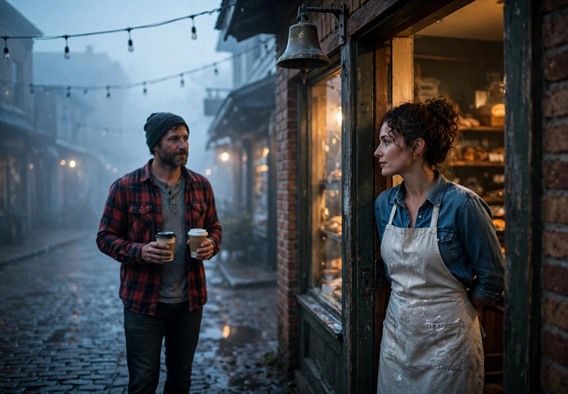
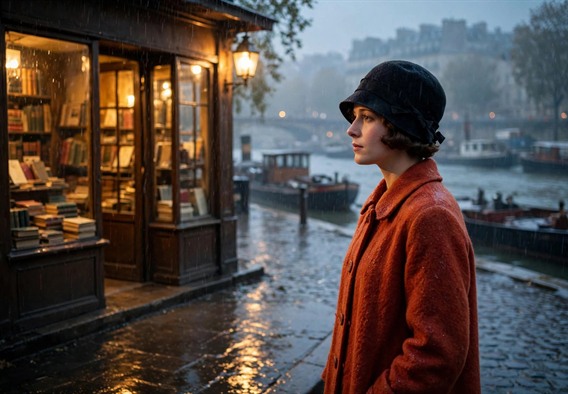

The Orchid Bench
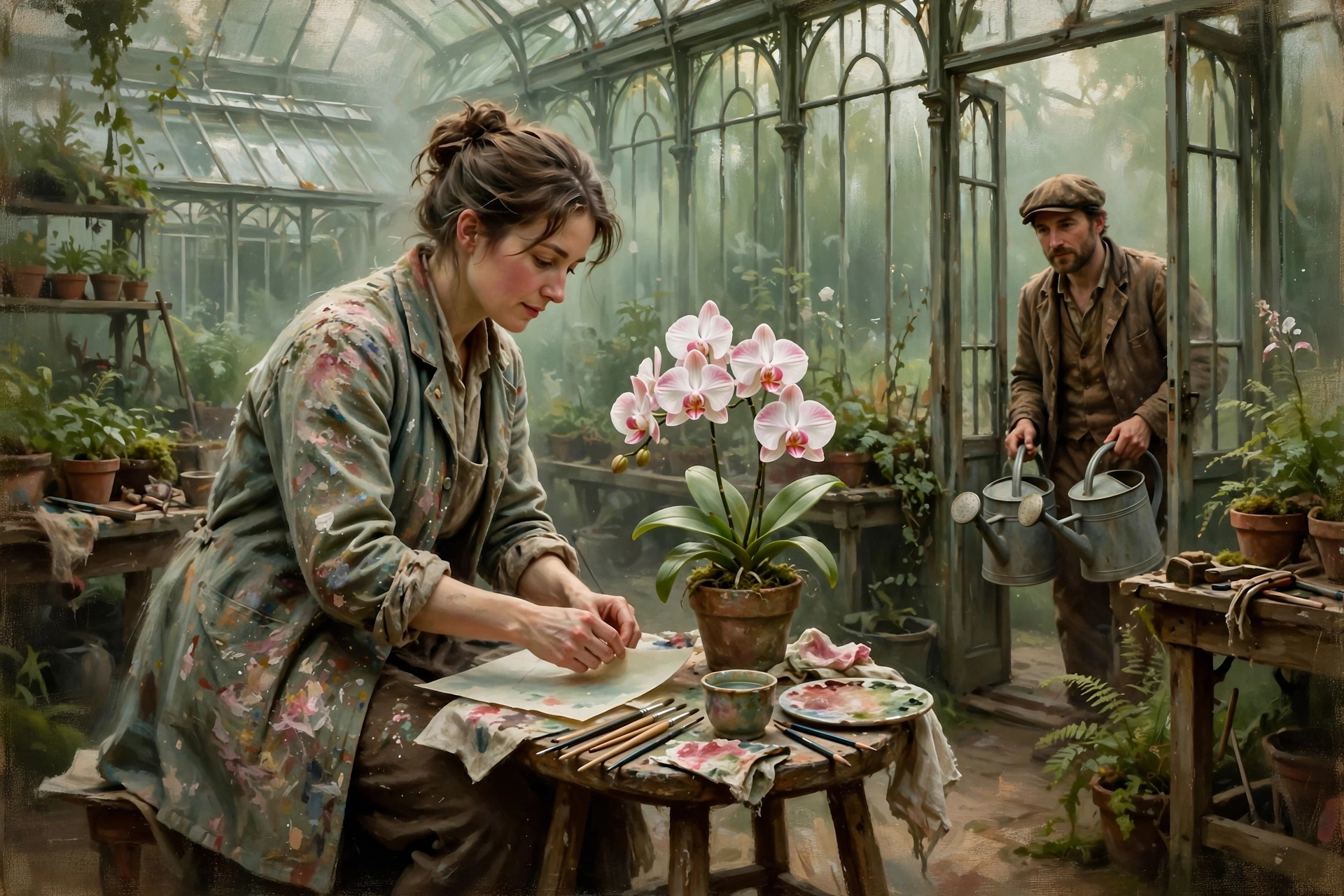
Cordelia Merritt arrived at Ellerby Hall with paint on her cuffs and twenty minutes to spare, which she considered a kind of victory, because the stagecoach had run late and the sky over Yorkshire had spent the whole morning looking prepared to rain on her specifically.
The glasshouses sat behind the hall in a long glazed row, catching what light there was, and the door of the nearest one stood open. A man came out of it carrying a watering can in each hand and did not see her until she was near enough to be splashed.
"Miss Merritt." He set the cans down on the gravel. "You're the painter."
"I'm the painter," she agreed. "You must be Mr. Crane."
"Julian Crane. Did Peck send you out this way, or did you follow the smell of damp?" His handshake was brief and warm and left a smear of loam across her glove, which she decided not to mention.
"The secretary wrote that your orchid would close by Thursday," she said. "So I came at once. I've a commission to paint it, and a name to paint it under, and rather little time for either."
He picked the cans back up and led her through the door into a wall of warm, wet air. The glasshouse was long and green and smelled of moss and rain that hadn't happened yet. Along the far bench stood pots of ferns and a regiment of seedling trays, and at the very end, alone, an orchid in a squat terracotta pot.
She had seen plates of orchids all her working life, drawn by other hands, and she had never once trusted them. The living flower was white at the throat and blushed out to the palest rose at the edges of every petal, and its lip was marked with a scatter of small crimson spots, like a careless signature.
"It has no name," Julian said, watching her look at it. "I've flowered it four times now. It's mine, cross and seed, but I've not had the nerve to name it."
"Then I'd better get it right."
"That's what Peck said you'd say. He said you were exacting."
"Peck talks too much."
"He said that too."
She unbuttoned her coat and laid it over a stack of empty pots, set down her case, and opened it. Vellum, brushes, the little horn of gum arabic, the paints she had mixed on the coach and carried warm against her ribs so they wouldn't stiffen. She pulled the bench stool toward the orchid and sat.
"How long does a bloom hold, in this heat?" she asked.
"Three days, if the sun's kind. Less, if it isn't."
"Three days." She looked up at him. "I need four. The plate wants layering, and the gum wants drying time between them, and your flower wants its spots placed singly, not dabbed. Whoever painted the other plates of this genus dabbed."
"Then whoever painted them wasn't you."
"No," she said. "I place."
He laughed, a short, surprised sound, and turned to the cans again. She thought that would be the end of it, that he would leave her to it as every other owner of every other flower had left her to it, politely, with instructions to lock up behind herself. She was used to being a visitor in other people's greenhouses.
Instead he said, "You can't have four days."
"I beg your pardon?"
"Thursday," he said. "The society meets Thursday, and the members come round, and this house is on their route. If the bloom's still open they'll be through here in twos and threes, hands and elbows, and at least one of them will tap the pot to hear if it's terra-cotta all the way through."
"Then I'll paint in the evenings."
"You'll paint badly in poor light, and the bloom will be past its best by the second evening anyway. It closes from the lip inward, and once the lip curls your spots go."
She set down the brush she had just taken up. "Mr. Crane, I have painted flowers that opened for one day only, on a barge, in February. I have painted a primrose in a hailstorm with an umbrella over my board. I can paint a closing orchid."
"I don't doubt your hands," he said. "I doubt my Thursday."
There it was, the shape of the trouble, and it wasn't even a small trouble. He was right, and she knew he was right, and being right made him no easier to like standing there with his two watering cans while her commission sat wilting on his bench.
"Is there nowhere else it could spend those days? A corner where the members don't go?"
"I could carry it to the forcing pit," he said slowly, and she saw him turn the idea over the way she turned a drawing, checking it against what she knew. "It's at the far end, past the vine. There's a bench there, and the light comes off the pit water in the mornings. It's warm, and the members won't trouble it, they've no business there."
"Then let's carry it."
"It's in flower, Miss Merritt. You don't move a plant in flower if you can help it. The pot's light, it'll tilt, and a bruised petal on a first bloom sets the seed back a year."
"And a painted petal on a closed bloom sets me back rather more than a year," she said, "because Peck's journal prints what I hand him, and the society members who subscribe to it are the same people who come round Thursdays. If my plate is good, it doesn't matter that they saw the flower after. If my plate is bad, it matters that they never saw it well."
He looked at her for a long moment. Somewhere in the glass above them a drop of condensation let go and landed in a fern.
"You argue like my aunt," he said.
"I don't know your aunt."
"You'd like her. Come on, then." He bent and took the pot up with both hands, cradling it, not gripping it, and she saw that he held it the way she held a wet sheet of vellum, with the whole of his attention under the care. "Walk ahead and open doors. If I stumble, catch the pot and let me fall."
"That's a terrible order of priorities."
"It's the only one, in here."
They went the length of the glasshouse, past the vine, through a low door into the pit house, and it was like stepping into morning. The forcing pit ran along one wall, brick-lined, steam standing off it in a fine haze, and the light off the water was soft and moving. There was a plain wooden bench set just where the light fell warmest, and he set the orchid down on it as gently as a sleeping cat.
Against the near wall stood a long cedar crate, deep, filled with dark bedded moss, and above it a slate label in chalk.
"What's in the crate?" she asked, for the moss was heaped as though over something sleeping.
"Lily bulbs." He brushed the slate with his thumb. "A cross I've been nine years at. Crimson, if it comes true. It came true once, three springs ago, for eleven days, and no one saw it but me and my aunt."
"Eleven days of crimson and no painter."
"No painter," he agreed, and there was something in his voice that she recognized, because it lived in her own. He would not say what it was. He only said, "It's dormant now. It wants cold yet. But when it opens, it opens."
"When it opens," she said, "I hope you send for me."
"I might." He fetched a plain stool from the corner and set it at the bench, angling it. "The light's best before noon. You'll want your board tilted so the spots face you. And don't take the gum from the pot near the pit, it'll stay tacky in this steam and your layers won't set."
She looked at him. "You know a great deal about painting for a man who grows lilies."
"My mother painted," he said, and there was a door in the sentence, and he closed it again. "You'll have the bench as long as the bloom holds. Four days if it gives you four, and I'll not bring a soul through this door before Thursday, not even my aunt, and she'll mind that worse than I will."
"And you?"
"I've the pit to tend," he said, and took up his watering cans. But he didn't go far. He set them down again by the crate of sleeping bulbs, dragged a second stool to the far end of the bench, sat, and folded his arms.
"I'll stay and watch you work," he said. "Someone ought to see the first person to paint it."
So Cordelia laid her first wash of white across the vellum, thin and quick, and the light came up off the pit water and moved on her hand, and the orchid stood open beside her, spots blushing crimson, unnamed, holding.
Cyril's Letter
The second morning at Ellerby Hall came in gold, and Cordelia was at the bench before the steam had lifted off the pit water. She had laid her third wash the evening before, thin as breath, and now she leaned close to the vellum and touched her brush to the lip of the first petal, following the crimson spots one by one.
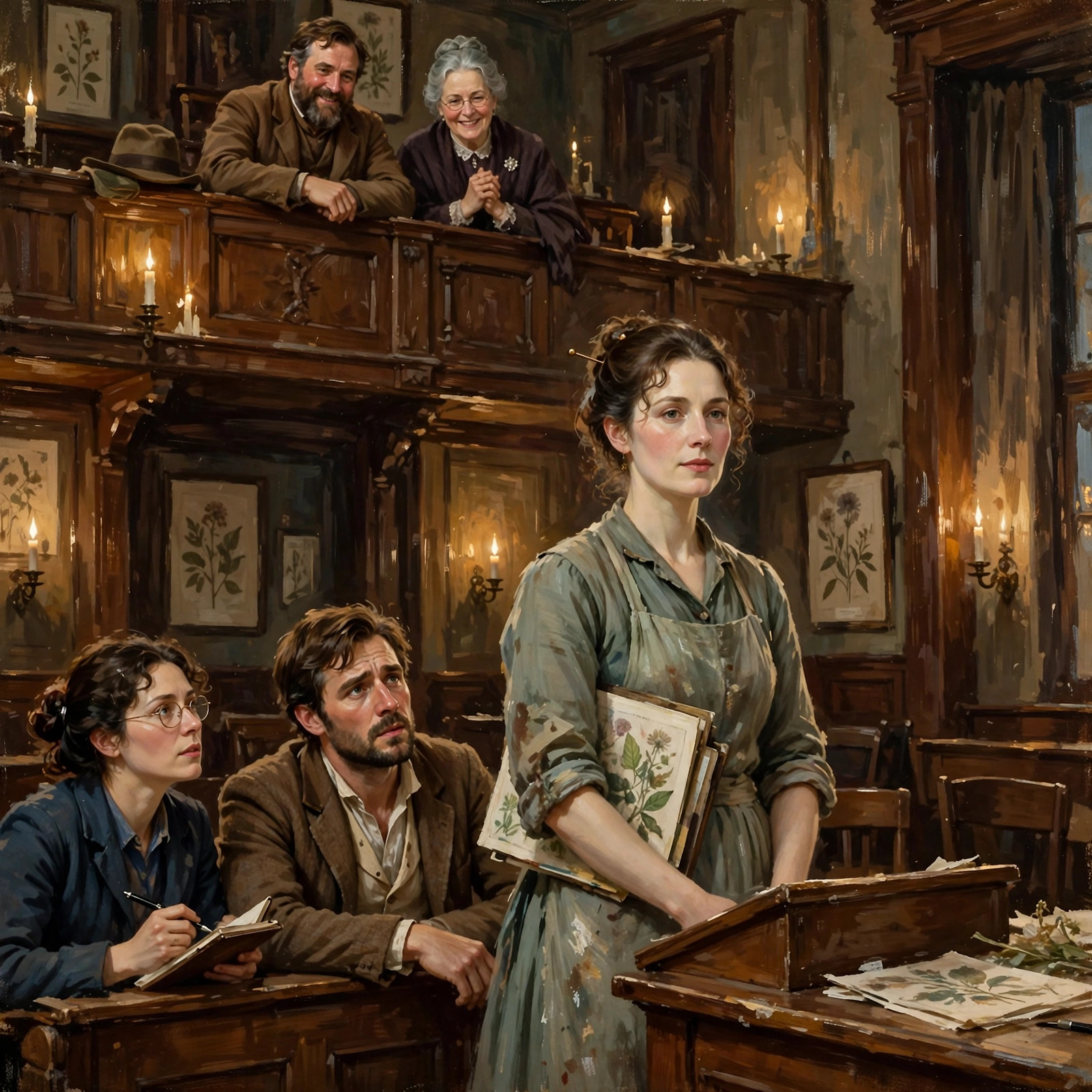
Julian worked at the far end of the pit, tipping water into the trays, saying nothing. That was the first hour. It was a comfortable nothing, which surprised her. Most silences she had sat in had teeth.
The letter arrived with the second post.
She heard the pit door first, and Hetty Crane's voice, low and unhappy, and then Julian's aunt came down the walk between the benches with a folded paper in her hand and a face like weather coming.
"Miss Merritt." She held the letter out. "This came for you. The boy brought it up from the village rather than leave it at Willow Row, as he knows you're here."
"Thank you, Mrs. Crane."
"It's franked from the journal's office." Hetty did not let go of the letter at once. "I'll say only this, and then I'll not say it again. A letter that travels fast to find a woman is seldom bringing her news she wants."
Then she let go, and went back up the walk, and Cordelia stood with the paper in her hand and the wet brush draining into her fingers.
Julian had stopped with his can half-tipped. "You've gone white."
"I know the hand." She turned the letter over once, as if the back might be kinder than the front. "It's from Mr. Dane. The sub-editor at the journal. He signs my commissions."
"Open it or don't," Julian said, "but open it sitting down."
She sat on her stool and broke the seal. Cyril's writing was small and neat and pressed hard into the paper, the way a man writes who has never once in his life doubted he'd be read.
She read it twice. The pit ticked and breathed around her.
"Well," she said. "He writes with great kindness."
"You don't look kindly read."
"No." Her voice came out flat, and she let it. "There's a plate gone into the journal under my name. A plate I never painted. A tradesman's account too, opened on the strength of my signature, run up to one hundred and forty pounds. He's very sorry to tell me. He thought I'd want to know before the society hears it, since the society keeps the tradesmen's books for the county, and a complaint has been lodged. There's to be a hearing."
"When?"
"Twelve days from now. He's very precise about the day." She laughed, and it was an awful sound, and she pressed her mouth shut. "Twelve days. He's even precise about the room."
Julian set his can down on the gravel. "A plate under your name. Who laid the complaint?"
"He doesn't say. He says only that he'll do what a friend can do, and that he hopes I'll remember, in this difficult season, that I once had warmer dealings with him." She folded the letter along its old creases. "He asked for my hand two years ago. I wouldn't give it. He's been sub-editor at the journal since. He signs every plate I'm paid for."
"And now there's a plate you never painted, carrying your name into a room where your living is decided."
"Yes," she said. "That is the size of it."
He came down the walk slowly, gravel loud under his boots, and stood at the end of her bench with his arms folded, looking at her the way he looked at his thermometers, as if the reading mattered. She liked that he didn't touch the letter. She liked that he didn't say there must be some mistake. Every other person in her life would have said that within the hour.
"A hundred and forty pounds," he said. "Under a tradesman's credit. That's not mischief, that's trade. And the society keeps the books, and the society hears the complaint, and the society has given me my commission." He rubbed his jaw. "I have forty orchid panels flowered for them, Miss Merritt. Forty panels and a seat my family has held before me. Everything I've grown in nine years walks into that same room."
"I know it." She set her brush down across the pot. "I'm sorry to bring my trouble to your bench."
"You haven't brought it. It followed you." He looked past her, at the orchid standing open in its light, spots blushing, and then he looked back, and she saw him decide something, the way she'd watched him decide which bud to cull. "There's a remedy that's old and plain and I'll say it plainly, so you can refuse it without ceremony. Marry me."
The steam moved between them. Somewhere a pipe ticked.
"I beg your pardon."
"A marriage of names, not of hearts, if you'd rather. Hear it out." He kept his voice level, an honest tradesman's voice. "My name stands well with that society. My family's stood there longer than I've been alive. If you're my wife, no sub-editor with a grudge drags your signature in front of them as a stranger's, and no tradesman holds a hundred and forty pounds over a Crane. I keep my commission with a respectable wife at Ellerby Hall, which half the county's mothers have wondered aloud why I haven't got. And you keep your name and your plates, and you paint anything you like for the rest of your life, including my lily when it wakes."
She stared at him. "You've had this thought before this moment."
"I've had it since you laid your first wash on that vellum and didn't ask me one fool question about whether the orchid was rare." His ears had gone red, which was the first time she'd seen anything move in his face that he hadn't ordered there. "That's a rarer thing than the lily."
Cordelia looked down at her own hands. They were shaking, and she stilled them against her knees.
"You'd bind your whole standing to my trouble," she said. "That's a poor bargain for you."
"My standing's been bound to that room since the day I was born in it. You'd be the first thing I'd have chosen myself." He coughed. "For the commission's sake."
"Of course. For the commission."
She thought of Cyril's letter, folded small on the bench, and of her cottage on Willow Row with its one good window and its roof that wanted mending, and of twelve days, and of the plate she'd painted in here, half-born, the only honest thing with her name on it in the county.
"If I say yes," she said, "I have conditions."
"I'd have been disappointed otherwise."
"I keep my accounts separate, and my plates signed Merritt, always. I won't have my work ride on anyone's name, not even a husband's. Not a line of it."
"Done. I'd sooner have your name than mine on that plate anyway. It's the better hand."
"And I paint where I like, and I go where I like, and if this ever wants undoing, you'll say so to my face and not by letter."
"That's a thing I'd never do," he said, "but yes."
"And the banns," she said, "will be read properly, because if I'm to be married in twelve days' shadow, I'll at least be married in a church porch where everyone can see I'm not ashamed of it."
"Three Sundays," he said. "I know how banns are read. I'll stand in the porch myself."
He put out his hand across the bench, over the vellum's edge, and she took it. His palm was warm and calloused and it closed around hers entirely, and she thought, with a small private alarm, that she had made a bargain and not a promise, and that her pulse had not read the difference.
"Then we're agreed," Julian said. "A marriage of convenience."
"Of convenience," she agreed, and did not look at him, and he did not look at her, and both of them held on a moment past what the bargain needed.
She turned back to the vellum to hide her face, and lifted her brush, and found the first spot again. The crimson had deepened since morning. It was going to be the finest thing she had ever painted, and it was going under a name that was still, for eleven more days, in danger of being taken from her.
"Julian."
"Miss Merritt."
"When the bloom closes, I'll not be done with it. And when your lily opens, whenever that is, you send for me, and I'll come as your wife or not, whichever we've managed by then."
"I'll send," he said, and went back up the walk, and she heard him stop once, halfway, and stand a long moment before he went on. She pretended not to notice. She was busy pretending the same thing on her own side of the bench.
Two Signatures
Cordelia slept badly and painted well, which she had long ago decided was the trade her body had made with her conscience without consulting either of them. By the fourth morning the orchid had begun its slow turning, the lip curling a half-degree against the light, and she had run out of time to be precious about it.
She was at the bench in the forcing pit before the sun had properly cleared the wall, working the last petals in layers, gum arabic and patience, when Julian came down the walk with two cups and said nothing at all, which she had begun to find restful. He set her cup within reach of her left hand and stood a little way off with his own, watching the flower and not watching her, or watching her and not the flower; she had stopped trying to tell the difference.
"It's closing," she said. "A fraction. You can see it if you've looked as long as I have."
"I've looked longer," said Julian. "You're right, though. Today it turns."
"Then today I finish."
The last hour went the way the good hours went, where the brush moved and the world kept its noise to itself. The crimson deepened toward the throat of the flower where the shadow pooled. She painted the unnamed thing as it was, four flowerings and a spine of bud, and when she set the brush down her hand ached in the familiar way and the plate was the truest work she had ever done. She let it dry while she drank the tea, gone cold, and then she took up the crow quill and the sepia and signed the corner: C. Merritt, del.
She sat back. Then, before she could think better of it, she wrote beneath, in the small, even hand she used for nothing else: Cordelia Merritt. Full. Twice on one plate, once for the journal and once for whoever came asking.
"Two names," Julian said from behind her. She had known he was there for some minutes.
"Two signatures," she said. "One's the habit. The other's for a man who's been writing my name where it had no business being. I intend to leave so much of the real thing about that any lie will stand out like ink on snow."
"That's either very clever or very proud."
"It's both, and it's my best and only defense, and you may as well know now that I'll be proud all the way to the hearing."
He laughed, low, and she liked it more than was convenient, and then the bell at the yard gate went, and the laugh went with it.
Mr. Aldous Peck came down the pit walk at the pace of a man who had rehearsed his face in a mirror. Secretary of the county horticultural society, hat in hand, sorrow arranged around his mouth.
"Miss Merritt. Mr. Crane. I'll not take your morning longer than I must."
"Then don't take it at all," said Cordelia.
"Miss." He set his hat on the bench, which she felt as an intrusion, and produced a folded paper from inside his coat. "The society's business has been made yours, and I'm sorry for it. There's a question before us concerning a plate that passed under your signature, and a tradesman's credit to the sum of one hundred and forty pounds, also under your hand. The society will sit and hear the matter."
"I know what the society will do. I've had the arithmetic in a letter since the day before yesterday."
"Then you know I'm obliged." He nodded at the vellum. "That plate. I'm instructed to impound it as evidence."
The words landed somewhere under her ribs and sat there. She put her body between the bench and him before she had decided to, one hand flat on the paper's edge.
"You'll take my work to sit in a hall with my name attached to a lie."
"I'll take it so it can speak for you," said Peck, and for one moment the rehearsed sorrow slipped and something more tired showed under it. "I've been secretary eleven years, Miss Merritt. I've watched this society weigh more than one man's honesty, and I'll tell you what I've learned, which is that the board weighs what's put before it, and no more. Put this before them. Let them see the difference between this hand and that one. Or keep it, and let them weigh a refusal."
Julian had come forward off the wall. He didn't touch her or the plate. He stood where Peck could see all of him.
"Peck. Off the record. Is it her they're after, or the plate?"
"Off the record, Mr. Crane, I don't know what they're after, and I've stopped guessing. On the record, I collect the plate and I don't editorialize." He paused. "Off the record again, there are men on that board who knew your father, and they don't all remember him fondly, and I'd not wager a shilling on how that cuts."
Cordelia felt Julian go still beside her, the particular stillness of a man who has just been handed a box he isn't ready to open. He didn't ask. She noticed that he didn't ask, and filed it away with the other things she was carrying.
She took her hand off the plate.
"Take it," she said. "Take it today, and I'll have a receipt, and I'll have your word that it goes before the board whole, not thumbed, and that my name on it is read aloud."
"You'll have all three." He wrapped the vellum himself, and his hands were careful, which she was not too proud to be grateful for. "Miss Merritt. I'll say one thing more, as a man and not a secretary. When it's your honesty on the table, everything else about you gets weighed with it, whether it ought or no. Your conduct. Your connections." His eyes went from her to Julian and back. "Whatever arrangements you make between now and then, make them ones you'd stand behind in a full hall."
He gave her the receipt, put on his hat, and went back up the walk with her four flowerings under his arm, and Cordelia stood looking at the empty stretch of bench where the plate had been for four days, and found that her eyes were hot and her chin was doing something she disapproved of.
"He's right," she said, when she could. "That's the ugly of it. It's not the debt. It's that they'll weigh whether I'm the sort. A woman alone in a hired cottage who paints for her bread. All he needs is for them to look at me and doubt."
"Then don't be alone in a hired cottage," said Julian.
"That's a proposal with a flaw in it, Mr. Crane. We settled that two days since."
"I'm not proposing the marriage again. I'm proposing the porch." He turned to face her squarely, and Peck was not yet out of sight of the pit, and two of the garden men had come round the wall with the watering carts and stopped, and Julian knew all of it, because he did not lower his voice. "The banns begin Sunday. Three Sundays. I mean to stand in that church porch when they're read, and I'd have you know before God and the watering carts that I'll stand there whether you take my hand or no, because my word's given and my word holds. But I'd rather stand there with your hand in mine than with it empty."
He put his hand out. Not across a bench this time. Palm up, steady, in front of Peck's retreating back and the two garden men and the whole waking morning of Ellerby Hall.
"Before witnesses," he said. "You told me once you'd not have your work ride on anyone's name. I'm not offering my name to ride on. I'm offering to stand where I said I'd stand. There's a difference, and you paint distinctions for a living, so I'll trust you to see it."
The bloom was closing behind her, a fraction, faithful. Her plate was gone down the walk under a stranger's arm, signed twice, the only honest thing with her name on it in the county, and here was this man's hand open in the light, and she thought of ink on snow, and how a body can know a thing is a bargain and still feel it as something else entirely.
She put her hand in his. He closed his fingers around it, careful, unhurried, as though signing something of his own, and one of the garden men said something low to the other that she did not catch and did not need to. Julian did not let go, and she did not take her hand back, and the sun came over the wall and found them both standing there in the pit, hand in hand, in front of everyone, with eight days between them and the hearing, and three Sundays between them and everything after.
"Sunday, then," she said.
"Sunday," said Julian, and did not let go until she was ready, which, she noted with some alarm, was not one moment before he had to.
The Gum Jar
Two days later, the study at Ellerby Hall smelled of pine smoke and dried gum arabic, and Cordelia had claim to the good end of the long table because Julian had ceded it without ceremony, the way he ceded everything, as if the table had simply grown toward her.

He worked at the other end with his panels. Forty of them, small vellum squares, each one an orchid from the pit, each one needing its label written fair for the commission. She worked on her own plates for the journal, a humble row of ferns Cyril had assigned her in the spring, before the spring had turned strange. Between them sat the gum jar, half-full, its lid gummed shut with its own contents, and it passed back and forth all evening like a coin between pickpockets.
"You've got it again," she said.
"I had it last."
"You had it last evening. I've been counting."
He slid it down the table. "There. Now you've had it last."
The fire had been fed twice. Hetty had brought up the lamp oil without being asked and had said, on her way out, that a house with two people working in it was a house with a proper noise in it, and had not explained herself, and had not needed to.
Cordelia laid a wash of green along the rachis of the smallest fern and watched, over the top of her brush hand, as Julian wrote his labels. His hand was not a scholar's hand. It was square and deliberate, the letters upright as fence posts, and he wrote ex forc. Ellerby on each one as though signing a deed.
"Peck's letter came by the afternoon post," she said. She had not meant to say it. The wash had dried and she had a moment, and the moment filled itself. "About the hearing. He sets it down for the twelfth."
"I know. He wrote me too."
"You?"
"I'm to bring the commission books. The society likes its accounts, and the accounts are mine." He capped his pen. "He also asked, in a postscript, whether my father's effects still held the registrar's old files."
The brush in her hand had gone still. "Your father's."
"My father was registrar of the county society for nineteen years." He said it evenly, the way one reads a label off a crate. "Before Peck. Before the lot of them. He kept the rolls, the minutes, the filings. Everything the society ever did to anyone passed across his desk, and half of it stayed there."
"You never said."
"Nobody asks a glasshouse man about his father." A small, dry sound, not quite a laugh. "They ask about his orchids."
She set the brush across the rim of her water glass and gave him her whole attention, which she had learned, in six days, was a thing he noticed and straightened under, like a plant toward light.
"What's in the files?"
He was quiet long enough that the fire spoke first, settling a log down onto its coals. Then he rose, crossed to the low press in the corner, the one with the crane worked into its doors, and took out a ledger, thin and cracked at the spine, tied with a bootlace.
"Dane," he said, and set it in front of her. "Nineteen forty-nine. Cyril Dane's father. He was a plate colorist for the journal before Cyril was. Good hand. Better than good, which is the trouble with that family, they're all clever." He untied the lace himself. "He signed another man's name to a plate. A commission plate. Passed it into the journal and took the fee under the other man's name as well. My father found it in the accounts. He struck him off the rolls and stood up at the society and read the whole of it out, the plate, the fee, the forged hand, all of it, in front of the county. The man never worked in color again. Went into trade. Died in it, I'm told."
She looked at the entry. It was there, in a hand very like Julian's, upright and unhurried, a date and a sum and a word she did not say aloud.
"Julian." She looked up. "Cyril knows this."
"I'd wager the nursery on it."
"Then the forged plate under my name, the debt, the hearing, all of it, it isn't about me at all."
"It's about the name on the letter he means to be read out at the hearing." He was watching her steadily. "Not yours. Mine."
The room had gone very warm, or she had. Two years she had carried it, the refusing of him, the wondering afterward whether she had been proud or merely careful, and now the shape of the thing turned in her hands like a plate held to the light, and the flaw was not in her glaze at all.
"He came to my cottage the second spring I was in town," she said. "He'd been kind all winter, reviewing my plates, advancing my fees. He stood in my little parlor and he proposed, and I refused him, and he went out without his hat and I had to run after him with it, and that was the last kind thing between us." She heard her own voice go thin and steadied it. "I thought the forgery was spite. Plain spite, a refused man taking my name because it was the nearest one to hand."
"It may be both." Julian retied the lace, wound it close. "Spite and an heirloom. He learned this trade at his father's knee, by watching his father lose everything to a Crane. Now he's found a Crane offering a Crane's protection to the woman he couldn't have, and he means to make the county watch while he takes it apart." He set the ledger back on the press. "The hearing will be about your signature. The letter underneath it will be about mine."
She thought of Peck's postscript. "Peck knows."
"Peck wrote to the son of the registrar who struck the Dane off the rolls, asking for his files, six days before a hearing on a Dane forgery. Peck knows exactly what he's holding, and he wants to see which way it's weighed before he puts his thumb on it."
The fire ticked. Out in the pit somewhere, the covering cloths would be going down for the night, and the orchid, her orchid, the one she had painted and signed twice and surrendered, would be folding itself up in the dark.
"He'll use you to get to me," she said, "and me to get to you, and we're to stand in the middle of the same and let him."
"We're to stand in the middle of it together, which is a different thing." He came back to the table but did not sit. "My father stood alone in that hall. I've read the minutes often enough to hear how alone. Whatever else the twelfth brings, I don't intend to inherit that part of it."
She looked up at him, this man she had known six days and agreed to marry on two, standing between her and the whole weight of a county's long memory, and something in her chest came loose and swung wide.
She reached up, took his collar in two fingers, and kissed him.
Brief. Certain. She had decided it before she knew she'd decided, the way one decides a wash is dry. His mouth was warm and he did not startle, only went very still, and then his hand found her shoulder, light as a label laid on wet gum, and the kiss was over and she was sitting back on her stool with her pulse behaving in a manner she declined to examine.
"That settles nothing," she said.
"No," said Julian. His voice had gravel in it that hadn't been there before. "Nothing whatever."
He sat down. He took up his pen. He wrote ex forc. Ellerby on another panel, and his hand was not quite as square as it had been, and they both saw it, and neither said.
She took up her brush. The fern waited. The gum jar sat between them, lid off now, passing its small amber breath over both their plates, and she worked in the lamp light and did not look at him, and knew precisely where he was in the room every moment, and was fairly sure he knew the same of her.
The door opened on Hetty and the tray, the good cups, the steam off the pot.
"Tea," said Hetty, setting it down, "and seed cake, and no arguments from either end of this table, for I've had a day of it from the kitchen boys." She looked at the lamp, at the two heads bent over two rows of work, at the gum jar sitting open between them. "You'll spoil that gum leaving the lid off."
"I'll close it directly," said Cordelia.
"See you do." Hetty poured three cups without asking who drank what, because she was Hetty, and left the door open behind her when she went, so the piano-quiet of the hall came in, and the clock somewhere striking nine, and both of them, in their separate silences, pretending very hard that nothing at all had been decided, and both of them, in the same moment, reaching for the gum jar.
His fingers got there first. He slid it down to her without a word, and she took it, and capped her brush, and did not once look up, and smiled at the fern.
The Tradesman's Ledger
Peck's letter had said eleven o'clock sharp, and eleven o'clock sharp the Yorkshire county society hall smelled of dust, floor polish, and chrysanthemums past their best. Cordelia arrived on Julian's arm, which was a matter of appearance and nothing else, she told herself, all the way up the steps.
Cyril Dane was already inside, standing by the impounded plate as if it were his own exhibit. He looked well. That was the insult of it. He always looked well when he had arranged something.
"Miss Merritt." He bowed over her hand without touching it. "And Mr. Crane. How the county does keep its threads tangled."
"Mr. Peck asked us to come," said Cordelia. "Not you."
"Oh, I'm here on society business. The journal's business. It's all one family of business, isn't it?" He turned the frame gently toward her. Her orchid looked back at her, painted in layers, gum arabic holding every vein down flat. Cordelia Merritt, in her own hand, twice.
"Pretty work," said Cyril. "It's a pity your hand is so easily had."
Peck came in from the inner room with a folder and his glasses pushed up into his hair. "Mr. Dane. Miss Merritt. Mr. Crane. I'll thank you all to sit, and I'll be plainer than I'd like. There is a tradesman's account, one hundred and forty pounds, signed Cordelia Merritt, at a house in Harrogate. There is a plate in the journal's spring number, signed the same. The hearing on the twelfth will weigh the one against the other."
"Then it will clear me," said Cordelia. "My signature is on that plate twice, and I can prove my hand against any paper he's got."
"Can you?" Cyril's voice stayed pleasant, which was the worst of it. "Because here's the difficulty as I understand it. A young woman, alone in the world, no father to answer for her, commissions thin on the ground. A hundred and forty pounds is a deal of money. Some young women find... ways. A signature lent out. A plate lent out. And when the tradesman comes calling, why, then it's forgery, and who's to say which way the lending went?"
The room went very quiet. The chrysanthemums on the side table had begun, somewhere in the last hour, to drop.
"You know that isn't how it was," said Cordelia. Her voice came out level, which surprised her. "You know it, Cyril. You sat in my cottage and I refused you, and I signed nothing but your memory out the door."
"I know I've never signed anything I couldn't defend," said Cyril. "That's rather the point of a reputation."
Julian had not moved. He stood by the long table with his hands folded behind him, and Cordelia knew that stillness, had watched it through six days of glass and fern, and she waited for it to break open.
It didn't. "Mr. Peck," said Julian. "May I see the tradesman's account?"
Peck passed it across. Julian read it the way he read a thermometer, all the way to the top, all the way down. Then he set it on the table, face down, and said, "It's not a matter for me. My father held the registrar's desk here nineteen years, and the society will want the Crane name kept well clear of any of it. I'd advise the committee to hear Miss Merritt's evidence on its own."
Cordelia looked at him. He did not look back.
"On its own," she repeated.
"It's cleaner," said Julian. "For everyone."
"For the seat," said Cyril, softly, and smiled at Julian, and Julian's jaw did something small and hard, and Cordelia stood up so fast her chair barked on the boards.
"I'll be at the hearing on the twelfth," she said, to Peck, to the room, to nobody in particular. "Under my own name, whatever company it keeps."
She was down the steps and three streets gone before her hands would close properly around her reticule.
She did not cry on the walk to Willow Row. She made a point of it. She put the kettle on, she laid out her brushes, she took the smallest one and cleaned it with water and a rag although it was already clean, and she sat by the window with her hands in her lap while the light failed and told herself that a man who had held her hand before witnesses in a forcing pit had not, twelve hours later, handed her to the wolves for the sake of a chair at a committee table.
Told herself it twice. It did not improve with repetition.
He came at dusk the next day. She heard the gate, then the knock, and she thought about not answering, and then answered, because she was who she was.
Julian stood on the step with his hat in both hands and a ledger under one arm, and he looked like a man who had been awake all night in a cold glasshouse.
"May I come in?"
"That depends on what you've come to say."
"Then I'll say it here, if you'd rather." He held the ledger out. "The tradesman's book. Peck let me at it last evening after you'd gone. I wanted to be wrong, Cordelia. I wanted it to be a mistake I could apologize over and a seat I could keep. It isn't a mistake. The account was opened the same week your plate went to the journal, at the same shop where Dane has charged his own paper and his own brandy for two years. The tradesman knew him. Knew his hand. Dane signed your name and paid his own debts with it, and the fool shopman kept the letters, because Dane wrote them on the shop's own billhead."
Cordelia took the ledger. It was heavy, and it smelled of ink and tallow, and it was the ugliest beautiful thing anyone had ever put into her hands.
"You read this last night," she said. "And then you let me walk home alone."
"I did." He said it flat, without a rag to polish it. "Because I stood in that hall and I looked at Peck and the committee and your plate in its folder, and I thought: my father held that desk nineteen years, and Dane's father was struck off it in 1849, and this is not about you at all, it's about the name Crane. And I thought if I stood next to you, the whole thing would read as Cranes and Danes, two houses fighting over a woman's paper. And I chose the seat. I chose it out loud, in front of you, and you heard me do it."
"I did."
"So I went home and I was sick in the shrubbery, and my aunt pretended not to know, which is the only mercy she extends. And then I sat up with the ledger until Peck's man brought the letters, and there it was. His hand. His debt. Your name, borrowed to hang it on."
The wind moved down Willow Row and took the last light with it. Somewhere a shop boy was putting out lamps.
"Say the rest," said Cordelia. "You didn't walk here in the dark to stop at the ledger."
"No." He set his hat down on the porch rail, and she noticed his hands were not steady, and she noticed that she minded that she minded. "I wrote to Peck this morning. I've resigned the seat. My father's seat, such as it was mine, which it never was, which is half of what I've been chasing. And I've withdrawn the commission. Forty orchid panels, six years of flowering, offered to the society as a gift, no name on the label but Ellerby's. If I stand beside you at that hearing, I'll stand as nobody's registrar, nobody's son, just a man who grows things and knows a forged hand when it's put in front of him. Peck has my letter. Dane will have it by morning."
"You gave up the commission," said Cordelia slowly, "to be allowed to say my name was clean."
"I gave it up because it was bought with the same coin," said Julian. "Standing. Succession. The Crane name kept well clear. I've spent my whole life keeping things well clear, and yesterday I watched you walk down those steps alone and I thought, there is nothing at that committee table worth the shape of her back going out that door."
She should have said something cool. She had prepared several things, on the walk home, in the night, at the window. They all went out of her head like birds.
"You're a fool," she managed.
"I'm a fool who can testify," said Julian. "The hearing is on the twelfth. I'll be there, beside you, whatever they make of it. And Cordelia, the banns go up Sunday whether I'm a society man or a nobody. I'd rather be a nobody who keeps his word."
She looked at the ledger in her arms, then at him, at the porch rail where his hat sat, at the whole of what he had set down on her doorstep like a man delivering bulbs.
"Then come in," said Cordelia. "It's cold out here, and I have tea, and you're going to tell me every word of those letters before the twelfth, because if I'm to be defended, I'll know my defense by heart."
He picked his hat back up. "Yes," said Julian, and followed her in.
She put the tradesman's ledger on the table between the teapot and the brush jar, where the gum jar had sat, and thought that it was a strange house that kept its whole happiness in the space between two work things. Then she poured, and he talked, and outside Willow Row lit itself lamp by lamp, and neither of them said one word about the committee seat for the rest of the evening, because it was gone, and they both knew what it had been traded for, and neither would cheapen it by naming the sum.
Banns and Bloom
On the twelfth of the month, Cordelia wore her second-best grey and carried the ledger to the Yorkshire county society hall herself, because she would not let her defense out of her sight, and Julian walked beside her carrying nothing at all except his hat, which struck her as the most remarkable thing he had done yet.
"You could have let me carry it," she said.
"I could," said Julian. "But then you'd have had to carry my nerve as well, and I don't advise it. It's lighter than it looks and less steady."
Mr. Aldous Peck met them in the passage with the orchid plate under his arm, framed now, and Cordelia's eye went to it the way a tongue goes to a sore tooth. Her name sat at the bottom twice, C. Merritt del., and under it Cordelia Merritt, full and unashamed, and she found she could look at it without her stomach turning only because Julian was standing close enough that his sleeve pressed her sleeve.
"Miss Merritt," said Peck. "The committee is seated. You'll be called first."
"And Mr. Crane?"
"Mr. Crane will be called, and Mr. Crane's resignation read aloud, which several members have asked to have entered in the minutes so that no one can later claim it wasn't." Peck's face was careful and unreadable, the face of a man who has watched nineteen years of other men's quarrels from behind a desk. "For what it's worth, Miss Merritt, I didn't ask for that letter. But I'm glad to have it."
The room was the same one where it had gone wrong on the ninth, and Cyril Dane sat in the same chair, thinner somehow, as if the week had been eating him from the inside. He did not look at her. He looked at the ledger in her arms the whole way down the aisle, and Cordelia understood, with a small cold clarity, that he had never once been afraid of being found out. Only of being left.
It went quickly, in the end. She laid the ledger open at the marked page, and the shop's billhead ran along the top like a sentence waiting for a verdict, and the chairman read aloud the account opened in her name, one hundred and forty pounds, and then the letters in Cyril's own hand asking that the bills be sent to Miss Merritt, and Cordelia heard the two signatures compared out loud, hers and the forged one, and she kept her chin level and her hands flat on the table and thought about the way water sits in a glass, still and held.
Then Julian stood, and they asked him why he had resigned his seat to testify, and he said, "Because the evidence is the same whether I hold a chair or stand beside her, and I'd rather stand. My father kept the registers of this society for nineteen years, and the last dishonest man he struck off was Mr. Dane's father, in 1849. I know what a forged plate costs. I've known since I was a boy. I wasn't going to stand by and watch another family pay the same bill in Miss Merritt's name."
Cyril's head came up then. "This is Crane's doing," he said, and his voice cracked like kindling. "She refused me, and I was fool enough to say so to his face, and now, two years later, the Cranes collect. Ask her what passed between us in her cottage. Ask her," and Cordelia looked at him across that long room and said, in a voice that did not shake, "I refused you, Mr. Dane. I refused you kindly, and twice now you've answered a kindness with somebody else's ruin. The first time was my name. The second time was your father's. I am done paying for what you cannot carry."
The room was very quiet. Cyril was escorted out through the side door, and Peck wrote something in his minutes, and then he did a surprising thing. He turned the orchid plate around to face the members and said, "This plate was impounded by me as evidence. I've examined it four times since. There is no dishonesty in it anywhere, and I'd stake eleven years of my own position on that. Miss Merritt, the society would like to engage you to paint its new register plates, under your own name, at a fair rate. If you'll consider it."
"She'll consider it," said Julian.
"She can speak," said Cordelia, "and she'll accept."
Peck almost smiled, which she had not known his face could do.
On the fourteenth, which was Sunday, she walked to church with Mrs. Hetty Crane on her arm, because Hetty had declared that if there were to be banns read in that family, then there would be at least one Crane woman in the pew looking respectable about it, and no one had dared argue. It had been two days since the hearing, and Cordelia had slept for eleven hours of the first of them, and had spent the second brushing out her best shawl and telling herself the thing was a formality, a protection, a sensible arrangement between two people who had agreed on its terms.
Julian was in the porch when they came up the path, hat in hand, waiting exactly where he had said he'd be, and when the rector's voice filled the church and came out into the morning air, "I publish the banns of marriage between Julian Crane of Ellerby Hall and Cordelia Merritt of Willow Row," she found she was holding Hetty's arm very tightly.
"First time of asking," murmured Hetty. "Twice more and you're caught, my dear, and no appeals."
Afterward the congregation spilled out into the churchyard, and Peck was there with his wife, and half the village, and Julian walked Cordelia out through the lychgate as though the whole crowd weren't watching him, which Cordelia suspected was the most Crane-like thing he'd ever done.
"Well," he said. "That's the protection secured. Your name's cleared, your plate is framed, the society's engaged your hand. The arrangement has done everything we asked of it."
"It has," said Cordelia. And then, because she had promised herself on the walk over that if he said one more sensible thing she would say an honest one, she stopped under the yew and added, "Except that I never once wanted it as an arrangement. Not from the glasshouse. Not from the first day. I wanted it real, and I let you believe it was terms and standing and sensible clauses, because that was safer than saying I'd fallen in love with a man who was showing me an orchid."
Julian stood quite still. A bee went past his ear and he didn't flinch.
"You said it first," he managed.
"I did."
"Then I'll say the rest. I proposed to you in a pit full of bulbs and dressed it up as a contract, because I've spent my whole life watching men buy their standing and I couldn't bear to buy a wife. I wanted you to choose me. Not the commission, not the Crane name, not the seat. Me. And you've chosen me at the exact moment I've got nothing left to offer except a crate of lilies and two glasshouses full of orchids."
"That's a great deal to offer," said Cordelia.
"It's yours. All of it. The plants, the glasshouses, and the man, who has been yours since you took off your bonnet in my greenhouse and said the light was better than the reality."
They walked home to Ellerby through the noon, and Hetty went ahead discreetly with the parish register and her own opinions, and at the glasshouse door Julian stopped her with a hand on the frame.
"There's one more thing you should see before the second reading."
Inside, the heat came at them soft and green, and the orchid bench stood in full light where she had first sat with her paints, and above the study door he had hung her plate, framed, the double signature catching the sun. And against the near wall of the forcing pit the cedar crate stood open, and the crimson lily bulbs had broken into shoots, dozens of them, dark red points coming up through the moss.
"Nine years of crossing," said Julian. "They'll bloom by autumn. I was going to name the lily for the society, if I got the seat. I didn't get the seat." He looked at her sideways. "I'd rather name it for my wife."
Cordelia put her hand into his, there among her painted flower and his living ones, and said, "Then plant it where I can paint it."
Get notified when new stories drop

Ivy Chen
Ivy writes historical and second-chance romance with period texture and modern emotional clarity. Courtship stakes, letters, and choices that cost.
Leave a comment
Comments