

The Dismantled Press
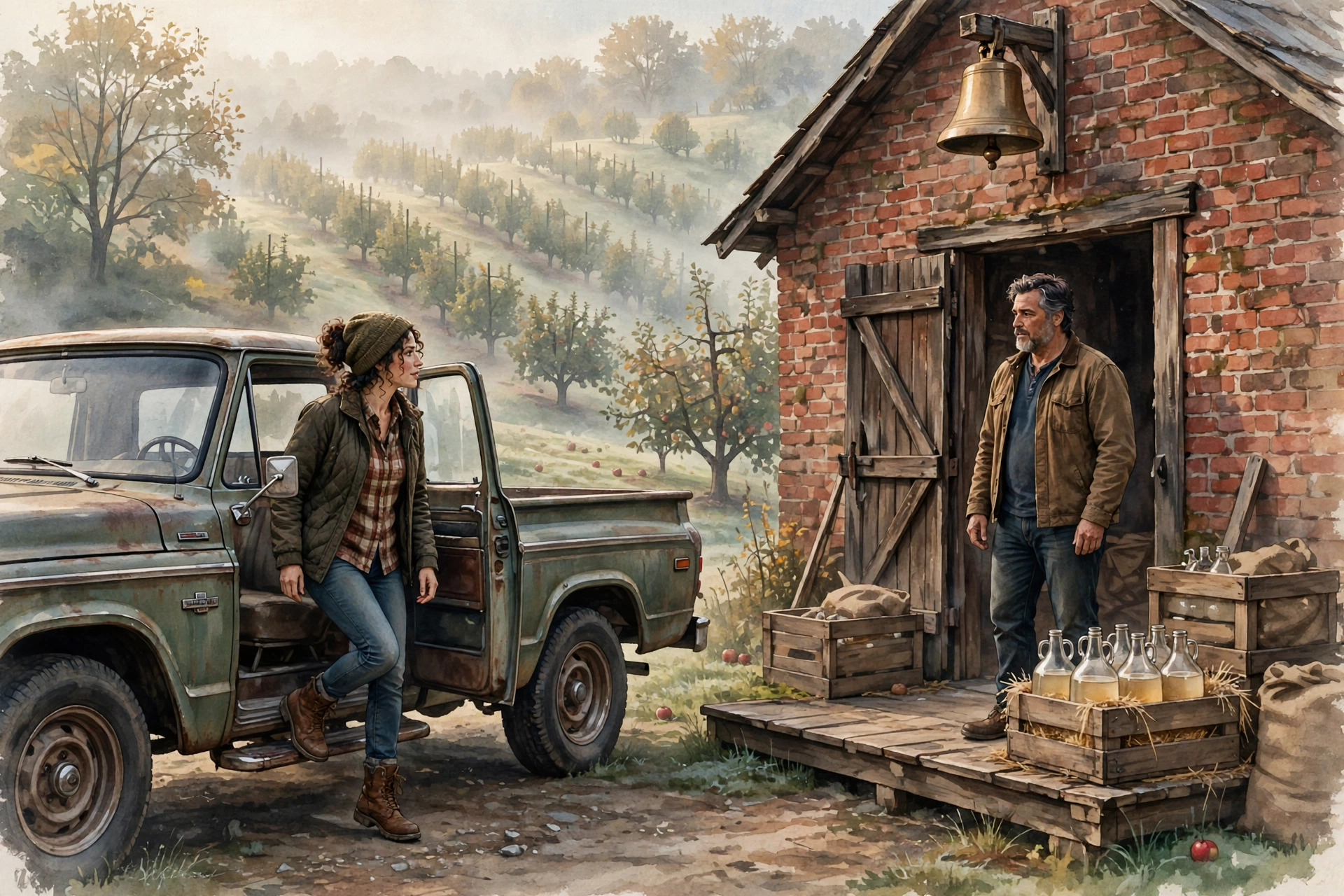
Rowan Tallowcross pulled her truck into the cider barn lot at ten minutes past seven in the morning, and the first thing she saw was the door. Same door. Same crooked hinge, same paint gone the color of old brick, same brass bell somebody had hung so high that only tall people could duck under it. She had ducked under it a thousand times. She sat in the truck with her hands on the wheel and did not get out.
The orchard ran up the hill behind the barn, sixty acres of heirloom rows she could name in her sleep, and the morning fog was still pooled between them like milk in a bowl. The trees needed pruning. She could see it from here, the water sprouts standing up off the tops of the russets like bad haircuts. Somebody had kept the orchard alive. Somebody had not kept the barn painted.
She had a county job an hour west and a plant of her own on a windowsill and no reason in the world to be here except a phone call from Prue Dellwood in April, saying, I need someone who loves those rows more than the ledger, and I can only think of one person, and she left.
Rowan put the truck in reverse. Her boot hovered over the gas.
The barn door opened, and Micah Dellwood came out carrying a crate of empty jugs, and her foot came down on the brake so hard the seatbelt locked.
He'd gotten broader across the shoulders, and his hair had gone from dark brown to something with gray stitched through it at the temples, but he moved the same way, like a man who had spent his whole life carrying heavy things carefully. He set the crate on the loading dock, saw her truck, and went still.
Eleven years. She had driven out of this town eleven years ago with everything she owned in the bed of a smaller truck, the week her father's farm went up on the auction block, and she had not once looked in the rearview mirror on purpose. She had not said goodbye to anyone. Especially not to him.
He raised one hand. Not a wave, exactly. More like a man hailing a bus he wasn't sure would stop.
She cut the engine.
"Rowan Tallowcross." He came down the dock steps. "In the flesh. Prue said you'd come, and I said Prue was a romantic."
"Prue's a realist," Rowan said, climbing out. Her voice came out steadier than she had any right to expect. "She knows a good hire when she makes one."
"Does she." He looked at her the way he used to look at a graft he wasn't sure had taken, like the verdict was still out. "You're a day early."
"I'm a day on time. You're eleven years late noticing."
That got a corner of his mouth, which was dangerous, so she looked past him at the barn. The loading dock was stacked with jugs and pallets and a coil of hose. Through the open door she could see the center floor, and on the center floor, under a great canvas tarp that had gone green at the folds, something lay in pieces.
"What's under there?" she asked.
"Granddad's press."
She was already walking. She heard him follow, boots on the dock boards, and she ducked under the door she'd been afraid of, and the smell hit her, apples and wood and the cold mineral breath of a concrete floor in September, and her chest did something she did not permit it to do.
The press lay dismantled. The twin screws were out of their housing and laid on a blanket like patients in a ward, brown with rust. The oak beams that should have formed the cage were stacked against the wall, their hand-joined edges split, and the iron linings were cracked clean through in two places. Somebody had taken it apart with care, numbered the pieces in chalk, and then run out of either money or heart.
"When did this happen?"
"Cracked a lining at last year's pressing," Micah said behind her. "I tore it down in the spring. Got a quote to reline and re-shim it." He rubbed the back of his neck. "It's not small."
"How not small?" She ran her thumb along a chalk number on the middle beam. His grandfather had built this press the year Eisenhower was in office, joined every beam by hand, and Rowan had helped press the first cider of the season on it every fall from the time she was tall enough to reach the crank handle. First jug of the year, carried down Mill Street to the fair, given to the oldest resident in town. She'd carried it twice herself.
"Not small enough that I've fixed it yet."
He didn't say the number, and she noted that, the way she noted a tree that fruited on one side only. Something wrong at the root.
"Six weeks to the fair," said a voice from the office doorway, and there was Prue Dellwood with her reading glasses pushed up into her white hair and a ring of keys in her hand. "You're both standing there like it's a funeral, and it is not a funeral. It's a press. It comes apart, it goes back together."
"Morning, Prue."
"Rowan." Prue crossed the floor and took both her hands, and her grip was still a farmer's grip, dry and strong. "You look like your grandmother. Stubborn and hungry at the same time."
"That's the family recipe."
Prue laughed and pressed the keys into her palm. "Orchard gate, tool shed, barn, and the loft. The loft's yours if you want it, there's a little apartment up there. I pay your wage, Micah matches it from the cider account, and you answer to the rows, not to him." She said the last part loudly enough for the barn to hear it. "The fair is six weeks out, and the first pressing is done on that press, in this barn, by hand, and carried down Mill Street. It has been done that way since before either of you was a glint. I'd like it done that way this year."
"Then I'd better get the screws out of the rust," Rowan said.
"That's the spirit." Prue patted the ring of keys once, like they were a dog being left in her care, and went back toward the office, where her desk sat with its drawer shut and a folded piece of paper in it that no one had mentioned, and no one was going to mention yet, though the paper sat there all the same with its signatures drying quietly in the dark.
Rowan didn't know that. She only knew the barn, and the smell of it, and the man standing three feet from her pretending to read a chalk number.
"You didn't write," she said.
"You didn't leave an address."
She had no answer for that, so she picked up the top screw, the big one, the king screw, heavy as a fence post, and the rust came off on her palms in orange dust. "I can soak these in vinegar. White vinegar, the cheap kind, a couple of days. The linings, though. The linings need real money."
"I know what the linings need."
"Do you want to tell me?"
He looked at her for a long moment, and she thought he might, and then he picked up the other end of the screw without a word and helped her carry it to the blanket by the door, and they set it down together, and their hands were close, and neither of them moved away fast.
"Prue'll want you settled before dark," he said. "Loft stairs are on the north wall. Mind the fourth step."
"It's still the fourth step?"
"It'll always be the fourth step."
She took the keys and climbed to the loft, and there was the little apartment, dust-sheeted furniture and a window facing the rows, and on the workbench shelf by the window, a shape under an old rag that she did not lift. She knew what it was. A chipped stoneware jar with R.T. scratched into the base by a man's thumbnail, the summer they'd pressed their first cider alone together and he'd been so proud of a pottery night class. She'd left it on this exact shelf the day she drove out. He'd kept it.
She put the rag back down. Later. That was a later thing.
At dusk she walked the rows alone, because that was the job and because she needed it. The fog had lifted and gone, and the light came low and gold across the hill, and the heirlooms stood in their crooked rows, russets and the old sheepnose and the winter banana she'd begged her father to graft off a cutting when she was a kid. The air smelled of apple-rot and coming rain. The trees were alive. Somebody had kept the trees alive, and she found she was breathing hard, not from the hill but from something underneath the breathing.
She could still leave. The truck was gassed. The county job would take her back with an apologetic shrug. Leaving was what she did first, before anything could be taken from her, and she knew the shape of that habit the way you know the shape of your own teeth with your tongue.
She turned around at the top of the hill and looked down at the barn, gold-lit, its windows warm, the tarp over the press just visible through the open door like a made bed waiting for company.
Six weeks. One press. One fair.
Rowan Tallowcross put the keys in her pocket and walked back down.
Six Weeks
By the end of the first week, Rowan's arms knew the shears again, and her shoulders knew the rows, and her hands knew which trees needed her and which ones just needed to be left alone. That was the whole job, her father used to say. Most of farming is knowing when to leave a thing alone.
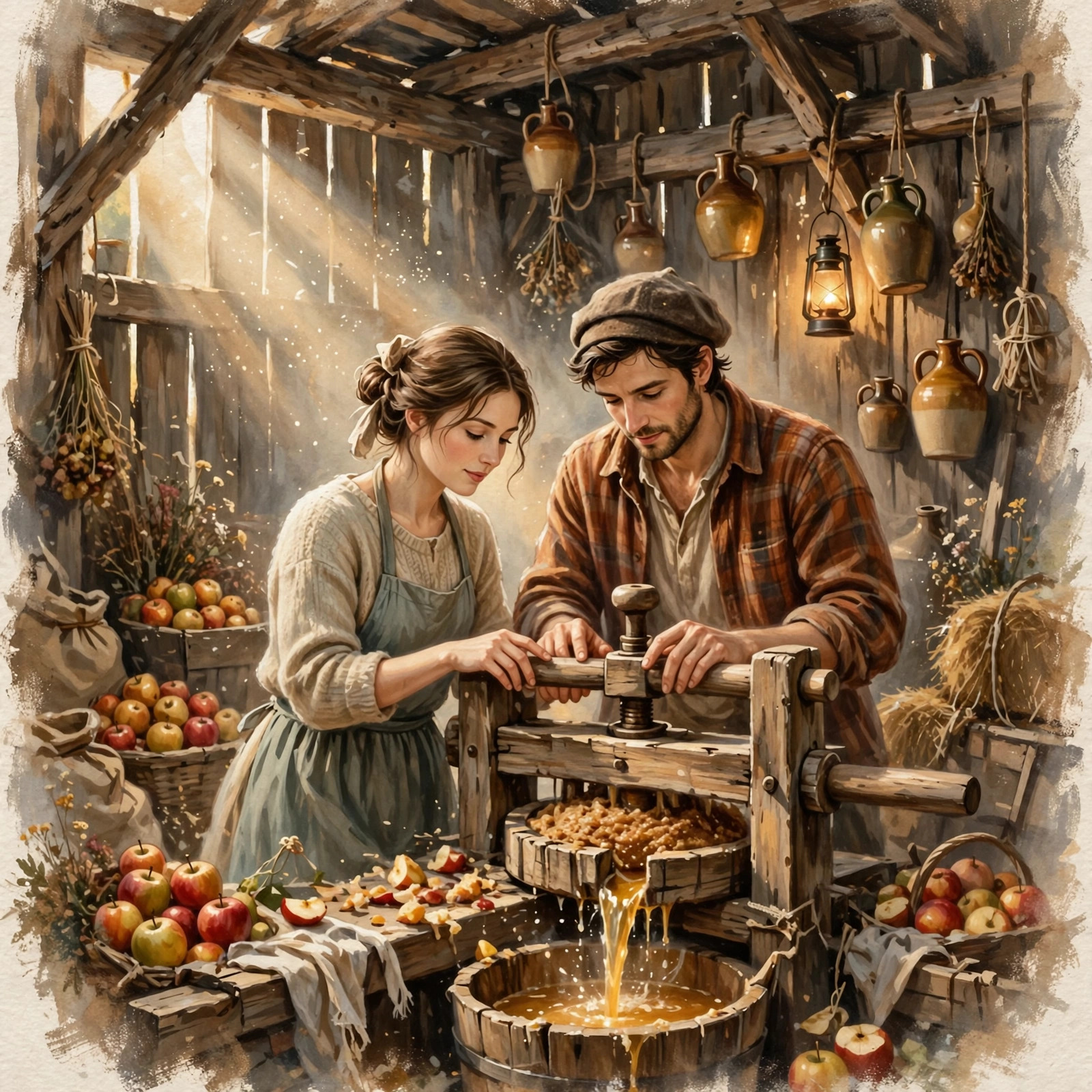
Micah worked the row across from her, moving through the trees the way he always had, quiet and even, cutting only what needed cutting. They didn't talk much the first day. By the third day they were talking the way they used to, which meant arguing about pruning cuts.
"That limb's carrying fruit wood," she called over.
"That limb's carrying a grudge. It grows sideways every year just to spite the sunlight."
"It grows sideways because you topped the tree above it when you were nineteen and it's been fixing your mistake ever since."
He looked at the limb. He looked at her. He put his saw back in the scabbard. "Fine."
"Fine."
"You don't have to look like that."
"Like what?" But she knew like what, and she was smiling, and she turned back to her own tree before he could see it turn into something bigger.
The heirloom rows ran up the hill behind the barn, sixty acres of crooked old trees that some careful hand had kept alive through the years she'd been gone. She'd figured out by day four whose hand it was. There were grafts in the winter banana row in a neat whip-and-tongue style she'd have known anywhere, because he'd learned it from her father, who'd learned it from his.
"You kept the sheepnoses," she said that evening, at the tailgate, when the sun was doing its last gold work on the hill.
"Somebody had to." He handed her a thermos cup. "They make the blend taste like a barn raising. All the good apples do. You can't get that flavor out of a tidy orchard."
"You could have let the rows go and bought juice concentrate like everybody else."
"And have Junie put it in the newsletter?" He shook his head. "I'd rather be poor."
She almost said, are you poor, and didn't. It wasn't her business. It wasn't her ledger. She was here for trees and one press and one fair, and after that, after that she'd see.
The press took up the mornings, before the rows. It lay dismantled under the tarp on the barn's center floor, its pieces chalk-numbered by Micah's grandfather, the cast iron gone brown with rust, the oak linings cracked along the grain. Rowan got down on her knees beside the screw housing with a wire brush and a can of penetrating oil and started in, and Micah knelt at the frame with a scraper, and Prue came through with coffee and stayed to hand them rags and hold bolts and tell them both they were using too much elbow and not enough patience.
"It needs relining," Micah said. "And the screws need re-shimming, and neither of those is cheap."
"It'll be cheap enough," Prue said. "It's run the fair's first pressing since before either of you could reach the crank."
"Everything runs until it doesn't," Micah said, low, mostly to the bolt in his hand.
Rowan heard it and let it go. She was getting good at letting his small dark remarks go past her like weather, and she told herself that was patience, and some of it was.
On the sixth day her pruning blade snapped. Old blade, hard wood, a bad angle, and it cracked off at the ferrule with a sound like a knuckle popping. She stood there holding a handle and half a story.
"That's my fault," she said. "I'll replace it."
Micah was already at his kit, the canvas roll his father had used, and he unrolled it on the tailgate and took out a blade, a good one, honed and oiled and clearly kept for somebody. He fitted it to her handle, seated the pin, and handed it back without ceremony.
"That was your dad's spare," she said.
"It's a blade. It doesn't care whose hand it's in." He rolled the kit back up. "Don't cut toward your thumb this time."
"I never cut toward my thumb."
"You cut toward your thumb every year of your life until you were twenty."
She took the shears. The weight of them was different now, balanced, and she knew what it meant that he'd carried a spare blade honed and ready in his kit all these years, and she knew he knew she knew, and neither of them said one word about it all afternoon.
Word of her return had, of course, beaten her everywhere. On the eighth day she went down Mill Street for a coffee before the afternoon's grafting, and Junie Pallas leaned over the counter of the Mill Street Kettle with the expression of a woman holding four aces.
"Rowan Tallowcross. In my shop. Drinking my coffee."
"It's good to see you too, Junie."
"Eleven years, and that's the greeting I get." Junie slid the cup across. "You know he hasn't so much as looked at another woman in this town. I keep a list. It's a very boring list."
"Junie."
"I'm just saying what the list says."
"You're saying what you say. The list is theoretical."
Micah came in behind her, hat in his hand, and Junie's whole face lit like a fair booth. "And here he is. Two coffees, then. On the house, because I'm a romantic and this town is starving for material."
"We're pruning the west rows," Micah said flatly.
"You're always pruning something," Junie said. "It's the most romantic thing I've ever heard."
Rowan laughed, a real one, before she could stop it, and Micah looked at her the way you look at a light that's come on in a house you thought was empty.
They took the two cups to the window bench because it was that or stand at the counter and be performed at. The bench was the same one, scarred oak, and they sat at opposite ends of it with the whole length of it between them, and the length of it felt like both a mile and a decision not yet made.
That was the morning Hollis Vantry came to the barn.
Rowan was in the office doorway with a crate of grafting tape when the feed truck pulled in, and Hollis came across the yard with his clipboard under his arm and his chair-of-the-fair-committee face on, warm and businesslike at once. He didn't see her. The office was dark and she was dark against it, and she'd stopped to set the crate down.
"Prue," he said. "Just checking in on the buyer's timeline. He's a patient man, but patient has a season, and the season's the fair. He'll want an answer one side or the other by then."
"He'll have it," Prue said, even as a fence rail. "When we have it."
"Of course, of course. Nobody's rushing anybody. It's only that a number like that doesn't sit on a desk forever. And if the barn parcel goes, well. The fair committee will want to know about the pressing, won't it. That's all I'm saying."
"That's a lot, Hollis."
"It's my job to say it out loud." He tipped his hat to the yard in general and left, and his tires crunched off down the lane.
Rowan came out of the doorway with the tape. "What buyer?"
Micah had come around the corner of the barn with a coil of hose, and he didn't slow and he didn't stop, and he said, "Hollis likes to farm other people's business," and kept walking toward the tank, and the subject went with him.
Prue met her eyes for one second longer than was comfortable, and then said something about the kettle on the stove and went inside.
Rowan stood in the yard with the grafting tape sweating in her hand. A number like that. A number like what? The barn parcel. The barn was the fair pressing, was the first jug down Mill Street, was the whole reason she'd been able to come back and picture staying for even six weeks. Somebody was talking about selling it out from under the town, and the Dellwoods were talking about it in the past tense of not-talking, and her whole chest had gone tight in the old familiar way, the leaving way, the door-already-opening way.
She made herself carry the tape up the hill. She made herself graft four rows. She made herself ask nothing, because she'd learned at her father's auction table exactly how much good it did to ask people you loved what they were about to lose.
The next evening, the ninth, they finished the west rows early and walked down to the Kettle because the light was good and neither of them had said the word dinner and both of them were hungry. Junie brought two ciders without being asked and put them on the window bench and withdrew with the dignity of a stage manager leaving her actors to it.
The glasses were the old stoneware ones, and the cider was last year's, russet-heavy, and outside the window Mill Street was going amber and people were calling good evening to each other across it, unhurried, the way they always had.
"The rows look better already," Micah said. "You're better at this than the last three managers put together."
"The last three managers were a scarecrow, a goat, and your cousin Dale."
"Dale kept the sheepnoses alive through the dry year. I'll hear nothing against Dale."
"Dale grafted with electrical tape."
"He was a pioneer."
And that was the one that got her. She laughed the way she hadn't laughed since she'd come back, since before she'd left, a laugh that came up from under the breathing, and the cider almost went over, and Micah went still across the bench with his glass halfway to his mouth, just looking at her, and the look on his face was so open and so unguarded that she had to look out the window to survive it.
He raised his glass. He didn't say anything clever. He just raised it, and she raised hers, and the stoneware touched with a small clean click, and outside, the streetlights came on down Mill Street one after another, all the way to the bottom of the hill where the barn stood dark and waiting.
Grafting Wax
By the third week of grafting, Rowan had learned the loft's hours. The sun came off the orchard hill around six and came through the loft's west window in long honey bars, and if you got the scions cut and waxed before full dark, you could sit on the floor by the wall with your notes and your knees up and let the barn settle around you, creak by creak, like it was exhaling after its own long day.
That was where they were on the last evening of the third week, on either side of a spread of burlap, with the wax pot between them cooling to a clouded amber and a crate of scion wood Micah had cut that morning from the rows behind the barn. Whip-and-tongue grafts. Her father's method, or the version of it Micah had rebuilt from watching him, which was the same thing in every way that mattered.
"Your angle's steep," Micah said, not looking up from his own stock. He never looked up when he said things like that. He'd learned that from her father too, probably. Criticism went down easier when it was aimed at the floor.
"My angle is correct."
"Your angle is proud. There's a difference."
She turned the graft in her hand and looked at it honestly, which was the discipline the work demanded and the one she was worst at. The cut did lean a little steep. The tongue would seat, but it would seat fighting.
She recut it. "Happy?"
"Deeply." And there it was again, that dry delivery, the one that had taken her half the week to stop hearing as mockery and start hearing as what it was, which was Micah being as close to delighted as his voice allowed in public.
They worked. The knife made its small sounds. Down below, through the floorboards, she could hear the tarp over the old press shifting when the evening wind came through the barn doors, and she'd gotten used to that too, the dismantled giant breathing under its sheet while they sat up here making new trees out of old ones. Somebody had to get down to those cracked linings before the fair. She'd priced the relining in her head three times and each time the number had been uglier.
"Pass the wax," she said, and he passed the wax, and as she took the pot their fingers overlapped on the rim, his thumb across her knuckle, and neither of them moved for the length of one full second, which was a very long time to not move, and then she took the pot and waxed the join in three smooth strokes and he went back to his stock with his ears gone red, and the loft was quiet in a new way, a way with a floor under it.
He cleared his throat. "I need more tape. It's in the boxes by the shelf."
"Which shelf?"
"The long one. Under the, uh." He waved a hand at the wall of the loft, at the rank of shelves and crates that had accumulated the way barns accumulate, one kept thing on top of another kept thing until the keeping itself was the architecture.
She got up with the lamp and went along the wall. The tape was in the second box she opened, under a bundle of orchard twine, and she lifted it out, and then she stopped, because under the twine, wrapped in a rag gone soft with age, there was a jar.
Stoneware. Chipped at the lip, one clean little moon of a chip. And pressed into the clay near the base, small and hand-scratched, the letters R.T.
She stood there with the lamp and the tape and looked at it the way you look at something you already know you're going to pick up. The loft was very quiet behind her. When she turned around, Micah was sitting exactly where she'd left him, knife still, looking at the jar in her hands, and his face had gone open in a way she recognized from the evening at the Kettle, that unguarded thing he did when he forgot to hold himself shut.
"You kept it," she said.
"It was on the workbench." He set the knife down on the burlap, carefully, handle toward himself. "You left it on the workbench. I didn't know what else to do with it."
"You knew what to do with it. You wrapped it in a rag and put it in a box and carried it up a ladder and kept it for eleven years."
"That's just where things go."
"Micah."
He rubbed the back of his neck. "Yeah. Okay. I kept it."
She came back and sat down, closer than she'd been sitting before, near enough that the crate of scions pushed at both their knees. She set the jar on the burlap between the wax pot and the tape. It sat there in the lamplight, small and lopsided and hers, and she didn't pick it up again, because if she picked it up she was going to have to say something about it, and there was a whole week of that summer she had never said anything about to anyone.
"I made it in that night class," he said, into the quiet. "The pottery one, at the grange. I was going to give it to you at the pressing." He turned a scion over in his fingers without seeing it. "You'd have laughed at it. The stamp's crooked."
"The stamp is crooked."
"I did it with a nail."
"I know. I was there when you told me. You said, and I quote, it's not crooked, it's rustic." She heard her own voice go strange on the last word, thick, and she pushed through it. "You were so pleased with yourself."
"I was twenty-five and I'd made a jar." He almost smiled. "Of course I was pleased."
The lamp hissed a little. Below them the tarp breathed.
"I meant to say goodbye," she said. It came out lower than she'd planned. "That week. I had it in my head that I'd come up to the barn on Friday and tell you I was leaving. And then Thursday the auctioneer's signs went up along the county road, every quarter mile, my father's name on every one of them, and I couldn't. I got in the truck and I drove, and the jar was on the workbench because I'd already decided it was too much to take, like everything else that week. Too much to take. So I took nothing."
Micah didn't say anything for a while. He took the wax pot and warmed it slowly in his palms, turning it, and she watched his hands and waited, because she knew his silences now, knew the difference between the one that meant nothing and the one that meant he was choosing.
"I came up Friday," he said. "With cider. The first of that year's, just a small jug, nothing official. I was going to, uh." He stopped. Turned the pot again. "Doesn't matter what I was going to. You were gone and the bench was clean except for the jar, and I stood there like the barn had answered a question I hadn't finished asking."
"Micah."
"It's all right. It was a long time ago." But his jaw was working, and he wasn't looking at her, and she understood suddenly and completely that it wasn't all right, that it had never once been all right, that he had carried that Friday up and down these ladders for eleven years the way he carried everything, alone and without complaint, until it wore grooves in him.
She reached out and put her hand flat on the burlap, palm up. It was the bravest thing she'd done since driving back over the county line. He looked at her hand for a long moment, and then he put the wax pot down and set his hand in hers, and his palm was warm and calloused and slightly sticky with grafting wax, and neither of them laughed at that, though she could feel the laugh sitting in both of them, waiting.
"I keep almost saying something," he said.
"Say it."
"I don't..." He turned his hand over so their fingers laced, and his voice dropped to almost nothing. "I keep almost saying that if you'd stayed, or if you'd come back sooner, or..."
"Or."
"Yeah. Or." He looked at their hands. "It's not a finished sentence. I've been working on it for a while."
"Take your time," she said, which was the thing her father used to say over grafts, and Micah's breath caught on something that was nearly a laugh, and he squeezed her fingers once and let go, gently, and picked his knife back up, and they worked on into the dark because neither of them wanted to be the one to call the evening done.
They talked about other things after that, low and slow. The rows. The fair. The press, and whether the linings could be redone in time, and how his mother had been quieter lately, eating her supper standing at the office window. At some point her notes were in her lap and his shoulder was against the wall and hers was against the wall and the gap between them had closed by degrees the way the gap between graft and stock closes, by weather and patience, until she woke in the gray before dawn with a crick in her neck and the lamp burnt down to a smear and the jar sitting between them on the burlap where they'd left it, upright, unchipped side toward her.
He was asleep, head tipped, mouth soft, one hand still loosely holding the knife he hadn't finished putting away. In sleep his face had none of the shut-ness he wore in the day. She sat very still and looked at him and felt the old warm terrifying thing, the staying thing, rise in her chest, and she didn't drive it off. She just sat with it, the way he'd said he was sitting with his unfinished sentence.
Then he stirred, and his eyes opened, and he saw how close they were, and the shut-ness came back down like a shutter, and he got up too fast and started gathering the wax tools in silence, and she folded her notes, and the jar stayed where it was, between them, in the first light coming through the west window, not saying a word.
"I'll start the linings today," he said at the ladder, not turning around.
"I'll be down after the rows."
He went down. She stayed one minute longer, her hand resting briefly on the cool clay shoulder of the jar, and then she put it back in its rag, in its box, on its shelf, face out where she could find it again. Then she followed him down into the barn.
The Folded Letter
By the evening of the test pressing, the barn smelled like the inside of an apple again. Micah had the new linings seated and the screws chased clean of rust, and he'd been oiling the oak all week until the wood had gone the deep amber it must have been when his grandfather bolted the thing together. Rowan stood at the press's side with a crate of early drops from the heirloom rows while he fed the first fruit into the hopper, and neither of them said anything for a minute, because it was the kind of moment you didn't want to talk over.

"All right," he said. "Turn it."
She took the wheel. It came around heavy, then heavier, then the screws took hold and the whole frame groaned like a ship and the first pale ribbon of juice ran down the channel into the waiting bucket. Clean. Sweet. It smelled like every fair she'd ever stood in the middle of.
Micah put his hand flat on the press bed, feeling for shake. "No wobble."
"No wobble." She laughed, and it came out of her bigger than she meant. "Your grandfather would be insufferable about this."
"He'd say the oak remembers." He dipped two fingers into the bucket and held them out to her, and she took his wrist and drank from his hand, which was a barn-thing, an orchard-thing, and they both knew it was more than that, and neither of them stepped back.
That was when Hollis's truck ratted up the drive.
He came in with his clipboard under his arm and his feed-store smile on, but the smile had a job in it. "Evening, you two. Smells like a fair in here already." He walked a slow circle around the press, admiring it properly, and then he got to the point, which was what Hollis always eventually did. "Look, I hate to be the boot. But the buyer's man called the store twice this week. They want an answer on the barn parcel by the fair, and they want it in writing. Prue's got the paperwork. All I'm asking is that you all decide something, one way or the other, so I can tell them done."
"There's nothing to tell," Micah said. "We haven't decided anything."
"That's the trouble, son. Not deciding is deciding, where an option's concerned."
Rowan looked from one of them to the other. "The barn parcel," she said. "This barn?"
"It's a conversation," Micah said, too even, and the shut-ness came down over him like weather.
Hollis lifted a hand, peaceable. "I'm just the messenger. Fair booth assignments are on the clipboard too, that's the fun part. Prue around?"
"Office," Micah said, and Hollis crunched across the gravel toward it, and Rowan stood in the juice-smelling quiet with her heart going wrong.
She went to find Prue.
The office lamp was on but the room was empty, the window open to the yard, and Prue's chair sat pushed back at an angle like she'd gone out mid-thought. On the desk, the ledger. Beside the ledger, the drawer, not quite shut.
Rowan only meant to close the drawer. That was the truth she'd hold to later. But the paper inside sat folded with a bold letterhead showing, and the letterhead had a number on its bottom line that stopped her breath: a quarter of a million dollars, close enough, offered in clean type for the parcel the barn stood on, signed, dated, waiting. And beneath it, in Micah's hand, small pencil marks against columns of figures, the same figures from the ledger, checked and rechecked, the way a man does when he's wearing a groove into a decision.
She heard his boots on the gravel and she didn't put the letter back.
She was holding it in the middle of the office when he came in, and he stopped in the doorway with the dusk behind him, and she watched him understand exactly what she was holding and exactly what it meant, all in one breath.
"You knew." Her voice came out flat. "You knew the whole time. Hollis asked you, the day I arrived he was asking you, and you said nothing. Six weeks I've been rebuilding your press. I redid the linings with my own hands. I gave this place the whole of me, Micah, and you were going to sell the ground it stands on."
"Rowan."
"No." She shook the letter once. "Tell me it's not what it looks like. Tell me these aren't your marks."
He came in and took his time about it, which was worse than shouting, and sat on the edge of the desk, and rubbed his jaw. "The marks are mine."
"And the marks mean yes."
"They mean I was working it through. There's a difference."
"Then tell me the difference! Tell me one thing. Anything. You've had weeks to say the barn was on a table and you let me fall in love with saving it."
His head came up at the word love, and she wished it back, and she'd have taken it back with both hands if wishes worked that way.
"You want the whole ledger," he said. "Fine. But it isn't only mine to open. Some of what's in that book belongs to my mother, and it's hers to say or not say, and I've spent years making sure she never had to."
"There it is." She almost laughed. "The carrying. The silent carrying. You'd rather sell your grandfather's barn than knock on a door and ask."
"You don't get to lecture me about leaving things unsaid." It came out low and fast. "You drove off with no goodbye. Eleven years, and I find out from a jar that you ever meant anything you said that summer."
"I was twenty-three and my father's farm was being sold at auction!"
"And I was here! I was right here, Rowan, and you never once, not once, looked back to see."
They stood in the lamplight with the letter between them and the years between them, breathing hard, and she had the old rising in her, the leaving thing, the door-out thing, get out before it's sold out from under you, and he had his jaw set like a man bracing for the truck to leave again.
And then neither of them did the thing they always did.
He moved first, or she did, and afterward she could never honestly say which. There was a step and a hand and the letter hitting the floor, and then his mouth was on hers, rough and desperate and tasting of the first cider of the season, eleven years of unfinished goodbye breaking open all at once, her fists in the front of his shirt, his hand cradling the back of her head like something he'd carried too far to drop now.
It lasted a long minute. It lasted no time at all.
She tore back from him with her heart hammering betrayal and want in the same pulse, and the leaving thing won because it always won, because it was the oldest muscle she had.
"I can't," she said. "I can't do this and watch it get sold."
"Rowan, wait, I'll explain, I swear there's more, just don't--"
But she was already through the barn, already up the ladder, already wrapping the jar in its rag with hands that shook, and she set it on his workbench below, face in, and left it there the way she'd left it there before, on purpose, taking nothing.
She was on the county road before her headlights steadied. She drove past the town line and up the long grade to the overlook where the whole valley showed, the orchard a dark quilt, the barn a small pale shape with one lamp still lit in the office where a man was probably standing with a letter on the floor and his hands empty. She sat with the engine running a long while, waiting to feel free. She didn't. She felt like a graft cut off its stock and left on the table.
She turned back only partway, only as far as the county road motel, its sign buzzing blue over the parking lot. She took a room. She lay in the strange bed with her boots by the door and her keys still in her pocket, close enough to drive back in the morning, and that was the decision she let herself make, and it was not a small one, and sleep took a long time coming.
The Ledger Drawer
The knock came before seven, two soft raps and a pause, like the person doing the knocking had rehearsed it in the parking lot. Rowan was already dressed, sitting on the end of the motel bed with her boots tied, which told her something about herself she didn't want to examine too closely. She opened the door on Prue Dellwood holding two paper cups of coffee from the Mill Street Kettle, steam rising off them into the cold, and a canvas ledger bag over her shoulder like a schoolteacher's satchel.
"You look terrible," Prue said, handing her a cup. "Drink that. Then get in the truck."
"Prue. I can't come back and watch that barn get sold. I've done that before, with better luggage, and it about killed me."
"The barn," Prue said, "is not getting sold. That's what I've come to show you, and it's not a conversation for a motel step. Get in the truck, Rowan. I drove past the orchard every working day of your childhood. One more morning won't kill either of us."
Prue's truck smelled of woodsmoke and apples, same as it always had. Rowan held the coffee with both hands and watched the county road unspool, the auctioneer's ghosts of old signs at the fence lines, the town line, Mill Street just waking, Junie's lamp burning in the Kettle window. She didn't ask where Micah was. She was afraid of the answer in both directions.
The barn doors stood open. The press sat finished on the center floor, relined and shimmed, its oak beams scrubbed pale, the screws oiled dark, looking like it had another fifty years in it and knew it. And Micah was at his workbench with the rag-wrapped jar in front of him, face in, exactly where she'd left it, and his eyes when he raised them were the eyes of a man who hadn't slept and hadn't touched the jar either, like moving it might break whatever it was still holding.
"I didn't know if you'd come back," he said.
"She didn't either," said Prue. "That's why I went and got her. Sit down, both of you. It's time you saw what I've been keeping in a drawer, and I'll thank you both to stop talking until I'm done, because I've had twenty-two years of practice at this and I intend to use it."
She set the ledger bag on the workbench beside the jar and unbuckled it with quick, sure fingers. The book inside was fat and soft-cornered, and she laid it open to a page near the end and turned it so they both could read.
Rowan read. Columns in Prue's small upright hand. Dates going back years. Payments in and payments out, and one column that ran down the left margin like a spine, marked only with a D, each entry smaller than the last, the way a wound closes from the bottom up. The last entry in that column was dated this past spring, and beside it, in Prue's hand, small and final, was written one word: cleared.
"I don't understand," Micah said. But his voice had gone somewhere thin, and he put his hand flat on the bench as if the floor had tilted.
"You wouldn't, because you never once asked me. You looked at your father's books after he died, saw what he owed, decided it was yours to fix, and started funneling cider money into it without a word to anyone. I found out inside the first year. I let it go on because you were grieving and because it kept you at the press instead of in the ground beside him." Prue turned a page back, then another. "But you were paying the same paper twice over, Micah. Some of those debts I'd already settled with the life insurance. I kept the record so I'd know the day you stopped. You stopped in spring. It's done. It's been done. Whatever you thought the sale of this barn was going to finish, there was nothing left to finish."
The silence had weight. Rowan watched Micah read the column twice, three times, his finger under the figures like a man checking a bridge before he'd trust it with a truck.
"Then why," he said slowly, "did it feel like there was a hand on my throat the whole time. Why did I still get the letters from the buyer and think, finally, finally there's a door."
"Because you decided at twenty-five that the honest thing was to carry it alone, and you've been building a barn around that decision ever since. The debt was never the whole weight. The weight was hiding it." Prue closed the ledger and folded her hands on it. "You were going to sell the barn my father-in-law hand-joined to pay a debt that didn't exist anymore, and you were going to do it quietly, the way you do everything quietly, and you were going to stand at that fair tomorrow and press cider in a building you'd already given away. Tell me I'm wrong."
"You're not wrong." Micah dragged a breath in. He looked at Rowan then, properly, and she saw what the hiding had cost him, the whole architecture of it. "I watched my dad go under and then go, in that order, and I couldn't fix either one. So I made myself a promise about you and Mom and this place, and I kept it so long it stopped being a promise and started being a wall. I didn't even know how to knock on it anymore. Then you came back and stood in these rows like you'd never left, and I still couldn't say it. I started to say it, that night in the loft, and the words wouldn't come because they'd had eleven years of practice not coming."
"I know something about that," Rowan said. Her own voice wasn't steady either. "The week the auctioneer's signs went up on my dad's place, I learned that everything you love gets priced and posted, and the only mercy is leaving before the tag goes on. So I leave first. I left you first. I was going to leave again last night, and the only reason I stopped at the motel instead of the county line is that I was too tired to run and too stubborn to feel free." She looked at the jar, still face in, still wrapped. "I left that jar here on purpose, both times. Like I was returning something so it couldn't be taken from me."
Micah reached past the ledger and turned the jar over, unwinding the rag. The chipped rim, the hand-scratched R.T., the glaze he'd fumbled in a night class because he'd wanted to give her something with her own name in it. He set it upright between them.
Then he pulled a folded paper from his shirt pocket, opened it flat on the bench, and Rowan saw it was the buyer's counter-offer, and that the bottom line carried his signature, signed in his careful hand sometime before she'd found the first letter. He looked at it a long moment. Then he took hold of the signed strip at the bottom and tore it off, slow, the paper parting with a sound like a small branch giving way, and he tore the strip again and let the pieces fall into the rag with the jar.
"There," he said. "That's my answer, and it's the first one I've signed in daylight. I'll tell Hollis and the buyer myself, tomorrow, on Mill Street, in front of the whole town if that's what it takes. The barn stays. The pressing runs. And if the books need help, they can ask for it, because apparently asking is allowed now."
Prue made a sound that was half laugh and half something older. "Tomorrow, then. The committee wants the first jug down Mill Street by noon, and the oldest resident this year is Mrs. Ostrander, who will absolutely tell you if the cider's off. I'll bring the truck around at ten." She shouldered the ledger bag, then paused at the door. "For the record, I hired you, Rowan, because this boy loves the orchard more than the ledger and needed someone who'd remind him which one came first. I didn't count on him smiling like that again, but I'm old, not blind." She went out into the morning, and the doors stood open behind her, and neither of them moved for a moment.
"Stay the night in the loft," Micah said. "Not because of the fair. Because the grafting notes are still up there and I have eleven years of things I practiced saying and I'd like to start getting them out while there's no one to interrupt."
Rowan picked up the jar, and it fit her hands the way it always had, warm from the bench, hers in a way that nothing sold at any auction had ever been. "Okay," she said. "I'll stay."
They climbed the ladder together. He lit the lamp. Below them, the press waited, clean and patient for morning, and Rowan sat down against the loft wall with the jar in her lap and her keys still in her pocket, and this time that meant something entirely different, and she let it.
First Jug
Mill Street smelled like woodsmoke and fried dough by ten in the morning, and by eleven it smelled like apples. Rowan stood at the mouth of the street with a stoneware jug in both hands and watched Bramblewick become itself: bunting strung between the lampposts, a fiddle tuning up somewhere near the feed store, kids weaving through the crowd with cider donuts held high like torches.
The pressing had gone clean. She and Micah had worked the twin screws together in front of a barn full of neighbors, his hands on one crank, hers on the other, the oak frame holding steady the way a thing holds when it's been rebuilt by people who meant it. The first juice had run gold into the jug, and the crowd outside the barn doors had actually cheered, and Rowan had laughed out loud, surprised by the sound of her own voice doing it.
"You've got donut sugar on your sleeve," Micah said now, walking beside her down the middle of the street. He was wearing a clean shirt she'd never seen, blue, ironed, which meant something in the Dellwood family vocabulary she was still relearning.
"Your mother gave me two donuts and instructions. She said if I dropped the jug she'd never forgive me, and she's had forty years of practice at not forgiving."
"She's had practice at everything. Come on, the committee's waiting."
Prue walked ahead of them in her fair scarf, carrying nothing, greeting everyone, and everyone greeting her back. Junie Pallas had come down from the Kettle with an apron full of paper cups and a smile that suggested she already knew everything that had happened in the barn office and was being, for once, discreet about it. She fell in beside Rowan anyway.
"So," Junie said. "The orchard manager job. Long-term, is it?"
"Ask me after noon."
"I will, that's a promise."
The oldest resident of Bramblewick sat in a ladder-back chair at the corner of Mill and Church, wrapped in a wool blanket despite the mild day, her white hair pinned and her eyes sharp as tacks. Rowan knelt to hand her the jug, and the old woman took it in both small hands, held it up to the light, and squinted at it like a judge at a county show.
"Dellwood apples," she said. "You can tell by the color. Who pressed?"
"Both of us," Micah said. "Me and Rowan Tallowcross."
"Tallowcross." The old woman looked at Rowan a long moment. "You used to steal windfalls off the ground behind my fence, girl. I never minded. Ground apples want taking." She uncorked the jug with a practiced twist, poured a shallow cup, tasted it, and smacked her lips. The whole street seemed to lean in. "Good year," she announced. "Sweet at the front, dry at the finish. The orchard's in honest hands."
The street applauded, and Rowan felt her face go hot and didn't care.
Hollis Vantry was standing on the steps of the feed store with his clipboard, and when the applause settled he climbed onto an apple crate and held up both hands for quiet. He got most of it.
"Folks, before the dancing starts, there's a piece of fair business that can't wait past today." He turned the clipboard pages. "There's a buyer from out of the county who's asked for an answer on the cider barn parcel by tonight. Big money, I won't pretend it isn't. Some of you know, some of you guessed, and I'll own my part, I carried the papers because I thought it was the family's best way through a hard stretch." He looked down at Prue and Micah. "The town would like to hear it from you."
The street went quiet in a different way, the way a room goes quiet when someone might say a hard thing. Rowan's old instinct rose up in her, the one that said leave before it turns, and she stood on it, both feet on the cobbles of Mill Street, and stayed.
Prue stepped up first. She didn't climb the crate. She didn't need to.
"The answer's no," she said, clear and carrying. "The barn stays ours, the orchard stays working, and the first pressing runs next year, and the year after that, same as it always has. And for anyone worrying about the books, the books are sound. I've seen them myself, recently, top to bottom." She turned her head toward her son, and something passed between them that the whole street could see and no one in it needed explained.
Micah came up beside her, and his voice wasn't loud, but it reached. "I'll say my own piece, since I'm the one who nearly signed. I thought selling was the honest way out of a mess my family made before me. I was wrong, and worse, I was quiet about it, and quiet near cost this town its fair. The barn's not for sale. Not this year, not ever, not while a Dellwood's drawing breath to press apples in it."
Someone in the crowd, an older man in a tractor cap, called out, "Been pressing in that barn since I was a boy!" and a woman near the donut stand shouted, "Not for sale, tell them Hollis!" and the murmur spread, gathering voices, and then it wasn't a murmur, it was the street saying it together: not for sale, not for sale. Hollis held up his hands again, and when he spoke his voice was thick.
"Then that's the town's answer and mine to carry. I'll telephone the buyer tonight and tell him Bramblewick's barn isn't his and never was." He looked at Micah and added, quieter, "You could've told me, son. I'd have helped."
"I know that now," Micah said. "That's the lesson I'm still learning, and I've got a better teacher than I deserve."
His eyes found Rowan's across the crowd, and she felt the words land in her chest like warm cider going down.
Prue hadn't finished. "One more piece of business," she said, and beckoned. Two committee men rolled a half barrel out of the feed store doorway and stood it on its head at the foot of the steps, and Prue produced from her bag a folded paper and a pen. "Rowan Tallowcross. The orchard manager position at Bramblewick Cider Works, wages paid jointly by the orchard and the cider works, contract to run year to year with a standing renewal, if you'll have it. Signed on the barrel head, where Dellwood business gets done."
The street turned to look at her. Rowan looked at the paper, at the barrel, at the pen, and the old fear came one last time, the auctioneer's signs going up along the county road, everything she loved carried off in trucks. She looked up the street instead. Above the rooftops, past the bunting and the lampposts, the cider barn stood whole in the afternoon light, its doors open, the press inside it clean and waiting for next season.
Micah was watching her, and he didn't say anything, and that was the thing she'd finally understood about him, that his silence wasn't a door closing. It was a door held open, and it had been, for eleven years.
She walked to the barrel. She took the pen. She signed, Tallowcross, R., in a hand that didn't shake, and the street cheered a second time, louder, and Junie cupped her hands around her mouth and yelled, "I'm putting it in the newsletter!" and Prue laughed, and Rowan laughed, and Micah stood there with his clean shirt and his eyes bright and said nothing at all, which said everything.
The fiddle struck up. The donut stand sold out by two. Somebody's kids were already asking about next year's pressing, and somebody's grandfather was already exaggerating this one.
As the lamps came on down Mill Street and the fair lights followed, string by string, Rowan stood with her shoulder against Micah's arm, and his hand found hers, fingers lacing through like they'd been doing it for years and had only just gotten around to it. The oldest resident raised her cup to them from her corner chair. The jug sat in her lap, half gone, and the barn stood above the rooftops with its doors open, lit gold at the edges by the last of the day.
"So," Micah said. "The orchard manager job. Long-term, is it?"
"Year to year," Rowan said, "with a standing renewal. I hear the boss renews it every fall, on the barrel head, in front of the whole town."
"Sounds like a boss who plans to keep you a while."
"Sounds like," she said, and stayed.
Get notified when new stories drop

Lila Monroe
Lila writes contemporary and small-town romance with banter-forward leads and soft landings. She believes the best love stories sound like two specific people, not a trope checklist.
Leave a comment
Comments