


Dust on Beams
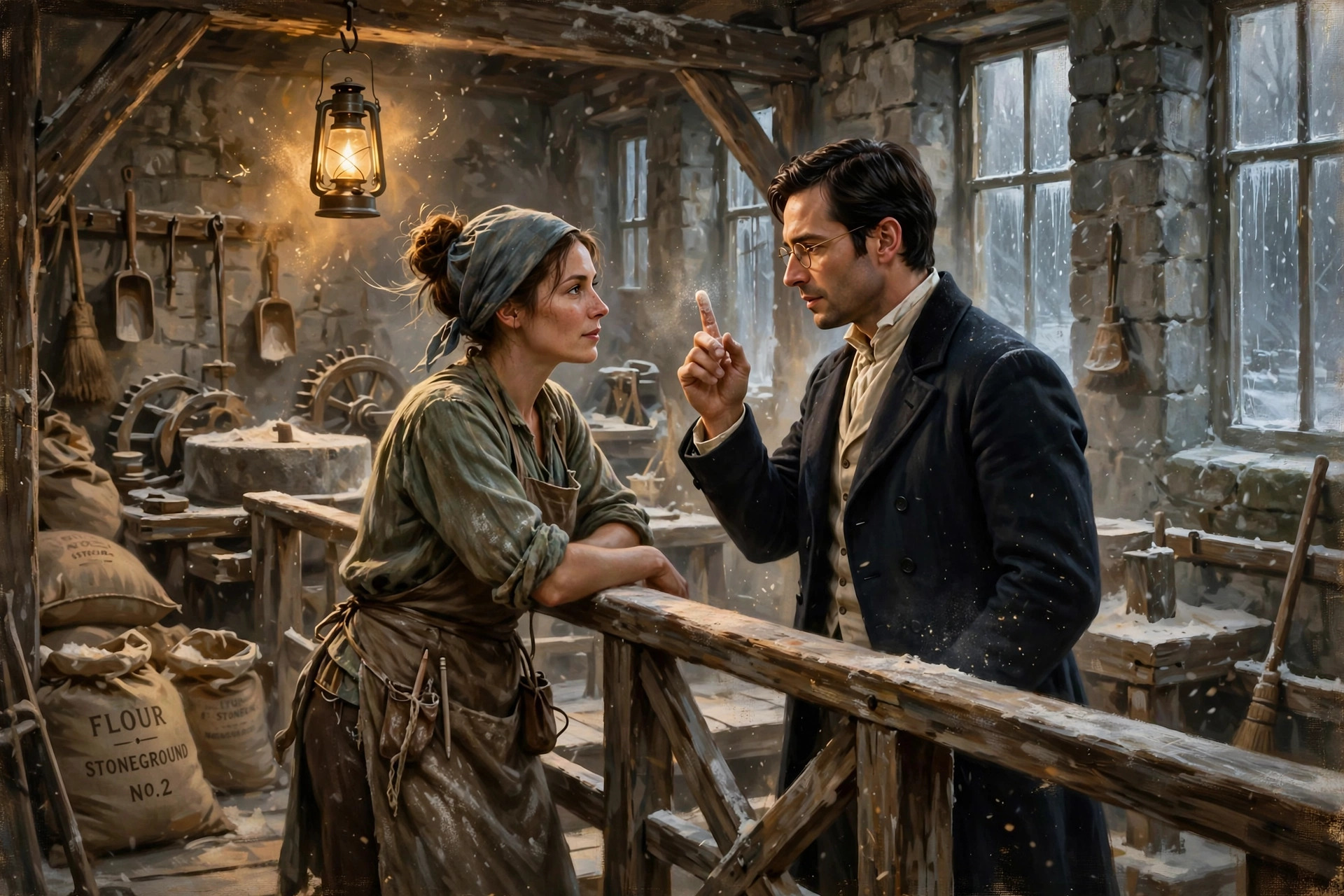
"That's not dust," Josie said. "That's flour. There's a difference, and the difference is my family's name on the door."
Rafe Okonkwo didn't look at her. He stood on the second-floor catwalk with one arm raised, a gloved finger drawn along the oak beam above the stone bins. It left a clean stripe behind it, dark wood showing through the pale. He turned his hand over and held it out between them, the fingertip furred white.
"Flour that has settled on a beam is dust," he said. "Dust that goes up all at once is fuel. I'd call this about three millimeters. Past that, a single spark in the wrong place and your roof lands in the river."
"We sweep every shift."
"Then someone's missing the high ledges."
Josie's jaw tightened. She had swept those ledges herself, with the long brush, at four that morning. She did not say so. Saying so would sound like an excuse, and she had learned young not to hand anyone an opening.
Below them the old stones ground on, a low, steady rumble she felt in her boot soles. Warm wheat smell, cold air. Sleet ticked against the high windows. He had arrived an hour ago in a rental sedan too clean for this county, carrying a hard case and a clipboard, and he had shaken her hand like a man signing something.
"You're on the insurer's clock," she said. "I'm on the mill's. So let's be plain about what you're here to do."
"Audit your dust control. Seventy-two hours, then I make a recommendation to the underwriter."
"To cancel."
"To continue, amend, or cancel." He peeled the glove off and folded it into his pocket as if it were evidence. "I don't arrive with an answer, Ms. Hartwell."
"Josie. Everyone here says Josie."
"I'm not from here."
"No kidding. Your shoes are shiny."
Something moved at the corner of his mouth, quickly put away. She noticed it anyway, and was annoyed that she had.
He walked the catwalk with his eyes on the ceiling, then the conduit, then the long ducts that ran down to the collector. He wrote small, neat lines. Twice he stopped to photograph a joint, and both times Josie bit back the urge to tell him she knew exactly which joints.
"Who checks the collectors?" he asked.
"I do."
"Who signs behind you?"
"Nobody. It's my mill."
"Your father's mill, according to the file." He glanced up. "Which means a second signature is exactly what the policy expects."
"My father is sixty-six and fishing his way through retirement. He trusts me."
"Trust isn't a control."
"It is in Harlow Reach."
"Then Harlow Reach has been lucky." He said it flatly, without cruelty, and that was worse. It sounded like something he had said before, to himself, in a mirror.
She stepped closer, close enough to see a faint gray in the stubble along his jaw and the tired set under his eyes. "I run the night shift here. Eight people. I know every one of their kids' names. Don't tell me about luck."
"Then you want the same thing I do." He held her gaze. "Nobody hurt."
That landed somewhere she kept guarded. Her mother had gone into a mill fire on a night like this one, at a different mill, when Josie was small enough to be asleep in the truck. She did not tell him that. She reached to the hook by the stair, took down a paper-wrapped respirator, and pushed it into his chest.
"Visitor's mask. You'll want it on the lower floor. The fines get into everything."
He looked at the package, then at her. "I brought my own."
"Then you can have a spare and be twice as safe." She turned for the stairs. "Fit it snug. Beards break the seal."
"I don't have a beard."
"You have an opinion on everything else."
He followed her down, the mask strap swinging from two fingers. At the landing he caught the rail, and for a moment their shoulders nearly touched in the narrow stairwell. She smelled cold air and pencil shavings on him. She moved faster.
On the milling floor the night crew was coming in, stamping snow from their boots. A woman at the sifter lifted a hand to Josie, then eyed the stranger with open curiosity. Josie nodded back: later.
"Basement tomorrow," Rafe said, raising his voice over the stones. "The main collector, the gauges, the seals."
"Fine."
"You'll let me see everything?"
The iron key to the millstone loft sat in her pocket, worn smooth by her grandfather's hands and her father's and hers. She closed her fingers around it without thinking. "You'll see what the audit needs."
"That isn't a yes."
"It's the one you get today."
He tucked the respirator under his arm. For a moment he looked less like an inspector and more like a man who had driven a long way for a job he didn't enjoy and meant to do properly anyway. "I'll take it," he said.
The radio on the shelf above the scale crackled, and the voice that came through was the county dispatcher, clipped and tired. Heavy snow, wind gusts, power lines at risk. The state road out of Harlow Reach would close by nightfall.
Josie looked at the high windows. White flakes were beginning to slide past the glass, thick and slow, catching the yard light.
Rafe followed her gaze. "How long does the road stay shut?"
"Long enough," she said, and wished she hadn't sounded so sure.
Night Shift, No Power
The lights died in the middle of an argument about ladders.
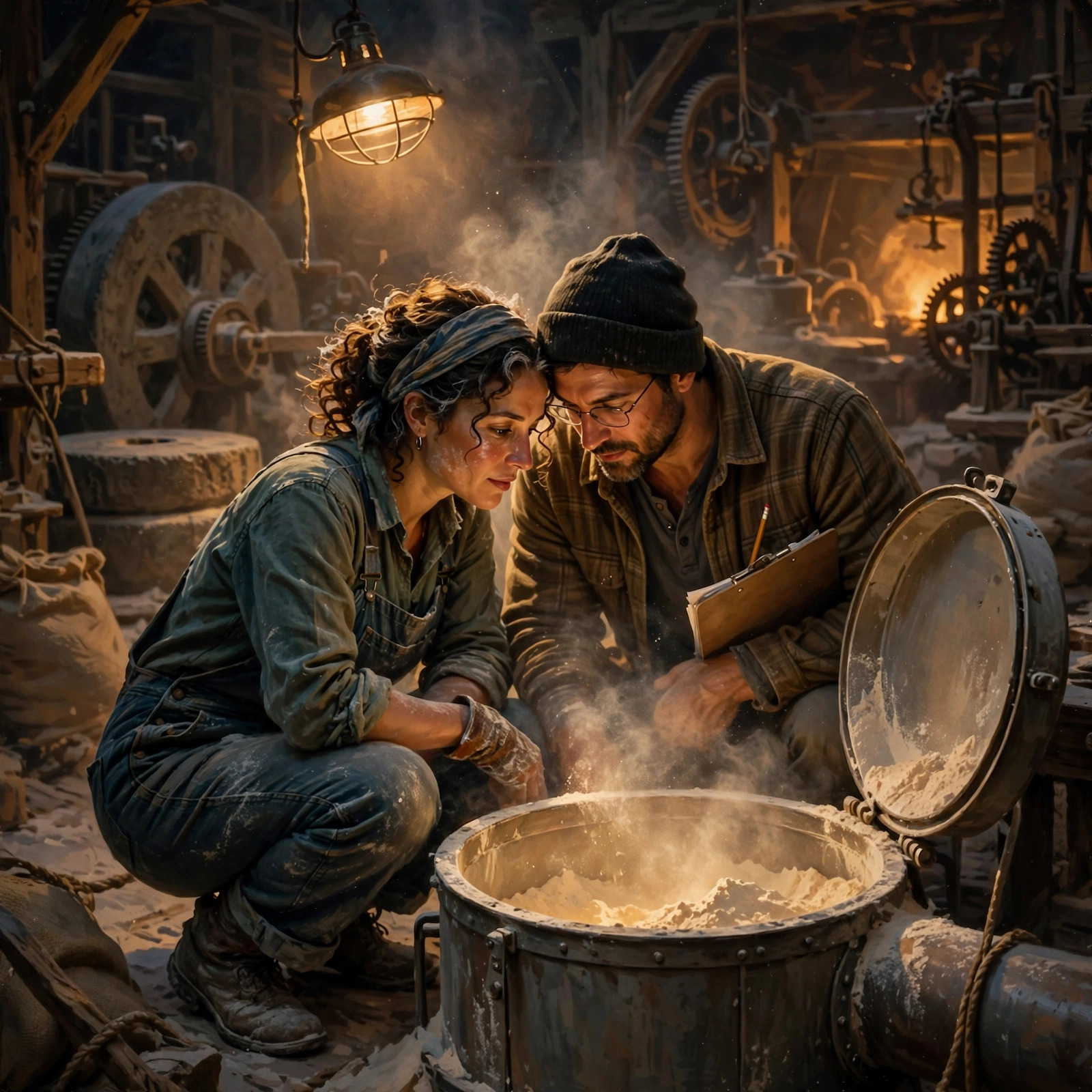
"I'm not asking to climb the roof," Rafe said. "I'm asking to see the collector housing before the shift gets deep into the run."
"And I'm telling you the housing can wait until..." The sifter wound down with a long groan. The overhead tubes blinked out. Every stone on the floor slowed at once, and the quiet that followed was so large it had a weight. Somewhere above them the wind leaned on the roof.
Josie was already moving. She knew the dark in this building the way she knew her own kitchen. Eleven steps to the panel, left hand on the cold pipe, right hand finding the lever. "Everybody stay where you are," she called. "Hands off the belts."
The backup generator coughed in the lean-to outside, caught, and coughed again. Then a single row of work lamps came up yellow along the east wall, and the stones took their turn at turning.
The woman from the sifter let out a laugh that shook. "Two minutes. Best one yet."
"Don't jinx it, Dee." Josie said it lightly, and nobody noticed her palms were damp.
Rafe had not moved from the spot beside the scale. His flashlight beam pointed at the floor, and the respirator hung around his neck like a medal he hadn't earned. "That's a small feed," he said. "How much of the plant is on it?"
"Stones, one sifter, the bagging line. Lights where we need them."
"And the dust collectors?"
She hesitated half a second too long. "The main unit draws more than the generator likes. It runs on a lower setting."
"Then that's the first thing I check."
"It's the first thing I checked, an hour ago."
"Then you won't mind a second pair of eyes." He kept his voice even, which was worse than if he'd pushed. "Josie. A road that's closed and a plant on half power is exactly when a fire starts. I'm not here to catch you out tonight. I'm here because I'm stuck in it with you."
Stuck. The word hit her harder than it should have. She looked at the high windows, black now, snow hissing against them, and thought of the truck seat and the smell of smoke coming across a field. She turned away before her face could say anything.
"Fine. After the first grind. Stay out from under the belts."
Her father was waiting by the two iron stoves at the back of the floor, where he'd parked himself the moment the power failed. Hal Hartwell had been told, many times, that retired meant retired. He sat in his old canvas coat with a blanket across his knees and a poker in one hand, scowling at the grate as though it owed him money.
"Road's gone," he announced. "Heard it on the radio. Plow won't come till morning, and that's if the plow's still alive."
"Dad, you should be at the house."
"House is on the same dead line. At least here there's a stove." He squinted past her. "And company. Does he bite?"
"Only paperwork," Rafe said, walking up. He offered a hand. Hal looked at it for a long moment, then shook it hard.
"Insurance," Hal said, like a diagnosis. "Sit. You look like a man who hasn't been warm since Tuesday."
"I'm fine."
"You're blue around the mouth." Hal jabbed the poker toward a stool. "Josie, give him the thermos."
"He's working."
"So are you. And you haven't eaten since noon, I counted."
She wanted to argue, but the thermos was already in her hand, the dented green one that had ridden to every night shift for six winters. She unscrewed the cup, poured, and the steam rose into the lamplight smelling of black tea and too much sugar. She held the cup out to Rafe without looking at him.
He took it with both hands. Their fingers didn't touch, quite. He drank, and his shoulders came down a fraction. "That's very sweet."
"It's Dad's recipe."
"It's a crime," Rafe said, and drank again. Hal grunted in what might have been approval.
They passed the cup between them in the glow of the stove, Josie perched on an upturned bucket, Rafe on the stool, flour drifting down through the lamp beams like slow snow indoors. For a minute nobody talked about dust or seals or policies. Rafe asked how long the mill had stood. Hal told him, with more detail than anyone had asked for, about his grandfather and the forge and the stones hauled up by mule. Josie watched Rafe listen. He listened well, with his whole face, and that bothered her more than the argument had.
When the cup came back to her, the rim was warm where he'd held it. She drank anyway.
"Right," she said, standing. "Basement. Ten minutes. Bring your light."
The stairs down were steep and cold and smelled of damp stone. The main collector squatted at the far end, a long steel body with ducts running into the ceiling like roots. Josie led the way along the wall with the generator thudding faintly overhead, keeping a step ahead so he couldn't read her.
Rafe crouched by the housing and ran his beam over the seams. He was careful. He touched nothing he hadn't named aloud first. Then the light stopped on the brass face mounted at eye level, the gauge her father's friend had cast and machined back in 1998, and stayed there.
"This reads low," he said quietly.
"It's old."
"The unit's running hard, you can hear it. But the needle hasn't moved since I walked in." He tapped the glass with one knuckle. Nothing. "It's stuck."
Josie stared at the seam of a duct on the far wall, at a smear of rust, at anything else. Overhead the generator stuttered and recovered.
"Josie. Did you hear me?"
She adjusted the lamp on its hook and did not turn around.
Brass Needle
"I heard you," Josie said, to the lamp. "It's stuck. Old gauges stick."
"Then it'll move when I do this." Rafe took the flat of her father's old wrench from the hook, wrapped his sleeve around it, and rapped the brass casing twice. The needle didn't so much as shiver. "Or it won't."
"Don't hit my equipment."
"I hit it gently." He held out his hand. "Screwdriver. Please."
She gave it to him. That was the part she'd think about later, how easily it left her fingers. He unthreaded the bezel with small, patient turns, lifted the glass free, and tilted his beam inside. Then he went quiet in a way she didn't like.
"Come look."
She came. The cold had gotten into her knees. Behind the needle, where a thin spring should have been working, a wedge of folded cardboard sat jammed against the pivot, pale and neat as a matchbook. Josie reached in with two fingers and pulled it free. The needle dropped like a stone to the bottom of the dial.
Zero. Dead zero, on a collector that was roaring behind them.
"It was never reading low," she said. Her voice came out thin. "It was reading nothing."
"Somebody wanted it to look like a unit that was fine. Or one that was dying. Either way, nobody trusts a number like that." Rafe turned the cardboard over under the light. "This is a cut from a flour sack. Clean edge. Razor knife."
She didn't answer. She was already moving along the housing, one palm flat on the steel, the way she'd walk a horse she didn't trust. Down at the access panel she stopped. The gasket seal along the lower seam sagged open the width of a pencil. Every bolt on it should have been snug. She'd torqued them herself in October.
"Light," she said.
He knelt beside her. The beam slid over the bolt heads, and there they were, bright little crescents scored into the dull paint, silver where the wrench jaws had bitten. Fresh. Not a month old. Not a week.
"Those aren't mine," Josie said. "I use a box wrench. That's an adjustable, and somebody's hand slipped."
Rafe said nothing, which she was grateful for. He laid two fingers beside a mark, not touching it, the way he'd touched nothing all day without naming it first.
The seal was leaking fine dust into the room instead of drawing it up the duct. That was why the beams upstairs wore a skin of it no matter how often she swept. She'd been blaming herself for months. She'd swept at dawn, swept at midnight, and been quietly, privately certain she was losing her touch.
"It's someone inside," she said. "The road's been cut since this afternoon. These marks are older than the storm. Somebody with a key to this room, who knows which bolt matters."
"Who has keys?"
"Me. Dad. The shift mechanic." She heard herself stop. "Half the crew could walk down here and nobody would blink."
"Josie."
"I walked past this every night. I signed off on it." Her laugh cracked in the middle. "I'm the one who checks everything alone, because I'm the only one who'd catch it, and I didn't catch it."
"You caught it tonight."
"You caught it."
"We caught it." He'd set the light on the housing, and it threw their shadows huge across the ducts. He was closer than she'd registered. His breath smoked between them. "It didn't fail you. Somebody went to a lot of trouble to make sure it would look like you had."
Her eyes stung, which was ridiculous. She was not going to cry on a basement floor in front of an insurance man. She stood, too fast, and her back met the cold housing. The steel hummed through her coat. Rafe stood with her, one hand lifted as if to steady her and unsure whether he was allowed.
"If this had gone on another week," she said.
"It didn't."
"My crew is up there. Dee's at the sifter right now with flour in the air."
"I know." His hand finally landed, light, on her sleeve. "I know. We're here. We know."
She looked up at him. The fear hadn't gone anywhere, and the relief had nowhere to go, and the two of them collided in her chest like a shoved door. She didn't decide. She took a fistful of his jacket and he bent his head, and the kiss was cold-mouthed and clumsy for one second, then not clumsy at all. His palm came up to her jaw, careful, as if she might be a seal he hadn't yet named. She kissed him back like someone setting down a very heavy sack.
The housing buzzed against her shoulders. He tasted of her father's terrible sugared tea. She pulled him closer by the lapels and felt him breathe out against her mouth, a long unsteady sound, like a man who'd been bracing for years.
Above them, a board creaked. Then boots, heavy and unhurried, crossing the floor directly over the collector.
Josie broke away. Her hand was still knotted in his jacket and she made it let go. Rafe's lips were parted, his light swinging as he reached for it, and neither of them said a word as the footsteps stopped right over their heads.
Locked Basement Door
The footsteps overhead moved on, and Josie was already climbing the basement stairs with Rafe behind her, saying her name like a question she didn't intend to answer.
Morning had come gray and loud with wind. She had not slept. Neither had he, and the sight of him in the stairwell, jaw rough, her father's mug in one hand, made her stomach drop.
"Show me the housing again," he said. "In daylight. I want photographs before anyone touches it."
"No."
"Josie, the gauge is evidence. The seal is evidence. If I don't log it..."
"If you log it, the underwriter reads it and sees a mill that ran blind for weeks." She heard her own voice, thin and quick. "Sees me. They'll cancel before the road opens."
"Or they'll see sabotage."
"They'll see paper." She stepped through the basement door and turned, one hand on the iron edge. His face changed. He understood a half second before she did what she meant to do. "I'll fix it myself. Go to the road. Wait there for the plow."
"The road's buried."
"Then wait anyway."
She shut the door. The bolt shot home, and she dropped the key into her pocket beside the old millstone loft key, the two of them clinking like coins. On the other side, his palm landed flat on the wood. Once. He didn't pound. That was worse.
"You're doing it alone again," he said, muffled.
She walked away.
For an hour she told herself it was sensible. She reseated the gauge by hand in the cold, scraping out the last gray crumbs of cardboard, and her fingers shook so badly she dropped the brass face twice. Then the needle swung, and kept swinging. The collector was laboring on the generator's low setting, and the lower seal breathed out a fine pale haze every time the fan surged.
She tightened the bolts. The haze thinned. It did not stop.
By midday the haze had a shape. It hung under the beams of the basement like breath on glass, and the floor above her gave a dry tick, a sound she knew from before she could name it. Some part of her was nine years old on a gravel lot, watching smoke lean against a sky.
The tick came again, sharp, followed by a blue flicker at the base of the sifter motor overhead. Dee's voice cracked down the stairs. "Josie! Something's sparking!"
She ran. She hit the basement door with her shoulder before she remembered the bolt, tore it back, and Rafe was there on the far side, not at the road, with his respirator already on and a damp rag over the motor housing in his fist.
"Cut the sifter," he said through the mask. "Now. Then the fan down another notch. Dust has to settle before the spark finds it."
She killed the sifter. Dee herded the night crew out into the snow, coughing and swearing. The flicker died. For a long moment the two of them stood in the settling white, listening to the generator mutter.
"I'm sorry," Josie said. Her voice came out in pieces. "I locked you out because I couldn't stand you seeing it fail."
"I know." He pulled the mask down. "I've spent nine years standing behind rules so nobody could see me fail either."
"That's not an apology."
"It's a confession. I'll do the apology after I do something worse." He pulled a form from inside his jacket, creased from the night. "I can't pass this mill. By the book, I recommend cancelling. But I can write a conditional pass on my own authority, pending the new collector and a full shutdown. If the underwriter objects, it's my license."
"Rafe. No."
"Yes." He was already clicking his pen. "Last time I trusted a signature on paper, people nearly died. I'd rather trust you."
Her throat tightened. "Then I shut it down. Today. Voluntarily. And I buy the collector myself."
"That's four hundred thousand dollars."
"My savings cover the first of it. My father covers the rest, or we find a loan." She said it flatly, the way she'd have said a weight. "It's only money."
He looked at her a long second, and something in his face broke open.
Then the boots came again, heavy and unhurried, down the basement stairs.
Dunstan Pike came into the haze with a wrench in his glove, his eyes on the lower seal. He didn't see them at first. He knelt, set the jaws on the bolt, and turned.
"Dunstan," Josie said.
He froze. The wrench stayed on the bolt. Above the doorway, the small camera Rafe had clipped to a duct overnight blinked its red eye.
"Josie. I was just checking the..."
"Seal," Rafe said. "At the same wrench marks. We recorded the last ten minutes."
Hal's cane knocked on the stairs. Behind him came a deputy in a snow-crusted coat, who must have walked the buried road in. Her father's face had gone gray and old. "Dunstan," he said quietly. "Twenty years I've known you."
Dunstan let go of the wrench. It rang on the floor.
They led him out through the white dust, past the crew huddled in the doorway, and Josie did not look away. Rafe put the form against the wall, uncapped his pen, and signed. His hand shook so hard the last letter of his name ran off the line.
The Loft Key
"You're going to make me climb something, aren't you," Rafe said, one hand on the rail of the narrow back stair.
"It's fourteen steps." Josie kept her eyes on the dark ahead and the cold iron in her fist. "You've climbed worse on this job."
"I've been lowered into worse. That's different."
She almost laughed. The mill was quiet around them, the way it had never been in all her years of running it. No stones turning. No sifter rattling under Dee's steady hands. Only the new collector down in the basement, humming low and even, a sound she'd stopped doubting somewhere around dawn. Outside, snow had begun again, soft against the high windows.
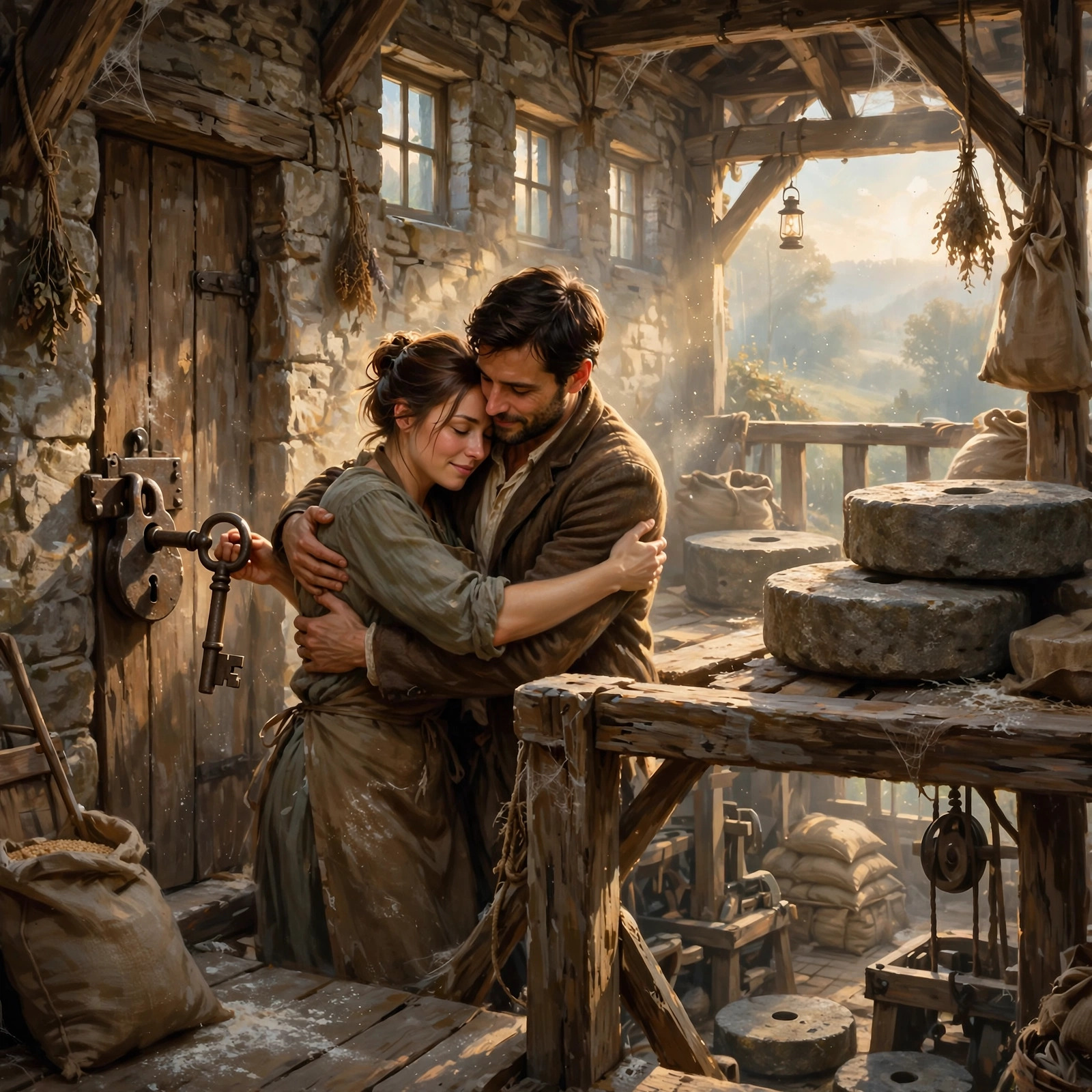
On the landing she stopped at the old door. The wood was gray with age, the lock a black knuckle of iron. She turned the key over in her palm. It was heavier than it looked. Her great-grandfather had forged it in 1931, her father liked to say, and it had outlasted every roof repair since.
"My mother used to bring me up here," she said. "When I was small. She said the stones were the only honest things in the building."
Rafe went still beside her. He didn't fill the silence. That was one of the things she'd started to love about him, how he let a sentence finish before he answered it.
"I haven't opened this door since the funeral," she said. "I did every check in this place alone for six years so nobody would ever have a reason to come up here with me."
"Josie."
"Let me finish. I'm not good at this." She held out the key. "I want you to turn it with me."
He looked at the key, then at her. His fingers closed over hers, warm despite the cold, a little rough from the pen he'd gripped so hard that morning. Together they fitted the iron into the lock. It resisted. Then something deep inside gave with a clunk she felt in her wrists, and the door swung inward on a breath of old wood and dry air.
The loft was long and low, lit only by the pale snow light slanting through the gable window. The original stones sat in the middle of the floor like sleeping animals, wide and gray and worn smooth in the grooves. Nothing stirred. Not a speck of dust hung in the light. Her father had swept it himself on Sunday, grumbling all the while.
Rafe stepped inside slowly, the way people enter churches. He ran his glove along the rim of the nearest stone.
"This is what I should have looked at first," he said quietly. "Not the gauges. This. Two hundred years of people who cared whether it burned."
"You looked at the gauge first. That's why we're standing here."
"I almost didn't." He turned. Snow light caught the edge of his jaw, the tired lines around his eyes. "I almost signed that first form. The clean one. I had the pen out."
"But you didn't."
"Because of you." He said it plainly, like a measurement. "You shut your own mill down and spent your savings on a machine you didn't want to need. Nobody in my whole career has done that. I've watched people argue for months to avoid a repair order."
Her eyes stung. She crossed the boards to him, her boots loud in the hush. "I locked you out. I told you to leave."
"You were scared."
"I was terrified. I still am, a little. Every time the generator coughs, I'm nine years old again." She made herself keep looking at him. "But I'd rather be scared with you in the room than safe by myself. I don't want to do any of this alone anymore."
He took off his gloves and laid them on the stone, one at a time, like a man putting down something he'd carried too far. Then he cupped her face with both hands. His thumbs were cold at her cheekbones and she leaned into them anyway.
"I love you," he said. "I'm not good with words outside of paperwork, so I'll say it the plain way. I love you, Josie Hartwell. I'd have loved you if you'd failed every inspection I ever gave."
The breath went out of her in a shaky laugh. "That's terrible romantic advice for an investigator."
"I'm retiring the advice."
"I love you too." It came out steadier than she'd expected, as if the words had been waiting at the top of the stairs. "I love you. I've known since you crouched in the flour at two in the morning and told me you were sorry about the dust on my floor."
"I said it was a hazard."
"You said it softly."
He kissed her then, and it was nothing like the frantic kiss in the cold dark of the storm. This one was slow, unhurried, tasting faintly of the bitter coffee Dee had pressed on them at dawn. She slid her hands inside his open jacket and felt his heart going hard against her palms. He made a low sound in his throat and pulled her closer, and the old stone at her back was solid and patient, as though it had seen every kind of beginning and was in no hurry about this one.
When they broke apart, neither moved far. His forehead rested against hers.
"Nine years I've been going from town to town," he said. "I never once thought about staying anywhere."
"Harlow Reach is small."
"So I've heard. The roads close."
"Only when it snows."
"Then I'll learn to like snow." He smiled, and it reached all the way to his eyes. "Your father already offered me the spare room. I'm fairly sure he meant it as a threat."
"He meant it as a test."
"Did I pass?"
"Conditionally," she said, and he laughed out loud, the sound bouncing off the rafters.
She took his hand and drew him to the oldest stone, the one with the deepest grooves, where her mother's fingers had once rested beside hers. She laid his palm flat against it and set her own over the top, and they stood there together in the pale snow light, hands joined on the oldest stone.
Get notified when new stories drop

Serena Blake
Serena writes romantic suspense and dark romance for readers who want pulse and payoff. Her stories chase trust as hard as they chase danger.
Leave a comment
Comments