



Gatehouse Pegs
"Temporary," Garrick said, flicking the corner of the permit with one finger. "It says so right there. Temporary."
"I can read, Harbormaster." Ysolde kept her hand flat on the gatehouse counter so he couldn't see it wasn't quite steady. "It also says I have full access to the weighbridge, the cranes, and the load records. Your signature is under that line."
"Access isn't the same as a free hand."
"It is when the trust writes the check."
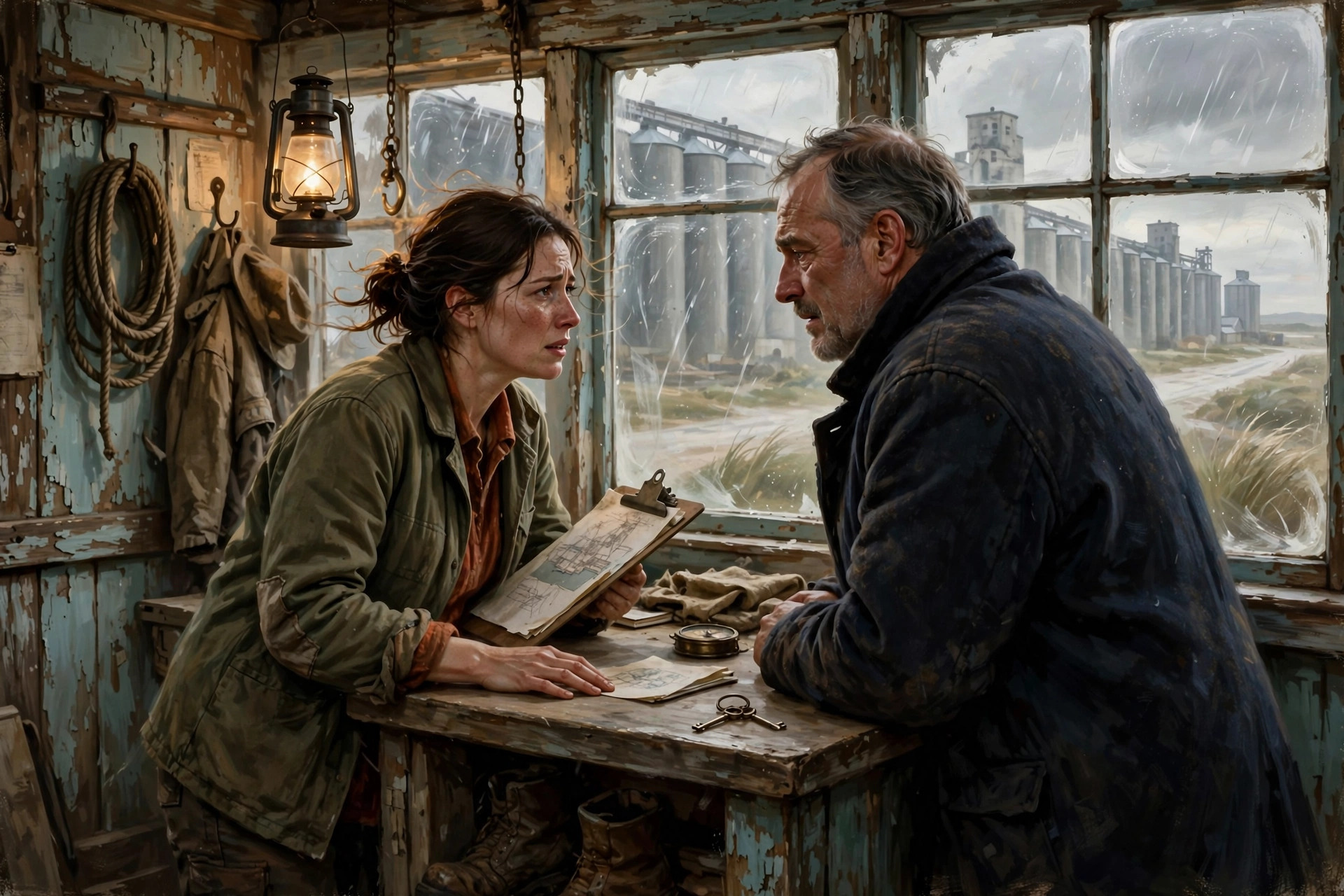
Salt wind pushed at the gatehouse door and rattled the glass. Outside, the Thornfield grain silos stood in a long gray row, and beyond them the Salt Road ran off toward the hills, empty and pale. She had walked it from the bus stop with her bag banging her hip, past every window she remembered. None of them had looked at her. That was worse than if they had.
Garrick Thorne hadn't changed in the ways she'd braced for. He was broader through the shoulders, a little gray at the temple, and he still stood as if the floor belonged to him. But he had a tired line between his eyebrows now, the kind that came from carrying something nobody else would lift.
"Five years," he said. "And you come back with a clipboard."
"I come back with a contract. You asked for me."
"The trust asked for you. I asked for anyone else."
"And got me. Terrible luck." She slid the clipboard onto the counter between them. "I'll start at first light. I'll want the old load logs, the maintenance sheets, and the bridge cleared of trucks."
"The convoys arrive in two weeks."
"Then you'd better hope I'm quick."
"I'd better hope you're reasonable." His jaw tightened. "I need a pass, Ysolde. Not a lecture on the last one."
She felt that land low in her chest. The last one. A cracked crane, a report she'd written with a steady hand and a sick stomach, and a town that had decided she was the crack. She had been twenty-nine. She had walked out with a boxed set of calipers and a letter that barred her from the port for five years.
"I don't write passes," she said. "I write findings. If the bridge is sound, you'll have your pass."
"And if it isn't?"
"Then you'll have something better. The truth, early."
He laughed, short and without any pleasure in it. "Early. That's generous."
A chair scraped behind the partition. Bettina Okoro came around it with a mug in one hand and a stub of chalk tucked behind her ear, gray hair pinned up like she'd been born with it that way. She looked Ysolde over, top to boots, and her face softened by degrees.
"Well. Lowell's girl."
"Hello, Bettina."
"You're thin." Bettina set the mug down and, without asking, squeezed Ysolde's forearm hard. "Your father's been ironing his good shirt since Tuesday. Don't tell him I said."
"I won't." Her throat did something awkward. She looked away, and that was how she came to be looking at the wall.
The peg board hadn't changed. It ran the whole length behind the counter, rows of brass-headed pegs, and from each hung a small stamped lead token on a loop of cord. Her father had cast every one of them in sand molds the year the port reopened, pressing the marks in with a punch and a mallet at the kitchen table while she sat under it and handed him spare nails. A square for a clear berth. Two bars for ice on the quay. A wave for a high tide, a hook for a crane out of service. She had learned them before she learned her times tables.
Her eyes ran along the second row without meaning to. Square, bars, wave, hook, hook, square.
There was a gap.
One bare peg, third from the end, with a faint clean circle on the wood where a token had hung a long time. She knew that token. It was the one with the red ring painted around the stamp. Her father used to hold it up to her and say, This one you never ignore, love. This one means come down off it now.
"That peg's empty," she said.
Garrick didn't turn his head. "Is it."
"The red-ringed one. Where is it?"
"Lost, probably. They wander." His voice was easy. Too easy. "It's a lump of lead, Ysolde."
"It's a warning." She turned to Bettina. "Who took it down?"
Bettina's eyes flicked to Garrick, then to the mug, then to the chalk slate on the wall with its tally of the day's trucks. "I keep the slate," she said carefully. "I don't keep the pegs."
"That's not an answer."
"No," Bettina agreed, mild as milk. "It isn't."
Ysolde looked back at Garrick. He met it, and held it, and for one moment she saw something move behind his face, quick as a fish under ice. Then it was gone, and he was only a harbormaster again, arms folded, patient in the way of a man who has decided not to be moved.
"You've been in the building ten minutes," he said, "and you've already found something to be suspicious of."
"I've been in the building ten minutes and found a missing token on the one peg that matters." She kept her tone level. Procedure was a good coat. She had worn it for years. "Every finding I make will go in writing. That includes this."
"Write what you like."
"I will."
Neither of them moved. The wind leaned on the door again. Somewhere out on the quay a gull complained at the grain dust, and Bettina quietly drank her tea like a woman watching weather arrive.
At last Garrick unfolded his arms. He reached into the drawer under the counter, and she heard the small clink of metal on metal before he straightened. The key was long, iron, and dull with handling, on a ring worn bright where thumbs had rubbed it. He held it out over the counter. He didn't let go right away.
"The bridge house is at the end of the east quay," he said. "It sticks. You lift the handle before you turn it."
"I remember."
"Do you." His fingers stayed closed on the ring another heartbeat, as if the key were the one thing in the port he had no business surrendering. Then he opened them, and the weight dropped into her palm, still warm from his hand.
"Don't make me regret it," he said.
She closed her fist around it. "That depends what's on the bridge."
He said nothing to that at all.
Tenement Row
"You're thinner," Lowell said, and held the door wider with his whole arm, as if she might bolt. "Come in before the wind decides it likes you."
Ysolde stood on the step with her bag still on her shoulder. The row hadn't changed. Same slate roofs, same sagging washing lines strung between the chimneys, same smell of boiled barley and coal. Her father had changed. His hair had gone entirely white, and he held his left hand against his ribs like something he was carrying for someone else.
"You didn't write that you'd been ill," she said.
"You didn't write at all. We're even." He took her bag. "Kettle's on."
The kitchen was two steps wide. A rigger's splicing fid hung over the stove, and the window looked straight onto the east quay, where the weighbridge house sat squat and grey against the water. She noticed that. She noticed that he had never moved his chair from where it faced it.
They drank tea. He asked about the road, and she answered with facts. He asked about her work, and she said it was steady. Neither of them said the word five, though it sat on the table between the cups like a third guest.
"Bettina rang," Lowell said at last. "Said you went at Garrick over a peg."
"Over a token."
"Aye. Same thing, here." He got up with a small grunt and fetched a biscuit tin from the dresser. Inside, nested in a rag, lay a dozen lead discs the size of a thumbprint, each stamped with a mark. Some were bright. Some were worn nearly smooth.
Her throat did something odd. "You kept them."
"I cast the whole set in the yard behind the old gatehouse, the year they reopened the port. You were underfoot, nine years old and bossy. You held the sand box." He tipped one into her palm. "What's this?"
"Berth clear." She didn't have to look. "A single wave line."
"And this?"
"Wet decking. Go slow." Her thumb found the little notch he always cut at the rim for that one. Her hands remembered before she did. "This is crane under inspection. This is no loads past the bollard."
"Good girl. And this?" It was a tight spiral, almost a knot.
She frowned. "Overweight on the approach."
"Close. Overweight and rising. Weight that's still climbing." He tapped the spiral. "Garrick never learned that one. He reads the pegs by the picture. Doesn't read the stamping."
"Why does that matter?"
"Because I put the real warnings in the stamping." He said it lightly, but he wasn't looking at her. "Anyone can read a picture. Only a rigger's child reads the rim."
A knock rattled the door before she could ask what he meant. Lowell's mouth twitched. "That'll be him. He knocks like he's serving papers."
Garrick stood on the step with a loaf wrapped in cloth, the crust still steaming at the fold. He had taken off his heavy coat, which made him look less like a harbormaster and more like a man who had walked the quay twice before knocking. His eyes went to her, then past her to the open tin.
"Bettina's oven," he said, and held out the loaf. "She said you'd both forget to eat."
"She's not wrong," Lowell said, and took it. "Come in, lad, you're letting the heat out."
Garrick came in sideways, because the doorway demanded it. He looked too big for the kitchen. He sat where Lowell pointed and put his hands flat on his knees, a man waiting to be told he'd done something wrong.
"I was short with you yesterday," he said to Ysolde.
"I was short first."
"You were accurate. It's worse." The corner of his mouth moved, not quite a smile. "Truce, for the bread's sake. You'll have the bridge to yourself. I won't stand at your shoulder."
She studied him. That was too generous, and generosity from a man who held her father's lease was a thing to inspect before trusting. "And if I find it unsafe?"
"Then you'll tell me." His gaze didn't waver, but his fingers curled against his knees. "Before you write it down. That's all I'm asking."
"That isn't how a report works."
"I know how it works." Quietly. "I've watched one end a port."
Lowell cut the bread with the splicing fid, which was a crime, and handed round slabs without comment. They ate. Garrick praised the butter, which was margarine. Ysolde almost laughed, and caught herself, and he saw her catch herself, and looked quickly at the window as if the quay had said something.
When he left he lingered on the step. "Convoys come in two weeks," he said. "I'm not telling you that to push."
"You're telling me because you're pushing."
"Aye. A little." He nodded to Lowell and went down the row with his shoulders set against the wind.
The door closed. Lowell stood a moment with his hand on the latch, listening to the boots recede. Then he went to the dresser again, and this time he reached behind the tin, into the dark at the back of the shelf.
"I wasn't going to give you this," he said. "Not till you'd seen the bridge. But I think you'll want it before."
He opened her fingers and set it in her palm. A lead disc, cool, a little heavier than the others, ringed round the edge with a band of red wax gone dull as old brick. She knew the stamp without turning it over.
"I cast a spare," her father said. "Just in case someone ever took the first one down."
Under The Deck
"You said you wouldn't stand at my shoulder," Ysolde said, not looking up from the hatch.
"I'm standing at your boots." Garrick held the lantern low, over the open trapdoor in the weighbridge house floor. "Different thing."
"Hold it steadier."
He did. Below them the under-deck smelled of wet iron and old grease. She went down the ladder with her hammer on her belt and her father's lead token in her coat pocket, a small weight against her hip. The main beam ran away into the dark, black with decades of paint. She worked her palm along it the way she'd been taught, slowly, listening more than feeling.
Halfway along, the paint changed. It was fresh, thick, and tacky at the edges.
"Someone's been painting down here," she said.
Nothing from above.
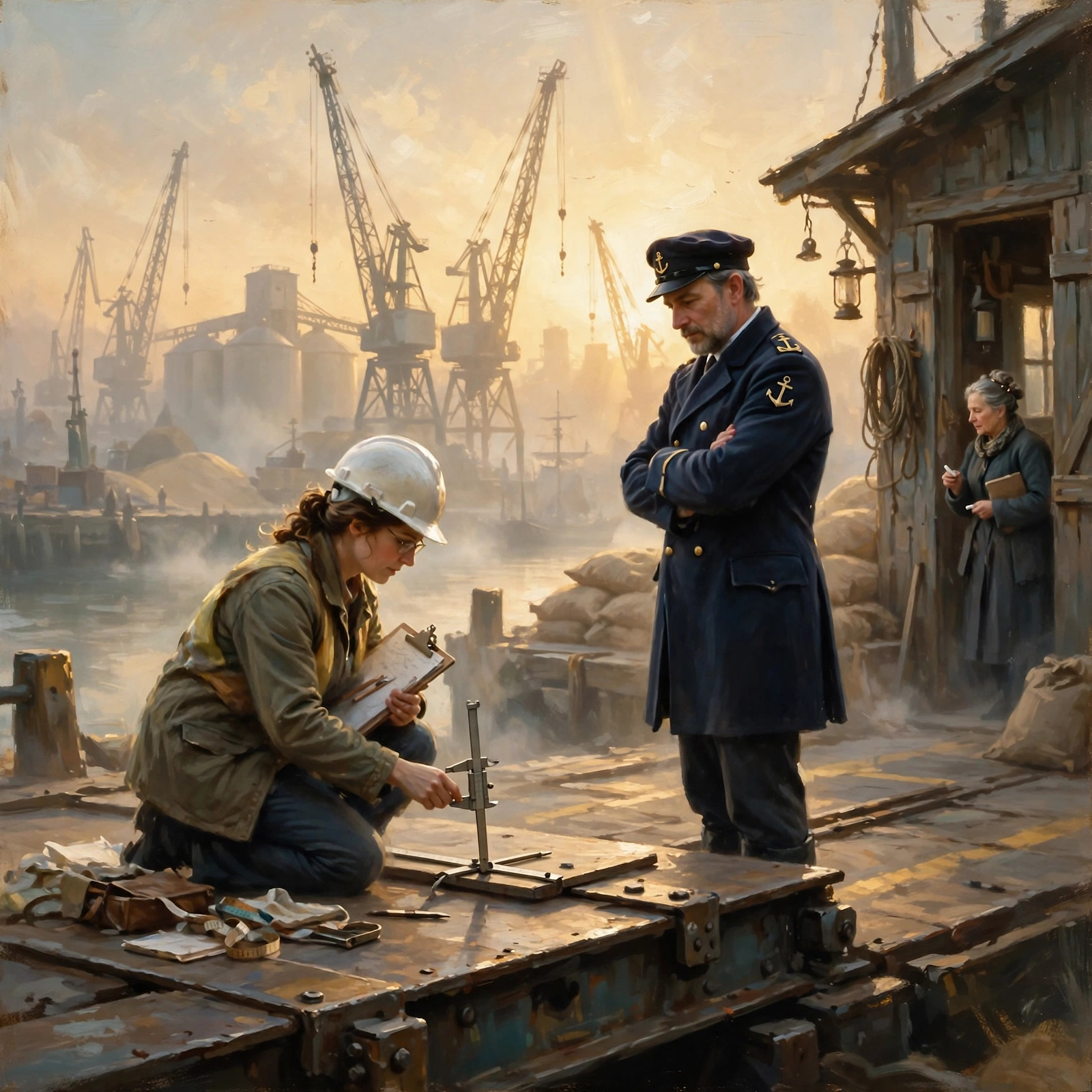
She scraped a corner with her thumbnail. The new coat flaked away, and under it ran a line, fine as a hair at the ends and wide enough in the middle to take the tip of her blade. She tapped beside it with the hammer. The note came back flat and dead, like a bell with a hand on it.
Her stomach turned over. She stayed very still a moment, because that was procedure, and because her hands wanted to shake.
Then she climbed out. Garrick had set the lantern on the token bench and was standing with his arms folded, too carefully.
"Forty tonnes is the rating," she said. "A loaded convoy truck is near that before the grain's counted twice for the scale. That beam is cracked through a third of its depth."
"I know."
She waited for him to say more. He didn't.
"You know." Her voice came out level, which frightened her more than shouting. "You painted over it."
"I had it painted. Before you came."
"So when you stood in that kitchen and asked me to tell you before I wrote it down..."
"I was asking you to hear it from me first." He unfolded his arms. "That's what I was asking. I didn't know how to say it."
"You could have said it in the gatehouse. You could have said it yesterday, when I asked you straight about the red token."
"And you'd have condemned it that hour, and the port would've lost every contract by the first frost." He dragged a hand down his face. "My brother went down under a deck some inspector passed because someone leaned on him. I know what a lax pass costs, Ysolde. I've buried it. Do you think I'd sign one lightly?"
"You'd hide a crack from the one person paid to find it."
"Aye. I would." He didn't flinch. "Because the last time I told the truth early, I was handed a form and told to wait."
The lantern hissed. Rain started on the roof, thin and then thick.
"Five years I was barred," she said. "For a cracked crane. For telling people what was true. And you'd have me do the opposite, quietly, for your convenience."
"I'd have you help me." It cracked on the last word. "I don't know how to ask that. I only know how to arrange things so nobody can refuse."
That landed somewhere she hadn't guarded. She looked at the bench between them, at the rows of lead tokens set out in the lantern light. She picked one up to give her hands something, turned it, and read the rim without meaning to. Her father's tiny stamping. A warning, the same warning, repeated on four of them.
"My father told you," she said. "In the rims. Every time that beam changed, he marked it. Four warnings, and you can't read a single one."
Garrick stared at the disc in her hand. "He told me?"
"He told the whole port. Nobody ever learned how to listen." She set it down. "I don't do this without help, Garrick. I've never once asked for any. I won't pretend that's a virtue."
"Then ask."
She almost laughed. "Help me. Don't lie to me again."
"Done." He said it at once, as if it had been waiting. "Both."
He had crossed the floor somehow. The bench was at her hip and he was in front of her, close enough that she smelled rain on his collar. His hand came up and stopped an inch from her jaw, asking.
She had spent five years being careful. She took his wrist and pulled it the last inch.
The kiss was nothing like procedure. It was clumsy at first, his nose against hers, her fingers knotted in his wet coat, and then it stopped being clumsy and became something slow and sure. The bench rattled behind her. A token slid and fell and neither of them looked. His hand went to the back of her neck as though he'd been holding it in for days, and she heard herself make a sound she'd never have admitted to.
When they parted he rested his forehead on hers. "That's not leverage," he said roughly. "In case you're counting."
"I'm always counting."
"I know. It's the best thing about you."
She stepped back, because she needed air and the floor to be a floor. He let her. He crouched and gathered the fallen token, set it in its row with a care that hurt to watch, and she saw how much of him was only trying.
"I need the night with the beam measurements," she said. "Alone."
"Of course." He picked up the lantern, then put it back in her reach. "The key's yours. Whatever you write, I'll hear it."
He went out into the rain. The door shut. She stood listening to his boots until the storm took them.
Then she slid her hand into her coat, closed it around the red-ringed token, and said nothing of her plans, not even to the empty room.
Notice On The Door
The paper was nailed at eye height, one corner already curling in the rain. Ysolde read it twice on her father's step with her hand still raised to knock.

Notice of revocation. Residency permit, Tenement Row. Vacate within the fortnight. The signature at the bottom was Garrick's, square and fast, and the ink had not yet run.
"Don't," her father said from inside. He had opened the door before she could pull the nail. He stood in his shirtsleeves with one arm clamped across his ribs, gray in the face. "Don't tear it. It's only a paper."
"It's a fortnight, Dad."
"I can count." He looked past her at the rain, then at her coat pocket, where her hand had gone without asking. "He came by himself, early. Wouldn't meet my eye. Hammered it up like a man putting down a dog."
"Did he say why?"
"He said the paperwork had caught up with him." Lowell tried a smile and it cost him. "I've been late on the paperwork for thirty years."
She worked the nail out anyway, slowly, so the paper would not tear, and folded it into her breast pocket beside the token. Her father watched her do it. "Ysolde. Whatever you're about to do, sleep first."
"I slept last night," she lied, and kissed his cheek, which smelled of liniment and old rope.
She walked to the gatehouse fast, down the Salt Road with the wind driving rain sideways off the water. Cranes stood black against the grain sheds. Somewhere behind her a gull screamed at nothing. She did not feel angry yet. She felt what she had felt at twenty-nine, in a hall full of people who would not look at her: a cold, orderly clarity, every thought filed and labeled.
Bettina Okoro was at the window with the chalk slate, rubbing out a tally with her sleeve. She saw Ysolde's face and put the chalk down very gently.
"He's in his office," Bettina said. "Love, before you go in--"
"Did you know?"
"I knew there was a paper. I didn't know whose." Bettina's mouth tightened. "I'd have told you. I told him to burn it."
"Then thank you for that." Ysolde meant it, and kept walking.
Garrick was standing at his desk with the signal board behind him, ninety pegs of lead discs gleaming wet where the door had let in weather. He looked up and she watched him read her. He did not even try for innocence. That was almost worse.
"Ysolde."
She laid the notice on the blotter, flat, and smoothed it with two fingers. "Yesterday you said you wouldn't lie to me again."
"It isn't a lie. It's a notice."
"Don't be clever. You kissed me in the dark and nailed my father's door in the morning." Her voice stayed level. She was proud of that and hated it. "What does the paper say, Garrick? Read it to me. What is it you'd like me to do?"
He did not read it. His jaw worked. "The convoys are coming in two weeks. I need a signature on that weighbridge and you've told me you won't give one. I can't lose this port. I can't lose it the way my brother--" He stopped, started again. "I had to hold something."
"Hold something." She nearly laughed. "My father is sick. He holds his own ribs when he thinks nobody sees."
"I'd never have put him out. It was never going to be carried through."
"Then why write it?" She took the token from her pocket. The red ring on its face had gone warm from her hand. "You asked where this was. You and Bettina both, sliding around the question like I couldn't see. He cast a spare and hid it. Because he knew someday somebody would need to tell you to come down off that beam, and you'd be too proud to hear it."
She set it on the desk, and it rang once against the wood and rolled in a short wobbling arc toward his hand. He didn't catch it. It fell flat and lay there looking at him.
"That's what he gave you," she said. "Thirty years of warnings, and you hung them on pegs like ornaments. I asked you for one thing. Not to lie. And you went straight to the only lever you had."
"Ysolde, please." He came round the desk. She stepped back and he stopped as if she'd struck him. "Let me fix it. Give me today."
"I gave you the truth about that beam and a kiss besides, and what I get back is a fortnight and a nail." She heard her own voice crack and flattened it. "I was never anything but a signature to you. I just hoped I'd been something else."
"You were. You are."
"Then you'd have asked me for help."
He had no answer. Behind her, through the open door, she felt Bettina not breathing.
Ysolde buttoned her coat to the throat, left the notice where it lay, and walked out past the slate and the wet pegs and the old woman's stricken face. The rain met her on the step like a hand in the chest. She did not look back at the window. She turned up the Salt Road with her key in one fist and her father's rooftop in the distance, and let the weather have her.
The Closing Bell
Ysolde had her bag on the bed in her father's back room and was folding a shirt for the third time when the knock came. It was not her father's knock. Her father never knocked in his own house.
"It's open," she said.
Garrick stood in the doorway with rain on his shoulders and no coat on his arm, which was the first wrong thing. The second was his hands. They were empty. He had never once come to her without a clipboard, a ledger, or a key.
"The coach leaves at nine," she said. "I'm not discussing the beam."
"I'm not here about the beam." He looked past her to the narrow bed, the bag, the shirt. "Come to the gatehouse. Please. Bring your father if he can walk it."
"He can walk anywhere you're not sending him."
From the front room came a dry cough and Lowell's voice. "He can hear you both, you know. Get my stick."
She nearly refused. Procedure had always been her coat, and she reached for it now, the clean rule that said a man who nailed paper to a door had forfeited an audience. But Garrick's face had no argument in it. It looked scraped, like a hull after a long season.
They went down Tenement Row slowly, her father's arm through hers, his breath short on the slope. Garrick walked a pace ahead and did not turn around. The morning had washed itself thin and gray. Gulls stood on the weighbridge roof like a jury.
The gatehouse was full. Dockhands, a cluster of drivers in oilskins, two men from the trust in good boots. Someone had told them. Bettina stood beside the slate with her arms crossed over her cardigan, and when she saw Lowell she uncrossed them and pulled out the chair by the stove without a word.
Garrick went to the desk. The eviction notice lay there, the nail hole still punched through its corner. Beside it sat the red-ringed token, where Ysolde had left it.
He picked up the paper. He did not read it aloud. He tore it down the middle, then again, then again, until it was a drift of pieces, and he let them fall into the stove grate where they curled and went orange.
"That was a threat against a man who's done nothing but keep this port standing," he said, to the room. His voice was not loud. "I wrote it to force a signature. It's void, and I'm ashamed of it."
Nobody moved. Lowell looked at the fire.
Garrick took a ring of keys from his belt, worked one free, and crossed the floor. He knelt, which she had not expected, in front of her father's chair, and put the key in the old rigger's palm. The brass was worn bright.
"Your door," Garrick said. "It's yours as long as you want it. Nobody revokes it. Not me, not whoever sits here next."
Lowell closed his fingers around it. "Whoever sits here next," he repeated, and his eyes came up, sharp under their lids. "That's a strange thing to say."
"I've signed the chair over to the trust." Garrick stood and pulled a folded sheet from his shirt. "Effective now. The berths, the permits, all of it. I'd rather somebody else held it than hold it badly."
A murmur went through the oilskins. One of the trust men started forward. "Thorne, the convoys are due in--"
"They're not coming in." Garrick turned. "Not to this weighbridge. I'm closing the port to loaded trucks until the beam is out and a new one is in. Send them to the coast road. Let the contracts go where they go."
"You'll be ruined."
"Probably." He said it plainly, almost lightly. "I've sunk everything I own into this place. It'll take most of it to fix. I'd rather be ruined with a sound bridge than rich on the day it drops a truck into the harbor."
Ysolde heard her own pulse. Fourteen years he had been in this town, and he had never once, she thought, let anything go.
He found her across the room then, and she saw how much it cost him to look. "I took your report like an insult when it was a gift. I took your father's warnings and hung them up like decoration. And when you wouldn't lie for me, I punished you for being right. I know that's not something a sorry fixes."
"No," she said. Her throat hurt. "It isn't."
"I'm not asking it to." He held out the red-ringed token, flat on his palm. "I can't read the rim. I never could. Will you teach me, if you stay? And if you don't, will you at least tell me what it says?"
She did not take it. She did not trust her hands. Lowell took it instead, thumbed the stamping, and chuckled, a wet, wheezing sound.
"It says," he told the room, "that the boy's finally come down off the beam."
Bettina laughed once, a bark, and wiped her eye with her wrist. Then she crossed to the door, reached up to the rope that hung beside the lintel, and took it in both fists. Ysolde had heard that bell once as a girl, on a day the port had closed for a drowning. She had not known it could still be rung.
Bettina pulled. The note rolled out over the yard, low and long, over the cranes and the cracked beam and the gulls going up in a white scatter. Men took off their caps. She rang it again, and again, and nobody told her to stop.
Ysolde slipped out under the sound. She told herself she needed air, and then she told herself she needed the road, and her feet agreed with the second one. She walked the length of the yard past the weighbridge, its fresh paint bright over the wound, and out through the gate onto the Salt Road, where the coach stop stood with its one tin sign.
Her bag was still on her father's bed. That was a fact. She stood with the bell going behind her and the wide gray road ahead, and she felt, quite clearly, the shape of every door she had ever walked out of.
She had always been good at leaving. It was the one thing the people who cast her out had taught her well.
The bell rang again. Under it, faint, she thought she heard her name.
Ysolde turned back.
Rail And Token
"You're holding it wrong," Garrick said.
"I'm holding it exactly how my father taught me." Ysolde kept the lead token pinched between two fingers and the other hand flat on the new rail. "Which makes you the one who's wrong."
"I've been wrong all month. I'm getting good at it."
The wind came in off the water and pushed at her coat. Beneath her boots the deck was new timber, pale and still sharp-smelling, laid over a beam she had stood under herself and signed for, every inch. No paint over anything. She had run her palm along the underside that morning like a woman checking a sleeping child, and found nothing but sound grain.
The old weighbridge had been hauled off in pieces three weeks back. Men had cheered when the cracked beam came down. Bettina had chalked a line through it on the slate.
Now the port stood quiet, just a handful of gulls and a rigger's crew eating lunch on the quay. The convoys had waited. Some had gone elsewhere. Garrick had taken that on his own back and never once asked her to feel sorry about it.
"Forty tonnes," he said, patting the rail. "And you made them test it to fifty."
"I made them test it to forty-four. Fifty was your idea."
"I wanted to see it hold."
"It held." She smiled before she could stop it. "Be insufferable about it. I'll allow it today."
He laughed, short and surprised, and the sound loosened something behind her ribs. He wasn't wearing the chair's heavy coat anymore. Just a plain wool jacket with a frayed cuff, and his hands bare and red from the cold. She had noticed, over the weeks, how those hands never knew what to do without a key in them. Lately they found other work. Carrying her father's groceries. Stacking timber. Resting against the small of her back in the doorway of the Gatehouse when he thought no one was looking.
Everyone was looking. Bettina had said so, loudly.
"Which peg?" he asked.
She turned the token over. It was her father's cast, sand-molded decades ago, the edges a little soft, the rim stamped with a pattern she had learned at six years old on the floor of his kitchen. A ring, a notch, two short strokes. Nothing a stranger would read as more than decoration.
"It's not a warning," she said. "Before you ask."
"I was going to ask."
"I know. You've asked about every token for a month. You've got a face you make."
"I don't have a face."
"You have a very specific face." She held it up to the light. "This one says the berth is clear. Sound footing, safe to load. Dad cast it first, the year the port reopened. He used to say it was the only one he hoped never to hang."
"Why?"
"Because if everything's always safe, nobody looks up." She let the wind take that for a moment. "He'd have been wrong to hope it. But I understand it."
Garrick was quiet. Then, carefully, as if the rail might shift under him: "Your father said I could do the first knot. If you'd let me."
"He said that?"
"He said you'd say no."
"Then I'm obliged to prove him wrong." She held out the cord. Her hands were not quite steady, and she let him see it. That was new too, letting him see.
He took the loop between thumb and finger and passed it through the ring. He was slow about it, almost reverent, the way he did anything he feared getting wrong. Their knuckles brushed. She did not pull away. When he pulled the knot snug, she reached over and set her own hand over his, and together they dropped the token onto the peg at the rail's end.
It swung. It knocked once against the wood with a small dull sound, like a knuckle on a door.
"There," Garrick said. His voice had gone rough.
"There."
Neither of them moved. His hand was still under hers. Down on the quay somebody dropped a tin cup and swore, cheerfully. The tide slapped at the pilings.
"I've been trying to find the right moment," he said. "I wrote it down once. It was terrible. I burned it."
"Garrick."
"Let me finish. I'm not good at this part. I like having everything in my hands, and you taught me what that costs, and I'd pay it again for you, every bit. I'd give up the chair twice. I'm not saying it to be noble. I'm saying it because it's true." He drew a breath. "I love you, Ysolde. I loved you before I was brave enough to deserve it, and I'm sorry for that, and I'm not sorry for the loving."
Her eyes stung, and she was irritated by it, and it made no difference. She had spent most of her life behind procedure, behind the clean safe walls of a signed form. She had left so many doors. This was the only one she'd ever turned around for.
"I love you," she said. It came out plain, no ornament, which was how she'd have wanted it. "I love you. I came here to condemn a bridge and I stayed for the man who burned his own chair to rebuild it. I'm not leaving. I want that written down somewhere. Bettina can chalk it."
"She already has," he said, and his mouth shook on a smile. "Last week. On the slate by the gate. I think she was early."
"She's always early."
He laughed again, wet this time, and she took his jacket in both fists and kissed him. It was nothing like the first time, rushed and frightened in the dark above a beam that was lying to them. This was slow. His hand came up to her jaw as if she might be made of something he'd had to learn to carry, and she leaned into it, into the cold nose and the warm mouth and the plain fact of him. When they parted, he rested his forehead on hers and neither of them said anything clever.
Then, because she was who she was, she opened one eye and glanced at the rail. "Knot's loose."
"It is not."
"Slightly."
"Inspect it, then."
She did, thoroughly, with her thumb, and the cord held fast. He watched her do it as if it were the best thing he'd ever seen.
They stood together at the rail with the whole gray water ahead of them and the long road behind. The wind picked up. Along the deck the lead tokens swung on their pegs, her father's old shorthand, and knocked together softly in the wind, a small bright sound over the water that said, to anyone who could read it, that everything here was sound.
Get notified when new stories drop

Serena Blake
Serena writes romantic suspense and dark romance for readers who want pulse and payoff. Her stories chase trust as hard as they chase danger.
Leave a comment
Comments