


Smoker and Signature
"You could have sent a memo," Briony said, without turning around.
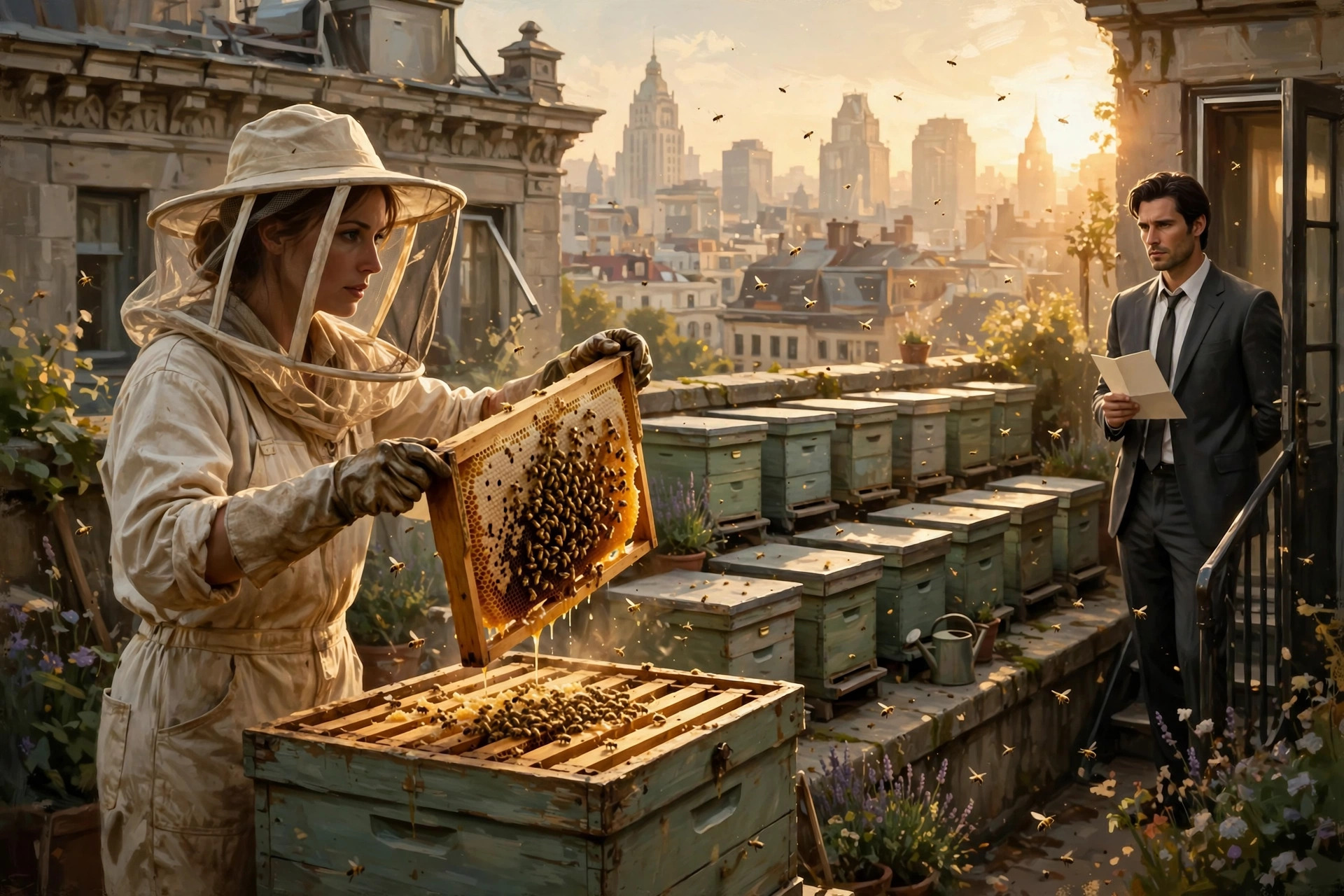
Joss Verhagen stood at the top of the service stairwell with one hand still on the door, as if it might close behind him and take his nerve along. He wore a charcoal suit on a roof that was baking in afternoon sun. A folded paper was in his other fist.
"I don't send memos about this."
"Then stay back from the entrance. You're in their flight path."
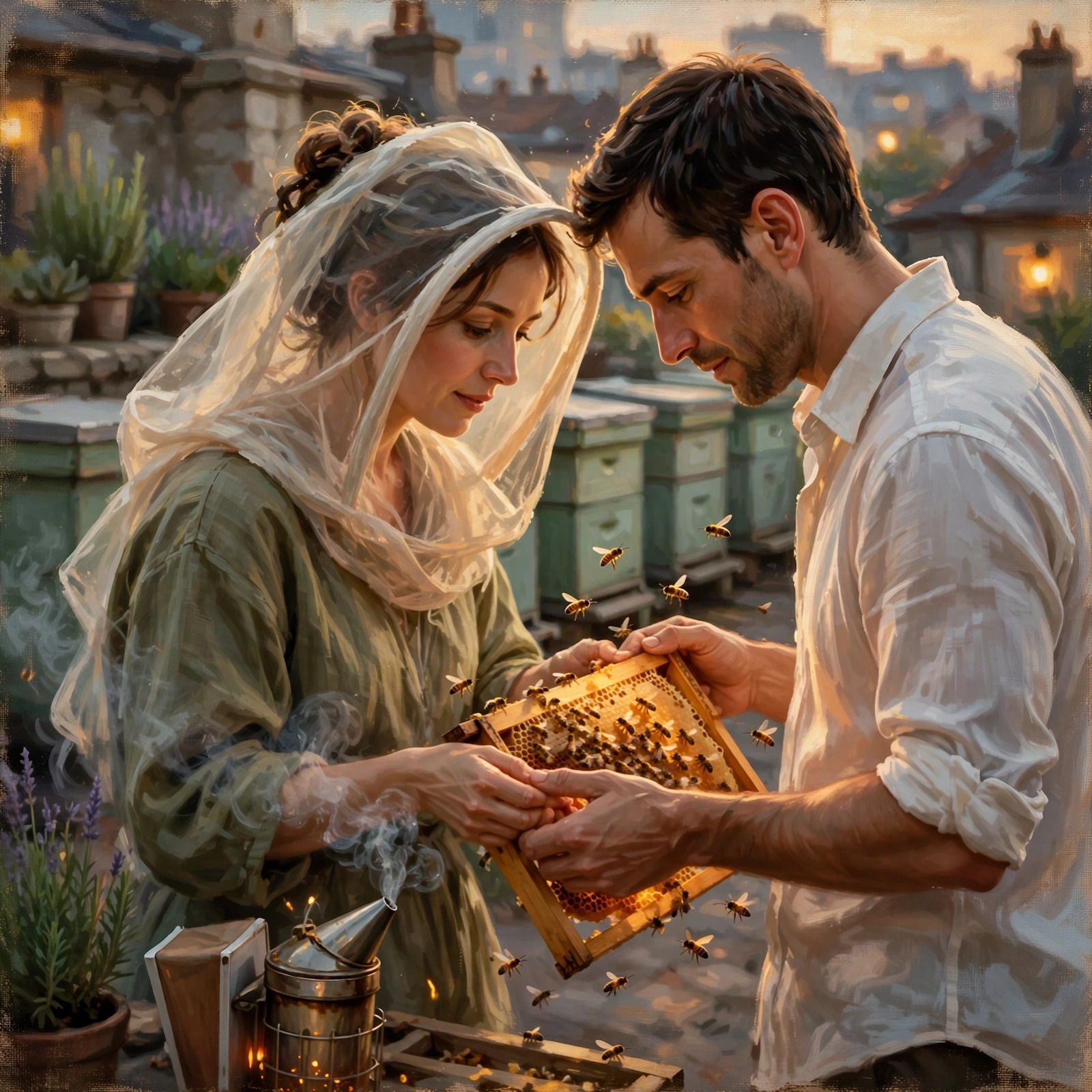
He stepped sideways, too fast. A forager bumped his lapel and he went very still, which was the correct response, though she didn't tell him so. She puffed the smoker twice over the lid of the nearest hive and lifted it off. The hum deepened. Warm wax and clover honey rose in a slow wave.
Fourteen hives stood in two rows along the parapet, painted the faded green of the hotel's old awnings. Nanette had chosen that color. Briony had never repainted them.
"The trust has made a decision," Joss said.
"The trust makes several a week. Last month it was the lobby carpet."
"Briony."
That stopped her hands, but only for a second. She slid the hive tool under the first frame and worked it loose from its propolis. "Go on, then."
"They're building a glass atrium over the roof. The contractors close it in three days." He drew breath. "Every hive has to be gone before then."
She lifted the frame. Bees spilled across the comb like slow brown water, and she studied the capped brood for a long moment because it was easier than studying him. Solid pattern. Healthy. Eight years of Nanette's lessons and six of her own work, all of it there in a rectangle of wax.
"Gone where?"
"There's a farm. A distant one, a few hours north. The trust has arranged transport and a place for you." He came a step closer, careful of the bees, and held out the paper. "It's a relocation form. It needs your signature."
"Arranged." She tasted the word. "Who arranged it?"
"I did. This afternoon."
"Before asking me."
"I was told this morning. I've had hours, not weeks." A muscle moved in his jaw. "I'm trying to give you a soft landing."
Briony set the frame back, gently, and nudged the bees aside with a brush. She didn't want to crush a single one over this. "A soft landing is when someone asks where you'd like to land."
"Where would you like to land?"
"Here."
He had no answer to that, and she watched him not have one. He was a tidy man, she'd learned over the past year. He lined up his pens. He remembered the names of the night porters' children. He also never once argued with the family, and she had taken that for weakness before she had started to wonder if it was fear.
"You can end my contract with your signature," she said. "I'm aware. So if this is a polite way of saying it, say it plainly."
"That's not what this is."
"Then what is it?"
"A way to keep you employed." He said it low, almost to himself. "Whatever else happens."
She straightened, smoker in one hand, tool in the other. Her veil had slipped and she pushed it back with her wrist. Sweat ran down her spine under the cotton suit. Somewhere below, the hotel carried on with its brass and chandeliers and guests who thought honey came from a jar.
"I've been told things were for my own good before," she said. "By a man with a title and a very warm voice. It cost me a laboratory and four years of work, and he put his name on the paper."
Joss's eyes lifted to hers. He didn't ask. That was one point in his favor, and she resented it.
"I'm not him," he said.
"You're holding the form."
He looked down at it as though he'd forgotten. Then, awkwardly, he shifted it to his other hand and reached for the hive's edge. "Let me see what you're doing."
"No. Gloves or no hands."
"I'll keep my hands to myself."
"That's the best offer I've had all week."
The corner of his mouth moved. It was nearly a smile, and it vanished at once, which annoyed her more than the form did. She turned back to the box and lifted the next frame, then the next, working the way Nanette had taught her, slow and low-voiced. Behind her she heard his shoes on the gravel, and the small crackle of him crouching to watch.
"They're calm," he said.
"They're calm because I am."
"Are you?"
"No. I'm very good at pretending."
She felt him absorb that. When she glanced over her shoulder he was bent close to the brood box, face solemn, a wasp of a tie flapping dangerously near the entrance. She hooked it with the hive tool and tucked it into his jacket.
"Thank you," he said, startled.
"Don't thank me. Stand up slowly and go downstairs."
He rose. He held the form out one more time, and she did not take it. For a moment they stood there with the paper between them, white and absurd in the green light off the hives.
"Three days, Briony."
"I can count."
"Osric won't bend on it."
"Then Osric can come up and carry fourteen hives himself."
He let out a breath that was almost a laugh and almost something worse. Then he leaned to set the paper on the lid of the empty hive stand, and as he did a pen slid from his inner pocket, bounced once off the smoker pouch at her hip, and dropped into the folds of canvas. Neither of them noticed. He straightened, gave her a look she couldn't read, and went to the stairwell door.
Only when it clicked shut did she feel the weight against her thigh. She dug it out. Heavy, black, with a gold band near the clip and his initials worn thin from use. A pen that signed contracts. A pen that could end her.
She turned it over in her gloved fingers, then slid it into her breast pocket and buttoned the flap. The bees went on humming, unbothered, over a roof that was not yet anyone's to take.
Down the stairwell, his steps were fading. She raised her voice and let it carry over the parapet.
"I'm not moving anything."
Nanette's Kettle
"You're scowling at my biscuits," Nanette said. "They've done nothing to you."
Briony put the tin down. The cottage kitchen was warm and smelled of lemon peel and old wood, and the kettle was already on its second rattle. She had come straight from the roof with propolis still under her nails and the pen still buttoned in her pocket, a small hard weight she kept touching without meaning to.
"They want the roof cleared," she said. "All fourteen hives. Three days."
"Ah." Nanette poured, slow and deliberate, her knuckles swollen but her hand sure. "And he told you this morning, I suppose. With a form."
"With a form. How do you know about the form?"
"I know about the man who carries it." Nanette sat down across from her and folded her hands around her cup. "The laundry supervisor's sister cleans for Osric. Briony, love, the atrium plans have been in that office for a month. Your Mr. Verhagen was shown them before he ever took the post. And he's been looking at your bees every day since."
The tea was too hot. Briony drank it anyway.
"A month," she said.
"Near enough."
She thought of him on the roof, crouched in the gravel, saying they're calm. She thought of the last few weeks, the quiet questions about the honey yield, the afternoon he had stood in the shed doorway and asked what the cedar frames were for. She had taken it for interest. She had let herself take it for interest.
"He asked me about the founding line," she said. "Weeks ago. I thought he was being kind."
"Perhaps he was. Kind men do cowardly things all the time." Nanette tilted her head. "That's no excuse, mind. Go and ask him. Don't build the worst of it in your head first. You're very good at that."
"I've had practice."
"You have." Nanette's voice gentled, and Briony looked at the biscuit tin instead of her. "Not every warm voice is that man in the laboratory. But I won't tell you to be foolish either."
Briony stood. She hugged her, briefly, one arm, smelling lavender and smoke. Then she went back to the hotel and took the service stairwell two steps at a time.
She found him on the landing below the roof door, one hand on the rail, a folder under his arm. He looked like a man who had been walking in circles and had been caught at it.
"Briony. I was coming to find you."
"How long have you known about the atrium?"
He didn't pretend. She saw it cross his face, the small flinch, the squaring of his shoulders, and she hated that it was honest.
"A month," he said. "A little more."
"Before you came up and asked me about the cedar frames."
"Yes."
"Before you said good morning to me every day, and asked about the yield, and let me tell you the whole history of that colony like it mattered."
"It did matter. It does." He set the folder on the step. "I was told to say nothing until the trust signed off. I told myself I'd find a way around it. I didn't."
"You told yourself." She laughed, and it came out thin. "That's it? Orders?"
"It's not an excuse."
"No. It's a habit." She heard her own voice rising and let it, the concrete walls throwing it back at them. "You sign what they put in front of you. And I'm the thing you sign next."
His jaw tightened. He didn't argue, which was somehow worse. A pipe knocked somewhere above them, and a housekeeping cart rolled past on the floor below.
"I can't undo the month," he said quietly. "But I can help you now. There are properties I can look into, people at the county agricultural office who owe me a favor. A place near enough that you can still tend them. Let me do that much."
"The trust already gave me a farm."
"The trust gave you a field four hours north. I'm offering to find you something better."
She looked at him a long moment. His tie was crooked again. He had the look of a man who hadn't eaten, and he was holding out a hand he plainly expected her to refuse. Everything in her had learned to refuse. A man with a pen and a kind voice, offering help, always had a price folded behind it.
"I don't trust you," she said.
"I know."
"I don't think you're cruel. I think you're careful, and careful men don't cross the people who pay them. When it comes down to it, you won't."
He took that without a word. She could have sworn it landed somewhere real.
Above them, through the roof door, she heard the faint steady roar of fourteen hives in the afternoon heat. Three days. Not one hive moved, not one place found, and the contractors coming whether she was ready or not.
"Fine," she said. "Find me a place. But I'm not doing it for you."
"I understand."
"I'm doing it because there's no time left to do anything else."
He nodded once, picked up the folder, and stepped aside to let her pass.
Swarm on the Parapet
The sound changed first. Briony was halfway across the roof with the relocation form folded in her fist when the steady roar of the hives pitched higher and thinner, and she stopped dead.
"Don't move," she said.
Joss, three steps behind her, didn't. "Why am I not moving?"
"Look up."
The air above the east hives had gone strange, a loose brown storm turning slowly on itself. Thousands of bees poured upward in a ribbon, bent toward the parapet, and began to gather on the stone lip like a dark fruit ripening in seconds. The noise settled into a hum she felt in her teeth.
"That's a swarm," Joss said.
"Top marks for the director." She was already moving, quick and low. "Half of one colony, anyway. The old queen's gone out with them. They'll hang there maybe an hour, and then they'll pick somewhere to live, and I would very much like it not to be the hotel's ventilation shaft."
"What do you need?"
She almost said nothing. Reflex. Then she looked at the cluster, the drop of the street behind it, the single carry box she had left by the shed door, and she needed two hands more than she needed her pride.
"Veil in the shed, second hook. Take the box and hold it under the cluster. Flat, level, don't tilt it."
He came back thirty seconds later in the spare veil, a battered thing Nanette had stitched years ago, too short at the back, the net sagging over his ears. He looked like a very serious ghost.
"Don't," he said, seeing her face.
"I haven't said a word."
"Your shoulders are saying it."
The laugh got out before she could stop it. She pulled on her own veil and took the box from him, wiped a thumb along its cedar rim, and set it back in his hands. "Here. Brace your elbows against your ribs. Right under the lip, where the stone curves."
He stepped up to the parapet. Wind pulled at the net. The cluster hung a hand's breadth above the box, heavy and glossy, shifting like a single animal breathing.
"They're very warm," he said, low. "I can feel it from here."
"They're about to be homeless. Everyone's warm when that happens."
She put on gloves she didn't need, because the gloves made her feel like she was doing something sensible. Then she took them off again. Swarming bees were gentle, fat with honey and uninterested in anyone, and she had never been able to work them blind.
"Hold still," she murmured. It was meant for him and for them both.
She slid her bare hands under the mass of the cluster, cupped them, and scooped. Warmth and weight, a slow living pour over her wrists. Bees ran down her sleeves, tickling. She lowered the first handful into the box, and the sound shifted again.
Joss's breath hitched inside the veil. "That's. That is a lot of bees on your arms."
"Tell me about your board meetings," she said. "Distract yourself."
"There was a seating chart dispute last month."
"Go on."
"Someone wanted to put the trust's accountant beside the florist. There were tears." His voice had a tremble in it, and still the box didn't. She glanced at his hands. They were rock still, knuckles pale but absolutely level, as though the whole of him had been poured into holding one cedar box straight. "The florist won. I don't know how."
She was laughing again, quietly, shoulders shaking, and bees lifted off her forearms in a small annoyed cloud and settled back. "You're a terrible liar."
"I'm not lying. It was a very bad meeting."
"Joss."
"Yes."
"Don't make me laugh. I'll drop them on you."
"I'd survive it." A pause, the net hiding his face. "Probably."
She worked the second armful in, then the third, her thumbs pressing the cluster's edge toward the box, coaxing, humming under her breath the way Nanette had taught her, a tuneless note that meant nothing and calmed everything. The mass thinned. Stragglers circled her head. She reached for the last dark knot on the stone, felt the small distinct weight of the queen's court in it, and eased it down with two fingers.
"Lid," she whispered. "Slowly. Slide it, don't drop it."
He slid it. It caught with a soft wooden sound. A few bees crawled across the seam, and the hum inside the box dropped from alarm to a deep, contented drone.
Briony let out a long breath and realized how near he stood. His shoulder was almost against hers. The sagging veil had slipped crooked, and through the net she could see his eyes, wide and bright and a little dazed, fixed on the box as though he'd carried something alive and been trusted with it.
"Is that it?" he asked.
"That's it. They're in."
"I didn't drop them."
"You didn't drop them."
He turned his head. Neither of them moved back. The last stray bees drifted in the evening light, and under his hands the box hummed like something happy, and she was standing very close to him, close enough to feel his breath stir the net between them.
The Locked Safe
She was the one who moved first, and she did not decide to. One moment the box sat quiet between their hands, and the next she had the veil's net lifted off his face with two fingers and her mouth against his.
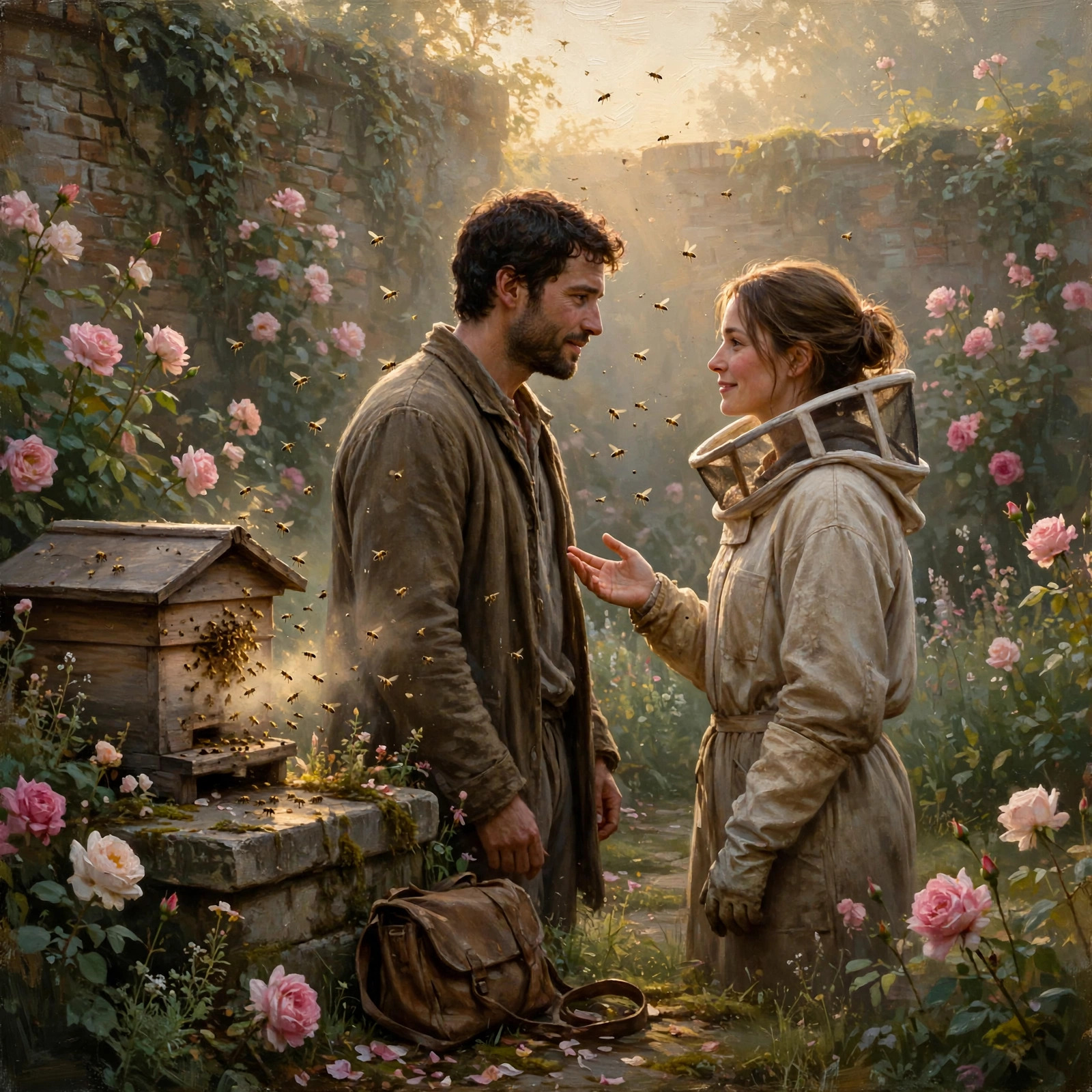
He made a small, startled sound. Then the cedar box was set down on the shed bench, carefully, because he was Joss and even now he would set it down carefully, and his hands came up to her jaw. They smelled of smoke and wax. His kiss tasted of the tea he'd carried up four hours ago and never drunk.
The shed had gone gold with dusk. Dust turned in the slant of light from the one window. Behind them the colony murmured in its box, a low settled thing, and Briony thought, absurdly, that the bees approved.
"I've wanted to do that," Joss said against her cheek, "since you told me I held a pen like a threat."
"You do."
"I'll work on it."
She laughed into his collar. His arms closed around her back, and for the length of several slow breaths she let herself be held by a man who had the power to end her with a signature. It was a strange thing to rest against. It didn't feel like a risk. That was the risk.
Footsteps rang on the iron stairs outside.
They sprang apart. Joss yanked the crooked veil off and had it half behind his back when the shed door opened and Osric Lind filled it, in a grey coat too good for a rooftop, his gaze traveling from the box to Briony's flushed face to Joss's hair.
"Joss. A word."
"Of course." Joss's voice had gone smooth and flat, a door closing. Briony noticed it and filed it away.
"Here is fine." Osric didn't look at her. "The contractors have been moved up if anything. The chair of the glaziers wants the roof clear by Thursday morning, not Thursday noon. And the trust has reviewed the staffing line for the roof." He paused, and the pause was a courtesy of a kind, the kind given to a man about to be handed something heavy. "The position goes with the roof. All of it. Her included."
Briony felt it land in her stomach. "I'm standing right here."
"So you are." Osric inclined his head. "Miss Castellane, my regrets. It's nothing personal."
"It never is," she said.
He left as he had come, unhurried. The iron stairs rang again, fading.
Joss stood very still. Then he said, "I'll fix it."
"How?"
"Give me tonight."
She nodded, because she wanted to believe him, and because the kiss was still on her mouth like a held note. She went down to help Nanette's old spare veil find its hook, to check the east hives, to be busy. When she came back to the shed an hour later for the carry box, the carry box was there. The frame was not.
It had been in the box's slot, the cedar-and-glass observation frame Nanette had dovetailed and sealed with wax the year the first bees came to the roof. The founding queen's line lived in that frame. Briony stood with her hand in the empty slot and felt the floor tilt.
She found him in his office on the second floor, the lamp low, a steel door standing open in the wall behind the desk. He was closing it when she came in. He turned the dial with his thumb, and the bolts went home with a sound like a verdict.
"Where is it?"
"Safe." He raised both palms. "Briony, listen. Safe is the point. Osric won't touch it while it's here, and he won't touch you if the colony is a transferable asset he can point to. The farm in the north. Take the post. They'll keep you, and the bees, and nobody will say a word about dismissal."
"You took it."
"I protected it."
"You took it out of my shed, in my hive, and locked it in a box that answers to you." She heard her own voice drop, cold and even, the voice she'd used once in a corridor in front of a man with a warm laugh. "You decided. Again. A man decided what was best for me and put it behind a door."
"That's not what this is."
"Tell me what it is, then."
"It's me keeping you employed." He took a step. His hand lifted, stopped. "I can't do the other thing. I can't be thrown out of this house, Briony. I won't be any use to anyone."
That was the truest thing he'd ever said to her, and it was the end of it. She looked at his face, the careful, frightened, well-meaning face, and thought of the pen in her breast pocket, and she did not take it out.
"Open the safe."
"I can't tonight."
"Then I'm done being managed." She was already at the door. "Don't follow me up there."
She climbed the service stairwell two steps at a time and crossed the dark roof to the shed. When she reached it she turned, found him in the doorway of the stair, small against the light, one hand held out as though to catch something falling. She shut the shed door on him.
Service Stairs, Midnight
The first hive weighed more than Briony remembered. She got her knees under it on the landing, strapped the entrance shut with the cloth band, and lifted, and the whole box shifted and grumbled against her ribs. Hundreds of bees muttered inside the wood. She had never moved one alone. Nobody did. It took two people and a trolley and a daylight permit from the front office.
She had none of those things. She had the dark, a headlamp turned to red, and a rule she'd decided to break.
Step. Breathe. Step. The service stairwell smelled of bleach and old carpet, and her thighs began to burn by the second flight. Thirteen more hives waited on the roof. She did not let herself count the trips.
"You'll drop it on the turn."
She nearly did. Nanette stood on the landing below in a quilted coat over her nightdress, a flask in one hand, a ring of iron keys in the other. Her white hair was flat on one side from a pillow.
"How did you know I'd be here?"
"Osric's cleaner's circle talks all day, and you've been walking like a woman with a plan since supper." Nanette set the flask on the step. "Put it down, girl. Rest your back."
Briony lowered the hive onto the stair. Her arms shook. "I can't ask you for anything. I've got no permit, no truck, no site that isn't a farm three hours north."
"You've got a site." Nanette lifted the keys and let them swing. "The walled garden. My lease runs another four years, and nobody's looked at the south wall since the roses died. There's shelter, there's lime, there's the old apple. Your colony will like it better than that glass box they're building."
Briony's eyes stung. "Nanette, I'm breaking every rule he signed."
"He signed none of them. A trust did." Nanette's voice gentled. "Where's the frame?"
Briony told her. The safe, the dial, the careful frightened face. Nanette listened with her mouth pressed thin, and when it was done she only said, "Well. He's a fool, then. Not a villain. Those are different animals, and you know it."
"I know."
"Carry. I'll hold the door."
They worked until the stairwell clock said past one. Nanette propped the garden gate with a brick and walked ahead with a torch, and Briony set each hive on its slate along the south wall, strapped boxes breathing in the cold. She went back up for the next. Her palms blistered. She welcomed it. It was easier than thinking about his hand held out in the stair door.
Two floors below, Joss Verhagen sat in the dark with his back to the safe.
He had not gone to bed. He had sat there since she left, hearing the building settle, until the sound of a strapped hive knocking against a stairwell wall came up through the floor like a knuckle on glass. He knew that sound. He had held a box like it the day before, in a borrowed veil, while she looked at him as though he were something she might keep.
He stood. His legs had gone stiff.
She was out there hauling alone, in the dark, because he had taken the one thing she could not do without and called it care. He had done to her exactly what had been done to him all his life. A thing was decided, a door closed, and a grateful face was expected. He had learned that lesson so well he'd passed it on.
He did not put on a jacket.
Osric Lind kept the old family suite at the end of the east corridor when he stayed at the hotel, and he answered the door in a silk robe with a glass of something amber, as if he had expected a visitor. He looked at Joss's shirtsleeves and sighed.
"It's the beekeeper. I had the night porter tell me. Come down to my office, then. I'd rather not do this on a threshold."
They went to Joss's office. Osric sat in Joss's chair. Joss stood.
"The roof is cleared by morning," Osric said. "Quietly. The woman goes north on the relocation, or she goes without a reference. I'm not unkind, Joss. I'm tidy."
"No."
Osric tilted his head. "I beg your pardon?"
"No, I won't carry it out." The word felt strange in his mouth, like a foreign coin. "The atrium can go over the east wing. I've read the drawings twice. It works there, and it costs you a month. The roof stays as it is."
"And if I say the decision is made?"
"Then I resign. Tonight." He heard how steady it came out and was surprised. "My directorship, and the rooms. I'll be out of the house by morning."
Osric set down his glass. For the first time in thirty years, Joss saw the man's face with nothing arranged on it. "You were nine when I signed for you. Everything you own, this family gave you."
"I know. I paid it back by being agreeable. It's been a very long payment." Joss took the pen from the desk, wrote four lines on hotel paper, signed, and slid the page across. "She doesn't owe you her work. Neither do I."
He knelt at the safe. The dial turned under his thumb, and the bolts went back without a sound this time. The carry box was cold. He lifted the cedar frame out with both hands, the old wax gleaming where bees had sealed it, and for a moment he could not stand.
Osric did not speak. Joss laid his office key on the blotter, then the ring with the suite key beside it, and walked out with the frame against his chest.
The stairwell was empty when he reached it. He followed the cold air and the smell of crushed grass down to the garden gate, held open by a brick, and found her at the south wall with her back to him, one hand flat on a hive lid, her hair stuck to her forehead.
She turned. Her face went through three things and settled on none of them.
He crossed the gravel and held the frame out in both hands. He said nothing at all.
Walled Garden Dawn
The frame was still in Joss's hands when the light came over the wall, and neither of them had moved to change that.
Briony had taken it in the dark, last night, and carried it to the new hive herself. Then she had sent Nanette home, sent Osric's silence away with a look, and sat on an upturned crate until the cold got into her knees. Joss had stayed by the gate. He had not asked to come closer. Somewhere around four he had taken off his jacket and put it over her shoulders without a word, and she had let him.
Now the sky had gone the color of the inside of a shell. Dew sat on the lid of the hive. Along the south wall, the other hives waited in their row, quiet, a little offended at the move.
"You haven't slept," she said.
"Neither have you." He rubbed his jaw. His collar was open and his shoes were ruined. "I kept thinking if I went anywhere, I'd come back and this would be a dream."
"It's a garden. It has slugs."
His mouth twitched. Then it stopped, because she'd stood up, and the jacket slid off her shoulders, and she caught it before it hit the gravel.
"I owe you something," she said. "Several things. I'll start with the worst one."
"Briony, you don't--"
"I walked out of that stairwell without hearing you. You'd locked the frame away, and I decided I knew why. I decided in about four seconds." She folded the jacket over her arm so her hands had a job. "A man in a good suit took my work once and put his name on it, and when I came to say so, he already had the story arranged. I've been waiting twelve years for someone to do it again. You stood in the right spot, so I hit you with it."
"I did lock it away."
"You did. Badly. You should have told me." She said it flatly, because it was true, and because he deserved that as much as the rest. "But you were trying to keep me employed, and I heard that you were keeping me in a box. Both things were in the room. I only looked at one."
Joss took a long moment. A blackbird started up on the wall, loud and unbothered.
"I was afraid," he said. "That's all it was. Osric told me what the order meant for you, and I thought, if I make it small and quiet, it can be survived. It's the only way I've ever known to get through anything. Make yourself easy and wait." He looked at his hands, the empty ones now. "I didn't ask what you'd want, because I was sure I knew what would keep you safe. That was the arrogance, wasn't it? Calling it kindness."
"Some of it was kindness."
"Some." He nearly smiled. "I'd like to be forgiven for that part."
"You are."
He breathed out, long and uneven, and turned his face toward the wall so she wouldn't see it. She let him. She was good at letting things be.
When he spoke again his voice was careful. "I should tell you where things stand. I've no job. I've no rooms. Everything I owned in that house was lent, I think, and I've given it back. I have two suitcases and a bank balance that would embarrass a clerk." He laughed once, short. "I'm thirty-eight and I've nowhere to live."
"Good."
"Good?"
"Not good that you're stranded. Good that you said it plainly." She nodded past him, to the far corner where the wall met an old pear tree. A low cottage sat there with a slate roof and a crooked chimney, its shutters the green of old bottles. "Nanette's lease takes in the cottage. It's damp and the stove sulks, and the roof leaks over the second bedroom. There's a kitchen with a window that faces the hives."
He stared at her.
"I've been sleeping there since the swarm. I'm saying there's room." Her voice went rough on the last word, and she was annoyed at it. "I don't want you to stay out of pity, or because you've run out of other doors. I want you to stay because I'd like you at my table in the morning, being bad at tea."
"I'm excellent at tea."
"You steep it like you're trying to punish it."
He crossed the gravel, slowly, the way he'd crossed it last night with the frame. This time he stopped near enough that she could see the gold at the edge of his eyes, and the sleeplessness under them. "I love you," he said. No flourish. A man laying a key on a desk. "I think I did when you told me to hold the box level and didn't say please. I'd like to say it every day, if you'd allow it. Not to make up for anything. Just because it's true."
Her throat closed and opened again. "I love you," she said. "I've been trying not to for most of a year. I'm terrible at it. I kept finding reasons, and then you'd do something stupid and decent, and the reasons fell over."
"I'll try to be less decent."
"Don't you dare."
She put the jacket down on the crate. She took his face in both hands, felt the stubble, the cold of his skin, and he made a small sound she would remember for a long time. Then she kissed him, and he kissed her back as though the garden might still take it away, and the blackbird gave up and left them to it.
When they parted, his forehead stayed against hers. She was smiling, which was ridiculous at that hour, with bees to see to.
"Come on," she said. "She's waiting."
The frame lay in its carry box on the crate, cedar and glass, the old wax gold with the first sun. Briony opened the hive. Joss, without being asked, set his hands beneath hers, and together they lowered the frame between the others until it hung straight and seated in its slot.
She closed the lid. For a moment nothing happened. Then a single bee crept from the entrance, tested the air, and lifted. Another followed, and another, and they rose in a loose bright line over the wall and into the light.
The frame hung in the new hive, and the first bees flew out into the light.
Get notified when new stories drop

Serena Blake
Serena writes romantic suspense and dark romance for readers who want pulse and payoff. Her stories chase trust as hard as they chase danger.
Leave a comment
Comments