

Cold Stile Fence
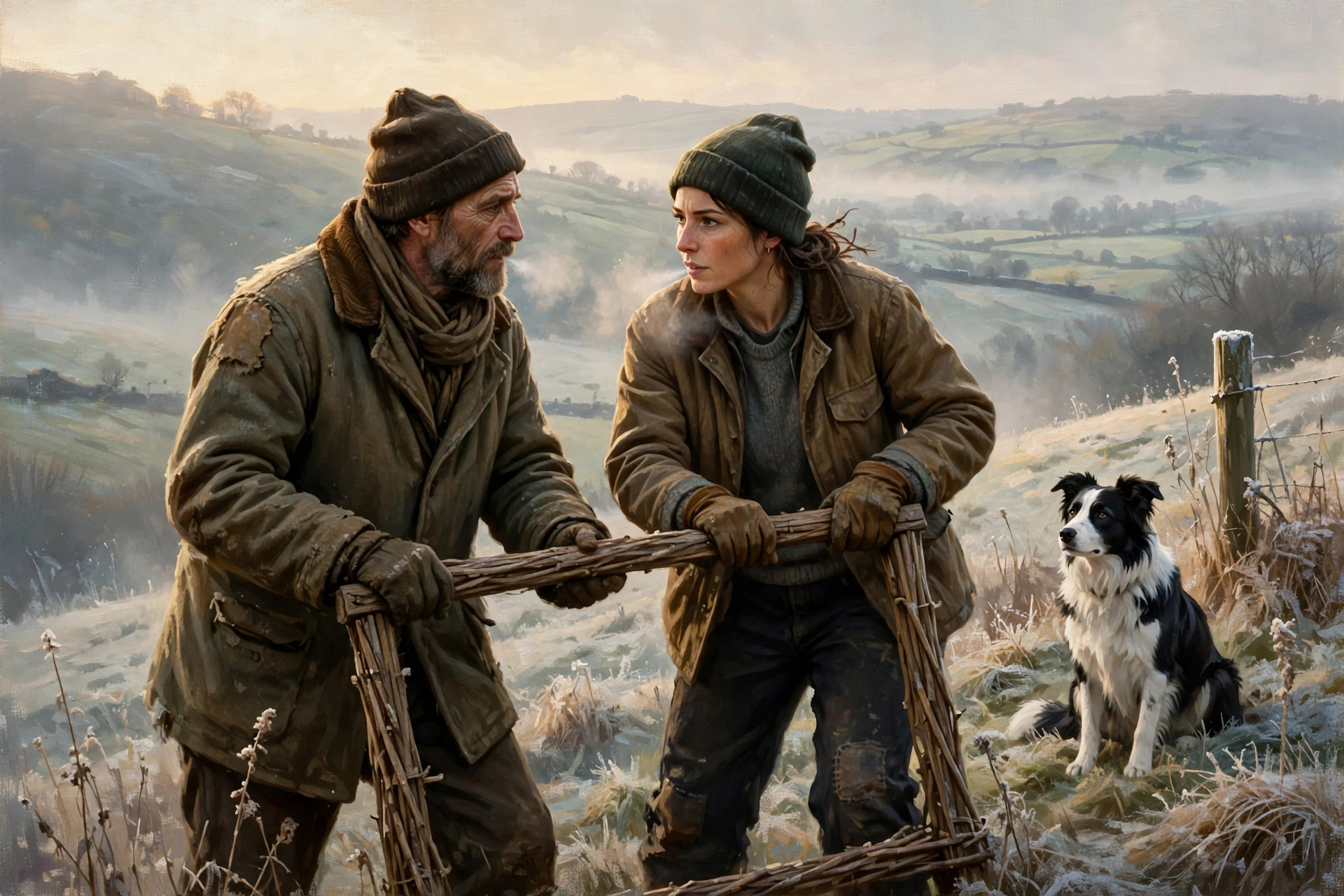
"Not there," Linnet said, and pulled the hurdle back across the frost-stiff grass to where it had been ten minutes before.
Joss Verrall watched her drag it, hands in his coat pockets. "It was there last year."
"Last year you weren't running it."
"I'm running it now." He said it mildly, which made it worse. He walked over, took the hurdle by its frame, and set it down a full length to the left, square to the rise. "Dogs lose the sheep behind that hump. They need to see the line from the top. Otherwise it's luck, and I don't hand out prizes for luck."
"They lose them there because that's the hill." Linnet wiped her palms on her trousers. The field at Cold Stile had been her father's to walk long before it was anyone's to rule. "A dog that can't work a blind drive off that rise has no business in the final. It's meant to be hard."
"Hard is fine. Unfair is a different thing."
"Unfair is you moving my fence."
"The estate's fence."
She looked at him then, properly. He was taller than she liked, with a weathered, patient face and a way of standing as though he might be told to leave at any moment and had already packed. Two years in the valley and he still stood like that. She'd noticed. She'd rather not have.
"Orrin Platt pays you to run the trials," she said. "He pays me to see the course stays honest. Honest is where it's been since before either of us."
"Then we've a disagreement." Joss almost smiled. "Lucky we've nine days to settle it."
That landed wrong, and they both knew why. Neither of them had wanted the estate agent's little contest, the title and the pasture lease dangled like a bone between two dogs. Neither had been asked.
She grabbed the hurdle. He grabbed it too, and for a moment they stood with the frame between them, breath fogging.
"Let go, Verrall."
"You first."
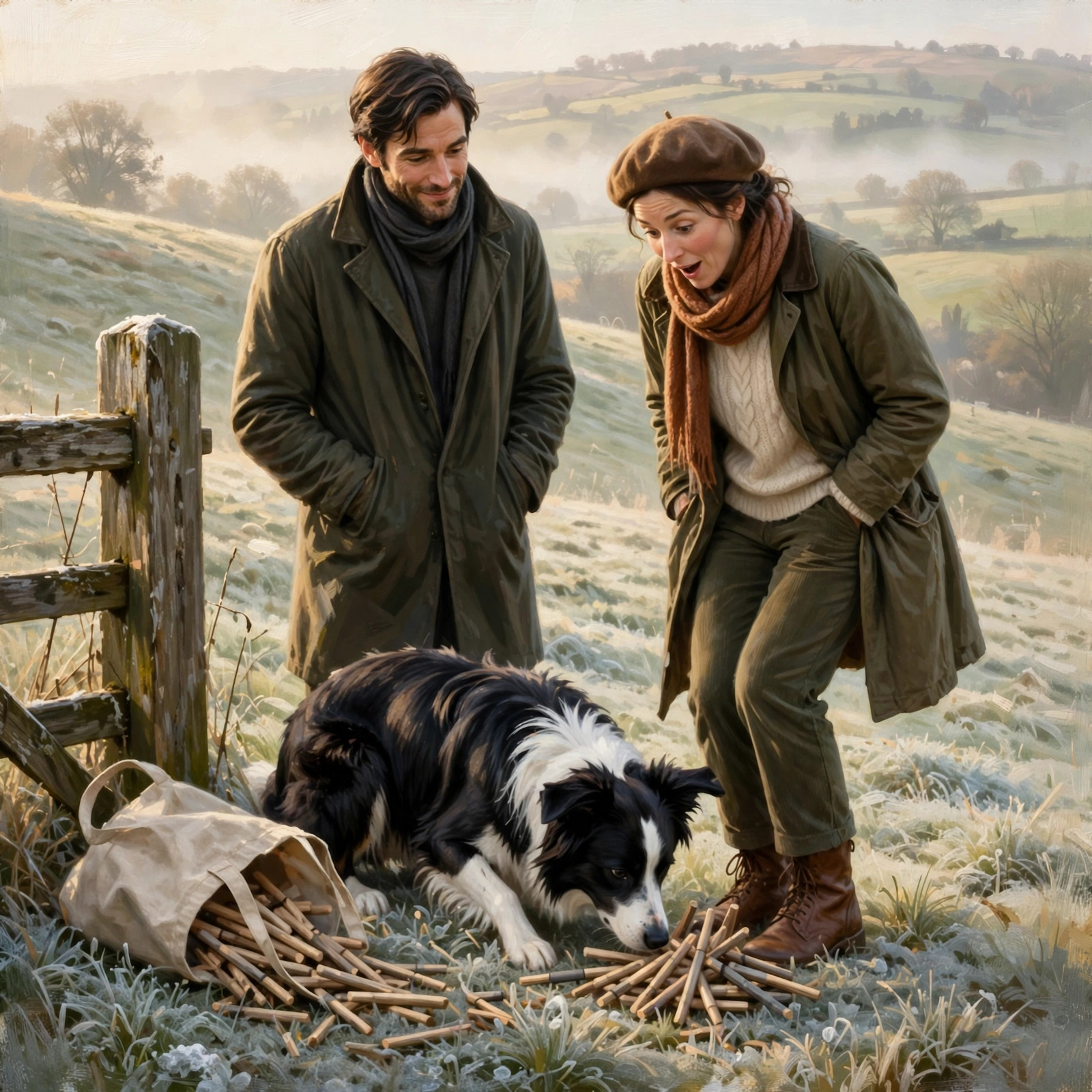
A low whine came from the fence line. Bess, his black and white collie, had been sitting where she was told, ears working between the two of them like a referee losing patience. Now she rose, trotted to the canvas bag of marker stakes by the gatepost, and nosed it over. Wooden stakes rattled out across the grass.
"Bess," Joss said. "Leave."
She did not leave. She dropped into a crouch, eyes fixed, and began to gather them. It was ridiculous and exact. She circled wide, came in behind the scattered stakes, and pushed them with her nose and chest, one cluster toward another, until a tidy heap sat at Linnet's boots.
Linnet stared. "She's herding them."
"She's bored." But his voice had gone soft. "She does it with anything that moves."
"Well. She's better at it than most."
"Don't tell her. She'll want wages."
A laugh got out of Linnet before she could stop it, short and surprised. She turned it into a cough. Joss looked at the ground, pleased and trying not to be.
Bess lay down beside the pile, chin on paws, satisfied with the work.
Linnet let go of the hurdle. He let it settle where he'd put it. She said nothing, just picked up the mallet from the gatepost and a stake from the pile, and walked to the spot she'd chosen, the one that was right whatever he thought.
"You'll have a sore shoulder tomorrow," he said, following. "That ground's like iron this time of year. Let me."
"No."
"It's only a stake."
"It's mine to put in." She set the point against the turf. Her father had hammered stakes on this same line with a bad shoulder and told no one, and she had learned what came of letting a person carry a thing alone and quiet. She had also learned the opposite, that nobody could be trusted to carry it for her. The two lessons had never agreed with each other. She didn't try to make them now.
The first blow jarred to her elbow. The second bit. Joss stood a pace back, hands out of his pockets now, uncertain what to do with them, while Bess watched from her heap of stakes.
Linnet swung until the stake stood firm, and then she swung once more, to be sure, with him watching every blow.
Tea in the Shed
The rain came over the ridge like a thrown sheet, and Linnet had the lambing shed door open before Joss finished saying he'd call it for the day.
"In," she said. "Both of you."
Bess went first, low and quick, and shook herself on the straw so hard her ears cracked. Joss ducked under the lintel after her, hat streaming, one sleeve black to the shoulder. Linnet's two dogs, Fen and Tam, had been working the far pen with Bess all morning, and they flanked her now as if she'd always been theirs.
"They've decided," Joss said.
"They've no sense. Bess has been here three hours."
"She makes an impression."
"So I've noticed."
He glanced at her, caught the corner of her mouth before she flattened it, and looked at the rafters instead. Rain hammered the tin roof. Somewhere in the back pen an old ewe complained about the noise.
The inner door banged and Hester came through with a tray held against her hip, tartan blanket over one arm. She did not look surprised. She looked like a woman who had watched the sky from the kitchen window and set out three cups an hour ago.
"You'll catch your death," she said, to Joss, as if he were a child. "Sit."
"Mum, he's leaving."
"He's sitting." Hester set the tray on an upturned feed bin. Tea, thick bread, a wedge of cheese, a bowl of water for the dog. "Mr. Verrall. Milk?"
"Joss. And yes, please." He sat on a bale as though it might object. Bess leaned against his shin.
Linnet took the other bale and her cup, and kept her eyes on the steam. Her mother cut cheese with the small knife from her apron pocket and handed it over on the blade, one slice after another, and between slices she asked questions.
Where was he from, originally. Which valley. Who'd trained Bess, and was it true he'd bred her himself. Did he have people. Did he mean to stay on past the trials, or was he the sort who moved with the weather.
"Mum."
"I'm making conversation."
"You're taking a statement."
"It's all right," Joss said. He turned the cup in his hands. "I bred her, yes. Her mother was a good dog on a bad farm. As for staying, I've been two years in Heron Creek. That's longer than most places."
"And before that?"
"Before that I had a place. Not mine. I worked it for the family a long time, and then the old man died and the son sold up in a month." He said it lightly, a story told often enough to have no edges. "Dog and I were in the lane with a bag each by the end of the week."
The rain filled the quiet. Linnet heard her own cup meet her saucer.
"I'm sorry," Hester said, and meant it, and went on cutting bread.
"It was a while ago." He looked at Linnet then, perhaps because she had not spoken. "You'd know something about that. Your father's ground."
"It's still ours."
"I know. I only meant, losing the man who held it together."
She wanted to say it was nothing like his case. That she had a roof and a flock and a mother with the breeding books spread on the kitchen table. But the words went stale before she found them, because he had not said it to wound, and because she knew exactly how a place could keep standing after the person it stood for was gone. The gate still swung. The crook still leaned by the porch door. Nobody was there to put a hand on it.
"He hid a hurt," she said. "On trial day. Wouldn't say, wouldn't stop. We found out after."
Hester's knife paused, then resumed.
"Mine never got the chance to hide anything," Joss said quietly. "He was just gone, and then so was the farm."
Neither of them said anything clever. Bess sighed on his boots. Fen, who trusted no stranger, laid her chin across Bess's back.
Hester wiped the blade on her apron. "Well," she said, in the tone of a woman closing a ledger. "That's enough of that. Eat the bread, Joss, it's not for show."
He ate it. Linnet watched him do so with the careful appetite of someone who had once measured meals, and something in her chest shifted a degree she did not authorise.
The rain eased to a steady grey drumming. Joss stood, rolled the wet shoulder, and winced when the cold cloth touched skin. He had a van at the field gate and a mile of open track between here and it.
Linnet was up before she'd decided to be. The old coat hung on its nail by the shed door, waxed canvas, the cuffs frayed pale, the pocket lining mended in three colours of thread. Her father's. She had not let anyone wear it in six years, and she took it down and held it out before she could examine why.
Joss looked at it, then at her. "I can't."
"It's dry. You're not."
"Linnet. That's not a coat you lend."
"Then bring it back." It came out sharper than she meant, and she let it stand. "Tomorrow. Clean enough that I can't tell you wore it."
Hester said nothing at all, which was louder than anything she might have said.
He took it. It hung a little long in the sleeve and wide through the back, and he stood very still as he settled it on, as if it might object. Then he turned up the collar against the wet, whistled Bess to heel, and ducked out into the rain wearing her father's old coat.
The Lame Ewe
"She's favouring the near hind," Joss said, already moving. "Don't let the others bunch."
"I can see that." Linnet was a step ahead of him and no happier about it. The ewe stood apart at the top of the rise, one hock held off the grass, while the rest of the practice flock drifted toward the rough ground beyond the hurdles. Cold Stile lay pale and wet in the morning light. Tam and Fen crouched at the edges of the field, waiting for a word.
"Then hold them. I'll take her."
"You'll frighten her."
"I won't."
He said it so flatly that she looked at him. He wore her father's coat, returned to her yesterday clean as a promise and then, absurdly, taken back that morning when the wind came up. She had not argued. Now the cuffs flapped as he crouched, hand low, his whole body made small.
Linnet whistled Fen wide and Tam tight. The two dogs slid out along the grass like water finding a channel. Forty ewes turned, hesitated, and settled into a loose crescent. Bess lay flat at Joss's heel, eyes on the lame one, trembling with the effort of not moving.
"Stay," Joss murmured to her. "Good girl. Stay."
The ewe lurched sideways when he came near. He stopped. Waited. Let her decide he was a post and not a threat.
"I need something with a hook," he said, without turning. "If I grab the leg I'll tear it worse."
The crook was propped against the fence where Linnet had left it that morning, out of habit, because she never walked the course without it. Hazel, pale and smooth, the heads of three herons carved along the shaft where her father's thumb had worn them soft. He had made it the year she was born. She had never lent it to anyone.
Her stomach tightened. The flock shifted, sensing her hesitation, and Tam took a step in.
"Tam, down." Her voice came out steadier than she felt. Then, to Joss: "Behind you. Left."
He found it without looking, closed his hand around the shaft, and went still for a moment. She saw him understand what he held. His thumb found the worn place on the herons, and he glanced back at her, a question with no words in it.
"Go on," she said.
He moved in slowly. The crook curved around the ewe's good hind leg, a gentle pressure, no pull at all, and she sagged against it and stood. Joss knelt, slid an arm under her chest, and ran his other hand down the injured leg while she shivered.
"Heat in the hock," he said. "Not broken. Thorn, maybe, or a twist on that stony ground."
"Hold her there."
"I've got her."
Linnet kept the flock. It was harder than it looked, because the ewes had caught the scent of trouble and wanted to run. She walked a slow arc with Fen at her knee and Tam sweeping the far edge, and she found that she was listening to Joss behind her as she might listen to her own pulse. His low voice to the ewe. The soft click of the crook against a stone. Bess's one sharp breath when the sheep stamped.
"Linnet. Left side's loosening."
"I know." She was already sending Tam. The gap closed.
"Thorn," he called a minute later. "Got it. Small. Come see."
She could not leave the flock, and he knew it. So he did not ask. He carried the ewe, crook hooked over his forearm, down the slope toward her, and Bess flowed beside him, close but never touching, the whole picture of a dog who had learned how to be quiet. When he stopped, the ewe stood on three legs between them, blinking, and Linnet bent and found the hock with her fingers.
It was true. A black blackthorn tip, no longer than a grain of barley, sat just under the skin. Joss held the leg. She pinched, drew, and the thorn came free. The ewe bleated once, offended, and put her foot down.
Neither of them said anything.
The flock had gone calm. Even the dogs lay with their heads on their paws. Wind moved over the rise and flattened the grass, and Linnet became aware of how close they were standing, how his shoulder nearly met hers, how the sleeve of her father's coat brushed her wrist. He had mud on his jaw. His eyes were the grey of the creek under cloud, and he was looking at her as if she had done something remarkable, when all she had done was stand in a field and keep forty sheep from leaving.
"You didn't need to let me," he said at last. "The crook."
"I know."
"It matters to you."
"It does." She did not say why. She did not have to, and that was the unsettling part. He turned the shaft in his hand, thumb resting once more on the heron's worn head, and handed it toward her with both hands, the way you return something that is not yours.
She almost took it.
Across the field, a gate clanged and someone far off shouted for a tractor. The world was going about its business. Linnet looked at the herons, at his thumb where her father's had been, and at the ewe grazing as though nothing had happened. Something that had been locked in her for six years eased a notch, quietly, like a latch lifting.
"Keep it," she said. "Until dusk. She might need steadying again before we get her to the barn."
His hands closed on the hazel. "Until dusk," he agreed, and did not look away first.
Papers on the Gate
Orrin Platt's car came up the farm track too fast, and Linnet knew before it stopped that something was wrong. He never hurried. He was the kind of man who let a thing come to him and then billed for it.
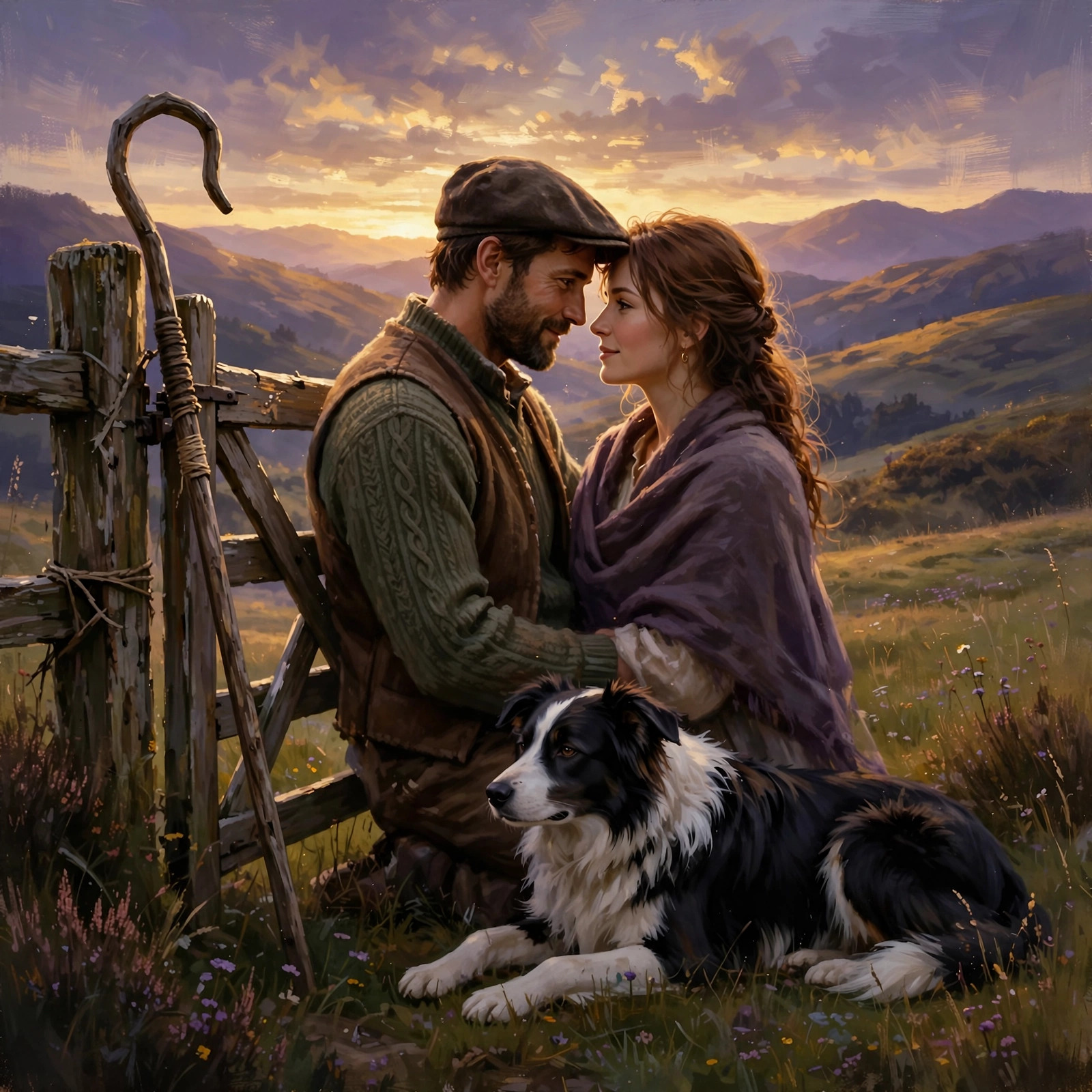
She was at the fence by the high gate, mending a strand of wire, Fen at her heel. Joss stood a few yards off with Bess, the crook propped against the top rail where he had left it that morning. He had brought it back at dusk two days ago, and she had told him to keep it for the week. She still didn't know why she had said that.
"Linnet." Orrin climbed out with a folder pressed to his chest. His good shoes sank into the verge. "Joss. Good, you're both here. Saves me a trip."
"Saves you a trip to where?" she asked.
"Nowhere. Nowhere at all." He smiled, and it was the smile he used on tenants. "I only wanted you to see that the estate is acting in good faith. Whatever happens at the final, the high pasture is going to be put to proper use."
He opened the folder and laid it flat on the gatepost. The wind lifted one corner and he pinned it with a thumb. Linnet read upside down at first, then stepped closer. It was a lease. The estate's crest sat at the top, and below it the words Aldous high pasture, and a figure she had already refused once at her mother's table. Eighteen thousand dollars, the old sum in the new currency the estate liked to use for outsiders.
At the bottom was a signature. Joss Verrall, in blue ink, the J looped hard.
She read it twice. The words did not change.
"That's a side agreement," Orrin said, almost gently. "Joss takes the lease now, outright, if the final goes his way. A courtesy, really. It gives him some security. Everyone should have some security."
"When?" Her voice sounded flat and far off, like someone else's down a well.
"Yesterday afternoon, at the office."
Yesterday. She had stood in this exact spot yesterday morning and told Joss the ewe was sound. She had laughed at something he said about Bess and the gate latch. She had let herself think, for the length of one cup of tea, that the week was going to end some way she could live with.
She turned. Joss had not moved, but all the colour had gone out of his face, and his hand had found Bess's head and stayed there.
"Say it isn't yours," she said.
"It's mine."
Orrin gathered his folder with sudden interest in the sky. "I'll leave you to it," he said, and for once he did not linger to enjoy himself. The car door shut. The engine turned over and faded down the track, and then there was only wind and the creak of the rail.
"Linnet." Joss took a step. "Let me tell you how it was."
"You signed it."
"I did."
"Without a word to me. After the thorn. After I..." She stopped, because the end of that sentence would have shown him too much. "After I gave you my father's coat."
"I know."
"Then why?"
He looked at the ground, then made himself look up. "Because he put it in front of me and said it might not be there tomorrow. And I've heard that sentence before. Every place I've ever stood has been taken from me at the last minute, so I take what's offered first. I didn't think. I just did it. It's what I do."
"From habit."
"Yes."
"You signed away my father's land from habit." She laughed, one short ugly sound. "Do you know what's up there? Four generations of ewes. My mother's books. A flock I have never once sold a lamb from without knowing its name. And you put your pen to it because you were frightened."
"I was going to tell you."
"When? After the final? After I'd carried your tea out to the field?" She heard her voice climb and could not stop it. "You told me you understood. You stood there with your thumb on his herons and told me it mattered."
"It does matter. Linnet, I'll go to the office now. I'll tear it up."
"You'll tear it up." She shook her head. "And next time something frightens you, you'll tear up something else. I've watched men do this my whole life. They push and they take and they call it surviving. My father did it. He bled for three days and told no one, because winning was easier than saying he was hurt. And I'm supposed to trust a man who does the same thing with a pen?"
"That isn't fair."
"No. It isn't." She reached past him and took the crook from the rail. The hazel was warm from the sun, smooth where two hands had worn it. The herons looked up at her, each with the small patient eye her father had cut with a penknife the year she was born.
"Don't," Joss said quietly.
She brought it down across the top bar of the fence. The sound was like a bone going. The shaft split at the neck and the lower half swung loose from a spine of pale splinters, and she stood there with it shaking in her fist and Fen flat to the ground at her feet.
Bess whined. Nobody else made a sound.
Joss's mouth opened and closed. He looked at the broken wood the way he might have looked at a dog hit by a car, and she hated that he looked that way, because it was grief and not guilt, and she could have fought guilt.
She dropped the heron-headed piece on the grass between them. It was the one with the worn crown, the one his thumb had known. She kept the long half in her hand, ragged end and all, and turned up the track toward the house without once looking back.
Brass Collar
Joss was standing in the lambing shed doorway at first light with the heron-headed piece wrapped in a tea towel and a dented tin under his arm. Linnet had been up since four, and she had not slept before that.
"I'm not here to argue," he said.
"Then you're in the wrong shed."
He didn't smile. Bess sat down behind his boots and kept her eyes on Linnet's face. Fen and Tam lifted their heads from the straw and, after a considering moment, put them down again.
"Your mother let me in the back kitchen," he said. "She gave me the long half. It was on the dresser."
Linnet looked at her hands. She had left it there herself, ragged end up, like something she was punishing.
"She said I could use the bench." He nodded toward the corner where her father's vise still hung on its board. "If you'll allow it."
She didn't say yes. She moved a bucket out of his way, and that was answer enough for both of them.
He worked without talking. He pared the splintered ends to clean slopes and fitted them until the grain met like fingers laced. He glued the join and clamped it. From the tin he took a ring of brass, plain and bright, no wider than a thumb joint. He had cut it from the old plate off his own truck's tool box, he said, and filed the edge. He slid it over the neck and tapped it down with a mallet. Then he sat back on the upturned crate and looked at it as if it might still be dangerous.
"It won't be what it was," he said. "There'll always be a line."
"My father had a line in him too," Linnet said. "He just never showed anyone."
Joss let that lie. Outside a gate clanged, and wheels came up the track too fast.
Orrin Platt arrived in the doorway with his folder under his arm and his good shoes already ruined by the mud. Hester came behind him across the yard, wiping her hands on her apron, in no hurry at all.
"Verrall. I was told you'd be here." Orrin glanced at the clamped crook, the shavings, the tin. "Is this a sentimental errand? The final is tomorrow."
"I know when it is." Joss stood. "I've come to tell you I'm withdrawing."
Orrin laughed, then saw nobody else was. "You signed the lease offer. I have your name on it."
"You have. I'm taking it back. I'm out of the final, and you can strike my name from the title. The lease too." Joss's voice stayed level, but his thumb was working at the edge of the bench. "The pasture isn't mine to take. It never was."
"You'd walk away from a permanent post? A house?" Orrin looked at Linnet as though she had done something underhand. "For this?"
"For her. And because I'd rather be a man who has nowhere than one who got it that way."
Linnet's throat had gone tight. She wanted to tell him to stop, that it was too much to give. She also wanted to tell him it was exactly enough, and she couldn't make either sentence come out.
Orrin opened the folder and shut it again. He was not a cruel man, only a tidy one, and nothing about this was tidy. "Then Miss Aldous runs the course by default," he said at last. "And the lease stays with the family. I'll have it redrawn by the week's end." He tucked the folder under his arm. "I'd have liked a contest."
"You had one," Hester said mildly. "You just didn't read it right."
Orrin went out. They listened to his car turn and complain down the track.
Joss exhaled. Bess leaned into his shin. He bent and unscrewed the clamp, lifted the crook, and turned it over in the grey light. Brass at the neck, the old herons looking out above it with their patient eyes. He held it out across the straw, handle first.
Linnet did not take it. She crossed the space between them instead, put her palms flat against his chest where the waxed coat had once hung on him, and kissed him.
He went still, then not still. His hand came up to her jaw, careful, as if she were something that could be dropped. She tasted tea and cold air and the salt of a bad night. When she drew back he kept his forehead against hers, and the crook swung loose in his other hand.
"That's not a yes to anything," she said, unsteady.
"I didn't ask anything."
"You will."
"Probably."
Over his shoulder she saw her mother in the doorway. Hester looked at the two of them, at the brass, at the shavings on the floor. She gave one short nod, the kind she gave a ewe that had lambed clean, and went back across the yard.
Linnet laughed, wet-eyed, and stepped back. Joss held out the crook again, and this time she closed her hand around the hazel, warm from his grip, and took it.
High Pasture Gate
The last of the light had gone copper along the ridge by the time Linnet reached the gate, the crook in her hand and her boots heavy with a day of other people's mud. Joss was already there. He leaned on the top bar with his sleeves pushed up, watching the flock drift across the slope in slow grey drifts. Bess sat at his feet, tongue out, ears turned toward every small sound.
"You didn't have to wait," Linnet said.
"I know."
"The course ran clean. Nobody lost a dog in the beck."
"I heard the applause from the lorry park. Whoever won the novice class had a mother with a very large voice."
She laughed, and it came out more tired than she meant. She set the crook against the post and rested her arms on the bar beside his. The wood was cold and damp. Down the slope Fen and Tam were working the stragglers in from the wall, low and quiet, the way her father had taught their grandsire.
Joss glanced at the crook. The brass collar caught what was left of the sun, a small hard gleam under the carved herons.
"It looks like it was always meant to be there," she said.
"It looks like a brass lid."
"It looks like brass that matters." She touched the metal with her thumb. "Dad would've hated it for about a week. Then he'd have shown it to everyone."
He didn't answer. His jaw worked, and he looked away over the pasture. She understood that look now. It was the one he wore when somebody was kind and he hadn't yet learned where to put it.
"Where are you sleeping tonight?" she asked.
"The truck. It's got a heater that works if you argue with it."
"And tomorrow?"
"Linnet."
"Humor me."
"I'll find something." He said it lightly, a man reciting a line he'd said in a dozen yards. "I always do. There's work at the Dunmore sales, and a woman near the coast who wants a dog trained. I'm not asking for anything. I told you that."
"I know you did. That's why I'm asking."
She turned and pointed up the hill, past the last wall, to where the roofline of the old shepherd's hut showed black against the sky. Slate roof, one chimney, a door she'd painted green the spring after her father died, because she couldn't stand to look at it grey.
"It's been empty since Dad's last hired man left. The stove draws if you open the flue properly. The roof's sound. The window sticks." She kept her eyes on it, because it was easier. "It sits on my pasture. On the lease that's still mine, because of you. I'd want rent."
"Rent."
"Somebody has to mend the wall by the beck. Somebody has to be up here at three in the morning when it's lambing and I've been on my feet since yesterday." Her voice wobbled and she let it. "I've done every job on this farm alone for six years, and I was proud of it. I'm tired of being proud of it. I'd like you to stay."
Joss didn't move. Bess looked up at him, then at her, then back, as if she were the only one in the conversation who'd already understood it.
"You're sure," he said, rough. "Not because I owe you a roof or you owe me one."
"I'm sure because I watched you put your whole future on a barn floor and walk off it. I'm sure because you mended my father's crook with the only good plate you had." She finally turned to face him. "I don't want a man who wins things. I want the one who gave them back."
He laughed once, short and cracked, and pressed the heel of his hand to his eye. "I spent most of my life certain that if I didn't grab a place first, it'd be taken. I never once thought somebody might just hold the door."
"I'm holding it."
"I see that."
The wind shifted. Down in the valley the lorry park lights flickered on, tiny and orange, and the sound of the trial field packing up came thin and far off. Linnet found she was gripping the gate bar hard enough to hurt.
"I love you," she said. It came out plain, with no shape to it at all, and she was glad. "I wanted to say it before I got clever about it."
His face broke open. There was no other word for it. All the careful lines went, and what was under them was young and astonished and entirely hers.
"I love you," he said. "God, I do. Since the sheep in the beck, probably. Since you told me I was standing in the wrong place and you were right."
"I was always right."
"Not always."
"Nearly."
He pulled her in then, and she went, her face against his collar, wool and dog and woodsmoke. His arms closed around her slowly, as though he still expected to be told to stop. She held on until he stopped expecting it. She felt the breath leave him in one long shaking rush, and under her cheek his heart going hard and steady.
"Come and see the window," she murmured. "It sticks."
"I'll fix it."
"You'll fix it badly. Then I'll fix it."
"Deal."
Something nudged her knee. Bess had wedged herself in between them, head tipped up, tail sweeping the grass in wide hopeful arcs. Linnet bent and scratched the dog's ears, and Joss's hand came down beside hers, and for a moment all three of them were one tangled, ridiculous knot at the foot of the gate.
Fen and Tam brought the last ewes through the gap, and the flock settled on the slope. Linnet straightened, took the crook, and hooked the gate latch with the carved head, the way her father always had. Joss put his hand on the bar beside hers. Bess pressed in between their legs.
Together they swung the gate shut, and the latch fell home.
Get notified when new stories drop

Lila Monroe
Lila writes contemporary and small-town romance with banter-forward leads and soft landings. She believes the best love stories sound like two specific people, not a trope checklist.
Leave a comment
Comments