


Soot on the Hook
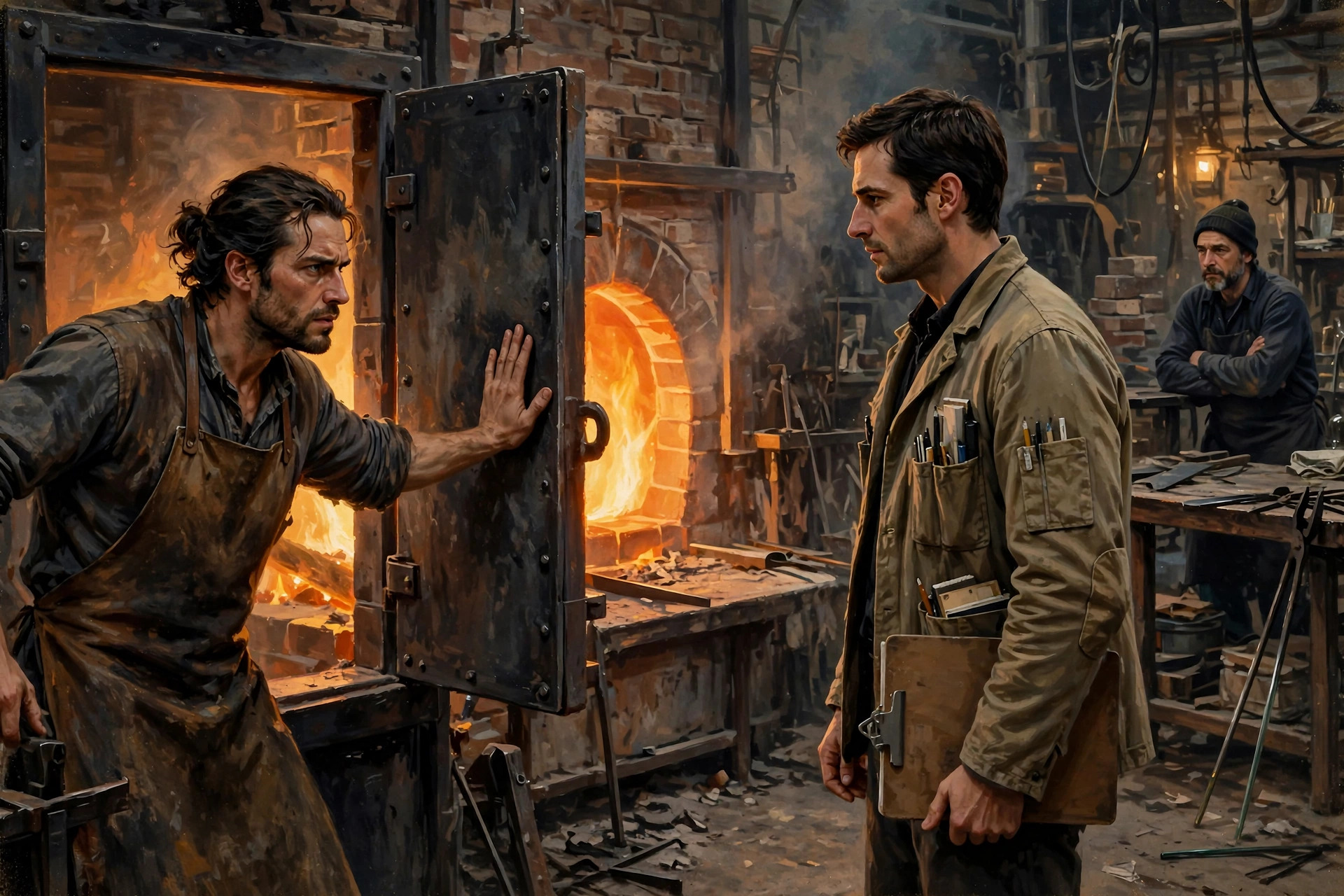
"You can't take that in there," Joanna said, and put her palm flat on the furnace door.
Elias Brandvold looked at her hand, then at the clipboard he was holding. "It's a clipboard."
"It's a clipboard with a form on it. Forms make Walter nervous, and a nervous Walter drops things." She didn't move. Heat pushed against her back through the steel, steady and low, the way it had every day for six years. "Whatever you need to write, you can say it to me first."
"That isn't how it works."
"It's how it works on my floor."
He had a patient face, which annoyed her. Rain-gray eyes, a canvas jacket with a dozen pockets, and the look of a man who had been told no by better obstacles than a glassblower in a scorched apron. Behind him, Dev Sandoval leaned on a marver table with a steel jack in one hand, pretending to inspect it.
"Ms. Pruitt," Elias said. "The underwriter pays me to certify this floor. If I certify it, the policy stands. If I don't, it lapses, and I'd like very much to certify it. But I can't do that from the doorway."
"Nine hundred thousand dollars," Dev said, to the jack. "That's what we're worth on paper. I looked it up."
"Dev."
"I'm just saying we should be polite to the paper."
Joanna exhaled through her nose. She had hidden worse things than a clipboard. She had once hidden a cracked crucible behind a stack of cullet for a whole weekend, and nobody had been hurt, and that was the point of hiding things. But the man in front of her did not look like someone who could be handled with cullet.
She stepped aside. "You touch nothing that's hot. You ask before you open anything. And the clipboard stays down at your side."
"The clipboard stays at my side," he agreed, and went past her close enough that she smelled cold air and pencil shavings.
The floor was loud in the usual way. The big furnace roared behind its brick, the glory hole glowed orange, and the exhaust fans pulled everything toward the roof. Elias walked it slowly. He crouched at the benches. He ran a gloved thumb along the ductwork and looked up at the sprinkler heads one by one. He didn't write anything, which was worse than if he had.
"You always this quiet?" she called.
"Only when I'm counting."
"Counting what?"
"Exits. Three. One's blocked by a cart."
"That cart lives there."
"Not tonight, it doesn't."
Dev wheeled it away without being asked. Joanna shot him a look. He shrugged with his whole face.
Elias reached the gas feed on the far wall, where the supply line came in from the yard and ran along the brick to the furnace. He stopped. He tilted his head, and then he went still in a way she recognized, the stillness of someone who has found the one wrong note in a song.
"Come here, please."
She came. He pointed without touching. A threaded union sat at an elbow in the pipe, a fat brass collar, and its nut had a bright scrape across one flat, the metal cleaner than the grime around it.
"That's loose," he said. "Not leaking. I can't smell anything yet. But someone's had a wrench on it, and recently."
"Maintenance."
"Whose?"
"Dev checks the line at the end of every shift."
Dev had drifted up behind them. "Last night, yes. Not the union. I looked at the gauge, ran the soap on the joints near the regulator, and it was fine." He frowned at the brass. "That wasn't shiny yesterday."
Joanna's stomach did something slow and cold. She thought of the studio she had lost years ago, the smoke that had a story behind it, the partner who had told her nothing until the insurers did. She looked at the bright scrape and felt her mouth begin to arrange itself into a reassurance.
"It's probably been like that a while," she said.
Elias turned his head. "Dev just said it wasn't."
"Dev's tired."
"Dev is standing right here," Dev said, mildly.
"If this line fails," Elias said, "it won't fail loudly. A loose union gives you a slow bleed. Gas pools in the low corner behind the annealer, and the first spark finds it. Four hours between a clean check and the dawn pour is plenty of time for it to happen, if someone wanted it to."
"Nobody wants that."
"Somebody had a wrench."
She hated how reasonable he sounded. She hated more that her hands had gone cold inside her gloves. Above the annealing oven, on its iron hook, hung the thing she trusted most on the floor, a forged steel key as long as her forearm, black with soot, hammered by Walter's father before Walter could walk. It cut the gas to the big furnace and to Kiln Nine with a single quarter turn. Nobody lifted it but her, Walter, and Dev.
She crossed the floor and took it down. It was heavier than it looked, always, and warm from the oven. Soot came away on her palm.
"This," she said, and held it so he could see the worn socket end, "is the lockout. Nothing feeds this furnace unless I say so. If your line is bad, I shut it. If you want it shut, you ask me."
Elias studied the key, then her. For the first time something moved behind the patience, not offense, more like recognition. "That's a good key."
"It's my key."
"I noticed." He looked at the union again, at the clock over the door, at the dark glass of the high windows going from gray to ink. "Then you won't mind that I'm staying overnight."
"You're what?"
"Someone has to watch that line until the pour. I'd rather it be someone with no reason to lie about what they see." He said it plainly, no edge. "I'll stay out of your crew's way."
"My crew stays on this floor. I don't leave them."
"Then we'll both be here."
Dev made a small, delighted noise and turned it into a cough.
Joanna looked at the key in her hand, then at the man who had just made her night much longer. She opened the front pocket of her apron, slid the iron down into the canvas, and felt its weight pull the strings tight across her hips.
"Fine," she said. "But it rides with me."
Night Crew Coffee
The coffee came out of a dented steel urn that Dev had been feeding grounds since before the ten o'clock shift change, and it tasted like a penny dipped in smoke. Elias drank it anyway. Joanna watched him do it from the bench by the glory hole, where the heat made her forearms ache pleasantly.
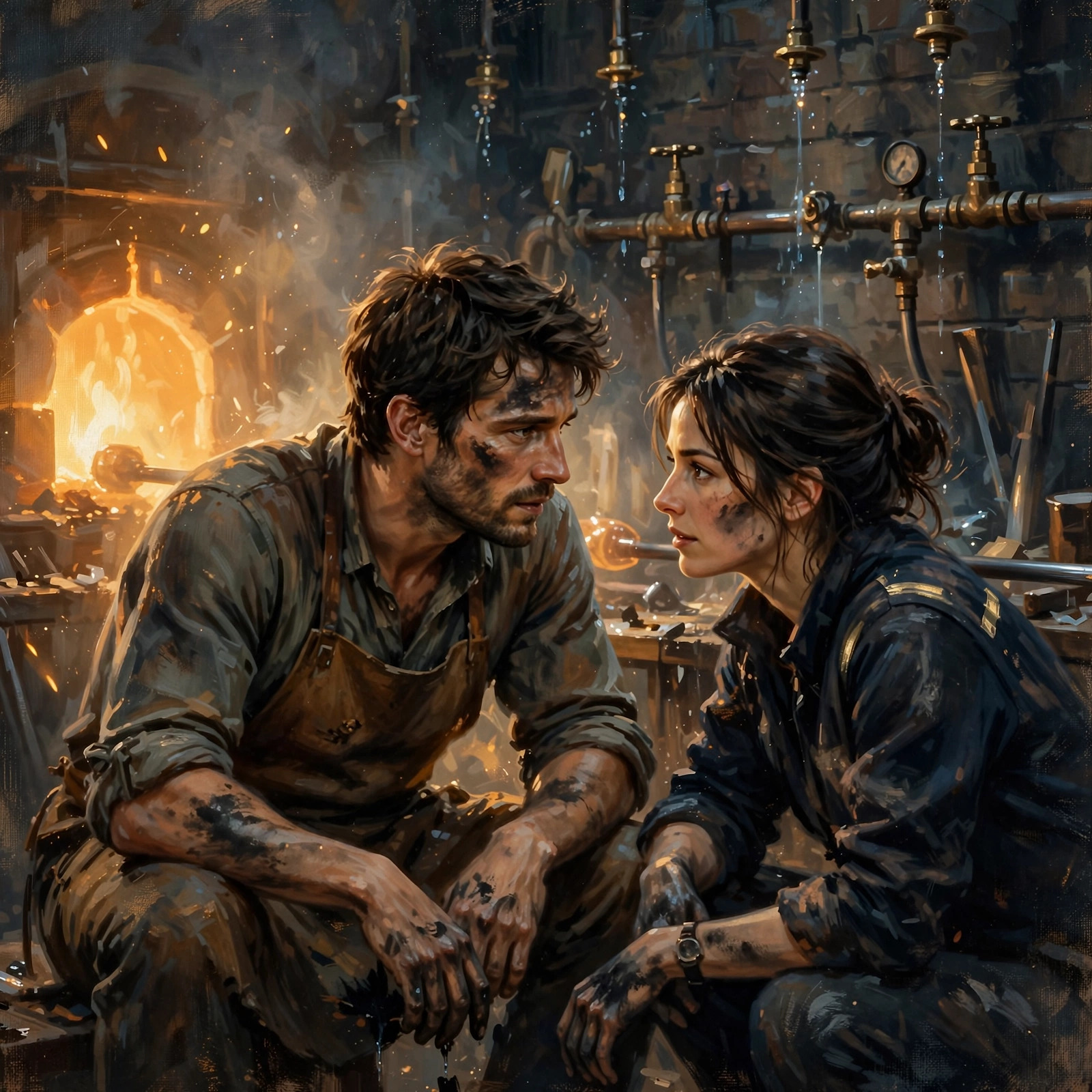
"You don't have to be polite," she said.
"I'm not. I'm cold." He wrapped both hands around the mug. "Your floor is the warmest place I've stood in a year, and I'm still cold."
"Gas does that. Walks the heat out of you while you're listening for it."
He glanced at her. Before he could answer, the loading dock door rattled and Walter Hallam came in with his coat buttoned wrong and his hat in his fist. He hadn't been asked to come. He looked at the furnace first, always, the way other men look at a sleeping child.
"Mr. Brandvold." Walter's voice was gravel and apology. "I won't keep you. I only wanted to say it to your face."
"Walter," Joanna said. "Go home."
"Let me say it." He turned his hat once, a full circle. "My father poured the first batch in this building. I've put forty years of my own into these walls, and there are eleven people on this crew who have mortgages and kids because I kept the lights on. If the paper says unsafe, it ends. I know that. I'm asking you to look at what we are before you look at what we might be."
Elias set the mug down. "I'll look at everything, sir. That's all I can promise."
"That's more than the last one promised." Walter nodded, stiffly, and reached out as if to pat Joanna's shoulder, then settled for touching the strings of her apron, where the key hung heavy. He knew what was in the pocket. He left without another word, and the dock door sighed shut behind him.
Nobody said anything. Dev, who could not abide a silence, clapped his hands.
"Right. Mr. Fire Marshal. You're going to be standing around for hours. Can you gather?"
"I'm not a marshal. And no."
"Then you're about to learn something." Dev was already pulling a blowpipe from the warming rack, five feet of steel with a wooden-wrapped grip, and he put it in Elias's hands the way you'd hand someone a baby. "Don't grip it like a bat. Rest it in your fingers. Roll it. It never stops rolling, understand? Never."
"Why not?"
"Because glass is honey that hates you."
Joanna should have stopped it. Instead she folded her arms and leaned on the bench. Elias walked to the furnace door in his borrowed leather apron, and Dev swung it open, and the light struck his face orange and white. He flinched and then forced himself still, which she noticed and wished she hadn't.
"Dip. Turn. Count three. Lift."
He dipped. He turned. He lost the rhythm at two and the pipe stalled in his hands, and a fat, glowing gather of glass sagged toward the floor, slow as a bad decision. Dev yelped. Elias yanked the pipe up, overcorrected, and the molten glob swung in a lazy arc past his own knee.
"Roll! Roll it!"
"I am rolling!"
"You're petting it!"
The laugh came out of Joanna before she could stop it, a real one, loud enough to startle her. It bent her at the middle. She had not laughed on this floor since before the spring. She pressed the back of her wrist to her mouth and it still got out, and Elias turned his head, the pipe wobbling, and looked at her with such open, wounded surprise that she laughed harder.
"Stop," he said. "You're making it worse."
"I'm not the one holding it."
She crossed the floor before she'd decided to. Heat pressed against her face. She stepped in close behind his shoulder, reached around, and set her gloved hands over his on the pipe, one near the mouthpiece and one by the grip.
"Loose," she said, near his ear. "Fingertips. Let it travel."
His hands were bigger than hers and not quite steady. She felt the tremor go out of them as she turned the pipe, slowly, then evenly, and the glowing mass settled into a sleeping, honeyed sphere at the end. He had gone very quiet. She could feel his breath catch under her forearm, and she knew exactly how close she was standing, and she didn't move.
"There," Dev said, softly for once. "That's a gather."
"It's ugly," Elias said.
"Every first one is."
Joanna eased her hands away. The air on her palms felt thin. She was reaching for something dry to say when she heard it, under the roar of the furnace and the tick of the cooling racks: a thin, wet hiss from the low corner behind the annealer.
All three of them turned. Elias set the pipe in its cradle without being told. He was across the floor before Dev had finished swearing, crouched at the brass union with his head tilted, and she saw his jaw tighten.
"It's moving again," he said. "Something's backed off the fitting."
Joanna pulled the wrench from the loop at her hip and put it in his palm, the small steel one that lived beside the key. He fitted it to the union and leaned his weight into it, and the hiss thinned, and thinned, and stopped.
He stayed there a moment with his hand flat on the cold brass. Then he looked up at her, and neither of them said what they were both thinking: that nobody had been near that line for hours.
Hot Glass Hours
The phone buzzed against the bench at midnight, and Joanna knew who it was before she looked. Nobody else called her that late. She wiped her palm on her apron and thumbed it on.
"You're still at the works," Rosalind said. No hello. A kettle clicked off somewhere behind her.
"Where else would I be, Mum."
"Home, asleep, like a woman with a lease and a bed." A spoon rang in a cup. "Walter rang me this evening. Cried a little, I think. Said somebody's been at the pipes."
Joanna turned her back to the floor. Elias was twenty feet off, pretending to read the pressure gauge, and she let him pretend. She didn't lower her voice. It surprised her how much she wanted him to hear.
"It's fine. We caught it."
"That's what you said the last time."
The words landed where they always did, just under the ribs. Joanna looked at the dark rafters. "This isn't the last time."
"I'm not asking you to quit. I'm asking you to be afraid like a normal person. You carry everything yourself and then it falls on you anyway." Her mother's breath went ragged and then steadied. "I can't lose you in a building, love. I've done my sums on that already."
"I'm not in the building alone. There's a man here. An inspector."
A pause, sharp with interest. "Is he any good?"
"Mum."
"Is he kind?"
"I'll ring you at breakfast." She pressed her thumb to the screen and stood a moment with the dead phone against her collarbone. The furnace muttered. She had been braced for his silence and found him ready for it.
"She sounds formidable," Elias said.
"She fed a school for thirty years. Nothing frightens her except me."
He nodded slowly. He had taken off his jacket hours ago, and his shirt sleeves were rolled past the elbow, a scorch mark already freckling one cuff. "Mine only worried about the weather," he said. "I think it was a relief to her, having a son who looked for trouble professionally."
She almost smiled. Then she saw how his hand worked at the cuff, thumb rubbing the singed place, and the smile went out of her. "You went quiet when she said last time."
"So did you."
"Fair." She pulled two stools to the cooling bench, the one under the lamp, and sat. After a moment he sat across from her. Between them lay a row of finished tumblers, still warm, set on the steel like sleeping animals. "You first," she said.
He took his time. "Early on, I inspected a bottling plant. A friend's. Old friend, we'd shared a flat at university." His eyes stayed on the glasses. "There was a guard rail that didn't meet code. Nothing dramatic. I wrote it up as advisory instead of required. He asked, and I thought, what's the harm. Four months later a line worker leaned on it."
Joanna said nothing.
"Her wrist, her shoulder. She was out for most of a year. She never blamed me, because she never knew." He laughed once, without air. "I know it's why I'm tiresome about forms. I'd rather be hated for the paperwork than forgiven for the lie."
"You're not tiresome." She turned a tumbler a quarter turn with one finger. "You're careful because it cost somebody. That's different."
"Is it?"
"Ask me about careful." She hadn't known she would say it until it was out. "I had a studio before this one. Across the river. My partner found a fault in the wiring and decided not to tell the landlord, then not to tell me. When it burned, he told the brigade it was a kiln flue." She flattened her hand on the steel. "I stood on the pavement and answered questions about a thing I hadn't known was wrong. Since then, when something's wrong, I fix it before anyone can look at it. Quietly. Alone."
"That's why you didn't like me on sight."
"You came in with a clipboard. I thought, here's the man who'll finish what the fire started." She tipped her head. "I was wrong about you. Mostly."
"Mostly," he said, and the corner of his mouth moved.
She stood. "Come here. You've only seen glass hot. Let me show you the other half."
She led him to the annealer, the long insulated oven where the day's work went to rest. She opened the door a hand's width, and a dry gold warmth rolled out over both of them. Inside, bowls and vases sat in rows, dull orange fading toward nothing.
"People think the fire makes glass," she said. "It doesn't. The cooling does. Cool it too fast and the outside sets while the inside's still pulling, and the piece looks perfect for a week. Then one night it cracks across, on a shelf, with nobody touching it."
Elias watched the glow. "Stress."
"Held in. Unseen. So you bring it down slowly, hours, a few degrees at a time, and let it forgive itself." She heard how that sounded and kept her eyes on the shelves. "Takes patience. I'm not good at it."
"You've been patient with me all night."
"That's the bad kind. That's me being polite."
"It didn't feel polite when you held my hands on that pipe."
The heat on her face doubled, and it wasn't the oven. She shut the door gently and, because her hands needed work, reached into her apron. The iron key came out warm from her body, heavy and dark, its bow worn smooth where Walter's father had gripped it before any of them were born. She had not let it leave her pocket since the afternoon.
She looked at it a long moment. Then she took his hand, turned it palm up, and laid the key across it.
"Hold that," she said. "I want to see how it looks on someone else."
His fingers closed slowly, the way you close them around something that might still be alive.
Annealing Oven Warm
Elias turned the key over in his palm as if it might have a seam. "It's heavier than it looks."
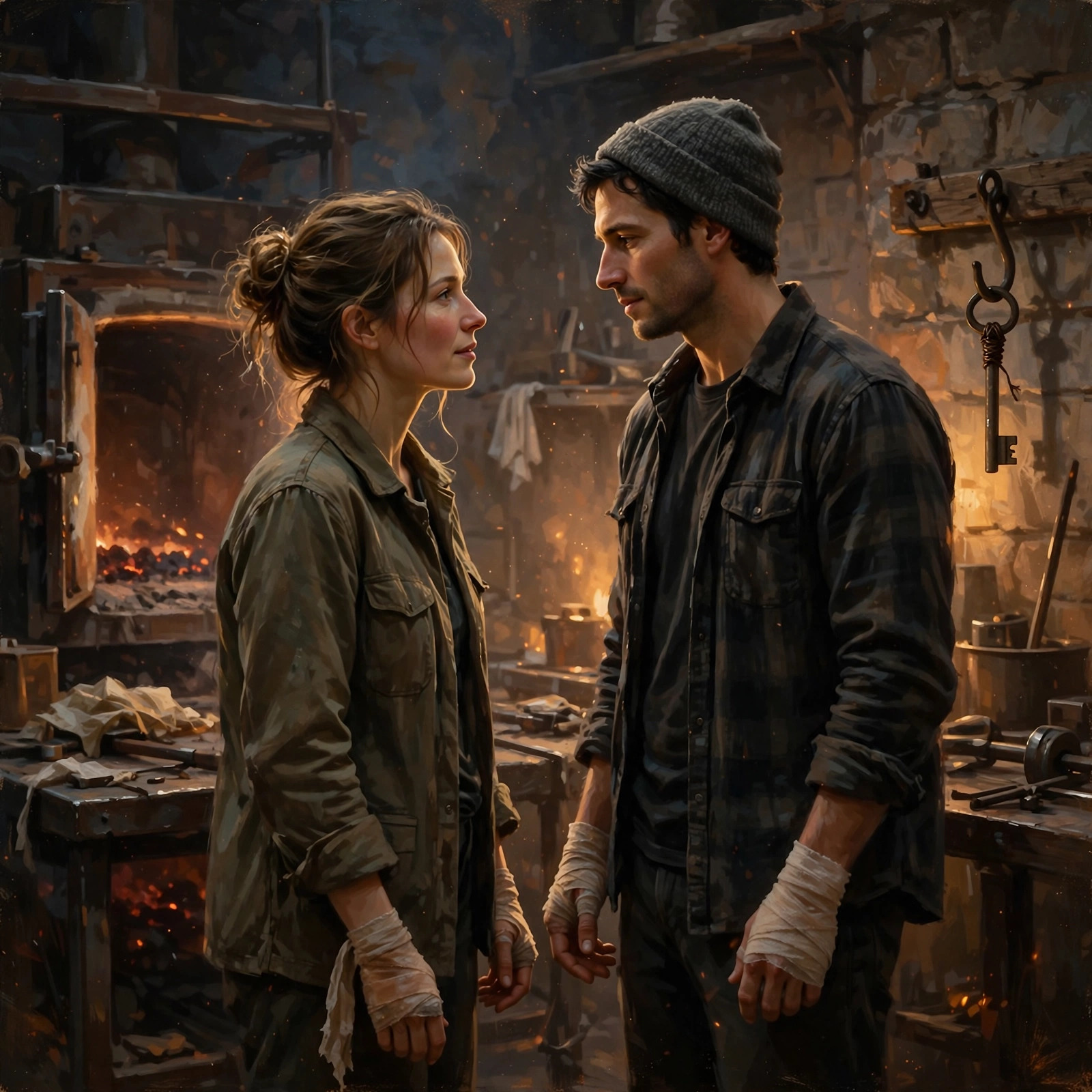
"Most things here are." Joanna leaned against the oven's flank, where the steel panel ticked as it cooled. "Walter's father made it. Hammered it out the year the furnace went in. Walter says it's the only thing in the building that's never lied to him."
"And you gave it to me."
"For a minute."
He didn't give it back. He stood close enough that the gold warmth from the door seam lay across both their faces, and the shop beyond them had gone to its small-hours hum, the pumps, the far tick of the gauge he had checked every half hour since midnight. Dev was out on the loading dock, taking his break with the door propped. Nobody was watching.
"Joanna." He said it carefully, like a measurement. "I should say something sensible."
"Please don't."
"I was going to say this is a bad idea."
"It's an awful idea." She reached up and straightened his collar, which didn't need it. "You're on my floor. You hold a pen that can close us."
"Yes."
"I'd like you to stop talking now."
He laughed, low, almost surprised at himself, and then he stopped. His free hand came to her jaw, rough-palmed and hesitant, and she turned her face into it before he could change his mind. The kiss was slow. It tasted of burnt coffee and the dry heat of the room. She felt the key against her shoulder blade where his fist had closed around it, and she thought, absurdly, that she had finally handed something over and it was being held right.
When they parted, neither moved far. His forehead rested on hers. His breathing wasn't steady.
"I've wanted to do that since you told me I was standing in the wrong place," he said.
"You were."
"I know. I stayed anyway."
She kissed him again, shorter, a promise rather than a question. Then the dock door banged and Dev's boots came scuffing back across the concrete, and they stepped apart like people caught at nothing. Elias slid the key into his coat pocket without looking at it. She noticed. She decided it was only safekeeping.
The rest of the night was quiet in a way she had stopped trusting. At three the union on the gas feed was tight. At four she checked it herself, wrench in hand, and found it tight again, and he stood at her shoulder and said nothing, just let his arm rest against hers. By five the sky over the loading dock had gone the color of dishwater. She dozed upright on a stool, her head tipped against a cool wall, and woke once to find his coat over her knees and him writing in the notebook by the gauge, his back to her.
She didn't ask what he was writing. That was her mistake, and she would turn it over for days.
When she woke properly, the light through the high windows was full and white, and the stool beside her was empty. The coat was gone. So was he.
She found Dev first, hauling a barrow of cullet. "Where's Elias?"
"Office. Walter's office, I think. He took a bag out of his car." Dev frowned. "Clear plastic. With a tag."
Something cold slid down the back of her neck. She walked, then didn't walk. The office door stood ajar. Elias was at Walter's desk with his back to her, and on the blotter lay a sealed evidence bag, and in it, dark against the plastic, her key. A white label had been filled out in his square, tidy hand. Beside it sat a form on the insurer's letterhead, still warm from the printer.
She read the top line, and then the box he had ticked. Furnace floor: provisionally unsafe pending laboratory examination of isolation hardware. The date was today. The time was an hour ago, while she slept in his coat.
"You said minutes," she said.
He turned. His face was gray, shaved badly, and he looked at her with an honesty she could hardly stand. "Joanna, let me--"
"You said you'd hold it." Her voice came out level, which frightened her more than shouting. "I gave you the one thing I've never let anyone carry."
"The union was tampered with twice. The key is the only object that touches both ends of that line. If I don't test it, and it's tested later by someone else, it's worse for you. I had to chain it. I had to file."
"You had to tell me."
"I knew what you'd say."
"Yes. I'd have said no." She picked up the form, folded it once, and put it down again because her hand wouldn't stay still. "That's what asking is for."
He didn't defend it. That nearly undid her. "Walter's been told," he said quietly. "Nothing closes today. It's provisional. But it's on record."
"On record." She thought of a pavement years back, a brigade officer with a notepad, and a man who had said flue when he meant fault. She had spent a decade making sure nobody ever stood there again, and she had walked this one straight to the oven door and kissed him.
"Off my floor," she said.
"Joanna. The line still needs watching."
"Then watch it from the car park." She did not raise her voice. She did not touch the bag, or the key, or the sleeve of his coat as she passed. "You wanted procedure. You have it. Go."
He stood a moment longer, as if there were a sentence somewhere he could still find. Then he took his notebook from the desk and went out past her, close enough that she smelled the oven on his shirt, and she did not turn to watch him cross the shop. She stood among Walter's old ledgers and her own cold anger, and she took back nothing.
The Main Valve
The hiss started at a quarter to five, and Joanna knew it before she knew she knew it.
She was at the glory hole with a gather going cold on her pipe when the sound changed, a thin rising whistle under the roar, like a kettle somewhere deep in the walls. Dev looked up from the bench. His face said it for both of them.
"Pressure's climbing," he called. "Gauge is past the red."
"Pull the crew back." She set the pipe in its rest. "Everyone to the dock side. Now."
They went without argument, aprons flapping, a pair of apprentices carrying the half-made bowls as if they could be saved. Flames in the big mouth leaned and stretched, turned from orange to a hungry blue-white. The floor shivered under her boots.
The key was in her apron, heavy against her hip. Then she remembered, and her stomach dropped. Her hand went to the pocket and found only the small wrench. The key was in a plastic bag on Walter's desk, or in a van, or in a lab with a label in Elias's tidy hand.
"Dev, the auto shutoff."
"Dead. It's been dead since the union." He was already running beside her. "Joanna, we can't get near that valve with the line like this."
"We can if we're quick."
The main valve sat behind the furnace in a niche of old brick, its wheel jammed years ago and kept loose by habit and a square of forged steel. Without the key, there was only the wheel, and the wheel was hot as a stove lid. She tore off a glove, then thought better of it, then did it anyway because the glove was thick and the wheel needed a feel.
"Joanna!"
The voice came from the dock door. Elias, coat open, hair wild, and behind him Walter in his slippers, breathing like a man who had run the length of Hallam Street. She didn't turn.
"Stay back."
"The key," Elias said, arriving beside her. "I know. I know where it is. I'm sorry, God, I'm sorry. Let me."
"Your hands are soft." She gripped the wheel. The iron bit her palm and she made a sound she'd never heard from herself. "Hold the pipe cover. Pull the wrench off my belt."
He did, fast and exact, and fitted the wrench to the spindle flat so she could lever it. Together they leaned. The wheel gave a groan, then a quarter turn, then another. The whistle climbed to a scream and fell to a sigh. The blue light in the furnace mouth guttered and shrank.
Her palm was a stripe of white fire. She kept turning until the wheel stopped, and then she kept her hand on it a moment longer, as if the iron might change its mind.
"Let go," Elias said, very low. "Joanna. It's closed."
She let go. He caught her wrist and turned her hand to the light, and his own face went the color of ash. Dev was already shoving a bucket of water at them. She plunged the hand in and swore at every saint she could name.
Walter stood a few steps off, holding a clipboard he must have grabbed from the office. He wasn't looking at her. He was looking at the brass union beside the valve, where something small and dark was caught in the threads.
"Somebody's been in here," he said. "Who has the late gate?"
Elias took the clipboard from his shaking hand. It was the night gate log, columns of initials and times. He ran a finger down it and stopped.
"Entered through the loading dock at ten past one. Signed out at twenty to two." He read the initials, then the printed name above them. "Cass Hallam-Lowe."
Walter's mouth moved without sound. "My nephew's... Cass keeps the books. Cass has no business on the floor at one in the morning."
"There's a wrench mark on the union," Dev said, squinting. "Fresh. Brass is bright underneath."
Walter sat down hard on an upturned crate. For a long moment the only noise was the tick of the cooling brick. Then he took out his phone, and his voice, when it came, was steadier than she expected. "Yes. I need the police at Hallam Street Glassworks. A gas line has been tampered with. I know who did it."
Joanna lifted her hand from the water. The blisters were rising, shiny and angry. She looked at Elias, who hadn't moved from her side.
"You filed it unsafe," she said.
"I did." He folded the gate log against his chest. "Which means that when the insurer reads it, the floor shuts and the policy lapses, and a man who rigged a pipe gets his payout from the ruins. I won't sign that."
"You'd have to rewrite it."
"I'm going to." He pulled a pen from his shirt pocket and, with his back against the warm brick, began to write on the report's blank reverse. His handwriting was no longer tidy. "Cause: deliberate interference. Isolation hardware removed by me, without the operator's consent, for testing. Floor condition: safe under supervision, as demonstrated tonight. Signed." He stopped. "They'll pull my licence for this. Altering a filed finding. Maybe for good."
"Elias."
"It's the first true thing I've put my name to in years."
She watched him sign. Something she'd held tight since a pavement in another town, since a brigade officer and a lie, let go all at once.
"Then I have to say mine." She kept her voice low, for him and Walter and Dev. "Three weeks ago the pressure spiked on the night shift. Same pipe. We caught it, and nobody was hurt. I didn't log it. I told Dev not to. I thought if it went in the book the works would be shut by Friday." She made herself meet Walter's eyes. "I should have told you. I should have told him."
Walter's face worked. "Joanna, if I'd known..."
"You'd have been right to fire me."
"I'd have been right to listen." He rubbed his forehead with his wrist. "You hid it because you thought it would be taken from us. That's no crime. But you'll put it in writing now."
"I will." Her palm throbbed. "They'll stain my record."
"Yes," said Elias, quietly. "Mine too."
Outside, a siren rose from the end of the street. Dev cleared his throat and lifted the lantern from its hook. The crew had drifted back from the dock, the apprentices pale and silent, and Rosalind's voice buzzed faintly from someone's phone, asking in tinny panic what was wrong.
Joanna reached out with her good hand and shut off the last working lamp. The furnace mouth gave one last wavering glow, thinned to a thread, and went out. In the dark the whole crew stood together, breathing, safe.
Cooled Oven Door
The annealing room had finally gone cold enough to stand in without sweating through her shirt. Joanna pushed the oven door shut with her hip, and it settled with a soft iron sigh.
"You're early," she said, without turning around.
"I was told six." Elias stood in the doorway with his coat over one arm, no clipboard, no case. His hands looked strange empty. "It's ten to."
"Ten minutes is early."
"Then I'll wait outside."
"Don't you dare."
He came in. The room smelled of old ash and warm brick, and the single work lamp threw their shadows long across the racks where the week's cooled pieces sat in rows, each one wrapped in paper like a sleeping thing. Her own bowls were there. One of Dev's lopsided vases, which he swore was intentional.
Joanna lifted the key from the bench. Somebody at the lab had cleaned it, which she resented a little. The soot was gone from the bow, and the forged edges showed bare and bright. But Walter's father's hammer marks were still there, and when she closed her fist around it, the weight was the same.
"They sent it back this morning," Elias said. "The courier wanted a signature. I signed for it twice, just to be sure he didn't take it away again."
"Walter cried, you know. Quietly. Into a tea towel."
"I believe it."
She held up the other thing she'd brought, a strip of tan leather she'd cut from an old apron and soaked soft the night before. Beside it lay her small wrench, which she'd carried every working day for years and never once thought of as a habit until now.
"The grip's been bare since 1974," she said. "My thumb finally wore a groove in it. I thought it was time."
She started winding. The leather fought her, then gave. Elias watched her hands, and after a moment he stepped close enough to hold the end taut, his knuckles brushing hers. Neither of them remarked on it. She tied off the cord with her teeth and he laughed, short and surprised.
"What did the board say?" she asked, still looking at the knot.
"You know what they said."
"I want to hear it from you."
He let go of the leather. "Suspended. Eighteen months, then a review. I can't sign a finding for anyone until it's done." He turned his coat over in his hands. "The underwriter read the amended report twice. Their man called me, which I didn't expect. He said they'd rather insure a floor with an honest inspector's name on it than a clean one with none. The policy stands. The works stays open."
She breathed out. She'd known for two days, because Walter had told the whole crew over bad coffee on the dock. But it was different, hearing it in this room, in his voice.
"And mine," she said. "A note on the file. Unreported incident. It follows me to any shop that asks."
"Joanna."
"No, listen. I'd have said I couldn't survive that. I've spent years arranging my life so nobody could write that sentence about me." She almost smiled. "It's just a sentence. I'm still standing in it."
"You're standing in it very well."
"Walter's selling the crew a share. Did he tell you that?"
"He told me. He also told me he'd wanted to for ten years and needed a fright to do it." Elias set the coat on the bench. "I've been offered a post in Dunmere. Teaching floor safety to shops that don't think they need it. I start when I'm allowed to stand near a furnace again."
"Dunmere's an hour away."
"Forty minutes, if the road's clear."
"You've timed it."
"I've timed it three times." His mouth twitched. "I'm told that's not a normal thing to admit."
She crossed the room to the hook above the oven, the old black one, bent a little by decades of the same weight. The key swung when she lifted it, caught the lamplight, and hung there, leather pale against the dark iron. Her hand stayed on it a moment.
"I was so angry," she said, to the key. "When I found the bag. It wasn't only that you'd filed it. I'd handed you the one thing I never hand anyone, and you took it like it was evidence."
"It was evidence."
"I know. That's the part I hated."
"I should have told you first. I knew it that morning, with the pen in my hand, and I wrote it anyway. Because the rules were clean and you weren't." He said it plainly, without flinching. "I've spent years hiding behind a procedure so I'd never have to be the one who chose. I'm done with that. I'd rather choose wrong in front of you than right behind your back."
She turned. He was close, and not hiding anything at all, his face open and tired and a little afraid.
"I love you," she said. It came out ordinary, no more breath than the words before it. "I'm not saying it because of the report, or the dock, or what you gave up. I was going to say it before any of that. I just didn't know where to put it."
"You put it here."
"Say it back, Brandvold."
"I love you." His voice cracked on the second word and he didn't try to fix it. "I've loved you since you told me my boots were a fire hazard."
"They were."
"They were," he agreed, and she kissed him.
It was slower than the first time. No adrenaline in it, no dark floor and failing lamps. His hand came up to the back of her neck, careful, as if she might still bolt, and she pulled him in by his shirt until there was nothing left to be careful about. The oven ticked behind her as it gave up the last of its warmth. Somewhere beyond the wall a crew was packing up, and someone laughed, and a phone rang with a ringtone that could only be her mother's.
"Let it ring," Joanna murmured against his mouth.
"She'll come looking."
"She'll bring soup."
"Then we have about eleven minutes."
She laughed into his collar, and his arms closed around her, and the lamp hummed on. They stayed in the dim room, the key swinging on its hook.
Get notified when new stories drop

Serena Blake
Serena writes romantic suspense and dark romance for readers who want pulse and payoff. Her stories chase trust as hard as they chase danger.
Leave a comment
Comments