


Wire and Sawdust
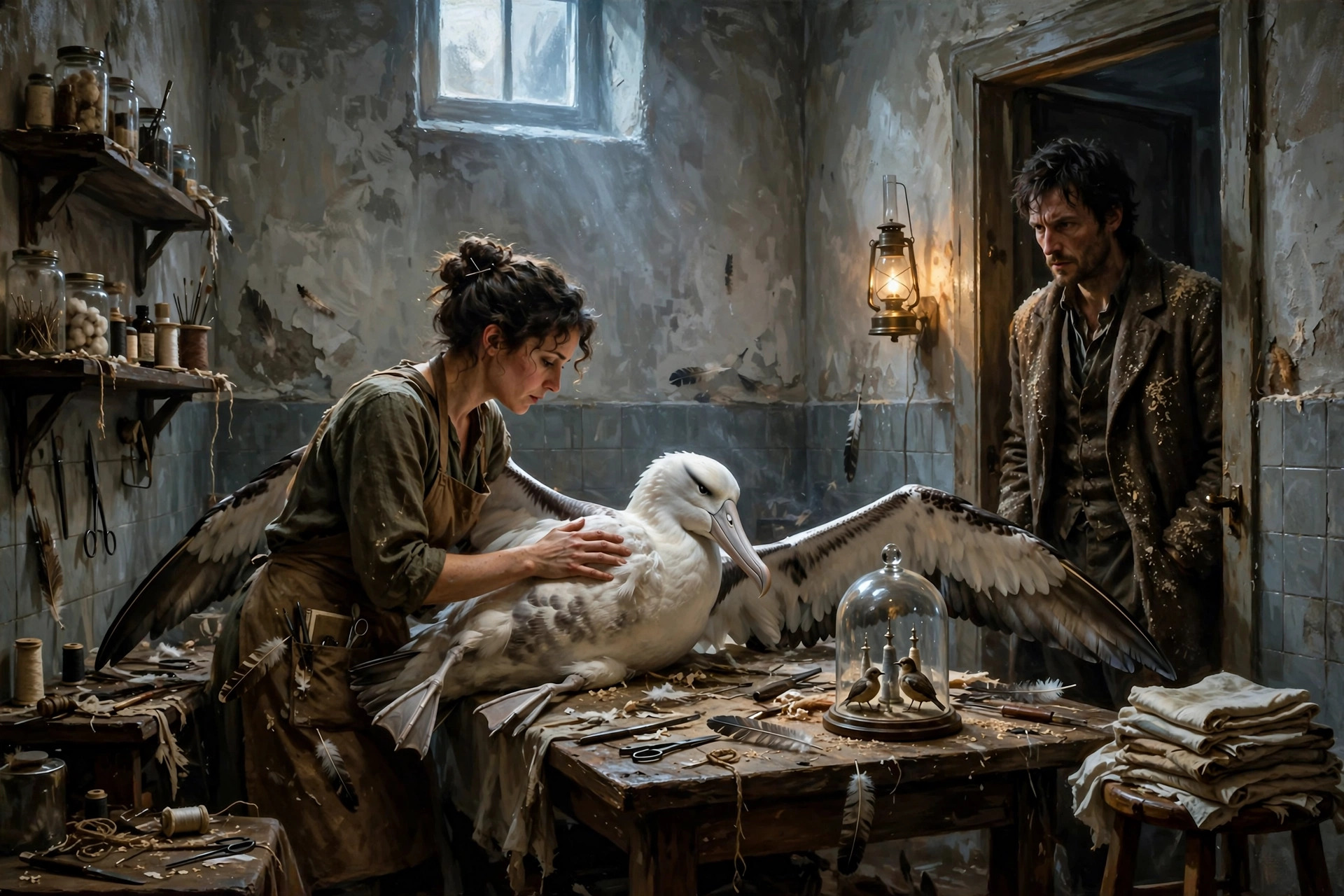
"It goes under your name, Mr. Fenmoor, and that's the end of it." Hester did not look up from the albatross. She had one hand flat on its breast and the other working a length of brass wire through the left wing, and the wire was not cooperating.
"It most certainly is not the end of it." Gabriel Fenmoor stood in the prep room doorway with his hat still on and sawdust already settling on his good coat. "Mr. Pettibone tells me the label is to read as my work. I have not so much as touched the bird."
"You're the curator. Curators are named."
"Curators are named for what they do."
"Then you'll be named for hanging it straight."
He came in. The room was narrow and cold, lit by one high window, and the great bird filled most of it, wings half-spread over the long table like a sail that had lost its ship. Her mother's linings lay folded on a stool. A tall bell jar stood on the workbench with a nest of finches under it, quite small beside the albatross.
"Miss Wainscott. I've read the ledgers. Eight years of mounts, and every label in the Rooms carries some gentleman's name. Whose names are they?"
"Whoever the committee finds convenient." She bent the wire hard. "It has always been so. It will be so for the Jubilee. I'd thank you not to make it a conversation."
"I'd like to make it a conversation."
"I'd like to finish a wing."
He took off his hat at last and set it on the sill, which she noticed, and resented noticing. He was tall and a little untidy, with ink on one cuff. He looked at the bird as if it were owed an apology.
"I am not the sort of man who takes another person's work," he said quietly.
"Every gentleman says so, right up until he does."
That landed somewhere. She saw it in the way his jaw set, the way he said nothing at all for a moment. She had expected a speech. Instead he looked at his own hands.
Her father's hands had looked like that, once, at the kitchen table, reading a journal that printed his findings under another man's name. She pushed the memory down where she kept it and pulled at the wire again.
It was the wrong pull. The brass, already bent too many times, gave a small bright crack and sprang apart in her fingers. The loose end whipped across her knuckle and left a thin red line.
"Damn," Hester said, and flung the broken length at the wall. It rang off the plaster and skittered under the table.
Gabriel was beside her before she had finished swearing. "Let me see."
"It's nothing."
"It's bleeding on the albatross."
She snatched her hand back and looked. A single bead of red sat on the pale feathers of the breast. She pressed her apron to it, rubbed, and made it worse, and then both of them stood very still, as if the bird might wake.
"Cold water and salt," she muttered. "Leave it."
"I'll fetch it."
"You'll do no such thing. You'll go up to your office and write the committee a letter about how impressed you are by your own modesty."
"Miss Wainscott." He said it gently, and that was the infuriating part. "The hall opens at midsummer. Mr. Pettibone has told me, twice, that if this bird is not hung and the hall not paid for, the subscribers will close these doors. I have had the keys a year. I don't intend to hand them back with the bird still on a table."
"Then you'd better pray for forty good hours from me."
"Forty?"
"Near enough. Wing, shoulders, lining, the head, the feet." She counted them off against her bandaged knuckle. "I work alone. I have always worked alone."
"And how has that served you?"
She opened her mouth and found nothing sharp enough ready. He took the pause the way a careful man takes a loose stair.
"I can't wire a wing," he said. "I'd ruin it. But I can hold things. I can fetch things. I've sat up with specimens since I was a boy, and not one of them ever complained of my company."
"They were dead."
"Yes. Very restful." The corner of his mouth moved. "Give me something to do, Miss Wainscott. Anything. I'll not stand about like a man at a christening."
She should have refused. Her mother would have said so, and her mother was upstairs sewing and not here to say it. Hester looked at him, at the sawdust on his sleeve and the stubborn set of him, and thought, he will not leave until I give him something.
Also, the lining on the left side was only half closed, and the light was going.
She crossed to the stool, took a curved needle from the cushion and threaded it with waxed linen, short, brisk, not gentle about it. Then she held it out between two fingers, point turned away from him.
"The belly lining. Small stitches, close together, and pull each one snug but not tight. If you tear the skin, I will know, and I will not forgive it."
He took the needle as though it were a fine instrument and he feared to bend it. "Show me where."
"There. Along the seam my mother basted." She pointed with her chin. She did not take his wrist, though she thought of it, and thought better.
He leaned over the bird. His coat sleeve slid up and she saw that his hand was not quite steady, which pleased her more than it should have. He set the point to the edge of the lining, frowned, and pushed.
The needle went through with a faint dry sound. He drew the thread, too loose, then too hard, so the linen puckered into an ugly little knot beside the seam.
"Oh dear," he said.
Hester folded her arms and watched, the red line on her knuckle stinging, and said nothing at all.
The Finch Nest
"You've had your boots on the fender again," Agnes said, and moved the teapot out of Gabriel's reach before he could pour. "Sit. Hester, the good cups."
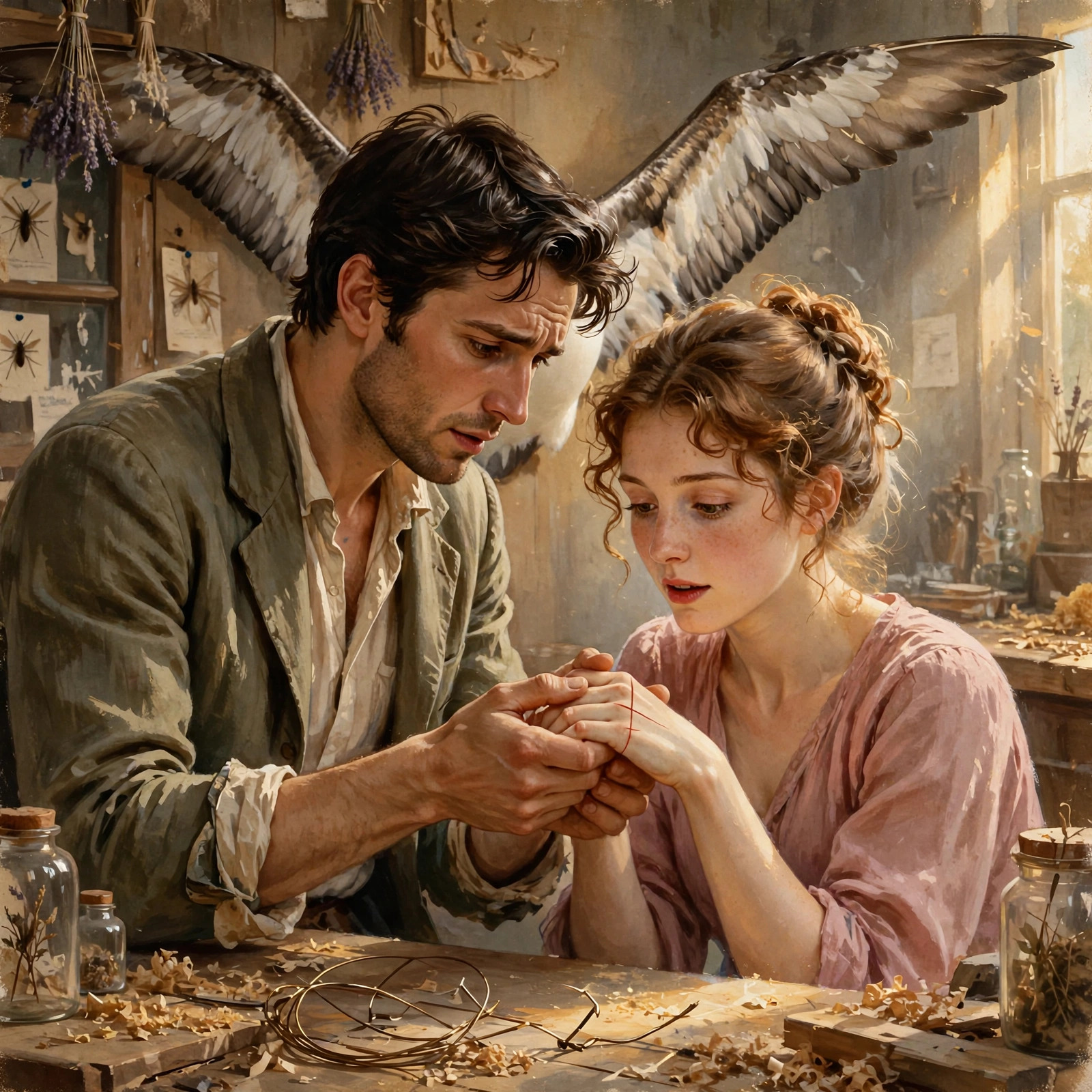
"He's only come to collect the lining."
"He's come for tea. I can tell by how he's standing."
Gabriel, who had been standing in the Wainscott kitchen doorway with his hat in both hands, looked at Hester as if she might rescue him. She did not. She took down the good cups, the ones with the chipped gilt rim, and set them on the scrubbed table with a little more noise than they needed.
It was the fifth evening he had walked her home from Linden Street. Nobody had arranged it. He simply had a way of being at the door with her shawl when the light went. Tonight the rain had turned the lane to pewter, and her mother had seen him from the window and sent the neighbour's boy running.
"Mr. Fenmoor," Agnes said, pouring. "My daughter tells me you can sew."
"Your daughter is generous."
"She said you sew like a man defusing a clock."
"I said no such thing."
"You said it with your face," said Agnes, and passed him the sugar. "Hester's father had the same hands. Great clumsy things for such small work. Never lost a stitch in his life."
Gabriel's cup paused halfway. His eyes had gone past her shoulder, to the dresser, where the bell jar stood on its walnut base with the finches inside. Hester had carried it home on the third night. She could not have said why. It had seemed wrong to leave it among the benches, with the glue pots.
"That's his," he said quietly.
"My father's," said Hester. "Eighteen sixty-one. The nest is horsehair and lichen, and the finches are goldfinch, three of them. He took a month over the youngest."
"May I?"
She nodded. He crossed the flagstones and bent to the glass without touching it, close enough that his breath dimmed it. The birds sat in their small eternal alarm, beaks open, one wing half lifted.
"They're alive," he said. "I don't mean the word loosely. Look at the feet. Nobody does the feet like that."
Something in her chest shifted, uncomfortably, like a drawer long stuck.
"He exhibited it once," she said. "At a county show. A gentleman from the Leeds society looked it over and asked to carry it home to show his friends. Two months later it was in the catalogue, under his name, with a gold medal beside it. My father went to see the man. Came home and said nothing for a week."
"And the medal?"
"Was never sent back. The jar was. The man was gracious about it." She heard her own voice go flat and dry. "Father died the winter after. People remembered the gentleman very well."
The kettle ticked on the hob. Agnes had found something urgent to do with the bread knife.
Gabriel straightened slowly. She waited for the soft face, the murmured sorrow, the hand on her arm. He gave her none of it. He looked at the finches a moment longer, then at her.
"Thank you for showing me," he said. "I'll not say I'm sorry. It's too small a word and you'd hate it."
"I would."
"Then I'll say the feet are the best I've ever seen, and leave it there."
Agnes set down the knife and looked at him a long moment over her spectacles. "He's got manners, Hester. Where did you find him?"
"He was sent. By the committee."
"Then the committee has done one sensible thing this decade." She buttered a slice and put it on his saucer without asking. "Eat. You've the look of a man who dines on specimens and other people's opinions."
"Mother."
"He's smiling. He doesn't mind."
He did not mind. He ate the bread, and Hester watched him do it, the tired line of his shoulders easing by degrees, and thought, with some alarm, that her kitchen had never held so much of a man before.
The wing was waiting at the Rooms the following afternoon.
The prep room smelled of arsenical soap and cold plaster, and the albatross lay on its armature under the north window like a vessel in dry dock. Its right wing was set, a long white sweep of feather and wire. The left hung loose from the shoulder, eleven feet of dead weight if one counted the span, and Hester had put off the thing for four days because it needed two pairs of hands.
"I'll take the tip," Gabriel said. He had his coat off, his cuffs turned back. "You tell me when."
"You'll lift it level. Not up. Level. If it tilts, the quills crack at the root."
"Level."
"And if I say stop, you stop, and you do not apologise, you simply stop."
"I do apologise a great deal."
"I've noticed."
He took the wingtip in both hands as though it were a sleeping child. She went to the shoulder with the pliers and the length of brass wire, and for a while there was only breath and the small creak of the stand. The wing rose. It trembled once, and she saw the muscle jump in his forearm and said sharply, "Hold," and he held. He did not speak. His eyes stayed on the feathers, steady, patient, utterly unhurried.
Footsteps sounded in the corridor. The door swung and the porter put his head in, a heavy man with a ledger under his arm.
"Mr. Fenmoor, sir, Mr. Pettibone's asking is the bird coming on? He says the committee likes to hear it's your work."
Hester's hands stilled on the wire. She waited for it, the easy lie, the polite assent. She had heard it all her life.
"It's coming on," Gabriel said, not turning his head. "Miss Wainscott has the matter in hand. You may tell him that exactly."
The porter blinked, nodded, and went.
Neither of them spoke of it. He had said it as he might have said the weather, and gone on holding the wing level. In four days she had not once heard him tell anyone what he had done, or what he had held, or who had stood beside him. She had noticed. She had also decided not to notice, which was a different thing and had stopped working somewhere around Tuesday.
"Now," she said. "A hair to the left."
He moved it a hair. She fed the brass wire through the shoulder, twisted, drew it down. The wing settled into its line with a sound like a long exhale, and the whole great bird seemed to lean into the air that was not there.
The wire slipped in her fingers. He let go of the tip with one hand, fast, and closed it over hers, warm and rough, pinning the twist in place.
"There," he said, low.
The wing sat true. Hester laid her other hand over his, and held the wire still until neither of them needed to.
Crane House Glasshouse
"You will both come and see the orchids," Lady Philippa said, in the tone other people used for sentencing. "Now, before the light goes. Gabriel, offer Miss Wainscott your arm."
Gabriel offered it. Hester, who had come to Crane House only to deliver a measured drawing of the albatross's plinth, looked at the arm and declined it with a small nod. Her boots were still dusty with the prep room. She followed them through the long passage with her portfolio held against her chest like a shield.
The glasshouse breathed at them when the door opened. Warm, wet air, the smell of bark and green things. Every pane ran with condensation, and beyond them the afternoon was going the colour of pewter.
"Forty years I have kept this house," Lady Philippa said, walking ahead with her stick, "and it has never once been so well looked after as in this last year. My nephew says the Rooms are the same. I am pleased to hear it."
"They're improving," Gabriel said.
"They are being rescued. Do not be modest, it is tiresome in a Fenmoor." She stopped before a bench of speckled blooms, pale as candle wax, and touched one with a gloved finger. "Mr. Pettibone dined here on Sunday. The committee is agreed on the Jubilee. The bird will hang, the hall will be paid for, and the card beneath it will carry the name Fenmoor. It is not a matter for discussion."
Hester kept her eyes on the orchid. A drop of water slid down its lip and fell.
"A brewer's name?" Gabriel said, very quietly.
"A name that opens subscribers' purses. Yours, Gabriel, is a good deal more useful than a seamstress's daughter's, however clever her hands. Miss Wainscott understands. She has understood it all her life, I should think."
"I do, my lady," Hester said.
It came out level. She was proud of that, and sick with it. She had said those words to a Leeds gentleman once, in her head, standing at the back of a cold hall while her father's finches sat under another man's card.
She looked at Gabriel. He stood with his hat in both hands, turning the brim slowly, a quarter turn and a quarter turn. His jaw worked. His mouth opened a little, and she saw the sentence gather behind it, and then she saw him swallow it whole. He looked at the floor tiles. He said nothing at all.
So that was how it would be. Hester felt something in her chest go small and cold and tidy, a drawer shutting. She had half hoped. She hated that she had.
"Splendid," said Lady Philippa, who took silence for assent as other women took tea. "Now come and look at this one properly, Miss Wainscott. It was brought from Java in a Wardian case and very nearly died on the road."
Hester looked at it properly. She admired its roots and its patience. When she was dismissed, she curtsied, and her portfolio left a damp print on her bodice.
Rain had begun by the time they reached the gate. It came down fine and straight, the kind that soaks without announcing itself. Gabriel walked beside her down the hill toward the town, a careful yard apart, and for the first street neither spoke.
"You might have said something," she said at last.
"Yes."
"You might at least argue with her."
"I've never won an argument with her. I stopped trying at about eleven." He wiped rain from his eyes with the back of his wrist. "It isn't an excuse. I know what it looked like."
"It looked like a man who has let a great many things pass."
He laughed, short and unhappy. "That's very exact."
"I'm exact. It's my trade." She stepped round a puddle and he took the outside of the pavement without being asked, so the carts splashed him instead. She noticed. She was getting tired of noticing. "Why do you hold your tongue? Truly. You hold a wing level for an hour and tell a porter the truth, and then in a glasshouse you turn into a hat."
He was silent for a good twenty paces. The gutters ran loud beside them.
"When I was a boy I wrote up a beetle," he said. "Properly. Measurements, drawings, a paper for a society. My father put the family name on the front and said it would be read the sooner for it. It was. Nobody ever asked who had spent three summers on his stomach in a ditch." He looked straight ahead. "I learned that if I did anything for another person, it would be taken as mine to gloat over, or theirs to be taken from. So I do the thing, and I say nothing, and no one can be robbed."
Hester's step slowed. She had expected excuses. She had not expected her own father, set down in other words, in a stranger's mouth.
"That isn't safety," she said. "It's only a quieter way to be robbed."
"I'm beginning to see that."
The rain thickened. It ran off her bonnet brim in a thread, and her shawl had gone heavy on her shoulders, and the cut across her knuckle had started to sting again. She tucked her hand under her arm. He saw. Of course he saw.
"You're shaking," he said.
"I'm cold. It isn't the same."
"No." He was already unbuttoning his coat. "Please don't tell me you'd rather catch a chill than owe me a coat."
"I'd rather not owe anyone anything."
"Then you may think of it as a loan against the wing."
It was absurd enough that she nearly smiled. He settled the coat over her shoulders, wool still holding the heat of him, smelling of camphor and old paper and rain. He stepped back at once, as if he had touched something that might spring.
She should have handed it back at her mother's door. She knew it quite well, all the way up the lane, with the hem dragging at her heels and him walking bareheaded and soaked beside her. She said goodnight at the gate with her fingers closed hard on the lapels, and she did not give it back.
The Cut Wire
"Hold the tail feather up a moment longer," Hester said. "No, higher. There."
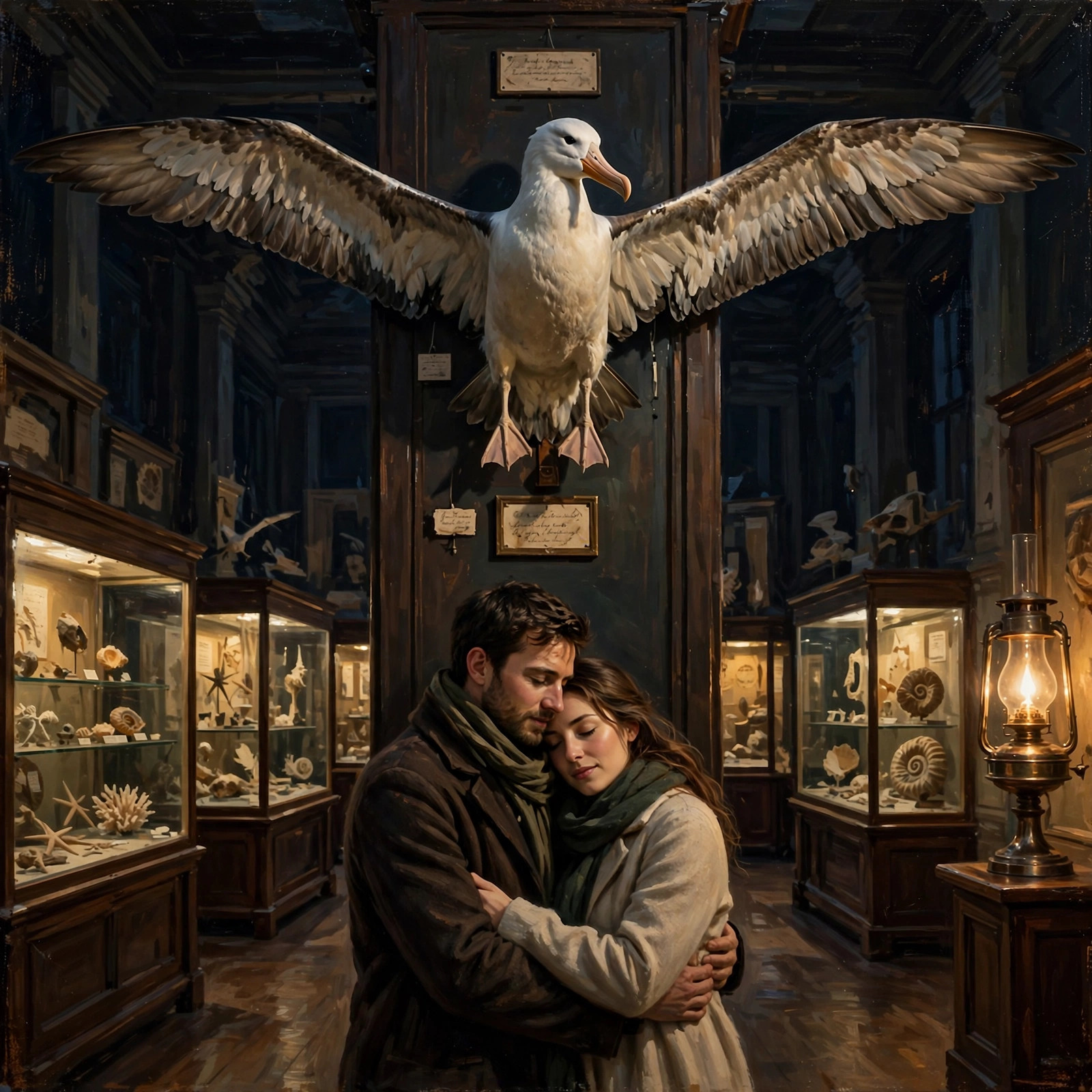
Gabriel held it. Lamplight lay along the primaries, and the albatross hung from its stand with both wings spread, wider than the prep room had any right to allow. Sawdust drifted in the light. Somewhere under the bench lay the last snipped end of wire, and she had stopped looking for it an hour ago.
She tied off the final stitch beneath the wing joint and bit the thread. Then she stood back and there was nothing left to do.
"It's finished," she said, and the words came out smaller than she meant.
"It's finished," he agreed, very quietly, as though the bird might wake.
She had not slept properly for a week. Her fingers smelled of arsenical soap and her hair had come half down. Gabriel looked no better, with his waistcoat unbuttoned and a smear of glue across one cheekbone. She almost told him so. Instead she reached up and wiped it away with her thumb.
His hand closed over her wrist. Not hard. He only held it there, against his face, as if asking.
She had never been asked so plainly in her life.
She kissed him. Or he kissed her. Afterward she could not have said, and it hardly mattered. His other hand found the back of her head and a hairpin fell and rang on the floor. She tasted tea and cold air. Wire spools rolled off the bench behind her and neither of them looked. Her heart went on knocking against her ribs, stupidly glad, and for the length of that kiss she forgot every name she had ever stood behind.
When they parted he was laughing under his breath, and so was she.
"I've wanted to do that since you told me to mind my elbows," he said.
"You were standing on my pattern."
"I was. I'd stand on it again."
He kept hold of her hand. Then he turned, still smiling, and looked up at the albatross with real wonder, the way he had looked at nothing else in the Rooms.
"Hester. Look at what we've made."
She smiled at the "we." She would think about that later, and about how nearly she let it stand.
"I read the label this afternoon," he said. "The proof from the printer's. Pettibone left it on the table." He squeezed her fingers. "I'll say it plainly at the opening, before the whole committee, if my aunt allows it. I'll thank you. But for tonight, let me say it here." He turned to her, bright-eyed, and said, "Thank you for my albatross. I'll never deserve it."
The warmth went out of her all at once, like a lamp turned down.
My albatross.
He had read the label. He had read his own name set in lead over her forty hours, her bleeding knuckle, her mother's lining stitches, and he had thanked her for it as a gentleman thanks a clever servant. She heard it all in that one word. She heard Leeds, and the finch nest under its glass, and her father coughing through the winter with his name gone from the card.
And under that she heard herself. She had let it stand. She had known the proof was coming and said nothing, and she had told herself it was only the rule, only the committee, only one more summer.
That was what made her angry. Not him.
"Say that again," she said.
His smile faltered. "Hester?"
"Your albatross."
"I only meant--"
"I know what you meant." She drew her hand out of his. It was steady, and that frightened her a little. "You meant it kindly. They always do."
"I don't understand."
"No. You wouldn't, because I never told you." She crossed to the bench and took up the long shears, the ones she used for canvas and tough sinew. "I never told you the name was wrong because if I told you, you'd have to choose. And I wanted to see whether you would."
"Choose what? Put it down, please."
She climbed onto the low stool beside the stand. The wire at the left wing root was cold and bright under her fingers. She set the blades to it.
"Hester, don't."
The first cut rang like a struck pane. The wing sagged an inch against its brace. He took one step toward her and stopped, as if the floor had shifted, and his hands came up empty. She cut the second wire. The right wing dipped, then hung, all that wide white sweep gone slack. Feathers shivered. Dust rose from the stand and glittered in the lamp.
"Take it," she said. Her voice shook now and she hated it. "Take it under your own name, Mr. Fenmoor. That's what's wanted. A bird that belongs to a gentleman. I'll not finish it for you to hang my work on."
"I never asked for the name."
"You never refused it either." She got down. The shears slipped out of her hand and struck the boards. "You hold your tongue and call it kindness. I held mine and called it sense. And my father is dead of it."
He looked at the wings. Then at her, and his face was the face of a man who has been struck and cannot find the place. "I would have said something," he said. "If you'd told me."
"Would you?"
He did not answer. That was the worst of it. He honestly did not know.
She took his coat from the peg where it had hung for four days and pushed it into his arms. He held it like a thing he had not expected to be handed back. Then he went to the door, slowly, and did not look at the bird again. On the threshold he paused, and she thought he might speak, but he only bowed his head.
The latch clicked. His steps went down the passage.
The shears lay on the floor where she had dropped them. Hester stood a long while with the lamp ticking beside her. She did not see the sawdust on his sleeve as he went, brushed there when he caught the stand, but she would remember it afterward, pale against the black cloth, as if he had carried a little of the work out with him.
Pettibone's Counting Room
"Forty hours," Hester said, "and I've had the bird back on its stand since dawn, so don't tell me the hour."
Her mother held a pin crossways in her mouth and said nothing until the lining was drawn tight. Agnes Wainscott had sewn skins for thirty-five years and did not waste breath on a woman who was already working. Then she took the pin out. "Your father would have cursed you for cutting those wires."
"I know."
"He'd have rewired them himself before breakfast."
Hester laughed, a poor cracked sound, and bent to the left wing root. The new wire was thicker than the old. She threaded it through the armature and bound it, and the wing came up an inch at a time under her palms until it hung in the lamplight as it had before. Her fingers ached. Outside the prep room window the lane went from black to grey. She had slept in a chair twice that week and in her clothes once, and she had not once let herself look at the peg by the door where a coat used to hang.
Gabriel had not come back. Three days, and not a note. She told herself that was the proof of it.
Then a boy from Crane House arrived with a card, and the card said Mr. Pettibone's counting office, noon, the whole committee. Her name was not on it. She read it twice.
"You'll go," said Agnes.
"I'll go when the bird's done."
"You'll go now, and take the jar."
Hester looked at her. The bell jar stood on the dresser where it had stood since the Leeds winter, the finches inside it still bent over their little woven cup, the glass clouded faintly at one edge by a century of Harrogate damp, or so it felt. Her father's hands had turned the walnut base. Three hundred pounds was the hall fee, and she had perhaps forty.
"Mam. I can't."
"He's not in it. You know where he is." Agnes tapped her own chest, once. "Take it."
Pettibone's counting office smelled of ink and coal and wet wool. The committee sat along one wall like crows on a rail. Lady Philippa Crane-Ostler occupied the only good chair. Mr. Pettibone stood behind his ledger with the printer's proof flat under his hand, and when Hester came in carrying a crate in her arms he frowned as though a dog had entered.
"Miss Wainscott. This is a private session of the subscribers."
"Then I'll be private in the corner."
She set the crate on the floor. Gabriel stood by the window. He was in yesterday's collar, and he looked at her once, quickly, then away, as if she were a lamp he'd been told not to stare at.
"Mr. Fenmoor has a statement," Pettibone said, with the air of a man bracing for weather.
"I have." Gabriel crossed to the table. He took up the pen, tested it on the blotter, and did not sit. "I resign the curatorship of the Rooms, effective now. My keys are on your ledger, Mr. Pettibone."
The keys were. Nobody had seen him put them there.
Lady Philippa's fan stopped. "Gabriel."
"Aunt." He said it gently. "The albatross is not mine. I let it be called mine because I was frightened of a quarrel, and the quarrel cost someone who didn't deserve it. I won't do it again."
"You'll do as you're bid, or you'll do without."
"Then I'll do without."
"The house. The brewery shares. Your father's, your grandfather's, everything I have held for you." Her voice did not rise. That was what made it dreadful. "You will not find a second door open."
"I know it."
Hester's mouth had gone dry. She wanted to say stop, and she wanted to say nothing, and she stood with her hands knotted in her apron while he drew the proof toward him. He struck through the line that bore his name. He wrote, in a hand that did not shake, Mounted by Hester Wainscott, and signed beneath it as witness.
"There," he said. "The work is hers, and the committee may thank her or not."
A silence followed. Someone coughed. Pettibone looked at the proof, then at the room, then at his ledger, and Hester saw the arithmetic cross his face: the hall, the Jubilee, the visitors, the fee.
"The sum is three hundred pounds," he said. "Due this week. The Rooms cannot carry it, and her ladyship's guarantee, I take it, is withdrawn."
"It is," said Lady Philippa.
Hester bent and lifted the cloth from the crate.
The jar caught the window light and threw it up the wall. The finches sat in their nest as they always had. She heard Gabriel breathe in sharply behind her. He knew what it was. She had told him once, at the kitchen table, with the kettle going.
"There's a dealer in Leeds who's wanted this for years," she said, to Pettibone and not to anyone else. "He'll pay what's owed. Mr. Fenmoor has given up more than I'd have asked of any man. I'll give up this. The fee will be paid by Thursday, and the bird will hang by Saturday, finished, with my name on it, or none will."
"Hester," Gabriel said, low.
"Don't. It's mine to sell."
She did not look at him. If she looked, she would take it back. She put her palm on the glass, cold and smooth, and thought of her father's thumb on the walnut, and she let go.
The dealer's man came by two. By four the money lay in Pettibone's ledger, and by evening the empty place on the dresser had a pale ring in the dust that her mother wiped away without a word.
She worked through that night and the next. Gabriel came on the second, quietly, and held the lamp. He said nothing. She said nothing. When the last glass eye was set he put his sleeve to his face and she pretended not to see.
On the morning of the opening, the committee voted in the counting office with the bird already hung in the hall. Pettibone read the motion. Hands rose along the wall, slowly, then more quickly, until only Lady Philippa's stayed in her lap, and she was looking at the ceiling. Pettibone dipped his pen. He signed. The others signed after him, one by one, and Hester stood in the corner and watched her name dry on the label, in ink, in her own right, and the vote settled.
Under the Skylight
"You've swept the same board three times," Gabriel said.
"It's a long board." Hester kept the broom moving. The last visitor had gone an hour ago, and the hall had the tired, trodden hush of a place that had held too many people for too long. Paper programmes lay under the benches. Someone had left a glove on the rail of the case of petrels. "And you've straightened that placard until it's crooked."
He looked at it. He took his hand away. "So I have."
The lamps along the walls had been turned down by the caretaker, who had said good night to her by name, her own name, as if he had always used it. She had carried that all evening like a coin in her pocket, turning it over when no one watched.
She leaned the broom against a pillar. Above them the albatross hung beneath the skylight, wings spread wider than the two of them could have reached with their arms out. The last of the dusk came down through the glass and silvered the long feathers along the edges. She had set every one. She knew where the wire ran under the skin and where her mother's stitches lay hidden in the lining, small as a seam in a glove.
"It looks as if it's still flying," Gabriel said.
"That's the whole trouble with it. It'll want dusting for a hundred years."
"Then I hope someone keeps on."
She glanced at him. He stood with his hat in his hands, turning the brim, his coat a plain one now, the good gray one gone to a pawnbroker's or a cousin. He had carried boxes for the committee that afternoon. Nobody had asked him to. Nobody had stopped him.
"Gabriel."
"I know what you'll say. That I oughtn't to have done it."
"I was going to say you've a smear of plaster on your cheek."
He rubbed at the wrong one. She crossed the boards and wiped the right one with her thumb, and then she did not take her hand away.
"I thought I'd be sorry by now," he said. His voice was quiet, pitched for the rafters and no one else. "I keep waiting. I keep checking, the way you press a bruise. My aunt's carriage went by the window this afternoon and didn't slow, and I thought, there it is, now it will come. And it didn't. I only felt lighter."
"You've no money."
"I've a trade I mean to learn, if someone will have me. And a few good boots."
"I could use a man who can hold a lamp." It came out dry, and then it caught in her throat, because he was smiling at her with his whole stupid, tired face, and the dryness gave out.
"Hester." He set the hat down on the nearest bench, carefully, as if it might break. "I should have said it in the prep room, before any of the rest. I let a great deal go by in my life without a word, because a word felt like claiming something. I won't let this go by. I love you. Not the bird, not the work, though God knows I love those too. You. I'd have loved you standing in that kitchen with nothing at all to your name but a kettle."
She had meant to be composed. She had practiced composure for eight years, in doorways, at committee tables, behind other men's initials. It went from her at once.
"You fool," she said. "You gave up everything."
"Almost everything."
"I sold my father's jar. I stood there and I couldn't look at you." Her eyes stung and she let them. "I thought if I looked I'd take it back, and then I'd be the same woman, hiding under a name that wasn't mine. I was so afraid of being robbed again that I nearly robbed us both."
"You paid for it. I saw."
"So did you." She took his lapels in her fists, just to have something to hold. "I love you, Gabriel. I've loved you since you held the wire and didn't say a word about how badly I'd done the joint. I didn't know what to do with it. I still don't. But it's yours, if you'll have it, and I'll not call it a loan."
"I'll not give it back."
"Good."
He drew her in then, and she went, her forehead against his collarbone, the wool smelling of dust and lamp oil and rain. His arms closed round her slowly, as though he were setting a wing he did not want to bend. She felt him breathe out against her hair, long and unsteady, as if he had been carrying that breath for months.
"Your mother will want to know whether I'm a respectable prospect," he murmured.
"She's already asked. I told her you were a very poor one."
"And?"
"She said she'd sew your buttons on regardless."
He laughed, and she felt it through both their coats. Then he went quiet, and so did she, and for a while there was only the tick of the cooling lamp glass and the faint wind moving over the skylight. She turned her head. Over his shoulder the albatross hung in the failing light, wings wide, a small neat card pinned below it in a clear black hand. She did not need to read it. She knew what it said.
She stayed where she was, and he did not let go, and the two of them stood beneath the wings while the lamps burned low.
Get notified when new stories drop

Ivy Chen
Ivy writes historical and second-chance romance with period texture and modern emotional clarity. Courtship stakes, letters, and choices that cost.
Leave a comment
Comments