


Warm on the Gatepost
"I didn't ask you to touch that wall."
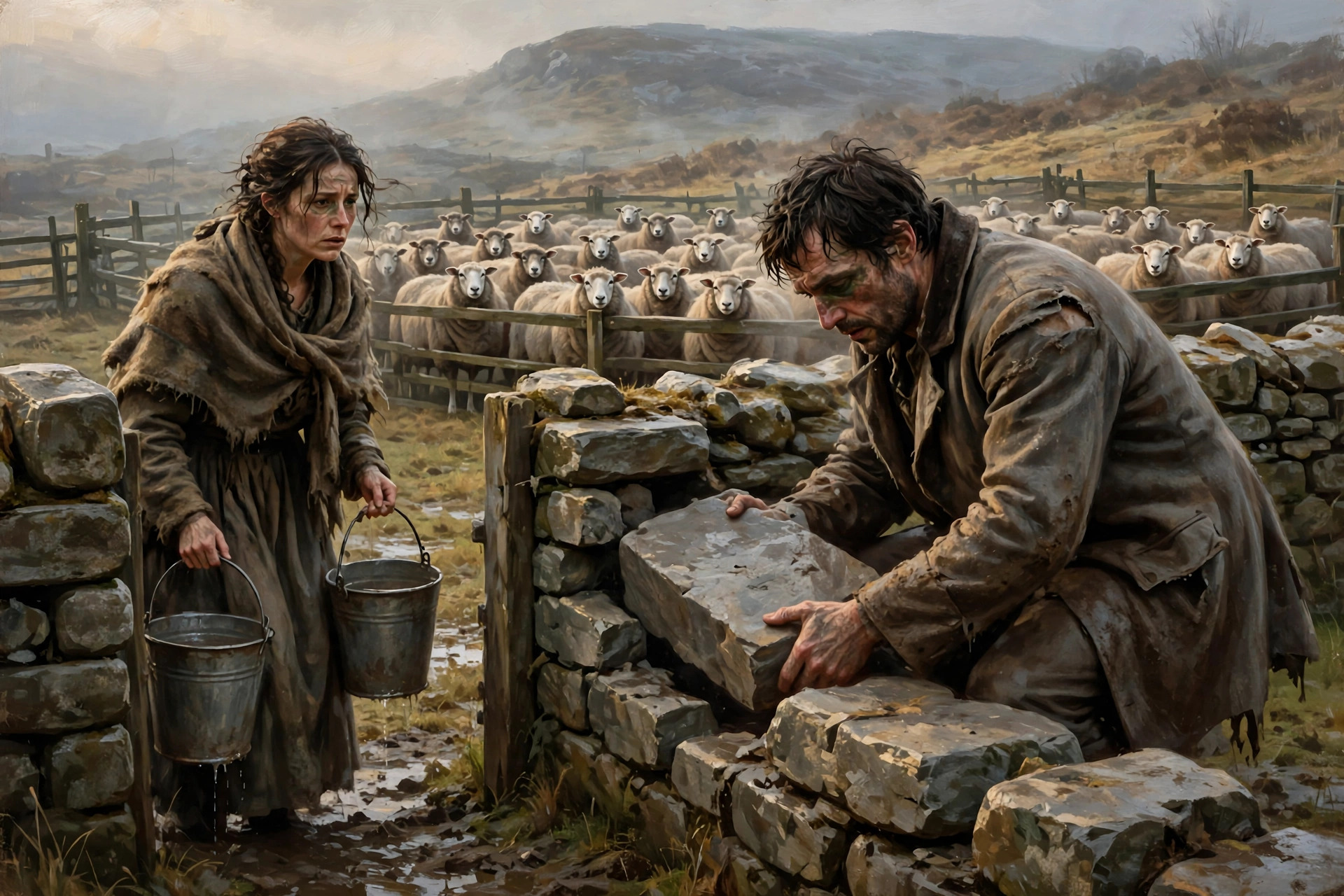
Fenn Ashgrove didn't look up. He had a slab of grey stone braced against his hip and mud to the elbows of a coat that had once been fine. Behind him the gap in her ewe pen wall was half closed, the thaw having slumped it in the night.
"No," he said. "You didn't."
Isaura Quill stood in the gateway with a bucket in each hand and the cold running off the hill behind her. Thirty-odd ewes pressed against the far rails, heavy and watchful. None of them had fled him. That bothered her more than the wall.
"Then put it down."
"It'll fall again by dark." He fitted the stone, tapped it twice with the heel of his hand, and it sat as if it had grown there. "The ground's soft all the way to the ford. You know that."
She did know it. She had meant to fix it after morning feed, and then again after noon, and the list in her head had been long enough to bury a person. She set down the buckets harder than she needed to.
"This is Quill land, warden. The Common starts past the gate. Your side of the line is wet, and mine is dry, and I'd like to keep it that way."
"The line moved." He said it quietly, as he said most things. "The meadow's been rising since the thaw began. The water's coming up through the roots, Isaura. I can hear it under the pen."
"You can hear a lot of things."
"Yes." A flicker crossed his face, gone before she could name it. He picked up another stone. "That's rather the job."
She hated how reasonable he sounded. Nine years he had walked the marsh edge in all weathers, unpaid, bound by a compact older than the parish books, and in all that time she had given him a nod at the ford and nothing more. It had worked. Nobody had needed anything from anybody.
"Agnes says the grazing grant's up for review," she said. "She says the Common's ground may not hold the flock this year. Is that your doing?"
His hands stopped. "Agnes Rudd talks to you about the Gap?"
"Agnes Rudd talks to me about paperwork. Then she looks at the meadow and goes quiet." Isaura crossed her arms. "So I'm asking you straight. What's coming?"
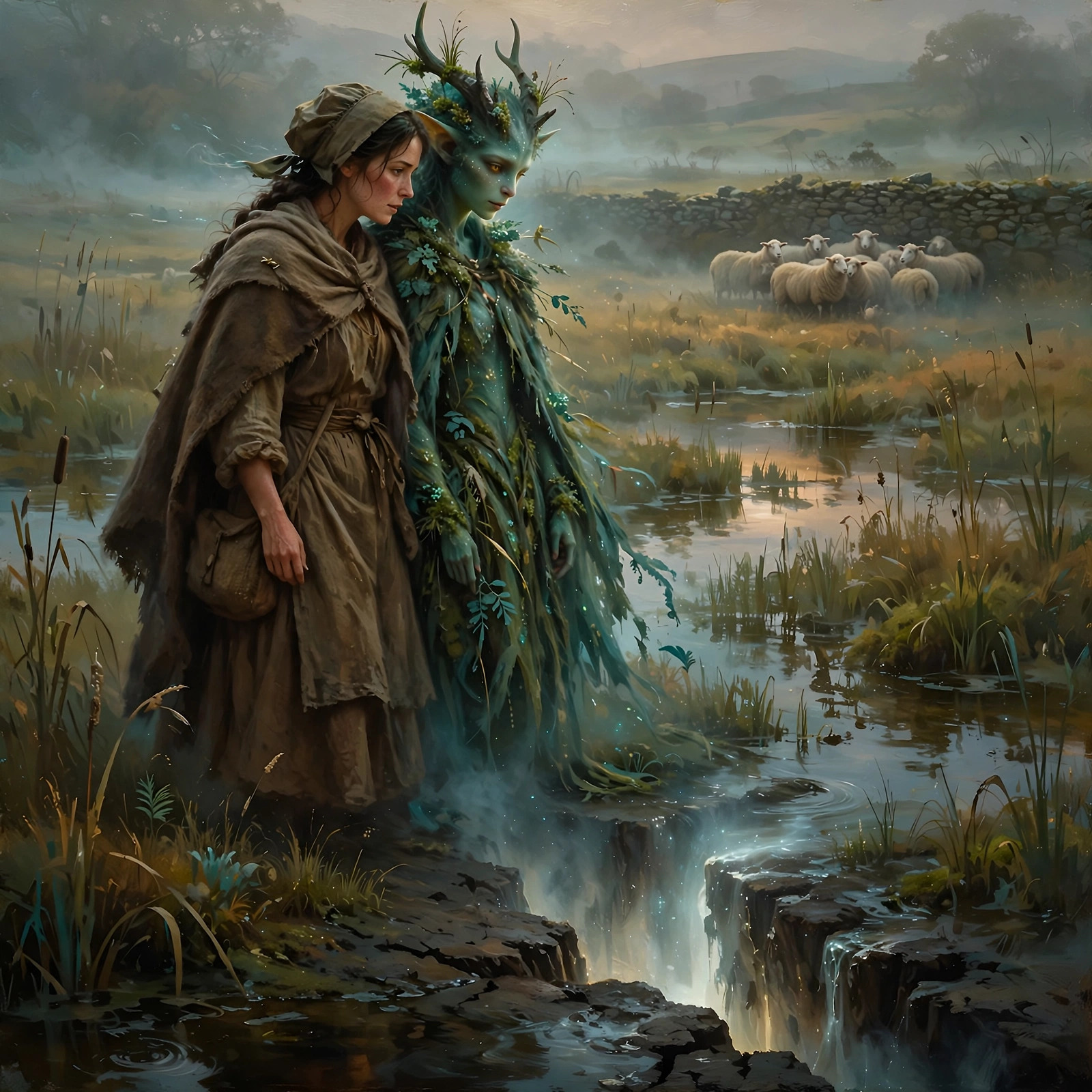
Fenn set the stone down slowly. When he turned, the grey light caught the strange green under his eyes, the colour of deep water, the mark of the hollow hill that he usually kept turned from her.
"The Tithe Gap opens at lambing," he said. "It has before. It takes what's in the pen and what's on the ground, and it doesn't give either back."
"How many?"
"Forty ewes, near enough. More, if the meadow goes."
The number sat in her chest like a swallowed stone. Forty was half the flock. Forty was the loan, the roof, the winter feed, her father's pension made up with her own work.
"And you can stop it."
"I can hold it. Alone, not for long." He wiped his palms on his coat and didn't meet her eye. "It wants two."
"Two what?"
"A pair. Bound."
She laughed, short and without any humour in it. "No. Whatever that is, no. I've kept this farm up on my own since I was twenty-two and I'm not about to sign myself over to a marsh."
"I'm not asking you to sign anything."
"You're asking me for something. I can hear it in how carefully you're not saying it."
His jaw tightened. For a moment she thought he'd argue, and she wanted him to, wanted the clean heat of a proper fight. Instead he looked past her shoulder and went very still.
"Isaura. The gatepost."
She turned. On the top of the old oak post, where it had hung from a nail since before she could remember, her grandmother's shepherd's whistle sat in its loop of waxed linen. Hazel wood, pale and worn, carved the spring she was born. She had never blown it. Nobody had. It had simply been there, like the weather.
It was humming.
Not a sound, exactly. A tremor she felt in her back teeth, as of a finger run around the rim of a glass. She crossed to the post in four strides and closed her hand around it.
Warm. Warm as a loaf from the oven, warm as a living thing.
"It's never done that," she said.
"It has been waiting." Fenn had come up behind her without a sound, as he always did. "Your grandmother knew what it was for."
"My grandmother made me a toy."
"She made you a key." He stopped a careful arm's length away. "Did she never tell you?"
Isaura thought of the kitchen at Quill Farm, the long table, the old woman's hands working a knife along the grain of a green stick. Nobody had told her anything. People in her life tended to leave before explanations. She worked the cord loose from the nail and shoved the whistle deep into her coat pocket, where it kept on humming against her hip like a second pulse.
"I'll thank you to finish the wall and go," she said.
"I'll finish the wall." He bent for another stone, then straightened without it. "The lambs are a few days off. When the ewes start dropping, the meadow will open. I'd rather you heard that from me than found it out in the dark."
"That's not nothing, I suppose. Hearing it."
"It isn't much."
"No."
She should have walked off. The buckets were waiting, and so were the feeders and the long list. Yet she stood there with her hand in her pocket and her heart going too fast, watching the marsh warden look at her as if she were something he was afraid to spoil.
"Take it out," he said softly. "Please. Just once."
"Why?"
"Because I've felt it call for nine years, and I'd like to know if it answers you."
She drew the whistle out. In the flat light it seemed paler, and she saw for the first time the fine line down its length, a seam so true she'd always taken it for a grain. It was a split, cut clean from end to end. Two halves, bound close with linen, wanting to be parted.
Fenn lifted one hand, slowly, as he might toward a skittish ewe. He didn't take it. He only laid two fingers on the far tip of the hazel, the end farthest from her grip.
The whistle flared in her fist like a coal.
Where the Meadow Drowns
"You're late," Agnes Rudd said, not looking up from the ledger she'd balanced on a fence rail, "and you've brought your boots but not your manners."
"I brought both," Isaura said. "The manners are in my pocket with the whistle."
Fenn, a pace behind her, made a sound that might have been a laugh if he'd let it. Isaura did not turn to check.
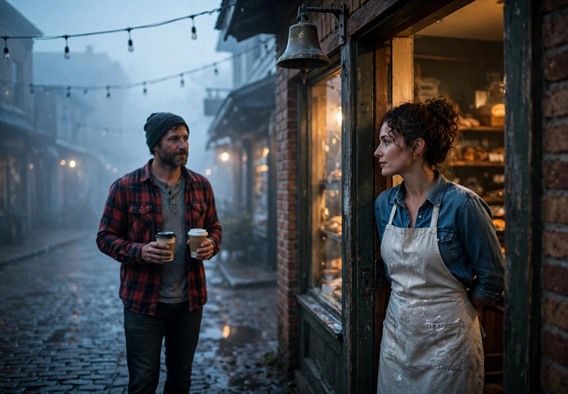
The drowned meadow lay below the last stretch of wall, where Thistledown Common gave up pretending to be pasture. Water stood in the grass to the ankle. Alder roots rose out of it like knuckles. Two days of thaw had turned the whole low field to glass, and the sky lay in it unbroken, so that walking down felt like stepping into weather.
Isaura had not slept much. She had checked the ewes twice, then a third time, then stood in the yard at Quill Farm listening to her father cough through the wall. Bertram had asked only if she wanted tea. She'd said no. He'd made it anyway and left it on the step, and she had drunk it cold at dawn, furious at how much it helped.
Now Agnes shut the ledger and tucked it under her arm. The parish clerk wore her good oilskin and the expression she used for disputed boundaries.
"I'll say it plain, since neither of you will," she said. "There's a compact on this ground older than the parish book. The Common's grazing was lent, not given. The lender wanted a keeper on the wet side and a keeper on the dry. One who knows the hill, one who knows the marsh."
"The warden and the wall," Isaura said.
"The warden and the wall." Agnes nodded at Fenn, then at her. "Your grandmother kept the wall before you. She came to me the spring you were born, with a green hazel stick and a face like thunder, and had me write her wishes down."
Isaura's mouth went dry. "She never said a word of it to me."
"She said it was too heavy for a child. I thought she was wrong, and I told her so." Agnes's voice stayed dry as paper, but her eyes softened. "She was stubborn as a post. You come by it honest."
"And the Gap?"
Fenn answered, low. "Where the meadow is deepest. It looks like a pool. At lambing the ground thins there, and what's under it comes up for the tithe. Ewes first. Then the ground itself."
"Forty," Agnes said. "That's what the old tally gives for one night's opening. Forty ewes, and the low field gone with them."
Isaura looked at the flock's shape on the far slope, white flecks on dun. She knew every one of them by sight. She knew what forty meant against the year's sales and the grazing grant, and what it would mean to stand in the yard and count what was left.
"So we close it," she said. "What do I do?"
"You hold half of what's yours," Fenn said. "I hold the other. It has to be parted before it can be joined."
"Parted by who? It's a whistle. It's been in a drawer most of my life."
"Parted by me. If you'll allow it."
She heard how carefully he asked. It rubbed at her, that care. She had spent her whole life arranging things so nobody had to be careful with her, and here he was, handling her like a lambing ewe that might bolt.
"Why you?" she said. "Why not me?"
"Because the knife has to be mine. It was made in the hill." He drew it from his coat, a short leaf of dark metal with no shine to it. "And because you'd cut it crooked, out of caution."
"I would not."
"You would, and then you'd say it was the grain."
Agnes coughed into her glove. Isaura glared at the clerk, then at him, then gave up and drew out the whistle. It was warm already, but sullen, like a coal banked for the night.
"If this breaks," she said, "I'll want it noted."
"It won't break." Fenn held out his palm. She hesitated, and he did not move, did not coax. That was worse and better. At last she laid the whistle across his hand, and the linen binding brushed her knuckle as it left her.
He knelt on a flat stone at the water's edge. The knife's tip found the seam. He did not press, only drew it down the length of the hazel, slow, the way a man cuts a loaf for someone he loves. The linen parted with a dry whisper. The two halves fell open in his hands, pale inside, each carved with half a hollow where the breath would go.
Something went out of her chest, a small cold gap where a weight had been. She hadn't known she'd been carrying it.
"Here." He held both halves out on his flat palm. "You choose."
She almost refused. She almost said she'd had enough of choices for one week. But Agnes was watching, and the meadow lay open and bright, and she thought of a kitchen table and an old woman's hands.
She took the half with the cord still threaded through it. Fenn took the other and closed his fingers over it as if it might spill.
"Step back," Agnes said, quietly, and for once nobody argued. Isaura took three paces up the bank. Fenn rose and stood across the shallow water from her, the sky between them.
Nothing happened. The wind moved in the alders. A moorhen complained somewhere in the reeds.
Then the hazel in her palm stirred, a slow flush of warmth spreading from the cut face to the cord, and across the water Fenn drew a sharp breath and looked down at his own hand. Each half warmed the instant the other was near.
Thaw Work
"You're holding the gate like it owes you money," Isaura said.
Fenn looked down at his hands. He was gripping the top rail of the lower pen, and the ewes on the other side were eyeing him with the flat disapproval of the very old. "I've never been asked to hold one."
"You're not holding a ewe. You're holding a gate. Swing it when I whistle."
"Which whistle?"
She glanced at the cord at her neck, tucked under her collar, and he glanced at his own coat. Neither of them said anything. She put two fingers to her teeth instead and gave the sharp, ordinary call she'd used since she was nine.
He swung the gate. Late, but he swung it. The first ewes poured through into the thawed paddock, bleating their outrage, and the mud took them to the knees.
It was the morning after the meadow. The yard had gone soft overnight, every rut brimming, the hay barn dripping from its eaves in long bright strings. She had meant to do the count alone, as she did every year. She had stood at the gate at first light with the tally stick and found him already on the lane, hands in his coat, saying only that the halves had kept him awake. Hers had kept her awake too. She'd said so by handing him a bucket.
Now he worked beside her through the long wet hours, and he was bad at it in ways that surprised her. He was patient with the ewes and hopeless with the hurdles. He could stand in the marsh up to his thighs without a flinch, but a ewe leaning on his knee made him go stiff and apologetic.
"She's not going to bite," Isaura said.
"She's looking at me."
"She's looking at your pockets. You smell of oats."
"I do not."
"You do. I've been wondering about it all morning." She hauled a hurdle into place and wedged it with her boot. "Don't answer that. Go and stand by the shed and be useful."
"I'm being useful here."
"You're being decorative."
He laughed, short and surprised, and the sound went through her like a warm draught through a cold house. She turned back to the hurdle so he wouldn't see her face.
By noon the heavy ewes were sorted into the near paddock, close to the shed, where she could reach them in the night. She worked down the line with a hand on each flank, reading the bellies, and Fenn followed a step behind, watching how she did it. He didn't ask questions. He just watched, and when she nodded at a ewe he marked it on the stick with his thumbnail, neat and small.
The halves had been quiet since dawn, a low steady warmth against her breastbone. When he came close to take the stick back, it rose, a small bright flare, and she felt her ears go hot.
"Yours too?" he asked, very low.
"Mind the ewe."
Behind them a voice rolled across the yard. "Is he any good?"
Her father stood at the farmhouse door with a mug in each hand, bareheaded, the collar of his old drover's coat turned up against nothing. Bertram Quill had retired from the roads years ago, but he still stood as if he were watching a long column go by.
"He's learning," Isaura said.
"Is he." Bertram came down the step, taking his time over the wet flagstones. "Last lad you let near that flock lasted till the first hurdle. Walked off, didn't he? Said you'd never let him finish a sentence."
"Dad."
"I'm only saying he's still here." He handed Fenn a mug with great ceremony. "Tea. You've the look of a man who takes it strong."
Fenn took it as though it were a relic. "Thank you, Mr. Quill."
"Bertram. Mr. Quill's my brother, and he's been dead since March." He turned to his daughter, eyes bright. "You've gone pink."
"It's cold."
"It's a mild day, love. The mildest we've had."
She would have thrown the tally stick at him, but a thin, wavering cry came from the corner of the paddock, and all three of them turned.
A ewe had dropped early. It lay in the trodden straw beside the wall, a small wet scrap of a thing, all knees and ribs, already trying to stand and failing. The ewe nosed it, anxious, and moved off a pace as if she'd forgotten what to do next.
Isaura was over the hurdle before the cry ended. She knelt, cleared the nostrils with two fingers, and rubbed the thin chest hard with a fistful of straw until the lamb coughed and shook its head. It was a good lamb. It was also nowhere near the shed, and the ewe was edging toward the open gate.
"Fenn." She did not look up. "Come here."
He was there at once, kneeling in the mud in his good coat, and she saw him take in the size of it, how little there was.
"Take it," she said. "Support the back end. Don't grip. Keep it level and walk slow, and the ewe will follow."
"Isaura, I'll drop it."
"You won't." She lifted the lamb and set it against his chest, and her hands stayed a moment too long under his, settling the weight. "It only wants to be held properly. Go on."
He rose with the lamb in both arms as though he were carrying something far larger. Maybe he was. He walked toward the shed at a pace that would have shamed a funeral, and the ewe trotted after him, grumbling, and the lamb nosed into his collar and went quiet.
Isaura stood where she was. She had never let anyone carry a lamb for her. She hadn't planned to let him.
"Well," Bertram murmured at her shoulder. "There's a sight."
"Don't."
"I haven't said anything."
"You're about to."
He sipped his tea and said nothing at all, which was worse.
Later, once the lamb was dried and suckling and the ewe had been persuaded into a pen of fresh straw, they sat in the farmhouse kitchen with the stove ticking and the window steamed to the sill. The mugs were new. Fenn held his in both hands and looked around the room as if it might be taken away. The dresser with its chipped blue plates. The boots by the range. The long scarred table where a hundred years of Quills had sat down to eat.
"You've been looking at that table since you came in," she said.
"It's a good table."
"It's an old table."
"It's been sat at." He turned the mug a quarter turn. "Where I grew up, nothing was sat at. Things were stood beside. Waited on." He stopped, as if he'd said more than he meant. "I don't know why I'm telling you."
She found she didn't want him to stop. "Go on."
"There isn't much. I was small when I went down to the marsh. I was told it was for a season." He gave a thin smile. "The season's been a while."
She thought of a door closing on a Tuesday and a coat gone from its hook. She thought she might say it. Her mouth was already open when Bertram scraped back his chair with a great deal of unnecessary noise.
"Right. That tup won't check himself." He took his cap from the nail without looking at either of them. "I'll be an hour. Perhaps two. Don't wait up."
"It's the middle of the afternoon," Isaura said.
"Is it? Funny." The door shut behind him, and his boots went away across the flagstones, whistling.
The kitchen was very quiet. The stove ticked. Between them on the table, her hand lay near his, a finger's width away, and under her shirt the hazel half was warm as a held palm.
Fenn did not move closer. He did not look at her. He only let his hand rest there, open, and waited.
She did not pull away.
Straw and Lanterns
"Hold the lantern higher," Isaura said. "No, higher. I can't see her back end."
"You said that about the last one." Fenn raised it anyway, and light swung over the pens, the steaming breath of the ewes, the fresh straw gone gold. "I'm not tall enough to be this useful."
"You're tall enough. You're just slow."
The ewe in the corner pen groaned and shifted. Isaura knelt, sleeves shoved past her elbows, and worked by feel, the way she had since she was twelve. Two small hooves, then a nose. She eased, waited, eased again. The lamb slid out in a rush and lay steaming on the straw. For a moment nothing moved.
"Come on," she whispered. "Come on, you daft thing."
She cleared its nose and rubbed it hard with a fistful of straw. It sneezed. Fenn made a sound that was half a laugh and half something else, and she looked up to find him staring at the lamb as if it had been handed to him from the sky.
"Every time," she said. "Every single time, I think it won't."
"And every time it does."
"Not every time." She sat back on her heels. "You learn not to count on it."
He set the lantern on a post and crouched beside her. Straw stuck to his coat. His hair had come loose in the wet, and there was a smear of afterbirth across his wrist that he hadn't noticed. She noticed. She noticed too much about him these days, the way he went quiet when the ewes cried, the way he never once asked her to let him do it his way.
"You've not slept," he said.
"Neither have you."
"I'm used to it. The marsh doesn't keep hours." He wiped his wrist on his knee, finally. "You keep everything. Every hour, every ewe, every gate. Has anyone ever just taken a shift from you?"
"Once."
"And?"
"He walked off."
"Did you give him a reason?"
She laughed, short and surprised. "My father's been talking."
"Your father hums when he talks. It's hard to follow."
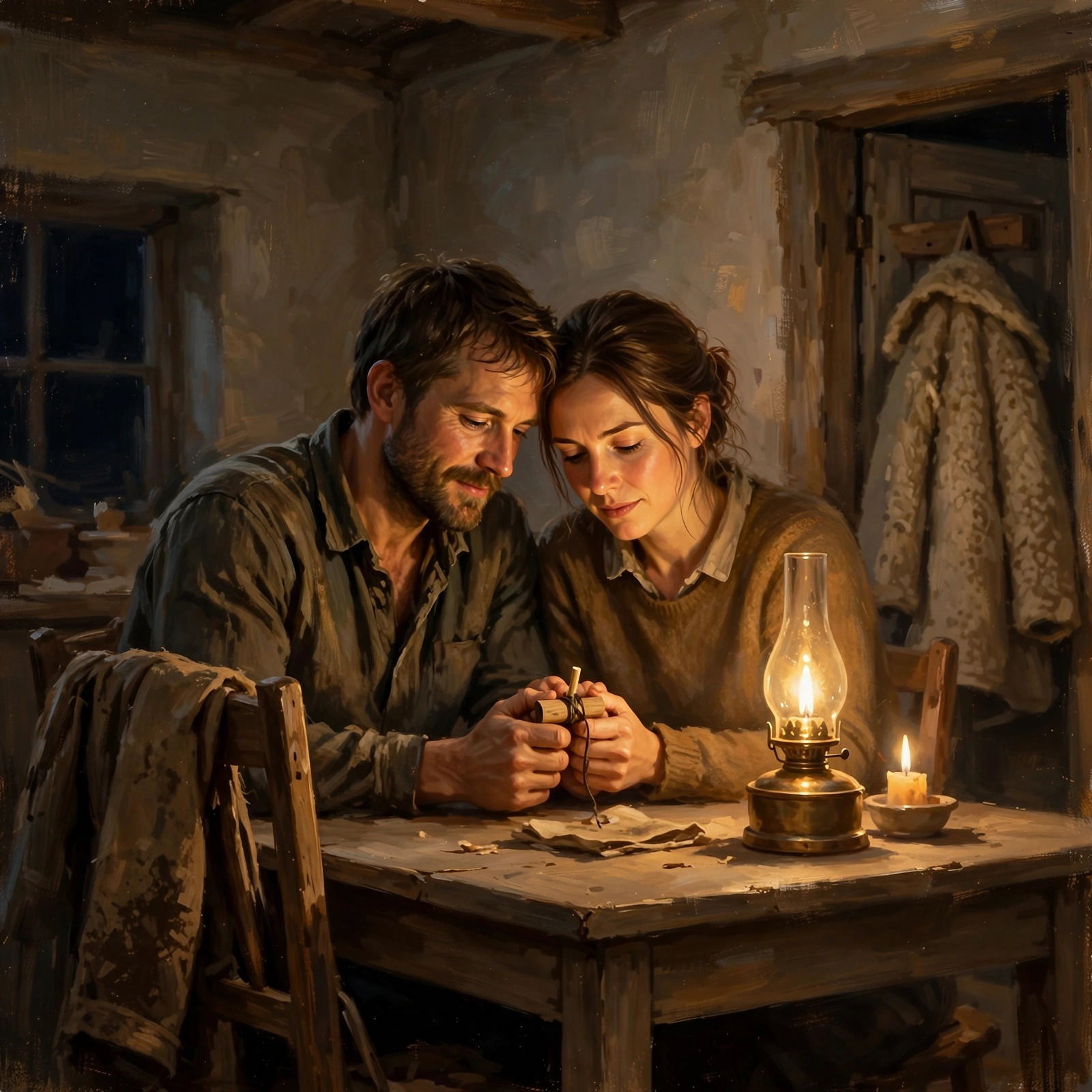
The ewe had begun to lick her lamb, rough and thorough. Wind pushed at the shed door and the lanterns shivered along their hooks. Isaura drew the cord from under her shirt. The hazel half lay in her palm, warm, a small flare running down the grain.
Fenn drew out his. He turned it over, and she saw his hand wasn't quite steady.
"Together?" he said.
"It's what they're for."
She fitted her half to his. The split edges met with a soft click, and the whole whistle bloomed gold between their palms, so bright she could see the bones of her own fingers. Heat ran up her arms. It wasn't a trick of the light. It was a bell struck somewhere under her ribs.
Neither of them breathed for a moment, and neither of them let go.
"Isaura."
"I know."
"I haven't said anything."
"You were about to." She heard the wobble in her voice and hated it, and went on regardless. "Don't. Not yet. Just..."
She kissed him.
It was clumsy at first, her nose against his cheek, her free hand fisted in his wet collar. Then he made a low sound and his hand came up to the back of her neck, careful, as though she might shatter or bolt, and the clumsiness went out of it. He tasted of tea and cold air. The lantern light swung and settled. The whistle lay warm and bright between their chests, and with a startled clarity she knew she had not been this unguarded in years.
When they parted she kept her forehead against his.
"That," Fenn said unevenly, "was not in the compact."
"Agnes will want it written down."
"She'll want it witnessed."
She was smiling. She could feel it, foolish and wide, and she was still smiling when the warmth in her hand faltered.
It went from the edges first. The gold shrank back along the grain like water leaving a shore. Her half, the corded one, went pale, then dull, then cold, cold enough to sting. She looked down. His half still glowed faintly. Hers lay in her palm like a stone from a river in winter.
"Fenn."
He had seen. His face had gone very still, the way it did when a ewe went down in the marsh and he didn't know yet whether to run.
"It only goes cold for a lie," she said. "That's what you told me. The first night."
"Isaura, listen..."
"Who lied? Me?" She made herself say it level. "I haven't. Not a word. So it's you."
"It's not a lie. It's something I haven't..." He stopped. Even to her, standing there with her mouth gone dry, he looked like a man deciding which door to run through.
"Don't," she said. "Don't you dare pick your words. Tell me what the price is."
"I told you the price. A bonded pair, and one of us gives up..."
"The whistle cooled when I kissed you. Not before. So what did you leave out?"
The ewe lowed softly. Somewhere in the rafters a wing shifted. Fenn looked at the cold half in her hand, and at last at her.
"To close it for good," he said, "I lose my ties to the hill. Everything I am down there. That I knew, and I told you." His throat moved. "The other half is yours. The partner gives up the home-claim. Quill Farm's. The deed, the right of it, the whole of what your family holds by that name."
She heard it as if from the far end of the shed.
"Since when?"
"Since the first night."
"Five days." Her voice came out thin and strange. "You sat at my table. You held my lamb."
"I was going to say. I wanted you to have one good night first. I wanted..."
"You wanted to decide for me."
"I wanted to keep your land."
"It's not yours to keep!" The ewe flinched. Isaura lowered her voice and it came out worse, flat and hard. "Everyone who ever stayed with me decided what I could bear. My mother decided. Every one of them. I thought you were different."
"Isaura, I'm not..."
"You are. You just did it kinder."
She stood. Her knees ached from the cold floor. The whistle half hung from its cord, dead weight, and she tore the linen over her head and looked at it, the thing her grandmother had carved the spring she was born, and could not think of a single thing to do with her hands.
"Get out," she said.
"Let me..."
"Out of my shed. Off my land. Go back to your marsh and keep your secrets there."
He did not argue. That was almost the worst of it. He rose slowly, took up his coat, and for one moment held his own half out toward her, still faintly warm. She would not look at it. He put it away. At the door he turned as if to speak, saw her face, and went out into the dark without a word, and the latch fell behind him.
Isaura stood with her back to the pens and her breath loud in her ears. Then she walked to the wall and threw the half as hard as she could.
The cold half rattled on the stone.
The Tithe Gap
She went before the light, with both halves in her coat and the frost cracking under her boots.
Isaura had not slept. At some grey hour she had gone out to the shed wall and found the cold half lying in the straw where it had fallen, and she had picked it up without letting herself think. It was the weight of a bird's wing. The linen cord was stiff with damp. In her other pocket, Fenn's half, which he had left on the gatepost sometime in the night, with no note and no footprints she could follow. She had stood looking at it for a long minute. Then she had taken it too.
The track down to the drowned meadow was slick. Mist lay on the Common in a flat white sheet, and the sheep she passed stood in it up to their bellies like stones in a pond. Forty ewes in that lower field, heavy and slow. She counted them as she walked, because counting was something she could do.
The Tithe Gap lay past Rudd's Ford, where the meadow went from grass to black water in a single step. It looked like nothing. A long dark seam in the reeds, a little lower than the water around it, breathing very slightly. She had walked past it all her life and thought it a drain.
Now the water leaned toward her. The reeds bent the wrong way against the wind.
"Isaura."
She did not turn at once. Agnes Rudd stood on the ford stones with her good coat buttoned to the chin and a ledger held flat against her chest, as if it might be taken from her. Behind her, slower, came the shape of a man leaning on a drover's stick.
"Dad."
"Agnes knocked me up at five," Bertram said. He stopped beside the clerk and looked at the water, then at his daughter. His face did what it always did when he was frightened, which was nothing. "Said you'd be here."
"I didn't tell her."
"You didn't have to," said Agnes. She opened the ledger. Her fingers were not quite steady on the page. "The compact needs a witness on the dry side. Two is better. I've kept the Common's rights twenty years and I'll not have it said the entry was careless."
"I don't want you here."
"Noted." Agnes uncapped her pen. "We're staying."
Isaura looked at her father. He met it, and for once he did not look away or find something to do with his stick. "I let you do the hard things alone once," he said. "When your mother went. I told myself it was respect. I'll not do it twice."
Something in her chest shifted, like ice moving on a pond. She turned back to the water before it could show.
She knelt at the edge. The mud took her knees at once, cold through the wool. She laid the two halves together on the flat of a stone, and they fitted, grain to grain, the old cut her grandmother's knife had made the spring she was born. Neither was warm. They were only wood.
"What do I say?"
Agnes read it from the ledger in a dry clear voice. "The holder names what she holds by right of the hill, and gives it to the Common in place of the tithe. The warden's half is the pledge. The keeper's is the seal."
Isaura closed her hand over both. "Quill Farm," she said. Her voice cracked and she made it go on. "The house and the land and the right of it. My grandfather's, and his father's, back past anything written down. I hold the home-claim, and I give it. Not lent. Given."
The water went very still.
Behind her Bertram made a small sound, quickly swallowed. She did not look. If she looked she would take it back, and she knew it, and so did he.
"It's the deed I'm giving," she said, to the water, to the reeds, to anyone. "Not the sheep. Not the work. I'll still be here. I'll still be up at dawn with the dogs. You can have the paper and the name. You can't have the rest."
The seam in the reeds drew shut like a closing eye. The mist lifted off the meadow in one long breath and thinned to nothing. Under her palm the hazel went hot, so hot she nearly dropped it, and then the heat ran out of her hand and into the ground, and one end of the wood blackened and curled as if it had been laid in a fire.
Agnes wrote. Her pen scratched and scratched.
Feet came pounding along the ford, wet and ragged. "Isaura, don't. Don't, I'll find another way, there's..."
Fenn stopped on the last stone. He was soaked to the thigh and his hair hung in his eyes. He looked at the water, flat as glass, and at the ledger, and at the black end of the wood in her fist, and she watched him understand that he was too late.
"You said it was mine to keep," she said. She stood, her knees sodden, and the words came out gentler than she expected. "It was mine to give."
He had no answer. His hand came up and fell. The marsh light was in his face, green and thin, and she saw how tired he was, how young, a child who had been told it was only for a season.
She held out the blackened half. After a moment he took it, his fingers shaking.
The black half sat in his palm. The water was still.
Kitchen Without a Deed
"You've been standing at that stove for ten minutes," Fenn said from the doorway. "It's cold. I checked."
"I know it's cold." Isaura did not turn around. She had her palm flat on the iron lid, the skin still pink and shiny where the cord had burned her. "I'm looking at it."
The kitchen was the same as it had been every morning of her life. Same scarred table, same dresser with the chipped blue plates, same window over the sink looking up at the wall she had mended stone by stone. Her father had gone to his sister's for a few days, and he'd gone quickly, with a look at her that said he knew better than to ask. Agnes's ledger sat somewhere in the parish office with one line in it that changed everything and nothing.
"Twelve days," she said. "I've walked the same boundary every morning. The sheep still come when I call. The gate still sticks in the damp."
"Yes."
"But it isn't mine. I'm a tenant in my own kitchen. Agnes was very kind about it. She said the grazing grant carries on, and I can stay as long as the Common allows." She laughed, and it came out cracked. "Isn't that something. Kind."
Fenn came in then, slowly, the way he approached a ewe that had been frightened. He had mud on his boots, and he stopped before he reached the rug, as if he had no right to track it in. He had not come near the house since the morning at the water. She had sent him off the land once, and he had obeyed to the letter, waiting on the marsh side of the wall for twelve days. She had seen him there at dusk more than once, a shape against the reeds.
"I'm not here to be forgiven," he said. "I'd like that understood."
"Then what are you here for?"
"To tell you what I should have told you in the shed." He took a breath. "I knew the price. All of it. I told you half, and I let you think half was the whole, because I thought I could find another way before the lambs came. I told myself I was sparing your land." His mouth twisted. "I was sparing myself. If you knew, you'd send me off, and I've been sent off before. I'd rather lie and stay than be honest and go."
She turned around at last. His half of the whistle hung at his collar, pale and whole. In his hand he held hers, black from end to cord, wrapped now in a scrap of linen.
"That was a fool's way of loving anyone," she said.
"It was."
"Mine's no better. I'd have taken the whole price on my own back and called it strength. I did, in fact." She crossed her arms, then let them fall. "I told myself that if I needed nobody, nobody could walk out."
"I'm not walking out."
"You've a marsh to keep."
"I've a choice to make." He set the blackened half on the table between them, gently, as if it might still bite. "The Gap is shut. The compact doesn't hold me the way it did. The ties to the hill are cut, and what's left is mine to spend. I can go back into the marsh and be its warden, and visit the wall on feast days. Or I can lay down the last of it, the half-life, the old claim, all of it. Be a man with boots and a bad temper and nowhere else."
Her stomach dropped. "Fenn, no. You'd be giving up everything you are."
"Everything I was told I was." He said it quietly. "I was sent to that marsh as a boy for a season. I waited a very long time for someone to come and fetch me. Nobody did. You're the only one who ever let me carry a lamb in out of the cold." His voice broke on the last word. "I'd give up the hill for a place at that table. I'm not asking you to ask me. I'm telling you what I'd do."
She looked at him, the mud, the open collar, the fear he was trying so badly to hide. A room in her that had been emptied at the water was not empty anymore.
"Don't," she said. "Don't spend yourself for me. Stay because you like the porridge. Stay because the roof leaks over the pantry and you can reach it."
He made a sound halfway to a laugh. "That's allowed?"
"It's the only reason I'll accept." She came around the table. "I lost the deed. I didn't lose the house. I'd rather keep the house with you in it than the deed with nobody." Her throat was tight. "I love you. I'm saying it plainly, because we've both been terrible at plain."
His eyes shone. "I love you. I have since the gatepost. I was very bad at it."
"You were awful."
"You told me to stay off your land."
"I was awful too."
She found the drawer by the sink where her grandmother's silver wire had lain for as long as she could remember, wound on a bobbin with a pair of tiny pliers. Her hands shook. Fenn's hands covered hers and steadied them, and she let him.
They fitted the black half to his pale one at the split. The seam met true, though one side was scorched and one was clean. She wound the wire around the join, turn by turn, and he held the hazel still while she twisted the ends and tucked them under. It was clumsy work. Neither spoke. When she bit off the last of the wire, the whistle lay whole across their joined palms, scarred and bright.
Warmth rose through the wood, slow and even, like bread coming out of an oven. It spread into her wrists, into her chest.
She stepped into him. His arms closed around her, careful at first and then not careful at all, his chin against her hair. The stove stood cold beside them and the kitchen was quiet, and the whistle lay warm between them.
Get notified when new stories drop
Cade Ellison
Cade specializes in romantasy and paranormal romance: magic systems with rules, courts with knives, and longing that rearranges destinies.
Leave a comment
Comments