

Split Seam
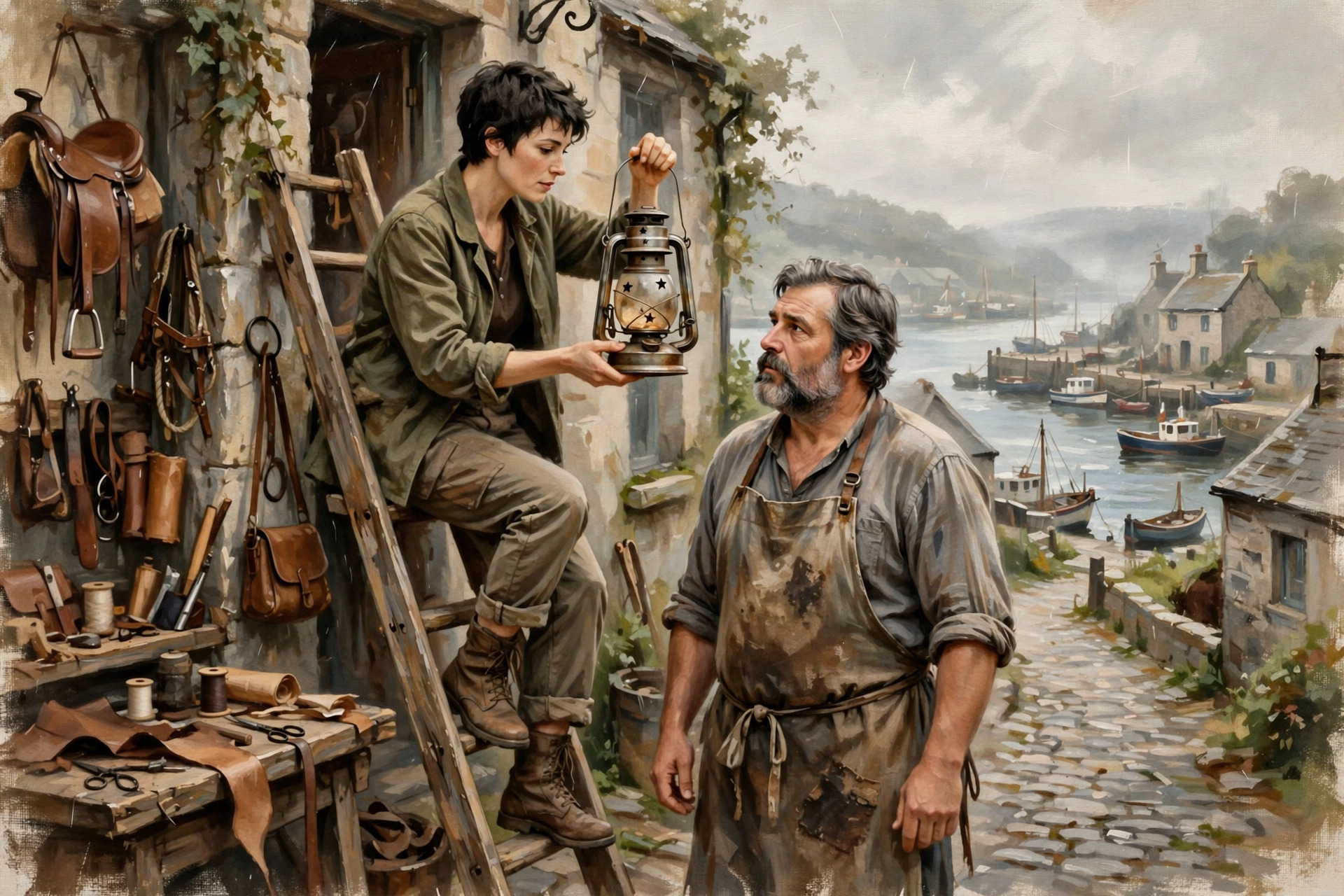
"You'll drop it," Bastian Orme said from the bottom of the ladder.
"I won't." Isaura Quennell had one boot on the top rung and one hand braced against the doorframe of her father's shop. The other hand was working the lantern's hook loose from the iron bracket. "I've held a mule's hind leg while it decided how it felt about me. I can hold a tin lamp."
"It's not the holding. It's the seam."
"Then stop talking about the seam and let me look at it."
He did stop, which surprised her. He stood with his hands in the pockets of a canvas apron scorched at the hem, and the Row went on around them. Somewhere down the hill a bell buoy clanged in the harbor, flat and patient, the way it had when she was nineteen and in a hurry to leave it behind.
Fifteen years. She had been back in Larkhaven since the morning ferry, and so far she had been hugged by her aunt, handed a ring of keys, and told by a stranger at the bakery that she had her father's walk. The shop still smelled of neatsfoot oil and old leather. That part she could stand. It was the lantern above the door that had stopped her on the step.
Her father had ordered it the year she left. Tin and brass, pierced by hand in a pattern of small stars, and hung every Lantern Night since. Now it hung crooked, one side crushed in like a cheek hit by a fist, the glass cloudy, the brass gone the color of weak tea.
"Storm took it in March," Bastian said. "Gus wanted it down. Your aunt said leave it for you."
"Fenella says a lot of things for me."
"She does." The corner of his mouth moved. It was not quite a smile. "She also said you'd try to do this alone."
Isaura looked down at him. He was broader than the boy she remembered, with solder burns across his knuckles and gray threaded early into his hair. He had the same steady, careful stare. It used to make her feel seen. Today it made her feel measured.
"Your father made this," she said.
"Anselm did. Pierced every star himself." He tipped his chin at the lantern. "I've got his pattern templates in the shop. I can match the cut."
"I can match a cut myself."
"On tin?"
"On anything that holds still." She slipped the hook free. The lantern swung down into her palm, lighter than she remembered and wrong in her grip, as if something inside it had let go. "I don't need a favor, Bastian."
"I didn't say favor. I said fix."
"Same thing in this town."
That landed. She saw it in the way his shoulders settled, and she was sorry and not sorry. She came down the ladder rung by rung, lantern held against her ribs. On the last step she turned it toward the light.
The dent ran from the base to the shoulder. Along its edge the old solder line had gone dark and brittle, and a hair-thin gap showed where the seam had been quietly giving up for months.
"It's tired," Bastian said softly. "Don't pull on it."
"I'm not pulling."
"You're about to."
She was. She knew it the moment he said it, because her thumbs had already found the dented panel. Her whole life she had fixed things by pressing them back into shape. Hooves, harness, her own face in a mirror. She set her thumbs and pushed, gently, the way she'd ease a swollen joint.
The seam let go with a small dry tick.
The side panel peeled away from the base like a page from a spine. The little brass ring that held the door pin dropped, rang once on the stone step, and rolled toward the gutter. Isaura stood with a half-open lantern in her hands and her ears hot.
Bastian caught the ring with his boot before it reached the drain. He bent, picked it up, and said nothing at all. That was worse than if he'd said I told you so.
"Well," she said. Her voice came out rougher than she meant. "That's one way to start."
"It was going to split. Better here than in the wind on Lantern Night." He held the ring out on his open palm, dark with soot. "Isaura."
"I know."
"Let me take it."
She did not want to. The wanting sat in her chest like a stone. This was her father's lantern, the one thing on the Row that still had his hands on it, and she had been home for a handful of hours and had already broken it. Giving it to Bastian felt like giving him the proof.
She thought of her mother's funeral, and of being nineteen and told by nearly everyone to be quiet and be grateful. She thought of the bus out. She had not asked anyone for anything since.
"It's only the lantern," Bastian said, quieter, as if he'd followed the whole thought. "Not the rest of it."
"You don't know what the rest of it is."
"No," he said. "I don't."
The honesty of it took the fight out of her. She turned the lantern over once more, stars scattered across the open tin, a little light still caught in the cloudy glass. Then she laid it in both his hands, panel and base together, and let go one finger at a time.
"Don't make it new," she said. "I want it to look like his."
"I wouldn't dare."
"And I'm paying you."
"We'll argue about that later." He tucked the brass ring into his apron pocket and cradled the lantern against his chest, careful as a man carrying a sleeping bird. "Come by the works when you've unpacked. Bring your opinions."
"I always do."
"I remember."
He went off down the Row. Past the harness shop, past the window where a baker was stacking trays, past the first tin lanterns already hung ahead of the season, swaying and winking. He walked slowly, so the broken thing would not swing. At the door of the Orme Lantern Works he paused and glanced back. She was still standing on her father's step with empty hands.
Then he went in, and the door shut behind him, and the bell buoy rang again down at the harbor.
Neatsfoot and Solder
"You're oiling that wrong," Fenella said from the doorway, a casserole dish balanced on one hip.
Isaura did not look up from the bridle on the bench. "It's a rag and a bottle, Aunt Fen. There isn't a wrong."
"There is when you're my brother's daughter. He went with the grain, in long strokes. You're scrubbing like it owes you money."
It did, in a way. Everything in the saddlery did. The ledger lay open beside the till, and the figure at the bottom of the last page had not shrunk overnight. Isaura slowed her hand. The neatsfoot oil darkened the leather evenly, and the whole shop gave back its old smell, warm and animal and faintly sweet. She had slept above it on a cot with her boots by the bed, the way she had slept for years, ready to be somewhere else by morning.
Fenella set the dish down on a saddle stand, then thought better of it and moved it to the counter. "Chicken and rice. Don't make that face."
"I'm not making a face."
"You've made it since you were six." Fenella leaned on the counter and studied her, schoolteacher to the bone. "You went down to the Works yesterday."
"I broke a lantern yesterday."
"I heard. The whole Row heard. The baker told me before I'd had my tea." A smile tugged at her mouth. "He carried it like a newborn, she said."
Isaura set the rag down. "Fenella."
"I said nothing."
"You said a great deal with your eyebrows."
"They're old. They do what they like." Her aunt's face softened then, and she touched the bridle's cheekpiece with one finger. "Fifteen years of postcards, and I never once asked you to come back. I want you to know that. I only wrote."
"I know. I read every one." Isaura's throat tightened. "I just didn't answer enough of them."
"You answered the ones that mattered." Fenella patted the counter twice, brisk again. "Go on. Bastian's short a pair of hands, and the committee wants every lantern counted before the week is out. Two hundred. I'll mind the till."
"You can't mind a till. You'll give everything away."
"To the right people." Fenella took the rag out of her hand. "Go."
The Orme Lantern Works was louder than she remembered, and hotter. Hot solder and tin hung in the air, with a bitter edge of flux. Racks of finished lanterns stood along one wall, still bare of their glass, and at the long bench four people hammered and trimmed and fed sheets of tin into a shear. A radio muttered somewhere beneath it all.
Bastian stood at the far end with his sleeves pushed up and a pencil behind his ear. When he saw her, he set down his snips and did not smile, exactly. His face just cleared, like a window wiped with a sleeve.
"You brought opinions," he said.
"Left them at the shop. I brought hands." She held them up. "Farrier hands. I can hold a hot thing without crying."
"Good. Half my crew can't." He tossed her an apron stiff with old flux. It smelled of him, tin and smoke and something like cedar. She tied it twice around her waist and pretended not to notice. "Sixty-one done. Sixty-one of two hundred, and the glass hasn't even come."
"That's a lot of lanterns left."
"It's a lot of lanterns left," he agreed, and led her down the bench.
She spent the morning on the work that needed no skill, cutting panels from templates, deburring edges with a file until her knuckles ached. Bastian moved around her without crowding, correcting a joint here, steadying a sheet there. Twice his shoulder brushed hers. Twice she shifted a half step away, and twice she noticed herself doing it.
Around noon, a young man at the shear dropped a sheet and swore. Bastian crossed to him and said something low and kind, and the young man nodded and went back to work with his ears red. Isaura watched it, the patience of it, and felt something shift that she did not want shifted.
"You used to shout," she said when he came back.
"I used to do a lot of things." He took a file from the rack. "Mostly I used to wait for the postman. Then I stopped."
The file rasped under her hand. She made herself keep the rhythm. "Bastian."
"I'm not asking for anything. I'm only saying it's strange, you at my bench." He kept his eyes on the tin. "You left on a Tuesday. I came by with a bag of rolls, and the door was locked."
"I couldn't say goodbye."
"I know that now. I didn't then."
She had rehearsed apologies on three continents. None of them survived the smell of that room. "If I'd said it, I'd have stayed," she said. "And if I'd stayed, I'd have gone smaller every year until there was nothing left to take on the bus."
He was quiet. Then he set down the file. "That's the most you've told me since you got off the bus."
"Don't get used to it."
"I won't." But the corner of his mouth moved, and the afternoon went easier after that.
By the next morning her hands knew the work. She came in early, before the crew, and found Bastian already at the back bench with a sheet of tin clamped flat and a small pierced template laid across it. The paper was brown and soft with handling, the star pattern punched through in careful rows.
"Your father's," he said. "Well. Mine made it, for yours. I've kept them all."
"Is that the one?"
"The very one." He held out a punch and a small mallet. "Two hundred lanterns, and the committee still wants a few with the old star. You said you wanted to see how it was done."
"I said I wanted to see it done. I didn't say I'd do it."
"Then watch."
He struck once, a clean small ring of metal. A bright hole opened in the tin and caught the morning through the high window. He struck again. Then he stepped back, and the mallet sat in his open hand, offered, not pushed.
Isaura looked at the punch. Her father's lantern still lay on the bench beside it, seam gaping, waiting. She wiped her palm on the apron. She set the point to the first mark on the template, the way he had, and drew back the mallet.
The blow was too hard. The tin bucked and rang. But when she lifted the punch, a small, crooked star-point glowed in the sheet, and light came through it onto her wrist.
She stared at it. Behind her, Bastian said nothing at all, and this time it was kind.
Bench After Dark
"Hold it still," Bastian said. "Stiller than that."
"It's a lantern, not a horse." Isaura pressed the two halves of the split seam together with both thumbs. "Horses I can hold."
"Then pretend it's kicking."
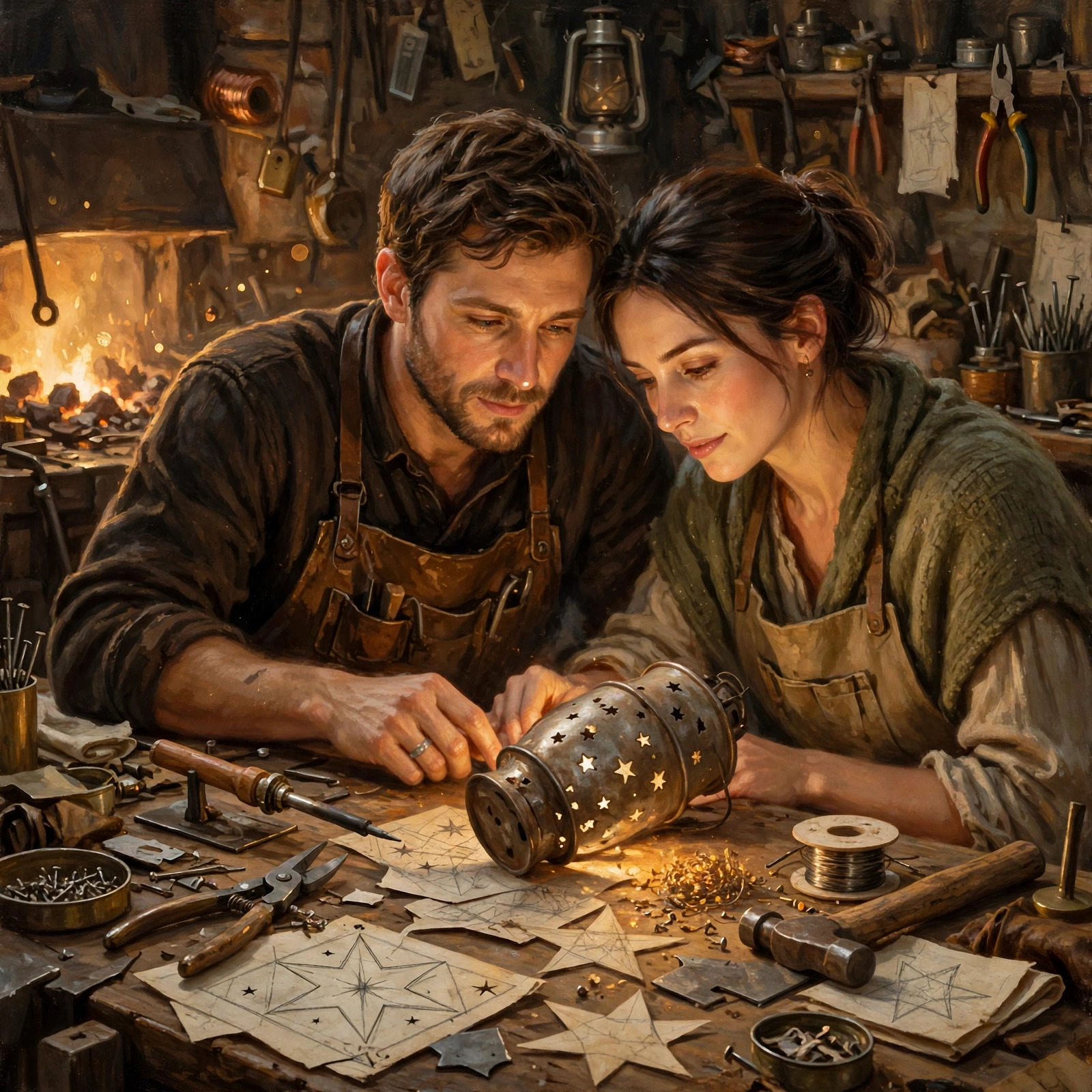
She almost laughed. The crew had gone home hours ago, and the Orme Lantern Works had settled into its night sounds: the tick of the cooling stove, the far bell buoys out in Larkhaven Harbor, a loose shutter somewhere knocking at the wind. One lamp hung over the back bench. Under it her father's storm lantern lay on a folded towel, tin and brass, dented where March had thrown a shutter at it.
Bastian had cleaned the seam first. He scraped it bright with a blade, brushed on flux, and tinned the edges while she watched. Now he lifted the iron from the stand. The tip glowed a dull orange, and the room filled with the hot, sharp smell of solder.
"You've done this," she said.
"Since I was ten. Badly until I was sixteen." He touched the iron to the metal, and silver ran along the joint like a thought finally finishing. "Your father came in once while I was ruining a batch. He told me a bad joint was only an honest one that hadn't been finished yet."
"That sounds like him." Her voice came out rougher than she meant. "He said things like that about saddles. Then he'd make me restitch the whole girth."
"Did you?"
"Every time." She shifted her grip. "He never asked me to stay, you know. Not once. I used to think that meant he didn't mind."
Bastian kept his eyes on the seam. "Did he mind?"
"Fenella says he kept my boots by the door for a year." She swallowed. "I left them there on purpose. I thought if I took everything, I'd have to admit I wasn't coming back."
The iron paused. He set it on the stand, and the quiet that followed was the kind she had learned to dread in other rooms, other years. This one wasn't hostile. It was only waiting.
"Say the rest," he said. "If you want to."
She watched the silver cool from bright to dull. "After Mum died, the whole town was kind. Casseroles, hands on my shoulder. And every kind person told me what I'd do next. Keep the shop, mind my father, stay close. Don't make a fuss, don't go off, don't be too much for anyone." She breathed out. "I was nineteen. I thought if I stayed one more month I'd agree with them."
"So you went."
"I went first. Before anyone could ask me to stay." She gave a short, dry sound. "It's the only way I've ever known to leave. I do it before it can be done to me."
He turned the lantern a quarter turn under the lamp. "I came by with rolls," he said. "I told you that. I stood on the step like a fool, and I knocked twice, and then I sat on the curb and ate both of them."
"Bastian."
"I'm not scolding. I'm telling you what I did." He picked up a rag and wiped his fingers slowly. "After that, I decided I'd never be the one who found a locked door again. So I stayed. I took the shop when my father's hands went. I learned every pipe in this building. If something might fall apart, I got to it first and fixed it, and I didn't ask anybody, because asking only gave them time to say no."
"That's not so different from what I did."
"No." His mouth tilted. "We're a matched pair of idiots. One runs, one grips."
She laughed, properly this time, and it loosened something behind her ribs. "Fenella would put that on a sampler."
"Fenella would make us stitch it ourselves."
The front door rattled. Not the wind this time, but a fist, three heavy knocks, and then the bell over the lintel clanged as someone shouldered inside without waiting.
"Orme! Light's on, so don't pretend." Gus Marlowe came through the shop in his rain jacket, hat in one hand, a folded paper in the other. He stopped at the bench door and took in the two of them, the lamp, the lantern between them. His face did something complicated and then settled into duty. "Isaura. Good. Saves me a walk."
"Evening, Gus." She straightened, and her heel found the old rigid stance, shoulders back, as if for inspection.
"I'll be quick. I don't enjoy this." He held up the paper. "The back rent. I've been patient, because I loved your father, and I'm not hiding that. But the developer's people want an answer, and the association meets before Lantern Night. Nine thousand dollars, Isaura. Before then, or I can't keep telling them no."
The number landed flat and heavy on the bench. She had known it, had carried it from the bus like a second bag. Hearing it said under that lamp was different.
"I know what's owed," she said. "I'm working on it."
"Working on it isn't money."
"Gus," Bastian began.
"Not now, son." Gus said it gently, but he said it. He laid the paper on the corner of the bench, well clear of the solder. "Your father would want me to be fair. This is fair. It's also all I've got." He looked at her a moment longer, tired and not unkind, and put his hat back on. "Get some sleep, both of you."
The bell clanged again behind him. Outside, a buoy tolled somewhere in the dark.
Isaura stared at the paper. Her hands had started to shake, a small fine tremor she had once trained out of herself on cold mornings in a field hospital tent. She pressed them flat against the wood.
"Don't," Bastian said quietly. "Don't pack it in your head yet."
"I wasn't."
"You were. I watched you do it." He picked up the iron again and held it out, handle first. "Finish the last inch. It's yours to finish."
She took it. The weight was familiar, the heat a clean, simple thing after the rest of the day. She set her left hand to hold the seam and brought the tip down, and he reached to steady the dented tin from the other side. The silver ran. The joint closed.
His fingers settled over hers, rough, warm, close enough to the glowing seam that neither of them moved away.
Forge Glow
The last inch of seam had cooled by the time either of them spoke.
"Hold it to the light," Bastian said.
Isaura lifted the lantern. He turned the wick lamp low and the stars her father had loved scattered over the back wall, small and sharp, one for every pierced hole. Anselm Orme's pattern. Her father's door. She turned it a quarter turn and the whole sky of them wheeled.
"It's tight," she said.
"It's better than tight. It's yours."
The night had gone on past the point where the shop made sense. Somewhere past midnight he had banked the forge and fed it again for no reason either of them named. Now it ticked and breathed in the corner, an orange mouth, and the smell of hot solder and tin sat thick in the air. She set the lantern on the bench between them. Her palms were black with flux. So were his.
"You've got a smear," he said, and touched his own jaw to show her where.
She wiped the wrong side. He laughed, low, and reached over with his thumb and did it himself. The thumb stayed. It was rough and careful, and she found she was leaning into it the way she'd once leaned into a warm horse flank at the end of a cold shift.
"Isaura."
"I know."
"You don't know what I was going to say."
"Yes, I do." She stepped in, close enough that the forge put a gold edge along his collar. "It's a bad idea. I've got a bag under the cot upstairs and a number on a piece of paper."
"That wasn't it."
"What was it?"
"I was going to ask if I could." He said it plainly, like a man asking whether a seam was ready.
She answered by taking hold of his apron strings and pulling him the last few inches. The kiss was slow at first, tasting of tin dust and cold coffee, and then it was not slow at all. His hand spread across her back. Hers found the hair at his neck. Fifteen years folded up small and went somewhere she didn't care to follow. When they parted, his forehead stayed against hers, and the forge muttered, and the stars on the wall shivered with the draft from the door.
"Stay for breakfast," he said.
"It's the middle of the night."
"Then stay until it's breakfast."
She did, mostly. They slept in snatches, her on the cot in the back room with her boots still on, him in the chair, one hand hooked loosely around her wrist as if she might go out through the wall.
The next afternoon the sun came flat across Cobbler Row, and she carried the finished lantern home like a held cup. She meant to hang it on the saddlery door early, just to see it there. She had the hook in her teeth and one boot on the step ladder when a voice said her name.
Gus stood on the cobbles with his hat in both hands, looking at the lantern and not at her.
"That's a good job," he said. "Your father would've cried."
"He cried at feed-store commercials." She took the hook from her mouth. "You didn't come to talk about my soldering."
"No." He turned the hat a full circle. "I came because you'll hear it anyway, and I'd rather you heard it from me. Bastian came by the house Tuesday."
Her stomach went quiet. "Came by for what?"
"He paid down some of the arrears. Three thousand, give or take. Cash, in an envelope, like it was a church collection." Gus winced. "And he gave me his word on the rest. That the saddlery stays a saddlery. That you stay, and he'll stand behind it, whatever it takes. I wasn't supposed to say so until you'd settled. But that's not right, is it? Not with you."
She came down off the ladder one rung at a time. The lantern swung from her fist and its stars slid across the brick, across her sleeve, across Gus's shoes.
"Tuesday," she said.
"Before the other night, if that's what you're asking."
It wasn't what she was asking. She was asking why a man could put his thumb to her jaw at midnight and not mention that he'd already gone to her landlord with an envelope. Why she was the last to be told about her own life. In this town they had chosen for her at nineteen. Stay small, stay quiet, stay put. And here was the same gentle hand, better-meaning, reaching in again.
"Did he say why?"
"He said he wasn't going to watch you go twice."
That should have helped. It landed like a ruling.
"Thank you for telling me, Gus."
"Isaura, he meant well."
"I know he did." She hung the lantern on the hook with great care, so her hands would have something to do. "That's the trouble with all of you."
He left without arguing. She stood a long while watching the stars crawl up the door as the sun slid, and across the Row the Orme shop's window stayed lit and she did not look at it.
Upstairs, the bag was where she'd left it, under the cot, canvas gone soft at the corners from three deployments and one bus. She dragged it out. The first thing in was the spare shirt, then the boots, folded the way the army had taught her. Her fingers were perfectly steady. It was the part of her she had always trusted.
She packed her bag.
Anvil for Sale
The buyer came on Wednesday, a farrier from two counties over with a truck and a strap-down tarp, and he ran his thumb along the anvil's face the way Isaura had taught herself never to watch anyone do.
"Army issue," he said. "You've kept it nice."
"I've kept it alive." She stood with her arms crossed in the back room of the saddlery, where the neatsfoot oil smell had soaked into the rafters. "The hardy hole's got a chip on the left. Doesn't affect the work."
"And the kit?"
She had laid it out on the bench the night before: rasps, nippers, the hoof knife with the worn handle, the driving hammer, the leather apron stiff with three deployments of forge scale. Everything she had that no one had given her out of obligation. She had cleaned each piece twice.
"All of it," she said.
He named a number. It was fair. It was nearly exactly what she needed, and she hated that the world could be so tidy about it. She shook his hand. He wrote the check on the hood of his truck, and she watched two men and a hand truck carry fifteen years of herself down the alley.
The anvil went last. It rang once against the tailgate, one clean note, and then it was only a shape under a tarp.
She did not cry. She went inside and washed the oil off her hands until they stung.
Gus's office was above the hardware store, a room of filing cabinets and old photographs of the Row in better and worse decades. He took the check and read it twice, then looked at her over his glasses.
"That's the whole nine thousand."
"Less what's already been paid. I'm putting the rest on top of it." She slid a second envelope across. "That's the three he gave you. Give it back to him. Tell him it's from me."
"Isaura. You could've asked the association for a few weeks."
"I could have." She looked at the photographs, at a young man with her father's jaw holding a saddle like a trophy. "I wanted it to be mine. At least this part."
Gus was quiet. Then he said, gently, "Your dad would've sold the building before he let anybody carry him. You get that from him."
"I'm trying to get out of it."
"Then try faster." He stamped the receipt. It made a flat, final sound. "You're current. The lease stands. I'll tell the merchants Friday that there's nothing left to buy out but a signature."
She walked down the stairs on legs that did not feel like hers.
Fenella was waiting on the Row, in her good coat, with a clipboard hugged against her chest like a shield. A bell buoy clanged out in the harbor, thin and far.
"Well," Fenella said. "Gus already phoned me."
"Of course he did."
"He said you sold the anvil." Her aunt's voice cracked on the last word, then straightened. "Your father forged that horseshoe over the shop door on one just like it. Did you know? I wrote you that. Eleven years ago."
"I know. I kept the letter."
"You kept every letter and answered perhaps one in four."
"Fen."
"I'm not scolding." Fenella shifted the clipboard. "I'm saying that whatever you do next, do it in front of people. I watched you leave once with a bag on your shoulder and your mouth shut. I'd like to see what you do with it open."
Isaura's eyes burned. She nodded, once, and crossed the Row.
The Orme Lantern Works was loud with the work of it, mallets and shears, the hot sweet bite of solder in the air. Rows of finished lanterns hung from the ceiling beams like a low, patient constellation. Bastian stood at the long bench with a pierced panel in his gloved hands and looked up when the door chimed.
He set the panel down very carefully.
"You're not on the bus," he said.
"I was going to be." She put the envelope on the bench between them, on the scarred tin. "That's yours. Gus has the rest. The saddlery's clear." "Isaura, where did you--"
"The kit. The anvil. A man came with a truck." She kept her voice level by force. "I'm not telling you so you'll feel bad. I'm telling you because you went to my landlord and decided my life for me, and I let you, because I was ready to run before I ever asked what you meant by it."
His face did something complicated. He pulled off one glove, then the other. "I thought if I fixed it quietly, you'd never have to be afraid of it."
"I was afraid of it anyway. I was afraid of you doing it."
"I know that now." He came around the bench but stopped an arm's length away, as if he had learned something about distance. "I should have asked. I should have walked across that street and said, Isaura, here's the problem, what do you need. I didn't, because I've been guarding things alone for so long I forgot there was another person in the room."
"I didn't say goodbye to you. I've never said I was sorry."
"You don't have to say it now."
"I'm going to." Her throat worked. "I'm sorry I locked the door. I'm sorry I made you eat those rolls on a curb."
A laugh broke out of him, rough and wet. "Fenella told you that."
"Fenella tells everyone everything." She drew a breath that shook on the way in. "I don't want to do this alone anymore. I want your help. Not your rescuing. Your help. There's a difference, and I need you to know I can tell."
"Then ask me."
"Will you help me hang two hundred lanterns on a Row that thinks I'm a stranger?"
He smiled, finally, and it reached all the way up. "Yes. And you'll tell me when I'm hovering."
"Loudly."
"Good." He took the envelope, looked at it, and put it in the pocket of his apron without counting. Then he took her hand, the washed, stinging one, and held it against the warm front of his shirt. "I'll carry the heavy ones."
That evening she walked back alone, because she had asked to, and he had let her. The father lantern hung on its hook by the saddlery door, unlit, its seam gleaming. She unlocked the shop and went through to the back.
The workroom was strangely wide without the weight of the iron. A pale square on the floorboards showed where the stand had sat. She stood in the doorway a long moment, listening to the bell buoys ring out over the water, and she looked at the empty bench where her anvil stood.
Lantern Night
"You're hovering," Isaura said.
Bastian lowered the hand he'd stretched toward the ladder. "I was bracing the air."
"Brace it from over there."
He stepped back with great ceremony, and she climbed the last rung with a pierced tin lantern in her fist. The hook above the Dunmore window took it on the first try. Along Cobbler Row the others already swung in the wind off the water, two hundred of them, star and crescent and the odd lopsided fish, waiting for dusk. Her palms stung from the day's work. She liked it.
By the time the light went copper, the Row had stopped looking at her sideways. A woman from the bakery pressed a paper bag of rolls into her hands without a word. Gus Marlowe, tie crooked, stood outside the saddlery with his hat in his fingers and nodded once, the way her father used to nod across a fence. Fenella marched by with a clipboard and a brass bell, pointing at everyone, and pointed last at Isaura. Her aunt's eyes were bright. She didn't say anything, which for Fenella was a speech.
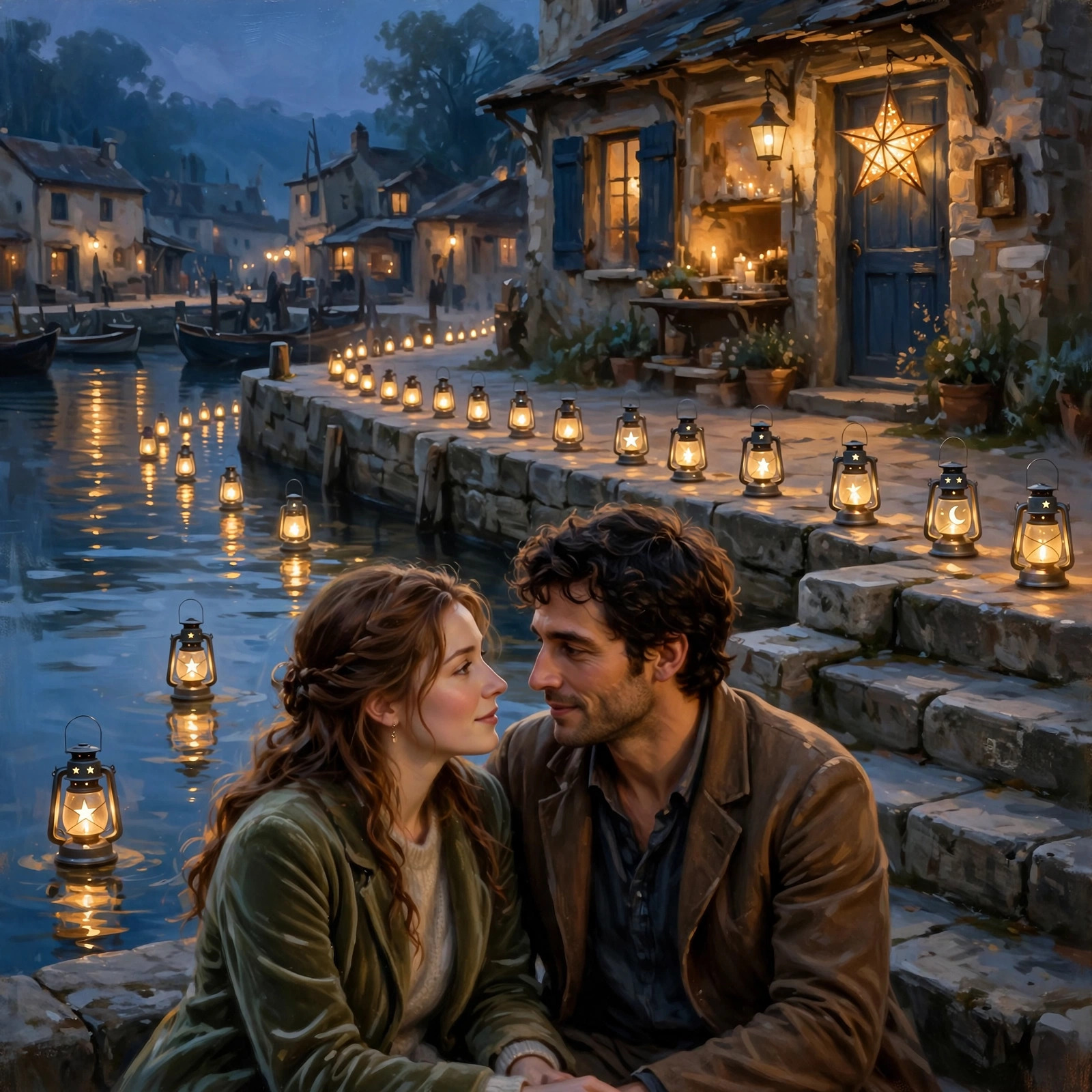
Then the match went down the Row, flame to wick, shop to shop. Tin glowed. Ten thousand little stars fell through the pierced panels and spilled over the cobbles, over shoes and strollers and dogs in ribbons. The whole street breathed gold.
"Come on," Bastian said quietly. "Fenella wants the Row at the harbor by full dark."
"I know. I read the clipboard."
"You read the clipboard."
"She handed me a copy. I think it was a threat."
They walked down with the crowd, then slipped out of it near the bottom, where the lane met the stone steps that dropped to the water. The parade went on without them, a slow river of lanterns bobbing toward the pier. The bell buoys rang out beyond the breakwater, low and patient. Salt air cut through the smell of hot tin that clung to Bastian's coat.
She sat on the third step. He sat beside her, a careful inch away, then no inches at all when she leaned.
Behind them the glow climbed the hill, lantern over lantern, until the Row looked like something poured out of a forge. The water below caught it in broken pieces.
"I counted," he said. "Two hundred and one. Somebody hung an extra."
"That was me. A spare. Never again will this town run short."
"You're planning for next year."
"I noticed that too." She turned her scarred hands over in her lap. The anvil was gone. The kit was gone. Her whole careful proof that she had a life of her own sat in a stranger's barn two counties over, and what surprised her was how light she felt. "I thought I'd miss it more. The weight of it."
"You carried it a long way."
"I didn't need it to be someone." She looked at him. "I just needed to stop leaving before anyone could ask me to stay."
His throat moved. "Are you being asked?"
"Are you asking?"
"Yes." No hesitation, no apron, no workbench between them. "Stay. Not because of the lease, or the Row, or the lanterns. Because I'd like to wake up knowing you're across the street and mad at me about something small."
A laugh caught in her chest and turned into something else. "I'm staying."
"Good."
"I love you," she said.
She had expected it to be harder. It came out plain as a nail driven true. His eyes shut for a second, and when they opened they were wet and entirely unguarded.
"I love you," Bastian said. "I did when you left. I was furious about it for fifteen years, and I never once stopped."
"I'm sorry it took me so long to come home."
"You're here." He lifted his hand and cradled her jaw, thumb along the cheekbone, as if she were something he'd shaped and was amazed to find still warm. "That's the part I'm keeping."
She kissed him first. It tasted of salt and cold air and the sugar from the bakery rolls, and his hand slid into her hair while the other found her back and held on. Out on the water a bell buoy clanged. Somewhere up the hill the crowd began to sing, ragged and happy and a little off key. She smiled against his mouth and felt him smile back.
When they finally stood, her knees complained and his coat was gold along one shoulder from the lanterns. He took her hand without asking, then looked at her, and she squeezed to say yes.
They climbed the steps together, slowly, into the lamplit stream of the town. Neighbors parted to let them in. Fenella waved the clipboard like a flag. Gus lifted his hat.
At the top of Cobbler Row the saddlery stood with its door open to the evening. Above it, on the hook her father had set, the old storm lantern burned steady, its mended seam glowing like a thin gold thread, and the whole town walked past beneath it, carrying their lights down to the sea.
Get notified when new stories drop

Lila Monroe
Lila writes contemporary and small-town romance with banter-forward leads and soft landings. She believes the best love stories sound like two specific people, not a trope checklist.
Leave a comment
Comments