


Thistlefurl Gorge
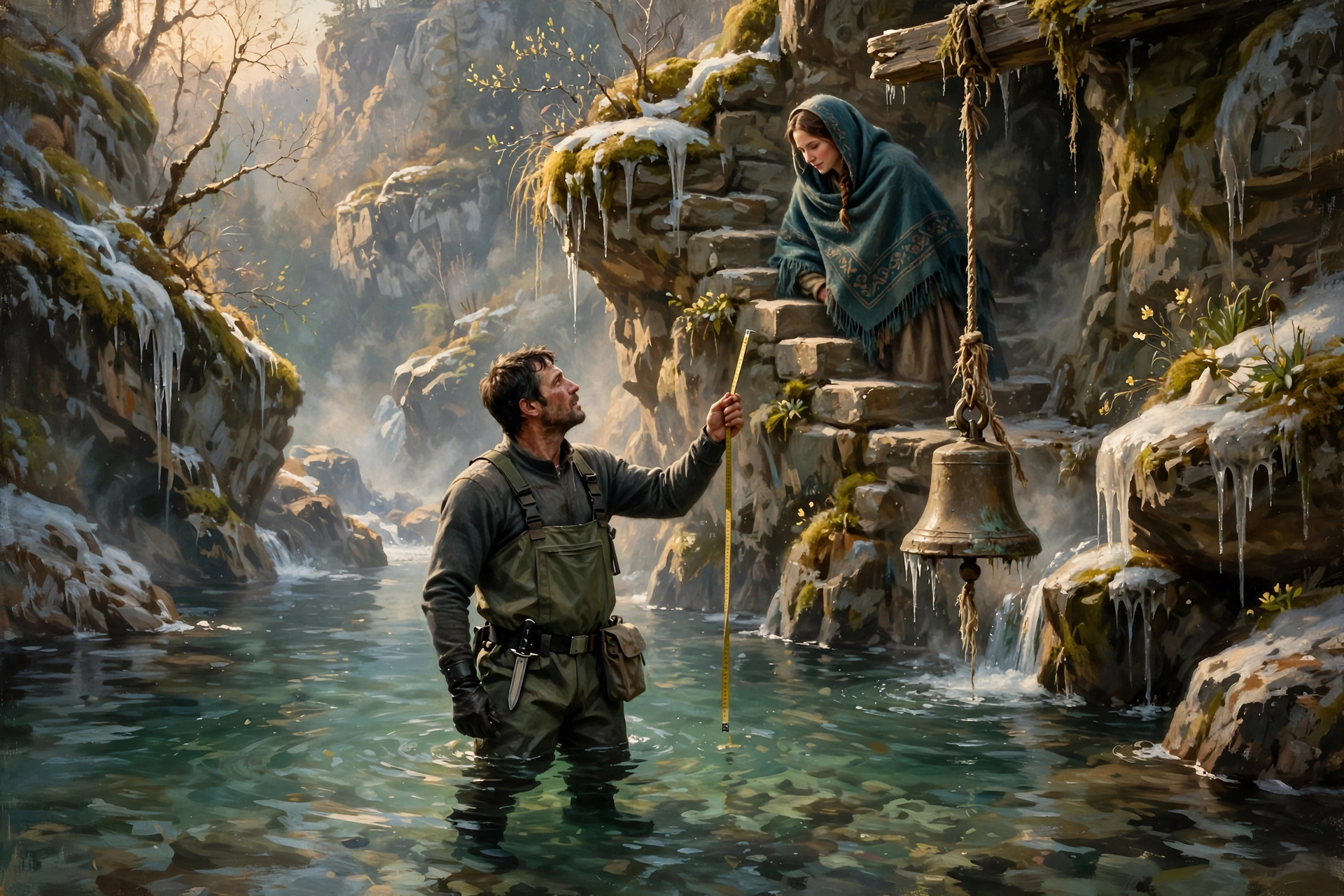
Greta Sund was halfway down the gorge steps when she saw the rope.
Not her rope. The bell rope, the old one, the one her grandmother had spliced and tarred and left to the weather the last spring she was alive. It hung from the mouth of the melt bell above the water, and it was frayed halfway through at the knot where it had rubbed the timber crosspiece for years. One good thaw, one good drop of the bell, and it would part.
She was still three steps from the bottom when she realized there was a man standing in her sill.
Not on it. In it. Boots in the shallows, a measuring tape in one fist, a slate under his arm, and a bright yellow float bobbing behind him on the current like something that had every right to be there. He had waded out to the low shelf of stone at the gorge mouth, where the water ran shallow and glass-green, and he was reading a number off the tape and marking it down as calmly as if the sill belonged to him.
"You're standing in the vale's water," Greta said.
He looked up. Sun-browned, dark-haired, a scar along one forearm where the skin had healed wrong. He had the unbothered stillness of men who worked under water and had learned not to waste motion above it.
"It's flowing water," he said. "It doesn't hold still long enough to belong to anyone."
"It belongs to Oxbell Vale. The whole of it, bank to bank, and the sill with it. And the council records who is allowed to measure it, which is a short list, and you're not on it."
"Corin Marzec." He didn't offer a hand, because his were wet. "Salvage, out of Millbrook. Brightwater Combine retainer."
He said it the way men say a thing that closes conversations. She let the silence sit until it stopped closing.
"The Combine," she said, "has a man in my gorge with a tape, a slate, and no permit. That's a gift, honestly. Dagny Hollan has been short of things to be furious about this winter."
"The steward. I've heard she collects the melt-levy."
He knew the levy. That meant Grive had briefed him, which meant this was not a man who had wandered off a road. This was a man with orders.
"She collects it and she pays it," Greta said. "Some of it comes to me, for the singing. Which you're currently standing in the middle of."
"The singing." He glanced down at the water as if there might be song in it. "Grive said the vale kept a voicekeeper. He didn't say what for."
"Then he told you half of it, which is the most anyone gets out of him." She came down the last steps and out onto the shelf, cold coming up through her boots immediately, and stopped at the edge of the deep line where the shelf dropped away. "Every thaw, when the melt comes down out of the high country, someone has to sing it through the gorge. Otherwise it comes through all at once, unsung, and takes the footbridge and the boat racks and a good piece of the lower pasture with it. My grandmother did it. Her mother did it. I do it. The levy pays for it, and the council's law about who may do business in this water pays for nothing but arguments, so let's have the argument."
"I'm not doing business. I'm taking a depth sounding."
"For whom?"
He weighed it. She watched him weigh it, and marked that too, the small pause before he answered a question he'd decided not to lie about.
"The Combine wants to know the state of the sill before the melt," he said. "There's talk of logging the gorge flanks, and there'd be a sluice across the mouth if it goes ahead. Grive sent me to get the numbers first."
"A sluice." She heard her own voice go flat. "Across Thistlefurl. Before the melt."
"That's the talk. It's only talk until somebody files it."
"A sluice across this mouth, before day sixteen of the thaw, would drown this shelf and half the steps. And you're taking the numbers that will decide whether it goes ahead, out of my water, with no permit, for a foreman in Millbrook who has never once seen this gorge in anything but a drawing." She kept her hands still at her sides, because her grandmother had taught her that anger in a voicekeeper travels, and it had traveled far enough for one morning. "You could have written to the council."
"Grive doesn't write to councils."
"Then Grive could have said so in a letter."
A corner of his mouth moved. Not quite a smile. "He's not much of a writer either."
That surprised a laugh out of her, short and unwilling, and she resented it. He had a diver's ease about him, unhurried even with cold water in his boots, and it was doing him no favors with her.
She turned and looked up at the bell. It hung in its timber cradle at the gorge mouth, above the drop, dark bronze gone green at the lip, cast by her grandmother's hands before Greta could walk. The rope came down from it to within arm's reach of the top step, if a person stretched, and the frayed place rode high against the crosspiece, well above anything a hand could get to without a ladder or a very bad idea.
"Now that's a fine old bell," Corin said, following her eyes. "But I wouldn't pull that line. It's fretted through more than half at the knot. One hard ring and it parts."
"I know what it is. I've known that rope since before you were on this river."
"You've been watching it fray."
"I've been waiting for low water to re-hang it, which is a two-person job, and which is my business, not the Combine's." She looked back at him. "The bell has to be rung before the melt, every thaw, from this cradle, and the rope has to hold for the drop, and the rope will not hold. So the rope comes down and a new line goes up before day sixteen. That is the actual state of this gorge, not whatever number you just wrote on your slate."
"The sounding's still worth taking," he said. "If the Combine builds the sluice anyway, you'll want the sill on record."
"If the Combine builds the sluice, this sill won't matter to anyone, because the vale will drag it through the council and through the courts after, and I will spend every thaw of my life arguing about water instead of singing it down." That came out sharper than she meant it to, and she let it stand, because it was true.
He wound his tape slowly, giving her the room of a man who had decided not to give anything else away. Then, instead of wading back to the bank, he stopped.
"What does the singing actually do?" he asked. "Grive calls it council superstition. A levy line item."
"Grive can call it whatever gets him up in the morning. The melt comes down from the high country whether anyone sings it or not. Sung, it comes down slow and level and the banks hold. Unsun, it comes down like a wall and nothing holds. The vale has twelve generations of drowned footbridges that say so. Whether you believe the song does it or the warning does it, the water behaves for it, and I'd thank you not to sound it out while it's deciding."
He looked at her for a moment longer than he needed to. Then he sloshed out of her sill, gathered his float, and paused at the foot of the steps, leaving wet prints on her stone.
"For what it's worth," he said, "the water runs cleaner here than anywhere on this stretch. Whatever you're doing, it's working. The numbers will say the same, if anyone at the Combine bothers to read past the last one."
"They never read past the last one. That's what the last one is for."
He almost smiled again, and this time she saw him decide against it, and she wondered what that cost him. He was three years on this water by the talk of the boat racks, and she had never once seen him at a council meeting, a levy day, or a market.
"Come back at low water," she said.
He stopped with one boot on the first step. "You want a second sounding?"
"I want you to come back at low water and put your face in it instead of your tape. Look at the sill, the stone, the shelf, the way it steps down. See it with your own eyes and then write down whatever number you can live with." She came up the steps after him, close enough to see the gray coming into the water behind him where the shallows fed the drop. "Because you're going to write something down either way. Men like you always do. So write what you've seen."
"Men like me," he repeated.
"Combine men. Tape-and-slate men. Grive's men."
He held her look a beat too long for courtesy, then went up the steps without answering. His prints dried behind him in the sun.
Greta stayed on the shelf a while after he'd gone, cold to the shins, looking at the frayed knot above her and the green water sliding over the sill. Low water would come again before the melt. There was time for the rope.
She wasn't at all sure there was time for anything else.
The Melt Bell
Corin was already in the water when Greta came down the steps with the new rope coiled over her shoulder, standing chest-deep at the mouth of the gorge with the frayed old line looped twice around his fist.
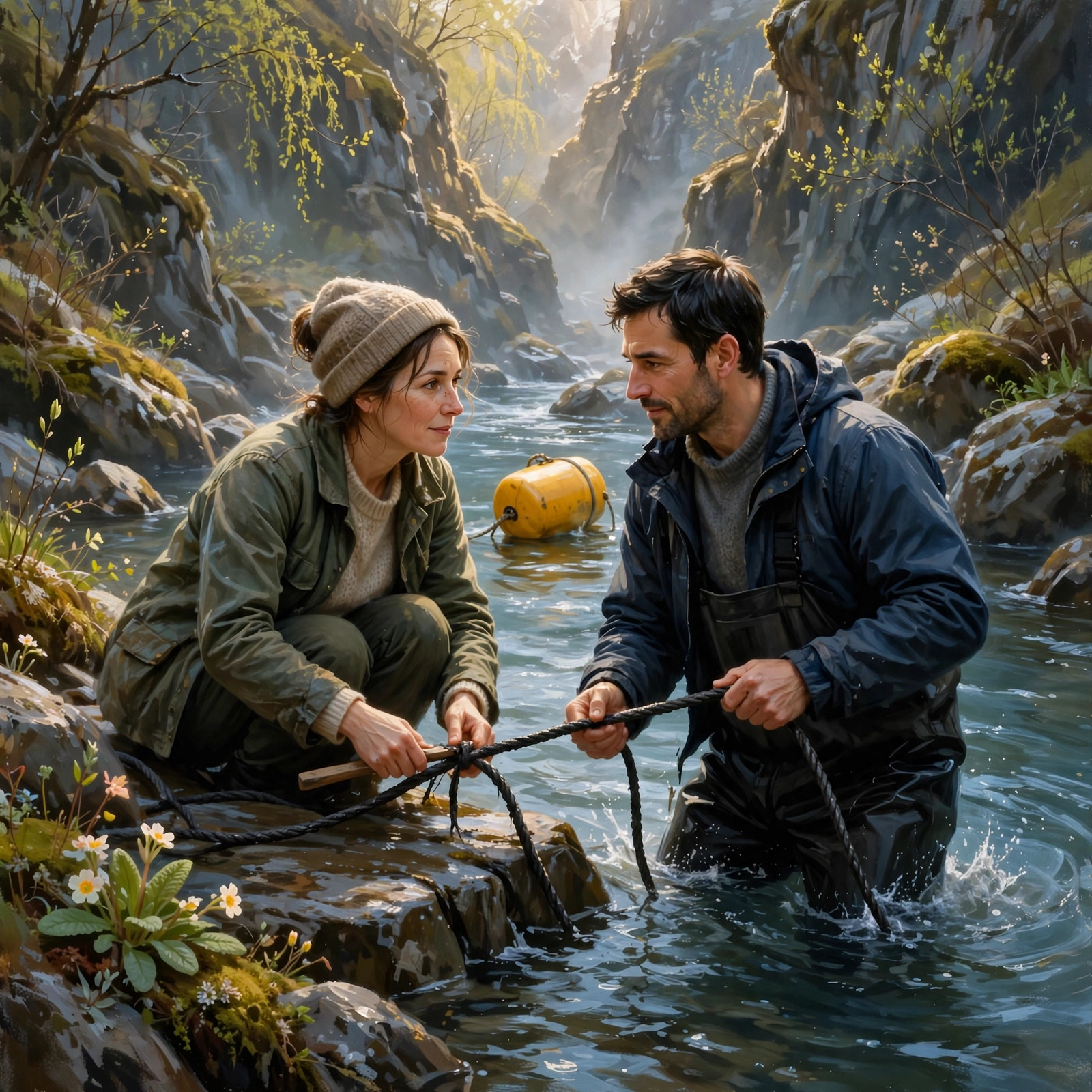
"You could have waited on the shelf," she said.
"You said dawn." He nodded up at the crosspiece, where her grandmother's bell sat in its timber cradle, dark with a dozen thaws. "Somebody got here before me, though."
Dagny Hollan was on the ledge above, wrapped in her council coat, holding the ledger against her chest like a shield. "I came for the levy count," she said. "I'll not stay. Greta, when the bell hangs, I want it rung once so I can mark the hearing of it. The vale pays for what the vale hears." Her eyes went to Corin, slow and level, and stayed there a moment too long. "I didn't know the Combine sent men up this far before the melt."
"The Combine didn't," he said. "I'm on my own time."
"That so." Dagny wrote nothing, which was how Greta knew she was writing it all down somewhere behind her face. "Mind the current at the throat. It turns early this week." Then she went, boots scraping the path up, and the gorge was theirs.
Greta paid out the new line over the crosspiece and let the end fall into the water. "Loop it under the cradle. There's a groove in the far foot, bronze against oak, you'll feel it with your knuckles before you see it."
"I know how bells sit," he said, but he went under anyway, and came up streaming, and the loop was in the groove on the first try. She had expected the argument. She noticed the absence of it longer than she would have noticed the argument.
"You've hung one before."
"Salvage, mostly. Raising, not hanging. But a line under a load is a line under a load." He braced his heels against the sill shelf and took the slack against his back the way a mule takes a cart, and she hauled from the top, and the bell came off its cradle smooth as a spoon out of a bowl.
Twelve meters was a long way to lower a thing you loved. She let it down in short gives, palm over palm, watching the bronze turn slow against the rock face where the water had cut the stone into shelves and teeth. Her grandmother had cast the bell with the vale's copper and hung it here with half the town watching, and every thaw since, someone had re-hung it, and for most of Greta's life the someone had been Greta alone.
"Easier with two," she said, before she meant to.
"Heavier with two, too." His voice echoed strangely off the far wall, arriving twice. "Somebody to drop it on your head."
"You'd drop it on your own head. It's over yours."
"That's the part I try not to think about."
She let out line and he guided the bell past a shelf that would have scraped it, hand flat against the bronze, patient, like a man steadying a door for a stranger. When the cradle took the weight again she felt it come taut in her palms before he called up, and she tied off at the crosspiece without being asked, the knot her grandmother had taught her, the one that holds by tightening on itself.
"Now the test," she called down. "Swing it. One, then stop it."
"It's mine to stop too?"
"Bronze doesn't argue with whoever's nearest."
He put a hand on the bell's lip and gave it a push. The tone came up out of the gorge the way the melt would come later, wide at the bottom and sharpening as it rose, and it rolled out over the vale and lay down over the fields, and Greta felt it in her teeth and in the soles of her feet and, briefly, in the backs of her eyes. Corin caught the bell on the return swing and stilled it against his shoulder, and the echo went on without them for a while, out and thinner and out.
"That's a good bell," he said, quieter than the water.
"My grandmother cast it. It's supposed to tell the whole vale when the melt starts, before the water gets loud enough to drown it. And when the water's low like this, it tells us the gorge is still itself." She looked down at him, at the bell dark against his chest. "You stopped it like you'd done it before."
"Like I was afraid of it." He eased it back into the cradle. "Same grip, different reasons."
She came down the steps while he climbed the shelf, and they met in the middle, both dripping, both laughing a little at the state of each other. He stood close enough that she could see the water beading in the scar through one of his brows, an old one, white and neat as a seam.
"You're not afraid of this water," she said. "I watched you stand in it for an hour without shifting your feet."
"I'm not afraid of water." He glanced once at the throat of the gorge, where the current turned and went down. "I've been in deeper than this. A lot deeper, and colder, and darker, with worse things overhead than a bell."
"Where?"
"Places the Combine wanted things out of." He said it plainly, but something closed a little behind it, a door eased to, not slammed. "You learn down there that you don't fight what's over your head. You give slack. You let it have you for a while. Then the water gives you back."
"And if it doesn't?"
"Then someone like me goes in after you." He shrugged, uncomfortable with the shape of his own answer. "It's a trade. It only works if the going-in-after part is true."
Greta coiled the old rope, the frayed one, half-cut through where the knot had worked against the crosspiece for years. She should have burned it. Her grandmother had always burned the retired lines so no one would be tempted to trust them twice. She turned the cut end in her fingers instead.
"Low water comes again before the melt," she said. "You still owe me a look at the sill with your own eyes. Tape-and-slate man."
"I remember what I owe." He held out his hand, palm up, expecting the coil.
She didn't give it to him. Then she did.
"Keep it," she said. "Cut the good length off if you want a lanyard out of it. But keep the knot end. That's the part that knows the bell."
He took the rope and didn't cut it, just wound it over his fist the way it had been wound when she'd first seen him, twice around, and pushed it into the dry pocket of his float vest like something he intended to still have in a year.
"So I'm trusted with rope now," he said.
"You're trusted with a bell. Rope is the lesser thing." She was already climbing toward the sun, and she heard him laugh below her, one short note the water couldn't carry off, and then his boots in the shallows, following.
Above them the bell hung true in its cradle, bronze against oak, patient as ever her grandmother had been. Somewhere under his vest, against his chest, rode the knot that had held it up over the vale for half her life. She found she wanted to know whether he'd come back at low water, and she found she already knew, and it made the climb feel shorter than it was.
Low Water
Low water came at dawn on the day the vale's frost gave out, and Greta was already on the sill stones when Corin came down the path with his gear slung over one shoulder and the frayed rope wound twice around his fist.
"You kept the knot end," she said.
"You told me to." He crouched at the lip of the plunge pool, where the falls had thinned to a veil and the gorge below lay open and still, the sill bare and black under the last of the winter light. "It's lower than I expected. You can see the shoulder of it from here."
"You can see the top of it. The sill's the wide shelf, all the way out to the drop. My grandmother's bell hangs above it, and when the melt comes down, the water stands up on that shelf before it falls. That's what I sing to. That's what I have to hold."
He looked at her the way he had on the first morning, measuring her the way he'd measure water. "Then I'd better see it all."
"You'll freeze."
"I've frozen before." He sat down on the cold stone and worked his boots off, then the vest, laying the rope on top of it where she could see he wasn't leaving it behind. "Hold my slate if I hand it up."
She watched him go in without a word wasted on it. That was his way. He'd told her once, on the bell day, that going in after people was a trade, and she was beginning to understand what he meant. He didn't dive like a man daring something. He dove like a man going to work. The water took him to the waist, the chest, the shoulders, and then only his head rode above the sill, and he swam out along the shelf with his hand trailing the rock.
Then his head went down and did not come straight back up.
Greta sat on the sill stones with her hands pressed flat under her thighs and did not call out. He had been down long enough to see everything twice. He came up with a hooked breath and something in his fist, and she saw that whatever it was, he had not meant to find it.
"There's a plate down there," he said, treading. "Lead. Stamped. On the drop-off edge of the sill, driven into a seam."
"A plate from what?"
He didn't answer at once. He swam to her instead, and hauled himself out on the sill stones, and sat dripping with his legs in the shallows and the thing in his closed hand, breathing like a man carrying something heavier than lead.
"From a survey." He opened his fingers. The plate lay on his palm, green with age, stamped along its face with a mark she didn't know but he clearly did, because his thumb had found the stamp and stayed there. "Brightwater stamp. Mine."
"Yours."
"Three years ago." He said it to the plate, not to her. "Before the Combine put me on retainer out of Millbrook. Grive wanted a depth sounding across this sill. I dove it, set the plate, and I logged what I found." His thumb moved off the stamp. "It was a fast dive. Cold water, a foreman waiting, a slate to fill. I've done a hundred of them."
"But?"
"But I've never once come back to check one." He looked up at last, and there it was again, the door eased to behind his eyes. "You asked me to see the sill with my own eyes. I've seen it twice now. Three years apart. It didn't look the same."
"Nothing looks the same after three years."
"The shelf doesn't lie about time. Water does." He turned the plate over and over in his palm, a small dark rhythm. "What is it you sing to, exactly? When the melt comes."
So she told him, because he had shown her his and it seemed ungenerous to hold hers shut. "There's a melt-song. Old, older than the vale's written anything. Three verses. The first verse names the water where it rises. The second verse names it on the shelf, here, standing up before the fall. My grandmother taught me both before I could read."
"And the third?"
"The third verse has to be carried by two voices in harmony. That's not style. That's the shape of it. One voice names the water down the gorge, and the other answers it, and the two lines cross over each other and hold the fall together while it goes past the bell. A single voice can carry the first two verses alone. The third one can't be sung alone at all. Not because it's hard. Because a lone singer who takes the third verse forfeits the thing the verse is for."
"Which is?"
"Hearing it. Ever again. The one voice she loves most." Greta was surprised at how easily it came out, sitting on cold stone next to a dripping man she had known a week. "You'd go on hearing everything else. Cattle, bells, your own boots. But that voice would go quiet in your ear for good. So no voicekeeper sings it alone, and none ever has."
"Not one?"
"Not one that anyone kept a record of." She picked at the moss between the stones. "My grandmother taught me alone. Every lesson, just us. She was the only other voice in the vale who knew the whole song. She meant to teach me the third verse at the thaw she didn't finish. She died mid-thaw, and the water went down unheld that year, and I have never once sung past the second verse. I hold the fall from the top of it, with the bell. It works. Mostly."
"Mostly."
"Don't fish at that word, Marzec."
"I'm a fisher of things, not words." But he said it gently, and he looked at the bell above them, bronze patient in its cradle, and then at her, and she felt the look land somewhere she hadn't bricked up yet.
"It's not some trick you can learn off me in an afternoon," she said. "Before you ask. There's no harmony in the vale that can stand it. Dagny's voice is a door creaking. The rest can't hold a line against moving water. The song needs two carried voices, and I've got one, and that's the whole arithmetic of my winters."
He was quiet for a while, turning the plate. Then, without looking up: "There's arithmetic on my side too. You should hear it. The Combine means to shut the Thistlefurl sluice. Before the melt. And Grive means to log the flanks of the gorge once the water's boxed."
The cold that went through Greta had nothing to do with the stone.
"They can't. The melt-song, the bell, the sill, it all rests on the water standing on that shelf. If they shut the sluice, there is no third verse. There's no second verse. There's a trickle and a dry bell and a logged-out vale."
"I know what it does. I told you. I dove this sill for them."
"And what does the closure rest on?" She heard her own voice go flat. "What do they base it on? A survey? Whose?"
Corin closed his hand over the plate and did not say anything at all, and the water moved in the shallows around his ankles, and the bell hung quiet above them both, and she watched him look at the drop-off edge of the sill as if he could see straight down to the seam and everything he'd stamped into it.
"Next low water comes tomorrow evening," she said at last. "Warm stone, the big one at the bell's foot. Come at dusk. Bring the plate. Bring whatever it is you're not saying. I'll bring the song's first verse, and you can hold the second line, and we'll see if a Combine man can carry a tune."
"I can carry a tune."
"We'll see. And Marzec, whatever's on your slate, I'd rather hear it from you on warm stone than from a council notice in the dark."
He wound the old rope twice around his fist, the knot end riding on top, and stood dripping in the first sun of the thaw. "Dusk tomorrow. Warm stone. I'll be there before you."
She believed him, and that was the part that frightened her.
Warm Stone
He was there before her, like he'd promised, sitting on the big flat stone at the bell's foot with the old rope coiled beside him and the lead plate face-down on his knee, as if it might say something if she looked at it straight on.

"You're early," Greta said.
"Low water came at noon. I've been counting the ledge stones." He tipped his head at the shallows. "There's forty of them between here and the sill. You'd know that."
"Fifty-two, and three of them move." She set her boots on the stone's warm flank and sat. The stone had held the sun all afternoon and it gave the heat back through her skirt like a hearth. Above them the bell hung quiet in its cradle, copper gone green-black at the lip, and the rope's replacement hung beside it, new hemp pale as wheat against the old dark timber. "You brought the plate."
"I brought the plate." He didn't turn it over. "You said the closure rests on a survey. Whose." He said it flat, the way a man reads his own sentence back before signing it. "You already know whose. You knew it in the shallows yesterday. You just wouldn't say it in front of yourself."
"I'd rather you said it."
"Mine. Three years ago, for the Combine, before Grive ever set foot in Millbrook. Grive got my sounding out of a drawer and built the closure order on top of it. Nine meters of soft silt over the sill, that's what I recorded. Soft silt doesn't hold a foundation and it doesn't hold a sluice tune, so the order says box the water, log the flanks, take the timber while the ground's useless anyway." He turned the plate over at last. The stamped figures caught the last light. "Nine meters of silt. That's what's in the record."
"And yesterday you put your hand on the sill."
"I put my whole arm on it." He looked at her then. "It's bedrock. Three meters down, clean stone, cold as a cellar floor. I knew it when I stamped the plate and I know it now. I was rushed, it was late in the season, the visibility was soup, and I took a grab-sample reading and dressed it up as a survey because the Combine wanted a number before the frost. That's the whole of it. The closure order stands on my error, and I'm the only one who can take it down, because I'm the only living soul who knows the number is wrong."
Greta let the water say its slow piece against the ledge while she thought. She had spent the morning telling herself he would arrive with some Combine trick folded in his pocket, some way to move the bell or buy the vale's quiet. She had not let herself imagine the other thing, which was that he would sit on the warm stone and hand her the whole error with nothing wrapped around it.
"Three meters," she said. "Bedrock."
"You could sound it yourself from a boat. You will, at the hearing, if I lose my nerve. But the record's mine to disavow. Nobody else's."
"Then we're at the arithmetic part." She pulled the council book out of her satchel, the melt-tuning ledger, canvas gone soft at the corners from a decade of thaws. She opened it flat on the stone between them. "Because here's mine. The melt-song's tuning belongs to the vale, and the vale's voicekeeper can't carry two lines, and the law says I can't make private bargains with Combine men. But there's no law against a free diver signing onto the tuning as a second voice before the council. It's been done before. Not in my winters, but the book doesn't close." She turned the ledger so the empty lines faced him. "Two names at the melt. Two voices. It goes to Dagny at the next levy meeting, which is after the hearing, so it's public when it needs to be public and quiet until then."
"You thought about this since yesterday."
"I thought about it while you were still dripping in the shallows." She held the pencil out. "You sign, you're in the tuning. You sign, the record says a diver of the Brightwater Combine stood on the voicekeeper's stone and took the second line of the melt-song. It doesn't fix your survey. You fix your survey."
"At Millbrook. In front of Grive."
"In front of Grive and the survey board and whoever else is in the room. That's where the order lives, so that's where it dies."
He took the pencil but didn't move it. "You know what it costs me."
"I can guess at half of it."
"The retainer. The fee. Grive's work, and Grive's work is most of what a diver eats between thaws." He looked at the empty lines a long moment, and she watched his thumb press a small gray dent into the page. "I've spent a dozen years learning that a man who owns his mistakes doesn't eat. You keep your head down and your numbers tidy and you let the drawer hold the rest." He set the pencil to the paper. "Head down doesn't work anymore. Mine's the number on the order."
He wrote his name in the second voice line, Marzec, C., the letters small and square, the kind of hand that labels crated salvage in bad weather. Under her own name. She looked at it so long the ink seemed to dry twice.
"Right," she said, and her voice came out steadier than she'd budgeted for. "Then you learn the harmony line. Tonight. Before you get clever and before the light goes."
"I said I can carry a tune."
"You can carry a salvage line. The harmony's different." She stood up on the stone and set her palm flat against the bell's cold flank. "First verse rides low, and it's mine. Second verse rides high. Third, the two lines have to lean on each other or neither stands." She sounded the low note without ringing the bell, just humming against the copper, and he stood too, and she moved one step to his left where the stone was warmest. "You take the high line on my third word and hold it. Don't push it. If you push, I hear the push and I chase you up and the whole thing capsizes."
He gave it back to her, the high line, and his voice was rough at the bottom of it and true at the top, and the pine roots on the gorge path seemed to lean in toward the sound. They went through it once, twice, a third time, and on the third one she heard it, the place where his line caught hers and held it up, and she stopped singing because if she kept going she was going to cry on the warm stone in front of a Combine man and she had a decade of practice at not doing that.
"That was," he started, and stopped himself, and she liked him for it.
"That was the shape of it," she said. "We'll have it by the melt."
The light had gone copper along the gorge rim. Dusk on the path, and her boots were on the gravel now, and he was still close, and she could smell river water and lead and the green of the pines coming down with the cool. He was holding the old rope in both hands, knot up, not going anywhere.
"You signed the book," she said. "You're going to testify against your own survey in front of Grive. You'll lose the retainer."
"I know what I signed."
"I know you know." And because a decade of winters had taught her every variety of not saying, and she was suddenly done with all of them, she took a fistful of his wet jacket and pulled him down and kissed him.
He kissed her back like a man coming off a long dive, careful and then not careful at all, one hand still full of rope and the other settling warm at her jaw. The bell hung silent above them. Some things a bell knows better than to ring in on.
When they broke apart, neither of them said anything clever. He touched his thumb to her lower lip once, a surveyor's mark, noting the depth, and she laughed and pushed his hand away.
"The hearing," she said, stepping back onto the path, getting her satchel strap right on her shoulder. "Two days after the filing. You testify first, before they vote."
"I testify first." He wound the rope around his fist, knot riding on top. "I'll walk you to the vale road."
"You'll walk me to the fork, and then you'll go back to Millbrook like a man with a retainer, and I'll go up to the council house like a woman with nothing new in her ledger." She said it lightly. He heard it exactly the way she meant it, which was the frightening new arithmetic of the whole evening.
"Dusk," he said at the fork, and didn't say when, and didn't need to.
"Dusk," she agreed, and went up the road alone, and her mouth was still warm from the kissing and from the harmony line both, and she didn't sort out which was which, and didn't care to.
The Hearing
Word came up the vale road on the twelfth day of the thaw, and it came fast, the way bad news travels uphill.
Greta was mending the bell rope under the cradle when the miller's boy pounded up the path, out of breath, delighted with himself. The Combine had filed its notice. The Thistlefurl sluice would close before the melt. The papers were stamped in Millbrook that morning, and the stamp was fresh, and the boy knew whose hand had held them because everyone at the crossing knew.
"Marzec," the boy said. "The diver. Filed it himself."
Greta set the rope down. She kept her voice even, because a voicekeeper's voice is a tool like any other, and you don't gouge wood with a fine chisel. "Thank you. Go on back down."
Then she walked up to the bell stone, the warm stone where two evenings before a man had kissed her like the answer to a question she hadn't known she was asking aloud, and she stood on it in the dusk, and the stone was just a stone, and he did not come.
She was still there when full dark settled, telling herself versions of it. That Grive had forced his hand. That the retainer bound him. That a man could file a paper and mean nothing by it. She got rid of them one by one, the way you cull bad notes out of a scale, and every one of them rang false, because the story coming up the road had said his own hand, and Corin Marzec did nothing halfway, least of all cowardice.
The melt was four days out. The hearing was in two. She sent nothing to Millbrook, and he sent nothing up, and the bell stone sat cold at the mouth of the gorge, and she told herself she was glad to know the shape of him before the water rose.
She was not glad. She was hollow, in the exact shape of him.
On the fourteenth day she took the council book under her arm, and the marker plate wrapped in oilcloth, and she rode down to Millbrook with Dagny Hollan, who talked the whole way about drainage and levees and the price of tar, and did not once ask why Greta's knuckles were white on the satchel strap.
The hearing room at the Combine's hall was full of benches and men who smelled of pitch. Grive sat front and center with a folder of papers squared in front of him like a hand of cards he'd already counted. Corin sat to one side, apart, in his good jacket, and he did not look at her when she came in, which told her more than a look would have.
The notice was read out. Closure of the Thistlefurl sluice before the melt, on the finding that the sill lay under nine meters of soft silt, unstable, unsafe, a hazard to the flanking works.
Nine meters. Greta sat with her hands folded and her teeth set. She had touched the sill with her own palms. She knew what lay down there. Bedrock, cold and honest, at three.
The chair called for the surveyor of record.
And Corin Marzec stood up.
Greta's whole body went still. He'd told her he would do this. She hadn't believed it, not all the way down, not after the twelfth day, not after the stone went cold.
"I ran that sounding three years back," Corin said, and his voice carried in that room the way it carried on the water, quiet and level and reaching every corner. "I stamped the plate myself and I left it in the seam, and I'll own both of those things. But the figure on the survey is wrong. I rushed the cast. I took one reading at high water with sediment in the column, and I didn't go back and check it, because checking meant another week in that gorge and I wanted to be done."
Grive's head came around slow, like a gun in a housing.
"The sill is bedrock," Corin said. "Three meters down at low water. I've been on it this thaw. The voicekeeper of Oxbell Vale can tell you the same, and she has no stake in the Combine and no reason to lie for me. There is no silt bank. There is no hazard. The closure order rests on my error, and I withdraw it as the surveyor of record."
Grive stood. The room had gone quiet enough to hear the river working under the floorboards.
"You're done," Grive said. Not loud. That was the worst of it, how quiet it was. "The fee's forfeit. The retainer's done. And if you think the Combine puts work in the hand of a man who breaks his own survey in a public room, you've been holding your breath down there too long."
"I expect I have," Corin said.
Greta sat with her spine straight and did not reach for him across the aisle, though every part of her that wasn't sitting was.
Dagny rose, and the room turned to her, because nineteen years of collecting the levy will put that kind of authority in a small gray woman. "The vale concurs with the corrected sounding," she said. "And the vale will enter into its record that the voicekeeper's tuning this season is carried by two voices, as the melt-song requires, and that the second voice is Marzec of Millbrook, whose conduct in this room I find to be the opposite of what I was told to expect of a Combine man." She looked once at Greta, dry as a seed. "The law of the vale frowns on private bargains, Voicekeeper. It does not frown on this one."
Greta's eyes stung, and she blinked it back, because a voicekeeper cries on her own time.
The chair took a vote without leaving the bench. The order collapsed there in the room, all at once, like a scaffold with the pins pulled. Grive gathered his folder and his men and went out slamming nothing, which somehow was louder than slamming would have been.
The benches emptied. Somebody shook Corin's hand on the way out, and he stood there and let them, awkward as a fencepost, a man richer in one thing and poorer in every other, watching his retainer walk out the door in another man's pocket.
When the room had drained, Greta crossed the aisle. He was still standing, and he still wouldn't look at her, and so she took his chin in her hand, the way he had once taken her jaw, and turned his face to hers.
"You filed it," she said.
"I filed it."
"Your own hand."
"Grive had my fee in one fist and my future in the other, and ten years of taking both without a word. It was easier," he said. "That's all it was. Easier. I'd already told you I'd stand up here, and then the paper was in front of me, and the old habit stood up instead of me."
"And today?"
"Today you were in the room," he said. "I couldn't be the man who filed it and the man standing next to you in the same skin. Something had to give, so I gave up the fee."
"You're poor now."
"I'm very poor," he agreed, and the corner of his mouth moved. "Terribly poor. I may need to be kept."
"The melt-levy pays for one voicekeeper."
"I'll sing for my supper, then. I hear there's an opening for a second voice."
She let go of his chin and took his hand instead, the rope-scarred one, and folded his fingers down so he couldn't get away with anything. Dagny was watching them over her spectacles with an expression like a ledger balancing, and outside the sun was out on the river, and the water was coming, four days out, two voices signed where the book needed them.
"Walk me up," she said. "There's a bell stone that wants warming."
He walked her out of Millbrook a poorer man than he'd come into it, and lighter than she'd ever seen him, holding her hand the whole way like something he'd finally surfaced.
Melt Morning
She woke him in the dark by the simple method of putting her cold hand on the back of his neck.
"It's here," Greta said. "The ice on the upper lake let go an hour ago. I heard it from the porch."
Corin came up out of sleep the way he came up out of the water, all at once and already moving. "Already?"
"You said the melt waits for no one."
"I say a great many things at night that I'd like struck from the record." He was pulling his boots on anyway, hopping on one foot, and she stood in the doorway of the little loft above the boat shed and watched him do it and loved him so hard it was inconvenient.
They walked down to the gorge mouth with the sky going gray behind the eastern shoulder of the vale, no lantern, needing none. The path was the old one, worn into stone by feet older than anyone either of them had ever met. Corin carried nothing. She carried nothing. That had been the whole point of every day before this one, and it was still strange to her, walking to the water's edge with her hands empty.
"Say it again," she said, "the part where you have no job."
"I have a job. I'm second voice on the melt-song. It's in the book. Signed and witnessed."
"The book pays nothing."
"The book pays in grandmothers' approval, I'm told."
"Mine would have liked you," she said, and it didn't catch in her throat the way it would have two weeks ago. The thaw had loosened that too. "She liked a man who was wrong and then stopped being wrong. She said they're rarer than men who are right."
"I'll put that on my ledger. Assets: one rare distinction."
The bell hung quiet in its cradle above the sill, gray as the sky, holding its tongue. It had rung once already this season, the day they'd re-hung it, and it would ring again when the water came through. That was the order of things: bell first, then the song, then the water deciding whether to listen.
The stream below the sill was low yet, black and glassy, lying to anyone who didn't know it. Somewhere up-valley, above the gorge and the lakes and the old snowfields, the real water was already walking this way, patient as anything that big has to be.
Greta sat down on the bell stone and set her back against the post of the cradle. The stone had already some warmth in it from the season, and more from the years, and more than either from the mornings she'd sat on it with a bowl of tea going cold beside her while she practiced the first verse alone. Corin sat down next to her, close enough that his shoulder pressed hers, and looked out at the still water as though it might try something.
"Tell me the rule again," he said.
"You know the rule."
"Tell me anyway. I like the way you say it like it's a sentence."
She turned her head. In the half-light his face was all planes and shadow, and the groove between his brows was already there, the one that meant he was taking something seriously that other men wouldn't.
"The third verse goes up on two voices or it doesn't go up," she said. "One voice alone can carry the first verse and the second, and I've done that every year since I was eighteen. But the third is the one that asks the water to keep its shape going down the sill. It wants harmony. It wants two people who can hear each other. And if a singer takes the third verse alone, she keeps her voice, but she loses her ear for the one she loves best. Forever. She'd hear you speak, Corin, and it would be noise. She'd hear you laugh and it would be weather."
"That's a cruel piece of music."
"The vale didn't make the rule. The vale just keeps it."
He was quiet a moment. Then: "So every year, one of those mornings, you sat here and you knew the verse was yours and couldn't be sung, and the water went down however it pleased."
"The water's never once gone down wrong while I've held the post. First and second verses have always been enough. But I've never once sung the whole song. Not since my grandmother's hand was the other hand." She looked at the sill. "I stopped on the second verse the year she died mid-thaw. And I told myself the story that I couldn't, that the verse wouldn't come to a lone voice, that it needs two and I am one. It was a good story. It kept me warm."
"What changed?"
"A man came up out of my gorge," she said, "dripping, and put a plate on my sill with my own vale's name misspelled on it, and then had the nerve to be right about everything afterward."
The light came up while they sat there, not all at once but in the way of mornings in the gorge, first the far rim going gold, then the far water, then slowly down the walls toward them, and by the time the sun found the bell itself, the cradle creaked once with the warming of the metal and it sounded almost like a small word.
Then they heard the water.
It came as a change in the air first, which was the thing nobody believed until they'd stood at a gorge mouth on a thaw morning and felt it: a thickness coming down the canyon, a sound under the sound, like a hall filling up one bench at a time. Corin stood. She stood. The black stream under the sill began to run backward at the edges, water climbing the stones, the whole low river leaning upstream to meet its own arriving self.
"Bell first," she said.
He took the rope that hung from the clapper and waited, which was its own kind of trust, a man who'd spent his life being the one who knew the depths standing aside to let her be the one who knew the timing. She counted it off the trembling of the stones underfoot, and when the hum came up through the bell stone into her boots, she nodded, and he rang it.
One clean note, rolling up the gorge, going ahead of the water like a lamp carried ahead of a procession. Somewhere up there the melt heard it, or anyway that was the story, and Greta had decided this year to believe the stories again.
She took the first verse alone, as she always had, her voice going out over the rising water, low and sure, the old words about the stone and the shape and the promise. Corin held his silence and held her hand through it. The second verse she started and he came in under her, as they'd practiced on the path and the porch and once, ruinously, over soup, until the verse could stand a wet rope and a cold morning. Two lines moving together, hers above, his below like a keel.
Then the pause where the third verse begins. The water was loud now, white showing upstream, the first tall tongues of it coming around the bend above the gorge mouth. There was no time to be afraid, which was the gift of the third verse: it doesn't wait for you to be ready.
Greta drew breath and looked at him, and Corin was already looking at her, and he came in on the third line exactly where the verse asks the lower voice to enter, and her note rose to meet his, and they sang it.
Harmony is a small word for what it is. It's two people holding the same shape from two sides. His voice was rougher than hers and steadier than she'd imagined it would be, and there was a moment in the middle of the verse when she could hear his breath and her own as one count, and the water came down over the sill and took the shape the song asked of it and slid, green and white and exact, over the bedrock three meters down that he had given up his living to make true.
The verse ended. The water went on. The bell swung once more in the cradle, rung by nobody, and stilled.
Greta's ears rang with the ordinary ringing that follows loud things, and under it, clearly, unmistakably, she heard Corin say her name.
"You hear me?" he said. He had both her hands. "Greta. Say you hear me."
"I hear you."
"Prove it."
"You have a leaf in your hair from the path," she said. "You're shaking. Your boots are the wrong ones, you've been wearing the wrong ones for two days. And you're poor."
He laughed, and it wasn't weather. It was him, whole and near and hers to keep, and she let the tears come because it was melt morning and everything here was allowed to run.
"I love you," he said. Plain, not as a verse, not on a note, just a man on a warm stone with nothing in his hands saying it in the daylight. "I think I started before the bell. Possibly before the plate. I'm not good at surfacing things, so I'm saying it while I can hear you answer."
"I love you," she said. "You surfaced."
He put his arms around her and she turned into him, her face against his collar, his chin on the crown of her head, the two of them fitted together on the bell stone like something cast that way. Under them, through the stone, the melt went by, all that arriving water taking the old path down, out of the gorge, past the silent bell, over the sill he had finally told the truth about, unhurried now, going down the vale in the shape they'd asked.
"Second verse next year," she said into his coat. "Third verse every year after."
"Every year," he said. "It's in the book."
Get notified when new stories drop

Cade Ellison
Cade specializes in romantasy and paranormal romance: magic systems with rules, courts with knives, and longing that rearranges destinies.
Leave a comment
Comments