


Studio B
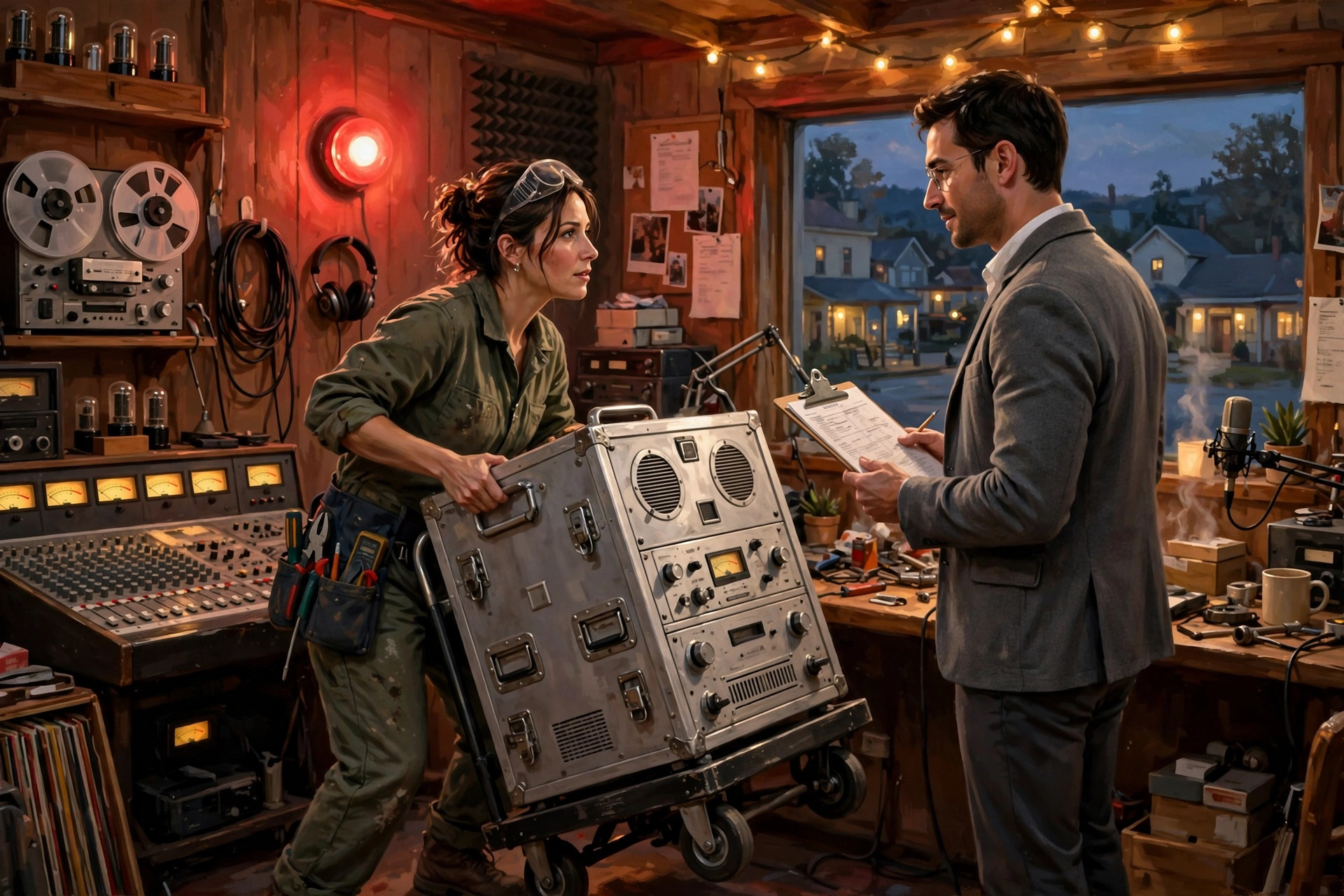
The cart machine came off the rack with a screech of metal on metal, and Nell Ambrow was halfway across Studio B before the intruder had it fully free of the rails.
"That's loaded," she said. "That's loaded and it works."
The man holding it didn't startle, which annoyed her immediately. He just looked at her over the top of the machine, a heavy silver-faced thing that had been batching station IDs since before he owned a razor, and set it, gently, on the wheeled cart he'd dragged in with him. The cart already held two dead reel decks and something she didn't recognize.
"It plays one format," he said. "Cart format. Nobody's made carts in years."
"Nobody's made replacement parts for the transmitter either, but you don't see me hauling IT off to the dump." She got a hand under the cart machine's weight and hauled it back off the cart, onto her hip. It was heavier than it looked. It was always heavier than it looked. "It's the backup. For the backup. It runs."
"Does it?"
"It ran Tuesday."
"Tuesday," he repeated, like she'd given him a date for a court appearance. He straightened his jacket, the kind of gray jacket that cost a week of her pay and had never once been near a soldering iron. "Okay. I'll leave it. For now."
Mid-afternoon drive was murmuring through the board behind her, Russ on the mic reading school closings for the county, none today, and the red ON AIR lamp over the door washed the whole room in a color she'd stopped noticing years ago. She set the cart machine on the workbench where it lived and turned to face him properly.
"You're Idris Farrow."
Something flickered across his face, quick as carrier loss. "You've seen the press release."
"Cascara Media, pleased to announce the appointment of Idris Farrow as station manager, KRLM Ridgeline Radio, effective this week." She gave it back in the exact rounded tone of the network announcers, and was rewarded with the corner of his mouth twitching. "I read everything they print about this station. Somebody has to."
"Nell Ambrow," he said. "Board operator. Overnights, mostly."
"Engineer," she said. "Board operator. Overnight host when nobody else will take the shift. The release didn't say what you are."
"Manager." He said it flat, no apology in it, and pulled a folded sheet of paper from inside the jacket. "Which brings me here. I'm doing an inventory before I do anything else. Equipment, feeds, schedules. All of it."
"Before you do anything else," she repeated. "That's a comforting sentence."
He unfolded the paper on the workbench, right next to her cart machine, and she noticed he did it without asking, the way a man spreads a map on someone else's kitchen table. She didn't look at the paper. Looking at the paper would tell him she was worried, and she wasn't worried, and she wasn't going to give him a reason to think otherwise.
He, meanwhile, had gone still. She followed his eyes to the far wall.
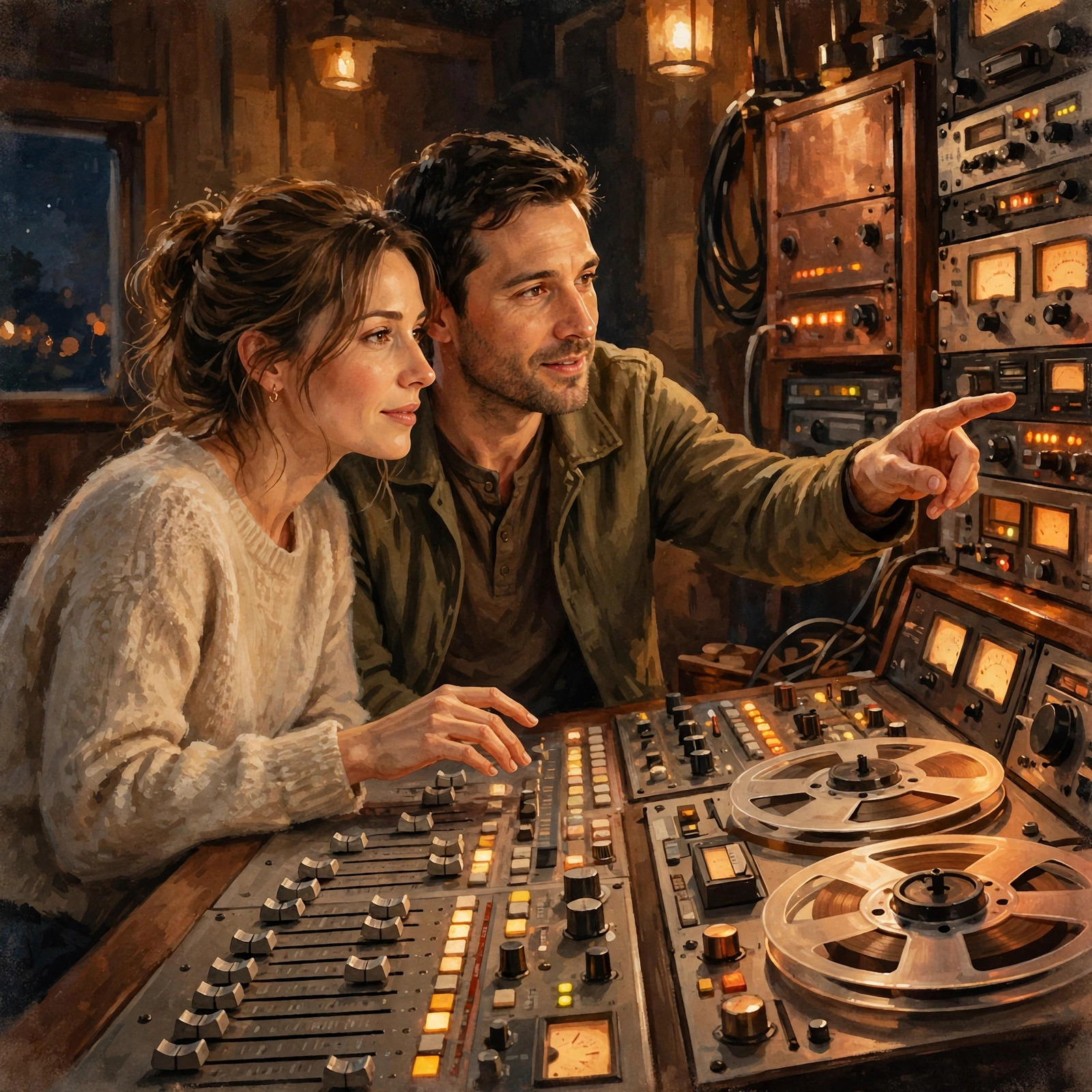
Studio B's patch panel ran floor to shoulder height across the whole wall, copper jacks in an oak frame, every feed in the building labeled in her father's small blocky capitals: STL, TOWER, AM STL, NET, TELCO 1, TELCO 2. Two decades of hands on that panel had polished the oak to a dull shine at the corners. In the middle of the second row, one jack sat unlabeled, its tag long since gone soft and blank, and Idris Farrow was staring straight at it.
"That one's not marked," he said.
"No."
"Everything else is labeled."
"Everything else," she agreed, and picked up a rag that didn't need to exist, and wiped down the cart machine that didn't need wiping.
The rag worked about as well as rags ever do. He stood there another few seconds, waiting, and then, to his credit or his detriment, he stopped waiting. "Your patch panel has a blank jack, Ms. Ambrow, and every other jack on it has a name. In my experience that means somebody took the label off on purpose, or the label meant something nobody else needed to know."
"In my experience," she said, "that means it's my panel."
He let it go. That surprised her a little, the letting go. She'd expected him to pry, to stand there with that patient gray tone until she gave up the story, the way suits always did. Instead he turned his back on the wall entirely, which nobody did, nobody turned their back on that wall, and looked at the board.
"Walk me through something," he said. "I want to understand how the overnights run here."
She stopped wiping. "The overnights run fine."
"I didn't ask if they run fine. I asked how they run. Who's on the board, what's live, what's voice-tracked, how the network feed drops in at the top of the hour."
"Live." The word came out of her before she'd decided to say it, hard as a thrown switch. "All of it. Me, the board, the mic, the network on the hour and back to me after. It's been live since before I could reach the faders."
Something in his voice had changed, and she catalogued it without wanting to. Softer. Careful. "That's what I want to understand. Every station I've ever taken over, the overnights were the first thing somebody asked me about, and the last thing anybody explained to me. Cascara has targets, and I have to know what's here before anything gets decided."
Targets. There it was. Not the memo she hadn't seen yet, but the shadow of a memo, a big gray shape under the water moving toward her dock. She'd heard the word targets from enough network people to know what came next: targets meant savings, and savings meant somebody's voice going silent at midnight while a computer played weather and an automation box forgot to take the network.
She put the rag down. "I'll walk you through the board. This week, when I say. You'll get the real answer, not the one in your inventory."
"That's all I'm asking."
"I know exactly what you're asking." She held out her hand, because Russ was signing off in there and the ON AIR light would blink dark any minute and she needed this over with. "I know how this works. You come in quiet, you walk the halls, you fill out your little sheet, and then one day there's a press release."
He took her hand. His grip was steady, dry, and completely unready for how hard she squeezed. She watched the wince travel up his arm and felt, for one petty and perfect second, like the storm front rolling in off the ridge.
"Efficiency targets," he said, recovering his hand. "That's all. It's a sheet of paper, Ms. Ambrow."
"So was the press release."
He looked at her for a long moment, then at the sheet he'd set on the bench, then, briefly, at the blank jack on her father's panel. "This week, then. You'll show me the board, and I'll try to keep up."
"I'll walk you through it," she said, "slow."
The ON AIR light went dark. Russ pushed through the door with his headphones still around his neck, took one look at the junk cart and the stranger and the cart machine sitting on the bench where it had absolutely not been that morning, and said, "Oh, good, you've met."
Ice Warning
The generator sat behind the transmitter room in a cage of its own chain-link, and Nell had the cover half off before Idris Farrow found her there, holding a clipboard like it was a hymnal.
"The county site says the freezing line hits us by dark," he said. "The roads will go first. Ridge roads go fast."
"I know what ridge roads do." She pulled the dipstick, wiped it on her jeans, dipped it again. "I've been running this generator since I was shorter than it is. Hand me that flashlight."
He handed it over, then didn't leave. Instead he crouched at the cage wall, reading the service log she kept zip-tied to the mesh. "Last load test was October."
"October was fine."
"October didn't have freezing rain in it." He looked up at her, and there was something underneath the clipboard voice, something that had actually read the log rather than skimmed it. "If you want, I can stand at the transfer switch and throw the fake outage while you watch the governor. That's a two-person job anyway."
She had a whole speech ready about network men and their hands staying soft, and it died in her throat, unused. "You've thrown a transfer switch before."
"A few." He said it lightly, too lightly, the way people set a cup down so it won't ring against the table. "Load tests, load shares, cold starts at three in the morning because a storm doesn't check your calendar. It's not my first ice."
They ran the test. He stood at the switch in his coat and called the steps like he'd been born in a plant room, and when the generator caught and the lights in the cage flickered over to the diesel hum, he nodded like a man listening to a sentence finish. She found herself watching his hands. He held the flashlight exactly where she needed it before she asked, twice, and the second time he already had the seal tape unrolled and ready across the cable tray, smoothed flat with the edge of his thumb.
"You tape like an engineer," she said. "Not like a manager."
"I was an engineer before anyone paid me to sit in offices." He cut the tape with a key from his pocket, small clean corners. "My mother would've skinned me for a sloppy seal."
The roof antenna was worse. The ice had started as a fine clinging mist, the kind that looked like nothing and weighed like lead, and they went up the inside ladder to the little penthouse under the dish with the wind making the door lean on both of them. He checked the tension on the guy anchors while she worked the de-icing breaker, and when she came back along the catwalk he was standing very still at the rail, looking out at Mount Amsel going gray and then white and then gone.
"How far is the shack from here?"
"The transmitter shack? Up the tower road. Twenty minutes in dry weather." She came up beside him. "Nobody drives it in ice."
"Then I hope nothing up there breaks tonight."
"Nothing up there breaks. My dad built half of it to outlive him." She hadn't meant to say it like that, flat, no softening. The mist was in her lashes. She wiped it with her wrist. "He was chief engineer here forever. Ran the overnights too, on the air. Called it Night Light. Little show, three till six, mostly him and whoever else couldn't sleep in Marberry Junction." She nodded back down the stairwell, toward Studio B, toward the copper panel. "The station's heartbeat, he called it. A town sounds alive if somebody's awake in it saying so."
"And you kept the slot running."
"It never stopped. There was a Sunday between the funeral and Monday where nobody did it, and I just... I couldn't let it go dark one night longer. I put on the headphones, and I pressed where he'd pressed, and I ran the board, and it turns out the show doesn't need him." Her voice caught on the last of it, and she hated that it caught. "It needs somebody. That's all."
Idris didn't say sorry, which she'd been braced for, and didn't touch her arm, which she'd been more braced for. He just kept looking at the mountain. "I can't imagine this place with the overnights silent," he said, so quietly the wind nearly took it.
"Me neither." Then, because the silence after it was worse: "Cascara can, though. I bet they've imagined it in color."
"Silence is cheaper." He said it to the rail, to the ice, to the place where the mountain had been, and there was a bitter flatness in the word that didn't match a budget line. Cheaper came out of him like something he'd been carrying in a pocket too long, worn smooth with handling.
She let it lie. She catalogued it, though, the way she'd catalogued targets the day before, and put it next to that in the drawer of him she was keeping without admitting to it. He had too much bitterness about money for a man who'd just been handed a station. Men who were only doing a job said efficient. This one said cheaper, like it had once been said to him.
"Your last post," she said. "You left it, you said. By choice."
"By choice." He turned from the rail. "That's the accurate word."
"Accurate isn't the same as true."
"No." A small laugh, no humor in it. "It's not."
He didn't offer more, and she didn't take it by force, because his shoulders had closed like a door easing shut, and she knew what a person looked like carrying a story they weren't ready to set down. She'd looked at one in the mirror for months.
They went back down and did the emergency feed wiring together, working the length of Studio B in a rhythm that surprised her: he called the runs off the old print, she landed them on the panel, his thumb tracing the little copper label stamped NIGHT LIGHT on the way past, once, twice, like he was learning it for something. The unlabeled jack he did not touch, and she clocked that too.
"You're good at this," she said, before she could stop herself.
"Don't tell Cascara. They'll move me again."
By eight the windows were sheets of milk, and the parking lot held one car: hers, iced to the doors. Everyone else had gone home ahead of the warning, sensible people, hours ago.
She stood in the green room doorway with her coat half off and her keys in her hand, looking at the hotplate she'd dragged in for storm nights, at the kettle, at the instant noodle bricks she kept in the cabinet over the sink. The roads would be shut by ten. The network feed would drop on the hour, every hour, all night, and somebody had to be at the board to catch it, and the somebody was always her, and there was no sense in him dying on the ridge trying to get back to whatever motel they'd put him in.
"Stay," she said. "For the shift. I mean here, at the station. The roads are done."
He looked at her, then at the window, then at the board he'd spent the day learning the shape of. "I'd like that," he said, and then, correcting himself, "I mean, I don't have anywhere else to be. Practically speaking."
"Sure. Practically." She pulled the coat the rest of the way off and threw it at the couch. "You know how to make the noodles or do you just eat them?"
"I've been informed I burn water."
"That's not possible."
"I have nonetheless achieved it. Twice."
She got the kettle going and handed him a brick of ramen, and he held it in both hands like a small dignified animal while she got the bowl down, and the laugh that came out of her was the first one in a long time that didn't feel borrowed. Somewhere out in the dark the ice thickened on the tower road, and the network feed came and went, and the two of them stood in the green room steam arguing about whether a man could burn water, and she let the clock run on and didn't check it once.
"Nobody's leaving tonight," she said, and poured the water.
The Transmitter Shack
The network feed died at 11:42, mid-sweep, mid-song, and Nell's head came up off the log sheet before her brain caught up to what her ears already knew.
"There it goes," she said. The board went to that particular silence, the one that wasn't quiet at all, the one with meters asleep and the modulation light dark. She flipped the monitor to the off-air position and got nothing. Not static, not network tone. Nothing.
"Network drop?" Idris came out of the green room with his sleeves shoved up, a noodle bowl still in one hand.
"No." She was already reaching for her coat. "If it were the feed, we'd still hear ourselves on the transmitter monitor. We're dark. Whole station."
She thumbed the remote monitor by the door, the little battery job her dad had wired to a strap so it could ride in a truck. Dead air, everywhere she swept it. Somewhere out there, Marberry Junction was tuning across the band and finding a hole where the town's heartbeat should have been.
"The STL," Idris said. Studio-to-transmitter link. He said it like an engineer, which she kept forgetting he'd been. "Up the tower road?"
"Up the tower road." She looked at the window, at the glaze on it, at the ice ticking across the glass in little dry clicks that meant worse coming. "Somebody iced the dish or pulled a line loose at the shack. Somebody has to go up."
"Somebody," he said, "being two somebodies, because you're not driving that ridge alone in freezing rain."
"I've driven it in worse."
"I don't doubt it. I'm still coming."
She almost argued. She could feel the shape of the argument, how it would go, her side of it worn smooth from use. But the clock was running, and the town was dark on every dial, so she grabbed the flashlight and the toolbox and said, "Truck's got four-wheel drive. Try not to scream."
"I've been told I drive like a grandmother."
"Good. Tonight you drive like one."
The tower road was a sheet of wet glass with gravel frozen into it. They crawled up in low gear, wipers carving half-moons, the portable monitor hissing between nothing and a whisper of a carrier. The trees on the bend past the second cattle guard were silvered over and bowed, and twice something cracked off in the dark and hit the roof of the truck and they both jumped.
"Ice limb," she said, mostly to herself. "It's fine."
"You say fine the way other people say a Hail Mary."
"It's a gift."
The transmitter shack sat under the tower on Mount Amsel, a squat concrete room with a door that stuck in cold weather. She shouldered it open, and they came in out of the rain into the hum of the racks, that deep green-glowing hum she'd known since she was small enough to be stood on a milk crate to see the meters.
Idris went straight for the STL receiver like a man going home. "Rack's alive. Power's fine. Low voltage alarm's clear."
"So it's the link." She handed him the little flashlight and got the door of the waveguide junction open, and they found the trouble in the beam of it, together, at the same instant: the patch joint at the dish end had iced over, and the seal had pulled, a finger's width of gap where ice had gotten in and levered the joint loose while the wind worried at it.
"There," he said.
"There."
She could have said let me do it. That was the old habit, cold as the night, keeping every repair to herself like it was the last thing she had left of him. But her hands were already going numb, and the joint needed two people, one to hold and heat and one to seat and clamp.
"Hand warmers," she said. "Left coat pocket. Crack 'em both."
He found them, cracked them, and pressed one into her palm without being asked, and she wrapped it around the fitting while he held the light in his teeth and worked the clamp with fingers that had gone stiff and clumsy. Her shoulder was against his. It had to be. There was no other geometry in that little room, but she noticed it anyway, the whole warm length of him braced against her arm, both of them breathing fog.
"On three," he said around the flashlight. "Push, seat, and pray."
"I push, you seat. I'm stronger and you're more stubborn."
"That's a compliment somewhere."
They did it. Push, seat, and the clamp bit down, and she held the joint while he ran the seal tape in a slow spiral, and the ice came off in scales under her thumb, and the whole thing took eleven minutes that felt like an hour, and then the rack light went from red to green so quietly that for a second neither of them believed it.
"Monitor," she whispered.
He grabbed the portable off the toolbox and thumbed it on, and out of the little speaker came KRLM, faint and fierce, the automation logging the correct ID, the tower burning its signal up through the freezing rain and back down into every kitchen and every parked truck and every lonely overnight in Marberry Junction.
"There it is," he said. "There it is."
He was grinning. She hadn't seen him grin yet, three days in, and it undid something in her chest, and the relief crested in the green glow of the racks, and when he turned and she turned they were already too close, had been too close for an hour, and he said, "Nell," soft, a question, and she answered it with her mouth.
Cold lips, his and hers, tasting faintly of ramen salt, the racks humming under it all. He made a small startled sound and then his hand came up to her jaw, careful, like the joint, like something you didn't want to lever loose.
Then she pulled back, two inches, her heart going like a meter in the red, shaken down to her boots. Not sorry. She searched herself for sorry and couldn't find a scrap of it.
"That was," he started.
"Don't you dare analyze it."
"I was going to say good. Then I was going to say we should probably drive down before the road gets worse."
"...Yeah. Okay. That." She put the flashlight in the toolbox so she wouldn't have to look at it. "Practical."
"Practically speaking," he said, and she snorted, and that was the whole of the conversation on the subject, and they went out into the rain and locked the shack.
The ride down was quiet, mostly. She drove, because he offered and then un-offered when he saw the grade, and she watched the road and he watched her, and once she caught him at it and he looked out the window fast, and once he caught her doing the same and neither of them said a word about it.
Back at the studio the feed was still down at the studio end, the network's storm feed snarled somewhere in the ice between here and wherever it came from, so she did it the old way, the way her dad had taught her on nights just like this one: she pushed the emergency program line through the copper patch panel, patched the satellite receiver straight into the program bus, hands moving through the labeled jacks in the green glow of Studio B.
And then his hand was there too, holding the patch cord steady while she seated it, his knuckles against hers on the panel, on the panel her father had soldered in the garage the year the station went stereo, under the jack with the little copper label that said NIGHT LIGHT, and the photo of Earl taped beside it looking on with his headphones half off, laughing at somebody off-frame.
Neither of them pulled away.
"There," she said, not looking up from the jack. "We're live. Local. Whole."
"Whole," he agreed, low.
She let the silence sit for a second, and then, because the old habit would have been to take it back, she beat it to the door instead.
"You know," she said, sliding the panel cover closed over her father's handwriting, "this is the part where I'd usually tell you I could've handled the whole night alone."
"I know. I've read your file."
"You haven't."
"Dot sent two pages of it. Mostly the words 'does not delegate.'"
She laughed, and shook her head, and finally looked up at him.
"Idris. Your help tonight," she said, "wasn't the worst thing."
He looked at her for a long moment, the rack light green on his face.
"Coming from you," he said, "that's a love poem."
The Memo
The sun came up loud. That was the only way Nell could think to describe it, the whole town dripping and ticking and cracking as the ice let go of everything it had grabbed overnight, and the light coming through Studio B's window so bright she had to squint at the rack she was stripping.

The fuse in the third slot had cooked itself into a little black bead, and the spare box in the workbench drawer held only those flat plastic automotive ones her dad had never trusted. "For boats," he used to say, holding one up to the light like it had lied to him personally. "Not for racks."
So she went hunting. The manager's office was the only place in the building she hadn't picked over, because until this week it had been hers on paper and empty in fact, and then it wasn't, and she had been too busy being annoyed about the cart machine and then too busy not being annoyed about the storm to get around to it.
The morning was warm enough that the puddles in the parking lot were smoking. She could hear Idris somewhere down the hall, on his phone probably, his voice pitched low and reasonable the way it went when he was being a manager instead of a person. She'd learned that much in four days. She'd learned a lot in four days. She was trying not to learn anything else.
The office still smelled like his coffee. The desk drawers ran smooth, better than the ones in Studio B, and she went through them in order: top drawer, pens and a tire gauge, fine; middle drawer, stapler, blank forms, a spreadsheet printed out and folded into eighths, fine, that was his whole personality right there; and the deep bottom drawer, under a folder of transmitter shack keys, a single sheet of paper folded once, network letterhead, a signature she already knew from the requisition slips.
She read it standing up. She read it twice, because the first time the words kept sliding off.
PROPOSAL: AUTOMATION OF KRLM OVERNIGHT DAYPART. ELIMINATE LIVE LOCAL OVERNIGHT PROGRAMMING. PROJECTED ANNUAL SAVINGS: $40,000. RECOMMENDED FOR APPROVAL, I. Farrow.
His ink was still crisp. Dated before he ever set foot in Marberry Junction. Before the cart machine. Before the ice. Before the tower road and the shack and his knuckles against hers on her father's copper panel, before "whole," low, like a word he'd been saving up.
She heard his footsteps in the hall and had the presence of mind, barely, to put her body in the doorway before he reached it.
"Nell." He had his phone in his hand and a whole morning arranged on his face, and then he saw the paper, and the morning fell off it. "Where did you get that."
"The drawer you put it in." Her voice came out flat and strange. "You signed this."
"Nell, let me explain the process, that's a first step, it doesn't mean anything is final, there's a whole review, the memo is procedural, it's a formality to get ahead of the budget cycle."
"A formality."
"It's how these things are introduced. It has to exist on paper before anyone can argue against it on paper."
"You've been arguing against it on paper? Because from where I'm standing, you've been arguing for it on paper and against it out loud, and I only had access to one of those mouths."
He closed his eyes for a second. "That's fair."
"Don't you dare manage me right now."
"I'm not. I'm trying to be accurate."
"Accurate." She laughed, and it was an awful sound, and she stopped it. "You know what my dad would've done if a suit from a network showed up with a signed paper to kill his show? He'd have shown him the door. No. That's not true. He'd have shown him the panel first. He'd have shown him every jack, every label, every one of the forty underwriters he shook hands with himself, and then he'd have shown him the door, and the guy would've left knowing exactly what he was ending. You didn't want me to know what I was standing next to. That's the difference. It'd have been cleaner if you'd come in swinging a hatchet. A hatchet's honest. This came in wearing my own team jacket."
"I was going to tell you."
"When."
He didn't have it, and she watched him reach for the spreadsheet answer, the review-cycle answer, and watched him know better, and watched him land on nothing. "I don't know. I had it scheduled."
"You had telling me scheduled."
"Yes." He said it like it cost him. "After the storm assessment. I have a sequence, I always have a sequence, it's how I keep things from being worse than they have to be. Sequences keep people from getting hurt in doorways."
"I got hurt in a doorway anyway. Here I am."
"Nell."
"Was any of it real? Tuesday, the cart machine, you hauling cable up an iced road for a station you'd already signed off on. Was that reconnaissance? Was I the local color you had to keep sweet while the paperwork went through? You said 'cheaper.' In my studio, the second day, you said overnights going dark would be cheaper, and I let it go because I liked you. That's on me. I let it go because I liked you."
"I liked you too," he said. "That was the problem. I've done this before, at my last post, and I did it the clean way, the sequence way, and it was clean right up until they read the host his termination over a phone while I stood in the next room with my mouth shut. By choice, that's what I told everyone. By choice. I promised myself the next one would be handled better. Managed. Kind. That no one would find out from a hallway."
"I found out from a drawer."
The words hit him visibly, in the shoulders, in the hand holding the phone, and he didn't argue with them, which in a way was the worst thing he could have done, because it meant they were true and he'd already graded them.
She held the memo out. He took it slowly, like it might still be wet.
"My father ran that desk for over twenty years," she said. "Eleven of them with me in the chair next to him, and this last year without, and I kept it live every single night because he said this station was the town's heartbeat and you don't let the heartbeat go to voicemail. Those hours aren't a line item. They're not yours to close. Not the savings, not the sequence, not the version of kind where I find out in a drawer after you've already held my hand on the patch panel."
"Nell, wait. Please. Let me fix the sequence."
"There's no fixing it. There's only doing the next right thing and you'd know that if you'd ever once done a thing without a plan in a drawer."
She walked past him. He didn't grab her arm, which she respected and hated him for. At the front door she stopped, hand on the push bar, and said it to the glass, not to him.
"The overnights were his. You can automate a daypart. You can't automate hands." Then she pushed the bar and went out into the bright, loud, dripping morning, ice letting go of the power lines in sheets, the whole town cracking and ticking and running, and she walked to her truck and did not look back at the building where he stood in the hall holding the memo at arm's length, like it had come hot out of a fire, which in a way, she figured, it had.
The Woodstove
She came back at dusk with a toolbox and a speech, and she found him before she found either.
The green room door stood open, and warm air rolled out of it, and there was Idris Farrow on his knees in front of the old woodstove with the door swung wide and a fire already going inside it. A phone lay faceup on the floor beside his knee. Her toolbox handle creaked in her grip.
"You're still here."
"I never left." He didn't get up. "I've been on the phone since you drove out. I made the call while I could still hear the ice coming off the lines. Figured if I waited for a calm moment I'd find a reason to schedule it instead."
She set the toolbox down by the doorframe. "I came back to fight you for the overnights. I had a whole evening planned. Binder, petition, the works."
"Save the binder."
He reached over and tapped the phone's screen. It woke still on the call summary: LARKIN, DOT, forty-one minutes.
That stilled her where she stood. Dot Larkin did not stay on a line for forty-one minutes to say no.
"You called her."
"On speaker, in the manager's office, door open, like I should've done everything from the start. I told her the automation plan is withdrawn. Signed letter is coming tonight, e-mail first and print by morning. She wasn't gentle about it."
"I can guess the shape of it."
"The shape was, do you understand what a forty-thousand-dollar savings costs you personally, Farrow, and I said yes, actually, I'd priced that one out myself. I've got a whole file on what things cost." He looked at the fire. "The track I was on with Cascara runs through this. Ran through it. She said it in past tense, so I guess that's settled. I told her I'd resign first. End of live local overnights, I'd resign first."
Nell sat down slowly on the bench by the wall. The toolbox stayed by the doorframe where she'd left it, and she let it stay there.
"You'd resign. Over the night shift. In a town you've been in for five days."
"Over the night shift, over the cart machine, over the copper on the wall in Studio B if it came to it." He fed the stove a split log. "I followed the sequence once before. All of it, every page, very tidy. And the host on that show, she was seventy-something, been on the air longer than I'd been alive, and I knew the date the letter was going out, and I put it in the calendar and I went home and I slept fine, Nell, that's the part I can't get past. I slept fine. Then the day came and I stood in the next room while somebody in a city she'd never been to read her a script that ended her show, over a phone, and she kept saying, but I have people who call in, and nobody on the line could answer her because nobody on the line knew what she meant."
"And you filed instead of fighting because..."
"Because fighting costs. I'd watched what happened to the ones who fought. I told myself managed exits were the kind version." He turned the poker, not needing it, just needing hands. "The kind version is a drawer. It's kind the way a drawer is kind."
She was quiet long enough that the stove popped.
"My father built that panel in the garage in ninety-six, the year we went stereo. Soldered every joint at the kitchen table while I did my homework in the same room, and if I'd known then it was the good part I'd have paid more attention." She looked at her own hands. "I know what this building is. It's not a secret. It's the last place I can still hear how he said the sign-on. I keep every cart and every fuse like keeping them is keeping him, and I hoard it all because if someone else's hands make it work fine without him, then he wasn't..." Her voice went thin and she let it. "Wasn't load-bearing. And letting anybody help means admitting it's mine now, only mine, and I've been pretending it's still ours."
Idris set the poker down in the rack.
"It's ours for about four more hours," he said. "The print letter comes tonight. I asked for the e-mail to the office account so there's a timestamp neither of us can flinch out of."
Then the phone buzzed against the floorboards, and he picked it up, and after a moment he turned it toward her so she could see the incoming mail: a Cascara letterhead, a signature, continued live local overnight programming at KRLM, Marberry Junction.
"Say it out loud," Nell said. "I want to hear it in a voice."
"Cascara Media commits to live local overnights at KRLM. Signed, Dot Larkin." He paused. "She cc'd her own boss, which is Dot for you hurt me before I hurt myself."
Then he reached into his jacket, which hung over the chair, and took out the memo. Her memo. His signature at the bottom, the date before he'd ever shaken her hand, the whole neat schedule of it. He held it a second, and she thought he might keep a corner of it, people keep corners of things. He didn't. He opened the stove door and put the whole page in, and the fire took the edges first, and then the middle, curling it the way paper does when it stops being a document.
Nell watched it until there was nothing left to read anywhere.
"That letter goes up on the wall," she said. "On the studio wall, next to the panel, where his photo is. Not in a drawer. Nothing else goes in a drawer."
"Agreed. Pin, not tape?"
"Pin. He'd have opinions about tape."
They printed it in the manager's office, the printer so loud in the empty hall that she laughed for the first time all day, and they walked it back together and put it up beside the copper panel, right at the height of the photo's bottom edge, and Idris took down the sheet he'd hung his first day, his own neat cover memo, and handed it to her to feed the stove herself. She did.
Afterward they stood in front of the panel with the studio lights low, and she picked up the toolbox, then held it out to him instead, and dropped the fuses into his palm one at a time, each with its paper label in his hand, and took them back only so she could say it properly.
"You should come run the board with me tonight. Not a storm, not a crisis, no hands required. Just the overnight, the way it actually sounds at two in the morning when the underwriters' spots roll and the phones light up and someone from Mount Amsel calls in to say the transmitter shack light's on."
"Yes."
"I haven't finished telling you what it..."
"Yes," he said again. "Say yes first. I've learned that much."
She closed the toolbox with her hand over his on the handle, and outside the green room window the whole town had gone quiet and dark and ordinary, forty businesses' worth of lights on in the valley, and the woodstove ticking down behind them, the wall one sheet lighter, the ash still warm.
She took the fuses back, pocketed them, and said, "Then come on. The night's mine. It's about to be yours too."
Night Light
The overnight began the way it always did, with Nell flipping the studio lights down to their evening setting and the console waking up row by row, green and amber, like the town's own windows coming on. She had the place to herself for eleven years of two a.m.'s, and tonight she did not, and the strange part was that the room felt bigger for it, not smaller.
"Chair's yours," she said, and pulled the second stool up to the far side of the console, on the panel side, where the copper jacks caught the low light.
Idris sat, and she watched him look at the wall first, the way everyone who came into Studio B looked at the wall first. The panel ran the length of it, oak uprights and hand-soldered copper, every feed in the building labeled in her father's small block capitals. TOWER. NETWORK. PHONE 1. PHONE 2. And near the end, above the label that read NIGHT LIGHT, the small brass lamp that Earl had wired himself, burning steady.
"He soldered all of that in the garage," she said. "Ninety-six. The year we went stereo. Mom kept the garage door open and complained about the smell for a month."
"It's beautiful work."
"It's overbuilt work. He'd tell you that himself. Two of those jacks have never carried anything. He put them in because the row looked uneven." She tapped the cover of the one marked SPARE 2. "I've checked on them. They're still good. He'd want me to say that."
The Cascara letter was pinned beside the photo, the pin going through clean, no tape anywhere, and the studio had a new sound to it tonight, which was Idris's breathing at her elbow while she ran the top of the hour.
"Okay. Watch my hands, not the meters." She brought up the mic fader with two fingers and let it sit. "Board's hot, so you cough on the cough switch, never into the room. You want the back-off switch here." Her thumb rested on it, a pressure that was more memory than force. "Dad had a cold once, whole week of overnights, and he ran every break with his hand flat on this thing like it was a piano. Nobody listening ever knew."
"That's why the letter's pinned," he said. Not a question.
"That's why." She leaned in. "KRLM, Marberry Junction, Ridgeline Radio, you're under the Night Light with me, Nell Ambrow. It's one minute past two, we made it through the ice, and the valley is looking clear and cold and very awake for this hour. Stay with us."
The VU's swung, the lamp glowed, and she faded herself down, and it was quiet in the room again, the kind of quiet a live room makes.
"Your voice is lower than his," Idris said. "On the air. I noticed the first night."
"I know. It took me a year to stop pitching up to sound like him. Then I figured the valley wasn't stupid. People who call in at three a.m., they know who's running things."
He was quiet then, in a way that had weight to it, and she knew what kind of quiet it was. She'd been carrying it around him all day, since the stove, since the printer, since the pin went into the wall. She pulled her stool around to face him.
"Tell me the rest of it," she said. "The last post. Not the shape of it. The part you left out."
He looked at the panel a while. The lamp above the NIGHT LIGHT jack was on him and he didn't move out of it.
"Her name was Mrs. Chaudhry," he said. "She'd read the farm report there since before I was born, I think. The home office sent the termination script and a schedule, and I followed both. Phone call, eleven minutes, read off the page." He turned his hands over once, like he was checking them for something. "She thanked me. That was the part I couldn't put down. She thanked me for the years. I told my boss I was leaving and I told myself I'd never do that again, and then I came here, and there was a schedule in my bag with your name in it."
"You could have told me."
"I know. I told myself you'd quit the moment you knew, and I'd have to be the reason. I've since learned I'm not the best judge of what people will do. You walked out into a melt and walked back in with a toolbox."
"I walked out because you were going to be another person who took the night away," she said. "And then you took it back. You can't have known what that cost me to find out. Or maybe you did. You pin things to walls, Mr. Farrow. You don't file them."
"Dot asked me yesterday what I thought I was doing. I told her Marberry Junction keeps what it builds." His mouth moved, almost a smile. "She said, and I quote, that's not a strategy, that's a feeling. I said I was aware."
Nell laughed, and the laugh came easy, which surprised her, and then didn't. She reached over and moved his hand to the console, one finger to the fader for PHONE 1.
"That's yours tonight. Anyone calls, you ride that, and you stay off the cough switch unless you mean it. Underwriters roll at half past. Forty businesses, most of those signatures his." She nodded at the photo, at the wide man with the headphones around his neck and the grin that had made three a.m. feel like a place. "He signed them by hand because he said a handshake you can read is still a handshake."
"Do I get to say anything on the air, or is my job to sit here and look managed?"
"You get the top of the four. If you're brave." She set the log sheet in front of him, his name penciled in where a guest host went, and watched him read it twice, which was his way of letting a thing be real.
"Nell."
"I'm working."
"So am I. I love you." He said it plainly, the way he read the news, no flourish anywhere. "I've been drafting it for days and there's no better sentence, so that's it. I love you, and I'm staying. Not the job first. You first, and the job, and this town, in whatever order keeps all three."
The meters were resting. The lamp burned. Her father's row of jacks sat there being steady at her, and her thumb found the back-off switch and pressed it all the way down, because she knew what came next and she wanted it clean.
"I love you," she said. "I've been saying it all week in ways you'd have to be an engineer to parse. So here's the plain feed. I love you, Idris Farrow. I want you here when the light's on that jack, and I want you here when it's burned out and I have to fix it. You were always going to be in this room. He'd have liked you. That's not a small thing for me to hand somebody."
"I know what it weighs."
"Good." She let the switch up. "Then sit there and be liked."
He reached across the console, over PHONE 1 and PHONE 2, and she met him halfway, out of her chair, his arms coming around her shoulders, hers around his waist, the headphones sliding off their hook and swinging, the whole board lit under them like the valley. She put her face against his collar and felt him breathe, and the room held them both without complaint, which was more than she'd ever asked of any wall.
The red minute light came on. She didn't move yet.
"Top of the four," she said into his shirt. "You're on."
He didn't let go either. "Thirty seconds is long enough."
"Twenty-five. Learn the room."
She got her fader up at fifteen and gave the valley its weather, clear and cold, and opened his mic at five, and Idris Farrow told Marberry Junction good morning from the Night Light, live and local, his voice a half-step lower than the town had heard him all week, and the meter swung just right, and the lamp above the jack burned on, and she left her hand on his shoulder through the whole break.
When the sign-off music came up under them, soft horns and the world turning toward daylight somewhere east of the ridge, neither of them reached for the lights. The door to the hall stood open a little, the way she'd left it, and the overnight went on being alive, and theirs, and they stayed exactly where they were.
Get notified when new stories drop

Marcus Hale
Marcus writes slow-burn and marriage-of-convenience stories where logistics become intimacy and competence is a love language.
Leave a comment
Comments