



Storm Rota
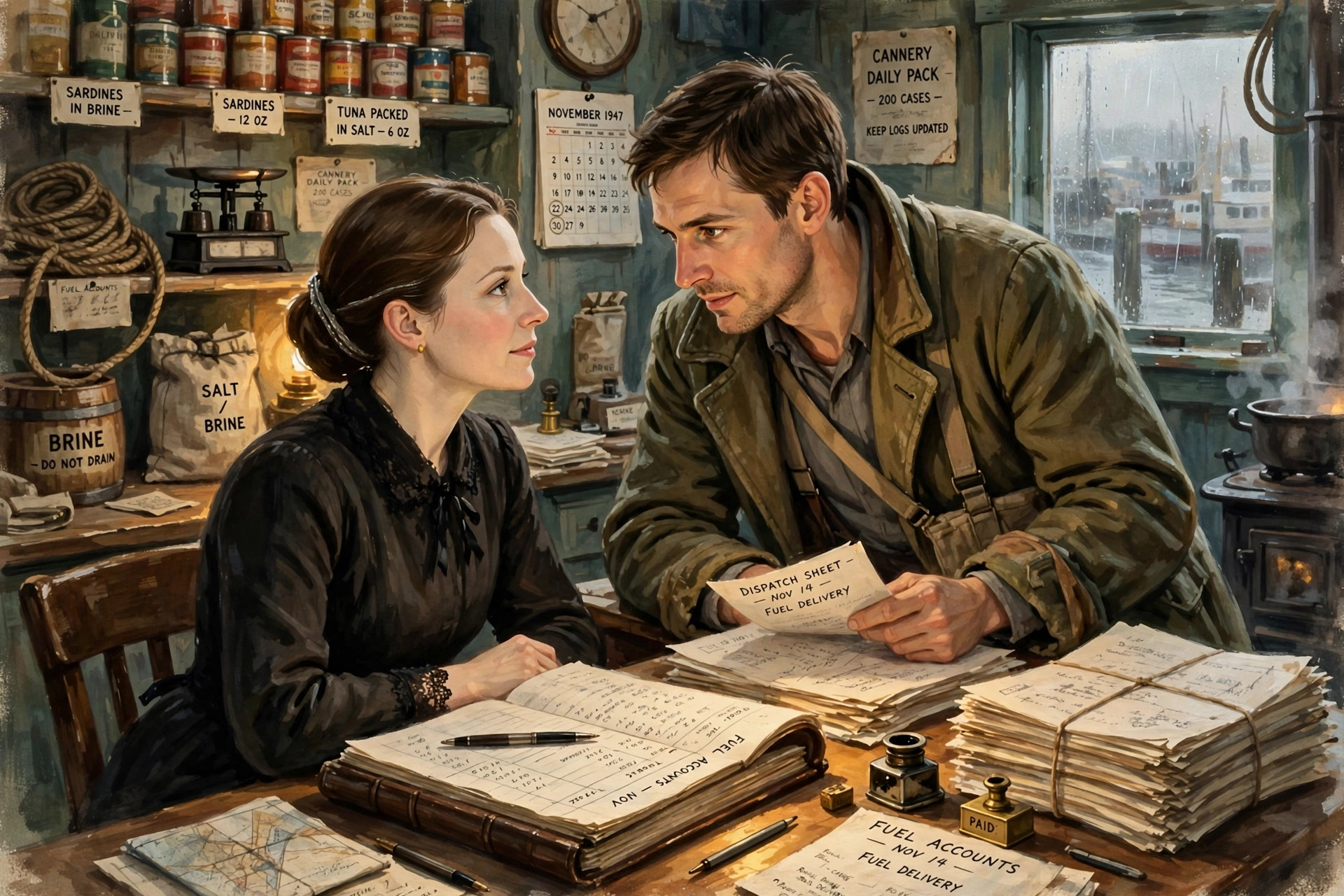
"The log says what it says, Mr. Varga. I'm not signing a correction to a page I copied myself."
Iris kept her pen flat on the ledger, which was her way of ending an argument, and Emil Varga did not take it as one. He leaned over the cannery office desk instead, coat sleeves pushed up, a folded dispatch sheet pinned under two fingers like it owed him money.
"The county wants a countersignature before the filing deadline," he said. "A mayday went out during the tape change Wednesday. The log shows it queued behind the weather wire. I need the fleet's bookkeeper to witness that the time stamp was the deck's, not mine."
"Then write that the deck delayed it. You don't get to write that it was 'promptly relayed' when half the harbor heard the gale warning twenty minutes after the clouds made it obvious." She slid the sheet back across the desk. "I tally fuel and landings. I don't tally your conscience."
He laughed, short and surprised, and she disliked how much she liked the sound of it in her small office, which smelled of brine and ledger glue and, since his arrival, faintly of hot solder. He had come straight from the Point Ada watch house with the smell of his machines still on him.
"My conscience is spotless," he said. "It's my tape deck that's a menace. County shop welded that chassis back when this harbor had a herring cannery instead of a co-op, and nobody's loved it since."
"Everything here is older than its job," Bett Osgood said from the doorway, and Iris hadn't heard her come in, which was Bett's way. She had the storm rota rolled under one arm and a tin of pins in her fist. "Storm season opens Friday, so listen fast, both of you."
The door stood open behind her, and the packing floor beyond it was loud with the noon shift. Iris heard the belt thump, heard someone call for ice. Bett pinned the rota to the corkboard without taking her eyes off them.
"Point Ada watch house needs two on every storm shift. Dispatcher and a record keeper. I've had complaints about sitting up there alone," Bett said, "mostly from mothers."
"I don't need a babysitter," Emil said.
"It's not for you." Bett's voice was dry as salt cod. "The board wants the watch logs and the fuel books kept together during weather, since the radio hut's where the landing numbers actually match what comes over the wire. Mrs. Fenwick's books go where the numbers live."
"The archive's four steps from this office," Iris said.
"The archive floods," Bett said, which was true, and which everyone in the building knew was not the whole reason. Bett pinned the rota flat, and Iris saw her own name on it twice, then saw whose name sat beside it both times, in Bett's blunt pencil.
Emil Varga. The same, in every storm shift.
"You've rostered us together," Iris said.
"I've rostered the dispatcher with the bookkeeper." Bett tapped the page once with her pen. "Same as rostering two people. You want it redrawn, bring me a reason the board would like."
He'd want a reason too, Iris thought. He'd say something like, "She just told me she won't sign a paper for me, and you want us sharing a kettle for twelve hours at a stretch." She waited for it, and got the invoice out of her top drawer instead, some excuse to look down at her own hands.
Grant's hands had done the same work, three seasons gone and a lifetime ago, at the dock and in this office. Fuel tallies in a small oilcloth notebook, taken down at the fuel dock in his blocky capitals, and she had shelved that notebook in the back row of the archive herself, unopened, because opening it meant reading the season that ended with his boat going down off Point Ada and she had not once managed to want it that much. It sat back there still, wrapped and mute, in among the older ledgers.
The archive row was behind the map cabinet, and after Emil gave up on her countersignature, which took another minute of his standing there with the folded sheet and his jaw working, she went back there on the excuse of the loaner handset. He'd brought one for the office, since the cannery's own radio had died in the spring.
"Bett says you keep the storm season books from up top," he said, following her, which the county apparently paid him to do, into other people's archives. "Point Ada has the best ears on the coast. Everything lands there."
"Everything lands somewhere." She took the handset and its coiled cord, and while he was holding the lantern up for her, she slid the oilcloth notebook a full shelf deeper, behind the landing books from the season before last. Deeper out of the storm's reach. That was the reason she'd have given Bett. Floods came up the back wall first.
He watched her do it, and didn't ask, which she had not expected.
"There's a cot and a stove up there," he said instead. "And the deck, when it's not sticking, runs cleaner than anything in this building. You'll want to hear it. The fleet sounds different on a bad night, and the deck doesn't lie about what it heard."
"Decks don't lie," Iris said. "People correct them."
He flushed, and she was sorry, and then interested that he didn't snap. He just set the folded dispatch sheet on the ledger, square and patient, like a man leaving bait in a trap.
"Keep the correction," he said. "When you hear the deck for yourself, you'll know which of us should sign."
From the doorway, Bett rapped the corkboard with her pen, twice, and both of them turned like schoolchildren. The rota hung flat and fresh, storm shifts inked down the page in Bett's blunt hand, all the coming gales parceled out.
"First shift's Friday, six sharp," Bett said. "Take a thermos. Deacon packed the fuel shed's stove away for the season, so the whole point's cold as a banker's heart till noon." She left the pins in the tin on Iris's desk, which was her way of saying the rota was final, and went back out to her packing line.
The office was quiet. Iris looked at the rota. Emil looked at the rota. Between the storm shifts and the bookkeeping shifts, in two inks, their names stood side by side all the way down the page, his and hers and his and hers, like a song that couldn't decide on a refrain.
"Well," Emil said.
"Mm," said Iris.
They stood there, staring at the same name twice, while the packing floor thumped and the gale season waited outside the window for Friday.
Point Ada Nights
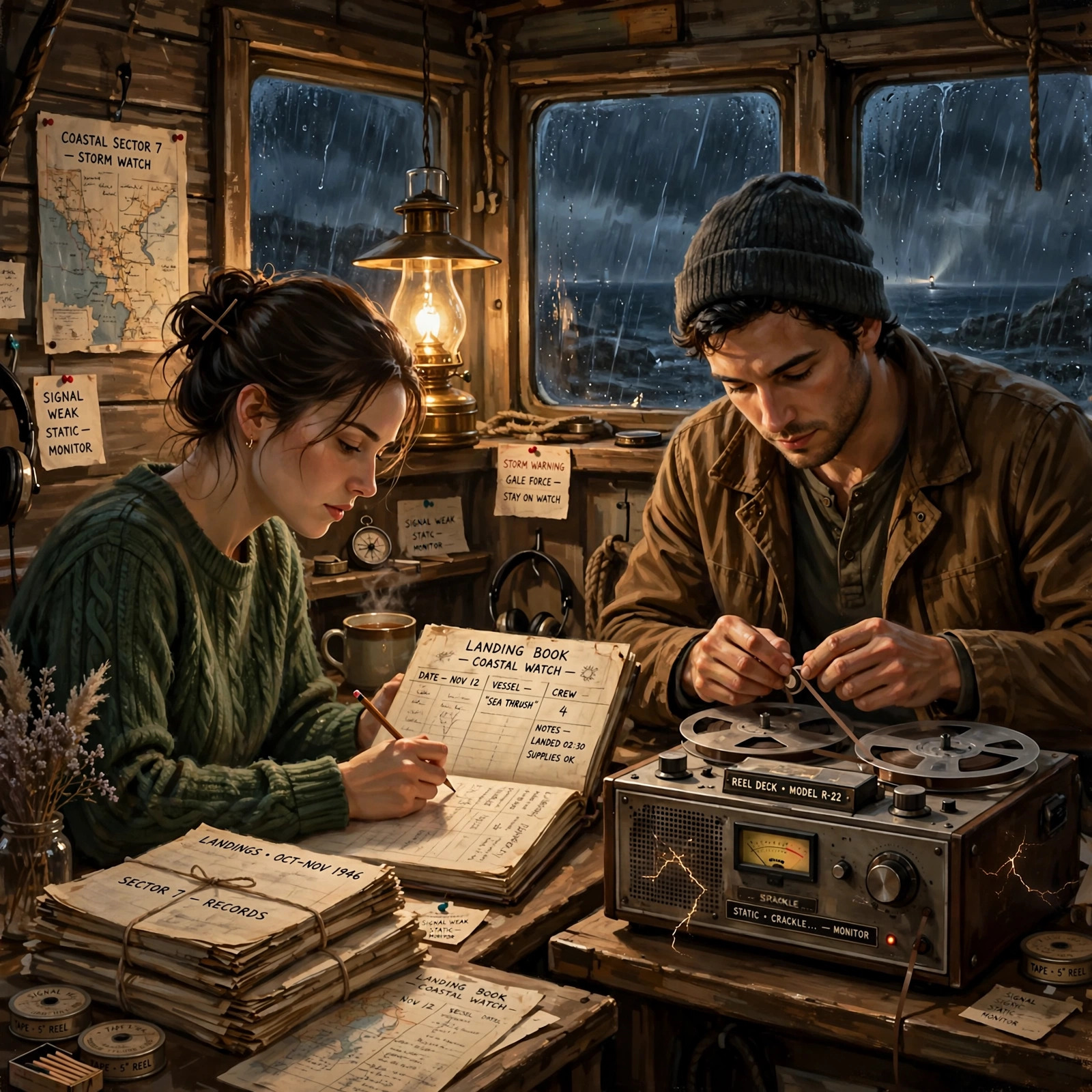
The gale found Point Ada an hour after dark, and the watch house leaned into it and held. Iris climbed the last stair with the thermos Bett had pressed on her, and found Emil already at the tape deck with a screwdriver between his teeth and his shirtsleeves rolled to the elbow.
"You're early," she said.
"Deck's been sulking since noon." He took the screwdriver out of his mouth. "Figured I'd sit with it before the fleet got loud."
The watch house was one round room and a stove, and the stove was banked low because the fuel shed at Gullwick had been packed away for the season, same as Bett had said. One lamp burned on the chart table. The tape deck sat against the north wall in its welded steel chassis, relays clicking, the spool turning over with a sound like slow breathing.
She hung her coat on the peg that didn't wobble and put the thermos on the table. "Bett says you take it black."
"Bett says right." He rose from his crouch and looked at the thermos, then at her, like a man who'd been handed something he hadn't asked for and didn't know how to carry. "You didn't have to."
"I didn't. I brought my own too." She poured two cups, because the flask had two cups nested in the lid, and that was the whole reason she'd give anyone.
The first hours were easy and then not. The gale walked around the point and knocked, and the fleet checked in one boat at a time, voices out of the static like men speaking through wool. Iris had her ledger open beside the lamp, fuel figures and landing weights, her pencil moving. Emil took each transmission down, read each one back, logged the time. His hand on the log was quick and neat, and she noticed he never once wrote a time he hadn't read aloud twice.
Around ten the deck began to fall behind. It was small at first, a boat calling a position that reached the log a breath after the boat itself had stopped talking. Then a herring skipper up past the buoy came through with his words stretched and clipped, and Emil was up out of his chair before the transmission ended, palm flat on the chassis like he could steady it with touch.
"Queue's sticking," he said. "Spool's dragging in the gate. It'll hold a mayday in there if one comes while I'm rewinding, that's the ugly part. A minute and a half, worst case, sitting in the machine like a letter nobody's opened."
"That's a long time," Iris said, "in weather."
"In good weather it's nothing." He crouched and worked the gate lever, coaxing, not forcing. "I've seen worse decks. I've also seen better ones, and I've told the county so in writing every year I've sat in this chair. They send back apologies and a parts list."
She watched his jaw while he worked. He had a long patience with the machine and a short one with nothing, she was learning, and the difference interested her, the way a man who'd been blamed for lateness once would spend years refusing to be late again. She didn't ask. She'd been a widow long enough to know which silences were load-bearing.
Near midnight the wind swung and a voice she knew came up out of the static, the May Queen's skipper, an old man who'd bought fuel from the same dock for thirty seasons. "Ada, May Queen," he said. "Headed in ahead of it. That's a full gale, not half of one, and I'll tell you what's strange. Your last weather line said the worst was holding off point and it is not holding off point. It came on faster than the wireless said it would. I read my barometer with my own eyes. Over."
Emil read the observation back to him, calm as chapel, logged it, released the mic. Then he sat still with his hand on the desk, and Iris watched his jaw set, hard, the whole line of it.
"Barometers don't lie," she offered.
"No." He pulled the tape log toward him and ran his finger down the times. "I put that weather line out on the hour. It's in the book, hour on the hour, all day. I don't hold weather. Weather's the first thing out the door." He said it evenly, but his finger had stopped on the page and stayed stopped. "Every skipper out there tonight will go home saying the wireless was late, because from where they sat, it was."
"And from where you sit?"
"From where I sit it wasn't." He looked up at her, and there was something raw in it, a thing he'd carried into the room with him and hadn't put down yet. "I had a job before this one. City desk, big traffic. A mayday came through on a shift I was running and it got to the boats behind schedule, and it was on me the way those things get to be on the person in the chair. I couldn't prove the wire was slow. Nobody can prove a wire was slow, after. You can only prove what you wrote down and when." He tapped the log. "So now I write down everything and I write down when, and it's still a thing people can take from you if they want to."
The stove ticked. Outside, the gale leaned and the window held.
"Barometers don't lie either," Iris said, "and that old man reads his better than he reads his wife's moods. If the storm was ahead of the schedule, the schedule had a hole in it somewhere. Schedules get holes. I've seen ledger lines with holes, and the holes never fall evenly. They fall where somebody's hand was."
He turned that over the way she'd watched him read back a position, twice, before writing it down.
She went to the thermos and refilled his cup without asking, because it had gone cold beside his elbow, untouched while he worked, and because she wanted to and wasn't ready to examine why. He said thank you with his eyes and the machine with his hands, threading the spool gently through the gate until it ran clean.
At four the gale eased into a long grumble, and the fleet went quiet, and the lamp burned low, and they were two people in a small warm room who had run out of reasons to sit apart. She'd moved to the chart table hours ago without either of them remarking on it. His knee was near the leg of her chair. Neither knee nor chair had moved away.
"Your pencil," he said suddenly. "You hold it like my sister does. Same slant."
"Heavy hands run in my family," she said, which was true, and was not the whole truth, and he didn't push, which she was beginning to understand was his way of being kind. He'd noticed something and set it down again. Most men would have held it up to the light.
She looked at the tape deck, breathing slow again, and then at the log under his arm, and made the choice before she could talk herself out of it.
"Emil. The old man's right, and the fleet will be saying it all week, that the wireless ran behind the weather. I keep the fuel and landing books for the co-op, every boat, every season. Dates, quantities, who took what and when off the dock." She turned her ledger so the lamp caught it. "If your raw tape has the times the weather actually went out, and my ledger has the times the fuel and the boats actually moved, I'd like to hear your tape against my dates. Both sets, side by side."
He was already reaching for the spool key. She watched him catch himself, half a second, and slow down as if not agreeing instantly mattered. It didn't help. He was pulling the take-up reel free before he'd finished nodding.
"Tonight," he said. "Now. I'll run it on the table, you keep your book open. Whatever doesn't line up, we'll see it not line up together."
That was quicker than any man agrees to anything, she thought, and filed the reason for it with the other things she was carrying up this stair, and pulled her chair in beside his.
Two Cues
Emil had the spool key out before Iris had her wrap undone. That was the first thing she noticed on the second night of their shared watch, that he had been waiting on her, and that waiting had made him quick.
"Sit," he said, and dragged a second chair to the chart table with his boot, the way a man clears ice off a step. "You brought it."
"You knew I would."
"I hoped." He set the take-up reel on its cradle and looked at the oilcloth in her hands the way other men looked at parcels from home. "That's his wrap. Grant's. He used to fold the corners under twice, remember, so the damp couldn't find a way in."
She remembered. She had spent three years not letting herself remember it on purpose, and here it came anyway, easy as tide. "The archive shelf was getting to it," she said. "Salt gets into everything in that room."
"Salt gets into everything in this whole town."
The lamp was trimmed and the stove ticked and outside the Point Ada light swept its slow circle, and the notebook was on the table between them, still folded, corners double-turned, damp locked out.
Iris opened it. Her hands did it without asking her first, which she noted, and filed.
Grant's figures ran down the pages in his narrow hand, fuel and landings, boat by boat, season by season. Beside it she laid her own ledger, the co-op's, the fair copy that the board saw. Emil uncapped his log and squared it at the top of the pile like a third plate at a small table.
"Read me a season," he said. "Any one."
"The last one. His last." She could say it flat now, most days. Tonight it came out flat with work behind it. "Fuel drawn off the dock, May Queen and the herring boats, week on week."
He read his raw tape times against her dates, finger moving down one page, up the other, his mouth going thinner by degrees. "Here." He tapped. "Your book says the fleet took eleven hundred gallons across those weeks. His says nineteen hundred. Same weeks. Same boats. Same dock."
He said it plainly, no drama in it, and she watched the plainness land in herself like a dropped stone. She turned pages. She turned more pages. The gap ran backward through the seasons, season under season, always in the same direction, always fat on one side of the ledger and thin on the other.
"Someone billed the fleet for fuel that never came off the dock," she said slowly. "Or billed it twice. For years."
"And who signs the fuel dock's margins?"
She didn't answer. She didn't have to. Every page of Grant's notebook carried the dock's counter-signature in a hand she'd know in the dark: Received, D. Hale. Neat, confident, generous with the space around it, the way a man signs when he has never once been asked to prove anything.
Her throat closed. Emil, watching her face, slid the kettle off the stove and poured without a word, and set the tin cup down in front of her, and she wrapped her hands around it because they wanted something to hold.
"Grant died owing the co-op money," she said. "Everyone knows he died owing. Hale stood up at the funeral and said the board would be patient with the widow, and I sat there grateful to him. Four seasons of fuel bills, he called it. Four seasons the fleet had carried him on." She turned the notebook toward the lamp. "But Grant kept the real count. Every gallon. He knew, Emil. He knew, and he kept it in oilcloth, and he didn't tell me, and then his boat went down."
"Maybe he was gathering it," Emil said. "For the board. Maybe he was going to swear it in and he ran out of time."
"Or maybe he was afraid of his own partner. Thirty years in this town, Hale has. Nobody runs against him." She heard her own voice go bitter and let it. "Grant took the debts on his own name so nobody would look closer at the dock. That's the shape of it, isn't it. My husband died absorbing his partner's crooked arithmetic, and I have spent three years being polite to the man at board meetings."
Emil was quiet a moment. Then: "You've been checking his books for a while. Haven't you."
It wasn't a question, so she didn't treat it as one. "The co-op's ledgers have had a second set of eyes on them lately," she allowed. "Someone has been mailing notes up the coast. Someone with heavy hands and a slant to her letters."
He looked at her pencil, lying on the table, and she watched him not say the obvious thing, and be given, for once, the credit of watching her that closely. His sister's name was in that look somewhere, she could feel it, but he set it down again as gently as he'd set down the kettle.
He picked up the spool instead. "Then here's my half," he said. "We put your dates against my tape, and my tape's been lying. Two nights running I've had a deck that queues traffic, and I ran it clean and greased it myself, and it still sat on that skipper's mayday like it was deciding whether to bother. You heard the May Queen's man on the air. The storm ran ahead of my line, he said. Every man on that boat says the same."
He cued the tape to the weather line, found the hour he wanted, and then took his penknife out of his breast pocket. Iris watched him lift the cue loose with the little blade, delicate as a surgeon, thumb riding the tape's edge where it fed.
His thumb stopped.
The room got very quiet. Even the stove seemed to lean in.
"There it is," he said softly. "Feel."
She put her finger where his had been. Under the pad of it, tiny and certain, a ridge in the tape that was not wear and was not age. A join. Cut and mended, edges laid flush, so neat you would never find it unless you were looking for the lie inside the truth.
"That's a splice," she said.
"That's a splice." He turned it to the lamp. "Not a break from use. A break somebody made and wanted found late. And here," he moved her finger along, "the weather line runs on the far side of it. So the line went out late. Not because my deck queued it. Because someone put a hand in the works and made sure of it."
She looked up from the tape and found his face very close, closer than it had been, both of them bent over the same small lie with their heads nearly touching. His eyes were dark and steady and lit amber at the rim, and he was not moving away, and neither was she. The night shift had six hours left to run and no one within a mile of them in any direction.
"Emil," she said, and did not finish, because there was no honest end to that sentence that wasn't dangerous.
"I know," he said. Low. The penknife was still open in his hand, forgotten. "I know."
She straightened. Her neck was warm in a way the stove didn't account for. He straightened too, and cleared his throat, and put the knife away like a man putting something back in a drawer he shouldn't have opened at work.
"I can't take this to the radio shop," he said. "Their cousin works nights somewhere down that line, and I don't yet know where the hands are that reach this high. Somebody has to sit with this deck and trace it, and it has to be me, and it has to be quiet."
"It doesn't have to be you alone."
"It does, though." He was already coiling the spliced reel, and she watched him put it inside his coat, an inner pocket, worn against the chest. "Nights, when the chair is mine anyway. The shop can't smell this on me. Nobody can. If it's in the building and I'm wrong about one person, the splice gets lost the way your notebooks nearly got lost."
"So I'm to sit at my ledger and wait."
"You're to keep doing what you've been doing." His mouth pulled sideways, half a smile, all apology. "Which I'm starting to think is a great deal more than keeping books. When you're ready to tell me the rest of it, I'll still be here. I'm not quick to leave a seat once I've earned it."
He meant it kindly. It still stung going in, the way true things do, and she turned her cup to give her hands their work. Grant's notebook lay open between them, spine cracked, corners still damp-proofed, the true count finally in the light where it had waited out three patient years.
"Nights," she said. "Alone."
"Nights," he agreed. He wound the stove down and checked the lamp, all dispatcher's hands, all watchman's hours. "But Iris. You've got the dates and I've got the tape, and neither one of us is worth half without the other. That's just arithmetic."
It was the kindest thing anyone had said to her in this town since the funeral, and she drank her tea and didn't answer, because the answer was yes and yes was a large word to be carrying around at the start of a twelve-hour shift.
The Spliced Reel
Two shifts later the lamp was trimmed low and the rain had come in from the west, ticking against the watch-house glass like a hand that wanted counting. Iris was at the table with the fuel ledgers squared in front of her when Emil came up the stair with water running off his coat and the reel held out in front of him, level, the way a man carries a thing that has already burned him once.
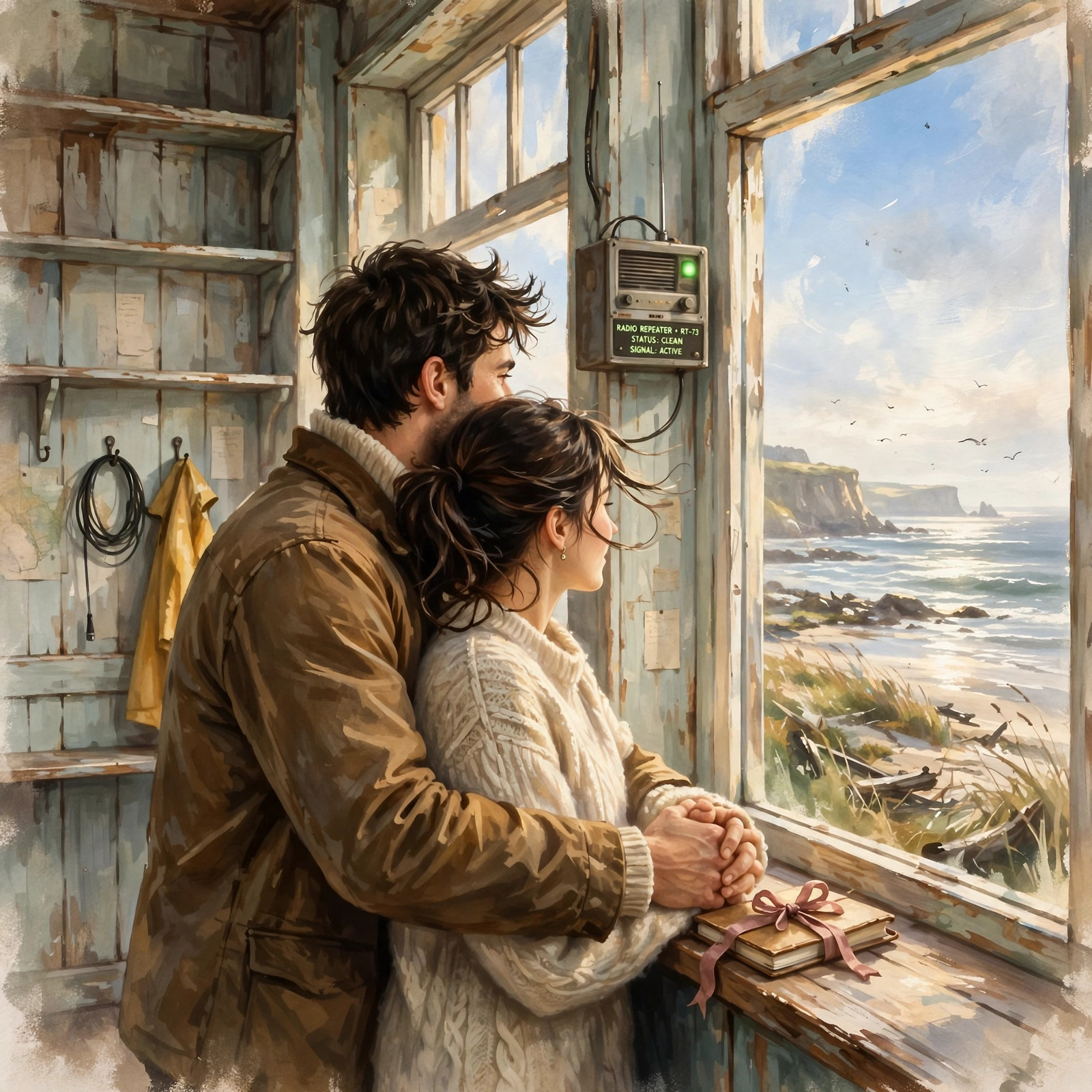
"You were right," he said. "And I was wrong to be quiet about it."
"Sit down before you drip on the log."
"No. Look at this first." He set the reel on the oilcloth and turned it with one finger, slow, until the splice came around under the lamp. "That's machine work. Clean, fast, done by somebody who's handled tape before. I sat with it two nights running, and last night I watched the far end of the line instead of the near one." He looked up at her, and his face had the gray the sky had been saving up. "The delay rides in on the fuel dock's channel. Same nights. Same hand. Whoever splices my weather line keys off the fuel dock first, and I've got the hours to prove it."
Iris's pen stopped over the ledger. The fuel dock was Hale's. The night hand was Hale's cousin. She had known the shape of it for three days, and now here it was, small and physical, lying on Grant's oilcloth next to Grant's numbers, and the two of them finally touching.
"Emil," she said. "It frames you."
"It frames the seat." He pulled the chair out and sat, finally, like his knees had been waiting for permission. "The radio shop reads a late relay, they don't read a splice, they read me. Negligent dispatcher, tired dispatcher, city boy who already dropped one mayday once. It's a tidy story and every piece of it is true except the cause." He rubbed his mouth. "I almost mailed the reel to the harbor authority myself. I didn't, because the hours put the hand on the fuel dock's nights, and the fuel dock's nights belong to Gullwick, and Gullwick owns half the authority's good opinion."
"And Gullwick is Deacon Hale," she said.
He nodded once. Outside, the rain found a new gear against the glass.
She looked down at the ledgers, and the ledgers looked back at her with her own handwriting all over them, and the lie she'd been carrying for three seasons sat up in her chest and put its feet on the floor. She'd sworn to herself she'd tell him before the notebook went to the county. She'd told herself she'd know the right night when it arrived, and here it was, arrived, and no better than any other.
"There's something you don't know about me," she said.
"There's a list," he said, and tried for the sideways smile and didn't quite land it. "Go on."
"You know the audit notes the county examiner's been getting. On the co-op's fuel books, every quarter, unsigned complaints that hold up in the ledgers because whoever writes them has actually read the ledgers."
"I've heard them discussed. Bett calls the writer a ghost with a grudge."
"Bett's close." Iris turned her cup, though it was empty, and gave it to her hands so her hands would have something honest to do. "N. Corbett. That's me. Corbett was my grandmother's people, out of the county north, and I sign it because a widow keeping the fleet's books can't be seen accusing the board chair of billing the fleet for fuel that never left his pumps. Hale's counter-signature is on every season of it. I've been mailing it in for two years. Grant found the pattern before I did."
The silence after that had a texture to it. Emil didn't move. Rain ticked. The stove ticked. She made herself keep going, because half a confession is worse than none.
"And when Bett's rota put us together, that first shift, I'll own that I wasn't only glad of the company. I keep the landing dates. You keep the relay times. I'd been wanting your logs since I figured out the delays weren't the fleet imagining things, and then there you were, on my shifts, offering me your notebook like it was nothing. I sat at this table and I copied your raw times into my margins twice while you made tea. I was going to put Corbett's name to them and send them out without ever telling you. That's why I'm here."
"That's why you're here," he repeated. Not a question. The warmth had gone out of the room by some door she hadn't known the room had.
"Some of why."
"The useful part."
"Emil, I never once--" She stopped, because once was exactly the word that could lie for her, and she had just sworn off lying in this room. She started over. "Most of it. Then it stopped being most of it somewhere around the third shift, and I've been dreading telling you ever since, because of how it lands."
He stood. He walked to the tape deck, not looking at her, and she watched him arrive at whatever he was arriving at with his back to her and his shoulders set like a man taking a swell head-on. She thought of him on Day 1, up this same stair, carrying the loaner handset for the cannery office like it was a gift and not a leash. She thought of the mayday he'd told her about, the one from the city desk, the blame that had followed him here, and knew exactly which wound of his she'd just pressed her thumb into.
"Do you know what I did," he said, quietly, to the deck, "when I found out my logs were going somewhere without me? I felt sick. Because for a second I thought I'd finally found the one person in this town who read them straight."
"I did read them straight. Every line. That was Corbett's whole job."
"Corbett's job." He turned around. His eyes were bright and hard and hurt, and she deserved all three. "Your county examiner gets an anonymous parcel and opens a file and maybe someday it falls on me, the late dispatcher, as the cause, and I never even get asked. That's what you were building, out of my hours, at my table. And Hale sits on the authority and the board both, so where exactly did you figure the inquiry lands, Iris? Did you think about that? Did you think about me at all, or was I arithmetic?"
"I thought about you the way you told me to think about you." Her voice came out flat and awful. "Keep doing what you're doing. Your words. I kept doing what I was doing. That's all Corbett ever is, is somebody keeping on."
"Somebody keeping on and keeping quiet," he said. "I know that animal. I've been one." He came back toward the table and stopped by her chair, close enough that she could see the rain still in his hair. "You should have handed me the pen and let me sign it. Whatever Corbett's evidence was, I'd have put my name under it the first night you asked. You know that. I know you know that."
She did know that. It was the cruelest thing about it, that the whole scheme had been built to protect a trust that had been standing in that room, open-handed, since the first shift, waiting to be used honestly.
"Say what you're going to say," she said.
"I don't want to say it."
"That hasn't stopped either of us all week."
A breath went out of him that had been held a long time, maybe all seven days, maybe longer, and he reached down and took her hand off the ledger and held it, once, hard, and she stood up because sitting felt wrong, and they were at the door of the watch house, and he kissed her. There was nothing careful in it and nothing arranged. It was relief and grievance in the same mouth, and her free hand found the front of his wet coat and gripped it, and for the length of it she was nobody's keeper and nobody's ghost.
He pulled back first. He kept her hand a second longer, then gave it back like a man returning borrowed tools.
"That was honest," he said. "That was the most honest thing that's happened in this room tonight, and it came second, and that's the whole problem."
"Emil."
"Take the notebook home." He nodded at the table, at Grant's cracked spine, at the whole weight of it. "You were right that it belongs in daylight. Swear it in, get the fleet their money, clear Grant's name. Do all of it. Just do it down the stair and not up it, tonight. I've got the deck alone until the change, and I find I do my best work that way."
It was a cruelty and it was fair, and she took her satchel and put the oilcloth notebook in it with the ledgers on top, and buttoned the flap over both. He held the door. The rain came in sideways and bent around him, and he didn't move from the doorway while she went down the stair, so that the last thing in the room behind her was his shape in the lamplight, and the last thing he said went down the stair with her, spoken to the night and not to her at all.
"You had the whole of me for the asking."
Landfall Board
The lamp above the board table guttered twice while Bett counted the room, and Iris told herself both times that it was the wind and not the storm putting its finger through the cannery's eaves. Eleven chairs. Nine full. The fleet's skippers sat along the window wall with their hats in their hands, and Deacon Hale sat at the head of the table with the agenda flat under his knuckles, and the rain came at the salt glass in long ropes.
"Storm watch stays paired tonight," Bett said, reading off the rota. "Twelves, same as always. Point Ada runs one keeper."
"One," Hale said. "Good. One is all we're paying for."
Iris kept her hands in her lap and her satchel under the table, buttoned, heavy. Grant's oilcloth notebook rode in it like a live thing. Two nights ago Emil had kissed her at the watch-house door and then handed her back to the rain like a parcel he'd decided not to sign for, and she had spent the day since doing what she did best, which was putting figures in front of people who didn't want them, in a hand nobody knew was hers.
Except one person knew. The wrong one, possibly. Or the right one. She hadn't decided.
Hale pushed the agenda across the table with two fingers. "Old ledgers. Five seasons of fuel books sitting in the archive, paper rotting, rats in the walls. I move we purge anything past the last two and bill the co-op for the shelving we'll free up."
Seconded from the fuel dock's night hand before the echo of it died. Iris watched the man's mouth move and thought of tape splices and night hours, and put her knuckles on the table.
"Point of order."
"Mrs. Fenwick keeps minutes," Hale said, not looking up. "She doesn't make them."
"She makes them tonight," Bett said, and her voice carried the whole length of the packing floor when she wanted it to. "She's got standing. Widow of a partner. So do I. Sit down, Deacon, and let the room hear her."
Iris stood. The lamp steadied, or she did. "The archive holds more than paper. It holds the reason the fleet's fuel bills ran high and the landing prices ran thin, season on season. Before anyone votes to burn the proof, the board should see it."
"See what?" Hale's chair scraped back an inch. "Written by whom? Some county scribbler who mails us envelopes we can't verify? I've had my fill of anonymous hands in this co-op's business."
The door opened on the storm before anyone could answer it, and the storm came in sideways with Emil behind it, soaked to the collarbone, salt-white, his coat black with rain. He'd come down the Point Ada stair in the worst hour of the worst night of the season, and he stood in the doorway dripping on Bett's clean floor while every man at the window wall turned around.
"Radio's clean," he said. "From now on, whatever else is true tonight."
"You're off shift," Hale said. "You're off your own mountain. What are you doing in my board meeting?"
"Bringing a piece of evidence that a bookkeeper I trust tells me belongs in daylight." Emil crossed the floor, and Iris watched him not look at her, then look at her, then set his hand flat on the table within reach of her satchel. "Mrs. Fenwick."
Her fingers went to the button before she'd decided anything. The flap came back. The ledgers came out first, then the oilcloth, dark with old wax, cracked along Grant's spine. She laid it in front of Emil because that was the arrangement his face had asked for, and Emil put both hands on it.
"The fuel tallies in this book were kept at Gullwick dock, in Grant Fenwick's hand, the season before his boat went down. They show fuel billed to this fleet that was never drawn. Every page carries a counter-signature. Every page. Deacon Hale's."
The window wall went quiet in a way that had weight to it. Hale said, "That's a dead man's word against mine."
"It's a dead man's arithmetic," Emil said, "and arithmetic doesn't hold grudges. It just adds." He reached inside his coat and brought out two reels of tape, and set them on the table beside the notebook, dark little wheels of it. "And these are my raw logs, every dispatch hour off Point Ada for the season, and I'm surrendering them to the board tonight, whole, untouched, before anyone else gets to them first. The county radio shop can read them. The county examiner can read them. Because somebody's been splicing my line, clipping the storm warnings and the maydays late past the repeater, and I've traced the hours, and the hours run to the fuel dock's night man. So the board should ask itself who had reason to make the mountain look careless, and I'll stand here and take the question, and I'll stand here and take whatever comes of it. The dispatch seat is yours to hand me or take from me. The tape isn't."
"He can't prove the reel wasn't spliced by him," the fuel dock's night hand said, too fast, and Bett turned her head slowly toward him and let the room hear how fast he'd said it.
"I can swear to envelopes," Bett said. "The county examiner's audit notes have been coming to this co-op for two years now, signed N. Corbett. I've watched that hand. I pack fish next to Mrs. Fenwick's ledger desk five days a week, and I've watched that hand too." She didn't say Iris's name. She didn't have to. She let the room do the arithmetic, and the room was good at it, being a room of fishermen. "I'll swear to the slant of it before any man asks me to."
Hale stood up. "This is a circus."
"It's a quorum," Bett said. "Sit down."
He didn't sit. He stood while Iris read the fuel figures aloud off Grant's pages, season by season, the billed gallons against the drawn, the shortfall running out ahead of them like a channel at low tide, and when she got to the season Grant's boat went down, and the debts that had been hung on a drowned man's name, the May Queen's skipper put his hat on the table and left his hand on it, and two more men did the same, and Hale's second at the dock looked at the door.
The vote, when Bett called it, was not close. Suspension, papers to the county examiner, the spliced tape and the tallies both, by the end of the count. The fuel dock's night hand was out the door and into the rain before the last hand came down.
Hale went last, coat over his arm, and stopped at the table's end where Iris sat. "Grant would've come to me first," he said. "Grant would've come to me."
"He did," Iris said. "You're in the book. You're in it every page."
He went out into the storm and the storm took him.
The skippers filed out after, talking low, hats back on, and Bett went with them to bar the cannery door against the tail of the gale, and the room emptied the way rooms do, all at once and then in stragglers, until the lamp over the board table burned on a shorter room than it had an hour before.
Emil still sat where the vote had left him. His coat had dried in patches. He drew Grant's notebook across the table, and untied the ribbon that held the oilcloth's fold, and turned the last pages to the end, and read the end, the way she never had. Then he began rewrapping it, corners in, ribbon flat under his thumb, taking longer over it than wrapping needed to take.
"You found the splice at Point Ada," she said. "The storm line ran clean tonight. You did that before you came down."
"Ninety seconds is what the old deck could queue a mayday during a tape change. Somebody had built that lag into the line and I was the only one who could take it back out. So I went up early, and I took it out. Hand-wired around the splice. Both my thumbs and half a spool of solder and one very bad word." He smoothed the ribbon down. It had a fray in it near the knot. He matched the fray to the knot, the way it must have lain for three seasons in the dark. "You'll want this for the examiner. I'll walk it to the county seat myself tomorrow, with the logs. I've got nothing in my pockets now but my own neck."
"You put your seat on the table for it."
"It was never mine. It's the fleet's. I just keep the chair warm." He tied the ribbon off and squared the notebook on the table, dead center, where the agenda had been, and put his hands flat on either side of it, and looked at her for the first time since the door. "I said a thing at the top of that stair I'm not proud of, about the asking."
"I remember what you said."
"I know you do. You keep everything. That's the trouble with you." His mouth went sideways, not quite a smile. "The examiner's going to want the Corbett envelopes too. She'll want the hand behind them."
"She'll get them. She'll get the hand."
"Good," he said, and the lamp hissed, and the storm moved off the glass a degree, and neither of them stood up to go anywhere.
Clear Morning
The stair up to Point Ada had dried in patches, and Iris took them the way she took everything now, one hand on the rail and her eyes on the door at the top. Emil had left it unlatched. That was new. For eleven watches he had shot the bolt behind him like a man sealing something in, and today the door stood ajar, swinging a finger's width on the wind, and she could hear the deck inside before she could see it.
Not the deck. The fleet. Voices on the water, coming through clean, one over another the way they were supposed to run, none of them clipped at the front or arriving late and panting. She stood in the doorway a moment and just listened to it, because three seasons of her life had been spent guessing what the fleet heard on the far side of that line, and this morning she could hear it herself.
"You're on time," Emil said. He was at the window with a mug in each hand, and the light off the water caught him full in the face and made him squint, and he let it. There was a crease in his shirt where he'd slept in it, or hadn't slept at all. The board lamp had burned late. She had watched it through her kitchen window from across the lane, a small stubborn yellow, and had not gone over, and he had not come down, and that had been its own kind of answer, the kind two people write without penmanship.
"The fleet went out at first light," she said. "I counted them off the point. Twenty-two hulls."
"Twenty-three. The May Queen went out with a patched cabin and a grudge." He handed her the second mug. It was hers. The chip on the rim faced away from her mouth without her having to turn it, and she looked at that a long second, because a man who knows where your mug's chip sits has been paying attention with more than his ears.
"You walked to the county seat," she said.
"This morning. Before light. I left the logs and the reel on the examiner's desk with a note, and I took the long way back so I could count the boats going out instead of counting anything else." He drank. "She'll want the envelopes. She'll want statements. She'll want me to sit in a room and say the same things over and over while a man's cousin says otherwise."
"You've done harder things this week."
"I've done harder things this week." He set his mug on the sill. "Hale's fuel dock is shuttered. Bett told the packing line at six, and the packing line told the town by seven, which is the town's official speed limit for news. Somebody threw a herring at the shutter. It stuck. It's still there."
She laughed before she meant to, and the sound surprised them both in the little room, and the deck relayed a gull and a deckhand swearing at a gull and neither of them minded.
"Bett cornered me before I came up," she said. "She'd made a copy of the storm rota in her own hand and folded it into my coat pocket like a receipt. Twelves, like always. My name and yours on the same line, right through the season."
Emil turned from the window then. He had a way of going very still when something mattered, like a man listening for a signal under static, and she had watched him do it over a splice and over a vote and now over a folded paper.
"What did you say to her?"
"I said I'd think about it."
"You didn't show it to me yet."
She took it out of her pocket and unfolded it, and the creases were sharp, because she had folded and refolded it twice on the stair. He read it. She watched him read it. His eyes went down the columns of names and stopped where Bett had written theirs, side by side, week on week, to the end of the sheet.
"That's the whole season," he said.
"That's the whole season."
"Iris." He said her name carefully, the way he read figures back over the air, like something you don't want to get wrong. "I've been up here alone for most of a decade because I thought the chair needed a man with nothing in his pockets. Clean hands, empty life. It made the dispatch tidy. It made everything else thin." He tapped the rota against the sill, squaring it, the way he squared tape. "I'd been half a person at this desk, and I got used to it, and then you started sitting across from me with your ledgers, and the shifts stopped feeling like shifts. So I'm asking you plainly, because I've learned from you that plain is the only way worth asking. Take the desk and the watch as one rota. Your books up here, my line beside you, twelves together. Not because the board needs it. Because I'd rather have you on the other side of this table than anything the county could put in my hands."
The deck relayed the May Queen's skipper, cheerful, obscene, and on time.
She had rehearsed nothing. That was the discovery. She had walked up eleven hundred stairs in her life and never once arrived rehearsed for the thing at the top.
"I sat across a table from you for two days while the board tore at you," she said, "and I kept my hands folded and my face shut, because that was the only thing I could do for you at the time, and it nearly broke me to do it. And then you were gone before light, and I stood in my kitchen holding a cold cup, and I understood I wasn't standing there because of Grant's notebook or the examiner or any of it." Her voice went thin and she let it. "I love you, Emil. I've known it since the gale came through and I watched you count the boats home. I love you, and I want the twelves, and I want the whole sheet, and I want to be the one who brings the lamp up the stair on the bad nights."
He didn't move for a moment. Then he crossed the small room, and took the rota out of her fingers and set it on the sill beside the two mugs, and put his arms around her, and she put her forehead against his collar where the shirt was still creased from the long night, and the crease was warm from him now, and that was a thing she hadn't known she'd want until she had it.
"I love you," he said, into her hair. "Plain, on the record, no static."
"Read it back," she said, muffled.
"Iris Fenwick, I love you. Time was, ah..." He glanced at the deck clock out of pure habit and she felt him smile against her temple. "On time."
They stood like that while the fleet worked the water below, and the deck ran their voices through the room without hurrying any of them, one and then another and then one, all arriving when they arrived, not a second clipped, not a mayday kept waiting in a queue built by a man with a reel and a reason. She listened with her eyes shut and her cheek on his chest, and heard it clean, the way the fleet would hear it all season, the way it should have been all along.
"Twenty-three boats," he said.
"I'll recount."
"You'll recount. You'll reconcile. You'll initial the twelves and complain about my handwriting." He didn't loosen his arms. "My sister's going to ask when she comes in on the herring run."
"Tell her the bookkeeper and the dispatcher filed one rota."
"She'll want it in writing."
"Then it's a good thing we know somebody who keeps records."
The May Queen cleared the point on the way back with the morning's first quiet traffic, and it came through the speaker low and easy and on time, and outside the window the light lay flat and gold across a sea gone calm, and they held each other and let it all pass through, unhurried, the way it was built to run.
Get notified when new stories drop

Serena Blake
Serena writes romantic suspense and dark romance for readers who want pulse and payoff. Her stories chase trust as hard as they chase danger.
Leave a comment
Comments