


The Pulled Folder
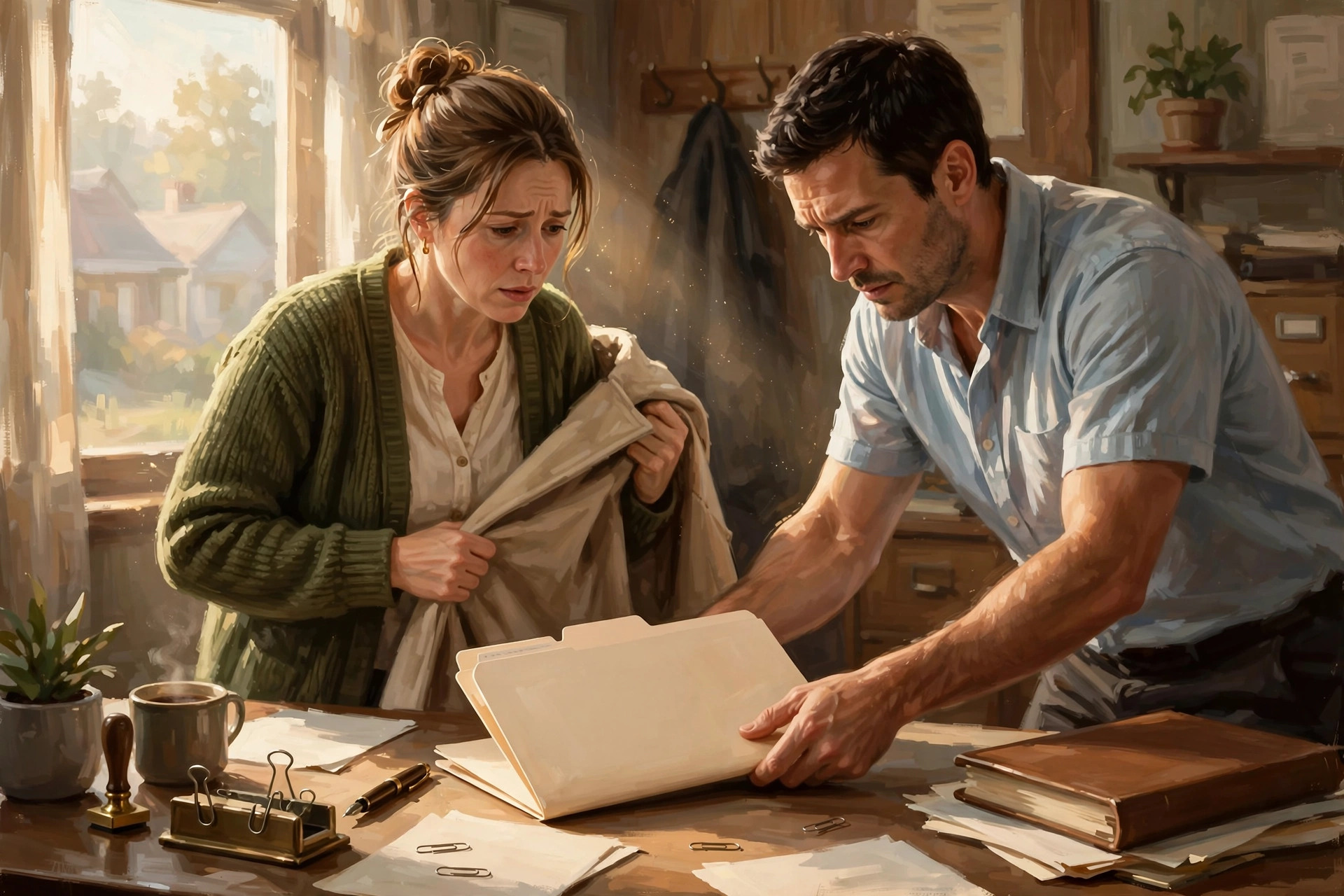
The folder hit Sabine's desk before she'd finished hanging up her coat, and she knew the weight of it before she saw the tab. Heavy cardstock, her father's name in Emrys's small block capitals. RUBEN FERRAR. She stood there with one arm still out of her sleeve.
"Your father didn't show this morning," Emrys said. He wasn't looking at her. He was looking at the folder like it might do something if he took his eyes off it.
"I know what day it is." She let the coat fall onto the back of her chair. "I balance the docket before you do, remember? I'm the one who types it up."
Behind them, the front door of the office rattled shut and Nia came through with two coffees and a manila envelope of courthouse slips between her teeth. She stopped when she clocked the room, set the coffees down slowly, and retreated to her desk with the discretion of a woman who had watched this family's weather for years and knew a front when one blew in.
"Say the rest of it," Sabine said.
"You already know the rest of it."
"Say it anyway."
Emrys pulled the visitor's chair around and sat on the wrong side of her desk, facing her, which he never did. He was in his courthouse shirt, the good one, cuffs still buttoned, and she noticed his knuckles where they rested on his knee. He had come straight from the hearing room. He hadn't gone home to change.
"Judge gave me the window. Forty-two days from this morning before the clerk enters judgment. I produce him, the bond reinstates, we all go home. I don't produce him..." He turned his palm up, like a man showing he was unarmed. "Eighty thousand. The full amount."
"We don't have eighty thousand."
"We have reserves."
"We have reserves," she agreed, and hated how her voice came out even, how the bookkeeper in her had already priced the sentence before the sentence finished. Money trouble thins a room out. She'd watched it happen her whole life, and here it was happening again, in the one room she'd thought was sealed against it.
"Then there's nothing to panic about," Emrys said.
"I'm not panicking. I'm itemizing."
Something almost like a smile moved at the corner of his mouth and was gone. Nia snorted from the front desk without looking up.
"Skip tracer's already out," he said. "Tolliver. He's good. He'll start with the bus station, the pawn shops, the usual."
"My father doesn't pawn."
"Everybody pawns something."
"Not him." She pulled the folder toward herself and opened it, and there was her father's signature on the contract, shaky since the stroke but stubborn, all the loops still trying. Below it, Emrys's own, tidy and small. Two men's names on one page, and hers in the corner as witness, because she'd been standing right there the day they signed it and Emrys had handed her the pen without a word.
She closed the folder before he could watch her read it twice.
"Where'd he go?" she asked.
"If I knew that, I'd be driving, not sitting here."
"He called you. Before."
"Phone's got nothing since Tuesday. You checked the log yourself."
She had. She'd checked it four times, and then she'd checked the lockbox drawer where the collect-call slips went, and she'd found what she'd known she'd find, because she'd been the one to take the slip out of the tray Wednesday morning and fold it into her purse before Emrys came in. The paper was still there, against her bus pass, creased into quarters.
Daddy okay. Don't tell Brant. Tell no one. I'll come home when it's right.
Collect from a depot payphone two towns over. Recorded by the operator, time-stamped 11:40 at night, the same night he'd missed his bed check, two nights before the hearing. Her father, rationing his dimes like a man on the run from something, or toward something, and either way telling her, his bookkeeper daughter, his only child, the one thing she could not do with it: tell no one.
"Sabine." Emrys was watching her. He had a way of watching that felt like an audit. "Where is he?"
She looked up from the folder and let the silence sit long enough to be honest. "If I knew that," she said, "I'd be on a bus, not answering your questions."
It wasn't a lie. It was just a smaller truth than the one in her purse, and she set it down between them gently, the way you set down something breakable.
Emrys leaned back. Rubbed his jaw. Outside, a truck downshifted on the street and the old Union Trust building took the rumble into its bones, the way it took everything, and gave it back as a shiver in the file box behind the counter. Steel, that box, welded and riveted in the railway shops in the sixties by Emrys's grandfather, before her father was ever born. Everything in this town connected twice if you waited long enough.
"Here's how it runs," Emrys said, and she recognized the tone, the one he used on nervous clients' wives. Steady, unhurried, everything already decided. "Tolliver hunts. I back him up where he points. You hold the shop. Nia holds the phones. Nobody talks to the county, nobody talks to reporters, nobody talks to your father's poker crowd. In six weeks this is a story we tell at Christmas."
"Forty-two days," she said. "It's forty-two days. I filed the notice."
"Forty-two days," he repeated, as if she'd confirmed it rather than corrected him, and she filed that away too, because correcting Emrys Brant was like correcting a map. He'd already driven the road.
"And if Tolliver's chasing the wrong ghost?" she said.
"He's not."
"You don't know that. You know where a man's money goes. That's not where a man goes. You've got his card history, his pawn slips, whatever. Any of that tell you who he called?"
She kept her voice flat, bookkeeper-flat, and hoped her face held the same line. Emrys looked at her a moment too long, the way he did when he caught a column that didn't foot, and she felt the slip of paper in her purse like a coal.
"You want the numbers run, run them," he said. "That's what I pay you for."
"You pay me to make the numbers true. You want them useful, that's extra."
"Then invoice me for extra." He stood, and pushed the chair back to where it belonged, on the public side of her desk, where visitors sat and were charged and left. "His accounts, the tracer's leads, whatever Tolliver's run down. You see a hole in the pattern, you bring it to me before you bring it anywhere else. Sworn."
Sworn. Like they were at an altar instead of a desk with a dead plant on it.
"Before anywhere else," she said.
He held out his hand. Stupid, formal, a bond of their own, and she looked at it, and at him, standing there in the good shirt with his whole livelihood riding on a retired railway mechanic who called his daughter collect and begged her silence. She took the hand. His grip was careful, like he was afraid of what his hands could do, which was a strange thing to notice about a man who hunted people for a county living, and she noticed it anyway.
Nia looked up from her slips. "Coffee's getting cold, you two."
Sabine let go first. She pulled the folder back across the desk, squared it, and reached past him for her ledger.
"Give me the tracer's file," she said. "Every lead. All of it, tonight."
"You think a number's going to find him where Tolliver can't?"
"I think your tracer's reading a man's tracks." She opened the ledger to a fresh line. "I'll read his life. There's a difference."
He watched her a second. Then he went behind the counter, unlocked the steel box with the little brass key he'd never once let out of his sight in three years, and came back and set the file beside her lamp.
"Anything you find," he said quietly, "comes to me first."
"You said that already."
"I'm saying it again."
She didn't answer. She wrote the date at the top of the page, pressed hard enough to read the number through to next week, and in the second column, where the explanation of charge went, she left a space wide enough for everything she wasn't going to tell him yet.
Her purse hung on the chair back, and the folded slip inside it rode quiet against her hip, and she ran the numbers.
Petty Cash
Two evenings later the office smelled like garlic and cold paper, because Nia had declared the shop closed at six and nobody had argued with her, and because Emrys had sent out for takeout from the place on Bellow Street without asking anyone what they wanted, and had been right about all three orders anyway.
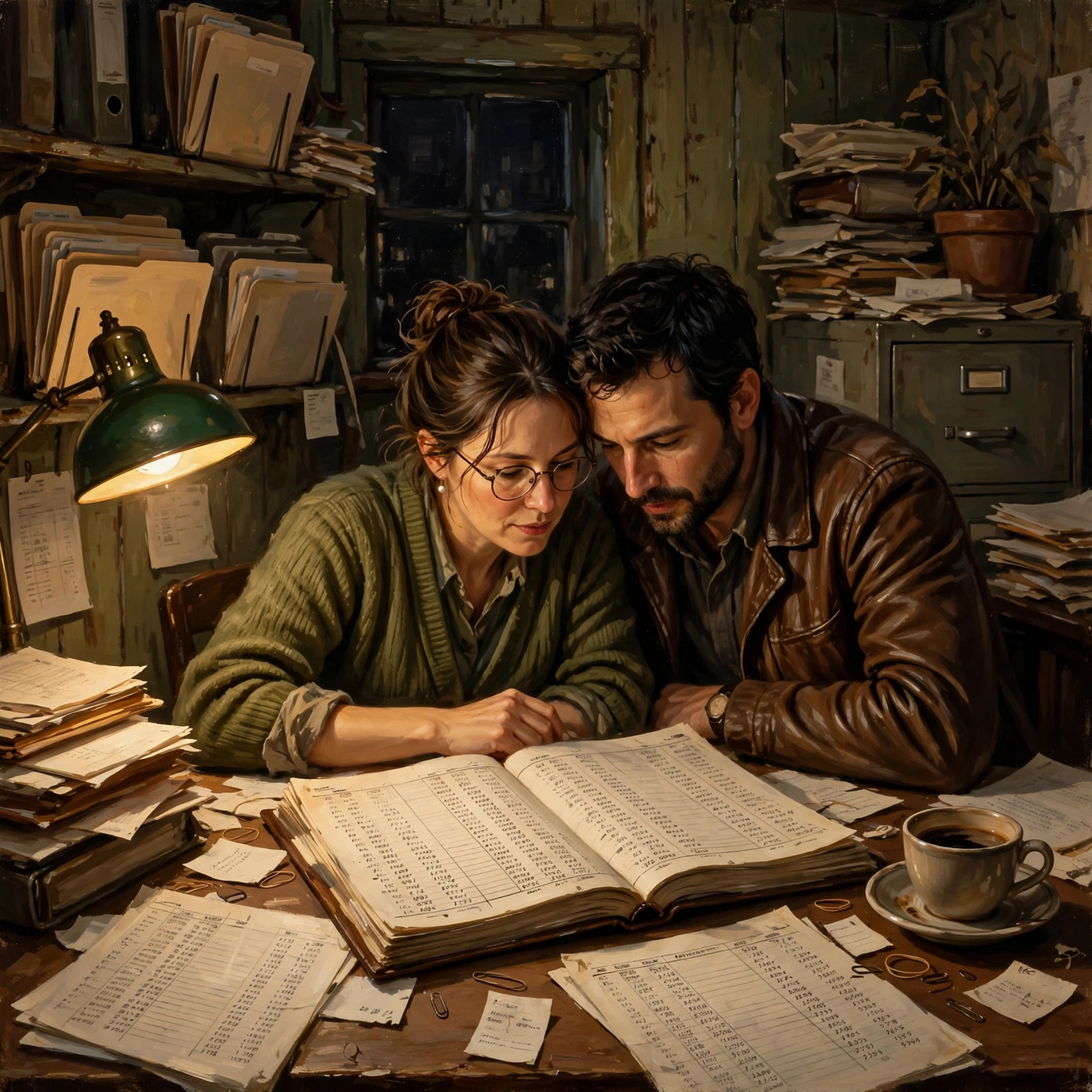
"You got the dumplings again," Sabine said, watching him set the little box on her desk, on top of the petty cash tin, because every flat surface in the office was already a ledger or a folder or an open map of the county, and the desk was the only country he hadn't annexed yet.
"You ate them last time."
"That's not a reason to assume a pattern."
"It's three times. Three's a pattern. You do it in your books."
He was right, which was the annoying part. She'd been over his tracer's file every night since the hearing, and the man's notes ran in threes: three sightings, three alleys, three corrections in a row where the math stopped being math and started being hope. Tolliver chased like a man who'd already decided what the answer was and was collecting reasons to keep it.
She took the box anyway. Nia came around the counter with her own carton and pulled the third chair, the visitor's chair, the public one, and sat in it herself, which scandalized nobody, because Nia had worked the front desk since Emrys's father ran the place and the chairs obeyed her more than they obeyed him.
"You two eating over the books again," Nia said. "In my day your father shut the drawer at supper, Emrys."
"In your day he also charged widows full freight on a Tuesday, so let's not canonize him."
"I'm not canonizing. I'm saying grace." She folded her hands over the carton for exactly as long as it took to make them both feel it, then opened her chopsticks.
Sabine ate with one hand and worked the ledger flat with her forearm. Reconciling the shop's month, line by line, receipts against entries. It was the part of the job she'd have done for free if anyone had been fool enough to offer, the part where the world agreed to sit still and add up. Alimony. Nothing at Nia's.
Then she hit the petty cash line and her chopsticks stopped.
Because it was short. Not much. Rent money, the kind of gap a body makes when a body's father goes missing and the landlord doesn't care and the paycheck comes on Friday and Friday is two days off, and a tin sits right there behind the counter with nobody's name on it. She'd covered it Monday, fully intending to be made whole by now, and the being-made-whole had gone the way of everything else that week.
"You went quiet," Emrys said. He wasn't looking at her. He was looking at his own carton, which meant he was looking at her.
"The tin's out," she said, which was true and was also the oldest trick in the world, moving the thing to the noun so the verb never has to be anyone's fault. She reached over and popped the clasp, and counted it back to whole right there at her desk, in fives and ones, the rent-gap going home to where it lived. The receipt went into the side pocket of her purse, the pocket with the snap, the same purse with the folded slip in it from a depot two towns over, and she didn't let her hand slow down going in or coming out.
She slow-walked it anyway. She should not have slow-walked it.
"Petty's tall," Emrys said, mouth full, not accusatory, just a man who counted things for a living.
"It's fine. I squared it."
She could feel him doing the arithmetic in the air between them. Monday the tin was whole. Tuesday she'd borrowed nothing on paper. Wednesday it was whole again and the rent receipt was in her bag. He did that math the way other people breathed.
Nia stood, gathered the empties, and made a show of needing the bin across the room, which was Nia's way of leaving without leaving, and her way of telling them both she was doing it.
"Your rent came up short this month," Emrys said, when the door to the back had clicked shut. Not a question.
"It's squared."
"I didn't ask if it was squared. I asked why."
"Because landlords like Friday and my pay likes the end of the month. It's not a mystery, it's a calendar."
He set his carton down. He pushed his chair back, the public one, the visitor's, and went behind the counter, and she heard his wallet, that soft worn-leather sound it made, and she thought, oh no, don't, before anything else happened at all.
He came back with bills, folded lengthwise, the way he folded them into the bond box, and held them out over the desk. Not enough to insult her. More than enough to make her chest go tight.
"No."
"It's not a loan. It's payroll. You worked the weekend on the tracer's file, that's billable, I'm billing it."
"You are not inventing hours so you can hand me rent money, that's not how books work, I would know, I keep yours."
"Sabine."
"No. Take it back."
"Your father's out on my paper. Your rent's my problem whether you like it or not. You want to be proud about it, be proud somewhere it doesn't cost you."
She stood up. Her chair rolled back and knocked the desk, and the pen tray rattled, and the petty cash tin buzzed against the lamp, a whole little shop's worth of small objects saying what she was saying louder.
"It's not your problem. It's mine. It's been mine since I was eighteen and it'll be mine after this is over, and the day I can't cover my own rent is the day you can start a file on me. Until then, I take care of my side of the counter and you take care of yours."
He didn't flinch, which was worse. He set the bills on her desk, on the corner, in the dead-plant zone, the no-man's land of the desk where nothing official lived, so the money sat there meaning what it meant and refusing to be an entry.
"Then don't pay for things that aren't yours," he said, quiet. "That's the whole job. You know it better than anyone I've hired. You know what happens to people who cover other people's shortfalls with their own thin cash. You've watched it."
The office went very still. Nia's radio, somewhere in the back, some station playing strings to nobody.
He knew. He knew about her mother, he'd known, maybe from the beginning, maybe from some file he'd read on her before he hired her, because he read everyone, that was the whole man. And he'd waited, this long, to lay it on the counter like a bond copy.
"Don't," she said.
"Sabine."
"You don't get to know that and then hand me seventy dollars like it fixes the shape of it. It doesn't. It's just numbers."
"Numbers are the only thing I've got," he said, and it came out rough, like it cost him. "Everything else I've ever handled, I've had to give back."
She took the bills off the corner. She did it slowly, so he'd see her do it, and she put them in the tin, and shut the clasp, which did not close all the way and hadn't since she'd worked there, and didn't that just figure.
"Petty's tall," she said. "I'll square it Monday."
"That's not what I meant and you know it."
"Then say what you mean. Once. Without the ledger."
He looked at her for a long second, and she watched him not do it, watched the whole sentence assemble behind his eyes and get filed somewhere she'd never be issued the copy.
"Eat your dumplings," he said. "They're getting cold."
Nia's door opened behind them, radio off, innocent as Sunday. "His father," she said, hanging her keys on the hook, "used to hide soup in that woman's desk drawer, and she never once caught him, and she ate every drop. You want to know how to give, in this family, you ask somebody who's bad at it."
Sabine sat back down. The bills sat in the tin, wrong and warm. Her purse hung on the chair back with both of her secrets in it now, one paper and one that weighed nothing and cost more, and she picked up her pen and wrote the petty cash line tall and true, and left the explanation column empty, because there weren't columns for what she owed him, or for what she was still, three days in, not going to say.
The Empty Road
Nia came in at nine with a coffee tray and a face she was failing to keep neutral, which for Nia was the same as shouting. Sabine had the ledger open to the month's bond fees and a pen uncapped, and she watched over the top of it as Nia set a cup on the counter, straightened the pen cup that did not need straightening, and said, to the dead plant near the window, "He took the truck."
"Who took what truck."
"Our truck. Emrys." Nia said it the way you'd say the weather had turned. "Before light. Full tank and his father's old road atlas on the seat, which nobody uses anymore, so you know he wanted to be sure nobody could guess where he was going by a phone."
Sabine put the pen down. "He said nothing to me about a truck."
"He said nothing to anybody." Nia wiped the counter in a slow circle, buying herself room. "But I heard him Thursday, on the phone with that skip tracer he won't name, writing on his palm the way he does, and then last night he asked me how early the county garage opens, and this morning the truck's gone and the mileage book shows empty road."
Sabine's chest did something cold and complicated. Thursday. Thursday he'd stood at her desk with the month's numbers and been pleasant and boring about it, and all the while he had a line on her father and hadn't said one word. "North," she said. "You said north."
"I said nothing of the kind." But Nia's eyes went to the ceiling, which was where Nia kept her honesty. "I may have said upstate. There's a cousin up there somewhere, that's all I know, and you didn't get it from me, because in this office we don't air each other's trips, we just soup each other when they go bad." She slid the coffee across. "Drink that. You've got the face your father gets when the numbers won't line up."
Sabine did not drink it. She sat with it going cold between her palms and thought about her purse in the drawer behind her, the call slip folded inside the receipts where it had lived for eight days now. A depot two towns over. He went north, her father had gone south, and one of the two of them was a paper trail and the other was a man, and she'd let the paper trail be the whole story because telling Emrys meant handing him the hunt, and handing him the hunt meant admitting the one true thing she'd promised the dial tone she wouldn't.
He came back near dusk. She heard the truck before she saw him, the rattle of it in the alley, and then the side door, and then Emrys in the doorway with his collar up and a night's worth of dust on him and the atlas under his arm like it had personally disappointed him. Nia was gone by then. Sabine had made sure of it, had invented a filing errand and a tone that made it not a request, and now it was just the two of them and the lamps and the bond box locked behind the counter with her father's folder sitting on top of it where it had sat for nine days like a headstone.
"You found him," she said. Not a question.
"No." He set the atlas on the counter. He didn't take off his coat, which meant he intended to be somewhere else within the hour. "The tip was good. The cousin's place was real. Nobody'd seen him."
"The cousin. The one upstate." She kept her voice level, which took doing. "That cousin."
Something crossed his face, quick, and she caught it and he knew she caught it.
"Nia," he said.
"Nia. Who you left holding the front desk with no truck and no reason, because God forbid anyone in this building know what the man who signs every bond is doing with his days." She stood up. It felt better than sitting. "You drove all night, Emrys. On a tip. About my father. And you didn't tell me there was a tip, or a road, or a cousin, or a full tank. You didn't tell me anything."
"Because it wasn't anything. It was a ghost address and a tank of gas."
"It was him." Her voice cracked on the second word and she hated it and let it stand. "It's my father, and he's on your paper, and you went hunting him like he's any other body you'd drag back for the county's cut. Which is what he is to you. I know that. I've written that column four hundred times. I just didn't think I'd be sitting in the lobby while you did it."
"That's not what it's like."
"Then tell me what it's like. Use words. I've got all night and you've got a locked box with his name in it, so one of us might as well be honest."
He took his coat off then. She noted that, filed it away, the small surrender of it, the coat going over the counter stool. "There's a window," he said. "Forty-two days from the date he missed it before the clerk enters judgment. We're nine days in. The bond is eighty thousand dollars and I don't have it liquid, and the county doesn't take installments from men they've just had to chase."
"I know what we're in. I do the books, Emrys. I've done the books on every bond you've ever signed. I know what his costs you down to the nickel, I know what your reserve looks like, I know what this office is worth on a Tuesday." She put her hand flat on the counter between them. "What I didn't know was that you'd found a thread. That you'd pull it. That you'd go pull it alone, at four in the morning, with a paper atlas so nobody could follow you. Including me."
"Including you," he said quietly, "most of all you."
She waited. He didn't fill the silence, which was his way, and the lamp buzzed, and outside a car went by slow the way cars did outside bond offices.
"You think I can't sit in a room with you and know where he is," she said. "You think knowing would break something in me and I'd drive off a cliff with the thin cash of my feelings, or worse, I'd warn him. Which one is it."
"Neither."
"Then it's the other thing. It's that you decided it alone, because you decide everything alone, because somewhere back there somebody in your family did a thing with a bond that they couldn't take back, and now you have to hold every ugly plan where nobody can see it, so nobody can watch you be the man who does what needs doing." She watched that land on him, watched him not move. "You're not the only one who reads people before you hire them, Emrys."
"No," he said. "I guess you're not."
He came around the counter then, slow, hands loose, and stood near enough that she could see the road in his eyes, how tired they were, how long the night had been and how much of it he'd driven on the fuel of not finding anyone. "I'll tell you everything from here," he said. "Every tip, every call, every cousin with a porch light. It goes through you. You hear it the same hour I do."
"And the hunt."
"The hunt goes through you too. Nothing moves on him unless you're standing next to me when it does."
"Say the last part again. The part where you mean it."
"I mean it."
He said it steady and he held her eyes and he was lying, or not lying, or telling the exact truth he intended to keep right up until the moment it stopped being convenient, and both of them stood there knowing it. She thought of the slip in her purse, folded small, tell no one, and how he was promising her transparency with one hand and she was three ahead of him with the other.
"All right," she said. "Then it goes through me starting tonight. Where's this cousin, exactly."
"That's the part that cost me a night," he said. "The cousin's real. The address is real. Ruben was never on that porch."
He picked up the atlas like it was heavy, which it wasn't, which meant it was. She looked at him, dusty and stubborn and hiding something even now, even mid-promise, and thought: he's chasing a ghost, and I'm the one holding the body, and neither of us will say so out loud.
"Eat something," she said. "You look like the road."
"The road looked worse." But he stayed put a minute, coatless, unhunted, in the office his grandfather's hands had welded shut around its secrets, and she let him.
The Misfiled Name
Six days after the empty drive north, the month-end pages wouldn't balance, and Sabine stayed late to make them.
It wasn't the petty cash. That had been square for days, quietly, the way she'd made it square. It was the county's side of the ledger, the intake lists that came over on Tuesdays, and one entry from the night her father vanished that had been sitting in the wrong stack ever since. She'd filed it herself, three pages deep in a bundle she hadn't had reason to open until now.
Hospital intake. A county facility, across the state line. Seizure on a bus, unresponsive on arrival, no papers on him, name taken down wrong by a night clerk who'd heard Farrell and typed Farrow and never once wondered. Admitted the evening of the missed hearing. Still there, the transfer log said, under the wrong name, in a bed nobody had come to claim.
She read it three times. Then she set it down flat on her desk, put her hands on either side of it, and laughed once, a short wet sound she didn't recognize as her own.
Footsteps from the back room. Emrys came out with his sleeves rolled and a mug gone cold in his hand.
"What's funny?"
"Nothing." She turned the paper so it faced him. "Everything. Pick one."
He read it. She watched his eyes go down the page the way she'd watched him read a thousand documents, fast and then faster, and then stop moving entirely at the date.
"That's the night he," Emrys started, and didn't finish, because the page had already finished it for him.
"The night he missed court. The night you were calling every cousin with a porch light." She stood up. Her chair rolled back and bumped the wall. "He had a seizure, Emrys. On the bus. Two towns over. Some clerk wrote the wrong name and he's been lying in a bed under it this whole time, and you were up north kicking a ghost."
"The tip was solid."
"The tip was a story someone told someone who told your tracer. You know what a solid tip is? It's a fact with legs. That was legs with no fact anywhere on them." She was around the desk by then, not sure when she'd moved. "You drove all night. You burned gas and days and half the grace window on a man who has never once in his life been on time to anything."
"I know how late it is."
"Do you. Because I've been counting it for you. Every morning I come in and it's another morning where you've got some new plan you're half of, and I'm none of, and the county's clock is just going."
He set the mug down. "I told you it goes through you."
"You told me that standing in this room with your eyes already on the door."
She went to her purse on the coat rack, took out the slip of paper folded down to the size of a matchbook, and unfolded it on the desk between them. A collect call record. A depot number two towns over. Her father's voice down a bad line, low and slurred in a way she'd told herself was the connection.
"He called me. The night he missed court. He wasn't making sense, and he said tell no one, and I told no one." Her voice cracked on the middle of it and she let it. "I've known for days your lead was nothing. I sat on it because he asked me to, because he's my father, and because I know exactly what you were going to do with him the second you found him."
Emrys looked at the slip for a long time. "What was I going to do with him."
"You had a pickup man. Don't tell me you didn't. Somebody on retainer with a van and cuffs that fit." She watched his face and got her answer. "That was the plan you were building up north while I reconciled your books and you paid my rent into a tin so you could pretend it wasn't a gift."
"He missed a hearing, Sabine."
"My father. Missed a hearing. And you were going to bring him back to this county in a van, which is legal, and which I would have stood here and watched, which is the part that keeps me up. Because I knew. I knew for days and I kept my mouth shut so you'd never have to look at the way you get things done."
He was quiet. The ice in his mug shifted and settled.
"The forfeit is eighty thousand dollars," he said. "The full bond. If I don't produce him before the window closes, the county takes it and then the county takes this office, because that's the reserve, that's all of it, and this shop is the only thing my family ever kept." He rubbed a hand down his face. "So yes. I had a pickup man. I had two. And I would have used them, and I would have put him in that van still warm from a hospital bed if that's what found him first, because I looked at the calendar and I looked at my father's picture hanging in the back room and I thought: I will not be the man who lost it all twice."
"You'd have been worse," she said. "He sold a friend's paper and hated himself for it and you've spent your whole life promising you're not him. Dragging my father back in a van while I'm telling you he's sick, that's not the shop, Emrys. That's just the same ugly thing with better paperwork."
"I know." He said it simply and it seemed to cost him the whole room. "I've known since the drive back. Every mile I kept it quiet I knew what I was doing."
"Then you're a coward."
His head came up.
"A coward," she said, "in the specific way where you'd rather lose everything your hands are holding than open them and let one other person see what's inside. You didn't chase a ghost because the tip was good. You chased it because it was a thing you could do alone."
He didn't argue. He looked at the intake record again, at the wrong name on it, at the bed no one had claimed, and something in his shoulders came down an inch at a time.
"He's alive," Emrys said. "All this time I was hunting him like a man on the run, and he was lying in a bed."
"Under somebody else's name. Three pages from where I put him." She pressed her palm flat on the record. "I found him with arithmetic. You could have found him in a week ago if you'd asked me one question instead of building a plan in the dark."
"Ask you what."
"Anything. Ask me if he'd called. Ask me if I knew things. Ask me what I was afraid of. You ask Nia what's in the coffee, Emrys, and you never once asked me if I was holding something."
He took a breath like it was heavy. "I didn't want to be watched. Not by you. Not while I still had a van in my back pocket."
The office was very quiet. Somewhere behind the wall a pipe ticked as it cooled.
"Show me," she said. "The reserve. The books on the building. Whatever it costs, I want to see the whole price, not the version you decide I can handle."
He came around the desk then, unlocked the bond box, and pulled the ledger out from under Ruben's folder. He laid it open where she could see every line of it, and she read down the columns and understood, in numbers, exactly what he'd been carrying and how close to the edge he'd been standing while he promised her the hunt went through her.
"That's everything," he said. "No second drawer."
"Good." She closed the bond box and turned the little brass key, and the lock went home with a sound like a decision. "Now call that hospital and tell them his real name. Then call your tracer and cut him loose. Then you and I are going to drive over that state line and go get my father, and I'm driving."
"You don't drive at night."
"You've driven nothing but night for two weeks." She picked up the intake record, folded it along the same creases she'd made six days ago, and slid it into her purse where the call slip had been. "You've been alone behind that wheel long enough. I'm done watching it."
He reached across the top of the bond box, and for a second she thought he meant the record, but his hand found her jaw instead, her cheek, careful the way he was never careful with anything except the parts of the business that couldn't be redone.
"I was going to lose him," Emrys said. "Either way. The van or the forfeit. And I'd have lost you somewhere in the middle and told myself it was the price."
"You're not allowed to do my arithmetic for me anymore."
"No," he agreed, "I'm not."
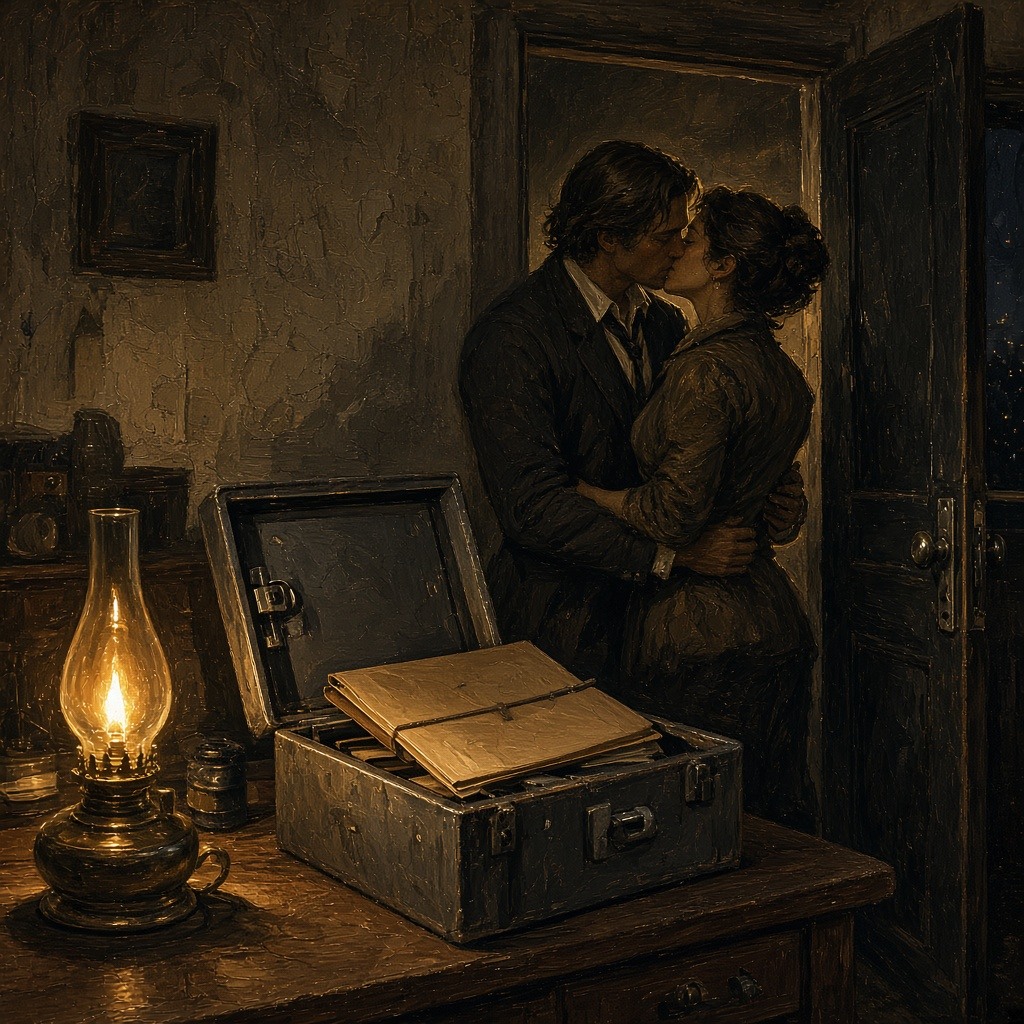
She leaned in over the lid of the box and kissed him, or he kissed her, and it didn't matter which, because he'd rolled his sleeves down and she'd left the room in her mind six times tonight and come back six times, and his mouth was warm and his hand shook a little at her neck like a man setting down something heavy. She kept her hand flat on the steel so she'd remember where they were, which was everywhere they'd ever signed anything.
When they came apart, he rested his forehead against hers, both of them breathing like they'd carried the bond box up stairs.
"Get your coat," she said. "I'll pull the car around."
The Reserve
Emrys spent most of a week making the calls she'd ordered him to make, and then he did the thing she hadn't ordered, which was the thing that mattered.
She came in on the sixth morning and found him at his desk with the ledger open and a cashier's check gone from the reserve line. Not the whole of it. Not the part that mattered to anyone but him. He had written the number himself, in his own hand, and the number was the full forfeit the county clerk had demanded in her letter, down to the dollars, and the line it came from was labeled with two words she'd never seen him write before: building fund.
"You paid it."
"Paid it this morning." He didn't look up. "Hand-delivered to the clerk's office before open. They'll enter it as satisfied. Judgment never lands."
Sabine sat down slowly across from him. "That was the money for the building. Emrys. That was the money to buy the Union Trust outright. Twelve years of it."
"Give or take a month." He turned the ledger so she could read the arithmetic, because he was done doing arithmetic alone. "The county gets its bond. Your father's paper is clean. Whatever the shop is after this, it's ours free and clear, not the bank's. I ran it both ways. This way, nobody hunts anybody."
"You were going to own the building your grandfather's box sits in."
"I was going to own a building." He said it flat, and then he said it truer. "I was going to own the thing my whole adulthood said I was. And then I sat in that parking lot with a checkbook and thought about what my father would've done, and what he'd say if he could see the two options. And I knew exactly which one he'd pick, and I picked the other one."
Her throat hurt. "That's the ugliest gift anyone's ever given my family."
"It's not a gift." He slid a folder across the desk to her. "It's paperwork. Restitution filing, the clerk's receipt, the release for the hospital transfer. Everything needs both our signatures, because you're the bookkeeper and you're going to know exactly what this cost, in writing, where I can't round it down later. Sign with me."
She read every page. He let her. Somewhere in the middle of the second page she stopped being able to pretend she was checking his figures and just read his sentences, which were careful and plain, and at the bottom of each one there were two signature lines, side by side, like a decision about a shared life.
"There's a second set here."
"For the shop." He watched her face. "New operating agreement. Equal shares. You've been running half of it since you walked in, and you've been carrying the half that doesn't show in columns. I'm not asking you to take charity, Sabine. I know how that lands with you. I'm asking you to take a job you've been doing for three years and finally get the papers for it."
She set the pen down. "You did this while I was sleeping."
"You sleep at ten. I had four hours." A corner of his mouth moved. "Nia held my hand through the seal and told me I was a fool for waiting this long. She's been telling me that since roughly your first week."
"Nia's usually right."
"She said that too."
Sabine picked the pen back up and signed the restitution papers, both sets, and when she got to the operating agreement she paused with the pen over the line next to his name, because the line under hers was blank and the line under that said BRANT, EMRYS, and there they were, in a steel box's worth of history, about to be on the same page. He slid his own pen out and waited, and they signed at the same time, and it didn't feel like paperwork. It felt like standing somewhere together on purpose.
"Now," she said, capping the pen. "My father."
She drove.
He objected twice in the first hour and then stopped objecting, and by the state line he was giving directions in the voice of a man reading a map he didn't trust, which she ignored, because she had the discharge papers folded in her purse beside the call slip she'd carried for twenty days and she was done letting anyone else hold anything for her. The hospital had already called twice. A social worker named Ferrar had been located in their system as one Farrow, transferred intake, seizure on a bus, no ID on him when he went down, and a man who mended railway engines for thirty years had waited in a bed under somebody's clerical error while two people drove around the countryside chasing each other.
When they wheeled Ruben out, he was thinner and furious about the wheelchair.
"There is nothing wrong with my legs," he announced to the parking lot. "There's a railing, and it should be cleaned."
"There's a car," Sabine said, and stopped, because her father was looking past her at Emrys, and Emrys was looking at Ruben, and neither of them said anything for a second that lasted a long time.
"You're the bondsman," Ruben said finally. "You came yourself."
"Somebody had to drive the paperwork," Emrys said.
"Somebody had to pay eighty thousand dollars," Ruben said. "The social worker reads everything out loud. She thought it would upset me." He looked down at his hands. "You should've let the county have it. That was the shop."
"The shop's not a building," Emrys said. "I found that out this week."
Ruben considered him the way he considered engine blocks, and then he held out one hand, and Emrys took it, and that was all of that.
Sabine drove them back over the state line with her father snoring in the back seat before the second mile marker, because a hospital will wear a man out even when he claims it hasn't. They went to the courthouse first, because she was the bookkeeper and she was not going to let a single day of that window go unused, and they walked Ruben up the courthouse steps together, discharge papers and the clerk's receipt in one folder, and produced him, alive and upright and present, eleven days before the judgment would have entered, and the clerk stamped it all and said, "All set," in the flattest voice in the world, and Sabine wanted to hug the stamp.
Then she drove them to Bellow Street.
Ruben's house had been aired by a neighbor, the mail was in a rubber band on the table, and he waved them both off from the doorway twice before he was believed, and then, when Sabine checked on him before dark, he was asleep in his own chair with the radio on and his boots half off, and his reading glasses were down on his chest, and he was home.
She stood in his doorway a moment. Twenty days she'd been doing the arithmetic of losing him, the way she'd done it over her mother, the way she'd done it over the rent, the way she'd done it over every person she'd ever tried to keep by holding the books tight enough.
Then she drove back to the old Union Trust building, where the light was on.
Emrys was at his desk with the new agreement in front of him, reading it like a man who wanted to be sure of what he'd done, and she came around behind him and put her hand flat on the page, on the two signatures drying side by side.
"You didn't have to spend the building to tell me," she said. "That's not how you tell somebody."
"No," he said. "The building was how I was going to tell myself. This is how I tell you." He turned his chair, looked up at her. "I'm going to have to learn to say things when they're cheap instead of when they cost everything. Nia says I'm a slow study."
"Nia's usually right," Sabine said, and sat on the edge of the desk, and he leaned his forehead against her knee the way she'd seen tired men do who had finally set something down, and she put her hand in his hair and let him stay there, in the shop that was both of theirs now, on the last night of the worst month of her adult life, with her father asleep in his own chair across town and nothing forfeit anywhere with her name on it.
Rented Ground
Nia had gone home at six with the new agreement folded in her purse like a church bulletin, and she'd left the front lamp burning, which she never did, and Sabine understood why before she got all the way inside. Nia wanted the office to look like a place somebody lived in. For years it had looked like a place somebody guarded.
Sabine found Emrys in the back, on his knees in front of the bond box, which was wrong in three ways she could count before he said anything. He was never on his knees in front of anything but a stuck drawer. He had the little brass key out of her coat pocket's usual place, which meant he'd gone into her coat pocket. And the box was open, which it had not been since her first week, when he'd told her the lock was older than both of them and better than anything made since.
"You went through my coat," she said.
"You left it on the hook. I got impatient." He didn't turn around. "Bring your ledger, if you want to catch me at anything."
"I don't need the ledger for you. You're sloppy." She came around and stood over him. Inside the box, under the lamp Nia had left on for them, the contracts lay in their folders like churchgoers, all neat, and on top of them, pulled up where a man could reach it in the dark, was her father's file, stamped twice, closed, paid, done. Emrys rested his hand flat on the stack the way you'd rest a hand on a sleeping animal. "Forty-two days ago I stood in front of this thing and thought, if I get him back, everything else is negotiable." He turned his head and looked up at her from the floor. "Forty-one days ago I started lying to you about how I'd do it."
"I know the count."
"I know you know the count. I'm saying it out loud anyway, because that's the lesson, apparently. Say it while it's cheap."
"Say what while it's cheap?" She knew what. She sat down on the floor across from him, which put the bond box between them like a low table, like a hearth, and she made herself not look away when he looked at her, because he had spent three years not quite looking at her and she was done pretending she hadn't noticed.
"The whole thing," he said. "The true one. Not the version where I fix it first and you find out later and I get to look like a man who had a plan." He turned the key over in his fingers, shut his hand around it. "I gave up the building because of you, and not in the way you think. Not to impress you. Not because of your father, not even for the shop. I did it because you were never going to be safe with a man who owned the ground you stood on. I'd have had you on my paper forever. Rent, salary, a desk by the window, and me holding the deed over all of it, and you'd have stayed out of arithmetic, the way you stay, the way you kept that call slip, and you'd have hated me a little every year and called it loyalty."
"That's not what I called it," she said, but the fight had gone out of her voice days ago, or maybe it had never been in her voice, only in her hands, in the books, in the tin where she counted his money and refused to touch it.
"You called it bookkeeping." He set the key on top of the folders, in the open box, where anyone could take it. "I own half of nothing now but the shop, and the shop's half yours, and the office is rented ground, and the landlord is a bank in the city that will never once care what we do in here. And I've never been able to say one real thing to you in three years without making it look like an invoice." He took a breath. She watched him take it, watched it cost him. "So here it is with nothing attached. I love you, Sabine. I've loved you since you found the error in the Vega file and told me I was wrong in front of Nia and I laughed about it for a week. I was too much of a coward and too much my father's son to say it while it was cheap, so I'm saying it now that it costs the building, and I'd say it again. I'd say it if it cost the shirt. I love you. That's the whole file."
The lamp Nia had left on buzzed faintly, and somewhere in the old Union Trust building a pipe knocked, and Sabine sat on the floor across from a man who had opened a box he'd kept locked his whole working life and put his one clean sentence on top of the folders, and she found that she was crying without having decided to, quietly, the way you cry when the arithmetic finally comes out even.
"You were wrong about one thing," she said. "It wasn't loyalty." She wiped her face with the heel of her hand, impatient with herself. "It was fear. Same ledger, different column." She reached across the box and picked the key up off the folders, and held it, and did not give it back. "I kept the books tight because my mother left when the money went, and I decided at eight years old that if I never let the numbers get away from me, nobody else would get away either. And then my father vanished into a hospital with the wrong name on him, and you vanished up a highway, and I sat here with the tin and the ledger and I couldn't keep any of you. I couldn't keep you with numbers. I couldn't even keep myself, because I was lying to you from day three about that call slip and every night I told myself it was protection." She stopped, steadied. "I love you too. Not the version where I keep you. The version where I don't get to. That one. Since before the Vega file, if you want the honest date, which you don't get to have, because you made me wait."
"I'll accept the date I got."
"You'll accept what I enter in the ledger," she said, and he laughed, and the laugh broke something open in his face, the tiredness sliding off it like a coat he'd been wearing indoors.
He stood, and offered her his hand, and she took it, and he pulled her up and didn't let go. She could hear her father's radio across town in her head, the neighbor's air freshener, the clerk's flat little stamp. Everything with her name on it was clear. She looked up at Emrys, at the man who had spent a fortune learning to speak, and said, "Take me home. Not to Bellow Street, not tonight. Home where you live."
"It's a rented apartment," he said. "Ground floor. Landlady likes me."
"Then she's the only one ahead of me."
He reached past her and switched off the lamp Nia had left burning, and the office went dark except for the street light through the front glass, and the bond box sat open behind the desk with no one guarding it, and Sabine left the key inside it, on top of the folders, where it belonged to anyone who worked there now. He held the door. She went through it into the warm evening with him behind her, and turned, and he was already leaning down, and she met him halfway, her hand flat on his chest where his heart was doing its own bad arithmetic, and he wrapped both arms around her on the doorstep of the old Union Trust building like a man who had finally figured out what was worth keeping and what could stay unlocked, and the street went soft, and the door stood open behind them, and neither of them looked back.
Get notified when new stories drop

Serena Blake
Serena writes romantic suspense and dark romance for readers who want pulse and payoff. Her stories chase trust as hard as they chase danger.
Leave a comment
Comments