


Rack Three
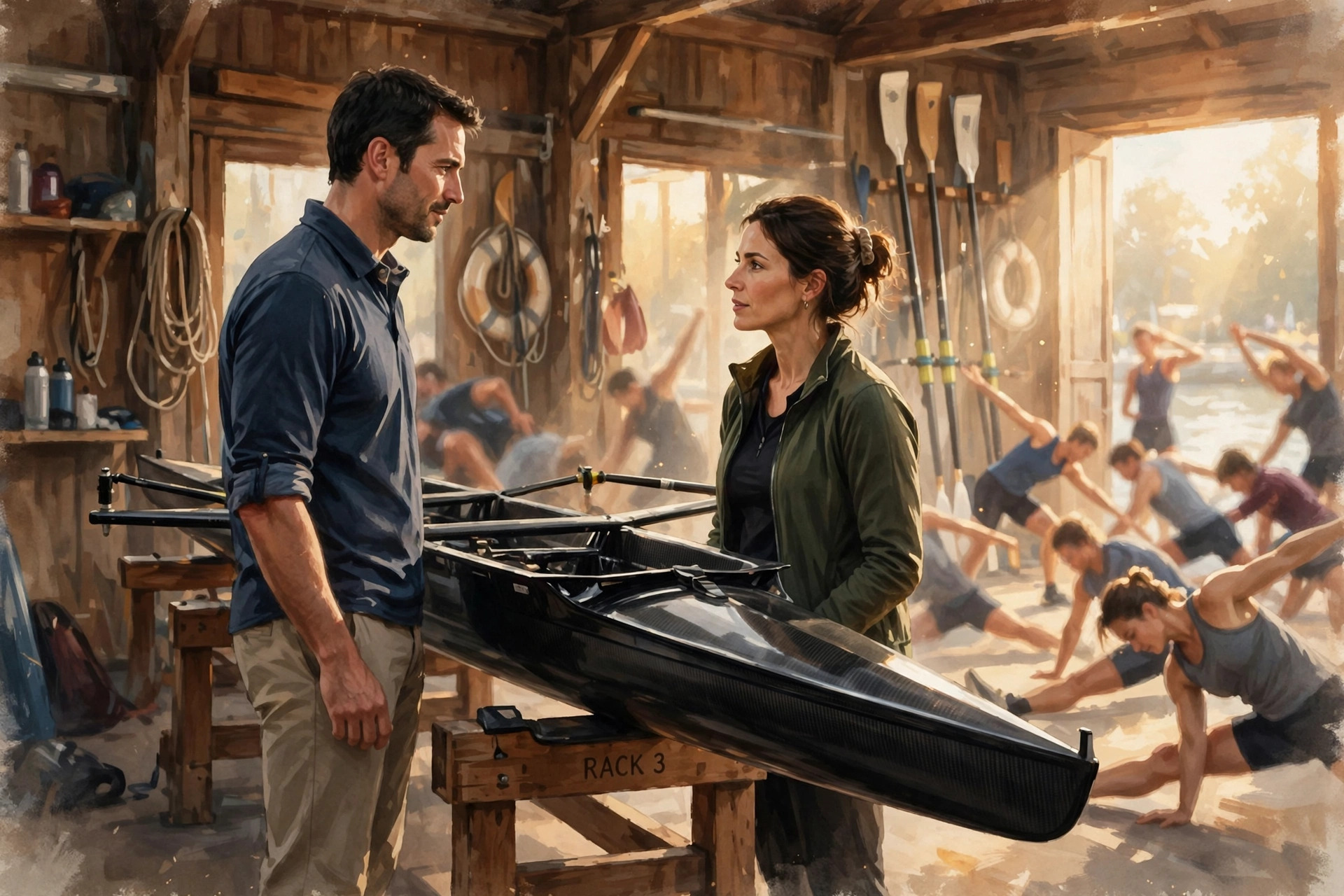
"You're standing on my foot," Verity said to the stranger crowded against her at rack three.
"That's the boat's foot, actually. Mine are down here." He shifted anyway, which she appreciated, and she got her first real look at him. Tall, sleeves rolled, forearms like something off a poster for a sport nobody paid to watch. He had the sunburned neck of a man who'd spent a season on water that wasn't this water.
Behind them, Maureen Castile cleared her throat the way she cleared it before bad news, which was the only way she cleared it anymore.
"Since you two are already attached to the same hull," Maureen said, "this will be easier than I feared."
"Maureen, whose boat is this?" Verity kept her palm flat against the Naiad's carbon fiber, warm from the rack's afternoon sun. The shell was new-ish, Wolpert-built, one smooth black piece, and it had lived on the women's side of the boathouse since the day it arrived. The men had their own rack. Their own, older, heavier everything.
"Ours," Maureen said. "As of this morning, everything here is ours."
The boathouse held maybe thirty people when it was empty, and today it wasn't empty. Both squads, all of them, dripping from an early row and pretending not to listen. Verity's women sat on the stretching benches with their chins up. Anaya Fitzgerald, her stroke, didn't even pretend. She watched Maureen the way she watched a start line.
"The center came up thirty-eight thousand short for the season," Maureen went on, brisk, like she was reading a recipe for something she hated cooking. "The county trimmed us, the dues couldn't cover it, and I refuse to sell the singles. So. One program. One boathouse, one schedule, one budget. The men's and women's squads merge today."
A sound went through the room, low, like wind finding a gap in a window. Verity felt it pass through her own chest.
"And the coaching," Maureen said. "For the season, two coaches, both of you, sharing. But there'll be one head coach contract after the Riverhead Regatta." She looked at Verity, then at the man beside her, then at the boat between them. "I'll name my choice on regatta day. It'll be fair, and it'll be final."
Fair. Verity had heard that word before, twice, from two different committees, right before they handed the job she'd earned to somebody who hadn't refused to put an unsafe rower in a racing shell. Fair was a word people used when they'd already decided.
"Bram Holloway," Maureen said, "men's squad. Verity, Bram's been with us a year now. He handles their rigging. Bram, Verity runs our women's program."
"I know who she is," Bram said. "We've crossed wakes on the Corrin all season. She coaches loud."
"I coach so my rowers can hear me over the coxswain they're hauling," Verity said.
"Fair enough." He said it lightly, but his eyes had gone flat and careful, and she recognized the look because she owned one just like it. He put his hand back on the Naiad's hull, low, near the stern, right where a rigger bolt would seat. She was holding the gunwale. Between them, the boat hummed faintly under two sets of fingers.
"One thing," Verity said to Maureen. "The Naiad is rigged to my numbers. Neutral work, actually. Oar height, spread, pitch, all of it set for my crew last month. If the men's squad rows it…"
"We'll row it," Bram said.
"You'll row it wrong."
"I'll row it the way it's rigged." He crouched to look along the hull, one eye closed, and she had to admit, annoyingly, that he looked at boats the way a doctor looked at x-rays. "Your port riggers sit high. My port side rows long. You want to argue with physics, take it up with physics."
"I want to argue with you leaving your fingerprints all over my boat."
"Our boat," Maureen said. "Do try to keep up."
Anaya leaned toward the shell from the bench, squinting at the riggers like they'd said something rude to her personally. Anaya knew boats the way some people knew weather, by feel, and she was frowning.
Verity pulled her hand off the gunwale. This was the moment where she usually took everything on herself, wrote the schedule, held the keys, made the chart, fixed it alone before anyone could fix it wrong. She felt the pull of it, old and strong. Six years of it.
But Maureen was watching, and this was, whether anyone said it aloud, the first day of a competition with exactly one prize.
"Fine," Verity said. "We share it. But we rig it together, or not at all. No touching the boat when the other one isn't standing right here. Nothing gets adjusted without both of us."
Bram stood up from his crouch. He was quiet a second, rubbing bolt grease off his thumb with two fingers, and she got the strange sense that trust cost him something physical, like paying with skin.
"Both of us on every change," he said. "Agreed."
"Swear it on the boat," she said. "It's the only witness we both like."
Something moved across his face that wasn't quite a smile but was in its neighborhood. He laid his whole hand flat on the hull, an honest palm's worth of contact, and held it there. "Sworn."
She put her hand a foot away from his, on the warm black skin of the boat. "Sworn."
"I'm putting this on paper," Maureen said, already writing on the clipboard she kept strapped to her hip. "A rigging chart. Both sets of numbers, every change logged, dated, initialed by both coaches."
"Tape it inside the boathouse door," Verity said. "Where everyone sees it. If somebody rigs the Naiad behind the other one's back, I want the whole program to know."
Bram's hand was still on the hull. He looked at her a beat too long before he answered, and she filed the look away, because she'd spent six years filing looks away and she was good at it.
"Inside the door," he said. "Public record."
"I'll draft it tonight," Verity said. "My numbers on the left column."
"And mine on the right, so it's even." He finally took his hand back. "I'll bring my own tape. You strike me as somebody who'd use the cheap stuff."
"I strike you correctly." She turned to her women and found Anaya still frowning at the shell. "Anaya. You've got that boat-wrong face."
"It's not the boat," Anaya said slowly. "The boat's fine. Something about the rigging's just. Off. Like a seat that looks level and isn't."
Bram's head came around. "Off how?" His voice was even, but he asked it the way people asked about a noise in an engine, immediately and with their whole body.
"Can't say." Anaya shrugged, sheepish. "It's a feeling."
Verity waved it off, mostly. "She gets feelings. Last year she had one about a bent track and she was right, so if it still feels wrong tomorrow, tell me and not the hull."
But Bram was still looking at the Naiad, one thumb moving along his knuckles, and he didn't say anything else about it at all. Verity marked that, too, the way you mark a shell that sits a little odd in the water: not a problem yet. Just something to watch.
Maureen snapped her clipboard up. "Wonderful. A boat, a chart, and two coaches who've already stopped fighting." She headed for the door, waving the squads out ahead of her. "Regatta's in nine days' time. I suggest you two learn to share nicely before then. The Riverhead course doesn't care whose feelings get hurt."
The boathouse emptied in a scrape of sneakers and chatter. Verity stayed at rack three and, a moment later, so did he, on the other side of the Naiad, its long black body lying between them like a border neither had agreed to draw.
"For the record," Bram said, "I rig clean. Ask anyone."
"I don't ask anyone," Verity said. "That's usually my problem."
She heard him exhale something close to a laugh. "Yeah," he said. "Mine too."
Charted Numbers
The Corrin was flat and gray and mercifully empty of anyone else's wake, which was the last mercy the morning offered. Two eights' worth of rowers had become one large, suspicious crowd on the dock, men's squad on one end, women's on the other, and the Naiad sitting in the water between them like a hostage exchange neither side trusted.
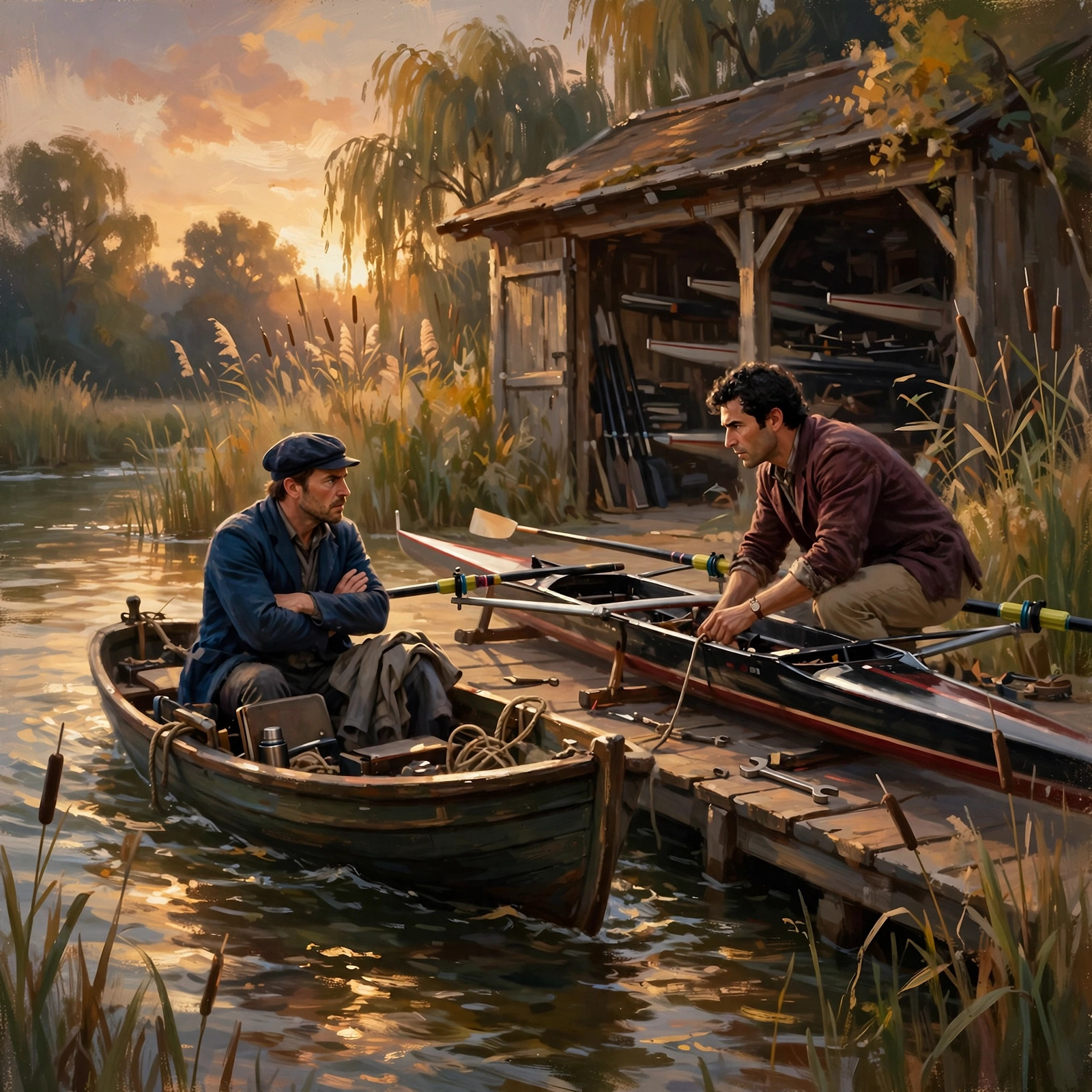
Verity had the chart taped inside the boathouse door, as agreed. Her numbers on the left, his on the right, both sets initialed. She'd checked his initials twice, which she was not proud of, and then she'd gone out and checked the riggers themselves, because that was who she was and she'd stopped apologizing for it somewhere around her second interview for a head job she didn't get.
"Pairs," she called. "Anaya's four takes the first drill block."
"With my two in the stern?" Bram asked, already squinting down the boat.
"With your two in the stern, yes. That was the chart."
"I have eyes, Coach. I read it."
He read everything. That was the thing she was learning about him, two days into this arrangement. He read the chart, the water, the set of a rower's jaw. He'd walked the dock at dawn checking heel heights with a small metal gauge he kept in his jacket like other men kept pens. She had watched him do it and told herself it was professional respect that made her watch that closely.
The four pushed off. Anaya took stroke seat the way she always did, like the seat had been holding her place for years, which it had. They rowed a warm-up length up the reach, and it took roughly six strokes for Verity to see what Anaya had been feeling on Day 1. Something was off. Not off off. Off like a song played a half-tone sharp. The blade work at Anaya's seat was landing a whisper late, and the woman behind her was compensating, feathering early, and by the third length the whole rhythm was a rumor of itself.
"She's fighting it," Verity said into her megaphone, mostly to herself. "Back it down, four. Reset."
Bram was already leaning out over the dock edge, one hand flat above the water like he was reading the hull through the air. "It's the pitch," he said. "Her oarlock. Port side. It's sitting low by a degree, maybe less."
"The chart says that lock is at four."
"The chart says what you measured on Day 1. Doesn't say what the dock did to it on Day 2 when somebody clipped it with a shell."
Verity looked at him. He looked back, absolutely unbothered, already pulling a stub of white grease pencil and a thin wrench from that jacket of his, because apparently he carried a whole rigging kit against his ribs like a smuggler.
"Bring it in," he called past her, and the four turned and came back, and Anaya's face as she shipped her oar said she knew exactly what was about to happen and had opinions about it.
He knelt at the oarlock, thumbed the pencil against the metal, and adjusted. No question to Verity. No question to Anaya, who owned that seat. Just a quarter turn and a check with the gauge, and then he stood, dusted his knees, and said, "Row it."
"You didn't ask," Verity said.
"Water's flat and it's October. Ask me in December."
She wanted to re-measure it herself. She wanted to make him stand there while she pulled out her own gauge and confirmed his numbers in front of everyone. Instead she lifted the megaphone, because the rowers were drifting and staring at the two of them the way you stare at two people deciding something without words.
"Half pressure," she called. "Twenty strokes. Show me something."
They showed her something. On stroke nine, Anaya's blade stopped landing late. On stroke fourteen the woman behind her stopped feathering early, because there was nothing left to fix. By stroke twenty the four was moving in a single breath, the hull quiet under them, and Verity felt the specific sting of being wrong in public and having the correction come from a man who'd been in the building for one year.
"Better," she said, which cost her.
"Yeah," Bram said, and didn't gloat, which somehow cost her more.
He didn't gloat, and he also didn't leave. When the four turned at the top of the reach, he crouched at the dock edge again and watched the approach with his forearms on his knees, and when they passed he called, "Anaya. Your port hand. Wrists flat at the finish, not after." And Anaya, who took correction from Verity like a feed and from strangers like an insult, flattened her wrists and rowed better, and actually said, "Yeah, that," over her shoulder.
Verity checked his knots anyway. When the four came in for water bottles, she went down the dock on the pretense of a heel-plate check, ran her thumb over the oarlock collar he'd reseated the day before during the boat swap, and found it exact. Locked. Clean. Rigged the way she would have rigged it, which was the most irritating possible thing for it to be.
"You checking my work?" He'd come up beside her with two bottles in one hand, quiet on his feet for a big man.
"I check everyone's work."
"I know." He handed her one of the bottles. "You checked the chart twice yesterday. I watched you do it."
"You watch a lot."
"I get paid to." He drank. "Also I like it."
She took the bottle because refusing it would have been a scene, and because her hands wanted something to do that wasn't a wrench. "The pitch," she said. "You saw it from the dock. Before they'd rowed ten strokes."
"I saw it on Day 1, honestly. Anaya said something felt off and I've learned to take her feelings seriously. Feelings are usually just data that hasn't found its excuse yet." He capped the bottle. "I didn't say anything because I was waiting to see if it mattered."
"Everything matters."
"Sure. But some things only matter a little, and you can spend your whole life on the little things and never fix the big one." He said it easily, like a man quoting himself, and something behind it was not easy at all, a door he closed with his own heel. She didn't push it. Two days in, she knew the difference between a door closed and a door locked, and that one had a bolt on the inside.
"Pressure piece," she called out, to the river, to the four, to herself. "Full pressure, two minutes, then paddle. Anaya, you set the rate. Nobody else's tempo."
They went. And here was the thing Verity would not be reporting to anyone: Bram coached the piece from the dock the way she did, which was to say barely, which was to say only when it would land. He called one correction, to the stern pair, about the timing of the catch, and he called it in the gap between strokes where a rower can actually hear. He didn't shout over the work. He let the boat be the loud thing.
The four came down the reach full pressure, Anaya's back straight and unhurried at the front of it, spray coming off the bow in a clean sheet, and it was a lovely piece of rowing, the kind you don't see every morning, the kind you stay for.
Verity had a clipboard, a schedule, three more drill blocks before lunch, and a coffee going cold on the dock. She stood with the megaphone down at her side and didn't call the next drill. She caught herself watching him, watching him watch Anaya, his whole attention on the stroke seat like the river only had one boat on it, and she caught herself thinking, there's a man who's been dropped by something and never said so, and she caught herself still standing there when the last twenty strokes went by.
The four glided in. Anaya was grinning, sweat at her temples, alive in the way only pressure makes people.
"Again after lunch?" Anaya asked.
"Again after lunch," Verity said, and Bram handed Anaya her bottle without being asked, and nobody asked anybody anything for a moment, and it was, Verity noted with alarm, the easiest minute the merged program had yet produced.
She wrote nothing on the clipboard. There was nothing wrong to write.
The Erg Room
The erg room at nine at night was Verity's favorite room in the world, which she would never have admitted in daylight. Six machines in a row on the dark side of the boathouse, fans off, windows open so the river could be heard doing its low, patient work. She had the season plan spread across two folding tables, weight pages, calendar pages, a pencil behind each ear because one was never enough.
She was on her fourth page of session blocks when the door opened and Bram came in with a thermos and a rolled chart under his arm, like he'd expected to find her here. He probably had. Two days of a merged program and they already knew each other's hours.
"Your lights were on," he said. "I saw them from the parking lot."
"My lights are always on."
"That's what I saw from the parking lot." He set the thermos on the end of the table, uninvited, unapologetic, and started unrolling his chart across the free half. "Maureen wants one plan per crew by Friday. One plan. Singular."
"I know what singular means, Bram."
"Do you? Because you've drafted the women's plan three times since Saturday. I counted the pencil marks. You erase like a person rehearsing an apology."
She looked up. He wasn't smiling, quite. He was looking at her margin notes, where she had written and rewritten the same Wednesday block four ways, each one hedging the load a little safer than the last.
"The load's heavy in the third week," she said. "If I get the taper wrong, I lose them by the regatta."
"Or you get it so right nobody notices you did anything."
"That's the job."
"That's half the job," he said, and tapped the table with two fingers, gently, like a man who had learned not to knock on things. "The other half is letting somebody see you do it."
She let that sit. The river said its patient thing through the window. He poured coffee into the thermos cup, drank half, and set the cup down between their two charts, dead center, in no-man's land. Neither of them moved it.
They worked. It genuinely surprised her how well they worked. He built sequences like a rower, front to back, one piece flowing into the next; she built them like a coxswain, everything timed to a clock that hadn't been set yet. When they argued, which they did, twice, both times about recovery lengths, the arguing was fast and technical and free of casualties, and once, when she conceded a point about mid-week steady state, she said "fine" out loud and meant it, and he looked up like she'd handed him something.
It was almost ten when she said, because the room was dark and it was easier in the dark, "Can I ask about the national team?"
His pencil stopped.
"You don't have to answer," she said, immediately, hating how fast she'd gone to the hedge.
"No, it's fair." He set the pencil down across his chart, deliberate, a man putting a tool away before a climb. "I rowed for the selection squad two cycles. Second seat in the camp boat. Fastest erg in my group both years, and I don't say that to brag, I say it because it's the only number I had, and numbers were supposed to matter."
"What happened?"
"New head coach came in with the men he'd brought up through his own club. Four seats open, four names he already had. He timed the cuts so late there was nothing left to trial for that season. No camp, no spare seat, no phone call." He turned the thermos cup a slow quarter turn on the table. "I found out from a list taped to a door. My name wasn't on it, and that was the whole conversation."
"What did you do?"
"Spent a season abroad, rowing for a club that paid in lodging and pasta. Came home. Took this job last year when Maureen called, because a year out of the system is a long time and Aldercrest was the only door that opened." He smiled, and it didn't reach anything. "So when one head coach contract is all that's left after the merge, you'll understand I don't experience that as an abstraction."
She did understand. That was the trouble. She understood it in her spine.
"They did the same thing to me," she said. "Twice."
He went still in the way she'd noticed on the dock, the way he did when a boat said something true about itself.
"Both times, final round, both times a club that told me the head job was mine if the season went clean. First time I had a rower I wouldn't seat. Huge engine, sloppy blade, and he'd come off a rib injury he was hiding. I pulled him from the boat before a head race and the committee called it insubordination. Second time, same song, different verse. Unsafe rig, unsafe rower, same word from them. Loyalty." She heard her own voice go flat and let it. "I wouldn't put a crew on the water I thought would hurt somebody, and I wouldn't promote one either. Turns out that's expensive."
"So you over-prepare," Bram said. "As a policy."
"I over-prepare as a religion. Pencil marks, three drafts, safe loads. If the plan is airtight, nobody gets to ask questions about my judgment. Nobody gets hurt, either, which I also count." She shrugged and felt the shrug land heavier than she meant it to. "I'd rather carry the whole thing than hand someone a piece and watch them drop it."
There was a silence. Then Bram said, quietly, "I take every edge I can get. Rigging, seat races, whatever's within reach. Because the one time I trusted a process to be fair, it put my name on a list on a door."
They looked at each other across the two tables, the season plans still open between them, one set of numbers too safe and one set too sharp, and Verity thought, with a clarity that annoyed her: there are two ways of never being dropped, and neither of them is rowing.
"We're a pair," she said.
"We're a mess."
"A pair. Stern pair, maybe. The kind that fights about the catch and gets down the course anyway."
He laughed then, a real one, short and surprised out of him, and she found she'd been waiting for it without knowing.
"Come on," she said, and capped her pencil, and picked up his thermos before he could, because tonight, just once, she was going to hand somebody a piece of something. "The steps. I can't read another chart tonight and the coffee's yours anyway."
Outside, the river had gone to black glass and the dock lights laid a soft yellow strip across the boathouse steps. She sat. He sat beside her, close enough that their shoulders touched, and neither of them adjusted away. She poured, badly, in the dark, and he drank what she gave him without comment, which she understood was its own kind of trust.
"Friday," he said. "One plan."
"One plan," she agreed. "Three drafts, though. Minimum."
"Two."
"Two and a half, and I don't erase anything after Wednesday."
"Deal." He tipped the thermos cup toward her like a toast, and behind them, through the window, the season plans lay open under the one light they'd left on, both their handwriting on the same pages, still arguing quietly without them.
Verity drank her coffee and did not think about the head coach contract, or not much, and did not think about Friday, or not much, and let her shoulder stay where it was. The river went on saying its patient thing. It wasn't a plan. It was better than most of her plans, and it had taken no pencils at all.
Wet Planks
The finish flag dropped and the clock on the bank said what Verity already knew in her teeth: eight tenths of a second. The men's second four had taken the trial race off the Corrin River's last two hundred meters, and her women had crossed second, and the rain had chosen exactly that moment to arrive properly, straight down, warm, indifferent.
"Again," Anaya said, from the stroke seat of the Naiad, before the boat had even gone slack. "Coach. Again."
Verity walked the dock with the coxswain's bow line in her hand and did not answer, because the answer was no. Maureen watched from the boathouse steps under a golf umbrella, clipboard held flat against her chest, dry as a treaty. One trial, one clock, one line in a column somewhere. Verity had wanted the women to win it outright, wanted it so badly she'd typed the start list three times last night, and now the margin was the width of a hand.
"Get the boat up," she called. "Dry rigging, then debrief. Nobody drowns on my watch before lunch."
They came up the ramp in the rain, eight women and the coxswain, sliding the Naiad along the overhead racks in a motion so practiced it looked like breathing. The men's four was already up, oars stacked, and Bram stood at the end of the dock with a towel over his shoulder, taking his crew's fists and shoulders one by one, saying something to each of them that made each of them taller. Verity watched him do it and felt the old two-way pull: that's mine to do, and, God, he's good at it.
Anaya caught her on the planks before she could get away.
"Coach, the boat was wrong today."
"Wrong how?"
"Wrong like, sliding on wet stairs. I'd set the catch and the boat would just, go somewhere I didn't put it." Anaya pushed wet hair off her face with the back of her wrist, the handle calluses showing. "I know you'll say the headwind. But I've rowed this shell three years, and today it wasn't her. It was somebody else's boat wearing her paint."
Verity opened her mouth to give her the speech about conditions, about owning the margin, and closed it again, because Anaya's face was the face of a woman who had already given herself that speech and thrown it out. "Get dry. Tell me at the debrief, all of it, in order."
Anaya went. The dock emptied the way it does after a lost race, faster than it should, everyone suddenly urgent about somewhere else to be.
Bram stayed. Of course he stayed. He crouched at the end of the dock with the towel over his shoulder and a rag in his hand, wiping down the Naiad's stern as though it were a horse that had run its heart out, which, in fairness, it had.
"Eight tenths," he said, without looking up.
"Don't."
"I wasn't going to say anything. I was going to stand here and be quiet, which you'd notice, and then you'd say something, and then we'd fight, and then it'd be dinner time."
The rain got in her collar. "You want to know what I was doing while they were dying out there? Charting the headwind. Like a rookie. Anaya came in saying the boat felt wrong and I was three seconds from giving her the conditions speech."
"She's right, though."
"About the headwind?"
"About the boat." He said it to the stern deck, gently, and something in his shoulders closed, a door she'd only ever seen open.
"You fixed her oarlock yourself two days ago. You reseated the collar. I checked your work on this dock, Bram, with my own hands. It was textbook."
"The collar's fine." He stood up. The rag was wrung to a rope in his fist. "Verity."
"Then what? Tell me what, and don't do the thing where you go quiet and useful."
He looked at her then, and the look had too many things in it to read in the rain, care somewhere in it, and something that flinched, and something underneath that had already decided something, and her pulse went wrong because she knew him well enough now to know she wasn't going to like the end of this look, and then, because it was the worst possible moment, and because his hair was flat with rain and hers was too, and because they had spent last night on these steps arguing about a season plan until her ribs ached from not laughing out loud, she kissed him.
Or they arrived at it at the same time. She'd never fully untangle that. Wet planks, warm rain, his hand coming up out of reflex to keep her from slipping, her mouth finding his, his surprise lasting half a heartbeat and then, no, longer, and then the kiss was happening and it was not careful. It was the opposite of careful. It tasted like rain and the cheap coffee he made too strong, and he kissed her back like a man grabbing the gunwale, and she thought, distantly, with the part of her brain that ran splits: this is a terrible idea, and the rest of her said, out loud, against his jaw, "Okay. Okay, that happened."
"That happened," he agreed. His thumb was at her cheekbone, clearing rain or not clearing it, just resting. "Verity, there's something I have to, I should tell you before the debrief, before, God, before anything else happens tonight."
"Then tell me."
"I'd rather tell you standing up. Somewhere dry."
"You're stalling." She stepped back, one step, onto the plank seam she knew by feel, and the dock put its ordinary cold up through her shoes and her head came back on all the way, cold water on a fever. Because Anaya had said the boat was wrong. Because the collar had been textbook and the boat had still been wrong. Because there was exactly one person who could set a shell's riggers to numbers nobody asked for, and he was standing in front of her with rain running off his chin, and his hand was still half raised where her face had been.
She turned to the Naiad, racked and dripping, and took the tape measure off the clip by the rack post where it lived, because it always lived there, because she had put it there.
"Verity."
"Work spread," she said, to herself, to the boat. She measured. Rain ran down the tape. She measured again at the stern, then the bow, then port, then did it all again, and the numbers came up the same three times, which was two more times than she needed, and they were not her numbers. Her numbers were on the chart inside the boathouse door with both their initials under them. These were taller, sharper, a rig set for longer levers, and she knew whose levers they were without doing any arithmetic at all.
The trial race. The margin. Eight tenths of a second, given away in a boat that had been quietly moved out from under her women in the night like furniture in a dream.
"Bram."
Just that. Flat, once. His name put down on the wet planks between them like something she was setting on a table and stepping back from.
He didn't follow. She walked inside with the tape, past the chart on the door, both their initials going soft in the damp at the bottom of the page, and the debrief whiteboard still said WOMEN'S FOUR, and Maureen had lifted the corner of the umbrella to watch her come in, and Verity thought: dry as a treaty, and went to find a pen.
The Taped Chart
By the time both crews assembled on the dock at morning practice, the Naiad was already back on the rack, dry, and rigged to the chart, and Bram was standing in front of it with his hands clasped behind him like a man reporting for sentencing.
Verity had checked it at six. She'd told herself she wouldn't, and she'd gone anyway, tape in her pocket, and measured the work spread at bow and stern and port and starboard until there was nothing left to catch him at. Every measurement matched the chart. He'd even re-seated Anaya's collar, and she'd pressed it with her thumb and found it true.
Maureen came down the ramp with her umbrella furled, which meant she already knew something. Bram had gone to her office at seven, Verity had heard, and been in there long enough for the kettle in the staff room to cycle twice.
"I owe you all a minute," Bram said, and the dock went quiet the way a dock can, water slapping the pilings underneath the silence.
He told it plainly. That before the trial race he'd moved the Naiad's riggers to his own settings, taller and sharper, built for longer levers. That he'd done it at night, alone, and told no one. That the women's four had raced a boat that had been pulled out from under them without their knowledge, and lost by less than a second, and that the loss was his. Not the margin, he said. The whole race. The unfair shape of it.
"Why," Anaya said. Not a question so much as a knife laid on the table.
"Because I don't lose races if I can help it," Bram said. "And because I've never once been in a room where the fair thing happened by itself. I've waited for fair. It doesn't arrive. So I stopped waiting, years ago, and it became a habit, and habits row with you whether you seat them or not." He looked down the line of women, then the men, then Maureen. "I've withdrawn my name from consideration for the head coach post. In writing, this morning. Ms. Castile has the letter."
Someone on the men's side muttered something ugly. Bram didn't flinch from it. He took it the way you take weather, standing in it.
Maureen's umbrella stayed furled. "You'll make this right with more than a letter," she said, "or I'll make it right for you. The shell goes to the chart and stays there. And you'll say it again to any rower who wasn't on this dock, one at a time, however long it takes."
"Yes," he said.
Verity stood at the end of the women's line with her arms crossed and her jaw aching from clenching it, and she was so angry she could feel her pulse in her teeth, and underneath the anger, unwelcome as ever, was something worse. He'd done it in front of everyone. He'd set his last chance in this sport down on the planks and stepped back from it, and she knew exactly what that cost, because she'd watched two search committees not pay it.
She kept her mouth shut through the whole assembly. It was the hardest rowing she did all year.
Maureen lifted her chin at the sky, deciding something. "My announcement stands down until the Riverhead Regatta. You'll race first and hear about jobs after. If anyone wants to spend today being furious, kindly be furious in a boat."
The Given Slot
Afternoon came in bright and shifting, the Corrin running quick with the week's rain. The women's four had the last practice block before the regatta, five to seven, the golden one, the slot Verity had guarded for six years like a bone in her mouth.
She spent the morning not deciding, which is a form of deciding. Then, at four-thirty, she walked to where the men's top pair was coiling astatic on the dock, arguing about a shoe tie, and said, "You're rowing five to seven. In the Naiad."
The taller one looked at his partner, then back at her. "Ma'am?"
"You heard me. My women went out at noon. It's your turn." She said it loudly enough that the whole dock heard it, because that was the point, and it scraped her raw to say, and she said it anyway.
Bram came down the ramp mid-sentence and stopped dead when he understood what she'd done.
"Don't," she said. "Don't thank me. I'm not doing it for you."
"Then who's it for?"
"Anaya. The four. Me." She pulled the tape measure off her belt, the one that lived on the clip by the rack post, that had lived there six years because she'd put it there, and she held it out to him. Handle first. "The shell's yours to rig for them. To the chart. I'll watch."
He didn't take it right away. He looked at the tape, then at her, and she watched him do the arithmetic she'd already done: that she was handing him the two things he'd taken, a boat and a say in it, freely, in front of both crews, the day after he'd cheated her.
"Verity," he said, low. "You don't have to."
"I know I don't have to. That's the entire difference between this and what you did." She didn't lower her voice. "Take it."
He took it.
He rigged the Naiad for the pair the way he'd rebuilt oarlocks all season, quick and exact and unshowy, wrench moving, tape moving, calling out each measurement so she could hear it from where she stood. She verified three of them and then, deliberately, in front of God and both squads, she put her own tape back on her belt and stopped verifying. She stood with her hands in her pockets and let his hands do it. Anaya, resting her oar on the dock after the noon row, watched the whole thing with her chin on the shaft and said nothing, which from Anaya was a paragraph.
The pair went out at five. The light went long and gold on the water, and their strokes sat down into it, and Bram stood beside Verity at the water's edge not saying anything, both of them coaching the same shell out loud at the same time, his calls on the catches, hers on the release, and it worked, it worked the way a four works when nobody's fighting the rig.
"I keep trying to figure out your angle," he said finally.
"There isn't one. I'm fresh out of angles. I've been hoarding them like a dragon and look where it got me. Eight tenths of a second and a kiss I haven't spoken to you since."
He turned toward her. "We could, Verity."
"Not tonight. Race first. Then jobs. Then, God, I don't know, then everything else." She said it steadily, and the steadiness cost her. "But you should know I'm not giving you this slot because I forgive you. I'm giving it because I watched a man give up the only thing he wanted this morning to make a race fair, and I've wanted to see somebody do that since I was twenty-five years old and it cost me my first head job."
He absorbed that. "You got passed over for that?"
"Twice. I'd do it again. I'd just do it louder." She watched the pair swing through the bridge pilings. "So row well tomorrow, Holloway. Both of us. Whatever Maureen decides, it should be decided on the water by people who didn't cheat."
At seven, the shell came in, and the crews racked it and carried oars and shouted about dinner, and the dock emptied down to the three of them: Verity, Bram, and Maureen, who had appeared at some point with her umbrella open against nothing, the evening clear.
"Regatta day," Maureen said. "Both crews, six o'clock launch. The announcement comes after the medals, on the dock, in front of everyone, so that it's plain and it's public and no one has to wonder whether it was fair." She looked between them for a long moment. "You two have made a proper mess and then a proper job of it. I've seen worse seasons."
She went up the ramp. At the door she paused, umbrella down, and looked at the chart taped inside the frame, its two sets of initials gone soft and gray at the bottom from three days of damp, and she did not take it down. She left it exactly where Verity had taped it, and then she locked the door of the old boathouse with her own key, and the click carried across the water, and the chart stayed.
Bram stood beside Verity in the last of the light, the Naiad racked behind them, rigged true, and neither of them said anything, because the tape inside that door was doing the talking, and both of them had signed it.
The Corrin River at six in the morning was the color of a knife left in milk, and the women's four was already at the staging beach when Verity got there, Anaya walking the length of the shell like a soldier inspecting a rifle she'd built herself.
"It's still true," Anaya called. "I checked. He didn't touch it. Nobody touched it."
"Nobody was going to touch it," Verity said. "It's yours."
"I know." Anaya crouched at the rigger and laid two fingers on the collar of the stroke oarlock, gentle, the way you'd touch a horse you'd decided to trust. "But I checked anyway."
That landed somewhere under Verity's ribs and stayed there. She thought, where did you learn that, checking anyway, and then she thought, from me, and didn't say anything, because Bram was coming down the shingle with the men's pair behind him, oars on shoulders, and the two crews were about to be one crew whether they liked it or not.
"Right," Bram said, stopping in front of her. He had his race face on, the flat one, but under it he looked like he hadn't slept much either. "Shall we?"
Eight rowers walked the Naiad down to the waterline together. Verity had meant to supervise this part. Her whole body had planned to supervise it. Instead she stood with her hands in her jacket pockets and watched the men take the bow seats and the women take the stroke end, and the shell went up and over and down so smoothly that it hardly wet the water when it settled. Anaya's coxswain called the count, and the boat slid away from the beach into the mist, and Verity and Bram were left standing side by side in the cold with nothing to do but be the kind of coaches whose crews didn't need holding.
"You rigged that fair," she said. "I never checked."
"I know you didn't." He watched the boat go. "That was the strangest morning of my life, having somebody not check."
The racing started at nine and went the way racing goes, hours of waiting compressed into minutes. The men's pair rowed their heat stubborn and came through to the final by half a length. The women's four rowed their heat like women who had been told, quietly and for years, that they were the overflow squad, and had decided on this particular morning to be nothing of the kind. They won the heat by open water, and Anaya sat at the finish with her chest heaving and her eyes already on the next start.
Verity didn't coach the final. She stood at the bank beside Bram, both of them too far from the line to matter, and Maureen behind them under the club awning with her arms folded. When the flag dropped, Verity discovered she had grabbed Bram's sleeve without noticing, and he had grabbed hers, and neither of them let go.
The women were down a seat off the start. Then they weren't. Somewhere past the bridge pilings, Anaya found a rhythm that was less a rhythm than a decision, and the whole shell rose to it, and they came through the last three hundred meters the way Verity had watched them do in her head every night for six years without ever quite seeing it in the flesh. They crossed first. Not by much. By exactly enough.
The sound Anaya made could be heard across the water. The men's pair, waiting for their own final, ran the bank screaming her name, and the women's crew turned the shell around and rowed back to the staging beach cool and finished with it, because Anaya had forbidden any celebration before the boat was racked properly, and her crew had learned that from Verity too.
Both crews carried the Naiad out of the water together, eight pairs of hands, women at bow and men at stroke, the hull dripping down the middle of them, everybody laughing at the state of their legs. Verity watched it from the awning and found, without warning, that she was crying, and had to pass it off as the wind.
"It's not the wind," Maureen said, handing her a folded handkerchief. "It never is. Come along."
The medals were given on the dock. Then the crews didn't leave, because Maureen didn't leave, and when the director of Aldercrest Rowing Center planted her umbrella on the planks, everyone understood what was coming and stood still for it.
"The shortfall is still real," Maureen said. "The merger stays. One budget, one season plan, one head coach. I said I'd decide on the water, and the water decided. The women's four won their event. The men's pair medaled. But that isn't the half of it, and everyone on this dock knows it, so I won't dress it up." She looked at Verity. "Verity Odell. You'll have the head coach post, and the contract, and my word that if you tell me a rower isn't safe to seat, that rower doesn't seat, whatever it costs me in phone calls. I've wanted to say that to somebody for six years and no one ever made it easy." She paused. "That's yours if you'll have it."
Verity's voice came out lower than she planned. "I'll have it."
"And Bram Holloway." Maureen turned to him, and the dock went quiet in a different way, because everyone knew what he'd done on Thursday and what he'd given up with it. "I have a permanent assistant coach post, shared season planning, rigging, and crew development, and I'm told the head coach would want him to have full charge of the men's crews in the shell we all use. It doesn't pay like the national team. It doesn't shine like it either. But it's honest work at a fair club, and it's offered in front of everyone, plainly, because you accused this sport of being unfair to you once and I'd rather not run my club the same way." She waited. "Take it or don't."
Bram looked at the planks for a moment. Then at the crews, men and women mixed along the dock, still wet from carrying the same hull. Then at Verity, who kept her face still and her hands in her pockets, because this had to be his, all the way his, no help from her.
"I'll take it," he said. "Plainly. Yes."
The crews made more noise than they had for the medals.
Later, when the trailers were loaded and the tents came down and Anaya had hugged everyone twice, including the umpire, Verity went back to the old shell house to put the trophy somewhere safe and to stand alone for one minute before whatever came next. The chart was still taped inside the door frame, its initials gone soft and gray, and she ran her thumb over the tape as she passed.
She wasn't alone for the minute. She'd known she wouldn't be.
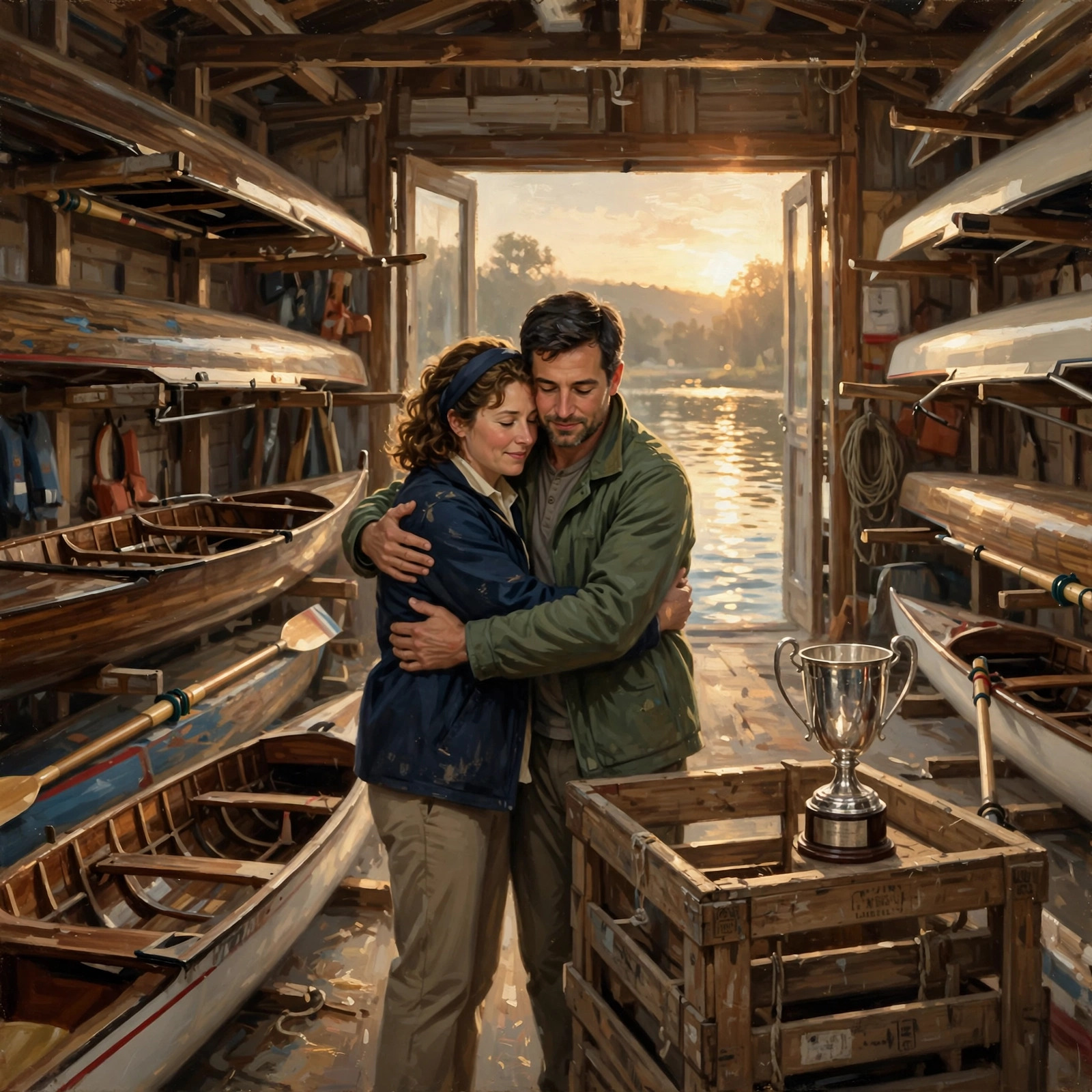
Bram came in and set the trophy down on the packing crate between the racks, carefully, the little silver cup with the club's name newly on it, and then he stood there in the smell of varnish and river, and neither of them had a shell to rig or a chart to sign or an excuse.
"I made a list," he said. "Of things I should say. It had eleven items."
"How many are 'I'm sorry'?"
"Nine." He turned the cup a quarter inch, aligning it with nothing. "The other two are the same thing said two ways." He looked up. "I love you, Verity. That's the tenth. It's not a strategy and it's not an apology, it's just a fact now, like my measurements and your stubbornness. I've been carrying it since the erg room and probably before."
She looked at the cup between them, then at him, and thought of every season she'd spent rowing alone in the middle of a full club.
"Say the eleventh," she said.
"The eleventh is that I'd like to find out what happens if I don't row alone." His voice went rough at the end of it.
"Then don't." She came around the crate. "I love you too. Loudly, if you want. I'm done doing things quietly and paying for it twice." She took hold of his jacket, the same sleeve she'd gripped on the bank, and he wrapped both arms around her and held on like a man coming into shelter, and the racked hulls stood dark and gleaming down the long shed around them, and the tape on the door held, and neither of them checked anything at all.
Get notified when new stories drop
Noah Carrington
Noah covers sports romance and forced-proximity heat: rivalries, road trips, and the quiet moment after the crowd goes home.
Leave a comment
Comments