


The Firehouse Door
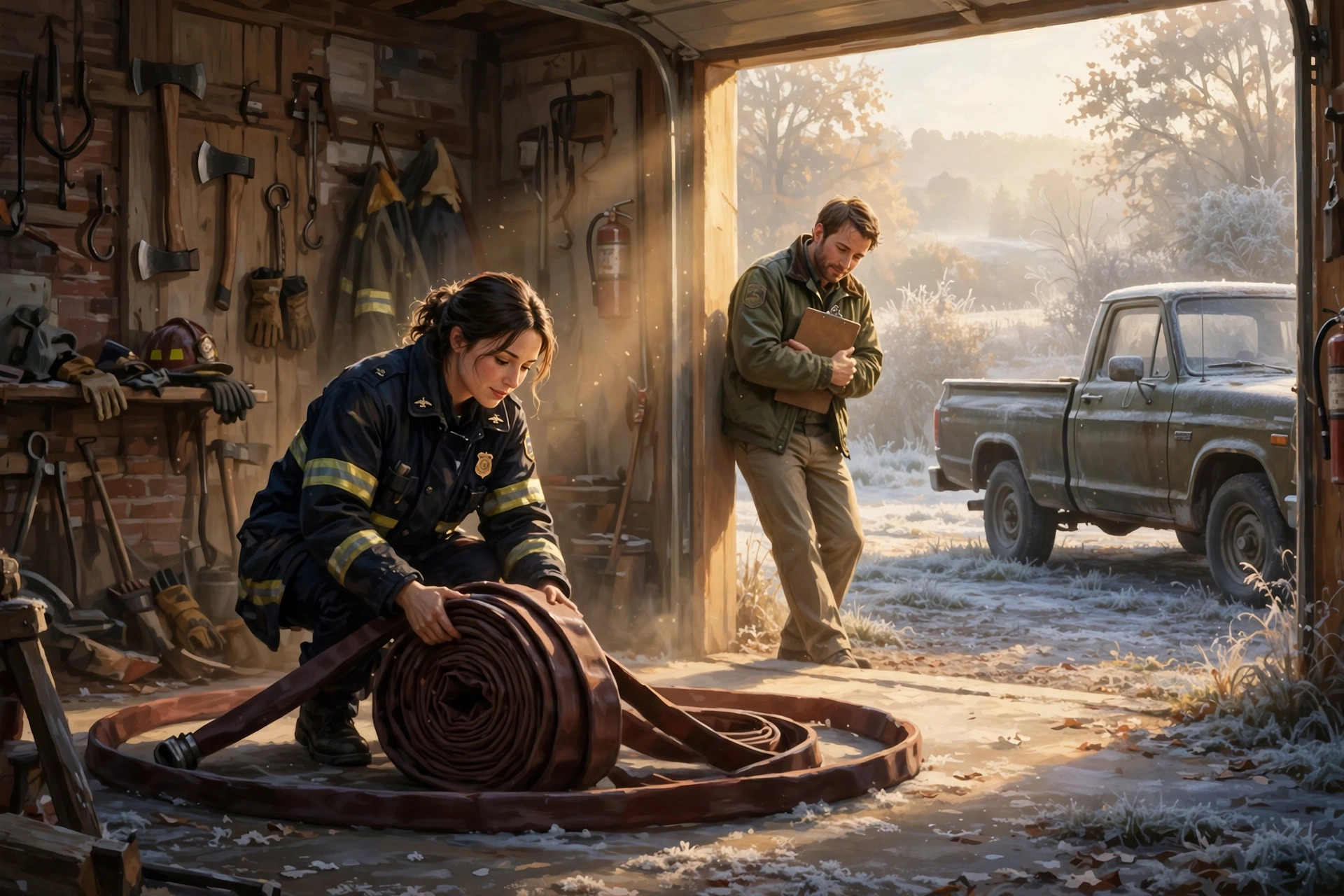
The county truck was already parked crooked across the apron when June came out of the bay with the last winter coil on her shoulder, and the man leaning on her doorframe had a clipboard, a lanyard, and the gall to look like he belonged there.
"You're blocking the hose beds," she said.
"I'm beside the hose beds." Silas Marsh turned the clipboard around so she could see the seal on it. "County review. Bellcross sent me."
"Bellcross sent somebody three autumns ago. He drank our coffee, told us our roofs were old, and left."
"Our roofs are old," said Opal, from the tailboard, not looking up from the fitting she was wire-brushing. "He's not wrong."
June set the coil down on the concrete, unhurried, so it landed with a weight he'd have to notice. Twelve winters she'd packed these beds, and every one of them had gone out again in spring soft and square and ready. Nobody from the county seat had ever once carried a bed down the trail with her.
"I'll need the charter book," Silas said. "Run sheets. Any pledge ledger you keep for Ember Watch."
"You'll need to stand somewhere that isn't my door. That's the first thing you'll need."
He shifted. He had the good manners to shift. He also had the same way of planting his boots he'd had at nineteen, heels together like he was ready to be graded on it, and she hated that she'd noticed.
"It's a review, not a judgment," he said. "The county's asking whether Ferndale Hollow keeps its charter or folds in with our service. I'd think the captain of the company would want that decided right."
"The captain of the company wants it decided by somebody who's been up Copper Ridge in the dark. That a county thing? Going up in the dark?"
Silas's jaw moved. He looked down at his clipboard and wrote nothing.
"Packs tight," Opal said, nudging the coil with her boot. "You always were tidy, June."
"Leave her be, Opal."
"Wasn't touching her." Opal held up her wire brush in surrender, grinning at Silas in a way June did not appreciate.
The bays were half winter-ready, the engines backed in nose-first for the snow, the bench along the wall stacked with hose that had to be rolled before the frost got into the rubber. She had a rhythm for it. Fold, roll, weight it, stack. She picked the coil back up and carried on with the rhythm, because a man with a clipboard watching her work was not going to slow her down.
"You can read the run sheets off that bench," she said. "Dry ones. The wet ones I keep where I can argue with them."
"Fair enough."
"It's not fair. It's my company."
He wrote something then. She didn't ask what.
The truck from the orchard came up Main Street with a rasp of a clutch, and Dale Voss got out of it the way he got out of everything now, right hand doing the work his left had quit doing after Copper Ridge, sleeve rolled past the scarring. He came up the apron like the apron was his, which it had been for longer than June had been alive.
"Silas Marsh," he said. "They still let you carry a badge?"
"Afternoon, Chief Voss."
"Mister Voss, now. Retired." Dale stopped beside the doorframe and looked at June's hands on the hose, then at the bay, then at his own boots, and June knew that look. It was the look of a man arriving at a thing sideways. "June. Come down off the tailboard a minute."
"I'm not on the tailboard. Opal's on the tailboard."
"You know what I mean."
She set the coil on the stack and gave him her whole face, because he'd earned that much, whatever was coming.
"Ember Watch's in three days," Dale said. "You know Hal Rennick's been at the trustees about the upper ditch again. Twice this fall. He wants the water feud finished before the snow flies, same as we all do."
"The feud's finished enough. We don't cut each other's lines anymore."
"We cut each other's lines all summer and you know it." He said it mild, and that was worse. "So the heads of both houses have talked. His house and mine."
The hose bed was cold under her hand. "Dad."
"There's a way these things get done in this valley, June, and you know it as well as any of us. A pledge, spoken at the Vigil Lantern, in front of the whole town. Binding. Old as the fire company. Hal's agreed, and I've agreed."
Silas had gone very still against the doorframe, clipboard down at his side.
"A pledge," June said. "Between who."
"You. And Dane Rennick."
Opal's wire brush stopped.
"No," June said.
"It ends the feud. Upper Copper Ridge water, shared legal and proper, both houses to sign. That's what Rennick's asking for his side of it."
"What he's asking for his side of it is me."
"Dane's a decent boy," Dale said, which was not the argument he thought it was. "Runs their pumps. Their crews mind him. He'd be good to you."
"Dad. You're telling a stranger from the county my marriage terms and a lantern in the same breath. Do you hear it? Do you hear how it sounds?"
Color came up his neck. "It's the way it's done."
"It's the way it was done in Grandma's day. You didn't have to pledge anybody to the Merrows to settle the fence line."
"The fence line wasn't water."
They stood there, both of them breathing like they'd carried something heavy up the stairs, and June did the only thing she trusted herself to do, which was work. She pulled the next length off the bench, folded it, put her knee on the roll to keep it square.
Opal said, quietly, "I'll be on the ridge if anybody wants me," and took her brush and her lantern and went out the side door.
Dale rubbed his scarred hand over his jaw. "Think on it. That's all I'm asking. Three days, and think on it."
"I'll think on it." She rolled harder than the hose needed. "It's my answer that won't be rushed."
"Good girl."
"Don't."
He winced, and went, and the orchard truck took Main Street down toward the Rennick side of things, leaving her alone in the doorway with a man from Bellcross she hadn't spoken to in twelve years.
Silas hadn't moved. He was looking at the Vigil Lantern on its hook by the door, tin and glass, glass smudged, wick gone ragged from a year of nobody trimming it.
"You still do the lantern speech?" he said.
"Every year."
"Your granddad soldered that."
"My granddad soldered half this town. You've been gone a while."
That landed, and she watched it land, and got no satisfaction out of watching.
"They're good beds," he said, nodding at the hose. "The rolls. I did a stint up north, they'd have killed for rolls like these."
"Did they." She squared the last coil, stood, and looked at him straight on for the first time. "You want to see how the company runs, county man? On paper, everything's a number. Up top we've got a repeater box on the lookout that's been dead two weeks, and Bellcross won't send a tech till after the frost. That's how the company runs. Us, going up, fixing it ourselves."
"Dead how?"
"Come find out."
She reached down, picked up the spare coil she'd been saving for the truck rack, and held it out to him, both hands, like a man being handed something more than forty pounds of canvas hose.
He took it. He looked ridiculous with it, county shirt and clipboard and no idea what to do with a winter coil, and hefted it anyway.
"Tomorrow, then," he said.
"Sunrise. Bring boots you can fall down in."
Ridge Road
The trail up Copper Ridge started behind the old mill flume, and June set the pace before the town was done waking. She'd left the firehouse with frost still on the truck windows, and Silas had been standing at the trailhead with a county-issue pack and boots that at least looked honest.

"You remember the switchbacks," she said.
"I remember falling down most of them."
"You were fourteen and showing off."
"I was fourteen and there was a girl behind me."
She didn't answer that. She kept her eyes on the trail, where the pine needles had gone grey and slick with the first cold, and she let the silence do what silence does on a mountain, which is get bigger the longer you feed it.
Halfway up, the trail crossed the old burn scar. The trees there were charcoal skeletons laid over each other like something knocked down on purpose, and between them the new growth had come in thick and pale. The ground still smelled of ash when you turned it with a boot, a sweetish, dead smell that June had stopped noticing years ago and noticed completely now, because Silas had gone quiet beside her and his breathing had changed.
"It's been a long time," he said. "Since I stood up here."
"Twelve years."
"You'd know the count."
"I keep the logbook. The logbook keeps the count." She said it flat, and he took it flat, and they climbed.
At the rope pitch, the cable the county had strung to help walkers over the last shelf had frayed through the year before, and June had spliced it herself with a short length of line and a tension knot her father taught her before his hands got bad. She went up first, planted her feet, and then reached down.
"Your hand."
He put his hand in hers. That was all it was, rope work, hauling a man over a shelf, but his palm was cold on the outside and warm in the middle, and he didn't let go the second he could have, and neither did she, and then they both pretended the extra breath it took was the altitude.
He didn't say anything until they were on the flat above.
"You splice that yourself?"
"Who else."
"The county would send a crew."
"The county would send paperwork." She dug the water bottle out of her pack, drank, and handed it to him without thinking, the way you hand a bottle to the person climbing with you, because your body remembers a thing your pride has given up on. He drank. He wiped the mouth of it with his sleeve first, an old habit, and she saw him catch himself doing it and look over to see if she'd seen.
She had. She looked at the ridge instead.
Opal Pryce was already at the lookout, sitting on the bench by the platform with her runner's stick across her knees, whittling the end of it square. She'd come up in the dark, the way she did most mornings, reading the trail and the wind and the dry side of the bench, and she didn't look surprised to see a county shirt on the platform.
"Warden," she said.
"Opal. You still run this trail?"
"Somebody's got to." She stood and thumbed toward the box. "It's still dead. Same as yesterday and the week before."
The repeater sat on its post at the lookout's edge, a steel case bolted down against weather that had beaten it anyway. The gasket around the face had cracked and curled back like burnt paper, and June crouched and put her hand flat on the lid. Cold. She lifted the cover anyway, though she knew what was under it, and looked at the hand-crank housing with its handle folded in, the whole interior furred with damp and a fine orange rust along the seals.
"Weather-cracked all through," she said. "It didn't die, it drowned."
"I'll log it," Silas said. He already had the clipboard out. Of course he did.
"Log that Bellcross wouldn't send a tech for two weeks while the only link up this trail rusted shut. Log that part."
"I will log the maintenance failure." He wrote it, and she watched him write it, and hated less than she expected to.
Opal came over with her stick, and turned it in her hands, and didn't whittle while she talked, which June knew was how Opal got when something had been sitting in her a while.
"Warden. You were lookout that night," Opal said. "The big one, up here."
June's stomach went down before her mind did.
"I was," Silas said.
"County report says your word came down forty minutes late. That's what I keep in the runner log on my end, the county never matched it. My entries don't say forty minutes. My entries say you called it in on time and hard, and it took the town too long to answer it."
Wind moved over the platform. The dead box ticked once, cooling.
"The county report is the county report," Silas said. His voice had gone somewhere flat and far. "They ran the times twice."
"They ran your times," Opal said. "I ran mine. Mine's got Rennick ditch crews on it too, that night. That's the part I never liked. They were all up along the trail line with lanterns and shovels, guarding their water, and the trail's the same trail you'd have used to get down fast."
"Dane's crews," June said.
"Dane runs them now. His father's orders, then," Opal said. She looked at Silas, steady. "A man can't run fast on a trail that's got ditch crews and lanterns all over it. Nobody wrote that part down."
Silas had stopped writing. His thumb was on the corner of the clipboard and pressing a crease into it, over and over, the only moving thing on him.
"I didn't send word late," he said, finally, quietly, like a man turning over a stone he'd carried in his pocket so long it had worn smooth.
"That's my log too," Opal said.
June stood up from the repeater. She wanted to say something, and every version of it was too big for the platform and the wind and the morning, so she said the working thing instead.
"Then let's get the box alive and argue history after."
The crank handle was seized. It took oil from her pack and both their hands, his over hers, leaning the whole weight of him into the last half turn until something inside let go with a crack and the handle swung free. June cranked it, slow and steady, feeling the generator bite and hum, watching the face of the box for anything at all.
A needle shivered. A light, weak as a firefly, held.
"There's the county's link," she said, breathing hard.
"There's yours," Silas said, and pointed past her.
She followed his arm. Below the lookout, out along the dry bench where the dead pine stood in rows, a thread of pale smoke stood up off the ground, not rising like a chimney, just leaning, the way smoke leans when it's coming off something low and patient and cooking in the duff.
Her whole body went to work without asking her.
"Smolder on the bench. Call it in."
"June." His voice stopped her hand on the crank. "I'll report it. But it's small, it's holding, and the county won't move on it until Bellcross confirms a crew's clear to roll. If I call it wrong, and they scramble trucks for a ground cook that dies by nightfall, that's my second false alarm in this town's memory."
"Second."
He didn't flinch, which was worse. "I don't send words I can't stand behind. Not from this ridge. Not again."
"It's not holding." She turned the crank again, hard, watching the needle. "It's been dry three weeks and that bench runs to the flume and the flume runs to town. You want your county confirmation, you'll get it, and you'll get it over our roofs."
He looked at the smoke, and at her, and she watched him do the arithmetic she'd watched him do at sixteen, weighing the fall of the ground against the fall of a maybe, and she knew which way he'd land before he did, because he always had, and it had cost them both.
"Opal," June said, not looking away from him. "You're fastest on the trail. Go down and stand the company by. Turnout, packs, the engine at the hall, nobody rolling yet. I'll have a word up here."
"On it." Opal took her stick and her legs and was gone down the switchbacks like the mountain had made her out of its own downhill.
June put her hand on the crank handle and took it off the housing, folded it, and put it in her own pack. Zip. Done.
"That's the company's handle now," she said. "You can have your confirmation, warden, all seven layers of it. But I'm not Bellcross's and I'm not my father's and I'm not a Rennick treaty, and I'm not standing on top of this ridge waiting for a man to decide whether my hills are worth being sure about."
"June."
"The company rolls when I say. My people, my call. That's how the charter reads."
He held her eyes for a long moment, and something in his jaw worked, and then he did the last thing she expected, which was take out his radio and hold it out to her, antenna first, clip still warm from his vest.
"Then make your call," he said. "And I'll write down that I stood here and watched you be right."
She took the radio. Her hand was steady. It was the rest of her that wasn't.
Ember Watch
Main Street held its lanterns the way a church holds its candles, a whole street of them, and every one of them lit by somebody's grandmother before sundown. June stood on the firehouse steps in her good jacket, which was her only jacket, with the Vigil Lantern on its hook beside her and half the town below.
The lantern was older than anyone holding a lantern that night. Tin and glass, soldered by Elias Voss the year Ferndale Hollow had a fire company and no fire to speak of yet, and the glass had a smudge on it she'd been meaning to wipe for a week. She'd wiped it that morning with the tail of her shirt, standing at the sink, and then she'd looked at it and thought about her grandfather's hands and put the cloth down. Some smudges you kept. Some you earned.
Her father was on the second step down, close enough to touch the lantern if he reached, which he knew better than to do. Dale Voss held the trustee's book against his chest like it was a hymnal. His scarred hands were folded over it. Twelve years of June's captaincy, and he still took his seat at every Ember Watch like the lighting was his to give away, and every year she proved to him it wasn't.
It wasn't. It was hers.
"Ferndale Hollow," she said, and the street went quiet in that particular way towns have, the chatter draining from the back forward like water finding a low spot. "Another year, another lantern. Keep your porches wet, keep your chimneys swept, and if the siren blows, you know where the hall is."
A ripple of laughter, mostly from the older tables. Somebody's kid was asleep on somebody's shoulder. The baker's wife had a tray of buns and no plan to survive the night with any of them.
June struck the match off the step rail, the same rail her father had done it off, and put the flame to the wick, and the Vigil Lantern caught. The crowd made its low warm sound, the ohh that Ferndale Hollow had been making at this exact minute for longer than anyone below the steps had been alive.
She lifted it off the hook by its bail and held it up, and the light went through the smudge and made a shadow on her sleeve, and that was when Hal Rennick came up the steps.
He came up like he owned the second step, and he had a right to, because the Rennicks owned the second step every year, that was the arrangement, water in the flume for lantern oil in the hall, oldest truce in the valley. He put his hand out. Old custom. The lantern passes from Voss to Rennick and back, one year each, so nobody's family ever holds the light alone.
He didn't take the lantern. He held his hand under hers, under the bail, so that to take it back she'd have to pass it through both of their grips, and he said, loud enough for the front three rows, "And this year it's a joined hand, isn't it. This year we light it as one."
The street made a different sound. Not the warm one.
Her father shifted his weight behind her, book still against his chest, and June knew that shift, knew it meant go along, June, it's one lantern, it's one night, and she hated that she knew it.
"The lantern passes hand to hand, Hal," she said. "Same as always."
"Same as always." He smiled with the bottom half of his face. "Only this year the hand's spoken for. Dane, come up. Come up and stand by your promise."
Dane Rennick came up the steps slowly, wiping his palms on his trousers like a man walking into a courtroom. He was a big, decent-faced man, sunburnt across the nose, and June had known him since he was a boy with a frog in each pocket, and in all those years she had never once seen him look like he wanted to be somewhere less.
"Pa," he said. Low. "Not at the lantern."
"At the lantern's exactly where," Hal said, "because the lantern's where the town's watching, and the town's who the truce is for. Voss water runs upper Copper Ridge, and that's a fact older than this girl's captaincy, and the joining of the two lines needs a public seal. Your captain knows the terms. Her father set them. Shake on it, the two of you, here, tonight, at the light, and we'll have done with the whole tired feud before the lantern's burned down an inch."
The crowd had gone very still. Somewhere behind the baker's table, a chair scraped.
"Hal." Her father's voice, mild as ever, mild as the day he'd signed whatever he'd signed. "It was to be a quiet arrangement, announced after."
"It's after now. It's Ember Watch now. Forty years I've hauled water past that flume watching how it's doled out, and I'll have the town see it sealed before I'm another year older."
Forty years. He said it like a weight, and June thought, you and me both, Hal, except my whole life got spent carrying yours.
She looked at Dane. Dane looked at his boots, and then at her, and there was something in his face she hadn't let herself read until that moment on the steps, which was plain miserable, and which she understood all at once, the way you understand a smell from childhood. He didn't want this any more than she did. He'd never wanted it. He'd been dragged up the same steps.
She was still holding the lantern. Her arm was getting tired.
"One thing before we shake anything, Hal," she said. "Ask your son if he wants my hand. Go on. In front of the town, since it's for the town."
The crowd made a small, terrible sound, the sound of a whole street leaning in.
Hal Rennick's face went the color of the lantern glass. "My son does what the family requires."
June set the Vigil Lantern down on the step, carefully, both hands, the way you set down something you're not going to be holding hostage. "Then the family can shake itself."
And that was when the boy came in from the trail road.
He was Opal's youngest runner, maybe ten, and he'd come down the mountain at a speed that didn't leave anything for dignity, and he came up the middle of the street yelling before he'd even reached the steps. "Smoke! Smoke on the bench, under the lookout, it's come up since supper, Opal says it's walking, Opal says stand the company!"
The street didn't erupt, which June would always be half proud of. It turned, all together, toward the firehouse, toward the hall, toward her.
And Silas Marsh came down off the top step where he'd been standing all night at the edge of the lantern light, radio in his hand, that county radio he wore like a uniform under the uniform, and he said, clear and level and carrying, "Hold. Nobody rolls. I've a call in to Bellcross for confirmation, and until the county confirms a crew's clear to move, nobody's trucks leave anybody's hall."
"It's walking," the boy said. "Opal said."
"And Opal's word is good on that ridge," Silas said, not unkind, June would give him that, he was never unkind about it, that was the whole cruelty of him. "And the wind's died since, and a smoke that small might be a ground cook dying on its own. If I call the county out and it's nothing, that's a false alarm on a charter review. If I hold and it walks, we've lost minutes. I'll take the minutes. I always take the minutes."
I always take the minutes. Like it was a creed. Like it was a stone he carried in his mouth.
The crowd was looking at her. Dane had stepped back. Hal had gone quiet, which meant Hal was doing sums. Her father was behind her with his book, and twelve years of dry weeks and wet weeks and every week of her captaincy were behind her, and the smoke was on the bench, and the bench ran to the flume, and the flume ran to town.
"You held once before," June said. "On that same ridge. And I lost a mill."
"That's not what happened, and you know the shape of what I'll say about that."
"I know the shape of everything you'll say." She heard her own voice go flat and loud, too loud for the steps, loud enough that the third row heard every word, and she let it. "You've got your confirmation and your county and your minutes, Silas, and the smoke's got my town. So stand there and be sure. It's what you're good at."
She turned her back on him, on all of them, and shoved the firehouse door open with her palm, and yelled into the dark of the hall, "Company! Turnout! Now!"
And behind her, in the lantern light, for the first time in twelve years, she heard Silas Marsh say her name, and she did not stop walking.
Smoke on the Ridge
The crank handle had rattled loose in her pack somewhere on the second switchback, and June found it by feel, cold steel biting her palm, while the bench below the lookout breathed its thin gray ribbon into a sky with no moon in it yet.
"There," Silas said, and clicked his flashlight onto the repeater box. "Hand connector first."
"I know how it goes together. I've rebuilt it twice without the county."
"I know you have." He crouched beside the box anyway, close enough that his shoulder came up against her arm, and did not move it away, and neither did she, and that was a thing she was going to have to look at later, when the bench wasn't smoking. "Terminal's corroded. Give me the small driver."
She gave him the small driver. Her hand was steadier than she'd have bet on, an hour ago, on the steps, with her whole voice and half the town's ears on her. He'd said hold. He'd said he'd take the minutes. She'd told him to stand there and be sure, and he had, and she'd walked, and the wheels of the engine had already been turning by the time she got to the hall.
"Your crews rolled," Silas said. It wasn't a question. He'd heard the engine climb.
"Opal's got the wet line strung across the bench road. Dane brought his pump wagon."
"Dane Rennick." He set the driver down on the box ledge, very precisely. "Hal's son."
"The pledge hasn't been said yet. Lantern's lit, words aren't. There's a grace till morning."
"I heard the terms when I got in. The whole depot heard. It's a popular story in Bellcross, the Voss girl and the Rennick boy." He looked at her then, sideways, the flashlight putting a hard edge under his jaw. "I read it three times on the drive up. I couldn't tell you a word of what it said."
"Don't." Her voice came out cracked at the edges. "Don't you start that up here, in the dark, where I can't walk away from you with a whole town watching."
"I'm not starting anything. I'm telling you what I did." He went back to the terminal. "Hand me the wire."
She handed him the wire. Below, down the trail and across the dark shoulder of the bench, the pump wagon's engine caught and settled into its chugging, and somewhere under that, faint, the sound of water going where water was told to go. Dane's water. Rennick water, spent on Voss ground, twelve years of feud running downhill in a ditch.
"Grinder," she said, and fit the crank to its housing, and he braced the box with both boots and said, "On three. One."
"I count from my own three."
"Then count."
She counted. They cranked together, her right arm and his left, and the gears took with a sound like a mule deciding to cooperate, and the little needle on the face of the repeater box shivered, and rose off its pin, and stood up straight.
"Squawk it," he said.
She keyed the handset. "Ferndale Hollow unit to any listener. Opal, you've got the ridge back. Say your mark."
Static. Then, faint and tinny and so familiar June's throat closed around it: "Copy, Captain. Opal's mark. Bench road holding. Smoke's laid down, not out. Where's the warden at?"
"On the ridge," Silas said into his own radio, low and even. "Ferndale Hollow, Bellcross has no confirmation yet. You are not waiting on it. Roll whatever you've got and I'll square it with the county myself."
A pause on the air. Then Opal, dry as August: "Well. That's new."
"Say again?"
"Said it's about time somebody said so. That's all I said. Opal clear."
June laughed, one short bark of it, before she could stop it, and Silas was grinning at the box like it had told him a secret, and for one whole breath it was twelve years ago on this same platform with the county's new radio between them and nothing ruined yet.
Then she heard boots on the trail, fast, and her grin went into her pocket where the crank handle had been. Opal came up into the flashlight spill with her runner's log under her arm, breathing hard, a leaf in her hair.
"You climbed that in the dark," June said. "Opal. You're not on that trail after dusk."
"I'm not. I was. Here's why." She thumped the log down on the repeater box, right across the needle, and June moved it flat with one finger, careful, because Opal's logs were the only true history kept in this town. "You two have been chewing on the old fire all week. I got the ridge records out. Look, twelve years back, night of Copper Ridge." She turned pages with a wet thumb. "I ran the trail line that night. Sunset mark to the depot, four minutes over the usual."
"The county report says the warning came down forty minutes late," Silas said. Flat. Too flat.
"The county report's wrong, and I can prove it, because I was the runner. My mark went out on time." Opal's finger came down on a column of figures. "But the line itself, the telegraph wire up the trail, that was cut, and spliced, and cut again, all along the stretch where our line crosses Rennick ditch land. Somebody'd been tapping it all season to watch for county men sniffing at their water. The splice men were clumsy. Night of the fire, the message went into the wire at the lookout on time and came out at the depot late. It wasn't the lookout held it."
The wind moved over the platform. June looked at Silas.
He was standing very still, one hand on the repeater box, and his face in the flashlight was the face of a man doing sums that kept refusing to come out even.
"You were the lookout," she said.
"I was the lookout."
"Twelve years, Silas."
"I know what it's been." He said it quiet, but there was iron under it. "I've paid it by the day. Every morning I've taken the safe road because I thought I was a man who'd been unsafe once. That's mine. Nobody spliced that." His thumb moved over the corner of Opal's log, not quite holding it. "Somebody else spliced the wire. But the waiting, June. The standing there being sure. I chose that. I chose it again tonight, on your steps, and the smoke walked while I did."
"And then you got on the radio and un-chose it," Opal said. "Fastest I've ever heard it done, too. Now hush, both of you, because I didn't climb up here for the wedding part." She thumped the log again. "Ditch crews on the line all season. That's in the old maintenance ledger, Hal's own hand, signed, because that man signs everything and can't help himself. Tomorrow's your assembly. It'll all be said proper then."
More boots on the trail. Dane Rennick topped the platform with a lantern and his pump hat pushed back, and he stopped dead when he saw his own family's name sitting there in Opal's log under Silas's thumb.
"My father's crews cut the line," he said. Not a question either. Rennick men and their statements.
"All season," Opal said. "Signed."
Dane took his hat off. He held it against his chest, and June watched him do the same arithmetic everyone else had just finished. "Then I owe the warden a debt I can't count," he said, "and you, Captain, an apology I can't say up here and mean properly. I'll say it in the hall tomorrow. I'll say it in the hall tomorrow, where my father has to hear it, and mean it there. I'd rather fix pumps than be a treaty. That was true when I said it and it's true now, and it turns out I wasn't even a good treaty, because the whole pledge was built on a lie about this man's name." He nodded at Silas, and it was the loosest June had ever seen him. "My crews are on your bench road already. We'll keep the water coming till it's wet through. Whatever else gets decided, that part doesn't wait on anybody's confirmation."
"Gratitude," June said, "has a bad history in my family where yours is concerned."
"Then don't call it that. Call it pumps." He set his hat back on and went down the trail, and his lantern swung away into the dark like a low star.
They stood, the three of them, over the repeater box, and the needle held its little quiver, alive.
"I'll write it up plain for the county," Silas said. "Your trail line was tampered. The warning wasn't late at the lookout. Twelve years of my ledger, wrong at the entry line." He looked at Opal. "I'll want your log certified."
"You'll have it. I keep a clean book." She shouldered her pack. "I'm not climbing down in the dark, whatever the rule is, so I'll be up here with the radio till the bench crew relieves me. You two have a road." And she went to the far rail with her thermos, and made herself very busy with the stars.
June fit the crank handle back into her pack.
"June." Silas's hand was out, not for her hand, just out, palm up, an offer of the flashlight. "Walk you to the switchback."
"I know the trail."
"I know you know it."
She took the flashlight.
At the top of the first turn he stopped, and she stopped, because the trail was narrow and he was in front of her and he wasn't moving.
"Tomorrow at the assembly I'm going to stand up and say the whole of it. The fire, the wire, the years, my part in the years, which nobody cut and spliced but me. No script. I won't know my own words till they're out."
"That's a bad way to give a report."
"It's the only honest way I've got left." He turned around on the trail so she had to look at him, dark sky behind his head, the smoke gone to a smear below. "And there's a thing I'd ask, and you can tell me no and I'll take the no standing up. Your pledge. The betrothal. It's unsaid till morning, that's what the grace is. Don't answer it tonight, either way. Wait until I've said my piece before the town. Whatever you decide after, decide it knowing the whole of what I'm going to tell them."
"Silas."
"That's all. That's the ask." He moved up the trail so she could pass, and didn't touch her, and his voice stayed low and even. "You told me once I was good at being sure. Let me be sure of one thing on my own account, before you're spoken for."
She went by him on the narrow rock with the flashlight making one shadow of the both of them, and she did not answer, and he let her not answer, all the way down to the switchback, where the light of Ferndale Hollow lay below in its shallow cup of mountain, every window lit for the watch, like a town holding a lantern of itself up out of the dark.
The Company Bell
The firehouse floor had never held the whole town before, and it showed. Men stood three deep along the engine bays, and the women of the bakery aisle had claimed the benches by the hose rack, and Opal sat up on the table where the ledger was usually spread, her runner's log held flat on her knees like a hymnal. June stood at the steps with her father. Dale's scarred hands were folded over the head of his cane, and he didn't look at her, and she didn't look at him, because if they looked at each other just then, one of them would have said something that couldn't be unsaid, and they had both already spent enough years doing that.
The Vigil Lantern burned on the step beside her ankle, tin and glass and a hundred years of soldered repairs, throwing its light up over the open door.
Silas went up front without notes, without a table, without anything but the floor in front of the boots and buckets. He'd shaved, she noticed, and then hated noticing.
"The county sent me to decide whether this town still deserves its own fire service," he said. "My report was going to be that it doesn't. That you're too small, too poor, too slow. I had it half written in the truck."
The hall went very quiet. Dale's cane shifted on the boards.
"Yesterday I ordered this town to wait for confirmation from the county seat before answering a smoke on the dry bench. You all know how that went. Some of you yelled at me on the steps. One of you was right." He didn't look at June, but his jaw worked once, like a man setting down something with weight. "I gave that order because twelve years ago, on Copper Ridge, I was the lookout the night of the fire, and the warning I sent down reached town forty minutes late. The mill burned. Dale Voss's hands burned. And I left, because I believed I was the man who'd been late."
A murmur, quickly hushed. He let it die on its own.
"The county's own report put the delay at my post. Here's the truth, and it's worse, and it's mine to say. Opal Pryce has kept the runner log since before that night, every soul that went up the trail and every hour they crossed the line. Her book puts Rennick ditch crews along the trail telegraph that whole week. And Hal Rennick's own ledger has a line paying those crews for wire work above the switchback. They cut the line to guard their water. They spliced it crooked. My warning went down late because the wire I trusted was broken by the time I ever touched it."
Hal came up out of the crowd like a fence post pulled from soft ground. "That ledger's private, and no read-aloud of Pryce's scribbles…"
"Your crews cut it," Opal said, not loudly. She turned the log toward the room. "Here's the week. Here's your men, Hal. Up and down, up and down. I clocked them myself from the lower rail."
Dane stood. He'd been standing at the back by the bucket racks, and June watched him walk the whole length of the hall through the silence, past every face that had ever called his family worse than neighbors, until he was beside his father, and then past him, so that he stood alone. "The pumps on the bench road ran all night for this town," he said. "That was mine, and I'd do it again. The pledge wasn't mine. I never asked for it, and I won't carry it. I'd sooner fix a dry pump than be one." He looked at June across the room, plain as a handshake. "Captain, I'm sorry my name was ever in it."
Hal's face had gone the color of the lantern glass. "You'd stand against your own…"
"I'm standing against the water, Dad." Dane's voice cracked once and steadied. "You taught me where every ditch runs. I know exactly which one this came out of."
Dale rose, slow, both hands on the cane. "Hal," he said, and the old weight of the two names came into the room and sat down between them. "You let a man carry this for twelve years. You let my girl grow up without a lookout she could trust on that ridge, and you let me skin my hands on a mill we could've saved. Say it, or sit down, but the wire says it either way."
Hal sat. That was the whole of his answer, and everyone in the hall heard it.
June stepped forward before her turn could be taken from her. "Then hear my answer too, while the town's assembled. I was asked to seal a betrothal tonight, a Voss to a Rennick, water for peace. I'd have gone through with it." Her voice surprised her by not shaking. "But I'm done buying peace with myself. I won't be a treaty. No."
Silas faced the room again. "Last thing, and it costs me. I recommend against absorption. This town should keep its volunteers, and fund the repeater on the ridge, and I'm resigning my warden's surety to say it with both hands open. I'll stand for election as a lieutenant if you'll have a man who left and came back. I'm asking to be one of you again."
"Question's called," Dale said. "Lanterns up."
All over the hall, hands went up with their lanterns, glass and flame and tin, a rising tide of little lights, and the ayes came so hard the rafters ticked. Opal stamped both boots on the floorboards. Dane raised a bucket in both hands over his head, which had no lamp in it, and nobody minded.
The crowd spilled out onto Main Street slow, in twos and threes, Hal going early and alone with his collar up. June came out last with the Vigil Lantern, because it was hers to carry back tonight, her one job after a night where everyone else had decided things. The steps emptied. The town's lit windows lay below in their shallow cup of mountain.
Silas was waiting at the bottom step with his jacket over his arm, gone from the county truck in every way she could see except the boots.
"You quit your surety," she said. "Seven years of sure pay."
"It wasn't sure," he said. "Never was. I just finally checked the arithmetic."
"Twelve years you paid a debt that was never on your books." She set the lantern down on the step between them, still burning, its glass going soft with heat. "You could've told me up on the ridge. You made me wait a whole night with it."
"You made me wait twelve." A corner of his mouth. "I figured we were due one apiece."
She laughed, wet and sudden, and put her hand flat on the warm tin of the lantern's side, steadying herself on a hundred years of solder. "You told the whole town before you told me you were coming back."
"I told the town first because they had to vote. I'm telling you now." He came up one step, so the lantern was at his knee and her face was level with his, its light on both of them. "I love you, June Voss. I loved you at sixteen and I loved you at the switchback last night and I'll love you however many committees you put me on."
"That's a bad way to give a report."
"It's the only honest way I've got."
She took his collar in both fists, the way you'd take hold of a rope over a drop, and she kissed him on the firehouse steps beside the burning lantern, and he made a sound against her mouth like something long carried set down at last, and his arms came around her, careful of nothing, holding on.
The Bell Tower
June took the lantern up the tower stairs in the dark by feel, the way you take your own stairs, one hand on the cold plaster and one around the bail of tin, and she was three turns from the top before she heard the board that wasn't hers.
"It's me," Silas said, from the landing above. "Unless you'd rather I wasn't."
"You carried my lantern up my own tower before I did. That's the whole review in one sentence, isn't it."
"Your door was open. Your father's light was on. He pointed at the stairs and didn't say anything, which I took as instructions."
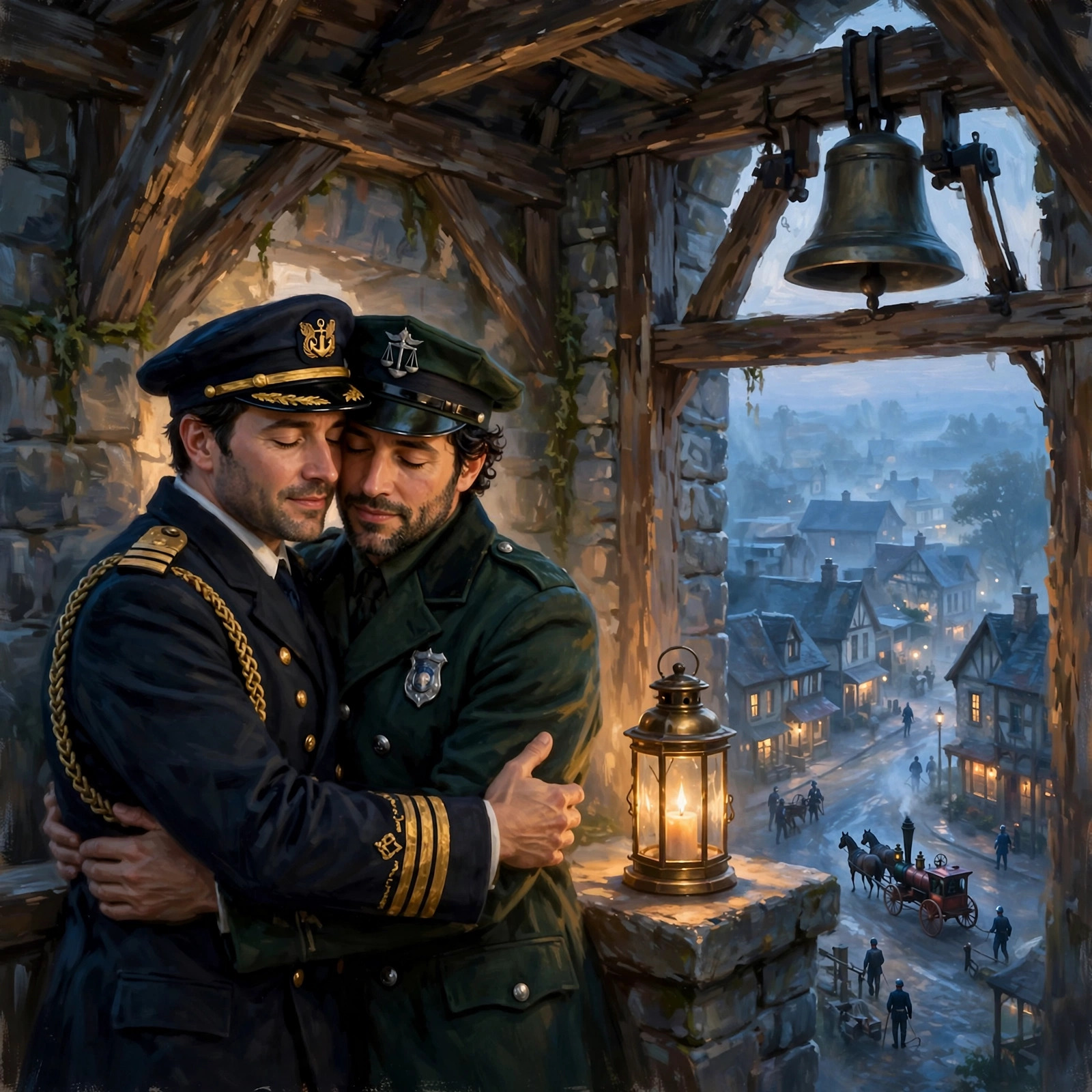
She came up the last turns and found him in the little room under the bell, sitting on the bench her grandfather had built into the sill, with his boots off and his socks on the cold boards, which was such a strange domestic sight that she had to stop at the top step and look at it a while before she could speak.
"You took your boots off."
"Your bell rope's got fresh serving on it. I didn't want to scuff anything. It felt like a room somebody kept."
It was a room somebody kept. She'd swept it the week before Ember Watch, the way she did every year, and wiped the glass of the four windows, and oiled the bell's pivot pins with a rag and a patience she showed almost nothing else. From up here you could see the whole shallow cup of the town, every lit window set down in it like coins in a dark palm, and the ridge standing up black against the last of the night, and the thin gray thread of river that had started all of this before anyone living had been born.
She set the Vigil Lantern on the ledge, in the worn ring its own feet had scratched into the wood over a hundred years of dawns, and sat down beside him on the bench. Not touching. Her shoulder near enough his that she could feel the warmth of him without any claim on it.
The lantern guttered once and settled. It had burned all night on the steps and it had come up the stairs with her, and now it stood cleaned and trimmed and going soft in its glass, the way it did toward morning.
"I used to count your windows," he said.
"Mine?"
"Your family's. From the lookout. You could see the town from up there if you stood on the north rail, and I'd stand on the north rail like an idiot, in the wind, and pick out which light was yours. I told myself it was for the watch report." He rubbed the back of his neck. "It wasn't for the watch report."
"You never came down. All that summer. You'd come as far as the store and no further, and I'd stand behind the counter hating you at a perfectly professional distance."
"I'd come down if I saw your light go out early. I figured if it went out early you had a fire, and a fire gave me a reason."
She laughed, low, so as not to wake the bell. "You hoped my house would burn."
"I hoped for any reason at all. That was the trouble." He turned on the bench, one knee up, and she made herself look at him straight. Up here there was no table between them, no radio, no town, no two families with ditches and grudges between them, just the two of them and the bell above their heads keeping its own silence. "June. I said it on the steps and you kissed me before I got all of it out, so I'm going to say the rest where you can't reach my collar."
"That's a coward's way to give a report."
"It's the only honest way I've got." He wasn't smiling now. "I love you. Not the way I did at sixteen, watching your light. Not the way I did up on the ridge this week, being handed things to check. I love you knowing the whole of it, the night you don't talk about and the jobs you do alone and the way you stand at a meeting like a woman guarding a door. I'm staying. I quit the sure pay, I'm standing for lieutenant in March, and if the town's foolish enough not to elect me I'll still be here, hauling hose for whoever it does elect. I'm not asking you for anything back. I just didn't want to be the one who never said it plain."
The lantern hissed softly and a thread of smoke went up past the glass.
She looked down at the town while she got her voice together. Below them the first few windows had gone dark, the households where someone rose early and put a lamp out on their way to a barn or a kitchen, and the rest still burned, and Main Street lay along the bottom of the cup with its strings of little lights strung out for Ember Watch, and above the ridge the sky was going the color of a bruise turning well.
"Do you know what I was afraid of, all these years?" she said. "Everyone thinks it was the fire. It wasn't the fire. It was that I'd get good at being the only one who decides. I got very good at it. I got medals good at it." She turned. "You stood up last night in front of everyone and took your own sure pay apart, and I thought, there's a man who knows what a thing costs. And then I thought, twelve years, and he never once checked whether the debt was his. And then I thought, neither did I. I never once asked anyone to help me carry it. I just carried it, and hated everyone who didn't volunteer."
"You can keep the hating if you want," he said. "I did it twelve years. It's warm work."
"I'm done with it." It came out steadier than she felt. "I love you, Silas Marsh. I loved you at sixteen, and I loved you when you were a name I wouldn't say, and I loved you Tuesday on that ridge when you made me so mad I climbed past you on the switchback out of spite. I'm not asking you to be my deputy or my second or the man who backs me up. I'm asking you to be mine. All of it, not the part that's useful."
"The useful part's pretty thin this week anyway," he said. "My boots are off."
She reached over and took his hand, and his fingers folded around hers, careful and then not careful, and she leaned into him and he leaned back and they were holding each other on her grandfather's bench in her tower in the town she had run alone and did not have to run alone anymore. His chin came to rest against her hair. Neither of them said anything for a long while. The bell hung over their heads like a held note.
Below, a shutter banged somewhere. A dog took up an argument with the daylight and lost it. The windows on the east side of Main Street began to go out one at a time, doused by people rising into their mornings, and it stopped feeling like a losing and started feeling like a passing, light handed from the little panes to the sky, which was going gold at the ridge line now.
"There's breakfast," she said, into his collar. "Opal's crew cooks the morning after Ember Watch. Eggs, and the good kind of potatoes."
"In a minute."
"In a minute," she agreed.
The last lamps on Main Street went out, one, then two, then the final one above the store, and the town lay lit only by the sun now, and the two of them sat wrapped together in the small warm room under the bell as Ferndale Hollow woke beneath them, and June did not keep watch, and did not need to.
Get notified when new stories drop

Lila Monroe
Lila writes contemporary and small-town romance with banter-forward leads and soft landings. She believes the best love stories sound like two specific people, not a trope checklist.
Leave a comment
Comments