


The Channel
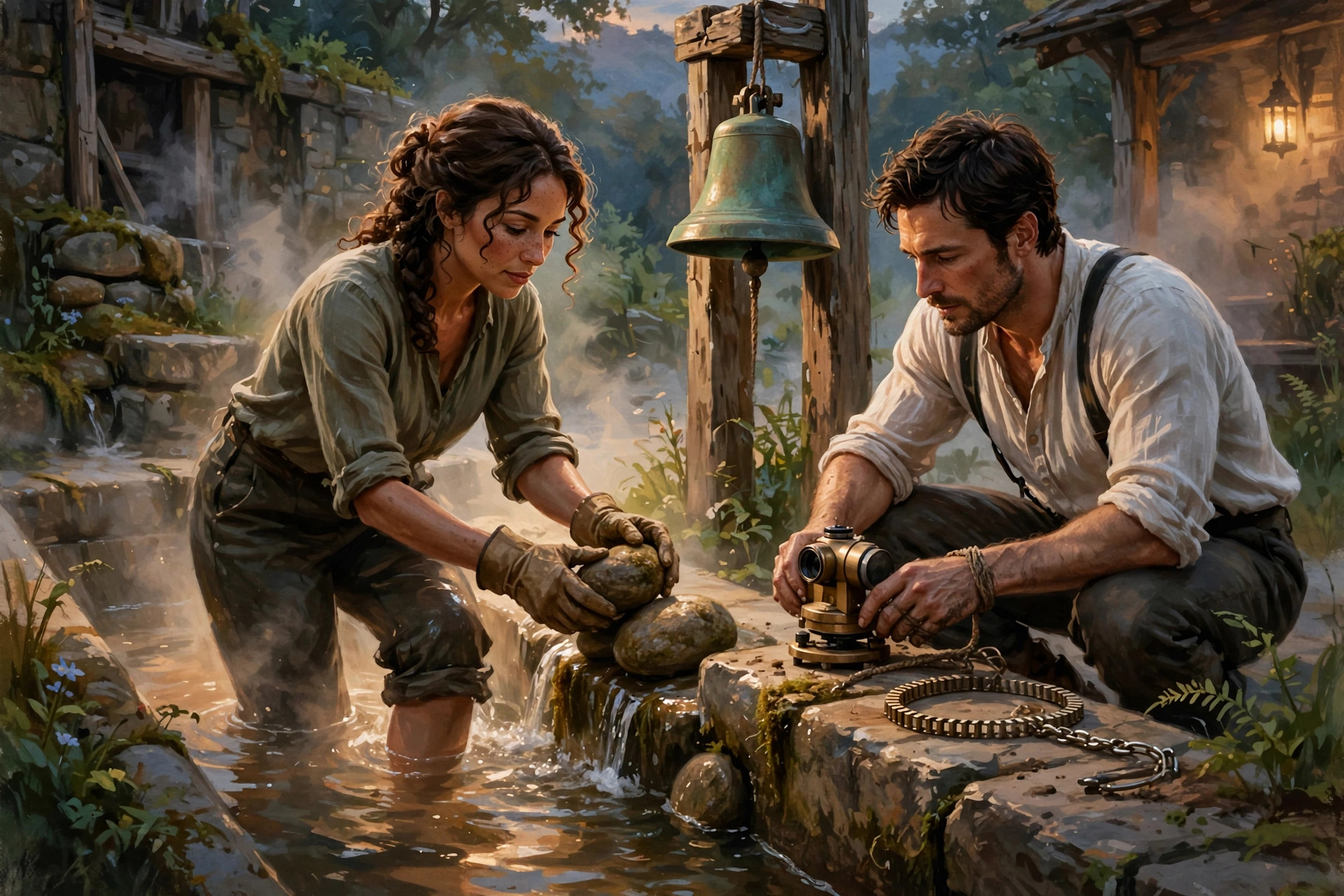
Hesper had the sluice gate half-drawn when a stranger in a pressed shirt stepped into her channel and said, "Careful where you put that stone."
She kept stacking. The pool bed wouldn't re-stone itself, and the last of the bathwater was sliding out around her calves in a long, warm sigh. "You're standing in my channel," she said. "Mind the rope, or you'll be standing in my pool."
"Rafe Kiloran." He handed a business card down to her like she was a mailbox. "Corrigan Vale Resorts. I'm here to survey the spring."
"I know what a theodolite is." She nodded at the tripod he'd set on the flagstones, its little brass feet already dimpling the mortar between two of her grandmother's stones. "It's the part where you don't ask before you set it down that I mind."
"The bathhouse is on the council's books as a public utility. I don't need a keeper's permission to stand in a public channel."
"Then you'd best take it up with the council. They meet Thursdays." She bent, hoisted the next stone, and set it in the groove it had worn for itself over the years, a shallow cradle in the pool bed where the water liked to run. Four meters up the bell post, the vesper bell hung quiet and green, waiting for dusk. "Hettie Malin chairs it. She'll be thrilled."
He crouched at the channel's edge, unhurried, and watched her work. That was the thing she noticed second. The first thing she noticed was his hands. Rough for a man with a card. Rope-burned across the palm, a farmer's or a rigger's hands, wrong somehow for pressed cotton and a measuring chain.
"You're doing that by hand," he said. "There's a company in Ashvale that drains and resurfaces these in a day. Machine-set, guaranteed grade."
"There's a spring that feeds this pool, and it likes its stones where I put them. Machine-set grade would be dead level, and dead level means still water in the corners, and still water in this pool goes strange by morning." She set another stone. Warmth came up through it into her palm, through the cotton, through the gloves. "The Well runs at a tilt. Always has."
"A tilt."
"You came to survey it. You tell me."
He unslung the chain from his shoulder and paid it out along the channel wall, brass link by brass link, and she watched him do what surveyors did, which was turn everything living into a number. Depth to the sill. Width at the throat. Fall per chain-length. He wrote in a little oiled book with a pencil he licked, and he was quick about it, and he was good, and none of that made her like it.
"Twelve above the sill," he said. "The company's engineers figured the source under Hollowpine Ridge. Rise of the water says an artesian head, maybe eighty, ninety feet of pressure. That's a drill site. That's a spa with a hundred rooms and paved parking."
"That's a dead spring." She said it flat, because it was flat. "You drill an artesian head on the ridge, you drop this pool to a trickle in a season. I've watched this water my whole tenure, Mr. Kiloran. It doesn't forgive much."
"Corrigan Vale pays a hundred and twenty for the bathhouse, and the town keeps the pool rights. That's generous for a building this size."
Her hands went still on the stone. A hundred twenty. More than the bathhouse earned the council in a decade of dimes and towels, and both of them knew it, and he'd said it the way a man lays a card face up. "The council votes Thursday."
"I heard. My survey closes Friday." He shrugged. "I'm just the fellow with the chain."
"Everyone's just the fellow with the chain until the chain's around something."
He smiled at that. She hadn't meant it to be smiled at, and she'd have taken it back if she could have, because when he smiled he looked ten years younger and slightly stunned, like the expression had surprised him on the way out. She put her head down and went back to work.
The channel bed rose in steps toward the sill, and the steps were her doings, each stone seated on the one below, and she knew every one blind. Rafe worked his way upriver of her, measuring, and she tracked him out of the corner of her eye the way she tracked weather.
"Your gloves," he said. "You work in wet stone in gloves. In August."
"Yes."
"Leather would last longer."
"They're cotton." She reached for the next stone, and her cuff, fraying where the seam had gone soft, caught on a burr of mortar. She worked it free without looking. "They were stitched for me."
"By somebody who never worked stone."
By somebody who worked this channel twenty years, she didn't say, and the not-saying sat in her chest like a swallowed stone. "By somebody," she said. "You're standing on the third step, Mr. Kiloran. There's only two."
"I can see the step I'm on, thanks. I count things for a living."
"You count lengths." She set the stone. "I count what's under them."
He laughed, short, and shifted his weight to prove her wrong, and the second step was the one she'd lifted and not yet re-seated, the one waiting beside her knee with its cradle empty, and his boot came down on the slick clay where the stone should have been.
He went in fast and badly. The channel was shallow but the pool was not, and the warm outflow had polished everything to glass, and he went back and down with his instruments clattering and his clipboard cartwheeling off the sill into the deep end. His head came up, hair gone flat, coughing, and then his hand slapped the stone lip and slid off it, and she saw the second thing about him, which was that he was not a swimmer, and the warm water that held her like a habit was holding him like a decision.
She was five steps up the bed before she'd thought a single word. Then she was at the lip, then her hand was in the water, and it was her bare hand, and his hand found hers and gripped it, rope-burned palm against her bare palm, and she braced her heel in the cradle where the lifted stone should have been and hauled.
He came up the steps in a slosh of warm water and sat down hard on the sill, and she dropped to one knee beside him, and only then, only with both of them dripping and breathing, did she feel her own fingers. Bare. Wet. His pulse had been in them a moment ago, hard and quick.
"You're all right," she said. It came out angry, which surprised her. "You're all right."
"Twelve feet," he managed. "You said twelve. It's deeper than that at the throat."
"Fourteen at the throat. I said the sill." Her voice wasn't steady, and she hated that. She reached into her pocket, into the dry corner where she kept them, and worked her mother's gloves back over her wet hands, right then, in front of him, cotton going dark at the knuckles. "You dropped your chain in four fathoms of pool, Mr. Kiloran. I'll fetch it at dusk when the water settles. Your book too, if it hasn't drowned."
He was looking at her hands. At the gloves going back on. At her face, which she did not turn to him, and did not turn to him, and the bell hung four meters overhead patient and green and waiting for the ring that would not come till dusk, and the warm water ran on between them, doing its slow work, carrying whatever it carried down to the sea.
"Your gloves," he said quietly.
"What about them."
"You put them on after." He was still catching his breath, and he was still watching her like a man reading a field with a chain that had lied to him once. "Not before."
She stood, and offered him nothing, and the last of the bathwater sighed out of the pool bed around her bare new stones.
"Come back Thursday," she said. "You can stand on land."
Storm Water
The rain started before dawn and did not stop, and by midmorning the outflow channel below the bathhouse had risen a hand's width over its sill, running brown and fast and loud. Hesper stood on the stoop in her oilskin and watched it eat the lower stepping stones one by one, and thought, not for the first time that day, that water had two moods and only one of them was warm.

Rafe Kiloran came up the path at ten, collar dark with wet, chain coiled over one shoulder like a snake that had given up. He stopped at the gate and looked at the channel the way he had looked at everything since yesterday, like a man checking sums.
"You told me Thursday," he said.
"I told you Thursday for standing on land. Nobody told you about the rain." She didn't move aside. "Mr. Kiloran."
"Rafe."
"Mr. Kiloran," she said again, mostly to hear herself hold the line, "the path to Hollowpine is a river today. You'll survey nothing up there but your own boots."
"I'm not going up there." He unslung the chain anyway, and she saw the chain was dry, and that he had oiled it, which was a thing she had not asked him to do and which she declined to find endearing. "I came about my book. You said dusk, and you said if it hadn't drowned."
She looked at him standing there in the rain, being rained on with what she had to admit was a certain amount of practice, and she thought about telling him to come back in an hour, and then a small voice came down the lane behind him, high and cracked with fear, and neither of them got to choose.
"Pepper! Pepper, no, come back, come BACK, mama said, mama said…"
The child was maybe ten, in a slicker two sizes big, and the dog was a black-and-white thing, half grown and all legs, and it was already in the channel. It had gone in after a stick or a smell or nothing at all, and the current had it. It was being carried, quick and tumbling, toward the culvert mouth under the lane, and the culvert, in water like this, was a hole that did not give things back.
Hesper was already reading the water before her mind caught up with her eyes. That was what the Well lent, had always lent, the hearing under the noise, and what she heard now was simple and terrible: a seam of current along the near bank, a slack tongue of water in the lee of the second stone, a place where a standing man could put his feet. It would be gone in seconds. It was already closing.
"Near bank!" she shouted at Rafe, because he was nearer to it than she was and because there was no time to be anything but certain. "The slack water past the second stone, there, where it goes flat, get your boots in that and lean upstream, it'll wash him to you, he'll come to you there, GO."
He went. He didn't argue, didn't ask her how she knew, didn't say one word, and afterward she would think about that longer than she meant to. He was off the bank and in to his thighs in brown water with the chain still over his shoulder, and she heard him grunt when the cold took him, because the channel was rain and the channel was not the Well, and then he planted himself in the flat place she had named and dropped his hands into the current.
The dog came to him exactly as she had said it would, spinning sideways, and Rafe got a fistful of slicker collar and then a fistful of dog, and hauled the whole scrambling mess of it against his chest and sidearmed it up the bank, where the child caught it and sat down hard in the mud and held on.
Rafe stood in the channel a moment longer, breathing hard, soaked to the waist, and the water tried to turn him and could not. Then he waded out and shook like the dog had.
"Cold," he said, in the tone of a man reporting the sky was blue.
"It's rainwater," Hesper said. "It's not mine."
"Yours is warm."
"Mine is warm." She came down off the stoop to the child, and crouched, gloves on, and did not touch the dog or the girl, only stayed level with them both. "That was close," she said. "Tell your mother the channel's high today. Keep him on a line till it drops."
"Yes'm." The girl looked at Rafe, who was dripping on the bank, and then at Hesper. "You hollered and he just went in. Mama says nobody goes in that channel."
"He's new," Hesper said. "He hasn't been told."
The girl laughed, wet and shaky, and hauled the dog up the lane toward town, and Rafe stood there and watched them all the way out of sight, and then he sat down on the flooded second step like his legs had voted without him.
"That water," he said. "You read it before it happened."
"I've stood in that channel since before I could spell it." True, and not the whole of it, and she left the rest where it was.
"No." He was quiet a moment, wringing his sleeve out. "No, it was more than that. You called the seam. The flat water past the second stone. That's not knowing a creek, that's..." He stopped, and shook his head, and she watched him decide not to push on it, which was its own kind of strange. "Your survey's better than mine is."
"I doubt that." She got up. "Come on. You're shivering, and you went in after somebody's dog, which earns you five minutes of the warm end. One-time offer."
She took him in through the bathhouse, past the closed changing doors, to where the floor gave onto the source pool at the back, the one the town never used and she used every day. The sound changed as they came into it, the rain still working the roof but under it the deep warm hush of water coming up out of the ground, and the steam stood in the doorway like a curtain holding still.
Rafe stopped at the lip of it. The pool lay pale and green-gold in the storm light, and where it rose in the middle the surface bellied up and broke, over and over, unhurried, older than the rain.
"That's the source," she said. "That's what you've been chaining and triangulating for three days. Say hello."
He crouched. He put his hand near it, not in it, a man who had learned something yesterday about water and reaching. "It doesn't stop."
"It hasn't in my lifetime. Or Hiram Duvall's, and his bell's older than this town's patience." She nodded up at the bell post, where the vesper bell hung green and patient. "It comes up warm at every season. Snow on the ridge, it comes up warm. You could set a house on it."
"You could," Rafe said, and the words came out flat, and she knew flat words, she had grown up in a valley of them. He stood up. He was quiet too long, and then he said, "I need to tell you what I'm doing here. Properly. Not the version from the road."
"The version from the road said the town sent you."
"No. Corrigan Vale Resorts sent me." He kept his eyes on the pool. "They're buying Hollowpine Ridge, or they mean to. They want a drill site up top for an artesian well, and they want this bathhouse with it, and my survey is what makes the numbers work. There's a purchase figure, and there's a vote Thursday, and my report closes Friday. That's the whole of it. That's the job."
The rain kept on, soft on the roof, and the source broke and bellied and broke, and Hesper stood very still with her gloved hands in her pockets and let it land on her one piece at a time, the way you let weather land.
"Corrigan Vale," she said. "A resort."
"A resort."
"On this water."
"On a well beside it. Deep enough, they say, not to touch yours." He said it like a man reading fine print aloud, and she could hear where he didn't believe it, or was tired of being paid not to. "Say it out loud and it sounds like a lie, doesn't it."
"It sounds like Thursday," she said. "It sounds like I should go and find Hettie Malin and tell her what the man with the chain is for." She turned for the door, and he caught the sleeve of her oilskin, gloved hand or no, and she stopped, which she had not planned to do.
"I have one thing that's mine," he said. "I'll say it fast. There's a supper place in Marrow Bend, the one with the green door. Tonight. With me. Not the job, just..." He let go of her sleeve. "Just supper."
She looked at him standing there, soaked and honest and newer than yesterday, and something in her wanted it so plainly it frightened her, the way the culvert would have frightened her if she'd let herself look down its throat.
"I can't," she said. "I have a bell."
"A bell."
"At dusk, every dusk, this one included." She was almost to the door, and she made herself not soften. "Ring it or don't come Thursday, Mr. Kiloran, but I ring."
Dusk came early under the storm clouds, gray on gray, and she climbed the four meters of bell post like a stair she owned, and took the worn rope in her gloved hands, and pulled. The vesper bell swung out over the swollen channel, bronze and low and green with age, and the sound went out over Marrow Bend the way it had gone out every night of her life, settling the boundary, telling the water it was watched.
At the gate, in the last of the light, Rafe Kiloran stood with his collar up and watched her ring it, and did not leave until she had finished, and she told herself she did not count that, and she counted it.
Gloves Off
The water in the pool was warm the way it always was, warmer than the night, warmer than the season had any claim to be, and Hesper sat on the stone lip with her boots off and her gloves on and told herself she was only there to close the gate.
She had not closed the gate. She had opened it, because Rafe stood in the dark part of the yard holding a lantern and a folded towel and looking like a man who had been told he could come in and did not quite trust the telling.
"You said the pool doesn't freeze," he said. "Even in December."
"It doesn't."
"And you said nobody swims at night."
"I said the town doesn't. I didn't say the water minds."
He set the lantern on the flat stone by the steps, where the light lay down on the water and stayed there, gold on green. Then he took off his coat, and then, in the way of a man doing something he has decided about, everything else down to nothing but a pair of trousers rolled to the knee, and went in off the low step without a speech about it.
The water took him with a sound like a held note let go. She could hear it, the whole shape of him in it, the temperature of it running up his shins and his thighs and the bones of him, and she looked away because the hearing was too much, always had been too much, water telling her more of a person than a person offers.
"It's warm," he said. There was wonder in it, plain boyish wonder, and she liked it more than she meant to.
"It's a spring-fed pool, Mr. Kiloran. It comes up out of the rock at blood heat. That's not a wonder, that's a fact."
"Everything that comes up out of the ground is a wonder if you've spent six years standing on top of ground that's being sold out from under you."
She let that sit. She took off one boot and then the other, and then her socks, and sat with her bare feet on the cold stone where he could not see the gloves come off, except that he could, of course, because the lantern was right there and her hands were not a secret to anyone who watched them.
"You can come in," he said. "Or you can sit up there being a fence post. Either way I'm not getting out to polite you, it's too good in here."
She came in the far side, working clothes and all, gloves and all, down the wide step into the shallows where the shelf of rock made a bench under the surface. The warmth went up her like a slow apology. She kept her hands low and under.
He found the bench too, a body's length away, and for a while neither of them said anything, and the night said it for them, wind in the firs on Hollowpine Ridge, water lipping the stone edges, somewhere down the yard the sound of the overflow running away through the dark to join the river below the town.
"You know what I did before this," he said. It was not a question.
"Surveying, you said."
"Before surveying. I had a farm. My father had a farm. It was my grandfather's before him, and there's a creek through the middle of it with trout in it that my mother named, individual trout, she was that kind of woman. And I was twenty-four and full of plans, and one fall I came back from a course in the city with a certificate and a duffel and my father had signed the place over to a man with a checkbook because the years had been lean and the man had smiled at him. Not sold it for debt. Sold it because the man asked charmingly and the money looked bright."
"And you," she said.
"And I stood in the yard and watched the man's agent put up a fence across a field I had a plan for. And I thought, never again. Nobody will ever again take a thing from me that I haven't already counted first. So I learned to count. Fields, cuts of timber, water under the rock. I count other people's ground for a living now, and I'm very good at it, and every job I close I put the money where nobody can lean on it, and I own nothing that can be leaned on at all."
He was not looking at her when he said it. He was looking at the water, at the lantern light trembling on it.
"Your father," she said. "Is he living?"
"He is. He sends me a card every Christmas with a sentence in it. This year the sentence was about his hip."
"Do you answer?"
"I count that as a question I don't owe in the dark." But he said it gently, and then, after a moment, "I send one back. Shorter. It's not forgiveness, it's arithmetic."
She laughed, and the laugh came out of her before she could put a task in front of it, and it echoed off the bathhouse wall and went up into the pines.
Under the water her hands had been resting on her knees, and she understood, in the way you understand the flood before you understand the cloud, that she had been holding them there like something spilled. The water had been at her wrists this whole while. The water had been in the gloves, working loose the little stitches she never looked at, and the warmth was in her hands entirely without permission.
Slowly, so slowly she could have called it nothing, she drew them up out of the water and let them lie open on the surface, palms up, in the dark between them.
Rafe turned his head.
He looked at her bare hands a long time. He did not reach, and she understood that too, that not reaching was the whole of his courtesy, and it undid her more than a reach would have.
"They're cold," she said, "when they're out. The rest of me isn't, but the hands are. It's why I wear the gloves. Don't make it a story."
"I wouldn't." Then, quietly, moving his own hand through the water toward hers, an inch at a time, so she could stop it or not. "May I."
She did not stop it.
His fingers folded over hers under the surface. His hand was rough and warm and had counted a thousand fields, and hers lay in it like a small animal that had decided, against all its raising, to be held.
"You ring it every dusk," he said. "The bell. I asked Hettie at the store what it was for and she said, tradition, and looked at me the way you'd look at somebody standing on a cake."
"Hettie says tradition because Hettie knows what it's for and isn't telling you either."
"And what's it for?"
The pool held them, and the warmth held her, and the words came up her like the spring itself, old and wanting out. The water carries things here. The water talks, and the bell tells it somebody's listening. The bell tells the valley its boundary holds because the keeping holds, and the keeping is mine, and it has a price, and my mother stood where you're sitting.
She got as far as drawing breath.
"It's for the gloam," she said instead, and heard how the sentence shut like a gate. "Gloaming. The hour when the light can't make up its mind. We ring so the day knows it's done."
"That's not what you were going to say."
"It's what I said."
"It is." He did not press it, and his thumb moved once across her knuckles, under the water, small as a stitch. "You keep a thing by keeping it. I know how that is. I know what it costs. I've watched you pay it since Monday."
"You've known me three days."
"Long enough to know a keeper when I sit in one."
She looked at him then, at his wet face in the lantern light, at a man who had lost a farm and never stopped counting fences, and the wanting in her came up so fast it was nearly panic, the wanting to be, for once in ten years, the thing chosen instead of the post holding the gate.
"Rafe," she said.
He said, "Hesper."
He said her name like something he had picked up carefully and did not intend to put down, like a hand-held bird, like a title he was checking he had the right to, and she did not tell him no, and she did not put a task in front of it, and she let him come across the bench's length to her, water sheeting off his shoulders, and she let him kiss her.
He kissed like a man who had decided slowly and then all at once. She kept her hand in his under the water the whole time, bare, palm to palm, no cloth between, and the pool went on being warm, and the night went on being dark, and somewhere above them the bell hung quiet on its post, waiting for the dusk it already knew was coming.
When he drew back, he kept her hand.
"Thursday," he said, "I have to file the survey."
"I know when Thursday is."
"I know you know." He looked at their hands, at hers in his. "I'm trying to say I'm glad I'm bad at the arithmetic that matters."
She did not ask him what that meant. She was afraid she knew.
The Worthless Survey
They came up out of the warm water onto the stoop, and the night air found every wet inch of her at once. Hesper had kept a lantern lit there since sundown, the way she kept everything, by habit and by hand, and now its little flame stood between them like a witness that had been waiting up.

Rafe wrung the tail of his shirt out over the step. His boots had been sitting inside the door, dry and patient, all evening, and she watched him step into them barefoot, heel first, a man who could not be rescued from his own competence even soaking wet.
"Your hair's full of the Well," he said.
"It usually is."
"No, I mean it's full of steam. You're steaming. In December."
She put a hand to her head and found he was right, that the warmth ran off her like she was a kettle taken off the fire. The spring ran hotter than the season every day of the year. That was the whole of Marrow Bend's argument for her post, and Corrigan Vale's argument against it, and until this week she had never once thought of her own head as a thing that steamed.
Her gloves were still folded over the bench by the steps, soaked through, and she did not go to them. That was new. Ten years of reaching for cloth between her palm and the world, and now she stood with both hands bare at her sides, and one of them was still warm from his, and the night was very cold, and she let it be cold.
"Hesper." He said it the way he had in the water, careful, like a parcel he'd been trusted to carry. "Say something about Thursday. Anything. I keep waiting for the bell to fall off its post when you don't."
"The bell hasn't rung yet. I ring it at dusk."
"You don't ring it for me?"
"I ring it for the day. You happen to be standing in the day."
He laughed, and the laugh was worse than the flattery would have been, because it was easy, because he gave it to her free. He sat down on the step with the lantern light on his jaw, and after a moment she sat too, near enough that their shoulders could touch if one of them leaned, and neither of them leaned, which was its own kind of loud.
"I've been doing the sums," he said.
"You're always doing sums."
"Thursday I file the survey. It closes clean, I bank the bonus, and by spring there's a road up Hollowpine Ridge and a pump house where your potting shed sits, and a spa where the bathhouse is, and a plaque that says mineral source, historic, and not one word about you." He turned his eyes from the dark yard to her. "I can stop all that."
Her heart went up like a bird startled off water. "How."
"Come with me."
He said it fast, the way other men ask for things they've rehearsed, and she thought, dimly, that he had rehearsed it, that he had probably sat in his rented room above the feed store saying it to the wall in three different tones and picking the one that sounded most casual.
"When the sale closes and the bonus pays out," he went on, "I'll have enough to live a year without asking anyone's permission. Longer, if I'm careful, and I'm always careful. There's work south of here. There's a whole coast of surveyors who've never heard of Corrigan Vale and don't care. I'm asking you to get on a train with me." His hand found hers on the step, bare on bare, and stayed. "I'm asking badly. I know I'm asking badly. I've never asked anyone anything, it turns out. I've only ever filed reports."
She looked at their hands. Ten years of keeping the gloam, and no one had ever asked her to go anywhere. Her mother had never asked. Her mother had simply gone, and left her the bell and the gloves and a silence shaped exactly like a man's hat on the peg by the door.
"The council votes Thursday," she said. "You told me. Vote first, then sale."
"Friday I sign everything over. Saturday we could be gone." He was talking faster now, and she understood that this was the counting, that this was what it looked like when Rafe Kiloran let himself count something he had not already secured. "It isn't a small thing I'm offering. It's the whole ledger. I don't open it for anyone. You know that about me."
"I know everything about you is a number in a book."
"Not everything." His thumb moved along her knuckle, small as a stitch. "One thing isn't."
And there it was, the wanting again, that near-panic, the wish to be the thing chosen instead of the post holding the gate. Her mother had stood in this exact steam. Her mother had stood on this exact stone with a man who had promises in his mouth like this one, and she had said yes, and she had gone, and she had left her daughter holding a bell rope at eight years old with nobody's hands to show her how to hold anything.
The warmth went out of her like water finding a crack.
"Your survey closes Thursday," Hesper said, and heard her own voice arrive cold from somewhere far up in her. "It's worthless. You should know I filed it with the council already. Yesterday. My own hand, Hettie's stamp. Your drill site, your ridge, your numbers, all of it, notarized and copied. So whatever you're asking me to run away from, you've already handed it to them in triplicate."
He went still. Not confused, not wounded, just still, a man watching a sum come out wrong.
"You filed my survey."
"I keep the records here. I keep everything here. Did you think the town pays me to steam?" She pulled her hand out from under his, and it was like drawing a splinter, slow and wrong-way. "You're a surveyor, Rafe. You told me what you are the day you waded in. I believed you. Don't fault me for it."
"That isn't what I..." He stopped. He picked up the lantern and set it down again without having done anything to it. "Hesper. Did you want it dead? The sale? Say so and I'll withdraw the filing myself, I'll eat the bonus, I'll stand up Thursday and tell them the water reads foul. Just say one true word to me."
One true word. She had a true word in her, whole and frantic, beating itself against the inside of her chest, and what came out was: "I don't care what the town does with your numbers. I never did."
The lie sat on the step between them, ugly and useful. Because she had seen where the truth ran, that she would stand in this steam and choose a man, the exact choosing her mother had made, and the town would go to the buyers anyway, and there would be nothing left of her keeping at all, and she would be the same desert her mother had been, twice over.
He stood. He found his case where he'd left it under the eave and buckled it, strap by strap, and each strap clicked like a small door shutting.
"Three days," he said. "I've known you three days, and I gave you the whole ledger." He shouldered the case. "Rigorous of me."
"It was."
He looked at her once more, all the way down to wherever she kept the things she kept, and then he went down the stoop steps and onto the ridge road, and the dark took him in three strides, and his case was a shadow, and then a sound of gravel, and then nothing but the spring running in its basin, warm and patient and hers.
Hesper stood alone on the stone.
She thought about the gloves on the bench, soaked, her mother's stitching going soft with her own steam, and she did not put them on. She climbed the four meters of post by the old footholds to where the bronze bell hung hoary and green, older than any of them, older than her mother, older than every keeper who had ever stood where she was standing and wanted something she couldn't hold and keep the keeping too. The rope was worn soft as a bird's leash. The hour had come without her noticing. It was dusk.
She rang the vesper bell into the dark, one round toll, then another, the sound going out over the water and up the ridge road and down the whole of Marrow Bend, settling the day the way it had been settled since 1861, and the light couldn't make up its mind, and she stood in the steam with her eyes running wet and told herself it was only the cold.
The Hand-Drawn Map
The town hall smelled of coffee gone cold and floor wax, and every folding chair was full. Hesper sat in the back row with her knees together and her gloved hands folded, watching the door the way she watched the water, without seeming to.
Rafe came in late, which she had not expected. She had expected him to be gone, bonus banked, survey filed, a postcard from someplace with no springs in it. Instead he walked to the front while Hettie was still shuffling the agenda, and he set a case on the council table and unbuckled it, strap by strap.
"Point of order," Hettie said. "You're not on the docket, Mr. Kiloran."
"I'm turning in my work. That's on somebody's docket." He lifted out a stiff roll of paper, and the room leaned. "Corrigan Vale Resorts hired me to map the spring under Hollowpine Ridge. I mapped it. Here's what the drilling does that their prospectus doesn't say." He unrolled the sheet across Hettie's blotter and pinned its corners with her inkwell, her stapler, her glasses, and one blunt forefinger. "The fracture they want to tap feeds the Well from below. You drill there, you don't get a second spring, you get a drained first one. Sludge in the basin within a season."
Someone in the second row said the water would find its way, water always did. Rafe didn't argue. He said, "Come measure it yourself. I'll show you the seams. That's my whole profession, not believing me about land I've walked."
Hesper looked at the map. Not the printed survey beneath it. His hand-drawn one, in pencil gone nearly black at the pressure points, the ridgeline hatched careful as stitching, the Well marked not with a symbol but with a small drawn bell.
"And your employer?" Hettie said. "You're filing this against their interest."
"I'm not filing anything. I withdrew the survey this morning. I quit this morning. The bonus rides on delivery, and there's no delivery, so there's no bonus." A ripple went down the folding chairs, the arithmetic of a stranger burning money in a town that had none. Rafe waited it out. "I'll take whatever the council pays to map the town's other springs. If you'll have it."
The vote came before the coffee was poured again. The offer of a hundred and twenty thousand went down, and Hettie's hand didn't waver when she raised it, and the deed to the bathhouse went into the town strongbox with a key the size of her thumb, and the room clattered up out of its chairs into talk, and it was over, and it was safe, and Hesper sat in the back row feeling nothing she could name.
He found her on the walk back, at the place where the road bent toward the bathhouse and the steam hung over the stone basins like a held thought.
"You didn't file my survey," he said.
"I told you I did."
"I called Hettie Tuesday to confirm receipt. She hadn't seen it. I've had a strange couple of days doing arithmetic on that." He looked at the steam, not at her. "So tell me the lie was for a reason."
She could have let him go with it. She had let him go with it twice already. But he had stood up in a room of strangers and unpaid himself, and there was a hand-drawn bell on a council table with her bell drawn on it, and she was tired of being the only one who knew what the water knew.
"Not here," she said. "At the Well."
He didn't speak on the walk down, and neither did she, and the dusk came up purple off the ridge and settled into the steam. At the stoop she sat, and he sat, and she took off her gloves, finger by finger, and laid them on the bench where the stitching had gone soft from all her steam.
"My mother stitched these," she said. "She was keeper before me. She sat where you're sitting. The Well isn't only a hot spring, Rafe. It lends its keeper something. A hearing. I can tell what the water carries, a swimmer in trouble, a lie in a voice, a stranger on the ridge road before anyone sees him. And a slow life. Slow ages. Keeper's years run wide."
"You're twenty-eight," he said. "You look it."
"I've looked it for a while." She watched the steam climb. "There's a price on the gift. If a keeper speaks love aloud while she holds the keeping, to a mortal, the Well calls its years home. All of them. In one night. My mother fell in love with a surveyor, one of yours, come to count this valley. He was kind to her and she said it aloud, right there, at the water. I was eight. I woke and she was gone."
"Gone where?"
"Away. Out of the valley. Before I could see what one night of called-home years does to a person." Her voice stayed even, which cost her. "I grew up believing she chose him. That she picked a man over me and left. I built my whole keeping on that, gloves on, hands off, warmth answered with a task. And then Tuesday I called Hettie, and Hettie told me the rest, because Hettie was her friend, and Hettie says my mother didn't run to him. She ran from me. She ran so I'd never watch her fade. She said the word aloud at the water and the years came due, and whatever was left of her got on a stage out of Marrow Bend, and Hettie locked the bathhouse and wept and never told a child."
Rafe was very still. "So when I asked you to leave with me."
"I heard my mother's whole life coming out of my own mouth. Choose the man, lose the town, lose the keeping, lose everything but him." She turned her bare hands over in her lap. "So I made you small instead. Filed your survey, didn't care, all of it. I made you easy to walk away from, because you were going anyway, and I wanted to be the one who walked first."
"I wasn't going anywhere," he said. "I was asking."
"I know. Now." The steam moved between them. "That's what I came to tell you, all of it, no filings, no lies. The sale's dead, you're broke, and I've kept nothing from you except the one thing I couldn't say."
"Say it, then."
"You know what I am. You know what it costs."
"Tell me the cost."
"If I say the word aloud, the years come home. Every year the Well ever lent. One night." She looked at the black water, patient, running, hers a while longer. "I'd lose the keeping. The hearing. The slow life. Perhaps the rest of it, I don't know, no keeper ever stayed to find out. My mother didn't."
He was quiet so long the vesper hour came and went unmarked above them, the bell hanging in its verdigris, waiting.
"What happens if you say it," he said at last, "and it doesn't take everything? What if the water's fairer than you've been told? You're the only one who ever tests it by never testing it."
"It's not a test I get to grade."
"Then say it anyway. Say it tonight. I'll take whatever comes with you, I've been counting everything I own since I was twenty-four so nothing could be taken uncounted, and I'm telling you now, count me. I'm yours, whatever the water does about it."
Her chest hurt with the size of what was beating in it. "Not tonight," she said. "Not yet. If I say it, I say it free. Not frightened, not cornered, not on a stoop with a dead sale behind me. When it's only mine to give."
"When?"
"Soon. I'll ring you the hour." She put out her bare hand, and he took it, and the steam held them both, and the water ran warm in its basin below, keeping its counsel, keeping its years, waiting to hear what she would choose.
The Vow at Dusk
Hesper came down to the bathhouse early, while the light was still honeyed on Hollowpine Ridge, and found Hettie already on the stoop with the deed box under one arm and her reading glasses pushed up into her gray hair. Two days since the vote. Two days of Hesper walking the floor of her own keeping, practicing the sentence, putting it off.
"You look like a woman rehearsing a resignation," Hettie said.
"I'm not resigning. I don't get to." Hesper turned her mother's gloves over in her pocket, soft cotton, one cuff fraying to thread. "If I say it, it's out of my hands. All of it."
"Then say it and find out." Hettie set the box down on the bench and sat beside it, knees creaking. "I've kept your books for most of two decades, girl. You want a truth from someone who watched your mother go? Esme never told the water anything it didn't already know. The Well heard her heart before her mouth got around to it. That bell up there has rung every dusk since Hiram Duvall cast it, and it's never once rung early to punish a keeper for loving somebody."
"It took her years, Hettie. One night."
"It called its own home. That's not the same as taking hers." Hettie looked out at the steam rising off the warm water, the pool running patient and bright in its stone basin. "The bookkeeping on that was never anybody's to audit but your mother's, and she loved you enough to leave so you wouldn't watch. That's the account I can read you. The rest you have to hear from the water yourself."
The dusk came on slow, the way it did in the valley, sliding down the ridge like it was reluctant. Below them, on the road, a figure walked up with his coat over his shoulder and a canvas satchel of ink and paper swinging at his hip. Rafe. He'd been three days at the town's little contract, mapping springs up the far slope, coming back each evening to eat whatever Hesper cooked and to not ask her the question she could see him not asking. He stopped at the gate, and she saw him check it, still there, still open.
"The mapmaker," Hettie said, and stood, and patted the bench. "Dusk's near. I'll take the rope tonight."
"It's mine to ring."
"Not tonight." Hettie held out her hand, palm up, steady. "You heard me in the strongbox room, and you heard me at the vote. If the keeping's going to pass, it passes to a keeper, and I'm standing here telling you I'll be one. Sixty-one years in Marrow Bend, half of them watching you grow into those gloves. The water can have me while it looks for whoever's next. Now give me the rope, Hesper Duarte, and go stand where the bell isn't."
Her hands shook. She took the rope from the post's iron hook anyway, the line worn soft as an old shirt, and coiled it into Hettie's palm. Hettie's fingers closed over it, and she pressed it once, brief, and went up the steps to the rope.
Rafe came through the gate. His boots left prints in the damp ground. "Hettie rang?"
"She's ringing."
"And you're down here with your hands empty." He looked at her pockets, then at her fingers, bare all week now, and something in his shoulders came down an inch. "You said soon."
"I said I'd ring you the hour. She's ringing it. That's the hour."
The bronze bell spoke above them, one long round note, hoary with verdigris, the sound rolling out over the water and up the darkening ridge, the sound that settled the boundary every dusk of her life. It had rung her to sleep as a child. It had rung the night her mother packed. It rang now, and for the first time since she was eighteen years old and took the rope, Hesper stood below it with nothing in her hands and nothing in her pockets.
She heard it all the same. That was the strange part. The undersong, the hearing, the water's low second voice under everything, it didn't lift when the bell rang. It was still hers. Still lent. Still waiting to hear what she would choose.
She drew the gloves out of her pocket one last time. Her mother's stitches, tiny and even, made the year Hesper was seven, worn thin at every knuckle where a keeper's work goes through. She laid them on the bench beside the deed box, flat, unfolded, like a pair of hands at rest.
"Hesper." Rafe's voice was low. "Whatever it does, I'm standing here. I counted myself in the morning and I'm counting myself now. I haven't moved."
"I know." She looked at the pool, at the steam feathering up into the blue-gray air, at the warm water running in its basin the way it had run for longer than the town, longer than the bell, longer than any keeper. "I was so sure it would be a losing. My whole life I watched love come into the valley and take keepers out of it, and I made my hands into gloves and my heart into a ledger and I thought that was safety. But my mother didn't leave me for a man. She left so I wouldn't have to watch her fade. She chose me. Nobody ever told me that, and I never let myself hear it, and I've been paying interest on a debt that was never owed."
"Hesper."
"Let me get it out." Her breath came ragged. "I love you. That's it. That's the whole survey. I love you, Rafe Kiloran, and I'm not saying it cornered or frightened or traded, I'm saying it at dusk, with the bell rung by somebody else, with my hands bare, on purpose, because I choose you. I love you."
The words left her and the water took them the way it took everything, and the pool went still. The steam stood up in a single white column, then folded, then softened, and the undersong rose in her one long last time, not mournful, rising, like a bell rung sweetly at the end of an hour. Then it set her down. She felt her own pulse plainly, mortal, one heart, one span. The keeping lifted from her shoulders like a coat off a hook, and she heard it settle elsewhere, up the slope, into old steady hands on a rope.
She waited for the taking. Her mother's night, the years come due. What came instead was warmth, welling up out of the pool and over the stoop and around her bare ankles like a tide, deliberate, gentle, the water pressing close to her skin as if to say what it had kept, what it had lent, and what it had all along been willing to give back. Her hands were her own. Her years were her own. Nothing faded.
She was laughing before she knew she was, laughing with tears in it, and Rafe crossed the stoop and took her face in both careful hands.
"You didn't go anywhere," he said. "You're still here."
"I'm still here. I'm exactly here." She turned her hands over inside his, palms up, nothing hidden. "All mine, all yours, whichever way you want the accounting."
"I love you," he said, plain as a fence line. "I loved you before the bell, I'll love you after it, and I'm not going anywhere. I haven't since the storm. Count on me."
The dusk bell spoke again above them, Hettie drawing the rope in her old rhythm, and the sound came down over the bathhouse and the water and the two of them on the stoop, and Hesper heard it as she'd never once heard it, with nothing in her ears but bronze and air. She pressed her forehead to his jaw, and his arms came around her, and the steam rose up and held them both.
"Stay for supper," she said into his collar.
"I took the contract. I'm staying for years."
Up the slope the rope went still. The bell hung quiet in the last light, and the pool ran warm, and it was just a bell, and it was just a town, and she was just a woman in love on her own front stoop, holding and held.
"Next time Hettie rings," she said, "I'm going to be cooking. And you're setting the table."
"Counted," he said, and kissed her hair, and did not let go.
Get notified when new stories drop

Cade Ellison
Cade specializes in romantasy and paranormal romance: magic systems with rules, courts with knives, and longing that rearranges destinies.
Leave a comment
Comments