

The Locked Drawer
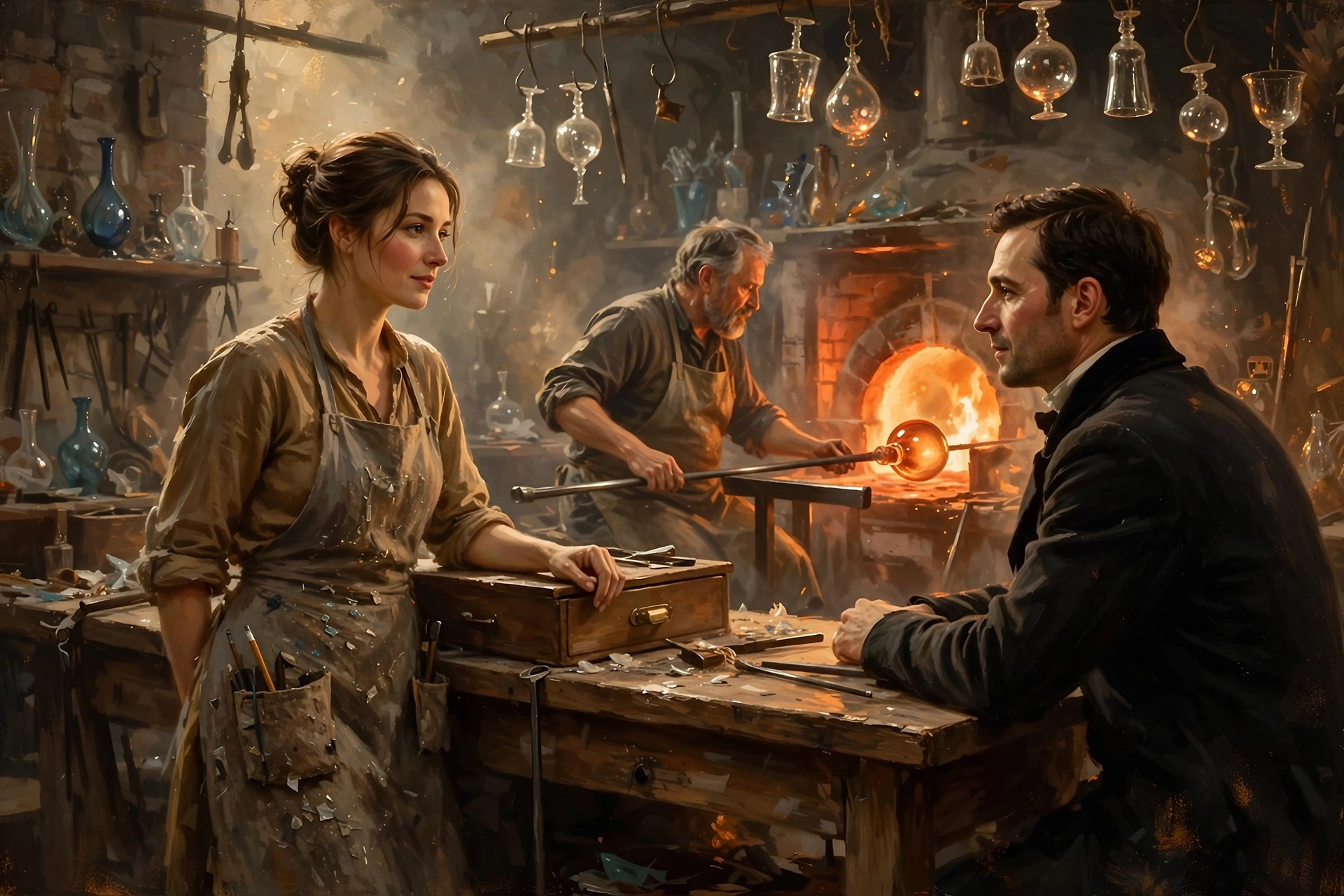
"You've shown me cups," Anselm Whitcombe said, setting down the third goblet she'd handed him. "Very fine cups. I didn't cross the Alps for cups, Signorina Ferro."
Lucia kept her hand flat on the bench, an inch from the drawer. "You crossed them for chandelier drops. My uncle has shown you drops."
"Your uncle has shown me drops that any shop on the Fondamenta dei Vetrai could sell me by the crate." He said it pleasantly, as if commenting on the weather, and that was worse. "My firm wants engraving no one in London has seen. I was told the Ferro workshop had it."
"Who told you?"
"A merchant at the Rialto warehouse. He said the best hand on Murano belonged to this bench." His gaze dropped, briefly, to her fingers. "He didn't say whose."
Behind them the furnace muttered and spat. Bartolo stood at the glory hole with his back to them, turning a gather on his pipe, his shoulders doing the listening his face refused to. He'd told her that morning, in the voice he used for funerals, that the lease on the furnace would lapse at the end of the season unless something large came through the door. Then he'd told her a buyer from London was coming, and to be kind.
She was being kind. She hadn't thrown anything.
"The merchant exaggerates," Lucia said. "Merchants do."
"So do buyers. I'm told it's how we're paid." He smiled, a quick crooked thing that didn't quite settle on his mouth before it left. He had a tired London face, pale under the Venetian sun, and a coat too good for the dust of a workshop. He hadn't once brushed the dust off it. She'd noticed that and disliked noticing it. "What's in the drawer?"
"Tools."
"You've touched it four times since I walked in."
"I touch my tools often. It's how one uses them."
"Then use one. Show me." He leaned on the far edge of the bench, close enough that she could smell rain on his collar from the crossing. "Signorina, my uncle's house wants an order of four hundred engraved drops for a ballroom in Mayfair. Four hundred. I've been to six workshops since Tuesday and none of them made me want to write a letter home. I'd like very much to write one tonight."
Four hundred. Lucia felt the number land in the room. Bartolo's pipe stopped turning for half a heartbeat, then went on.
It was enough to keep the fire lit. It was enough to keep the roof.
Her father's stylus lay beside her wrist, the steel shaft worn bright where his thumb had ridden it for years and hers had ridden it since. He'd hand-set the diamond himself, filing the collar until it held without a whisper of play. He'd also once laid out a whole folio of designs on this very bench for a smiling foreign gentleman with a good coat, and a year later they'd come back to Murano printed in a catalogue under another house's name. Her father had kept that catalogue. He'd looked at it some evenings the way other men looked at the bottom of a cup.
"My uncle will draw you samples," Lucia said. "He's very good."
"Your uncle is a master blower. I can see that from here." Anselm tipped his head toward the furnace. "I'd wager he doesn't engrave."
Bartolo said, without turning, "He'd win the wager."
"Zio."
"What? The man has eyes, Lucia." Bartolo lowered the pipe onto the marver and rolled it, slow. "And we have a lease."
Anselm glanced between them, and something in his expression shifted, as if he'd stepped into a family argument and recognized the furniture. He straightened off the bench and stood properly, hands behind his back.
"I'm not trying to rob anyone," he said, more quietly. "I'm only trying not to go home with nothing."
"Everyone who comes to rob us says that."
"Do they?" He considered it. "Then I'm in poor company. Let me find better. Show me one piece. You can stand there with that stylus pointed at my eye the whole time."
It surprised a sound out of her that was almost a laugh. She smothered it. He looked pleased anyway, and she disliked that too.
"Signore Whitcombe."
"Anselm. Please. Nobody but my uncle calls me Whitcombe, and he only does it when I've disappointed him."
"Is that often?"
"I try very hard for it not to be." He said it lightly. His eyes didn't. They went away for a moment to some cold room she couldn't see, and came back.
Lucia picked up the stylus. She opened the drawer just far enough to lay it inside, on top of the folded felt and the sheaf of drawings she had never once shown a stranger, and she shut it again. The key was on a ribbon at her wrist. She turned it. The lock gave its small iron click, loud as a door in the quiet.
Anselm watched the whole thing and didn't pretend otherwise.
"That," he said, "was rather a clear answer."
"I'm told I'm a clear woman."
"By whom?"
"By everyone who has tried to open that drawer."
Bartolo made a noise into his beard that might have been despair or might have been pride. With Bartolo it was often both.
"Come back in a few days," Lucia said. "My uncle will have samples."
"Your uncle's samples." Anselm inclined his head, polite, defeated, not quite. "Very well. I'll come back."
He took up his hat from the stool. He didn't go. He turned instead toward the window, where the light off the Rio dei Vetrai came in green and shifting, and where the morning's rejects and keepers hung on a wire to be judged. Bartolo's plain drops, mostly, clear and honest, catching the canal light and doing nothing much with it.
And one that wasn't his.
She'd hung it there herself before dawn, meaning to take it down. A small pear-shaped drop, no longer than her thumb, cut on the wheel and then finished by hand. Along one face, so fine it only showed when the glass turned, a vine climbed and doubled back on itself, each leaf veined, one leaf curled under as if a wind had caught it. The curl was a trick of her father's. She'd spent most of a decade getting it right.
Anselm stopped in front of it. He didn't touch it. He stood with his hat in his hands and let the wire turn it for him, once, twice, until the light caught the vine and the whole leaf lit like a struck match.
Lucia's hand had gone to the key at her wrist without asking her.
He looked at the drop for a long moment. Then he looked at Bartolo's broad, scarred hands on the pipe. Then, slowly, at hers.
"Ah," Anselm said, very softly, and nothing else at all.
Heron Prism
"Higher," Lucia said. "No. Left. Your left, not mine."
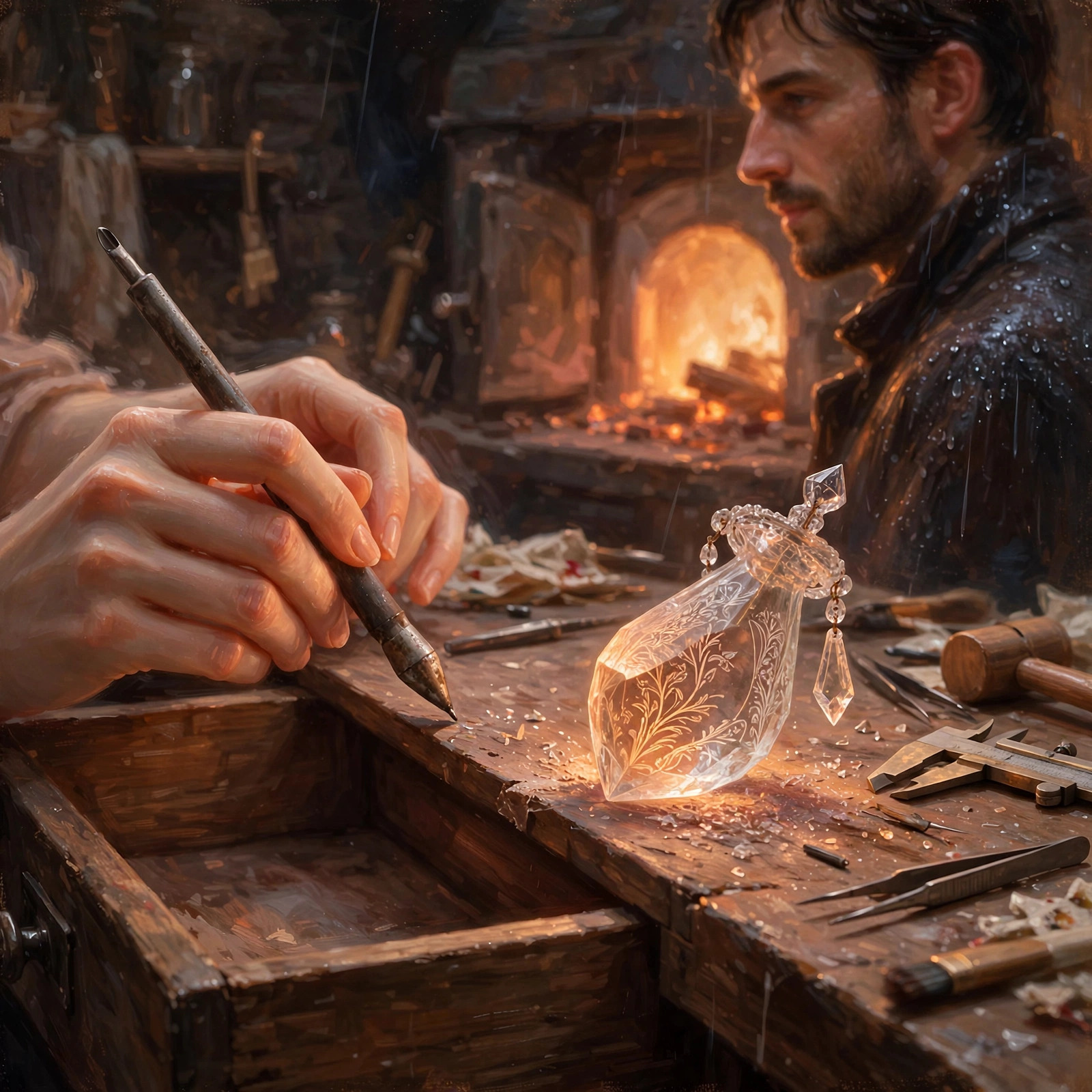
Anselm moved the lamp a careful inch. The flame leaned, steadied, and threw its light across the blank prism clamped in the wooden jaws of her bench.
"You might have warned me I'd be employed," he said.
"You came back two days early. People who come back early hold lamps."
"Is that a guild rule?"
"It's my rule. The guild has enough of its own."
He laughed under his breath and didn't argue, which surprised her. She had expected argument. She had spent most of yesterday expecting it, rehearsing small sharp answers while she cut the prism on the wheel, long and six-sided, clear as cold water. Bartolo had watched her carry it in from the grinding room and said nothing at all, which from Bartolo was a speech.
Now her uncle was out at the furnace with the boys, and the workshop was hers, and this Englishman was standing at her shoulder with his coat off and his sleeves turned back like a man who meant to stay.
She untied the ribbon at her wrist.
The key felt heavier than it was. She fitted it to the drawer, turned it, and heard the lock let go. She took out the stylus and nothing else. The drawings stayed where they were, under the felt. She shut the drawer again with her hip.
Anselm saw. Of course he saw. He only shifted the lamp so the light fell kinder on her hands.
"Your father's?" he asked.
"He set the diamond himself. Filed the steel for a week until it sat right." She turned it once in her fingers, the old familiar weight. "He said a tool should feel like an opinion you already hold."
"And what opinion is that one?"
"That I'm usually right."
"Ah. A family heirloom, then."
She bent to the glass so he wouldn't see her mouth twitch.
The first line was always the worst. After that the glass told you things. She set the point at the prism's upper edge and drew it down, a long thin stroke, barely a whisper of sound. A neck. Then the curve of a head, the dagger of a beak. The lamp held perfectly still above her, and she noticed that, noticed it the way she'd notice a draft.
"A heron," he said quietly.
"Don't talk while I'm doing the eye."
He didn't. She did the eye. It took one flick of the wrist and nine years.
When she lifted the stylus he let out a sound that was not quite a word. She ignored it. She began the feathers along the back, short strokes laid like roof tiles, and the quiet between them settled into something easy, the hiss of the lamp, the tick of the canal against the stones below the window, his shirt sleeve near her ear.
"Why do they stand on one leg?" he asked eventually.
"Herons?"
"I've always wondered. There are some on the river at home, near Greenwich. My uncle's warehouse looks out on the mud. I used to watch them when I was meant to be counting crates."
"Were you a bad clerk?"
"I was an excellent clerk. I counted the crates and the herons both. Nobody ever asked me about the herons." He moved the lamp as she moved, without being told now. "Nobody ever asked me about much. I was the cousin they took in. One learns to be useful very quickly in that position. One learns not to say no."
She glanced up. He was looking at the glass, not at her, and his face had gone careful in a way she recognized. It was the face she wore when someone admired the drop in the window.
"Do you say no now?" she asked.
"I'm practicing." A small rueful smile. "I said it to a gondolier yesterday. He charged me double anyway."
"Then you need more practice."
"Will you teach me? You're very good at it."
"I've had reason." She went back to the feathers. Her stylus slowed. "A man came here when I was a girl. English, like you. Very charming. He bought three of my father's designs to take home as samples, and a year later we saw them in a catalogue from Birmingham. Pressed glass. Cheap. His name under them." She cut a feather harder than she meant to and had to soften the next. "My father never drew for a buyer again. He drew for that drawer."
Anselm was silent so long she thought he hadn't understood her English.
"And you?" he said at last. "Who do you draw for?"
"The drawer." She reached the heron's legs. One leg, long and jointed, standing in a few curved lines of water. The other tucked up into the body, hidden. "I'm told herons stand like that to keep one foot warm."
"Is that true?"
"I've no idea. It's what my father said."
"Then it's true enough."
She finished the water. She finished the reeds, three of them, one bent. Then she blew the glass dust from the cuts and held her hand out without looking, and he set a soft cloth in it as if he'd done it a hundred times.
That was the thing she would turn over later, alone, in the dark. Not the compliment that came after. The cloth.
She polished the prism and lifted it out of the clamp. Anselm brought the lamp down close, and the heron woke up inside the glass, lit from within, every feather a thread of light.
"Lucia," he said.
It was the first time he'd used her name without the Signorina in front of it. She should have corrected him. She found she didn't want to waste the breath.
"It's a test," she said. "To see if the cristallo takes a fine line at this angle. That's all."
"Of course."
"Bartolo will sign it."
"Will he?" His voice was mild. His eyes weren't. "Four hundred of these would hang in a ballroom full of people who've never once been told who made anything. I'd like them told, for once."
"The guild doesn't put a woman's name on a mark."
"I'm not the guild."
"No," she said. "You're a buyer."
It landed. She watched it land, and she was sorry for it, and not sorry enough to take it back. He set the lamp on the bench very gently.
"Yes," he said. "I am. My uncle's buyer. I'll write to him tonight and tell him what I've seen. I'd want your leave to describe it." A pause. "I'm asking for that. I've decided to start asking."
Lucia looked down at the heron, one foot hidden and warm.
"Describe the glass," she said. "Not the drawings."
"The glass, then."
She carried the prism to the window herself. The wire still held Bartolo's plain drops and her small vine. She threaded a loop of brass through the hole at the prism's end, reached up, and hung it beside them. The canal light came green through the shutters and caught it, and the heron turned slowly to face the room, and the man in it, as if it had something to say.
She let it hang there, in full view, and didn't take it down.
Glory Hole
"You're standing in the draft," Bartolo said, without turning from the furnace. "Either come closer or go home, Englishman. The glass doesn't care which, but I do."
Anselm came closer. Lucia watched him do it from the marver, the long pipe cooling across her knees, and thought he looked like a man stepping into the sea in his good boots. The glory hole threw its orange mouth wide across the dark workshop. Every shadow leaned toward it.
"He's never seen a night firing," she said.
"He's seen enough of mine to stop flinching." Bartolo swung the gather out, a molten pear of light, and rolled it on the steel. "Lucia. The jacks."
She handed them over. Her uncle shaped the neck of the drop in four quick pinches, the way he had since before she could walk, and the glass sighed and gave. Sweat ran into his collar. He worked the way he spoke, in short pushes, never asking twice.
Anselm had taken off his coat sometime after midnight. Now he stood with his sleeves rolled and a smear of ash along one wrist, holding the bucket of water for the paddles as if someone had promised him a medal for it.
"Back in," Bartolo said, and Lucia took the pipe and fed the drop into the glory hole to warm it again. Heat came at her face like an opened oven. She turned the pipe, turned it, counted under her breath.
"Why the second fire?" Anselm asked. "It's already shaped."
"It cools from the outside in. If you keep working it cold, it cracks later. Weeks later, sometimes. Hanging over somebody's dinner." She drew the pipe out. "Glass remembers being rushed."
"So do people."
Bartolo grunted, which from him was nearly applause. He took the pipe, knocked the drop free into the annealing oven, and shut the iron door on it.
That was the last of the plain drops for the night. Bartolo wiped his face with his whole forearm and looked at the two of them, and then at the window where the heron hung in the dark, catching furnace light along its wing.
"I'm going to bed," he said. "Bank the fire in an hour. Don't let him touch the pipe."
"I wouldn't dream of it," Anselm said.
"You'd dream of it. Just don't do it." Bartolo paused at the stair and looked back at his niece, a long look that said several things she didn't care to translate. Then the boards creaked overhead, and a door shut, and the workshop was only the roar of the furnace and the slap of canal water against the foundations.
Lucia sat down on the bench. Her arms ached from the shoulder to the fingertips. Anselm set the bucket down and stood there, not quite sure where to put himself, which she was beginning to think was his natural condition.
"Sit," she said. "You've earned the bench."
He sat beside her. Not close. Close enough that she could feel the heat still coming off his shirt.
"Your uncle doesn't like me," he said.
"My uncle likes you very much. If he didn't, he'd be polite to you." She rubbed her wrist. The ribbon there had gone damp, and the small brass key on it pressed a print into her skin. "Did you write the letter?"
"I did. The glass only." He looked at his hands. "I described the heron for most of a page. I think my uncle will assume I've taken a fever."
"And has he answered?"
"Not yet. He'll answer." Something moved behind his face, and was put away. "He always does."
She didn't ask what that meant. She was too tired, and he was too careful, and the furnace was too loud for confessions. Instead she sat and looked at the drawer under her bench, the one with the brass lock, and thought about her father sitting at this same bench, showing a smiling foreigner everything he had, because the foreigner had asked so nicely.
Then she thought about the cloth in her palm, three days ago, set there before she'd said a word.
She untied the ribbon.
Anselm went very still. She fitted the key, turned it, and pulled the drawer out into the light.
Her father's stylus lay on top, wrapped in chamois, the steel worn bright where his fingers had been. Under it were the drawings. Years of them. Herons and reeds, lagoon grasses, a fish turning in green water, a whole chandelier sketched as a flock of swallows coming down to roost, every drop a different bird.
She didn't hand them to him. She set them on the bench between them and took her hand away.
"You can look," she said. "You can't take them. You can't describe them. Not to your uncle. Not to anyone."
"I won't."
"Say it slower."
He looked at her, and he did. "I won't."
He turned the pages the way a priest turns a missal, by the edges, barely breathing on them. When he got to the swallows he stopped and stayed there a long time. The furnace light moved over the paper. She watched his throat work.
"These would hang," he said finally, "in that ballroom. And nobody in it would ever look at a candle again."
"They'd look at Whitcombe and Sons."
"Not if I--" He stopped himself. Set the page down. "I'm not going to promise you something I haven't won yet. I've done that before, to other people. I'd rather not start with you."
It was the most honest thing anyone had said to her in a long while, and it frightened her more than flattery would have.
She got up, because sitting still had become impossible, and went to the window. The heron prism had gone cool in the night air from the shutters. She unhooked it and brought it back to the bench and set it on the open drawings, on the paper heron it had come from.
"That's what I did with them," she said. "Took them out of the drawer. Once."
"Twice now." He touched the prism, one fingertip on the cold glass, beside the hidden foot. "Lucia, I don't know what my uncle will say."
"I know."
"I want you to know I'm frightened of him. I've been frightened of him since I was a boy at the bottom of his table. I'd like that to be the least important thing about me."
"It isn't the least important thing," she said. "But it isn't the most."
The fire roared behind them. His hand stayed on the prism. Hers came down beside it, and somehow neither of them moved away, and his fingers slid over hers on the glass, warm on cold, and the heron sat between their knuckles with the furnace burning gold in every cut line.
She leaned first. She would remember that, later, and not be sorry. He met her halfway, slow, as though she were something still soft from the fire that could be marked by hurrying, and he kissed her over the cooled glass with ash on his wrist and her father's drawings spread out under both their hands.
Rialto Warehouse
"He's early," Anselm said, before she had both feet off the boat. "He came in on the Trieste steamer last night. I didn't know. I swear to you I didn't know until his note came to the inn."
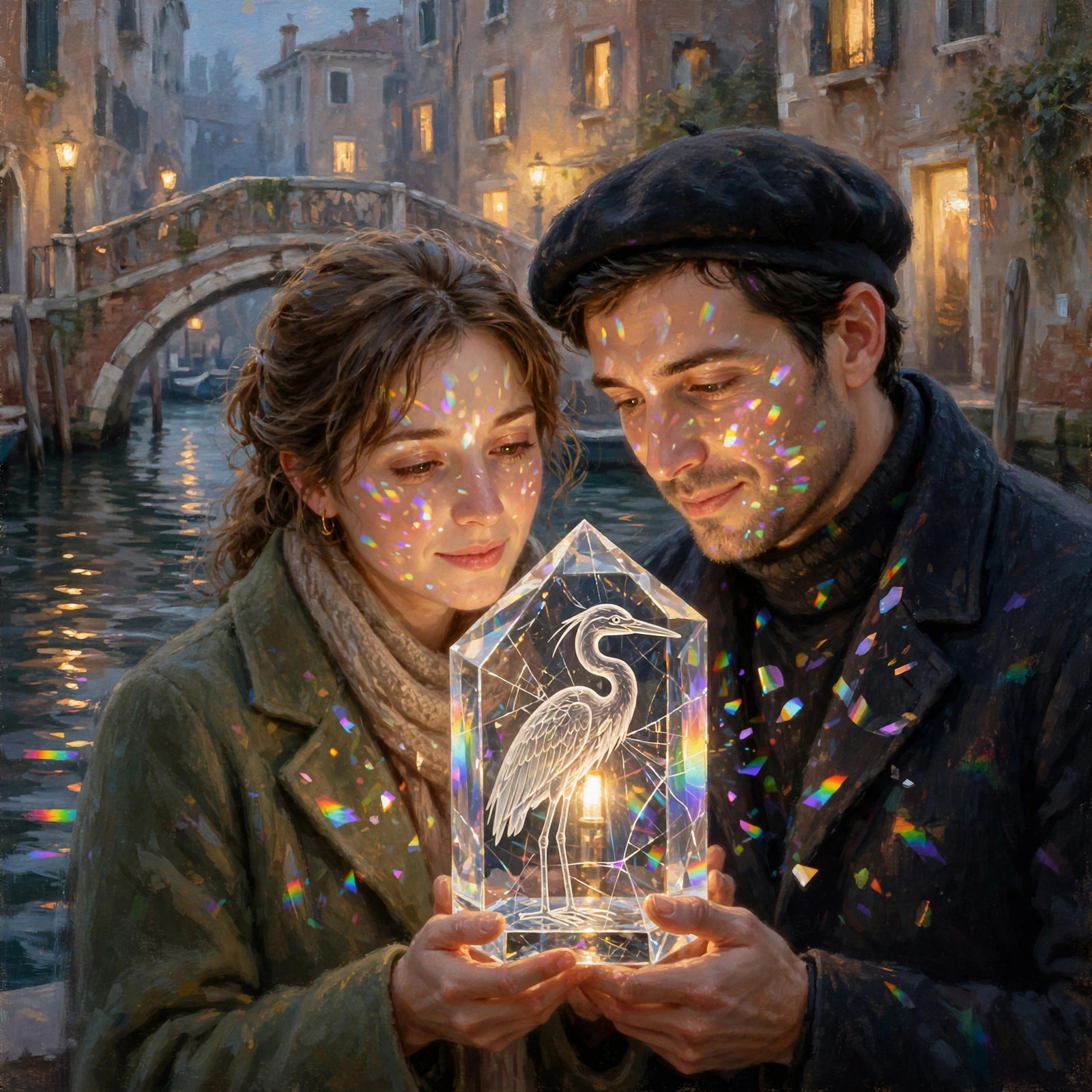
Lucia let him take the satchel from her shoulder, because his hands were already reaching for it and it seemed cruel to leave them empty. He looked as though he hadn't slept. His collar was buttoned wrong, one hole off, and she wanted to fix it and didn't.
"Then I'll meet him," she said. "That's what we wanted, isn't it?"
He didn't answer that. He held the warehouse door for her instead, and she went in out of the bright noise of the Rialto into a long brown dimness that smelled of tar and straw and river damp.
Crates stood in rows to the rafters. At the far end, under the only good window, someone had laid planks across two barrels to make a table, and behind it sat a heavy man in a grey travelling coat, writing. He didn't stop when they came in. He finished his line, blotted it, and only then looked up.
"Signorina Ferro." Gideon Whitcombe rose, which she hadn't expected. He had Anselm's height and none of his softness, a face built for weighing things. "My nephew writes very warmly of your glass. He writes warmly of very little, so I came to see."
"Then you should see it."
She opened the satchel on the planks. The heron prism came out of its wrapping of wool, and after it the slim leather case that held her father's stylus. She hadn't meant to bring the stylus. At the last moment, at the bench, she'd thought an Englishman would believe a hand more than a story, and she'd slipped it in.
She took it out now and laid it to one side on the lid of a crate, the diamond point turned away from her sleeve. Then she lifted the prism to the window.
The light went through it and the heron woke. Every cut line burned white. The bird stood in the reeds on one leg, the other foot hidden in water, and the shadow of its neck slid down the old man's coat as she turned it.
Gideon Whitcombe watched for a long moment. Then he held out his hand, and she gave it to him.
"Yes," he said quietly. "Yes, Anselm. You were right." He turned the glass over, ran a thumbnail along the base. "No mark."
"My uncle signs at the furnace," Lucia said. "It's the custom here."
"So I'm told. It makes things simpler." He set the prism down on the planks, beside the paper he'd been writing on, and tapped the paper with two fingers. "Four hundred drops, to this standard, by the end of your season. The Mayfair rooms are to open at Christmas. My nephew has signed for the firm this morning. Your uncle need only put his mark beside it, and the advance is paid on the day. Nine hundred lire."
She had known the figure would be large. She hadn't known it would be the lease exactly, to the coin, as though someone had asked.
She looked at Anselm. He was looking at the paper.
"May I read it?"
"Of course." Gideon turned it toward her with a courtesy that was almost warm. "Clause three is the one that matters to you."
Her English was good. Her father had made sure of that, in the years after, so that no one would ever again sit across a table from a Ferro and say one thing in one language and write another. She read clause three twice.
The designs supplied under this agreement, together with any further designs of the same hand, to be the sole property of Whitcombe and Sons, London. All pieces to be executed under the Whitcombe stamp. No maker's name to be cut, painted, or otherwise shown on any piece, nor given in any account of the work.
Beneath it, in a hand she knew from a dozen notes passed across her bench, was his name. The ink was quite dry.
"Any further designs," she said.
"A precaution." Gideon was already capping his pen. "One doesn't build a line on a single bird. Anselm says there's more where that came from."
"I said there might be." Anselm's voice came out rough. "I didn't say--"
"You said quite enough, my boy. You said it in three letters." The old man smiled at her. "He's a dreadful correspondent, usually."
Lucia set the paper down. She was careful with it. She noticed that, distantly, the way she would notice a tremor in her own wrist before a cut and wait for it to pass.
"Did you tell him about the drawer?"
"No." Anselm took a step toward her. "Lucia. No. I told him the heron, I told him your hand. I never described a single page."
"But you signed this."
He didn't answer. That was the answer.
"When?"
"This morning. Early." He dragged a hand down his face. "He had it drawn before he landed. He said the offer stood for one day. He said if I sent for you first, if we went back and forth with your uncle, he'd take the steamer home and buy pressed glass in Bohemia for half the price, and your furnace would go cold, and I sat there and I thought, she'll have the lease. Whatever else, she'll have the lease, and we can fight about the stamp after, when there's money in the--"
"After." She heard her own laugh, short and ugly. "There's no after on this page. It says any further designs. It says no name, in any account. You read English better than I do."
"I know what it says."
"Then you knew when you signed it."
Gideon cleared his throat. "Signorina, I think you misunderstand the custom of the trade. No buyer in London cares who held the wheel. They care whose name is on the box. Your uncle's name isn't on it either, and he hasn't complained."
"My uncle hasn't been asked."
"He will be. And I suspect he'll be grateful." The old man reached for the prism, to wrap it, she realised. To take it. "I'll keep this as the sample, if you don't object."
She reached for it at the same moment. Their hands met over the glass, his heavy and sure, hers fast, and the prism turned between them on the rough plank and slid off the edge.
It struck the stone floor with a sound like a single bell, very small.
Nobody moved. Then Lucia went down on her knees in the straw dust and picked it up.
It hadn't shattered. A crack ran from the top corner straight down through the heron's raised neck and out the base, clean as a hair, and when she lifted it to the window the light hit the flaw and split, and the bird stood broken in two pieces of brightness that no longer met.
Anselm crouched beside her. "Let me see. Lucia, let me see, it might--"
"It won't."
She stood. She wrapped the prism in its wool again with her back to both of them, slowly, every fold square. Then she went to the crate and picked up her father's stylus and closed it into its case and put the case inside her coat, against her ribs, where she could feel the hard shape of it.
"My uncle will read your paper," she told Gideon Whitcombe. "It's his mark you need, so it's his choice. I won't stand between him and the furnace." She looked at Anselm. "But you won't come to the workshop."
"Please. Let me walk you to the boat."
"No."
"I did it for the lease. I did it so you'd be safe, I swear it."
"You did it so he'd be pleased with you." She said it quietly, and watched it land, and took no joy in it. "And then you'd have told me something gentle about it after. You told me you'd rather not start with me the way you'd started with other people. You started."
His face went white around the mouth. He didn't argue. She almost wished he would.
Gideon Whitcombe had gone back to his chair. He was folding the contract into thirds.
Lucia shouldered the satchel. The cracked prism knocked once against her hip through the leather.
"Go back to your inn, Anselm," she said. "Go back to London, if he tells you to. You always do what he tells you. Just don't come to the Rio dei Vetrai again."
She walked the length of the warehouse between the crates and didn't look round, and the door swung shut behind her on the dark.
Torn Paper
"He has not read it," Lucia said, before Gideon Whitcombe had both feet over the threshold. "So don't speak to him as if he has."
The Englishman paused on the worn step, hat in hand, and looked past her into the workshop as a man looks into a shop he means to buy. Behind him, on the Fondamenta dei Vetrai, Anselm stood with the canal light at his back. He had come anyway. She'd known he would, and she'd hated knowing it.
Bartolo didn't rise from the bench. He was cleaning the blowpipes, one after another, slow, the way he did when he wanted his hands busy and his tongue still.
"Signor Ferro." Gideon set the folded contract on the bench between the pipes. "Your niece tells me you decide. I'm told you need the season's lease paid. I'm offering the means."
Bartolo wiped his fingers on his apron. He unfolded the paper and held it out to Lucia without looking at her.
"My English is for ships and prices," he said. "Read me the part that made you come home and not eat."
She took it. Her voice stayed level, which surprised her. Clause three. All present and further designs of her hand. No maker's name upon the work or any part. The advance, payable on his countersignature.
When she finished, the furnace muttered behind the wall and nobody else made a sound.
Bartolo looked at the signature at the bottom. Then, at last, at Anselm.
"You wrote your name here."
"Yes." Anselm hadn't moved from the doorway. "I did."
"Before you asked her."
"Yes."
Gideon made a small, impatient noise. "My nephew acted for the firm, which is his place. The terms are customary in London. Your guild hardly differs, from what I gather. Her name wouldn't stand on your mark here, either."
That was true, and it was the part that cut. Lucia felt the stylus case against her ribs where it had lain three nights. She took it out without thinking and turned it in her hands, the leather gone soft at the corners from her father's thumb and then her own.
"Uncle." Anselm stepped inside. His voice was quieter than she'd ever heard it, and steadier. "May I have the paper?"
Gideon frowned. "Whatever for?"
Lucia held it out. She didn't know why. Perhaps only to see what he'd do with it.
He read it once more, standing in the straw dust by the cooling racks. Then he tore it across. The sound was thin and dry. He put the halves together and tore them again, and again, until the pieces wouldn't tear any smaller, and he set them on the bench beside the blowpipes like something swept up.
"Anselm." Gideon didn't raise his voice. He didn't need to. "You'll sit down and write it fair, and we'll forget this."
"No, sir."
"I took you in when your mother had nothing. I put you at a desk instead of a counting stool. I've made you." Each sentence was laid down like a coin. "You'll write it fair."
"You did all that, and I've thanked you for it every day since." Anselm's hands were shaking. He pressed them flat against his coat. "I've never told you no. Not once. I told her the truth was something I'd get to later, and I'd have kept on getting to it later for the rest of my life. I won't sign her name away. I won't sign it off her glass."
"Then you're no buyer of mine. You'll be off my books by the next post, and your commission with you."
"I understand."
"Do you." Gideon studied him with something like curiosity. "And the lease? You've torn up the only money in this room."
Anselm reached inside his coat and brought out a leather purse, heavy, the drawstring knotted twice. He set it on the bench on top of the torn paper.
"Nine hundred lire," he said to Bartolo. "It's what I've saved. Six years of it. There's no contract on it and no clause. It goes on the lease in her name, not mine and not the firm's. If there's ever an order from me again, and I don't suppose there will be, her name's on the glass or I don't buy it."
Lucia looked at the purse. She thought of all the small economies that had filled it: the cheap inns, the coat he'd had turned instead of replaced, the single coffee he drank standing. Six years of saying yes to a man who'd just cut him loose in a sentence.
"You can't," she said.
"It's done. I asked you nothing before. I'm asking nothing now." He didn't look at her when he said it, which was the only reason she could bear to hear it.
Bartolo picked up the purse and weighed it in his palm, the way he weighed a gather of glass on the pipe to know if it would hold. Then he put it down and held out his hand to Lucia.
"Your father's stylus."
She gave it to him. He opened the case, drew out the slender steel shaft with its diamond point, and took down from the window rack the vine drop that had hung beside the heron, hers, every leaf of it. He turned it to the light. There at the base, small and deep, was the mark she'd watched him cut on her work for nine years: a furnace in a circle and the letters B.F.
"Zio, the guild..."
"The guild can come and tell me in my own shop." He bent over the glass. The diamond whispered. When he straightened, beneath his mark, in a hand plainer than hers but sure, it said Lucia Ferro.
"Your father would have done it," he said roughly. "He was braver than me. I should have done it before an Englishman shamed me into it." He laid the drop in her palm. "The lease will go in your name. I'll take the money to the landlord myself, and he can make a face if he likes."
Her eyes stung. She closed her hand around the cold glass and couldn't speak.
Bartolo set the stylus on the bench by the purse. Gideon's gloved hand moved toward it, almost idly.
"The designs are her hand. The tool, I suppose, comes with the hand. I'll hold it as surety against that advance, since it seems I'm paying nothing and getting nothing."
Anselm was quicker. He swept the stylus up, fitted it in its case, and put it in his own breast pocket, and stood there with his hand over it.
"It isn't yours, sir. Nothing in this room is."
For a long moment the two Whitcombes looked at each other. Then Gideon put on his hat.
"You were always your mother's boy," he said, and it wasn't quite an insult. "I'll send your trunk to the inn."
He went out onto the Fondamenta and didn't look back. His steps faded along the water.
Bartolo cleared his throat, gathered the purse, and went through to the back without a word, and the door to the furnace room banged behind him louder than it needed to.
Then it was only the two of them, and the torn paper, and the light coming through the window where the heron had hung.
Anselm looked like a man who'd walked a long way and found the road ended in water. He didn't come closer.
"I'll go," he said. "You told me not to come here. I came anyway, and I'm sorry for that, too. I only couldn't let him have it without you hearing me say no."
"Where will you go?"
"I haven't the least idea." Something that was nearly a laugh. "That's new."
He took the case from his pocket. He held it a moment, his thumb over the soft corner where hers always went, and then he crossed the floor and put it in her hand, on top of the vine drop with her name in it.
"It's yours," he said. "It always was."
Fondamenta at Dusk
"You're standing on the wrong side of the canal," Lucia said.
Anselm turned from the railing. He had been looking at the water as if it owed him an answer, and his coat was buttoned wrong, one hole off all the way down. She had noticed that from the bridge and decided not to tell him yet.
"I'm told the inn is on this side."
"The inn is. The Ferro workshop isn't." She stopped an arm's length from him. "You told my uncle this morning you'd be gone by the evening boat."
"I did say that." He looked past her toward the lagoon, where the last boat was already a dark smudge against the orange. "I've missed it, it seems."
"You've been standing here an hour. The boy who sells eels told me."
His ears went pink. It was a ridiculous thing for a grown Englishman's ears to do, and she liked it more than she wanted to.
The furnaces along the Fondamenta dei Vetrai were banking down for the night. Smoke lay low over the water, and somewhere a shutter slammed and a woman shouted at a cat. Lucia shifted the satchel on her shoulder. She felt the weight of the wool bundle inside it knock against her hip.
"Bartolo paid the landlord," she said. "He made a face. My uncle made a worse one back."
"Good." He let out a breath. "Good. In your name?"
"In my name." She'd seen it written, the clerk's careful hand, Lucia Ferro, tenant. She had stood at the counter and read it four times while the landlord coughed. "It's the first paper in this town with my name on it that isn't a baptism."
"Then it was worth it."
"Was it?" She made herself look at him properly. "You've no post. Your uncle's sending your trunk to the inn like a parcel. You've given away every coin you'd put by."
"Most of them."
"Anselm."
"Nearly all of them," he amended, and the corner of his mouth moved. "I kept enough for the inn. And eels, apparently."
She wanted to laugh and was too angry with him, and too frightened, so she did neither. She opened the satchel and took out the bundle and unwound the wool.
The heron prism lay in her palm. The crack ran from the top corner through the long neck, down to the base, a silver line that caught the dusk and split it. The bird's eye was still whole. She had cut that eye at midnight with her father's stylus, alone at the bench, the first thing she'd made in years that she hadn't hidden in a drawer.
Anselm's face changed. "You kept it."
"Bartolo wanted to put it back in the batch pot. Melt it down." She turned it, and the crack flashed. "He says cracked glass is only good for teaching apprentices what not to do."
"He's probably right."
"He's always right about glass." She held it out to him. "Hold it."
He hesitated, then took it in both hands as if it were warm from the furnace. His thumb found the crack and stopped short of touching it.
"It fell because you were angry," he said quietly. "Because I'd given you reason to be. I've thought about that sound every night since."
"It fell because I threw down my satchel in a warehouse full of stone." She lifted her chin. "I don't need you taking that too. You've taken enough blame to fill a boat."
"I signed that contract, Lucia."
"Yes. You did." She let it sit between them, plain as the crack. "You put your name where mine should have been, and you didn't ask me, because asking me would have meant saying no to him first."
He didn't look away. That was new too, she thought. "Yes."
"And then you tore it up in front of him."
"Late."
"Late." She stepped closer. "My father trusted a man once who smiled at his drawings and went home and sold them as his own. I've spent most of my life making sure nobody ever saw what I could do. I locked the drawer. I signed nothing. I let Bartolo's mark go on everything and told myself it was safer." She breathed. "That was a kind of lying, too. Smaller than yours. Not so different."
"It isn't the same."
"It's near enough that I can't stand on the bridge and pretend I'm better than you."
The water slapped the stones below them. A gondola went by with a lantern already lit, and the boatman glanced at them and away, the way Venetians did when they wanted you to know they'd seen.
Anselm looked down at the heron. "What will you do with it?"
"Hang it back in the window. Crack and all." She touched the base, where under the frosting she had cut two letters so small only she would know. Then she thought better of keeping it secret. "Look. Tilt it to the light."
He tilted it. His brows drew together, then went up. "L.F."
"I put them there the night I made it. Before I knew you'd ever see it. Before I'd shown anyone." She swallowed. "I'm going to put my name on everything now. Big enough to read. Bartolo says the guild will grumble and he'll grumble louder."
"They'll come to you," he said. "Buyers. Real ones. They'll come to the Rio dei Vetrai and ask for Lucia Ferro by name, and you'll make them wait on the step."
"Will you be one of them?"
He went still. "I've no firm to buy for."
"Then don't buy." She was shaking a little and hoped he'd blame the wind. "My uncle needs someone who can read an English ledger and write a letter to a chandler in London that doesn't sound like a goat wrote it. He says he'd rather have an honest fool than a clever thief. He was very rude about it. That means he likes you."
"Lucia." His voice had gone rough. "You told me never to come back."
"I know what I told you. I'm telling you something else." She closed her hands around his, around the glass, so the cracked heron was held between all four. "Stay because you choose it. Not because I asked, or because you owe us, or because you've nowhere else. If you go, go because you choose that. I only want the choosing to be yours."
He was quiet so long she began to be afraid. Then he said, very simply, "I love you."
Not to please her. She could hear the difference now. It came out of him as if he'd carried it across a long way and set it down at last.
"I love you," she said back. "Your coat's buttoned wrong."
He looked down, and laughed, really laughed, the sound ringing off the shuttered furnaces. "I choose to stay. I choose it."
She stepped into him then, and his arms came around her, careful at first and then not careful at all. The prism was pressed between them, cool against her collarbone, the crack catching the last red light off the lagoon. She held on. She felt his heart going hard under her cheek and the edge of the glass, whole enough, against her hand.
Behind them, along the Fondamenta, someone was lighting the lamps one by one.
Get notified when new stories drop

Marcus Hale
Marcus writes slow-burn and marriage-of-convenience stories where logistics become intimacy and competence is a love language.
Leave a comment
Comments