


Fog Horn Test
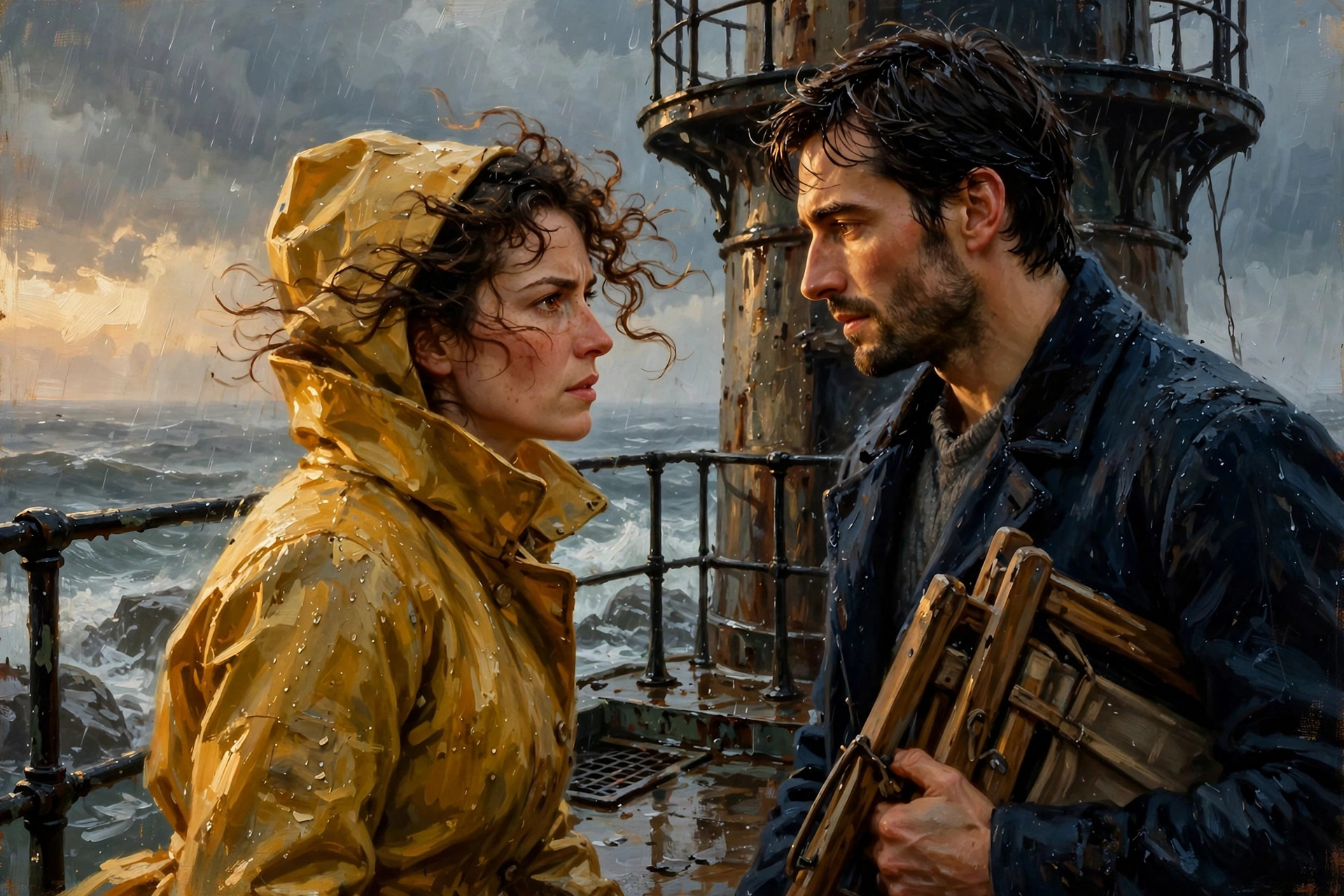
"You can't put a chair against the lamp room door," Isolde said, wiping her palms on her oilskin. "It's a fire exit."
"It's a door." Joaquin Beltran stood on the top landing with a folding chair under one arm and a clipboard under the other. "Doors are how people come in."
"People come in because I let them. That's the whole system."
"That's the whole problem."
Below them the sea slapped the rocks of Ravenscroft Light, gray and restless under a sky the color of dishwater. The gale warning had gone up at the Harrowgate Harbor Office that morning, and the wind had already begun to lean on the tower. She'd barely slept. He'd arrived at dawn with a duffel, a dive knife on his belt, and a letter from her uncle's trust that said, in elegant type, that he was hers to command.
He had not once acted as if that were true.
"Rounds every two hours," he said, reading from the clipboard. "Lower door, strongroom hatch, lamp room, gallery. I log each one. Nobody climbs without my say-so."
"Your say-so." Isolde laughed, short and unamused. "My grandmother kept this station before me. My family pays you."
"Your family pays me to keep this place standing." He set the chair down. "Not to keep you comfortable."
She turned from him and went down the iron stairs, boots ringing. He followed. Of course he did. He was a tall, steady shadow with a salvage diver's patience, and she had known him less than a day and already wanted to throw something at him.
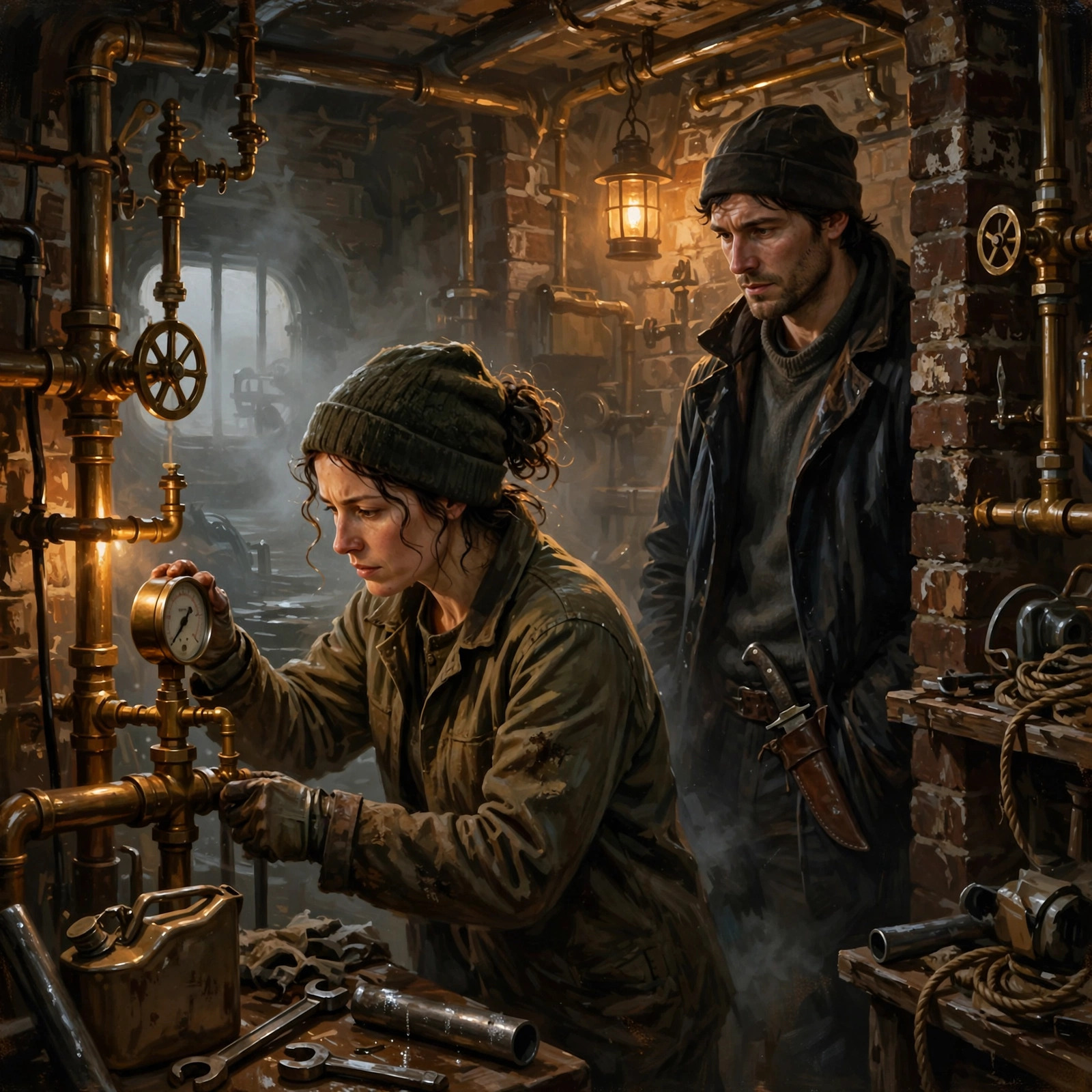
The horn house sat at the base of the tower, a squat brick room that smelled of oil and cold metal. She hauled the compressor switch. The machinery coughed, shuddered, and began to build pressure with a groan like a waking animal.
"What's this?" he asked.
"The test. I run it before any storm. Bess at the harbor office likes to hear it, and the boats like to know it works." She checked the gauge, tapped the glass. "You'll want these."
She held out a pair of ear defenders. He didn't take them.
"I'll tell you what I want," he said. "Your word you'll stay inside the tower once the weather turns. No walking the rocks, no checking the causeway on your own."
"I won't give it."
"Isolde."
"I've kept this light four years. I know where the rocks are." She heard her own voice go tight and hated it. "I don't make promises I might have to break. Ask anyone in Gullhaven."
Something crossed his face, quick and private, like a shutter slapped closed. "I've heard that about you. That you only trust what's written down."
"Paper doesn't forget."
"Paper doesn't pull you out of the water either."
The gauge needle crept toward the red line. She should have been watching it. Instead she was looking at the hard set of his jaw and wondering who had taught him to guard things alone.
"If you don't like my rules," he said quietly, "I'll go. Radio the trust. They'll send someone more agreeable."
"Then go."
He didn't move.
The wind rattled the horn house shutters. Far off, a gull screamed. Isolde folded her arms and waited for him to turn on his heel the way hired men did when the work got awkward. Joaquin only shifted his weight, planting his boots on the brick floor like a man who had decided where he would stand.
"I said I'd go if you wanted me to," he said. "I didn't say I would."
"That's not how it works."
"It's how it works for me." His mouth twitched, not quite a smile. "The causeway floods when the gale hits. If I leave now, you're alone out here with a lens worth more than this island, and a man named Stoll asking questions about your strongroom. Bess mentioned him. Twice."
Isolde's stomach turned over. Garrick Stoll had been sniffing around the family accounts for months, all smiles and patient letters. She hadn't known Bess had said a word to anyone.
"Bess talks too much," she muttered.
"Bess worries. It's different."
The needle touched the red line. Isolde slapped the relief valve, and steam hissed out in a long white sigh. Her pulse was doing something stupid. She wasn't sure whether to blame the pressure or the man.
She dug in her pocket, found the iron ring she kept there, and worked a single brass key off it. It was worn smooth. Her grandmother's thumb had polished it before hers.
"Lower door," she said, and pressed it into his palm. "It sticks in damp weather. Lift as you turn."
He looked at the key, then at her. "You said no one comes in without your say-so."
"I'm saying so. You, and no one else." She pulled the ear defenders over her own head, then thought better of it and shoved the spare pair against his chest. "Don't make me regret it."
"I'll log my rounds," he said.
"You'll log them in pencil. The ink runs in here."
That earned a real smile, brief and lopsided, and it did unfair things to her knees. He closed his fingers around the key, slid it onto a cord at his neck, and tucked it beneath his collar like something that might bite.
Isolde pulled the lever.
The horn came up out of the brick and the rock and the sea itself, a vast, bellowing note that shook the dust from the rafters and rolled out across the water toward the harbor. It filled her chest and her teeth. Beside her, Joaquin flinched, then settled, one hand braced on the wall, the other still wrapped around the key at his throat.
She glanced sideways, braced for him to bolt. He was looking out through the narrow window at the churning gray, jaw set, listening.
The horn sounded, long and low, and he stayed.
Salt on the Stairs
The radio on the landing crackled before Isolde had finished wiping the horn grease from her hands. Joaquin was two steps below her, one shoulder against the cold wall, and he glanced up at her as if she might know what it wanted.
"Ravenscroft Light, Ravenscroft Light, this is Harbor Office." Bess's voice came through the static, flat and brisk. "Isolde, pick up. I know you're standing right there."
Isolde lifted the handset. "I'm here."
"Good. Listen to me and don't argue. The gale's turned north faster than the forecasters thought. Tern Causeway goes under by dark, and it won't come back for three days, maybe longer. Nobody crosses after the tide turns. Nobody."
"Understood."
"Is the diver with you?"
Isolde looked at him. He lifted one eyebrow. "He's with me."
"Then he's staying whether either of you likes it. Shutters, Isolde. All of them. And eat something hot." A pause, the hiss of open air. "I'll call at every change of the tide. You answer, or I send the boat the second I can."
"You'll send nothing into that sea."
"Watch me. Harbor Office out."
The handset clicked dead. Isolde hung it on its hook harder than she meant to. Her aunt's voice, her father's voice, every old warning in her head had said never let a storm find the shutters undone, and here she was with the afternoon slipping away.
"Where are they?" Joaquin asked.
"Boat shed. Then the gallery. Then the keeper's cottage windows." She was already moving. "They're oak and they weigh more than you'd think."
"I've carried worse."
"Not up wet stairs."
He didn't answer that, only followed her out.
The wind had a different voice now, lower, with weight behind it. The sky over the water had gone the color of an old bruise. They hauled the first shutter between them across the wet grass, Isolde taking the heavy end out of habit, until Joaquin simply shifted his grip and took it from her without comment. She opened her mouth to object. He was already walking.
"I can manage that end."
"I know you can. Humor me."
She humored him, and hated how little it cost her.
By the fourth shutter her palms burned and her braid had come half undone. Spray reached them even this far from the rocks, a fine cold grit that tasted of iron. The tower stairs were slick with it, salt tracked in on every boot, and halfway up the spiral Isolde's heel skated out from under her.
A hand closed around her elbow. Firm, warm through her sleeve, gone again the instant she found her feet.
"Thank you," she said, too quickly.
"Mind the third landing. It's worse."
"It's always worse. I've been falling on that landing since I was six."
"Then why haven't you fixed it?"
"Because the stone is older than the family, and the family can't afford a mason." It came out sharper than she intended. She heard herself and added, quieter, "It's a long list. That's on it."
He said nothing, but at the third landing he walked on the outside, nearer the drop, and let her keep the wall.
They bolted the last shutter on the lamp room gallery as the first real rain began. Behind the glass the great lens turned, its brass frame gleaming, a hundred and thirty years of Ravenscroft patience throwing its slow white arm over the darkening water. Joaquin stopped to look at it. She had seen visitors do that for most of her life, and every one of them wore the same expression, as though someone had spoken their name.
"It's smaller than I expected," he said at last.
"Everyone says that."
"And then?"
"And then they stand there for ten minutes." She nudged his arm toward the stairs. "Come on. You can worship later. Supper first."
The keeper's kitchen was a low room with a black iron stove that took up most of one wall and gave off more heat than it had any right to. Isolde fed it driftwood and a shovel of coal, then dug through the cupboard. Tinned tomatoes. Half a loaf. Onions that had seen better weeks. A wedge of hard cheese wrapped in cloth.
"I'm not much of a cook," she warned.
"I'm not much of a guest." He had shed his wet jacket and rolled his sleeves, and she noticed, against her will, the pale scars crossing one forearm. "Give me the knife."
She gave it to him. He cut the onions with quick, careful strokes and said nothing about the tears she pretended not to see, and she said nothing about his. They worked in the narrow space without speaking, shoulders brushing, the stove ticking, rain hammering the shutters like a crowd demanding entry.
The stew was ordinary. They ate it standing at first, then sitting, then with their boots stretched toward the stove. Joaquin tore the bread in two and gave her the bigger half without remark.
"Bess says you dive," Isolde said.
"Salvage. Wrecks mostly. Pipes and moorings when the wrecks run dry."
"Do you like it?"
"I like the quiet." He turned his spoon over. "Nobody tells you anything down there that you can't see for yourself."
"That sounds lonely."
"It's restful." A shrug. "You live up a tower at the end of a causeway. Don't tell me you don't understand."
She wanted to be offended and couldn't manage it. "Fair."
The lamp above the table swung slightly as a gust found the chimney. He watched her over the rim of his mug, and she watched him back, and for a moment neither bothered pretending to look elsewhere. Then the radio muttered down the corridor, and she was on her feet before she knew she'd moved.
Night came on hard. She checked the lens twice, and he logged his rounds in pencil, as promised, in a neat slanting hand. Near midnight she found him on the lower landing, one palm flat against the door as water began to gather at the sill.
"Tide's in," he said.
Out past the rocks, where Tern Causeway had been a pale stripe of stone all her life, there was only black water, heaving and silver at its edges. It lapped over the last marker post and kept coming.
Isolde stood beside him and felt the whole island pull away from the mainland. Down the corridor the radio hummed, patient and low, waiting for the next call.
Neither of them moved from the door.
The Cracked Panel
The boat came in at first light, which was a generous word for the bruised grey seeping over the water. Isolde saw it from the gallery door, a squat harbor launch riding the swell too close to the rocks, and she said "No" aloud, to nobody, before Joaquin appeared at her shoulder.
"Friends of yours?"
"Garrick Stoll." She watched three figures in oilskins clamber onto the landing stage. "He trades at the harbor. He's been writing me letters for a year."
"Bess said he might come."
"Bess said the causeway would hold, too."
He didn't smile. He took the brass key from his pocket, turned it once in the lower door, and stepped out ahead of her into the wind. She let him. Then she stepped up beside him, because it was her door.
Stoll climbed the slick steps with his hat in his hand, as if he'd come to a christening. He was broad and pink-faced and courteous, and he smelled of wet wool and peppermints. Behind him, the two men stayed at the foot of the stairs. One carried a canvas bag. Neither looked at the tower. They looked at Joaquin.
"Miss Ravenscroft. Forgive the hour. The weather rather insisted."
"You took a boat through this."
"I took a boat before it got worse." He glanced at Joaquin. "And you're the hired man."
"I'm the man at the door," Joaquin said.
Stoll laughed, mildly. He turned back to Isolde and lowered his voice, as if the gulls might be listening. "Let's be sensible. Your uncle holds a debt against this station. Two hundred and forty thousand dollars. He's told half the harbor he'll forgive every penny if the old lens goes to a buyer. I am that buyer. The lens, and the strongroom beneath it, which I understand no Ravenscroft has opened in sixty years."
"It isn't for sale."
"Everything is, in a storm." He said it gently. "I'll clear the debt today. Cash against signature. Your uncle's trust is relieved, your name is clean, and you go back to your quiet life with a modern light, which is all anyone out there wants from you."
Her mouth had gone dry. Clean. She had carried that word like a stone since she was a girl, and he had found it in a single morning.
"The lens is the light," she said. "It's been turning since 1894."
"And it will turn in a museum, or in my warehouse, with a bulb in it. What does it matter where?"
"It matters to the ships."
"Ships have radar." He smiled. "Think of your family, Miss Ravenscroft. That's all I ask."
That was the cruelty of it. He knew exactly which lever to press. Isolde felt her spine straighten the way it always did when someone spoke of obligation, felt the old reflex to reach for a pen. She did not move. Joaquin, beside her, did not look at her at all, and somehow that was worse, and kinder.
"Leave the paper," she said. "I'll read it."
"I'd rather you read it with me. The tide won't wait for either of us."
"Then it won't," Joaquin said. "You've had your answer. Get back in your boat."
Stoll's face stayed courteous. His eyes did not. "Mr. Beltran, isn't it? I hear you're careful. I hear you obey sensible instructions."
Something crossed Joaquin's face, quick as a fish under ice. His hand closed at his side, over the forearm with the scars.
"Not lately," he said.
Stoll sighed and put his hat on. He lifted two fingers. The man with the canvas bag shouldered past the others, came up the steps in three strides, and Joaquin moved to block the door. For a moment the whole stair seemed to hang there. Then the second man, quicker than she'd credited, ducked around the tower's curve toward the seaward stair, where the little service door to the lamp room gallery had a latch that had never once worked properly.
"Joaquin!"
He was already running. Isolde ran after him, up the iron spiral, her boots ringing, her lungs burning. The gallery door was banging in the wind. The man stood inside the lamp room with his hood back and a long steel wrench in his fist, and the great lens turned its slow gold wheel around him, gorgeous and unbothered, throwing a thousand small rainbows over his face.
"Stop," she said. "Please. Don't."
He looked at her, and almost seemed sorry. Then he threw the wrench.
The sound was small and terrible, a single bright crack like ice on a pond. One panel of the lens starred from edge to edge, the beam stuttering, light scattering sideways across the glass. Isolde cried out as if she had been struck herself.
Joaquin hit the man at the waist and drove him backward through the gallery door. They went out into the wind together. She heard a shout, a boot on iron, the second man's voice below, and then Joaquin's, low and flat and utterly calm, saying something she couldn't catch. Feet scrambled down the stair. A moment later a boat engine coughed to life, and the launch swung off the landing stage and ran, Stoll's pink face turned back toward the tower, small and furious in the spray.
Isolde stood in the lamp room with both hands pressed over her mouth. The cracked panel glinted. The light kept turning, patient, wounded, still doing its work.
Joaquin came in a minute later, soaked, breathing hard. He shut the gallery door and set his back against it.
"They're gone."
"It's cracked," she whispered. "Eighteen ninety-four, and it's cracked."
"Glass can be mended."
"Not this glass." She turned, and saw the dark line running down his sleeve, bright at the cuff, dripping onto the brass floor. "You're bleeding."
He glanced at it as if it belonged to someone else. "It's nothing. The railing."
"Sit."
"Isolde."
"Sit down, Joaquin."
He sat on the low step beneath the lens. She knelt in front of him, tore a strip from the clean cloth she kept for polishing, and pushed his sleeve up past the old pale scars, where a fresh, ragged line cut across the newest of them. Her fingers were shaking. His forearm was warm and rough and very still. She wound the cloth tight, once, twice, and he hissed through his teeth but let her.
"You didn't have to go after him," she said.
"Yes, I did."
She tied the knot and kept her hand over it, pressing, while red bloomed slowly through the linen and the light went round and round above their heads.
Generator Stairwell
The lights died halfway down the stairs, and the dark came in like cold water.

"Generator," Isolde said, and put her palm flat on the wall. The stone shook under it. Above them the gale leaned on the tower, and the lens, with its one starred panel, was still turning on the battery backup. It wouldn't hold for long.
"Where?"
"Bottom landing. Behind the oil drums." She was already moving, one hand trailing the rail. "It stalls when the damp gets into the fuel line."
Joaquin's torch came on behind her, a narrow white beam bobbing over wet steps. His bandaged forearm was a pale shape in the edge of it. She had tied that knot herself, an hour ago, and she hated how clearly she remembered his skin under her fingers.
The generator sat in a stone alcove, squat and green and silent. Isolde knelt and found the choke by feel. Joaquin crouched beside her and held the torch in his teeth, then thought better of it and wedged it on a drum.
"Fuel cock," she said. "Left of you."
"Got it."
"Open it a quarter. Not more. It floods."
"A quarter." He turned it. His shoulder pressed against hers in the cramped space, solid and warm through two wet jerseys. "Pull?"
"Pull."
The cord snapped back through her fist. The engine coughed and died. She tried again, and again, and on the fourth pull she swore at it in a voice her grandmother would have scolded.
"Let me," he said.
"It's my generator."
"Then put your hand over mine."
She hesitated, then did. His fingers closed on the grip and hers closed on his, and they pulled together, one long drag from the hip. The engine caught. It stuttered, roared, and settled into a rough, honest drone. Overhead the stairwell bulb flickered and came up yellow.
Isolde laughed. It came out cracked and too loud, and she sat back on her heels with her hand still on his.
"Quarter turn," Joaquin said. "I'll remember that."
"You'd better."
He didn't smile back. He was looking at her the way he had looked at the lens, as if something fragile had survived by luck and he wasn't sure he was allowed to touch it. The torch beam lay across the floor between them. Wind found some gap in the tower and moaned through it.
"You went out on that gallery after him," she said quietly. "Bleeding."
"You told me to guard it."
"I told you to guard it. I didn't tell you to be hurt for it."
"Isolde." Her name sounded different in the stairwell, lower, rubbed smooth. "I've walked off a post before. Once. I'm not doing it again."
She wanted to ask what he meant. Instead she lifted her free hand and laid it against his jaw, cold stubble and warm skin, and felt him go utterly still.
"Tell me to stop," she said.
"No."
He kissed her, or she kissed him, and afterward neither could have said which. It was slow at first, careful, his hand rising to the back of her neck as if he expected her to flinch. She didn't. She fisted her fingers in his wet collar and pulled, and the kiss turned hungry and salt-sweet, tasting of rain and tea and fear finally let out. Her back met the cold stone. The generator shuddered beside them. Above, the tower groaned, and neither of them cared.
When they broke apart she kept her forehead against his. His breath came ragged. Hers wasn't any better.
"That," Joaquin said hoarsely, "was not in my contract."
"Aldous's trust will be devastated."
He huffed out a laugh against her mouth, and kissed her once more, short and certain, like a signature.
The radio crackled on the landing above. Bess's voice, tinny and brisk, was reading out the tide. Isolde closed her eyes.
"I should answer that."
"Go. I'll watch the generator."
"Quarter turn," she said, and he saluted her with two fingers, and she climbed the stairs with her lips still burning.
She answered Bess. She confirmed the shutters, the fuel, the lens. She said yes, they were both fine. Then she said she was going to check the cottage line, and hung up before Bess could ask anything else.
Down in the alcove the generator droned steadily, and Joaquin was down there with it, whistling very softly through his teeth. She stood at the landing cabinet and listened to it for a long minute.
Then she opened the cabinet and took out the consent book.
It was small enough to lie in one palm, leather gone soft as a glove, its brass corners worn bright by her grandmother's thumbs. Every promise the family had ever made was in here, in ink, in a dozen hands. Who might climb the tower. Who was owed what. Her grandmother had written on the first page, in her tidy slanted script: A name on this page is a name that holds.
Isolde turned to a clean leaf. Her own handwriting was already there, from the morning, the terms Stoll had dictated and she had copied out and not yet dared to finish. Two hundred and forty thousand dollars, forgiven at last. Aldous's patient disappointment, lifted off her like a hand from her shoulder. Every Ravenscroft who had ever paid what they owed, and she would be one of them.
Joaquin had said he was done walking off posts. She believed him. That was the trouble. If Stoll came again with more men and a better plan, there'd be no lens left to guard, and no tower, and Joaquin would be standing in the wreck of it with another wound on his arm.
He had a word he kept, now. She had hers.
She uncapped the pen. The tower shook, and her hand shook with it, and she steadied her wrist on the cabinet edge. The kiss was still on her mouth. She signed anyway: Isolde Ravenscroft, keeper, the ink bleeding a little into the old paper.
It looked horribly final. It looked like her father's handwriting.
She blew on it until it dried, closed the book, and slid it deep inside her coat, against her ribs, where she could feel it every time she breathed.
Struck Through
"Where is it?" Joaquin stood in the lamp room doorway with her coat in his fist, and the book lay open on the brass rail between them, her signature drying on the page.
Isolde had come up the stairs with two mugs of tea. She set them down very carefully. "You went through my pockets."
"You hung it on the hook and the coat fell. The book fell with it." His voice was flat, which was worse than loud. "You signed it. After the stairwell. After I told you."
"I signed it so you wouldn't have to stand in the wreck of this place."
"You decided that for me." He shut the book with a snap. "I've been on the receiving end of safe-sounding orders. I know what they cost."
"Joaquin."
He was already on the stairs. She heard the iron door at the bottom, the wind taking it, and then nothing but the gale leaning on the glass. Through the cracked panel, patched with his sealant, the light swung out over a sea the color of slate. Down on the rocks, a figure in yellow oilskins was crossing from the old boathouse. Stoll. He had walked the last stretch of the cut causeway on the ebb, with two men behind him.
She took the book from the rail and ran.
The wind hit her like a shoulder. Rain came sideways, stinging her cheeks, and she got to the yard in time to see Joaquin square himself in front of the generator shed with his hands open at his sides. Stoll stopped ten paces off. He was smiling the way a man smiles at a bill he knows will be paid.
"Mr. Beltran. Your employer's niece and I have an understanding."
"Then she can tell me so to my face."
"Isolde!" Stoll saw her and lifted a hand, warm as a host. "Good. Tell your hired man to stand aside. You've signed. I have a boat waiting and the tide won't."
The two men behind him carried bolt cutters and a long pry bar. One of them was looking at the power line. Isolde saw it and understood, with a cold drop in her stomach, that nobody was going to wait politely for paperwork.
"You said you'd come when the gale eased," she called. "For the transfer. With a proper witness."
"I said what the day required." He shrugged. "Aldous wants this settled before the weekend. He's been very clear."
"Has he?"
"He sent word through me. Time is short."
That was the thing she had missed. Aldous never hurried anything in his life. He had let the debt sit for years like a patient hound. And the lines to the mainland had been flat since midnight — the morning call had carried nothing but the tide. No message had come through. No message could have.
"You forged his hurry," she said.
Stoll's smile slipped a quarter inch. "Don't be dramatic."
Isolde opened the consent book against her coat, shielding it from the rain with her body. Her hands were shaking. She found the page. Her signature sat there, tidy and ruinous, above her grandmother's slanted rule about names that hold.
A name held, her grandmother meant, because someone chose each time to hold it. Not because ink said so.
She uncapped the pen with her teeth. Two lines, hard, through her own name. Then a third, through the whole pledge, until the nib tore the paper.
"There," she said. "Struck through. Two hundred and forty thousand dollars, Mr. Stoll, and Aldous can have the lot back from me in installments until I'm eighty. You don't get the lens."
Joaquin hadn't moved. But he looked at her then, across the rain, and something in his shoulders gave.
"That's a crime," Stoll said softly. "Breaking terms."
"It's an unsigned page."
He lunged. Not at her, at the book. Joaquin was faster, a hip, a forearm, and Stoll went down hard in the wet gravel with a grunt of pure outrage. One of the hired men started forward and stopped, because the portable radio on Isolde's belt crackled and Bess's voice cut across the wind, dry as toast.
"Ravenscroft Light, Harrowgate Harbor Office. Tide's turned and the pilot boat's off the point. Two minutes, Isolde. Tell me nobody's dead."
Isolde pressed the key. "Nobody's dead. Three trespassers, one forged message. Bring rope."
"Already aboard," said Bess. "Don't let him wander."
The men did not wait to be asked twice. They went for the rocks, and then slowed, because the harbor boat was coming round the headland with its searchlight raking the spray, and there was nowhere on that island left to run. Stoll sat in the gravel with mud to his collar, glaring at the book as if it had cheated him.
"Aldous will hear of this," he said.
"Good," said Isolde. "I'll tell him first."
She held the pen out to Joaquin, and it took her a moment to realize why her hand wouldn't stop trembling. He took it. Then he took her hand, pen and all, and kept it.
The boat came in on the swell. Men in slickers jumped to the landing, and Stoll was walked down the rocks between two of them, still protesting. The wind had dropped a notch. The rain thinned. Somewhere over the water a gull complained.
"Go up," Joaquin said. "Check the lamp. I'll see them off."
"You'll come back."
He looked at the book in her other hand, at the torn nib and the three black lines. "Quarter turn," he said, and it was almost a smile. "Count the stairs."
She climbed. The lens was still turning, still lit, its patched panel throwing an honest bar of light over the water. She stood beside it with the ruined page against her chest and counted, and when she reached the last landing she heard the iron door below, and his boots, coming up.
Lamp Room Dawn
"You're standing on the cracked side," Joaquin said.
"I'm aware." Isolde did not move. The patched panel threw a pale seam of light across her wrists, and beyond the glass the sea lay flat and gray, rinsed clean by three days of weather. "I like it. It's honest."
"It's held together with brass tape and your grandmother's good opinion."
"Those are excellent materials."
He laughed, low, and came up the last of the ladder with two mugs balanced in one hand. Tea, from the smell. He'd slept in a chair on the landing, because neither of them had trusted the stairs to stay quiet, and his hair still showed the shape of the chair back. The pale scars along his forearm caught the early light as he set the mugs on the sill. The bandage she'd tied was gone. In its place was a neat strip of white tape, applied by someone who had clearly done it one-handed.
"Bess called," he said. "Stoll's in a cell at the harbor office with a blanket and a grudge. The two men gave statements before breakfast. Fast, and in quite a lot of detail."
"Of course they did."
"And Aldous rang the office at six. Bess put him on the radio so I could hear." He picked up his mug, put it down again. "He wants you to call him. He sounded like a man who'd been told to eat a lemon."
Isolde touched the brass rail of the lens frame. It was cold and smooth, worn bright in the places where four generations of Ravenscroft hands had steadied themselves. "He'll ask about the debt."
"Will you tell him?"
"I'll tell him I'm keeping the lens. I'll tell him I'll work the money back, one job at a time, the way the harbor does it. Surveys, the horn contracts, the training courses Bess keeps nagging me to run." She breathed out. "It will take most of my life."
"Mm."
"That's all you have to say?"
"I'm thinking it doesn't sound like much of a sentence." He turned to face her fully. The sun had cleared the horizon behind him, and for a moment the whole lamp room went amber, glass and brass and the dust turning in the air. "Isolde. I walked off a post once. Not here. Before. I was told to wait for orders and I waited, and a man I trusted went into the water without me."
She had known the shape of it. She had never heard him say it flat out.
"After that I stopped promising anybody anything," he said. "Easier. Nobody can say you broke your word if you never gave it. And then I got here, and you handed me a key and a bad cup of coffee and treated me like I was staying."
"The coffee was fine."
"It was terrible." He stepped closer. "The night before last I left you at the generator; yesterday I went after Stoll alone, and that was the old thing. Doing what I thought was right and calling it loyalty. I'm sorry for it."
"I signed that page behind your back." Her voice came out smaller than she meant. "I hid the book. I thought a promise on paper would protect everyone. I thought it was safer than asking you to stand next to me."
"And now?"
"Now I think people are the only thing that hold a promise up." She looked at his hands, scarred and capable, and then at his face. "I love you, Joaquin. Plainly. No terms."
The wind ticked against the glass. Somewhere below, a gull tried out its morning voice.
"I love you," he said. It sounded like something he'd carried up a long stair and finally set down. "I'm staying. If you'll have me, I'm staying. Not because the trust pays me, and I'd say so to Aldous's face."
"He'd be thrilled."
"He'd choke on his lemon."
She was laughing when he kissed her, and then she wasn't. His hand slid to the back of her neck, careful of the tangle her hair had become, and she pulled him in by the front of his sweater until the cold brass rail pressed against her spine and she didn't care. It was slower than the stairwell. Less like an accident, more like a decision made twice. When they parted, his forehead stayed against hers.
"The book," she said, not moving.
"The book."
She had carried it up the night before and left it on the stool by the lamp, the torn page still marked with its three black lines. Now she opened it to a clean sheet. Her grandmother's careful hand ran down the earlier entries, who might enter the tower, which promises the family kept and to whom. The struck-through pledge lay there like a scar, and she let it, and did not tear it out.
She uncapped the pen. The nib was bent, and it scratched.
"What do we write?" Joaquin asked.
"The truth. Short." She thought, then wrote in her plain upright hand: Joaquin Beltran is welcome in this tower, by day or night, for as long as he will stay. She signed it, and held out the pen.
He read the line twice. Then he bent over the book and added beneath it, slowly, as if every letter were a stair he meant to climb: I will. And his name, and the date.
She blew gently on the ink. He watched her do it with an expression she intended to remember until she was very old.
"Quarter turn," he murmured.
"Count the stairs."
He reached past her and threw the last switch on the old brass panel, the one that was only ever thrown at day's end, and then he stopped, and shook his head, and laughed at himself. "Wrong direction. It's morning."
"Leave it."
"The lamp's meant to go out at dawn."
"It will. In a minute." She slipped her fingers through his. "I'd like to see it once in daylight with you here."
He nodded. They stood together beside the patched panel, shoulder to shoulder, while the sun climbed and the cracked glass took it in and bent it into a long gold bar across the water. The mechanism ticked. The great lens began to turn, slow and sure, its light pouring over the sea in the dawn.
Get notified when new stories drop

Serena Blake
Serena writes romantic suspense and dark romance for readers who want pulse and payoff. Her stories chase trust as hard as they chase danger.
Leave a comment
Comments