


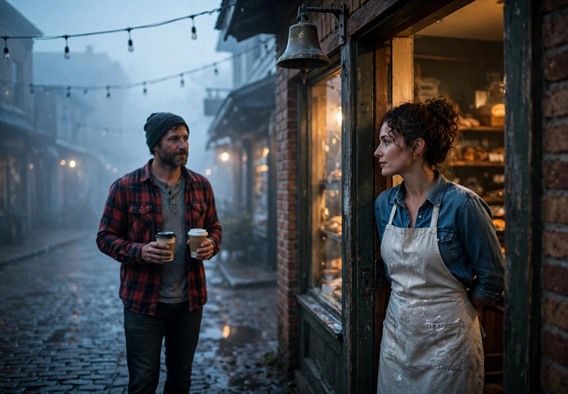


Brine Barrels

"I'm not asking for charity," the lamp keeper said. "I'm asking to buy something you sell."
Ilse Marchetti didn't look up from the herring. She slit the next one from gill to tail, thumbed out the silver memory curled inside it like a seed, and dropped it into the curing jar at her elbow. It hissed faintly as the brine took it.
"We sell to the cooperative," she said. "And to families. And to the old men who want to remember their wives' cooking. We don't sell to the Company."
"I'm not the Company."
"You're wearing its coat."
He glanced down at himself as if he'd forgotten. The coat was navy wool with brass buttons stamped with a lantern, and it was soaked through at the shoulders. Fog had followed him in the door. It hung in the smokehouse rafters now, gray and patient, curling around the strings of drying fish.
"Theo Lacroix," he said. "I keep the lamps from the breakwater to North Point."
"I know who you are."
That stopped him. She liked that it stopped him. Everyone in Gullstone knew who the lamp keepers were, the way you knew which dogs bit. Six of them walked the shoreline every dusk with their oil cans and their long brass poles, and the Company sent a new one whenever an old one quit or drowned. This one had lasted longer than most. He was tall and narrow, with a jaw that needed a shave and the careful posture of a man who expected to be blamed for things.
"Then you know the oil's failing," he said.
Her knife paused. Only for a moment.
"Two lamps went dark last night by the fish market. The fog came right up the steps." He took a folded paper from his coat and smoothed it on the edge of her table, away from the brine, as though it were precious. "The Company's oil burns blue in clean air. In this fog it gutters inside the hour. I've filed four reports. I've requested a better grade. I've followed every procedure there is."
"And now you're in a smokehouse."
"And now I'm in a smokehouse," he agreed, and something in his voice went dry and tired, almost funny.
Ilse set the knife down. She wiped her hands on her apron, which didn't help much. Her fingers smelled permanently of salt and smoke and the bright copper tang that memory left behind.
"Your Company," she said, "put a notice on the chapel door that says any keeper who touches cooperative magic will be dismissed. My aunt framed it. It's hanging in her kitchen."
"I've read it."
"I'd imagine you've memorized it."
He didn't deny it. He just looked past her, at the shelves that lined the back wall: rows of stoppered jars glowing faintly amber, each one holding a cured memory packed in salt. A child's first snowfall. A wedding dance. Somebody's grandfather whistling. They pulsed softly in the dim, the only warm light in the room.
"Is it true," he asked, "that one jar will hold a lamp through fog?"
"Three hours. Then the brine needs renewing."
"Three hours is more than I've got now."
"And when it burns, the memory's gone." She said it flatly, so he'd understand. "Not faded. Gone. Whoever gave it to us never gets it back. You want me to sell you someone's wedding dance so you can light a street the Company won't pay to light properly."
He was quiet. Then, more carefully than she expected: "Do people give them willingly?"
"Some do. For money, or because it hurts to keep them." She picked up the knife again so her hands had a reason to be busy. "Some of us don't give anything."
He heard the shift in her voice. She saw him hear it, and hated that she'd let it show. She turned to the nearest barrel to check the brine level, mostly to put her back to him.
The barrels stood in a row along the north wall, oak staves sweating salt, each taller than her hip. The end one had been listing on its blocks since spring. She'd meant to fix it. She'd meant to fix a great many things.
When she leaned to lift the lid, the block beneath it gave a soft, rotten crack.
The barrel tilted toward her. Brine sloshed over the rim in a cold sheet down her skirt, and the whole weight of it kept going, slow and terrible, toward the shelf behind her where the oldest jars lived.
"Move," Theo said, and then he was there.
He got his shoulder under the rim and both hands flat on the staves. She braced beside him, boots skidding in the spill. For a moment the barrel hung between them, groaning, the brine inside heaving like a living thing. She could feel his arm trembling against hers through the wet wool.
"On three," she managed.
"One--"
They didn't wait for three. They shoved together, and the barrel rocked back upright and settled with a heavy thud that shook dust from the rafters.
Ilse stood there breathing hard, soaked to the knees. Theo straightened and pressed a hand to his shoulder. Brine dripped from his cuffs. His careful paper lay on the table, untouched and dry, and she found she was absurdly glad of that.
Then she turned to the shelf.
The jars had rattled. A few had shifted forward. And at the end, where it always sat, the pewter salt cellar had slid to the very lip of the board. It was small enough to fit in her cupped hands, its lid etched with a ring of tiny engraved gulls. Her mother had cast it the year before Ilse was born, and engraved every gull herself by lamplight.
Ilse pushed it back. Her fingers didn't quite want to let go of it.
"That one's different," Theo said behind her. He wasn't asking.
"It isn't for sale."
"I didn't think it was."
She waited for him to ask what was in it. People always asked. Instead he crouched by the barrel, examined the split block, and pulled a folding knife from his coat pocket.
"You'll want a wedge under the near side until you can replace this," he said. "Have you got any scrap wood?"
She stared at him. "You're fixing my barrel."
"It nearly fell on you." He looked up, faintly puzzled, as if this were obvious. "And on that."
She found him a slat of driftwood from the kindling box. He shaved it into a wedge with neat, economical strokes and tapped it into place with the heel of his hand. He checked it twice. Then he tested the barrel with his weight and checked it a third time.
"You do everything like that," she said.
"Like what?"
"Like someone's going to inspect it."
His hands stilled on the staves. For a moment the tired, dry humor left his face entirely, and what was underneath was older and sorer than she'd guessed.
"Someone usually does," he said.
He stood and wiped his knife clean and put it away. He picked up his paper and folded it back along its creases. He didn't ask again. That, more than anything, undid her.
Outside, the fog pressed against the windows. Somewhere toward the fish market, a woman was calling a child's name, sharp with worry.
Ilse went to the shelf. She skipped the wedding dances and the snowfalls. Down at the end, past her mother's cellar, sat a jar of memories the cooperative bought cheap from sailors who wanted to forget: a storm, a bad night at cards, a quarrel. Small griefs people were glad to be rid of. She took one down and held it out.
"Three hours," she said. "Not one minute more. And if anyone from the Company asks, you found it in the gutter."
He looked at the jar, then at her. He reached into his coat and counted coins onto the table, more than the jar was worth. When she opened her mouth to say so, he shook his head.
"For the barrel," he said, and took the salt out into the fog.
Aunt Magda's Rule
"He's back," Magda said, without looking up from the ledger. "Your lamp keeper. Standing in the yard like a heron that's lost its pond."

Ilse set down the brining paddle. "He isn't my anything."
"Then you won't mind if I send him off."
"Aunt Magda."
Her aunt finally lifted her head. Magda had a face weathered into permanent amusement, and she turned all of it on Ilse now. "Three nights ago North Point stayed lit through the worst of it. The Company's oil didn't do that. I can count jars, girl. I've been counting them since before you could walk."
Heat climbed Ilse's neck. "It was one jar. Sailors' leavings."
"I know what it was." Magda closed the ledger and tapped the cover twice with one blunt finger. "The cooperative doesn't sell to the Company. That's the rule, and I made it, and I'll keep it in public till they bury me." She stood, joints creaking, and took her shawl from the peg. "What my niece does with the cheap shelf on her own time, I don't see. I'm old. My eyes go."
"Your eyes have never gone a day in your life."
"Then don't make me use them." At the door, Magda paused. "And Ilse. Don't let him pay you in anything you can't spend."
She was gone before Ilse could ask what that meant.
Theo came in a moment later, hat in his hands, coat beaded with fog. He looked at the door Magda had left by, then at Ilse.
"She walked past me and said good evening," he said. "Is that bad?"
"It's unprecedented." Ilse wiped her hands on her apron. "She knows."
The color went out of his face so fast it alarmed her. He'd been standing easy, and now he stood like a man waiting for a sentence to be read out.
"She won't say anything," Ilse added quickly. "She told me she's going blind. Very convenient. Very sudden."
Some of the stiffness left his shoulders, though not all of it. "And the Company?"
"The Company doesn't drink in her kitchen." She tilted her head at him. "You came back for more."
"The fog's thicker than it was. Ashby sent a crate of the new oil this morning. I tested it." He turned his hat a slow half circle by the brim. "It gutters at the first wet gust. I've got the North Point lamp tonight and two more down the strand, and the oil won't hold any of them."
"So you need salt."
"I need a lamp that burns." He hesitated. "I'd also like to see how it's done. Properly. I set the jar in the well last time and hoped."
She laughed before she could stop herself. "You hoped. You, with your wedges checked three times."
"I wrote it down afterward," he said, with dignity. "In detail."
Of course he had.
She fetched two jars from the end of the shelf, past her mother's pewter cellar, which sat exactly where it always sat, lid shut, catching a dull gleam from the stove. She didn't look at it long. She never did.
"Bring a lamp," she said. "I'll show you here, where it's dry."
He'd brought one. Naturally. A Company tidelamp, brass and thick glass, heavy enough that he set it on her worktable with both hands. He unscrewed the font and tipped out the useless oil into her slop pail, and the smell of it, thin and sour, hung between them.
"The salt doesn't go in like oil," Ilse said. "It has to know where it's going." She uncorked the first jar. Inside, the crystals were grayish, a little cloudy. "This was someone's bad night at cards. He lost his boat's share and walked home in the rain, too ashamed to knock on his own door."
"You know that just from looking?"
"I cured it. I know all of them." She tipped a measure into her palm. The salt was faintly warm, as cured memory always was, as if it had been held a long time in someone's pocket. "You press it in. Not pour. Here."
She took his hand without thinking and turned it palm up, and poured half the salt into it. His hand was colder than hers and roughened at the knuckles. He went very still.
"Into the wick bed," she said, and her voice came out lower than she meant. "Slowly. Pack it with your thumb."
He did it the way he did everything, carefully, evenly, as though there'd be a test. When the wick bed was full she struck a match and touched it to the salt, and the flame took on the instant without smoke: a clear, gold, stubborn light that didn't so much as flicker when he opened the shutter and let the wet air in.
Theo stared at it. "Three hours," he said.
"Three. And then that poor man's night at cards is gone for good. Nobody will ever remember it again. Not him, not me."
"Does that bother you?"
"That one?" She shrugged. "He paid us to take it."
His eyes went, briefly, to the shelf and the pewter cellar, and then came back to her without a question in them. She was beginning to depend on that, which was its own kind of danger.
The cupboard door above the stove chose that moment to swing open on its own and bang against the wall, as it did every time the wind shifted. Ilse reached up and shoved it shut. It drifted open again.
"How long has it done that?"
"Since my mother was alive. The top hinge pulled loose."
He was already at it, knife out, frowning up at the screw holes. "They've stripped. You need a longer screw or a plug."
"I've lived with it."
"You shouldn't have to." He looked around. "Matches? Spent ones."
She gave him a saucer of them. He broke three in half, dabbed the ends in the glue pot she used for labels, and packed them into the holes, then drove the old screw back in with the tip of his knife, slow quarter turns. When he let go, the door stayed shut. He opened it and closed it twice. It stayed.
Ilse found she'd come to stand very close to him. Close enough to smell the brine and lamp brass on his coat.
"Nobody's fixed that in a long time," she said.
"It was a small job."
"That isn't what I said."
He looked down at her, and for a moment neither of them seemed to know what to do with their hands. Then he picked up the burning lamp and closed the shutter on it.
"I'll walk it out to North Point," he said. "And I'll bring the empty jars back. I'll keep a count, so you'll always know what's gone where."
"You'll keep a count," she repeated. "On paper?"
"Somewhere safe."
A small chill went down her back, and she couldn't have said why. She gave him the second jar. He tucked it inside his coat, and when she pressed the cork down firm against his chest to make sure it wouldn't leak, he covered her hand with his to hold it there.
It was meant to be a moment. A thank you.
Neither of them let go.
The lamp hissed softly in its brass. Fog pressed at the window. Somewhere in the yard, Magda's voice rose, loud and theatrical, scolding a gull, giving them warning. Theo's thumb moved once across her knuckles, and still he didn't step back, and still she didn't pull away.
North Point
"Hold the light still," Theo said, "or I'll put my thumb through the frame."
"I am holding it still. The wind isn't."
The lamp room at North Point was barely wide enough for the two of them and the great brass lantern between them. One pane of its glass lay in pieces on the iron floor. A gull, or a gust, or the fog itself had driven something through it in the dark, and the salt-flame inside had guttered and drowned. Out past the rail, the grey pressed close and thick. Ilse could hear the water moving under it. She tried not to listen for anything else.
She lifted the hand lantern higher. Theo knelt at the frame with a putty knife, scraping out the old glazing in short, careful strokes. The replacement pane leaned against his knee, wrapped in a flour sack. He'd carried it up the stair inside his coat.
"You keep spare glass," she said.
"I keep two of everything." He didn't look up. "Company regulation is one."
"So you break the rules after all."
"I exceed them. That's different."
She laughed before she could stop herself, and he glanced up at the sound, quick, as if he wanted to catch it. Then he went back to scraping.
The shards on the floor caught her light. She crouched and began picking them up into her apron, the big curved pieces first.
"Leave those. You'll cut yourself."
"I've gutted fish since I could walk. I know how to hold something sharp."
"Ilse."
It was the first time he'd said her name like that, low and plain, without a Miss in front of it. She stopped with a shard between her fingers. He held out his hand, palm up, and after a moment she gave it to him. He set it with the others in a tin bucket by the door, then took the apron's gathered corner from her and tipped the rest in, slow, so nothing spilled.
"Light," he said. "Please."
She held it up again.
He pressed fresh putty along the frame with his thumb, then lifted the new pane out of its sack. It was thin, nearly invisible, a square of cold air with an edge. He fitted the bottom into the channel and tilted it home. The wind hit it at once and it shuddered in his hands.
"Hold this corner," he said. "Just there. Not hard."
She set the hand lantern on the floor and put two fingers to the glass. He worked the putty up the far side, pressing, smoothing, pressing. His sleeve brushed her wrist each time he reached. She kept her fingers where he'd put them.
"Why North Point?" she asked. "You keep eleven lamps along that shore. This is the one you come back to."
"It's the one that matters most. The channel bends here. Boats coming in blind hit the shoal if they can't see it." He smoothed the last seam. "And it's the one I lost last week. Before you."
"Lost?"
"Went dark. Company oil. It thickens in the cold and won't draw." He sat back on his heels. "Nobody wrecked. I was lucky."
"You don't sound like you think so."
"I've been lucky before. Once you're not, nobody remembers that you were." He wiped his thumb on a rag and didn't say anything more about it, and she didn't push. She knew what it was to keep a door shut.
The pane held. He tapped it once with a knuckle and it rang faintly, and the wind found nothing to rattle.
"Now the salt," he said.
She took the jar from her basket. This one held an old net-mender's memory, one of the ones Theo had bought from the barrel: a summer morning, a boy's shoulders under his hands, a laugh across the water. She'd cured it three weeks ago. She'd sat with it a long while before she let it go into the brine, the way she did with all of them, turning it over to make sure she'd remember that someone once had it.
She uncorked the jar. The salt glowed faintly gold inside, the color of that morning.
"You do it," Theo said.
"You're the keeper."
"It's your salt. It should be your hands."
She looked at him. He stepped aside to give her room, which in that lamp room meant pressing his back to the rail.
Ilse opened the lantern's brass door and poured a line of salt into the well, then wet it from the brine flask at her hip. It hissed. For a moment nothing happened. Then the light came up from underneath, slow, warm, gold going to white, and the fog outside the new glass turned luminous all the way down to the water. She heard, or thought she heard, the edge of a child's laugh, there and gone, burned clean.
She shut the little door and kept her hand on it.
"Three hours," Theo said quietly.
"I know."
"Then I'll come back up and renew it. You needn't stay."
"I'm not going down that stair in this."
The beam swung out over the channel. Below, somewhere in the grey, a bell answered, a boat finding its way. Ilse let her breath go slowly.
"Somebody's coming home," she said.
"Because of that." He nodded at the lamp. "Because of you."
"Because of a stranger's summer morning." She turned the empty jar in her hands. "He'll never have it back."
"Does that hurt? Burning them?"
"Every time." She didn't mean to tell him the rest, and told him anyway. "My mother went out in a fog like this one. Walked down to the boats to bring my father his supper and never came up the hill. They didn't find her till the tide turned. I keep everything since. Every scrap. Because I couldn't keep her."
Theo didn't say he was sorry. He took the empty jar from her, took out the little book from his coat, and wrote in it by lamplight, small and square. Then he tore the corner off the page and held it out.
She read it. One jar, North Point. A summer morning. Ilse remembered it.
"So it's written somewhere," he said. "That it was here. That it mattered."
She folded the scrap very small and put it in her bodice, against her skin, and when she looked up he was nearer than the room required. The light moved over his face and away and back again.
"You'll get putty on my dress," she said.
"I'll pay for the dress."
"You overpay for everything."
"Not everything," he said, and his hand came up, careful, the same way he'd held the glass. He waited. He gave her all the time in the world to step back.
Ilse rose onto her toes and kissed him.
He made a low sound against her mouth, surprised, and then his hand was at the back of her neck and the rail was cold behind them both and the lamp turned its slow white circle over their heads, holding the dark off the water.
The Company Desk
"Sit down, Lacroix. You look like a man who's come to resign."

Lionel Ashby didn't look up from the ledger. The Harbor Lantern Company office smelled of lamp oil and wet wool, and the window behind the desk showed nothing but grey, the fog pressed flat against the glass as if it meant to come in and read the books too.
Theo stayed standing. He had his cap in both hands and his little notebook in his coat, and the notebook felt heavier than it had any right to.
"I've come to make a report, sir."
"Then make it."
"The oil hasn't held North Point since the fog came in. Not for more than a few minutes at a stretch." He kept his voice level, the way he'd practiced it on the walk down. "The lamp's been burning on cooperative salt. Brinewife salt. Most nights this week."
Ashby's pen stopped.
He set it down very gently, which was worse than if he'd thrown it. "Say that again."
"I've kept a count." Theo took out the notebook and laid it on the desk, open to the page with the neat columns. Jar, night, hours burned. "Every jar I took, where it was used, how long it held. It's all there."
"You kept a count." Ashby turned the book toward himself with one finger. "Of breaking Company law."
"Of keeping the light lit, sir."
"Those are not the same sentence." Ashby read down the page. His mouth thinned. "Who supplied you?"
Theo had known that question was coming. He'd known it since before dawn, sitting on the edge of his cot with his boots in his hands, thinking about the last post and the inquiry board and the man who'd stood up and said the keeper should have caught it. Nobody had asked about the cracked reservoir or the bad oil. They'd asked about him. He had sworn, after, that there would never again be a thing he'd done that wasn't written down and handed in first.
"The Gullstone smokehouse," he said.
"Marchetti's girl."
"Miss Marchetti, yes."
Ashby leaned back. The chair creaked. "And you've come to me now, before anyone else could, because you'd rather be the man who reported it than the man who got caught."
Theo didn't answer. It was true, and he hated that it was the first true thing Ashby had said.
"Sensible," Ashby said. "I'll note your cooperation. I'll also be sending two men to that smokehouse within the hour to take every grain of cured salt off the premises. The Company doesn't burn witchcraft in its lamps, Lacroix. Not on my district."
"Sir, the fog--"
"Will be met with oil. Better oil. I've written to the city." He stood, and the conversation was over. "Go back to your lamp. And don't make me fine you."
Theo took his notebook. His hand wasn't quite steady on it.
"You might go with them," Ashby added, at the door. "To the smokehouse. Show them where it's kept. You seem to know."
He went. He told himself it was so that nothing would get broken.
The Company men were not gentle. Ilse heard them before she saw them, boots on the shingle and a cart behind, and she had just enough time to wipe her hands on her apron before the door banged open and let the fog in with them.
Theo was third through. He didn't look at her.
"By order of the district superintendent," said the taller man, and held out a paper she didn't take. "All cured salt on these premises is to be surrendered."
"This is cooperative property."
"Not anymore it isn't."
They started with the shelves by the door. Jar after jar went into the crates on the cart, the stoppered ones and the open curing crocks, a whole winter's work of other people's mornings and lullabies and arguments. A drowned fisherman's wedding. A widow's last good afternoon. The shorter man tipped one of the end barrels to see what was in the bottom, and Theo's driftwood shim skittered out across the floor and fetched up against her shoe.
Ilse bent and picked it up. It was warm from the stove side of the room. She held it so hard the grain bit her palm.
"How did they know," she said. Not to the Company men.
Theo stood by the cupboard with the matchstick hinge, the one he'd fixed. His hands were at his sides. "I told Ashby."
She'd already known. She'd known the moment he walked in third and kept his eyes on the floorboards. Hearing it was something else, a cold thing going straight down through her.
"You told him."
"He'd have found out. Somebody would have seen the light and asked what was burning, and it would've been an inquiry, and they'd have come for you anyway, only I'd have been--" He stopped. Started again, quieter. "I wrote it all down. It's on my record now that I came forward. That I kept count. You were never named as anything but the supplier."
"Never named as anything but." She laughed, and it came out wrong. "Do you hear yourself?"
"I'm trying to keep a post, Ilse. If I lose North Point there's nobody up there who knows that lamp."
"There's nobody up there now. You've seen to that. There's no salt."
The taller man had reached the high shelf above the stove. His hand closed on the pewter cellar, the little lidded one with the engraving worn soft at the rim, and lifted it.
"Put that down." Ilse was across the room before she'd decided to move. "That isn't stock. That's mine."
"It's salt, miss."
"It's my mother's." She took it out of his hands. He let her, mostly from surprise. "It's sealed. It's never been opened and it's never going to be. Write that on your paper."
The man looked at Theo. So did she.
Theo's jaw worked. He'd seen her nearly lose it the first day, when the barrel tipped. He knew exactly what it was.
"It's personal property," he said at last. "Leave it."
The taller man shrugged and went back to the crates. It was a small mercy, and it was his, and she didn't want it.
When the cart was loaded the smokehouse looked like a mouth with the teeth pulled. Bare shelves. Rings in the dust where the jars had stood. The Company men went out and the fog swallowed them, the wheels grinding off toward the harbor.
Theo didn't go.
"Ilse." He took a step toward her. "The fog's going to get worse before the week's out. Everyone at the harbor says so. If the oil doesn't hold--"
"Then you'll have it written down that it didn't."
"That's not fair."
"No." She held the cellar against her chest with both hands. "It isn't."
He looked at it. She saw him look, saw him think it, and she hated him for one bright moment more than she'd hated the fog.
"There's enough in that," he said, very low, "to hold North Point through the worst of a night. You know there is."
"Get out."
"I'm not asking you to sell it, I'm only saying if it comes to--"
"You don't get to say it." Her voice cracked and she let it. "You don't get to take everything else and then stand in my kitchen and ask for her too."
He opened his mouth. Closed it. For a second she thought he'd reach for the notebook in his coat, write something small and square and tear it off for her, and if he did that she would throw the cellar at his head.
He didn't. He put his cap on and went to the door and stopped there with his hand on the frame, the fog beading on his sleeve.
"I'm sorry," he said.
"Write it down," Ilse said, and slammed the door.
Pewter Lid
The fog had come over the breakwater at noon and by dusk it had eaten the harbor whole. Ilse could hear it more than see it. Bells muffled into thumps, gulls gone quiet, and under everything the soft slap of water against stones that should have been lit.
She was halfway up the North Point path with the cellar inside her coat when she heard voices at the top. One of them was Theo's.
"I'm not disputing the regulation, sir. I'm telling you I broke it."
She stopped in the wet grass. The lamp above them was a smear of sick yellow, guttering. Company oil, failing the way everyone had said it would.
"You came to my office yesterday with a report." Ashby's voice was dry and careful, a man reading aloud from a ledger. "You named the cooperative. You named the woman. You did not name yourself."
"I'm naming myself now."
Ilse climbed the last few steps. They stood on the platform under the lamp, Ashby in a good wool coat with a lantern of his own, Theo bareheaded, his cap twisted in one hand. Behind them, at the rail, a shape in a black shawl turned. Magda.
Her aunt raised one eyebrow at her and said nothing at all.
"Every jar of salt that went into this lamp, I carried up myself." Theo didn't look at Ilse. He was looking at Ashby the way he looked at a cracked pane, as if it were only a thing to be fixed correctly. "I kept a count. Here." He pulled the notebook from his coat and held it out. "Dates, jars, hours burned. She brined it. I'm the one who used it on Company glass."
Ashby took the notebook and turned pages under his lantern. Fog beaded on his spectacles.
"This is very thorough, Lacroix."
"Yes, sir."
"It makes you liable for the full fine."
"I know what it is." Theo dug in his pocket and came out with a fold of banknotes, soft from handling. "Four hundred. It's all of it. Count it if you like."
Ilse knew what four hundred dollars was to a keeper. It was most of a year. It was the spare pane, the extra wick, every careful thing he'd ever put by so that nobody could say he'd been caught short again.
Ashby counted it. Slowly, by lantern light, while the lamp above them spat and dimmed.
"The fine is paid," he said at last. "The post is another matter. The Company can't keep a man who conspires with the cooperative. You understand."
"I do."
"Then you're relieved. Effective tonight."
Theo nodded once. His shoulders went down a fraction, as though something heavy had finally been set on the floor. Then he looked up at the lamp, and his face changed.
"Sir, the oil won't last the hour."
"That's no longer your concern."
"There's a fishing boat still out past the reef. I saw her lantern at four." His voice rose for the first time. "If North Point goes dark in this, the drowned come up the rocks, and they don't stop at the waterline. You know they don't."
Ashby's mouth tightened. He looked at the lamp, then at the fog, then, finally, at Ilse, as if he'd only now remembered she existed.
"And you, Miss Marchetti. I'm told every grain of cured salt in Gullstone is sitting in my storeroom."
"Not every grain," said Magda, from the rail.
Ilse felt the cellar against her ribs. Cold pewter, warming slowly through her shirt. Her mother had cast it the year Ilse was born and cut the vines into the lid with a nail and a borrowed file. Ilse had traced those vines a thousand times without lifting the lid once.
Theo turned and saw her properly. He saw her hand at her coat, and his face went very still.
"No," he said. "Ilse, no. I didn't come up here for that. I didn't tell him so you'd--"
"I know why you told him." She pulled the cellar out. The fog swallowed the lantern light off it, so it glowed dull, like a coin at the bottom of a well. "You told him so it'd be your name in the book and not mine."
"It was always going to be my name. It should've been from the start."
"Yes." She was surprised how easy it was to agree. "It should."
The lamp coughed. Somewhere below, a sound came off the water that wasn't a wave. Low and wet, almost a voice.
Magda crossed the platform and put her hand on Ilse's wrist, not to stop her. Just to be there.
"Your mother laughed like a kettle," Magda said quietly. "Too loud in church. She'd have told you a sound is for using."
"You're not helping."
"I'm not trying to."
Ilse looked at Theo. He'd come a step closer, his empty hands half lifted, like he wanted to take the weight from her and knew he had no right.
"You'll write it down," she said. "Afterward. What it was."
His throat moved. "Every word I can find."
"Then open the glass."
He didn't argue. He climbed the short ladder and unlatched the lamp housing, and the sour oil smell rolled out. He scraped the dead wick clean with his knife and held his hand down for her. She passed the cellar up, then climbed after him, because she wasn't going to let anyone else's thumb be on that lid.
It stuck. Twelve years of sea air had sealed it tighter than wax. She worked her nails under the rim and pried, and it came free with a small, clean pop.
For one breath, nothing. Grey salt, fine as flour.
Then she heard it. Not in her ears, exactly. Somewhere behind them. Her mother in the kitchen doorway with flour on her elbow, laughing at something Ilse had said, that bright, ridiculous, too-loud sound that made the dog bark and the neighbors bang on the wall.
Ilse tipped the cellar into the brine cup.
The laugh went with it. She felt it go, the way a tooth goes, a sudden absence her tongue kept looking for. She tried to hear it again, just once more, and there was only the shape where it had been.
The lamp caught.
White light, clean as noon, burst out through the lens and struck the fog, and the fog gave way. Down on the rocks, pale shapes that had been climbing stopped. Turned their faces from the beam. Slid back, one by one, into the black water.
Far out past the reef, a small boat lantern bobbed and swung toward shore.
Ilse realized she was gripping the empty cellar so hard the vines were printing into her palm. Theo's hand closed over hers. He didn't say anything. He just held on, the two of them crouched in the lamp housing with the heat on their faces.
Below, Ashby lowered his lantern. Magda let out a sound that was almost a laugh of her own.
"Three hours," Theo said hoarsely. "It'll burn three hours. That gets her in. That gets us to the turn of the tide."
"Then sit with me," said Ilse. "And don't you dare write anything yet."
He sat. Above them, steady and bright, the light held.
Empty Cellar
"You polished it," Theo said from the top of the stairs.
Ilse didn't turn around. She was sitting on the lamp room's iron floor with her back against the housing, the pewter cellar in her lap, a rag in one hand. The lid lay beside her knee, bright as a coin.
"Somebody had to. It was black with brine." She rubbed the engraved vines one more time, though there was nothing left on them to rub. "Magda said you'd be up here."
"Magda said you'd be up here."
"Then she's a liar or a schemer, and I know which."
He came the rest of the way up. He wasn't wearing the Company coat. She'd never seen him without it, and he looked strange in a plain brown jacket, narrower, like a man who'd been unbuttoned from a uniform and didn't yet know where to put his hands. He settled on putting them in his pockets.
The lamp above them was cold. Clean, though. Someone had scraped the lens and trimmed the wick and laid fresh oil in the reservoir, the ordinary way, for ordinary weather. Through the glass the sea was flat and grey and harmless, the fog gone back to wherever fog went when it had been beaten.
"You're not supposed to be in here," she said. "You're not the keeper anymore."
"Ashby hasn't changed the lock." He paused. "Also I kept a key. Beyond regulation."
That nearly made her smile. She bent over the cellar so he wouldn't see it.
He crouched an arm's length away, careful, the way he'd crouched beside her two nights ago in the heat of the lens. He took a folded paper from his jacket and held it out.
"I said I'd write it down."
She looked at the paper and didn't take it.
"I wasn't sure what to put," he said. "I only heard what you told me after. So I wrote what you said. Flour on her elbow. The dog. The neighbors banging on the wall." His jaw worked. "It's not the sound. I know it isn't. It's just the shape of it."
"The shape's all I've got now." She took the paper. His handwriting was small and square and dreadfully neat, a ledger hand, and halfway down he'd written too loud, she said, and she said it like that was the best part, and Ilse had to fold it closed fast.
"I keep trying to hear it," she said. "Like poking at a gap in your teeth. Twenty times this morning. Every time, nothing. And then I think, well, the boat came in. The fisherman's wife bought me a pie. A whole pie, Theo. Rhubarb."
"Was it good?"
"It was terrible. I ate half." She turned the cellar in her hands. "She'd have laughed at that. And I can't hear her do it."
He didn't say he was sorry. He'd said it enough on the stairs of the smokehouse, on the road, at the bottom of this tower with the fog coming in. Instead he reached over and set his thumb against the rim of the cellar, beside hers, not taking it, just there.
"I kept it twelve years so I'd never have to be the girl on the beach again," she said. "Waiting for a light that didn't come. And then I was the one holding it."
"You were."
"It was the first thing I ever gave away."
"It was the best thing anyone's ever done on this coast," he said, "and I'd write that in any ledger you like."
She laughed, short and startled, and the sound bounced off the glass. Not her mother's. Hers. Smaller, rougher. Still there.
Theo heard it too. She saw him hear it.
"Magda's offering you a post," she said, because if she didn't say something practical she'd do something foolish. "Lampman for the cooperative. She thinks we can sell salt to the outlying lamps the Company won't keep. Ashby's already muttering about it."
"She told me this morning." He rubbed the back of his neck. "There's no rulebook. She said I'd have to write one."
"You'll love that."
"I will, actually." He hesitated. "I told her I'd only take it if you didn't mind me underfoot. I'm not going to ask you to forgive me so I can have a job."
"You already paid for it."
"Four hundred dollars doesn't buy back what I did to your aunt's salt."
"No," she agreed. "But you walked into Ashby's office and gave up the only thing you had that nobody could take, which was a clean record. I know what that was to you. You told me about your last post. You told me in that awful flat voice like you were reading it off a form."
"I was protecting it," he said quietly. "Then I watched you climb that ladder, and I couldn't remember why it had ever mattered."
The cellar was warm now from both their hands. Ilse set it down on the iron floor between them, upright, lid off. Empty. Polished. It caught the grey light and cheap it back, a dull little moon.
"I'm going to cure something new into it," she said. "Not today. But I'm not keeping it empty, and I'm not keeping it shut for twelve years again either. Whatever goes in it, I'll burn when someone needs it."
"What will you put in?"
She looked at him. At the ridiculous plain jacket and the key he shouldn't have and the folded paper still warm in her fist.
"I haven't decided," she said. "Something that happens up here, maybe."
His face did something slow and careful, a man reading a line twice to be sure of it.
"Ilse."
"Don't make me say it first. I've given away enough this week."
He laughed, helpless, and then he stopped laughing and looked straight at her, the way he looked at a lamp before he trusted it.
"I love you," he said. "I've loved you since you sold me a jar off the cheap shelf the day I met you. I'm going to love you in writing, in triplicate, with a copy filed."
"You're impossible."
"That's not an answer."
"I love you," Ilse said. It came out plain and easy, nothing hoarded about it at all. "I love you, Theo. Write that down."
"Later," he said, and reached for her.
She went. Across the cold floor, over the empty cellar, into his arms, and he pulled her in so tight her cheek pressed against the rough wool of his collar and she could feel his heart going hard and fast under it. She held on to him with both hands. Below the tower the sea moved, quiet and ordinary, and the light around them was only daylight, and it was enough.
He didn't let go. She didn't ask him to.
Get notified when new stories drop

Cade Ellison
Cade specializes in romantasy and paranormal romance: magic systems with rules, courts with knives, and longing that rearranges destinies.
Leave a comment
Comments