


The Open Action
"Don't," Lorna said, and slapped his hand away before the key finished going down.
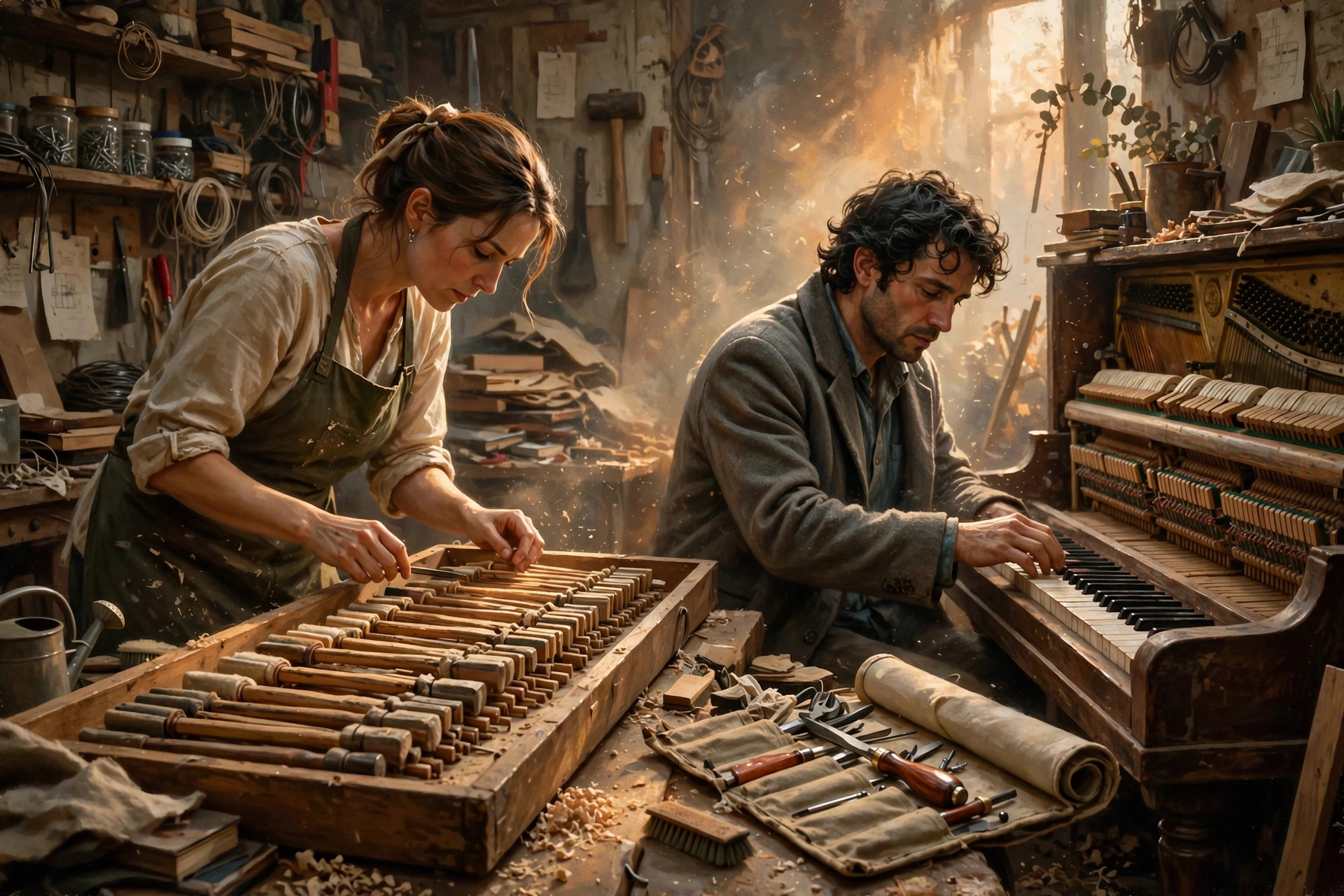
The man in the gray overcoat pulled his fingers back as if the ivory had bitten him. He looked at his hand, then at her, then at the long wooden tray balanced across her workbench. Eighty-eight hammers stood in a crooked row, some upright and gleaming, some still tipped at angles only she could read.
"It's a piano key," he said. "I've touched a few."
"It's a half-regulated action sitting out of its case. You just knocked a jack I spent forty minutes setting."
Gus Treml cleared his throat from the doorway, wiping sawdust off his palms onto his apron. "Lorna. This is Theo Marchetti. From Linden Hall."
She knew the name. Everyone in Brennick, Ohio who cared about music knew the name, which wasn't many people, but it was enough. The board had hired a touring pianist to run the recital series, and the local paper had printed his photograph twice: dark curls, serious mouth, the kind of jaw that photographed well under stage lights.
He looked tireder in person. There was a crease between his brows that didn't go away when he stopped frowning.
"I'm sorry about the jack," he said, and seemed to mean it, which annoyed her more.
Lorna bent over the tray. The key he'd pressed was a G above middle C, and the hammer had flown up and checked a hair too high. She slid the regulating tool from her apron pocket and eased the let-off button down a quarter turn without looking at him.
"You can fix it that fast?"
"I can fix it. Fast is your word."
Gus made a small noise that might have been a laugh. He was a big, slow man with reading glasses pushed into thinning white hair, and he'd built Halvering Piano Works out of a garage and stubbornness. He drifted toward the coffee maker. "Mr. Marchetti's here about the contract."
Lorna's hand stilled on the tool.
"Theo," the pianist said. "Please."
"Theo's here about the contract," Gus repeated, mildly, and poured three mugs nobody had asked for.
Lorna set the regulating tool down on the bench, beside the rosewood handle of her father's tuning lever where it lay in her open tool roll. She touched the lever once, a habit, the way some people touched a doorframe on the way out.
"What about it?"
Theo took the mug Gus handed him and held it without drinking. He had pianist's hands, long and clean, and he kept them very still, as if he'd learned not to trust them near anything that mattered. "The series lost its biggest donor last spring. The board wants the season to reopen in the fall, but they want it cheaper. I've gone through everything. Lighting, printing, the reception wine." He paused. "Piano service is the largest line I haven't touched."
"Eighteen thousand a year," Gus said, to the coffee.
"There's a firm in the city that's bid twelve."
The workshop was suddenly very quiet. A radiator ticked under the window. Somewhere in the back, Bea had left a sanding block on a soundboard, and Lorna could see it from here, a small blue rectangle on pale spruce. Bea, who had come to them two years ago knowing nothing and now could voice a treble section better than half the technicians Lorna had trained under. Bea, whose paycheck came almost entirely out of that eighteen thousand.
Lorna looked at Gus. Gus looked at his mug.
"A city firm," she said. "Who drives out once a month, tunes for an hour, bills you for the mileage, and never opens the case."
"I haven't decided anything."
"You came here to tell us you're weighing it. That's a decision with its coat still on."
He set the mug down carefully on a stack of felt samples, then looked at it there and moved it to the windowsill. "I came because I don't know what eighteen thousand buys. Nobody at the hall could tell me. They said the piano sounds fine."
"It does sound fine." She heard her own voice go flat. "Fine is what I'm paid to stop it from sinking below. That hall has a 1978 Baldwin with a cracked pinblock I've been nursing through three winters. Every week I'm there, I'm keeping it from dying in front of an audience."
Something crossed his face. It was quick, a flinch more than an expression, and then it was gone.
"Then the hall needs a new piano more than it needs a service contract," he said.
"The hall can't afford a new piano."
"No."
Gus finally set his coffee down. "It doesn't need a new one." He tipped his head toward the tray of hammers, then toward the shape beyond it under a canvas cover, nine feet long and black where the canvas didn't reach. "Show him."
Lorna didn't move.
"Lorna."
She knew what Gus was doing. She'd known since the morning he'd bought the instrument from a church in Dayton that was closing its doors, paying more than he should have and grinning about it all the way home. A 1962 Steinway D with a split bridge and moths in the dampers. She had rebuilt the action herself, every hammer, every flange, every felt, and finished last year. She had been regulating it since, one careful pass at a time, and it was not ready to be shown to a performer. Performers looked at a piano the way a buyer looked at a used car, hunting for the thing they could blame later.
Her father had trusted a performer once.
She pulled the canvas back anyway, because Gus was her boss and because Bea's sanding block was still sitting on that soundboard.
The case was empty where the action should be, the keybed bare, the strings shining in the work lamps like a long iron harp. Theo stepped closer. He didn't reach for it this time. His hands went into his coat pockets, and stayed there, and she noticed that, unwillingly.
"That's what's on your bench," he said. "The action's from this."
"Yes."
"You built all of it?"
"Rebuilt. The factory built it." She folded the canvas over her arm. "I want it at Linden Hall. As the house piano. Gus would loan it to the series for the cost of moving it, as long as the hall keeps us on to maintain it."
"And if the hall goes with the city firm?"
"Then I'm not letting someone I've never met put a wrench on a piano I spent a year rebuilding."
Theo looked at the strings for a long moment. The crease between his brows deepened. "I'd want to play it before I took that to the board. Properly. Not a few chords in a workshop."
"It's half regulated."
"Then finish regulating it." He turned to her, and his voice was quieter. "I'm not trying to ruin anybody's year, Ms. Achebe. I'm trying to keep the doors open. If this piano is what you say, I'll fight for it. But I won't stand in front of a board and promise them something I haven't had under my own hands."
Under his own hands. She almost said something sharp about that and found she didn't have it ready.
Gus looked between them like a man watching two dogs decide whether to share a porch. "How long, Lorna?"
She glanced at the tray, at the crooked hammers, at the G she'd already put right. "A few days. Enough to play on. Not enough to perform on."
"That's fair," Theo said.
"You'll come back and test it."
"I'll come back and test it before I decide anything." He took his mug off the windowsill, drank it finally, and grimaced. "Gus, this is terrible coffee."
"Thirty years, nobody's complained."
"Everybody's complained," Lorna said.
Theo's mouth moved, not quite a smile. He set the mug down and, at the door, paused to look back at the bench. At the hammers, at the tool roll, at her father's lever with its worn rosewood grip. He didn't ask about it. She was oddly grateful.
"Don't touch my keys next time," she said.
"Then you'd better be there to play them for me."
The door swung shut behind him. Lorna stood with the canvas over her arm for longer than she meant to, then laid it back across the open case and picked up her regulating tool.
Felt and Needles
"Again," Lorna said. "The C major. Slower, and stop leaning on the thumb."
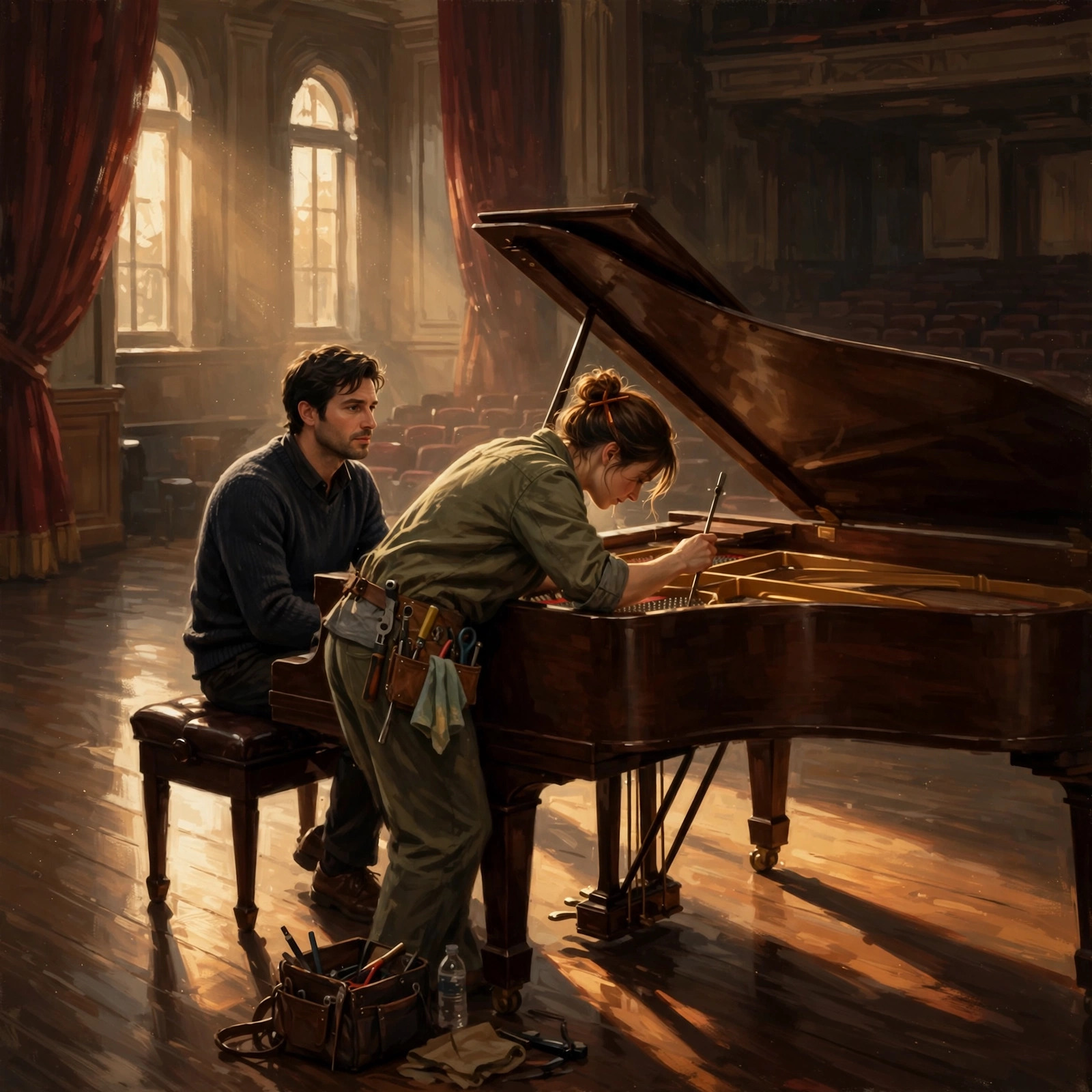
Theo lifted his hands off the keys and looked at her over the top of the action frame. "I don't lean on my thumb."
"You lean on it like it owes you money." She had the hammer for the D above middle C pinched between two fingers, the voicing tool in her other hand, three fine needles set in a short wooden handle. "Play."
He played. The scale climbed out of the old Steinway's keyboard, which sat on her bench outside its case with the whole action exposed. Eighty-eight hammers stood in a row like a choir that hadn't learned to sit still. Each note thumped a little, bare and close, because there was no rim around it to lift the sound. When he reached the D, it came out bright and hard, a little glassy, the way a voice sounds when someone is trying too hard to be cheerful.
"There," she said. "Hear it?"
"I heard it Monday."
"You heard it Monday and said nothing."
"I was told not to touch your keys." He had the grace to look pleased with himself. "I'm following instructions."
Lorna bent over the hammer. She angled the needles into the shoulder of the felt, low and away from the striking point, and pressed. Once. Twice. A tiny exhale of give under the steel. The felt was dense, good German wool, and it fought her the way good felt should. She turned the hammer to the light, ran a thumb over it, and set it back in its place.
"Just the D," she said.
He struck it. Rounder now. Not quite there, but warmer, as if it had stopped performing and started talking.
Theo struck it again, then the C and the E on either side, and frowned. "Now it's darker than its neighbors."
"Now its neighbors are too bright. I'm working up from the bass. Some of us do things in order."
"Some of us have a board meeting at the end of the month."
"Some of us should've thought of that before telling a technician to finish regulating a concert grand in a few days."
"You told me a few days."
"I said enough to play on." She pointed the voicing tool at him. "You're playing on it. Scales. Slower."
He started again from the bottom. She moved down the row and pulled the next hammer forward. She had never voiced with a pianist at the bench before. Usually she played her own test notes, one finger, the same soft-loud-soft pattern her father had taught her at a workbench in a shop that no longer existed. She'd assumed a performer would be impatient. She'd assumed he'd want to play Rachmaninoff at her and call it feedback.
Instead he played what she asked, exactly, the same velocity every time. His left hand was so even it was almost irritating.
"You practice scales," she said, not quite a question.
"Every morning. An hour."
"Still? At your level?"
"Especially at my level." He didn't look up from the keys. "If you skip the boring part, the boring part waits for you onstage."
Something about the way he said it made her glance over. His jaw was set. Then he hit a G with a clean, square attack and the moment passed, and she wasn't sure she'd seen anything at all.
The back door banged. Bea came in with a coffee carrier in one hand and a box of hammer shanks under her arm, her hair stuffed into a knit hat with a pom-pom that had seen better winters.
"Gus says the city firm's rep called him," Bea announced, before she'd even put anything down. "Wanted to know if we'd sell our dampers. Our dampers. Like we're having a yard sale." She noticed Theo and stopped. "Oh. Hi. You're the director."
"Theo."
"Bea. I'm the apprentice. I'm the one who does the shanks nobody else wants to do." She set the carrier on the end of the bench, well clear of the action. "Lorna, yours is black. Mr. Director, I didn't know you were here, so you get Gus's."
Theo took the cup and sniffed it with real suspicion.
"It's from the place on Main," Bea said. "Not the shop pot. Nobody should drink the shop pot."
"Thank you," he said, sincerely enough that Bea grinned.
Lorna watched him over the action. He was looking at Bea's box of shanks, then at Bea, the crease between his eyebrows coming back. She knew he'd done the arithmetic. Anyone who looked at the shop's books would know Gus couldn't carry a second technician on retail tunings and school uprights. The Linden Hall contract was what paid Bea. Lose it, and Bea would be the one packing her pom-pom hat into a car.
Bea knew it too. She was too cheerful about the dampers.
"I'll be in the back," Bea said. "Gluing. Yell if you need hands."
"I won't," Lorna said.
"She never does." Bea winked at Theo and was gone.
The silence afterward was different. Theo set the coffee down on the windowsill, far from the keys, which she noticed and didn't comment on.
"She's good?" he asked.
"She's very good. Better hands than I had at her stage." Lorna pushed a hammer back into line with the tip of her finger. "She moved here for this job. Turned down a warehouse manager position to sweep sawdust for Gus."
"I'm not trying to--"
"I know what you're not trying to do. You said." She kept her eyes on the felt. "Play the A-flat scale. Both hands."
He played. She voiced. It went on like that, the room filling up with notes and little bursts of argument. He told her the F-sharp sounded like a cough. She told him the F-sharp sounded like a cough because he played it like one. He laughed out loud at that, a real laugh, short and surprised, and it changed his whole face. She bent closer to the hammers so he wouldn't see what it did to hers.
By late afternoon the light through the high windows had gone amber. Her fingertips were tender from the needles. Theo had rolled his sleeves to the elbow at some point and she hadn't seen when.
"Play me the middle," she said finally. "Anything you like. Quiet."
He hesitated, hands hovering. Then he played a few bars of something slow, a melody that walked carefully and turned at the end like it had forgotten something. The bare action thumped under it. Still, the hammers met the strings evenly, one after another, and the tone held together across the break where it had been fighting itself all week.
He stopped in the middle of the phrase.
"That's not finished," she said.
"Neither is the piano." But he was looking at the keys with an expression she hadn't seen on him before. Not satisfied. Something closer to hungry. "It's going to be beautiful, isn't it."
"It already is. You're just finally hearing it."
He looked up at her then, and held it a beat longer than he needed to. She looked away first, toward her tool roll and her father's lever lying in its sleeve, the rosewood dark with years of somebody else's grip.
"Let's put it back," she said. "You can't judge it outside the case."
"Show me what to do."
"Nothing. Hold the door if the wind catches it."
He held nothing and didn't argue, which she counted as progress. She lifted the action by its rails, felt the familiar heft settle into her forearms, and walked it to the open case. She lined the keyframe up on the keybed, checked the hammers cleared the strings, and pushed.
The action slid home into the case with a soft wooden sound, like a drawer closing on something kept.
After Closing
"You're still here," Lorna said, which was a stupid thing to say to a man standing in the workshop doorway with snow on his shoulders.
"The sign says closed. The door says otherwise." Theo stamped his shoes on the mat. "You didn't lock it."
"I never lock it when I'm working."
"Anyone could walk in."
"Anyone just did." She set down the tuning lever on the felt strip beside the pins and wiped her hands on her apron. Gus had gone home at six. Bea had left with a container of his wife's soup and a promise to be in early. The overheads were off except the one above the grand, so the Steinway sat in a pool of yellow light with the rest of the shop dark around it, benches and half-strung uprights and a pile of old keytops like teeth in a jar.
Theo didn't come closer right away. He stood with his hands in his coat pockets and looked at the piano the way people looked at a dog that had bitten them once.
"You said you'd play-test it," she said. "Next week. In daylight. With the board's ears on it."
"I know what I said."
"So why are you standing in my shop at ten at night?"
"Because I'd like to play it when nobody's deciding anything." He finally walked over. Up close he looked tired, the kind of tired that sat behind the eyes. "Is it ready?"
"It's tuned. I finished the unisons an hour ago. It's as ready as it gets without a hall around it." She hesitated, then stepped back from the bench. It cost her something, that small step. She noticed him notice it.
He didn't sit. He put one hand flat on the rim, on the black lacquer where it curved, and left it there.
"Can I tell you something first," he said. "Before I play. Otherwise I'll play badly and you'll think it's the piano."
"I'd know it wasn't the piano."
"Yes. That's sort of the problem." He almost smiled. "You asked me on Monday why I don't perform anymore. I gave you some line about directing."
"Programming is a calling. I remember. You said it like a brochure."
"It was a brochure. I wrote it." He looked down at his hand on the rim. "Years ago I was in a hall out west, a good hall, a recital everyone said would make me. Second half, Schumann. The piano was badly regulated. Nobody had checked it after the afternoon rehearsal. The keys went shallow on me in the upper middle, a few of them didn't repeat. Halfway through the slow movement a note just didn't come."
Lorna said nothing. She knew exactly what a note that didn't come felt like under a finger. It felt like stepping onto a stair that wasn't there.
"I tried to cover it. Then I listened to myself trying to cover it." He breathed out through his nose. "And then I stopped. Hands in my lap. In front of everyone. I don't know how long. Long enough that someone coughed, and then someone else, and then a woman near the front started clapping like it was over, to be kind, and that was worse."
"What did you do?"
"I stood up and walked off. I haven't played a public recital since." He took his hand off the rim. "Every hall I programmed after that, I checked the piano myself. Every key. Every pedal. I've sent technicians home. I've made them cry, probably. I couldn't let anybody else's hands decide whether I'd freeze again."
She thought of her father's shop window, the paper sign taped inside it. She thought of a man in a good suit telling a newspaper the piano had been out, it had been the tuning, a shame. She had spent a long time hating performers in a general way so she wouldn't have to hate one in particular.
This one was standing in front of her with his shoulders up near his ears.
"That wasn't your fault," she said.
"It was partly my fault. I didn't check."
"It was the technician's job."
"You'd say that."
"I'd say it because it's true." Her voice came out harder than she meant. She softened it. "The piano is supposed to be the one thing in the room you don't have to think about."
He looked at her for a long moment. Then he nodded at the bench. "Will you check it for me? Before I sit."
It was such a small request. She understood it wasn't small at all. He wasn't checking it himself.
She sat on the bench, ran a chromatic scale soft from the bottom to the top, then the same loud. She tested repetition on the notes he'd mentioned, the upper middle, thumb and finger trading fast. Every hammer came back. Every note spoke. She lifted the damper pedal and let the whole instrument ring once, a low wide shimmer, and stood.
"It'll hold," she said. "I promise."
He sat. He moved the bench an inch back, then a half inch forward. He shook out his hands. She leaned against the curve of the case on the far side, where the lid stood open on its long stick, and waited.
He started with the slow melody from the other day, the one that turned at the end like it had forgotten something. This time it didn't stop. It went on into a second part she'd never heard, darker, the bass coming up under it, and the Steinway gave him everything she'd built into it: the even middle, the clean break, the felt she'd needled for hours singing instead of thumping. In the case and in the dark shop the sound was enormous and private at once.
She watched his hands. Then she stopped watching his hands and watched his face, which was the more dangerous thing to do.
When he reached the turn at the end, he played it slowly, and this time it resolved. He held the last chord until it thinned to nothing.
Neither of them moved.
"That's finished," he said quietly. "I finished it this week. I haven't finished anything in a while."
"What's it called?"
"I don't know yet." He looked up at her across the strings, through the opening the lid made. "It was for the piano. Mostly."
"Mostly," she repeated.
He stood. The open lid was between them, black and angled like a wing, and he put his hand on the edge of it, and she put hers beside his without deciding to. She could feel the last of the chord still in the wood.
She leaned across. So did he. The kiss was careful at first, as if either of them might be wrong about it, and then it wasn't careful. His hand came up to her jaw. Somebody's elbow bumped the lid prop and she caught it without looking, because some part of her was always going to be the technician.
He laughed against her mouth. "You just saved the lid."
"I always save the lid."
"I know." He said it like it meant more than the lid.
She came around the tail of the piano. He met her halfway, by the bench. She lowered the lid onto its short stick, gently, her eyes on him the whole time, and reached for the switch over the grand.
In the last of the light he shrugged off his coat, still damp from the snow, and dropped it on the bench.
Let Me Try
"It's the G above middle C," Theo said, before she'd even put her bag down. "It's late. Barely. Listen."
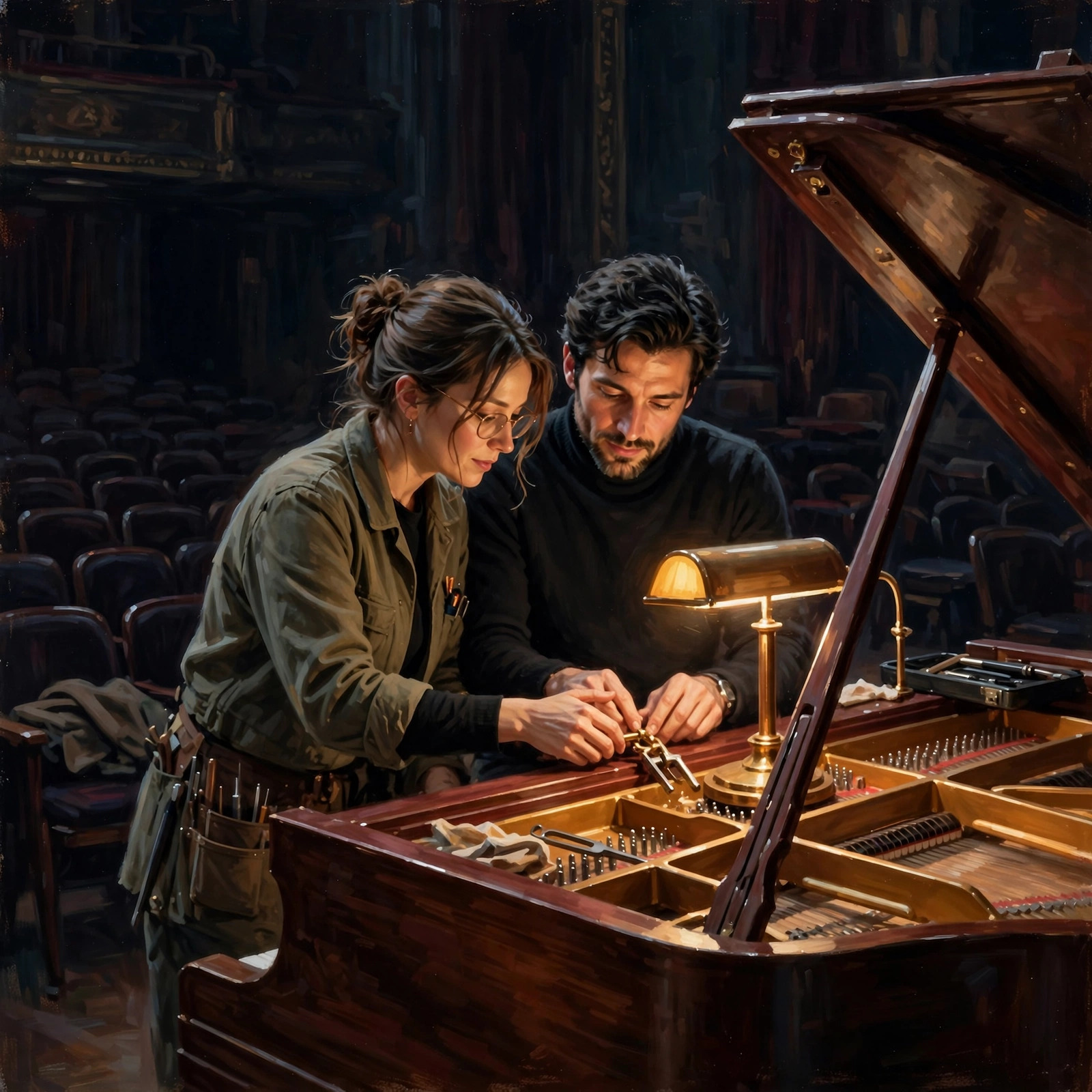
Lorna listened. He played the note, then the run leading into it, then the note again. The snow had melted off the workshop windows overnight, and the gray light came in flat and honest across the keys. He'd been there before her. Gus must have let him in.
"It's not late," she said.
"It's a hair late. Under the hand, it's a hair late."
She hung her coat on the hook by the door, slower than she needed to. Three days since the night he'd finished the piece. Three days of texts that were mostly about weather and once, at midnight, just the word Mostly with no explanation, which she had read more times than she'd admit to Bea. And now he was here early, sitting at her piano with his sleeves pushed up, telling her the action was wrong.
She came around and sat on the corner of the bench he wasn't using. "Play it again."
He did. She watched the hammer this time, not his hand. She watched it rise and strike and fall back to rest. It was fine. Maybe there was something in the let-off, a thread's width. Maybe.
"I'll look at it after lunch," she said.
"I'm here now." He was already turning on the bench toward the felt strip by the pins, where her father's lever lay where she'd left it the other night, rosewood handle worn pale at the grip. "It's one hammer. I know how to do this. I used to regulate my own practice piano when I was a student. I just want to feel what it does if we bring it in."
His hand was on the lever before she'd stood up.
"Don't."
It came out louder than the shop deserved. He stopped, the lever lifted an inch off the felt, his fingers around the handle her father had turned on a lathe in a back room in a town she didn't live in anymore.
"Lorna. It's a tuning lever. I'm not going to break it."
"Put it down."
"I'm only--"
"You don't touch my work." She was on her feet now. "And that isn't even what you'd use for a let-off button. You'd need a regulating tool. You'd know that if you'd ever actually done this instead of telling people how it ought to feel."
He set the lever down. Carefully, she noticed, which made it worse. He laid it on the felt the way she would have.
"Okay," he said. "Then you do it. Now. While I sit here. I'd like to watch."
"So you can check me."
"So I can understand it."
"You asked me the other day to check it for you." She heard her voice going thin and couldn't stop it. "You said you'd trust what I did. That lasted, what, a long weekend?"
Something closed in his face. "I'm trying to play this thing in front of people. In a hall. For the first time since I walked off a stage in front of eleven hundred of them. You know what that was about. You know what a piano that's even slightly wrong under the hand does to me."
"It isn't wrong."
"Then show me."
"I don't have to show you." She pushed the bench back with her knee, hard, and the legs barked on the floorboards. "My father didn't have to show anybody either. He tuned for thirty-odd years in a shop you could cross in six steps. And one night a man in a very good suit sat down at a piano Dad had worked on, and played a concert, and afterward told a reporter the instrument was out. That was all. One sentence. 'The instrument was out.' People stopped calling. Within a year the shop was a phone store."
Theo didn't move.
"Was it out?" he asked quietly.
"No." The word cracked. "It was the man. He'd had a bad night. He needed it to be somebody's fault, and Dad was the somebody standing closest. That's what you all do. You sit down and you feel something you don't like and you reach for the nearest pair of hands that aren't yours."
"I'm not him."
"You're sitting at my piano at eight in the morning telling me a hammer's late that isn't late, picking up my father's tools, because you don't trust anybody's hands but your own. Tell me how that's different."
The furnace ticked on somewhere under the floor. He looked down at the keys. He had beautiful hands; she'd thought so the first day, angrily, and every day since without the anger, and she hated that she was thinking it now.
"I don't know how it's different," he said at last. "I was hoping you'd tell me."
She could have. That was the thing she'd remember later, standing at the bus shelter on Mill Street with her coat unbuttoned. She could have sat back down. She could have said, it's different because you asked me, and he never asked anyone. She could have taken the regulating tool off the pegboard and shown him the let-off button, the little felt-faced screw, and let him feel the difference of a quarter turn, and they would have argued about it, and it would have been the best morning of her week.
Instead she said, "Find out yourself. You're good at that," and walked to the hook and took her coat.
"Lorna."
"Gus can let you out."
"Your lever--"
She didn't turn around. She knew exactly where it was. On the felt strip beside the pins, where she'd left it the night he played her the end of his piece, where he'd just put it down as carefully as if it might bruise. She could feel the shape of the handle in her palm from across the room. Her father's thumb had worn that groove before hers had.
"Keep it," she said, and meant something cruel by it, and didn't wait to see whether he understood.
The door was heavy and it shut slowly on its closer, and she was halfway across the lot before she heard it latch.
Inside, the light came in flat and gray across the case. Theo sat where she'd left him, at the end of a bench that was still crooked from her knee. After a while he straightened it. He played the G above middle C once, very softly, and listened, and could no longer separate the late note from the long morning.
Then he reached over and picked up the lever. It was heavier than it looked. The rosewood was warm from the room, or perhaps from her hands. He turned it over in his hands and didn't put it down.
The Loading Dock
"Lift on three, and if anybody says one-two-three-go, I'm firing them," Gus said, and Bea laughed so hard she had to let go of the strap.
Lorna didn't laugh. She had her shoulder against the curve of the case where it lay on its side, legs off and wrapped in moving blankets, the whole long body of the Steinway strapped to the piano board like a patient. The rental truck idled at the end of the loading dock behind Halvering Piano Works. Its lift gate was down, rattling a little in the cold.
"Three," Gus said.
They rolled it. The board tipped onto the dolly with a sound like a held note settling, and Bea let out a whoop, and Lorna pressed her palm flat on the blanket over the rim and felt nothing wrong, no shift inside, no thunk of something loose. She'd packed the action herself at six that morning. She'd wedged every gap with felt.
"You can breathe," Bea told her.
"I'm breathing."
"You're doing that thing where you breathe through your teeth."
Gus's phone buzzed in his shirt pocket. He didn't reach for it. He looked at Lorna over the top of the case, and his face did something careful, and then he pulled the phone out and read it with his glasses pushed up on his forehead, which meant he couldn't actually read it.
"Give it here." Bea took it, squinted. "It's the board secretary." She scrolled. Her mouth opened. "Seven to two. Halvering keeps the service contract. Full year." She looked up. "Full year, Gus."
Gus sat down on the edge of the dock. Just sat, legs hanging over, like his knees had made the decision without him.
Bea turned to Lorna with the phone held out as if it were proof of something she'd personally built. "I can renew my lease. I was going to call my sister tonight about her couch. I don't have to call my sister about her couch."
"Good," Lorna said, and meant it, and hugged her, awkwardly, around the strap. Bea smelled like key lacquer and the orange gum she chewed when she was nervous. Over her shoulder Lorna watched Gus. He wasn't celebrating. He was rubbing the back of his neck.
"They took the cheap bid off the table this morning," Lorna said. "Didn't they. That's why it was seven."
"Bea, go check the lift gate pins."
"I checked them."
"Check them louder."
Bea went, rolling her eyes, and banged the gate with the heel of her hand. Lorna sat down next to Gus on the cold concrete. Her breath came out white.
"The city firm was twelve thousand," she said. "We're eighteen. Nobody on that board votes to spend six thousand dollars they don't have. So somebody found it."
"Somebody did."
"Gus."
He folded his glasses, unfolded them. He'd worked on pianos in Brennick since before she was born, and he had a way of looking at a problem like it was a sticking key: patiently, a little sorry for it. "Marchetti called me Monday. Asked what the gap was, to the dollar. I told him. He went in front of them this morning and said he'd waive his fee for the reopening. All of it. Said he'd play the opener on whatever the series pays the student players, the little stipend for gas."
The truck engine coughed. Lorna watched the exhaust curl up and vanish.
"That was his fee for coming back," she said. "That was the whole..." She didn't finish. It wasn't money she was thinking about. It was what it meant to walk out under those lights again and not even be paid like a man who was supposed to be there.
"He asked me not to tell you."
"Then why are you telling me?"
"Because I'm sixty-seven and I don't do what pianists ask me." Gus nudged her with his elbow. "And because he asked me one more thing. He doesn't want to see the piano before tomorrow. Not the regulation, not the voicing, not the tuning. He said you set it, and he'll sit down at it cold, the way the audience hears it."
Lorna stared at him.
"He's not coming to the hall today," Gus said. "I offered. He said no twice."
Bea came back and looked at both of them sitting there and decided, visibly, not to ask. "Are we moving a piano or are we having feelings on a dock?"
"Both," Gus said, and stood, and his knees popped.
They got it on the lift. They got it in the truck and strapped to the wall, and Lorna rode in the back on an overturned bucket with one hand on the blankets the whole way across town, through every pothole on Mill Street, feeling each one in her own spine. Nobody told her to sit up front. Nobody ever had.
Linden Hall's stage door was propped with a fire extinguisher. The hall was dark except for the work lights, and it was bigger empty, the seats folded up in their rows like a crowd that had decided to wait. Somewhere out there, tomorrow, about eleven hundred people would unfold them.
It took the three of them and a stagehand an hour to get the legs back on and the Steinway upright and rolled to its mark, the little tape cross center stage. Bea unwrapped the bench and set it down and then, without being asked, picked it up and set it down again two inches to the left, where Lorna would have put it.
"I've learned," Bea said.
"You have."
Gus lingered by the wings with his hands in his coat. "You want us to stay?"
"No."
"Didn't think so." He looked at the piano, then at her. "Your father would've liked this one."
"He'd have found something wrong with the treble."
"He'd have found something wrong and then fixed it and not told anybody. That's what he liked." Gus tipped his chin at the case. "Go on."
The stage door shut behind them. The work lights hummed.
She lifted the fallboard and played an A and listened to the hall take it, the way the sound went out and came back changed. The trip had pulled it a hair flat. Everything had shifted a little; it always did, wood remembering cold and heat and the road. She opened her case on the floor.
Her hand went to the left-hand slot, where it had gone every working day for eleven years, and found the spare lever, the black composite one Gus kept in the shop drawer. It was lighter. The handle had no groove. She held it for a moment, feeling the absence like a missing tooth, and then she fitted it to the first pin.
She worked from the middle out. Unison, fifths, the slow beats easing toward stillness under her ear. Once she heard the stage door and turned, too fast, her heart going, and it was only the stagehand coming back for his gloves. He waved and left.
Nobody else came. The phone in her coat stayed quiet. At some point she understood that it would stay quiet, that he meant it, that somewhere in this town Theo Marchetti was not playing scales on anything, was keeping his hands off the one piano he would have to trust tomorrow in front of all those seats, and was letting her be the only one who knew how it sounded.
It was past dark when she reached the top octave. She tuned the last string and played it, and it rang clean and small and went out into the empty hall, and she sat on his bench in the work light and let it go all the way to silence before she closed the lid.
Center Stage
"You can stop pretending to check the pedals," Theo said from the wings. "Everyone's gone. Even the man with the gloves."
Lorna didn't look up. She was lying half under the Steinway with a penlight in her teeth, and she took it out before she answered. "I'm not pretending. The una corda felt sticky in the second half."
"It wasn't sticky."
"You'd know?"
"I'd know." He came out onto the stage. The house lights were down to the glow over the exits, and the work lights made a pale square around the piano and left the rest of the hall in shadow. "I didn't think about it once. That's how I know."
She slid out and sat up on the boards. He'd lost the tie somewhere. His jacket was open, and his shirt collar stood crooked on one side, as if he'd pulled at it in the dressing room and not bothered to fix it. He looked tired in the way people look after they've been afraid for a long time and then suddenly aren't.
She had watched the whole recital from the back row of the balcony, behind a pillar, where she could hear the room and not be seen. She had watched him walk out and sit and put his hands in his lap, and she had stopped breathing properly for what felt like a full minute while the hall went quiet around him. Then he'd lifted his hands and started the Haydn, and she'd heard the first chord land exactly where she'd set it.
"The slow piece," she said. "In the middle section. You took it slower than when you played it for me."
"The hall's bigger than your shop."
"That's not why."
He almost smiled. "No. That's not why."
He stopped at the curve of the case and put one hand flat on the lid, the way you'd touch a horse to let it know you were there. Then he reached into his jacket and took out a long shape wrapped in a cloth napkin from the green room, the hall's crest printed in one corner.
She knew it before he unwrapped it. She knew the weight from across the stage.
"I should've brought it back the next day," he said. "I kept meaning to. I'd get as far as your street, and then I'd think you wouldn't want to see me holding it, and I'd turn around." He folded the napkin back. The rosewood handle caught the work light, dark and worn pale where a thumb had pressed it for thirty-odd years. "So it sat on my piano at the rental. I didn't use it. I want you to know that. I didn't touch a single pin with it."
"I told you to keep it."
"You did. You were angry, and you meant it when you said it, and you didn't mean it afterward." He held it out across the closed lid. "I'm not going to hold you to the worst thing you said to me."
She got up off the floor. Her knees ached from the hours under the keybed, and she didn't hurry. When she took the lever her fingers found the groove right away, the shallow channel her father's grip had worn into the handle and hers had kept there. Something in her chest let go that she hadn't known she'd been clenching since that afternoon in the shop.
"I said you were like him," she said. "The man who said the instrument was out."
"I remember."
"You're not. I knew you weren't when I said it." She turned the lever over. "You picked it up and I saw his face. Not yours. I've been seeing his face on every pianist who walks into Halvering for most of my life, and you happened to be standing in the right spot."
"I shouldn't have picked it up."
"You were scared. You wanted to fix the one thing you could reach."
"That's not an excuse."
"No. But it's a reason." She looked at him. "Gus told me. About the fee."
He winced, very slightly, and looked out at the empty seats. "He wasn't supposed to."
"He waited until after the vote. He said if he'd told me before, I'd have marched into the board meeting and made it worse." She swallowed. "He's right. I would have."
"It was the cheapest line in the budget I could actually cut. The series needed the money and Bea needed the job, and I didn't need to get paid to play one night." He shrugged, but his hands had gone into his pockets, which she'd learned meant he was hiding them. "And I didn't come and check the piano because you asked me not to be that man. So I wasn't."
"I didn't ask you."
"You did. Just not out loud."
She set the lever down on the music desk and walked around the end of the case until there was nothing between them but a few feet of stage.
"You walked out there in front of all those people," she said, "and you didn't know what you were sitting down to."
"I knew who'd set it."
"That's not the same thing."
"It's better." His voice roughened on it. "I've spent years not trusting anyone's hands. Tonight I sat down and played the first chord and it was yours, all of it, every hammer, and I've never felt so safe on a stage in my life."
She couldn't answer that. She stepped in and put her forehead against his collarbone instead, and his arms came around her slowly, as if he were still giving her the chance to change her mind. She didn't. She held on to the back of his jacket with both fists.
"I love you," she said into his shirt. Then, because that was cowardly, she lifted her head and said it again to his face. "I love you, Theo."
He let out a breath that sounded half like a laugh. "I love you too. I've been in love with you since you told me my left hand was lazy."
"It was lazy."
"It was. It's better now."
"I heard." She let him pull her closer, his chin settling on top of her head, and for a while they just stood there in the square of work light beside the piano, swaying a little, nobody playing anything.
Eventually he said, "Can I ask you something, and you can say no?"
"You can ask."
"Show me how you do it." He leaned back enough to see her. "Not so I can check your work. So I know what you're listening for. So when it's right, I'll know why."
She looked at him a long moment. Then she took her father's lever off the desk, raised the lid to the short stick, and pulled the bench out with her foot. "Sit."
He sat. She stood behind him and leaned over his shoulder and found middle A, the pin she always started from, and fitted the steel head down onto it until she felt it seat.
"Hold it here," she said. "Lightly. You're not turning it, you're feeling it. The pin's in maple. It'll tell you how much it wants to move."
His hand came up uncertainly. She took it in hers, his long fingers under her short ones, and set them on the rosewood, his thumb in the groove where her father's thumb had been, and pressed down just enough for him to feel the pin answer.
Get notified when new stories drop
Noah Carrington
Noah covers sports romance and forced-proximity heat: rivalries, road trips, and the quiet moment after the crowd goes home.
Leave a comment
Comments