


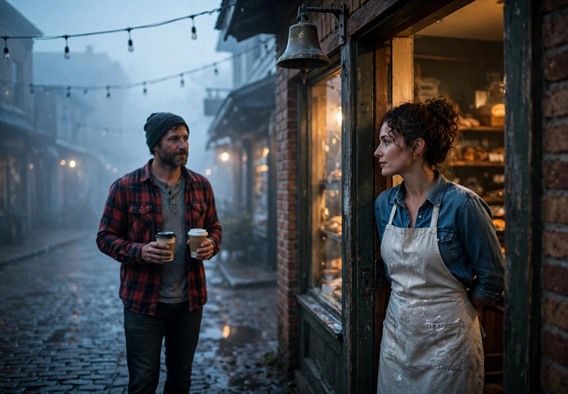
Gate Latch
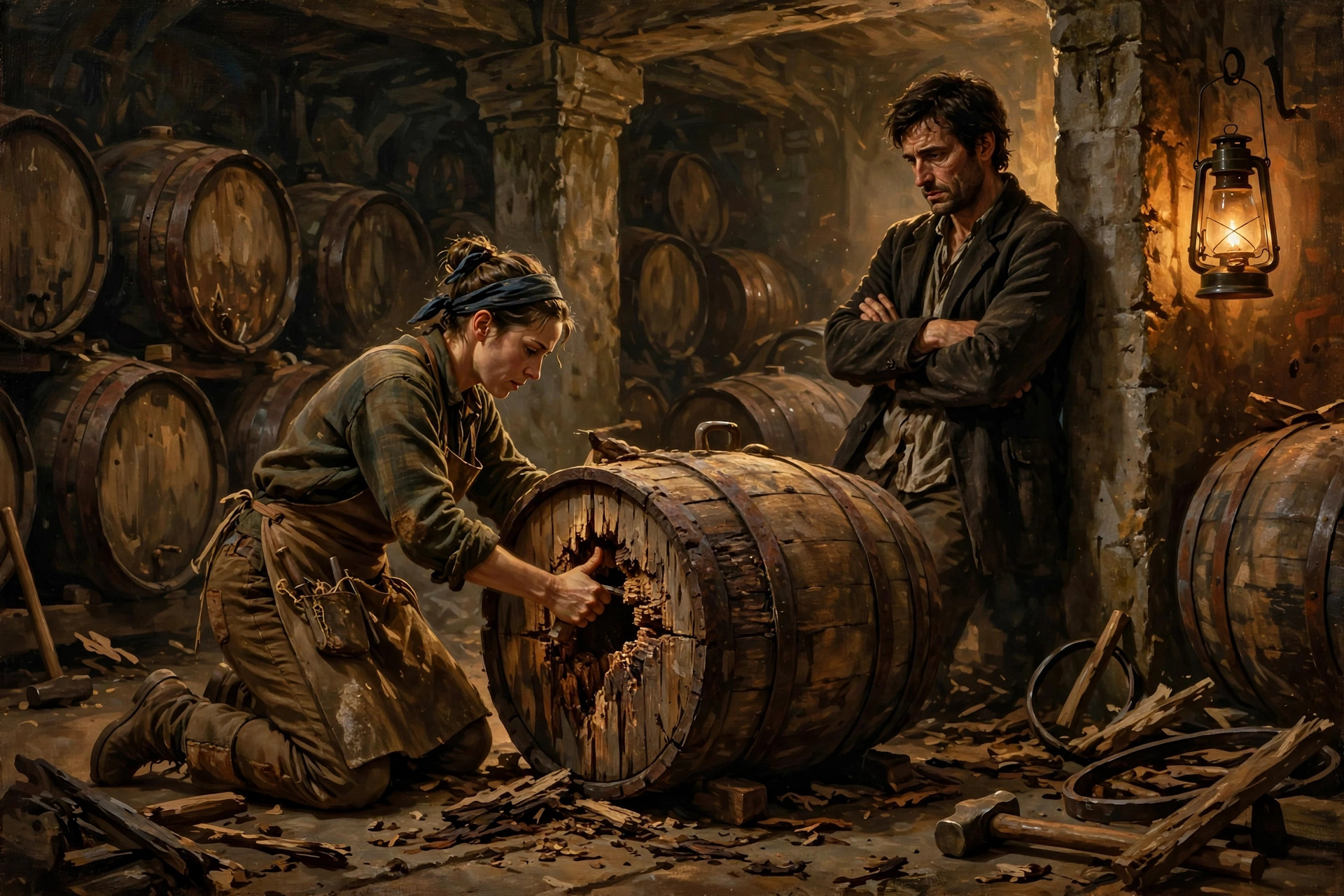
"Rotten is a strong word," Gabriel Thorne said, and Linnea pushed her thumb through the stave to prove it wasn't.
The oak gave like wet bread. A dark crumb fell onto the cellar floor, and the smell came up after it, sour and old, the smell of a cask that had been trusted too long.
"It's the word I've got." She wiped her thumb on her trousers. "Your gate latch was the first thing I saw when I walked up, and it was fixed with wire. I thought, well, they make do here. I didn't think they made do with this."
"That cask held my grandfather's reserve."
"Then it's held it past its time."
He was taller than she'd pictured from his letters, with the lean, tired look of a man who did his own accounts at midnight. He stood with his arms folded, one shoulder against a pillar, and he did not look like a man who liked being corrected in his own cellar. She found she didn't mind it as much as she should have.
Rows of casks ran back into the dim, bellies bulging, hoops rusted to the color of tea. Somewhere above, a rafter ticked as it cooled. Her bags stood by the steps where the carter had dropped them, and her shoulders still hummed from the road.
"Sixty," Gabriel said. "That's what the autumn bottling needs. Sixty sound casks, and I don't have a cooper who'll touch them."
"Because they're afraid of the job."
"Because they're afraid of you." He said it flatly, without cruelty. "Every man in Valmere knows your name. Half of them wouldn't hand you a mallet."
There it was, laid on the floor between them like the crumbled wood. She had expected it later, over supper maybe, softened by bread. Her pulse climbed anyway.
"You wrote to me knowing that."
"I did."
"Then why am I here?"
"Because your work was the best I ever saw, before." He pushed off the pillar. "And because I'm out of time. Here are my terms. You work under my roof and by my rules. You eat with the house. You keep to the cellar and the yard, and you don't go into the town to make friends or enemies. You answer to me, and nobody else."
"And at the end?"
"At the end, we'll speak of the end."
She held his eyes. Ten years of exile had taught her what a door sounded like when it was only pretending to open. This one gave a little, and no more. It was the only door anyone had offered her in a decade.
"My wages are paid on the first of each month," she said. "Not when you feel generous."
"Agreed."
"I choose the oak. I'll not build on what I haven't touched."
A pause. A small, dry twitch at the corner of his mouth. "Agreed. Anything else?"
"If I tell you a cask can't be saved, you don't argue."
"Now that," Gabriel said, "I'll argue every time. But I'll listen first."
It was more than she'd come in hoping for. She nodded once, because speaking might have cracked something in her voice, and bent to her bags.
The toolkit lay wrapped in oilcloth at the bottom of the larger one. She unrolled it on a trestle by the lamp: the adze with its worn handle, the croze, the long jointer plane, the drawknife, the hoop driver, the froe she'd carried through three towns and never once used in anger. Each piece came out with its own small clink. She set them in order without thinking, the way other people said their prayers.
Gabriel watched her hands. He didn't pretend otherwise.
"Show me," he said.
"Show you what?"
"A joint. Any joint. I'm paying for a master. I'd like to see one."
Irritation flared, clean and welcome. She pulled two scrap staves from the pile by the wall, sound oak, pale at the heart, and set the first in the vise. The jointer ran long and quiet. Curls of wood lifted and fell. She turned the second stave, took a bevel off it, and set the two edges together against the lamp.
No light came through the seam. She'd have been insulted if it had.
He stepped close. His sleeve brushed her arm, and he didn't seem to notice, which was somehow worse. He laid his palm flat along the joint and drew it slowly down the length of it, the way a man might gentle a horse. His thumb paused at the center. Pressed. She felt it in her own wrist.
"Tight," he said.
"It's a stave. It's supposed to be."
"Most men's aren't." He lifted his hand, and the warmth of it went out of the wood. "Welcome to Thorne Brandy House, Miss Marchetti."
"Linnea. If I'm to be under your roof."
He considered that as though it were a clause in a contract. "Linnea."
Then he was gone up the steps, boots heavy on the stone, and she let out a breath she hadn't known she'd stored. Above, a door shut. Voices murmured in the kitchen, an older woman's among them, sharp and amused, and a name she half caught: Odalys.
She hung the lamp higher. Swept the shavings into a pile with her boot. Walked the length of the cellar once, laying her hand on every cask she passed, counting the failures by touch. Too many. Not too many to mend.
At the foot of the steps she turned and looked at the heavy door. Old iron bolt, thick as her wrist, worn bright where hands had drawn it for generations. She slid it home. It went with a deep, certain sound, the first sound in a long while that felt like hers.
The bench stood against the far wall, scarred and solid. From the bottom of her bag she drew the last thing she'd carried, a raw hazel stave wrapped in a rag, pale and straight and barely dry. She set it down in the lamplight and left her hand on it a moment longer than she needed to.
Smoke and Oak
"You're burning them too long," Odalys said, and lifted a toasted stave from the rack to her nose as if it had insulted her.
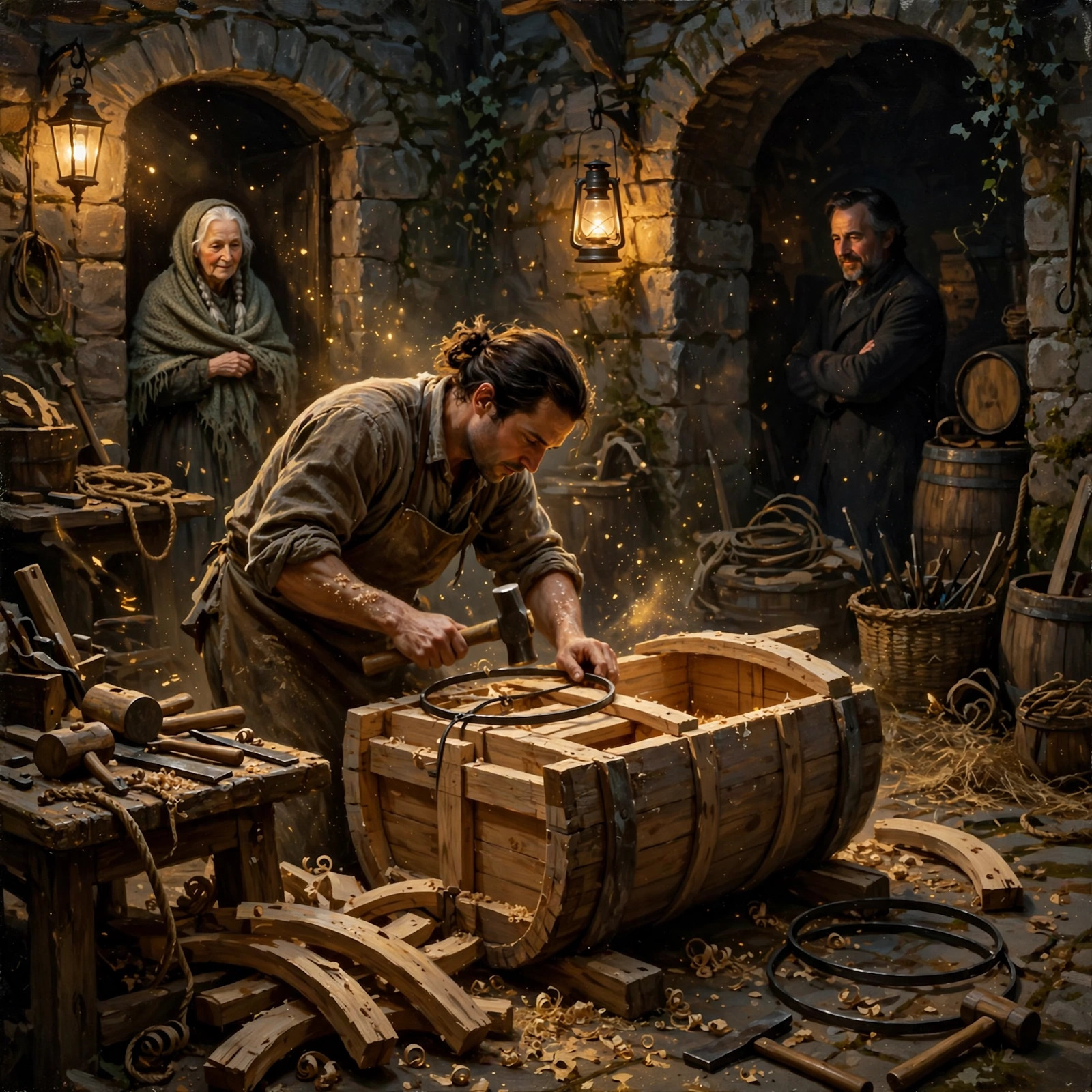
Linnea straightened from the fire basket. Five days of oak dust had settled in the creases of her knuckles, and she had no patience left for a stranger's nose. The woman in the cellar doorway was small, white-haired, and built like a fence post. She wore a blender's apron, stained the color of weak tea down to the hem.
"Medium toast," Linnea said. "Twenty minutes over the coals, turning."
"I can smell twenty. I can smell the edge of twenty-one." Odalys sniffed again and tapped the stave's blackened face with a fingernail. "Vanilla at the front, then bitter at the back. My nephew's brandy will taste of the bitter."
"Your nephew's brandy has been sitting in tired casks for years. It tastes of the cask."
A pause. Then a dry, delighted sound, almost a laugh. "Gabriel said you'd bite."
She took a second stave from the rack and held it out. "Tell me which side faced the fire hardest."
It was a test, and Linnea knew the shape of it. She ran her thumb down the grain, felt the faint dip where the heat had pooled, and turned the stave over. "This one. The wood's pulled a hair toward the coals. Someone put it nearest the basket's mouth."
"That was me," Odalys said. "I wanted to see if you'd notice."
"I noticed."
"Good. Do the twenty at nineteen." She handed the stave back with the care of a woman returning a borrowed child, and went up the steps without another word. Linnea stood there with warm oak in her hands and something near approval prickling at the back of her neck.
Gabriel came down at dusk with two small glasses and a bottle with no label.
"My aunt says you're stubborn," he said.
"Your aunt says I'm over-toasting."
"She said that second." He set the glasses on her bench, between the plane and the hazel stave she'd left to season, and poured a finger into each. The brandy was the color of old brass. "Taste. Then tell me what's wrong with it."
"You've decided something's wrong."
"I've decided you'll find it."
She drank. Heat first, then a thin sourness underneath, like a coin held on the tongue. She set the glass down harder than she meant to. "It's tired. The wood's given up everything it had and now it's giving you the cellar."
He nodded slowly. He didn't look wounded, which irritated her more than anger would have. Instead he lifted one of her fresh staves from the rack, charred face to the lamp, and broke a sliver from the edge with his thumbnail. He chewed it. Considered.
"Now this."
She tasted the shaving he held out. Sweet smoke, clean grain, a hint of bread crust. "That's what it should be."
"Then why does it frighten me?" he said, quietly, to the stave and not to her.
She had no answer to that. They stood with the lamp hissing between them, and she became aware of how near he was, the shirt rolled to his elbows, a scar across one forearm that she wanted to ask about and wouldn't.
"Where did you work before?" he asked. "Before the road."
"Here and there."
"Brandt Cellars?"
Her fingers closed on the glass. "A while ago."
"And they let you go."
"The Trade did." She kept her voice level, her eyes on the amber. "It was a long time ago, and it's not what you're paying me to be good at."
He let the silence run. She hated that he did. Then, because she couldn't bear it, she turned the question. "Ten years is a long time to wait on a petition. You hold the pen. You haven't said when you'd sign."
"Finish the casks first."
"That isn't an answer."
"No." He drank off his glass and set it down with care. "It isn't. Ask me again when the work's done."
Something moved behind his face, quick as a fish under ice, and was gone. She might have pressed. She was tired, and the brandy was in her blood, and she let it go, which she'd later think was her first mistake with him.
He crossed to the far wall where a single cask head leaned against the stones, dark with old spill, split along one seam. She had passed it a dozen times. Someone had chalked a cross on it.
"That one's condemned," he said. "I marked it myself."
"I saw."
"Do what you like with it. Burn it for kindling." He rubbed the back of his neck. "I wouldn't have thought it could be saved."
She knelt and turned the head into the light. The split ran clean, not rotten. The boards beneath the grime were good, old chestnut-brown oak, dense as bone. She laid her palm over the chalk cross and rubbed it out.
"Leave it with me," she said.
He looked at her a long moment, then nodded once and went up the stairs, and she heard him stop at the top, as if he meant to say more. He didn't. She fetched the froe and began.
The Leaking Roof
"Not that one, the one beside it!" Gabriel shouted over the rain, and Linnea, already leaning her shoulder into a cask, shouted back that they were all beside each other, it was a cellar.
The roof had given way over the north racks an hour past midnight. First a drip, then a sheet, then a brown rope of water pouring through a gap in the slates and slapping the stone. She had come down the stairs in her shirt and boots to find him already there, barefoot, lamp in one fist, trying to roll a full cask alone.
"Together," she said now. "On three. Low, use your legs."
They heaved. The cask groaned off its cradle and rumbled along the floor, and the cold water ran down her collar and along her spine. Gabriel's hair was plastered flat. He was grinning, which she found outrageous.
"You're enjoying this."
"I'm terrified," he said. "It's the same face."
They moved twelve casks before the water reached the rim of the drain and began to climb. Fourteen. Her palms burned. Once her foot skated on the slick floor and his hand shut around her upper arm and held her upright, hard, then let go as though he'd touched a stove. Neither of them said anything. They went back for another.
The last cask stood on the dry flags by the east wall, and they both leaned on it, panting. Overhead, the rain thinned to a patter. Somewhere above, Odalys's voice floated down the stairwell, asking whether anyone was dead, and Gabriel called that nobody was, and to go back to bed.
"She won't," he told Linnea.
"She'll make tea."
"She'll make tea and an inventory."
She laughed, and it came out cracked and too loud. He looked at her mouth, then at the floor, then at the hole in his ceiling, a man choosing very carefully where to put his eyes.
"The sixty," he said. "Is the work lost? Any of it?"
"Ask me in daylight." But she was already walking the line of dragged casks with the lamp, thumbing staves, rapping heads. Wet oak rang dull where it was sound and flat where it wasn't. "Dry them slowly. No fire, no fans. If you rush it, they'll check along the grain, and then I'll be rebuilding what I've already built."
"Then we won't rush."
"You'd rush. You'd put a stove in here by noon."
"I would," he admitted. "Odalys would stop me with a spoon."
The tea came, as promised, carried down by Odalys in a shawl with a face like a closed door. She set the tray on an upturned bucket, looked at the ceiling, at her nephew, at Linnea's soaked shirt, and said only, "Hazel," before climbing the stairs again.
They both stared after her.
"What does she mean, hazel?" Linnea asked.
Gabriel took a cup, warming his hands. "When a house takes on a hand for a long job, the old way is a tally stick. Hazel, split down the middle, one half each. Whoever breaks the bargain has to come up with their half." He shrugged, embarrassed. "Nobody's done it in my lifetime. She's sentimental."
"She's pointed."
"That too."
Linnea drank her tea. It was strong and over-sweet and she wanted a second cup. On her bench across the cellar sat the hazel stave she'd been seasoning since the first week, pale and straight, meant for nothing. She looked at it a long moment.
"Bring the lamp," she said.
He followed her over. She laid the stave in the vise, took the froe and the mallet from the wall, and set the blade at the crown of the grain. Her hands had stopped shaking. They always did, with a tool in them.
"Linnea." He sounded uncertain. "You don't have to."
"I know."
She struck. The hazel opened along its length with a long dry sigh, as clean as a page turning, and two halves fell into her palms, each pale and fragrant and matched to the other at every fiber. She trimmed the ends with a knife, rubbed the cut faces smooth with her thumb, and found two bands of brass in the offcut tin, left from some cask hoop long ago. She heated each over the lamp chimney, tapped them down with the small hammer, and quenched them in the cooling tea.
He watched every motion. When she held out the two halves, he didn't take one right away.
"What is it you're promising?" he asked quietly.
"The work. All sixty. Done right, before autumn, whatever else happens." She kept her eyes on the wood. "That's all it is."
"And mine?"
"You'll see it through. You'll pay what you said and you'll listen before you argue." She finally looked up. "You can keep the rest to yourself."
Something crossed his face she couldn't read, a flinch maybe, gone quickly. He took the half nearer his hand. His fingers closed over hers for a moment on the brass, warm now, damp, rough from the casks. Then he let go.
She tucked the other half into her belt. He turned the one he held over twice, studying the pale grain, and she waited for him to say what was on his mind.
He said, "I'll have a hook put up."
"A hook."
"For mine."
He carried the lamp and the half-stick up the stairs. She stood in the wet cellar listening to the last of the rain, and heard his office door open overhead, the scrape of iron driven into old wood, and then a small clean sound: the band on the hazel knocking once against the hook as he hung his half there and left it.
Cask Loft
"You're building that head backward," Gabriel said, and Linnea didn't look up from the stave she was truing.
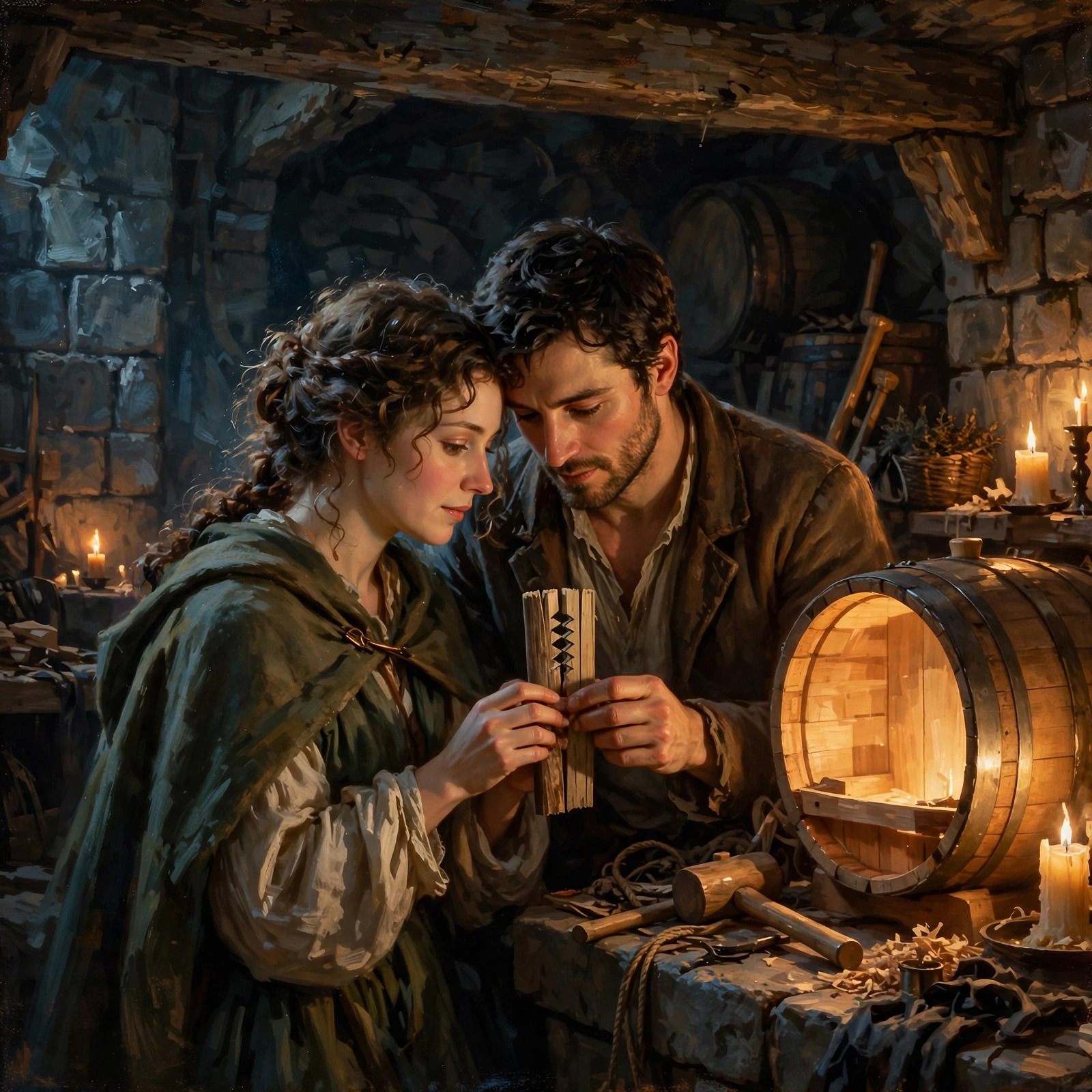
"I'm building it the way the oak wants."
"It's the way you want."
"Same thing, if I've done it right." She ran her thumb down the joint. It sat tight. The loft was warm under the roof, full of cut oak and lamplight, and the last of the finished casks stood in a row below the rail like patient animals. Sixty, nearly. Six days since the hazel, and neither of them had mentioned it, though his half hung somewhere beneath her feet and hers rode against her hip.
He came and crouched beside her. Too close, as usual. He smelled of char and cold air. "I need to tell you something, and I need you to let me finish."
She set the plane down. "That's a bad way to start."
"It's the only way I've got." He turned his hands over, looked at them. "The vintage that burst. The one the Trade banished you for."
"I know which one."
"It was my father's. His last cellaring, the year before he died. I opened the cask myself, and found the flood and the glass and nothing left to save." His voice stayed level, which made it worse. "I knew your name when your letter came. I've known since before you slid that bolt."
The loft went very quiet. Below, a hoop ticked as it cooled.
"You hired me," she said.
"Yes."
"Knowing."
"I wanted to see what kind of person it was. Whether I could hate her." He laughed once, without humor. "I tried for about two days."
She stood. Her knees felt unreliable, and she hated it. "You let me tell Odalys about the stave. You let me sit at your table. And the petition, you kept saying after the casks, after the casks--"
"Because I didn't know what I'd do with it. I still don't." He stood too. "That's the truth, Linnea. I'm not asking you to forgive it. I just couldn't hold it alone any longer."
She should have shouted. She'd imagined this for years, some faceless owner standing in front of her with the ruin in his hands. Instead there was a tired man with sawdust in his hair, who had put his father's name on the table knowing what it would cost him.
"I sold that cask," she said. Her throat hurt. "I saw the stave and I sold it anyway. Because the bank was coming, and I was a coward, and I told myself the oak might hold."
"I know."
"Then why aren't you angry?"
"I was. I've watched you spend three weeks refusing to let a single bad stave through." He stepped closer. "I don't know what to do with a person who changes like that. Except this."
He waited, a full breath, giving her room to leave. She didn't. She took the front of his shirt in her fist and kissed him, and he made a low sound against her mouth like something set down at last. His hand found her jaw. Her tools, the lamp, the whole slanting roof went somewhere far off. He kissed her as though asking, and she answered every time, until her back met a cask end and his forehead rested on hers.
"Stay," he said, rough.
"I'm here."
That was all, and then the lamp burned low, and the door at the loft's foot closed on the dark, and the rest belonged to them.
She woke before light on the shavings he'd spread under a blanket, his arm heavy across her waist. Gray showed in the roof slats. He slept with his face turned half into her shoulder, unguarded, younger.
Her mind did what it had always done. It laid out the facts coldly. His father's cask. His power over her name. A man who'd lain beside her knowing, and who still hadn't said what he meant to sign. If she asked him now, and he said no, she would have to stand there and hear it. If he said yes, she would owe him for it, forever.
She had never once stayed to hear.
She eased out from under his arm. He stirred, murmured something, and settled. She dressed in the dark, gathered her mallet and the froe and the small hammer, rolled her adze in its cloth. At the rail she looked down at the finished casks, the last one still unhooped, and her chest closed like a fist.
She slid the bolt of the cellar door softly. The yard was wet and silver. She did not look back at the window.
Upstairs in the office, the door stood open to the pale morning, and his half of the tally stick sat alone on the hook.
Warden's Table
The Trade Hall at Valmere smelled of beeswax and old ledgers, and Linnea Marchetti walked into it with her tool roll on her shoulder and her half of the hazel stick in her fist.
Piers Quillon sat at the long table under the high window, a stack of petitions squared in front of him. He looked up. His pen stopped.
"You're not on my list today," he said.
"No." She crossed the floor. Her boots were loud on the boards. "I'm here to make a statement, and I'd like it written down."
"Statements are heard on the first of the month."
"Then hear this one early."
He studied her. Then he set the pen in its tray and drew a clean sheet toward him. "Sit."
"I'll stand."
She had walked most of three days to get here, sleeping in a hay barn and a carter's shed, and every mile she had rehearsed it. Now the words came out plainer than anything she'd planned.
"Ten years ago I sold a cask I knew was bad. The stave was cracked at the heart and I saw it when I dressed it. I hid the flaw under the hoop. I sold it because my workshop was failing and I needed the coin. It burst in a cellar and took a vintage with it. The Trade banished me for that, and the Trade was right."
Piers wrote. His hand was slow and exact. "That's on the record already."
"Not all of it. I took work at Thorne Brandy House three weeks ago. I knew what was in Gabriel Thorne's power. I let him think I was only a cooper who wanted a wage. I never told him what I hoped from the petition." She made herself keep her eyes on his. "I hoped he'd sign it. I worked toward it. That's a kind of bribe, whatever I called it."
"Did he know?"
"He knew who I was before I reached his gate. He's never once used it against me." Her voice caught and she pushed through. "If his petition is read as a bargain with a banished cooper, it's tainted. It isn't his. It's mine. So I'm taking it."
Piers laid the pen down. "Taking it how?"
She set the hazel half on the table between them. The brass band caught the window light. The split face was pale and clean where she'd drawn the froe through.
"That's my mark. It was a pledge between him and me, and I'm giving it to the Trade instead. I'm asking nothing back. No readmission, not now, not at the end of the term. If the house is to be judged, judge it on sixty good casks and not on me."
The hall was very quiet. A clerk at the far end had stopped shuffling paper.
"You understand what you're saying," Piers said. "You'd never again stand in a cellar as a master of this Trade."
"I understand."
"You're good. I've seen the casks from his yard. Everyone has."
"I was good when I sold the bad one, too." She almost smiled. "It didn't help the man who lost his vintage."
Something shifted in his face. He picked up the stick and turned it over, ran a thumb across the band. "Did you come alone?"
"Yes."
"Did he send you?"
"He doesn't know I'm here. I left before he woke." The heat rose in her neck. "That was a different mistake, and it's mine too."
Piers said nothing for a long moment. Then he drew a second sheet and began to write in earnest, the pen scratching. She stood with her arms stiff at her sides and watched the words fill the page, and felt the odd lightness of a person who has set down a load and hasn't yet learned how to walk without it.
At last he read aloud, flat and clear. "Confession entered, freely given, uncoerced. The house of Thorne is found to have acted in good faith. Its penalty is lifted. The petition for the house stands clean." He looked up. "The exile of Linnea Marchetti stands also. No guild standing, no readmission, no appeal."
"Yes."
"But." He tapped the page. "The Trade does not govern a man's private hire. If the master of a house chooses to keep a servant of his own cellar, who works his oak and holds no guild mark, that is his affair. I can't stop it. I wouldn't."
She stared at him. "I didn't ask for that."
"No. That's why I'm offering it." He reached under the table for the stamp, inked it, and held it over the page. "Don't mistake me. It's less than you had. It's less than you deserve, perhaps, or more. I've never settled which."
"It's enough."
He brought the stamp down. The thud carried to the rafters.
She turned. The great doors stood ajar, and in the strip of daylight between them a man was leaning against the stone, his coat dusty, his hair uncombed, looking as if he had not slept in three nights. Gabriel did not come in. He only lifted his eyes to hers and waited.
Beam Notch
"You could have knocked," Linnea said. She was standing on the cellar floor with a mallet in her hand, and her voice came out sharper than she meant.
"I did. Twice." Gabriel stood at the foot of the steps with his coat still dusty from the road. "You were hammering. I thought it rude to shout over a barrel."
"It's not a barrel yet. It's a ribcage."
"Then I thought it rude to shout over a ribcage."
She almost laughed. She set the mallet on the nearest stave rack instead, because her hand needed somewhere to be. The cellar was empty of everything but the work. The old casks had been rolled out to the yard days ago, and the long stone room smelled of cut oak and cold lime wash. Lamplight pooled on the floor. Sixty casks wanted rebuilding before autumn, and only one stood half-finished in front of her, its hoops loose, its staves flaring at the top like an unfinished crown.
He had come to her at the Trade Hall doors and said almost nothing. He had walked her home through the lanes with a careful yard of air between them, and she had understood that he was giving her room to be angry. She hadn't been. She had been too tired, and then she had slept on the cot in the tack room like a stone dropped in a well.
Now it was morning, and he was here.
"Odalys says I'm to stop hovering," he said.
"Are you hovering?"
"Since sunrise. She sent me down with a message and a warning that if I turned back up the stairs, she'd hide my boots." He reached into his coat. "The message is this."
He held out a hazel half-stick, banded in brass.
She knew it before it was fully in the light. She had split that stave herself with the froe, the night the roof leaked and the buckets rang all down the cellar, and she had banded both halves by lamplight while he held the lantern and pretended not to watch her hands. Now a new mark sat on the cut face, a square of dark red ink pressed deep into the grain. The warden's stamp.
"He gave it back," she said.
"He sent it to the house at dawn. A clerk rode out with it wrapped in a cloth." Gabriel's mouth moved. "With a note that said, and I quote, the Trade has no further use for it."
She took it. It was lighter than she remembered. The wood was warm from his coat, and the stamp had a faint rough edge under her thumb.
"I gave it up," she said. "I meant it. I put it on his table so I'd have nothing left to bargain with."
"I know. I watched."
"You didn't sleep."
"No." He said it plainly. "I walked the road behind you two nights, and then I sat outside the Hall until the doors opened. I didn't know what else a man does when he's been left with an empty bed and a good deal to answer for."
Her throat tightened. "That was my doing."
"Some of it." He stepped closer, and the lamp caught the gray under his eyes. "I should have told you about my father's vintage the day you arrived. I let you build my casks for weeks with that between us, and then I handed it to you in the cask loft, right after you kissed me. That was cowardly of me, Linnea. I wanted one more day of you not knowing."
"I wanted one more day of not asking." She turned the stick over. "So we're a fine pair."
"We are a dreadful pair."
"Yes."
He went to his own coat pocket again and brought out the other half. His half, the one that had hung on a hook in his office the whole time she was gone. She had not known he'd bring it. The brass band had a fresh dull spot where his thumb had rubbed it.
"Come here," he said. "Odalys says it's done on a beam. Not a table, not a hand. A beam, so it can't be carried off in anger."
"Did she say which beam?"
"The one over the first cask you finish. She was very firm. She said you'd know."
Linnea looked up. Overhead, the old oak crossbeam ran the length of the cellar, black with a century of smoke, and one iron peg stood in it just above the unfinished cask, a peg she'd noticed on her first day and meant to ask about. She dragged a low stool across the floor and stood on it. He steadied her elbow without being asked, and this time she let him.
"The notch," he said, handing up his half. "It should match."
She fitted the two cut faces together. The hazel had dried since the night she split it, and she half expected the halves to refuse each other. But the grain met, ridge to ridge, and the little cut she had nicked in both ends closed into a single clean mark. The brass bands clicked, one against the other. She pressed the joined stick to the beam, over the peg, and it held.
For a moment neither of them spoke. Dust turned in the lamplight. Somewhere above, a floorboard creaked, and she was fairly sure Odalys was standing on the other side of the cellar door and not even pretending otherwise.
"I can't stand in a guild hall again," Linnea said, to the wood and not to him. "Not ever. You know that. The best I'll have is a leather apron and your cellar."
"It's not my cellar," Gabriel said. "It's the one place in Valmere where I'd rather be wrong beside you than right alone."
She stepped down off the stool. He was very near. His hand came up and rested against her jaw, careful, as if she might startle, and she turned her face into it.
"I love you," she said. It came out steady and a little rough. "I've been trying to find a cleverer way to say it, and there isn't one."
His eyes closed briefly. When they opened, they were wet and unembarrassed. "I love you. I loved you in the loft, and I loved you when I woke to a cold room, and I'll love you in this cellar when we're both too old to lift a mallet."
"I'll lift it for both of us."
"I don't doubt it."
She kissed him then, or he kissed her, and it hardly mattered which. His arms came around her and she held on to the front of his dusty coat, and the whole long stone room seemed to settle around them like a cask taking its first water. It was nothing like the hurried kiss in the loft. It was slow, and it asked for nothing but more of the same.
When they parted, she was laughing, and so was he, and his forehead rested against hers.
"Stay," he said.
"I'm staying. I've got fifty-nine casks to go."
"That's not what I meant."
"I know what you meant." She smiled up at him. "Yes."
Above them, the joined stick hung on the beam above the first rebuilt cask.
Get notified when new stories drop

Serena Blake
Serena writes romantic suspense and dark romance for readers who want pulse and payoff. Her stories chase trust as hard as they chase danger.
Leave a comment
Comments