



Lane Four Protest
"That was a clean exchange, and you know it."
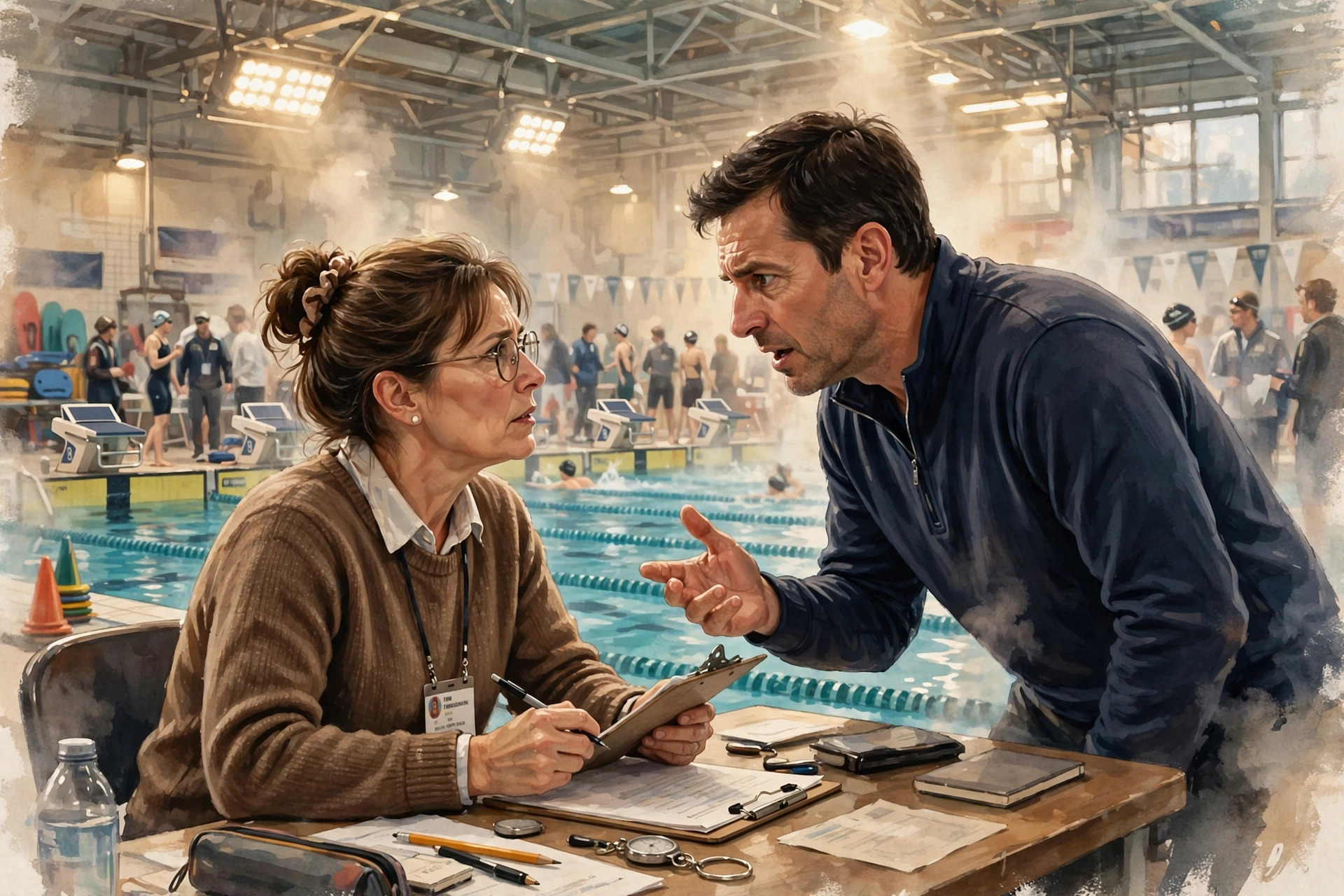
Hollis Brandt didn't look up from the relay takeoff sheet. She didn't need to. Mateo Ruiz-Halvorsen had a voice that carried over a pool deck the way some men's cologne carried across a room. It arrived before he did.
"Coach." She initialed the bottom of the slip. "Your third swimmer left the block before your second swimmer touched. The pad says so. The judge on the block says so. I say so."
"The judge on the block was looking at her shoelaces."
"She wears slides."
He stopped beside the timing table, close enough that she could see the chlorine had bleached the cuffs of his navy Ashgrove quarter-zip. Around them, Lindqvist Natatorium hummed with prelims noise. Kickboards slapped. A starter's horn bleated two lanes over. Somebody's parent was screaming a name into the rafters as if volume alone could shave a tenth.
Mateo set both palms flat on her table. She looked at his hands, then at him.
"Off my paperwork, please."
He lifted them an inch. Only an inch. "Hollis. Run the reaction time for me. Out loud. That's all I'm asking."
"You're asking me to read you a number you already saw on the board."
"I'm asking you to look at it like a person and not a clipboard."
That landed somewhere under her ribs, and she hated that it did. She turned the monitor toward him anyway, because the rules said a coach was entitled to see the data, and she followed the rules. She followed them so carefully nobody could ever say she bent one.
"Negative point zero three," she said. "Your swimmer's feet left the platform three hundredths before the touch. That's an early takeoff. That's a disqualification. It's not a feeling, Mateo. It's a sensor."
"Sensors fail."
"Not this one. I tested every pad on this wall at six this morning."
He laughed, short and without much humor in it. "Of course you did."
Behind him, a tall young man in an Ashgrove parka was hovering at a respectful distance, dripping on the tile. Benji Okoro, she knew without checking the heat sheet. Senior. Distance kid. The one Mateo talked about at every coaches' meeting like the boy had personally invented the flip turn.
"Coach," Benji said. "It's fine. We were never going to final in the medley anyway."
"It's not fine." Mateo didn't turn around. "It's never fine when somebody takes something you earned."
The way he said it made Hollis glance up properly. There was something older under the protest. Something that had nothing to do with a relay that wasn't going to final.
She'd been on the receiving end of Mateo's protests for most of his time at Ashgrove. False starts, stroke calls, a backstroke turn he'd argued about for so long that the meet ran twenty minutes behind. He'd lost every single one. He kept filing them anyway, like a man knocking on a door he knew was painted onto a wall.
"You want to file it formally," she said, "the form's in the referee's office. Dorothy will review the footage. I'll stand by the call."
"I know you will." He straightened. "You always do."
"That's sort of the job."
"Is it?" His eyes were a warm brown that had no business being in an argument. "Or is it just easier?"
She stood. She was nearly his height in her deck shoes, and she used every bit of it. "Easier would be letting a loud coach talk me out of a sensor reading because he's charming and he's loud. Easier would be the next team in line asking why Ashgrove gets a favor. I don't do favors."
"Charming," he repeated.
"Loud was the operative word."
Benji made a small noise that might have been a cough and might have been a laugh. Mateo shot him a look. Benji studied the ceiling.
The horn went for the next heat. Hollis had a 500 free to time, and lane four's backup button was hers. She stepped around the table, past Mateo, and crouched at the edge of the pool where the touchpad hung against the wall. Habit. She liked to put a hand on the equipment before a distance race, the way some people knocked on wood.
The pad was cold and slick under her palm. She pressed the upper edge to seat it, and it shifted.
Not much. A wobble so small she might have imagined it. She pressed again. The steel handle at the top corner, the part that hooked over the gutter, gave a faint, gritty click, like a tooth that wasn't quite set right.
She frowned and ran her thumb along it. It held. It read. She'd watched it register a hundred touches this morning without a hiccup. But it moved, and things on her wall didn't move.
"Something wrong?"
Mateo had followed her. Of course he had. He was crouched a few feet away, forearms on his knees, watching her hands instead of her face.
"No." She pulled back. "It's reading fine."
"That wasn't what I asked."
"It's what I answered." She'd make a note. She'd look again tonight when the pool was empty and nobody was standing over her shoulder with a reason to care. She wasn't going to say a word about her own equipment in front of the one coach who'd use it to reopen every call she'd ever made.
She rose too fast. The lanyard around her neck swung, caught on the edge of the starting block, and the clip popped. Her stopwatch hit the wet deck with a crack that went straight through her teeth, skittered, and spun toward the gutter.
Mateo's hand shot out and trapped it flat against the tile an inch from the water.
For a second neither of them moved.
He turned it over. It was old, chrome steel worn soft at the edges, heavier than anything anyone carried anymore. Officials laughed at her for it. She didn't care. Her father had engraved the back in 1998, the year his high school team won their league, his small careful letters cut deep: Eyes on the wall.
Mateo read it. His thumb brushed over the words, once.
"Still ticking," he said quietly.
"It always does."
He held it out. She took it, and his fingers stayed a beat longer than they needed to, his skin warm against the cold metal.
"You don't use the electronic splits for backup," he said. "You use this."
"Both."
"Because you don't trust the machines either."
She didn't answer. He nodded slowly, as if she had.
"Your call stands," he said. "I won't file."
She blinked. "You've filed on less."
"I have." A corner of his mouth lifted, reluctant, like it was costing him something. "But you checked the wall at six. And you just checked it again when you thought nobody was watching." He stood and tipped his head toward lane four. "That counts for something, Brandt. Not much. Something."
He walked back to his swimmers. Benji fell in beside him, glanced over his shoulder at her, and gave a small, apologetic wave.
Hollis clipped the stopwatch back onto her lanyard. It ticked against her sternum, steady and familiar. She looked at the pad on the wall for a long moment before the horn called her back to her table.
Fenner Street Booth
"There's a booth," the waitress said, pointing with a coffeepot, "but you'll have to share."
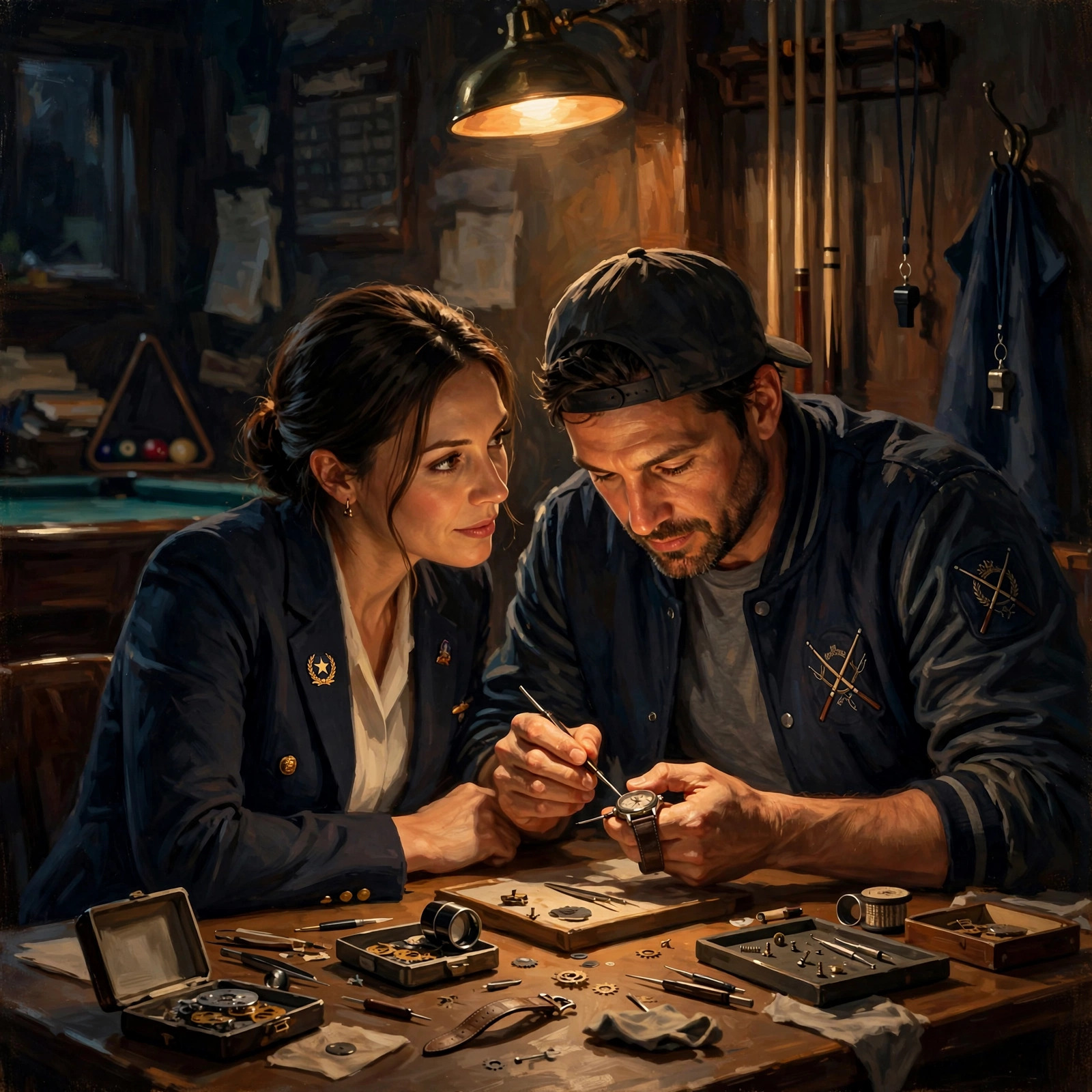
Hollis followed the pot to the back corner of Dot's Diner, where Mateo Ruiz-Halvorsen sat alone with a basket of fries and a legal pad covered in split times. He looked up. He did not look surprised.
"I can wait," Hollis said.
"Forty minutes," the waitress said. "Half the conference is in here. Swim parents eat like they swam."
Mateo pushed the legal pad aside and nudged the opposite bench out with his foot. "I don't bite before finals."
"Finals are Thursday."
"Then you're safe for two more days."
She slid in. The vinyl stuck to the back of her knees, and the table had a wobble that clacked every time either of them leaned on it. She ordered grilled cheese and tomato soup without opening the menu. He raised an eyebrow.
"I've been coming here since before you had a program," she said.
"Ashgrove had a program."
"Ashgrove had six swimmers and a coach who timed with his phone."
"Seven swimmers." He ate a fry. "And now I have a kid in lane four who could go to nationals, and you're sitting across from me, so somebody's going to see this and assume we're fixing it."
That landed closer than he probably meant it to. She unclipped her lanyard and set the stopwatch face-down beside the ketchup, the engraving catching the yellow light. Habit. She always took it off to eat.
He glanced at it, then back at her. "Your dad was a coach."
"High school. Down near the state line." She straightened the salt shaker so it lined up with the pepper. "Twenty-some years. Then the state meet one year, the timing system dropped a whole heat. Somebody on the deck crew hand-entered times. One of his kids got bumped into a final he shouldn't have made, and a parent on the other team said my father had leaned on the crew."
"Had he?"
"He didn't even know their names." She kept her eyes on the salt. "Didn't matter. It looked bad. The school didn't renew him."
Mateo didn't say he was sorry. She noticed that, and was grateful for it in a way she didn't examine. He turned the basket a quarter so the crispest fries faced her side.
"So you became the one who can't be leaned on," he said.
"I became the one who follows the rulebook."
"Same thing, the way you do it."
Her soup arrived. She burned her tongue on the first spoonful and refused to show it.
"Your turn," she said.
"For what?"
"You've protested every call I've made in four seasons. I figure there's a reason, or you just enjoy the paperwork."
He laughed, short and surprised, and then the laugh went somewhere quieter. He wiped his fingers on a napkin, one at a time.
"Conference final, my senior year. Two hundred breast. I touched first." He folded the napkin into a square. "Stroke judge said my kick went scissor on the last turn. One judge, one angle, from across the pool. DQ. I'd have been seeded for nationals. I was done with the sport three months later."
"Was it a scissor kick?"
He looked at her a long moment. "I still don't think so."
"That's not a no."
"It's the most honest answer you're going to get from me." He set the folded napkin down very precisely. "I don't remember my legs. I remember the guy's face when he raised his hand. He looked bored. Like it was nothing."
Hollis put her spoon down. She thought about every time she'd raised a hand on deck and kept her own face flat on purpose, so nobody could read anything into it. She'd always called that fairness.
"It's not nothing," she said. "Not to the person making it. Not to the good ones."
"I know that now." He shrugged one shoulder. "Mostly. Some days I still want to drag every one of you to the video booth."
"There's no video booth at our level."
"Exactly my point, Brandt."
The bell over the door jingled. Hollis didn't need to turn. She knew that walk, quick and flat-footed, the sound of a woman who'd stood on pool decks for thirty years and refused to sit on the ones with good chairs. Dorothy Kwan stopped at their table holding a to-go cup, her reading glasses pushed up into gray hair.
"Hollis." A nod, then a slower one. "Coach."
"Referee." Mateo half rose, an old-fashioned courtesy that seemed to amuse her.
"Sit, sit. I'm not staying." Dorothy's gaze traveled over the shared basket, the stopwatch beside the ketchup, the legal pad of Ashgrove splits within easy reading distance of the conference's head timer. Her expression didn't change at all, which was how Hollis knew.
"Walk me to the register," Dorothy said.
Hollis slid out. At the counter, Dorothy paid for her coffee in exact change and didn't look up from her coins.
"Nothing wrong with eating," she said. "Nothing wrong with talking. You know that."
"It was the only seat."
"I believe you." Dorothy snapped her wallet shut. "The parent at the window booth with the Lakeshore jacket might not. He's been watching you since I walked in." She finally met Hollis's eyes. "That kid of his swims lane five Thursday. Right next to Ashgrove's boy."
Hollis felt the old cold settle in her stomach, the one she'd carried since she was a teenager watching her father box up his office.
"I'll move."
"I didn't say move. I said know what it looks like." Dorothy patted her arm once, brisk. "And look at your equipment before Thursday, not after. You've got that face you get."
"What face?"
"The one where you've seen something and you're deciding whether it's your business." Dorothy picked up her coffee. "It's always your business. That's the job."
The bell jingled again behind her.
Hollis stood there a second longer than she needed to, thinking about a steel handle that gave a little too easily under her palm. Then she went back to the booth, because walking out now would look worse than staying, and because she didn't want to.
Mateo had flipped his legal pad face-down. He'd also moved the stopwatch away from the ketchup and set it on a clean napkin.
"Lakeshore dad," he said.
"You saw him."
"He tried to get me ejected from a dual meet once for yelling." He slid her water glass back toward her. "I was yelling. He still wasn't right."
She sat. The table clacked. She picked up her father's stopwatch, felt it ticking against her fingers, and clipped it back on.
"Thursday," she said, "if something happens in lane four, I'm not going to do you any favors."
"I know."
"I mean it, Ruiz-Halvorsen."
"I know you do." He studied her, his dark eyes steady and a little tired. "Just don't do me any un-favors, either. That's all I've ever asked."
She didn't have an answer that wasn't a rule, so she gave him none.
There was one fry left in the basket, long and golden and perfect. He looked at it, looked at her, and slid the basket across the wobbling table until it bumped her soup bowl.
Hollis took it.
The Rattling Bracket
"You're not supposed to be on deck," Hollis said, without turning around.
"Neither are you, technically." Mateo's sneakers squeaked on the wet tile behind her. "Custodian let me in. I left Benji's kickboard in the bleachers. He sleeps with it, basically."
"He does not."
"He names them. This one's Gerald."
She was kneeling at the end of lane four with a flashlight in her teeth and one hand flat on the touchpad, and she took the flashlight out to glare at him properly. The Lindqvist Natatorium after midnight was a different building. The banks of lights were off except for the row over the diving well. The water lay so still it looked poured from glass, and the only sound was the filter hum and the slap of a stray ripple against the gutter.
He had the kickboard under one arm. It did, in fact, say GERALD across it in black marker.
"Go home, Coach."
"What are you doing to my lane?"
"It's not your lane. It's the conference's lane." She put the flashlight back between her teeth and pressed the top edge of the pad. It gave. Just barely, a hair of travel, and then a small hollow clack as the steel met the wall again.
Mateo heard it. She watched him hear it, watched his face change from teasing to something sharp and quiet. He set Gerald down on the starting block and crouched beside her.
"Do that again."
She did. Clack.
"That's the bracket," he said.
"I know what it is."
"How long have you known?"
She didn't answer. She shone the light down along the side of the pad, where the steel mounting bracket bolted into the deck lip. The handle that she'd felt shift under her palm two days ago wasn't the problem by itself. Underneath it, one of the bolts sat proud of the plate by a couple of millimeters, its washer cocked at an angle. When she pushed the pad, the whole thing rocked.
"Hollis."
"Since prelims. I thought it was the handle. Handles wobble."
"That's not a handle." He leaned closer, his shoulder warm against hers through her fleece. He smelled like chlorine and the cold outside. "If a kid comes in soft on the touch, that thing could swallow it. Pad flexes, contact doesn't register right, or it registers late."
"Or it registers fine and I'm reading tea leaves at one in the morning."
"You don't read tea leaves. You read everything twice and then you read it again." He sat back on his heels. "Benji swims lane four tomorrow night. Final heat."
"I'm aware of the heat sheet."
"So report it. Get somebody in here with a wrench."
She turned off the flashlight. In the half dark his face was mostly outline, and that made it easier to say.
"If I report it tonight, the facility guy comes in at six and the bracket gets tightened and nobody thinks twice. Fine. But somebody will ask who noticed and when. And the answer is the timing official who was seen eating fries in a booth with Ashgrove's coach, looking at Ashgrove's lane, the night before Ashgrove's kid swims for a national cut." She heard her voice go flat and careful, the way it did on the microphone. "That Lakeshore father will have it in an email before lunch."
"So you'd rather leave a broken pad in the water."
"It's not broken. It's loose."
"Hollis."
"There's a backup system. There are three backup buttons per lane. There's…" She stopped, because her hand had gone to the stopwatch on her lanyard without her telling it to, and she was holding it like a rosary.
He looked at the stopwatch. Then at her. He didn't argue, which was so unlike him it unsettled her more than shouting would have.
"My dad tightened every bolt on every block at his pool," she said, quieter. "Every season. He'd lie on his stomach on the deck with a socket set. And when the system failed at state anyway, it didn't matter that he'd done everything right. It mattered what it looked like. It mattered who he'd been standing next to."
"Who was he standing next to?"
"A parent. Booster club president. They were talking about a fundraiser." She laughed, and it came out wrong. "Bake sale. He lost his job over a bake sale."
Mateo was quiet a long time. The filter hummed. Somewhere up in the rafters a vent ticked as it cooled.
"I've spent my whole career assuming people like you were looking for a reason," he said finally. "Officials. That somebody in a white shirt wanted to take something from my kids because somebody took something from me." He reached out and, very lightly, touched the edge of the stopwatch where it lay against her collarbone. His fingertip didn't quite touch her skin. "I don't think you're looking for a reason. I think you're terrified of being one."
She meant to say something cutting. Something about how he'd filed a protest at three of the last four championships and didn't get to be the reasonable one at one in the morning. What she did instead was look at his mouth.
He noticed. Of course he noticed. He'd been watching her across a pool deck for years, waiting for her to blink first.
"This is a bad idea," she said.
"Terrible," he agreed, and didn't move.
So she did. She leaned in across the tiny space between them, on her knees on wet tile at the end of lane four, and kissed him. He made a low, surprised sound and his hand came up to the back of her neck, careful, as though she might bolt, and she didn't. He kissed like he argued, all in, no hedging, and then slower, like he'd decided he had time. Her flashlight rolled off the deck and plopped into the gutter.
When she pulled back, his forehead rested against hers.
"Well," he said, a little hoarse. "That's a conflict of interest."
"Don't."
"Sorry. Joke. Bad timing." He didn't let go of her neck. "I'm not going to ask you for anything tomorrow. You know that, right? Whatever happens in that lane."
"You always ask for something."
"Not this time."
She wanted to believe him so badly it scared her. She fished the flashlight out of the gutter, shook the water off, and stood. Her knees were soaked through.
He picked up Gerald and tucked the kickboard back under his arm, and for a second he looked younger, like a man who'd once stood on a block himself and trusted the wall.
"Report the bracket," he said gently, at the door. "Please. Not for Benji. For whoever's in lane four."
Then he was gone, and the door sighed shut on its closer.
Hollis stood alone on the deck and pressed the pad one more time. Clack. She took out her phone and opened an email to the facility office. She typed the lane number. She typed the word bracket. She thought of the Lakeshore jacket in the window booth and a bake sale and her father on his stomach with a socket set.
She saved it as a draft.
The stopwatch ticked against her chest all the way to the parking lot, and she still couldn't tell if she'd done the careful thing or the cowardly one.
Four Hundredths
"Don't look at me like that," Hollis said, before Mateo had said a word.

He was already at the edge of the timing table, one hand flat on the folding surface, the other holding a heat sheet curled into a tube. Behind him, in lane four, Benji Okoro hung on the lane line with his goggles pushed up on his forehead, chest heaving, staring at the scoreboard like it might change its mind.
It had. Twice.
The board had flashed his touch first, bright and impossible, under the national cut by four hundredths. The Ashgrove section had come off the bleachers in one roar. Then the console had flagged the lane, and the board had gone blank, and the roar had thinned into a confused murmur that was still hanging over the water.
"I'm not looking at you like anything," Mateo said. "I'm standing here."
"You're standing here loudly."
His mouth twitched, then didn't. "What's the flag?"
She turned the monitor so he couldn't see it, which was procedure, and which she knew he'd hate. The pad time sat in its box. Below it, the backup button times from the lane four timers, both of them over the cut. Averaged, they put Benji a few hundredths on the wrong side of the line. The discrepancy between pad and buttons was well past what the system tolerated without a ruling.
A ruling. Hers.
She could feel the pool deck the way you feel weather. The officials at the far end, pretending not to watch. A man in a navy Lakeshore jacket three rows up, leaning forward with his elbows on his knees. Dorothy Kwan at the referee's stand, whistle on its cord, eyes on Hollis and nothing else.
"Pad and backup don't agree," Hollis said. "I have to determine which time is official."
"The pad. He touched the pad. Everybody in this building saw him touch the pad."
"Everybody in this building is not the timing official."
"Hollis." Quieter. He leaned in, and she smelled chlorine and coffee and remembered, against every intention she'd walked in with, wet tile under her knees. "You know what's wrong with that wall."
She did. She knew the proud bolt, the cocked washer, the clack. She knew there was an email sitting unsent in her drafts folder with the lane number typed into it.
And she knew exactly how it would sound. Head timing official discovers a defect, tells no one, kisses the coach in that lane at one in the morning, then rules the defective pad accurate in his swimmer's favor. She could hear the parent in the navy jacket telling it. She could hear somebody at a hearing reading it back to her in a flat voice, the way someone had once read a report back to her father.
"Step back from the table, Coach," she said.
He stared at her. "You promised me you'd..." He stopped himself. She watched him remember his own promise. Not going to ask you for anything. His jaw worked. He stepped back exactly one foot.
She didn't walk to the wall. She didn't kneel and press the pad and listen to it rock. She told herself it was because the rulebook let her rule on the data in front of her, because a pad malfunction was precisely what backup timing existed for, because checking the equipment herself, now, in front of everyone, with him watching, would look like she was hunting for a reason to give it to him.
She told herself a lot of things in about nine seconds.
Then she keyed the console, accepted the backup, and nodded to Dorothy.
The board relit. Benji's name. The new time. The little NQ that wasn't there before.
In the water, Benji's shoulders dropped. He didn't throw his cap or slap the lane line. He just put his forehead down on the plastic float and stayed there, and somehow that was worse.
The Ashgrove bleachers groaned. Somebody booed. Dorothy lifted a hand, and the next heat's swimmers were called to the blocks, because a meet doesn't stop for one kid's heart.
Mateo didn't move.
"You didn't check it," he said.
"I ruled on the data."
"You didn't even walk over there. Four hundredths, and you didn't walk forty feet." His voice was climbing, and she watched heads turn along the deck, a starter, two timers, a coach from another program with her arms folded. "You knew. You knew last night."
"Lower your voice."
"No." He turned, not to her now, but to the deck, to the officials, to anyone. "She sank my kid to protect herself. That's what that was. She's so scared of looking like she gave somebody something that she'd rather hand a senior the wrong time than walk to a wall."
It landed in the exact place it was aimed. She'd known it would, from the first word. The worst part was that half of her agreed, and the other half had spent her whole adult life making sure nobody could ever say it.
"Coach Ruiz-Halvorsen." Dorothy's voice, from the stand, carried without effort. "Off my deck or file it in writing."
Hollis was already standing. She didn't remember standing. Her fingers were at the lanyard, at the chrome case warm from her skin, and she yanked, and the cord bit the back of her neck before it gave.
"You want to talk about timing?" Her voice came out raw. "Here. Take it."
She threw it.
She hadn't aimed at him, exactly. She'd aimed at the deck by his feet, at the space between them, at the whole impossible week. The stopwatch hit the tile hard, skidded, and fetched up against the leg of the timing table with a small, wrong sound.
Nobody on the deck said anything. Out on the blocks, the starter waited.
Mateo crouched and picked it up. The crystal had a crack running across it from the two to the eight, a clean silver line splitting the face. Beneath it, the second hand still swept, stubborn, unbothered.
He turned it over in his palm. She knew what he was reading on the back. Her father's careful letters. Eyes on the wall.
He looked up at her, and the anger in his face had gone somewhere she couldn't follow. What was left looked like a man who'd once been told, from a judge's stand, that what he knew had happened hadn't.
"Hollis," Dorothy said, quieter now, much closer. She had come down off the stand. Her hand settled on Hollis's elbow. "Sit down. You're done for this session."
"I'm fine."
"You're done." It wasn't unkind. It was worse; it was certain.
In lane four, Benji had pulled himself out. He stood dripping on the deck, towel forgotten on the bleacher, and he wasn't looking at the board anymore. He was looking at his coach holding a broken watch, and at the official who'd thrown it.
"Coach," he said. His voice cracked on it. "It's okay. It's just... it's okay."
It wasn't, and every adult on that deck knew it.
Mateo straightened. He held the stopwatch a moment longer, looking at the crack, the ticking hand, the engraving. Hollis waited for him to hand it back, or set it on the table, or throw it into the pool and finish what she'd started.
He didn't. He closed his fingers around it, slid it into the pocket of his warm-up jacket, and walked his swimmer toward the locker room without another word.
Withdrawn
"You're recused," Dorothy said, before Hollis had even taken off her coat. "Don't argue with me in my own office."
"I wasn't going to argue."
"You were drafting it in your face." Dorothy slid a folder across the desk. "Sit. You can watch. You can't speak to it, you can't sign it, and you can't so much as touch that pad. Understood?"
Hollis sat. The conference room at the back of Lindqvist Natatorium smelled of chlorine and burnt coffee, and through the long window she could see the empty pool, flat and blue, the lane lines coiled on their reels. Lane four's wall pad sat where it always sat. From here it looked innocent.
The door opened and Mateo came in with Benji behind him.
She hadn't seen him in nearly a week. He looked like he'd slept in his car for some of it. He wore a collared shirt instead of the warm-up jacket, and he didn't look at her, which was fair. She looked at the table.
Benji did look at her. He gave her a small, uncertain nod, the kind a swimmer gives an official at the blocks, and she nodded back because that was all she was allowed.
"Coach Ruiz-Halvorsen." Dorothy folded her hands. "You have a protest on file regarding the lane four result."
"I'm withdrawing it."
Hollis's head came up.
Dorothy didn't blink. "You understand what that means."
"Yeah." He set a manila envelope on the table, then a thinner sheet on top of it. "The protest's mine. That makes it a coach fighting for his kid, and anything that comes out of it looks like I leaned on somebody. I don't want it to look like anything. So I'm pulling it. This," he tapped the envelope, "goes in as an equipment report. Facility issue. Neutral."
"An equipment report filed by a coach with a swimmer in the result."
"Filed and then walked away from." He pushed the thinner sheet toward her. "That's my athletic director's signature. My contract bonus for sending a swimmer to nationals, I've waived eligibility for it this season. Whatever you decide, I don't see a dime off the call. Nobody gets to say I bought a review."
Hollis read the number upside down. Six thousand dollars. She knew roughly what a Division II head coach made. She knew what six thousand dollars was to a man who drove a car with a cracked dash and bought his swimmers bagels out of his own wallet.
Benji was staring at his coach. "You didn't tell me that."
"Wasn't yours to carry."
"Coach--"
"Sit down, Benj."
Benji sat, slowly, like the chair might give.
Dorothy opened the envelope. Photographs spilled out: the lane four bracket shot close, the bolt standing proud, the washer cocked at an angle. A short video file on a thumb drive. A printed page from the timing system manufacturer's service manual with one paragraph circled in pen, about mounting tolerance and false secondary readings.
"When did you take these?"
"Saturday. Facility staff let me on deck with a maintenance tech there. He signed the back." Mateo turned one over to show the scrawl. "I didn't touch anything. He pressed the pad. It rocks."
Hollis knew it rocked. She'd stood on that deck the night before finals and heard it clack under her own palm. She'd written a report about it and left it sitting unsent in her drafts, because sending it meant admitting the pad by Ashgrove's best swimmer was faulty the day before he swam, and that would look like a favor.
She'd been so busy not looking like anything that she'd stopped looking at all.
Dorothy watched the video twice. Then she stood. "Pool deck. Everyone stays behind the line."
They followed her out. The air on deck was warm and wet against Hollis's face. Dorothy crouched at the lane four wall with the facility tech, who had appeared from the equipment room with a socket wrench, and pressed the pad with the heel of her hand.
Clack.
She pressed it again, harder on the low corner, where a distance swimmer finishing tired and a little sideways would hit. The pad tilted, and Hollis watched the console readout flicker, register late, register again.
Dorothy stayed crouched for a long moment. Then she stood and wiped her hand on her slacks.
"The bracket was out of tolerance during the final," she said. "The touch registered on contact. The secondary reading came from the pad settling. That's mechanical delay, not swimmer delay." She turned to Benji. "The pad time stands. Your swim was under the cut, son. Four hundredths. You're going to nationals."
Benji didn't move. Then he put both hands over his face and bent in half, and Mateo caught him around the shoulders and held on, saying something into the top of his head that Hollis couldn't hear and didn't try to.
She had to look away. Her eyes stung, and it wasn't the chlorine.
Dorothy came to stand beside her. "Report goes in today under my name. Facility has the bracket replaced before the next meet." A pause. "Your draft would've saved us all a week."
"I know."
"Good. Then I don't have to say it twice." Dorothy squeezed her elbow, once, and went to shake Benji's hand.
The deck slowly emptied. Benji went off toward the locker room with his phone already at his ear, his voice climbing as he told somebody at home. Dorothy followed the tech toward the equipment room, talking replacement parts.
Mateo stayed by the timing table.
Hollis made herself walk over. Her sneakers squeaked on the wet tile, loud in the empty room.
"You didn't have to give up the bonus."
"Yeah, I did." He still wasn't quite looking at her. "Twelve years I've told myself every official who ever called against me was crooked. Turns out the honest move is the one where I lose." He huffed something that wasn't a laugh. "Didn't love finding that out."
"I wasn't honest. I was scared."
"I know." He finally looked at her then. "I said you sank him to save yourself. In front of everybody."
"You weren't all wrong."
"I wasn't all right, either." He reached into his pocket.
The stopwatch lay in his palm. The chrome had been polished. The crack from two to eight was gone; a new crystal sat clear and perfect over the face, and the second hand swept beneath it, unbothered as ever.
"Guy in Grand Rapids," he said. "Does old watches. He wanted to buff out the engraving on the back while he was at it. I told him if he touched one letter I'd drive back and take it out of his hide."
She turned it over. Eyes on the wall. Her father's careful hand, every letter intact.
Her throat closed. She ran her thumb over the words, and then over the glass, smooth where it had been split.
"What do I owe you?"
"Nothing. I'm the one who kept it."
"I'm the one who threw it."
"Yeah." The corner of his mouth moved. "Good arm, though."
She laughed, and it came out wet. She closed her fingers around the watch, warm from his pocket, and held it against her sternum the way she'd held it at every meet for six years.
He nodded, like that settled something, and stepped back toward the door.
"Mateo."
He stopped.
"Saturday night. After the facility guys finish the bracket." She swallowed. "Meet me here. At the pool. Lane four."
He looked at her a long moment, then at the wall where the pad sat waiting for its new bolt.
"I'll be there," he said.
Starting Block Four
"You brought a wrench," Hollis said.
Mateo looked up from the gutter, where he was kneeling on a folded towel with a socket set open beside him. "You said after the facility guys finished. They didn't finish."
"They didn't?"
"New bolt's in. Washer's still cocked. Push it." He nodded at the pad on the lane four wall.
She crouched at the edge and pressed her palm flat against the yellow panel. It gave, just slightly, a dull little click under her hand. A week ago she'd have written it up and filed it and let somebody else decide. Tonight she only sighed.
"They'd have gotten to it Monday," she said.
"Monday's a dual meet. Lakeshore." He fitted the socket onto the bolt head. "I'm not trusting a Lakeshore kid's touch to that thing either."
The natatorium was dark except for the underwater lights, which turned the whole pool a soft, wobbling blue. The bleachers were black shapes. The scoreboard was off. Without the whistles and the horn and the roar off the tile, the place sounded like a held note, just the filter humming and water lapping at the gutters.
Hollis sat down on the deck, sneakers tucked under her, and watched his hands. He backed the bolt out, lifted the washer free with two fingers, and turned it over in the blue light.
"Bent," he said. "Barely." He held it out to her.
She took it. It was nothing, a ring of steel smaller than her thumbnail, the warp so slight she had to tilt it to see it. Four hundredths of a second had hung on this. A senior's whole season. His bonus. Her name.
"I almost reported this," she said. "Before finals. I had the email written."
"I know. Dorothy told me."
"Of course she did." She closed her hand around the washer. "I didn't send it because I thought it'd look like I was doing you a favor. After the deck. After..." She waved at the water, at the wall, at the exact spot where he'd kissed her.
He didn't answer right away. He dug a fresh washer out of a paper envelope in the socket case, flat and bright, and set it against the bracket.
"I spent twelve years thinking officials were out to get me," he said. "You spent however long thinking everybody was waiting to catch you cheating. We were both arguing with people who weren't in the room."
"My dad was in the room." It came out quieter than she meant. "That's the problem. He was standing right there when they said it was his fault, and it wasn't, and nobody believed him. I watched him stop going to meets. He'd been on deck every weekend of my life."
Mateo threaded the bolt back in by hand, slowly, so it wouldn't cross. "He engraved the watch before or after?"
"Before. He gave it to me when I started timing club meets. I was a kid with a clipboard who took everything too seriously." She pulled the stopwatch from her jacket pocket. The new crystal caught the pool light. "He said the eyes are the job. The machine's only there to check you."
"Eyes on the wall," Mateo said.
"Eyes on the wall."
"And at finals you didn't look."
"No." She made herself hold his gaze. "I didn't."
He nodded, once, and fit the socket back on. The ratchet clicked in the quiet, a quick ticking that sounded almost like the watch. He tightened it, eased off, tightened again, his jaw working.
"Okay," he said. "Now push it."
She leaned out and pressed the pad. Nothing. No give, no click. She pressed harder, both hands, her weight behind it. The panel sat dead solid against the wall.
"Huh," she said.
"Huh," he agreed, and he was grinning, sitting back on his heels with the wrench across his knee. "That's my whole Saturday night. Huh."
"You came here to fix a bolt."
"I came here because you asked." He started packing the sockets back into their slots, one by one, not looking at her. "The bolt was an excuse to have something to do with my hands."
Hollis turned the old washer over in her fingers, then set it on the edge of the deck beside the watch. Her heart was going hard. Every instinct she had said to wait, to be careful, to pick words nobody could hold against her later.
There was nobody here to hold anything.
"Mateo."
He snapped the case shut. "Yeah."
"I love you."
He went completely still. Then he set the case down very carefully on the towel, as if it might break, and turned to face her.
"You don't hedge," he said. "Ever. You don't say anything you can't back up with a printout."
"I know."
"So you mean it."
"I'm saying it out loud on an empty pool deck to a man who yelled at me in front of three hundred people. Yes. I mean it."
He laughed, a short, startled sound, and rubbed his face with both hands. When he dropped them, his eyes were wet.
"I love you too," he said. "I think I've been loving you since my first season here, when you DQ'd my relay for an early takeoff and showed me the pad readout and you were right, and I hated it, and I couldn't stop thinking about how sure you were."
"You filed a protest."
"I filed a protest," he admitted. "It was a very bad protest."
She got up on her knees and reached for him, and he was already reaching back. He pulled her in against his chest and held on, his chin coming down on top of her head, his hand spread wide between her shoulder blades. He smelled like chlorine and cold air from the parking lot. She pressed her face into his sweatshirt and felt him breathe, slow and uneven, and for a long time neither of them said anything at all.
"You gave up six thousand dollars," she said finally, muffled.
"Benji's going to nationals."
"That's not an answer."
"It's the only one I've got." His arms tightened. "I'd do it again. I'd do it every season. I just want it on the record that I'd rather not."
She laughed into his shoulder. "Noted."
When they finally let go, he stood and offered his hand, and she let him pull her up. Her knees ached from the tile. He scooped the watch off the deck and pressed it into her palm, and she curled her fingers around it, then changed her mind and walked to the starting block behind lane four.
She sat on the edge of it, the textured top rough under her jeans, feet dangling over the gutter. After a second he climbed up beside her. The block wasn't built for two. His hip pressed against hers, his arm came around her waist to keep them both from sliding off, and she leaned back into him.
Below them the water rippled blue, and the pad on the wall sat solid and silent.
She opened her hand. The stopwatch lay between them, half on her thigh and half on his, the second hand sweeping smooth under the clear new glass. Neither of them stopped it. They sat on block four and listened to it tick.
Get notified when new stories drop
Noah Carrington
Noah covers sports romance and forced-proximity heat: rivalries, road trips, and the quiet moment after the crowd goes home.
Leave a comment
Comments