


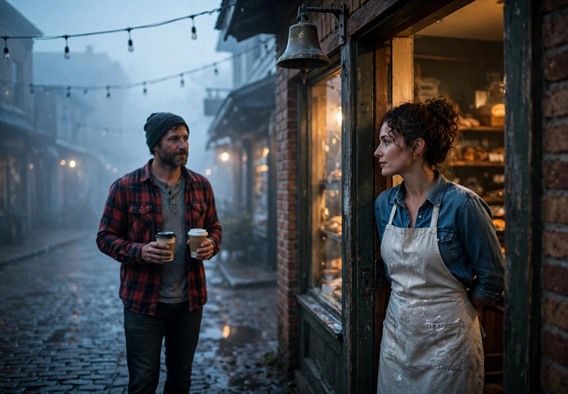
The Wrong Ford
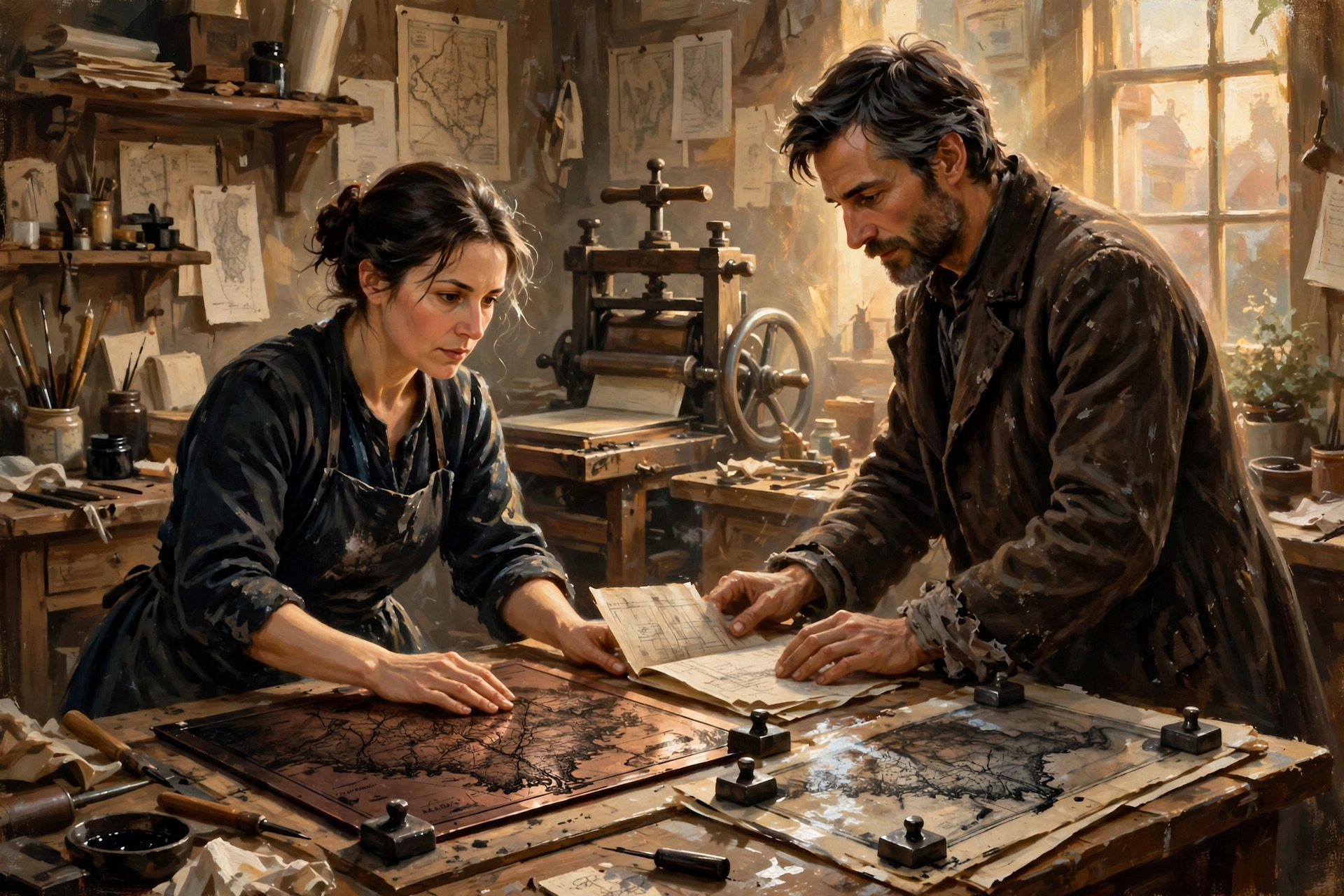
"You've put the ford a furlong too far north," the man said, and laid a folded sheet of paper squarely across her proof.
Clementine Ashgrove looked at the paper, then at the hand still flat upon it. The hand was brown from weather, with ink in the creases of the knuckles. The sleeve above it belonged to a dark coat gone grey at the cuffs, and the coat belonged to a tall, unsmiling man who had walked into the Ashgrove print shop on Broad Street without knocking, as though the door were a formality the Crown had abolished.
"Take your hand off my proof."
He lifted it at once. That annoyed her more than if he'd argued.
"Laurence Whitby. Ordnance Survey." He unfolded the sheet with care, smoothing the creases with two fingers. "I've been resurveying the river corridor below Ludlow since the spring. Your aunt sent word to the office that Ashgrove and Son were finishing the county plate for a London publisher. I thought you'd rather hear it from me than from him."
"Hear what?"
"That the plate's wrong at Corve ford."
Behind the counter, Aunt Agnes made a small sound into her ledger, the sort of cough that meant be civil. Clementine ignored it.
The proof lay pinned under two lead weights at the end of the bench, still faintly damp from the press that morning. Every line on it had come off copper she knew better than her own palms. Her father had begun that plate when she was a girl, had walked every lane of the county with his chain and his notebook, and had sat at this bench through long winter evenings cutting the river into the metal stroke by stroke. She had finished the lettering after his hands began to shake. She had finished everything after.
The copper itself rested on its leather pad beside the proof, its surface dark with old ink and bright where the burin had last bitten. She put her palm on its edge without quite meaning to.
"My father surveyed that ford himself," she said.
"I don't doubt it."
"He measured it twice."
"So did I." Mr. Whitby turned his field sheet so it faced her. His hand was small and plain, every figure upright, the bearings marked in a column down the margin. A neat pencilled river curled across the paper and crossed the lane well south of where her father's line crossed it. "Three times, in fact. Different days. Same result."
"Then your chain's stretched."
Something moved at the corner of his mouth. It might have been offence. It might have been the beginning of a laugh he'd decided against. He reached into his coat pocket and set a single brass link on the bench between them. It was thick, worn smooth on the inner curves, and it caught the window light like a coin.
"Checked against the standard at the office this spring. It's true to a hair." He nudged it toward her. "You may measure it yourself, if you like."
"I don't need to measure your chain, Mr. Whitby."
"No. You need to measure the ford."
She drew a breath to answer and found nothing ready. Aunt Agnes filled the silence by closing the ledger with a soft, deliberate thump.
"Clemmie."
"Not now."
"Yes, now, I think." Her aunt came around the counter, spectacles pushed up into her grey hair, and stood at the end of the bench as if she meant to referee. "Mr. Thorne's letter was very plain. He'll pay for the plate if it agrees with the new government sheets. He won't if it doesn't. He said he's had too many county maps come back from booksellers with complaints."
"Father's maps don't come back."
"Your father's maps were sold before there was anything to check them against." Agnes said it gently, which made it worse. "Forty pounds, love. That's the lease. That's Michaelmas and the winter coal, and nothing left over."
Clementine looked down at the copper. Forty pounds. She had done the sum herself a dozen times this month, in the margins of old proofs and on the backs of her hands, and it had never once come out kinder.
Mr. Whitby had gone quiet. When she glanced up he was studying the shelves behind her: the rolled sheets, the jars of burins and scrapers, the framed map of Shropshire her father had cut in the year she was born. His gaze lingered there longer than it had on her.
"He was good," he said.
She hadn't expected that. "He was very good."
"I can see it. That hill shading on the common is better than ours." He turned back. "That's why I came in person. A man who cut lines like that would've wanted the river right."
"He did have it right."
"Then show me."
She stared at him. He met her eyes without blinking, without softening, as if the matter were entirely about yards and bearings and nothing at all about a man who had died in the upstairs room believing his work flawless. Perhaps for him it was. He had the look of someone who lived out of a single trunk and liked it that way.
"You'll be gone before the plate is even printed," she said. "You people always are. You walk through, you draw your lines, and you leave the rest of us to explain them."
For a heartbeat his face did something she couldn't read. Then it smoothed again.
"I'm posted on to the next county within the month. You're right about that." He picked up the brass link and turned it once between his fingers before he pocketed it. "But the river doesn't care who's leaving."
Agnes cleared her throat. "When does Mr. Thorne come, Clemmie?"
"You know when."
"Tell Mr. Whitby, then."
Clementine pressed her lips together. "A fortnight. He collects the plate himself."
"Then there's time," Mr. Whitby said, "to stand on the bank and settle it."
She reached for the finest scriber in the jar. Both of them watched her, and she knew Agnes was half afraid she meant to strike out the river on the spot. Instead she bent over the copper and found the place where her father's lane met his water, a little hook of line she could have drawn in her sleep. She set the point beside it and pressed, just once, until a tiny bright pit showed in the metal. A witness mark. Something to find again, whatever she decided.
When she straightened, Mr. Whitby was looking at the mark, not at her. His shoulders had eased a fraction.
"Thank you," he said quietly.
"Don't. It's so I can prove you wrong to the very spot."
"Fair."
"I'll walk your ford with you." She set the scriber down harder than she needed to. "I'll bring my father's notebook, and his figures, and you'll bring your perfect chain. And when we're standing in the mud and you see where the lane really crosses, you'll go back to your office and correct your sheet. Not his."
Aunt Agnes let out a long breath that might have been relief or despair.
Mr. Whitby gathered his field sheet, folded it along its creases, and held it a moment before tucking it inside his coat. "Thursday, then. Early, before the carts churn the bank."
"Thursday."
He nodded to Agnes, then to her, and paused with his hand on the door. "Wear boots you don't mind ruining, Miss Ashgrove."
"I own no other kind," she said, and turned back to the copper so he wouldn't see that her ears had gone hot.
Corve Ford
"You're holding it upside down," Clementine said.
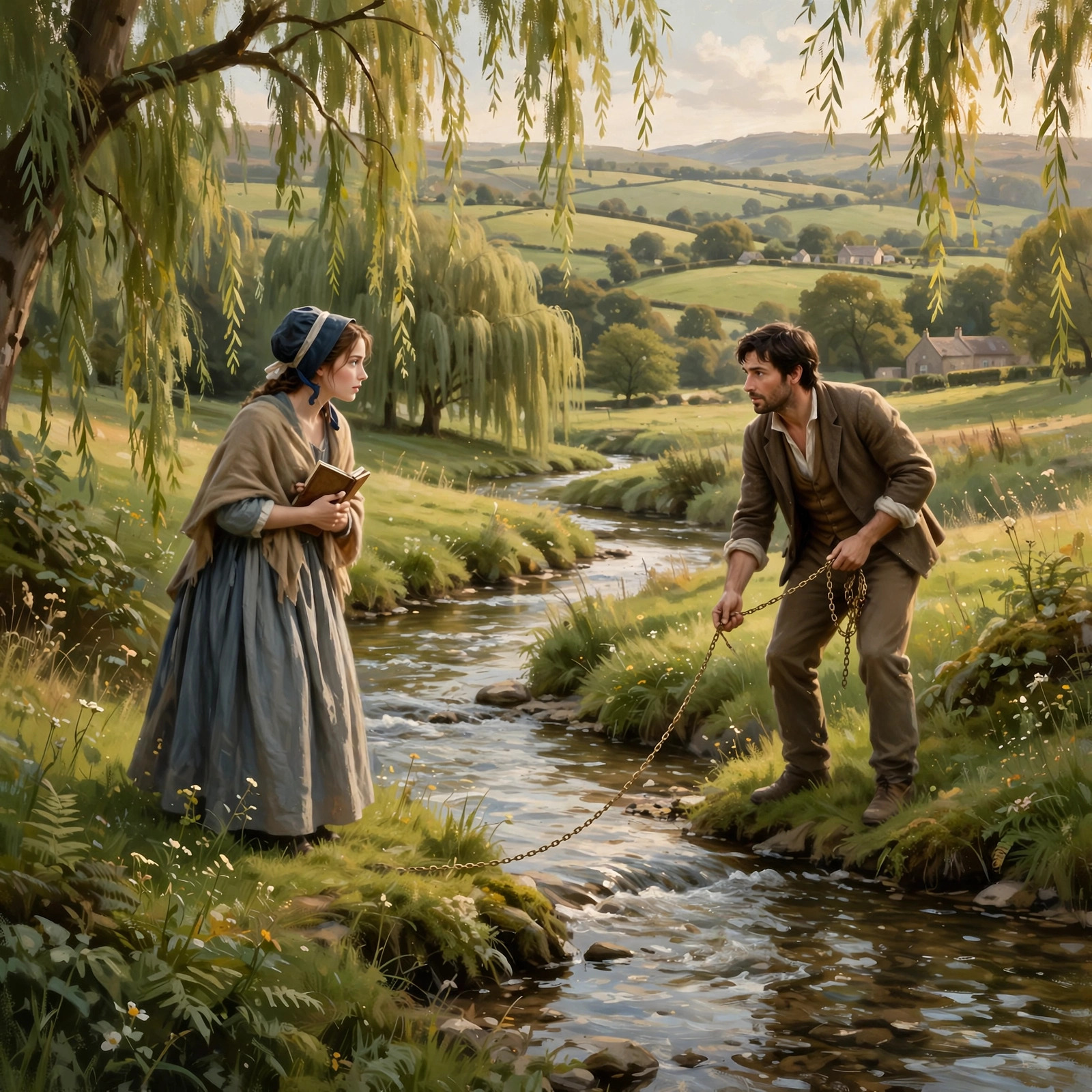
Mr. Whitby looked up from the notebook, the one she'd carried wrapped in oilcloth all the way down from Broad Street, and turned it the right way round without a word. A page of her father's small, slanting figures stared back at him.
"I wasn't reading it," he said. "I was admiring the binding."
"Liar."
"A little." He handed it back carefully, with both hands. "He wrote his sevens like a continental man."
"He learned from a Swiss engraver in Birmingham. He said an English seven could be mistaken for a one in bad light, and a mistaken one could send a cart into a bog." She tucked the notebook inside her coat, against her ribs, where it was dry. "So you see. He cared about errors."
"I never said he didn't."
The ford lay below them in the grey early light, a broad, shallow sheet of the Corve sliding over stones. Mist sat on the water in rags. On the far side the lane climbed away between hedges, rutted and silver with puddles, and nearer at hand a stand of willows leaned out over the bank as if they'd been caught listening.
No carts yet. He'd been right about that, at least.
He'd brought the chain in a canvas bag slung over one shoulder, and now he knelt in the wet grass and drew it out, link after link, until it lay coiled at his knees like something alive. It was brass, dull with use, each long link joined to the next by small rings, and at intervals little tags of brass hung off it, notched and shaped.
"There," he said. "My perfect chain."
"I didn't think it would be so..."
"Ugly?"
"Ordinary."
That made him smile, a quick thing that changed his whole face and then went away again. "It's meant to be. Sixty-six feet, a hundred links. Ten chains to a furlong, eighty to a mile. Every surveyor in England carries the same, so a field in Shropshire means the same as a field in Kent." He lifted one of the hanging tags between finger and thumb. "These are tallies. Every ten links. One point for ten, two for twenty. You count them in the dark by feel, if you have to."
"Have you had to?"
"Once. On a moor in Yorkshire, with fog so thick I couldn't see my own boots." He let the tally fall. "I wouldn't recommend it."
She crouched beside him and touched one of the links. It was cold and slightly greasy, and worn bright on the inner curve where it had rubbed against its neighbour for years. She thought of her father's burins in their roll of baize, the handles darkened by his palm. Tools took on the shape of the people who used them.
"Your father would have used a chain like this," Mr. Whitby said.
"He did. He borrowed one from the land agent at the castle." She stood, brushing her skirts. "So it isn't the chain that's wrong."
"No," he agreed. "It isn't the chain."
He handed her one end, a flat brass handle, and walked backwards with the other toward the water, paying out the links through his fingers. She'd thought he would be clumsy at it, a man so neat in a shop, but he moved without looking, his boots finding the stones by habit.
"Stand on your father's mark," he called. "The stone at the lane mouth. Is it there?"
She found it in the grass, an old squared boundary stone with lichen growing in the cut letters. Her father had sketched it on the first page of the notebook. Seeing it in the flesh made her throat tighten, absurdly, as if he'd left it there for her.
"It's here."
"Good. Hold the handle to the face of it. Don't let it slip."
"I've held a burin to copper for longer than you've been dragging that thing across fields. I won't let it slip."
"Then you're the best chainman I've had in a year."
He stepped into the river.
The water came up over his ankles at once, and he made a short, offended sound that he clearly hadn't meant to make. Clementine laughed before she could stop herself.
"Cold, Mr. Whitby?"
"Bracing." He took another step. "Refreshing. Entirely as expected."
The chain drew taut between them, a long glinting line laid over grass and mud and water. He bent, counted tallies under his breath, set an arrow into the gravel, and called the figure back to her. She wrote it in her father's notebook, on a clean page at the back, in her own hand. It felt like trespass and like company at once.
They did it again, and again, him wading, her following, the handle moving from mark to arrow. Halfway across she gave up keeping her hem clear and simply walked in. The Corve closed over her boots and filled them in one icy rush.
"Oh," she said. "Oh, that is vile."
"Bracing," he called back.
"Don't you dare."
"Refreshing."
She splashed toward him, meaning to say something cutting, and her foot found a slick stone and went out from under her. He caught her elbow. For a moment they both stood swaying in the current, his hand hard around her arm, her free hand flat against his coat, and then her boot squelched so loudly when she found her footing again that they both burst out laughing, helplessly, in the middle of the river with the mist lifting off it.
He let go first. She noticed that.
On the far bank he spread his field sheet on a flat rock and weighted the corners with pebbles. She stood dripping beside him while he set her figures against his.
The lane crossed lower than her father had drawn it. Not by much. A few chains. Enough that a stranger trusting the map would come down through the hedges to a bank that wasn't where the copper said.
She stared at the numbers until they swam.
"His figures are good," Mr. Whitby said quietly. "Look. Here, and here. His bearings are clean. I'd have been proud of them."
"Then how can he be wrong?"
He didn't answer at once. He was looking past her, at the willows on the near bank. Their roots stood bare above the water in a pale, scoured tangle, as if the earth had been washed out from beneath them. He looked a long time.
"I don't know yet," he said at last.
"You don't know." She heard her voice go sharp. "I thought your chain always knew."
"The chain tells me where things are now." He folded the sheet, slowly. "It doesn't tell me why."
She hadn't expected that. She'd come armoured for a man who would tell her, kindly and with great certainty, that her father had been careless. Instead he was frowning at tree roots like a man reading a letter in a language he half knew.
"My father," he said, still not quite looking at her, "had a steward who measured our tenants' fields with a rope. It stretched in the rain. Every wet year the farms grew smaller on paper and the rents stayed the same." He tucked the sheet away. "I said so, at supper, when I was too young to know better. That was the beginning of a long quarrel."
"Who won?"
"The rope." The smile came and went. "So I went and found a chain."
She didn't know what to say. Her wet stockings were going numb. Somewhere up the lane a cart was coming, its wheels grinding.
He reached into his coat pocket and drew out the single brass link he'd turned in his fingers that first day in the shop. In the daylight she could see how worn it was, thinned almost to a wire on one side.
"From my first chain," he said. "It wore through on a hill in Devon. I keep it to remind me that even brass goes wrong if you trust it long enough." He held it out. "For your witness mark. So you remember I wasn't certain, either."
She took it. It was warm from his pocket. She closed her hand around it and put it away inside her coat, beside the notebook.
Then he gathered the chain, and when he'd coiled all but the last length he held the end handle out to her, as if he needed her to carry it up the bank.
He didn't. She knew he didn't.
She took it anyway, and her fingers closed over the cold brass where his had been, and she went on holding it after he'd turned to lift the bag, long after there was any reason at all.
Chalk on Copper
"Not there," Clementine said. "If you lean your cuff on it, you'll smudge the hatching, and I'll have to cut it again."
Laurence lifted his arm off the bench as if the copper had burned him. "Sorry."
"You've been sorry four times since supper."
"Then I'm improving. It was six last night." He set his field book open beside the county plate, flattened the spine with his palm, and squinted at her proof. "Here. This is where the lane meets the water."
The lamp hissed between them. Aunt Agnes had gone up an hour ago with the account book under her arm and a look that said she would be listening to the floorboards. The shop smelled of ink and lamp oil and the vinegar Clementine used to clean the plate, and Broad Street outside had gone quiet but for a dog somewhere complaining at the moon.
She pulled the proof closer. Her father's line ran down to Corve ford in a clean, sure curve, the way he'd always cut a river, as though he'd been there when it was poured. Beside it sat her own small witness mark, the scratch she'd made after the walk, faint as a hair.
"Show me," she said.
He took the chalk from the tin. He held it the way he seemed to hold everything, carefully, at the very ends of his fingers. He bent over the copper and drew.
The line came out pale and soft against the dark metal, a few chains lower than her father's, bending where his did not. It looked like nothing. A ghost of a road. She could wipe it off with her thumb.
She didn't.
"Your father's bearing off the church tower is perfect," Laurence said, tapping a column of figures. "I've checked it three ways. And the mill. And the stile on the Whitcliffe path. It's only the ford." He frowned at his own chalk. "Only the ford."
"You said that on Thursday."
"I'm still saying it. I haven't found a better sentence."
She laughed before she meant to, and he looked up, surprised, as though he'd been handed something he hadn't asked for. Then he looked back down quickly and turned a page in the field book with great concentration.
They worked. He read out offsets and she found them on the proof, pricking each with a needle so the paper caught the lamplight in tiny bright holes. Twice he was wrong about which hedge he meant, and she told him so. Once she was wrong about a parish boundary, and he only slid the book toward her and waited until she saw it herself. She liked him for that more than she wanted to.
The church bell gave the hour. Then the half. Her fingers had gone grey to the knuckle.
"He used to let me hold the lamp," she said.
Laurence stopped with the chalk half-raised.
"When he cut the rivers. I was small, I couldn't do anything useful, so he'd say, 'Light, Clem,' and I'd hold it just so, and he'd cut the whole Teme in one sitting and never once look up." She pressed the needle into the proof though there was nothing left to mark. "He walked every mile of this county. He wore out two pairs of boots on it. When he was ill at the end, he had the plate brought up to his bed so he could look at it. He said it was the only thing he'd ever made that was entirely true."
The lamp hissed.
"And then you came in with your chain," she said, "and told me it wasn't."
"I told you the ford had moved on paper." His voice was low. "I didn't say he lied."
"It's the same thing, in Thorne's shop. He'll only take the plate if it agrees with yours. Forty pounds, or I lose the lease." She set the needle down very straight on the bench. "So I have to choose which of you is right, and I've known one of you my whole life."
He was quiet long enough that she thought she'd ruined the evening. Then he put the chalk down, and pushed the field book an inch toward her, the way he'd done with the parish line.
"I haven't got anything on paper as good as that," he said. "Nobody brought anything of mine up to a sickbed." He turned the brass rule over in his hand. "My father wouldn't have noticed if I'd mapped the moon. I left, and he took my name out of the will the same month. I sent him the first sheet I ever signed. It came back unopened."
"Laurence."
"It's an old letter." He tried to smile and nearly managed. "I only mean, you're lucky. Being so angry for him. It means there's someone to be angry for."
She found that her hand had gone into her coat pocket, where the worn brass link was, the one thinned to a wire. She hadn't taken the coat off all evening. She had told herself the shop was cold.
"You're leaving within the month," she said.
"Yes."
"You always do, I suppose."
"I'm good at it." He looked at the plate, not at her. "Before anyone asks."
"Nobody's asking."
"No," he agreed, very softly. "I know."
The bench was narrow. She hadn't noticed how narrow until she leaned across it to close his field book, and he leaned to stop her, because the last page wasn't dry, and their hands met on the cover and both of them stayed.
His fingers were chalky. Hers were black. She could see the smears they made on each other.
"You've ink on your face," he said.
"Where?"
He lifted his free hand and touched her cheekbone, just below the eye, with one careful fingertip. "There."
"Now there's chalk too."
"Then we're even."
She meant to say something sensible about the hour. Instead she kissed him. Or he kissed her; afterwards she was never sure who had leaned the last inch over the copper. His mouth was warm and uncertain and then not uncertain at all, and his hand slid from her cheek into her hair and knocked a pin loose, and she heard it ring on the plate and didn't care where it fell.
When they broke apart the lamp was still hissing and the dog had stopped complaining. He was breathing like a man who'd run up a bank.
"I shouldn't have," he said.
"You've apologised enough tonight."
"That wasn't an apology." He found her hairpin on the plate, held it a moment, and laid it in her palm. "I'll come tomorrow. We can look at the soundings again."
"Tomorrow," she said.
He gathered his book and his hat and went to the door, and turned there as if to say something more, and didn't. The bell over the door shivered. His footsteps went away down Broad Street toward the inn.
Clementine stood alone at the bench with her coat still on and his link in her pocket and her mouth still warm.
On the copper, his chalk line lay pale beside her father's deep-cut curve. So close she could have covered both with one finger. So soft a breath would move it.
She looked at it for a long time, and did not touch it at all.
The Burnisher
"You've not slept," Aunt Agnes said, before Clementine had the shutters fully open.

"I slept."
"In that coat?" Her aunt set the ledger on the counter and peered over her spectacles at the bench. "And you've already had the oilstone out. What are you doing to that plate, child?"
Clementine didn't answer. She had the burnisher in her right hand, the polished steel warm from her grip, and the county plate angled under the window where the morning came in grey and honest. Laurence's chalk was still there. He'd laid it so lightly that one sleeve would have taken it. That would have been easy, and it would have been a lie, because sometime after midnight she had taken up the graver and cut his line into the copper beside her father's. Shallow, a trial cut, the kind you make to see how a thing will look before you commit. It had looked right. That was the trouble.
"I'm putting it back," she said.
"Putting what back?"
"Papa's ford."
Agnes came round the counter, slow, her skirts brushing the type cases. She looked at the two lines, the old deep curve and the new pale furrow a few chains below it, and then at her niece's face. "Mr. Whitby said--"
"Mr. Whitby has a chain and a theodolite and a salary from London. He doesn't have to put his name on it." Clementine set the burnisher to the new cut and leaned. The copper gave under the steel, the way it always did, soft and obliging, the burr pressing down and the groove closing up like a healing scratch. "Papa walked that ford. He walked it in 1846 with me carrying the flags."
"I know he did. I sent you both off with bread and cheese."
"Then you know."
"I know he walked it," Agnes said. "I don't know that the river did as it was told."
Clementine pressed harder. A curl of copper lifted at the edge of the stroke where she'd caught a burr wrong, and she scraped it free with the scraper's edge and let it drop. It glittered on the boards by her boot.
The bell over the door shivered.
She knew his step before she looked. Measured, because everything about him was measured. He had his field book under his arm and his hat in his hand, and his face, when it found hers, did a thing she had to look away from. It opened. Then it saw the burnisher.
"Good morning, Mrs. Pollard," he said, without taking his eyes from the bench.
"Mr. Whitby." Agnes gathered her ledger to her chest. "I'll be in the back. With the accounts. Which are loud." She went, and did not quite close the door.
Laurence crossed to the bench. He stood on the far side of it, exactly where he'd stood last night, and she hated that she noticed. He looked at the plate a long while.
"You cut it," he said quietly. "You cut my line."
"I tried it."
"And now you're taking it out."
"Yes."
He set the field book down. Not gently. "Will you tell me why? I came to go over the soundings. I've got the depths from Thursday worked through, and there's something on the near bank I still can't account for, I said so, I'm not pretending I've got it all--"
"Then why should it go on the plate?"
"Because the lane crosses where I measured it. That part I'm sure of."
"You're sure of everything you can put a chain across." She heard her own voice and didn't stop it. "Papa was sure too. He died sure. He died thinking that sheet was the best thing he ever made, and he was right, it's beautiful, every hedge on it, and you came in here with your Ordnance numbers and told me he got it wrong."
"I told you the ford was off. I never said he--"
"You don't have to say it. You put a line next to his and let the copper say it." She worked the burnisher again, two short strokes, and the last of his groove shallowed to a faint bruise in the metal. "Thorne will want the new survey. Fine. Thorne can want it. I'm not cutting my father out of his own map so a man in London can feel tidy."
Laurence was very still. When he spoke it was almost mild, and that was worse. "You'd rather lose the shop."
"I'd rather it was his."
"It's yours. It's been yours for years. You're the one at the bench."
"And it goes out as Ashgrove and Son." She laughed, short and ugly. "There's no son. There's me, signing as a dead man's boy. The only thing in this shop with my father's hand still on it is that line, and you want me to scrape it off for forty pounds."
"I want it to be true."
"That's all you want from anything." She set the burnisher down so hard it rang against the plate's edge. "Measurements. Bearings. Nothing that can look at you and expect anything back. It's cold, Laurence. Your whole way of working is cold. You walk into a town, you tell everyone where they've gone wrong, and you leave before it matters."
She watched it land. He didn't flinch. He only took a breath through his nose and looked down at his hands, at the chalk still pale in the creases of his knuckles, as if checking something he'd measured once and needed to read again.
"I'm posted on at the end of the month," he said. "The office wrote. It came this morning."
The shop went quiet around them. Even the accounts in the back had stopped.
"Then you'll be glad to go," she said.
"I was coming to tell you." He picked up the field book and held it against his chest, the way Agnes had held the ledger. "I thought, after last night, you'd want to know before anyone else did. I thought you might..." He shook his head once. "It doesn't matter what I thought."
"No," she said. "It doesn't."
Her hand had gone into her coat pocket without her asking it to. The brass link was there, worn thin on one side, warm from her. She closed her fingers over it and did not take it out, and did not give it back, and she saw him see the shape of her fist through the wool and understand neither.
"Your father's bearings are sound," he said. "I'll write that in my report. Whatever you put on the copper." He turned the hat round once in his hands. "I don't think he was wrong, Clementine. I never thought that. I think something happened to that bank that neither of us has walked yet."
"Then go and walk it."
"I might."
"You'll be gone."
He looked at her then, properly, and for a moment she thought he'd come round the bench. Her whole body thought it. Instead he put on his hat.
"Good day, Mrs. Pollard," he called toward the back room, steady and polite, and Agnes's voice came back small: "Good day, Mr. Whitby."
He went to the door. He didn't turn on the threshold this time. The bell shivered and went still, and the latch clicked home, and his footsteps went off down Broad Street toward the inn.
Clementine stood with her fist in her pocket. On the plate her father's curve lay deep and dark and alone. Beneath it, where the other line had been, the copper held a faint dull smear she would have to polish twice to hide.
Agnes came to the doorway of the back room and didn't say anything at all. She only looked at the floor.
Clementine looked too. Bright curls of copper lay scattered round her boots, thin as hair, catching the grey light.
High Water
The door banged open hard enough to set the bell clanging. Clementine looked up from the copper and saw Laurence standing in the doorway, wet from his hat to his boots.
River water ran off his coat and pooled on the boards. Mud had climbed his trousers to the knee. There was a long scrape across the back of one hand, and he held his field book inside his shirt, pressed flat against his ribs.
"You'll drown the floor," she said, because the other words wouldn't come.
"I've been in the Corve." He shut the door behind him with his shoulder. "Most of the afternoon. It's over the lane now, right up to the hedge."
Agnes appeared from the back room, took one look, and went for the kettle without a word.
"You were meant to be at the inn packing." Clementine came round the bench before she'd decided to. "Your posting. The office..."
"I wrote and asked for a delay. They'll likely mark it against me." He fished the book out and set it on the bench, well clear of the plate. The cover was dark with damp, but the pages inside had stayed dry. "I don't care. Look."
She looked. He had drawn the ford three times on facing pages, in a hand that had plainly been shaking with cold.
"The willow roots," he said. "I couldn't make sense of them last week. Today the water showed me. The near bank's soft clay over gravel. In flood the current cuts straight under it, here, and lays the silt down on the far side, here. The whole channel walks downstream." His wet finger hovered above the page. "I found the old crossing stones. Your father's stones. They're sitting in a hayfield now, three chains back from the water."
Clementine stared at the little drawn stones.
"He wasn't wrong," Laurence said quietly. "When he measured, the ford was exactly where he cut it. The river moved after. He was right, and so is the new line. Both of them."
Behind her the kettle began to tick on the hob. Clementine put her hand flat on the bench to keep it still.
"You walked a river in flood," she said, "to prove my father right."
"To prove you both right." He looked at the plate, at the dull smear she still hadn't polished out. "Thorne comes in the morning."
"I know when Thorne comes."
Agnes pushed a cup into his hands and a towel round his neck, and gave her niece a look that said a good deal. Then she went back to her ledger and shut the door almost all the way.
Clementine picked up the burin.
She didn't sit at first. She stood over the copper with the tool in her fist and felt the old refusal rise in her chest. It had kept her upright for most of a decade, ever since her father's hands went too unsteady for the work and hers took it over. Nobody touches his lines.
Then she looked at Laurence's drawing of the stones in the hayfield, and she sat down.
"Hold the lamp lower," she said. "On the left. No, there."
He held it. He didn't speak. For a long while the only sounds were the rain on the window and the small bright hiss of the burin moving through copper.
She didn't touch her father's curve. She left it deep and dark, just as he'd cut it. Below it she engraved the new lane, following the line Laurence had chalked a week ago. Then, in fine dotted strokes, she marked the old crossing and lettered it small: ford of 1846.
When she lifted her head, his tea had gone cold, untouched.
"That's honest," he said.
"It isn't finished."
She turned the plate toward the cartouche in the lower corner, where the words Ashgrove and Son stood in her father's tidy lettering. There had never been a son. There had been her, at this bench, since she was old enough to sharpen his tools.
Under the line she cut T. Ashgrove, surveyed. Beside it, her hand slowing only once, C. Ashgrove, engraved and revised.
Laurence let out a long breath. "Thorne won't like that."
"Then Thorne won't buy it." She set the burin down. Her fingers ached from the grip. "I'm done selling this shop's work under a name that isn't mine."
He looked at her across the lamp as if he were measuring something and the figure had surprised him. She half expected him to reach for her. Instead he set the lamp down gently, very carefully, like a man afraid of spilling it.
Agnes sent him back to the inn before midnight to change into something dry. Clementine sat up until dawn, polishing out the smear.
Mr. Thorne arrived at ten, in a good grey coat, shaking rain from his umbrella with great irritation.
"Miss Ashgrove. Mrs. Pollard." He tipped his hat at the room in general. His eyes moved to Laurence, who stood in a dry borrowed coat by the window. "And this gentleman?"
"Mr. Whitby, of the Ordnance Survey," Agnes said, in her accounts-voice.
"Ah. The new sheets." Thorne pulled on his spectacles and bent to the proof Clementine had pulled at first light, the ink still giving off a faint sharp smell. He followed the river with one gloved finger. At the ford he stopped.
"Two crossings."
"The river shifted," Laurence said. "The new line agrees with the survey. The old one is where the ford stood when the county was first measured. It's correct for its year."
Thorne grunted. His finger moved on to the cartouche, and stopped again.
The silence lasted long enough that Clementine heard Agnes's pen go still in the back room.
"C. Ashgrove," Thorne read.
"Clementine." She kept her chin up. "I've engraved every Ashgrove plate you've bought since my father's hands failed him. I'll go on doing it, under my name, or you can take your trade to someone else."
Thorne took off his spectacles and polished them on his cuff, slowly.
"My customers," he said, "buy maps from me because the roads go where the paper says. Half my rivals would've printed the old ford and let some farmer's cart find out the hard way." He put the spectacles back on. "A map that shows its own history is unusual. I may charge more for it." He looked at her over the rims. "I suppose that was your idea as well."
"It was."
"Hm." He drew out his pocketbook and counted out notes onto the bench beside the plate. "Forty pounds, as agreed. Have it crated by noon."
Agnes came out of the back room fast, for her, and gathered up the notes as if they might fly off.
Clementine turned, wanting Laurence to see it. The lease was safe. The plate was going to London with both their names on it.
The window was empty. The borrowed coat hung on its peg.
The bell above the door gave a single small shiver and went still.
Whitcliffe at Dusk
She found him where the common tipped toward the river, sitting on a limestone outcrop with his coat collar up and his hat beside him in the grass.
"You left," Clementine said. She was out of breath from the climb, and it came out sharper than she meant.
Laurence didn't turn at once. Below them Ludlow was going blue at the edges. The castle had already lost its colour, and the chimneys were sending up thin lines of smoke into a sky that had finally stopped raining. The Teme ran high and brown along the foot of the cliff.
"I left the shop," he said. "Not the county."
"You might have said so. I turned round to tell you about the lease and you'd gone off like a cat out a pantry window."
That got the corner of his mouth. "It was your moment. Yours and your aunt's. I didn't think a man in a borrowed coat ought to stand in the middle of it."
"Agnes counted those notes three times. Then she made me count them. Then she put them in the tea caddy and sat on the lid." Clementine came the last few steps and stood beside the outcrop, skirts damp to the shin. "He's taking the plate this evening. The crate's nailed."
"Good."
"Both crossings. Both names."
"I saw."
She looked at him properly then. He had shaved, badly, and there was a scrape along his jaw from the willows at the ford. His boots were still dark with river. He hadn't slept either. She could tell by how carefully he held still.
"Did the office answer?" she asked.
"Not yet. They'll think me unreliable. It's possible they're right."
"You walked the Corve in flood with a lantern and a chain, Laurence. Unreliable isn't the word I'd choose."
"What word would you choose?"
She sat down beside him on the cold stone, closer than was sensible. From up here she could follow the Corve to where it met the Teme, a pale ribbon through the meadows, and farther north the dark smudge of the hayfield where her father's old stepping-stones lay in the grass like something set down and forgotten.
"I said your work was cold," she said. "I said it to your face, with the burnisher in my hand. I've been hearing it all week."
"You were defending him."
"I was hiding behind him. It's not the same." She pressed her palms flat against the rock. "He measured that ford in good faith and it was right. You measured it again and it was right. I couldn't let you both be right, because then I'd have to change something, and changing anything of his felt like taking a spade to his grave." She swallowed. "So I took a burnisher to you instead."
He said nothing. He'd learned that from her, she suspected: when to let a silence do its own work.
"Last night," she went on, "when you came in soaked to the waist and told me the river had moved, I wasn't thinking about my father at all. I was thinking you might've drowned for my sake, and I'd never said..." She stopped. Her voice had gone thin. She made it steady. "I love you. That's what I'd never said. I love you, and I'm not sorry about the shop or the name or any of it, except that I was unkind to you on the way here."
The wind moved through the grass on the common. Somewhere below a dog was barking at the end of the day.
Laurence turned his hat over in his hands, once, and set it down again.
"I've spent twelve years walking into towns with a chain and walking out of them," he said. "I'm good at it. I measure the place, I make the sheet, I'm gone before anyone learns how I take my tea. My father sent back the first sheet I ever signed without breaking the seal. After that it seemed easier to trust a line than a person." He looked at her. "Then you shouted at me across a print shop about a ford, and I've been trying to get the measure of you ever since. I can't. I've stopped wanting to."
"That's a very surveyor's way of putting it."
"I'm a surveyor." He drew a breath. "I love you, Clementine. I'd have said it last night, but I was dripping on your floor."
Her laugh came out wet. "You'd have been very romantic, dripping."
"I'd have been very cold."
He reached into his waistcoat and brought something out, closing her hand around it before she could see. Then he opened her hand again, gently, so she could look.
A brass link, worn at the rivets, the twin of the one in her coat pocket.
"You kept the other," he said. "I noticed. A chain's no good with a link missing, so I took this out as well, this morning. The office can send me a new one. They'll grumble." He touched the brass in her palm. "I wrote again before Thorne came. Not to delay the posting. To ask for the county. Someone has to keep the sheets right as the rivers wander, and it might as well be a man who knows where Ludlow's best engraver works."
She stared at him. "You asked to stay."
"I asked to stay." He said it plainly, as if reading off a bearing. Then, less plainly: "If you'll have me stopping here."
"They may refuse you."
"They may. Then I'll ask again, and keep asking. I've become stubborn lately. I can't think where I caught it."
Clementine didn't answer. She put her free arm round his neck and pulled him to her, and he came at once, both arms about her, his damp coat rough against her cheek and his chin settling on the top of her head as though it had been measured to fit there. He smelled of river and cold stone and lamp oil. She could feel his heart going hard under the wool, every bit as unsteady as hers.
Below them the town lit its first windows, one, then another, the way a map fills in.
"Agnes will want to know your intentions," she said into his shoulder.
"Agnes may have them in writing. Countersigned."
She laughed again, and he held her tighter, and between them her hand closed over the brass link until its edges pressed warm into her palm.
Get notified when new stories drop
Ivy Chen
Ivy writes historical and second-chance romance with period texture and modern emotional clarity. Courtship stakes, letters, and choices that cost.
Leave a comment
Comments