


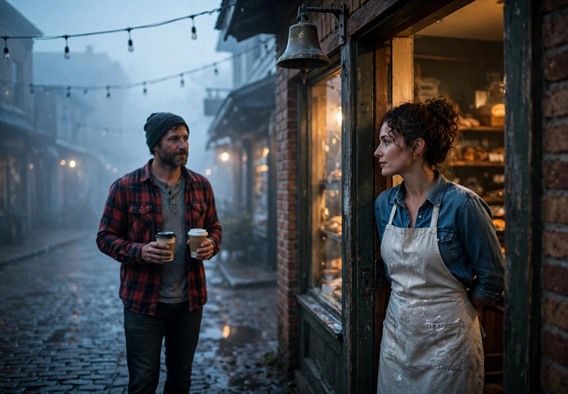
Flaking Gold
"It stays off," Amos said. "The whole word. I'm not paying to have it painted back on."
"You're not paying for anything. The town is." Joss tipped her head back and squinted at the board above the door. "And I haven't said I'll paint it. I said I'll look."
"You're looking at it like you've already ordered the gold."
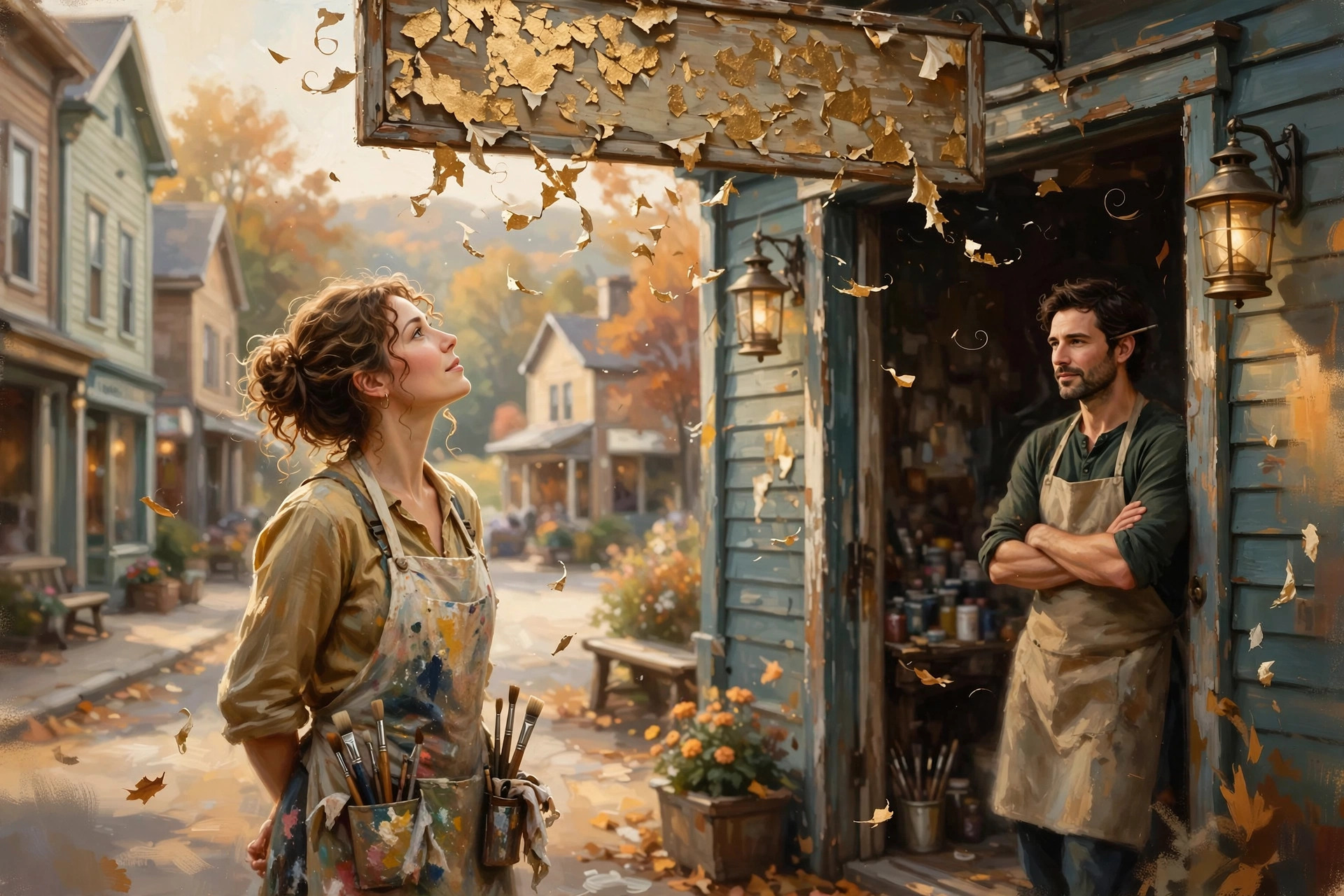
She was. She lowered her chin and found him standing square in the doorway of Pruitt & Daughter Hardware, arms folded over a canvas apron, a pencil behind one ear. He had the look of a man guarding a bridge. Behind him the shop smelled of machine oil and birdseed, and a bell on the door still swung from where she'd nearly walked into him.
"The sign says what it says," she said. "Or it did. Half of that last word has gone to powder."
"Then let it go the rest of the way."
"Mr. Pruitt."
"Amos." He said it flatly, like a correction on a receipt. "Nobody on this street calls me Mr. anything."
"Amos. My grandfather lettered that board in 1974. Water gilding, real leaf, laid by hand over cedar. It's lasted fifty years in Vermont weather and it deserves better than a shrug."
Something moved in his jaw. "I know who made it."
"Then you know I'm not the enemy of it."
"You're a stranger the council hired to tell me what to do with my own storefront."
"I grew up four doors down." She pointed with her chin toward the faded shape of the Ellery Sign Shop, its windows papered over. "I'm just a stranger who left."
That landed somewhere; she watched it land. His eyes went to the shuttered shop and back, quick, and his arms tightened.
A wind came down Main Street and the sign creaked on its hooks. Overhead, a curl of old varnish lifted and let go. It drifted past her shoulder. She stepped back onto the curb to get the whole board in view, the cream letters, the gold shadowed with grime, and that last word, the one with its tail eaten away.
"Forty brass lanterns on this street," Amos said behind her, "and every one of them I've hauled up a ladder myself. I know what keeping a thing costs. I'm telling you this one doesn't need keeping."
"Then why does it bother you so much?"
"It doesn't."
"You've said the word Daughter like it's a splinter."
"I haven't said it at all."
"Exactly."
He opened his mouth. A hand landed on each of their sleeves, and Tully Reyes was between them, clipboard hugged to his chest, his council lanyard swinging like a pendulum.
"Okay," Tully said brightly. "Okay! Good, everyone's talking. That's progress. Joss, you've been in town since breakfast and you've already made him raise his voice. That might be a record."
"I didn't raise it," Amos said.
"You raised it internally." Tully turned to her, and his smile went careful. "Cousin. Please. Look at the board before you start negotiating. That's all I asked."
"I am looking at the board."
"You're looking at his face."
She was, and she stopped. Heat crept up her neck. Tully had pulled strings for this, and she knew it. He'd stood in front of the council and argued for the full fee, six thousand dollars, over the cheaper offer for a vinyl banner, and then he'd phoned her three times until she said yes. She owed him a better first hour than this.
"Fine," she said. "I need a screwdriver."
Amos stared. "For what?"
"To see if the board's sound. If the cedar's rotten behind the gold, nothing I do matters, and you can have your banner in peace."
"Nobody's touching that sign without the council's say-so."
"The council's standing right here," Tully offered. "Touch it."
Amos looked at him the way a man looks at a dog that has just sat on his foot. Then he went inside. Joss heard a drawer scrape, and he came back and held out a flathead screwdriver, handle first, without a word. Their fingers didn't meet. She noticed that she'd noticed.
The stepladder leaned by the door, bolted at the feet with rust. She set it against the brick and climbed until the board hung at her eye level, close enough to see the brushwork. Walt Ellery's hand was all over it, the confident swell at the top of each stem, the way he'd let a stroke thin out and then catch it. She'd forgotten. Or she'd made herself forget, which wasn't the same.
Her throat tightened, and she bent to the lower left bracket so no one would see her face.
"Careful," Amos said from below.
"I'm always careful."
"You left town in a hurry."
She paused with the blade in the screw head. "That was a different kind of careful."
He said nothing. Tully, thankfully, said nothing either, which for Tully was a feat.
The screw gave with a dry squeal. She worked it free, dropped it into her palm, and eased the corner of the board a quarter inch off the brick. Behind it the cedar was pale and clean, dense, no softness when she pressed her thumbnail in. She breathed out. It was sound. The wood had held the whole time. It was only the surface that was failing.
"Well?" Tully called.
"It's good." Her voice came out rougher than she meant. "The board's good. It's the gold that's tired."
"Can you save it?"
"I can save all of it." She looked down at Amos then, and she didn't soften it. "Every word."
"Not that one," he said.
"We'll see."
"Joss." Tully's whisper was a plea.
She tightened the screw back by hand, not all the way, and a breath of wind caught the loosened corner. The board shivered. Flakes of gold lifted off the last word and spun down in the afternoon light, small bright scraps, like something being let go of.
One landed on the toe of Amos's work boot. He looked at it. She waited for him to scuff it off against the step, to shake his foot, to do anything a man does with trash.
He didn't move. He stood there with his arms finally loose at his sides, and let it stay.
Thursday Taper
"You're holding it wrong," Amos said.
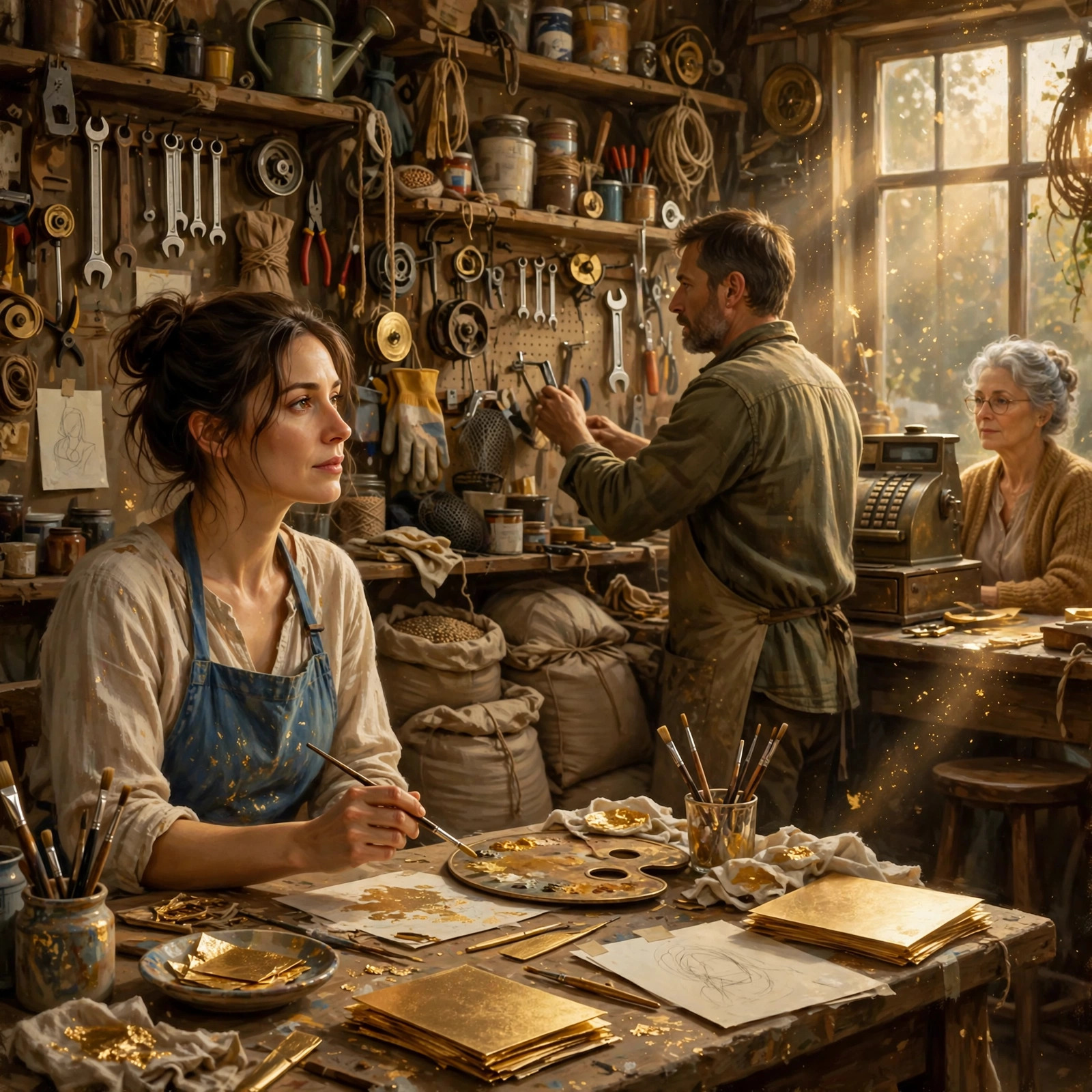
"It's a stick with fire on the end. There's no wrong."
"There's a wrong." He shifted her grip higher on the brass shaft, two fingers, quick and impersonal, and let go as if the metal had bitten him. "Lean it toward the glass. Not into it."
Main Street was filling in around them. Dusk had gone the color of weak tea, and people stood on the sidewalks with paper cups, children wedged between knees. Somebody's dog sat on Joss's boot. The kerosene smell came up sharp from the first lantern, and under it the sweeter bite of cedar smoke from the little brazier Amos kept going by the curb.
She hadn't meant to be here. She'd come down to measure the door frame, and he'd been standing there with the taper in one hand and a second, shorter one in the other, looking at it. Then he'd looked at her.
"Forty lanterns," he'd said. "My arms aren't long enough."
It was the nearest thing to a request she'd heard from him all week. Three days of arguing over one word, and now this.
Joss touched the flame to the wick. The lantern caught, bloomed, steadied behind its scratched glass. A small cheer went up, ridiculous and warm, and her face heated.
"One," Amos said.
"I can count."
"Thirty-nine to go."
They moved down the street together, him on the near side, her on the far, crossing at every second post. He reached the high hooks without a ladder. She trimmed wicks that sputtered. Once their tapers crossed in the air between them and the flames leaned toward each other, and neither of them said anything about it.
She'd forgotten the hush. When she was a girl, the whole street went quiet at the middle lanterns, as if the town were listening to itself. Her father used to lift her onto his shoulders there. She kept her eyes on the wick in front of her.
"You're slow at the ones by the bank," Amos said, low.
"The hook's bent."
"It's always bent." He reached across and straightened it with his thumb. "Mom keeps asking Tully to fix it."
"Your mom's still at the register?"
"Every day."
When the last lantern was lit, the length of Main Street glowed amber down to the Granite Steps, and the chatter rose up like steam. Amos set the taper in its iron stand. He rolled his shoulders. For a moment, in that light, he looked less like a man guarding a door and more like someone who'd carried something a long way.
"Thank you," he said, to the lantern nearest him.
"You're welcome," she told the same lantern.
Inside the store, the bell over the door gave its tired clank. The shop smelled of machine oil and string. Nora Pruitt sat on her stool beside the register with a cardigan buttoned to the chin and her reading glasses pushed up into silver hair. She'd watched the whole lighting through the front window. Joss could tell from the way she didn't pretend otherwise.
"You did the far side well," Nora said.
"Amos did the high ones."
"Amos always does the high ones." Nora's eyes moved over her son and back. "Come here, Josephine."
Nobody had called her that in years. Joss crossed the worn boards. Nora pulled open the register drawer, not the cash one, the shallow wooden one beneath it, and rummaged past rubber bands and a dried-out tape measure. She came up with a brush.
It was a lettering quill, squirrel hair gone stiff, the ferrule dented, the handle worn pale where a thumb had rested. Joss knew it before she took it. Her pulse knew it.
"Mom," Amos said.
"He left it here the week he finished." Nora kept her gaze on Joss. "Said he'd collect it. Then he was busy, and then he was sick, and I never found the right time to walk it down the street."
The handle fit her palm as if it had been waiting. She ran her thumb along the bristles. A few crumbs of old gold clung there, dull as pollen.
"I can't," Joss said. "It's yours."
"It's a brush. It wants a hand." Nora closed the drawer with her knee. "Use it on something worth the trouble."
Behind her, Amos had gone very still by the paint shelves. She didn't turn. If she turned she'd see his face, and she wasn't sure which expression would be worse, anger or the other thing.
"Tomorrow," he said finally, to the room. "The council wants it down by the weekend, and Tully won't stop calling."
"Tomorrow," Joss said.
They did it in the early light the next morning, with the lanterns dark and the street empty except for a delivery truck idling at the corner. She took the top bracket. He took the weight. The board came away from the brick with a long reluctant sigh, shedding flakes down both their sleeves, and for a second they stood with it between them, a plank of cedar nearly as wide as the doorway, lighter than it had any right to be.
"Your side," Amos said.
"Your left."
They carried it through the shop, past the nail bins and the coiled rope, past Nora's empty stool. The back room was cold and smelled of sawdust. Two sawhorses waited under the high window, a drop cloth already spread, and she wondered when he'd set it all out. Last night, probably. Before he'd said a word.
They lowered it together. The cedar settled with a soft knock. Pale light fell across the face of the board, the cracked gold, the ghost of the last word, and neither of them moved to cover it.
The sign lay bare on the sawhorses, and for the first time in years, Joss could touch it.
Cedar Dust
"You're pressing too hard," Amos said.
"I'm pressing exactly hard enough." Joss kept the sanding block moving along the grain. "You're hovering."
"I'm standing."
"Over my shoulder. Like I might steal it."
He stepped back one pace, which in the cramped back room put him against a shelf of paint tins. The high window threw a pale square across the board. Dust hung in it, fine and gold-brown, and it settled on his forearms and on the knuckles of her left hand. By the fourth morning she had stopped noticing it in her hair.
The old gilding came off in grudging patches. Beneath it lay the bole, the clay layer, red as a scraped knee, and beneath that the cedar, honey-colored and sound. She had said so on the first day. She said it again now, quietly, because saying it to the board felt safer than saying it to him.
"It's good wood," she said.
"Walt knew his lumber." Amos took a second block from the bench and knelt at the far end. He worked the way he did everything, in careful lines, as if sloppiness might be reported to someone. "He used to come in and argue with my father about grades of pine."
"He argued with everyone about pine."
"My father liked it. Said it was the only conversation in town that went anywhere."
She smiled at the board. The sound of two blocks scraping filled the room, uneven and then, slowly, not. Somewhere past the wall a customer asked Nora where the stove gaskets were, and Nora answered without getting up.
On the second day she had mixed the first batch of size, the thin gelatin glue the gold would one day lie on, and tested it on a scrap. Now she warmed a new jar on the hot plate he'd found for her, stirring with a wooden stick. It smelled faintly of a butcher's shop. Amos wrinkled his nose and didn't comment, which she counted as manners.
"Too thin?" he asked, watching it run off the stick.
"Too hot. It wants to be barely warm. Like bathwater for a baby."
"I wouldn't know."
"Neither would I. I've read it in a book by a man who's been dead a century." She lifted the jar off the heat and set it on a folded rag. "glowed your hand over it. Not touching."
He did. His palm hovered above the glass, broad and scarred across the thumb from some old slip with a chisel. "That's about right?"
"That's about right."
He took his hand back and went on sanding. For a while neither of them spoke. Then, to the board, in a voice so level it had clearly been leveled on purpose, he said, "My sister used to sit on that bench. Right where your brushes are."
Joss kept her block moving. She'd learned long ago that if you looked at a person at the wrong moment, they stopped.
"Dinah," he said. "Four years older. She did her homework on the paint counter and told customers the wrong prices to see who'd notice. Dad pretended to be furious. Mom always noticed first."
"Where is she?"
"Oregon, last I heard. Or she was." He blew dust off a corner. "She left the summer after high school. Said she'd call when she got settled. I think she meant it. Then it was a card at Christmas, and then it wasn't."
"Amos."
"It's fine. It's old." He scraped harder. "I just stopped expecting the door to open, so I quit watching it. Easier on everybody."
The sentence sat there. She thought of the lock he'd put on the register, the way he'd decided about the sale without a word to his mother, and understood something she'd rather not have. It wasn't coldness. It was a man who had practiced being the one who closed the door first.
She was a little too familiar with that.
"My dad had a shop," she said. "Four doors down. You know that."
"I remember the window. He did a rooster once, for the feed store. It crowed, almost."
"It did." Her throat tightened, absurdly, at a rooster. "He lost work to a printer in the next county. Vinyl, cheap, ready by Friday. People were nice about it. They'd say they were sorry, and then they'd order the banner." She wiped her palm on her apron and left a streak. "When the shop closed, nobody came. Not one person. I was eighteen. I stood in the doorway for an hour thinking someone would at least walk by and pretend to look at the lettering."
Amos had stopped sanding. "And you left."
"By September."
"You didn't want to wait and see if they'd come around."
"I wanted to be the one who went." She laughed once, short. "I'm very quick, you know. Give me a job and I'll finish it before the paint's dry so I don't have to look at anything afterward. Tully says I leave a town like other people leave a party. Coat already on."
"And now you're here with the coat off."
"It's on a hook by the door."
He nearly smiled. It came and went at one corner of his mouth, and she felt it in her chest like a dropped wrench. She bent to the board before it showed.
They worked through the morning. The bole came up smooth under her palm, and in the afternoon she brushed on the first thin coat of size and he held the lamp so the light raked across it. Every pinhole showed. Every place she'd been hasty. She fixed them without being told. He said nothing about her fixing them.
The sun had slid off the window by the time she straightened, spine cracking, and found the room gone dim and gold-gray. Her shoulders ached. Her fingers were stained russet to the second knuckle. She reached for her rag and found instead that the bench had changed.
He'd gone. She hadn't heard the door. She frowned at the empty doorway, then at the board, still tacky and shining under its coat.
The boots came back softly, from the shop side. Amos crossed the room without looking at her, reached past her elbow, and set a chipped blue mug of coffee on the bench beside her hand. Steam curled off it. He did not say a word.
Water Gilding
"You're breathing on it," Joss said.

"I'm standing here." Amos took one step back from the sawhorses anyway, hands raised like a man at a glowed-up. "That's all I'm doing."
"Your standing is very loud."
The back room smelled of cedar dust and wet clay, and the window had gone the pale gold of late morning. Overnight the size had cured to just the right tack. She'd tested it with a knuckle at dawn, then again at eight, and then stood there for a while like a fool, afraid of her own timing. Now the gilder's tip lay ready on the bench, along with the cushion, the knife, and a booklet of leaf so thin it trembled at the open window of the room.
She wet the bole with water and a touch of alcohol from a soft brush, a flood that shivered and held. Then she lifted the first leaf on the tip, a breath away from her skin, and laid it down.
It caught. The gold flattened with a tiny sigh and the board lit from underneath, like a lamp turned up in a house she'd thought was empty.
Amos made a sound. It wasn't a word.
"Don't," she said, though he hadn't moved. "If I laugh, it tears."
"I'm not laughing."
"You're about to."
"I'm about to do something." He folded his arms, as if to keep them out of trouble.
She laid a second leaf, overlapping the first by a hair, and a third. Her hands knew this. Her grandfather's hands had known it in this same room, and she felt him stand somewhere behind her left shoulder, grumbling about her wrist. She tipped the board a fraction with a wedge of folded cardboard. Water ran to the low edge and pooled. She blotted it, and the gold lay down brighter.
When the first run was in, she let herself look up. Amos was watching her face, not the board.
"What?" she said.
"Nothing. You talk to it. Under your breath."
"I do not."
"You said, there you go. Twice."
Heat climbed her neck. She reached for the sketch pinned to the wall instead of answering, a long strip of tracing paper she'd drawn out on the floor the night before with a stub of charcoal. She unpinned it and held it out. "This is the layout. For when the gold's burnished and ready for the letters. You should see it before I commit anything."
He took it slowly, the way he'd taken the coffee mug from the shelf the first day, as if it might be hotter than it looked. She watched him read it left to right. PRUITT &, in her grandfather's tall shouldered capitals. He nodded once.
Then the next word. She had drawn it plainly, every letter true to the old spacing, the swash on the D exactly where Walt had put it. DAUGHTER.
He went still. Somewhere in the shop a customer's bell rang, and Amos didn't turn.
"I said not to," he said. It had no heat in it.
"You did. I drew it anyway. Not to hang. To show you what's gone if I don't." She kept her hands busy with the knife, trimming a ragged edge that didn't need trimming. "It's only charcoal. You can fold it up and put it in the stove."
He didn't. His thumb moved along the paper's edge, pressing the curl of the D flat against his palm. His jaw worked.
"She used to sit under that sign," he said at last. "Dinah. On the bench, after school, with her shoes off. She'd read the letters upside down to annoy me. D-A-U..." He stopped. "I was nine. I thought if I learned to spell it better than she did, she'd stay."
Joss said nothing. The gold held its small shine beside her.
"It's a good D," he said.
"It's my grandfather's D."
"It's a good D." He looked up. His eyes were red at the rims, and he seemed angry about it, and not at her. "Do it the way it was. Not for the sign. Just do the drawing right. I'd like to see it right, once."
"I'll do the drawing right."
"Okay."
"Okay."
He set the paper on the bench with great care, weighted its corner with the burnisher, and then stood there with nothing to do with his hands. She had gold on her wrist. She had gold, she suspected, on her cheek. Neither of them was good at this.
"You have some," he said, and lifted a hand toward her face, and stopped an inch off.
"Where?"
"Here."
His thumb touched her cheekbone, light as a leaf, and the whole room went quiet around it. She didn't move. Her coat was on its hook by the door, and for once she did not think about the door.
"Joss."
"Yes."
"I'm going to kiss you. If that's wrong, say so now. I'm bad at being told afterward."
"It isn't wrong."
He kissed her carefully at first, the way he'd read the sketch, like a man learning the shape of something he'd been told not to love. Then she caught his collar in her stained fingers and the care went out of both of them. He tasted of coffee and sawdust. His hand slid into her hair, and the bench pressed the backs of her thighs, and somewhere a bell rang in the shop and rang again.
When they broke apart he rested his forehead on hers, breathing hard. On the shelf above the door, half hidden behind a coffee can of brush handles, sat a cream envelope with a chain's gold crest in the corner. It had sat there since before she came. He glanced at it. So did she. Neither said a word about it, and he closed his eyes.
"The customer," he said.
"Let them ring."
He laughed, low and startled, against her mouth, and the envelope on the shelf stayed unspoken between them. She kissed him again, and her elbow caught the booklet on the bench. A single sheet of leaf slid free, lifted on the draft from the window, and drifted off the edge in a slow, glittering turn. Neither of them caught it.
Locked Door
By the third night of gilding, Joss had stopped pretending she was only checking the size. The back room smelled of rabbit-skin glue and cold coffee, and the cedar board lay under the work lamp like a patient.
She had meant to wait. She had told Amos she would wait. He'd stood at the bench that afternoon with the chain's cream envelope in his sight line and said, "Give me till the weekend," and she had nodded like a person who could do that.
But the council meeting was Monday. Tully had called twice. The vinyl banner was already printed, he'd said, folded in a box in the clerk's office, and the word on it was just Pruitt Hardware. No Daughter. No hand in it at all.
So she laid leaf until the windows went gray. She pulled the quill from her kit and cut the last stroke of the R in one breath, the line as clean as anything her grandfather had ever done. Better, maybe. She stood back and knew it. Eleven years of work had gone into that one board.
Tully came at four in the morning with his truck and a face like a man smuggling something. "I'm not here," he said.
"You're holding the ladder."
"I'm holding the ladder, but I'm not here."
They hung it over the door by streetlight. The brackets still fit. The gold took the lamp and gave it back, and the whole word sat there, DAUGHTER, bright as a struck match. Joss climbed down with her knees shaking.
"Go home," Tully said. "Sleep."
She didn't. She sat on the curb across the street until the sun found the sign.
Amos came at seven, keys in his fist, and stopped in the middle of the sidewalk. She watched his shoulders go up. He did not look at her. He looked at the word for a long time, and then at the door, and then at her.
"I said the weekend."
"Amos, they'd have taken it Monday. I couldn't let--"
"I asked you for four days."
"I know."
"You know." He laughed, short and ugly. "You did the one thing. The one thing I said no to."
"You said it like you wanted me to do it anyway."
That landed. She saw it land, and she saw him decide it hadn't. His face closed like a shop at night.
He went in. The lock turned. A moment later the sign on the glass flipped to CLOSED, though it was well past opening, and the blind came down.
She knocked once. Twice. Her coat was in there, on its hook. So was her kit, her good brushes, her grandfather's quill. She stood on the step with gold still under her fingernails and understood that she had done what she always did. She had finished fast and left no room for anyone to ask her to stay.
She was still there at noon when the lock turned again, and it was not Amos.
Nora stood in the doorway in her cardigan, one hand on the frame. She'd come around the back, Joss guessed, and unbolted the front from the inside. "Come in out of that wind," she said. "He's in the back room. He's being a mule."
Joss followed her as far as the register. Amos stood at the far end of the aisle by the nail bins, the offer letter in his hands, torn open at last. He didn't look up.
"Mum, I asked you to leave it."
"You asked a great many people to leave a great many things." Nora lowered herself onto her stool. Her hand went to the register drawer, slid it open, and came out empty. The quill was in Joss's kit. Nora looked at the empty slot a moment, then shut it. "Amos. Put the paper down."
"I'm reading what they're offering."
"You're reading it to have something to do with your face."
He lowered it an inch.
"I have let you believe a thing for thirty years," Nora said. Her voice was plain, almost light. "Walt painted that word the week your father made me partner. Not Dinah. Me. I was the daughter, Amos. Pruitt and Daughter. My father wrote the name of his girl on the door, because he'd run out of sons to give it to."
Amos stared at her.
"You never said."
"You never asked. You decided it meant your sister, and I let you, because it was easier than saying that I'd taken her place in my own head. When she left, I told myself the sign was hers. I put her name in it. That was grief, love. It wasn't the sign."
"You watched me hate that word."
"I watched you hate it and I kept quiet like a coward." Her chin shook once, then steadied. "I'm sorry. It was always me, and it was always yours too, if you'd have it."
Amos looked at the letter in his hands. Then he tore it in half, and in half again, and set the pieces in the nail-bin scoop as if they were something he'd swept up. His eyes found Joss at last. They weren't soft. They weren't cold either.
"You still shouldn't have done it that way."
"No," she said. "I shouldn't."
"I'm not ready to talk about the rest."
"I know."
He walked past her to the front window and looked up through the glass at the gold. "It's the best thing you've ever made," he said, to the sign, not to her. "Isn't it."
She didn't answer. She went to the back room, took up the scraper from her kit, and climbed onto the ladder Tully had left against the wall. They'd carry the board down together later. For now she only had to stand in front of it.
The gold shone. Every letter was true.
She set the blade against the first stroke of the D, and pushed.
By evening the board was cedar again, pale and scored, her work in curls on the floor. She stood over it with the scraper still raised, and did not know how to put it down.
Granite Steps
"Wider," Amos said. "The tail of the R wants to reach under the next letter."
Joss lowered the brush. "That's not how my grandfather did it."
"It's how my grandmother's sign had it, before Walt's. Nora remembers." He stood at her shoulder with his arms folded, close enough that she could feel him not touching her. "Humor me."
She humored him. The board lay on the sawhorses again, pale cedar with a ghost of charcoal on it, and for most of the week she had worked with him at her elbow. He didn't grab the brush. He pointed, and he waited, and he said what he saw. It was slower than anything she'd done in years. It was also better, in a way she resented and then stopped resenting by Wednesday.
The first night she'd tried to hurry, from habit. He'd put a hand flat on the board beside hers. "No," he said. "Let it dry. We'll do it tomorrow."
We. She'd kept her eyes on the size and said nothing.
Now she pulled the R's tail out another half inch, and he nodded once. "There."
"Is it still the best I've done?" she asked.
"No." He almost smiled. "It's the best we've done. That's different."
Tully hung the board on Thursday afternoon, with a council member holding the ladder and half of Main Street pretending not to watch. Gold went up over the door, every letter in its place, Pruitt and Daughter, and Nora stood on the sidewalk with her cane planted and her hand pressed to her mouth. Nobody clapped. A man from the feed store took off his cap, and that was better.
Joss didn't wait for the ladder to come down. She went around the corner of the shop and stood against the brick, shaking, until Amos found her.
"You're leaving," he said. Not a question.
"The city firm called again. They'd pay four times what the town did for the work." She laughed, a thin sound. "I turned them down this morning."
He went very still. "Why?"
"Ask me later," she said. "It's nearly dusk. You've got lanterns."
He looked at her a long moment, then went to get the taper.
The town gathered the way it always did, in coats, with paper cups, children underfoot. Amos walked Main Street with the long brass taper and the smell of kerosene and cedar smoke trailed behind him. Joss didn't follow. She climbed to the top of the Granite Steps at the end of the street, where the chatter came up from below like water, and watched the flames catch one by one down the line of forty lanterns.
The last one lit. He came up the steps slowly, the taper cooling in his hand, and stopped one stair below her so their eyes were level.
"Ask," she said.
"Why did you turn them down?"
"Because I spent eleven years finishing jobs fast so I'd never have to be the one left behind." Her voice wobbled and she let it. "Then I ran out the door on you in the middle of the night, with a ladder. Same thing. I was just leaving by hanging something up."
"I locked you out."
"You did. You were allowed." She wiped her cheek with her wrist. "I'm opening my grandfather's shop again. Ellery Sign Shop, the real one, with the real name on the door. I'd like to do it here. I'd like to do it near you, if you'll have that."
Amos set the taper down on the stone. His hands, when he straightened, weren't quite steady. "I shut everyone out so nobody could go first," he said. "It didn't work. I still lost a sister and nearly lost you, and the only thing I did was make it lonelier."
"Amos."
"I love you, Joss. I'd like you to stay because you want to, not because I asked right. I'm asking anyway."
"I love you," she said. It came out plain and easy, the easiest thing she'd ever painted. "I'm staying. I'm not going anywhere."
He climbed the last step and she was already in his coat, her face against his collar, his arms around her hard. He kissed her, and she kissed him back, cold noses and warm mouths and kerosene on his sleeves. Below them the town laughed and called to one another, and somebody's child shrieked at a dog.
When they came apart he kept his forehead against hers. "Nora's going to ask if we've said it."
"Then we'll tell her we did."
They turned together to look. The lanterns glowed down Main Street, and below them the town's talk rose like water as they held each other in the last of the light.
Get notified when new stories drop

Lila Monroe
Lila writes contemporary and small-town romance with banter-forward leads and soft landings. She believes the best love stories sound like two specific people, not a trope checklist.
Leave a comment
Comments