

Shed Door Quarrel
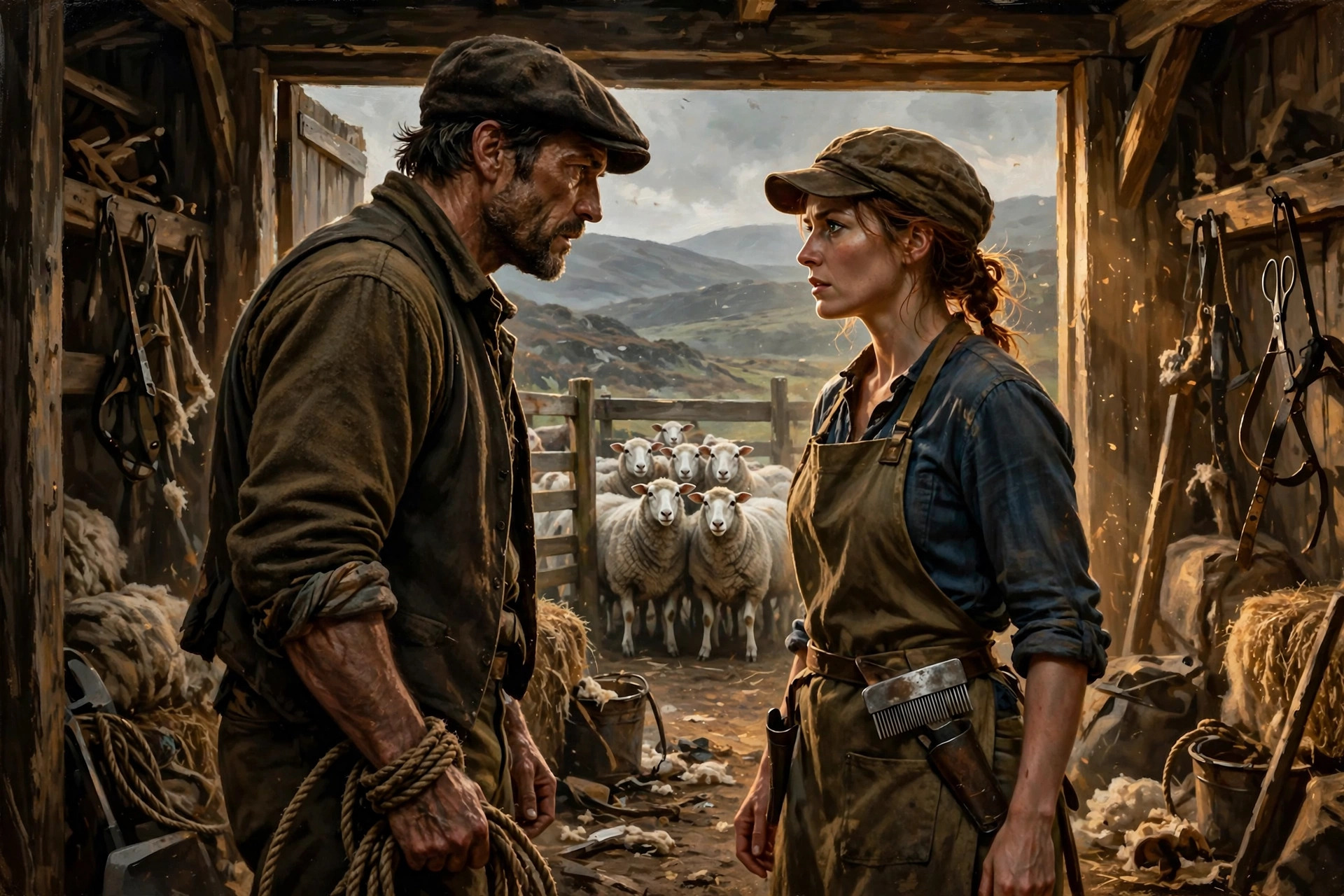
"You don't drive them like that," Joss said. "Not mine."
Edmund Sael stood in the wide doorway of the shearing shed with a ewe's rope still looped around his wrist, and the whole pen of them pressed against the far rails like wool had gone to water. He didn't look sorry. He looked like a man listening to something else.
"They were bunching at the gate," he said. "I moved them."
"You moved them like a dog with a grudge." She set down the fleece she'd been skirting and wiped her palms on her apron. The steel comb at her belt knocked against her hip, its edges worn bright from years of her father's hands and then hers. "Barnaby hired you to drover, not to frighten nine hundred ewes into a stupor before they've even been sorted."
"Quist hired me to bring them down off the fell."
"Then bring them down. Don't tear their nerves out first."
He was a tall man, a stranger of a season at most, with weather in his face and hands too careful for a drover's. He kept glancing past her toward the hills beyond the shed's open end, where the high pasture sat under a sky the color of old pewter. Joss had noticed it twice already. Nobody looked at the fell that way unless they were afraid of it, or owed it something.
"You've handled sheep before," she said.
"Some."
"Some." She snorted. "That's a kind answer for a man who's let three ewes slip the pen since noon."
"Four," Edmund said quietly. "One's hiding behind the wool press."
She turned. A grey ewe stood wedged beside the press, eyes ringed white. Joss swore under her breath and crossed to her, murmuring, hands low and slow, the way she'd done since she was old enough to stand in a shed. The ewe let her close. Behind her, Edmund said nothing, which was somehow worse than an apology.
"I don't need a man who's guessing," Joss said without looking back. "When the snow comes, guessing gets animals killed. And people."
The silence that followed had a shape to it. When she glanced over, his jaw had set, as though she'd touched a bruise he hadn't told her about.
"I'm not guessing," he said. "I know exactly what's coming. I'm only not good at pretending I know the sheep."
"That's a strange thing to say."
"It's an honest one."
She had no answer for that, and disliked it. She walked the grey ewe back to the flock and found the cause of the stampede at once: the gate to the second pen hung off its top hinge, one board split clean through, the latch bar bent like a wrist wrongly set. Every time a ewe leaned, the whole thing groaned and swung.
"That's been loose since August," she said. "Barnaby keeps meaning to see to it."
"Barnaby keeps meaning a great deal."
It almost made her laugh. She bit it back. "Doesn't matter. I can't pen a flock behind that."
"Then let me."
"You?"
"You've a mallet on that bench, and offcuts under it, and a coil of wire by the door." He was already moving, easy and quick now, like a man finally given something he understood. "Give me the time it takes your kettle to boil."
"My mother's kettle. It's never off the boil."
"Then give me less."
She folded her arms, because the alternative was handing him the mallet herself, and she had never in her life handed anything over on a stranger's say-so. But she stayed. She watched.
He lifted the gate off its pin with one hand as if it weighed nothing. He ran his thumb along the split board, considered it, then chose an offcut from the pile without searching. The right length. The right grain. He set it against the break and drove two pegs, each in one clean blow. His hands, which had been so wary around the ewes, knew exactly what to do with wood and iron. He straightened the bent latch bar across his knee, tapped it true with the mallet's edge, and refit the hinge so it sat flush.
Joss found she was standing closer than she'd meant to. She stepped back.
"Where did you learn that?"
"Somewhere cold," Edmund said. "Where nothing mended itself."
"That's not an answer."
"No." He glanced up, and for a moment his eyes held hers in a way that made the shed feel smaller, the air thinner. Something in his face was almost asking. Then he looked away, back to the gate. "It's the one I've got."
She should have pressed him. Every instinct she owned said a man with that much skill and that little history wanted watching. But the flock was restless, the sky was lowering, and she had a shed full of wool and no spare pair of hands.
"Fine," she said. "You stay. For now. You do what I tell you with my ewes, and you don't fix things I haven't asked you to fix."
"And if they need fixing?"
"Then you ask first."
The corner of his mouth moved, not quite a smile. "I'm not much for asking."
"Learn."
He swung the gate closed. Joss stood with her arms still crossed and her chin up, ready for it to sag or stick or groan, to prove her right.
The latch dropped into its keeper with one small, perfect click.
Orla's Kettle
"Nine hundred ewes," Barnaby Quist said, "and not one of them worth what that hill is worth to a man with a quarry licence."
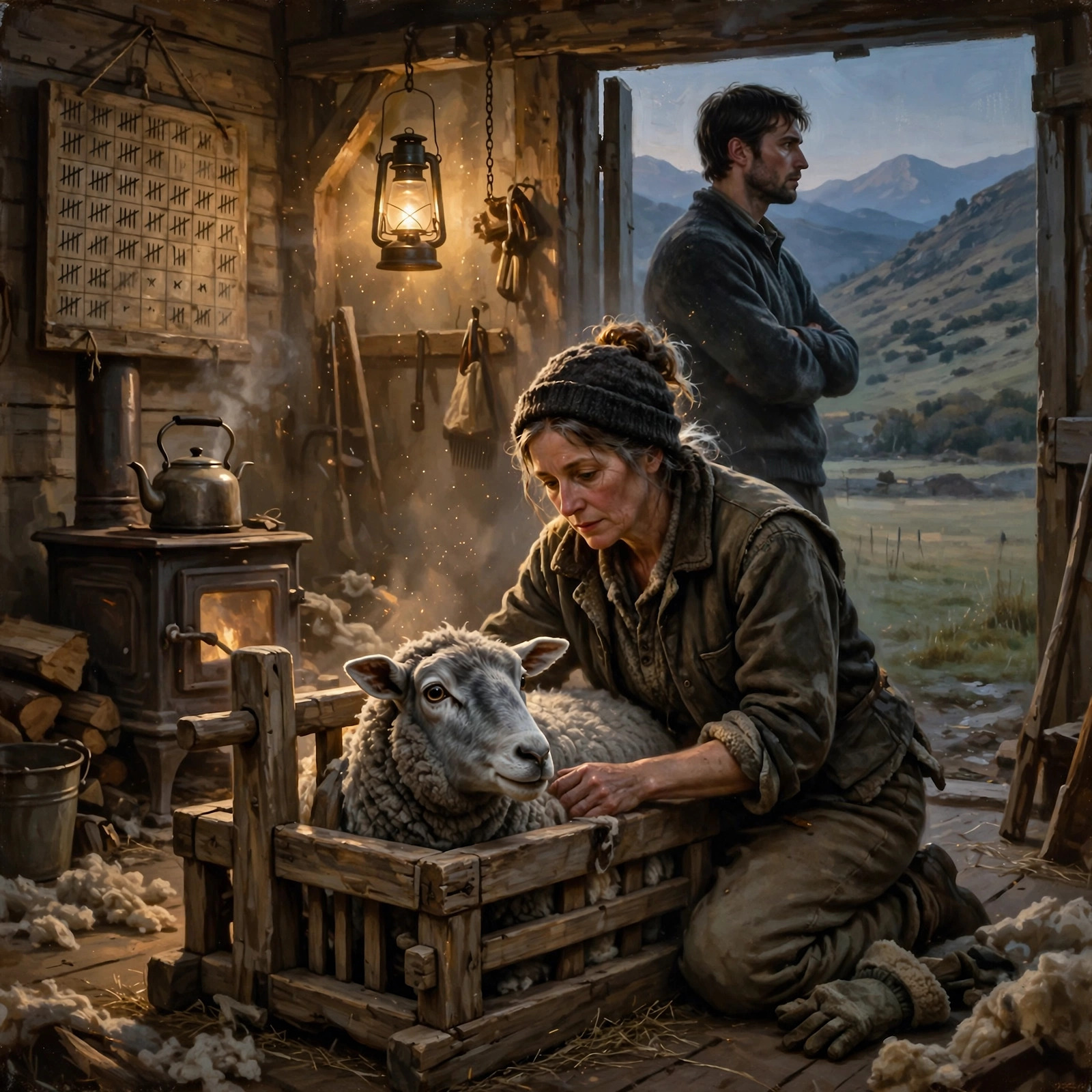
He stood in the shed doorway with his cap in his hands, which was how Joss knew it was bad. Quist only held his cap when he'd rehearsed.
She set down the fleece she was skirting. Edmund, by the second pen, went still.
"You said the high pasture was staying," Joss said.
"I said I'd think on it. I've thought." He turned the cap a full circle. "They'll pay for the whole of it. Stone and all. I'll be signing once the flock's down, so mind you get it down."
"Stone and all," Orla said.
She hadn't moved from her chair by the stove, but the kettle lid had stopped rattling in her hand. Joss's mother had graded wool for thirty years and could price a fleece with her thumb. She had never once, in Joss's hearing, said anything twice.
Quist looked at the floor. "It's only a rock, Orla."
"Go and have your tea at the house, Barnaby."
He went. The door banged in its frame and a little dust sifted down from the rafters.
Joss let out a breath through her nose. "Well. That's the quarry, then. I'll have the ewes down by Friday if I have to carry them."
"You'll not carry anything." Orla poured three mugs, though no one had asked, and pushed one toward Edmund without looking at him. "Sit. Both of you."
"Mam, there's fifty fleeces--"
"Sit."
Joss sat. Edmund took the upturned crate by the wall, and he held the mug in both hands like something he'd been told not to spill. Steam rose between them.
"Before there was a station," Orla began, "before there was a Quist, there was a stone up on the high pasture. The first shepherds raised it. They put an iron hook in the top, leaded in, and they hung a bell from it. Not to be rung just anyhow. The stone chooses who rings it. And when that one rings, the flock comes down, whatever the weather, whatever the distance. Every ewe, every lamb. Nothing's ever been lost off that fell that the bell could reach."
"Nothing," Joss said flatly. Her father's boots were still by the back door. Nobody had rung anything for him.
Orla's eyes met hers, level and old. "The bell was silent that night, love. I've told you that. I never told you why."
The shed went quiet. Even the ewes seemed to lean in.
"The hold's been going for years. Slow. Your father went up to look at it the week he died. He knew." She turned the mug a quarter turn on her knee. "I should have said. I thought if I kept it a story you'd never have to carry it."
"Carry what?" Joss's voice came out thinner than she liked.
"I don't know yet. Only that it's failing, and that snow's on its way, and that a man turned up on our doorstep the very week it got bad." Orla finally looked at Edmund. "Who mends gates like he's done it for a hundred winters."
Edmund set his mug down very carefully. "I'm a drover, Mrs. Penhallow."
"Aye. And I'm the Queen of Thistlemere."
Joss stood so fast the stool scraped. "I need air. And I want to see this hook for myself." She snatched her coat from its peg and settled it so the comb rode secure at her belt. "Edmund. You're hired to drove. You can drove me up there."
He rose without a word.
The track climbed out behind the station, stony and rutted, with frost still white in the shaded cuts. They walked it side by side and said nothing for a long time. Joss kept her hands in her pockets, one of them resting against the worn steel of her father's comb at her belt. It was the only thing she'd ever trusted to do what it was told.
"You didn't argue with her," she said at last.
"What would I have said?"
"That she was mad."
"She isn't." He kept his eyes on the ridge. "Mind the loose slate there."
She'd already stepped over it. She didn't say so.
The wind turned as they topped the rise, and something in the air changed with it, a low, close pressure, like the moment before a word is spoken. Joss felt it behind her breastbone. She glanced sideways. Edmund had slowed, his jaw tight, his hand flexing at his side as though it wanted to reach for something and had been forbidden.
"You feel that," she said. It wasn't a question.
"Yes."
"What is it?"
He was a long moment answering. "Weather," he said, and she knew it for the lie it was, and walked on anyway, closer to him than the narrow track required.
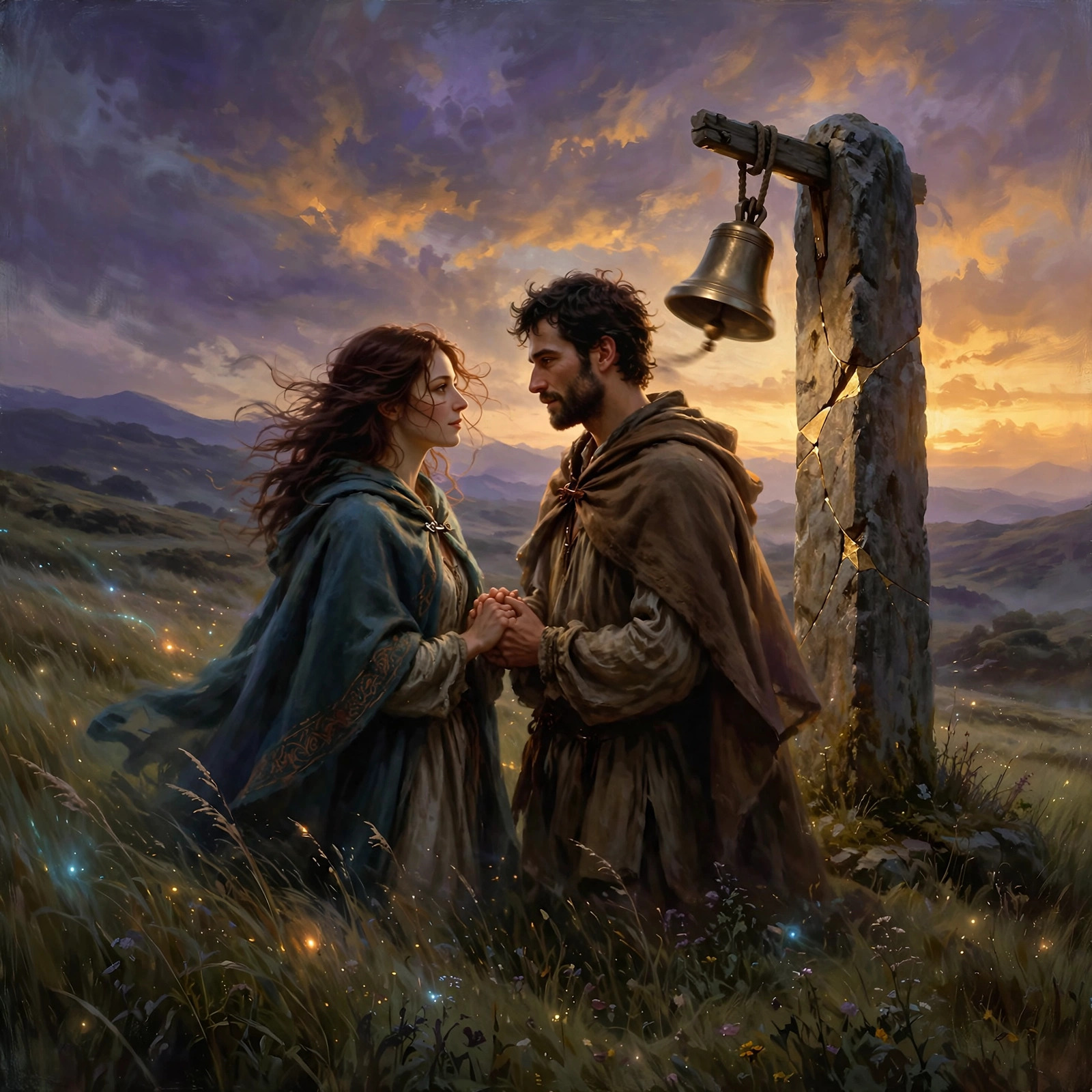
The stone stood alone in the brown grass, waist-high and grey, furred with lichen. At its crown the iron hook leaned out, scabbed with rust, the lead around its base split and crumbling. No bell hung from it. Only a thread of old wire, snapped.
Joss crouched and touched the hook. It flaked under her thumb. "One good pull and that'd come clean out," she said.
"Don't." The word came sharp, almost frightened. Edmund crouched beside her, and his shoulder brushed hers, and neither of them moved away. "Please. Not that."
She looked at him, at the strain around his eyes, and then, because she'd never in her life taken a thing on someone's say-so, she laid her bare palm flat against the cold granite.
Under her hand, faint as a held note, the stone hummed.
Warm Granite
The stone was warm. That was the first wrong thing, and Joss kept her palm against it long after good sense said to pull away.
Two mornings had passed since the track, and the frost had gone gritty on the grass. She had come back up alone at first light, telling herself she wanted a second look at the lead. Edmund was already there, standing with his back to the wind and his collar up, as if he'd known.
"You're early," she said.
"So are you."
"I came to measure the crack."
"Of course you did." He almost smiled, then didn't. "Joss. I have to tell you something, and I'd like you to let me finish."
She took her hand off the granite. The warmth stayed in her fingers like a coal. "Go on, then."
He didn't pace. He stood very still, which she was learning meant he was frightened. "I'm not a drover. I never was. I keep this stone. I'm what the old shepherds called a fell-spirit, though that makes me sound grander than I feel on a wet Tuesday."
Joss waited for the joke. It didn't come.
"The Assembly sent me to collect the stone's tithe this year," he said. "I found the hold nearly gone. And I found you."
"Me."
"The stone bound us. You were a girl, up here with your father one summer, and you put your hand on it, same as you just did. It chose you for the bell. And it chose me to stand beside whoever that was." His voice roughened. "We're mates, Joss. That's the oldest word I have for it. I knew the moment I walked into your shed."
The wind pushed at her coat. Somewhere below, a ewe called and another answered.
"You knew," she said. "Two days of mending my gates. Of walking beside me. You knew."
"Yes."
"And you didn't think I'd want to be asked?"
"I thought you'd run." He said it plainly, without defence. "The last one did. Years ago. She felt the weight of it and went, and the stone nearly went with her. I thought if I said it too soon..."
"So you let me think I was choosing." Her voice shook and she hated it. "Every time I stepped closer to you on that track. Every time I let you stay. Was that me, or was that the stone?"
"I don't know."
It was the honest answer, and it was the worst one. Joss turned away and stared at the long brown slope of the fell, at the place past the second ridge where her father had been found. She had spent twenty-odd years making sure nothing could decide for her. She chose her tools and her work. She trusted a steel comb because it did exactly what her hand told it. And all that time, a lump of granite had been writing her name in a ledger she'd never seen.
"I was nine," she said. "I didn't agree to anything."
"No. You didn't."
"Nobody asked me."
"No." He took a breath. "I'm sorry. It's a poor thing to say, but I am."
She pressed the heel of her hand to her mouth. Her eyes stung, and she blamed the wind. "Is that why the bell was silent? The night he died?"
Edmund said nothing for a moment. "The hold was already thin. Only the one it's bonded to can ring it. You were a child, Joss. It wasn't yours to ring."
That undid her more than anger would have. She stood there shaking, furious and grieving at once, and could not have said which of them she wanted to shout at.
The sound that came out of her wasn't a word. Edmund moved, slowly, giving her every chance to step back. She didn't. He shrugged out of his coat, heavy wool still holding the heat of him, and settled it over her shoulders. His hands lingered at the lapels, careful, barely touching.
"You're frozen," he said.
"I'm furious."
"You can be both."
She almost laughed, and it cracked halfway. Her forehead dropped against his chest before she'd decided anything at all, and she felt him go rigid with surprise and then, by degrees, soften. One of his hands came up and rested between her shoulder blades, light as a question.
She breathed him in, wool and woodsmoke and cold air, and it felt like the easiest thing she'd done in years. That frightened her worse than the stone.
"I don't know if this is mine," she said into his shirt. "Whatever this is. I can't tell where I stop."
"Then don't tell me yet." His voice was low and unsteady. "Take as long as you need. I'm not going anywhere."
"You can't promise that."
"Watch me."
She lifted her head. His eyes were grey in the early light, wet at the rims, and she thought that if she stayed one breath longer, she would stop being able to separate the wanting from the wiring. She stepped back. The cold rushed into the space between them.
She slipped the coat from her shoulders and folded it over his arm, and he looked at it as though she'd handed him something breakable. Then she turned and started down the track, boots loud on the stones, the warmth of him already fading from her skin.
He didn't call after her. She was grateful, and she was sorry, and she didn't look back.
The Rusted Hook
The crowbar was heavier than she remembered, and Joss carried it up the fell anyway, over her shoulder like a dare.
She hadn't slept. Somewhere around three she had stopped arguing with the ceiling and started making a plan, because a plan was something her hands could hold. By first light the sky over the high pasture had gone the color of old pewter, and the wind had a bite in it that she knew from childhood. Snow weather. Close.
Edmund was already at the stone. Of course he was. He stood with one palm flat against the granite, the way a man might steady a nervous horse, and he turned when her boots scraped the scree. His face did something quick and hopeful before he caught it.
Then he saw the bar.
"Joss." He took a step toward her. "Put that down."
"I asked if you'd fix the gate. You asked if I'd let you. That's how it works, Edmund. People ask."
"This isn't a gate."
"No. It's a leash." She set the claw of the bar under the rusted hook and felt the iron grit against the steel. "You said it yourself. The hold is thin. It was thin when my father died, and it's thin now, and nobody ever asked me whether I wanted to be part of it."
"You were a child."
"And I'm not now." Her voice shook and she hated it. "I've spent my whole life making sure nothing decides for me. I grade wool. I read the fleece in my hands and I know what it is. I don't get told by a rock who I belong to."
"It isn't like that." He was close now, not touching, his hands open at his sides. "The bond doesn't force anything. It only recognizes what's there."
"Then it won't mind if I take it off."
"If you pull the hook, the hold breaks. All of it. The weather, the flock-luck, nine hundred ewes still up on this fell with snow an hour behind the wind. And the price falls on you." He swallowed. "Ten years, Joss. Ten years of your life, taken when the iron comes out."
For a moment she stood very still. Ten years was a number, and numbers she could weigh. But under it was the thing she could not weigh, the memory of a silent bell and her mother's face at the window.
"Then I'll pay it," she said. "And then it's done, and neither of us is wired to anyone."
"That isn't how--"
"Tell me you wouldn't be free too."
He opened his mouth. Closed it. The wind took the silence and worried it between them, and she saw the truth go across his face before he could dress it. He would not be free. He didn't want to be. And she could not bear that, because wanting him was exactly what frightened her most.
She set her weight on the bar.
The iron screamed. Flakes of rust sifted down over her wrists, and the old lead crumbled around the base of the hook like dry bread. Edmund said her name once, low and raw, and did not lunge for her. She would think about that later, how he stood there with his hands shaking and let her choose, even choosing wrong.
The hook came out with a crack she felt in her teeth.
She stumbled back with it in her fist, absurdly light, a crooked rusted thing no longer than her hand. For one second nothing happened. She almost laughed. Then a seam opened at the foot of the stone, dark and bright-edged, and ran upward through the granite with a sound like a frozen pond giving way. Dust poured from it. The ground under her boots shivered.
Something left the air. She couldn't have said what. It was like a drone she had never noticed until it stopped, a pressure at the back of her skull that had always been there and was suddenly gone. Her knees went soft. A cold ache bloomed behind her ribs, deep and strange, as if a hand had reached in and taken something small and precious, and she understood it was years. Her years. Ten of them, lifted out of her like a coin from a pocket.
She dropped the bar. It rang on the stones.
Edmund hadn't moved. He stood with his arms at his sides, and his face had gone very quiet, the way a house goes quiet when someone has left it. He looked at the cracked stone, then at the hook in her hand, then at her. He did not look angry. She would have preferred angry.
"Edmund," she said. "It's done. It's over. We're--"
He stepped back. One step, then another, until the stone was between them. His throat worked. He lifted a hand as if to say something, and let it fall, and said nothing at all.
That was worse than any speech.
Down the slope, a ewe called, thin and uncertain, and then another answered. The sound carried up from the folds of the fell, hundreds of voices beginning to understand that nothing was coming for them. Joss turned toward it, and the first wind of the real cold hit her full in the face, sharp as a slap, smelling of iron and distant snow.
She looked up. The bell hung from its snapped wire above the cracked stone, dull and dark.
It did not ring.
Forge Fire
"You're not touching that comb," Orla said, and then she put the bellows in Joss's hands anyway.
The forge behind the shearing shed hadn't been lit in years. Edmund had cleared the flue before dawn, and now the coals breathed orange in the gray light. Joss stood over them with her father's comb lying across her palm. Sheffield steel, worn bright along the teeth by his thumb and then by hers. It still fit her grip better than anything she owned.
"I can hammer iron," she said. "I can't hammer him."
"He'd say it's only a comb." Orla's voice cracked on it. She wiped her hands on her apron and kept them there. "He'd also say don't waste good steel on sentiment."
"Is that what this is?"
"No, love." Orla looked at the fire. "This is the other thing."
Edmund stood at the doorway with his coat dusted white at the shoulders. Snow hadn't fallen yet, but the sky had the heavy look of a held-back sheet. He hadn't said much since the fell. He had walked her down in the dark and put a blanket round her, and then he had stood outside the kitchen window all night like a man guarding something that had already been taken.
"You don't have to," he said now. "There's another way. The Assembly could..."
"Could what? Send a letter?" She softened it with a look. "Edmund. I'm not doing this because you asked. You never asked. Do you know how much I hated that?"
His mouth moved. Not quite a smile. "I was told to carry it alone."
"Well, you were bad at it."
She turned back to the coals and laid the comb among them. The steel darkened, then glowed cherry, then orange, and the teeth softened and slumped together like something falling asleep. Her eyes stung. She told herself it was smoke. Orla worked the bellows without being asked, and the fire roared up around her father's last good tool.
Joss drew it out with the tongs and set it on the anvil. The first blow rang through her arms into her chest. The second was easier. She drew the steel long, bent the head into a hook, and quenched it in a hiss of steam that smelled of oil and cold water. Her hands knew every step. That had always been her faith. What she could make, she could trust.
Tonight she was making something else to trust. She felt the difference and did not turn from it.
When the hook lay finished and black on the bench, Edmund stepped in at last. "The price is already paid," he said quietly. "The ten years. Nothing you do now gets them back."
"I know."
"Then why--"
"Because yesterday it was taken." She held up the hook. "Today I'm giving it. That's different, and I'm tired of pretending it isn't."
He looked at her for a long moment. Then he took off his glove and laid his bare hand over hers on the cold iron. His palm was rough and warm.
Orla cleared her throat and busied herself with the lead pot. "I'll bring the kettle," she said, much too briskly, and went out before anyone could see her face.
They climbed with the sky lowering. The ewes were a gray murmur on the upper folds, bunched against the wind, nine hundred of them crowded and afraid. The cracked stone waited at the top, dark seam running up its belly, bell dangling dead from the snapped wire.
Joss knelt at the socket. Edmund poured the molten lead without being told, steady and slow, and she seated the new hook into it with both hands. The metal ticked as it cooled. She cut a fresh length of wire, knotted it, and hung the bell. Her fingers did not shake.
"Now?" she asked.
"Now." He crouched beside her. "It has to be you, and it has to be meant."
She put one palm flat against the granite. It was cold, and then it wasn't. Something under the stone turned over and listened. The hum she had lost came creeping back into the base of her skull, small and shy, like a dog returning after a scolding.
"I choose it," she said aloud, to the stone, to him. "All of it. Him, the fell, whatever it costs me. Mine to give."
She rose, took the wire, and rang the bell.
The note was low and clear, nothing like the dull clank she remembered. It rolled out over the pasture and down the folds, and a ewe lifted her head, and then another. Joss rang again. Warmth rushed up through her arms, through the ache behind her ribs, and the ache did not vanish, but it settled, like a coat finding her shoulders.
She turned. Edmund was already looking at her, wet-eyed, wholly undefended.
"Joss."
She didn't wait for the rest. She took his coat in both fists and kissed him, and he made a sound against her mouth as though he'd been holding it for a year. His hands came up to her face, careful and then not careful at all. He tasted of smoke and cold. She felt him tremble. She felt the stone hum through her boots like a held chord finally let go.
Something soft touched her cheek. She drew back an inch and laughed. A flake, then ten, then the air itself turning white, drifting slow and silent across his dark hair.
"First snow," he murmured, forehead against hers.
"Late," she said. "Typical."
Below them the bell's last note faded, and the slope began to move. A gray tide of fleece spilled over the rim of the fold, ewes pouring down the hill in the thickening snow, nine hundred strong, following the sound home.
Bell in Wind
"You're limping," Joss said.
"I'm walking with feeling." Edmund shifted the sack on his shoulder and kept climbing. "There's a difference."
"There's a ewe's hoof in your boot print. Look."
He looked. A neat cloven mark sat inside his own, the old girl having followed him up the slope for company. She stood twenty paces back, chewing, unbothered. Joss laughed, and the sound carried across the high pasture and came back thin and pleased with itself.
Three days since the snow. The fell had gone quiet under a crust of white, and the flock was down in the low paddocks behind the shearing shed, nine hundred ewes grumbling over their hay. Her mother had counted them twice, once aloud and once with her lips moving, and then gone back to the kettle as though nothing remarkable had happened.
Joss had her own sack, heavier than his. Bread, cheese, a flask, and a rolled blanket that smelled of the shed. She had not said why they were climbing. He had not asked. That was new, too, the not asking, and the not needing to.
The stone stood where it always had, dark against the white, waist-high and patient. The seam in its base had not closed. She had stopped expecting it to. But the new hook sat in its leaded socket, bright where the old one had been rust, and the bell hung from fresh wire.
Wind lifted off the ridge. The bell swung and spoke, one low note, then another.
"It rings by itself now," Edmund said.
"It's allowed. I checked."
He smiled at that and set down his sack. She spread the blanket on a dry flat of rock in the lee of the stone and they sat shoulder to shoulder, passing the flask. The tea had gone lukewarm. Neither of them minded.
"Quist came by the shed this morning," she said.
Edmund's head turned. "And?"
"He stood in the doorway turning his cap around like a wheel. Said he'd rung the quarry company and told them the high pasture wasn't his to sell after all." She picked at the bread. "Then he asked if I'd shear his own two pet wethers for nothing, as a favor, as though that squared it."
"Will you?"
"I'll charge him double. Mum already told him the price."
Edmund laughed, quietly, into his collar. Then it faded, and he looked at the stone instead of at her. She knew that look. It was the one he'd worn the first week, when he stood in the shed doorway pretending to be a drover and measuring the distance to the nearest exit.
"Say it," she said.
"The Assembly sent word." He turned a crust over in his fingers. "They'll accept the tithe as paid. They'll accept me back, too, if I want it. A place on the high ground. No more walking in boots."
Her stomach dropped, and she let it. She had spent most of her life refusing to trust what she couldn't hold, and the habit did not die in a week. It rose in her now, quick and practical, wanting to pack her feelings into a tidy bundle before anyone could take them.
She didn't pack them. "And do you want it?"
"No." He said it before she'd finished. Then, slower, "I thought I might. I thought it was the only way to be useful. Carry the stone alone, stay what I was made to be. The last one who held this bond left because she couldn't bear the weight of it. I learned from that to bear everything myself, so no one else would have to run."
"That's a daft way to avoid being left."
"I know." He rubbed his thumb along his jaw. "You pulled the hook out with a crowbar rather than be handed a fate. I stood there and let you, because asking you to stay felt like theft. We are a matched pair of fools."
"Matched," she agreed.
He finally looked at her. His eyes were the grey of the slate on the shed roof, and they weren't hiding anything now. "I'm staying, Joss. As a man. I'll keep the stone from a bed in Thistlemere village if I must, or a cot in your mother's back room if she'll have me. I'll learn to grade wool badly. I'll be cold in winter and bored in August and I'll want it anyway."
"My mother already aired the back room."
"Of course she did."
"She said, and I quote, a man who limps up a hill with bread deserves a mattress." Joss's voice wobbled on the last word, and she let it. She set the flask down. Her hands found his, cold knuckles, a burn scar across the left from the forge. "I'm keeping the fell. I decided that on the way up. Not because of the stone. Because my father's buried under it, near enough, and I've spent twenty-odd years afraid of this place. I'd rather be afraid of it with you."
"That's not much of a proposal."
"It's a start."
He drew a breath, and she watched him decide. It showed in his shoulders first, the old braced lift of them easing down.
"I love you," he said. Plainly, without ornament, the way he'd say the weather. "I've loved you since before you knew my name. I'll love you after the ten years are paid, and the ten after that."
Her eyes stung. The cold, she told herself, and then didn't bother with the lie. "I love you too. Damn it. I love you, Edmund. I don't need the stone to tell me so."
"No," he said, and his smile cracked open. "You never did."
She moved first. The blanket bunched under them and the bread rolled off into the snow, and she didn't care. His arms closed around her, solid and warm, and she pressed her face into his neck where the wool of his coat smelled of woodsmoke and lanolin. His heartbeat knocked against her cheek. Under her palm, against the granite at her back, the stone gave a low settled thrum, like a house with every lamp lit.
"Listen," he whispered.
The wind rose off the ridge and took the bell with it. One note, then a second, rolling out over the white pasture and down the long folds toward the sheds and the village and the nine hundred ewes asleep in the hay. Joss held on to him, and he held on to her, and the bell kept ringing.
Get notified when new stories drop
Cade Ellison
Cade specializes in romantasy and paranormal romance: magic systems with rules, courts with knives, and longing that rearranges destinies.
Leave a comment
Comments